Leaders in Business
  • Membership
  • Events
  • Content
  • Virtual Learning
  • Connections
  • Partners
Login
  • Leaders Meet: Innovation
  • Events
    • Leaders Week London
    • Leaders Sports Awards
    • Leaders Club Events
    • Leaders Performance Institute Events
    • Leaders Meet: Innovation
  • Memberships
    • The Leaders Club
    • Leaders Performance Institute
  • About
    • Careers
    • Contact
I’m a sports leader:
  • Off The Field For those focused on the business of the sport View more
  • On The Field For those working with an athlete or elite team View more
  • Login
    • Leaders ClubThe membership for future sport business leaders
    • Leaders Performance InstituteThe membership for elite performance practitioners
  • Newsletters
Performance Institute Leaders Performance Institute Logo
  • Membership
  • Events
  • Content
  • Virtual Learning
  • Connections
  • Partners
Login
Members Only

8 Aug 2024

Articles

Difficult Conversations: Five Top Tips… and Three Pitfalls to Avoid

Category
Coaching & Development, Leadership & Culture, Premium
Share
Facebook Twitter Email Copy Link
https://leadersinsport.com/performance-institute/articles/difficult-conversations-five-top-tips-and-three-pitfalls-to-avoid/

Jide Fadojutimi and Marianne O’Connor of Management Futures explain why ‘skilled candour’ generates psychological safety and lets you show your people that you care.

By John Portch
Leaders don’t always know how best to have those difficult conversations.

They may recognise the need to take someone to one side, but if they are unable to broach the topic in a skilled and productive way, then a small problem can quickly escalate.

At the 2023 Leaders Sport Performance Summit in London, Jide Fadojutimi and Marianne O’Connor from Management Futures led an onstage skills session explaining what to do and what not to do when approaching someone to have a ‘courageous conversation’.

What is a ‘courageous conversation’?

The term was coined by executive coach Kim Scott, who argues in her 2017 book Radical Candor: Be a Kick-Ass Boss Without Losing your Humanity that leaders have a ‘moral imperative’ to step into difficult conversations and challenge with skill. This requires courage because it is simply easier to avoid such conversations.

Scott devised a skills grid to illustrate what it takes to lead a courageous conversation. O’Connor and Fadojutimi shared Scott’s grid with the Leaders audience but changed the top-right quadrant from ‘radical candour’ to ‘skilled candour’:
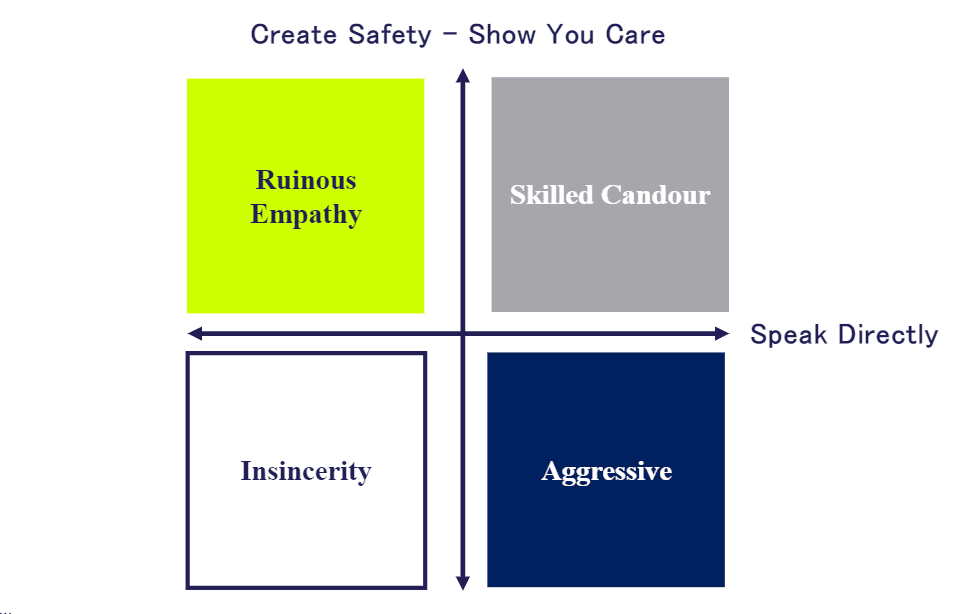
Image: Management Futures

“We’re going with ‘skilled candour’ because it’s a skill we can all learn and build,” said Fadojutimi of Management Future’s way of teaching the topic.

The three pitfalls to avoid

The arrows on the grid suggest that the path to skilled candour lies in giving people a sense of psychological safety and the feeling that you care about them. The grid also suggests three pitfalls, which were discussed at length by Scott in Radical Candor:

  1. Ruinous empathy: when you want to spare someone’s short-term feelings, you don’t tell them something they need to know. You care personally but fail to challenge them directly.
  2. Manipulative insincerity: when you neither care personally nor challenge directly. You offer insincere praise to a person’s face and criticise them harshly behind their back.
  3. Obnoxious aggression: when you challenge someone directly, but don’t show you care about them personally. It’s praise that feels insincere and feedback that isn’t delivered kindly.

The five steps towards skilled candour

O’Connor explained that there are five steps you can take to help develop your ability to approach conversations with skilled candour:

  1. Master your story: if you hold negative views of a person it is going to hinder your ability to make them feel safe. O’Connor said: “It’s really important that you master your story and any assumptions you might have about the other person and what’s going on for them”.
  2. Create safety: this starts before you have the conversation in both the broadest and narrowest sense. Do not ambush someone in the corridor and don’t shut the conversation down once you’ve made your point. Bear this in mind when the other person is feeling challenged, vulnerable and defensive.
  3. Provide skilled feedback: this means evidence-based feedback free of judgement. “To be able to give evidential feedback, you need to talk about what you observed and the impact that it had,” said O’Connor. “It just helps to keep the conversation safe and on track.”
  4. Open a two-way dialogue: don’t just download information on someone without being curious about their perspective or seeking to understand what might be at play for them.
  5. Make the other person feel heard: after a balanced conversation, it’s important for both parties, as O’Connor said, “to agree next steps or further action so that things don’t get lost in translation.” This enables both parties to feel accountable and understand what they need to do next.

Members Only

25 Jul 2024

Articles

Win or Lose, Brendon McCullum’s England Will Hold the Line – Here’s Four Reasons Why

Category
Leadership & Culture, Premium
Share
Facebook Twitter Email Copy Link
https://leadersinsport.com/performance-institute/articles/win-or-lose-brendon-mccullums-england-will-hold-the-line-heres-four-reasons-why/

We highlight the core beliefs that have strengthened the ECB’s resolve to transform English men’s cricket despite the setbacks.

By John Portch

Brendon McCullum had no first-class coaching experience when he was appointed Head Coach of the England men’s Test cricket team in May 2022.

Nevertheless, the New Zealander was the favourite candidate of England & Wales Cricket Board [ECB] Managing Director Rob Key, who himself had been appointed a month earlier.

McCullum, assisted by captain Ben Stokes, introduced a bold playing style that has been labelled ‘Bazball’ (a reference to McCullum’s nickname).

England have improved on his watch and are moving in the right direction ahead of their primary objective, which is a successful 2025-26 Ashes series in Australia. There have been resounding victories in the past two years and there have been some chastening defeats too, which McCullum had anticipated.

‘Are you prepared to take a punt?’ He asked Key during the hiring process. ‘This could go wrong.’ Key was not fazed. ‘What’s the worst that could happen?’

Key shared this story at November’s Leaders Sport Performance Summit at London’s Kia Oval, where he spoke alongside the ECB’s former Performance Director Mo Bobat (who now works in the IPL with Royal Challengers Bangalore). The duo discussed the ECB’s efforts to transform the way England’s men think about and play cricket following a meagre run of one Test win in 15 months prior to McCullum’s appointment.

The subsequent teething troubles were as inevitable as the criticisms that accompanied them, but they have not dissuaded the ECB.

Here, we highlight four beliefs that underpin their resolve.

1. Brave decisions lead to good outcomes

Key inherited a “bruised” performance team riddled with insecurity. Key, who believes that brave decisions made by the right people can lead to good outcomes, got to work immediately. He began to give people the latitude to make decisions without any blowback. With the atmosphere of negativity stripped away, Bobat’s playful side began to emerge. “If you don’t take yourself too seriously, what appears like a risky or brave decision to someone else just feels like the right thing to do.” This was Bazball in the boardroom.

2. Positive reinforcement is critical

McCullum is Key’s ideal frontman. His belief in a fearless style of play, much like Key’s, is born from memories of feeling stifled by coaches when he was a player. So when England batter Ben Duckett was caught and bowled for a duck during England’s 2022-23 tour of Pakistan, McCullum simply said: ‘well done, you’re going to get all your runs with that approach – keep committing to it’. It’s another story Key told at the Oval. “In that moment, it’s not about the ‘well dones’, it’s the player who got nought that Brendon’s reinforced,” he said. “I’ve had so many coaches when I was playing and they’re all over you when you’ve scored 100. What about the bloke in the corner who’s got no runs and he’s thinking that the world is coming to an end? That’s the person who needs you; sometimes they just need you there to listen.”

3. Progress cannot be taken for granted

Anyone looking for a stick with which to beat Key, McCullum or Stokes would not have to look further than their recent high profile defeats. “In English cricket we unravel quickly,” said Key of the criticisms that come his way. “That’s the time when you’ve got to look like you’re the most calm; you’re the one in control; you’ve got all the answers.” This was underlined in the one-day game, specifically following England’s group stage elimination from the 2023 Cricket World Cup. Key’s view is that he and his colleagues made the mistake of assuming their messages had landed. “When people say ‘just go out there, be aggressive and we’ll back you’ they’ve got to believe it,” he said. “We ended up with players who doubted the way we wanted to go.” Do not take your progress for granted.

4. Understand your strengths, minimise your weaknesses

England’s underage teams have adopted the same playing principles as the seniors. The ECB’s hope is that English cricket will produce players with the confidence to back themselves and their technique in the face of adversity. “We’re trying not to be overly focused on technique or fault-spotting, both of which are easy to do in performance systems,” said Bobat specifically of the England Lions and under-19s programmes. Weaknesses are addressed by coaches, but not dwelt upon. “We’re trying to be focused on moments and situations where you use your strengths to put the opposition under pressure.”

3 Jul 2024

Articles

The Debrief – a Snapshot of Powerful Discussions Happening Right Now Across the Leaders Performance Institute

Category
Coaching & Development, Leadership & Culture
Share
Facebook Twitter Email Copy Link
https://leadersinsport.com/performance-institute/articles/the-debrief-a-snapshot-of-powerful-discussions-happening-right-now-across-the-leaders-performance-institute-4/

Moonshots, how leaders can work on themselves, and the pathway to better collaboration – just some of the topics that featured on the June agenda at the Institute.

By Luke Whitworth
We want to start this Debrief with a big thank you to those who made it to our Sport Performance Summit in LA last month.

It is always wonderful to see the great and the good of the Leaders Performance Institute gathered to discuss the pressing performance challenges of the day.

Speaking of which, the happenings at Red Bull were far from the only opportunities on offer at the Institute in June, with roundtables and community calls packed with members sharing both challenges and best practices on a range of topics.

Many are covered in this month’s Debrief. As ever, do check out our upcoming events and virtual learning sessions, which are designed to help you to connect, learn and share with your fellow members from across the globe.

Right, let’s get into some reflections on June.

What we learned at the Sport Performance Summit in LA

We had a great couple of days with those of you who made the trip; and there was plenty of thought-provoking content for us to get our teeth stuck into (full account here). Below are a few snippets that particularly caught our attention:

Four tips for avoiding the ‘Innovator’s Dilemma’

The Innovator’s Dilemma is a 1997 book by Harvard Professor Clayton Christensen that explores the tension between sustaining existing products and embracing disruptive innovations. It resonated with Jen Allum, from X, the Moonshot Factory and Alphabet, the parent company of Google, who understand they could easily fall prey to the Innovator’s Dilemma. Onstage, Allum shared their four top tips for avoiding this scenario:

  1. Aim for 10x not 10% – use ‘bad idea brainstorms’; practise the behaviours of audacious thinking; put everything on the table.
  2. Be scrappy, test early – reject the social norm of refining; find the quickest way to learn that you’re on the wrong path; have a thick skin and be OK with people thinking you’re wrong and weird.
  3. Build-in different perspectives – recruit for a growth mindset (high humility, high audacity; people who take risks in their own lives; who think differently and challenge the way problems are solved).
  4. Reframe failure as learning – you can’t solve for success, so track what you do, as failures will support future ideas.

Allum added that X, the Moonshot Factory “rewards project shutoffs, dispassionate assessments, and intellectual honesty” in the work they do.

How to optimise your energy as a leader

As a leader, strategic thinking is in your remit, but do you ever include protecting your energy as part of the equation? “An organisation can’t outpace its leaders,” said author Holly Ransom onstage. “So there’s nothing more important than working on ourselves as leaders.” Here are her thoughts on how leaders should show up each day:

  • Manage your energy, not your time; and build-in moments of ‘micro recovery’ to support yourself in the moments that matter. We spend too much time in ‘up-regulation’ and we need to find ways to down-regulate’.
  • Make sure your highest energy moments of the day align with your most important tasks so that your return on energy is optimised.
  • Who in your corner is your supporter, sage, sponsor and sparring partner?
  • Remember: you are the Chief Role Model Officer in your team – make sure you live and talk about the things that help people lead themselves in ways that manage their energy.

The biomarkers of a healthy culture

Back to the myriad insights gleaned from our June Virtual Roundtables, starting off with the latest segment of our series of learning centred around culture and change. The sessions highlight findings from a recent research project by the Premier League’s Edd Vahid titled ‘Cultural Hypothesis’. The project examines the key components of cultures that have been able to sustain themselves.

Vahid posits astute leadership as a ‘super enabler’. Indeed, as Donald and Charles Sull wrote in the MIT Sloane Management Review in 2022: ‘A lack of leadership investment was, by far, the most important obstacle to closing the gap between cultural aspirations and current reality.’

What are some strategies we can consider?

  1. Start with acknowledging the connection between leadership and culture: the literature largely points in this direction, with leaders having a fundamental role in supporting the change management process.
  2. Identify aligned leaders: from there is important to ‘identify leaders who align with the target culture’ as Boris Groysberg, Jeremiah Lee, Jesse Price, and J Yo-Jud Cheng wrote in the Harvard Business Review in 2018.
  3. Honour your existing culture: you can too quickly go from point A to point B without taking a moment to understand what the existing culture looks like.

Vahid’s also research reveals that cultural leadership operates on three levels:

  1. Sponsors: senior individuals critical for manifesting the desired culture.
  2. Architects: these are responsible for designing cultural initiatives.
  3. Guardians: everyone contributes to safeguarding the culture to varying extents.

Four features of a great debrief

Effective debriefing skills was the top of conversation for our latest Leadership Skills Series session. If you are interested to join roundtable sessions centred around developing your own leadership, there are some great topics coming up around strategy and cohesion you can find on the Member’s Area.

To keep this section punchy, a section of our discussion focused on some top line considerations for what constitutes a great debrief. Are you doing these well in your environments?

  1. Psychological safety and the notion of creating a calm, positive and supportive space. As part of this consideration, set people up to focus on learning, not to be defensive and model your belief in their potential to create great performance. Finally, do everything you can to reduce power differentials.
  2. Get good at questioning. Use open, non-judgmental questions and a lot of follow up questions. Focus on learning more than results and allow time for reflection.
  3. Strike a good balance between focus on the positives and areas for improvement. A reminder: we learn quickest by reinforcing what works.
  4. Pay attention to group dynamics to get the best possible contribution from all individuals.

The pathway to better collaboration and multidisciplinary working

Finally, we wanted to highlight some interesting insights and perspectives from our topic-led roundtable on functioning more effectively as multidisciplinary teams, which is often a very popular topic of interest across the Institute when speaking to many of you.

Do check out the complete summary. Below are a handful of ideas from members on the call that they feel are currently missing or need to be given more attention in the quest to do this well:

  1. How are you supporting new leaders in your teams? Often we see those in technical expertise of ‘tactician’ roles move up to leadership position but lack the requisite skills to lead effectively. The role inevitably changes, so what are you or we doing to help them ‘lead’ their teams and embed true collaboration?
  2. Be intentional with feedback. It was shared that an opportunity is a robust and thoughtful feedback mechanism that have variations in their approach. The idea of thinking about detailed feedback is to support learning on a consistent and ongoing basis within your teams. It always seems to us that high quality feedback seems challenging for our teams, so this may well be an opportunity to explore.
  3. Are your standard operating procedures clear? If not, they need to be to support this quest for high levels of collaboration.
  4. Psychological safety and empowerment. How do we  empower people more effectively to take targeted risks within their roles, whilst still feeling safe and secure? What we are really getting at here is psychological safety in teams and a shared understanding of what that means and looks like.

Members Only

2 Jul 2024

Articles

Remember: We Learn Quickest By Reflecting on and Reinforcing What Works

Category
Coaching & Development, Premium
Share
Facebook Twitter Email Copy Link
https://leadersinsport.com/performance-institute/articles/remember-we-learn-quickest-by-reflecting-on-and-reinforcing-what-works/

Here we explore why effective debriefing can enable you to squeeze as much as possible out of your athletes, coaches and staff members’ experience.

By Luke Whitworth
The old adage that people learn best through experience is not necessarily true – at least not on its own.

For learning to take place, people need to both reflect on and make sense of the experience; then they can think through how they will apply the knowledge gained.

Therefore, it follows that one of the most powerful applications of coaching is to facilitate learning through an effective debriefing process; to squeeze as much richness out of the experience as possible.

Done well, it can drive a very steep learning curve, build responsibility and confidence, and increase the focus on results.

In short, the high performance organisations that best sustain success know how to debrief.

What the literature says…

Debriefing was at the heart of the most recent Leadership Skills Series session, where members of the Leaders Performance Institute spent time considering some academic findings on the topic.

A 2008 study in the International Journal of Performance Analysis in Sport found that coaches only recall between 16.8 per cent and 52.9 per cent of events. This underlines the notion that if coaches don’t debrief consistently well, they are missing out on potentially rich conversations and insights.

Here are some further numbers:

  • Leaders who engaged in reflection and debriefing improved their decision-making skills by 18 per cent, according to a study in the Academy of Management Journal.
  • Reflective practices in leadership were linked to a 25 per cent increase in innovative solutions and problem-solving abilities in organisations, according to a report by the Center for Creative Leadership.
  • Looking through a sport-specific lens, a survey of professional coaches found that 90 per cent believe debriefing is crucial to athlete development, with 85 per cent reporting noticeable improvements in performance and strategy understanding following regular debriefing sessions.

The positive effects of good debriefing

  • The process builds self-awareness and enables ownership of individual and collective learning.
  • Consistent and well thought-through debriefing fosters an openness to feedback.
  • Helps to build relationships and team cohesion.
  • Can decrease negative emotional effects.

What Leaders members are doing well in this space

During the session, members were invited to rate their teams’ debriefing skills on a scale of one to five and the mean was 2.8. Much room for improvement, no question, but there were a list of things that people believe they are doing well:

  • At most teams, there is a genuine honesty and curiosity around enhancing performance.
  • Intelligent framing and consistency.
  • The creation of a safe space.
  • Prioritising the debrief as a crucial source of information about how to get better.
  • Appropriate priming. Differentiating between a ‘hot debrief’ and a post-event review. If it’s a review then sharing content beforehand allows for productive discussions.
  • Taking nothing personally, instead, taking feedback professionally with the goal to be better – detaching from the emotional side of things and sticking to facts.
  • Sensitively-phrased questions that focus on positive outcomes and changes even when asking what could have been better.

Six steps towards an effective structure for debriefing

The following is a six-step approach to debriefs. Consider each when designing the structure that works for you and your team:

  1. A focus on reviewing where you are against your goals.
  2. Dedicate time to draw out the learning around what has gone well.
  3. Explore areas for improvement and insights around what’s not gone well.
  4. Focus on learning, not blame.
  5. Use root cause analysis.
  6. Understand the key lessons and how they inform future actions.

David Kolb’s learning styles model

The session explored the work of educational theorist David Kolb, who devised a structured approach to understanding how individuals learn from their experiences. It involves a four-stage cycle and four separate learning styles. Much of Kolb’s theory concerns the learner’s internal cognitive processes, therefore can be a useful model to consider when thinking about both individual and collective debriefs.

The four stages of learning:
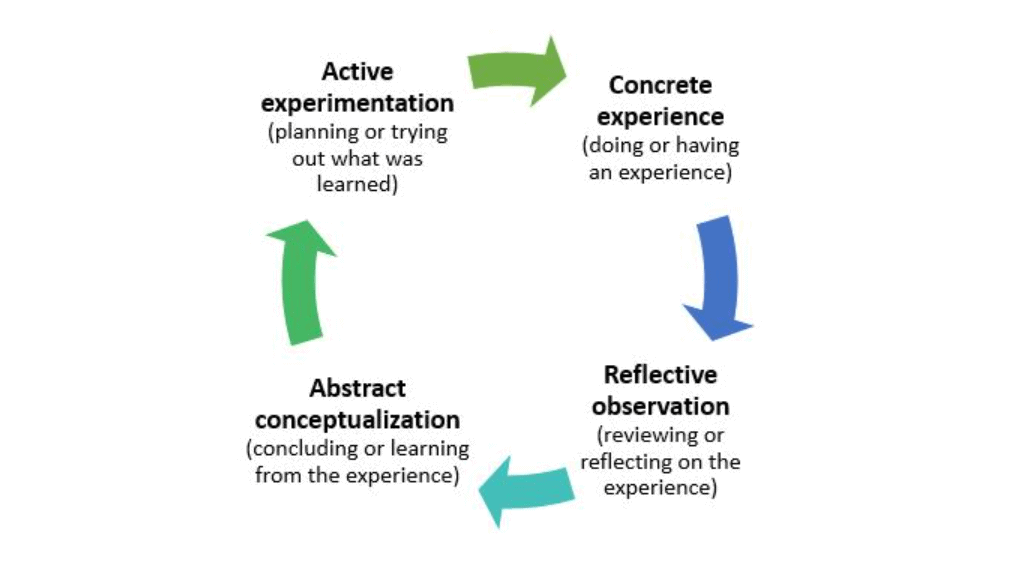
Graphic designed by Educational Technology.

1. Concrete experience

The learner encounters a concrete experience. This might be a new experience or situation, or a reinterpretation of existing experience in the light of new concepts.

2. Reflective observation

The learner reflects on the new experience in light of their existing knowledge. Of particular importance are any inconsistencies between experience and understanding.

3. Abstract conceptualization

Reflection gives rise to a new idea or a modification of an existing abstract concept (the person has learned from their experience).

4. Active experimentation

The newly created or modified concepts give rise to experimentation. The learner applies their idea(s) to the world around them to see what happens.

Kolb developed his four learning styles to illustrate different ways people naturally take in information:
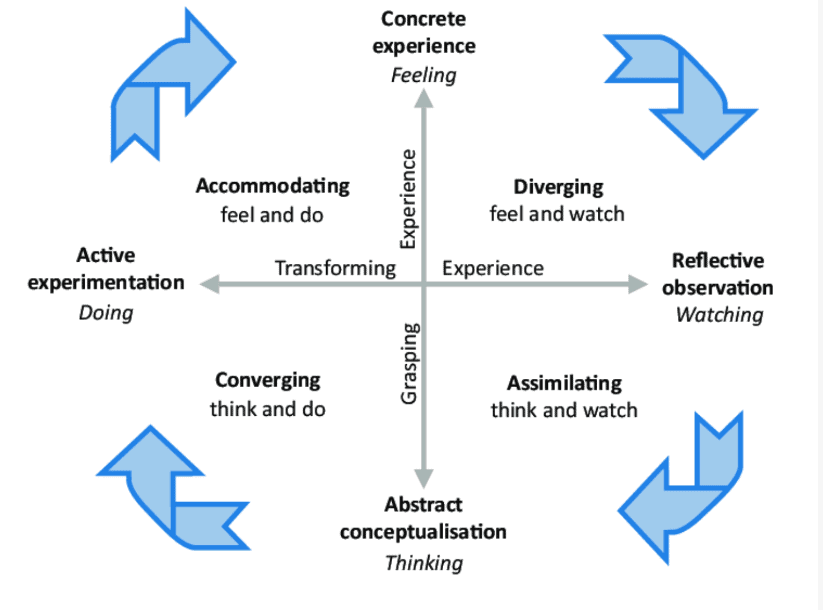
Graphic designed by Educational Technology.

1. Diverging (concrete experience/reflective observation)

Learners who prefer the diverging style are best at viewing concrete situations from multiple perspectives. They prefer to watch rather than do, tending to gather information and use imagination to solve problems.

2. Assimilating (abstract conceptualization/reflective observation)

Assimilating learners prefer a concise, logical approach. They require a clear explanation rather than practical opportunity. They excel at understanding wide-ranging information and organising it in a clear logical format.

3. Converging (abstract conceptualization/active experimentation)

Learners with a converging style can solve problems and will use their learning to find practical applications for ideas and theories. They prefer technical tasks, and are less concerned with people and interpersonal aspects.

4. Accommodating (concrete experience/active experimentation)

Accommodating learners are ‘hands-on’, and rely on intuition rather than logic. They use other people’s analysis, and prefer to take a practical, experiential approach. They are attracted to new challenges and experiences.

The STOP model for live debriefs during the event

The session also discussed the STOP model, which is useful for ‘in the moment’ debriefing (sometimes known as ‘hot debriefing’).

Stand back: take a helicopter view of a situation or problem.

Take stock: analyse what is happening in the moment.

Options: explore options around what you can do differently.

Proceed: step back in and take action. Then assess what impact your new approach has.

The features of a great debrief

  • Psychological safety and the notion of creating a calm, positive and supportive space.
  • An approach that underlines belief in the potential for great performance, that encourages learning and reduces defensiveness.
  • Reduces the impact of power differentials between leaders and those they lead.
  • It involves good questioning. Use open, non judgmental questions and be prepared to follow-up.
  • Focuses more on learning than results and allow time for reflection.
  • Strikes a balance between focusing on the positives and areas for improvement. People learn quickest by reinforcing what works.
  • Pays attention to group dynamics in order to get the best possible contribution from all individuals.

Members Only

27 Jun 2024

Articles

You May Talk a Good Game But Do your Habits Match your Ambitions?

Category
Leadership & Culture, Premium
Share
Facebook Twitter Email Copy Link
https://leadersinsport.com/performance-institute/articles/you-may-talk-a-good-game-but-do-your-habits-match-your-ambitions/

New Zealand Rugby’s Mike Anthony lays out why the All Blacks and Black Ferns are always ‘restless’, ‘uncomfortable’ and ‘itchy’.

By John Portch
It’s difficult to imagine Dan Carter looking awkward or out of place in an All Blacks environment so we’ll have to take his word for it.

The former first five-eighth (fly-half), who won back to back Rugby World Cups with New Zealand in 2011 and 2015, was one of a “legacy group” of former players invited in August 2023 to observe the team’s preparations and answer any questions the younger players might have ahead of their World Cup campaign.

“It’s a new bunch and you guys know pretty well that when you finish playing, you get invited back into the changing rooms or the team room and it’s quite awkward,” Carter told former England internationals James Haskell and Mike Tindall on The Good, The Bad & The Rugby podcast.

It was a changing room Carter had shared with a number of that All Blacks squad. “I don’t know if you guys feel it but going back into that environment, you kind of feel like a spare wheel.”

At no point was this the perception of the players, coaches or the All Blacks’ high performance team. In fact, two months later Carter, Keven Mealamu, Richie McCaw, Conrad Smith, and Liam Messam were invited to return at the Rugby World Cup in France, which took place in October and November.

“Talking to our team’s leaders, they got the most from the legacy group because the players are the ones who are having to drive along with that in the environment and the playing group would look up to them,” said Mike Anthony, New Zealand’s Head of High Performance, at February’s Leaders Sport Performance Summit at Melbourne’s Glasshouse.

Here were some of the most-esteemed guardians of the All Blacks culture coming back to reinforce the connection between all those who have worn the jersey.

Anthony continued: “That group had been through adversity. They’d lost World Cups and won World Cups. They knew what it took. The legacy piece for us is important.”

Legacy – a word long-associated with the All Blacks – is crucial in bringing to life the ambitions across the ‘teams in black’ i.e. the All Blacks, the Black Ferns (current women’s world champions) and both programmes’ sevens teams.

Their three core ambitions are:

  1. To be the most dominant team in history.
  2. To leave Mana in their wake.
  3. To include the players in shaping the team’s vision.

These ambitions help to plot the path towards a performance culture described by Anthony as “unwavering at it’s core, it’s inspiring, it’s empowering, it’s inquisitive, and it’s responsive to change.”

The last point is critical. “How do you bring it to life day to day and how do you refresh it so that’s it’s relevant to your current group?” asked Anthony. “I’ve observed teams being successful and then they continue to run with what worked before as the group changes. It comes down to induction: how do you make sure your vision is relevant for your current group?”

Here, we unpack how the ambitions of the teams in black are brought to life through their behaviours and habits.

The building of a legacy: the All Blacks have won three World Cups; the Black Ferns have won six of the last seven Women’s World Cups. This enduring excellence burnishes their legacy year on year. “We talk of leaving the jersey in a better place,” said Anthony. “You’re the guardian for a short time, so when you leave it to the next person, you hope to add value.”

A team-first attitude: this is a challenge for New Zealand Rugby as a whole, with the growth of individual brands and the often more lucrative opportunities on offer abroad. Yet New Zealand’s best players invariably remain at home during their peak years to pull on the black jersey. The allure runs deep and it requires selflessness. “You’ve got to be selfless,” said Anthony. “You’re an All Black or Black Fern 24/7 and it’s in the little things you do when no one’s watching. You’ve all heard the analogy ‘sweep the sheds’ – it is genuinely something that our guys do. It’s not the job of somebody who’s paid to clean up after us and we take pride in how we do that.”

A player-driven environment: Anthony explains that buy-in is at “100 percent” amongst the players and that some players “never want to leave” New Zealand. This is in part because the team is intentional in its efforts to encourage players to speak up and contribute to the culture (“you have to create something pretty special to keep players here”) but it is also due to the increasingly creative ways that players are incentivised. “We give guys sabbaticals to go away because we know the money’s good; then we bring them back and that’s worked really well,” said Anthony.

Alignment: it is obvious that no two people are alike but that does not necessarily prevent them sharing a common vision. Said Anthony: “For me, ‘alignment’ is when people understand and are deeply connected to your vision.”

It is also a consequence of effective leadership, which he distilled into several traits while adding the caveat that you have to, above all else, play well. “I think we sometimes burden our leaders and they feel cluttered,” he said. “We want the spine of the team playing well first because, generally, they’re your best players. You have to get the balance right there.”

In New Zealand rugby, leaders embody…

Humility. As Anthony said, “you’ve got to be humble and vulnerable because that’ll encourage others to step into that space and contribute.”

Inclusivity. Anthony felt that although teams want everyone to have a voice, there is too little focus on schooling people in how to give and receive feedback. “If we want our players to challenge their peers, we’ve got to give them the tools”.

A growth mindset. There is always a performance gap; always a challenge. “It’s never about ‘we’ve arrived’,” said Anthony. “That gap creates that discomfort and itch that you want in a high performance environment.”

Ownership. Being an All Black or Black Fern is a 24/7 commitment. Anthony described Richie McCaw as the embodiment of that view. “It’s doing the unseen things,” he said. “It’s easy to sweat, but when you go home, what you’re eating, your sleep, how you present around your family – those are key.”

Finally… he tāngata, he tāngata, he tāngata

Anthony wrapped up his presentation with a whakataukī (Māori proverb):

He aha te mea nui? Māku e kii atu, he tāngata, he tāngata, he tāngata.

What is the most important thing in the world? Well, let me tell you, it is people, it is people, it is people.

“The price of entry is technical knowledge,” said Anthony, “but get the people right and hopefully you can build the right environment for a performance culture that supports the athletes.”

Members Only

26 Jun 2024

Articles

Ever Had a Great New Idea Fall Flat? Here’s Why it May Have Happened

Category
Leadership & Culture, Premium
Share
Facebook Twitter Email Copy Link
https://leadersinsport.com/performance-institute/articles/ever-had-a-great-new-idea-fall-flat-heres-why-it-may-have-happened/

As Jen Overbeck explained, we can make people change or we can persuade them to change. We should choose deliberately and we should be clear about what makes people listen to us.

By John Portch
Jen Overbeck painted a scene for Leaders Performance Institute members.

“Here’s the situation,” she said. “You have an idea born out of your expertise; a lightbulb moment. Maybe it’s something that’s developed over time and you bring it to somebody you think is going to benefit, whether that’s an athlete, someone in your organisation or somebody who works with you.

She continued: “You’re explaining it with all your passion and they say ‘yeah, nah, I’m not excited about that at all. I don’t think I want to do that.’ Has that ever happened?”

A few individuals tentatively raised their hands in the audience at Melbourne’s Glasshouse.

“OK, good, because otherwise you should be up here teaching instead of me!”

Overbeck, a Professor of Management at Melbourne Business School, was speaking at February’s Leaders Sport Performance Summit.

Over the course of half an hour she explored the social and psychological elements that affect how people react to requests to change and why, as a leader, that reaction can depend on your power and influence.

Power v influence

Overbeck used the example of Phil Jackson as someone sports coaches and practitioners might aspire to emulate. She lifted a passage from his 2013 book Eleven Rings where he wrote about ‘benching the ego’:

‘After years of experimenting, I discovered that the more I tried to exert power directly, the less powerful I became. I learned to dial back my ego and distribute power as widely as possible without surrendering final authority. Paradoxically, this approach strengthened my effectiveness because it freed me to focus on my job as keeper of the team’s vision.’

Jackson came to recognise that power and influence sit on a spectrum. As such, the NBA’s most-decorated coach, provided the perfect case study for Overbeck to define those terms.

“‘Power’ is your ability to get somebody to do something that they don’t want to do,” she said.

This is set in contrast to ‘influence’. “You could also call it ‘persuasion’,” she added. “This is all about how much credibility and persuasiveness you have to influence people to go where you want them to and they’re going there willingly.”

There are few coaches in the high performance community that would prefer to increase their power at the expense of their influence and Overbeck stressed that you are free to make your choice.

“When you understand the differences and what drives them, you can make those choices deliberately – and that’s generally better for ourselves, our athletes and our organisations.”

How to elicit change

Overbeck explained that there are three types of behavioural strategy:

  1. Dominating

She says: “That’s when you’re using a great deal of power; you’re not using a great deal of influence. You’re basically trying to make the person change.”

  1. Negotiating

This emerges in a space where a leader has more moderate power and influence. “We’re giving people some choice, but we’re not giving up on our power altogether.”

  1. Supplicating

“This is a very big word,” said Overbeck, “because it means you’re completely leaving it in the other person’s  hands; you’re exerting no power whatsoever.”

The best scenario for a leader, as Jackson understood, is to be negotiating. Overbeck posed a series of questions that leaders can ask themselves when moving away from either dominating or supplicating:

  • Do you typically believe that you have the skills and ability to bring people into alignment with yourself?
  • Is it more your experience that you end up fighting them?
  • Do you tend to lean more on power? Or do you lean more on your persuasion and your credibility? And what informs your response? Do you know why you’re doing that?
  • Which of these three behavioural strategies is your go-to?

The tactics available to a leader

Overbeck ran through some of the tactics available to ‘negotiators’ and asked the audience to raise their hand if they’d employed any of the following:

  • Sharing information about the background and context of change. Nothing unusual here and when she asked the audience at the Glasshouse most admitted they had tried this approach.
  • Explaining the benefits of the change to the person. “We all here are supposed to do this,” said Overbeck and indeed the room indicated that it was a common tactic.
  • Promoting your own expertise. “Letting people know why they should listen to you because of what you know.” Overbeck noted that in comparison to the first two, this approach was less common.
  • Dare them, challenge them. “A bit more contentious,” said Overbeck. “‘I don’t know if you can do this one – prove me wrong’.” Again, a few hands went up.
  • Make them feel like a loser if they don’t make the change. It may have been a favoured tactic of former college basketball coach Bob Knight, who Overbeck referenced for his draconian approach, but no hands went up in the room. “Nobody will admit it,” she said, with a smile.

The six types of capital available to leaders

None of the tactics described above are particularly unusual. “We know a lot about the tactics we’ve been told will be helpful for pursuing change,” said Overbeck, adding, “we don’t know what kind of power and influence we need to have ready and available with us in order for these tactics to succeed.”

She returned to the example of Jackson, who managed to elicit the very best from Michael Jordan during their time together at the Chicago Bulls in the 1990s.

“Phil Jackson may not have led with power but it was in what he did,” she said. “He was using what was available to him.”

He was, in essence, aware of his ‘capital’, as Overbeck put it. “Power comes from the resources that you control.” There are six kinds of resources, or ‘capital’. The first three are easily explained:

  1. Financial – money, essentially.
  2. Human – people, specifically their talent, strength and energy (in sporting context)
  3. Material – facilities and equipment.

The final three must be used carefully because they can be sourced into power:

  1. Psychological – your ability to affect other people’s mental and emotional states. “If you can inspire people and rev them up and get them excited about something then that builds your credibility; it helps to persuade them.” This can, of course, tip into the dark side of manipulation in unscrupulous hands.
  2. Social – networks and relationships can be a source of credibility. “That could be encouraging team members to lean on a person or getting your coaches together to influence upwards”, said Overbeck. “That could be social capital as long as you’re controlling that relationship as opposed to abusing it.”
  3. Intellectual – your expertise (separate from human capital). “If you hoard it and you only give it out when you get what you want that’s power, otherwise it can be a source of credibility.”

Social and intellectual capital

Overbeck homed in on social and intellectual capital because while leaders in sport may want to have power in the background, you probably will not want to lead with that power.

Instead, you’ll want to dial up your influence and credibility, which can come from various sources, such as trust and belief in your abilities as a coach due to your track record and reputation; that your place is not a result of political chicanery or nepotism.

“I’m going to talk about it as ‘tribal membership’,” said Overbeck. “When people are deciding whether to accept your influence, the No 1 thing they are assessing is: are you with me? Are you part of my team?” She makes it clear that ‘team’ may not be the literal team but your alignment with an individual’s personal values. Without that, they may reject you out of hand. “The first thing we have to do is make sure that we’re telegraphing to the other person that ‘even if we have those differences in terms of those things that you most cherish and value, I honour those things, and I’m not going to get in the way of them. I’m going to work with them, not against them’.”

Once you loosely establish yourself in the same tribe, you then need to demonstrate how your expertise can be of value – that’s your intellectual capital.

Overbeck said: “When we’re trying to build credibility, it’s our job to build that bridge and make sure that the other person understands.”

She likens it to a credit account. “The higher your credit limit, the more you’re able to go out and spend.” However, it must be kept topped up. “Once we’re good, we always have to be thinking: ‘am I getting over my limit?’” You have to continuously demonstrate your credibility or you will lose people.

Final questions to ask yourself:

  • How much power and influence do we have in the relationship with the person or people we’re trying to influence?
  • Which behavioural style – dominating, negotiating and supplicating – do you lean towards? Or is it a combination? What are the likely outcomes going to be of employing this style?
  • Is it doing what we need or do you need to make adjustments?
  • To the extent that either our power or our credibility are lacking, are you engaging with some of these behaviours and using some of these resources to boost them up?

20 Jun 2024

Articles

One Small Step or One Giant Leap: Seven Factors to Fuel your Moonshot

Category
Coaching & Development, Data & Innovation, Human Performance, Leadership & Culture
Share
Facebook Twitter Email Copy Link
https://leadersinsport.com/performance-institute/articles/one-small-step-or-one-giant-leap-seven-factors-to-fuel-your-moonshot/

Adaptive growth sat at the heart of the Leaders Sport Performance Summit in Los Angeles. Discover the insights to propel you to greatness courtesy of the arts, academia and, of course, the world of sport.

An article brought to you by our Event Partners

By the Leaders Performance Institute team
John F Kennedy’s ‘we choose to go to the moon’ speech remains a masterclass in political rhetoric.

“We choose to go to the moon in this decade and do other things, not because they are easy, but because they are hard,” said the US President at Rice University on 12 September 1962.

Those words, undiminished by six decades of distance, might have become a monument to presidential hubris had NASA’s Apollo program failed to land Neil Armstrong and Buzz Aldrin on the moon. Instead, Kennedy’s vision galvanised his nation and, allied to federal resource, gave the program the impetus it needed.

NASA’s ‘moonshot’ has since become a byword for ingenious and audacious projects that showcase adaptive growth. That is: being adaptable in the face of change and challenges, continuously striving for growth and improvement, learning from your experiences and making strategic decisions that drive progress and innovation.

Moonshots were a theme of the recent Leaders Sport Performance Summit at Red Bull in Santa Monica, with Jennifer Allum, who is part of the leadership team at Alphabet’s X, The Moonshot Factory, taking to the stage to discuss an environment where audacity is a prerequisite.

It was a marvellous start to proceedings on the morning of day one but, in truth, other themes discussed across both days, from talent and creativity to strategic thinking and resilience, just as readily point to adaptive growth.

Here, inspired by the worlds of sport, the arts and academia, we touch upon seven factors that can help to fuel your own moonshot, whether you’re taking your first small step, sustaining your early momentum, or looking to make a giant leap.

  1. Fearlessness in the face of failure

Harvard professor Clayton Christensen observed that large, established organisations do not always take advantage of potentially disruptive technologies and trends, while newer and less-established organisations often do. In his 1997 book The Innovator’s Dilemma, he explores the tension between sustaining existing products and embracing disruptive innovations.

Allum discussed the concept onstage in front of an audience where ‘failure’ is a common bedfellow. She understands that Alphabet, the parent company of Google, could easily fall prey to the Innovator’s Dilemma. So while X, The Moonshot Factory performs an instrumental role in delivering ‘moonshot technologies that make the world a radically better place’, there are myriad failures that pile high on their factory floor – and Alphabet wouldn’t have it any other way because they perceive failure as a learning opportunity rather than a threat.

Allum’s top tips for avoiding the Innovator’s Dilemma:

  • Aim for 10x not 10% – use ‘bad idea brainstorms’; practise the behaviours of audacious thinking; put everything on the table.
  • Be scrappy, test early – reject the social norm of refining; find the quickest way to learn that you’re on the wrong path; have a thick skin and be OK with people thinking you’re wrong and weird.
  • Build-in different perspectives – recruit for a growth mindset (high humility, high audacity; people who take risks in their own lives; who think differently and challenge the way problems are solved).
  • Reframe failure as learning – you can’t solve for success, so track what you do, as failures will support future ideas.

“We reward project shutoffs, dispassionate assessments, and intellectual honesty.”

Jennifer Allum, leadership team, X, The Moonshot Factory
  1. Swerve common pitfalls

Long-established teams can all do better, but what of those just starting out, particularly in women’s sport? How can a beginner’s zeal be channelled into establishing a stable, long-term concern? Those are two of the questions currently facing NSWL expansion team Bay FC and their WNBA counterparts the Golden State Valkyries.

It is an exciting time for women’s sport but there are pitfalls to be avoided:

  • It’s important to understand and appreciate the differences between men’s and women’s sport – don’t look to replicate the approach. Bay have, for example, intentionally fashioned a culture that is people-first, player-centric and focused on player health.
  • What skills are required in expansion environments? An entrepreneurial mindset, for one. Embrace the unknown and have empathy.
  • There will be critical moments in the early days, but this is where you can shape the culture. Find moments to demonstrate what is both acceptable and unacceptable.

“Our culture and values are aligned to the name of our team. We want people to be Brave, Accountable and You; underpinned by the idea of bringing your authentic self everyday.”

Lucy Rushton, General Manager, Bay FC

“I am a believer in asking people how they are feeling in terms of a particular climate: are you sunny, happy or cloudy? It’s a simple way to help measure your culture.”

Ohemaa Nyanin, General Manager, Golden State Valkyries
  1. Conditions where creativity can thrive

Is yours a creative learning environment? Either way, you’d do well to listen to the Westside School of Ballet (LA’s most successful public ballet school) and the UCLA Herb Alpert School of Music – what can such schools teach the world of sport about the creation of learning environments that encourage improvisation, experimentation and intrinsic motivation?

It begins with a love for the art form and a welcoming ecosystem that allows the freedom to explore:

  • Open yourself to the notion of ‘winning’ in other ways; you need to allow failure to happen and experimentation to take place so that young people can find different moments in their work.
  • How can you shift your environment to create more challenge and failure, but communicate it in a way, that nurtures solution-minded individuals who can respond to what’s thrown at them in the context of competition?
  • Can you say you understand your young athletes’ intrinsic motivations? If you don’t, it can leave a lot of creative potential on the table.
  • At UCLA, they do not speak about ‘working’ music – they talk about ‘play’.

“We want to foster a love of the art form rather than fear.”

Adrian Blake Mitchell, Associate Executive Director, Westside School of Ballet

“We work on improvisation to get to more fundamental questions – what am I trying to convey? What story is being told?”

Eileen Strempel, Dean, UCLA Herb Alpert School of Music
  1. Leaders skilled at optimising their energy

As a leader, strategic thinking is in your remit, but do you ever include protecting your energy as part of the equation? “An organisation can’t outpace its leaders,” said author Holly Ransom onstage in Santa Monica. “So there’s nothing more important than working on ourselves as leaders.”

How to show up each day:

  • Manage your energy, not your time; and build-in moments of ‘micro recovery’ to support yourself in the moments that matter. We spend too much time in ‘up-regulation’ and we need to find ways to down-regulate’.
  • Make sure your highest energy moments of the day align with your most important tasks so that your return on energy is optimised.
  • Who in your corner is your supporter, sage, sponsor and sparring partner?
  • Remember: you are the Chief Role Model Officer in your team – make sure you live and talk about the things that help people lead themselves in ways that manage their energy.

“Are the habits that you’re leading with still serving you, your career, role and impact?”

Holly Ransom, author, The Leading Edge
  1. Collective resilience

No matter your level of success or the smoothness of your systems, high performance can exact a large toll if your stakeholders are not resilient. As Red Bull US CEO Chris Hunt explained, a leader’s first job is to engender trust amongst their team. There’s no instant solution – you have to advocate for people and stand up for your values time and again.

How can people in high performance develop their resilience?

  • Celebrate examples of resilience within the team.
  • You have to manage your personal and collective fear of tactical failure; allowing for the ability to test and learn from the failings and, simultaneously, build resilience. Look for dynamic interruption and get better at absorbing it.
  • Leadership is not changing, but the context is. What has traditionally grounded teams in the past will still help them now.

“Marginal gains come from resilience, and victory comes from marginal gains time and again.”

Chris Hunt, CEO Red Bull US, Red Bull
  1. Clutch performers

As a big wave surfer, Red Bull’s Ian Walsh is well-placed to discuss performance under pressure. He took to the stage to discuss the strategies that serve him well out on the surf.

Pressure points:

  • Understand how your body reacts when under duress both in sport and beyond. From there you can maintain control.
  • When your work requires you to continually return to moments of risk and pressure you have to ensure that your ambitions, drive, hunger and desire outweigh your fear of failure or injury.
  • At Red Bull, Walsh and his teammates catalogue their good and bad experiences in the moments of pressure and risk – these help to create a lifetime of understanding that can be used the next time they encounter both.

“Pressure is a valuable condition for performing at your highest level.”

Ian Walsh, big wave surfer, Red Bull
  1. The role of tech in decision making

Technology at its best can inform your decision making and, as Fabio Serpiello, a professor at the University of Central Queensland, told the audience at Red Bull, there are steps you can take to ensure you’re using the right technology and datasets.

Ensure you’re staying on top of tech innovations:

  • Is the technology helping us to make better decisions or requiring us to make more decisions? It can be overwhelming so be sure your tech is in service of the former.
  • The future lies in the ability to read and interpret context; personalise recommendations and make decisions easier.
  • Consider using the Cynefin Framework.  This is a conceptual tool used in the field of leadership and decision-making. It was created by management consultant Dave Snowden in 1999 during his tenure at IBM Global Services. The word ‘cynefin’ comes from Welsh and means ‘habitat’ or ‘haunt’.

“Innovation doesn’t necessarily mean impact. We often forget about impact because of the overwhelming amount of consumer tech.”

Fabio Serpiello, Director, Sports Strategy, University of Central Queensland

Members Only

19 Jun 2024

Articles

Why Patrick Mahomes’ ‘Dad Bod’ Has Inspired the Brisbane Lions

Category
Leadership & Culture, Premium
Share
Facebook Twitter Email Copy Link
https://leadersinsport.com/performance-institute/articles/why-patrick-mahomes-dad-bod-has-inspired-the-brisbane-lions/

As Brisbane’s Damien Austin said, the Kansas City Chiefs quarterback has proved a useful reference point for a Lions team that sees high performance as a 24/7 pursuit.

By John Portch
A personal declaration by three-time Super Bowl winner Patrick Mahomes has been a valuable performance education tool at the Brisbane Lions’ Springfield Central training ground.

The players and staff stand in awe of the Kansas City Chiefs quarterbacks’ postseason exploits, but Google images of a topless Mahomes with a less-than-perfectly-chiselled figure provide conversation-starters on training, performance and nutrition.

“He’s considered the GOAT at the moment and he’s basically got a ‘dad bod’,” said Damien Austin, picking up on the term Mahomes has used to describe his own appearance. As a three-time Super Bowl MVP, Mahomes is clearly doing the right things, and Austin, who is Brisbane’s High Performance Manager, was simply illustrating how highly attuned his athletes are to the demands of their own high performance.

“We educate the players about acute-chronic workload,” he told an audience at February’s Leaders Sport Performance Summit at Melbourne’s Glasshouse. “They know about injury management, they know about their programmes and why we do what we do.”

Brisbane are one of the best teams in the AFL; and a premiership, their first since 2003, is a realistic target. It’s a far cry from the mess Austin inherited when he first walked through the door in November 2015. He came from the Sydney Swans with a remit to revamp Brisbane’s high performance setup, but it would prove to be easier said than done. “I came to the harsh reality that we were very different.”

Brisbane rock: not all it’s cracked up to be

In 2016, Chris Fagan was appointed Brisbane’s Senior Coach. He initially focused on the physical, technical, tactical and psychological elements that could give him the biggest bang for his buck.

The team also decided to fake it until they made it; “stealing” ideas from individuals and teams, including Usain Bolt, Eluid Kipchoge and the San Antonio Spurs. Austin said: “These people reminded the players what some teams did and we mirrored [their actions and philosophies] until we could develop our own.”

They even brought a large rock to Springfield Central so that the players could ‘pound the rock’ in the manner talked about at Gregg Popovich’s Spurs, where a rock takes pride of place at the entrance to their practice facility. It brings to life the Spurs’ belief that it is not the final strike that cracks the rock but the hundred blows that came before.

While it makes for a stirring scene in San Antonio, Brisbane’s rock did not hold up its end of the bargain. “Every now and then the players would have a crack at it but the rock wasn’t hard – it kept breaking – we had to get another rock!”

On the field, the team continued to lose most weekends. “We called ourselves ‘the happiest bunch of losers’.” While Fagan’s first two years were characterised by turbulence and continued turnover, the atmosphere gradually improved because the people that stayed (or joined) believed in the direction of travel.

The team had long since resolved that at least no one would outwork them. It was their founding philosophy. Players were pushed out of their comfort zones (Brisbane introduced 3K time trials when 1K or 2K were the league norm) but given all the necessary support to prepare. Additionally, no other team had to train in the oppressive heat of the Brisbane summer (routinely reaching 29˚C/84˚F) but the local climate was reframed as a performance advantage.

The team also began to measure everything they could. “I’ve never been in a programme where strength results or running results from the general running session were put up in team meetings so much,” said Austin.

Little victories were celebrated along the way. “If a rookie player benched 60 kilos for the first time it was a pretty big deal.” The players enjoyed their progress. “It could not be us just harping on and on [otherwise] those early losses could have taken their toll.” Instead, as results turned, it led to a firm bond between the players, many of whom are locals who happily spend their downtime together.

Eight years on from teaming up with Fagan, Austin defines high performance very differently. “In the early days we would say ‘let’s do the basics and get as many gains as we can to attract younger players and hopefully they perform later down the track’. Now we’re looking for the finer edge. How we can improve our weaknesses? If you were to play us, how would you as an opposition coach or stats department play against us? Years ago we would not have looked at that.”

Best foot forward

Under Fagan, Brisbane have become known for their growth mindset and fearless approach. The staff have worked continuously to remove the fear of failure, with sessions that demanded players kick off their weaker foot being a prime example. Such efforts underlined that this was a psychologically safe environment. “Those sessions weren’t pretty, but there was an acceptance that you’re going to fail; but don’t be fearful of it. Learn from it,” said Austin, who also explained that players now routinely run their own training sessions and both give and receive performance feedback. “Leadership is not about being the best. Leadership is about making everyone else better.”

Nevertheless, for all their progress, Brisbane’s major defeats have been frustrating. These include semi-final losses in 2019 and 2021 and preliminary final reverses in 2020 and 2022. They bounced back to make the Grand Final at the MCG in 2023 but their narrow defeat to Collingwood that afternoon still rankles and they are determined to make amends. They have put their belief in a 24/7 approach to high performance to bridge that four-point gap. “You need to live it, endure it, deliver it. You need to do everything off the field, look at how you manage it; be involved and make the best out of it.”

Patrick Mahomes would no doubt approve.

Members Only

11 Jun 2024

Articles

Can you Be your Team’s Harry Kane?

Category
Leadership & Culture, Premium
Share
Facebook Twitter Email Copy Link
https://leadersinsport.com/performance-institute/articles/can-you-be-your-teams-harry-kane/

Some cultural leaders are front and centre, but many work from the wings to deliver the success their teams crave. Here are some steps you can take to ensure your team has its cultural leaders too.

By Luke Whitworth
There is a firm link between strong cultural leadership and sustained excellence.

Those leaders can be athletes, such as England captain Harry Kane, who will lead the Three Lions in their Euro 2024 campaign. Or Breanna Stewart, the New York native who returned home in 2022 and led the Liberty to the 2023 WNBA Finals; bagging the league’s MVP in the process.

Kane and Stewart are the embodiment of local heroes who have done well, particularly if you include Kane’s remarkable spell at Tottenham Hotspur.

Then there are coaches who represent an expression of the systems that enable their programmes to excel. On that front, one can point to Kane’s international manager, Gareth Southgate, who has overseen England’s most successful spell since the mid-1960s.

Cultural leaders, however, need not be so high profile. They operate at all levels of an organisation, independent of job title or seniority. Do you recognise the cultural leaders in your team? What steps can you be a better cultural leader?

Cultural leadership – the super enabler

The link between leadership and sustained success is the centrepiece of a research project run by Edd Vahid, the Head of Football Academy Operations at the Premier League.

In June 2022, the business and leadership consultancy commissioned Vahid to undertake a piece of research to discover the ‘secrets of culture’. Two years later, this project, titled ‘Cultural Hypothesis’, is on the cusp of publication.

Ahead of its release, Vahid is leading a three-part Performance Support Series at the Leaders Performance Institute that seeks to explore the enablers in high performing cultures.

The first session, which took place in early May, was a useful way of testing the importance and relevance of the four enablers highlighted by Vahid in the Cultural Hypothesis: purpose, psychological safety, belonging and cultural leadership.

The second, which took place in early June, homed in on cultural leadership, specifically how leaders might change or sustain a culture. The concept is, as Vahid described, a “super enabler” for your sense of purpose, belonging or even psychological safety.

Culture should be an accelerator and energiser

In the session, Vahid observed that organisations are increasingly deliberate and intentional about culture because they see it as a competitive advantage. It is not a one-time annual event – it’s a regular part of ongoing conversations.

This is lost on some organisations, as Jon R Katzenbach, Illona Steffen and Caroline Kronley wrote in the Harvard Business Review in 2012:

‘All too often, leaders see cultural initiatives as a last resort. By the time they get around to culture, they’re convinced that a comprehensive overhaul of the culture is the only way to overcome the company’s resistance to major change. Culture thus becomes an excuse and a diversion rather than an accelerator and energiser’.

Four ways to get to grips with your culture

To understand culture you need keen observation and data collection. Vahid proposed several useful tools:

  1. The OODA Loop Framework.

During the Korean War, John Boyd, an American military strategist and fighter pilot, devised the OODA Loop as a decision-making process designed to emphasise adaptation and agility in four stages:

  • Observation: collect data from various sources.
  • Orientation: data is filtered, analysed and enriched.
  • Decision: selecting actionable insights for the best response.
  • Action: action is taken and the loop begins anew.

Organisations can apply the OODA Loop to assess and respond effectively to cultural dynamics.

  1. Cultural health checks

Vahid also pointed to other efforts to collect data around culture, such as UK Sport’s ‘cultural health check’ or retail giant Selfridges using data to better understand their most culturally-stressed communities.

  1. Critical incident reviews

Vahid also stressed the importance of critical incident reviews to help observe culture during specific moments such as exits, inductions, wins and losses.

  1. The Sigmoid Curve

Teams can also find their place on the Sigmoid Curve, a common model for tracking organisational growth and decline. At each stage, expectations can change, which affects what we see, hear and feel.

Five Steps Towards Cultural leadership

Vahid explored five steps that can help a team to develop cultural leaders.

  1. Start with acknowledging the connection between leadership and culture: the literature largely points in this direction, with leaders having a fundamental role in supporting the change management process. As Donald and Charles Sull wrote in the MIT Sloane Management Review in 2022: ‘A lack of leadership investment was, by far, the most important obstacle to closing the gap between cultural aspirations and current reality.’
  2. Identify aligned leaders: from there is important to ‘identify leaders who align with the target culture’ as Boris Groysberg, Jeremiah Lee, Jesse Price, and J Yo-Jud Cheng wrote in the Harvard Business Reviewin 2018.
  3. Honour your existing culture: you can too quickly go from point A to point B without taking a moment to understand what the existing culture looks like. Katzenbach, Steffen and Kronley noted that existing cultural strength should be acknowledged.
  4. Build a guiding coalition: identify key individuals and consider diversity within your leadership groups. You should build what thought leader John Kotter calls a ‘guiding coalition’.
  5. Understand the levels of cultural leadership: Vahid’s research reveals that cultural leadership operates on three levels:
    • Sponsors: senior individuals critical for manifesting the desired culture.
    • Architects: these are responsible for designing cultural initiatives.
    • Guardians: everyone contributes to safeguarding the culture to varying extents.

15 May 2024

Articles

There Are Four Elements that Sustain a High Performance Culture – How Do you Rank on Each?

Category
Leadership & Culture
Share
Facebook Twitter Email Copy Link
https://leadersinsport.com/performance-institute/articles/there-are-four-elements-that-sustain-a-high-performance-culture-how-do-you-rank-on-each/

Dr Edd Vahid kicked off his latest Performance Support Series with a discussion of the traits that define cultures at the top of their game.

By Luke Whitworth
What traits characterise a sustainable high performance culture?

We have all asked ourselves this question at various times but Dr Edd Vahid and Management Futures decided to delve a little deeper.

In June 2022, the business and leadership consultancy commissioned Vahid, the Head of Academy Football Operations at the Premier League, to undertake a piece of research to discover the ‘secrets of culture’. Two years later, this project, titled ‘Cultural Hypothesis’, is on the cusp of publication.

Ahead of its release, Vahid is leading a three-part Performance Support Series at the Leaders Performance Institute that seeks to explore the enablers in high performing cultures.

The first session, which took place in early May, was a useful way of testing the importance and relevance of the four enablers highlighted by Vahid in the Cultural Hypothesis: purpose, psychological safety, belonging and cultural leadership.

Vahid explored each enabler in turn.

  1. Purpose

Most sustained high performing cultures have an inspiring purpose. Vahid referred to clothing brand Patagonia, which says ‘we’re in the business to save our home planet’ and its every action is driven by that purpose. This example calls to mind the work of Alex Hill who, in his book Centennials, suggests that organisations that have sustained success over a long period of time have a stable core and a disruptive edge. According to Hill, it is important that your purpose doesn’t fluctuate too much or disappear because its has the power to help your organisation shape society and enable you to effectively engage future talent.

Another aspect of ‘purpose’ is the idea of individual and organisational alignment. Those organisations that are tending to culture regularly are taking the time to consider how their purpose resonates at an individual and organisational level.

Questions to consider:

  • Does your organisation have an inspiring purpose?
  • How closely aligned are your people’s sense of individual purpose and your organisation’s?
  1. Psychological safety

In The Fearless Organization, psychologist Amy Edmondson suggested that ‘making the environment safe for open communication about challenges, concerns and opportunities is one of the most important leadership responsibilities in the twenty-first century’.

The findings of Vahid’s ‘Cultural Hypothesis’ suggest that cultural leadership plays a fundamental role in an individual’s experience of psychological safety. In the session, he referred to Netflix, which has adapted its in-house feedback mechanisms to ‘lead with context and not control’ (concepts that are highly aligned and loosely coupled).

Questions to consider:

  • What are you doing to build safety?
  • How do you respond to mistakes in your environment?
  1. Belonging

Owen Eastwood, in his seminal book Belonging, wrote that ‘our senses are primed to constantly seek information about belonging from our environment. We are hardwired to quickly and intuitively understand whether or not we are in a safe place with people we can trust’.

Organisational anthropologist Timothy Clark also highlights a bridge between psychological safety and belonging in suggesting that the first level of psychological safety is the idea of inclusion safety – you belong to something.

New Zealand Rugby provide a case study in this area, as the theme of belonging is central to their philosophy. They recognise the diversity of their playing groups. They invest in their inductions, and there’s some literature that highlights the importance of your sense of belonging on entry and the critical process of effective inductions to ensure from the very outset that you feel like you belong in your environment. There is a regular and considered approach to belonging cues and rituals that reinforce the idea that people belong, and that could be as simple as ensuring that people’s voices are heard.

Ultimately, we want to get people to a point of challenge. The most optimal environments where there is a high degree of psychological safety is where individuals feel comfortable to challenge.

A question to consider:

  • What belonging cues are evident in your environment?
  1. Cultural leadership

An inspiring purpose is essential, a psychologically safe environment is crucial, and a sense of belonging exists as a fundamental human need. Coupled with exceptional leadership, these elements distinguish cultures that thrive.

Leadership is presented as a crucial and critical part of Vahid’s ‘Cultural Hypothesis’. It feels central in that it is seen as a super enabler, that when you’ve got strong and aligned cultural leadership it will be a precursor, certainly to psychological safety and belonging.

Questions to consider:

  • Who are your cultural guardians?
  • How are you supporting the development of your guardians?

The four traits of the ‘Cultural Hypothesis’ ranked by members

Vahid invited attendees to rank their current satisfaction with these enablers. This offers a snapshot of the state of play across elite sport, particularly in North America, Europe and Australasia:

  1. Purpose
  2. Belonging
  3. Cultural leadership
  4. Psychological safety

Other reflections on culture

The ‘Iceberg Effect’

The discourse prompted a further question on the nature of ‘culture’. Vahid cited the work of psychologist Edgar Schein on the ‘Iceberg Effect’. Schein’s model likens culture to an iceberg: what we see (artifacts) is just a fraction of what lies beneath (espoused beliefs and assumptions). This is how that may look in a sports organisation:

  • What we see: policies, systems and processes.
  • What we say: ideals, goals, values and aspirations.
  • What we believe: underlying assumptions.

Culture: a ‘group phenomenon’

The ‘Iceberg Effect’ chimes with the work of business academic Boris Groysberg who in 2018 co-wrote an article in the Harvard Business Review with Jeremiah Lee, Jesse Price, and J Yo-Jud Cheng. They defined culture as:

  • Shared: it is a group phenomenon. It is a product of the interaction between multiple people.
  • Pervasive: it exists on multiple levels.
  • Enduring: it is resistant to change.
  • Implicit: it possesses a ‘silent’ language.[1]

[1] ‘The Leaders Guide to Corporate Culture’, Harvard Business Review, January-February 2018

If you are interested in joining the second session of this Performance Support Series with Dr Edd Vahid on Thursday 6 June, sign up here.

Go to home
Follow us on Instagram Follow us on LinkedIn Follow us on X

Contact

Leaders UK

Tuition House
27-37 St George's Road
Wimbledon
SW19 4EU
London
United Kingdom

Enquiries Line: +44 (0)207 806 9817
Switchboard Number: +44 (0)207 042 8666

Leaders US

120 W Morehead St # 400
Charlotte
NC 28202
United States

Enquiries Line: +1 646 350 0449

Leaders

  • Contact
  • About
  • Careers
  • News
  • Privacy Policy
  • CA Privacy Rights
  • Cookie Notice
  • Website Terms of Use

Performance Institute

  • Membership
  • Events
  • Content
  • Virtual Learning
  • Connections
  • Partners

Latest

Intelligence Hub
High Performance Future Trends Research Elite Performance Partners continue to drive the potential in high performance forward through renewed Leaders partnership
Your Privacy Choices

© 2026 Leaders. All rights reserved

  • Privacy Policy

Attendees

x