Everton’s Head of Sport Science Jack Nayler concludes his exploration of complexity in sport by outlining what it takes to be resilient and adaptable under pressure.
We also looked further at the implications for this in a sporting organisation, notably that complexity is fractal, exists at different levels, and that each person within the organisation will exert different levels of influence over the performance at any given moment.
Last week, I began to look at what this means for those in leadership positions.
Leadership in complexity requires you to have the humility to accept the ignorance of your position and the understanding that autocracy won’t work. It is impossible to micro-manage every decision in the fast pace and short turnaround of games in a professional sports season. You will not be present to control every interaction that occurs and you will not possess all of the information available to make every decision.
With the inherent fluctuations that occur in a complex environment, it is incumbent on the leaders to provide a framework within which everyone can operate, as effectively as possible, in a transdisciplinary manner.
I believe there are four pillars to this framework, that are characteristics of high-performing environments.
Your role as a leader is to ensure that these are in place so your team operates as effectively as possible.
I explored the first two pillars here. Let’s now delve into the third and fourth pillars below.
The complexity of the sporting season ensures that as results wax and wane so will pressure and external noise. The processes you have in place need protecting from this pressure and the associated emotion.
For some simpler tasks and processes you can have checklists or flight manuals where processes can be recorded, ratified and referred back to (1). However, these only go so far and will be less useful as the complexity dials up.
When you and your staff are committed to helping the team perform, it is easy (or just human nature) to become overly emotional about performances (both positively and negatively), and this can leach into your decision-making processes. Leaders need to be aware of the propensity for this as well as the influence of subconscious bias on any decision making (this is a wider topic than the scope of this series but a good place to start is Thinking Fast and Slow by Daniel Kahneman, 2). Setting up your team/environment to reduce the effect of these factors is key to leading your team effectively.
As the leader, with your wider viewpoint and greater access to those higher up the organisational hierarchy, you should have a greater appreciation of the pressures you and your team face. As emotions tend to affect quality decision making, it is your job to be judicial over which pressures you allow to filter through to your team and which you will bear.
Objectivity must become a cornerstone of making decisions. We need to collect data on the subject (player or situation) over which we are trying to make a decision. This data then needs turning into information (tables, graphs and other visualisations) by adding context (use of appropriate statistics) to help the reader understand the magnitude of any effect. This information turns into knowledge when the reader reflects on the new information, with respect to what they already know and understand.
As we have discussed, each person will have their own unique take on a given set of information. Organisations that can successfully make the leap from individual to organisation level knowledge will be better prepared to perform in complexity.
The threat to an organisation if knowledge sits siloed with individuals is two-fold. Firstly, the quality of the decisions being made will fall and secondly the organisation is fragile to an individual leaving and removing the intellectual property (IP) from the building.
I believe the threat to the organisation is greater from the loss when IP walks out of your facility, than if that person was to be employed by a rival team. As each organisation is its own complex mix of culture, practitioners and athletes, it is difficult to transfer tacit knowledge from one environment directly into another.
Once you have objective information around which you can make decisions, you can begin to plan what you and your team will deliver. This planning process provides a framework for everyone involved to work within and should remain just that: a framework. Remember that in complexity the person closest to the action has the most information in a given moment. This framework provides a set of parameters that act as a fallback, against which new information can be assessed. In the moment, under pressure, this framework coupled with a clearly understood direction of travel from you as leader should help the practitioner on the ground make a better decision.
As the outcomes of the decisions we have made as a team become apparent our framework can become the basis against which we can reflect and review the decisions made, by providing a reminder of the conditions as they existed in that moment. This again helps to objectify the review process and fosters a culture of psychological safety (3).
Understanding the complex nature of this environment has helped me to appreciate that we cannot get everything right all of the time (remember there is never a perfect game) and my first thought when things fall down is: how could I, as an intrinsic part of this complex system, have acted differently through the process to have affected a better outcome? This helps me to remain less emotional when analysing failures as and when they happen. I do this before turning my lens outwards to think how we could have done better as a team.
The fact that complex systems are never perfect and we cannot predict outcomes with 100% accuracy creates uncertainty. In their book Radical Uncertainty, John Kay and Mervyn King describe uncertainty as “the result of our incomplete knowledge of the world, or about the connection between our present actions and their future outcomes.” (P. 13, 4). We need all members of the team to understand that although this space is uncertain, performance will emerge from it.
There is then a gap that exists between our expectations and the outcomes. Acknowledging the inevitable existence of this gap allows the leader to be more sanguine and less frustrated by it, putting us in a better headspace to explore why the gap exists like it does and how we can narrow it in the future. I see little point in the wasted energy that would be spent railing against this gap’s existence. Rather I see this gap as the learning space, a space to be curious about. It is the space where the information mentioned in the previous section becomes knowledge.
When we reflect on information in the context of what we already know, we develop our knowledge base. This should then spark off further questions as to why we ended with the result we did, restarting the cycle back to collecting more data. This process is critical in the complex world. As the system shifts and changes, so do our levels of expertise (5). Further, knowledge developed in other environments and populations diminishes in power the further away from that population it moves. The most powerful learning will come from research done in our own group of athletes. This should be a mix of quick and dirty in-house enquiry and more formalised research carried out with partner universities and led by in-house research and development departments.
You also need to lead your team into this gap by putting in place structures that allow your team the time and space for reflection. We are really good in team sports at planning and doing, before all too soon the next fixture rears its head. You need to be intentional about reflecting and reviewing. Reflecting skills can be learnt and should be fostered amongst your team. Make reviews normal and model behaviour by openly reviewing the things you personally have done and seeking feedback. This normalises the feedback process and creates space for you to feedback to your team members more easily (6). Mix regular small hot reviews in the moment (7) with more analytical, larger reviews. In these, review a specific subject (e.g. grade 2b hamstring injury rehab) as opposed to generalised time periods (e.g. pre-season). Signpost your reviewing – create a structure or framework around how you want to reflect and share it with the team ahead of time. Your team should then turn up in the spirit of reflection, rather than having it sprung upon them. Most critical of all is to have concrete outcomes that everyone is aware of and can be held to.
The second space we need to be mindful of as leaders is the space from which the performance of our team emerges.
In 2012, Google embarked on a large study to try and discover what made a successful team within their organisation, they called it Project Aristotle (8). Google studied 180 teams from across the business and looked many combinations of factors (e.g. personality traits, emotional intelligence, demographics and skillsets of team members) that they hoped would indicate levels of learning and performance. Whichever way they crunched the data, they could find no pattern as to what would bring success. Some of the factors that did not influence team success intuitively sounds like items that would be important when trying to build a successful team:
Eventually the researchers looked away from the hard skills and instead looked at interactions between team members, driven by the work of Amy Edmondson, Professor of Leadership and Management at Harvard Business School. Professor Edmondson’s research has also studied effective teams and the work at Google confirmed her theories. The number one factor that will describe team success is termed psychological safety, which she describes as “a shared belief held by members of a team that the team is safe for interpersonal risk-taking… a sense of confidence that the team will not embarrass, reject or punish someone for speaking up” (P. 354, 3).
A psychologically safe environment is one which recognises that the space between the components of the complex system is where the magic happens and works to ensure that all members of the team can lean into said space.
In a complex world, we cannot see the connection between our decisions and their future impact, we only make sense of them with hindsight. As the author Robert Louis Stevenson said: “The worst historian has a clearer view of the period he studies than the best of us can hope to form of that in which we live. The obscurest epoch is to-day.”
However, there is evidence to suggest that better predictions and decision making come from cultures that “harness the power of collectives and encourage diverse opinions, perspectives and collaborative teamwork” (9).
The challenge we face when leading in an increasingly complex world is that it is constantly shifting in front of us, and we only see what is happening through our lens. There are a whole host of things we cannot see and second and third order effects that we cannot predict. Therefore, any time we take an immovable position or opinion, we are also opening ourselves up to being incorrect.
As leaders these positions, either polarised, immovable (or worse, both) are dangerous places to be. This is demonstrated by the work of Philip Tetlock, summarised in his book, Expert Political Judgement: How good is it, how can we know? Over a nearly 20 year period Tetlock ran forecasting tournaments with 284 experts from a variety of fields, leading to 28000 predictions (10).
Experts were only slightly more likely than chance to be correct, however the interesting part was in discovering that how the experts thought was more important than what they thought when it came to the accuracy of their predictions. Tetlock characterises these two styles as Foxes and Hedgehogs after the title of an essay by the philosopher Isaiah Berlin, based on a quote by the Greek philosopher, Archilochus: “a fox knows many things, but a hedgehog knows one big thing”.
When the hedgehog is challenged, they curl up in a ball with their spikes out to deflect the world. It is the same with the experts, their position is immovable, and they deflect critique. Experts who were more fox like were less sure of their predictions and more willing to change them as events unfolded. Foxes were more likely to be accurate in their predictions than hedgehogs in the long-term. Hedgehogs had the potential to be more precise, but with a much greater chance of being wrong. When dealing in complex environments, when you are wrong, you have the potential to be spectacularly wrong.
By contrast, foxes will recognise that they do not have a complete perspective and therefore not all of the answers. They will lean into the space between themselves and others, inviting their perspective and collaboration, seeking to co-create solutions for the best possible outcome.
To develop a climate in which foxes can flourish, we must create psychologically safe environments that protect the space between the members of our teams as sacred and encourage them to lean into these spaces to collaborate and provide diverse perspectives. Edmondson (3) describes it as “a team climate characterized by interpersonal trust and mutual respect in which people are comfortable being themselves.”
This process takes modelling from us as leaders. If we cannot show up, be true to ourselves and honestly lean into the space between us, those we lead, and our teammates, then we can never hope to engage others to do the same. If we fail to do this effectively, we may struggle to create a high performing environment.
Further thinking
Bottom line
Throughout this series, I have endeavoured to explain the way that I have come to see the world and, because I work in performance sport, how this applies in that context.
In the spirit of this, I also see how it has emerged from my own upbringing, education and experience to form in this way, at this point, and that you may well see things differently. This is OK because we all encounter this world in different ways. As my own experience grows, I am sure these ideas will develop and adapt.
The biggest messages I would wish to convey is that as a leader, show up and be authentic to yourself and your beliefs, don’t be afraid to try things and fail (as long as you’re willing to do the work to understand why) and go looking for feedback.
Writing is a fantastic way to force you to critically confront your thoughts and assumptions, and writing for an audience, to distil your ideas down as succinctly as possible. I would recommend it as an exercise for anyone leading or aspiring to lead as clear communication of your ideas helps bring people on a journey with you.
References
Renowned performance advisor Richard Young explains how serial winners cut through noise, prepare for pressure, and deliver when it counts.
It’s on every classroom wall for a reason: literacy is foundational. It’s the skill that keeps on giving.
In high performance, we need a different kind of literacy — one that helps us lead, perform, and sustain success amid noise, pressure, and constant change.
It’s the ability to navigate complexity with clarity and intent.
That’s what I call performance leadership.
Over eleven Olympic cycles, I’ve seen what separates one-off winners from serial champions. It isn’t more talent, motivation, or resources.
It’s three deeper literacies that repeat medallists — and the systems around them — consistently master. I call them The Three Literacies of Repeat Medal-Winning Systems. This idea is explored in my book Amplify: The Keys to Performance Leadership.
Beyond the surface
There’s a difference between reaching high performance and sustaining it. The first is an achievement. The second is an art.
Sustained success isn’t about pushing harder or repeating what worked before, it’s about finding and releasing the hidden friction — the small resistances that quietly wear performance down over time. Grit may get you to the summit, but clarity, alignment, and rhythm are what keep you there.
Too often, leaders chase short-term wins or mistake movement for momentum. These distractions drain energy and blur focus. Exceptional leaders rise above by cutting through the noise — focusing on the vital few forces that sustain performance over time. That’s where the Three Literacies come in: the disciplines that keep clarity sharp, alignment strong, and rhythm alive. Let’s explore each of these.
Einstein once said, “If I had an hour to solve a problem, I’d spend 55 minutes defining it and five minutes solving it.” Most teams flip that ratio.
Problem literacy isn’t about tackling a high volume of problems, it’s about knowing which problems matter most and gaining alignment around them. It’s the discipline of naming the real issue, not just the visible one.
In medal-winning systems, people don’t confuse activity for clarity. They slow down to diagnose, ask uncomfortable questions, and map the terrain before they march.
I once worked with a cycling team convinced their problem was bike technology. Our analysis revealed the real limiter wasn’t the equipment, it was the decision speed between coaches and mechanics during live races. Once they solved that, medals followed.
Try this:
Before your next big decision, pause and ask: what problem are we really trying to solve?
Then get the people closest to the action to describe it.
If you hear ten different answers, you don’t have problem literacy yet.
Once the right problem is named, preparation literacy ensures you build the systems, habits, and routines that hold under pressure.
A gold medallist once told me, “When I feel pressure, I return to my basics. That’s my anchor.” True preparation is quiet, repetitive, and often invisible — like a rhizome spreading beneath the soil. You don’t see the roots growing, but they’re forming strength, connection, and resilience long before anything breaks the surface. When pressure comes, those roots hold everything together.
When the right problem is identified, the solution becomes leverageable and sustainable.
As a great leader once told me, “Think once and deliver often.” That’s the essence of preparation literacy: finding the root issue and creating a systemic solution that can deliver again and again. It’s not about reacting faster, it’s about building better. The deeper the root, the stronger and more repeatable the performance.
Try this:
Audit your preparation. Ask, “If the pressure doubled tomorrow, would our routines still hold?” Preparation literacy isn’t about doing more—it’s about building deeper. Because when the surface shakes, only what’s rooted endures.
Knowing what to do and doing it under pressure are two different skills.
Performance literacy is the capacity to act with clarity when the stakes are high and the conditions unpredictable. It’s the meeting point of preparation and reality where plans are tested, emotions surge, and choices define outcomes.
Champions train for this space. They prepare their systems, minds, and relationships to hold steady when the environment doesn’t. High performers don’t wait for calm. They rehearse in the storm. They build familiarity with chaos, practice decision-making under fatigue, and refine communication when time and pressure close in. Over time, they develop a kind of internal rhythm that holds even as everything around them speeds up.
Performance literacy shows up in the small details — the pause before reacting, the deep breath before deciding, the steady tone in the middle of noise. It’s the mark of someone who has built trust in their process and belief in their preparation.
Try this:
Pressure-proof your moments. Rehearse them. Run “what if” scenarios. Expose yourself and your team to the demands of performance before the real moment arrives. Each deliberate repetition builds readiness, confidence, and flow.
The best don’t rise to the occasion; they return to what they’ve trained for. Performance literacy ensures what you’ve trained for is enough when it matters most.
The Performance Leadership Triad
Together, the three literacies form a Performance Leadership Triad:
• Problem literacy focuses your energy on the right target.
• Preparation literacy builds the foundation to hit it.
• Performance literacy ensures delivery when it counts.
Miss one, and the system wobbles. Solve the wrong problem and effort is wasted. Prepare poorly and pressure exposes it. Neglect execution and planning stays on paper.
Literacy never ends
School teaches reading, writing, and arithmetic. High performance demands Problem, Preparation, and Performance literacy—the hidden grammar of sustained success. Because literacy doesn’t end at school — it evolves. And when you master these three, you don’t just win once; you create a system capable of winning again and again.
In my book Amplify: Performance Leadership, I explore these three literacies in depth, with stories from Olympic campaigns, diagnostic tools, and practical frameworks you can apply immediately.
Richard Young is an internationally renowned performance advisor. He has been involved with 11 Olympics as an athlete, coach, researcher, technologist, and leader working across more than 50 sports and seven countries focused on sustained high performance. He has won international gold medals and coached world champions. He founded international performance programmes including, the Technology & Innovation programmes for Great Britain and New Zealand, and a Performance Knowledge & Learning programme for the New Zealand Olympic, Winter Olympic and Paralympic teams. Across seven Olympic cycles he has researched the differences between medallists and non-medallists, their coaches, support staff, leaders and the system they are in to unlock the keys that separate them from the rest.
24 Nov 2025
ArticlesIn the third part of his miniseries exploring complexity in sport, Everton’s Head of Sport Science Jack Nayler explains the importance of a clear direction of travel and a solid, collective decision-making process.
The second part looked further at the implications for this in a sporting organisation, notably that complexity is fractal, exists at different levels, and that each person within the organisation will exert different levels of influence over the performance at any given moment.
This brings us onto this third instalment, where I begin to look at what this means for those in leadership positions.
Leadership in complexity requires you to have the humility to accept the ignorance of your position and the understanding that autocracy won’t work. It is impossible to micro-manage every decision in the fast pace and short turnaround of games in a professional sports season. You will not be present to control every interaction that occurs and you will not possess all of the information available to make every decision.
With the inherent fluctuations that occur in a complex environment, it is incumbent on the leaders to provide a framework within which everyone can operate as effectively as possible, in a transdisciplinary manner.
I believe there are four pillars to this framework, that are characteristics of high-performing environments.
Your role as a leader is to ensure that these are in place so your team operates as effectively as possible.
Below, I will run through the first two on that list. I will tackle the third and fourth pillars in another piece.
Previously we spoke about how in a game, the influence over performance grows or diminishes in relation a player’s proximity to the ball, peaking whilst they are in possession. At the complexity scale of the wider organisation, this becomes the person (practitioner) stood in front of the player.
As a leader, whilst you may previously have had boots on the ground, chances are when stepping into a leadership role, your player-facing time has diminished. You are now generally removed by at least one, if not several degrees, from working directly with players.
The challenge you face is that the responsibility for the decisions taken around the athlete(s) is still ultimately yours and, as you rise higher, the difficulty factor of the decisions increases.
As your time with athletes diminishes, so does the amount of knowledge and information you have about them. There should be no way that a head of performance in an organisation has more ready information on an athlete than the therapist who has hands on that athlete daily. The paradox is that the closer you get to the centre of the complex system (the athlete), the more difficult it is to see the whole.
There is an Indian proverb about five blind men who are presented with a different part of an elephant, each perceives that they are touching a different object (e.g. the tail is a rope, the trunk a snake etc) because they have not been presented with the whole. The more reductionist we become in complexity, the narrower our focus, the more we are reducing our bandwidth and leaving ourselves open to larger errors.
Thus, your ability as a leader to frame the nature of the problem, provide an understanding of what the wider landscape looks like and cut through noise with your team is essential. This creates your direction of travel, a clear understanding around what you expect as a leader that frames the decisions made by your team on a daily basis. You may need to do this at larger scales (philosophy setting, season planning, game model development) as well as smaller scales (planning end stage rehab and return to performance, or where to place team meetings in the training week). Whatever the scale, you need to be able to provide a consistent thread of behaviour and values that will underpin how decisions are taken, and you need to do this regularly.
You also need to ensure that the vision you are setting fits the wider organisational goals. If necessary, this can be accompanied by some relevant key performance indicators (KPIs), but caution is advised. The aim of KPIs should be more of an outcome measure than a target in and of themselves. They should be the resultant of good practice, not become the embodiment of it. When numbers become targets, they can become a form of control placed on the complex system and, as per Goodhart’s law (1), can be gamed. A case in point is player availability. If the target is above a certain percentage availability for the team, it can lead to under-reporting by practitioners who do not want to negatively affect the standard by which performance is being assessed.
If the behaviours and values that underpin your vision can be co-created with your team, then the understanding and buy-in from the members of the team will be much greater. This will provide the basis for how your team will operate. This is less about the tacit knowledge in your team or the operational decisions that are being made (as these will be constantly adapting to the changing situation or player) but should include the values and behaviours the team want to exhibit and hold each other to. These are akin to the ‘why’ in Simon Sinek’s famed Golden Circle (2).
A clear vision with underpinning values set by the leader (with their team) creates a north star that will guide the decisions made by the team.
Even though cause-and-effect aren’t obvious in complexity and there is a degree of uncertainty in every decision made, we should not become fatalistic about making decisions and leave them to chance. We can absolutely increase the quality of the decisions that we are making.
As a part of the complex system, you are inherent in the decision-making process, but as mentioned above, you often have less information than those you lead.
In a hierarchical command structure, it takes too long to gather all of the relevant information and pass it up the chain of command to make a decision that is then passed back down again. Remember that the more you try to control a complex system, the more you leave yourself open to bigger failures.
David Marquet is a retired US naval captain who illustrates this problem well in his book Turn the Ship Around (3). He describes how he was trained to command one class of submarine and, at the last minute, was switched to another ship of a different class (at the time, the worst-performing ship in the Navy). He decided what the crew needed was licking into shape with training.
On their first voyage, Captain Marquet gave an order that was passed down the chain of command to the sailor whose job it was to enact that order. When the action didn’t happen, Marquet thought he had to gotten to the bottom of the problems that beset the boat. He marched over to the sailor demanding an explanation, and the sailor calmly informed him that what he had ordered wasn’t possible on this class of submarine. Marquet didn’t know what he didn’t know.
His experience speaks to another truism of complex environments: there is always a gap between expectation and reality, it will never play out exactly as you think. Crucially, Marquet stepped into this gap; he learned from the experience and changed the command structure from top-down order to bottom-up intention. Sailors had to declare to their superior that they intended to carry out an action, and this was then either approved or denied. The boat went from worst to best-performing ship in the US Navy the following year.
General Stanley McChrystal recognised a similar challenge whilst commanding US forces during the Iraq War in 2003 (4). US forces were picking up suspected insurgents off the streets and taking them back to base for interrogation. The information gathered was assessed by analysts before leaders made decisions and then issued orders back down the chain of command. The trouble being that by the time it took to do this, the message had been passed around the insurgents’ network, which immediately went to ground. McChrystal recognised the complexity of the situation and pushed decision making closer to the centre of the action on the front line. He trained troops to be able to question insurgents on the street and empowered them to act on what they found. This is credited as a key tactical change that helped to swing the tide of the insurgency back in the favour of the US forces.
Accepting then that in complex environments, we need to empower those in our team to make to make decisions, the most obvious way to improve decision making is to hire the best skillsets available to you. The art comes in blending these skillsets and setting them up to make good decisions.
As each person in the staff is their own complex mix of upbringing, education, skillset and experience, all may have a different viewpoint on the same set of information. Played correctly however, this is a value-add and is a key part of why diversity within your team is beneficial, each person will see things others cannot (5). Leading means you need to be able to synthesise what others are seeing and hearing and bring that together in a coherent decision.
There can be a temptation (which I have fallen for) to think you need to gather as many people/opinions together as possible when making decisions, allowing everyone in the team the opportunity to contribute. In fact, there is a limit beyond which the quality of decision-making drops. As the number of people involved in the process increases, there can be a reduction in the trust that the group members have in each other. This reduces psychological safety, and you lose agility.
For the kind of agile decision making necessary in and around a heavy fixture schedule, quality discourse will begin to reduce with as little as 5 people involved in the decision (6). A key task for the leader therefore is to figure out what the key decisions are that need to be made, and then set their team up accordingly, with the appropriate individuals correctly assigned.
Once you have your best people in place to make decisions, the next step is to ensure they are set up for success. Whilst we want people to bring all of their experience to bear on the decisions being made, we also need these to be informed by the available evidence. We should be collecting data and turning this into information (visualising it) so that the team members can then begin to process the evidence and reflect on it in relation to their existing knowledge. (I will describe this process in more detail in part four).
Leaders need to check and challenge the decision-making process effectively. They should ensure that those involved have all had the chance to contribute, check that the team have used the available evidence and provide the greater context held, if appropriate.
Also crucial is to break an impasse when it occurs, you hold the casting vote. As the leader, the more difficult decisions will be yours to make when they are beyond the scope of your team (who can help advise). You may well be in your position due to your greater level of experience. Your team will expect you to bring all this to bear when influencing the final decision that is being made. Whilst not everyone will agree with the final decision, ensuring the relevant people have had the chance to contribute and then explaining your decision will help to unite everyone behind a course of action.
Disagreeing and committing is a key skill for high performing teams, particularly when the stakes are high.
Future thinking
In the fourth and final part, I shall explore the remaining pillars: processes robust to pressure and a culture of curiosity and learning.
References
24 Sep 2025
ArticlesIn a recent Leaders Virtual Roundtable, Tim Cox of Management Futures discussed the traits of adaptable leaders and the common problems that trip up their rivals.
Cox, the Director & Lead for High Performance Research at Management Futures, is leading a Skills Sprint Session virtual roundtable for Leaders Performance Institute members on the topic of adaptability.
It is a skill, as Cox explained, that was highly coveted by the coaches and practitioners who contributed to our Trend Report earlier this year.
Not that this is anything new. “It is well known that Charles Darwin did not talk about ‘the survival of the fittest’,” Cox continued, with reference to Darwin’s 1859 book On the Origin of the Species.
“The endpoint of Darwin’s research was that it’s not the strongest or the most intelligent of the species that survives, it is the one that is most adaptable to change.”
Over the course of 25 minutes, Cox discussed traps that people can fall victim to in pursuit of better adaptability. He also brought into focus the qualities of adaptive leaders and the skills that can aid adaptation.
Firstly, those four traps that inhibit adaptation:
Cox then set out the four qualities of adaptive leaders and the skills and tools that support those qualities:
1. They spot the need for change
“It is important to actually spot the need for change and not just continue doing what you’re doing.”
Adaptive leaders…
Are able to shift perspective. “Adaptive leaders don’t just sit within their position,” said Cox. “They can see it from others’ perspectives, whether it’s a stakeholder’s or your competition’s.”
Are good at listening. “Our response to challenges to the status quo: how are we receiving them? Are we hearing them or are we just simply emotionally responding and cutting them down in whatever way?”
Conduct regular debriefs and reviews. Cox mentioned both the OODA Loop and the STOP framework, the latter of which he outlined:
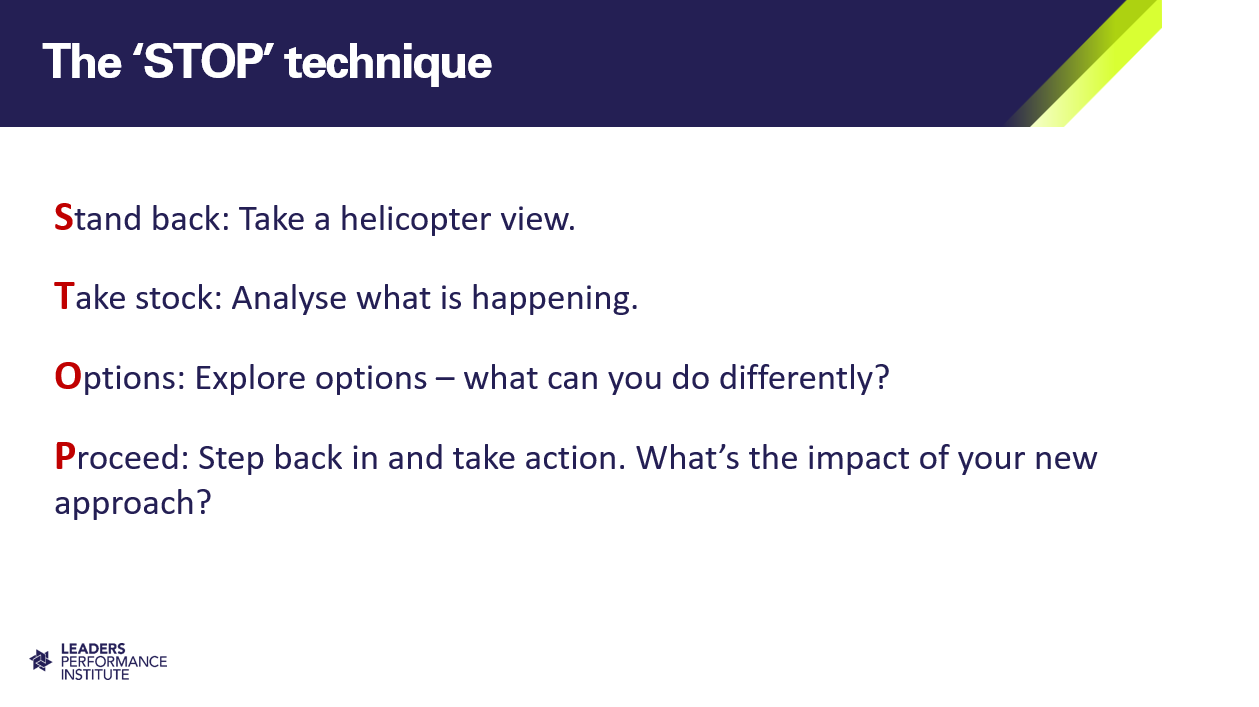
“There are many other frameworks. You will have your own,” said Cox. “But in whatever shape or form, remove yourself and take a moment on the balcony to see things from a different perspective.”
Scan for assumptions. “What we are assuming may not be that useful. Think of an issue you’re currently dealing with and write down eight assumptions you’re currently holding about it.”
Cox then invited Leaders Performance Institute members to ask themselves two questions:
2. They are the grandmasters of their response.
“This speaks to calmness but it also speaks to the strategic element and scanning ahead in terms of the decisions that might need to be taken.”
Adaptive leaders…
Plan for contingencies. “They red team in peace and look for what might happen in the same way that a team will plan for what happens when they go two goals down or receive a red card.”
Understand that self-care isn’t a luxury. “They put on their own mask first,” said Cox. “What might be your first response that buys you time to then consider a better, wider, more sustainable response?”
3. They empower people to contribute to the adaptation response.
“This is about understanding ideas from both within and outside the team.”
Adaptive leaders…
Convene their people and successfully convey the need to adapt.
Encourage collaboration and gather ideas. “Invite the outside in,” said Cox, citing the words of professor Alex Hill.
Test and learn. As Cox put it, they fire bullets before cannonballs. “Let’s test it small and then let’s see if it works; then we can fire the cannonball.”
4. They are adept at leading the change
“This is often where adaptation fails. It’s one thing to spot the change, it’s another to decide your response and empower people to put their mark on it.”
Adaptive leaders…
Mobilise people behind the strategy. “Key to this is understanding the roles individuals will play in that strategy,” said Cox. They communicate tangibly what they’ll be doing and what they can expect from the leader.”
Navigate resistance or conflict. “Enabling people to voice their emotions and values. Often, once they’ve been heard, even if they disagree, they’ll commit.”
Flex where flex is required. “Again, they spot the need for change.”
4 Aug 2025
ArticlesIn July the art of listening, coach and staff wellbeing, and the postpartum return of athletes were top of the conversational agenda.
Nestled in between the myriad elements that contributed to their success was the team’s sense of being “proper English”.
The trope was first aired in February following England’s 1-0 defeat of Spain (who were also their opponents in the Euro 2025 final), with defenders Millie Bright and captain Leah Williamson hailing a “properly English” performance.
Winger Chloe Kelly repeated it during the Euros, and several players were asked to define what it meant as the tournament went on. No-one gave exactly the same answer.
“It’s that we give everything, we run ourselves into the ground,” said midfielder Keira Walsh. For forward Alessia Russo it means “we’ll stick together”. For defender Lucy Bronze it means “if push comes to shove, we can win in any means possible”.
For England’s Dutch Head Coach, Sarina Wiegman, it means “passing with purpose”.
Perhaps it doesn’t really matter one way or another. Much like words on the wall of your changing room, it is more about the feelings they generate than the actual words used.
That is certainly the opinion of Dan Jackson, the General Manager of Player Development and Leadership at the AFL’s Adelaide Crows. He has spent his post-playing career working with teams on their culture. The words on the wall are often a focus.
“I probably spend the least amount of time worrying about whatever words they’ve got,” he told the Leaders Performance Institute in an article that appeared last month.
“Often, I don’t even bother changing them because if you want ‘connection’ or ‘unity’ or ‘team first’ or ‘family’, it doesn’t really matter. What I want to know is the behaviours you’re going to commit to, your system of accountability, and how you drive those behaviours.”
It was one of several nuggets of insight on offer, member to member, across the Leaders Performance Institute in July.
Are you a soldier or a scout?
“Some of the skills of adaptive leadership are more obvious, but that doesn’t make them easier to learn,” said John Bull.
The Director & Lead for High Performance Research at Management Futures hosted the third and final session of our Virtual Roundtable series entitled ‘Leading in Complexity’.
Bull wanted to encourage Leaders Performance Institute members to reflect on their own role as an adaptive leader and pinpoint some areas for self-development.
He introduced the table to the work of philosopher Julia Galef, who has outlined what she calls ‘scout’ and ‘soldier’ mindsets:
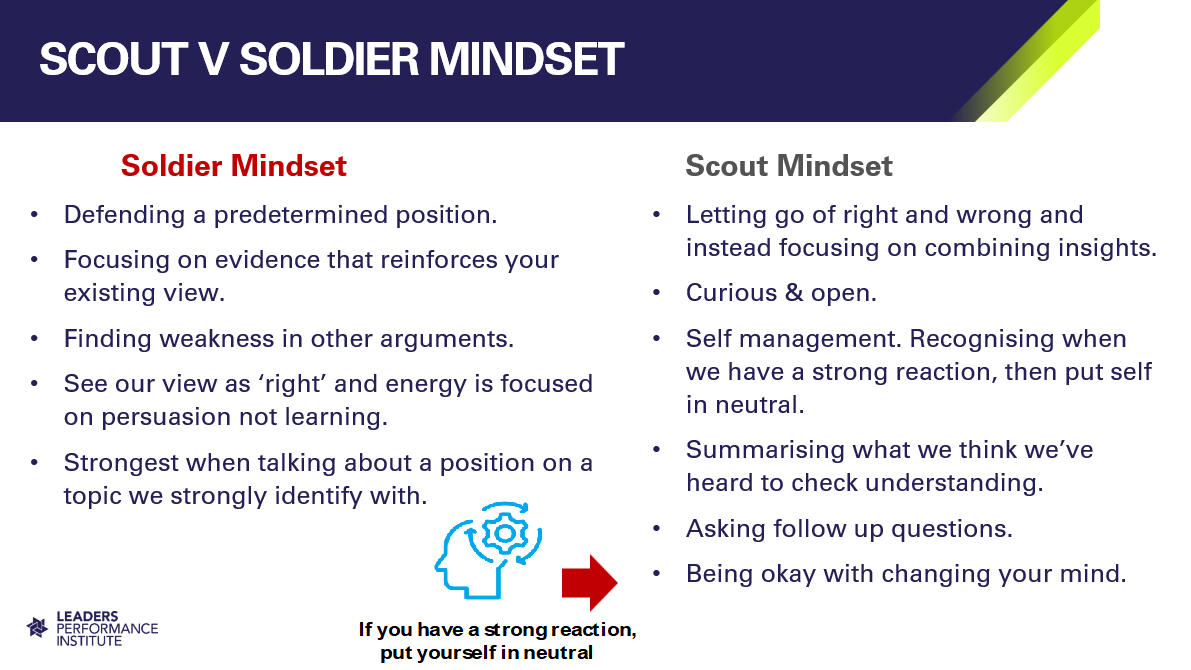
A scout mindset, such as when a scout might draw a map, is essential when learning and adapting. “It’s about acknowledging we might know some elements of the map, but large parts of the map are still undrawn,” added Bull. “It’s not ignoring that we have expertise, but it’s looking for what’s missing.”
On the other hand, a soldier mindset is counterproductive because, as Bull said, “most of our energy is going to influencing other people to see things our way as opposed to learning from what we’re missing.” It can also help, as Shona Crooks, a colleague of Bull’s from Management Futures says, to ‘put your brain in neutral’.
What kind of listener are you?
It was a question posed by Management Futures’ Jeff Pagliano during July’s Leadership Skills Series session.
There are at least four different types of listener, as Pagliano pointed out, but anyone can become better at listening at depth.
He illustrated his rationale with this graphic:
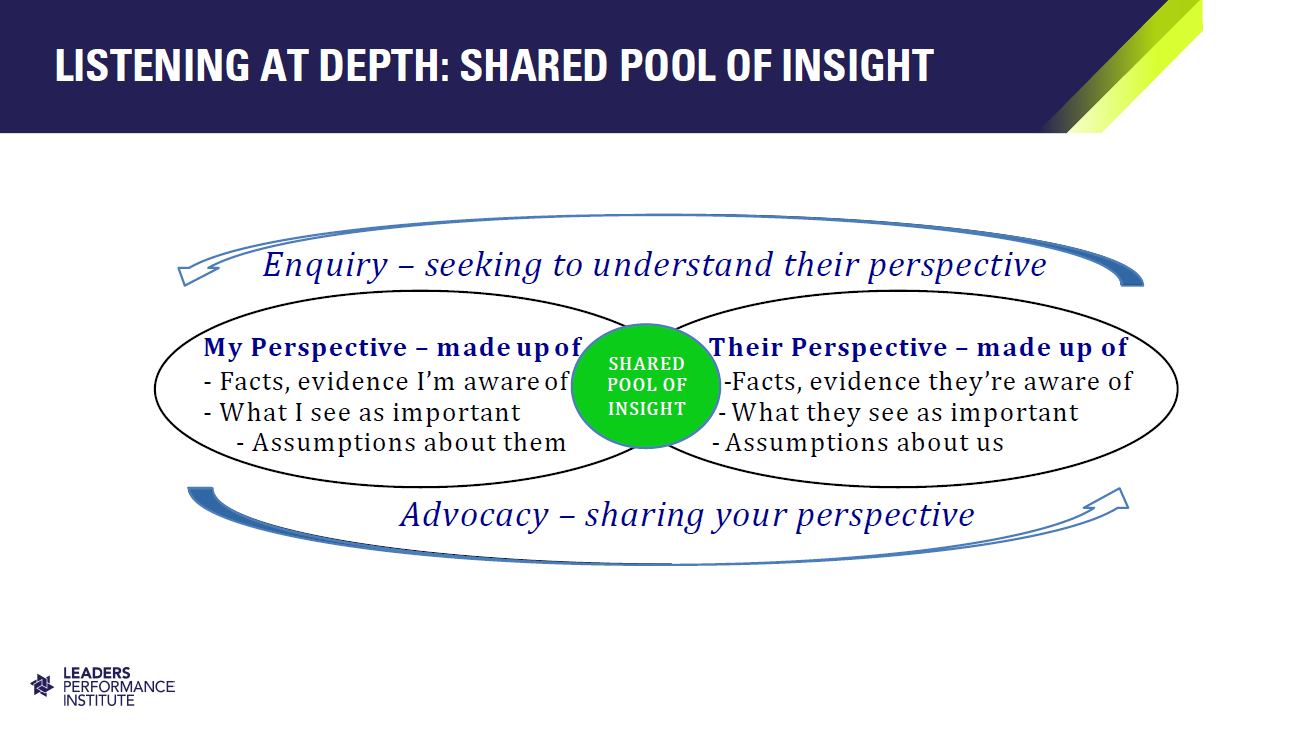
“Usually when we’re trying to persuade someone, it’s all about sharing our perspective. We call that ‘advocacy’,” said Pagliano. Your advocacy will be made up of the facts known to you, things you see as important, and any assumptions you make about the other person.
That person will have facts, thoughts and assumptions of their own, which is why we must add ‘inquiry’ to help bring those to the fore. “And when you bring those two things together that’s where you get that shared pool of insight.”
Listening at depth has other benefits too:
Do you care enough about your coach and staff wellbeing?
“We’ve had athlete wellbeing and engagement in place for more than ten years. We still don’t have coach wellbeing and engagement in place at all.”
This observation, offered at a Leaders Virtual Roundtable on the topic, is by no means unique.
Members of the Leaders Performance Institute have seen the following approaches help:
Read a full account here.
The postpartum return of British athletes
This was a theme of last month’s Women’s High Performance Sport community call, which featured Esme Matthew, the Head of Physiology at the UKSI, and Dr Kate Hutchings, who works with the UKSI’s leading clinical services for all world-class-funded Olympic and Paralympic athletes.
Early and open communication helps athletes and their teams set expectations and create tailored return-to-performance plans, with support from performance lifestyle advisors.
These help to place the athlete at the centre of their own decision-making.
Pelvic floor education and support are essential for postpartum recovery.
Each athlete’s requires unique and flexible plans informed by health monitoring and any necessary practical adjustments. It is key to enable them to stay connected to their sport.
Mental health support is vital as athletes adjust to motherhood.
Informal peer networks, such as WhatsApp groups, offer valuable emotional and practical support, helping athletes share experiences and reduce isolation during pregnancy and postpartum.
Click here for a fuller insight.
9 Jul 2025
ArticlesIn the third and final session of our Virtual Roundtable series ‘Leading in Complexity’ John Bull of Management Futures explores the skills and tools that enable a leader to be more adaptable in the face of change.
The Director & Lead for High Performance Research at Management Futures hosted the third and final session of our Virtual Roundtable series entitled ‘Leading in Complexity’.
Bull wanted to encourage Leaders Performance Institute members to reflect on their own role as an adaptive leader and pinpoint some areas for self-development.
But, as he admitted, this is easier said than done. He recalled a conversation he had with his colleague Tim Cox, who led sessions one and two, and our own Luke Whitworth.
“We reflected that it takes energy to spot the necessary changes,” said Bull. “It probably feels like it then takes even more energy to then try and lead the change in the face of resistance.”
There are, however, skills to be learned and tools available to all leaders.
Four inhibitors (and four more)
In session two, Cox outlined four common ‘traps’ that can inhibit your ability to be adaptable.
They were:
You can read about these in greater detail here.
At the start of this session Bull added four additional traps suggested by the Leaders Performance Institute members who have attended this series:
“You know the end of this sentence,” said Bull, who introduced the table to the work of British organisational theorist Charles Handy, specifically his 2015 book The Second Curve: Thoughts on Reinventing Society.
Handy wrote: ‘The nasty and often fatal snag is that the Second Curve has to start before the first curve peaks.’
“You need to start reinventing almost on the peak of the curve before your competitors do,” added Bull.
Sports, as Bull pointed out, tend to recruit leaders from within the realms of their own sport. “The implication of that is that the sport is lacking some cognitive diversity,” said Bull.
As an antidote, he cited the example of British Cycling’s ascendancy in the late 2000s under Sir Dave Brailsford. “The two biggest breakthroughs in British Cycling came from Australian swimming [equipment design] and in introducing a clinical psychiatrist.”
All change requires a leap of faith. “This inhibitor is linked to the traditional,” said Bull, “but where an organisation may be very risk averse that can get in the way of adaptation.”
This was a major area of focus in our recent Trend Report.
Bull said: “The more alignment you have, the faster you will be able to pivot and adapt as a team.”
Why mindset matters when it comes to adaptability
Put simply, a leader’s mindset influences how they perceive, respond to, and lead through change in complex environments.
Bull then led the virtual room through six areas that demonstrate why mindset matters:
‘Radically traditional’ is a term coined by Professor Alex Hill to describe organisations that have thrived for over a century through an adherence to tradition allied to a willingness to adapt.
“The key insight out of that work is: in order to be able to be adapt, you have to be really clear on what doesn’t change,” said Bull. “It’s about being really clear on what is the core that we want to safeguard, what is what is now out of date. It’s having a balanced view and doing both at the same time.”
Bull used neuroscience to make his point here. “If we are threatened by the uncertainty we’re going to go into fight or flight mode,” he said. “And as we all know we’re going to be less resourceful in fight or flight as opposed to seeing it as an opportunity.” This is what sets adaptable people apart. “They’re calmly ready for it, they’re calmly in alert. Their radar is on and, if you can relish the uncertainty and dial up that part of your personality that relishing it, your brain’s going to be operating at its best. You’ll have all the feel-good hormones of serotonin, endorphins, dopamine and oxytocin.”
Bull is fond of the phrase ‘situational humility’, which was coined by renowned psychologist Amy Edmondson. “If we’re operating in a domain where we have a lot of expertise it’s recognising there’s still going to be stuff we don’t know,” he said.
He built on his point by introducing the work of philosopher Julia Galef, who has outlined what she calls ‘scout’ and ‘soldier’ mindsets:

A scout mindset, such as when a scout might draw a map, is essential when learning and adapting. “It’s about acknowledging we might know some elements of the map, but large parts of the map are still undrawn,” added Bull. “It’s not ignoring that we have expertise, but it’s looking for what’s missing.”
On the other hand, a soldier mindset is counterproductive because, as Bull said, “most of our energy is going to influencing other people to see things our way as opposed to learning from what we’re missing.” It can also help, as Shona Crooks, a colleague of Bull’s from Management Futures says, to ‘put your brain in neutral’.
“From a mindset point of view, this is about where’s our energy going?” said Bull. “Is our energy going to what we can’t control? Or is our energy going to the element of that which we can control?”
Bull said: “Do we focus on learning from failure and finding opportunities where the failure has low consequences?”
This is “the courage to speak up, challenge and name a need to adapt even when that’s really unpopular,” said Bull of the term commonly used in marketing. “There will be some elements of what the sport does or what the organisation does which has served your team incredibly well in the past, which you might feel needs revisiting. That’s going to get the strongest reaction, but sometimes that’s important to show that courage.”
The group were then invited to rank themselves, strongest to weakest, on their ability in each area:
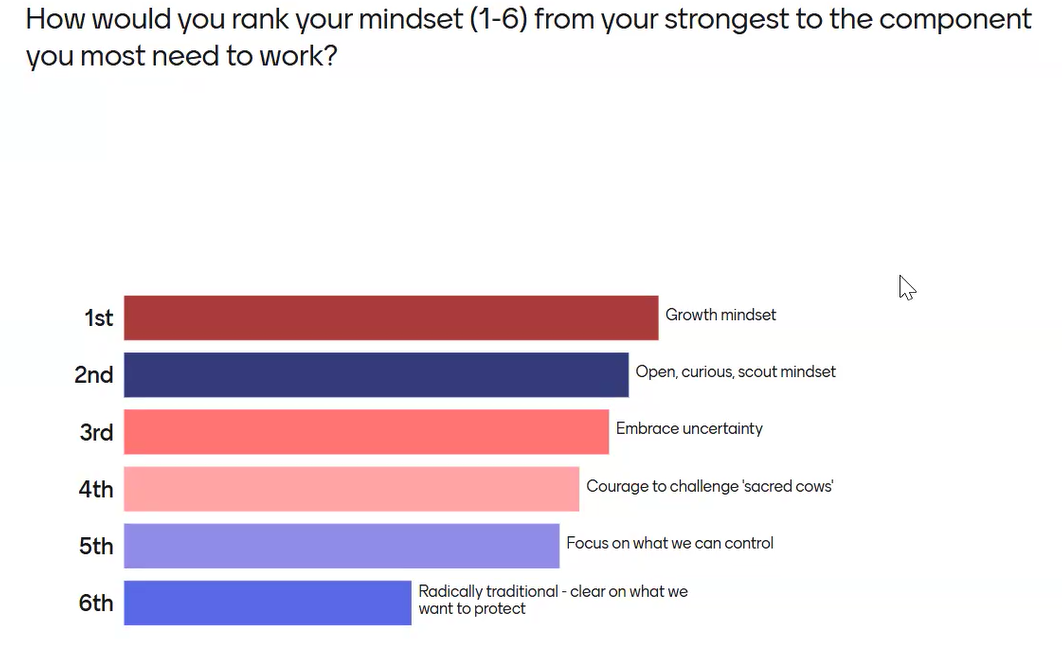
“The common component is emotion,” said Bull in reflection.
How we respond to challenges is critical and, to follow up, he shared eight important adaptive leadership skills needed in complex environments:
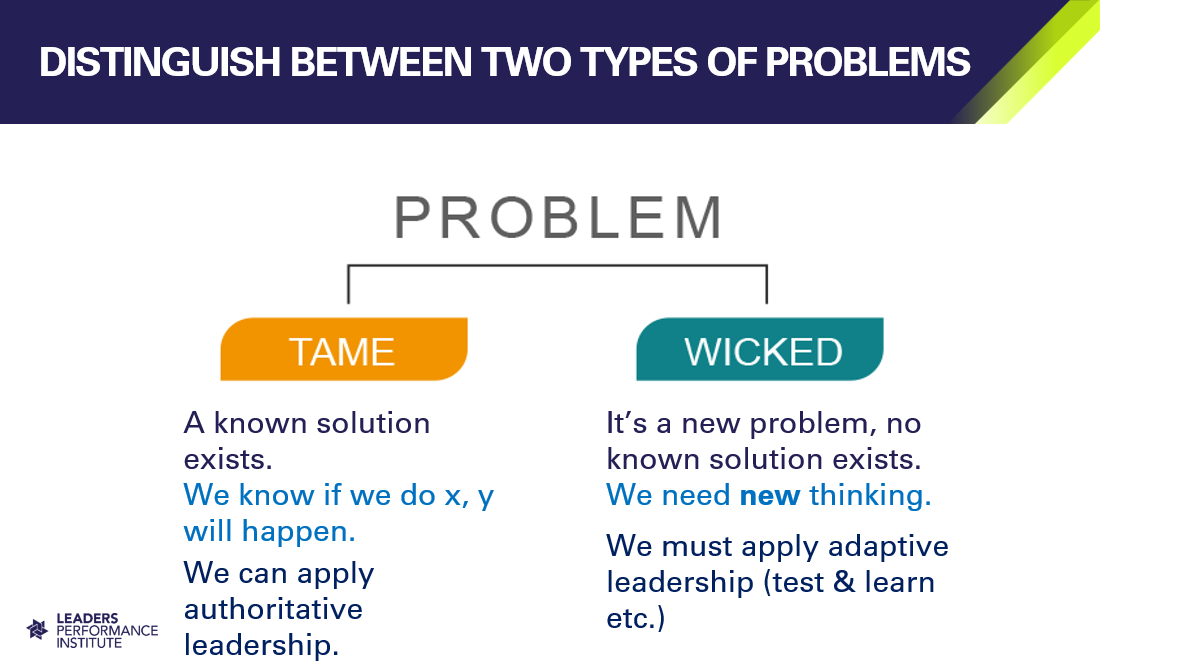
“The leadership required around a tame solution is very different to the leadership skills required around adaptive leadership and solving a wicked problem,” said Bull. “And where a lot of leaders and organisations get into trouble is where they treat a problem that is wicked as though it’s tame and they try and just implement a simple solution; and it doesn’t work or they try and ignore the problem.
“One of the key skills is how do we spot when we need to go into adaptive leadership mode?”
Again, attendees were asked to rank themselves on each of the eight suggestions:
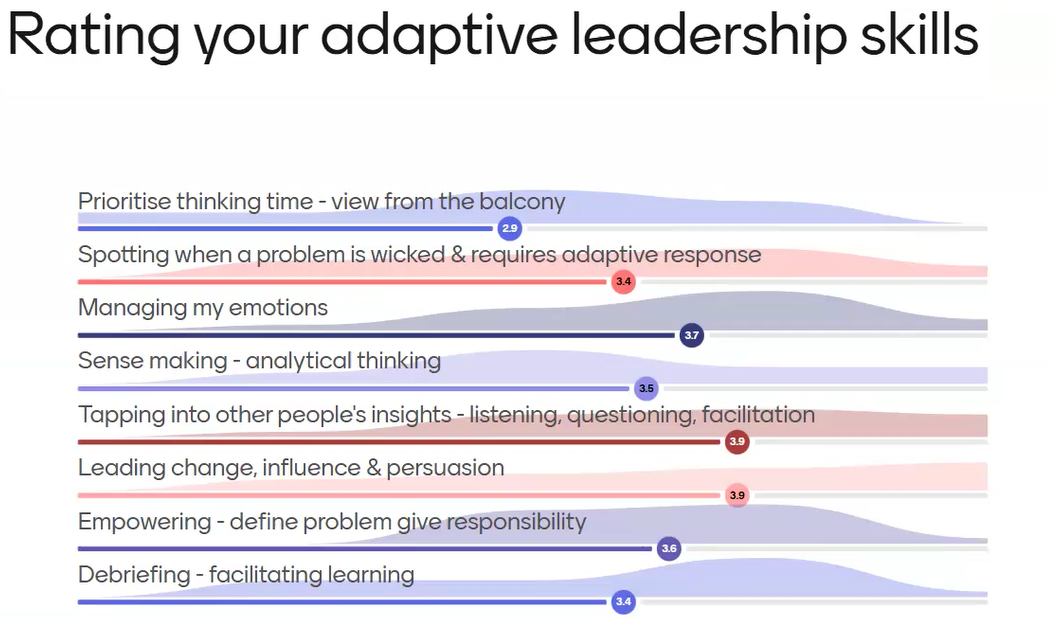
Bull believes the snapshot provided by the above bodes well for sport. “I’m struck, relative to outside of sport, how strong people are generally scoring on the ‘leading change, influence, and persuasion’,” he said. “That’s a positive strength to be able to bank here because, in our experience, and if you look at the research around this, that’s often the skill that most holds back adaptive leadership.”
To wrap things up, Bull shared eight tools to help leaders be more adaptive:
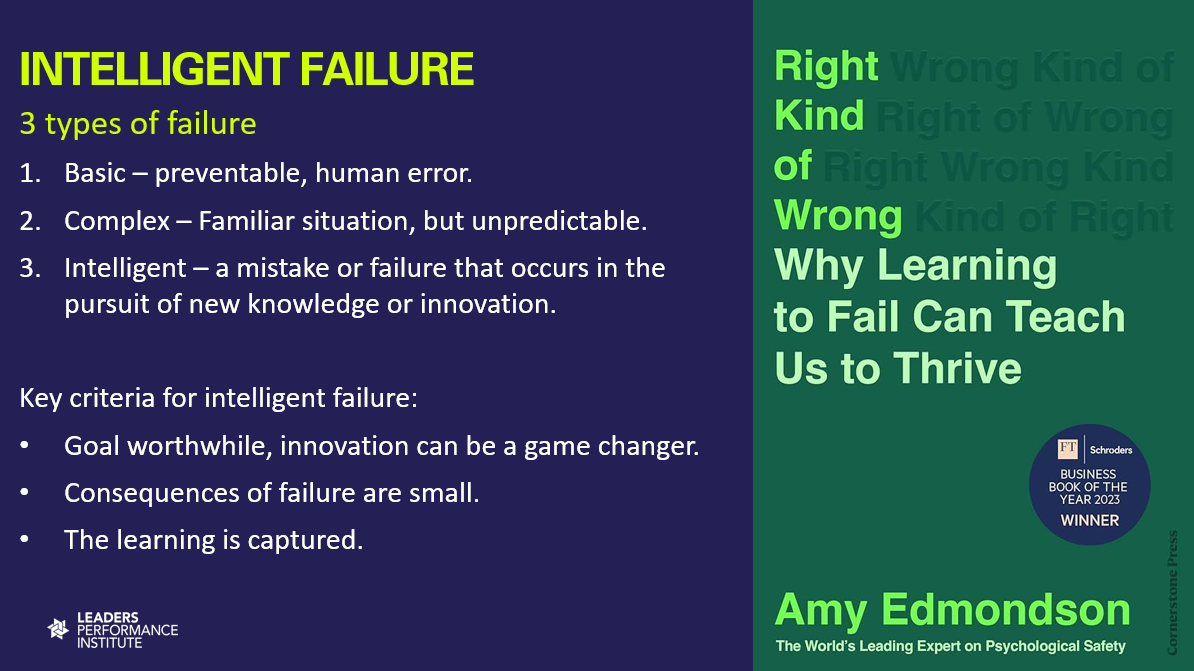
“So what she would say is in organisations that that have a more mature attitude to failure will find opportunities to do ‘intelligent failure’.”
In her book Right Kind of Wrong: Why Learning to Fail Can Teach Us to Thrive, Edmondson outlines three types of failure and the conditions for ‘intelligent failure’:
Final task
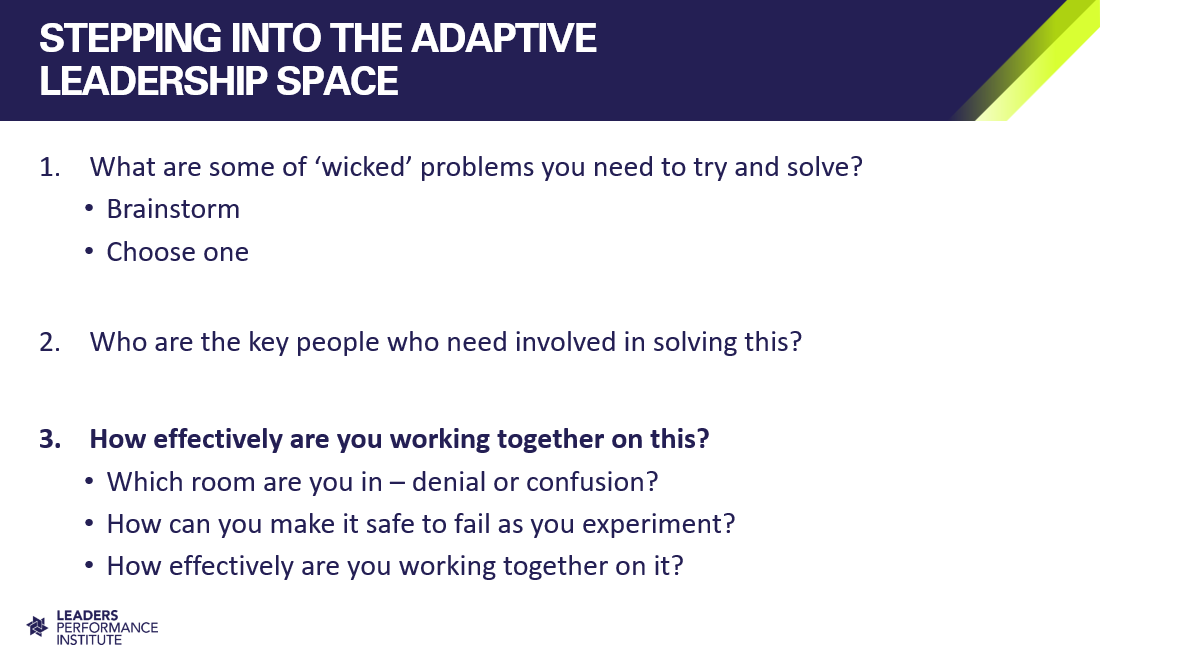
Bull concluded by setting the virtual room a task to consider in their own time:
What to read next
In a recent Leaders Virtual Roundtable, Tim Cox of Management Futures presents a series of tools for navigating those obstacles.
Many of you will be familiar with VUCA (which stands for ‘volatility’, ‘uncertainty’, ‘complexity’ and ‘ambiguity’) and employed it in your day to day work.
It looks like this:
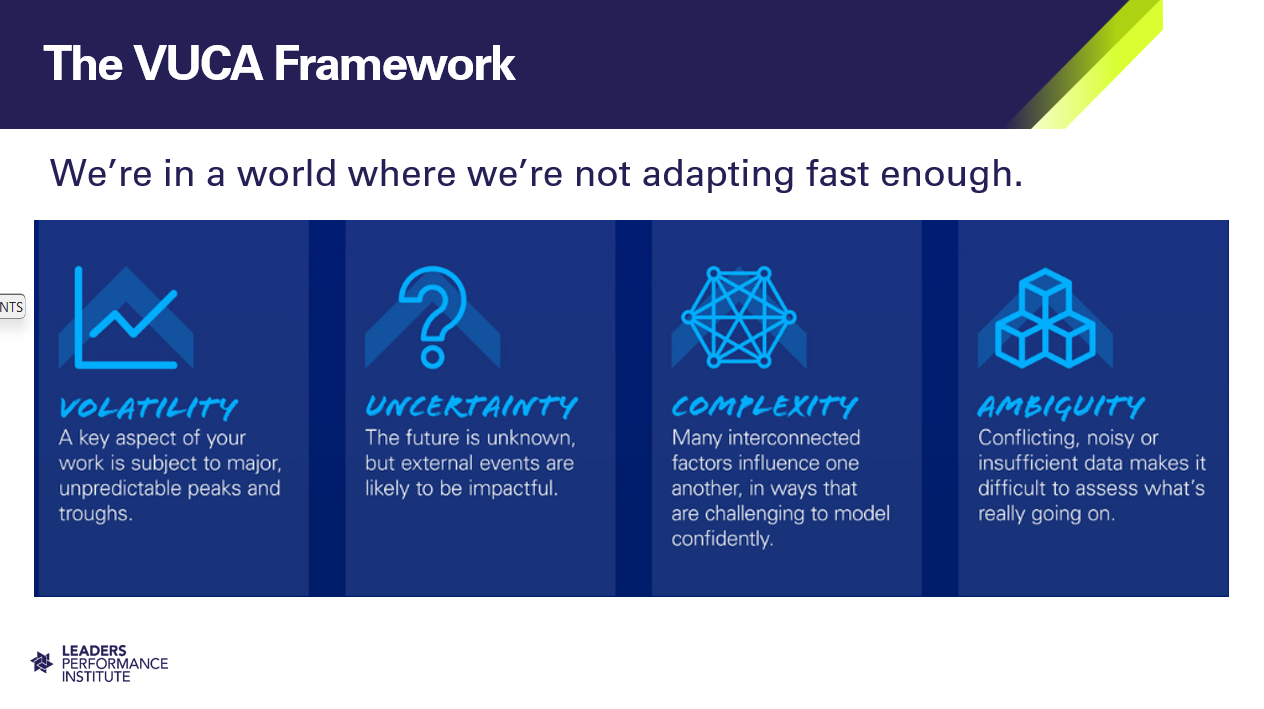
VUCA was devised in military circles in the 1980s as a strategic response to external forces and is both analytical and structural. It remains a useful tool for planning and building resilience.
However, there is a growing consensus that VUCA alone does not capture the emotional and psychological toll as environments become increasingly complex.
In 2018, the author Jamais Cascio, a self-styled ‘futurist’, published his BANI Framework, which is his effort to introduce a more human-centred lens, that emphasises fragility, emotional responses, and the breakdown of linear logic.
Here is an outline:
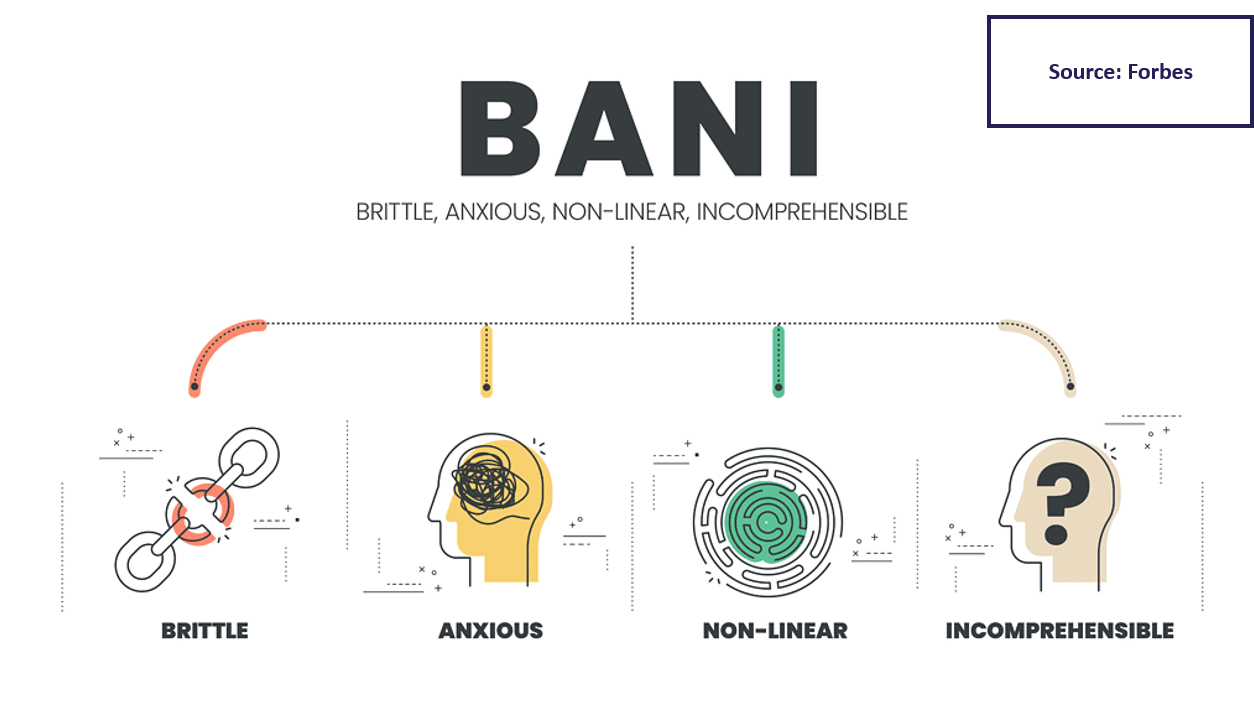
And here is how it may look in your environment:
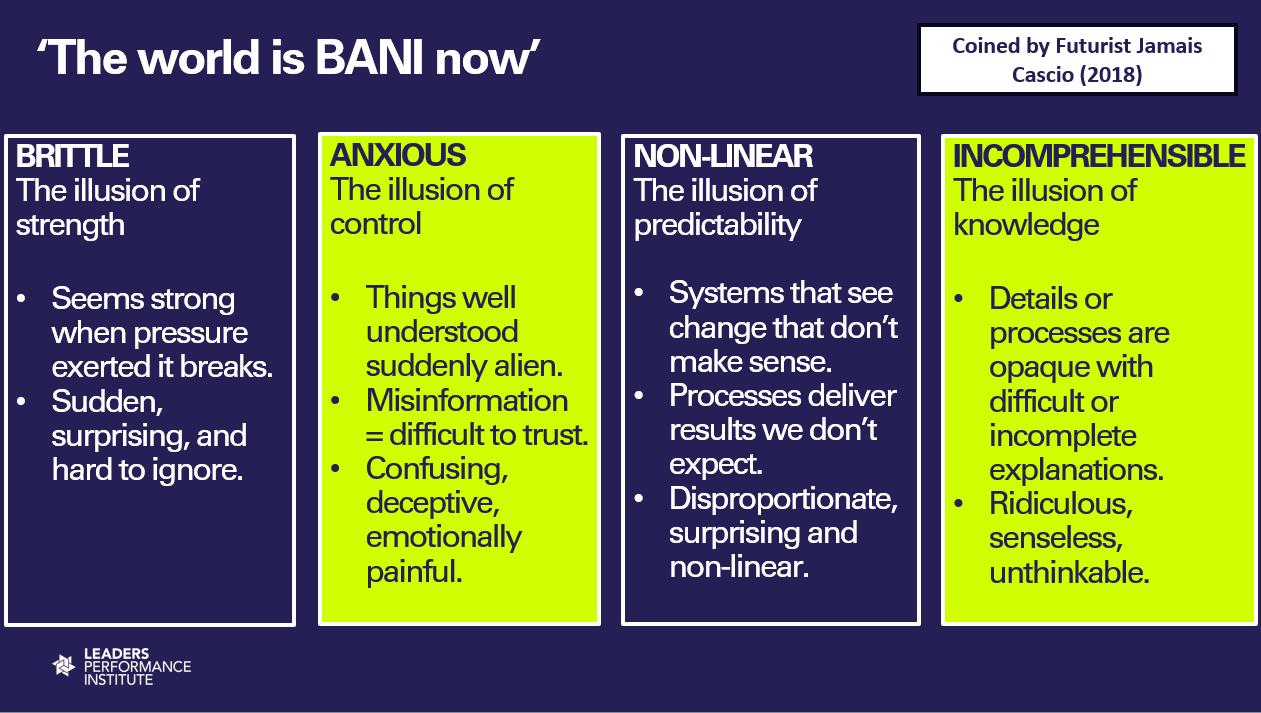
“Cascio sees BANI as parallelling VUCA, but he thinks VUCA is not real enough,” said Tim Cox of Management Futures, the host of a recent Leaders Virtual Roundtable. “He’s not saying BANI replaces VUCA, but he feels that it’s much more up to date with what’s going on at the moment.”
It helped to set the scene for the second session of our three-part Virtual Roundtable series entitled ‘Leading in Complexity’.
Which trap is most common in your organisation?
In part one, we explored how adaptability can increase the chances of an effective response to complexity.
In part two, we turned our attention to four common factors that can inhibit your ability to be adaptable and asked the table to select their most common ‘trap’.
Cox then spoke to each trap in turn.
This trap was cited by the fewest attendees but, as Cox explained, “even in sport we are often hijacked by emotions and we fail to adapt because they override our thinking.”
One must “relax, observe, and make a call”. Cox has some tips on that front:
Nearly half of attendees cited this as the most prominent trap.
It is an enacting metaphor too. “The classic operating from an out-of-date map was the belief that the world was flat,” said Cox. “It limited people and it spread fear in people not to go beyond certain points.”
Without active sense-making, he explained, leaders risk falling into mental ruts that limit adaptability.
Cox recommended the following:
It is a practical method for fostering adaptability and creative problem-solving in complex environments:

Our poll indicated that more than one in five attendees rank this as their team’s most prominent inhibitor.
“Authoritative leadership has been proven time and time again to be effective in very short bursts,” said Cox, “but it isn’t much good for adaptability.” The reasons are simple enough. “It’s really difficult for one person to be able to think through, be creative, respond to the environment around them when things are changing at a high pace.”
Leaders should:
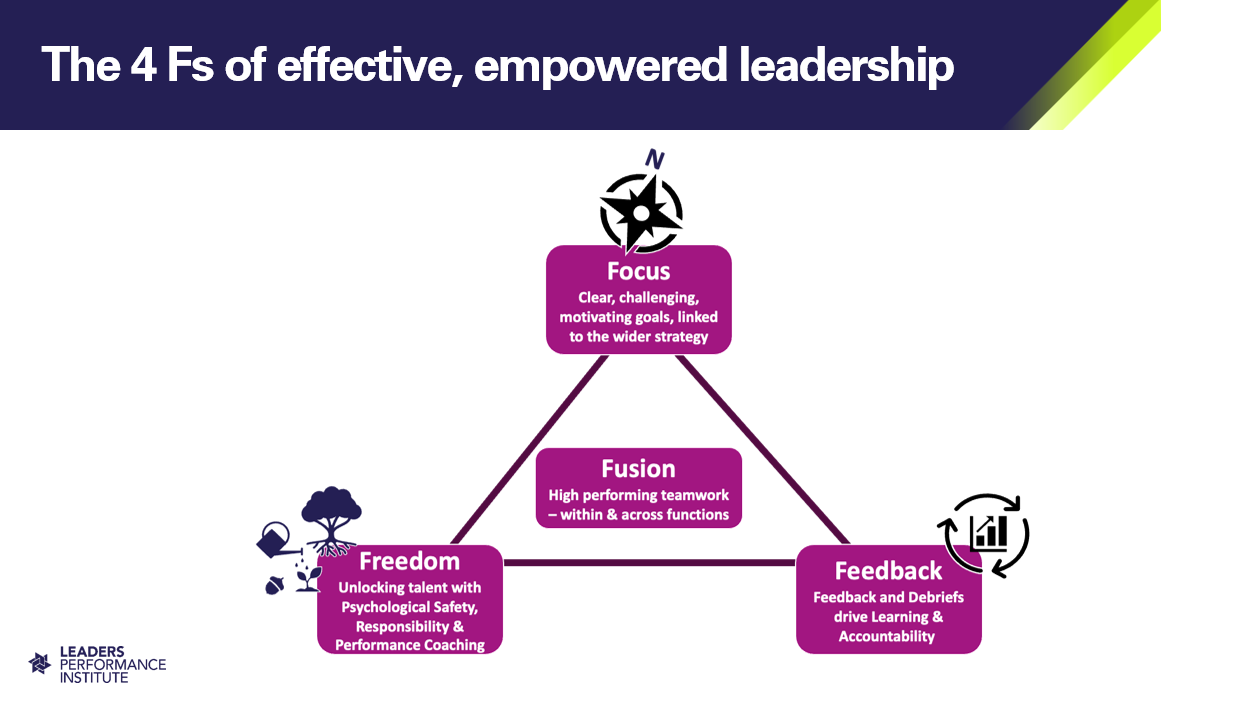
Focus: The leader must deliver clear, strategic alignment where everyone understands the direction and purpose of their work.
Feedback: Regular feedback and debriefing are essential for learning and continuous improvement, especially in dynamic settings.
Freedom: Give people autonomy and allow them to explore, innovate, and respond to change.
Fusion: This is about building strong relationships and collaboration, both within and beyond your organisation with a view to harnessing collective intelligence
As with authoritative leadership, our poll indicated that more than one in five attendees rank this as their team’s most prominent inhibitor.
Cox had a selection of ideas that leaders might consider:
Other inhibitors cited by Leaders Performance Institute members:
Sign up for Part Three
In the third and final session on 3 July, we will explore building a collective playbook for leading in complexity:
Dr Edd Vahid and Ben Baroody led a conversation into the five trends highlighted in The Winning Formula for the Future of Performance Sport
The session was led by two report contributors, namely Edd Vahid, the Head of Academy Football Operations at the Premier League, and Ben Baroody, the Executive Director at the Center for Sports Leadership & Learning at Abilene Christian University.
Firstly, the duo asked the virtual room to select which of the five trends highlighted in the Trend Report resonated most with them. This is what the poll revealed:
We now had the basis for our discussion of the five.
Trend No 1: Alignment is more integral to success than ever before
The clear winner in our poll. Baroody suggested that while ‘alignment’ is a commonly-used term, its practical application is often vague; additionally, silos persist. There are several common factors that hinder alignment:
Baroody stressed the need for clarity in daily operations, especially in decision-making and strategic direction, if alignment is to be brought to bear. Vahid also praised practitioners who can simplify complexities and present ideas in a clear manner that promotes unity.
Trend No 2: Leadership is stagnating
The Trend Report revealed that 57 per cent of practitioners believe that leadership within their organisation has stayed the same or got worse in recent years.
The primary factors appear to be the shift towards task orientation and the pressure to ‘win now’, which can act to stifle innovation and long-term thinking. Leaders, as the floor pointed out, have less bandwidth, less time for staff development and even less time for staff onboarding.
Baroody observed that even at organisations that prioritise leadership development, stagnation is still reported. For him, this is compounded by what he sees as the link between alignment and (high) quality leadership.
Vahid questioned whether leaders are giving themselves enough capacity to lead effectively and, as such, he is an advocate of distributed leadership models and leaders who invest in their own development as well as that of their people.
The virtual floor highlighted the importance of skills including influencing, an ability to hold honest conversations, and active listening.
Trend No 3: Resourcefulness continues to trump resource
Performance programmes are impacted in all directions whether it’s by ownership, internal politics or resource allocation.
As Vahid illustrated, your people remain your central competitive advantage. He argued that success is less about having greater resources than prioritising more effectively. Both he and Baroody emphasised a leaders ability to adapt, which comes from greater alignment around a clear purpose. With clarity comes a greater ability to prioritise.
Trend No 4: Psychology is increasingly game-changing
The Trend Report identified psychology as the most underserved area across the human performance disciplines in sport.
More than 40 per cent made that point despite a full 80 per cent stating their belief that psychology is ‘very important’ to the enhancement of human performance.
So if we know psychology is vitally important, why is the consensus that it isn’t working effectively across parts of the industry? There are several commonly cited reasons:
There are, however, steps that teams can take:
Trend No 5: Smart teams are leading the tech arms race
Vahid stated that while we remain “data rich” we are still “insight-poor”. In the Trend Report, only 43 per cent of practitioners reported having a clear decision-making process for adopting new technologies, which means the rapid pace of development is not always matched by effective integration.
Vahid, Baroody and the wider table offered a series of tips:
Other trends in your sport, discipline or environment that are not mentioned in the Trend Report:
And if you haven’t read the Trend Report yet:
Ian Walsh of Red Bull is renowned for his meticulous approach to tackling some of the biggest waves on the planet. Here he shares his wisdom with the wider sporting community.
Main Image: Fred Pompermayer / Red Bull Content Pool
“In every other part of my life there’s a million things going on. I feel like I always have ten balls in the air. Did I forget to take the laundry out? Did I put it in the dryer? I have bills to pay, groceries to buy. And surfing is one of the few places in the world where that all just drifts away.”
This level of focus may sound familiar to athletes, but the stakes of big wave surfing are something else entirely. One false move and Walsh risks serious injury every time he mounts his board.
Walsh has built a career on his coolness under pressure, which is why he was invited to share his insights at the Leaders Sport Performance Summit at Red Bull Media House in Santa Monica last year.
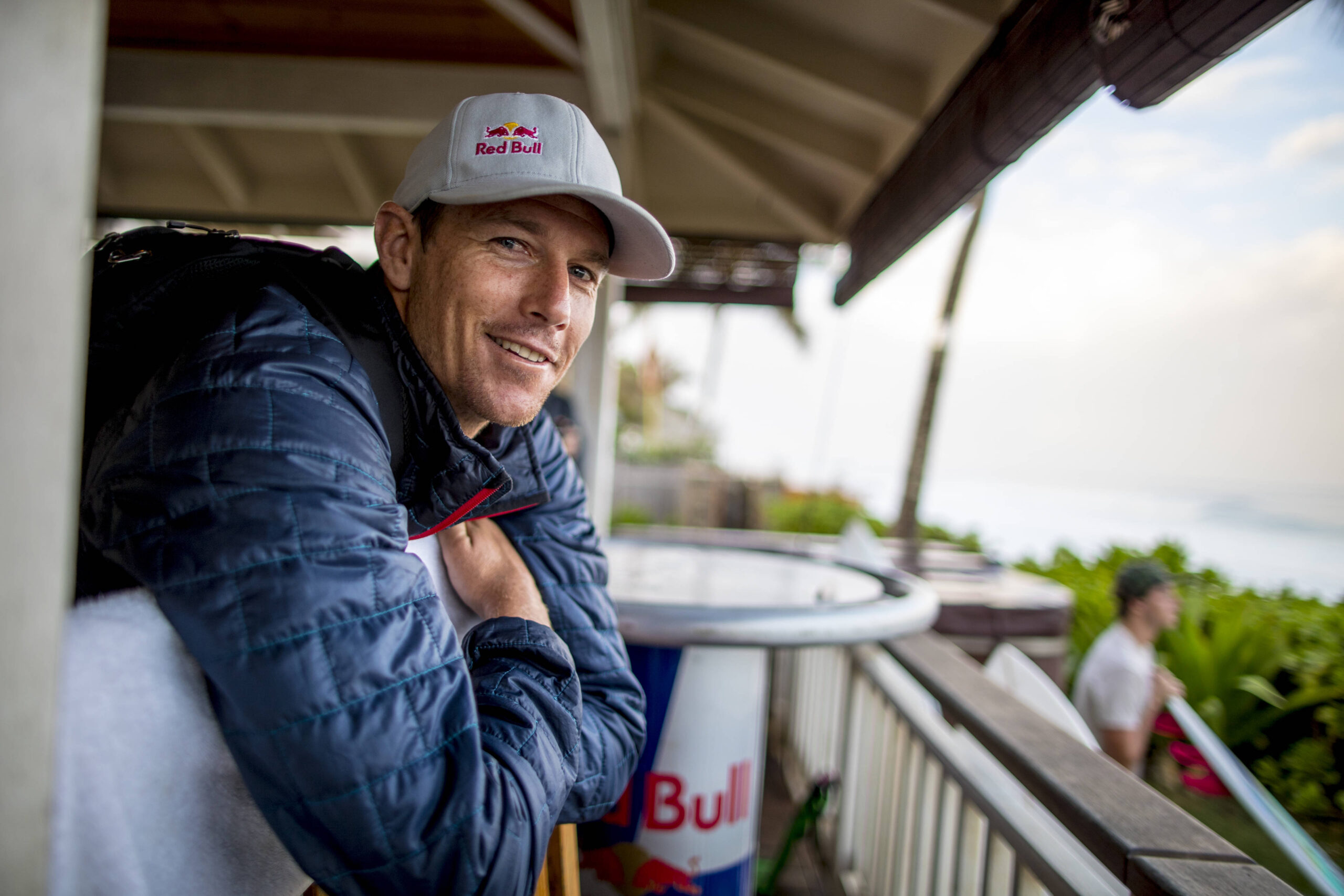
Ian Walsh poses for a portrait at the Volcom Pipe Pro on 4 February 2018, on the island of Oahu, Hawaii, USA. [Zak Noyle / Red Bull Content Poo]l
1. He acknowledges and harnesses his fear
“Those nerves and everything you fear are natural, and you can use that to elevate your performance,” said Walsh. “It commands every ounce of your being and your focus to deal with what’s coming at you and how you want to navigate it to try and finish on your feet.”
This ability comes with “repetitions and time”. Walsh was in town for a training block at Red Bull’s state-of-the-art Athlete Performance Center ahead of the northern hemisphere summer season. “I’m going to take full advantage of having this amount of time in a facility like this,” he added. “It gives me the chance to push myself in a controlled environment.”
2. He keeps his ‘smart brain’ online
Walsh can keep his ‘smart brain’ online under pressure. It is a term often used by high-performance specialist Rachel Vickery. “Have you got enough buffer in the system to absorb that natural increase in arousal state peaking?” she said on the Leaders Performance Podcast in 2023.
“Every human has a threshold that basically says if my arousal stays below my threshold or below my red line, I can perform in a way that I’ve got a lot more control of. If I’ve got more buffer in the system, so to speak, then when I get the normal increase in arousal it’s still under control and it’s not shooting me across the red line.”
In Walsh’s case, he de-escalates and grounds himself through the ‘breathe-up’ technique, which is a cycle of diaphragmatic breathing aimed at lowering his heart rate and preparing his body to stay relaxed underwater for an extended period.
Additionally, thanks to training alongside Red Bull freediver Kirk Krack, Walsh has learned to hold his breath underwater for up to five minutes. “It’s creating situations where I could elevate my heart rate and then get into a breath hold and understand how my body is going to react and eventually adapt to those scenarios.”
“It’s a skill in and of itself to then go, ‘how do I apply that once this physiological threat response kicks in? How well am I able to adapt and adjust and execute when all those changes happen?’” said Vickery, who would no doubt approve of Walsh’s strategies.
3. He already knows what to do when things go wrong
Walsh has long had a firm interest in meteorology and bathymetry [the study of the seabed, lakebeds and riverbeds]. He can pinpoint with reasonable accuracy when and where the most suitable swells will appear during both the northern and southern hemisphere surfing seasons. He said: “The reason it evolved to so much precision is to give myself as much of an opportunity on those special days as I can, because those days are rare and everything can change so fast on those mega swells.
He then readies his equipment and support team. “By having my preparation done, I can get absolutely smoked on a wave, break my board, everything gets washed onto the rocks, but I have everything ready to go again. I can go right to the boat or the jet ski, get my second board, catch my breath, make sure everything’s good and then get back into the lineup within 15-20 minutes.
“If you don’t have that ready, you could spend two hours dealing with it and it could be another month to six weeks or even the next season when you get another opportunity to push yourself in that calibre of surf.”
His meticulousness extends to listing and ranking restaurant menus in different locations. It drives his partner up the wall. “I take it into my normal life and my girlfriend can attest to how annoying those details are.”
Jokes aside, Walsh’s approach calls to mind the words of mountaineer Kenton Cool, who once told an audience at a Leaders Sport Performance Summit: “People often think of extreme adventure athletes as possessing a ridiculous appetite for risk, that we’re reckless, foolhardy and make illogical decisions. In reality, it’s quite the opposite.”

Ian Walsh photo session for The Red Bulletin, Los Angeles, 19 July 2024. [Maria Jose Govea / The Red Bulletin]
Walsh’s near-catastrophic failures have taught him to be humble when ironing out creases in his performance. “Letting go of some of your ego will create a lot more latitude for opportunities,” he said. “Maybe I did get annihilated on that wave, but I was also an eighth of an inch from making it.”
Walsh studies film of his efforts. He is also a comprehensive note-taker. “I can go back and be like ‘this swell angle, these winds, these tides are shaping up like January 10, 2004 [a date on which he suffered a severe injury – one of several throughout his career]’.” He can then tell himself “maybe I should have ridden this forward or tried those fins. Maybe our water safety protocol could have been a little more buttoned-up.”
What to read next

2 Jun 2025
ArticlesMay shone a spotlight on ‘influencing skills’, leading in complex environments, coach development and finding the right ways to test tech solutions.
“We want to keep on building from this,” said Slegers after her side had defeated Barcelona Femení 1-0 in May’s Uefa Women’s Champions League final.
“We believe in who we are and what we do and we want to keep on building and keep on going next season.”
Slegers, who is less than a year into her first head coaching role, knows the risk of standing still, both as a team and as a head coach.
Throughout the fifth month, the Leaders Performance Institute was on hand to deliver a selection of sessions to help members further hone their leadership skills, from the art of influencing to introducing and managing more efficient processes for testing tech.
Here are some of the choicest cuts.
To influence, you need to listen
Jeff Pagliano of Management Futures hosted an ‘influencing skills’ session for Leaders Performance Institute members as part of our Leadership Skills Series.
He introduced the topic of ‘listening well’, which supports influencing in two specific ways.
“It helps the intimacy part of the trust equation and it gives you the context for a person’s point of view,” he said. “You’re more prepared when the time comes for you to share your knowledge and suggest a course of action.
“Active listening is when you’re not only tuned into what someone says but also what they feel and believe picking up on both their verbal and non-verbal communication is the foundation of intimacy and the antithesis of self-interest.”
He shared the following image to illustrate his point:

When you’re talking to someone you are hoping to influence it’s always useful to reflect on the goals of each conversation, both what you want and what the other person needs as a way to determine the best way to listen at the moment. And you may realise that a different mode or combinations of modes would be better.
Jeff Pagliano, Management Futures
Top tips for leading in complexity
In May, we also launched a Learning Series that explored adaptability in the complex world of high performance. In the first session, Tim Cox of Management Futures offered a series of seven tips, including: prioritise time for analysing what is changing.
Here’s what that entails:
Read all seven tips here.
Are you able to thoroughly assess tech solutions?
At the beginning of May, we published our Trend Report entitled ‘The Winning Formula for the Future of Performance Sport’.
The report delves into the barriers that prevent organisations adopting new technologies and is informed by more than 200 individuals from nearly 40 sports. While cost was predictably high on the list, three other challenges emerged as equally, if not more, critical.
It was the perfect opportunity to run a virtual roundtable discussing the systems and processes that members have in place at their teams. The table identified a number of critical success factors.
While much of the conversation focused on systems and structures, several participants emphasised the importance of culture and communication as critical to the success of these processes. One high performance manager noted that their organisation is “risk-averse” when it comes to new tech, not because of a lack of interest, but because of a desire to protect core business functions. “If there’s anything we can use to get all the noise out of other people’s way so they can actually do the day-to-day job better, then we’re normally onboard with that.”
Another pointed out the generational divide in digital fluency. Younger staff are digital natives and eager to adopt new tools. Older staff, by contrast, may be more cautious or feel overwhelmed. Bridging this gap requires not just training, but empathy and thoughtful change management.
Additionally, performance sport may need to rethink its leadership structures. In other industries, CTOs and innovation directors play a critical role in aligning technology with strategy. In sport, these roles are rare but increasingly necessary.
Without someone to “own” the innovation agenda, organisations risk falling into reactive patterns and chasing shiny new tools without a clear sense of purpose. As one contributor put it, “We need someone who can sit above the noise and guide us forward.”
Coach development cannot be separated from athlete development
Another virtual roundtable looked at helping athletes to bridge the gap from the youth to senior ranks.
While discussing an array of approaches, the table underlined the importance of investing in coach development as a key influence on transition experiences for athletes. One element of this is ensuring coaches are equipped to recognise and understand different transitions as they occur in different contexts and, therefore, deal with them more effectively.
An environment within the Olympic system explained how their decentralised programme has witnessed new performance records at junior level due in part to their consistent approach to coach development. Their heightened emphasis on coach support and development extends not only to their current athletes but those next on the pathway.
Also, coach-to-coach exchanges enable individuals to discuss both common transitions and those lesser-considered transitions that are nevertheless challenging, such as injuries.
Additional reporting by Luke Whitworth.
Read the Trend Report now