Everton’s Head of Sport Science Jack Nayler concludes his exploration of complexity in sport by outlining what it takes to be resilient and adaptable under pressure.
We also looked further at the implications for this in a sporting organisation, notably that complexity is fractal, exists at different levels, and that each person within the organisation will exert different levels of influence over the performance at any given moment.
Last week, I began to look at what this means for those in leadership positions.
Leadership in complexity requires you to have the humility to accept the ignorance of your position and the understanding that autocracy won’t work. It is impossible to micro-manage every decision in the fast pace and short turnaround of games in a professional sports season. You will not be present to control every interaction that occurs and you will not possess all of the information available to make every decision.
With the inherent fluctuations that occur in a complex environment, it is incumbent on the leaders to provide a framework within which everyone can operate, as effectively as possible, in a transdisciplinary manner.
I believe there are four pillars to this framework, that are characteristics of high-performing environments.
Your role as a leader is to ensure that these are in place so your team operates as effectively as possible.
I explored the first two pillars here. Let’s now delve into the third and fourth pillars below.
The complexity of the sporting season ensures that as results wax and wane so will pressure and external noise. The processes you have in place need protecting from this pressure and the associated emotion.
For some simpler tasks and processes you can have checklists or flight manuals where processes can be recorded, ratified and referred back to (1). However, these only go so far and will be less useful as the complexity dials up.
When you and your staff are committed to helping the team perform, it is easy (or just human nature) to become overly emotional about performances (both positively and negatively), and this can leach into your decision-making processes. Leaders need to be aware of the propensity for this as well as the influence of subconscious bias on any decision making (this is a wider topic than the scope of this series but a good place to start is Thinking Fast and Slow by Daniel Kahneman, 2). Setting up your team/environment to reduce the effect of these factors is key to leading your team effectively.
As the leader, with your wider viewpoint and greater access to those higher up the organisational hierarchy, you should have a greater appreciation of the pressures you and your team face. As emotions tend to affect quality decision making, it is your job to be judicial over which pressures you allow to filter through to your team and which you will bear.
Objectivity must become a cornerstone of making decisions. We need to collect data on the subject (player or situation) over which we are trying to make a decision. This data then needs turning into information (tables, graphs and other visualisations) by adding context (use of appropriate statistics) to help the reader understand the magnitude of any effect. This information turns into knowledge when the reader reflects on the new information, with respect to what they already know and understand.
As we have discussed, each person will have their own unique take on a given set of information. Organisations that can successfully make the leap from individual to organisation level knowledge will be better prepared to perform in complexity.
The threat to an organisation if knowledge sits siloed with individuals is two-fold. Firstly, the quality of the decisions being made will fall and secondly the organisation is fragile to an individual leaving and removing the intellectual property (IP) from the building.
I believe the threat to the organisation is greater from the loss when IP walks out of your facility, than if that person was to be employed by a rival team. As each organisation is its own complex mix of culture, practitioners and athletes, it is difficult to transfer tacit knowledge from one environment directly into another.
Once you have objective information around which you can make decisions, you can begin to plan what you and your team will deliver. This planning process provides a framework for everyone involved to work within and should remain just that: a framework. Remember that in complexity the person closest to the action has the most information in a given moment. This framework provides a set of parameters that act as a fallback, against which new information can be assessed. In the moment, under pressure, this framework coupled with a clearly understood direction of travel from you as leader should help the practitioner on the ground make a better decision.
As the outcomes of the decisions we have made as a team become apparent our framework can become the basis against which we can reflect and review the decisions made, by providing a reminder of the conditions as they existed in that moment. This again helps to objectify the review process and fosters a culture of psychological safety (3).
Understanding the complex nature of this environment has helped me to appreciate that we cannot get everything right all of the time (remember there is never a perfect game) and my first thought when things fall down is: how could I, as an intrinsic part of this complex system, have acted differently through the process to have affected a better outcome? This helps me to remain less emotional when analysing failures as and when they happen. I do this before turning my lens outwards to think how we could have done better as a team.
The fact that complex systems are never perfect and we cannot predict outcomes with 100% accuracy creates uncertainty. In their book Radical Uncertainty, John Kay and Mervyn King describe uncertainty as “the result of our incomplete knowledge of the world, or about the connection between our present actions and their future outcomes.” (P. 13, 4). We need all members of the team to understand that although this space is uncertain, performance will emerge from it.
There is then a gap that exists between our expectations and the outcomes. Acknowledging the inevitable existence of this gap allows the leader to be more sanguine and less frustrated by it, putting us in a better headspace to explore why the gap exists like it does and how we can narrow it in the future. I see little point in the wasted energy that would be spent railing against this gap’s existence. Rather I see this gap as the learning space, a space to be curious about. It is the space where the information mentioned in the previous section becomes knowledge.
When we reflect on information in the context of what we already know, we develop our knowledge base. This should then spark off further questions as to why we ended with the result we did, restarting the cycle back to collecting more data. This process is critical in the complex world. As the system shifts and changes, so do our levels of expertise (5). Further, knowledge developed in other environments and populations diminishes in power the further away from that population it moves. The most powerful learning will come from research done in our own group of athletes. This should be a mix of quick and dirty in-house enquiry and more formalised research carried out with partner universities and led by in-house research and development departments.
You also need to lead your team into this gap by putting in place structures that allow your team the time and space for reflection. We are really good in team sports at planning and doing, before all too soon the next fixture rears its head. You need to be intentional about reflecting and reviewing. Reflecting skills can be learnt and should be fostered amongst your team. Make reviews normal and model behaviour by openly reviewing the things you personally have done and seeking feedback. This normalises the feedback process and creates space for you to feedback to your team members more easily (6). Mix regular small hot reviews in the moment (7) with more analytical, larger reviews. In these, review a specific subject (e.g. grade 2b hamstring injury rehab) as opposed to generalised time periods (e.g. pre-season). Signpost your reviewing – create a structure or framework around how you want to reflect and share it with the team ahead of time. Your team should then turn up in the spirit of reflection, rather than having it sprung upon them. Most critical of all is to have concrete outcomes that everyone is aware of and can be held to.
The second space we need to be mindful of as leaders is the space from which the performance of our team emerges.
In 2012, Google embarked on a large study to try and discover what made a successful team within their organisation, they called it Project Aristotle (8). Google studied 180 teams from across the business and looked many combinations of factors (e.g. personality traits, emotional intelligence, demographics and skillsets of team members) that they hoped would indicate levels of learning and performance. Whichever way they crunched the data, they could find no pattern as to what would bring success. Some of the factors that did not influence team success intuitively sounds like items that would be important when trying to build a successful team:
Eventually the researchers looked away from the hard skills and instead looked at interactions between team members, driven by the work of Amy Edmondson, Professor of Leadership and Management at Harvard Business School. Professor Edmondson’s research has also studied effective teams and the work at Google confirmed her theories. The number one factor that will describe team success is termed psychological safety, which she describes as “a shared belief held by members of a team that the team is safe for interpersonal risk-taking… a sense of confidence that the team will not embarrass, reject or punish someone for speaking up” (P. 354, 3).
A psychologically safe environment is one which recognises that the space between the components of the complex system is where the magic happens and works to ensure that all members of the team can lean into said space.
In a complex world, we cannot see the connection between our decisions and their future impact, we only make sense of them with hindsight. As the author Robert Louis Stevenson said: “The worst historian has a clearer view of the period he studies than the best of us can hope to form of that in which we live. The obscurest epoch is to-day.”
However, there is evidence to suggest that better predictions and decision making come from cultures that “harness the power of collectives and encourage diverse opinions, perspectives and collaborative teamwork” (9).
The challenge we face when leading in an increasingly complex world is that it is constantly shifting in front of us, and we only see what is happening through our lens. There are a whole host of things we cannot see and second and third order effects that we cannot predict. Therefore, any time we take an immovable position or opinion, we are also opening ourselves up to being incorrect.
As leaders these positions, either polarised, immovable (or worse, both) are dangerous places to be. This is demonstrated by the work of Philip Tetlock, summarised in his book, Expert Political Judgement: How good is it, how can we know? Over a nearly 20 year period Tetlock ran forecasting tournaments with 284 experts from a variety of fields, leading to 28000 predictions (10).
Experts were only slightly more likely than chance to be correct, however the interesting part was in discovering that how the experts thought was more important than what they thought when it came to the accuracy of their predictions. Tetlock characterises these two styles as Foxes and Hedgehogs after the title of an essay by the philosopher Isaiah Berlin, based on a quote by the Greek philosopher, Archilochus: “a fox knows many things, but a hedgehog knows one big thing”.
When the hedgehog is challenged, they curl up in a ball with their spikes out to deflect the world. It is the same with the experts, their position is immovable, and they deflect critique. Experts who were more fox like were less sure of their predictions and more willing to change them as events unfolded. Foxes were more likely to be accurate in their predictions than hedgehogs in the long-term. Hedgehogs had the potential to be more precise, but with a much greater chance of being wrong. When dealing in complex environments, when you are wrong, you have the potential to be spectacularly wrong.
By contrast, foxes will recognise that they do not have a complete perspective and therefore not all of the answers. They will lean into the space between themselves and others, inviting their perspective and collaboration, seeking to co-create solutions for the best possible outcome.
To develop a climate in which foxes can flourish, we must create psychologically safe environments that protect the space between the members of our teams as sacred and encourage them to lean into these spaces to collaborate and provide diverse perspectives. Edmondson (3) describes it as “a team climate characterized by interpersonal trust and mutual respect in which people are comfortable being themselves.”
This process takes modelling from us as leaders. If we cannot show up, be true to ourselves and honestly lean into the space between us, those we lead, and our teammates, then we can never hope to engage others to do the same. If we fail to do this effectively, we may struggle to create a high performing environment.
Further thinking
Bottom line
Throughout this series, I have endeavoured to explain the way that I have come to see the world and, because I work in performance sport, how this applies in that context.
In the spirit of this, I also see how it has emerged from my own upbringing, education and experience to form in this way, at this point, and that you may well see things differently. This is OK because we all encounter this world in different ways. As my own experience grows, I am sure these ideas will develop and adapt.
The biggest messages I would wish to convey is that as a leader, show up and be authentic to yourself and your beliefs, don’t be afraid to try things and fail (as long as you’re willing to do the work to understand why) and go looking for feedback.
Writing is a fantastic way to force you to critically confront your thoughts and assumptions, and writing for an audience, to distil your ideas down as succinctly as possible. I would recommend it as an exercise for anyone leading or aspiring to lead as clear communication of your ideas helps bring people on a journey with you.
References
24 Nov 2025
ArticlesIn the third part of his miniseries exploring complexity in sport, Everton’s Head of Sport Science Jack Nayler explains the importance of a clear direction of travel and a solid, collective decision-making process.
The second part looked further at the implications for this in a sporting organisation, notably that complexity is fractal, exists at different levels, and that each person within the organisation will exert different levels of influence over the performance at any given moment.
This brings us onto this third instalment, where I begin to look at what this means for those in leadership positions.
Leadership in complexity requires you to have the humility to accept the ignorance of your position and the understanding that autocracy won’t work. It is impossible to micro-manage every decision in the fast pace and short turnaround of games in a professional sports season. You will not be present to control every interaction that occurs and you will not possess all of the information available to make every decision.
With the inherent fluctuations that occur in a complex environment, it is incumbent on the leaders to provide a framework within which everyone can operate as effectively as possible, in a transdisciplinary manner.
I believe there are four pillars to this framework, that are characteristics of high-performing environments.
Your role as a leader is to ensure that these are in place so your team operates as effectively as possible.
Below, I will run through the first two on that list. I will tackle the third and fourth pillars in another piece.
Previously we spoke about how in a game, the influence over performance grows or diminishes in relation a player’s proximity to the ball, peaking whilst they are in possession. At the complexity scale of the wider organisation, this becomes the person (practitioner) stood in front of the player.
As a leader, whilst you may previously have had boots on the ground, chances are when stepping into a leadership role, your player-facing time has diminished. You are now generally removed by at least one, if not several degrees, from working directly with players.
The challenge you face is that the responsibility for the decisions taken around the athlete(s) is still ultimately yours and, as you rise higher, the difficulty factor of the decisions increases.
As your time with athletes diminishes, so does the amount of knowledge and information you have about them. There should be no way that a head of performance in an organisation has more ready information on an athlete than the therapist who has hands on that athlete daily. The paradox is that the closer you get to the centre of the complex system (the athlete), the more difficult it is to see the whole.
There is an Indian proverb about five blind men who are presented with a different part of an elephant, each perceives that they are touching a different object (e.g. the tail is a rope, the trunk a snake etc) because they have not been presented with the whole. The more reductionist we become in complexity, the narrower our focus, the more we are reducing our bandwidth and leaving ourselves open to larger errors.
Thus, your ability as a leader to frame the nature of the problem, provide an understanding of what the wider landscape looks like and cut through noise with your team is essential. This creates your direction of travel, a clear understanding around what you expect as a leader that frames the decisions made by your team on a daily basis. You may need to do this at larger scales (philosophy setting, season planning, game model development) as well as smaller scales (planning end stage rehab and return to performance, or where to place team meetings in the training week). Whatever the scale, you need to be able to provide a consistent thread of behaviour and values that will underpin how decisions are taken, and you need to do this regularly.
You also need to ensure that the vision you are setting fits the wider organisational goals. If necessary, this can be accompanied by some relevant key performance indicators (KPIs), but caution is advised. The aim of KPIs should be more of an outcome measure than a target in and of themselves. They should be the resultant of good practice, not become the embodiment of it. When numbers become targets, they can become a form of control placed on the complex system and, as per Goodhart’s law (1), can be gamed. A case in point is player availability. If the target is above a certain percentage availability for the team, it can lead to under-reporting by practitioners who do not want to negatively affect the standard by which performance is being assessed.
If the behaviours and values that underpin your vision can be co-created with your team, then the understanding and buy-in from the members of the team will be much greater. This will provide the basis for how your team will operate. This is less about the tacit knowledge in your team or the operational decisions that are being made (as these will be constantly adapting to the changing situation or player) but should include the values and behaviours the team want to exhibit and hold each other to. These are akin to the ‘why’ in Simon Sinek’s famed Golden Circle (2).
A clear vision with underpinning values set by the leader (with their team) creates a north star that will guide the decisions made by the team.
Even though cause-and-effect aren’t obvious in complexity and there is a degree of uncertainty in every decision made, we should not become fatalistic about making decisions and leave them to chance. We can absolutely increase the quality of the decisions that we are making.
As a part of the complex system, you are inherent in the decision-making process, but as mentioned above, you often have less information than those you lead.
In a hierarchical command structure, it takes too long to gather all of the relevant information and pass it up the chain of command to make a decision that is then passed back down again. Remember that the more you try to control a complex system, the more you leave yourself open to bigger failures.
David Marquet is a retired US naval captain who illustrates this problem well in his book Turn the Ship Around (3). He describes how he was trained to command one class of submarine and, at the last minute, was switched to another ship of a different class (at the time, the worst-performing ship in the Navy). He decided what the crew needed was licking into shape with training.
On their first voyage, Captain Marquet gave an order that was passed down the chain of command to the sailor whose job it was to enact that order. When the action didn’t happen, Marquet thought he had to gotten to the bottom of the problems that beset the boat. He marched over to the sailor demanding an explanation, and the sailor calmly informed him that what he had ordered wasn’t possible on this class of submarine. Marquet didn’t know what he didn’t know.
His experience speaks to another truism of complex environments: there is always a gap between expectation and reality, it will never play out exactly as you think. Crucially, Marquet stepped into this gap; he learned from the experience and changed the command structure from top-down order to bottom-up intention. Sailors had to declare to their superior that they intended to carry out an action, and this was then either approved or denied. The boat went from worst to best-performing ship in the US Navy the following year.
General Stanley McChrystal recognised a similar challenge whilst commanding US forces during the Iraq War in 2003 (4). US forces were picking up suspected insurgents off the streets and taking them back to base for interrogation. The information gathered was assessed by analysts before leaders made decisions and then issued orders back down the chain of command. The trouble being that by the time it took to do this, the message had been passed around the insurgents’ network, which immediately went to ground. McChrystal recognised the complexity of the situation and pushed decision making closer to the centre of the action on the front line. He trained troops to be able to question insurgents on the street and empowered them to act on what they found. This is credited as a key tactical change that helped to swing the tide of the insurgency back in the favour of the US forces.
Accepting then that in complex environments, we need to empower those in our team to make to make decisions, the most obvious way to improve decision making is to hire the best skillsets available to you. The art comes in blending these skillsets and setting them up to make good decisions.
As each person in the staff is their own complex mix of upbringing, education, skillset and experience, all may have a different viewpoint on the same set of information. Played correctly however, this is a value-add and is a key part of why diversity within your team is beneficial, each person will see things others cannot (5). Leading means you need to be able to synthesise what others are seeing and hearing and bring that together in a coherent decision.
There can be a temptation (which I have fallen for) to think you need to gather as many people/opinions together as possible when making decisions, allowing everyone in the team the opportunity to contribute. In fact, there is a limit beyond which the quality of decision-making drops. As the number of people involved in the process increases, there can be a reduction in the trust that the group members have in each other. This reduces psychological safety, and you lose agility.
For the kind of agile decision making necessary in and around a heavy fixture schedule, quality discourse will begin to reduce with as little as 5 people involved in the decision (6). A key task for the leader therefore is to figure out what the key decisions are that need to be made, and then set their team up accordingly, with the appropriate individuals correctly assigned.
Once you have your best people in place to make decisions, the next step is to ensure they are set up for success. Whilst we want people to bring all of their experience to bear on the decisions being made, we also need these to be informed by the available evidence. We should be collecting data and turning this into information (visualising it) so that the team members can then begin to process the evidence and reflect on it in relation to their existing knowledge. (I will describe this process in more detail in part four).
Leaders need to check and challenge the decision-making process effectively. They should ensure that those involved have all had the chance to contribute, check that the team have used the available evidence and provide the greater context held, if appropriate.
Also crucial is to break an impasse when it occurs, you hold the casting vote. As the leader, the more difficult decisions will be yours to make when they are beyond the scope of your team (who can help advise). You may well be in your position due to your greater level of experience. Your team will expect you to bring all this to bear when influencing the final decision that is being made. Whilst not everyone will agree with the final decision, ensuring the relevant people have had the chance to contribute and then explaining your decision will help to unite everyone behind a course of action.
Disagreeing and committing is a key skill for high performing teams, particularly when the stakes are high.
Future thinking
In the fourth and final part, I shall explore the remaining pillars: processes robust to pressure and a culture of curiosity and learning.
References
24 Sep 2025
ArticlesIn a recent Leaders Virtual Roundtable, Tim Cox of Management Futures discussed the traits of adaptable leaders and the common problems that trip up their rivals.
Cox, the Director & Lead for High Performance Research at Management Futures, is leading a Skills Sprint Session virtual roundtable for Leaders Performance Institute members on the topic of adaptability.
It is a skill, as Cox explained, that was highly coveted by the coaches and practitioners who contributed to our Trend Report earlier this year.
Not that this is anything new. “It is well known that Charles Darwin did not talk about ‘the survival of the fittest’,” Cox continued, with reference to Darwin’s 1859 book On the Origin of the Species.
“The endpoint of Darwin’s research was that it’s not the strongest or the most intelligent of the species that survives, it is the one that is most adaptable to change.”
Over the course of 25 minutes, Cox discussed traps that people can fall victim to in pursuit of better adaptability. He also brought into focus the qualities of adaptive leaders and the skills that can aid adaptation.
Firstly, those four traps that inhibit adaptation:
Cox then set out the four qualities of adaptive leaders and the skills and tools that support those qualities:
1. They spot the need for change
“It is important to actually spot the need for change and not just continue doing what you’re doing.”
Adaptive leaders…
Are able to shift perspective. “Adaptive leaders don’t just sit within their position,” said Cox. “They can see it from others’ perspectives, whether it’s a stakeholder’s or your competition’s.”
Are good at listening. “Our response to challenges to the status quo: how are we receiving them? Are we hearing them or are we just simply emotionally responding and cutting them down in whatever way?”
Conduct regular debriefs and reviews. Cox mentioned both the OODA Loop and the STOP framework, the latter of which he outlined:
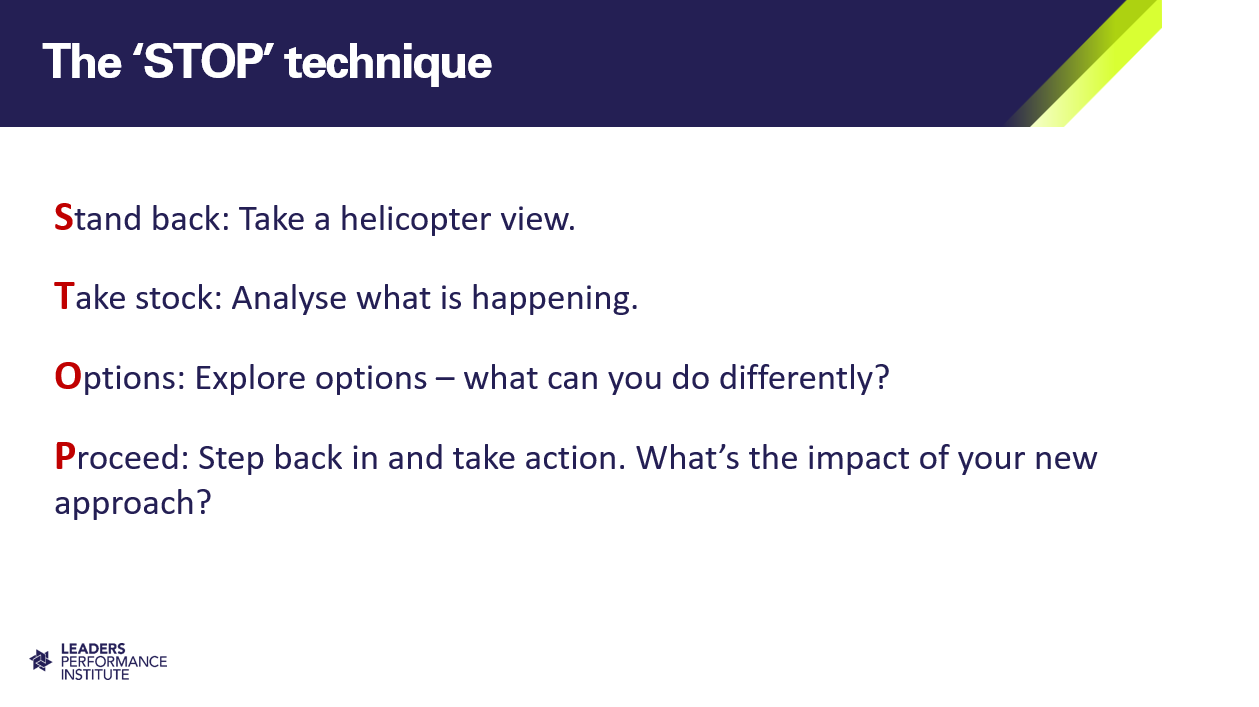
“There are many other frameworks. You will have your own,” said Cox. “But in whatever shape or form, remove yourself and take a moment on the balcony to see things from a different perspective.”
Scan for assumptions. “What we are assuming may not be that useful. Think of an issue you’re currently dealing with and write down eight assumptions you’re currently holding about it.”
Cox then invited Leaders Performance Institute members to ask themselves two questions:
2. They are the grandmasters of their response.
“This speaks to calmness but it also speaks to the strategic element and scanning ahead in terms of the decisions that might need to be taken.”
Adaptive leaders…
Plan for contingencies. “They red team in peace and look for what might happen in the same way that a team will plan for what happens when they go two goals down or receive a red card.”
Understand that self-care isn’t a luxury. “They put on their own mask first,” said Cox. “What might be your first response that buys you time to then consider a better, wider, more sustainable response?”
3. They empower people to contribute to the adaptation response.
“This is about understanding ideas from both within and outside the team.”
Adaptive leaders…
Convene their people and successfully convey the need to adapt.
Encourage collaboration and gather ideas. “Invite the outside in,” said Cox, citing the words of professor Alex Hill.
Test and learn. As Cox put it, they fire bullets before cannonballs. “Let’s test it small and then let’s see if it works; then we can fire the cannonball.”
4. They are adept at leading the change
“This is often where adaptation fails. It’s one thing to spot the change, it’s another to decide your response and empower people to put their mark on it.”
Adaptive leaders…
Mobilise people behind the strategy. “Key to this is understanding the roles individuals will play in that strategy,” said Cox. They communicate tangibly what they’ll be doing and what they can expect from the leader.”
Navigate resistance or conflict. “Enabling people to voice their emotions and values. Often, once they’ve been heard, even if they disagree, they’ll commit.”
Flex where flex is required. “Again, they spot the need for change.”
9 Jul 2025
ArticlesIn the third and final session of our Virtual Roundtable series ‘Leading in Complexity’ John Bull of Management Futures explores the skills and tools that enable a leader to be more adaptable in the face of change.
The Director & Lead for High Performance Research at Management Futures hosted the third and final session of our Virtual Roundtable series entitled ‘Leading in Complexity’.
Bull wanted to encourage Leaders Performance Institute members to reflect on their own role as an adaptive leader and pinpoint some areas for self-development.
But, as he admitted, this is easier said than done. He recalled a conversation he had with his colleague Tim Cox, who led sessions one and two, and our own Luke Whitworth.
“We reflected that it takes energy to spot the necessary changes,” said Bull. “It probably feels like it then takes even more energy to then try and lead the change in the face of resistance.”
There are, however, skills to be learned and tools available to all leaders.
Four inhibitors (and four more)
In session two, Cox outlined four common ‘traps’ that can inhibit your ability to be adaptable.
They were:
You can read about these in greater detail here.
At the start of this session Bull added four additional traps suggested by the Leaders Performance Institute members who have attended this series:
“You know the end of this sentence,” said Bull, who introduced the table to the work of British organisational theorist Charles Handy, specifically his 2015 book The Second Curve: Thoughts on Reinventing Society.
Handy wrote: ‘The nasty and often fatal snag is that the Second Curve has to start before the first curve peaks.’
“You need to start reinventing almost on the peak of the curve before your competitors do,” added Bull.
Sports, as Bull pointed out, tend to recruit leaders from within the realms of their own sport. “The implication of that is that the sport is lacking some cognitive diversity,” said Bull.
As an antidote, he cited the example of British Cycling’s ascendancy in the late 2000s under Sir Dave Brailsford. “The two biggest breakthroughs in British Cycling came from Australian swimming [equipment design] and in introducing a clinical psychiatrist.”
All change requires a leap of faith. “This inhibitor is linked to the traditional,” said Bull, “but where an organisation may be very risk averse that can get in the way of adaptation.”
This was a major area of focus in our recent Trend Report.
Bull said: “The more alignment you have, the faster you will be able to pivot and adapt as a team.”
Why mindset matters when it comes to adaptability
Put simply, a leader’s mindset influences how they perceive, respond to, and lead through change in complex environments.
Bull then led the virtual room through six areas that demonstrate why mindset matters:
‘Radically traditional’ is a term coined by Professor Alex Hill to describe organisations that have thrived for over a century through an adherence to tradition allied to a willingness to adapt.
“The key insight out of that work is: in order to be able to be adapt, you have to be really clear on what doesn’t change,” said Bull. “It’s about being really clear on what is the core that we want to safeguard, what is what is now out of date. It’s having a balanced view and doing both at the same time.”
Bull used neuroscience to make his point here. “If we are threatened by the uncertainty we’re going to go into fight or flight mode,” he said. “And as we all know we’re going to be less resourceful in fight or flight as opposed to seeing it as an opportunity.” This is what sets adaptable people apart. “They’re calmly ready for it, they’re calmly in alert. Their radar is on and, if you can relish the uncertainty and dial up that part of your personality that relishing it, your brain’s going to be operating at its best. You’ll have all the feel-good hormones of serotonin, endorphins, dopamine and oxytocin.”
Bull is fond of the phrase ‘situational humility’, which was coined by renowned psychologist Amy Edmondson. “If we’re operating in a domain where we have a lot of expertise it’s recognising there’s still going to be stuff we don’t know,” he said.
He built on his point by introducing the work of philosopher Julia Galef, who has outlined what she calls ‘scout’ and ‘soldier’ mindsets:
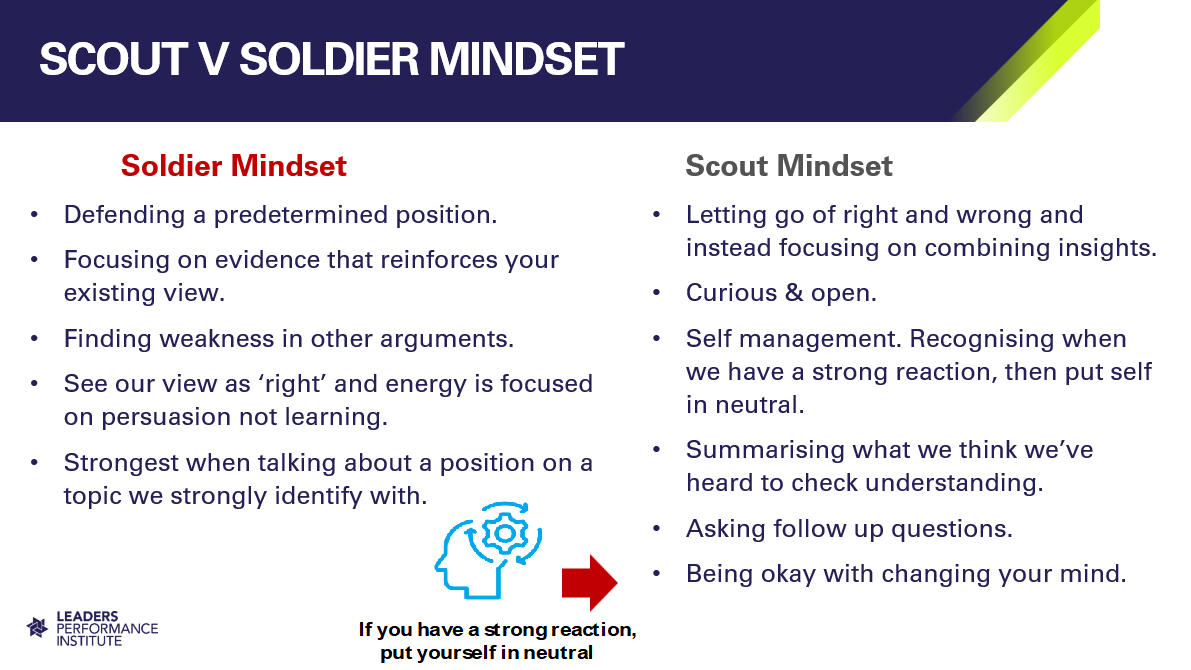
A scout mindset, such as when a scout might draw a map, is essential when learning and adapting. “It’s about acknowledging we might know some elements of the map, but large parts of the map are still undrawn,” added Bull. “It’s not ignoring that we have expertise, but it’s looking for what’s missing.”
On the other hand, a soldier mindset is counterproductive because, as Bull said, “most of our energy is going to influencing other people to see things our way as opposed to learning from what we’re missing.” It can also help, as Shona Crooks, a colleague of Bull’s from Management Futures says, to ‘put your brain in neutral’.
“From a mindset point of view, this is about where’s our energy going?” said Bull. “Is our energy going to what we can’t control? Or is our energy going to the element of that which we can control?”
Bull said: “Do we focus on learning from failure and finding opportunities where the failure has low consequences?”
This is “the courage to speak up, challenge and name a need to adapt even when that’s really unpopular,” said Bull of the term commonly used in marketing. “There will be some elements of what the sport does or what the organisation does which has served your team incredibly well in the past, which you might feel needs revisiting. That’s going to get the strongest reaction, but sometimes that’s important to show that courage.”
The group were then invited to rank themselves, strongest to weakest, on their ability in each area:
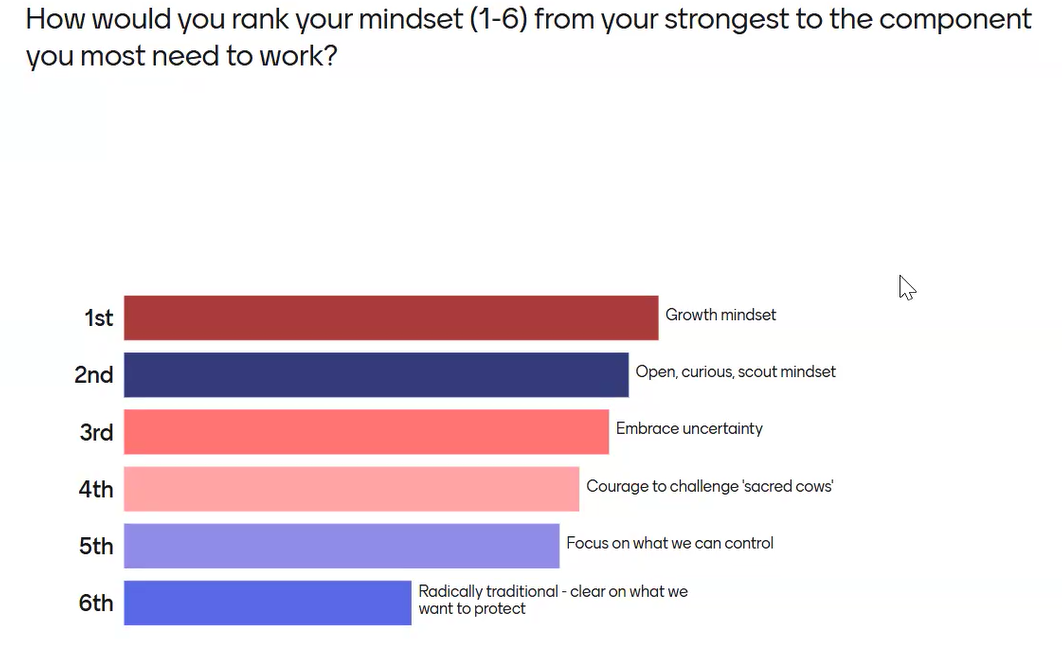
“The common component is emotion,” said Bull in reflection.
How we respond to challenges is critical and, to follow up, he shared eight important adaptive leadership skills needed in complex environments:
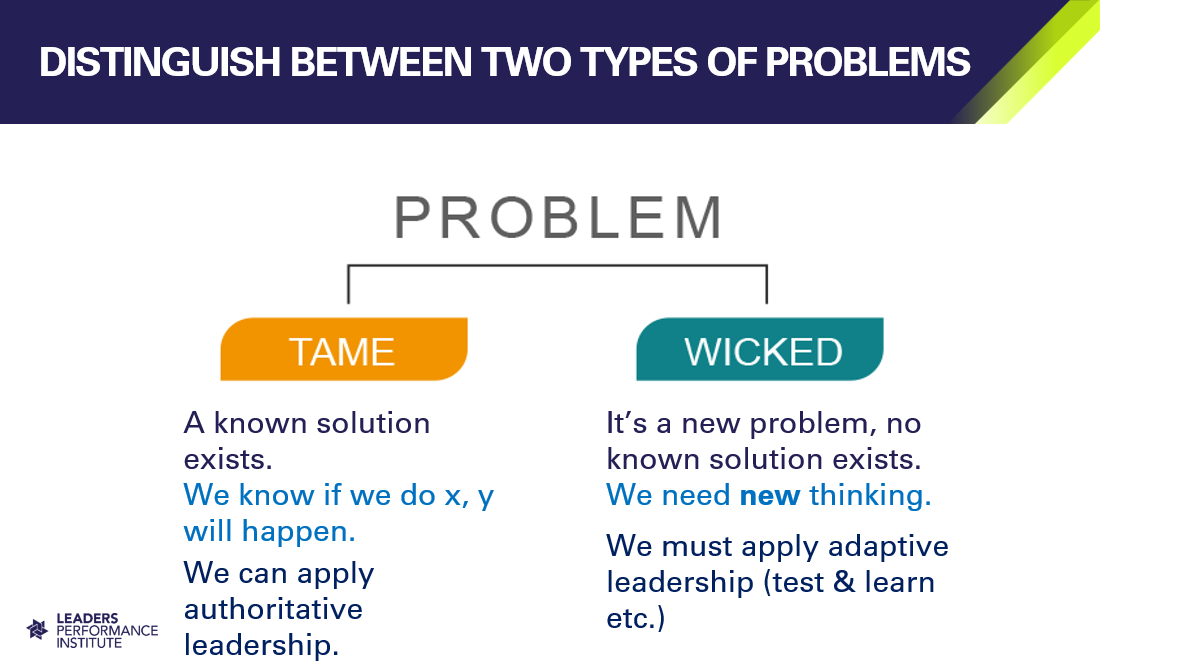
“The leadership required around a tame solution is very different to the leadership skills required around adaptive leadership and solving a wicked problem,” said Bull. “And where a lot of leaders and organisations get into trouble is where they treat a problem that is wicked as though it’s tame and they try and just implement a simple solution; and it doesn’t work or they try and ignore the problem.
“One of the key skills is how do we spot when we need to go into adaptive leadership mode?”
Again, attendees were asked to rank themselves on each of the eight suggestions:
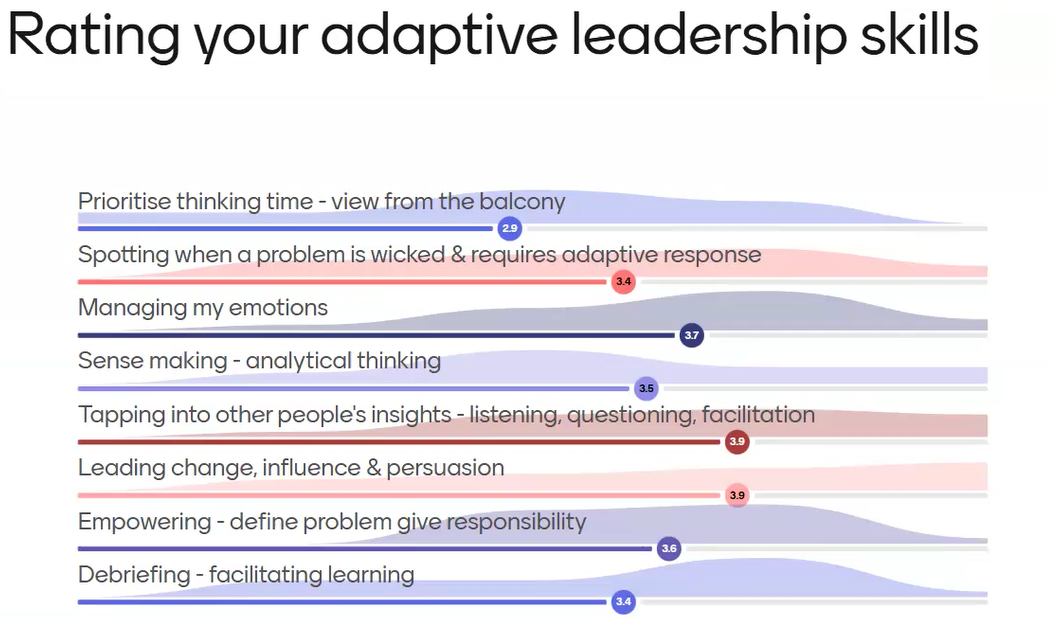
Bull believes the snapshot provided by the above bodes well for sport. “I’m struck, relative to outside of sport, how strong people are generally scoring on the ‘leading change, influence, and persuasion’,” he said. “That’s a positive strength to be able to bank here because, in our experience, and if you look at the research around this, that’s often the skill that most holds back adaptive leadership.”
To wrap things up, Bull shared eight tools to help leaders be more adaptive:
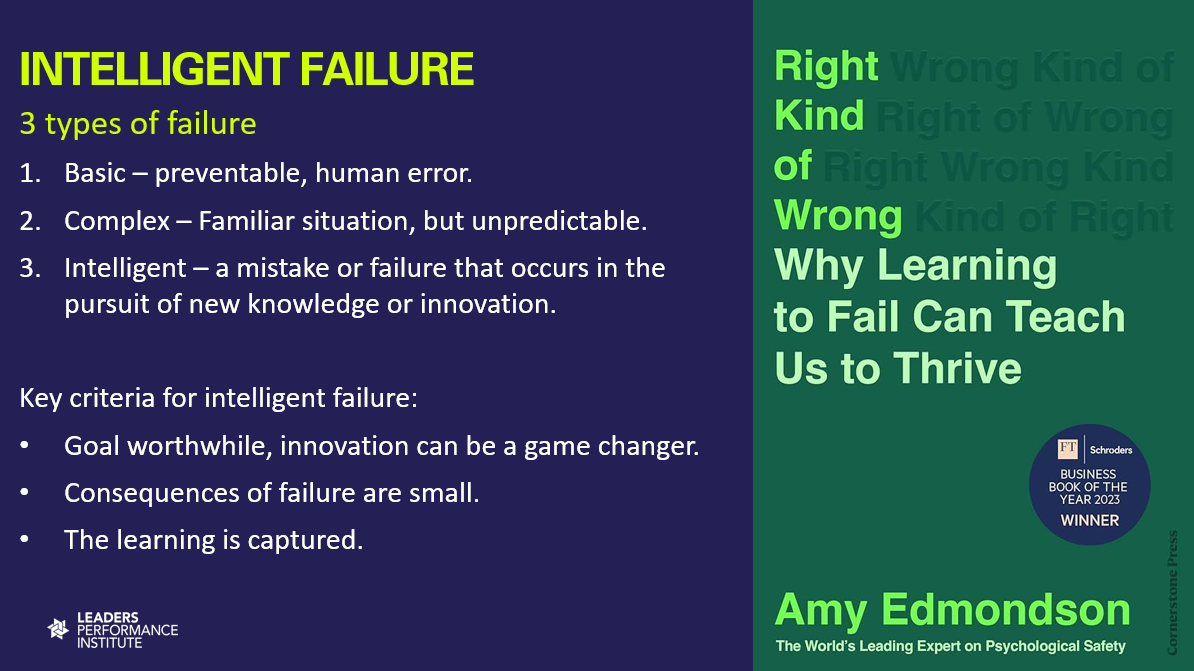
“So what she would say is in organisations that that have a more mature attitude to failure will find opportunities to do ‘intelligent failure’.”
In her book Right Kind of Wrong: Why Learning to Fail Can Teach Us to Thrive, Edmondson outlines three types of failure and the conditions for ‘intelligent failure’:
Final task
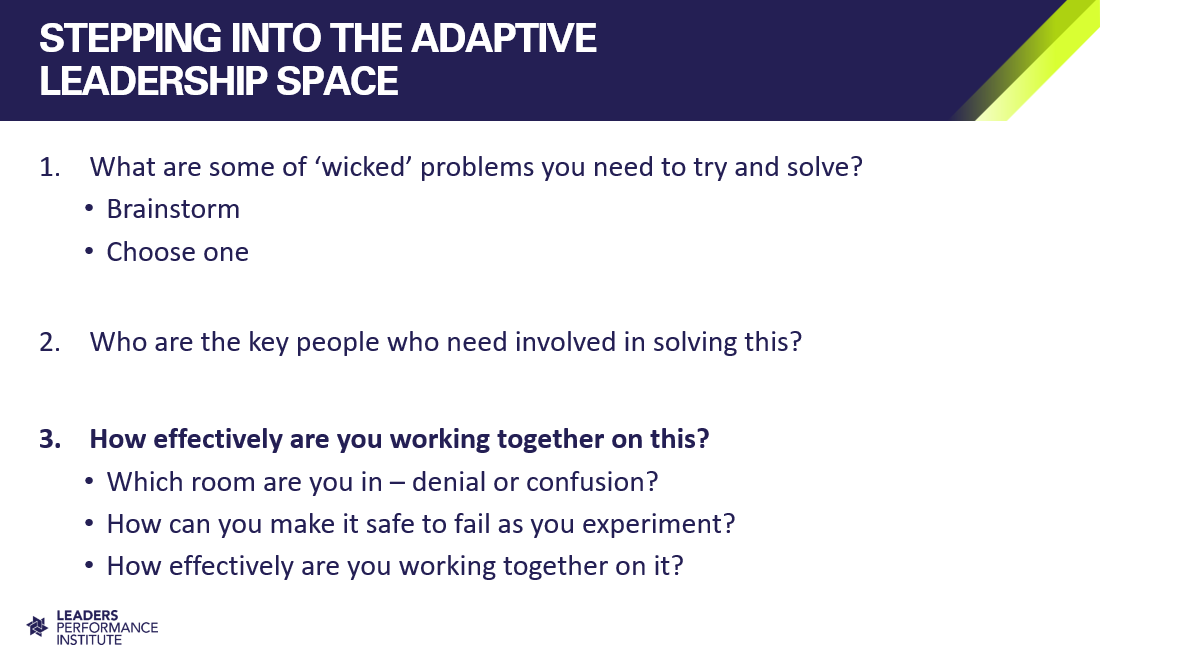
Bull concluded by setting the virtual room a task to consider in their own time:
What to read next

What sets apart an effective, efficient and successful high performance team in sport? Smart protocols, for sure. There’s plenty to be said about useful technology, too. But the overriding factor is the individuals who come together in service of the athletes.
“Our goal is to put the athlete in the centre and then we fit the jigsaw pieces around them,” says Simon Rice of the Philadelphia 76ers.
This universal goal has long inspired Teamworks’ efforts to support high performance teams in their delivery of personalised and unified support to athletes. We understand that because the jigsaw pieces often move, practitioners must be able to see the complete picture in real time as they make high-stakes decisions.
High Performance Unpacked delivers a snapshot of that world through the eyes of the specialists who grace this Special Report.
Beyond the NBA, we hear from the worlds of the English Premier League, NFL, WNBA, motorsport, Olympic and Paralympic sports and others.
We explore how high performance roles and structures are evolving; tackle the question of scalability, which often comes down to the ability of interdisciplinary teams to elevate the collective and surmount the growing complexity of high performance environments; we then shift the focus to athlete care and ponder where the balance needs to sit between challenge and support while asking how tech can be best leveraged to meet the athlete’s needs; lastly, we ask how tech and data set the stage for the innovations that deliver efficient and effective high performance programmes.
Complete this form to access your free copy of High Performance Unpacked: Interconnected Performance Teams.
3 Feb 2025
ArticlesThis month we touch upon the power of flexibility, relatability and collaboration in leadership and what you need to know to be better in each area.
Ideally, you found time for both and, here, we highlight a selection insights from the first month of 2025 that may help you to consider a problem in a different way or enable you to identify the right people to whom you can turn.
We hope to see some of you in Melbourne later this week for the Leaders Sport Performance Summit.
And, whether or not you can make it to the Glasshouse, here are five thoughts for all leaders to ponder.
If you can find new ways to consider your problems, it can open up new ways of thinking.
In this article, John Bull of Management Futures used the example of an elevator. Perhaps your goal is to make the elevator go faster, but what if your aim was to make the wait less annoying?
“Most hotels will put a mirror beside the elevator,” he said. “That seems to kill time when we’re looking at ourselves in a mirror.”
Bull suggested we “think of at least three different ways we could define our goal, to help open up new ways of thinking about the problem”.
He also share the STOP process for creative problem-solving:

In November, John Longmire called time on his 14 years as Senior Coach of the Sydney Swans. He has taken a new position as the Swans’ Executive Director of Club Performance but, before doing so, he reflected on his tenure as Senior Coach, which brought two AFL flags and four Grand Final appearances in total.
You can read his thoughts here, but here is a snapshot of his desire to remain “connected and relatable” to his players and staff. As he said onstage at November’s Leaders Sport Performance Summit in London, “the coach is no longer looked upon as being bulletproof” whatever their standing may be within the game.
His final speech to the players and staff as Senior Coach attested to that belief. He weaved in personal stories and his voice cracked at times. He wiped away tears too.
It called to mind the weekly ‘storytelling’ sessions that Longmire made a key feature of the Swans’ environment. He told the Leaders audience that players and staff share stories or complete a series of tasks for discussion each week. Recent examples included writing ‘a letter to your 16-year-old self’. These sessions are popular with players and staff alike.
“Sometimes it’s a photo of something that mattered to you and quite often there’s tears involved,” he said. “The way I looked upon coaching 25 years ago is completely different now – these 18, 19, 20-year-olds need to be able to relate to you. If you can show that you’re human, you get a lot more back.”
The question of team dynamics sits at the heart of The Social Brain: The Psychology of Successful Groups by Tracey Camilleri, Samantha Rockey and Robin Dunbar. The trio has spent decades observing the worlds of academia, business, and government as they look to better understand the workings of high-performing teams.
Camilleri and Rockey came to the summit in London to discuss how their research has its applications in the world of sport. Decision-making was one such area:
For decisions made at speed, you’ll count on five people.
Five is the number of intimate relationships a person can have. Rockey said: “These are the relationships that protect us, make us thrive, and ensure that we go through life in a joyful way. They protect us from ill-health and from some of the psychological challenges that we might have from feeling insecure.” They, of course, occur in intimate spaces.
For more complex decisions, you’ll count on 15 people (including your original five).
The ‘pain’ comes when you look to insert new thinking into complex decision making in a group space. “We spend about 60 per cent of our social time with just 15 people,” said Rockey. “With the 15 in the workplace, they would have built long-term relationships and loyalty to you over time – that’s how we work as humans – so breaking up those people to bring in new thinking is painful.”
According to Dunbar, the upper limit on the number of social relationships we can enjoy is 150
Dunbar suggests that people can have no more than 150 social relationships at any one time. “It’s a very stable number across all societies and cultures,” said Rockey.

From The Social Brain: The Psychology of Successful Groups by Tracey Camilleri, Samantha Rockey, and Robin Dunbar.
Young athletes are bolder in stating their desire for belonging and connection than their forebears, but this comes with a paradoxical demand for more personalised training and attention. There are clear implications for the time coaches spend on team dynamics in an era where the power has shifted to the athlete. The topic was discussed on a recent virtual roundtable. “Staff and coaches are more vulnerable,” said one participant, who pondered where the balance needs to sit. “Give the athletes a voice and a choice, give them ownership, have the consultation, but there is a line too.”
Another participant with experience of coaching in European football, highlighted that individual work will mean different things to different people and can be dependent on team selection. They argued that there is room for better management of expectations and, more broadly, a consensus for coaches and athletes alike on what constitutes ‘individual’ training.
In February 2024, the England & Wales Cricket Board launched its Insight 360 platform, which adopts a data-driven approach to athlete and performance management.
Ahead of the launch, the ECB gathered input from practitioners and coaches across the English game. “This means Insight 360 is bespoke for women’s cricket,” said Anna Warren, the Head of England Women’s Science & Medicine. Players, she said in this article, are happy with an app that allows them to review their own data in as much detail as they like. “This is good for player buy-in, which is always a challenge in relation to athlete monitoring.”
There is also the power of a co-designed project. UK Sports Institute have found as much with their Project Minerva. Dr Richard Burden, the UKSI’s Co-Head of Female Athlete Health & Performance, said: “Get the practitioners involved, get athletes, get the teams and bring them along with it because if they’re onboard you get easier access to them and you’re going to produce something that’s more translatable, meaningful and applicable to them.”
Warren is on the same page with Insight 360. “You can link loads of different data sources together and start to answer some key performance questions – we’re not looking at everything in isolation.”
John Bull of Management Futures sets out where sources of disruption may prove useful for you and your team.
In answering that question, one must consider “the best sources of disruptive thinking in our environment and in our sports,” as John Bull put it.
The Director & Lead for High Performance Research at Management Futures hosted a recent Leaders Virtual Roundtable on the topic.
Bull went on to suggest nine useful habits of disruption that any team can use, but he began by posing another question: where is disruption useful?
“How open are you to disruption and how proactive?” asked Bull, who added that he thinks the answer is often situational.
“I want to put an emphasis on the word ‘useful’; and the balance between disruption and stability is really critical. I think disruption can be really negative if it tips it over into disrupting everything.”
The nine habits
Bull identified nine habits that help to ensure that disruption is useful in your context.
On that last point, cognitive diversity is important because it allows for a wider range of perspectives and approaches to problem-solving, leading to more innovative solutions, faster decision-making, and a greater ability to adapt to change within a team or organisation.
Bull then referred to the work of MIT professor Alexander ‘Sandy’ Pentland:
“If you look through human civilisation of the last 10,000 years, the pattern Sandy Pentland keeps finding is that you’ll see a core team of people who know each other incredibly well; where cohesion is really high. But what they do is frequently connect with outside stimulus. There needs to be a team with a lot of cohesion, but they need to be getting external stimulus. And the question is: where are you getting that external stimulus from?”
You should, as Bull said, be constantly updating your ‘mental map’. Video rental firm Blockbuster, for example, could have taken the crown currently held by Netflix with more proactivity when streaming came to prominence.
Remember:
If the pace of change in your environment is slower than the pace of change in your external environment, your competitiveness will be going backwards.
Bull cited the OODA Loop (Observe, Orient, Decide, Act) which is commonly used in the US military. He spoke specifically of the Observe and Orient phases:
Observe – taking stock of how are world is changing
Orient – thinking about how we should respond
Bull had the All Blacks in mind here:
“Their best periods have always come after a crisis. Actually a crisis for the New Zealand All Blacks is typically if they lose three games in a row.”
Do you have an innovation department or people who can regularly keep themselves in that head space? Bull returned to the theme of front-foot and back-foot innovation and the importance of proactively identifying opportunities for improvement.
Ask yourselves:
Amy Edmonson, the psychologist behind the theory of psychological safety, discusses ‘intelligent failure’ in her new book, Right Kind of Wrong.
Of this idea, Bull said:
“We talk a lot about the importance of failure. What Edmondson brought to that debate is, yes failure is important, but it has to be failure where it’s safe; where the stakes aren’t high. So it’s finding opportunities where you can fail where there aren’t bad consequences.”
Bull suggested four steps to help with contingency planning:
As Bull said:
“If you develop a plan but don’t test it, people don’t tend to use. It is one of the things we’ve noticed through research at Management Futures.”
Bull cited science-based technology company 3M as a prime example of systemised disruption. “They have a mechanism that says 25 per cent of their profit needs to come from products introduced in the last five years,” he said.
Peer coaching questions
Bull wrapped up the session with some peer coaching questions:
What we learned about turning underperformance into success at the Leaders Sport Performance Summit.
An article brought to you by our Event Partners


A rich seam of answers ran through both days of this month’s Leaders Sport Performance Summit at the Kia Oval in London.
We listened to speakers from various sports organisations discuss their responses to setbacks. Teams including Chelsea, Racing 92, Harlequins and the Sydney Swans laid it all on the table. Several explained how they managed to turn things around.
Stephan Lewies, for example, captained a Quins team to victory over Saracens in October; their 17-10 win ending a miserable run of eight consecutive defeats to their Premiership rivals.
“Coming off a record like that,” said the South African lock, “you often look for answers in the wrong place.” Lewies explained that season after season Quins would change their usual approach when facing Saracens. This season they stuck to their guns and it paid off.
“When the pressure came on in this game, [we turned to] something we’d done for the whole season, for years previously, versus something new in the pressured moment.”
Kudos to Quins, but neither they nor anyone in sport has dealt with the difficulty of landing a probe on Mercury or the conundrum of trying to thaw a microscopic strand of ice on the lens of a space telescope 1.5 million km from Earth.
For Carole Mundell, the Director of Science at the European Space Agency [ESA], such stories represent another day at the office. Crisis after celestial crisis is routinely averted on Mundell’s watch by some of the brightest minds in astrophysics.
Of ESA’s triumphant run-in with the intrusive ice, she said: “Data gives you information. Information gives you knowledge. Knowledge only gives you insight and wisdom for action if you really understand what it’s telling you and how to interpret it with your own experience on top of that.”
Mundell feared impostor syndrome when stepping onto the Oval stage but her words instantly resonated with an audience of coaches and practitioners.
They also lead us nicely back to our original question: how do you turn setbacks into springboards? We bring you six interrelated smart tips from across both days of the summit.
1. Find the right skills to help you in a crisis
How does it feel to be under the cosh in your role? What tools do you lack in those moments? Carole Mundell has allowed herself to be shaped both by the crises she’s confronted and the organisation she leads. Instinctively, she’s a creative scientist, a physicist with the urge to investigate independently. Yet her work at ESA requires her to think like an engineer and commit to the team; these newly acquired skills have proven crucial in moments of crisis.
Carole Mundell
2. Seek key allies above you
Racing 92 were treading water in France’s Top 14 league when they appointed Stuart Lancaster as Director of Rugby. Lancaster, whose tenure began in 2023, was hired to transform their fortunes, but faced considerable obstacles. Language was one, culture another; he also knew he’d be working under his predecessor, Laurent Travers. Nevertheless, Lancaster felt that he was “pushing on an open door” thanks to the quality of his coaching work with England (2011-2015) and, in particular, Leinster (2016-2023).
The big question he asked himself was: should he tiptoe in or smash down the door? As Racing’s revival required more than a cosmetic makeover, he opted for the latter. With the help of his French coaching staff, Lancaster introduced a new working week, a new playbook, and called time on Racing’s long lunch culture. He could disregard those who labelled him an ignorant ‘Anglo-Saxon’ thanks to the relationships he forged with Travers and the Racing board.
Stuart Lancaster
3. Who are your key influencers?
The Sydney Swans had to dust themselves off following their 2022 AFL Grand Final defeat. John Longmire, who this week stepped down as the Swans’ Senior Coach, led them back to the Grand Final again this year. Since leaving London, he has handed the reins to his assistant Dean Cox, who will renew the team’s fight for a first flag since 2012. The factors that propel a team one season will not necessarily apply the next, but Cox is sure to emulate Longmire in learning and applying the lessons from another painful defeat. In dealing with setbacks, Longmire always leaned heavily on the key influencers in his “ecosystem”.
John Longmire
4. Don’t be afraid to let the wrong people walk away
When Chelsea won the Champions League in 2021, the club would not have expected to slump to a 12th-place finish in the Premier League just two years later. Nor would they have predicted the organisation narrowly avoiding oblivion and a subsequent change of ownership. Bryce Cavanagh was hired as Performance Director in the summer of 2023 and, while he has long been considered one of the best in the business, an arduous task awaited him.
He admitted his presence created a sense of risk and vulnerability in some quarters, but he was fair in setting out his stall. Some relished the challenge of staying to help build a fresh performance strategy (a work in progress, he admitted), but others sought roles elsewhere. Cavanagh was willing to let them go.
Bryce Cavanagh
5. Have the difficult conversations quickly
As captain of Harlequins, Stephan Lewies regularly faces difficult conversations. They are of added importance when the chips are down and tempers are frayed. Time and again, as Lewies explained, he has been able to plot a path out of disharmony by being proactive, acting fast and ultimately putting the team first. A leader should also strive to understand multiple points of view without leaping to conclusions.
Stephan Lewies
6. Prioritise your stress and emotional responses
Success and failure both present psychological and emotional challenges. In 2021, the UK Sports Institute introduced its ‘Performance Decompression’ tool to help athletes and support staff transition back to daily life following intense competition periods. The tool consists of four phases: first there’s the post-event ‘hot debrief’ followed by ‘time zero’, which, as the UKSI website explains, focuses on ‘restorative care in a soothing place’; then it’s ‘process the emotion’ and, finally, a ‘performance debrief’.
The tool can be used anywhere. British 1,500m runner Jake Wightman, for example, chose a sofa in a Twickenham café to unpick his underperformance at the Tokyo Olympics. A year later he was world champion and, while there was much more to it, psychologist Sarah Cecil believes the tool helped Wightman to plot his comeback. She and the UKSI’s Head of Performance Psychology, Danielle Adams Norenburg, are also happy to teach their tool to any individual or organisation who may find it useful.
Sarah Cecil
25 Nov 2024
ArticlesSo says Fabio Serpiello of Central Queensland University, who explains that innovation will remain elusive if all the technology does is complicate your problems.
Your answer is likely to be governed by your levels of confidence in a tech modality, which will be influenced by its accuracy and reliability, its ability to help deliver insights, and its applicability to the performance problem at hand.
In the second session of this three-part virtual roundtable series titled ‘How to Approach Innovation’, Professor Fabio Serpiello, the Director of Sport Strategy at Central Queensland University, led a discussion on how coaches and practitioners might employ a decision-making framework to inform how they use technology to innovate.
“I think we’re on a plateau in tech when it comes to innovation,” he told the virtual roundtable. “Technology needs to solve problems for the decision maker. The definition of ‘innovation’ is finding new ways to solve problems. Technology needs to support the decisions you make – if tech is not supporting that, then you have a problem.”
This session explored David J Snowden and Mary E Boon’s Cynefin Framework to help attendees better understand and define both their innovation challenges and the role technology might play in solving them.
Software: the difference-maker
Serpiello contemplated the future and is in no doubt where tech will best aid innovation work. “If you look at hardware or software, there is some cool innovation coming in the hardware space with patches and smart materials,” he said. “But I think the future is in the software.”
He feels that effective software will be defined by its ability to:
The Cynefin Framework
Serpiello spoke of his efforts to find a framework for decision-making and adapting it for tech in the world of sport. He alighted upon the Cynefin Framework.
‘Cynefin’, which is pronounced ‘ku-nev-in’, is a Welsh word that signifies ‘the multiple factors in our environment and our experience that influence us in ways we can never understand,’ as Snowden and Boon wrote in their 2007 Harvard Business Review essay titled ‘A Leader’s Framework for Decision Making’.
The Cynefin framework, they continued, ‘helps leaders determine the prevailing operative context so they can make appropriate choices’.

Source: HBR
Snowden and Boone identified five operative contexts – simple, complicated, complex, chaotic and disordered. Serpiello touched upon each:
Simple
Simple contexts are stable and one can observe a clear cause-and-effect relationship (although there is a risk of oversimplification). “Your job as a leader is to make simple, quick decisions based on categorising the information available to you,” said Serpiello. “The technology that we use in the simple domain should be able to categorise information and communicate it easily.”
Complicated
Complicated contexts are the world of known unknowns; multiple right answers exist, but they require analysis. Serpiello said: “Your job as a leader is to sense, analyse and respond” and “the tech in this space needs to be focused on analysing the environment and then communicating a response”.
In Serpiello’s opinion, training falls between simple and complicated from a decision-making point of view. “The majority of what we do happens in training and it’s where we can control the most variables,” he added.
Complex
Here, there are unknown unknowns; and cause-and-effect relationships are only apparent in hindsight. “Most sport competition is complex,” said Serpiello. “You have relationships between athletes, coaches, the environment, the scorelines etc.”
Here, “your role as a decision maker is to probe the environment, sense, and respond,” he continued. “So probing, as in inserting something into the system to get a reaction, to get an answer – technology should be able to support that.”
Chaotic and disordered
These are domains of no clear cause-and-effect relationships and high turbulence. “In a chaotic environment,” said Serpiello, “you act first, then you sense, then you respond”. This tends to refer to catastrophic events, although if an athlete failed a doping test, for example, the team may be thrown into chaos and disarray.
“If you’re using tech, it needs to be able to support your quick action. So I don’t think it applies often in performance,” he added. “So, in my opinion, performance happens between a simple, complicated, and complex environment.”
Load monitoring: from the complex and complicated to the simple?
Using load monitoring as an example, Serpiello explained how tech use in the complicated or complex domains can lead to confusion and leave decision-makers overwhelmed.
“Most of this technology is sold to us as allowing you to do complex stuff, complex analysis, 100 metrics,” he said, “and you collect all this data, but perhaps it’s not the right way to use it.” Instead of focusing on sensing and analysing, “tracking technology should be used in a simple decision-making framework”.
He emphasised that technology should simplify decision-making rather than complicate it; and perhaps load monitoring technology currently has its best application in categorising the outcome of drills. “Your athlete management system tells you ‘yes, you’ve met this goal’ or ‘no, you haven’t’,” he added.
Serpiello also suggested that once the simple aspects were well-managed, organisations can then explore more complicated or complex analyses. “Is the decision maker at training – the coach – actually making the right decision with their tech? I don’t know.” He explained that he would use the aforementioned frameworks if he were a coach. “I would use an innovation framework first to inform the performance challenges and a decision-making framework to say, ‘OK, do we actually have the right tech for the right decisions?’”
Final thoughts
Can technology help define problems more effectively? By leveraging technology, perhaps a coach or practitioner can identify the necessary expertise and perspectives needed to tackle their challenges.
Sustained innovation may appeal for its perceived lower risks, but it is important to first define the problems you face. With this in mind, should the focus, in fact, shift to better research?
There is immense value in engaging external experts who can provide different viewpoints on interpreting data and findings.
The Cynefin Framework can help people to organise their thoughts around decision-making and technology. It also allows for a better understanding of how to align technology with the specific needs of their environment.
Further reading
‘Innovation’ Means Different Things to Different People – No Wonder Progress Can Be Hard to Track

We discuss the Cynefin framework and how it can help coaches to adapt their behaviour and their decisions.
In time, the coach transforms the fortunes of their team and it sparks a wealth of imitators who try to mimic their winning ‘philosophy’. Think Bill Belichick, Dawn Staley or Pep Guardiola: big personalities whose decisive actions (and coaching talent) have led to sustained success.
In their 2007 Harvard Business Review essay titled ‘A Leader’s Framework for Decision Making’, David J Snowden and Mary E Boone did not discuss sport, nor did they use the word ‘philosophy’, but they did reference leadership ‘recipes’ that tend to ‘arise from examples of good crisis management’. In that sense, sport and business are similar.
Snowden and Boone believed this trend was a mistake and not only because crises are rare. ‘Leaders who are highly successful in chaotic contexts,’ they argued, ‘can develop an overinflated self-image and become legends in their own mind’.
Snowden and Boone’s treatise lodged in the mind of Peter Brown, the Assistant Director of Workforce and Organisational Development at NHS Wales’ Aneurin Bevan University Health Board.
Brown, who spent a decade working in high performance sport, most notably at the UK Sports Institute, came to Leaders Meet: Teaching & Coaching at Millfield School in April to discuss problem-solving in organisational contexts.
As he explained, “the problem with problem solving is this phrase: problem solving”. No two problems are the same; some have solutions, some do not, and the context is different each time.
Instead, Brown advocates moving towards “sense-making”. He said: “Sense-making is about our understanding; everything that’s going on around us; orientating ourselves within that and then moving towards action”. It encompasses analytical thinking which, as he reminded the audience, was listed No 1 in 2023 by the World Economic Forum Future of Jobs report on their list of essential skills for the next five years.
One of Brown’s favoured sense-making tools is Snowden and Boone’s Cynefin framework (outlined in their essay). Cynefin, which is pronounced ‘ku-nev-in’, is a Welsh word that signifies ‘the multiple factors in our environment and our experience that influence us in ways we can never understand’.
The Cynefin framework ‘helps leaders determine the prevailing operative context so they can make appropriate choices’. Snowden and Boone identified five operative contexts – simple, complicated, complex, chaotic and disordered – but argued that few leaders are adept in more than a couple.
‘Many leaders lead effectively – though usually in only one or two domains,’ they wrote, ‘and few, if any, prepare their organisations for diverse contexts’.
Onstage, Brown explored each in turn.
Simple
Simple contexts are stable and one can observe a clear cause-and-effect relationship. The risk with simple problems is that they risk being incorrectly labelled as such due to oversimplification. ‘Leaders who constantly ask for condensed information, regardless of the complexity of the situation, particularly run this risk,’ wrote Snowden and Boone, who also referred to ‘entrained thinking’ when leaders are closed to new perspectives.
Of the risk of bias, Brown said: “If I’ve only got my own experiences to fall back on I’m going to interpret [problems] in a way that is predetermined.”
Things may well be running smoothly, with each and every problem presenting a simple solution, but there is a risk of complacency, a drop-off in performance, and a descent into chaos. “It’s really important to get the voices of others,” added Brown. Belichick, Staley or Guardiola may seem like auteurs, but they all have their trusted assistants.
“We want to make sense of our world and get all these different perspectives; when someone says something to you, what else are they thinking? What else aren’t they telling you? Then multiply that by the people in the room.”
Complicated
Complicated contexts are found in “the realm of good practice” said Brown. “There’s still a right answer but you might not know it at that particular time. There might be better or worse ways of getting the same thing.” He cited altitude training for athletes as an example: you could arrange an alpine camp, set up altitude tents, or use a combination of both.
In their essay, Snowden and Boone explained that entrained thinking is also a risk in complicated contexts but ‘it is the experts (rather than the leaders) who are prone to it, and they tend to dominate the domain’. Sense-making can fall by the wayside. ‘When this problem occurs, innovative suggestions by nonexperts may be overlooked or dismissed.’
Complex
In complex contexts, “the cause-and-effect isn’t knowable except in retrospect,” said Brown. “What works here may not actually work somewhere else because the conditions are different.” It is again incumbent on the leader to create the conditions that enable the team to move forward. ‘Instructive patterns,’ wrote Snowden and Boone, ‘can emerge if the leader conducts experiments that are safe to fail’.
“In this space, you just start putting things in place,” added Brown. “We call them ‘enabling constraints’. A constraint is not always something that stops things.” A coach, he said, might request that a wall be removed in a changing room to reduce the walking distance to the training pitch. “That’s an example of something in complexity to see if it makes a difference; to see if a pattern of behaviour emerges.”
Again, there are risks in complex contexts. Snowden and Boone warned of ‘the temptation to fall back into traditional command-and-control management styles’.
Chaotic and disordered
Chaotic contexts are scenarios where, as Brown said, “all hell has broken loose – here you want to try to take swift action to try to nudge us into something else”. The leader, as Snowden and Boone argued, must strive to find order, work out what is stable and what is not, and work to shift from chaos to complexity as ‘the identification of emerging patterns can both help prevent future crises and discern new opportunities’. Again, they must approach the chaos in an egoless fashion.
Finally, Brown touched upon disordered contexts. These probably require the least explanation. “You just try different things, try to gather information, try to understand where you might be sitting,” he said, adding in jest, “that’s where I tend to be most of the time.”
The key is the leader’s behaviour. As Snowden and Boone wrote: ‘Truly adept leaders will know not only how to identify the context they’re working in at any given time but also how to change their behaviour and their decisions to match their context’.