In a recent Leaders Virtual Roundtable, members discussed how their team cultures are evolving, with one readily embracing the global hit Bluey in its pursuit of performance.
“We used an episode to bring to life our ‘embrace change’ value,” said the team’s performance lead at a recent virtual roundtable.
It made sense. For one thing, the eponymous character, an Australian cattle dog (known colloquially as a Blue Heeler) puppy, is cute; secondly, the show’s themes of self-development and selflessness resemble the values often espoused in dressing rooms.
With his fellow Leaders Performance Institute members smiling, the performance lead explained that his playing group had gone as far as creating a ‘Rusty Award’, which is named in honour of Bluey’s friend Rusty, an Australian kelpie, to celebrate teammates.
He continued: “At the end of each camp, the players pass the Rusty Award to whoever they think has either embodied our values or has been a real good person around their teammates over that camp or weekend.”
That insight set the scene for a conversation on how members believe their own team cultures are evolving; what is working well and where the opportunities lie.
This is a snapshot of what they shared.
Firstly, there are five things that most teams on the call tend to do well:
1. Articulate their values in a resonant way
Values have to be more than words on a wall.
“Having consistent language has worked well for us,” said the aforementioned performance lead. “We have three values or pillars – ‘embrace challenge’, ‘evolve yourself’ and ‘enjoy the ride’ – and the coaches and support staff have been forthright in using that language within sessions so that the players can always draw back to that.”
A performance support specialist from the Australian Olympic and Paralympic system spoke of her organisation’s renewed emphasis on transparency.
“We’re trying to communicate to athletes as frequently as we can to drive that connection,” she said. “If they feel like they’re well informed and they’re part of the planning, they can also hear reflected back to them things that they have potentially asked for in our feedback mechanisms.”
“We can’t leave any of this for chance,” added a head of coaching and development from the British system. “How intentional can we be with spending time on it? To start to label things so they aren’t subject to misinterpretation?”
2. Inspire personal accountability
It is a question of the standards you walk past being the standards you’re prepared to accept, whoever you are.
“That starts with leading yourself,” said the performance support specialist. “You’ve got to be able to look after yourself before you can look after your teammates.”
“When are we nudging?” said the head of coaching and development. “When are we realigning and checking and challenging the behaviours that we do not want to see or may not be in line with our desired options?”
3. Make their people feel safe
Whether you encounter resistance from long-tenured staff or you are dealing with rapid turnover, your people must feel that you are listening to them.
“Listen to the system and the system will tell you what it needs,” said the performance support specialist, adding, “I think a large part of where culture can get derailed is where people don’t feel heard and valued.”
In response, a sports scientist spoke of their institute’s desire to engender a collective sense of belonging in the pursuit of innovations.
“It’s allowed people to feel like they can make another level of contribution,” she said. “It opened the door in ways where some of our different support team members and our coaches have been given an opportunity to talk about their ‘why’ and talk about their own attachment to our values.”
From that place of interpersonal safety, teams and team members are ready to tackle the issues of the day, even if they end up down “rabbit holes” as an athlete support officer working in the UK system put it.
The first step is to establish the performance question. “That enables us to have challenging conversations without it feeling personal”. Then you must “make sure your people have the ability to express themselves, bring new ideas, problem-solve and make decisions and add their own flavour.”
3. Try new things in low-risk settings
Comfort in risk-taking cannot be separated from notions of accountability, belonging and safety.
“We have benefited from a strong, overt, and repeatedly iterated attitude from our new director and leadership team to take on and try new things,” said one long-tenured attendee presently adapting to new management at a new practice facility. “There’s a sense that we’re not writing a new story but a new chapter.”
4. Celebrate their people
The Rusty Award is a prime example, but gestures can be just as important.
“A lot of people probably perceive working on your culture as a grand gesture moment,” said one attendee, “whereas the little gestures and the little interactions matter way more because they stack and pound over time”.
On top of these encouraging signs of progress, there are three areas where teams can further strengthen their culture with simple tweaks:
1. Celebrate progress, not perfection
“I like to celebrate our imperfections and reframe expectations to give the team belief in its potential,” said a performance support specialist based in Australia. “We say pressure is a privilege, but expectation can sometimes make culture deteriorate because of the pressure and expectation to perform or to behave in a certain way.”
2. Focus on the small interactions
“Corridor conversations are key,” said the athlete support officer, “and I think we forget the impact that they can have.”
3. Keep challenging your assumptions and biases
One attendee suggested red-teaming, which is the practice of stress-testing ideas. He said: “How do we check our blind spots? How do we identify them? How do we systemise those processes?” Doing so is important because “what don’t know what we don’t know”.
What to read next
Everton’s Head of Sport Science Jack Nayler concludes his exploration of complexity in sport by outlining what it takes to be resilient and adaptable under pressure.
We also looked further at the implications for this in a sporting organisation, notably that complexity is fractal, exists at different levels, and that each person within the organisation will exert different levels of influence over the performance at any given moment.
Last week, I began to look at what this means for those in leadership positions.
Leadership in complexity requires you to have the humility to accept the ignorance of your position and the understanding that autocracy won’t work. It is impossible to micro-manage every decision in the fast pace and short turnaround of games in a professional sports season. You will not be present to control every interaction that occurs and you will not possess all of the information available to make every decision.
With the inherent fluctuations that occur in a complex environment, it is incumbent on the leaders to provide a framework within which everyone can operate, as effectively as possible, in a transdisciplinary manner.
I believe there are four pillars to this framework, that are characteristics of high-performing environments.
Your role as a leader is to ensure that these are in place so your team operates as effectively as possible.
I explored the first two pillars here. Let’s now delve into the third and fourth pillars below.
The complexity of the sporting season ensures that as results wax and wane so will pressure and external noise. The processes you have in place need protecting from this pressure and the associated emotion.
For some simpler tasks and processes you can have checklists or flight manuals where processes can be recorded, ratified and referred back to (1). However, these only go so far and will be less useful as the complexity dials up.
When you and your staff are committed to helping the team perform, it is easy (or just human nature) to become overly emotional about performances (both positively and negatively), and this can leach into your decision-making processes. Leaders need to be aware of the propensity for this as well as the influence of subconscious bias on any decision making (this is a wider topic than the scope of this series but a good place to start is Thinking Fast and Slow by Daniel Kahneman, 2). Setting up your team/environment to reduce the effect of these factors is key to leading your team effectively.
As the leader, with your wider viewpoint and greater access to those higher up the organisational hierarchy, you should have a greater appreciation of the pressures you and your team face. As emotions tend to affect quality decision making, it is your job to be judicial over which pressures you allow to filter through to your team and which you will bear.
Objectivity must become a cornerstone of making decisions. We need to collect data on the subject (player or situation) over which we are trying to make a decision. This data then needs turning into information (tables, graphs and other visualisations) by adding context (use of appropriate statistics) to help the reader understand the magnitude of any effect. This information turns into knowledge when the reader reflects on the new information, with respect to what they already know and understand.
As we have discussed, each person will have their own unique take on a given set of information. Organisations that can successfully make the leap from individual to organisation level knowledge will be better prepared to perform in complexity.
The threat to an organisation if knowledge sits siloed with individuals is two-fold. Firstly, the quality of the decisions being made will fall and secondly the organisation is fragile to an individual leaving and removing the intellectual property (IP) from the building.
I believe the threat to the organisation is greater from the loss when IP walks out of your facility, than if that person was to be employed by a rival team. As each organisation is its own complex mix of culture, practitioners and athletes, it is difficult to transfer tacit knowledge from one environment directly into another.
Once you have objective information around which you can make decisions, you can begin to plan what you and your team will deliver. This planning process provides a framework for everyone involved to work within and should remain just that: a framework. Remember that in complexity the person closest to the action has the most information in a given moment. This framework provides a set of parameters that act as a fallback, against which new information can be assessed. In the moment, under pressure, this framework coupled with a clearly understood direction of travel from you as leader should help the practitioner on the ground make a better decision.
As the outcomes of the decisions we have made as a team become apparent our framework can become the basis against which we can reflect and review the decisions made, by providing a reminder of the conditions as they existed in that moment. This again helps to objectify the review process and fosters a culture of psychological safety (3).
Understanding the complex nature of this environment has helped me to appreciate that we cannot get everything right all of the time (remember there is never a perfect game) and my first thought when things fall down is: how could I, as an intrinsic part of this complex system, have acted differently through the process to have affected a better outcome? This helps me to remain less emotional when analysing failures as and when they happen. I do this before turning my lens outwards to think how we could have done better as a team.
The fact that complex systems are never perfect and we cannot predict outcomes with 100% accuracy creates uncertainty. In their book Radical Uncertainty, John Kay and Mervyn King describe uncertainty as “the result of our incomplete knowledge of the world, or about the connection between our present actions and their future outcomes.” (P. 13, 4). We need all members of the team to understand that although this space is uncertain, performance will emerge from it.
There is then a gap that exists between our expectations and the outcomes. Acknowledging the inevitable existence of this gap allows the leader to be more sanguine and less frustrated by it, putting us in a better headspace to explore why the gap exists like it does and how we can narrow it in the future. I see little point in the wasted energy that would be spent railing against this gap’s existence. Rather I see this gap as the learning space, a space to be curious about. It is the space where the information mentioned in the previous section becomes knowledge.
When we reflect on information in the context of what we already know, we develop our knowledge base. This should then spark off further questions as to why we ended with the result we did, restarting the cycle back to collecting more data. This process is critical in the complex world. As the system shifts and changes, so do our levels of expertise (5). Further, knowledge developed in other environments and populations diminishes in power the further away from that population it moves. The most powerful learning will come from research done in our own group of athletes. This should be a mix of quick and dirty in-house enquiry and more formalised research carried out with partner universities and led by in-house research and development departments.
You also need to lead your team into this gap by putting in place structures that allow your team the time and space for reflection. We are really good in team sports at planning and doing, before all too soon the next fixture rears its head. You need to be intentional about reflecting and reviewing. Reflecting skills can be learnt and should be fostered amongst your team. Make reviews normal and model behaviour by openly reviewing the things you personally have done and seeking feedback. This normalises the feedback process and creates space for you to feedback to your team members more easily (6). Mix regular small hot reviews in the moment (7) with more analytical, larger reviews. In these, review a specific subject (e.g. grade 2b hamstring injury rehab) as opposed to generalised time periods (e.g. pre-season). Signpost your reviewing – create a structure or framework around how you want to reflect and share it with the team ahead of time. Your team should then turn up in the spirit of reflection, rather than having it sprung upon them. Most critical of all is to have concrete outcomes that everyone is aware of and can be held to.
The second space we need to be mindful of as leaders is the space from which the performance of our team emerges.
In 2012, Google embarked on a large study to try and discover what made a successful team within their organisation, they called it Project Aristotle (8). Google studied 180 teams from across the business and looked many combinations of factors (e.g. personality traits, emotional intelligence, demographics and skillsets of team members) that they hoped would indicate levels of learning and performance. Whichever way they crunched the data, they could find no pattern as to what would bring success. Some of the factors that did not influence team success intuitively sounds like items that would be important when trying to build a successful team:
Eventually the researchers looked away from the hard skills and instead looked at interactions between team members, driven by the work of Amy Edmondson, Professor of Leadership and Management at Harvard Business School. Professor Edmondson’s research has also studied effective teams and the work at Google confirmed her theories. The number one factor that will describe team success is termed psychological safety, which she describes as “a shared belief held by members of a team that the team is safe for interpersonal risk-taking… a sense of confidence that the team will not embarrass, reject or punish someone for speaking up” (P. 354, 3).
A psychologically safe environment is one which recognises that the space between the components of the complex system is where the magic happens and works to ensure that all members of the team can lean into said space.
In a complex world, we cannot see the connection between our decisions and their future impact, we only make sense of them with hindsight. As the author Robert Louis Stevenson said: “The worst historian has a clearer view of the period he studies than the best of us can hope to form of that in which we live. The obscurest epoch is to-day.”
However, there is evidence to suggest that better predictions and decision making come from cultures that “harness the power of collectives and encourage diverse opinions, perspectives and collaborative teamwork” (9).
The challenge we face when leading in an increasingly complex world is that it is constantly shifting in front of us, and we only see what is happening through our lens. There are a whole host of things we cannot see and second and third order effects that we cannot predict. Therefore, any time we take an immovable position or opinion, we are also opening ourselves up to being incorrect.
As leaders these positions, either polarised, immovable (or worse, both) are dangerous places to be. This is demonstrated by the work of Philip Tetlock, summarised in his book, Expert Political Judgement: How good is it, how can we know? Over a nearly 20 year period Tetlock ran forecasting tournaments with 284 experts from a variety of fields, leading to 28000 predictions (10).
Experts were only slightly more likely than chance to be correct, however the interesting part was in discovering that how the experts thought was more important than what they thought when it came to the accuracy of their predictions. Tetlock characterises these two styles as Foxes and Hedgehogs after the title of an essay by the philosopher Isaiah Berlin, based on a quote by the Greek philosopher, Archilochus: “a fox knows many things, but a hedgehog knows one big thing”.
When the hedgehog is challenged, they curl up in a ball with their spikes out to deflect the world. It is the same with the experts, their position is immovable, and they deflect critique. Experts who were more fox like were less sure of their predictions and more willing to change them as events unfolded. Foxes were more likely to be accurate in their predictions than hedgehogs in the long-term. Hedgehogs had the potential to be more precise, but with a much greater chance of being wrong. When dealing in complex environments, when you are wrong, you have the potential to be spectacularly wrong.
By contrast, foxes will recognise that they do not have a complete perspective and therefore not all of the answers. They will lean into the space between themselves and others, inviting their perspective and collaboration, seeking to co-create solutions for the best possible outcome.
To develop a climate in which foxes can flourish, we must create psychologically safe environments that protect the space between the members of our teams as sacred and encourage them to lean into these spaces to collaborate and provide diverse perspectives. Edmondson (3) describes it as “a team climate characterized by interpersonal trust and mutual respect in which people are comfortable being themselves.”
This process takes modelling from us as leaders. If we cannot show up, be true to ourselves and honestly lean into the space between us, those we lead, and our teammates, then we can never hope to engage others to do the same. If we fail to do this effectively, we may struggle to create a high performing environment.
Further thinking
Bottom line
Throughout this series, I have endeavoured to explain the way that I have come to see the world and, because I work in performance sport, how this applies in that context.
In the spirit of this, I also see how it has emerged from my own upbringing, education and experience to form in this way, at this point, and that you may well see things differently. This is OK because we all encounter this world in different ways. As my own experience grows, I am sure these ideas will develop and adapt.
The biggest messages I would wish to convey is that as a leader, show up and be authentic to yourself and your beliefs, don’t be afraid to try things and fail (as long as you’re willing to do the work to understand why) and go looking for feedback.
Writing is a fantastic way to force you to critically confront your thoughts and assumptions, and writing for an audience, to distil your ideas down as succinctly as possible. I would recommend it as an exercise for anyone leading or aspiring to lead as clear communication of your ideas helps bring people on a journey with you.
References
24 Nov 2025
ArticlesIn the third part of his miniseries exploring complexity in sport, Everton’s Head of Sport Science Jack Nayler explains the importance of a clear direction of travel and a solid, collective decision-making process.
The second part looked further at the implications for this in a sporting organisation, notably that complexity is fractal, exists at different levels, and that each person within the organisation will exert different levels of influence over the performance at any given moment.
This brings us onto this third instalment, where I begin to look at what this means for those in leadership positions.
Leadership in complexity requires you to have the humility to accept the ignorance of your position and the understanding that autocracy won’t work. It is impossible to micro-manage every decision in the fast pace and short turnaround of games in a professional sports season. You will not be present to control every interaction that occurs and you will not possess all of the information available to make every decision.
With the inherent fluctuations that occur in a complex environment, it is incumbent on the leaders to provide a framework within which everyone can operate as effectively as possible, in a transdisciplinary manner.
I believe there are four pillars to this framework, that are characteristics of high-performing environments.
Your role as a leader is to ensure that these are in place so your team operates as effectively as possible.
Below, I will run through the first two on that list. I will tackle the third and fourth pillars in another piece.
Previously we spoke about how in a game, the influence over performance grows or diminishes in relation a player’s proximity to the ball, peaking whilst they are in possession. At the complexity scale of the wider organisation, this becomes the person (practitioner) stood in front of the player.
As a leader, whilst you may previously have had boots on the ground, chances are when stepping into a leadership role, your player-facing time has diminished. You are now generally removed by at least one, if not several degrees, from working directly with players.
The challenge you face is that the responsibility for the decisions taken around the athlete(s) is still ultimately yours and, as you rise higher, the difficulty factor of the decisions increases.
As your time with athletes diminishes, so does the amount of knowledge and information you have about them. There should be no way that a head of performance in an organisation has more ready information on an athlete than the therapist who has hands on that athlete daily. The paradox is that the closer you get to the centre of the complex system (the athlete), the more difficult it is to see the whole.
There is an Indian proverb about five blind men who are presented with a different part of an elephant, each perceives that they are touching a different object (e.g. the tail is a rope, the trunk a snake etc) because they have not been presented with the whole. The more reductionist we become in complexity, the narrower our focus, the more we are reducing our bandwidth and leaving ourselves open to larger errors.
Thus, your ability as a leader to frame the nature of the problem, provide an understanding of what the wider landscape looks like and cut through noise with your team is essential. This creates your direction of travel, a clear understanding around what you expect as a leader that frames the decisions made by your team on a daily basis. You may need to do this at larger scales (philosophy setting, season planning, game model development) as well as smaller scales (planning end stage rehab and return to performance, or where to place team meetings in the training week). Whatever the scale, you need to be able to provide a consistent thread of behaviour and values that will underpin how decisions are taken, and you need to do this regularly.
You also need to ensure that the vision you are setting fits the wider organisational goals. If necessary, this can be accompanied by some relevant key performance indicators (KPIs), but caution is advised. The aim of KPIs should be more of an outcome measure than a target in and of themselves. They should be the resultant of good practice, not become the embodiment of it. When numbers become targets, they can become a form of control placed on the complex system and, as per Goodhart’s law (1), can be gamed. A case in point is player availability. If the target is above a certain percentage availability for the team, it can lead to under-reporting by practitioners who do not want to negatively affect the standard by which performance is being assessed.
If the behaviours and values that underpin your vision can be co-created with your team, then the understanding and buy-in from the members of the team will be much greater. This will provide the basis for how your team will operate. This is less about the tacit knowledge in your team or the operational decisions that are being made (as these will be constantly adapting to the changing situation or player) but should include the values and behaviours the team want to exhibit and hold each other to. These are akin to the ‘why’ in Simon Sinek’s famed Golden Circle (2).
A clear vision with underpinning values set by the leader (with their team) creates a north star that will guide the decisions made by the team.
Even though cause-and-effect aren’t obvious in complexity and there is a degree of uncertainty in every decision made, we should not become fatalistic about making decisions and leave them to chance. We can absolutely increase the quality of the decisions that we are making.
As a part of the complex system, you are inherent in the decision-making process, but as mentioned above, you often have less information than those you lead.
In a hierarchical command structure, it takes too long to gather all of the relevant information and pass it up the chain of command to make a decision that is then passed back down again. Remember that the more you try to control a complex system, the more you leave yourself open to bigger failures.
David Marquet is a retired US naval captain who illustrates this problem well in his book Turn the Ship Around (3). He describes how he was trained to command one class of submarine and, at the last minute, was switched to another ship of a different class (at the time, the worst-performing ship in the Navy). He decided what the crew needed was licking into shape with training.
On their first voyage, Captain Marquet gave an order that was passed down the chain of command to the sailor whose job it was to enact that order. When the action didn’t happen, Marquet thought he had to gotten to the bottom of the problems that beset the boat. He marched over to the sailor demanding an explanation, and the sailor calmly informed him that what he had ordered wasn’t possible on this class of submarine. Marquet didn’t know what he didn’t know.
His experience speaks to another truism of complex environments: there is always a gap between expectation and reality, it will never play out exactly as you think. Crucially, Marquet stepped into this gap; he learned from the experience and changed the command structure from top-down order to bottom-up intention. Sailors had to declare to their superior that they intended to carry out an action, and this was then either approved or denied. The boat went from worst to best-performing ship in the US Navy the following year.
General Stanley McChrystal recognised a similar challenge whilst commanding US forces during the Iraq War in 2003 (4). US forces were picking up suspected insurgents off the streets and taking them back to base for interrogation. The information gathered was assessed by analysts before leaders made decisions and then issued orders back down the chain of command. The trouble being that by the time it took to do this, the message had been passed around the insurgents’ network, which immediately went to ground. McChrystal recognised the complexity of the situation and pushed decision making closer to the centre of the action on the front line. He trained troops to be able to question insurgents on the street and empowered them to act on what they found. This is credited as a key tactical change that helped to swing the tide of the insurgency back in the favour of the US forces.
Accepting then that in complex environments, we need to empower those in our team to make to make decisions, the most obvious way to improve decision making is to hire the best skillsets available to you. The art comes in blending these skillsets and setting them up to make good decisions.
As each person in the staff is their own complex mix of upbringing, education, skillset and experience, all may have a different viewpoint on the same set of information. Played correctly however, this is a value-add and is a key part of why diversity within your team is beneficial, each person will see things others cannot (5). Leading means you need to be able to synthesise what others are seeing and hearing and bring that together in a coherent decision.
There can be a temptation (which I have fallen for) to think you need to gather as many people/opinions together as possible when making decisions, allowing everyone in the team the opportunity to contribute. In fact, there is a limit beyond which the quality of decision-making drops. As the number of people involved in the process increases, there can be a reduction in the trust that the group members have in each other. This reduces psychological safety, and you lose agility.
For the kind of agile decision making necessary in and around a heavy fixture schedule, quality discourse will begin to reduce with as little as 5 people involved in the decision (6). A key task for the leader therefore is to figure out what the key decisions are that need to be made, and then set their team up accordingly, with the appropriate individuals correctly assigned.
Once you have your best people in place to make decisions, the next step is to ensure they are set up for success. Whilst we want people to bring all of their experience to bear on the decisions being made, we also need these to be informed by the available evidence. We should be collecting data and turning this into information (visualising it) so that the team members can then begin to process the evidence and reflect on it in relation to their existing knowledge. (I will describe this process in more detail in part four).
Leaders need to check and challenge the decision-making process effectively. They should ensure that those involved have all had the chance to contribute, check that the team have used the available evidence and provide the greater context held, if appropriate.
Also crucial is to break an impasse when it occurs, you hold the casting vote. As the leader, the more difficult decisions will be yours to make when they are beyond the scope of your team (who can help advise). You may well be in your position due to your greater level of experience. Your team will expect you to bring all this to bear when influencing the final decision that is being made. Whilst not everyone will agree with the final decision, ensuring the relevant people have had the chance to contribute and then explaining your decision will help to unite everyone behind a course of action.
Disagreeing and committing is a key skill for high performing teams, particularly when the stakes are high.
Future thinking
In the fourth and final part, I shall explore the remaining pillars: processes robust to pressure and a culture of curiosity and learning.
References
ESA Director of Science Carole Mundell discusses creativity and problem-solving in volatile environments both in space and here on Earth.
Main Image: European Space Agency
The video depicted a range of space-faring feats performed by the European Space Agency [ESA] as it enjoyed its 50th year.
Mundell, who is the Director of Science at the ESA , brought the room back to Earth again when outlining her efforts to bring together 23 European nations (more specifically their governments) in pursuit of the agency’s interstellar goals.
“Diplomacy is a contact sport,” said Mundell, who is a diplomatic veteran at this stage. She is responsible for a pan-European staff of over 45,000 people, with headquarters in five jurisdictions. You can also throw in the challenges posed by Brexit, the pandemic (when international diplomacy definitely was not a contact sport) and the war in Ukraine.
“The political churn at the moment is unprecedented,” she continued. “From one day to another, we don’t know whether our member state governments will continue to be governments or remain in place for another election.”
This volatility stands in contrast to ESA missions, all of which take decades to devise and tend to last longer than most political careers.
Then there’s the space-based challenges. In her time onstage, Mundell described a range of missions, from explorations of Jupiter’s moons to detailed observations to the surface of Mercury. All require incomprehensible precision.
Take the LISA [Laser Interferometer Space Antenna] mission. Its purpose is to detect gravitational waves in space; the ripples in space-time caused by cosmic events such as black hole collisions.
“They will have three spacecraft flying in convoy, with two and a half million kilometres between each spacecraft,” she said. “They will follow an Earth-Sun orbit and they will rotate and stay in that triangle.”
The lasers in question must be able to point with precision narrower than a proton.
““We’re going to measure the nature of space-time itself. It’s eye-watering technology.”

LISA measuring the properties of gravitational waves (Image: the European Space Agency)
Mundell has become adept at managing the external elements that could derail projects such as LISA. Thanks to her leadership, ESA’s creative and technical minds are able to do their best work in a climate of political uncertainty.
Psychological safety
In space, Mundell told us, things often go wrong. Take the Euclid mission, the purpose of which is to map the ‘dark’ universe. The lens of space telescope, which orbits the sun 1.5 million km from Earth, became contaminated by a strip of ice thinner than a strand of DNA. Mundell’s team had to find a way to defrost the ice without damaging the equipment’s sensitive optics.

Euclid begin its dark universe survey. (Image: European Space Agency)
But if you can reasonably anticipate microscopic space ice then you can devise a plan to defrost it.
“We did that last month,” she said almost matter-of-factly, but the ESA’s staff have built trust in their systems. “At a time of crisis, the first thing you do is check the process.” The system provides a layer of safety that goes beyond the interpersonal dynamics originally associated with the term ‘psychological safety’ (although these remain important; Mundell says: “Please create the best possible cultures you can. Please have the courage to really call out bad behaviour”).
“The cognitive safety comes from the fact that you know there is a process that you’ve all built together.”
This knowledge is also useful when navigating potential cultural differences present in a supranational organisation.
More creative, less expensive, more innovative
On her way to the Kia Oval, Mundell received news that one of an ESA contract negotiation was going backwards.
“My first instinct was to think of a solution,” she said. “And a very calm senior colleague said to me: ‘we don’t need to escalate this’. We don’t always need to go to the nuclear option.”
Such setbacks and budget cuts are par for the course. During his annual press briefing in January, ESA Director General Josef Aschbacher revealed that the ESA budget for 2025 would be €7.68 billion. It was €7.79 billion in 2024, but Germany, Italy and the UK reduced their contributions by a collective €430 million.
“We have to continually innovate and make things more creative, less expensive, but more innovative,” said Mundell, who explained that the ESA must design to cost. While there is room for creativity in day to day problem-solving, the process guides the action taken. “We have a whole quality assurance system where we set our objectives and we say ‘what will we do?’ ‘What did we say we’d do?’ ‘Did we do what we said?’”
Enduring purpose
The ESA was founded to enable European nations to explore the cosmos and further the continent’s knowledge and understanding. It’s an enduring purpose that continues to appeal. On 1 January this year, Slovenia became the 23rd member state, with several others still in the queue to join.
“Our missions are lifetime generational missions,” said Mundell. “You’ll see that people will give a significant fraction of their lifetime to develop, design and fly these missions, and ultimately protect them, to deliver science back to society. Children in school today will use data from our missions.”
She explained that once every three years there is a council meeting of ESA members at a ministerial level to decide the agency’s budget for the next three-year cycle. She shared an image from the 2022 meeting in Paris. It was taken just before she joined:

The official portrait of ministers at the 2022 ESA Council Meeting at Ministerial Level. (Photo: Stephane Corvaja / European Space Agency)
“This is a photograph of inspiration,” she said. “These ministers come from all different political backgrounds, they were facing various different challenges at this time. There was cost of living crisis and obviously the war in Ukraine was pushing all sorts of problems across these member states, and yet they all came together and they agreed that space is important.”
Hear more from Carole Mundell
Mo Bobat of IPL champions Royal Challengers Bengaluru describes the fundamental difficulty with forging alignment in a ‘high-judgement environment’.
The question is posed by Mo Bobat, the Director of Cricket at the 2025 India Premier League champions Royal Challengers Bengaluru. He also serves as Director of Cricket at London Spirit.
“We don’t know that it is more significant in sport,” he continues, “in fact it’s probably the same in other industries”.
Still, the Leaders Performance Institute knows from our Trend Report that more than a quarter of practitioners believe that alignment (or misalignment) has the single greatest impact on the quality of leadership at their team.
So why might alignment seem more significant in sport?
“In a lot of other industries you may have to wait a quarter before you get that ripple effect of trends and feedback,” says Bobat, who also spoke to the Leaders Performance Institute for the report.
“In sport, there’s actually feedback every week; and it’s pretty open and transparent feedback too. It isn’t the way that someone interprets a board report or a set of accounts, it’s ‘one-nil’, ‘two-nil’, it’s ‘lost by an innings’. “That means there’s a lot of judgement attached to how things are going and, therefore, I think any misalignment is highlighted quite quickly.”
For Bobat, this raises another question: who actually needs to be aligned?
“When you think about alignment, you can almost convince yourself that everyone in the building needs to be aligned,” he says. “Of course, that’s true to a degree, but not every single person in the system has the same proportional impact when it comes to alignment.”
The most important is alignment between your executives, board and key performance decision makers.
“You can add the captain in cricket just because of the role they play,” he continues, “and if you’ve got those four or five people aligned you can almost guarantee that everyone else will be.”
The flipside is true as well. “If that core is misaligned, it doesn’t matter if everyone else is aligned to something.” He repeats his second question: “So who needs to be aligned? I think it’s worthy of debate.”
In sport, the immediacy of the feedback and, therefore, the judgement, has implications for how a performance director seeks alignment within their team.
“You’ve almost got to approach it like a psychologist,” says Bobat, who explains that sport is full of practitioners and coaches exhibiting protective tendencies in the workplace.
These people can protect for different perceived threats. An owner, for example, might be trying to protect the value of the team, a CEO may also have financial concerns. If that were the case, then it stands to reason that the CEO may have a different level of appetite for transfer/trade risk to the head coach, who will perceive threats of their own.
Bobat says: “If you’re protecting for a different threat, you’re going to value different things, and you’re going to have slightly different emphases. That’s misalignment already.”
His solution is easy to say but potentially much harder to deliver, as he freely admits.
“What you need to create – and this is hard in a high-judgement environment – is everybody having exactly the same purpose and intent, with nothing going unsaid.”
If the performance director or head coach perceives differences in key stakeholders then it is incumbent on them to find ways of managing in all directions.
Bobat says the leader has to “bring people back to the same North Star and try not to let the things they’re protecting for drive the behaviour” of other key stakeholders because when highly functional people are unshackled from protecting for things, you tend to see the best results. When they are dysfunctional, it tends to be the opposite.
Is psychological safety the answer?
“Yes, although that’s quite idealistic,” says Bobat. “People talk about ‘psychological safety’ like its dead-easy. Ideally, you want to feel safe enough so that you’re not reacting to those threats, but it’s unrealistic to think that those threats are going to go away. They’re not.”
The true answer, he believes, is “to try and create a culture where you can at least call it out. That’s what you’ve got to aim for.”
Another variable is your stature within an organisation. “Your ability to influence events, as optimistic as anyone is, is a little bit contingent on your own level of authority as well.
“So it’s tricky. It’s not straightforward. It sounds simple, but it’s not easy.”
What to read next
13 Oct 2025
ArticlesIn an exclusive column, Peter Hodgkinson, the former Head of Build at Mercedes F1, sets out the considerations that helped him to lead in one of sport’s most high-pressured arenas.
Main Image: Getty Images / Mark Thompson
Not only is it difficult to fully see someone’s body language, it also makes it near impossible to see a leaking water pipe at the front of an engine!
In my opinion, you need to be present in a high-performance environment.
I served as Head of Build at Mercedes between 2011 and 2019, an era when we won five driver’s and five constructor’s world championships. It was a period of unprecedented success for the team and for at least part of that time I worked out of a small, tired office in the middle of the team’s factory.
It was a terrible space. It had no natural light, the AC was incredibly bad, and the ceiling tiles were water-stained. Admittedly, I couldn’t see those tiles – or the worn-out carpet, come to think of it – as easily at 7:30am when six or seven people turned up for work and squeezed into a room that was more suitable for four.
I wasn’t sad when that office was finally knocked down as part of a factory refurbishment, but it had been a home away from home. For 20 years I’d spent more time there than I did at home.

Peter Hodgkinson holds the Formula 1 Drivers’ and Constructors’ World Championship trophies in his ‘dreary’ former office at Mercedes HQ in Brackley, Northamptonshire.
This story (at least my schedule, if not the dreary office) probably sounds familiar to many of you. I was routinely on the road at 5:15am and did not leave until 6:30pm most evenings. Of course, I left my phone on just in case.
Such scenarios in high-performance are not going to change any time soon, but there are several things that you can do as a leader to protect yourself and your team from excessive workloads while still delivering the required work.
There are sure to be other things, but these five considerations make a good starting point.
I believe it was important to be seen and to say at least ‘good morning’ to as many of my team as possible. I wanted them to feel that I cared for them and I was interested in what they were working on and the issues that they faced; and it was another opportunity for information gathering.
When we were in the build period or working on a big update, I would try and get to work in time to talk to the nightshift in Build, Compbond, Inspection etc to get an understanding of the current status and get a head start thinking about what I had learnt. This floor walking – asking questions, providing challenge, learning about the current status and building relationships – as I said, I don’t think you can do this as effectively on Teams or Zoom.
I’ve touched upon this before. I never tried to plan more than 30 percent of my day. Most days, meetings were added into my calendar which I needed to attend and, if I had a big gap, I would try and block it out for my work.
We think of work as writing plans, answering emails, attending meetings, doing things, etc but floor walking and talking to people is just as important and is part of the job. It might not feel like work as you have nothing physically to show for it, but it is so important as you are building relationships with your team which is an essential part of the trust equation.
As a leader, you cannot be chained to your desk doing work, looking at your feet and never lifting your head to talk to your team.
Manage your job list by focusing on getting things done. But don’t just keep adding to the job list. Create movement.
Trying to have 70 percent of my day unplanned also meant that I had a pretty good chance of achieving the 30 percent that I did have planned, so I felt like I got stuff done and when I went home, I felt that I had achieved something.
This is important. We all like big, long job lists. It makes us feel valued, but if we just keep adding to them it is soul destroying, as you never feel like you have achieved anything. Try and get three things done each day, completed and finished. This is movement, placing a real mental focus on a task to get it completed. This is what I attempted to do from 6:00am to 8:00am each day. With the 30 percent rule, if there is a crisis that does require your full attention, then you should have some capacity to manage it without impacting too much of your day.
Dr Ceri Evans got me thinking about tasks in this way:
Name it: What is the technical task you are undertaking? Give it a name.
Time it: Add a deadline for when you are going to get this task completed. This adds pressure which gives us energy to perform.
Move it: Time to step in and perform. Complete or complain, it is your choice. Try three times a day for 15 minutes to focus on a task and get it completed. This is movement.
Trust is at the heart of any team’s performance. Trust is choosing to risk making something you value, vulnerable to another person’s actions. It happens in small moments when you have the opportunity to increase your trustworthiness.
For example, I tried to keep meetings to a minimum as I wanted to walk around and talk to people and follow up on issues. It was important to me to be connected to what was going on in the workshops and for the technicians to know that I cared deeply about what they were doing and the effort they were putting into their piece of the puzzle.
After clearing as many emails as possible, I would try and get out the door by 6:30pm and leave the Team Leaders to it. As I said, the phone was always on but, on the whole, it didn’t ring that much in the evenings or at night because the team knew what to do and what was required.
In short, they had my trust. I believe trust is made up of the following:
Reliability: You turn up at the same time every day, you deliver the work, you can be counted on in a crisis to be there. You are present.
Competent: You are knowledgeable and you know how to do the work to the best of your ability.
Relationship: You need to have a relationship with the people you are interacting with. Find out about what they like and dislike; be curious about them as a person.
In F1, I tried to get to a position where 80 percent of what we did was planned and 20 percent was chaos. The chaos makes the job both challenging and fun. It’s one of the reasons you get out of bed in the morning.
When the chaos hits 40 or 50 percent, this is too much and it leads to overload and overwhelm. Cracks will start to show in the team’s behaviours and the quality of the work will decline.
As a leader, you need to manage this carefully and do everything in your power to protect your team as much as possible from the really impossible requests.

Peter Hodgkinson on the factory floor at Mercedes HQ in Brackley, Northamptonshire.
Sometimes you have to say ‘no’, but make sure you have other alternative options ready to present. You can’t just say ‘no’. There is a very fine line between protecting your team from excessive workload and delivering the required work to support the plan so if you do push back, make sure you can fully explain your concerns with facts, not just emotions.
Peter Hodgkinson is a leadership and performance specialist skilled in helping high-performers become better at what they do. As an accomplished manager and mechanic, Peter has enjoyed almost three decades of success in elite sporting environments. His work in motorsport, as part of winning teams at Le Mans and Daytona, culminated in seven Formula 1 driver’s world championships won at Brawn and Mercedes, where he led car-building operations. Peter was Mercedes’ Head of Build during Lewis Hamilton’s era-defining run of six world titles. After a spell serving as Mercedes’ Head of Employee Engagement, Peter returned to the Factory Floor as Build Operations Manager for the INEOS Britannia sailing team when Mercedes supported their quest for the 37th America’s Cup.
If you would like to speak to Peter, please contact a member of the Leaders Performance Institute team.
16 Sep 2025
ArticlesThe 2008 world champion joined Mercedes in 2013 and would win a further six titles with the team. But, as Peter Hodgkinson tells us, things got off to a rough start. What followed as the team rebuilt the car was a case study in performance under pressure. But it started with a quick spot of lunch.
Main Image: Paul Gilham / Getty Images
Lewis’ rear brakes failed on his 16th lap and he careered into a wall at turn six, which is known as ‘Dry Sack’ corner. He emerged from the wreckage unhurt but his car’s front wing assembly, front uprights and the floor were all damaged in the accident and we had no spares at the circuit. To compound matters we also needed to supply a fix for that rear brake failure.
As the Head of Build for Mercedes F1, I was one of the first to receive the bad news from the Race Team in my office back at our HQ in Brackley, Northamptonshire. Not long after I put down the phone, Aldo Costa, our Engineering Director, came to find out the status of available spares.
The crash had only just happened so I did not have all the answers. I told Aldo I would get back to him shortly. I said much the same to Rob Thomas, our COO, when he stopped by. It was not long before a stream of people came to my office looking for answers and a plan. It was a big moment and I could feel the pressure building. I told some to stand by and others to go and gather information.
Then I told everyone I was going to lunch.
I could see the shock on their faces. How can you eat at a time like this?
For my part, I needed to get out of my office. I normally ate lunch at my desk so my trip to the canteen was out of character. People could see that. I sat on my own and ate for 20 minutes but at the same time my mind was going flat out.
When I got back to my office I knew what we needed to do.
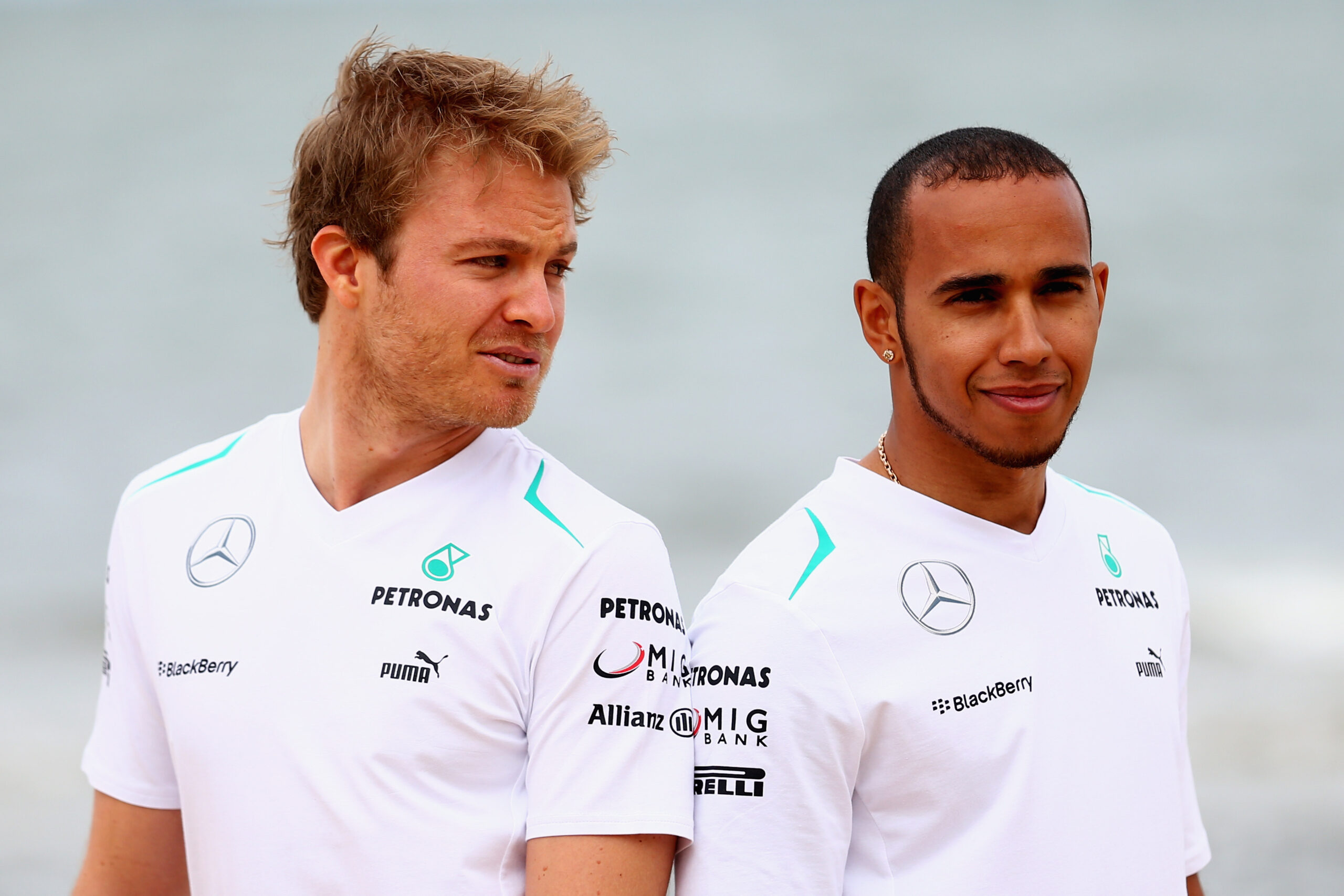
Mercedes teammates Nico Rosberg and Lewis Hamilton in 2013. Photo: Clive Mason / Getty Images
I called everyone to gather around for a short meeting (no one else had moved). We figured out what we knew and what required answers then came up with a basic plan and assigned responsibilities. The Composite Build team looked after the floor and the front wing along with Compbond and the design team. Sub Assembly had to look after the front uprights that were still in the Machine Shop.
I went looking for what we didn’t know because we couldn’t afford any surprises. The Race Team in Jerez needed sufficient time to rebuild the car. I needed to know both the latest the private jet could depart from the airport in nearby Oxford and if a car floor would even fit through the door of the plane. We also booked extra vans to take parts to Jerez and assigned extra people to support repairs at the circuit.
Once we had timings, we were able to understand what we could achieve in the time available. I’d like to think everyone had clearly defined roles and knew their responsibilities. There were so many details to sort out and any one of those could have prevented the car from running the next day.
Instead of meetings – there simply wasn’t time – I walked a thousand miles around the factory gathering and communicating information, asking and answering questions. That communication was dynamic. It was mostly verbal but reinforced with an email when time permitted. I kept Rob and Aldo informed of progress. The late Barry James, who was our Composite Manufacturing Manager, and Darren Burton, our Ops Director, worked with their departments to ensure we got all the support required.
The car ran the next day. It was a true team effort. The damaged parts were returned from Jerez for inspection, repair and service and a fix was sent out for the rear brake issue. It was an amazing recovery from a difficult situation, but that is Formula 1.
So, what did I learn? These moments are important, as the way you react to them is what you will be measured by as a person and a leader. If you think back on your careers, you will have good and bad moments. Some will be short, others will be longer. It will not stay tough forever, it will get better, but nor will it stay under control. Something will happen.
It is important to think about your behaviours in good and bad moments.
Firstly, Lewis’ crash hit five pressure drivers:
So, why I did I go to lunch?
I want to explain my rationale with reference to Dr Ceri Evans’ Red-Blue model, as set out in his 2020 book Perform Under Pressure. I cannot recommend it highly enough for a fuller, clinically-informed account of the principles of performance under pressure and how one can gain emotional control at the times when you need it most.
Ceri proposes a three-step model:
Here, I’ll explain how I approached each in turn after Lewis hit that wall.
The Step Back
I needed to go to lunch. I was under pressure and could feel it. I had to get out of my office and away from the noise. I realised that this was a flight response. I also realised I was under both internal and external pressure. My heartrate was up and you are trying to think of numerous things at the same time. Going to lunch allowed me to move from Step Back to Step Up. It gave me a moment to move away from the emotional response and start to come up with a mental plan of what we were going to do next.
The Step Up
You need to understand what is going on and start coming up with a plan for what you need to do and the desired outcome you seek.
In Step up mode, I was moving from Red mind to Blue mind. This requires a further explanation with a little help from Ceri, who describes two interacting mental systems:
Neither state is ‘good’ or ‘bad’. There must be a balance, as too much Red can make you impulsive, emotional and reactive, while too much Blue can leave you detached and hesitant.
In Step Up mode, I was moving from Red to Blue, from emotions and feelings to logic and planning. I allowed my Blue to dampen the Red. I now had an idea of a plan and what we needed to do and I remember very clearly feeling energised and ready to rock ’n’ roll.
The Step In
You have a plan to start tackling the issue, using the clarity of the Blue combined with the energy of the Red system. Trust you skillset, you are the best in the world at what you do.
We talked through the basic plan and off we went to face the challenges in front of us. During the course of that day, well into the evening, I remember going back to Step Back mode as something went wrong but this was quickly followed by Step Up (planning) and Step In (doing). Red/Blue, Decide and Do.
That day I was in a purple patch, balancing the Red and Blue.
How this impacted my behaviour
I knew that how I behaved and the language I used would impact the people working on this challenge. The pressure was on and one wrong word could trigger a shift back to a Red brain response, which we simply could not afford.
I also felt trusted by Aldo and Rob, who knew I would play my part to help resolve the issues along with the rest of the team. They didn’t interfere with what we were doing and allowed us to get on with the job. We made sure to regularly check-in with them both, providing updates and seeking their thoughts on something in those moments when we were stuck. It was classic Intent-Based Leadership in action.
This was one of many situations we faced weekly at MGP and no F1 team is any different.
You will be judged on how you respond and react to these moments. It is not about placing blame, it is about movement and making extraordinary things happen using the right mindset and behaviours.
Finally, there will always be lessons from these moments, so make the most of them. They are a great opportunity to improve as individuals, teams and organisations.

Lewis Hamilton, with Lotus driver Kimi Räikkönen and Mercedes teammate Nico Rosberg on his tail at the 2013 Australian Grand Prix. Photo: Ker Robertson / Getty Images
Peter Hodgkinson is a leadership and performance specialist skilled in helping high-performers become better at what they do. As an accomplished manager and mechanic, Peter has enjoyed almost three decades of success in elite sporting environments. His work in motorsport, as part of winning teams at Le Mans and Daytona, culminated in seven Formula 1 driver’s world championships won at Brawn and Mercedes, where he led car-building operations. Peter was Mercedes’ Head of Build during Lewis Hamilton’s era-defining run of six world titles. After a spell serving as Mercedes’ Head of Employee Engagement, Peter returned to the Factory Floor as Build Operations Manager for the INEOS Britannia sailing team when Mercedes supported their quest for the 37th America’s Cup.
If you would like to speak to Peter, please contact a member of the Leaders Performance Institute team.
2 Sep 2025
ArticlesIn August, the Leaders Performance Institute explored why psychological safety, alignment and smart planning represent different ways to putting the person first.
All-rounder Nicola Carey hit an unbeaten 35 runs at Lord’s to help the Superchargers chase down the Southern Brave’s first innings total of 115 for six.
“The whole group is amazing, so it was so easy to come in the middle of the tournament,” said Carey on the field at Lord’s in the aftermath.
“A couple of weeks ago I was back home in Tasmania, doing a cold pre-season,” she added, “so to get the call-up first of all was pretty surprising and to finish the couple of weeks with a win, it couldn’t have gone better.”
Head Coach Lisa Keightley and captain Kate Cross have pulled out all the stops to foster an inclusive environment, to which Carey’s compatriot, Phoebe Litchfield, alluded.
“The Northern Superchargers are my favourite team to play for,” she said, “and it’s just been a blast.”
Their human touch was in further evidence as the team carried a life size cardboard cutout of their injured and absent teammate, Georgia Wareham, onto the podium, then going as far as to place a medal around the cardboard Wareham’s neck.
Add this all up and the Superchargers’ approach appears to be simple: put your people first and they will deliver upon their talent.
This was a recurring theme across the Leaders Performance Institute in August.
Here is a snapshot of what was said.
Psychological safety… or psychological confidence?
This question was raised in a recent Leaders Virtual Roundtable that explored the balance between challenge and support for athletes.
Psychological safety has long been a performance buzz term, but a team in motorsport is taking it upon itself to reframe its terminology. Their wellbeing lead told the table: “We’re playing around with the idea of creating psychologically confident people. In meetings, we make sure that we give everybody a chance to speak up… there’s also got to be challenge, to get [people] to that psychologically confident point.”
Words clearly matter, as a performance support coach in British varsity sport pointed out. “The language we use when we’re talking to the athletes, it’s not a ‘challenge’, it’s not an ‘adversity’, it’s ‘exploration’, ‘playing’, ‘responsibility’.”
Try to cut through the noise around the athlete
Athletes increasingly ask for support beyond their sport and performance, which means everyone must be on the same page.
“Do you think the modern athlete has changed or has it always been like this, but as performance staff, have we failed to notice it?” asked Simon Rice, the Vice President of Athlete Care at the Philadelphia 76ers at our Sport Performance Summit in Philadelphia.
“We think it is 50:50 as there is no denying that they are more informed because of more information being available,” he adds, “but this does create noise.”
The remedy requires trust as players in the modern era tend to ask for an explanation more often. The Sixers talk to their players and they talk to them early as they seek to understand what’s important to them. “Do not shut things down right away, work with them to find solutions.”
There is, however, a limit. “It is important to have your non-negotiables so they know where the line is too.”
Team planning, individual focus
Patrick Mannix, the Sports Science Senior Manager at US Soccer, set the scene for a roundtable presentation that centred on performance planning in the international game, specifically the development of camp training plans for players who join up from their respective clubs in the US and beyond.
The players as individuals are at the heart of their planning, with sessions devised two weeks out once player arrival times are confirmed.
“We will design things from a team level, but then we also have to look at matters very closely at an individual level when we’re trying to safely integrate players into our national team environments,” said Mannix.
“Most of the time, we are dealing with tapering strategies and figuring out how can we optimize players’ readiness going into competition,” he continued. “So it’s often an exercise in fatigue management when they’re coming into our environment and not necessarily trying to drive fitness adaptations, but, on the flip side, we’re also there to potentially facilitate a lot of those long-term physiological adaptations that are occurring.
Alignment and the ‘multiplier effect’
True alignment delivers a multiplier effect, as John Bull told a roundtable of Leaders Performance Institute members last month.
In an ideal world, each stakeholder’s efforts would multiply the others. “One person’s talent is building on and adding,” says the Director & Lead for High Performance Research at Management Futures. “The multiplication becomes exponential.”
If teams are to achieve the multiplier effect, Bull highlighted five critical considerations:
Who are you trying to align and what different talents can you bring to bear on a problem? Be sure to involve all relevant parties, including those who may be excluded for fear that they will be distracted.
Misalignment often arises not from disagreement on the goal itself, but on the timeline and resources needed to achieve it.
The distinction between strategy (high-level direction) and tactics (specific applications) is not always understood.
Alignment is an outcome of agreed processes of communication, collaboration and decision-making.
While vertical alignment (e.g. between board and coach) attracts a lot of focus, horizontal alignment between departments or teams underpins a truly joined-up approach.
What to read next
Transparency, Empathy and Empowerment: Five Ways Teams Are Serving their People in 2025
13 Aug 2025
ArticlesJohn Bull of Management Futures outlines what it takes to deliver coordinated efforts within a team.
“When you get everyone in a system pushing in the same direction, it can have a multiplier effect. The momentum of each person’s efforts building on each other,” said John Bull, the Director & Lead for High Performance Research at Management Futures.
“It is,” as he adds, “a key area of performance at which we can all get better.”
In his online presentation for members of the Leaders Performance Institute, Bull outlined the common obstacles as well as steps all teams can take to get better at coordinating their efforts.
How alignment affects performance
Alignment – the coordinated efforts of a team – takes several forms. Each has different implications for performance outcomes.
Bull illustrated some of those differences using mathematical symbols (and idea lifted directly from Ineos’s Sir Dave Brailsford).
In an ideal world, each stakeholder’s efforts would multiply the others in this fashion:

“One person’s talent is building on and adding,” says Bull. “The multiplication becomes exponential.”
He used the analogy of a group of people pushing a car up a hill. “It’s also about timing. Are we pushing at exactly the right time, which is really what the multiplication symbol is because you get this amplifier effect.”
Additions are more commonly found, but it’s not true alignment:

“What I would mean by a plus is that two parts of the organisation are still moving in the same direction, still aiming at the same goal, but it’s not joined up. It’s independent activity,” said Bull. “They’re still adding their talent, so it’s still a positive contribution, but you’re not getting that momentum multiplier effect. And we all know what that feels like.”
The risk is that subtractions or divisions rear their ugly head:

“If you’ve got two parts of the organisation with very different interpretations of the strategy, you have it taking away from each other,” said Bull of the subtraction.
As for the division symbol, “that would be where, politically, you’re starting to get factions, briefing to the media, or people actively recruiting allies against another part of the organisation. Or sometimes where you have a board or owner deliberately undermining the coach.”
If teams are to achieve the multiplier effect, Bull highlighted five critical considerations:
1. Who?
Who are you trying to align and what different talents can you bring to bear on a problem? Be sure to involve all relevant parties, including those who may be excluded for fear that they will be distracted.
2. What are you trying to achieve and by when?
Misalignment often arises not from disagreement on the goal itself, but on the timeline and resources needed to achieve it.
3. Alignment on strategy i.e. the ‘how’
The distinction between strategy (high-level direction) and tactics (specific applications) is not always understood.
4. Ways of working
Alignment is an outcome of agreed processes of communication, collaboration and decision-making.
5. Vertical and horizontal dimensions
While vertical alignment (e.g. between board and coach) attracts a lot of focus, horizontal alignment between departments or teams underpins a truly joined-up approach.
Bull then highlighted some common tensions:
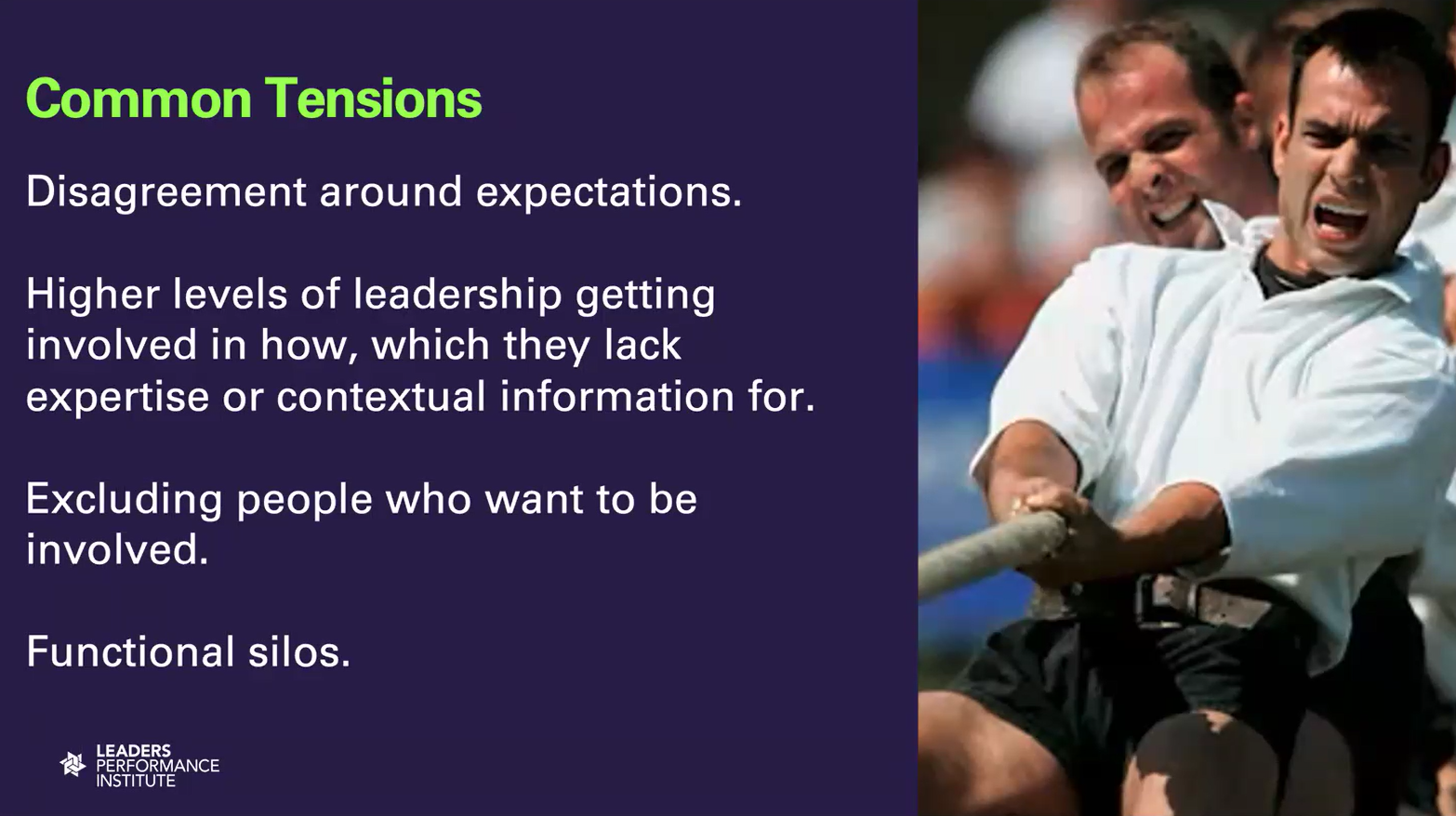
He said: “The reason I want to share these is to highlight where you might go for opportunities for improvement. Where do you see the opportunities for improvement in your environment and what’s your role in that? Where can you make a difference?”
The same goes for tests of alignment:
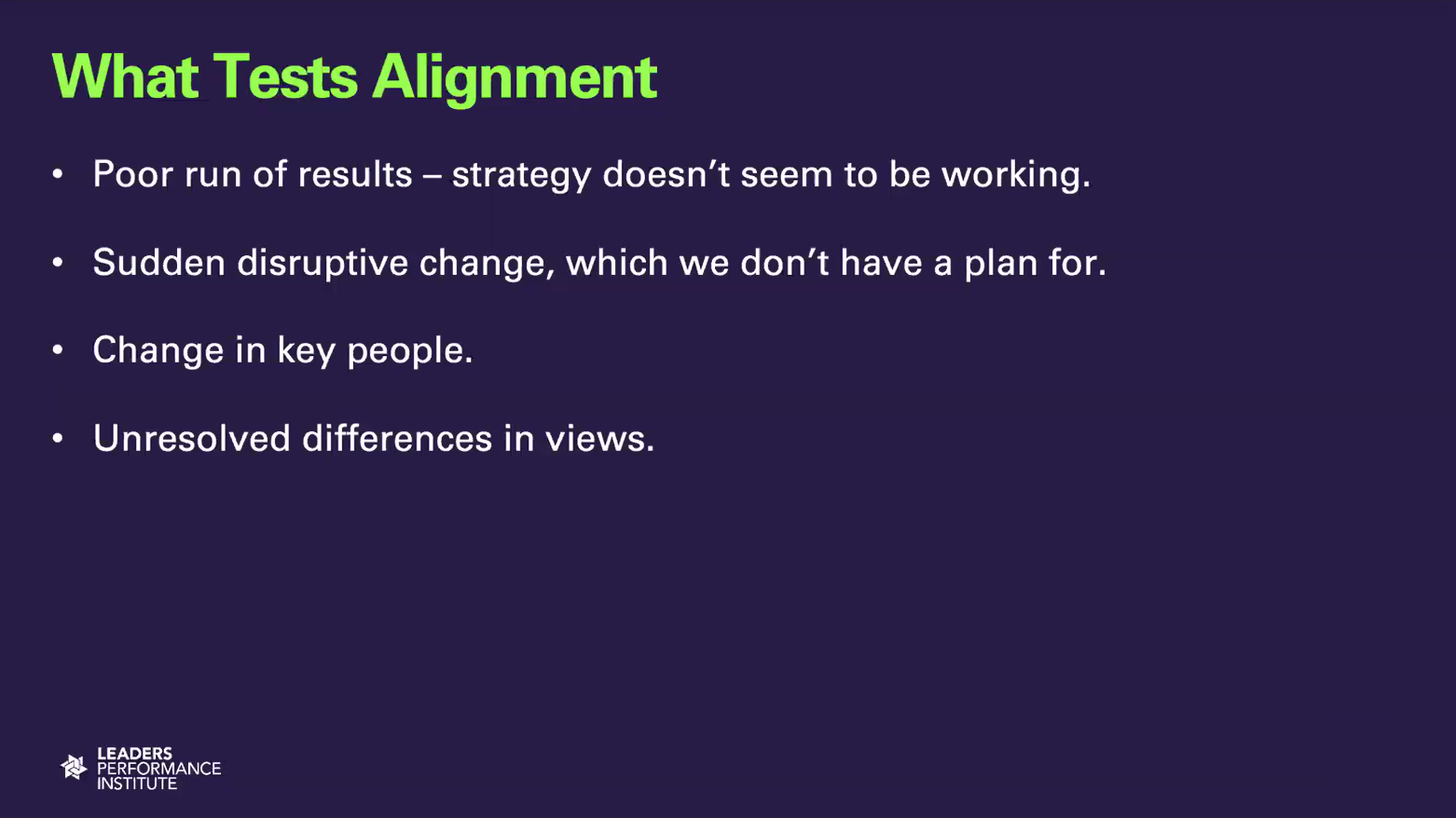
Each type of test presents opportunities to strengthen systems through reflection, planning and proactive leadership if you’re minded to look.
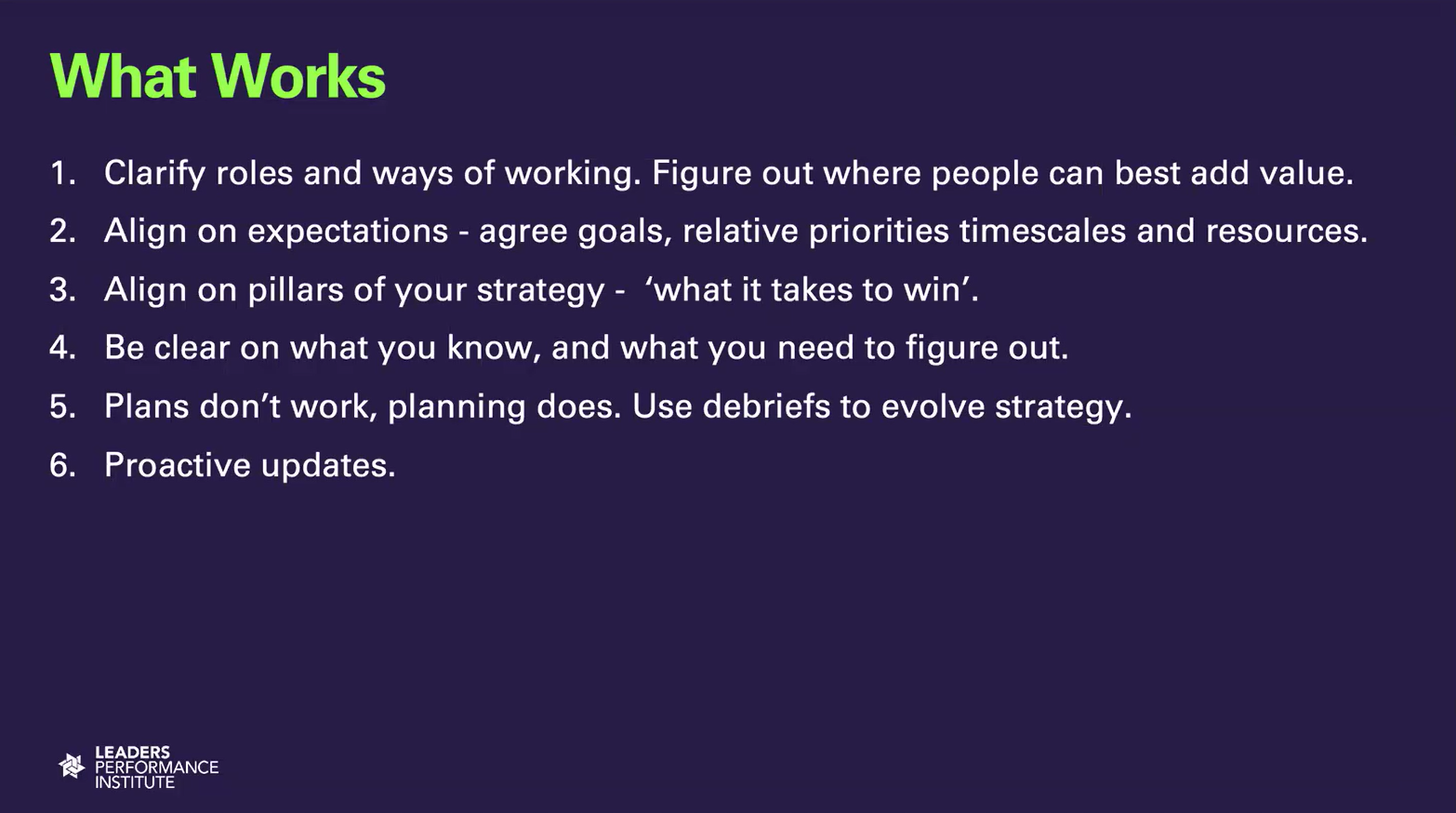
What actually works?
Bull suggested several methods for Leaders Performance Institute members to mull over:
What to read next
Do you Feel your Team Has Plenty of Clarity But Still Suffers from Misalignment?

Greg Shaw of Swimming Australia describes four areas where his team are working to help people make smart decisions and follow hard behaviours.
The Leaders Performance Institute has just asked Greg Shaw, the High Performance Director at Swimming Australia, for his thoughts on the growing complexity of performance environments.
This complexity is both reflected in and a reaction to what Shaw calls the “growing sophistication” of performance roles. In many respects, as he noted in our Teamworks Special Report earlier this year, Shaw perceives himself as a “project manager”.
Which is not in itself a bad thing. Fields such as sports science have blossomed in elite sport, but consistency of application and outcome, whether locally or at scale, has often proved elusive.
“We all make bad decisions,” adds Shaw, “and a lot of smart people make dumb decisions.”
Here, we highlight four areas where Shaw and Swimming Australia, are trying to give their athletes, coaches and staff every chance to make better choices.
1. Identify the barriers to better decision making
“We heavily invested and remain interested in behavioural science and how we can help our athletes and coaches make smart decisions and follow hard behaviours,” says Shaw. Swimming Australia’s aim is to “help make those decisions easier and those hard performance behaviours more frequent.” They enlisted the help of behavioural design experts to help identify and understand the existing barriers.
Shaw himself has a background in sports nutrition and illustrates his point through the lens of dietetics. “It’s the behavioural component of nutrition,” he continues. “It doesn’t matter what you know in terms of, say, biology, it’s if you can make the right choices and how social and cultural drivers impact those choices.”
2. Manipulate the environment to remove those barriers
The ideal, as Shaw says, is for the athletes to “turn up, do what they need to do, and live a high performance lifestyle”. This, he admits, is easier said than done. Even a disciplined athlete can inadvertently harm their health and performance. “It often leads to concerns around wellbeing, being overloaded, overworked and over-stressed.”
The key is to “manipulate the environment and the process to help the athlete make it simpler and easier.” Shaw continues: “I think the future of high performance is designing things purposefully, not just the training we do but everything that fits outside of that; the life, the social environment, the club culture, the programme culture, the experts around you so you know to make the right choices and adaptations.”
He is clear that it is “more about environment and behaviour than it is about science and the expertise of performance.”
This is in keeping with Swimming Australia’s ‘people-first’ approach. “It’s understanding what’s a good stress and what’s a bad stress,” says Shaw, who explains that there is an increasing empathy for what athletes go through to sustain high performance over extended periods of time.
“An athlete may enter our ecosystem at 15 or 16 and leave our ecosystem at 35, so if we don’t have that ability to understand how we must adapt in how we interact with and support our athletes, then they’ll leave.”
3. Let people refine their processes before looking for scalability
Shaw admits that Swimming Australia, when it comes to system-wide initiatives, has traditionally been an organisation that “scales first and tries to find efficiencies later”. However, the organisation has typically excelled when it comes to individual and group piloting. Shaw has noted the distinction and continues to learn as he goes. “Over the last 18 months I’ve realised it’s not about adding more, it’s subtracting and refining ideas to their simplest and easiest, then letting people add their flavour to it,” he says, warming to the theme.
“Oftentimes, we try to scale and have things fit within boxes, but scalability comes from understanding the fundamentals of an idea or process, making sure that happens, and then giving enough space for others to iterate and develop their own process.”
4. Use AI as a co-pilot
Shaw sees the potential in automation, with caveats. “As we automate, we free up time to interrogate the data more and more, but that puts people behind the screens and offices we’re trying to free them from in the first place,” he says, adding, “automation should free coaches to spend more time on the pool deck and in performance environments”. Doing this will enable coaches to “be compassionate with the athlete, to better understand what they’re going through, or to understand if a piece of information is going to be necessary for them at this point in time.”
As for AI, he sees the benefit as being rooted in “augmented decision-making”. “We want to use AI to help people make good decisions, to help strip away the noise, to make the signal a bit clearer,” he continues.
Such clarity helps to reduce “data hallucinations and noise, which you may not realise for a couple of months”. By that point, “you’ve wasted your time.”
That does not mean outsourcing data interpretation entirely to AI. “We believe in the co-pilot model of AI rather than having the artificial intelligence doing it for people.”
What to read next
Coach and Staff Wellbeing: Five Approaches to Five Common Challenges