



3 Apr 2025
ArticlesHead Coach Chris Fagan laid the foundations for the Brisbane Lions’ 2024 AFL Grand Final success with three big steps.
Their premiership success was not a bolt from the blue – they had reached the Grand Final a year earlier – but it was a far cry from the 18th place finish the Lions managed in 2017, which was Fagan’s first campaign at the helm.
He appeared at the 2023 Leaders Sport Performance Summit in London – just weeks after Brisbane narrowly lost the Grand Final to Collingwood.
There were no guarantees that they would make the decider again in 2024 but Fagan, who had his doubters in Australia, transmitted confidence from the Oval stage. “Last year [2022], we lost the preliminary final by 71 points. A lot of people said we wouldn’t recover from that,” he said. “This year, we made a Grand Final and lost it by four points. I said to the players, ‘we’re getting better, we’re getting closer. We’ve been the most successful team over the last few years. Be proud of that. The team we played in the Grand Final is older and more experienced, so that’ll be good for us.”
So it was to prove. But the focus here is those early years, when Fagan worked to turnaround a faltering team. It was only in year three, when the team jumped from 15th to 2nd in the AFL ladder, that his methods were vindicated by points and victories.
There were three factors that underpinned Fagan’s approach.
In 2017, Fagan arrived with his vision for a high performance culture. In outline it bore some familiar features:
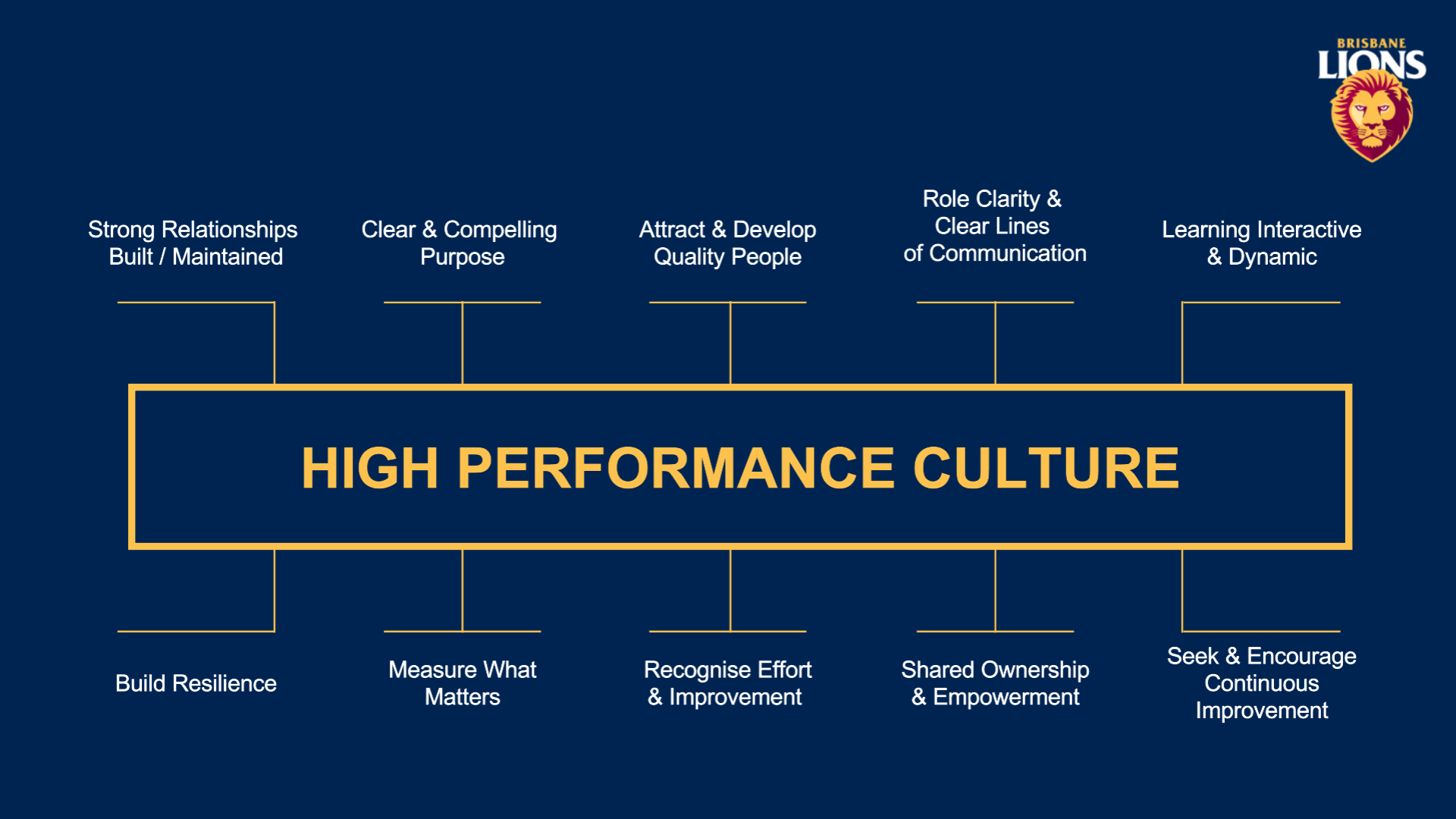
But in order to deliver this through a strategic plan, Fagan needed everyone onside. It wouldn’t be easy in what had become a “poor bugger, me” environment. “I discovered that many of our players preferred to be in rehab than to be actually playing – it was safer there,” he said.
Over the course of four weeks he solicited the views of every player and member of staff. “I wanted to send a message to everyone at the club that they would be listened to, that it wasn’t just me coming in and telling them what was going to happen,” he added. “I wanted to find out what they thought the club needed to do to become better because they needed to be partners with me in the process. I think they appreciated that because they hadn’t had a process for a long time. They’d just been told what to do.”
This brought him trust and credibility during those first two seasons when there was barely a flicker of improvement in scoreboard terms.
Fagan is a big believer in high challenge, high support for players in pursuit of their goals. The challenges were plain to see in 2017, and the first measure of support came from Fagan himself. “I see myself as the chief energy and psychological safety officer,” he said onstage. “I want to build an environment where the players and staff feel trusted and motivated, because that certainly wasn’t the case when I turned up.”
Even as the poor results endured, the team’s morale did not falter. “You’d have said we were the happiest bunch of losers during the early years,” says Damien Austin, the club’s High Performance Manager. “We celebrated everything because we were such a young team.” That included winning quarters of games, strength gains or running PBs in training. “We were always striving for progression,” he continues. “And if there wasn’t progression there’s a reason why, and I think like any young kids today, you’ve got to take them on a journey.”
It chimes with Fagan’s emphasis on growth mindsets and, as a former teacher himself, the importance of learning day in day out. As ever in a Fagan team it comes with a human face. His list has a WhatsApp group chat called ‘Moments of greatness’ where players celebrate examples of their teammates setting new standards.
AFL veteran Luke Hodge joined the Lions’ journey for Fagan’s first two years. The new coach’s first big recruitment decision was to bring in the man he regarded as “the greatest captain to ever play the game” from Hawthorn, the club from which Fagan himself had joined Brisbane.
“He was well and truly at the end of his career,” said Fagan of the four-time premiership player. “But I just wanted somebody to come in and role model great leadership to a young group of players.”
Additionally, Fagan worked with leadership consultant Simon Fletcher to devise a leadership development programme for senior and emerging leaders. “The first thing he did was establish a trademark, which was a reference point for leadership.”
To this day the Lions’ trademark is built around the concepts of ‘brotherhood’, ‘heart’ and ‘selflessness’:

But Fagan knows as well as anyone that these are just words on a wall without the behaviours that drive and sustain these ideas. “The players come up with those and we drive it,” said Fagan of the Lions coaching staff.
“After a game, the players have to send me a text the day after and one of the things they need to rate is their compliance to the trademark for that game.” Usually, the better the result and performance, the higher the rate of compliance. It can go the other way when the team loses. In any case, “we have a vision of it being done well and we also show a vision of when it’s not so good”. Additionally, the Lions hand out a ‘brother of the week’ award, where players are invited to vote via WhatsApp for the player who best demonstrated the trademark behaviours that week.
In summary…
Fagan understands that if your environment is highly demanding then it must also be highly supportive. He has clear ideas on what motivates people that go back to his days as a teacher:
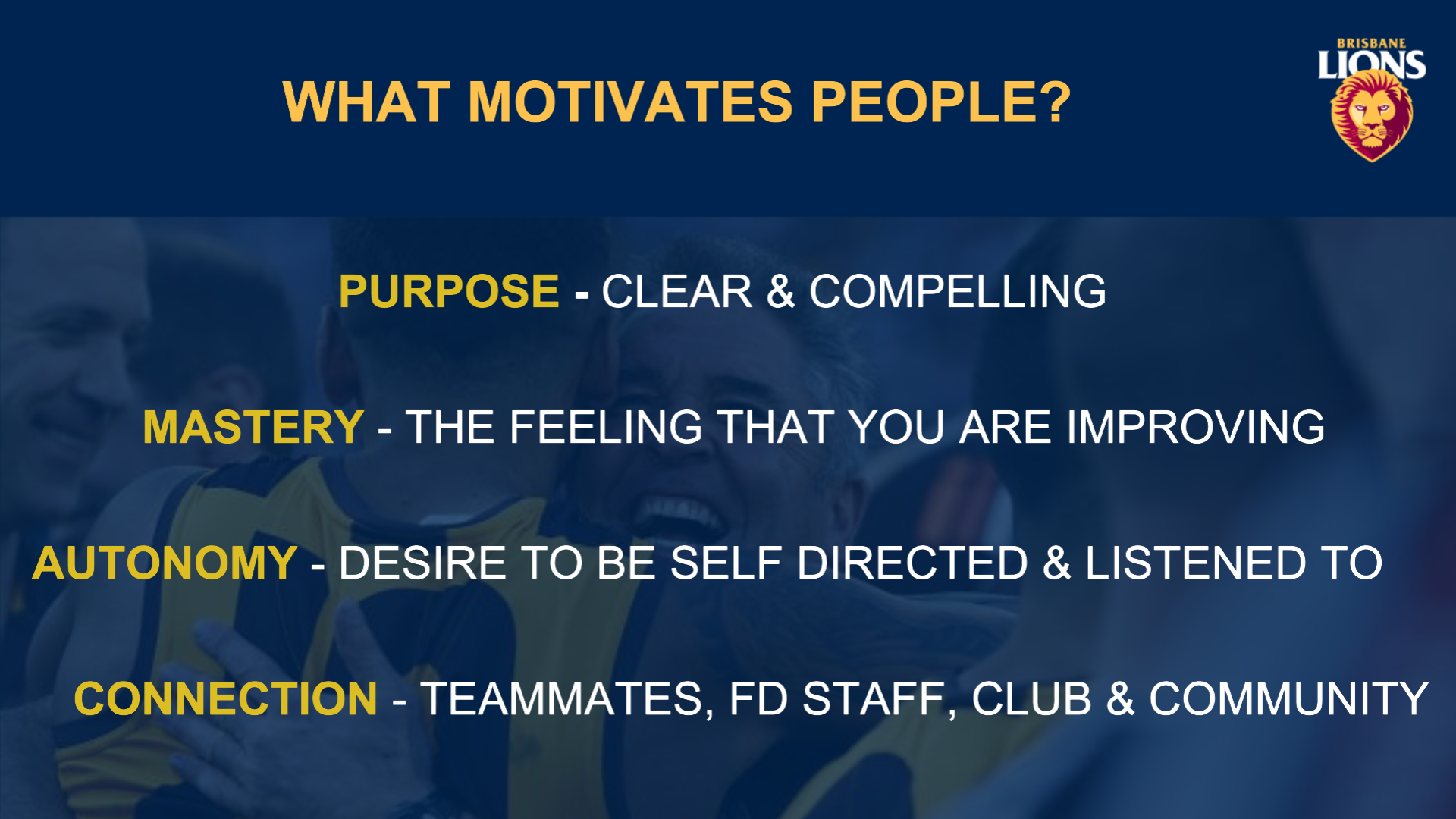
He said: “To be motivated, you have to have a clear purpose, that feeling that you’re improving, which I think our guys hadn’t felt for a long, long time. There is a desire to be listened to and to be a participant in your own growth and development; and that connection with teammates, staff and community.
“I put that model up as areas we would spend a lot of time on over the next few years, trying to grow our culture and team into a better place.”
What to read next
1 Apr 2025
ArticlesIn March, we explored ways to improve and optimise the relationship between coach and practitioner. Here are four elements to consider with your teams.
The question came up time and again during March across a range of Virtual Roundtables, whether the primary theme was organisational alignment, sports science, psychology or data usage.
This month we reflect on those roundtables and bring you four practices that have served Leaders Performance Institute members well when working with their head coaches.
It sounds obvious, but coaches need to know how to apply the insights you deliver as a practitioner. “By always giving information that is contextually useful for that time of the year or by understanding the training cycle, you get more engagement,” said Kenneth Graham, a member of the Australian Institute of Sport’s Research Review Committee, who was speaking at an Exercise & Sports Science Australia roundtable. “You do need that time to build up the credibility and the acceptance of the coach to take on information from you; and over time that becomes a faster process. It can be done over a cup of coffee, you may not need a formal presentation, but being part of the process, seeing the development of the training programmes, being at the training sessions, being at the competitions, looking for the gaps where the information you’re giving is seen as valuable.”
A department should articulate its goals within the team’s wider vision. “We all have a vision of what each department is working towards and who’s going to be responsible for those elements,” said one attendee during a roundtable discussing organisational alignment. A team can also ask, “‘this is what this department is working on – is that getting us to where we want to go?’”
Where your values are on the wall, they can serve as a useful conversation-starter. Another attendee, who works as a director of performance, spoke of approaching a staff member “standing in front of our strategy and saying, ‘where’s the work you’re doing? Where does it fit in our strategy? The acid test is they say, ‘oh, yeah, I work on this, and I know I contribute to that’. If they can’t do it then that’s on me, because we haven’t made it really clear where their work fits.”
Where there’s progress, you can celebrate the wins. “People get the chance to be appreciated. ‘OK, this is what you’re working on, this is how it’s going’” said a participant from a club in the NWSL, “and we can celebrate the victories where we’ve started to move the needle towards that ultimate goal.”
“Timing is everything with coaches,” said one member during a roundtable that focused on the use of data. “The timing of when you plant the seed or present something new to a coach is really the start of the success or failure of what you’re trying to do.” Another attendee suggested that a practitioner must consider “what is it that you’re going to provide? And what is it you’re going to hold back?” A third offered an example of this in practice: “We’ve introduced not just new technology, like tools and hardware, but also a large number of new datasets and data metrics for the coaches to understand.” An astute practitioner will foster a curious mindset and understand “when it’s OK to give the coach a little bit more to stretch them and when we will hold something back.”
Some people in sport openly lament the perceived lack of metrics in fields such as psychology. This notion frustrates Rich Hampson, the Head of Psychology on the men’s side at the Football Association, as he told a virtual roundtable on the topic of psychological services. He said: “I see psych fall down because it’s not defined well enough early enough.” However, if you are clear at the beginning, “90 per cent of it can be tracked. The broader you are, the less defined you are, it’s harder to ask: ‘is this actually having impact?’”
Benchmarking tends to be an area where sport excels, but not when it comes to psychological services. Hampson said: “I think sports should be more confident in going ‘if we’re clear on what we’re doing, more often than not, we’ll be able to give you an indicator here, whether that has done what we want it to do’; and then, like any science experiment, if your first intervention doesn’t lead to the outcome that you want, it gives you a real good platform to go ‘OK, why did that not work? And what do we need to adapt and change?’
“I think that’s really hard to do in a really objective way when you’re not setting that in the first place.”
And if you missed it…
Our latest Special Report, High Performance Unpacked, is now available.
We’ve gathered insights from some of the sharpest minds in athlete performance: the people and the places that are taking their athletes to the next level.
With expert contributions from Teamworks, Chelsea Football Club, The Ryder Cup, Swimming Australia, NBA, Philadelphia 76ers, and Clube Atlético Mineiro, this report dives into the cutting-edge strategies shaping the future of high performance.
Get an inside look at the methods and breakthroughs driving success at the elite level from some of high performance sport’s best problem-solvers.
Download the report now.
Tips gleaned from a Leaders Virtual Roundtable titled ‘Generating organisational alignment: what to consider and work works’.
Alignment is perhaps more crucial than ever in high performance, yet as this practitioner noted, it is absent too often.
They were speaking at a Leaders Virtual Roundtable that dug into the topic.
“We’ve got a large team of staff, whether that’s coaches, practitioners, athletes, and that starting point of knowing where you’re going or what you’re aiming for is really important,” said one attendee who works for a Premier League team. “Then we build a strategy around that. So what we’re looking to do and the type of things we’re trying to do – and the things we’re not going to try and do.”
“I think the point of making it intentional is a huge one for us,” said another participant who works in the NWSL. “That’s been a huge emphasis with us as a staff this year – just making sure that we are all aligned and all on the same page.”
It takes time and effort and, over the course of the conversation, the participants shared their experiences and offered some best practice tips to help you and your team.
Alignment starts at the top
The consensus was that alignment flows from the top of an organisation. The table said that senior leaders must articulate an organisation’s goals and consistently reinforce them.
“Ownership has come in and been very clear about the goal of the club,” said the practitioner from the NWSL. “We want to be a leading global sports franchise, not just within the soccer space, not just within the women’s football space.” It is a lofty aspiration but all staff members understand the aim.
Find the low-hanging fruit
Next is identifying the obstacles, “the low-hanging fruit”, which means “each department approaching the general structure of practice by identifying what’s important and then identifying how you’re going to measure those things,” as a participant working in Major League Baseball explained. “Then you break that down into its subcomponents and figure out how you’re going to identify where the lowest-hanging fruit is to then solve those problems.”
Frequent check-ins
Find opportunities to check against your team’s objectives. As one attendee said of their team’s meetings, “we started with the end goal for the end of the season and how we are going to break that up.”
It requires “crystal clarity,” as another attendee put it. They said: “do we reduce the amount of interpretation, and then on the back of that, how are we checking for understanding?” It cannot just be a case of the leader “broadcasting” messages of expectation or definitions. “What’s actually being heard and understood? How frequently do we check that?”
Develop a common lexicon
Words are critical in ensuring that athletes are presented with a united front. “That comes with knowing what are the goals, the mission, the vision of the club,” said the same attendee, “and then all being able to speak from a common language.”
“It’s in how we use strategy and try and bring it to life,” said another attendee. “I’ve seen staff buy-in, not only in one-to-one meetings or annual reviews, but day to day. They are using the language that exists in our strategy – we’re talking the same way, and we’re trying to achieve the same things.”
Let staff shape how your vision comes to life
As a leader, it is also critical to understand staff motivations and aspirations. “There’s so many compartmentalised pieces to some environments,” said one attendee with knowledge of the British sports system. “How do we actually align where there are different motivations and aspirations?”
“If you get buy-in from people and input from day one, I always find that more impactful,” offered one participant. When people are invested it leads to smarter ideas and strategies – and everyone understands how they can help to achieve them.
Make accountability the norm
Each department must articulate their goals within the bigger picture. One attendee said: “We all have a vision of what each department is working towards and who’s going to be responsible for those elements.” A team can also ask, “‘this is what this department is working on – is that getting us to where we want to go?’”
Where your values are on the wall, they can serve as a useful conversation-starter. One attendee, who works as a director of performance, spoke of approaching a staff member “standing in front of our strategy and saying, ‘where’s the work you’re doing? Where does it fit in our strategy? The acid test is they say, ‘oh, yeah, I work on this, and I know I contribute to that’. If they can’t do it then that’s on me, because we haven’t made it really clear where their work fits.”
Where there’s progress, you can celebrate the wins. “People get the chance to be appreciated. ‘OK, this is what you’re working on, this is how it’s going’” said the participant from a club in the NWSL, “and we can celebrate the victories where we’ve started to move the needle towards that ultimate goal.”
Be agile in your programmes
Alignment is not fixed, it requires constant revisiting. As one attendee said, “when we start to add more staff and the structure sometimes becomes redundant” as reporting lines change. The risk is “you have people who are tied to titles and roles that may not function anymore.”
Therefore, it is important to move beyond grand gestures of alignment and place emphasis on those day to day interactions. “The behaviour layer”, as one attendee phrased it. “‘If we do this well, we would see this, this and this’. So now you actually have things to hold people to or, if they are demonstrating it, celebrate it. ‘Great! Let’s have more of that’. If they’re falling short, ‘let’s have a conversation. Why aren’t we seeing some of that? It’s taking it from the grand gesture to the day to day: ‘demonstrate it, live it, breathe it’.”
3 Mar 2025
ArticlesFrom integration to performance under pressure, we shine a light on the topics that engaged our high performance community in February.
“The coach knowing their players, having good relationships and understanding what they need – this sets you up for success. They also let talented people around them do their jobs. This is particularly important when the pressure comes and you need to remember that everyone is there for a reason.”
With those words, Moore, a renowned orator amongst AFL players, neatly captured some of the performance conversations happening across the Leaders Performance Institute.
Here, we pose five questions, all of which were answered in some shape or form during February. We hope these to help you on the path to being a better coach or leader.
Dr Robin Thorpe has instant reservations when performance departments describe themselves as ‘integrated’.
“It’s become a new trend or buzz term in high performance,” said the former Director of Performance at Red Bull. “I’d be really interested to see how many self-proclaimed integrated departments and processes actually are.”
Thorpe was speaking at the first session of ‘The Future of Performance Sport’, a three-part Virtual Roundtable series brought to members by the Leaders Performance Institute and Exercise & Sports Science Australia
In a truly integrated department, he argued, there has to be “positive and respectful challenge between staff and then between the disciplines” and he is unconvinced that this is always the case in many environments.
“Not to be controversial, but I would think that in some of the areas or places where true integration is preached, there might actually not be any collaboration whatsoever,” Thorpe added. “And so, without collaboration, there might not be any friction points or any challenge, so it might only be perceived as an integrated process.”
There’s plenty those goes into it, as high-performance specialist Rachel Vickery said during a Leaders Virtual Roundtable.
For one, a coach’s words and actions are critical in high-pressure moments. “As soon as something is set up as a threat – ‘if we don’t win this we’re not making the playoffs’ – the stress response kicks off,” said Vickery. “If we can flip that to opportunity – and I’m not talking about rainbows, crystals and unicorns – I’m talking about intentional language; ‘how clean can we play this?’ The language is really important in those moments.” She also spoke of a Premier League coach who worked to de-escalate his own arousal state before giving half-time team talks. It also important for coaches (and their teams) to not fall prey to the notion or narrative that an undemonstrative touch line figure is somehow disinterested.
Appreciative inquiry is a social constructivist-informed model that seeks to engage people in self-determined change. The model, which was devised in the 1980s by David Cooperrider and Suresh Srivastva, is inherently positive. It focuses on discovering and amplifying the best of what already exists (individually and collectively) within a system or organisation.
The idea was discussed in great detail at our most recent Leadership Skills Series session.
Appreciative inquiry stands in contrast to most change models, which tend to identify problems and seek to fix them.
The generational gap in sport applies to athletes and coaches, but the term just as readily applies to coaching and performance staffs, as was discussed in this Leaders Virtual Roundtable.
One environment, in preparation for the 2026 Commonwealth Games, is asking its athletes and coaches a series of questions as they seek to bridge the generational gaps.
“We’ve been getting athletes into a room and asking ‘how are you experiencing this environment?’” said the attendee who shared the story. “We ask ‘do you feel like you’re developing? And do you feel like you’re successful along with your wellbeing is being looked after?” They ask coaches: “What is your intention in terms of the environment or the experience that you’re trying to create for athletes?”
There has been some positive outcomes. “This insight has led to some activities that coaches and athletes can engage in to bridge that gap and make it more likely that people are collaborating efficiently and effectively on the path to get that goal.”
It may sound counterintuitive, but you really should.
David Burt, the Director of Entrepreneurship at the University of New South Wales, delivered a presentation at the Leaders Sport Performance Summit in Melbourne in which he lauded the value of exploring ‘terrible ideas’. His rationale was sound: it reduces the negative emotions that can cloud creativity and reduces the impact of power dynamics in a team environment.
Burt said: “Terrible ideas allow you to develop new skills and meet different people in the process. There is a surprising amount of value in implementing a little bit of resource in them to drive another layer of growth.”
A recent Leaders Skills Series session explored cultural leadership and how we might improve our cultures one step at a time.
The label was used by sports psychologist Willi Railo, who worked as a consultant in the early 2000s for Sven-Göran Eriksson, the England men’s national team Manager at the time.
“He has grown to become a cultural architect,” said Railo of then England captain Beckham in a BBC documentary titled The England Patient, which was broadcast ahead of the 2002 Fifa World Cup.
“[Beckham] has today a very great influence on the attitudes of the other players and he is thinking along the same lines as Sven-Göran Eriksson. So he’s a very good tool for Sven.”
According to Railo, cultural architects are “people that are able to change the mind-set of other people. They’re able to break barriers, they have visions, they are self-confident and they are able to transfer their own self-confidence to a group of people”.
Present day cultural architects include figures such as the Phoenix Mercury’s Diana Taurasi, Australia men’s cricket captain Pat Cummins, and Chelsea Women captain Millie Bright. The list is endless when you dig down.
Your cultural architects can be coaches or staff members too. They can be anyone who pays enormous attention to culture. Critically, while they are not always the most senior leader, they do have to have the ear of those leading.
The idea that cultural architects can emanate from anywhere gave real impetus to a recent Leadership Skills Series session, where members of the Leaders Performance Institute explored various interventions and the value of adopting a strengths-based approach to building culture.
Current cultural goals
What established goals do you have in your organisations that relate to your wider organisational culture?
One of the trends we’re noticing when it comes to cultural leadership is a focus on one specific aspect of culture at a time. The participants in the session identified a series of culture-strengthening goals that, if achieved, would deliver a competitive advantage:
When you align behind a goal, progress can be swift.
The six levers needed to lead a cultural change
In the session, we revisited six key levers for leading cultural change.
1. Make the key principles ‘sticky’
A message needs to be heard at least six times for a person to take it in and, if the principles are ‘sticky’, they naturally become easier to remember. Consider your straplines or strategy: do they meet that level of ‘stickiness’? A good example from the Olympic world is the question: ‘will it make the boat go faster?’ Another is the All Blacks’ ‘leave the jersey in a better place’.
2. Role models
This is the classic example of ‘words on the wall’ versus living the values. If the leaders and cultural leaders really model those behaviours, it’s what people will experience and lead by. Research in the field of inclusive leadership shows that leaders can influence the people, the athletes, the organisation around them by up to 70 per cent with their behaviours.
3. Culture conversations
A team must constantly review their organisation and culture and reflect on their current status. Ask yourself: where are our gaps? Where are our strengths? How can we improve? You can use a system rating scale from 1-4 to guide some of these insights. These system rating scales create an opportunity for those culture conversations to emerge and they provide an insight into the health of the culture at a specific moment in time.
4. Develop skills and processes to support intent
Take psychological safety: it is important to enable people to speak up. If you provide such opportunities it supports the intent to make positive change.
5. Feedback
Feedback is critical, yet people do not always deliver skilful feedback. Too often it can feel personal, it provokes defensiveness and is ultimately counterproductive. It is better to create a feedback loop and a culture of ‘skilled candour’ (a twist on Kim Scott’s ‘radical candour’) so that people are able to deliver feedback in a skilful manner.
6. Get the right people on the bus
When engaging in culture change, do you have the right people in your environment? It may come to a time when you have to make a decision about who needs to be on the bus – and who doesn’t.
The power of AI (appreciative inquiry)
Appreciative inquiry is a social constructivist-informed model that seeks to engage people in self-determined change. The model, which was devised in the 1980s by David Cooperrider and Suresh Srivastva, is inherently positive. It focuses on discovering and amplifying the best of what already exists (individually and collectively) within a system or organisation. It stands in contrast to most change models, which tend to identify problems and seek to fix them.
What are some of the benefits of appreciative inquiry?
The model:
How we do it:
Here are some reflective questions you can use within your environments when considering what aspects of your culture you want to develop:
Nurtured and sustained excellence sat at the heart of proceedings at the 2025 Leaders Sport Performance Summit in Melbourne. Below, discover the insights to help propel you to greatness courtesy of the worlds of medicine, academia, the military and, of course, the world of sport.
Brought to you by our Event Partners
“There are parts of your game going well at a particular time and other parts of your game that are not going well,” he told Fox’s Face to Face in 2023.
“You’re trying to improve these things without sacrificing the things you’re doing well.”
He and Collingwood span those plates with alacrity during the 2023 season, his first as captain: they won the AFL Grand Final. Today, they remain one of the league’s finest teams; and Moore has been praised for his leadership abilities both on and off the field. It was to great acclaim that we welcomed him to the stage at the 2025 Leaders Sport Performance Summit at The Glasshouse in Melbourne.
“Good player leadership is organic and comes from natural respect based on competency, status and character in alignment to the team’s values,” he told an audience of Leaders Performance Institute members.
In addition to Moore, across two insight-laden days, we hosted a range of speakers from organisations including Melbourne FC, Leinster Rugby, the Royal Melbourne Hospital and Royal Australian Air Force. The overarching theme was the approaches one can adopt to give performers the best chance of success.
There were six approaches that stood out.
The athlete-coach relationship is pivotal, whether it’s a long-tenured coach setting up a new leader for success or, conversely, a senior athlete taking steps to put a new coach at ease.
Craig McRae, the Senior Coach at Collingwood, demonstrated the former with his public endorsement following Darcy Moore’s appointment as captain in 2023. “Be yourself, forge your own journey, and take a swerve at what that needs to be,” he told Moore. “Lead from the front and lead your way.”
Across town a year later, Rebekah Stott, a hugely experienced New Zealand international defender with more than 100 A-League appearances under her belt, went out of her way as captain of Melbourne City FC to ensure incoming Manager, Michael Matricciani, felt at home.
“From day one when I signed for the club, from the first conversations I’ve had, she’s only welcomed me with open arms,” said Matricciani. “She’s been a great support and she’s an excellent leader off the pitch.”
Neither Moore nor Stott, who spoke onstage together, believe they’re the finished article. Both spoke of their need to work on confronting teammates and having difficult conversations. In that regard, it helps when the on-field leader feels both comfortable and supported.
Rebekah Stott, Melbourne City FC
Darcy Moore, Collingwood FC
Moore and Stott’s concern with confronting people in emotionally charged environments is a daily feature of life at the Royal Melbourne Hospital, where Brian Le serves as Director of Palliative Care at the Peter MacCallum Cancer Centre. “Preparation is really important,” he said. “I formulate what needs to be spoken about and what my agenda is. But once with the patient, I adjust to what I’m hearing and the clues I’ve picked up in relation to their context.”
Timing is critical too. “Not addressing the situation has its own cost,” said Le, adding that delays are regrettable when the patient likely knows that an emotionally-wrought conversation is coming anyway.
Brian Le, Royal Melbourne Hospital
Data-informed decision-making is preferable, but where does the balance sit between objective and subjective sources? Additionally, what of the balance between disruption and stability? The topic was tackled by Kate Hore, the captain of AFLW team Melbourne FC, who spoke alongside Marcus Wagner, the club’s Chief Innovation Officer & General Manager of Football Operations. The Demons have been using Teamworks Performance as they look to strike that balance.
“You can get a flag from your monitoring that helps a discussion, but the impact really comes from your relationship with the athletes,” said Wagner. “Baseline information helps, but understanding the person is most important.”
When you understand the person, you can ask the right questions (either in-person or via questionnaires) and, if something needs to change based on something that happened in training, staff can swiftly make adaptations (supported by data).
As for the balance between disruption and stability. “It’s fine balance,” added Wagner. “You need to ensure you don’t lose your identity by going too far either way. How we measure is by looking at overall performance internally and externally, how we communicate, and the quality of our data.”
Kate Hore, Melbourne FC
Approximately 95 per cent of Nobel Prize-winning scientists emanate from the same cluster of labs or have enjoyed the proximal influence of past winners. Why? It is their higher minimum standards or greater openness to new (and often bad) ideas?
David Burt, the Director of Entrepreneurship at the University of New South Wales, delivered a presentation in which he lauded the value of exploring ‘terrible ideas’. His rationale was sound: it reduces the negative emotions that can cloud creativity and reduces the impact of power dynamics in a team environment.
He recommends an ‘accountability loop’:
David Burt, University of New South Wales
What must we do to sustain excellence? That was at the centre of Dave Walker’s appearance at the summit. The former naval pilot, who works for the Royal Australian Air Force, spoke of PBED:
PBED, he explained, is a continuous improvement process to table improved error recognition, error reduction or correction, which enables the creation of efficiencies that lead to improved performance. It is an essential tool in an environment where students must learn quickly.
“It’s the quality of interaction in each event that ultimately turns a team of experts into an expert team,” said Walker. “We often find that members do not know how to work or operate as a team – just following a framework does not make a team.”
David Walker, Royal Australian Air Force
Leinster Rugby, one of Europe’s most prominent teams, has a squad that is 86 per cent homegrown – what is the secret to finding and nurturing supreme talent in your region? As Simon Broughton, the Academy Manager at Leinster, explained, the team benefits from a group that has played and developed together in the youth ranks. They have travelled, won and lost as a collective. “So many experiences that strengthens their connection,” said Broughton.
The club has adopted a variety of approaches, including proximal role modelling, which sees younger players spend 80 per cent of their time integrated with older players. Proximal role modelling is “integrated organically into different aspects of their training week, from walking the pitches, to session design, and into analysis rooms.”
Leinster have also latched onto the ‘goldilocks principle’ as 33 per cent of their players are neurodivergent. “This has led to changes in how messages are delivered,” Broughton added. “There are slides, but also video and walkthroughs, and time for reconnecting and breaking mental circuits.”
Simon Broughton, Leinster Rugby
David Clancy and Alexia Sotiropoulou set out strategies for leaders to inspire meaning, fulfilment and belonging in their people.
Purpose is the north star that guides us through adversity, keeps us focused amidst distractions, and fuels our long-term engagement. When leading yourself and others, the power of purpose cannot be understated. It’s about creating an environment where every individual finds meaning in their role, feels fulfilled in their contributions, and experiences a sense of belonging to something greater than themselves.
Purpose-driven leadership is not just about results. It speaks to human connection; when one feels seen and heard. Great leaders cultivate deep relationships with their teams, which comes by empathy, trust, and support. The connection between a true leader and their team hinges on a shared understanding of what motivates everyone on a deeper level. As John C Maxwell puts it, “People don’t care how much you know until they know how much you care.”
It’s more than just retention
Gallup and studies reported in HBR often highlight that employees who find meaning in their work show increased productivity and retention. One well-cited article is ‘Meaning Is More Important than Happiness’ by Emily Esfahani Smith, which explores the impact of meaningful work on wellbeing, productivity and engagement. Deloitte highlighted in their Global Human Capital Trends Report of 2019 how employees who find purpose in their work are more likely to stay with their employer. That makes sense. A great place to work is a great place to work.
As Simon Sinek, leadership expert and author of Start with Why, says: “People don’t buy what you do; they buy why you do it.” This fundamental concept applies not only to customers but also to team members, colleagues, and leaders. By fostering purpose in yourself and others, you align actions with deeper values, creating a culture where high performance and personal fulfilment coexist.
Meaningfulness: a compass in uncertain times
Meaningfulness isn’t just about liking what you do; it’s about understanding why it matters. In elite environments, whether you’re a player, coach, or part of the front office, the pressures and expectations are immense. The need to win, deliver results, and meet expectations often dominates the narrative. But the best leaders, those who guide their teams with purpose, know that long-term success is rooted in meaningful work. This drives individuals to not only execute their tasks but also to find value in how those tasks contribute to the big picture. Leaders who strive to inspire meaningful work allow individuals to not just survive pressure, but thrive under it, empowering them to embrace challenges as part of their career journey.
Three principles to cultivate meaningfulness:
Fulfilment, fuel for high performance
Fulfilment is about finding personal satisfaction in the work you do. It’s that feeling of deep contentment that comes from using your strengths to their fullest potential and knowing that what you do matters. In high-performance sporting environments, the external pressures can sometimes overshadow personal fulfilment, but when fulfilment is present, individuals feel more locked-in and resilient.
Fulfilment creates a ripple effect throughout the entire organisation. When team members feel fulfilled – filled full if you would like – they bring their best selves to work, inspiring those around them to do the same.
Four ways leaders can foster fulfilment:
Case in point, Dennis Rodman. Here is a prime example of where recognition can be seen, by how Head Coach Phil Jackson managed his Chicago Bulls squad during the 1995-96 season. Jackson often recognised Rodman, not just for his defensive prowess, hustle and rebounding, but for his unique role, style and intensity on the court. By publicly acknowledging Rodman’s contributions, Jackson built Rodman’s confidence and reinforced his core value to the team, despite his unconventional approach. This clear recognition played a critical role in fostering trust, thereby maximising Rodman’s performance. The Bulls had a historic 72-win season.
Belongingness, the glue that binds it all
At its core, belongingness is about feeling valued and accepted by the group. High-performing teams that experience a strong sense of belonging operate on a different level.
One of the guiding principles within the All Blacks is the Māori concept of ‘Whānau,’ which means ‘family’, but it extends beyond immediate relatives to include the team as a whole unit. Players are taught to understand that when they put on the famous black jersey with the silver fern, they are not just playing for themselves, but for their teammates, their country, and the generations of players who came before them.
Belonging. Part of something bigger.
It’s a powerful feeling to know that you are a part of something bigger than yourself, like helping to put someone on the moon.
Four strategies to create a sense of belonging:
Final thoughts
Leading yourself and others with purpose is about much more than reaching performance goals. Before you can lead others, you must first lead yourself. Leading with purpose involves setting common value-based goals, staying focused in the choppy seas of collaboration and motivating yourself and your team to stay on track, with eyes on the prize.
To lead yourself with purpose, you need to define your own personal mission, vision and values.
Start there.
These are your guiding principles to help shape decisions and actions aligned with your purpose. You must also set clear goals for yourself and develop a plan to make them happen. This will take discipline and fortitude. Give it a go, starting today.
As with anything in high performance, you need to find what works for you first. So off you go.
David Clancy is a Learning and Development Consultant at the Houston Texans and Director at The Nxt Level Group. He is also the Editor of Essential Skills for Physiotherapists: A Personal and Professional Development Framework, which is available now from Elsevier.
Alexia Sotiropoulou is a Co-Founder & International Markets Specialist at the The Nxt Level Group. She is also a Public Relations & International Sales Specialist at the Isokinetic Medical Group.
If you would like to speak to David and Alexia, please contact a member of the Leaders Performance Institute team.

5 Nov 2024
ArticlesIn October, we discussed ‘energy audits’, female health and wellbeing, mental skills and the methods behind effective learning.
It’s an ever-pertinent question, whether you hear whispers within your corridors or not, and it is always worth checking in with your people.
During October, with this in mind, we returned to a memorable presentation delivered by Holly Ransom, author of The Leading Edge, who spoke at our February Melbourne Sport Performance Summit about ‘energy audits’ that we can all perform.
Speaking of Sport Performance Summits, our next London edition is just around the corner – specifically the 13 and 14 November at London’s Kia Oval.
Speakers include Stuart Lancaster, the Head Coach of the Paris-based Racing 92; John Longmire, the Senior Coach of the AFL’s Sydney Swans; and Anna Warren, the Head of Science & Medicine at the ECB.
It promises to be another cracker but, if you are yet to reserve your place, get in touch with the Leaders Performance Institute today – or at least after you’ve perused October’s Debrief.
This time we posed a series of questions, starting with energy audits, progressing to wellbeing and mental skills, before alighting on learning, performance analysis, and, in a left-field turn, the weather.
What is an ‘energy audit’?
They probably sound grander than they actually are, which is not to diminish their importance.
When Holly Ransom spoke at Melbourne’s Glasshouse in February, she suggested three questions we should all ask ourselves:
Ransom believes people should tackle their most important tasks when their energy is at its highest so that they “get the return on energy they deserve”.
She also explained that leaders set the tone for the organisation. She said: “The most powerful thing that you could actually do for that group of people that you lead is think about how we influence that energy in that moment so we don’t get the contagion of that negative energy running through more of the day or more of the week.”
Do you feel guilty for focusing on your wellbeing?
You probably have felt guilty at some point and you’re not alone.
Emily Downes, the General Manager of Wellbeing & Leadership at High Performance Sport New Zealand, admitted as much onstage at the Glasshouse.
“We all probably struggle with that at one point in time or another,” she said. “Who else do you need to have on your support crew that helps give you that permission?”
Part of the solution is systems and processes that enable people to step away from their desks.
“The challenge around this is: are you asking for it?” said Downes. “Are you communicating to your manager what support looks like for you or what you might need to be at your best?”
She addressed the leaders in the room directly. “Have you set up systems within your environment to enable people to [step away from their desk]?”
In any case, if you get up and go for a walk or a run, what’s the worst that can happen?
How effective is your mental skills work?
The growing focus on wellbeing is matched by an increased emphasis on mental performance, but in an exclusive column Aaron Walsh, a performance coach with the Chiefs and Scotland Rugby, considered whether that emphasis is being translated into effective work.
It became a focus of his recent research, with Walsh speaking to 35 head coaches and heads of performance. The project revealed four major shortcomings:
Most teams don’t know where to begin and there is a clear lack of application.
He discussed the five approaches open to all teams and encouraged all leaders to ask themselves three questions:
Are you setting your female athletes up to succeed?
The Sport Wales Female Health & Performance Team are working to address some of the major health and performance considerations that affect female athletes from the grassroots to podium potential.
Prominent among their concerns are myths around the menstrual cycle.
“There are still female athletes who see it as a positive if their periods stop when they’re training,” Dr Natalie Brown, a Research Associate at the Welsh Institute of Performance Science, tells the Leaders Performance Institute on Teams.
“This is because it’s easier and more convenient; they’ve not got to deal with the symptoms or the bleeding.”
Yet the impact on their short and long term health, let alone performance, could be significant. “It’s an indicator that they do not have enough energy for those basic bodily functions.”
However, as Brown said, “even in just focusing on the menstrual cycle you’re ignoring the bigger picture around women’s experiences of sport and how the system that we’ve designed doesn’t enable women to thrive in sport because they’re trying to thrive in a male system.”
More available here.
What are your greatest challenges with performance analysis?
Reliability and efficiency are likely to feature prominently, as they did in this recent virtual roundtable for Leaders Performance Institute members, but have you considered your job descriptions? Do they adequately set out what your organisation requires, both in terms of filling gaps in skillsets and finding seamless integration.
Dr John Francis of the University of Worcester and Dr Denise Martin from Atlantic Technological University in Ireland have conducted research into this space. During the roundtable discussion, they set out recommendations for both organisations and applicants across four areas:
Organisation: outline values and goals, provide infrastructure, staffing and philosophy.
Applicant: understand the organisation’s goals and how to contribute.
Organisation: list job-specific tasks and required skills; list specific academic or coaching knowledge and software competencies; emphasise evidence-informed processes and the need to understand feedback and learning strategies.
Applicant: gain clarity on role tasks and responsibilities; highlight relevant experiences in application and determine their fit. Identify areas for personal and professional growth.
Organisation: clearly present salary bands and rewards.
Applicant: assess job value and potential rewards.
Organisation: detail career progression and CPD activities.
Applicant: make informed decisions about career path within the organisation; consider your long-term aspirations.
Ensuring value capture in applied performance analysis
Martin and her colleagues have conducted research into value capture in performance analysis and alighted on three key questions:
What? Organisational capability to generate, curate and translate data to c0-create knowledge and insight.
How? Skills and contextual intelligence allow practitioners to embed effectively in the performance ecosystem.
Why? These lead to what Martin calls the ‘lightbulb moments’ – where value is added to decision-making processes and contributes to performance.
Additional reporting by Luke Whitworth.
Is yours a good learning organisation?
Lucy Pearson, the Director of FA Education, believes that learning is too important to take seriously.
“As a society, we make a distinction between work and play,” she told an audience at the Kia Oval during the last Leaders Sport Performance Summit. “Work is grown up, it’s serious, it’s important; and play is seen in the adult world as childish, frivolous, a bit inessential, a luxury. But play is the creative process through which we learn.”
This comes with a caveat. “People can be playful at work, yes, but we need to be thoughtful about what we’re looking to achieve in those learning opportunities. Design is deliberate – not accidental – if you want to drive high performance.”
As such, FA Education is on a “journey to design, develop and deliver learning, across a number of different modes, to a range of people who’ve all got different tasks, concerns and priorities.”
Pearson is mindful, however, that people can’t be compelled to learn. “Learning is up to the learner,” she said. “All we can do is create the circumstance in which the learning has the best opportunity to happen.” She likened it to classes at school that we either liked or didn’t like. “The teachers all may have put the same amount of effort in, but it was the all-round environment that you found yourself in, the person leading it, the text that somebody chose – it all needed to be thought-through on your behalf.”
Final thought: how important is the weather in pre-season?
The popularity of warm weather camps, particularly in the depths of winter, is universal, but what about during pre-season?
Tom Cleverley, the Head Coach of Championship Watford, was intent on taking his team to St George’s Park in Staffordshire in July rather than copying his rivals in going abroad.
“You can guarantee that the weather isn’t going to impact training loads,” he told the Leaders Performance Institute. “Sometimes you can go to Spain, Portugal and it’s too hot to get the intensities that you want.”
Cleverley was echoed by Tony Strudwick, the Director of Medical at West Bromwich Albion and by Neil Thompson, the Assistant Manager Sheffield Wednesday. Much like Watford, Albion and Wednesday both visited SGP in July to get that desired balance of suitable weather and a refreshing change of surroundings.
If you live and work in a temperate zone or even somewhere altogether more sunny, is it something you’ve considered?
David Clancy, Richard Kosturczak and Ronan Conway explore the identifiers of team cohesion and the fundamental building blocks that separate the great from the good.
Without it, even the most skilled groups falter. As Peter Guber, the CEO of Mandalay Entertainment and Co-Owner of the Golden State Warriors, LA Dodgers and LA FC said, “Without social cohesion, the human race wouldn’t be here. We’re not formidable enough to survive without the tactics, rules, and strategies that allow people to work together.” This principle is as true in modern business organisations and elite sports as it was in our evolutionary history.
High-performing teams aren’t just thrown together without thinking. They are intentionally built through careful design, clear communication, and shared goals. It’s about finding the blend where roles, responsibilities, and diverse perspectives align, allowing every individual to leverage their strengths for the benefit of the collective.
So, how do we achieve that cohesion, especially in environments where team members may not fit neatly into traditional roles? How do we ensure that the whole team operates as a cohesive unit, even when differing opinions and reporting lines exist?
Finding the sweet spot
Cohesive working requires creating an environment where finding the sweet spot means aligning team members’ roles and responsibilities in a way that meets both organisational goals and individual capabilities. It’s about meeting in the middle – ensuring that while everyone contributes their unique expertise, they also respect the collective objective.
Leaders play a pivotal role in facilitating these moments of alignment, ensuring that when opinions or methods differ, the focus stays on finding the most effective solution, rather than reinforcing silos, judgements or personal agendas. In this sense, cohesion is about not just collaboration, but collaboration that works toward shared objectives, adapting as needed to meet challenges in real time.
The building blocks
The foundation of a cohesive team lies in four critical elements:
These building blocks allow for cohesion even in complex or unconventional team structures.
Identifiers of high cohesion
How a team clicks: does it work in harmony? Knowing where to look is essential for identifying how well a team is functioning together. Here are some concepts to look at for indexing this sense of ‘teamwork’.
These markers are crucial for evaluating is a team functioning as a tight unit. You could use these identifiers as a means for tracking and measuring how well the team is doing.
When these indicators are robust, the team’s ability to perform at a high level is elevated.
Ensuring that everyone is on the right bus – and in the right seat on that bus
Ensuring that people have the right roles and responsibilities in a team isn’t as simple as matching a title to a task. Often, it requires rethinking traditional organisational designs. Instead of relying on predefined job descriptions, high-performing teams focus on matching skills, expertise, and interest to the actual needs and musts of a team. This flexibility ensures that individuals are positioned to succeed, even if their role falls outside a traditional org chart.
The best approach is to identify the key outcomes the team needs to achieve and then allocate responsibilities based on who is best suited to drive those outcomes. It’s not uncommon for someone to hold responsibilities that cross functional boundaries, but as long as clarity exists, cohesion can still thrive.
The goal is not to fill predefined slots but to build a dynamic, flexible system that adapts to the needs of the moment, such is the demands of elite sport.
Good on paper vs good in reality
It’s easy to assume that a team looks perfect on paper – each role clearly defined, each person seemingly in the right position. But the reality is often far more nuanced. Good on paper might mean that organisational charts, roles, and responsibilities are technically correct, but it doesn’t account for the personal dynamics, communication styles, or agility of the individuals involved.
Good in reality, on the other hand, refers to teams that function well in practice, in the training room, on the field – when it counts, when pressure comes. This requires fluidity, acknowledging that roles may overlap, opinions may diverge, and people may need to step outside of their ‘assigned’ lanes to help the team succeed. Cohesion in the real world demands malleability, trust, and a willingness to change when necessary.
Managing differing opinions
It’s quite common for teams to have two people with different opinions or views reporting to different leaders. This could be shaped by the individual’s personality predisposition, such as are they more Type A and Type B, for example. These differing views, opinions and traits can create friction – but in high-performing teams, this diversity of thought is seen as a strength, something to be amplified, if positioned well. It pushes the team toward innovation and deeper problem-solving. The key is to ensure that these differing opinions don’t lead to disjointed decision-making and fragmentation.
This is where a decision-making model becomes critical. Leaders should establish processes that guide how decisions are made, who gets the final say, and how differing viewpoints are resolved. For instance, a performance director may not need to make the final call on a return to play decision, but having the A-Z flow will make this decision ‘cleaner’. Each professional stays within their expertise, but they collaborate through a framework that aligns with the team’s overarching goals, such as getting the player back on the pitch after an injury.
Overseeing the decision
Who oversees the decision-making model depends on the structure of the team, but it’s crucial that not every decision needs to reach the top. In well-functioning, cohesive teams, there are levels of authority and autonomy, allowing for faster and more efficient decision-making. Sometimes, well-oiled departments have decentralised command structures, often seen in the military. For example, a doctor doesn’t need the performance director’s approval to prescribe treatment, but the doctor and the PD must work within an established system that ensures consistency and alignment with the team’s overall strategy and vision from a sporting director.
The model should be overseen by those who understand both the day-to-day operational needs and the bigger picture. One needs to be able to zoom in, but also out. This is often a middle ground between front-line team members and senior leadership; this ensures that decisions are informed, timely, and strategic.
Cohesion reading
As a leader, you have likely accumulated a bank of time in teams and groups, from school, university, your organisation, etc. Thus, you have experienced a wide spectrum of people dynamics, cultures and environments. Think of the moments where something felt ‘off’. The energy seemed blunted. People were preoccupied with relational issues, toxic rhetoric, or disgruntlements. In these environments, the task at hand sometimes became secondary. On the flip side, when a team felt closer, it felt ‘right’. In these moments, energy flows… it bends… it adapts like a river. People are locked in, focused on the team vision. Why? Because these relationships are grounded on bone-deep trust and mutual respect.
Call it intuition. Gut feel. Emotional intelligence. This is how you gauge how cohesive a team feels, like a barometer for linkages.
The next time you walk into a team meeting or the changing room, allow yourself a moment to take a reading of the room. Pause and step back. Take a breath. Watch your people. Track their body language and eye contact. How do they greet each other and interact? Listen in. Note the intonation, the laughter, the silence. This is all data.
Is the energy flowing or is it stuck? Notice what you are picking up. Trust it. Take note.
Connection is a separator of great teams
If role clarity, conflict resolution, collaborative decision-making and mutual accountability are the bricks in the house, connection is the cement that binds it all. The quality of our team interactions is heightened when we feel psychologically safe with others, valued and respected. We remain open and engaged and are less likely to shut down or retreat into a corner.
So, how do we foster this connection more?
The elite coaches and managers take no chances in this area. Connection must be intentional. It is not something that one assumes will happen in a performance café or at a team-building Christmas party per se. Just as time is allocated in the weights room to build muscle, elite teams dedicate time to strengthen the collective muscle. This can be bridged by facilitating conversations with individuals to enable them to take stock and interact on a meaningful level. In doing so, they reinforce their connections between teammates, the jersey, their why, legacy and their higher purpose.
A great example of this deliberative connection-building comes from Europe’s Ryder Cup win in 2023 at the Marco Simone Golf and Country Club. Post victory, Rory McIlroy reflected on when his team started to take shape, under the leadership of Luke Donald, their team captain at the time, and European Captain for the 2025 Ryder Cup. On a practice trip in the lead-up to the tournament, putting greens, driving ranges and tactics boards were swapped for an ‘amazing experience’ around a fire pit. The team reflected on topics like ‘why they love the Ryder Cup so much’, and ‘having parents that sacrificed a lot for them’. This moment helped galvanise the European team.
Now to The Last Dance. In 1998, Phil Jackson, the Head Coach of the Chicago Bulls, gathered Michael Jordan, Scottie Pippen, Dennis Rodman, and co. He asked them to write about what their Bulls team meant to them before each player read aloud to the group. After they all had their turn, Jackson symbolically lit the tin cup filled with papers on fire, and all the Bulls watched on and felt more connected. “One of the most powerful things I’ve ever seen”, said current Head Coach of the Golden State Warriors and former Chicago Bull, Steve Kerr. The rest is history.
Final thoughts
Building cohesion and connection is about far more than getting the right people in the right roles – it’s about finding that sweet spot where collaboration thrives, even when team structures or opinions don’t fit the mould.
The successful teams of the past, whether this is Manchester United Football Club under Sir Alex Ferguson, the All Blacks of 2011 to 2015, or the Red Sox after they broke the curse, they all built strong foundations of trust, clear communication, and adaptable roles.
Teams can become great, making decisions that are informed by a diverse range of perspectives yet aligned toward shared goals. By implementing robust decision-making systems and processes, and fostering environments where flexibility, connection and trust are prioritised, high-performing teams can unlock their full potential…navigating complexity with confidence, and a higher sense of team.
David Clancy is a Learning and Development Consultant at the Houston Texans and Director at The Nxt Level Group. He is also the Editor of Essential Skills for Physiotherapists: A Personal and Professional Development Framework, which is available now from Elsevier.
Richard Kosturczak is a Market Specialist at The Nxt Level Group and Specialist Physiotherapist.
Ronan Conway is a Team Connection Facilitator, who has worked with teams including the Ireland men’s rugby team and Dublin GAA, Ireland’s most decorated Gaelic football team.
If you would like to speak to David, Richard and Ronan, please contact a member of the Leaders Performance Institute team.


3 Sep 2024
ArticlesThe steps needed to build team cohesion and the perennial problem of getting to grips with performance analytics were chief amongst the challenges faced by Leaders Performance Institute members in August.
This powerful quote from the legendary basketball coach Phil Jackson rings as true today as it did in his 1995 book Sacred Hoops.
Trust is a fundamental component of team cohesion – a topic that formed the basis of August’s Leadership Skills Series session for Leaders Performance Institute members.
That session features prominently in this month’s Debrief but, before we get into it, we wanted to thank those of you who have already completed our Future Trends in High Performance survey.
As members of our Institute and community, we’d love for as many of you as possible to complete the survey and, in doing so, gain access to the insights we unearth. You can complete the survey here.
Without any further ado, let’s reflect on some of the key moments for members at the Leaders Performance Institute.
Growing cohesion, quickly
‘Cohesion’ is defined by Gain Line Analytics as ‘the level of understanding between the component parts of a team system’.
Gain Line – who have worked with elite teams in business and sport for the past decade – contributed to last month’s Leadership Skills Series session, which explored the dynamics of team cohesion and the datapoints that can help you to build that cohesion at speed.
They express their findings through an equation: Skill x Cohesion = Capability. They suggest that even if a team has highly skilled individuals, their overall capability will be limited if they lack cohesion. Conversely, a team with lesser skill levels but high cohesion can outperform more skilled but less cohesive teams.
Leaders Performance Institute members were invited to share ways in which they feel cohesion can improve performance. They suggested:
What works when growing cohesion at pace? Here are five recommendations:
1. Create a strong sense of belonging
Send strong belonging cues from the outset and develop your inclusive leadership skills. In fostering belonging, allow people to share their personal story and cultural background, widening your ‘us’ story to encompass everyone’s unique background. It’s important to not overlook the past, so look at connecting the team to its heritage. Shine a light on key moments and individuals from which we can draw inspiration or lessons. Finally, ensure you create a shared vision together for the legacy this generation want to leave behind.
2. Acknowledge shared responsibility for building high trust relationships
Relationship mapping is a practical way to reflect on your relationships with other members of your team and encourages shared responsibility. Base your score on how well you know each other, your openness to each other’s thinking, and the quality of your collaborations. Where are you areas for opportunity to elevate trust or relationships?
3. Teaming skills: speaking, listening and psychological safety
The fastest way to improve collaboration is to get individuals to think about their part in the process and getting good at the balance between speaking and listening within the group. Are people speaking up? Do we have that level of psychological safety? Are they listening?
4. The use of ‘getting to know each other’ questions
Skilled questioning can be powerful in developing relationships and cohesion. What are some examples of ‘getting to know each other’ questions? Here are some examples:
5. Increase knowledge of your ‘A-Game’ strengths and weaknesses
What do your athletes and staff do when they are on their ‘A-Game’? When you are bringing you’re A-Game, what is it that they are bringing too? Knowing this allows everyone in the team to know what they are looking for – then the team has a collective responsibility. Equally, when you are not on your A-Game, what do you see?
Addressing the challenges surrounding performance analysis in high performance environments
Nearly three-quarters of practitioners believe that their organisations could be better at using data to make decisions.
That is according to a straw poll of attendees at a recent Virtual Roundtable hosted by the British Association of Sport & Exercise Sciences [BASES] and the Leaders Performance Institute.
We have collaborated with BASES on a three-part series called Advances in Performance Analysis. We then kicked things off with a first session titled ‘The Influence of Performance Analysis on Organisational Strategy’.
Leading the conversation were Natasha Patel, the Director of Sporting Analytics at US Soccer, and Simon Wilson, the Director of Football at League 1 side Stockport County.
They began by leading a discussion of the biggest challenges facing people who use data analysis in sport. There were four that stood out: