Dr Daniel Laby is talking to John Portch and Joe Lemire about his vision training with Liverpool and England star Trent Alexander-Arnold in 2021.
A Data & Innovation podcast brought to you in collaboration with

He says: “If the question is: ‘are you worse than you should be for your sport?’ And knowing what each sport needs, if you have that information you can say how someone needs to train.”
Red Bull commissioned the project having been impressed by Dr Laby’s consultancy work in the NFL and his burgeoning collection of World Series rings having worked for three decades in MLB.
“So if Trent did well, which he did in certain areas [I would say], ‘Trent, you did great. We don’t have to give you glasses’ but if [instead I said] ‘Trent, your ability to monitor multiple targets at the same time isn’t what it needs to be compared to what it should be for someone on average of your level, we have to train that’; and that’s what we did with Trent.”
Dr Laby tells The People Behind the Tech podcast that the first goal is to help athletes to correct to the required level for their sport, which will differ depending on the discipline.
This was just one aspect touched upon during the conversation. Others include:
Listen above and subscribe today on iTunes, Spotify, Stitcher and Overcast, or your chosen podcast platform.
‘The soft skills – I call them essential skills’
A podcast brought to you by our Main Partners

“You have to be out there with the team on a daily basis, you have to have those soft skills – I actually call them essential skills – we have to recognise that we have to make ourselves completely valuable to the team.”
Johnny, who was recently appointed Associate Head Coach of the men’s tennis program at the University of South Carolina’s men’s tennis program, is the third and final guest on this Keiser miniseries, which seeks to understand the world of S&C through a leadership lens.
He is both an S&C and a tennis coach out on the court and, in his dual role, is in no doubt about what it takes to develop the essential skills of which he speaks.
He adds: “That might mean going out there for extended periods of time, watching practices, going above and beyond and staying later after an S&C session because a guy needs to work on their hip mobility a little bit more as opposed to just shutting the practice down.”
Also during this episode, we discuss:
Previous episode:
Emily Hall – Queensland Rugby League
Listen above and subscribe today on iTunes, Spotify, Stitcher and Overcast, or your chosen podcast platform.
‘Sometimes it is the strength coach that has to bring the energy to a session’
A podcast brought to you by our Main Partners
“You have to be able to read your athletes and know your athletes,” says the Strength & Conditioning Coach, who works with various women’s teams at Queensland Rugby League, including the U19s.
“[You need to] have those relationships with your athletes so you can say the right thing or make the right call in those situations,” she tells this Keiser Series Podcast.
In episode two of this series, we speak to Hall, a proud Wiradjuri woman, about topics including:
Previous episode:
Listen above and subscribe today on iTunes, Spotify, Stitcher and Overcast, or your chosen podcast platform.
A Data & Innovation podcast brought to you in collaboration with
He spent two years as an S&C at the Orlando Magic, a further six years as Director of Science & Research at the Houston Rockets, before spending almost nine years at the National Basketball Players Association [NBPA].
Since 2022, he has served as Chief Medical Director of the National Basketball Retired Players Association [NBRPA], a non-profit organization comprised of former professional basketball players of the NBA, ABA, Harlem Globetrotters, and WNBA.
Rogowski was at the NBPA in 2015, the year the league introduced its wearables committee and his views were informed by his time in Orlando and Houston.
As he tells Joe Lemire and John Portch, he worked with players wary of wearables as well as those mor willing “guinea pigs”, as they refers to them, such as retired Magic point guard Jameer Nelson.
Rogowski would ask himself of the latest devices: “Is it practical? Is it something that you can wear in a practice? Is this something that I can consistently do? Or is this a one-time thing and you collect the data and move on?
“I had plenty of those devices that actually changed how I think about training these guys or how I’d help them with recovery. But it is a sale because, with the players, you only have so many asks.”
Rogowski recalls those moments working with players as well as:
Listen above and subscribe today on iTunes, Spotify, Stitcher and Overcast, or your chosen podcast platform.
The startup’s InFlow product can be installed in toilets to measure hydration in real time for users.
Main image courtesy of Intake Health.
A Data & Innovation article brought to you by
SBJ Tech’s Startups series looks at companies and founders who are innovating in the fields of athlete performance, fan engagement, team/league operations and other high-impact areas in sports. If you’d like to be considered for this series, tell us about your mission.
* * * * *
World’s shortest elevator pitch: “Intake Health automates hydration testing for elite sports.”
Company: Intake Health
Location: Raleigh, North Carolina
Year founded: 2016
Website/App: https://www.intake.health/
Funding round to date: “We are self-funded.”
Who are your investors? “We have no external investors. We’ve been invested in with grants, SBIR funding from the National Institutes of Health and National Science Foundation, as well as founder funding. We’ve raised about $2-$3 million.”
Are you looking for more investment? “Not at the moment, but we will need some in probably 12-14 months.”
Tell us about yourself, Co-Founder & CEO Michael Bender: “I’ve always been drawn to technology – I had a computer in the early days – as well as entrepreneurship. Creating, selling things to buy what I needed to as a child. I was always excited about the option of software being low cost and something you could build and solve problems for others. I started companies in college, as well as right out of college. I started working for a software company right out of school for about four years and became an owner of that company. We sold that company three times. I created another software company I ran for 10 years before starting Intake Health. After doing software for so long as an electrical engineer, I thought it might be nice to get back to building physical things and use some of that education. I teamed up with my brother, who is a biomedical PhD engineer out of UCLA. He brought the science to the table, I brought some business experience and funding and electrical computer experience. We merged that together to build Intake Health.”
Who are your co-founders/partners? “My younger brother, Brian, is my Co-Founder. He has a material science undergraduate degree and has a PhD in biomedical engineering. I have experience in entrepreneurship, successful companies. Other people looking to start companies seek you out when you have that kind of background and most people just want you to do it for them. I gave him advice to quit his job. He had come to the table looking to measure his dietary intake. He thought there would be a better way to do it than blood tests with doctors and waiting and scheduling appointments and ‘What am I eating today? I can’t just take pictures and track it.’ That was the genesis of the company – to make it easier to track your intake. I told him to quit his job, he had some interesting ideas and concepts, and to double down on those and research those. That’s where I put up some of the initial funding. We created benchtop results that were successful enough to start landing the grants. What makes him special is his aptitude for science, his ability to understand the bigger business picture in conjunction with that and being a very easy guy to work with.”
How does your product work? “It’s a physical product called InFlow. You buy it and it measures hydration in real time for users. It’s installed in a urinal in just a couple of seconds with suction cups. You get it out of the box, install it in the urinal by pressing it into the back wall. In the locker room, as athletes are coming in and using the bathroom, they urinate on it and it fills up with a little bit of urine and they instantly get a very bright green, yellow or red indication of their hydration status, along with a graphic that goes over the urinal that tells them the next step depending on what that result is they got.”
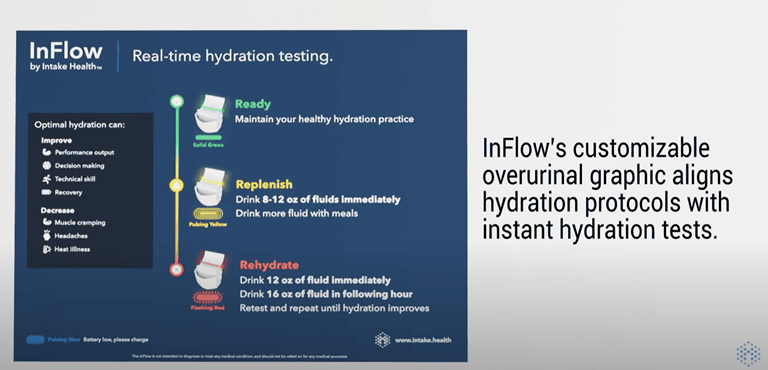
Image: Intake Health
What problem is your company solving? “Hydration testing happens quite a bit in these environments already. Some teams don’t actually have the capacity or resources to do it, even though they would like to do it. Others that have the capacity to find time for hydration testing with their staff can’t really do it frequently enough to change the behaviors of the athletes and keep it top of mind frequently enough to improve the hydration behaviors of their athletes. Proper hydration is really critical to get that extra 1, 2, 3% out of athletes. It improves decision making, keeps them healthier on the field and playing longer. It reduces cramping and injuries and improves recovery. All these things that very elite teams are looking to do is why they have these hydration protocols. Frequently, it starts to become deprioritized or they can’t get to it as often. Our technology allows them to distribute that and automate that process. Now, you have hydration testing in every urinal and the athletes are aware of their results and can act on them immediately instead of waiting for a large number of staff to collect urine samples, do all the testing and write those answers down. There’s a significant lag between existing processes for hydration testing compared to having the instantaneous, hands-free hydration testing in the urinal today. We’re able to bring hydration awareness to the top of mind for athletes and actually change the hydration culture among the team. We’re seeing great results.”
What does your product cost and who is your target customer? “The product is sold primarily through distributor channels. It retails for $2599 for a four pack. Our target customers are elite athletic programs. We sell globally, so professional sports, Division-I universities. Any sports program that can leverage these effectively to improve hydration.”
How are you marketing your product? “For marketing, we started with targeted emails and standard outbound tactics like LinkedIn and calling on people listed on desired customer websites. Since gaining traction, we now see a lot of organic inbound from word of mouth and are shifting to rely on our new distribution partners – Henry Schine, School Health, and Alert Services in the US and Perform Better in the UK – to increase awareness. We also go to conferences quite a bit. You’ll see us at a lot of sports conferences and our distributors will be representing the product. A lot of times, we’ll install the technology at the conferences so people can use it.”
How do you scale, and what is your targeted level of growth? “To scale the company, we are relying on distributors. We’re bringing on more distributors globally to help push the product out. As far as working with our partners to ensure product availability, we have manufacturing partners we’re ramping up to produce the product with the quality we demand, as well as support the customers with the support they deserve as we scale up. There’s a pathway of additional products in what we plan to do next and new markets we intend to take the market to. The sports world is interesting. We want to support it and we’re dedicated to supporting that industry and it’s a very large, global industry. When you’re looking at the elite and the top levels, it’s on the edge of a venture-backable business. Our intent is to get technology that measures wellness on the toilet of everyone in the world. Right now it’s hydration, but there are other indicators. Our strategy is to figure out: ‘How do we get this on everyone’s toilet?’ With hydration products specifically, we are just now looking into workplace safety markets, so construction, mining, warehouses, agriculture. We can have a large impact there keeping people healthy and safe by improving their hydration. We’re also looking at military and tactical environments, like fire, police, first responders. They also have existing hydration protocols and understand and need their people to be hydrated to perform at the level they’re working at. We’re expanding into those markets.”
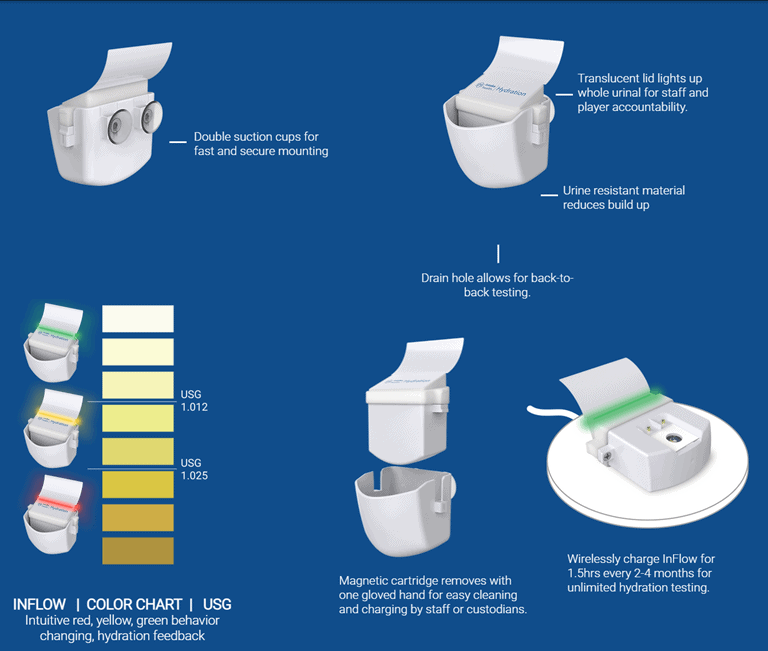
Image: Intake Health
Who are your competitors, and what makes you different? “When it comes to hydration testing, there are competitive options. Most of them are devices, so people are just selling products that help you measure your hydration. I don’t think there is anyone doing real-time hydration monitoring for professional sports in the toilet. Our competition seems to be more status quo, what people are doing today than an actual company producing a competitive product. Our product, when it comes to measuring hydration, whereas for a dipstick or an optical or digital refractometer you don’t have to use your hands. It’s hands-free. No one has to collect a urine sample to use our system to test hydration. The results are instant, so there’s no lag time between running a hydration program and delivering that information and acting on it with the athletes. They can act on it in real time and produce impact before they get to the field instead of often after they hit the field with existing products. The sweat patches can help give a one-time understanding of a person’s sweating capacity and what happens, but it’s not really an ongoing use case that keeps hydration top of mind. That may be more of a symbiotic product instead of a competitive product with a slightly different use case. When looking at other companies that are trying to measure stuff specifically from the toilet, like health indicators not specifically hydration, one thing that sets us apart and is important is privacy. Our technology is standalone, you install it and it does not collect personal, identifiable information nor health data. It’s meant to empower the user in real time. We’re able to bypass a lot of the privacy concerns that some people may have as they’re collecting the data and bringing it up to the internet and doing things like that.”
What’s the unfair advantage that separates your company? “We definitely have patent-pending technology around measuring health indicators from the toilet. The team we’ve built is pretty impressive. We have people from the industry and the sports world specifically that are trying to solve this problem. We have customers that want to come join the team. That’s what it comes down to. We have a good team and novel technology.”
What milestone have you recently hit or will soon hit? “Bringing on the distributors was probably our first milestone. We’ve been able to launch a product, get early traction and then attract distributors. You have to have a product the market cares about in order to have distributors place larger stocking orders. We’ve been able to create a product and validate it. We only launched the product last September, so it hasn’t been very long that we’ve been selling the product. In a very short time period we’ve been able to prove market demand and we have something useful for the market and for our distributors.”
What are the values that are core to your brand? “Transparency and trust are critical. We publish papers and make our data well-known. That is important in this industry, especially where a lot of people try to maybe sell you snake oil. Everyone is looking to get that 1-2 % and some companies take advantage of that. We want to put this on everybody’s toilet and improve health for everyone. Our mission is to help people live healthier longer, instead of us having decades of life at the end of life and degraded health where we can’t do stuff with our grandchildren or we’re going to the doctor’s all the time. We want everybody to be healthy until their final days. Hydration is our starting point but, to get there, trust and transparency is absolutely critical. That’s also why our device does not collect, store or transmit any data. We don’t want to muddy the waters with, ‘What are we doing with all this data we could be collecting on health indications?’ We’ll roll out data collection and connectivity later as customers demand it. Medical rigor is another one. We are not a medical product today, that’s definitely in our future. We appreciate the level of intentionality behind building a medical device and medical product and how the medical industry treats health information and rolls out products to make sure they are safe and efficacious. That’s really critical to us as well.”
What does success ultimately look like for your company? “The entire world living healthy until their final days.”
What should investors or customers know about you — the person, your life experiences — that shows they can believe in you? “We have a good bit of experience already. We’ve built successful companies and I’ve built successful companies. We have customers using the product. We have a history of doing what we say and delivering on what we say, whether that be with this business or previous businesses or life experiences. The team we’ve built is a very credible team with lots of experience in the industry for customers. You don’t get that far in life and build up a reputation without being trustworthy. That goes back to trust and transparency. We’re not new, we’re not the 17-year-old founders out there. We’re 40 years old and have been doing this for a while.”
What examples are there of how Intake Health has benefited a team or partner? “We have a case study with Millwall FC. They adopted our technology. That had an existing hydration protocol in place. After using our technology for a couple of weeks, they saw those results go up and decided they could stop doing their hydration protocol which was time-consuming. They improved their hydration, improving time and money for the organization, which is what we are hoping to do for all teams.”
This article was brought to you by SBJ Tech, a Leaders Group company. As a Leaders Performance Institute member, you are able to enjoy exclusive access to SBJ Tech content in the field of athletic performance.
Perch’s 3D camera has become a feature in the weight room of the college football champion, the Bulldogs.
Main image courtesy of Perch.
A Data & Innovation article brought to you by
The days of walking around a weight room with a clipboard are long over. At Georgia — not to mention other SEC schools such as Auburn, Ole Miss, Mississippi State and Mizzou — Bulldog players got stronger and stayed fresher last season through an automated velocity-based weight training platform from the fitness tech company Perch.
Saturdays were the gamedays in Athens, Georgia, but every other day of the week for the national champions was a Perch day. The school’s 24,000 square-foot weight room contains a ‘DawgTron’, a 25-foot-by-10-foot digital screen that displays a strength and power leaderboard. That meant players could lift, but not hide — which created a competitive environment that Georgia’s lead strength and conditioning coach Scott Sinclair attributes to Perch.
“Our players now see who’s moving the bar fastest,” Sinclair says.
Perch’s premise — and now about half of the NFL teams are on board, as well — is that computer vision, machine learning and artificial intelligence can inform players of their lifting data and consequently how hard to push themselves. In theory, it’s all about the speed of a lift, which is what Perch is able to quantify and display in real time.
The company’s co-founder and CEO Jacob Rothman is a former MIT baseball player who herniated his disc while squatting in a weight room — not realizing he’d been overexerted — and brainstormed a smart gym that could reduce the risk of injury. After internships with the virtual reality company Oculus and the corporate behemoth Apple, he entered the business world as an entrepreneur and made it happen.
“This is like 2016-ish,” Rothman tells SBJ. “Wearables were really, really popular. Apple Watch had just come out. Fitbit was popular. But there was nothing that collected a similar type of data for the weight room. So how do you complete the picture? How do you provide a similar experience for the people that prefer to strength train or who are augmenting their cardio with strength training? So we kind of set out to build an experience, and we discovered that elite athletics is an amazing use case for that product. So we just started building in that direction. And you know, the rest is history.”
Perch would solve the problem of athletic load and the inherent risk that comes with it. If a player or a team had a physically taxing game or practice the day before, typically their strength coach would assign perhaps a lighter day of lifting. But with Perch, that would all be determined by lift velocity. If Perch’s numbers prove a player can’t move a barbell fast enough, it means the weight is too heavy or they’re too tired to do so. The decision can then be made to back off. But if the player is moving the weight too swiftly, then they are alerted to add more weight to optimize what can be a sterling day.
“So basically, what [Perch does] is we tell the coach how the athlete is performing, and the coach can make real time adjustments based off of that,” Rothman says. “So it really is closing that feedback loop, and what that results in is reduced risk of injury and basically like athletes getting stronger, faster. You can get a lift in, and you can guarantee that you’re not over training or under training.”
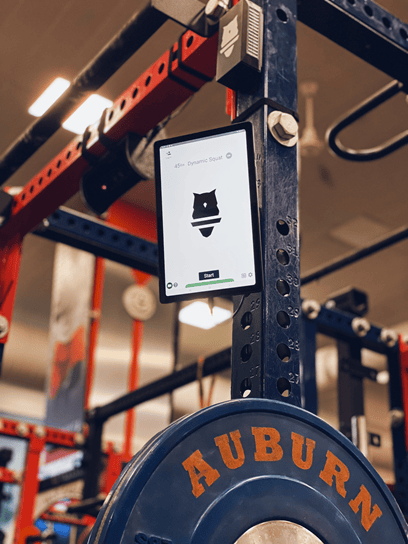
Image courtesy of Perch.
Computer vision cameras are attached, or “perched,” on top of the weight equipment, and through the machine learning and AI, can recognize and calculate the number of reps while charting the corresponding speeds of each lift. The analytics then emerge in real-time, and players can see their body outputs on a small screen or, in Georgia’s case, on the DawgTron.
MLB teams such as the Phillies leaned on it last season because, over the course of 162 games and cross-country travel, the team’s strength coaches were concerned about both muscle atrophy and exhaustion. To balance that properly — lifting without overexerting — the team leaned on Perch’s metrics.
“They wanted [Phillies] players to maintain strength or even get stronger and do that safely while in-season,” Rothman says. “So I think one of our huge benefits for baseball is managing fatigue.”
Other endurance-conscious teams such as the NBA’s Miami Heat and Orlando Magic and the MLS’s L.A. Galaxy and San Jose Earthquakes are also clients for similar reasons. But football players are still Perch’s most prominent use case. And as the season was starting last September, the company closed what Rothman called a “$4 million Seed Plus” round to help them hire a larger staff to keep up with demand.
For instance, NCAA schools such as Wake Forest, Maryland, Virginia, Duke, North Carolina, Boston College, West Virginia and Stanford have all gone public with their Perch usage, while NFL teams such as the Chargers, Patriots, Jaguars, Dolphins and Titans are also on board. Rothman hopes that perhaps the Philadelphia Eagles, Georgia’s football subsidiary, can end up joining next.
With one caveat, though. DawgTron is sold separately.
This article was brought to you by SBJ Tech, a Leaders Group company. As a Leaders Performance Institute member, you are able to enjoy exclusive access to SBJ Tech content in the field of athletic performance.
Leaders Performance Advisor Rachel Vickery explored breathwork and ‘default breathing’ in the third and final session of her Performance Support Series.
A Human Performance article brought you by our Main Partners
Part one, which looked at better understanding athletes’ physiological responses under pressure, is available here.
Part two explored how you can train your athletes’ physiological responses to pressure and can be found here.
We moved into the third and final session where the focus shifted to thinking around:
Relationship between breathing & performance
Before exploring some specific elements around how effective breathing can help to control arousal state and support performance, do we actually understand how pressure can influence breathing and vice versa?
In high pressure environments, inevitably we will see changes in breathing mechanics. If we want to be intentional and strategic in setting teams, organisations and ourselves up to be able to execute really well under pressure, efficient breathing is a powerful tool to support the control of operating state and to optimise physical, mental and emotional performance under pressure.
We need to avoid situations where things fall apart and then try to fix the problem – we will talk about the importance of front loading below, but to witness positive developments in this space, it takes time to become effective and second nature. We are seeking to keep our arousal state below the threshold for performance where you can perform well and in your sweet spot, as opposed to ‘crossing the red line’ where performance starts to fall apart. Approaches to breathing and other physiological support mechanisms can help to calm the nervous system for a more sustained approach to performance.
A really critical piece that’s often missing for teams and for individuals, is that we don’t get the chance to work with the arousal state in an environment that is not actually the performance arena whenever – whenever it is practised, there tends to be other things to be thinking about.
Importance of ‘front load buffer’
Throughout this series, we have reinforced the notion that performance under pressure is less to do with what you do in the moment of pressure. The concept of ‘front loading’ is something Rachel has woven throughout the sessions – it’s something she believes is a key determinant in controlling the pressure that will inevitably occur around competition time.
When we consider ‘front loading’, we are talking about the techniques and tools that can be used before a game or away from competition. Around ‘go time’ there is always going to be an increase in arousal state, driven by uncertainty, the unknown, high consequence, responsibility of outcome, being outside of the comfort zone and, even from a physiological perspective, the respiratory response to exertion.
A technique that can have a real positive impact is the ‘Theory of Fours’ breathing technique. This is a technique lasting four minutes, and includes breathing in for four seconds and out for six seconds across the four-minute period. There is strong evidence behind the science around its ability to bring the heartrate down. In high performance environments, it can be a useful practice to be used in the locker room both before and even after a game to reduce arousal. It’s also important to understand that the biomechanics of performance can be supported through effective breathing – there are more performance factors to be impacted than just heartrate control.
Front loading and giving yourself ‘buffer’ techniques can also help to manage arousal state in other instances, for example managing difficult conversations or other interactions away from the field. In the moment, if you are breathing calmly, your shoulders will relax, tone of voice lowers and the body doesn’t give a signal of stress. If you are able to do this, the other person you are interacting with doesn’t perceive the interaction as a threat and the communication is going to stay calmer and a lot more open. If you are carrying a lot of stress, you can carry it into a conversation with someone else.
Distinguishing breathwork & default breathing
Breathing isn’t just a key part of controlling arousal state, but it plays a significant role in optimising the physical and biomechanical aspects of performance, alongside mental and emotional performance under pressure. When it comes to breathing, there are two types to consider: breathwork and default or automatic breathing.
Breathwork in Rachel’s words is the ‘vitamins’, helping to give you a boost to more effective breathing. Default or automatic breathing is the ‘nutrition’, day-to-day breathing which is going to have the most impact in terms of optimisation – ‘if you have good nutrition, the vitamins can give you an additional edge’. There are huge performance gains through optimising breathing, which is different from breathwork.
If you have an athlete or are an inefficient breather yourself, you can miss out on the three factors below:
The final point in this section is the potential parasympathetic backlash that can occur for people operating in high pressure environments consistently. This is more commonly known as burnout. This is a downside of high performers who are typically very emotionally, mentally, physically, and virtually resilient. They can keep pushing a long way down the road before their physiology finally goes. Effective breathing, starting with default and topped up through breathwork, has been shown to help control the possible parasympathetic backlash that can occur.
Getting the basics right: what are the non-negotiables?
We have discussed the effectiveness of breathing techniques in helping to control responses to stress and pressure. There are a number of other factors that are important to get right to optimise human performance – they are the basics and non-negotiables which need to be focused on consistently. If we have these foundations well squared away, we can operate in a calmer nervous system state.
How can we de-escalate arousal states intentionally?
Rachel encouraged the group on the call to think about the importance of consistent de-escalating, especially in sports where there are repeat events, which is most. If we don’t strategically de-escalate between each game or aspect of the game, the arousal state will continue to creep up. This is where we can begin to see more mistakes occur. We can also do this for post-game to bring the arousal state down.
What are some of the things you can consider or implement to support this process:
De-escalate, don’t distract / escape.
The man who helped save Steph Curry’s ankle explains that there are times when athletes can train their movement patterns in the name of performance.
A Data & Innovation podcast brought to you in collaboration with
The Director of Performance at Uplift Labs was on the pod to discuss how the company’s AI can reduce injury risk in athletes.
There is no better candidate to delve into injury prevention and mitigation than the man often credited with saving Steph Curry’s ankle.
We made a whistlestop tour of his work at the Minnesota Timberwolves, Atlanta Hawks and, of course, the Golden State Warriors.
Also on the agenda were:
John Portch Twitter | LinkedIn
Listen above and subscribe today on iTunes, Spotify, Stitcher and Overcast, or your chosen podcast platform.