8 Jun 2026
ArticlesAt a recent Leaders Virtual Roundtable, members with a direct interest in the topic discussed their challenges and opportunities.
That observation and question, posed by a skill acquisition specialist at a recent Leaders virtual roundtable, neatly captured the challenge of optimising athlete skill development.
“I think we can say with confidence that it’s actually hard to measure all of these elements,” she continued. “Coaches can see changes in athletes over time, but how do we know that it’s actually stuck?”
To illustrate her point, she spoke of a recent university research project in Australia where athletes were asked to train within a set of fixed constraints. As part of the project, both the athletes and their coaches were quizzed on their perception of the level of challenge.
“One athlete found it harder, one found it easier, and it was the same constraints, same drills.”
There is nothing unusual in that fact, but it does highlight the importance of coherent, context-specific approaches if teams are to gain a handle on skill acquisition in sport.
Last month, members of the Leaders Performance Institute – all skill acquisition specialists or coaches with decades of experience in elite sport – shared their views on the challenges they face and the potential opportunities to pick “low-hanging fruit”, as another participant put it.
Challenges
Skill acquisition is fragmented
“We’ve got pockets of really great work, but there’s not necessarily a systemised approach to being able to embed that knowledge across coach development, across coach education,” said another skill acquisition specialist working in the Australian system. He added: “We need to take a systems approach and be able to influence all those different pieces. At the moment, they probably don’t talk well to each other.”
Unclear understanding
The aforementioned fragmentation is a direct consequence of the way skill acquisition is perceived more widely.
“Ultimately, what we’re trying to do is help athletes become more skilful,” said a coach development specialist based in the UK and Ireland. “People are doing things so differently; we use lots of different words in this area to describe much the same thing.” He then hinted at the solution. “What I think would be really useful for everybody is just going ‘what is it we’re trying to achieve?’ And then be clear; ‘what is it we actually mean when we say these things?’”
Overstated certainty
“One of the things that I see is that I think that often the concepts that are associated with skill acquisition get stated with too much certainty; that there is really clear, solid evidence that everybody should do a certain something,” said the coach development specialist. “That worries me because I just don’t think that there is the strength of evidence to support some of the statements that are made.”
One of his skill acquisition-focused peers concurred. “We can probably have confidence that the research often doesn’t reflect the complexities of the environments that our coaches actually work in,” he said. “I spent 10 years with Paralympic sport in Australia, and I remember the first time I went in. I was young, keen, had all this knowledge, all these ideas; and I remember going into the environment for the first time and thinking ‘I’ve got nothing because nothing from my academic background translates directly here’.”
Cultural barriers
Of all the challenges discussed thus far, the coach development specialist cites cultural context as perhaps the most significant for coaches. “We can probably have confidence that coach education in this space is mixed at best,” he said.
“Coaches are very often taught to think in a different way than what might support skill acquisition,” he added.
This is a problem because, as a coaching lead in the British system observed, “the expectation for coaches to be exceptional in this domain is not what it should be.” He then went further. “I think even the phrase ‘skill acquisition’ may put people off. No one wants to feel incompetent in the domain in which they’re employed.”
He also spoke of the challenge of managing athlete comfort, beliefs and expectations. “If they want to do something and you’re not giving them what they want to do, you’re on a sticky wicket.”
A skill acquisition coach admitted there were times when “we would have lost the athletes; they wouldn’t have been ready; it was too quick, too far away from their norm, it made them too uncomfortable. We had to continually iterate and play at their challenge level.”
Practice design
The coach development specialist cited challenge point theory – essentially pushing athletes beyond their current ability – as useful but limited in isolation. “The deeper challenge there is, well, when do we use more of it? When do we use less of it?” he said.
Is an error-strewn session better than one where athletes sharpen their existing skills? “I’m not sure we’re at a point where we can say we understand the value of repetitive drill-like practice,” he added. “If we introduce this level of variability, what’s going to be the impact? If we dial it back, what’s going to be the impact? I think that’s probably the next frontier, not just for research, but for coaches.”
Opportunities
Coherent systems (and language)
“It doesn’t sit with one group,” said another skill acquisition specialist. “We need to take a systems approach and be able to influence all the different pieces. At the moment, the different disciplines probably don’t talk well to each other.”
It requires a shared understanding and sharper definitions. ““What is it we’re trying to achieve?” asked the coach development specialist, “and then be clear, what is it we actually mean when we say these things? We use lots of different words in this area to describe much the same thing.”
He added: “I think that we might be better off going, ‘well, to what is it that we can actually anchor?’ What are the things that we could consider to be good practice rather than saying ‘do this all the time and everything will be better?’”
One trend is for skill acquisition to be implicit, as a coach working at a major European football club explained: “skill acquisition is a little more hidden and less explicit here – I don’t know whether I’m cheating the system by not trying to shout from the rooftop.”
A skill acquisition lead suggested there may be an opportunity in some instances “to be a bit more explicit and reflect back on how do we actually design the best skill-learning environment?”
As if to underline the complex nature of the problem, the UK-based coaching lead responded to both by saying: “I like the concept that it’s hidden, it’s implicit, but equally, I like the idea that it’s really transparent. There’s some solution somewhere between those two things.”
Better transfer from training to performance
“The more contextually relevant we can make the skill development, the more likely we are to get transfer into performance environments,” said a skill acquisition coach.
The coach development specialist then built on this point. He said: “I think we ignore the context around an athlete and a coach. If we’re going to make an impact with this work, we need to zoom out and look at the context around the coach and athlete rather than saying ‘do this all the time and everything will be better’.”
The coaching lead felt there was some “low-hanging fruit” to be found in this area. “We don’t do systematic analysis of training sessions to understand stimulus and response,” he said, while admitting he has yet to find the right tools or metrics.
For all that, athletes must have some agency too. The All Blacks of the 2011 and 2015 Rugby World Cup-winning vintage were a prime example of a mature, player-led approach to the transfer of training to competition, as their former GM told the table.
“We had players that wanted skill acquisition,” he said. “We had a mission as a group that come game time, we needed self-reliant athletes. And the only way we could build that was through them getting themselves ready to play. So coaches became the support rather than the lead. Skill acquisition was built into every session, but the player would design how they utilised that period of time.”
There is, of course, a balance to be struck. The coaching lead noted how frustrated his players once were with a monotonous session, yet “the transfer 36 hours later was unbelievable” (he also noted that his observation was “non-scientific”).
Improve how coaches think, not just what they do
“There tends to be a frustration that some of these ideas aren’t adopted more,” said a skill acquisition specialist. “I would encourage people to think about, well, what are the systems that we’re putting around coaches? What are the environments we’re creating to actually enable coaches to be more open, more curious, and make it more accessible? And what are the multiple nudges and ways in which we can do that?”
He also noted one coach lamenting the fact that there was little coach education in this space two decades ago (even if he admitted he might not have been receptive in the early 2000s). “How do we actually create systems so that more coaches more often can start to access these ideas and get support in this area?”
He added: “What we want to do is help coaches become good decision makers and designers of that environment and have a rationale and intent for why they’re making those manipulations.”
Connect training, data and performance
The coach based at the European football club spoke of their work with analysts to ensure better transfer of training to performance. “We have a database of all of our training sessions, logged what we’re doing, and then the analyst gives me a monthly report of like, ‘you’ve covered this, you’ve covered this, you’ve covered this’,” he said while emphasising that his club is only at the start of its development in this space.
“We also have a research and innovation team that feed back to us on our game performance and highlight any dips or trends such as ‘actually your counter-attacks are down in the last month’. Then I go back to the training library and go ‘okay, we’ve not done enough counter-attack practices or actually we’ve done loads of counter-attack practices, but they’re down, so why is there not a transfer?’ And so we’re trying to attack it that way.”
He then reflected on his ability to influence his coaches. “When we break off and do unit or individual work, I’m constantly trying to nudge them into making the practices a little bit more relevant, game relevant and asking themselves how that is transferring to what we’re doing.”
What to read next
28 May 2026
ArticlesAt a recent virtual roundtable, members of the Leaders Performance Institute discussed one of sport’s most pressing challenges.
So wrote Arie de Geus in the Harvard Business Review in 1988 while serving as the Head of Strategic Planning at Shell.
This idea was amplified by systems scientist Peter Senge in his seminal 1990 book The Fifth Discipline: The art and practice of the learning organisation.
They both emphasise the idea that learning is not a mere ‘nice to have’; it should be woven into your environment and enable your people to strive for continuous improvement.
They also discuss a problem that persists nearly four decades later: that learning in numerous organisations is inconsistent, unstructured, individualised and event-based.
This idea set the premise for a recent Leaders Virtual Roundtable where members convened to chat through their challenges in this area and potential solutions.
“In some quarters, we get caught up on a single event; you go to a conference or someone comes into your environment and we see that as a learning moment,” said Luke Whitworth, the Sport Performance Team Lead at the Leaders Performance Institute. “Whereas it’s really what we’re going to talk about today, which is how we embed this in what we’re doing.”
Firstly, he shared a selection of eight primers for the session ahead:
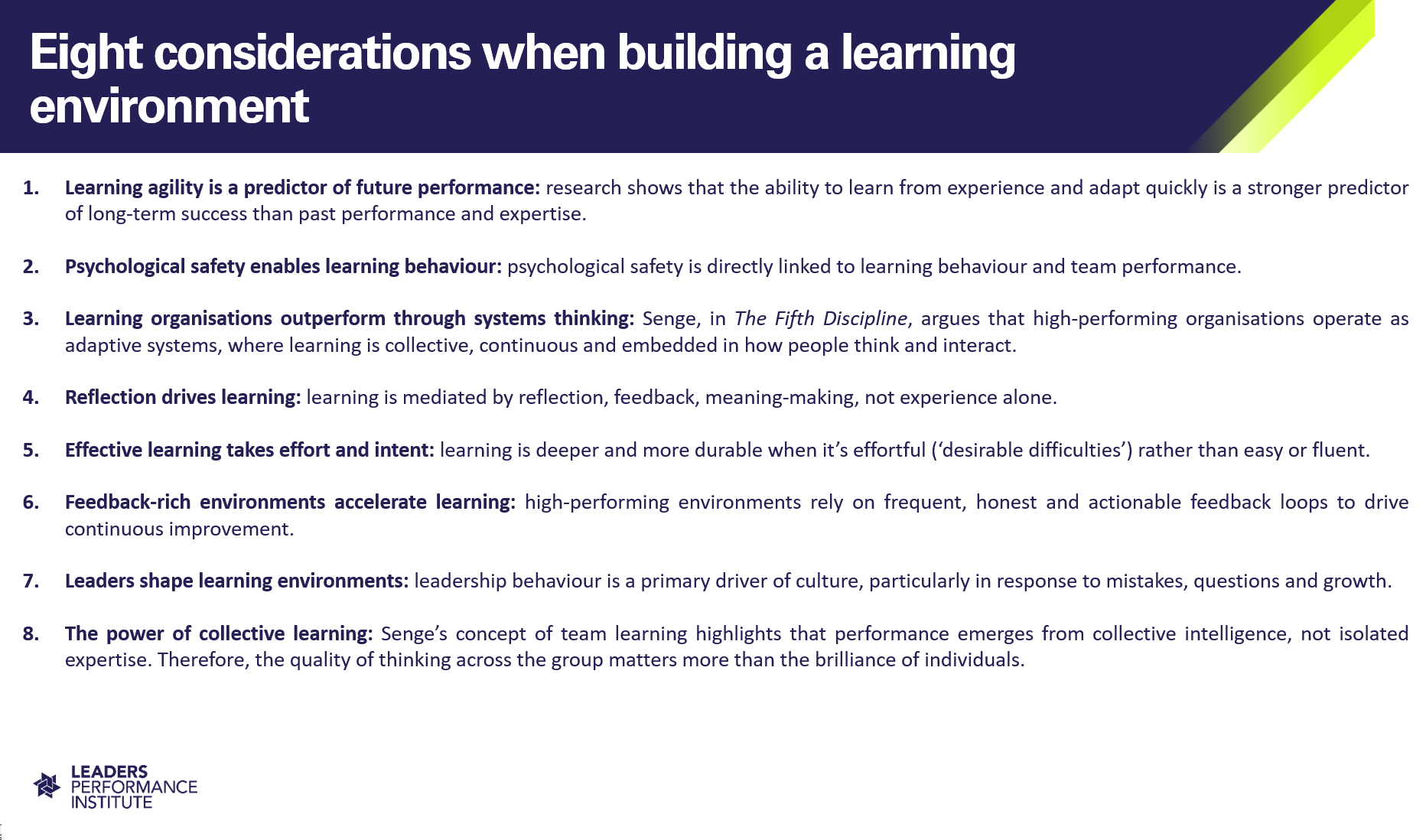
The table then conferred on the areas where learning currently breaks down in their systems and the challenges that prevent the creation of effective and impactful learning cultures. They raised a selection of common themes:
Time pressure and competing priorities
This was the most common challenge at the table. The struggle was succinctly captured by three attendees who have all worked in Major League Baseball. “The breakdown is typically the perception that I don’t have time for this,” said one. “The to‑do lists take precedent over the to‑be list.”
“You’re just constantly on to the next day and there’s not a ton of time to pause and reflect,” added another.
“Coaches think learning is getting in the way of getting the job done,” observed the third.
A lack of (the practice of) reflection
This is intertwined with the lack of time.
“The reflection piece is where we see a breakdown a lot,” said the Director of Player Development at an MLB club. “They probably don’t allow themselves enough time to review and reflect,” added an L&D manager at a British sporting organisation.
There is no consensus over “when is the right time to do all of this teaching and learning and, therefore, we simply don’t do it,” said a coaching lead at a British university.
Basic performance pressure
“There is a need for performance in the now rather than the development piece over time,” said a coach working in English football. “The managers are under real pressure.”
That coach was not alone. “The environment praises immediate results,” said another coach from the world of MLB. “There’s this pressure to produce over learning.”
This has engendered fixed mindsets when it comes to learning. “This is how we’ve always done it,” said the coach in English football citing a typical excuse.
A lack of clarity
As the Director of Player Development in MLB explained, “our group really wants to learn but is trying to be a jack of all trades and master of none.”
“It probably confuses coaches,” said the manager working at a British sporting organisation. “What do they want to be learning?”
As a consequence, that learning often happens in silos.
A lack of role modelling from leaders
“If leadership is not only supporting but modelling this, others then feel like they can take the time,” said the NCAA performance specialist, who explained that learning may be on the agenda of the lower ranks but “it stagnates at those middle tier leadership positions.”
Another leader based at a British university asked both the table and himself: “Are we doing enough as a manager to drive that thinking and priority?”
Poor quality teaching or coaching
“A lot of coaches are either overdoing the teaching so there’s not any learning taking place or there are too many missed opportunities for the teaching and learning,” said the head of coaching at a British university. “It’s also changing the perception of the teacher; I’m doing it to you versus facilitating learning.”
Then there is the question of timing. “Do you jump in straight away? Do you wait till the end of the session and reflect? Do you wait till the next day and do some teaching and learning?”
Then Whitworth invited the table to share what they need to do to make learning a competitive advantage in their organisation. As before, there were some common themes:
Space for ‘failure’ and ‘messy’ learning
“Learning is messy,” said a coach working for the NBA. “Learning is not ‘you learn it, you go and execute it, and everything’s beautiful’. If we don’t allow the space for mistakes then learning won’t happen.”
And, as an individual working in MLB, said, “it’s going to be messy, it’s not going to be pretty and we have to be okay with that.”
There also needs to be a shift in tone and content from negative to positive, as another coach working with the NBA noted. “A coach will highlight, ‘okay, you did this wrong’, but there is not too much focus on what you can improve.”
Psychological safety is further built through clear scaffolding. “If I’m dedicating time, how does it apply? How can I put it into play? How does it connect to my role?” asked a performance specialist working at a US college.
Crucially, messy does not mean unplanned. “We need to be more intentional in planning it,” said a nutritionist based at a British university. He was supported by a colleague who added that we need to “put it front and centre in objectives and appraisal meetings.”
Leaders that role model learning behaviours
“You’ve got to create that psychological safety,” said the Director of Player Development in MLB. “It goes back to modelling.”
“Do we give it time?” said the nutritionist. “Do we prioritise it in conversations and in meetings and in one-to-ones? Do we celebrate it when it’s done well? Do we hold people accountable when it’s not done?”
Embedded learning
“What about consistency and integration?” asked a performance specialist from an NCAA college. “Is learning aligned with the daily fabric of the organisation? It cannot be those one-offs. We’ve all been to those workshops, and it gives you a little energy boost, but what’s the lasting impact? What’s the follow up? How do we actually put it into play?”
Self-directed learning
“How can people take accountability for themselves and identify where they need to go?” asked a coach working in the NBA. “How can you create those spaces for self-reflection or guided discovery for them to self-assess against the framework or anything else; to use a reflection-type tool to think about those things so that they can then identify and take ownership themselves?”
Facilitated learning
“Are we really coaching if we’re not teaching or are we just hosting sessions?” asked the coaching lead. “There is that skill of being the facilitator of learning rather than just being the teacher.”
Collective learning
As De Geus and Senge argue, organisations achieve sustained advantage when individuals learn faster together. A performance expert working at a US college echoed their thoughts, noting that “the competitive advantages are the creativity, the collaboration, innovation, and the consistency.”
This reflects Senge’s concept of collective intelligence, where the quality of thinking across the group exceeds that of any one individual. Collaboration enables better shared thinking, faster learning cycles and better decisions, which ultimately allows organisations to adapt more quickly than their competitors.
Balance the short, medium and long term
“What do you need to change now and where can you take a longer view?” It was an important question, that was posed by a coach working in the NBA. “I think it’s being comfortable with the different timelines and knowing what the objective is and then being able to work through that with your staff and in your one-to-ones.”
What to read next
You Don’t Arrive Strategic: How Leaders Grow Into their Role
12 May 2026
ArticlesAs recent participants on a virtual roundtable discussed, the best team leaders design environments around shared purpose and guided autonomy.
“I work primarily with staff on a day‑to‑day and they are very young,” said a senior sports scientist working in Major League Baseball.
“They’d be Generation Z; and I think there’s definitely a difference in terms of how I have had to learn to communicate with them and include them in various decisions and thoughts along the way — and I’ll be the first to say I fumbled royally multiple times at first.”
This individual – whose experience is far from unique – was speaking at a recent virtual roundtable for Leaders Performance Institute members on the challenge of working with the next generation. Several in attendance spoke of the different beliefs, values and attitudes that can exist within a single environment.
Over the course of an hour, the table discussed how to better understand those generational differences in a way that meets the needs of all their young people.
The session host Luke Whitworth, the LPI’s Sport Performance Lead, challenged participants to move beyond generational stereotypes. He said: “If we’re going to manage these multi‑generational teams, it comes down to the leader’s ability to understand the behaviours, values and beliefs of younger people.”
A top-down approach, he argued, is not going to cut it; and he posed the table two questions:
The first question set up the second; and collectively the table alighted on five themes.
1. Pursue co-creation
The consensus is that athletes want to have a louder voice in their own development.
As an attendee who coaches at a Premier League academy said, even boys as young as 11 “continue to want instant information; they want more challenge; they want to know what’s next.”
He added:
“At the moment, we are searching for more autonomy and ownership from young players around some of their developmental needs. We’re sitting down with a young boy and having conversations around what are some of the things that you’re really good at; what would you like to achieve this year; what do you think you’re not so great at and could be working on.”
While the player is encouraged to express their views, they are still guided by their coaches.
“We will tell them: ‘whilst we understand that you feel you need to work on these developmental areas, there are definitely other areas that we need you to continue to work on.’”
In several cases, the priorities of younger staff members mirror young athletes’. A sports scientist from a different Premier League club said:
“The younger staff want quicker progression. They want to know what is happening for them to progress into more senior roles.”
A coach from the US system has observed similar ambitions in their context. He said:
“They won’t take ownership if they’re not included in the process.”
It’s a similar story in a military setting, as another attendee observed from their work:
“You have to be really intentional, really painfully deliberate with junior staff members to make sure that they’re engaged and they feel like they’re part of the process.”
2. Make sure individualisation is rooted in identity and purpose
In several key respects, individualisation underpins efforts to co-create the development plans alluded to above, but sometimes, as a player development manager in Major League Baseball pointed out, the players need a helping hand to prevent them from “climbing the wrong mountain”.
He said:
“Over the last year and a half, we’ve really tried to dive in on the first question. And I think our feedback loops have changed because of that. The four things that stood out at the beginning were reflection, ownership, collaboration and impatience – four things that we feel like our players really struggle with.”
As for the solution:
“We’ve started to dive more into identity and their North Star. Why do they do what they do? What are their values? How can we help them? And they’ve really opened up to us just in terms of who they are, where they’re going, what they want to do. And that’s opened the conversation to their actual on-field performance things that we want them to work on.”
3. Be comfortable with digital delivery
Younger generations are digital natives and teams would do well to lean into this.
The player development manager from above said:
“We’ve actually had our coaches start to record 10 to 15 minute videos, send them to players beforehand, and then the actual talk becomes them being able to reflect and digest the information.”
He is not alone, as another attendee from a US NGB explained of her organisation’s approach to identity:
I’m not a coach, I’m not in performance, I’m in operations, but our data analytics team started talking in a really structured way with our 13 to 15-year-old athletes here at the training centre. They ask them what’s their preferred game style, what kind of player they want to be, who they look up to, and have them sit down and make a video of it. And that has been a really cool exercise.
Meanwhile, at the aforementioned Premier League academy, independent video learning is the norm. The coach said:
“We record training sessions and games that go straight onto Hudl for young players to go and watch. They can engage in it however they want.”
4. Promote peer-to-peer learning
Peer-to-peer learning is also essential. Another academy manager, this time in the world of basketball, said:
“The players have discussions internally between themselves and they come back to us with a conclusion as a group.”
At this juncture, he explained it is important to work out who are the key influencers in the playing group.
“We are living in an era of influencers, TikTokers, YouTubers. So who is the guy who has the biggest influence here in our team? And he’s going to be charged with talking to us and delivering the message to the rest of the group.”
Once again, this peer-to-peer dynamic is just as relevant to staff. A programme lead in the US spoke of their ‘zillennial’ staff i.e. those who could reasonably be classed as older Generation Z and younger millennial.
He said:
“When we have to make a big departmental decision, everyone has to bring a piece of paper. They have to write their own ideas down first before they hear anyone else’s and then walk it through as a group. By the end of it, we all come to the agreement like, ‘hey, this is what we’re doing as a team’. That way it’s everyone’s idea versus ‘that wasn’t my idea’.”
5. Re-evaluate staff reporting structures
A senior sports scientist at a Premier League club explained that his club restructured how staff members report to their line managers. He said:
“We added more layers in. Part of the reason for that was to allow some of the younger staff to get more regular feedback, more regular development. We’ve also tried to limit the number that any one clinician will line‑manage so that actually those conversations can happen more readily.”
What to read next
Four Questions those Working with the Next Generation Should Ask Themselves
At a recent virtual roundtable, skill acquisition specialists Damian Farrow and Lyndell Bruce led a conversation into one of sport’s most misunderstood disciplines.
“In general, the most positive experiences I’m sure anyone on the call has had are where a group of people come together and they just keep chipping away and asking questions,” said the AFL’s Football Innovation Manager, while co-hosting a recent Leaders Virtual Roundtable, the first of two to explore the theme of skill acquisition.
Farrow, also a renowned Emeritus Professor of Skill Acquisition at Victoria University, enjoys such conversations with coaches, who bring their own set of experiences to the conversation.
“The magic happens when you’re leaning on both sides of that equation,” he added.
The ‘magic’, as Farrow put it, was nicely captured by his co-host Dr Lyndell Bruce, the Director of Sport at Deakin University, who spoke of the sense of pride she feels when a training tweak pays off.
She said: “Whether the athletes pick things up quicker or that they just all of a sudden get it or we change something slightly and it just clicks, whether it’s for the individual or the group, we can then see the impact in what we’re all striving to do with our athlete cohorts.”
However, despite the centrality of skill acquisition to performance, it is often hampered by a range of systemic issues.
“It takes considerable time to improve skill,” said Farrow. “I think sometimes we just keep going around in this cycle going ‘oh, did that really work? I don’t know.’ But we probably, a lot of the time, didn’t give it sufficient time; we didn’t periodise it like we might do a strength training programme.”
Over the course of this first session, Farrow and Bruce led a cohort of Leaders Performance Institute members in a discussion about the challenges, tensions and opportunities in skill acquisition.
Beyond the time it takes to acquire a skill, the table noted several other challenges and tensions:
Some opportunities sit at training session level:
Other opportunities sit at a system level:
What to read next
AS Béziers Hérault Head Coach Rory Teague ponders the question of skill acquisition and delivers his six considerations.
These are the words of Rory Teague, who notably spent a year and a half between 2016 and 2017 working as a skills coach under then England men’s rugby union Head Coach Eddie Jones.
A decade on, Teague serves as the Head Coach of French Pro D2 club AS Béziers Hérault and, as he tells the Leaders Performance Institute, would not copy Jones’ appointment in southern France.
“I wouldn’t myself employ a skills coach,” he says. “I think every coach who coaches an area of the game should be able to coach the skill of their area. ‘Skills coach’ as a term has become archaic as coaching has moved along.”
He feels that assigning skills coaches to coaching units risks diluting accountability. “When something breaks down, you’re not going to just look to the skills coach who’s sat in the room waiting for the moment to say ‘oh, that’s me’,” he continues.
“If the lineout doesn’t go well because of the throw, who’s responsible for that? Is it the lineout coach or the throwing coach that comes in once a week? I would prefer that my forward coach has understanding of the skill of throwing and takes responsibility for it.”
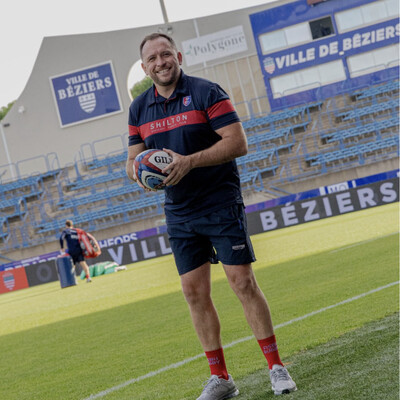
AS Béziers Hérault Head Coach Rory Teague. (Image: Rory Teague / LinkedIn)
Over the course of half an hour, Teague ponders the topic of skill acquisition from a coaching career spent as a skills coach, unit coach, and now a head coach.
Here are his six of his main considerations.
1. The difference between ‘skill’ and ‘technique’
“Ultimately, skill is technique performed under pressure,” says Teague, who has been influenced in his thinking by coaches including Rick Shuttleworth (a consultant at organisations including the Rugby Football Union and UK Sports Institute), Scott Wisemantel (Attack Coach at the NRL’s Paramatta Eels) and, of course, Jones (who is now in his second spell as Head Coach of the Japan men’s team).
“They were three incredible coaches who helped me along the way,” he adds. “They pushed me to go and find out what is ‘skill’; what is the difference between ‘technique’ and ‘skill’? Because there’s a big difference.” Skill, he suggests, is the ability to select, adapt and execute actions in a pressured context. There is little value in a player passing the ball ten metres to their teammate repeatedly at the end a training session. “They’re only working on their technique, because there’s no external cue for when they’re passing.”
It follows that skills in rugby develop as a consequence of an interaction between mechanics, cognition and match context. “If I stand in front of the player and they run towards me and I run towards them, they’re interacting with the environment i.e. me, them, and the distance – and then they’re performing the technique.”
There is also a psychological and emotional dynamic that goes beyond cognition and technical execution. All these elements can affect skill expression in a match situation.
“There’s no substitute for being in the saddle,” adds Teague. “Hot feedback in the moment can be so powerful because you’re living that moment with the player.” He will use the moment to talk them through a situation.
He will readily halt training sessions to allow kickers to practise too. “Get them to kick when their heartrate is up and their emotional state is variable rather than just doing 50 kicks at the end of the session – because that’s just technique.”
2. Implicit and explicit learning both matter
At the heart of discussions about skill acquisition is the dichotomy between information-processing approaches (skill acquisition as learning to plan and execute correct movements by processing information internally) and ecological approaches (skill acquisition as learning to perceive and act in context by interacting with the environment).
Teague is not a dogmatist, even if he leans towards the latter. “I like implicit coaching where the exercise and your questions give the player the feedback,” he says. “What exercises can you design whereby you don’t have to say anything, the player performs the act, and the exercise gives the player the feedback? If you look at, say, goal kicking or throwing, you want the player to self-regulate when they’re in the moment and feel the pressure.” He will look to ask a series of questions that “get the player to think about where they want the ball to end up, where they want the ball to go versus breaking it down too technically”. He will also be mindful of the timing too, both pre and post-match.
However, when it comes to explicit approaches, “it’s not that those guys you’re very direct with are not taking control of their own journey and development, they just need to be told.”
It comes down to knowing the individual athlete. “I’ve worked with some players where I’ve fluffed it up too much and asked too many questions and they just want you to go ‘tell me exactly what you want me to be doing, tell me exactly what I’m doing wrong, tell me exactly how I can get it better’. Whereas with others, you can ask ‘what do you think?’”
Skill acquisition requires the coach to understand what the best approach is and why. Additionally, while it may be ideal for the session design to act as the teacher, there will be times when the coach needs to check for understanding.
3. Ask yourself: what will help the player?
While it is important for players to be drawn towards training sessions, whether by coaches placing balls in their line of sight or by making sessions enjoyable, the guiding principle should be whatever will help the players in that moment.
“Do you want your players to think your coaching drills are really good or do you want players to think ‘you’ve taught me how to pass better’?” As ever, the answer “depends on where you are” with the players in question.
In any case, “sometimes you have to get through the reps and you can’t deviate away from repetition”. Teague says: “I’ve seen coaches try to do these fast exercises to appease players and sometimes they can be so complicated that the players don’t buy into it because of how complex it is.”
There will be times when a coaching intervention can harm a player’s development and Teague will consciously be less prescriptive as a game week develops. “As you get closer towards the game, you’re looking at confidence versus correction” because sometimes less is more.
4. The coach is only part of the player’s journey
Between 2022 and 2023, Teague worked as a forwards and backs coach with Racing 92 where he had the opportunity to coach Finn Russell, who is widely considered one of the best fly-halves in the world.
Teague reflects on that period and what he refers to as the “culture of extras”, which is the work that the world’s best players continue to do on their basic skillsets.
“Finn would ask to do some extras when he thought it was right for him,” says Teague, who explains that Russell’s experience guided their training interactions. “Sometimes he’d do them on his own, sometimes he’d ask a coach to be there to give him some feedback, sometimes he’d want a coach there just to keep him company.”
Teague has also worked at school and underage level where he employed a more directive approach but in an environment like England or Racing, “telling them what to do probably isn’t the most intelligent thing.”
Instead, “I think the more players take control of their own skill development, the more you as a coach just have to be part of that journey, not driving that journey for them.”
5. Be patient, it’s a journey
The Leaders Performance Institute asks Teague what he knows now that he wished he knew whilst working as a skills coach.
“Skill acquisition takes a lot more time than I thought,” he says, adding that it could take a season for a goal kicker to become 10% better. “I don’t know if patience is a skill, but I wish I understood more about the learning journey of the player in terms of skill; that each player can pick things up at different rates.”
It comes back to the player-coach relationship. “Players need to take responsibility around what they want to be working on; and that’s a shared process with the coach. Obviously, if there’s something the player has really not identified that they need to work on, and if the coach has to tell them, then so be it.”
Teague will decide when to intervene, when to step back, and when to change the task.
“If you’re clever in your design, you can keep pushing and changing the design incrementally as you see the player evolving and becoming better. Equally, you can take it backwards if the player isn’t getting it. So it’s that ability to move up and down the bandwidth of the learning journey where, ‘OK, I’ve set the start point here at three, I need to go back to one before I can move to four, five and six’.”
6. Data informs, it does not decide
When it comes to using data in skill development, Teague describes it as a question of “data versus feel”.
He says: “You can look at the number of passes per game, for example, but then I think you have to really sit down, watch the video, watch the technique, watch the context, look at the environment that they’re in at that moment in time in the game, conditions; there’s lots of different things.”
As ever data must inform judgement, not replace it; it must provide a meaningful talking point. “I think data can serve its purpose, but what we don’t want to do is go too much down the data route without looking at the individual data moments in the game.”
As a final question, the Leaders Performance Institute asks Teague what advice he has for coaches working in skill development.
“Go and find the theory behind skill acquisition. I think it will change you. It will change mindsets, definitely.”
What to read next
How Do you Develop the Most Expert Coaching Workforce in World Football?
Dr Áine MacNamara of DCU reflects on the characteristics that set the best apart.
“Early success does not always equal later success,” she tells the Leaders Performance Institute, “but, in some ways, our pathways drive early success to get into the pathway, get funding and get competition opportunities.”
It presents a challenge to pathway coaches and environments, but MacNamara, an Associate Professor in Elite Performance and Co-Lead of the Coaching and Expertise Lab (Co|Ex Lab) in the School of Health and Human Performance at Dublin City University explains where the balance must be struck.
“There’s a bandwidth of performance early that drives both motivation, technical and tactical coaching opportunities,” she continues, “and all of those development factors will propel athletes towards success. That means that at the start of the pathway, coaches and systems need to look beyond just what makes someone good now towards consideration of those factors that support later development.”
These factors are influenced by an athlete’s proximity to performance (this is how urgently an individual athlete needs to deliver performance based on their stage in the pathway and current demands).
Then there is the question of temporality. Rather than simply the linear progression of time, temporality “is inherently fluid”, as MacNamara and her co-authors Ger Barry and Jamie Taylor wrote in their recent research paper.
“Temporality”, they wrote, “varies across individuals, shaped by unique personal experiences and subjective perspectives” and, rather than isolated moments, it is “a continuous flow where each experience is shaped by both past events and future expectations.” So one young athlete may be ready for senior competition at 17 years old; another may not.
In either case, “temporality can create a series of temporal reference points for coaches to help them coach for development and performance as required.”
MacNamara tells the Leaders Performance Institute that the balance comes back to the coach’s intentions. “A coach must ask themselves what was I planning for that session, in this block, this season for the athlete or the team? How did I go about it? How did I review it? How does the athlete experience it?”
With all this in mind, we asked MacNamara to reflect on the characteristics of good pathway environments. We highlight ten that cover system prerequisites, environmental features, and day-to-day practice.
1. Multiple entry and exit points
Talent identification and development is not predictable. It is dynamic, non-linear and individual. “Because a 14-year-old swimmer isn’t just a 14-year-old swimmer,” says MacNamara. “They come with a range of individual factors and experiences.”
High quality pathways, she explains, are designed with multiple entry and exit routes that take into account that young athlete’s proximity to performance. “If I go and pick the best 14-year-olds for my pathway I’m probably going to include people who look good now but without the potential to be good later,” she continues, “and I’m at risk of excluding people who don’t look good now but have the potential to develop later.”
As for exit points, it may be that attrition rates are close to 99% but that is to be expected. “Conversion is a pretty poor metric to evaluate a talent development pathway,” she says of a topic that has long been at the heart of her research. “Even in the best environments there’s only finite space for athletes to develop into.”
Nevertheless, good pathway programmes equip young athletes with the “developmental constructs to be successful elsewhere”.
2. Firm understanding of an athlete’s ‘priors’
If coaches are to meet the demands of such a complex environment, they must develop both horizontal and vertical knowledge across their system’s curriculum.
“In a coaching context, horizontal curriculum knowledge informs what experiences might be desirable for athletes at specific stages of development, ensuring these experiences align with broader developmental goals,” write Barry, MacNamara and Taylor. “Vertical curriculum knowledge equips coaches to understand an athlete’s previous experience and anticipate the steps required to achieve desired future performance.”
Coaches generally possess strong horizontal knowledge but can lack that vertical understanding of an athlete’s “priors”, which is defined by Barry, MacNamara and Taylor as the experiences, beliefs, expectations and habits the athlete brings into the learning environment.
An athlete’s priors shape how they interpret coaching, respond to challenge and adapt over time and so, as MacNamara tells the Leaders Performance Institute, “coaches with a broad understanding of everything that’s happening across the pathway and a high level understanding of what they’re delivering” are best-placed to meet the development and performance needs of their young athletes.
“The ultimate job of a talent pathway is to develop players for the future,” she adds. “That future isn’t yet defined, so we need to develop a breadth of skills – adaptability, robustness, resilience, as well as a range of technical and tactical skills – that will allow them to evolve towards that ultimate aim.”
3. Specialist coaches
Youth coaching requires specialists – it is not just a stepping stone to senior coaching. “Lots of systems now recognise the importance of that development coaching population being supported and developed themselves,” says MacNamara.
“The young athlete is a mixing bowl of inputs and outputs. They’re in school, they might be in an academy, they might be on a national pathway or at a club. So, in a way, coaching a developmental athlete is more complex than coaching an elite athlete; and the better a young athlete gets, the more people they accumulate.”
4. Equity not equality
An athlete’s priors, proximity to performance and temporality require adroit handling. “There’s almost like an orchestration from the coach’s perspective that’s recognising what the individual athlete needs at this moment in time and how to organise the environment to do that,” says MacNamara.
The coach needs to know how an athlete will respond to, say, entering a competition above their current capability, training with a new group, or being coached in a certain way. “There’s a triangulation of asking what is this athlete bringing into the environment? How do they cope with this? And, after reflection, what’s next? It’s almost like giving them the water wings to survive the turbulent thing that’s going to happen next.”
This, MacNamara suggests, is why the best environments offer equity rather than equality. “No one gets the same experience, but they get the type of experience that is required, that promotes their development at that time.”
5. Athlete agency is essential
Young athletes should be considered agents in their own development. “It’s pretty condescending to think on a pathway we’re just doing things to them,” says MacNamara.
She uses the example of an early maturer who suddenly finds themselves in a difficult academy environment. “Unless they understand why this feels uncomfortable and unless they’ve been given a toolbox of skills to be able to cope with that then retention on a pathway is going to be difficult because why would you stay if you didn’t know why what was happening was happening? High quality systems and environments integrate the athlete into their conversations and individual development plans.”
6. A shared mental model of development
The best way to ensure coaches, athletes and other staff are on the same page is alignment between three distinct curricula:
“The alignment between the three is often broken because people don’t understand why what’s happening is happening,” says MacNamara.
“What we should be looking at is the experienced curriculum; what’s actually happening on the ground between different domains. So this idea of being interdisciplinary, not multidisciplinary. How do sports scientists, doctors, biomechanists, physiologists, coaches and other staff work together to ensure the experienced curriculum is what we intend it to be?”
7. Successfully managed expectations
Athlete experience is also shaped by how success is framed and celebrated. MacNamara jokes that she has spent her career warning about the perils of early athlete success, but there’s no inherent harm in an athlete winning early in their development providing it is interpreted correctly and fully understood by the athlete and their coach.
“Being successful is both a motivational and strategically useful outcome at a younger age” says MacNamara. “Pathways need to manage those social expectations and how that success is experienced by the athlete and the people around them.”
8. Equip athletes with psycho-behavioural skills
Generally, it is not social rewards but challenges that inspire growth. “When we look at those athletes that successfully navigate the pathway, often they have relative disadvantages early on,” says MacNamara. However, by the time they become a senior athlete, having faced a wealth of challenging experiences, they have acquired a range of developmental skills and mechanisms that have allowed them to progress through each stage of the pathway. “Those psycho-behavioural skills are part of a toolbox that allows them to cope with the inevitable ups and downs of development.”
By contrast, the early physical developer who has had access to high quality coaching and environments may steal a march on their peers, but if they lack those psycho-behavioural tools then there’s a risk, as MacNamara explains, that their early lustre will be exposed as “fool’s gold”.
9. Coaches that balance fluency and learning
Coaches must know how to balance their levels of challenge and support. MacNamara says: “Being able to slide that dial for different people in a session is a real hallmark of quality coaching. We don’t coach to the mean – we recognise the range of experiences that athletes are having at that time and adjust towards that. With young athletes, there’s often a tendency for us to do a lot for them, provide them with positive experiences, because we want them to be good, we want them to enjoy it, we want them to get that feeling, but we also should want to create desirable difficulties.”
In training, that might mean balancing the provision of fluency sessions, which are often fun and easy on the eye, with error-strewn learning sessions. Yet too often, onlookers rush to judgement on a disjointed learning session.
“I can’t judge whether that’s a good session unless I know what you’re trying to achieve. What’s your intention?” says MacNamara. “If you want the kids to look good, feel great and boost their confidence, then your fluency session is a good idea. If you said we’re dialling up the challenge tonight because we’re working on certain technical aspects or for a motivational intention then a messier learning session is a better idea. And it’s not just the session. The intention and debrief at the end are critical too.”
10. A continuous cycle of reviewing, debriefing and reflection
That debrief needs to occur at both a micro and macro level. “The coach does not just make decisions on a daily basis, they will be within a session,” says MacNamara. “It’s the reaction to what is happening in those day-to-day, minute to minute interactions of a coaching session, and a recognition that the environment is everything that happens to the athlete, and how they’re reacting to things.”
This goes hand in hand with regular reviews of systems, processes and athlete individual development plans. “Ten years is definitely a long time for a 13-year-old at the first stages of a pathway,” says MacNamara of the latter. “So actually reviewing plans is critically important, and integrating people into that review is key as well.”
What to read next
As Jamie Taylor of Dublin City University and the CoEx|Lab explains, the university’s master’s and doctorate programmes are designed to help coaches and other high-performance practitioners embed research into their daily practice – a habit that is sometimes overlooked in sport.
Additionally, one of the key challenges in coaching is that there is a world of evidence that can help practice, but most do not know about it.
At Dublin City University we are trying to subvert that attitude through our online doctorate and MSc programmes, which are aimed specifically at coaches and practitioners in high performance sport.
We have a community of around 100 coaches and practitioners who appreciate the capacity for research to enhance both theirs and their organisation’s practice in ways that have long been transformational in, say, S&C or medical.
In many respects, coaching is a discipline apart, yet sports performance has long-been reliant on other domains to pick up and apply research. More research can and should be done.
Below, I explore – drawing on insights from students across the doctorate and MSc programmes – the common barriers in coaching, before making the case for evidence-informed research that can meaningfully support practice. The programmes are delivered by a team of practitioner-researchers, including Áine MacNamara, Dean Clark, Robin Taylor, Rosie Collins, Stephen Behan and myself.
The common barriers
As a coach, you should be weaving research into your practice – it should not be additional.
“Last Friday, we protected two hours for some internal professional development with a group of practitioners,” says Ian Costello, the General Manager of Munster Rugby. “There’s 20 reasons not to do it, but if it’s important, it’s protecting the time in your diary, no matter how busy you are.”
Ian believes the programme has opened up new career options, potentially even beyond professional rugby union. He has now got into the habit of writing in his diary in three colours: black for operational matters; green for strategic issues; and blue for learning and personal development.
“Someone gave me one of those multicoloured pens – I hate them because of my bad handwriting and these don’t help – but it’s brilliant for my diary,” he continues. “Learning and personal development can be anything from podcasts to light reading or heavy reading. It can be writing too – that was a good life skill and practical skill that a mentor shared with me.”
Additionally, coaches have not often been shown how to critically organise their thinking, even when they thought they were doing so.
Ian has been coaching for more than two decades, but still wouldn’t describe himself as the finished article.
“The first year broke me down in terms of questioning everything I know around critical thinking and reflective practice,” he says. “What the doctorate does is give you more structure to that process. It provides you with a more robust and applicable skillset to be accurate in research terms and then to think critically about the information you’re absorbing. As time goes on, you’re able to transfer that to your practice more readily and with a lot more clarity.”
He is not the only one to find the first year challenging. “It was quite confronting and shocking,” says Jamilon Mülders, the Performance Manager at the Royal Dutch Hockey Association. “You try to present where you’re coming from, what you have achieved, what you have done and why you have done things, and the staff at DCU will pose little questions like ‘where’s the evidence?’”
Jamilon has won Olympic and world championship medals as a coach, and yet, as he says, “I have to acknowledge that nine out of ten things we did worked for whatever reason at that stage, but there was no underlying theory, no evidence. There was nothing you could fall back on where you can explain it or also just make sure that you detect possible mistakes, issues, challenges, hurdles which might have happened or occurred in other areas.”
He sensed that something was absent. “I felt that something was missing in my personal education and growth,” he continues, further reflecting on that induction period at DCU.
Some coaches may never have set foot in an academic setting but, whether it’s our doctorate or MSc programme, we don’t need to simplify course material for coaches. We just need to make sure we are providing the right provocation.
“When we’re asked better questions it causes us to say ‘actually, I took that situation for granted, but I need to peel that back a little bit more’,” says Rachael Mulligan, the Athlete Support Manager at the Federation of Irish Sport. “It forces you to go ‘what is the best question to ask in order to get to a better outcome?’”

The most recent cohort of students on DCU’s professional doctorate and MSc programmes lines up for a group shot at DCU in Dublin.
The case for evidence-informed – not evidence-based – research
I hear all the time that ‘we need to quantify this’. It leads us to measure things that don’t really matter simply because we can count them.
There are different ways of seeing this and my view is that evidence should inform coaching, working alongside professional experience, theory, and context, rather than being treated as something on which coaching can be straightforwardly evidence-based.
“For anybody to be genuinely comfortable about their view of the world or their view on practice, it should be research-informed,” says Scott McNeill, the Head of Coach Development at the Premier League. “The risk and challenge of research is that sometimes things can go out of date very quickly. A body of research can be nearly out of date the day that it’s printed. So to keep that as a consistent and live way of engaging in practice would make sense to me, that suggestion that knowledge isn’t fixed, that these things keep evolving.”
“The first thing I said was my issue with research is I sometimes think researchers are almost in an ivory tower and very much removed from what goes on in the day-to-day field of performance sport,” says Rachael of the topic.
“That perception was completely quashed after a couple of weeks in the programme because there’s so much emphasis in terms of, yes, this is fantastic in the academia space, but how do we move this into real-life practice?”
“I used to always say I was evidence-based and a lot of coaches will pride themselves on that,” says Christoph Wyss, the Lead Physical Performance Coach at Red Bull. “But I think evidence-informed makes more sense because if a research paper comes out, being evidence-informed is taking that research, reading it, critiquing it, seeing what’s good and what’s not, and then applying that to your setting, because every setting is different.”
As he says, “with evidence-based you’re just transplanting it, doing exactly what they did, but then evidence-informed is more translating it.”
“There’s not necessarily one solution,” says Eilish Ward, the Head of Player Development at the Ladies Gaelic Football Association. “There’s no one way to learn anything or to gain experience or expertise.” The key for Eilish in her work is to ensure she and her colleagues are “making as informed decisions as possible when we’re designing learning activities” because “not everything from research may be transferable into a practical environment and, equally, every practical environment is going to be hugely different.”
“Being evidence-informed is probably more aligned with what we do on a day-to-day basis,” says Niall O’Regan, the Head of Education & Development at the Football Association of Ireland (FAI). “It is something that has helped me to understand how to be authentic, how to be creative in adapting what the research is saying is to suit the needs and the context and the environment that you’re in.”
Plus, as Scott says, “people sniff you out pretty quickly whenever there’s a gap between what you’re saying and what might feel real to them. Our job as people that work in this space is to either translate the messaging in a more accessible way or to admit that there probably still is a gap.”
And therein lies the opportunity to ask better questions.
Research should never be far from practice
While the programmes can be intimidating for coaches, we’re here to help in any way we can because it is important that research is not too far from practice. When they are close, the research finds practical application.
“This was a part I enjoyed from day one because you could immediately see the practical implications and make an impact,” says Jamilon of his coaching in field hockey. “So if I were talking with S&Cs about load management around our training, my new way of approaching them and asking questions really helped me to have a clearer view on the team and the environment.”
In some cases, research can help to highlight the current inadequacies in a high performance programme.
Niall, for one, thinks differently these days about coach development structures at the FAI; and it feeds into his practice.
“There are some experienced coaches that have so much knowledge and so much expertise in their fields that they may not need to go systematically through a certain set of steps,” he says. “They may have the ability to effectively communicate, empower others or share knowledge in a way which doesn’t require them to go through a checklist. They can get to the end with the exact same learning and sometimes even more learning.”
Such an approach doesn’t necessarily sit right with the coach and it wouldn’t necessarily sit right with the coach developer. “There’s a grappling effect where those people probably feel like, ‘well, I’m being rigidly pushed into a checklist of things and being asked to do things that I naturally wouldn’t do myself’.”
It comes back to being research-informed. “The person in front of you is the actual start point, and then it’s up to us as the educators and developers to be able to link it into research. The practice comes first and then it’s a matter of layering in what research is out there that can inform the decisions that that person is making.”
If you would like to know more about the professional doctorate and MSc programmes at DCU please email Jamie Taylor at:
2 Jan 2026
ArticlesTeam culture, coach development and cartoons loomed large as we wrapped up 2025.
Here at Leaders Towers we were delighted to enter 2026 with Lando Norris newly installed as the Formula 1 world champion.
Several of us hope it will be the first of several world titles for the Brit, but my colleagues and I were also struck by the manner in which his McLaren Team Principal, Andrea Stella, spoke of Norris’ holistic development since finishing a distant second in 2024.
“He definitely learned a lot from last year’s mission, even though it didn’t go all the way to the last race,” said Stella in the aftermath. “There were some learning moments, like in Austria. That was tough.”
Stella referred to the moment when Norris collided with Max Verstappen as they vied for the lead at the 2024 Austrian Grand Prix. Norris would not finish the race; Verstappen claimed fifth position and a further ten points as he motored towards his fourth world championship. But Stella believed that something changed for Norris that day.
“I think Lando raised his self-image, along the lines of, ‘I can compete with Max’,” Stella added, warming to the topic.
“In my view, there was another important turning point this season: the way Lando responded to the difficulties at the start of the season. That was the beginning of a structured, holistic process that encompassed personal development, professional driving and racing craftsmanship. And I’m particularly pleased that Lando was able to capitalise on that because I haven’t seen anything like it in terms of the amount of work, the people involved and the speed of development.”
These utterances came just days after a Leaders Performance Institute Virtual Roundtable where members discussed holistic athlete development and alighted on some of the themes raised by Stella including athlete co-ownership, the convergence of performance disciplines, and the increasing emphasis placed on mental performance.
Members can read more here.
There was plenty more besides to engage our members’ during a busy December at the LPI.
Insight of the month:
“One of the things I see, certainly in the corporate world, is that people mistake ‘good’ for high performing. In my experience, genuine high-performing teamwork is much rarer than people would admit.
“We know what it feels like when a team is dysfunctional and something’s not working, but when a team is harmonious and there are fairly good relationships, people mistake that for being a high-performing team.”
The wise words of John Bull, the Head of High Performance at our friends Management Futures. Bull led a session looking at the elements that go into making a high performance team, from the building blocks needed to the human factors that can inhibit your progress.
Best advice:
“Listen to the system and the system will tell you what it needs. I think a large part of where culture can get derailed is where people don’t feel heard and valued.”
So said a performance support specialist from the Australian Olympic and Paralympic system at a virtual roundtable where members discussed how their team cultures are evolving.
They specifically referred to the potential resistance a leader may encounter from long-tenured staff or when dealing with rapid turnover. In any case, your people must feel you are listening to them.
Performer(s) of the month:
We’re within our rights to say Norris here, but December’s accolades go to Bluey Heeler and her friend Rusty.
The second half of that sentence may make little sense if you’re not familiar with the Australian children’s animated series Bluey, but one women’s international cricket team has inaugurated its ‘Rusty Award’ for the best teammate, a gong that is handed to a player at the end of every training camp or block.
“We used an episode to bring to life our ‘embrace change’ value,” said the team’s performance lead at the very same virtual roundtable.
Good to know:
Did you know there are four types of innovation?
That is according to renowned change management specialist Greg Satell and his model of innovation, which Professor Fabio Serpiello, the Director of Sport Strategy at Central Queensland University, shared during the second instalment of his three-part roundtable exploration of tech-supported innovation in sport:
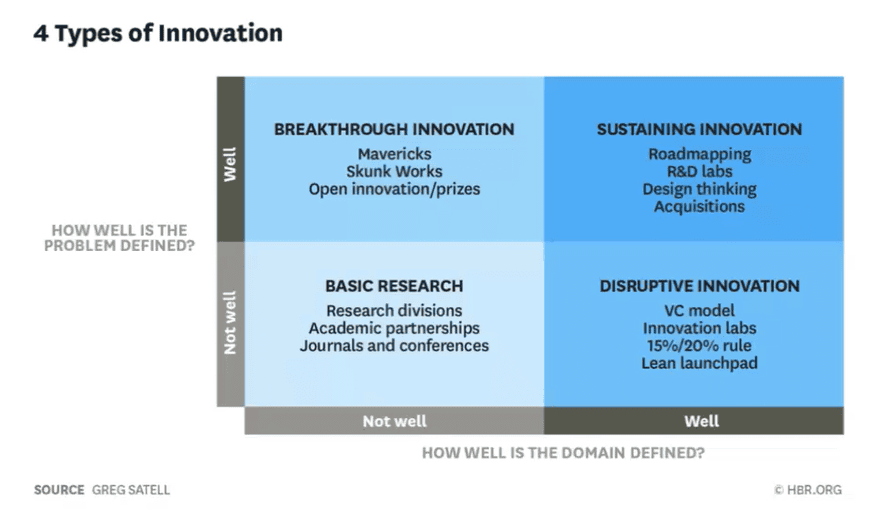
Serpiello then shared his thoughts on each quadrant:
Basic research – a low understanding of both domain and problem: “We don’t really know what the problem is and we don’t really know in which field or area it happens.”
Disruptive innovation – a well-understood domain but poorly understood problem: “In this area you may need something like innovation labs or launch pads.”
Breakthrough innovation – a poorly understood domain but well-defined problem: “This is the reverse of disruptive innovation… the classic example of open innovation.”
Sustaining innovation – a well-understood domain and problem: “The most common form in sport [and often the subject of] continuous research, design thinking or road mapping.”
Members can read more here.
Startling fact of the month:
Serpiello was back at it in the third and final session of his series with further reflections on our 2025 Trend Report.
The report posed the question: do you have a process in place to make sure that the tech you implement is the right one?
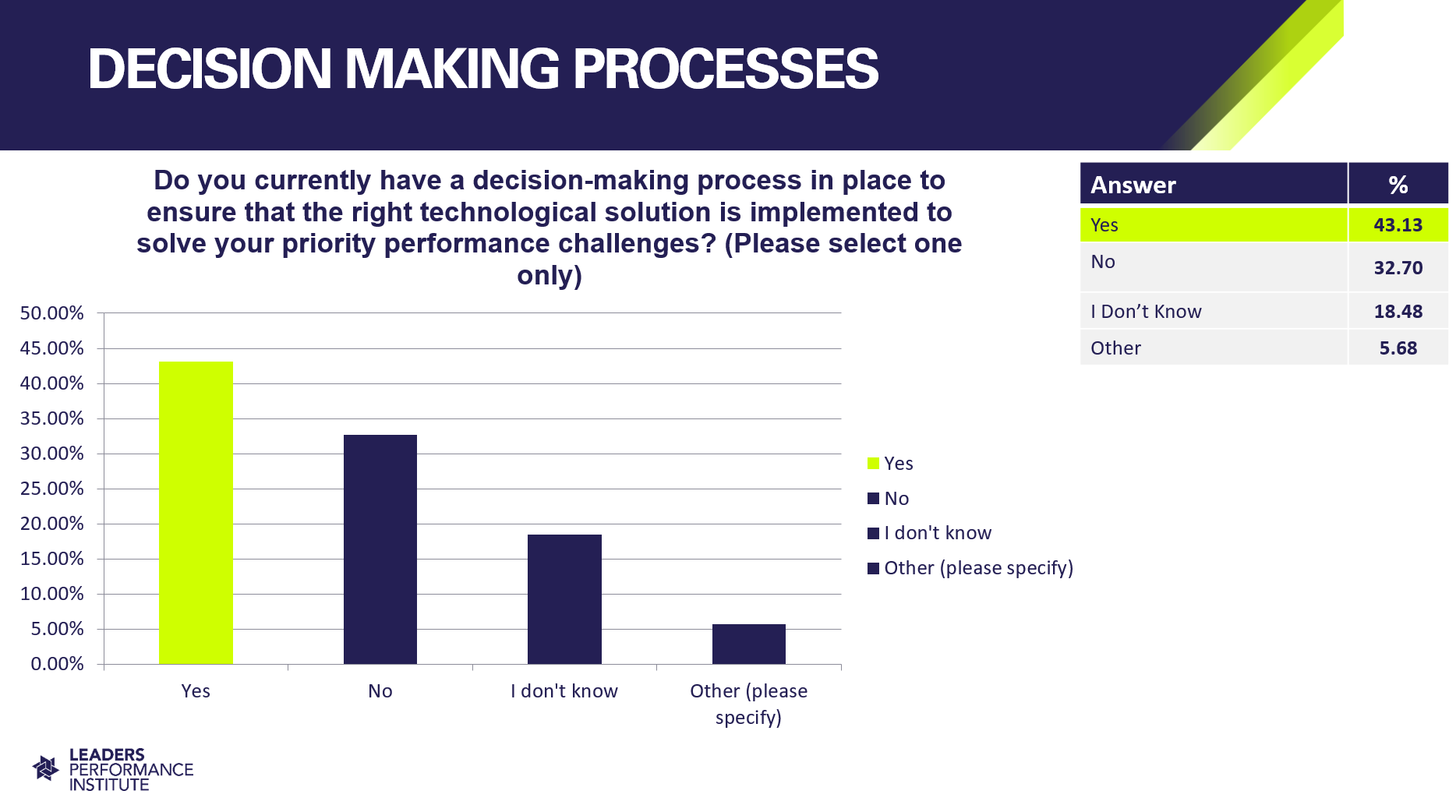
Fewer than half of respondents said ‘yes’, with more than a third saying ‘no’. Curiously, nearly 20 percent said ‘I don’t know’.
“That’s a good chunk,” said Serpiello. “It is probably more interesting than the ‘yes’ and ‘no’ given that most of the people that responded are at the ‘head of’, ‘director of’ or ‘vice president of’ level.”
What followed was an exploration of what a thorough and considered process of procurement should include.
One you might have missed:
Jamie Taylor, an Assistant Professor in Elite Performance at Dublin City University [DCU], used a virtual roundtable to explain to members that coach development too often veers towards less direct practices.
“Similar to what we see in coaching, there has been a view that it’s inappropriate to offer more direct pedagogical approaches,” said Taylor. He believes this is a consequence of sport being influenced by executive coaching practices and adult learning theory. Yet coaching is not C-suite work.
Supported reflection and communities of practice can be useful, but there are limitations. “If the coach hasn’t got the knowledge to reflect, or the coach developer doesn’t have a strong pedagogical capacity, then it can end up being just a nice coffee and a nice chat.”
Read more about the challenge of raising coaches from merely ‘competent’ to genuinely ‘expert’ here.
Finally…
A photo record of the best bits of 2025 at the Leaders Performance Institute.
What’s coming up in January for members:
Check out your 2026 virtual learning calendar at:

In a recent Leaders Virtual Roundtable, DCU’s Jamie Taylor led a discussion on the elements that hold back coach development practices.
That is according to Jamie Taylor, who described the state of play.
He said: “It’s unclear how we help coaches to get better and it’s even less clear what methods of coach development are appropriate.”
Then, he added, “it’s very difficult to be able to evaluate and review coach learning.”
Taylor, an Assistant Professor in Elite Performance at Dublin City University [DCU], had set the stage for his virtual roundtable presentation, which explored all facets of the coach development challenge that faces organisations across the world of sport.
Competent or expert?
Taylor, using the graphic below, outlined the tasks (on the left-hand side) that a coach developer needs to be able to fulfil in their role and the questions that each task provokes (on the right): 
Too often, organisations do not adequately answer these questions.
The Premier League, for one, were struggling when they turned to Taylor and DCU three years ago.
“At the time, the Premier League thought they had a competent academy coaching workforce, but they weren’t happy with just ‘good enough’,” he said.
Together, they worked to identify the qualities of coaches deemed ‘expert’ as part of their Coaching Expertise Project. They co-developed a coach profiling tool to help academy coaches on that pathway from competence to expertise.
“The tool itself is around a half a day’s worth of different simulations that the coach can go through. It presents them with various difficult scenarios,” Taylor continued. “At the end, it generates a profile that says, ‘here’s where a coach might be strong, here’s where a coach might be weaker’.”
The project has yielded demonstrable outcomes. “Coach developers are reporting that it’s much easier to understand what a coach needs and be able to direct them and say, ‘here’s the time we’ve got and this is how we might use this time to influence and enhance your practice’.”
There are, however, still unknowns. “When evaluating and reviewing coach learning and development, we are still unsure what ‘better’ is.”
The project continues and coaches are tracked in their progress.
The ‘messy’ middle
Good coach development work combines both more direct and less direct approaches.
Taylor believes a thorough approach would look something like this:

In reality, however, coach development too often veers towards less direct approaches.
“Similar to what we see in coaching, there has been a view that it’s inappropriate to offer more direct pedagogical approaches,” Taylor continued. He believes this is a consequence of sport being influenced by executive coaching practices and adult learning theory. Yet coaching is not C-suite work.
Supported reflection and communities of practice can be useful, but there are limitations. “If the coach hasn’t got the knowledge to reflect, or the coach developer doesn’t have a strong pedagogical capacity, then it can end up being just a nice coffee and a nice chat.”
Between the more direct and less direct approaches illustrated above is what Taylor calls “the messy middle”.
“We haven’t often seen approaches like cognitive apprenticeship, where somebody’s needs are identified, understood, and they’re given tasks that are just beyond their current ability. We haven’t got into directed reading and listening, mostly because lots of the available resources aren’t necessarily coaching-focused. Nor have we paid lots of attention to the ability to generate feedback rather than offer more supported reflection.”
‘The things we might do to generate competence don’t always promote expertise’
As the Premier League and DCU observed, the things that coach developers can do to generate competence do not always lead to expertise.
The notion of ‘best practice’ is a prime example.
“When we say ‘best practice’, I think we’re essentially saying ‘if we do it like this most of the time, it will be better rather than worse’,” said Taylor. “This tends to be more observable. I can see somebody doing ‘this’ and what I’m going to do is encourage somebody to repeat this ‘best practice’. This can be done through auditing processes; it can be done through more directive approaches; and it is significantly easier to leverage and promote than expertise.
“Now, expertise could be associated with good practice, but ultimately that means understanding intentions and context, and it requires us to probe and promote adaptability for coaches; for them to be able to respond to changing contexts. And I see these two things in tension with each other. Lots of the things that we might do to generate competence often don’t promote expertise.”
Taylor then illustrated this point of difference:

The middle domain – skill acquisition – came to the fore in Taylor’s work last year when the Dublin Gaelic Athletic Association enlisted his support in a coach development capacity.
At the start of his secondment he leant towards expertise, but when three coaches announced their intention to move on at the end of the season he pivoted towards supporting them in skill acquisition for athletes, specifically the planning of sessions and whether performance metrics were being met.
All three elements are key to coach development work, both “systemically and individually”.
Taylor’s hope is that “over the long term, we’re going to start progressing towards a broader and wider reach for coach development practice.”
What to read next
How Do you Develop the Most Expert Coaching Workforce in World Football?
As Jamie Taylor tells us, the Premier League-sponsored Coaching Expertise Project is challenging assumptions and establishing new standards.
Main Image: Phil Greig, courtesy of the Premier League
Yes, a head coach could be an expert, but that team might also be blessed with a highly expert foundation phase coach or an expert professional development phase coach. Each faces different demands and their work as coaches is inevitably different, but each can be expert.
My colleagues and I have been influenced by the adaptive skill model of Paul Ward and his colleagues. We see coaching expertise as the ability for someone to form intentions in their coaching practice and then flexibly and adaptively work towards those intentions – or change those intentions based on the changing context.
This idea is at the heart of the Coaching Expertise Project, which is an ongoing collaboration between the Premier League and Dublin City University and Insight Foundation Ireland. The project was launched in 2023 as part of the Premier League’s efforts to cement its reputation as world-leading in coach development practice.
Most of our data was collected by Mike Ashford, a postdoctoral researcher at the Insight SFI Research Centre for Data Analytics, while at the Premier League, Scott McNeill, the Head of Coach Development, and Danny Newcombe, the Senior Coach Development Manager, have driven the work from their side.
Scott and Danny’s roles have been to ensure the Coaching Expertise Project is anchored in the real demands of coaching practice and closely aligned to both academy and first team environments. They have worked with clubs to identify expert coaches across phases and to shape the project so that it reflects the realities of their day-to-day work. This is important for them because their ambition is to impact the full coaching pathway, supporting ongoing development not only in academies but also in first team settings. More broadly, their main intention is to contribute to the wider football system by enhancing the skill and expertise of both coaches and coach developers. The Premier League sees this as part of a bigger picture as they work alongside their professional game partners.

Photo: Phil Greig, courtesy of the Premier League
At the outset, we identified six coaches per phase across the Premier League, each working at a different development phase in their club’s academy. These coaches were selected from amongst their peers – the only effective means by which we can say one coach is better than another – and invited to undertake an extensive research journey.
Through this process we seek to better identify and understand the coaching demands at different levels. If we can understand those demands then we can be better at identifying expert coaches and helping coaches to reach an expert level.
The coaches involved in the project love it too. They’re constantly trying to find opportunities to learn and develop and it has supported their efforts to step into deep, reflective practice.
And so in shifting that focus from mere competence to true expertise, the Coaching Expertise Project has challenged long-held assumptions and is establishing new industry standards.
The issue with traditional coach development plans
Too often in coach development practice there has been a tendency to focus on coaching behaviour. That’s antithetical to what expertise is because, by definition, expertise is about flexibility, decision-making, and changes to practice that are, frankly, not very observable.
The risk in focusing on behaviour and attempting to change coach behaviour is that we end up reproducing what’s already there.
If there is too much focus on behaviours there is also too much focus on the coach and not their environment. This creates coach development plans divorced from demands. It is important to ask: is a coach development plan based on the demands of practice or on a series of generic capacities that cannot be tracked?
Our project is focused on the interaction between the coach and their context because we cannot identify expertise unless we understand the interaction between a coach and the demands of their role. We’ve identified a series of coaching demands – six or seven per phase – then mapped out the cues and strategies that expert coaches use to navigate those demands. It’s not a list of qualities that says ‘every good coach does this’. The demands are consistent but the coaches are different, and they navigate those demands in reasonably unique ways.

Photo: Phil Greig, courtesy of the Premier League
What ‘expert’ looks like
The Coaching Expertise Project has used this fresh understanding of the demands and coaching context to build a profiling tool that we want to embed in coach development at the Premier League.
It will inform a needs analysis for each coach because we can better understand good practice and the development status of the coach in question.
Capacities are still important. Entry level coaches will still need to show that they’re good enough to enter a role, but the Premier League’s ambitions extend beyond that starting point.
We’re going to be able to provide recommendations for coaches on the different demands of their roles and how they might work to develop themselves against these demands. Ultimately, we hope it’s going to become embedded into coach development practices across Premier League academies and in the daily life of an academy coach.
People have also asked me if we’ve simplified anything for coaches. The answer is no. You’d never say ‘how do you simplify this for a sports scientist or psychologist?’ because we have higher expectations of those professions. Coaches are some of the most expert practitioners in any field so it’s less important that it’s simplified and more that it’s valid and useful for coaches, that it can be integrated into their workflows.

Photo: Phil Greig, courtesy of the Premier League
Evolution not revolution
This remains a fruitful area for research. There are fewer than ten studies that have used expertise as a lens to understand coaching practice – and two of those studies have been mine.
The Premier League remains committed to the ongoing development of coaches across both academy and first team settings. The central intention of the project is to contribute to the wider football system by enhancing the skill and expertise of coaches and coach developers alike. By doing so, we aim to strengthen the overall quality of coaching and create development environments where the very best practitioners can continue to grow and positively impact the game.
We hope that this will eventually have an impact in the wider sporting world, but we are promoting an evolution rather than revolution, and if we can recognise the very best coaches and we’re better able to develop coaches towards expertise, it’ll see those coaches rewarded for good practice and then ultimately every player, when they walk into a club, is on the receiving end of high quality coaching practice.
Dr Jamie Taylor
Jamie is an Assistant Professor in the School of Health and Human Performance at Dublin City University, with a focus on coaching, coach development and coaching research. As a researcher, he supports practitioners on DCU’s MSc and professional doctorate programmes and collaborates with high-performance sports organisations including the Premier League, GAA, IRFU, and Premiership Rugby. As a coach developer, he has worked across a range of high-performance environments. Alongside his academic and development work, Jamie coaches rugby union at Leicester Tigers.
If you would like to speak to Jamie Taylor, Scott McNeill or Danny Newcombe about their work, please contact a member of the Leaders Performance Institute team.