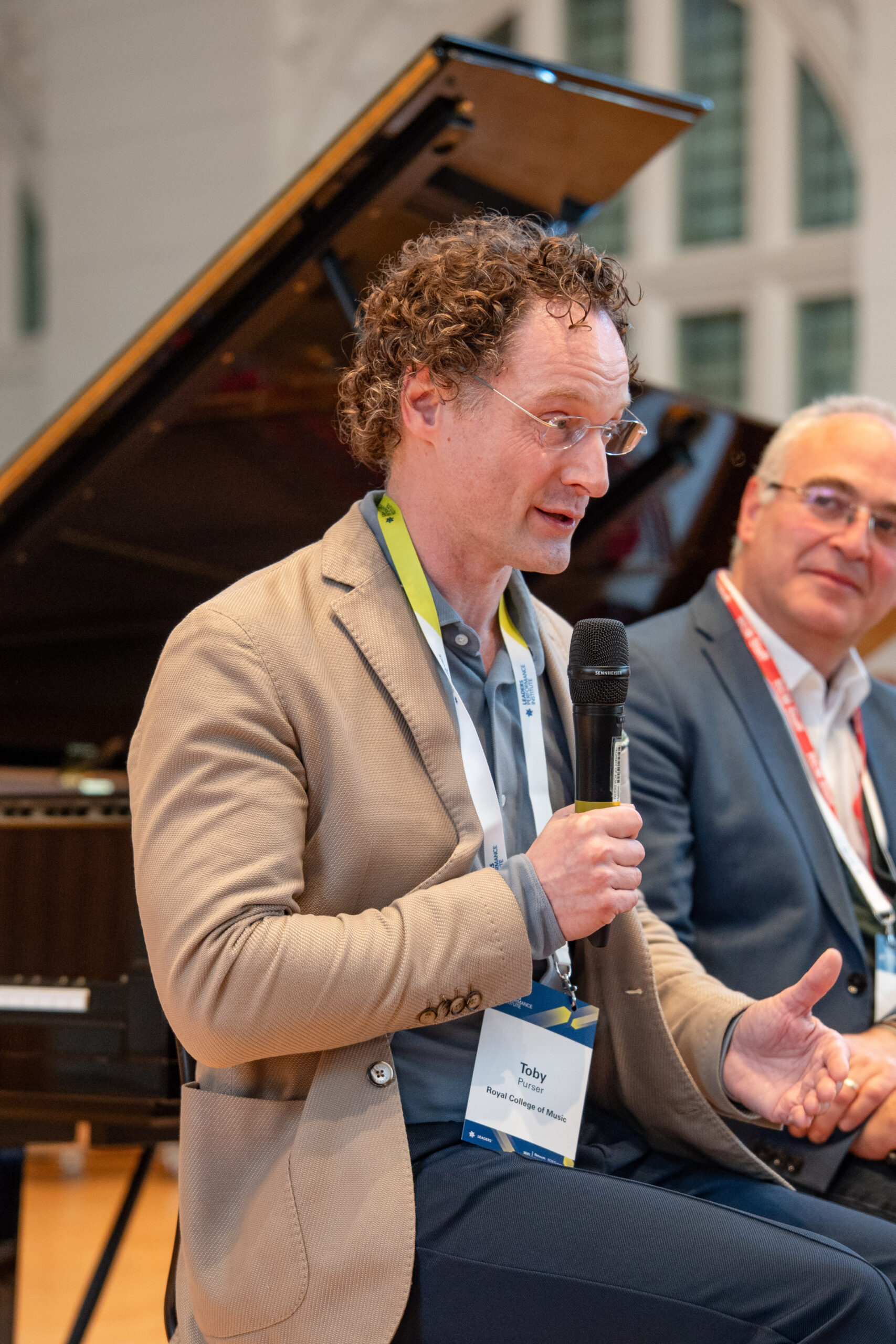
Toby Purser of the Royal College of Music discusses both elements of his work at April’s Leaders Meet: The Talent Journey.
British conductor Toby Purser also serves as Head of Conducting at the Royal College of Music [RCM], which makes him an educator too.
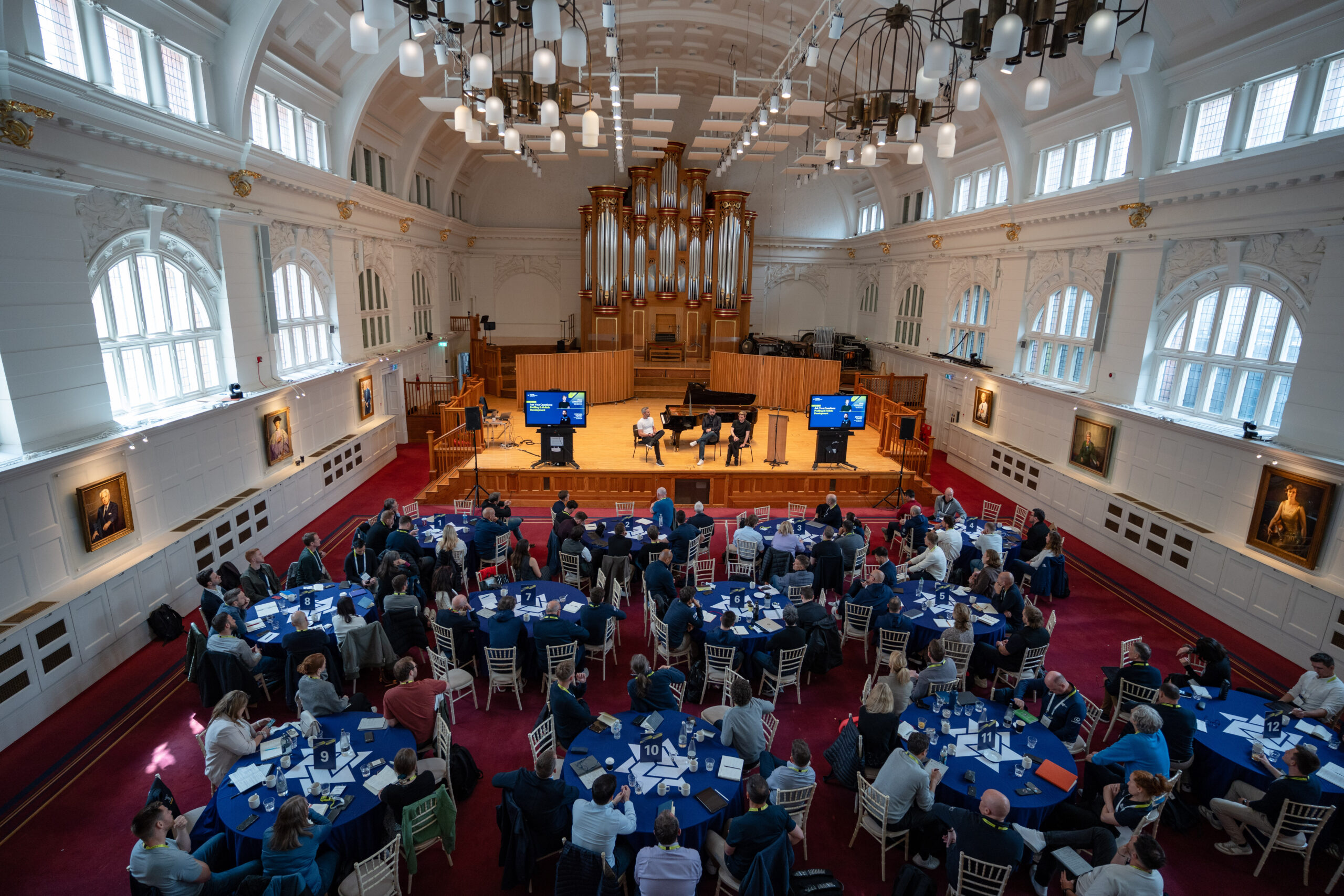
“There’s always an element in conducting of being a trainer because you are literally coaching the orchestra in what it is you want musically,” says Purser from the stage of the Amaryllis Fleming Concert Hall at the RCM in London.
The question of teaching vs coaching in youth contexts comes up time and again during the day’s programme at Leaders Meet: The Talent Journey.
There is a subtle distinction, which was succinctly expressed by Eric Reveno, the Associate Head Men’s Basketball Coach at Stanford University, in words that resonated this week on LinkedIn.
‘A teacher is responsible for making sure you know what to do,’ he wrote. ‘A coach is responsible for making sure you do it.’
In musical terms, the conductor creates the environment for musicians to perform. “It isn’t just about dictating,” adds Purser. “It’s about being open, listening, and knowing how to process the information you hear reflected back at you.”
A performance will succeed or fail based on how well the conductor “adapts what you do to the way your ensemble is understanding you”.
A good conductor must have a strong feeling or vision but “be open enough to allow people around you to be individual, to have their own personality, to have their own talent on show for the audience. The more empowered an orchestra feels, the better the final result.”
Here, we look at both elements of Purser’s work in turn.
The conductor as coach
Purser’s expert musical ear is similar to a coach’s tactical intuition. He has a vision for the music and, if the violins in an orchestra are playing the same thing but not in the same way, he must act. It starts with a ‘feeling’ – you need to know who is right and who is wrong – and it ends with the musicians making the correction.
“Your job a little bit like a doctor in a way, you have to evaluate what’s wrong with this body,” he says. “Sometimes the reason some people can’t hear each other is because of the acoustics or it might be because of the way they’re sitting.”
Rather than “go back to basics” – professional orchestras don’t require technical instruction – “what you are primarily doing is enabling them to know how to listen to each other and also when to step forward into the limelight.”
This must stem from the conductor’s vision. “If everyone in the orchestra just played what was on their page it would be awful, noisy and unbalanced. The trumpets would be too loud – they’re too loud anyway! – you also wouldn’t have any kind of leadership or musical direction behind it. Just a series of notes that didn’t hang together.
“So as a conductor, you’re trying to explain to an orchestra in the easiest way possible what the intention is behind the music. And the intention is not only the big emotional idea, but the person you need to listen to and accompany at any particular moment.
“I would say 90% of your work as a conductor is getting that balance right.”
And in delivering the remedy, less is always more. There are even some elements that he will leave musicians to correct on their own. “If something goes wrong in a performance you need to do less,” says Purser. “The worst mistake you can make is to suddenly conduct really big and with huge energy thinking that you’re going to bring it back by throwing yourself around. When you leap around, you kick energy in all directions and it becomes unclear. Like ripples in water. If you drop too many stones in all you can see is waves when you want something really clear.”
There is also a psychological element. “You can feel the room,” says Purser of rehearsals. “Is the orchestra in the mood for the sort of things you want to work on or is it better to wait for later?”
He must trust his instincts. One time that meant losing his temper one time, in Russia, when he snapped after two days of being “very English, polite and collegial”.
“Oh, maestro,” said the suddenly impressed concert master (the first violinist) at the outburst, “we just needed you to pull your weight.”
“It was just the case that the orchestra needed somebody to be a bit of a tyrant in order to get the result, which means you have to go against your own nature because you have to give the orchestra what they need.”
The conductor as teacher
Purser explains that truly great conductors have an innate qualities, which is why just two students are admitted to the RCM’s conductors’ master’s course each year (although 150 students take conducting as a secondary study).
He says: “What we’re looking for is not so much that somebody comes in and conducts the best Beethoven symphony we’ve ever heard, it’s more about seeing that magic thing which is sometimes a conductor changes the sound of an orchestra without saying anything”.
The RCM can work on a student conductor’s taste, but it’s almost impossible to put into them the “spark of genius”.
Purser will work to identify if the student candidate has the right attributes by asking probing questions that force them to dig deep. “This is something you have to be psychologically sensitive about,” he continues. “Sometimes you need to get into somebody’s personal space to force something out of them.”
Conducting is, Purser estimates, “90% in the head”. “You spend your time at your desk reading notes and building a mental image. Transferring that from the brain to something more physical and passionate can be a big leap for some students.
“You need to encourage them, as soon as they’re in front of an orchestra, to let go of the brain.”
The reasons are practical too. “If you lead with your feelings you can make a quicker decision than if you go through all the pros and cons in your head first.”
The RCM approach in general is to “help people have confidence in their opinions and ideas and be able to express them.”
What to read next
British actor Michael Fox explains that the best directors know that the answer can come from anyone in the room.
While not a bad thing per se, if the athlete is overly focused on doing what their coach may see as the ‘right’ thing, they’re not focused on performing to the best of their ability. Performance can be suboptimal if the coach imposes a creative straitjacket.
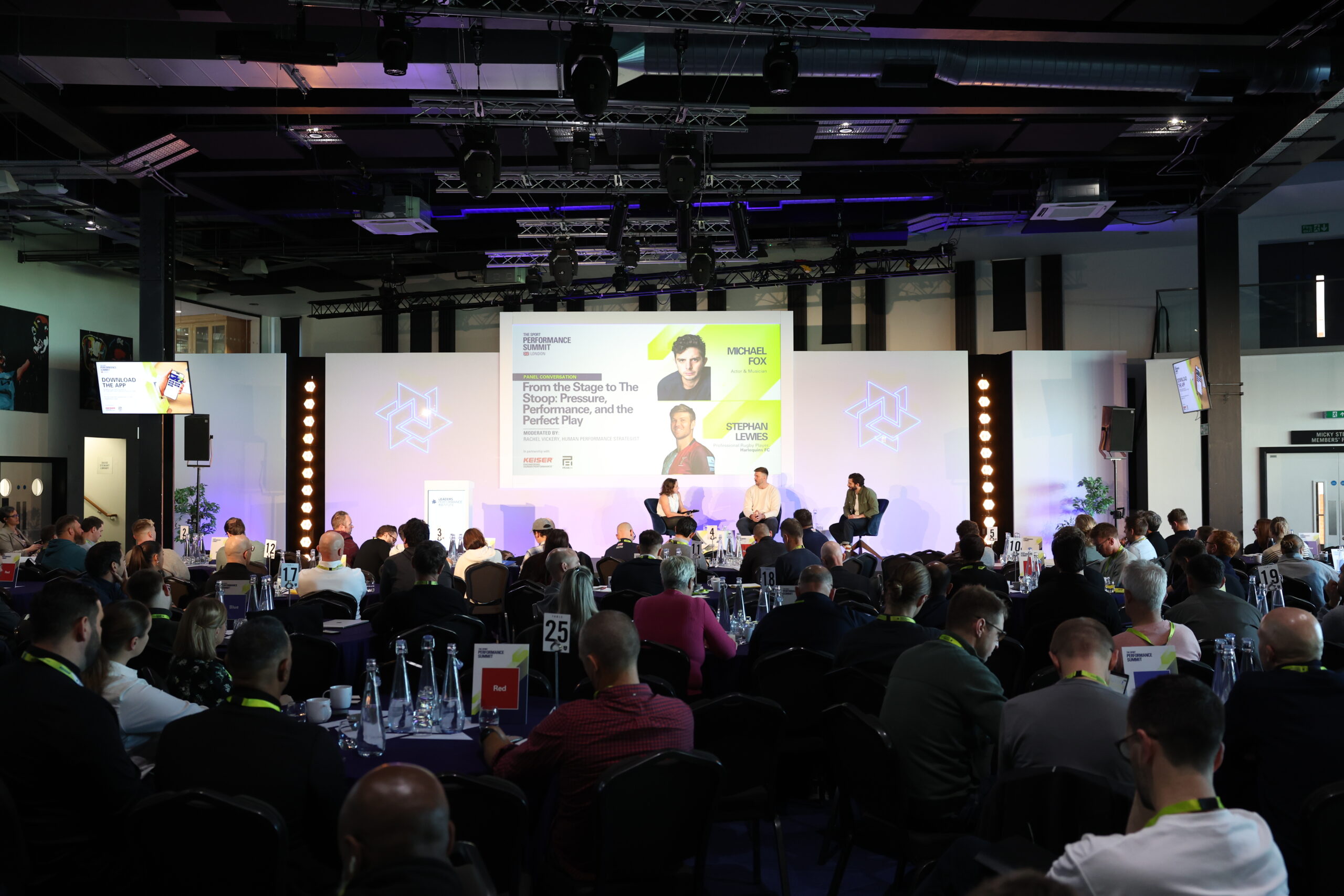
There are parallels between the athlete-coach relationship and the actor-director dynamic in the performing arts, as British actor Michael Fox explains onstage at the 2024 Leaders Sport Performance Summit in London.
“It’s about quality listening,” he says. “The director’s role is to lead, to steer the ship, but the frustrating thing is that you can lose answers if the actors are not able to voice their opinion and put it out into the room.
“It’s good to be heard, and the director can do what they want with it, but if you’re allowed to voice it then you can let it go. You can lose people’s creative instincts if they’re not able to voice their opinion.”
Fox, who is best known for his work on Downton Abbey and Dunkirk, has also appeared in numerous theatre productions and voiced characters in several video games since graduating from the Royal Central School of Speech and Drama.
On occasion in his subsequent career, he has encountered directors who see themselves as “gurus”. “You can make people really shrink around you,” he says of such characters. “Am I just an instrument for you to share with the world how amazing you are?”

Fox’s observations struck a chord with the coaches in the room at the Kia Oval and raised several questions:
Does the responsibility sit solely with the director?
No. In fact, as Fox says, “you have to still value the things that you need to do to make sure that you’re at the top of your game.” His routine includes yoga and meditation and, since he “spends a lot of time unemployed” he must do whatever it takes to ensure he is ready to go following a successful audition.
It sounds quite insular. How does that translate to a company setting?
“You do the work separately and then come and be crafted,” says Fox. “You’re taking the edges off to push in the right direction. You don’t want the director to do all the work.”
Speaking of directors, surely no two are alike?
Not at all. “That first week we just don’t know what we’re expecting,” says Fox. “You have to adapt to their way of working.” He appeared at the summit during the London production of The Fear of 13, which was unique in its genesis. “We were up on the first day and we nearly staged the front half of the play, which is madness, but it was amazing. But most directors talk over a coffee for the first few days.”
What qualities define the best directors, in Fox’s opinion?
“The directors I like working with are the ones that come into the first day of rehearsals and say ‘I don’t have all the answers – we’ll find them together’,” says Fox. “I respond better to that sort of mentality because I think it’s more honest. We don’t have all the answers. The best idea can come from anywhere in the room.”
However, it is still common practice, as he explains, for film call sheets to rank actors by importance on any given day. “That kills creativity, personal agency and instinct,” adds Fox. “They feel like their voice is less important.”
Therefore, “the best directors can give trust and individual agency to the actor over what they’re doing, their artistry, then you feel like you’re growing as an individual.” Critically, “in the moments where you need to be instinctive onstage you’re not thinking about getting it right for them or making a mistake.”
How might this look in practice?
A good example is Sinéad Rushe’s 2023 production of Shakespeare’s Othello in which Fox played the character of Iago.
It was notable for the fact that three actors played Iago onstage at the same time and Othello was given a more prominent role than in traditional stagings.
“We wanted to take Iago’s complicity with the audience away and put Othello much more at the centre of that play,” Fox told The Uncensored Critic Podcast earlier this year. Iago’s famous soliloquys became dialogues between the three aspects of his character rather than the usual series of knowing asides to the audience.
Rushe, who also taught Fox at Central, facilitated creative discussions from the off. “We’ve had two periods of development just of ten days each just to begin to workshop this idea of three actors playing Iago,” Rushe told The Theatre Audience Podcast on the eve of the second preview.
She also wanted to protect actor Martins Imhangbe in the titular role. “There’s a racial dynamic there that’s very problematic and there are these very interesting histories of actors who’ve played Othello over the years of finding it actually quite a distressing experience of feeling like the entire audience is laughing at them through the vehicle of Iago.”
Imhangbe himself also spoke at the time of the company’s work “dismantling” and “reconstructing” the play. “We’re trying to do something different with it, so it means we have to see it with fresh eyes,” he told The Rendition. “We’re trying to bridge the gap between what was written and how it’s relevant today.”
Rushe added that the production provided “a feeling of kindred spirits and people up for working in a collaborative and ensemble way.”
Fox agrees. “It was an unusual take but actually it meant that people could hear the play anew. And I loved it.”
What to read next
How to Transform an Underperforming Environment into a Thriving Hub
iBrainTech has worked with some of the biggest names in soccer, including Juventus, and now they are seeking to deliver their neurocognitive training tool to the ranks of academy soccer.
Main photo: iBrainTech

Users wear an EEG headset, which monitors brain activity and translates intention into action on the screen. The goal is to help soccer players sharpen their decision making and execution. It has been adopted by clubs in Serie A (Juventus), MLS (Orlando City SC and formerly Atlanta United), LaLiga (Real Sociedad) and the Portuguese Primeira Liga (SL Benfica). Longtime MLS star Jonathan Bornstein was an avid user.
Now, i-BrainTech is seeking to broaden its reach to academy and youth players. It’s a well-trodden path for performance tech to prove themselves with the elite before reaching the larger consumer market. But i-BrainTech has both the advantage of its inherent gamification and the challenge of making complex tech more frictionless.
“All transformative technologies should be ready and willing to become accessible, to validate the impact on the top level of performance and then to allow access of youth,” i-BrainTech Co-Founder/CEO Konstantin Sonkin said. “You need to be ready to cater your value to the young generation, and we are so lucky to be an engaging game at the end of the day.”
Sonkin has been working on this technology for 15 years to balance high signal quality with ease of use. He described a remodeled product as “a top-level, consumer-ready headset.” The goal is not only to improve the performance of younger players but also to encourage more athletic participation and unlock new revenue streams for clubs, such as with a co-branded cap or content.
“We want to drive them from Instagram back to the pitch,” Sonkin said. “Because when you exercise your mind, you’re so eager to execute in the [physical world] because your brain got so excited. It’s called neuro-priming. It has excessive, let’s say, electricity. It wants to utilize that in real-world actions, and that is the connection between their content created by clubs and then a long lifetime value.”
Michita Toda previously used i-BrainTech with rehabbing players as a physical therapist at Orlando City, where he saw value in keeping injured players mentally sharp while physically recovering. He recently joined the North Carolina Courage as its Head Athletic Trainer and is hoping to bring the product there, both for the NWSL club but also for the associated men’s USL team, North Carolina FC, as well as for the large youth academy system in the area.
“Being on the medical side of things, we talk a lot about youth sports specialization and how the more they play at a younger age, that might make them more susceptible to injury,” Toda said. “Well, using technology like this to supplement what they’re already doing, but not overdoing it physically, they still get the mental reps and get the quote-unquote ‘practice’ without having to tax their body.”
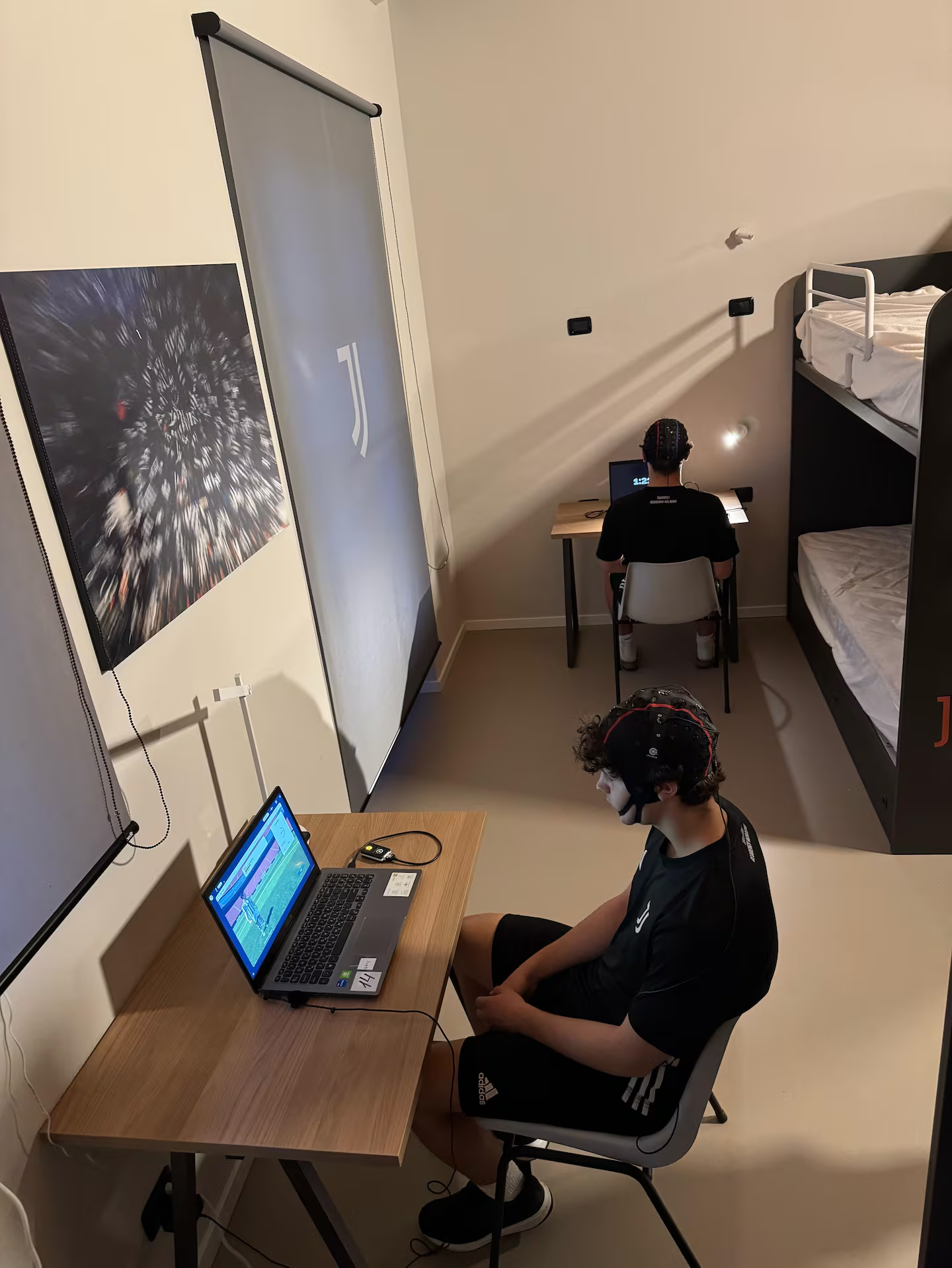
Members of the Juventus Residency Academy train with i-BrainTech. (Photo: iBrainTech)
Limited studies have shown promising results with the transfer of skill from the i-BrainTech product to the pitch. Real Sociedad B — the LaLiga club’s reserve team, which competes in the Spanish third division — completed a 15-player case study that spanned three months and 12,500 visualized actions. Those using i-BrainTech improved 12.4% in the accuracy of long kicks compared to 2.6% in the control group. Five of the eight players using i-BrainTech’s neurofeedback training also reported better concentration in matches.
“When we actually repeat all the actions on the pitch, most of the time we train our mind-body connection,” Sonkin said. “We train our muscle memory. Muscle obviously doesn’t have any memory. Memory lives in the brain.”
This article was brought to you by SBJ Tech, a Leaders Group company. As a Leaders Performance Institute member, you are able to enjoy exclusive access to SBJ Tech content in the field of athletic performance.
In the second episode of our three-part series, the AIS’s Director of National Performance Support Systems discusses how tech can be better used to deliver insights to athletes and coaches.
A vodcast brought to you by our Main Partners

“One of the things we’re trying to figure out, particularly for fresh graduates coming into high performance, is that sense of pressure to utilise technology because that’s what’s seen to be done in high performance,” she tells Teamworks’ Andrew Trimble and Leaders John Portch.
Miranda is the Director of National Performance Support Systems at the Australian Institute of Sport and a practising physiotherapist, which made her an ideal guest on this special Teamworks Vodcast, particularly when it comes to sharing her perspective on the way the Australian sports system uses technology.
“The next step is ensuring practitioners have got the critical thinking skills to understand why I am using this and what is it adding. What is it telling me? It’s getting that ability to analyse.”
Her words bring to mind High Performance Unpacked, the Teamworks Special Report that spoke to the importance of the practitioner optimising a given tech product to the final user.
It resonated with Andrew too. “When you haven’t got a centralised mechanism for presenting and communicating data, it shines a light on how important it is to be done correctly,” he says. “The greatest dataset in the world, if not communicated correctly, is nowhere near as effective and may be detrimental.”
Elsewhere in this episode, Miranda and Andrew discuss the idea of the physio room as the heartbeat of the team; the balance between system and individual performance [29:30]; why the physiotherapist is a ‘life coach’; and bridging the evidence gap in female athlete health.
Check out Episode 1, with Simon Rice, the Vice President of Athlete Care at the Philadelphia 76ers:
Listen above and subscribe today on iTunes, Spotify, Stitcher and Overcast, or your chosen podcast platform.
In the final session of ESSA’s ‘The Future of Sport’ virtual roundtable series, Dr Alex Roberts of the Queensland Academy of Sport and former All Blacks Manager Darren Shand discuss talent identification, development and management. ‘Fit’ is less valued in World Cup-winning dressing room than you might think.
An article brought to you by

“It is only a really small part,” said Dr Alex Roberts. “We need to make sure we’re putting those strong development environments around athletes because it doesn’t matter if we pick 100 per cent of the right athletes if we’re not putting them in the right environment.”
Roberts, the Talent Identification & Development Lead at the Queensland Academy of Sport [QAS], is speaking at the third and final session of ‘The Future of Performance Sport’, a three-part Virtual Roundtable series brought to you by the Leaders Performance Institute and Exercise & Sports Science Australia. The focus for the concluding conversation was talent identification, development and management.
She was joined on the virtual stage by Darren Shand, the former Manager of the New Zealand All Blacks, who offered perspectives from the senior end.
Firstly, Roberts outlined talent identification and development at QAS.
QAS offers opportunities, but not guarantees
Above all else, you must provide young athletes with a good experience, which QAS seeks to do through its YouFor2032 talent identification programme. Their goal is to discover and develop athletes with the potential to achieve medal success at the 2032 Olympic and Paralympic Games in Brisbane. At the time of writing, approximately 6,000 young Queenslanders have entered the programme.
“We can’t guarantee that athletes are going to succeed,” said Roberts, “but we want to make sure that they’ve got every opportunity to find the sport that they could be successful in, and that they have the appropriate education and development that will allow them to succeed.”
They have adopted the ‘principle of sports orientation’
Youngsters’ skills will be assessed to enable placement in a sport they may not have tried. “We see if their skills, their backgrounds, their traits, might fit a different sport,” said Roberts. Once assigned to a sport, the athlete will enter a three-month confirmation phase where they will learn the fundamental skills and get to know their coaches.
The physical is the starting point
Without the right physical characteristics mindset counts for little. “If you’re 160cm [5′ 2″] tall, you’re probably not going to be a rower, no matter how badly you want it,” said Roberts. “We match physical traits to where people are genetically predisposed to have more success.”
QAS also looks for elite behaviours
During the three-month confirmation phase, QAS will look for evidence of the behavioural patterns that denote elite performers (“We look at things like: do they show up on time? Do they put the effort into their warm up and cool down? Do they bring a water bottle?”). QAS does not, however, undertake formal psychological profiling at any stage. “As far as we know, the evidence isn’t there to support specific psychological profiles for long-term success in sport, particularly within the age groups we’re working with.”
Social support underpins the QAS approach
Social support is particularly important when athletes progress to the more intense 12-month development phase. It is a critical element of balancing challenge and support. Roberts said: “When we do our athlete development camps, we bring all of the athletes from all the sports in at once, so they can get cross-sport friendships. They can see what other sports look like. They can see that it’s not just them that are going through this. They’ve got that in-built support network that they can lean on.”
Additionally, “if we’re picking an athlete in Cairns for beach volleyball, we will take a few athletes to make sure that there’s a training squad up there; that they’ve got some other friends that are learning the same sport, that are progressing through the same system.”
The role of sports scientists
The sports scientists of QAS serve as educators, not only of coaches on state or national programmes, but further down to the grassroots. For young athletes it is, as Roberts said, about “early education; not waiting until they are moving through the system”. As for coaches, “they are the ones who are face to face with these athletes at every stage of their development.” Therefore she and her colleagues will work with coaches at different levels of the pathway and make sure that “they have that clear and consistent messaging, making sure that they understand what it looks like for the athletes, making sure that they understand the value of athlete wellbeing.”
The YouFor2032 app
As Roberts explained, the YouFor2032 app is helping QAS to find talent across the state of Queensland. Youngsters can download the app and test themselves in a home setting, with in-built AI enabling them to do it alone. Roberts said: “You don’t need an expert to hold the phone and get the angles right. You don’t need someone to sit down and analyse the joint movements. It does all of that for us.” Results are sent to QAS, who then begin the initial screening.
The app means fewer missed athletes during regional visits. “If you miss out, it used to mean you had to wait until next year,” added Roberts. “The app is going to remove a lot of those barriers for people.”
It was then Shand’s turn to provide an insight into the All Blacks’ double Rugby World Cup-winning environment, of which he was part for 18 years.
The All Blacks detest the term ‘fit’
The All Blacks’ maxim ‘you join us, we don’t join you’ is as true today as it has ever been. Yes, the team prizes hard work, self-driven individuals, and a willingness to learn – these help to set the standards that all players must meet – but there is also room for individuality.
“One of the things that annoys me in environments is when people say ‘we just want to get people that fit in’. I detest that,” said Shand. “I’m not after fit. I want people that are going to add.” He believes that diversity of personality and the very idea of complex individuals are something to be embraced.
“Saying you want someone to fit is a cop-out. You’re not really aiming high enough. You’re certainly not aiming at the world-class level,” he continued. “I reflect back on some of the players that we had whose high end was unbelievable, but their bottom end was a real nightmare, but they just added so much richness to the guys that perhaps sat in the middle. Across team sports, particularly that richness and what they can offer in terms of growth, outweighs what can happen at the bottom end.”
They create a home on the road
The All Blacks spent much of their time on tour, including at four overseas Rugby World Cups during Shand’s tenure. They quickly realised the performance benefit to making camps in France, Britain or Japan feel as much like home as possible, which meant including families at opportune moments. The penny dropped for Shand at a training session on the eve of a World Cup quarter-final in Cardiff.
“We finished the session and all the kids ran out into the field, and I just looked at it, and I just saw something I hadn’t really noticed before: the connection and the energy. I said to myself: ‘this is why they play’.”
Non-playing All Blacks are heavily involved
The All Blacks value their non-playing squad members and, once selection decisions have been clearly and respectfully explained, ensure their continued involvement throughout a game week.
“It’s an opportunity for them to coach,” said Shand. “So there might be three of them playing for the same position, but only two play, with the third becoming a coach. We often get our greatest learnings when we coach. It’s an opportunity to share the leadership without the pressure; how can I lead some of the things off field to take the pressure off those preparing to go on field?
“It’s also an opportunity to be the opposition and to learn and help our guys prepare because, at the end of the day, you’re never going to outperform your preparation. So the preparation has to be your best.”
In the future
Athletes will…
Enjoy longer careers. “It’s great to see that your age is not as much of a barrier anymore, that we’re not burning athletes out as early. They’re not getting injured and having to retire early,” said Roberts.
Not specialise as early. “In most of our sports we’re starting to see athletes have that much longer trajectory, which means we can wait to specialise.”
Take further ownership of their career trajectory, striking a balance between individual and team goals. Practitioners must “keep bringing the frame back to what do we need on Saturday and how do we best embrace that,” said Shand.
Practitioners will need to…
Further adapt to athletes’ needs. “I see it more in the work I’m doing now with sports, that real drive for life beyond sport, particularly as influencers,” said Shand. “It’s just trying to find the right marriage and the right method for letting people do that, but also realising that when they come back inside the walls and they fit with the behaviours and non-negotiables that we want.”
What to read next
SportAI’s system can be used in conjunction with phone or camera footage to generate overlays that chart swing curves in tennis.
A Data & Innovation article brought to you by
Through the agreement, SportAI’s offerings will be available on the MATCHi TV streaming service, which is underpinned by cameras installed at 2,000 of MATCHi’s tennis and padel courts. The integration lets players access highlights and technical analyses of match footage on their phones. In all, MATCHi has a network of more than 1M users across 2,600 venues and 14,000 courts in 30 countries.
Financial and duration terms were not disclosed.
Oslo-based SportAI was co-founded by Lauren Pedersen, a New Zealand native who is combining passions for sport and technology to democratize access to swing technique analysis – first in racquet sports but with the aim to eventually expand into the likes of cricket, baseball and beyond.

Image: SportAI
“Technique coaching, specifically, is still very subjective and expensive and unscalable,” Pedersen told SBJ in a recent interview at the USTA Billie Jean King National Tennis Center, where she spent time during the U.S. Open pitching prospective clients. “If you have a tennis lesson pretty much anywhere, it’s easily going to cost $100 – and you might have a good coach, but if you had three or four good coaches looking at your technique, they would all say something different, and there would be no data to back up what they’re saying.”
SportAI’s system is hardware agnostic; its algorithms can be applied to phone or camera footage and generate overlays that chart swing curves (and compare those curves to professionals), ball strike timing and other statistics like hip or shoulder rotation and swing velocity. The system also provides textual feedback, which as of now is pulled from a matrix of preset options but could in the future tap into a large language model, Pedersen said.
Here, Pedersen demonstrates the technology analyzing her one-handed backhand.
“To get to technique analysis, the computer vision, the platform itself, has to identify the boundaries of the court, identify different players on the court, be able to pick up all the biometric movement,” Pedersen said. “Before we even get to the technique analysis, we’ve got a lot of the technical data, which provides heat maps and statistics as well. We can deliver all that, and then technique analysis or coaching on top of it.”
Pedersen is charting a B2B model for the company, wherein SportAI licenses access to its software to three key segments: racquet sports clubs and coaches, broadcasters, and equipment manufacturers. She did not disclose pricing but noted it is variable based on which analysis modules businesses subscribe to.
As a coaching tool, Pedersen asserts that SportAI can reinforce instruction with empirical data, expand coaches’ influence outside of traditional lesson hours by making swing analyses accessible remotely, and unlock incremental revenue by creating a premium digital offering coaches or clubs can charge members to use.
For broadcast, Pedersen envisions the potential to improve the less objective niches of common tennis analysis and introduce technique comparisons between players or digital twin visualizations.
Integrating with equipment manufacturers, Pedersen added, would bring the opportunity for increased personalization in matching players with the appropriate racquet for their skill level and play style.
This article was brought to you by SBJ Tech, a Leaders Group company. As a Leaders Performance Institute member, you are able to enjoy exclusive access to SBJ Tech content in the field of athletic performance.