At a recent Leaders virtual roundtable, members discussed their enablers, levers, operational prerequisites and delivery mechanisms.
The Haas F1 Team Principal spoke onstage at the 2025 Leaders Sport Performance Summit in London about his team’s efforts to compete with better resourced and more illustrious teams.
“If we cannot work together, if you’re not supporting each other, if you’re not aligned, we’ve got zero chance against organisations minimum three times our size.”
Komatsu’s words set the scene for a virtual roundtable in late February, where Institute members reflected on what makes a performance environment great.
They set out the barriers they face before discussing how they would approach those barriers if given a clean slate.
Off the back of that, we’ve identified four building blocks of great performance environments for your consideration.
Building block 1: psychological safety (the enabler)
When people feel psychologically safe they are better able to contribute to the collective. It also promotes shared ownership and breeds alignment.
A head of culture from the world of English rugby union said:
“One of the most important elements of a great culture is to be a place where people can be themselves and be comfortable being the type of people they are.”
Job security is a critical element. A coach at an English Premier League academy said:
“Once you’ve got your key people, the people that want to be on the bus, in their roles then it’s just trying to keep them in those roles and develop them to better influence environment and the athletes.”
As for the athletes, a practitioner working in the British sports system observed their growing participation as stakeholders:
“We’re seeing a big shift in environments where athletes have much bigger voice and are involved in a lot more decisions, conversations. They don’t want to be told what to do anymore. They want to feel involved; know why what’s happening is happening.”
She then explained that the athletes need to be met halfway so that the dressing room does not turn into a “complaints forum”:
“We’ve definitely found that when you give that space to the athletes, they then can take it a little bit too far. Sometimes they complain about everything. ‘We want to fix this, we want to fix that’. It’s not super constructive… how do we create those boundaries and expectations on also what that looks like and how can we keep it productive to the goals of the environment and what we want to do?”
Building block 2: empathetic leadership (the primary lever)
When leaders are attuned to their people and consistent in their conduct, it helps to create an environment in which psychological safety, ambition and learning can flourish.
This begins with the everyday signals leaders send; what they are prepared to tolerate and the elements they choose to reinforce. The head of culture working in English rugby union said:
“Make sure that the sort of organisation you want to be is mirrored by the behaviours you accept. So it’s all good and well talking about having a good place to be and a good culture, but if you accept behaviours that are not aligned with that place you want to be, it’s disingenuous and people see through it.”
Leaders also shape the environment through the stability they create. In certain sports, this is a rare commodity. As a coach working in the notoriously trigger‑happy world of elite football pointed out:
“Where there’s lots of turnover, people become naturally less and less inclined to think about long-term growth and development.”
Yet this long‑term lens is essential staff and athletes alike. The same coach added:
“When you’re dealing with a 21-year-old high potential player who arguably hasn’t had some of the development they should have at a younger age, there’s probably loads of room for growth in those players if you can foster the right environment. You should be looking for the corners and the spaces around the programme where development is achievable.”
Building block 3: opportunities for growth (the operational prerequisite)
The trick is in providing athletes, coaches and staff with opportunities to develop under your stewardship.
A mental performance coach working in youth tennis in the US highlighted the problem that academy coaches (and their players) may encounter in this regard:
“It’s always a balance: how we can help the athletes improve, whether through coaches or what we call ‘free play’ so they can learn skills and have fun while doing it. But also, we live in a culture where the parents or whomever just want to see results right away and maybe that’s not the best for long-term success and the athlete’s career. You can be good at 12 years old and winning a lot of tournaments and matches, but how you’re doing it right now might not be better suited down the line.”
In the face of short‑term pressure, leaders must give people clarity in direction, expectations and the team’s priorities. A head of health and wellbeing from the world of motorsport spoke of their experience of the value in having “mission clarity”:
“You can then make sure that you’re really clear on the ambition of where you want to get to, then build back from there.”
Building block 4: systems & processes (the delivery mechanism)
When you have safety and clarity, one can then put in place the necessary processes to deliver high performance.
The head of health and wellbeing in motorsport spoke of an environment where leaders emphasise the importance of structured, backward‑planned systems. He said:
“Where are we currently? Look at the gap; and then how do we go about setting some really clear priorities and a strategy that we can deliver that gets us closer to it?”
Elsewhere, a member working in the military highlighted how intentional routines and reflective spaces help his teams stay aligned:
“There is value in being very deliberate in thinking about our infrastructure. We have a couple of offsites each year to drill down and make sure we’re getting these things right; to find the right answer. I’ve been a part of a few different teams and the ones that function the best find a way to do that.”
What to read next
Too Often, the Person Is a Sticking Plaster for a Lack of Robust Systems and Processes
4 Mar 2026
ArticlesAndy Burns of the New South Wales Institute of Sport offers advice to coaches and other leaders working to ensure everyone is on the same page when it comes to performance strategies and planning.
“He came up to me and said: ‘I think I should be promoted’,” says Burns, who today is a High Performance Manager with the New South Wales Institute of Sport.
At the time, which was several Olympic cycles ago, he oversaw the sports science and sports medicine programmes at a different organisation.
“I said: ‘Why do you think you should be promoted?’ He replied: ‘Well, because I can measure and articulate to you that the athletes are stronger, faster and fitter than they have ever been’.” The S&C coach quickly warmed to his theme. “‘The psychologist just sits and talks to them. How can they be a senior practitioner when I can clearly demonstrate that I’ve made them stronger?’”
Burns had a ready reply. “I said: ‘Let me ask you a question then. If we get to the Games and everybody hits a PB in the gym the week before we leave but everybody then goes out in the first round of the Games, have you done your job?’ His answer was ‘yes’. I said: ‘That’s the reason you’re not a senior – because you don’t understand how your part contributes to the whole’.”
In the intervening period, Burns has conducted extensive research on the topic of silos in sport and his work with the NSW Institute of Sport includes tackling those silos head on with a range of teams and sports.
Below, with Burns’ help, we explore the origins of silos and some practical steps teams can take to remove them.
What are some of the enduring barriers to interdisciplinary work?
Burns points to four common barriers in particular:
Naturally, people approach challenges with different priorities. He says: “The worldviews of coaches, physiotherapists and psychologists are based on how they were trained, how they were developed; their education system.”
Different disciplines have completely different terminology. Despite progress in bringing linguistic unity to this area, “we’re all still talking across each other to some degree,” says Burns.
Burns’ work has highlighted tensions between, say, a coach who often prefers their information “quick and dirty” compared to a sports scientist who takes their time to produce a shiny (and not overly succinct) PowerPoint report. As he points out, a coach can rightly say: ‘if we run a test on Thursday night and you get back to me by Monday, I’ve already taken four more sessions and your information is out of date’.
“KPIs are a massive challenge as well,” says Burns. “How do we move everyone to an interdisciplinary way of working if everybody’s objectives are just in their single discipline?”
What does it take to get everyone pulling in the same direction?
Shared ownership of the outcome, which includes both the successes and the ‘pain’ of performance.
Burns is preparing a paper that focuses on the characteristics of cross-functional teams and spoke to 12 performance directors as part of that process.
Some of their responses were to be expected, but one performance director spoke of the idea that ‘shared hardship forges teams’. Burns asked him to expand. The PD cited the example of a six-week cricket tour where players, coaches and staff are away from their friends and families.
“As a leader, that makes you think: what environments can I create where people are going to have to endure difficult moments as a team and share some of that hardship?” says Burns in reflection.
It’s not an easy question to answer because, as he points out, it’s generally the coach’s head on the chopping block if things go wrong. Coaches also tend to take a more “24/7 approach” than most practitioners. (“This is one thing that coaches told me that stuck with me and I don’t yet have an answer for how they might meet in the middle,” says Burns).
Moreover, if a coach is sacked, “there might only be two or three more jobs in that country at that level. They might have to move country and they can’t really jump from being a soccer coach to a rugby coach either.”
How can leaders work towards shared accountability?
For Burns, it starts with a programme’s over-arching KPIs and its ‘what it takes to win’.
“You have to clearly articulate the performance requirement of the sport, map your athlete cohort against that, and then the coach’s idea of how they interpret what it takes to win,” he says. When the coach is clear in their philosophy and the performance team understand what contributes to performance and what is a discriminator, they can start to share the workload.
“You have all these activities that are linked to the coach’s philosophy and the KPIs.” From there, the team can determine who needs to take the lead in a project and when. So when an athlete is injured, for example, the first lead would be the doctor, who would eventually pass the athlete to the physio, followed by the S&C coach, then, finally, the head coach.
Shared personal KPIs can also help to address the performance need, particularly as they are so much more powerful than KPIs that sit within a single discipline.
Burns explains his rationale using the example of a collective KPI for an S&C coach and a dietitian. “They need to understand the project around tapering for performance while maintaining lean muscle mass,” he says. “Now we’re talking about interdisciplinary practice rather than multidisciplinary; and then you’re in a position where you’re opening up those silos and getting people to think collaboratively.”
Coaches can have very different philosophies on what it takes to win. How should those differences be taken into account?
“For performance support staff, influence starts with understanding the coach”, says Burns. “Different head coaches value different disciplines in different ways.” For example, one coach may want their psychologist on hand each day, while another coach may not prioritise psychology. Burns likens it to the “layers of an onion”. “A coach needs to know who’s in their core team and who can be brought in as and when needed.”
Whatever the case, “you’ve got to cater to the individual sport, the individual programme, preferences of the coach and needs of the athlete cohort.” That means the practitioner must “learn their preferences, pressures and language, even if it’s not how you would ideally work. Credibility is built by solving real performance problems first. Once you’ve demonstrated value and earned trust, you can help shape broader planning and strategy. In high-performance environments, impact comes before influence.”
Burns then recalls a workshop he ran for an Archery team. “The coach and I wrote the name of an athlete on a whiteboard, wrote the score they needed to hit, and then the coach wasn’t allowed to speak for 30 minutes.”
Over the course of that half-hour, the other staff members wrote on the board how they would help that archer bridge their current gap between winning a medal or not.
“At the end, the coach turns to me and says, ‘I had no idea they had all that information on the athlete and the sport’.”
The message to coaches is that a practitioner may know more about your sport than you think and that knowledge (combined with their domain knowledge) can be used to generate deeper insights.
Does it come down to role clarity?
“That’s probably too simplistic – ‘role clarity’ has this airy quality,” says Burns, who points to his research with his co-author Dave Collins.
“It’s not just role clarity because I can tell you what your job is, but you have to accept that this is the job, that you’re comfortable with what you need to do; and then you need the recognition, remuneration and reward for doing the actual job.” These three aspects, as he explains, aren’t often discussed.
How do leaders ensure everyone is delivering the same messages?
Through a ‘shared mental model’, which Burns describes as “a common internal understanding held across a team about goals, strategies, processes, roles, and what ‘good’ looks like”.
This tackles the pervasive risk of mixed messages undoing your good work.
Burns adds: “If the coach says this is going to be a hard session but the physio puts an arm around the athlete and tells them to go easy, then it’s a problem.”
Athletes are as human as anyone else and some will look for a way out, if possible, “but if the whole performance team is like ‘no, this is really important for you’ then the athlete has no escape. The language is the same and there’s a clear outcome in mind.”
It “10Xs” the impact, as Burns puts it. “Every interaction with an athlete becomes an intervention and they keep hearing the same message and getting more and more reinforcement that ‘this is why we’re doing these things’. That speeds up how fast you can move as an interdisciplinary team.”
A shared mental model is also important when plans have to be adapted.
What about coaches resistant to change?
“Coaches,” as Burns says, “just want their athletes to deliver, perform, be successful and grow as people. So if you can contribute to that and demonstrate that you as a member of staff can contribute to that formula, they’ll generally listen to you.”
The shift is equally important for coaches themselves. “Opening the door to different expertise is not a threat to authority, it’s an expansion of it. The best coaches invite practitioners to become students of their sport, integrating their knowledge into performance decisions.”
He shares another real-life example concerning a talented athlete who was under-performing. “The athlete thought they had to be lean going into a competition,” he continues. “He thought: ‘if I’m leaner, I’m lighter, I’m faster’ and the coach reinforced that narrative.” The performance team unearthed the fact that the athlete’s PB came when they were eight kilos heavier. With both the athlete and coach’s consent, they adapted the athlete’s programme to great effect.
That evidence-based intervention earned the trust of that coach. “It’s not sports science and medicine versus coaching. At its best, it becomes one collective identity: the coaching team, sharing responsibility for performance.”
Burns is also ready for any coach who claims that something that failed ten years ago still has no place in the performance equation.
“It is sometimes about a simple reframe, such as: ‘Yes it didn’t work then, but do you know how much technology has advanced in ten years?’ It might have been the athletes weren’t ready for that, or the practitioner didn’t understand it well enough. I’d say ‘you’re a different coach because you’ve got more experience, the athlete cohort is different, and the concept might have progressed after ten more years of research and experimentation’.”
And what can help practitioners?
Burns suggests that all practitioners are given opportunities to lead projects that extend beyond their domain.
He says: “In one of our endurance sports, the younger athletes don’t fully understand general race day preparations such as: how do you manage a taper? How do you prepare on the day? What does your warm-up need to look like? What kind of food do you need to take with you? These are some basic fundamentals but rather than do one-to-one interventions, we decided to create a curriculum of education for this group.”
It has led to a situation where the S&C coach, despite not delivering on nutrition, is leading that stream. The contrast with the S&C Burns mentioned earlier in our conversation could not be starker.
“I’m holding them accountable to educating these athletes and pulling in the right people as and when needed to deliver certain elements of it.”
What to read next
Do you Feel your Team Has Plenty of Clarity But Still Suffers from Misalignment?
The theme of alignment was high on the agenda at February’s Leaders Meet: Australia.
The Shepmates – Australian identical twin brothers Archie and Miles Shepherd – have become internet stars due to their viral videos depicting their high-energy and comedic reinterpretations of dramatic moments of sports commentary.
“I’m not going to pretend like we probably should be offering you guys advice. You’re the best at what you guys do,” Miles told a room of Leaders Performance Institute members at Rivershed in Brisbane. “But hopefully we can inspire you guys, or you take something from our story.”
Their dedication to their art and their fans has taken them to places they never expected. “We’ve found ourselves in a pretty niche part of the internet,” said Archie.
On top of it all, the brothers’ obvious chemistry, as well as their ability to finish each other’s sentences, hinted at the theme of alignment that ran through both days down on the River Brisbane (and it’s a performance trend we’ve tracked for some time).
They were not alone. Others who took to the stage, including the Brisbane Lions, World Rugby and the Queensland Ambulance Service, spoke of their efforts to ensure everyone within their walls is on the same page.
Based on the insights shared onstage across both days, the Leaders Performance Institute highlights how alignment shows up in the work of high-performing teams in at least five ways.
1. Smart coaches who can manage up
In sporting terms, there has never been a better moment for the city of Brisbane, with the Lions defending their AFL premiership and the Broncos winning the NRL in 2025.
Lions Senior Coach Chris Fagan and Broncos Head Coach Michael Maguire have built winning machines in this corner of Queensland, and both were on hand to tell Leaders Performance Institute members how it was done.
Key to their approach is an ability to manage the executives within their organisations. As Fagan said, “I always said to myself, if I was going to be a head coach, that I would make sure I would manage up to that group of people.”
Over the past nine years, Fagan tried to dine once a week with Lions’ CEO Greg Matthews as well as the team’s senior-coach-turned-executive Leigh Matthews.
Chris Fagan
Maguire has adopted a similar approach to prevent any noise or confusion emanating from above.
Michael Maguire
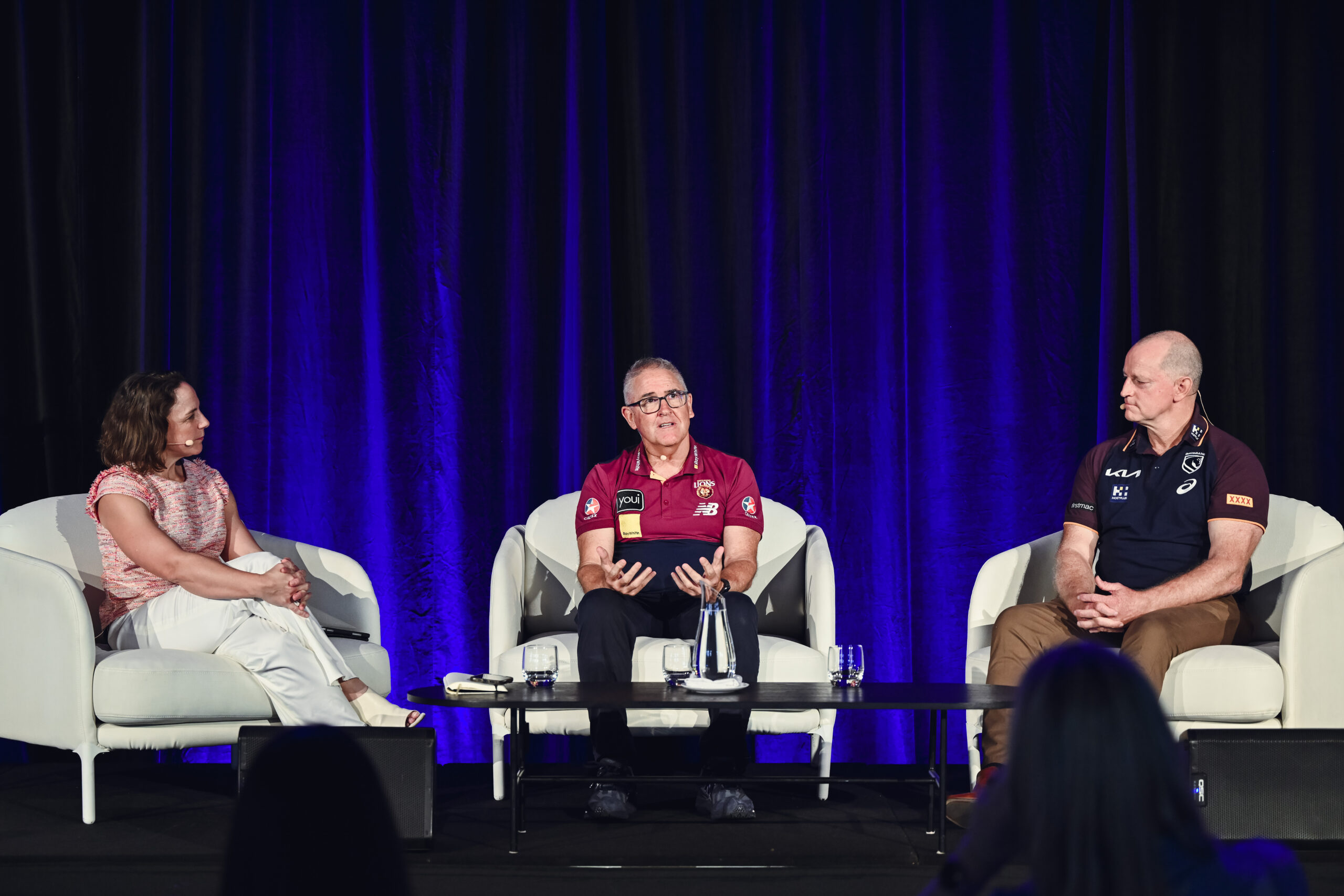
Chris Fagan (centre) in conversation with Michael Maguire (right) and moderator Rachel Vickery. Photo: Albert Perez
2. They seek ‘spine alignment’ too
While coaches can do what they can to ensure information is flowing in all directions, there is a role for both board members and heads of performance on the sports science side too.
Onstage, Peter Horne, the Performance Director at Rugby Australia, made the case for “spine alignment”, of which he said, “if we get true spine alignment of what we’re trying to achieve from a strategy, business and the deliverables [perspective] then we’re more likely to be able to execute.”
Crucially, as he admitted, it is not about agreement on every decision.
Peter Horne
“For the spine to work, you need everyone operating at the right level,” said Brett Robinson, the Chair of World Rugby, who joined Horne for the session. He included himself in that assessment.
Brett Robinson
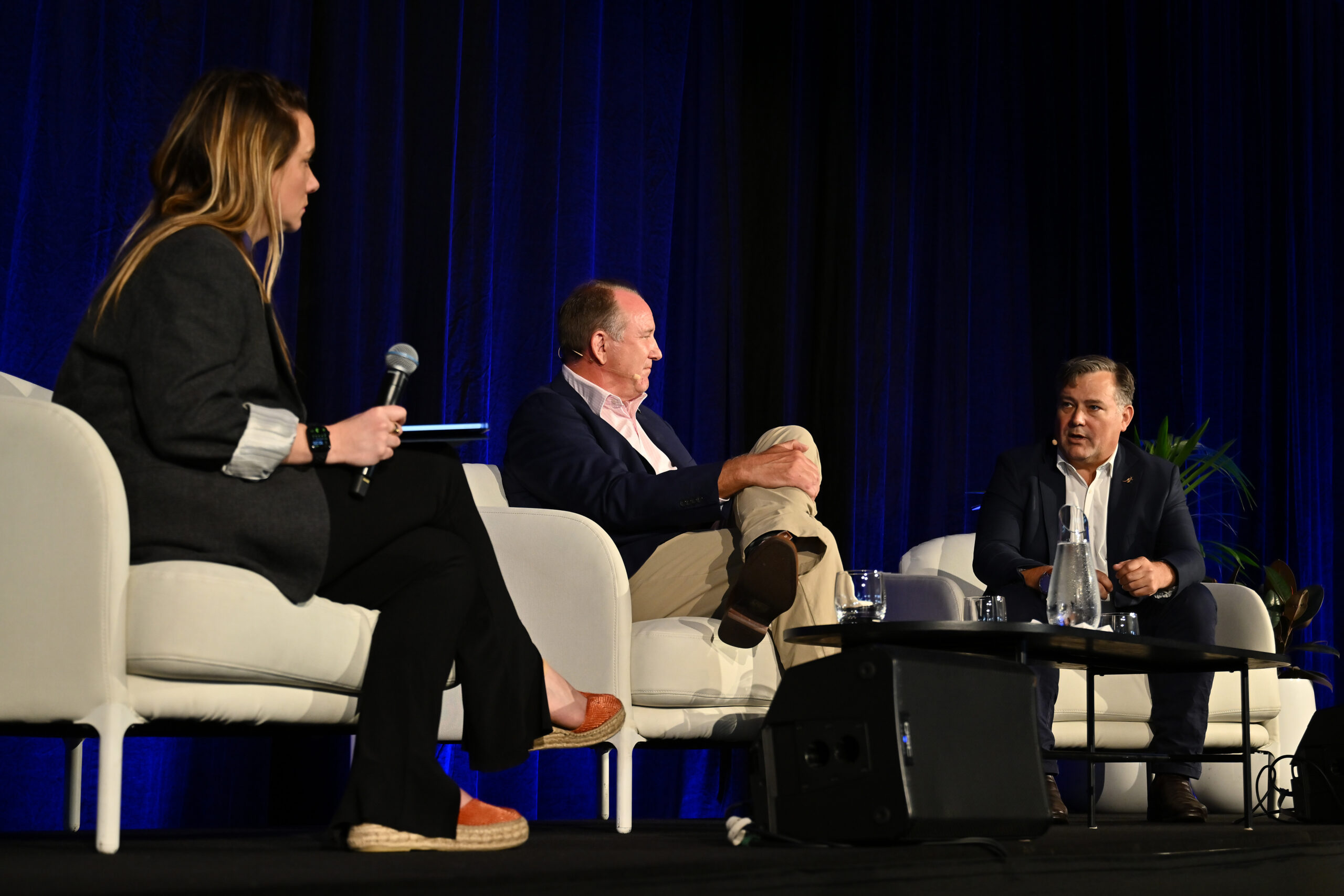
Peter Horne (right) makes his point onstage with Brett Robinson (centre) and Leaders’ Laura McQueen. Photo: Albert Perez
3. They bring their frontline people onboard
Few individuals are as well placed to discuss the concept of a culture driven by a shared purpose than Dr Stephen Rashford, the Medical Director of the Queensland Ambulance Service.
He is proud of his team’s “no excuses” approach too. “When we do our audits, everyone’s in the room, and there’s no making fun of anyone, there’s no bullying. We have honest, open discussions because we all just want to get better.”
Critically, their culture starts with their paramedics.
Dr Stephen Rashford

Dr Stephen Rashford mid presentation. Photo: Albert Perez
4. They have leaders who give their people psychological safety
Australian all-rounder Ellyse Perry is one of the greatest female cricketers of all time (then there’s her career as an international football player to consider). Her career has been underpinned by psychological safety. “When there’s a lot of support around that and real alignment on wanting to grow and improve, that makes a big difference,” she said.
Ellyse Perry
“No matter the position you hold, you don’t know everything, so be open-minded to learning,” said Anna Meares, the double Olympic gold medal-winning track cyclist who served as the Chef de Mission for the Australian Olympic Committee at the Paris Games. She spoke onstage alongside Perry and fellow Olympic gold medallist, the BMX cyclist Saya Sakakibara.
As Chef, Meares decided that open displays of vulnerability from early in the cycle would help to bring athletes and their coaches onboard.
Anna Meares
Psychological safety is just as important in individual sports, as Sakakibara told the audience. The Red Bull athlete won gold in Paris but recounted the story of her awful crash three years earlier in Tokyo and how it encouraged her to start placing her trust in others.
Saya Sakakibara

Anna Meares (second from left) makes her point to session moderator Fabio Serpiello in the company of Ellyse Perry (second from right) and Saya Sakakibara (first on the right). Photo: Albert Perez
5. They use process as a tool of alignment
In his presentation, Scott McLean, an associate professor at the University of the Sunshine Coast, explained that leaders must be aware of how things are connected in the complex systems of sports performance.
Scott McLean

Scott McLean from stage right. Photo: Albert Perez
Interventions should be governed by the performance need rather than results, according to James Thomas, the Performance Director at Warwickshire CCC, who made this case when he spoke onstage.
James Thomas

James Thomas onsite at Leaders Meet: Australia. Photo: Albert Perez
Where we’re going next
5 Feb 2026
ArticlesIn this exclusive column, performance specialist Dr Richard Young explains that repeated high performance is driven not just by plans or systems, but by the meaning performers attach to their work.
These hold the work together and give people a sense of direction, yet across numerous Olympic cycles and my work with teams in many countries, something deeper has shown up again and again. Repeat performers live by a small set of values that give their journey meaning, and that meaning becomes the story they return to when things get hard. Plans can organise a campaign, but meaning organises the person, and when the person is organised, behaviour aligns with purpose, decisions become cleaner, and responses under pressure strengthen.
Values are not abstract. They sit under the story people tell themselves about why the work matters. When performers are clear on their values, the story they live by gains weight and coherence. Meaning forms around those values, and behaviour follows the meaning. High performance at its core is high quality communication, and that communication begins with the internal dialogue that shapes how people approach their craft, their relationships and their response to the environment around them.
I learned this early in my work with an athlete who became a repeat performer. She spoke often about why she was doing the work, not in long speeches or motivational lines, but in a simple story grounded in a few clear values she believed in. Those values shaped how she behaved each day. She arrived ready because preparation mattered to her. She trained with intent because craft mattered to her. She kept close to people who steadied her because connection mattered to her. When she spoke with her coach she spoke with ownership because responsibility mattered to her. When we reviewed performance she measured herself against her values and her story rather than emotion or expectation. Her story filtered the noise and held her attention on what she could influence, and it stayed steady right through from her hardest performances to her best performances.
This pattern has repeated across many sports, campaigns and environments. The data I collect from repeat performers compared to the rest shows a consistent thread: they carry a story that fits their values and the meaning they bring to their journey, and they speak from that story in ways that guide their behaviour. Their story gives shape to their days and coherence to their choices. It grounds their relationships and helps them navigate difficulty. They are not waiting for meaning to arrive. They are building it and living inside it.
Those who are new or underperforming also care deeply and work hard, yet often do so without a clear set of values or a meaningful story that holds the work together. When values are unclear, meaning becomes vague, and when meaning is vague, behaviour loses structure. People get pulled by changing circumstances, shifting expectations and the noise around them. They work with effort but without consistent, clear direction, which slows their progress and creates friction in the system. This is not a comment on motivation or desire. It is a matter of clarity. Values anchor meaning. Meaning anchors story. Story anchors behaviour.
The power of distributed leadership
We know that the story in high performance environments is more than narrative. It is how people make sense of the path they are on and the role they play in it, and this is where distributed leadership becomes essential. In Amplify I wrote about leadership from the front, which is not the authority of the leader but the agency of the performer. When people are clear on their values and the meaning they bring, they contribute to the collective story of the team rather than waiting for the team to give them one. This alignment accelerates the group because each person brings their own clarity into the shared environment. When people are unclear, they wait for meaning to come from the outside, and that waiting creates misalignment and slows the group when pressure rises.
Distributed leadership grows when individuals write the story they want to live, then bring that story into the environment to help shape the story of the team. It is a form of contribution. It lifts the standard of communication. It clarifies the system. It allows people to act with confidence inside their role and in service of the whole. A team of people who know their own story and the story of the team has more alignment and more collective intelligence than a team with one story and many passive recipients. The power of meaning becomes a competitive advantage when everyone is an author rather than an audience.
One experience stands out to me from a world championships preparation phase. The team had come through a long training block. Performances were mixed, and the meetings were becoming heavier as the event approached. You could sense the pressure beginning to close in. To reset the group, we asked each athlete to tell the story of their season so far, not as a performance review but as an expression of the values they were trying to live and the meaning they brought to their work. One of the younger athletes spoke first. He said his season was about learning how to prepare in the right way and becoming someone who took responsibility for his craft. His values were clear. Growth. Responsibility. Trust. His story immediately shifted the tone in the room. Others followed with similar clarity. They spoke about identity, family, commitment, team and progress. Meaning returned to the group, and with meaning came direction. The environment lifted. And the team leaders connected the individual stories and values to the ambitious story of the team was creating together; people saw themselves first, then saw a clear and inspiring connection to the team story. That shift carried through to their highest calibre performance due to their collective ability to respond and adapt under pressure. They had triggered a conviction and belief in a story they had not experienced before.
Belonging: built from a shared sense of meaning
Meaning is one of the strongest levers of behaviour. When people know the values they stand on, their story gains structure. When their story has structure, their behaviour aligns in ways that support agency, transformation and performance. When teams share a sense of meaning built from individual values and stories, belonging grows. Belonging here is not sentiment. It is foundational to team performance. It keeps the group connected when tension increases and when pressure and uncertainty lift; and helps people stay inside their ‘circle of importance’ rather than drift into the noise.
I often ask leaders and high performers a simple question: What is the story you want to be able to tell about yourself and this team or organisation at the end of this campaign, cycle or career? Their answer reveals their values, priorities and the meaning they bring to the work. It opens the door for the team to see the personal stories that sit underneath performance and the personal meanings that drive behaviour. Most importantly, it gives leaders the opportunity to connect these stories, deepen the shared meaning and align the group around something that feels true to everyone. This is where distributed leadership grows. When people speak from their own story, they lead from the front. They help shape the environment rather than wait for the environment to shape them.
The advantage of meaning follows a clear line. Values shape meaning. Meaning shapes story. Story shapes behaviour. Behaviour shapes performance. When each person knows what they value, understands the meaning behind their work and brings that meaning into the collective story of the team, the group strengthens. Performance lifts. Cohesion deepens. The system grows more resilient because leadership is no longer held by a few. It is carried by many. When people wait for meaning to come from outside, the system slows. Alignment weakens because the stories underneath the work are not visible or connected. Teams are transformed when personal meaning becomes shared meaning.
Meaning does not guarantee medals, yet it strengthens the behaviours that make medals possible. It brings clarity to decisions, alignment to relationships and consistency to daily work. It supports cleaner communication and steadier responses when pressure rises. When meaning is present, people move with intent, and when people move with intent, performance grows.
Medals matter, but meaning matters most.
Richard Young is an internationally renowned performance advisor. He has been involved with 11 Olympics as an athlete, coach, researcher, technologist, and leader working across more than 50 sports and seven countries focused on sustained high performance. He has won international gold medals and coached world champions. He founded international performance programmes including, the Technology & Innovation programmes for Great Britain and New Zealand, and a Performance Knowledge & Learning programme for the New Zealand Olympic, Winter Olympic and Paralympic teams. Across seven Olympic cycles he has researched the differences between medallists and non-medallists, their coaches, support staff, leaders and the system they are in to unlock the keys that separate them from the rest.
More from Richard Young
26 Jan 2026
ArticlesJames Thomas of Warwickshire CCC tells us facilities count for little if leaders have not created the right environment first.
These things do matter. But after more than two decades working across Olympic and professional sport, I’ve come to believe that high performance is fundamentally an environmental challenge, not exclusively a technical one.
We don’t build winning teams or successful athletes by simply stacking programmes on top of talent. We build them by creating environments that consistently allow people to do their best work, make good decisions under pressure, and grow over time. When environments are working, performance becomes more repeatable, more resilient and ultimately more sustainable.
Whether it’s the four-year Olympic focus or the daily spotlight on professional sports. We are operating under constant scrutiny. The margins between competitors are small, the pressure is relentless, and the temptation to chase quick fixes is ever present. In that context, leaders are often drawn towards visible interventions, new structures, new roles, new technology (I know I have been), but the organisations that thrive over time are not those with the most impressive facilities or the biggest performance teams. They are those that are deliberate, consistent and disciplined about the environment they are continually trying to create, especially when results fluctuate.
Lessons from the boxing ring
One of the most formative experiences of my career came during my time as a performance director in Olympic boxing, in the build-up to and during the London 2012 Games.
Many of our world class boxers developed and trained in local boxing gyms, cramped spaces, ageing equipment, minimal to no recovery provision and little separation between training, admin and daily life. These were not purpose-built high-performance centres. They were community gyms, often operating with limited budgets and shared resources.
Yet within those walls, Olympic and world champions were forged.
What struck me most was not what those environments lacked, but what they possessed in abundance. There was deep trust between coaches and athletes. There was absolute clarity around standards and an expectation to commit. And there was a shared belief in the work being done, even when conditions were far from ideal.
That experience challenged a common assumption in high-performance sport; that performance requires elite surroundings. It reinforced a lesson I’ve returned to repeatedly across different sports and systems: facilities and equipment are only part of the environment. People, behaviours and belief are the real performance differentiators.
Boxing also exposes a truth that can sometimes become diluted in team sports: the individual performer has ultimate accountability for their career and performance.
On competition day, a boxer steps into the ring alone. There are no substitutions, no tactical timeouts and no teammates to absorb pressure. Preparation, decision-making and performance are owned entirely by the athlete. That reality creates a powerful mindset.
In the most effective boxing environments I worked in, athletes did not outsource responsibility to coaches, support staff or systems. They understood that support existed to enable performance, not to carry it. Behind each boxer sat a committed group of coaches, physios and performance practitioners, but the roles were clear. The system provided expertise, challenge, support and yes, at the highest level, impressive facilities. But responsibility for improvement always remained with the athlete.
This ownership created cultures where preparation was a non-negotiable, excuses given no airtime and standards were self-imposed rather than enforced. Accountability was not contractual; it was woven into its culture.
While boxing is an individual sport, this principle has resonated with me and translates directly into team environments, particularly in modern professional sport, where complexity is the norm.
From the boxing ring to the crease
In my current role as Performance Director in professional cricket, players operate across multiple formats within a condensed competitive window. From April to October, athletes move between the tactical patience of red-ball cricket, the intensity and speed of T20, and the unique demands of short-form franchise competition, both domestically and internationally.
Cricket is a team sport, but performance within it is highly individualised. Players are often selected for specific skillsets. Some are chosen for endurance and control, others for explosive impact. Some anchor innings, others finish them. Some lead with the ball, whilst others support in the field.
What underpins successful teams across formats is not uniformity, but clarity of individual responsibility within a collective framework. Team performance does not replace individual accountability; it depends on it.
The most effective environments make it clear why each player is selected, what excellence looks like in their role, and how their performance enables others. When players understand their contribution to the collective, alignment improves, decision-making accelerates, and pressure becomes more manageable. Easy to say, but this is hard to get right consistently, especially we often have large squads of players, all looking for 1st team selection. Individual Player Development Plans (IDPs) have been a useful tool to frame season and multi-year goals and how selection decisions can be woven into the discussions, that would otherwise be difficult to frame in a progressive manner.
Creating the space where performance can thrive
One of the most common traps in high-performance team sport is mistaking intensity for effectiveness. I have seen this a lot across all the sporting environments I have worked in. Long hours, relentless training loads and constant meetings can create an illusion of commitment. But without alignment, they often produce fatigue rather than progress. Effort becomes noise rather than momentum and time away from the environment, whether that’s for rest or self-development can be viewed as falling short. I’m calling this out!
Strong environments focus relentlessly on alignment. They establish a shared performance language. Coaching, data and performance teams work from the same principles. And leaders are clear about what the organisation is optimising for at any given moment.
When alignment is strong, intensity becomes purposeful. When it isn’t, that intensity becomes exhausting and I’d suggest the high levels of burnout we are commonly seeing in our system is in part down to this.
The environments that consistently outperform are those where honest conversations are encouraged, mistakes are reviewed and owned, with feedback flowing in all directions. Psychological safety is often talked about and often debated, but for me, this does not mean lowering standards or avoiding difficult conversations. In fact, it enables those conversations to happen earlier and more productively.
‘No spark without friction’ is a phrase I am always drawn to and I think it’s highly relevant in this context.
When I think of environments I have been part of, that have enabled this openness and safety, it has often come from understanding the players and staff in a more meaningful way. Learning about people, their goals, their strengths and areas for development can often help with those difficult conversations and decisions.
Why environment is a leadership choice, not a cultural outcome
Leaders set the tone here. How they respond to bad news, selection tension or performance dips sends a powerful signal about what the environment truly values.
We are also living through an unprecedented expansion of data, analytics and technology in sport. Used well, these tools enhance decision-making. Used poorly, they overwhelm and it starts and ends with the people using those tools.
High-performance environments succeed when data clarifies rather than complicates decisions, supports coaching judgement rather than replacing it, and is translated into simple, actionable insight. The most effective systems invest as much in people and interpretation as they do in platforms and tools.
If high performance is an environment rather than a programme, leadership attention must shift accordingly. The question is no longer “What initiatives should we launch?” but “What conditions must we consistently create?”
Final reflections: build what outlasts you
From my experience across Olympic and professional sport, leaders who build sustainable high-performance environments focus on four priorities.
First, they set a clear long-term performance direction. Ambition without direction creates noise. Leaders must articulate what the organisation is trying to become, what type of performers and people it wants to develop, and how success will be defined beyond short-term results.
Second, they are explicit about the environment they are creating. Every organisation has an environment, whether intentional or accidental. High-performing leaders are deliberate about behaviours, standards and expectations. Culture does not need to be complicated, but it must be visible and consistently reinforced.
Third, they obsess over daily performance habits. Performance is built in small, repeatable behaviours, quality of preparation, clarity of communication, ownership of recovery and willingness to review and adapt. What leaders notice and reinforce signals what truly matters.
Finally, they recruit people who take responsibility and can grow. People are the environment. The strongest systems are built by individuals who take ownership of their impact, are open to developing their technical and leadership skills, and understand how their role contributes to a collective effort.
Across Olympic gyms and professional stadiums, one principle has remained constant for me: high performance improves when clarity of direction, accountability of action and care for people are aligned.
Facilities matter. Data matters. Structure matters. But environments win or lose on the quality of people, the standards they live by and the habits they repeat every day.
High performance is not something leaders should demand. It is something they should enable.
James Thomas is the Performance Director at Warwickshire County Cricket Club and one of sport’s leading high performance experts. If you wish to speak to James, please contact a member of the Leaders Performance Institute team.
23 Jan 2026
ArticlesIn a recent Leaders Virtual Roundtable, performance specialist Iain Brunnschweiler led a discussion on strategies more effective learning. We pick out ten below.
With those words host Iain Brunnschweiler, who runs the Focus Performance Consultancy, set the scene for a virtual roundtable discussion during which Leaders Performance Institute members shared the strategies that have facilitated better individual and organisational learning within their teams.
“There’s definitely something about learning being contagious,” he added in expectation. “If credible, valuable members of staff are going after things deliberately like you are, I’d hope that there’s some sort of contagion within your organisation.”
To start proceedings, Brunnschweiler outlined a four-part model of organisational learning. “This is an unpublished model,” he said of it. “This is the world according to me.”
Effective priming
“How can we deliberately set people up for learning? That’s something that I’ve increasingly considered,” said Brunnschweiler, who highlighted one-to-one conversations with staff members as a way to identify their aspirations and their motivations.
Appropriate stimulus
“How do we provide a stimulus to create thought in aspirational people?” In a previous role, Brunnschweiler implemented weekly 30-minute meetings with staff members. He also enlisted external speakers and asked individuals to present on a teaching project.
Sense-making (culture)
“If within your organisational culture there are people and spaces that allow you to have conversations, check and challenge your thinking, that is a really good way of helping the learning to land,” said Brunnschweiler, while emphasising the cultural dynamic.
Committing to action
“Often,” Brunnschweiler said, “the greatest risk here is that we have a brilliant conversation, and then we do nothing about it’. How do we commit to something that’s going to make some sort of change, whether it’s small or large?”
The group then shared ten strategies to encourage more effective individual and organisational learning:
1. Give staff members the freedom to explore learning
“If we want to happy or we want to have happy staff, we need to give them some freedom,” said a sports scientist working in the major US leagues. “And if we want them to be free, then we have to encourage them to be courageous and pursue what they want to have and what they want to do.”
Brunnschweiler said:
“A learning culture starts with recruitment… can we keep shifting that culture by recruiting naturally curious and hungry people and maintain momentum.”
2. Hunger for learning must be role-modelled from the top
Often, staff members are eager to learn, as a psychologist working in the US college system observed, “but having leadership model this is so key”. Only then will staff members carve out the time, as he said:
“If your staff members don’t feel like they have the grace and space to allocate time in the day they’re going to say, ‘I have to do this,’ or ‘I have a meeting’ instead.”
3. Understand people’s motivations
If you can understand someone’s motivations or aspirations then you have an anchor for a conversation about their development. Brunnschweiler explained that it is important to focus on those who want to learn, not those who don’t. He said:
“Some people have little appetite for self-development. And I think we have to be cognisant of our own energy… and accepting of that fact.”
4. Create individual development plans for staff members
The aforementioned psychologist made a convincing case for staff IDPs. He said:
“We talk so much about player development plans, but do we truly have staff development plans, like, ‘here’s where you are, here’s where you can go, here are the gaps to be filled’?”
5. Place staff on secondments when possible
“We don’t put barriers in the way of our people going out on secondment,” said a director of cricket in the English game, where the season is not a 12-month schedule. This is, as Brunnschweiler observed, a cost-effective way of bringing IP back into the building. He said:
“How can we be resourceful? Can we create opportunities for people to visit places and return with knowledge without spending money?”
6. Find your critical friends
Sense-making can be difficult, but sometimes it just takes opening your phonebook. A call with a critical friend is what Brunnschweiler calls a “micro sense-making space”. He said:
“I’ve accrued a small network of people who, for example, when I’m driving, I just phone them up and I know they’ll challenge my thinking and that I’ll learn from that conversation.”
7. Learn from failures
“I’m far more interested in the failures,” said a physiotherapist at a globally renowned organisation. “When my team see me talk about failures, when things have gone wrong, that makes people listen a bit more; and I often think we should prep to fail. Are we ready to fail, so that if we fail, we can look back and say, ‘okay, we did everything we wanted to do?’” Brunnschweiler agreed, adding:
“It’s a good sign if you’ve lost and a staff team are reviewing and reflecting on it and they’re genuinely unpicking and they’re able to call each other out or go, ‘do you know what, I messed up today’. That is a real signature of a place that wants to get better.”
8. Importance of managerial vulnerability
Leaders can role-model learning, but they can also demonstrate vulnerability.
“If you can put your hands up and say, ‘I made a mistake’, that sets the culture, it sets the environment,” said a physiotherapist working in Australian sport. In building on that point, the physiotherapist from No 7 said:
“If we can guarantee that removal of blame, it will encourage us to talk about what we can learn.”
9. Job security
It sounds obvious, but managerial vulnerability goes hand in hand with job security.
“In a fast‑paced environment there is more chance of people getting sacked. I think this could be almost correlated to your hunger for learning,” said the physiotherapist based in Australia. “You might just sit there, be quiet, go insular, and just tick our day‑to‑day off – you don’t want to put your neck out there.” He has witnessed the impact of leaders reiterating that people’s jobs are safe.
“When you are told people aren’t just going to get sacked, it creates the environment for learning.”
10. Appoint a dedicated staff member for learning
“I’ve never worked somewhere that’s had a dedicated head of learning,” said an analyst working in Middle Eastern football. “It always falls on line managers and it’s hit and miss.” Brunnschweiler agreed and added:
“How does any organisation ensure that a PDR process is not just some tick-box exercise, but there’s genuine validity in what you’re going after, what you’re going to commit to, and then it’s followed up on?”
What to read next
13 Jan 2026
ArticlesWe explore athlete-involved development models and three other trends to look out for in 2026.
Cost was speaking at the 2025 Leaders Sport Performance Summit in London where he was invited to share his views on injury prevention and rehab.
He explained that while planning is important for a director of performance, the human element ensures there will always need to be a degree of flexibility when providing sports science services to athletes.
As he said, there is no “magic sauce” when it comes to reconciling coaching intent, the training required, the athlete’s experience of that training, and making tweaks as required.
Nevertheless, Cost and his peers have to be cognisant of the trends currently shaping athlete development, which we have divided into five themes.
1. The athlete as a member of your interdisciplinary team
Athlete-centric development is long been in vogue but athlete-involved approaches are starting to gain traction.
“Our goal is to put the athlete in the centre and then we fit the jigsaw pieces around them,” said Simon Rice, the Vice President of Athlete Care at the Philadelphia 76ers, in our Teamworks Special Report.
Those jigsaw pieces – the technical, tactical, physical and cognitive – will depend on the individual, which has inspired a trend towards athlete-involved development, as Jack Nayler explained in the context of his work at Premier League Everton.
“I believe that a player-involved as opposed to player-centred approach is vital in developing this knowledge,” wrote Nayler, the club’s Head of Sports Science. “Although the difference is subtle, it is an important distinction to make. In a player-centred model, the team of practitioners, ologists and experts discuss the player and develop a plan, drawing on all their expertise. A player-involved model brings the player into that process, involving them in the decision making and design of their training.”
For Nayler, the benefit is clear. “The player needs respecting as a key member of the interdisciplinary team. Not only will this help to develop the player’s understanding of their body and the training process, but also their investment and trust in the programme. This is key in a sport such as football where the link between doing physical work and performance isn’t always immediately obvious and the talent pool is global.”
2. The continued rise of external clinicians and coaches
As high profile athletes continue to work with their own personal trainers, the sports scientists of the major leagues are doing everything to bring them into the fold.
“It’s about role clarity,” Rice told the Leaders Performance Institute. “If a player has an external strength coach or external physical therapist, you try to sit down with them and work out what the player’s programme is going to look like. So what access do they have? Are they going to be working out in our facility? Are they going to do it separately?”
It is increasingly common for group chats including the athlete, their personal coach, and the key members of a team’s high performance staff. “We want all the information in one place so at least we know what everyone else is doing, and then it allows me in my role to make sure we’re not doubling up on things,” added Rice. “Can we agree on what the goals are for this player, understanding that we may be trying to get there in different ways with different philosophies, but what are the key points that we can agree on and can we get the data in one place so we can all access it and share it? We’re trying to work together, not fight against what the other people are doing.”
3. Better defined performance and clinical psychology
The highest-performing teams will understand psychology’s role in preparing their athletes.
This is a problem for many. As mental skills specialist Aaron Walsh wrote, “In other areas of performance, we give a clear mandate of what we want to happen in the programme, there are regular checkpoints to ensure we are on track, and we review the work after the season. With the mental stuff [skills] we tend to find a person and just let them loose, we don’t follow best practice.”
Walsh argues that is important to define the scope of the work, establish a clear framework, and provide the right content so that the delivery lands.
Whether it’s performance psychology, mental skills or a clinical issue, all staff members are called upon to play their part, as Dr Lyndell Bruce of Deakin University told a Leaders Virtual Roundtable.
“It’s not a once-off conversation because they flagged on the wellbeing this week and then two weeks later they’re back in their normal range – we continue that conversation and check-in,” she said of her work at Deakin.
“Where pathways are regularly communicated, [it’s about] checking for understanding of do you know when to use it, how to use it, what the process is, destigmatising it through education, through raising awareness so it becomes a normal part of life,” said Emily Downes, the General Manager of Leadership & Wellbeing at High Performance Sport New Zealand. “It’s not something that you go and necessarily do when you’re at your worst. So how can you use all of these services proactively to keep you actually performing?”
4. AI as a useful ‘sparring partner’
However AI is used in athlete development, there are some fundamentals that are likely to hold true, as Maximilian Lankheit explained to the Leaders Performance Institute.
“If you don’t know the question, if you don’t know what you’re asking for, you’ll never get a good answer,” said the Senior Medical and Performance Manager at European Football Clubs, which is the representative body for Europe’s football clubs.
“People don’t know what they’re actually looking for. They’re trying to find something in the data that either validates their bias or whatever, but you need to know what you’re looking for.”
With that first question answered, Lankheit believes AI could be “a useful sparring partner that can make you more efficient” when it comes to areas such as devising periodisation protocols.
However, he preaches caution. “When it comes down to everybody’s individual work, I think it will make us much better, but the human sense-making is important.” He cited Apple Co-Founder Steve Wozniak, who said: “I have AI myself: actual intelligence”.
“Without actual intelligence,” Lankheit added, “artificial intelligence doesn’t matter because we as the human users need to add the right context.”
John Bull of Management Futures says it as he sees it, but stresses that all teams can improve their teamwork.
“One of the things I see, certainly in the corporate world, is that people mistake ‘good’ for high performing,” said the Head of High Performance at Management Futures. “In my experience, genuine high-performing teamwork is much rarer than people would admit.
“We know what it feels like when a team is dysfunctional and something’s not working, but when a team is harmonious and there are fairly good relationships, people mistake that for being a high-performing team.”
He presented this distinction between dysfunction and high performing as different ends of a continuum:
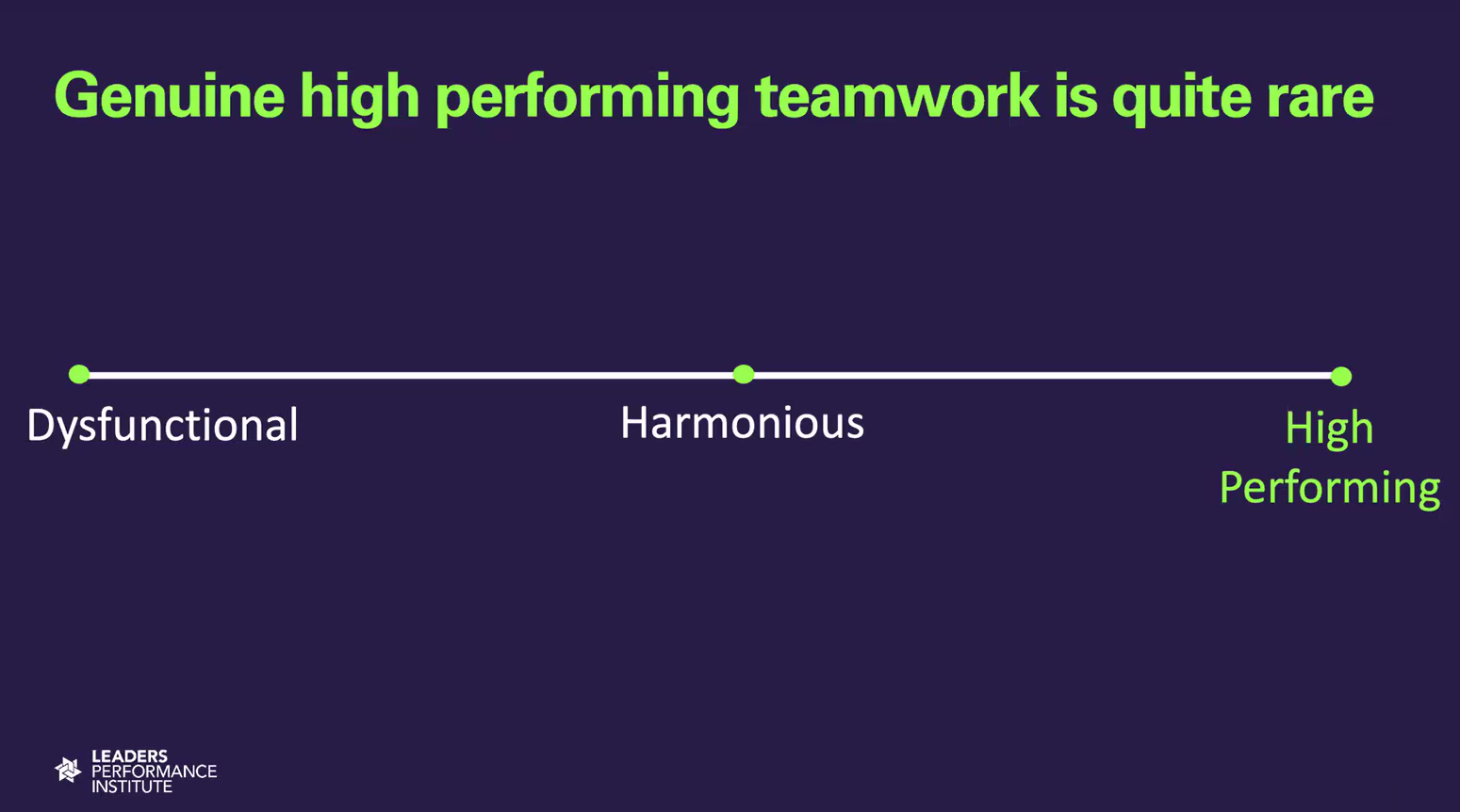
“In order to get to the right-hand side of this continuum, high-performing teamwork requires people to lean into behaviours that don’t come naturally,” added Bull.
He then explained that there is also a risk in over-collaborating. “This is about quality not quantity. Our efforts to get more out of teamwork can sometimes slow down performance.”
There is also a distinction between working within a ‘stable team’ (e.g. a department within a high performance team) and teamwork across boundaries, between people who rarely work together or don’t see themselves as one team (e.g. business and performance functions).
The aviation industry, Bull said, excels at cross-boundary teamwork.
“If you think about when you have a critical incident while flying, you’ve often got people in the crew who don’t know each other. The crew must collaborate with air traffic control on the ground, and they won’t know them,” he continued. He explained that the industry has long valued listening and speaking up.
It has also placed an emphasis on ‘diamond thinking’, which looks like this:
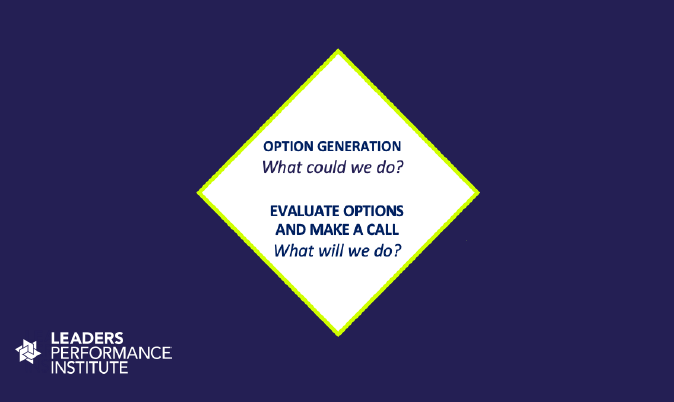
“In aviation, when you have to solve an issue, as a rule of thumb, you should spend 50 percent of the time opening the diamond up,” he said. “You get a lot of input but you’re then clear on who’s going to make the final call. Some of us in the coaching space struggle with the balance between democracy and a leader making a decision. Diamond thinking allows for that.”
Bull then led the table into a discussion on his four building blocks of team performance:
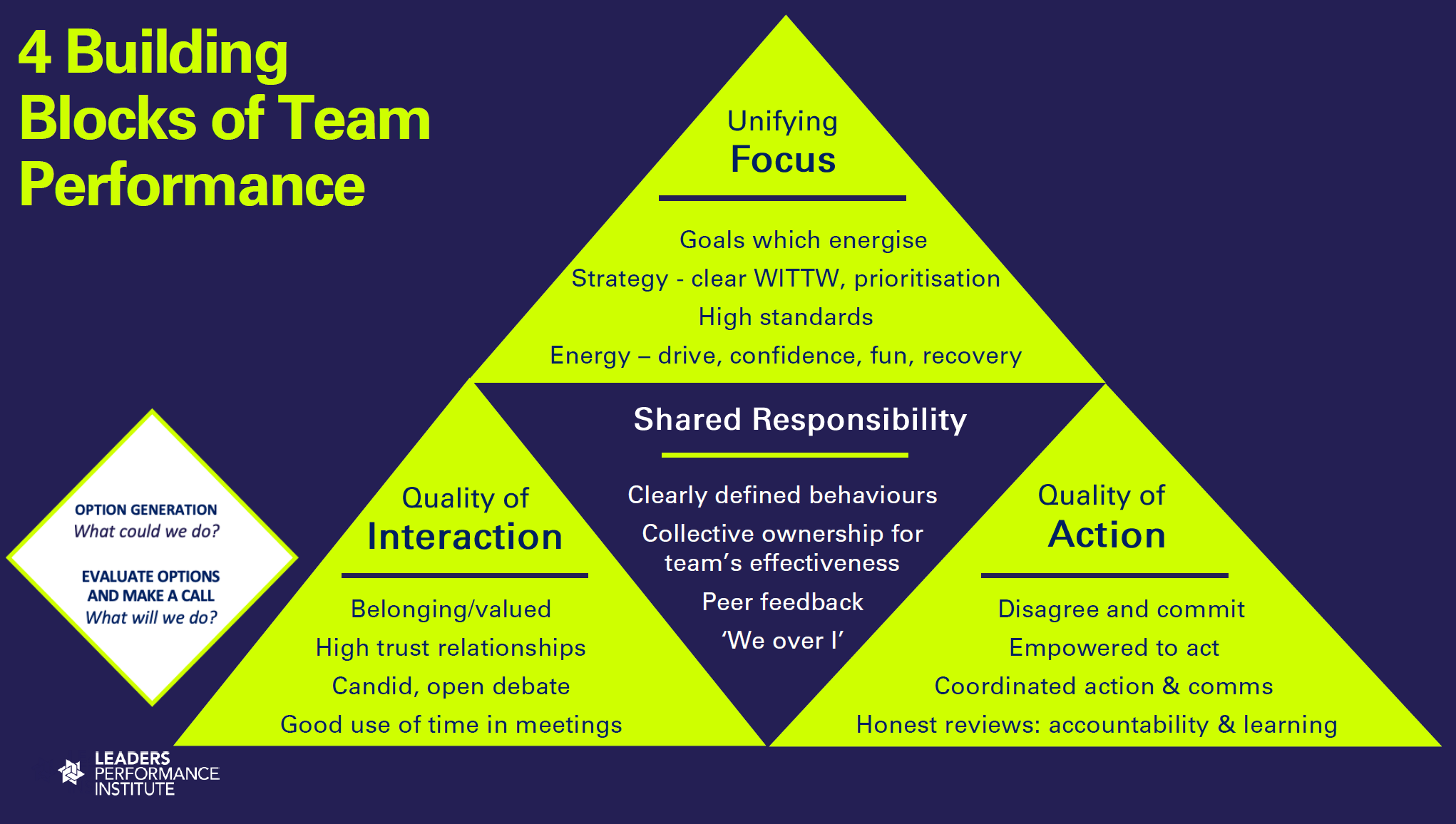
He explained each in turn and their different elements.
1. Unifying focus
“If you don’t have clarity you can’t create any of the other conditions.”
2. Quality of interaction
“Trust enables us to lean into more uncomfortable conversations and have the real performance conversations in a way that doesn’t put those relationships at risk.”
3. Quality of action
“High-performing teamwork emerges when people go for the gap.”
4. Shared responsibility
“It’s getting people to recognise that when the team’s not performing they should feel empowered to step in and say something about it and not just rely on the team leader.”
As a follow on, Bull highlights six human factors that can serve to inhibit team performance:
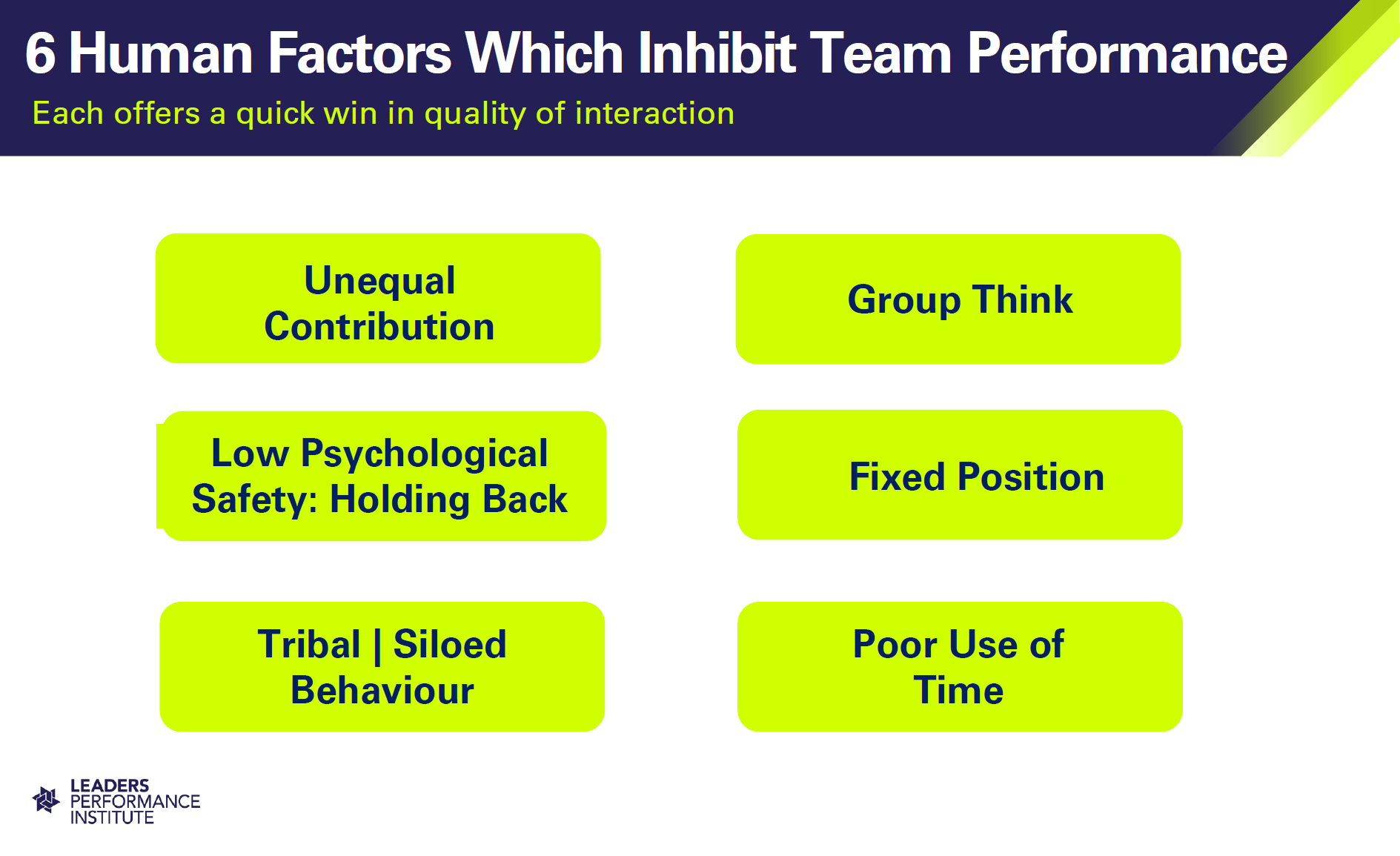
Again, he shared his thoughts on each:
Unequal contribution: “We know from research that if you have a group or a team of eight people 70 percent of the contribution will come from two or three… Status and personality has more of an impact on who speaks than who knows stuff, and that should scare you as a team leader.”
Groupthink: “It’s a hardwired principle of how our brains work that we will conform to the thinking of the group if we don’t have a strong view… One of the best ways to combat groupthink is to get people to think individually before a group discussion.”
Low psychological safety: “Probably the biggest thing that kills team performance is a lack of psychological safety.”
Fixed position: “One of the things that hurts psychological safety the most is defensiveness, where people are in a fixed position. The way you deal with the fixed position that I’ve seen work best is to deal with it one-to-one.”
Tribal or siloed behaviour: “We’re wired as humans to be tribal and there are two types of tribal behaviour. One is where you are deliberately trying to beat the other. What is much more common is you’re not competing but you just don’t think about the other ‘tribe’ as much.”
Poor use of time: “Humans tend to be pretty bad at how we use time together in groups. A quick win is to get the team thinking about when we had our best team meeting, what was it about that, what’s getting in the way of it.”
Bull then returned to the themes of psychological safety and fixed positions when sharing and describing the three types of “thinking environments” in groups and teams as revealed by Management Futures’ research:
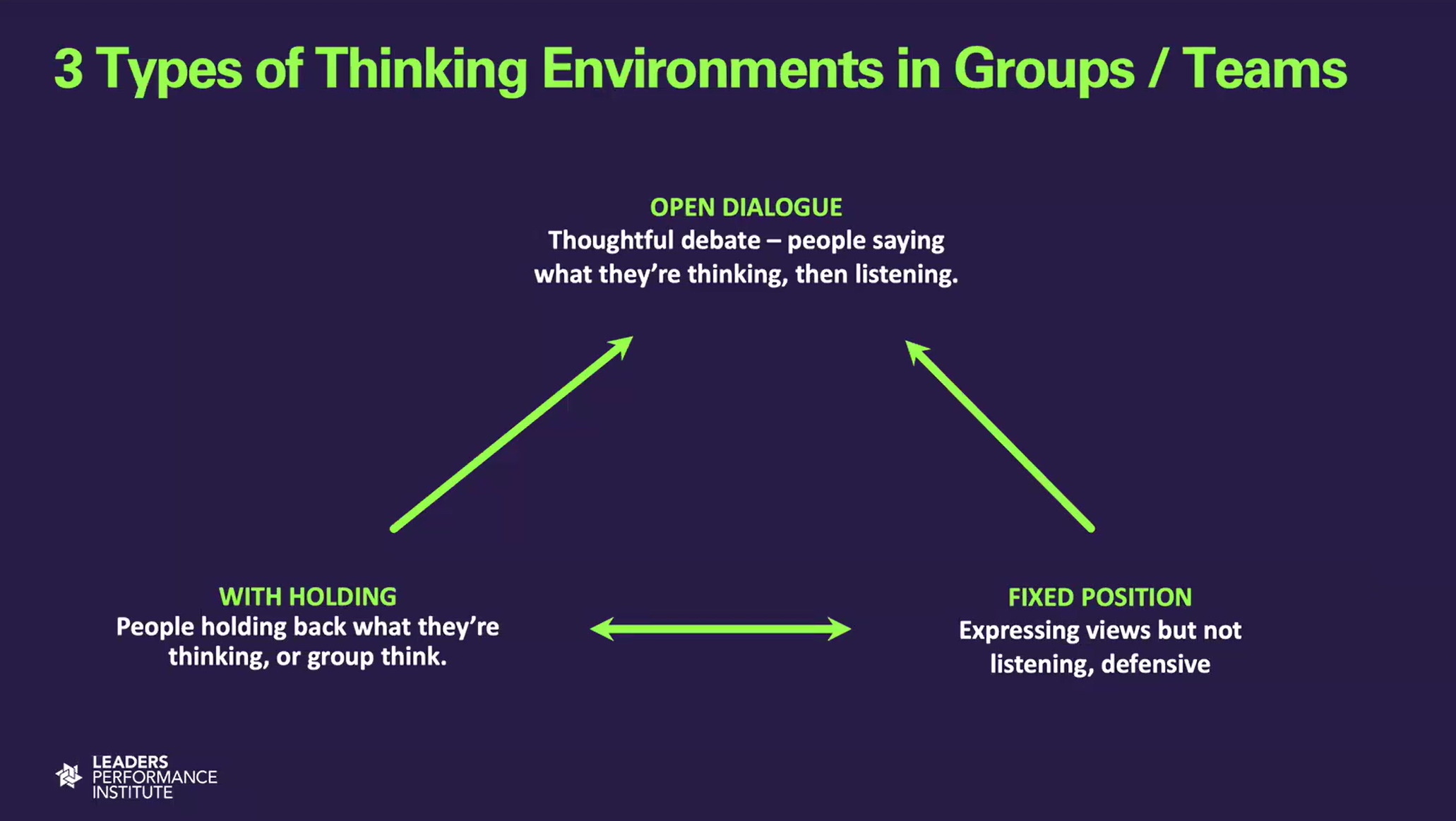
“The bottom two points are ineffective,” said Bull. “The definition of open dialogue is where people are saying what they think, but as soon as they’ve put their view out they’re inviting disagreement. It’s not about trying to win the argument, it’s about trying to get to a collective insight of what we know as a group. It’s very different to trying to influence colleagues.”
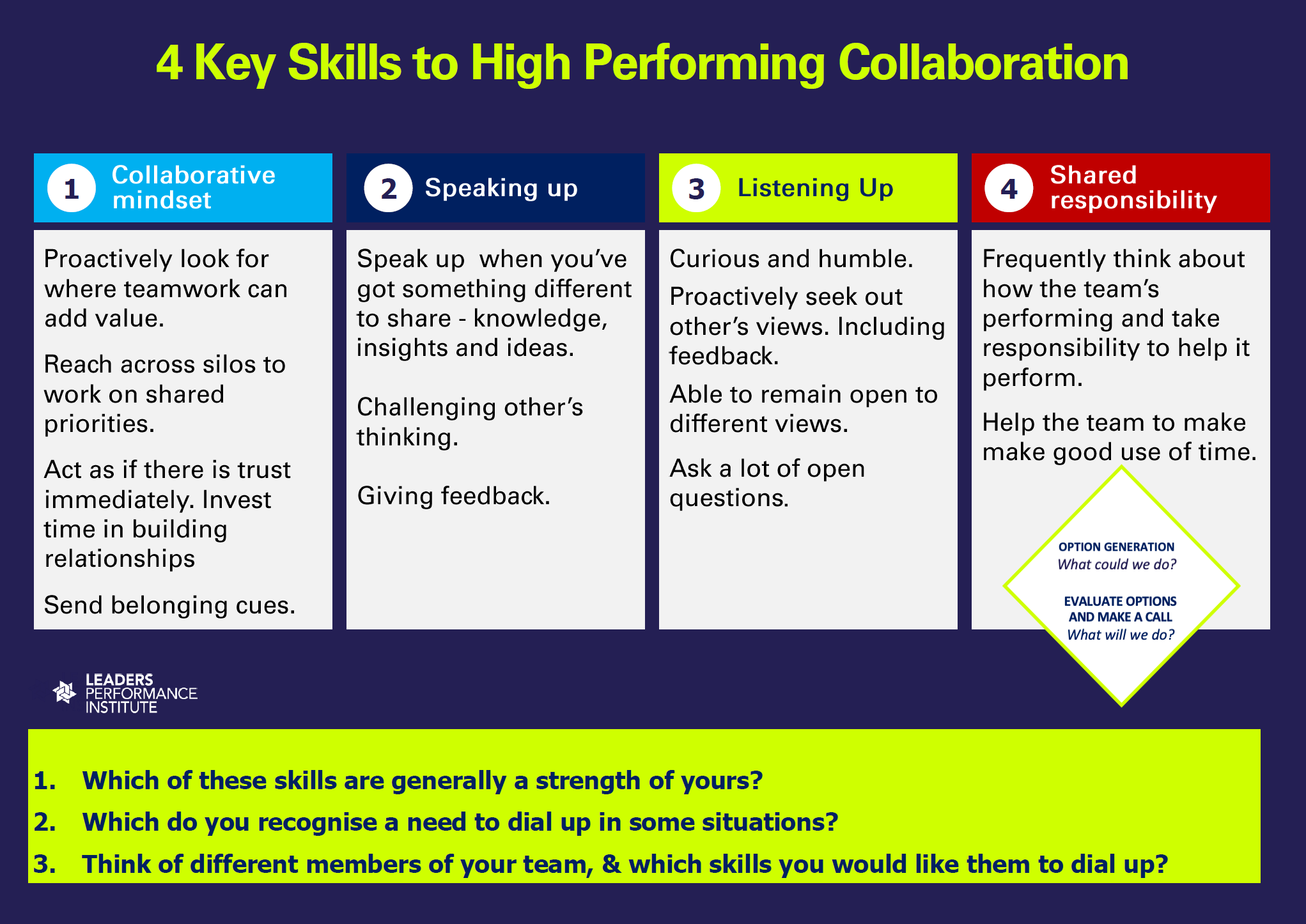
With time running out, Bull shared a final slide highlighting four key skills to encourage collaboration, with a series of questions for members to ponder: 

In a recent Leaders Virtual Roundtable, members discussed how their team cultures are evolving, with one readily embracing the global hit Bluey in its pursuit of performance.
“We used an episode to bring to life our ‘embrace change’ value,” said the team’s performance lead at a recent virtual roundtable.
It made sense. For one thing, the eponymous character, an Australian cattle dog (known colloquially as a Blue Heeler) puppy, is cute; secondly, the show’s themes of self-development and selflessness resemble the values often espoused in dressing rooms.
With his fellow Leaders Performance Institute members smiling, the performance lead explained that his playing group had gone as far as creating a ‘Rusty Award’, which is named in honour of Bluey’s friend Rusty, an Australian kelpie, to celebrate teammates.
He continued: “At the end of each camp, the players pass the Rusty Award to whoever they think has either embodied our values or has been a real good person around their teammates over that camp or weekend.”
That insight set the scene for a conversation on how members believe their own team cultures are evolving; what is working well and where the opportunities lie.
This is a snapshot of what they shared.
Firstly, there are five things that most teams on the call tend to do well:
1. Articulate their values in a resonant way
Values have to be more than words on a wall.
“Having consistent language has worked well for us,” said the aforementioned performance lead. “We have three values or pillars – ‘embrace challenge’, ‘evolve yourself’ and ‘enjoy the ride’ – and the coaches and support staff have been forthright in using that language within sessions so that the players can always draw back to that.”
A performance support specialist from the Australian Olympic and Paralympic system spoke of her organisation’s renewed emphasis on transparency.
“We’re trying to communicate to athletes as frequently as we can to drive that connection,” she said. “If they feel like they’re well informed and they’re part of the planning, they can also hear reflected back to them things that they have potentially asked for in our feedback mechanisms.”
“We can’t leave any of this for chance,” added a head of coaching and development from the British system. “How intentional can we be with spending time on it? To start to label things so they aren’t subject to misinterpretation?”
2. Inspire personal accountability
It is a question of the standards you walk past being the standards you’re prepared to accept, whoever you are.
“That starts with leading yourself,” said the performance support specialist. “You’ve got to be able to look after yourself before you can look after your teammates.”
“When are we nudging?” said the head of coaching and development. “When are we realigning and checking and challenging the behaviours that we do not want to see or may not be in line with our desired options?”
3. Make their people feel safe
Whether you encounter resistance from long-tenured staff or you are dealing with rapid turnover, your people must feel that you are listening to them.
“Listen to the system and the system will tell you what it needs,” said the performance support specialist, adding, “I think a large part of where culture can get derailed is where people don’t feel heard and valued.”
In response, a sports scientist spoke of their institute’s desire to engender a collective sense of belonging in the pursuit of innovations.
“It’s allowed people to feel like they can make another level of contribution,” she said. “It opened the door in ways where some of our different support team members and our coaches have been given an opportunity to talk about their ‘why’ and talk about their own attachment to our values.”
From that place of interpersonal safety, teams and team members are ready to tackle the issues of the day, even if they end up down “rabbit holes” as an athlete support officer working in the UK system put it.
The first step is to establish the performance question. “That enables us to have challenging conversations without it feeling personal”. Then you must “make sure your people have the ability to express themselves, bring new ideas, problem-solve and make decisions and add their own flavour.”
3. Try new things in low-risk settings
Comfort in risk-taking cannot be separated from notions of accountability, belonging and safety.
“We have benefited from a strong, overt, and repeatedly iterated attitude from our new director and leadership team to take on and try new things,” said one long-tenured attendee presently adapting to new management at a new practice facility. “There’s a sense that we’re not writing a new story but a new chapter.”
4. Celebrate their people
The Rusty Award is a prime example, but gestures can be just as important.
“A lot of people probably perceive working on your culture as a grand gesture moment,” said one attendee, “whereas the little gestures and the little interactions matter way more because they stack and pound over time”.
On top of these encouraging signs of progress, there are three areas where teams can further strengthen their culture with simple tweaks:
1. Celebrate progress, not perfection
“I like to celebrate our imperfections and reframe expectations to give the team belief in its potential,” said a performance support specialist based in Australia. “We say pressure is a privilege, but expectation can sometimes make culture deteriorate because of the pressure and expectation to perform or to behave in a certain way.”
2. Focus on the small interactions
“Corridor conversations are key,” said the athlete support officer, “and I think we forget the impact that they can have.”
3. Keep challenging your assumptions and biases
One attendee suggested red-teaming, which is the practice of stress-testing ideas. He said: “How do we check our blind spots? How do we identify them? How do we systemise those processes?” Doing so is important because “what don’t know what we don’t know”.
What to read next
Everton’s Head of Sport Science Jack Nayler concludes his exploration of complexity in sport by outlining what it takes to be resilient and adaptable under pressure.
We also looked further at the implications for this in a sporting organisation, notably that complexity is fractal, exists at different levels, and that each person within the organisation will exert different levels of influence over the performance at any given moment.
Last week, I began to look at what this means for those in leadership positions.
Leadership in complexity requires you to have the humility to accept the ignorance of your position and the understanding that autocracy won’t work. It is impossible to micro-manage every decision in the fast pace and short turnaround of games in a professional sports season. You will not be present to control every interaction that occurs and you will not possess all of the information available to make every decision.
With the inherent fluctuations that occur in a complex environment, it is incumbent on the leaders to provide a framework within which everyone can operate, as effectively as possible, in a transdisciplinary manner.
I believe there are four pillars to this framework, that are characteristics of high-performing environments.
Your role as a leader is to ensure that these are in place so your team operates as effectively as possible.
I explored the first two pillars here. Let’s now delve into the third and fourth pillars below.
The complexity of the sporting season ensures that as results wax and wane so will pressure and external noise. The processes you have in place need protecting from this pressure and the associated emotion.
For some simpler tasks and processes you can have checklists or flight manuals where processes can be recorded, ratified and referred back to (1). However, these only go so far and will be less useful as the complexity dials up.
When you and your staff are committed to helping the team perform, it is easy (or just human nature) to become overly emotional about performances (both positively and negatively), and this can leach into your decision-making processes. Leaders need to be aware of the propensity for this as well as the influence of subconscious bias on any decision making (this is a wider topic than the scope of this series but a good place to start is Thinking Fast and Slow by Daniel Kahneman, 2). Setting up your team/environment to reduce the effect of these factors is key to leading your team effectively.
As the leader, with your wider viewpoint and greater access to those higher up the organisational hierarchy, you should have a greater appreciation of the pressures you and your team face. As emotions tend to affect quality decision making, it is your job to be judicial over which pressures you allow to filter through to your team and which you will bear.
Objectivity must become a cornerstone of making decisions. We need to collect data on the subject (player or situation) over which we are trying to make a decision. This data then needs turning into information (tables, graphs and other visualisations) by adding context (use of appropriate statistics) to help the reader understand the magnitude of any effect. This information turns into knowledge when the reader reflects on the new information, with respect to what they already know and understand.
As we have discussed, each person will have their own unique take on a given set of information. Organisations that can successfully make the leap from individual to organisation level knowledge will be better prepared to perform in complexity.
The threat to an organisation if knowledge sits siloed with individuals is two-fold. Firstly, the quality of the decisions being made will fall and secondly the organisation is fragile to an individual leaving and removing the intellectual property (IP) from the building.
I believe the threat to the organisation is greater from the loss when IP walks out of your facility, than if that person was to be employed by a rival team. As each organisation is its own complex mix of culture, practitioners and athletes, it is difficult to transfer tacit knowledge from one environment directly into another.
Once you have objective information around which you can make decisions, you can begin to plan what you and your team will deliver. This planning process provides a framework for everyone involved to work within and should remain just that: a framework. Remember that in complexity the person closest to the action has the most information in a given moment. This framework provides a set of parameters that act as a fallback, against which new information can be assessed. In the moment, under pressure, this framework coupled with a clearly understood direction of travel from you as leader should help the practitioner on the ground make a better decision.
As the outcomes of the decisions we have made as a team become apparent our framework can become the basis against which we can reflect and review the decisions made, by providing a reminder of the conditions as they existed in that moment. This again helps to objectify the review process and fosters a culture of psychological safety (3).
Understanding the complex nature of this environment has helped me to appreciate that we cannot get everything right all of the time (remember there is never a perfect game) and my first thought when things fall down is: how could I, as an intrinsic part of this complex system, have acted differently through the process to have affected a better outcome? This helps me to remain less emotional when analysing failures as and when they happen. I do this before turning my lens outwards to think how we could have done better as a team.
The fact that complex systems are never perfect and we cannot predict outcomes with 100% accuracy creates uncertainty. In their book Radical Uncertainty, John Kay and Mervyn King describe uncertainty as “the result of our incomplete knowledge of the world, or about the connection between our present actions and their future outcomes.” (P. 13, 4). We need all members of the team to understand that although this space is uncertain, performance will emerge from it.
There is then a gap that exists between our expectations and the outcomes. Acknowledging the inevitable existence of this gap allows the leader to be more sanguine and less frustrated by it, putting us in a better headspace to explore why the gap exists like it does and how we can narrow it in the future. I see little point in the wasted energy that would be spent railing against this gap’s existence. Rather I see this gap as the learning space, a space to be curious about. It is the space where the information mentioned in the previous section becomes knowledge.
When we reflect on information in the context of what we already know, we develop our knowledge base. This should then spark off further questions as to why we ended with the result we did, restarting the cycle back to collecting more data. This process is critical in the complex world. As the system shifts and changes, so do our levels of expertise (5). Further, knowledge developed in other environments and populations diminishes in power the further away from that population it moves. The most powerful learning will come from research done in our own group of athletes. This should be a mix of quick and dirty in-house enquiry and more formalised research carried out with partner universities and led by in-house research and development departments.
You also need to lead your team into this gap by putting in place structures that allow your team the time and space for reflection. We are really good in team sports at planning and doing, before all too soon the next fixture rears its head. You need to be intentional about reflecting and reviewing. Reflecting skills can be learnt and should be fostered amongst your team. Make reviews normal and model behaviour by openly reviewing the things you personally have done and seeking feedback. This normalises the feedback process and creates space for you to feedback to your team members more easily (6). Mix regular small hot reviews in the moment (7) with more analytical, larger reviews. In these, review a specific subject (e.g. grade 2b hamstring injury rehab) as opposed to generalised time periods (e.g. pre-season). Signpost your reviewing – create a structure or framework around how you want to reflect and share it with the team ahead of time. Your team should then turn up in the spirit of reflection, rather than having it sprung upon them. Most critical of all is to have concrete outcomes that everyone is aware of and can be held to.
The second space we need to be mindful of as leaders is the space from which the performance of our team emerges.
In 2012, Google embarked on a large study to try and discover what made a successful team within their organisation, they called it Project Aristotle (8). Google studied 180 teams from across the business and looked many combinations of factors (e.g. personality traits, emotional intelligence, demographics and skillsets of team members) that they hoped would indicate levels of learning and performance. Whichever way they crunched the data, they could find no pattern as to what would bring success. Some of the factors that did not influence team success intuitively sounds like items that would be important when trying to build a successful team:
Eventually the researchers looked away from the hard skills and instead looked at interactions between team members, driven by the work of Amy Edmondson, Professor of Leadership and Management at Harvard Business School. Professor Edmondson’s research has also studied effective teams and the work at Google confirmed her theories. The number one factor that will describe team success is termed psychological safety, which she describes as “a shared belief held by members of a team that the team is safe for interpersonal risk-taking… a sense of confidence that the team will not embarrass, reject or punish someone for speaking up” (P. 354, 3).
A psychologically safe environment is one which recognises that the space between the components of the complex system is where the magic happens and works to ensure that all members of the team can lean into said space.
In a complex world, we cannot see the connection between our decisions and their future impact, we only make sense of them with hindsight. As the author Robert Louis Stevenson said: “The worst historian has a clearer view of the period he studies than the best of us can hope to form of that in which we live. The obscurest epoch is to-day.”
However, there is evidence to suggest that better predictions and decision making come from cultures that “harness the power of collectives and encourage diverse opinions, perspectives and collaborative teamwork” (9).
The challenge we face when leading in an increasingly complex world is that it is constantly shifting in front of us, and we only see what is happening through our lens. There are a whole host of things we cannot see and second and third order effects that we cannot predict. Therefore, any time we take an immovable position or opinion, we are also opening ourselves up to being incorrect.
As leaders these positions, either polarised, immovable (or worse, both) are dangerous places to be. This is demonstrated by the work of Philip Tetlock, summarised in his book, Expert Political Judgement: How good is it, how can we know? Over a nearly 20 year period Tetlock ran forecasting tournaments with 284 experts from a variety of fields, leading to 28000 predictions (10).
Experts were only slightly more likely than chance to be correct, however the interesting part was in discovering that how the experts thought was more important than what they thought when it came to the accuracy of their predictions. Tetlock characterises these two styles as Foxes and Hedgehogs after the title of an essay by the philosopher Isaiah Berlin, based on a quote by the Greek philosopher, Archilochus: “a fox knows many things, but a hedgehog knows one big thing”.
When the hedgehog is challenged, they curl up in a ball with their spikes out to deflect the world. It is the same with the experts, their position is immovable, and they deflect critique. Experts who were more fox like were less sure of their predictions and more willing to change them as events unfolded. Foxes were more likely to be accurate in their predictions than hedgehogs in the long-term. Hedgehogs had the potential to be more precise, but with a much greater chance of being wrong. When dealing in complex environments, when you are wrong, you have the potential to be spectacularly wrong.
By contrast, foxes will recognise that they do not have a complete perspective and therefore not all of the answers. They will lean into the space between themselves and others, inviting their perspective and collaboration, seeking to co-create solutions for the best possible outcome.
To develop a climate in which foxes can flourish, we must create psychologically safe environments that protect the space between the members of our teams as sacred and encourage them to lean into these spaces to collaborate and provide diverse perspectives. Edmondson (3) describes it as “a team climate characterized by interpersonal trust and mutual respect in which people are comfortable being themselves.”
This process takes modelling from us as leaders. If we cannot show up, be true to ourselves and honestly lean into the space between us, those we lead, and our teammates, then we can never hope to engage others to do the same. If we fail to do this effectively, we may struggle to create a high performing environment.
Further thinking
Bottom line
Throughout this series, I have endeavoured to explain the way that I have come to see the world and, because I work in performance sport, how this applies in that context.
In the spirit of this, I also see how it has emerged from my own upbringing, education and experience to form in this way, at this point, and that you may well see things differently. This is OK because we all encounter this world in different ways. As my own experience grows, I am sure these ideas will develop and adapt.
The biggest messages I would wish to convey is that as a leader, show up and be authentic to yourself and your beliefs, don’t be afraid to try things and fail (as long as you’re willing to do the work to understand why) and go looking for feedback.
Writing is a fantastic way to force you to critically confront your thoughts and assumptions, and writing for an audience, to distil your ideas down as succinctly as possible. I would recommend it as an exercise for anyone leading or aspiring to lead as clear communication of your ideas helps bring people on a journey with you.
References