As Harlequins’ lock Stephan Lewies explains, the key lies in collaboration – bring your athletes into the fold.
Quins’ 17-10 victory at the Twickenham Stoop ended five years of frustration and marked a complete turnaround from the 2023-24 Premiership Rugby season when they conceded 90 points in losing both home and away to Saracens.
Stephan Lewies, the lock who captained Quins to their long-awaited victory, had also endured every one of those losses. The run was particularly galling given the relative parity between the teams during that period. Quins were themselves Premiership champions in 2021.
So what was different this time? “Coming off a record like that in your derby game, in a way you go looking for answers in the wrong places,” Lewies told an audience several weeks later at the Leaders Sport Performance Summit in London.
“In the past, we’d review what’d gone wrong, and the coaches – who often feel pressure in a different way to the players – would go ‘let’s change this and let’s add that’ because Saracens are brilliant.”
It took eight reverses for Lewies and his team to work out why. “We’d always changed our tactics for Saracens,” he continued. “We would change how we structured our week.”
Quins, he explained, usually worked off an 80:20 game model where it is “80 per cent us and 20 per cent we change for the other team”. However, “we often went 50:50 against Saracens; training 50 per cent on us and 50 per cent on them.”
They did things differently ahead of the October 2024 match. Firstly, the players and coaches met independently before convening to discuss what was needed. The club had adopted a similar approach in their successful quest for the Premiership title in 2021. Their director of rugby [the de facto head coach] departed mid-season and the players worked with the remaining coaches to devise a winning formula after the club decided to wait until the off-season to appoint a replacement.
Once again it gave the team clarity in their convictions. “We said we’ve been constantly changing for this opposition because of the pressure that’s mounting on us,” said Lewies, “and we agreed that we should go back to what we do and just try to do that better.” That meant “doubling down” and going almost “90:10” in the week building up to the match. “That created clarity and alignment from the coaches to the players. And when the pressure came in this game, we could turn to something we’d done for the whole season, and basically for years, versus something new in a pressured moment.
“It’s much easier to stuff up something new under pressure versus something you’ve done for a long time because it’s already second nature.”
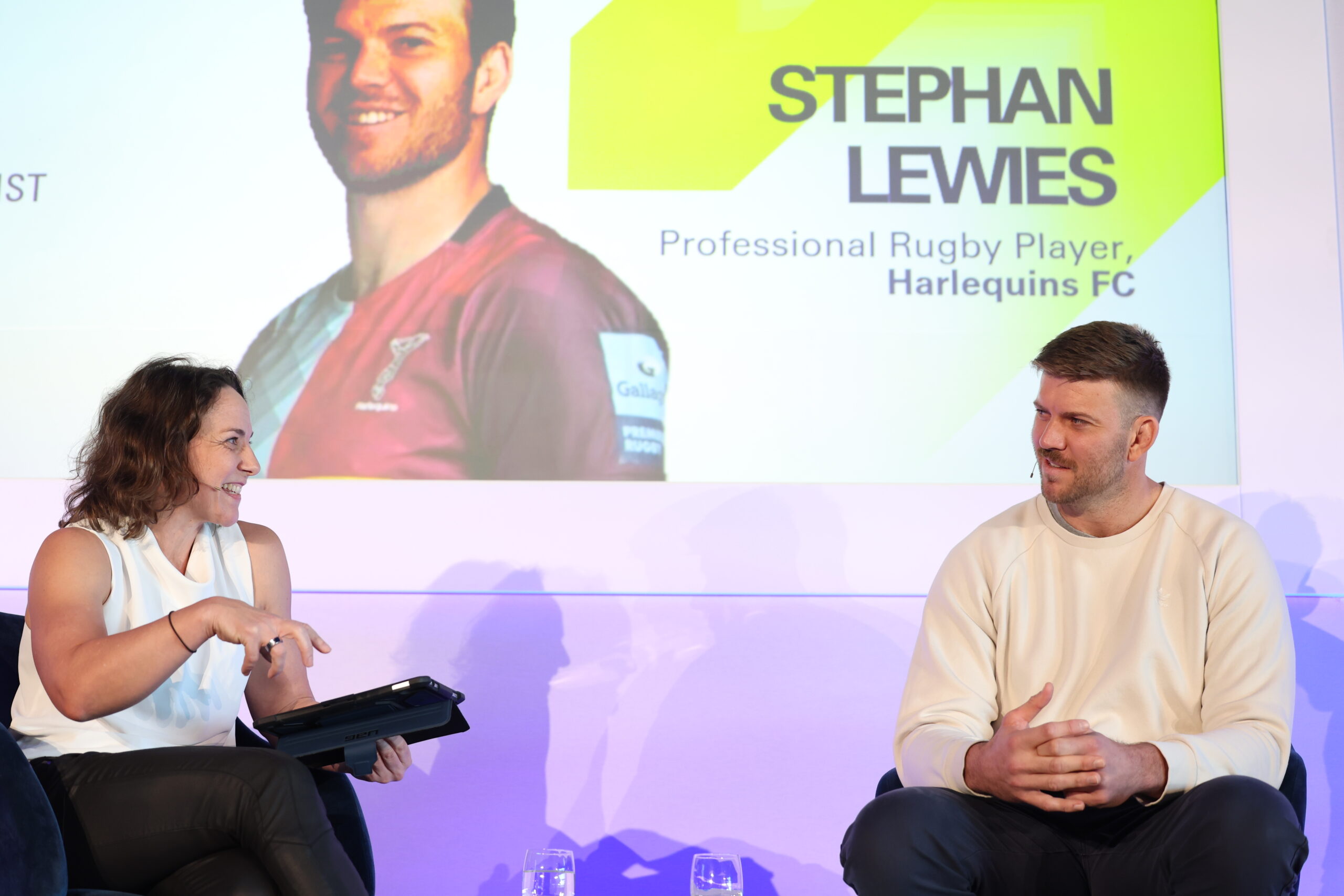
Stephan Lewies in conversation with Rachel Vickery onstage at the 2024 Leaders Sport Performance Summit at the Kia Oval.
Lewies’ reflections chimed with session moderator Rachel Vickery, a high-performance specialist helping teams in the worlds of sport, business and the military perform under pressure.
“So much of pressure is what happens off the pitch. When you’re on the pitch that’s actually your comfort zone in many ways and so you’re more prepared for that,” she said.
“Many teams have a monkey on their back around a particular opponent and that can change how the game is approached, which adds a lot of pressure.”
Lewies agreed and felt that being process rather than results-driven was ultimately what led to the result that day.
“It gives you freedom on the pitch to just go out and play,” he said. “You know your prep is done. Go out and express yourself. When you have clarity and alignment with the coaches you’re not asking yourself on the pitch ‘what’s the coach thinking?’ whenever there’s a tough decision. You almost know the answer to the question before it happens because you’re totally aligned in what you want to achieve in the game and at different stages of the game.”
It is an attitude Lewies takes into difficult conversations, which he faced often during his four years as Quins captain. The key was to be well prepared and, more often than not, those conversations would not be as tough as anticipated.
“If you kick the can down the road it can become a bigger problem. It can be scary to have that tough conversation in the moment, but that’s where growth happens, in that adversity. You grow closer as people and as teams.”
He recounted the story of a teammate who once skipped training and was suspended. Lewies endorsed the punishment but was labelled a ‘Judas’ by the player in question. The pair eventually made up after a frank exchange of views when it was clear that Lewies would listen to what his teammate had to say. It stopped matters escalating further and, as Lewies happily explained, made their relationship stronger.
“Getting him back on board and understanding him was critical for us.”
It was in such moments that the bonds, self-belief and confidence were forged that would eventually see off Saracens.
“There is so much value in creating opportunities to collaborate.”
What to read next
How Do you Develop the Most Expert Coaching Workforce in World Football?
In June, performance under pressure, empowered leadership and female athlete health were some of the topics discussed by members of the institute.
“I think the real champions are made in situations when you deal with that pressure,” said Alcaraz at Rolland-Garros in Paris last month. “That’s why I saw my best tennis in crucial moments, and that’s why I saw my best tennis in those difficult situations.”
Performance under pressure was a theme that run through the month of June here at the Leaders Performance Institute, starting with the wise words of Red Bull’s big wave surfer Ian Walsh.
His approach is geared around managing his fear. “Those nerves and everything you fear are natural, and you can use that to elevate your performance,” he said in this article. “It commands every ounce of your being and your focus to deal with what’s coming at you and how you want to navigate it to try and finish on your feet.”
Elsewhere, we returned to the question of alignment, named the common causes of inadaptability, and asked the Brisbane Lions to talk about their approaches to female athlete health.
What if there’s clarity in your communication as a team, but still you suffer from misalignment?
Edd Vahid, the Premier League’s Head of Academy Football Operations, answered this in a recent interview with the Leaders Performance Institute.
He explained there could be a few factors at play, all of which point to the importance of feedback:
Staff development needs. If a staff member commits an error of execution, it is an opportunity to deliver developmental feedback. Vahid says: “Does everyone understand what we’re going after? If they do and they step outside of that, then feedback is warranted.”
Psychological safety. “It’s a buzz term,” says Vahid of the commonly used phrase, “but it’s crucial for people to feel they are in a feedback culture.” The leader must show that the intent of feedback is to help the individual to progress. “You’re taking time to give them feedback because you care,” he adds. “You’re then seeking to work with the individual to create that development.”
The leader’s behaviour. Leaders must also demonstrate their willingness to listen to feedback. “They need to provide ‘speak up’ signals,” says Vahid with reference to the work of psychologist Megan Reitz. “The leader needs the skill to understand the position they’re in and the power they carry in that dynamic.”
The four inhibitors that prevent adaptability in a complex world
Those four inhibitors are discussed in great detail here, but one that will discuss below is when leaders themselves become the bottleneck due to their authoritative approach.
“Authoritative leadership has been proven time and time again to be effective in very short bursts,” said Tim Cox of Management Futures at a recent Leaders Virtual Roundtable, “but it isn’t much good for adaptability.” The reasons are simple enough. “It’s really difficult for one person to be able to think through, be creative, respond to the environment around them when things are changing at a high pace.”
Leaders, Cox said, should:
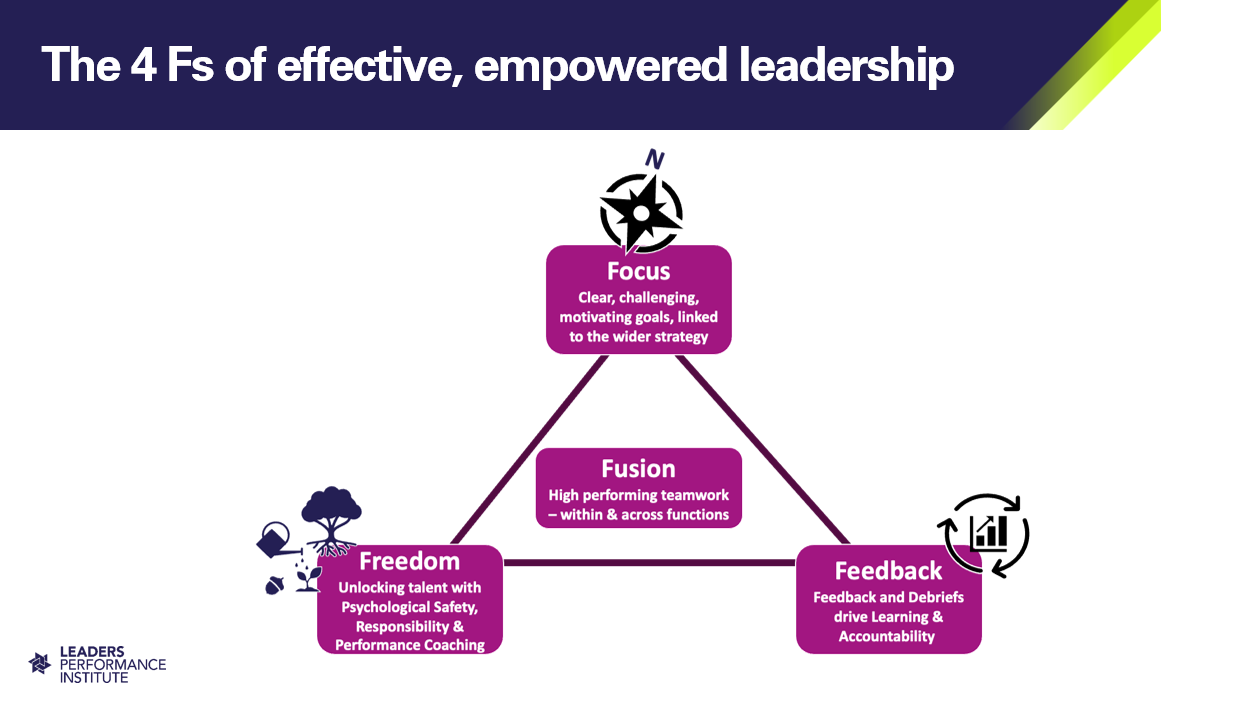 Focus: The leader must deliver clear, strategic alignment where everyone understands the direction and purpose of their work.
Feedback: Regular feedback and debriefing are essential for learning and continuous improvement, especially in dynamic settings.
Freedom: Give people autonomy and allow them to explore, innovate, and respond to change.
Fusion: This is about building strong relationships and collaboration, both within and beyond your organisation with a view to harnessing collective intelligence
Leadership is stagnating
This idea of leadership stagnating was revealed in stark terms in our Trend Report earlier this year.
The Trend Report revealed that 57 per cent of practitioners believe that leadership within their organisation has stayed the same or got worse in recent years.
The primary factors appear to be the shift towards task orientation and the pressure to ‘win now’, which can act to stifle innovation and long-term thinking. Leaders, as a selection of Leaders Performance Institute members agreed during a June roundtable, have less bandwidth, less time for staff development and even less time for staff onboarding.
Ben Baroody of Abilene Christian University, who co-led the session with Edd Vahid, observed that even at organisations that prioritise leadership development, stagnation is still reported. For Baroody, this is compounded by what he sees as the link between alignment and (high) quality leadership.
Vahid questioned whether leaders are giving themselves enough capacity to lead effectively and, as such, he is an advocate of distributed leadership models and leaders who invest in their own development as well as that of their people.
The virtual floor also highlighted the importance of skills including influencing, an ability to hold honest conversations, and active listening.
The Brisbane Lions have turned female athlete health into a performance question
The renewed focus on female athlete health is a direct result of the work of Matt Green, the Lions’ High Performance Manager for AFLW and his team.
As an organisation, the Lions focus on five key, interrelated areas:
In a recent Leaders Virtual Roundtable, Tim Cox of Management Futures presents a series of tools for navigating those obstacles.
Many of you will be familiar with VUCA (which stands for ‘volatility’, ‘uncertainty’, ‘complexity’ and ‘ambiguity’) and employed it in your day to day work.
It looks like this:
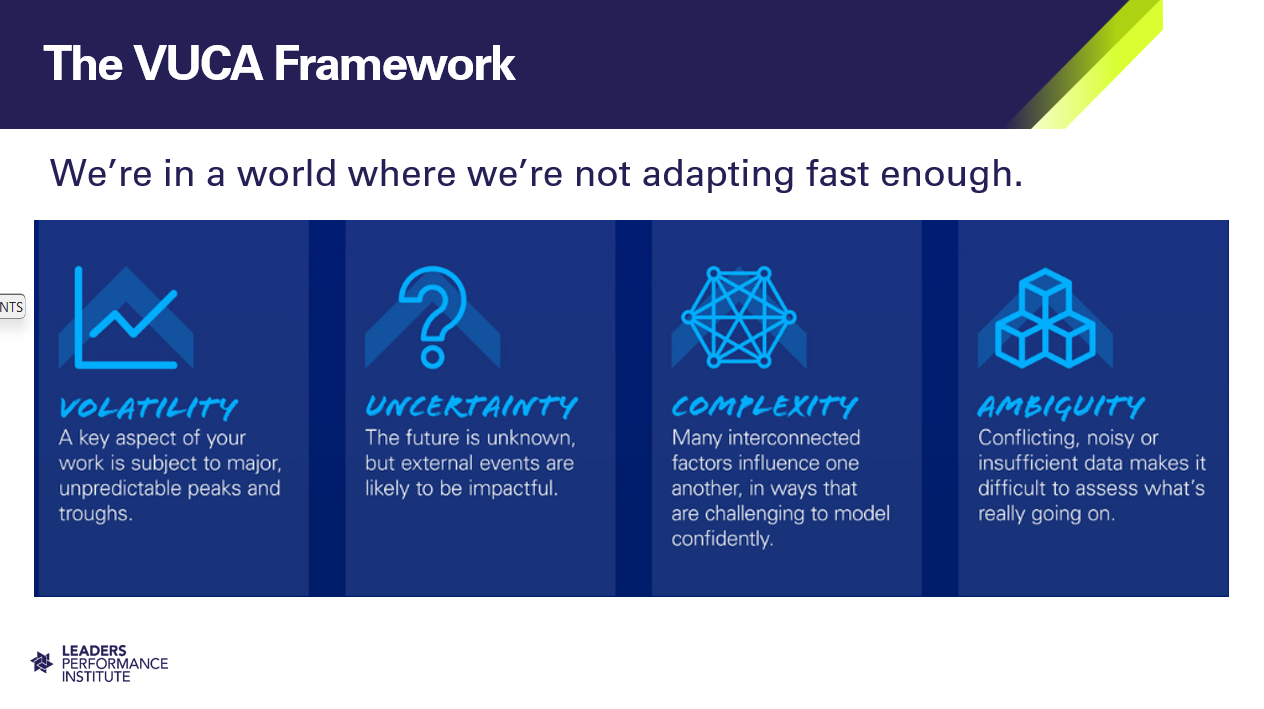
VUCA was devised in military circles in the 1980s as a strategic response to external forces and is both analytical and structural. It remains a useful tool for planning and building resilience.
However, there is a growing consensus that VUCA alone does not capture the emotional and psychological toll as environments become increasingly complex.
In 2018, the author Jamais Cascio, a self-styled ‘futurist’, published his BANI Framework, which is his effort to introduce a more human-centred lens, that emphasises fragility, emotional responses, and the breakdown of linear logic.
Here is an outline:
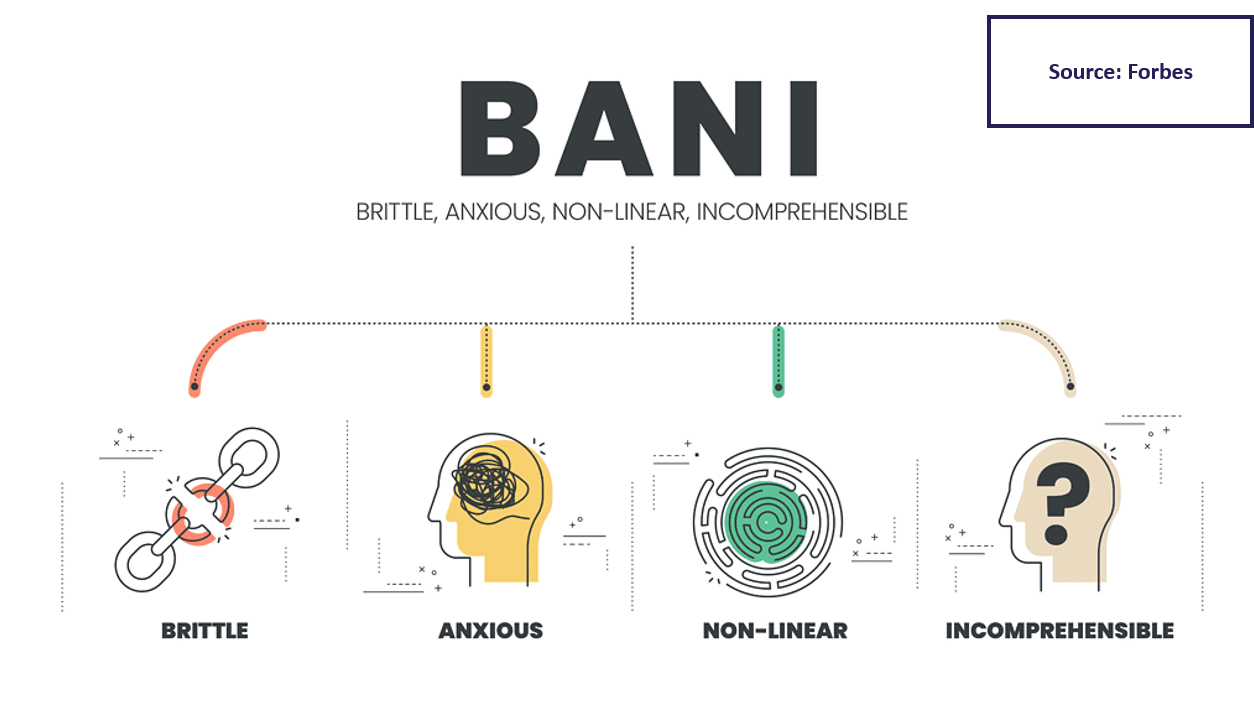
And here is how it may look in your environment:
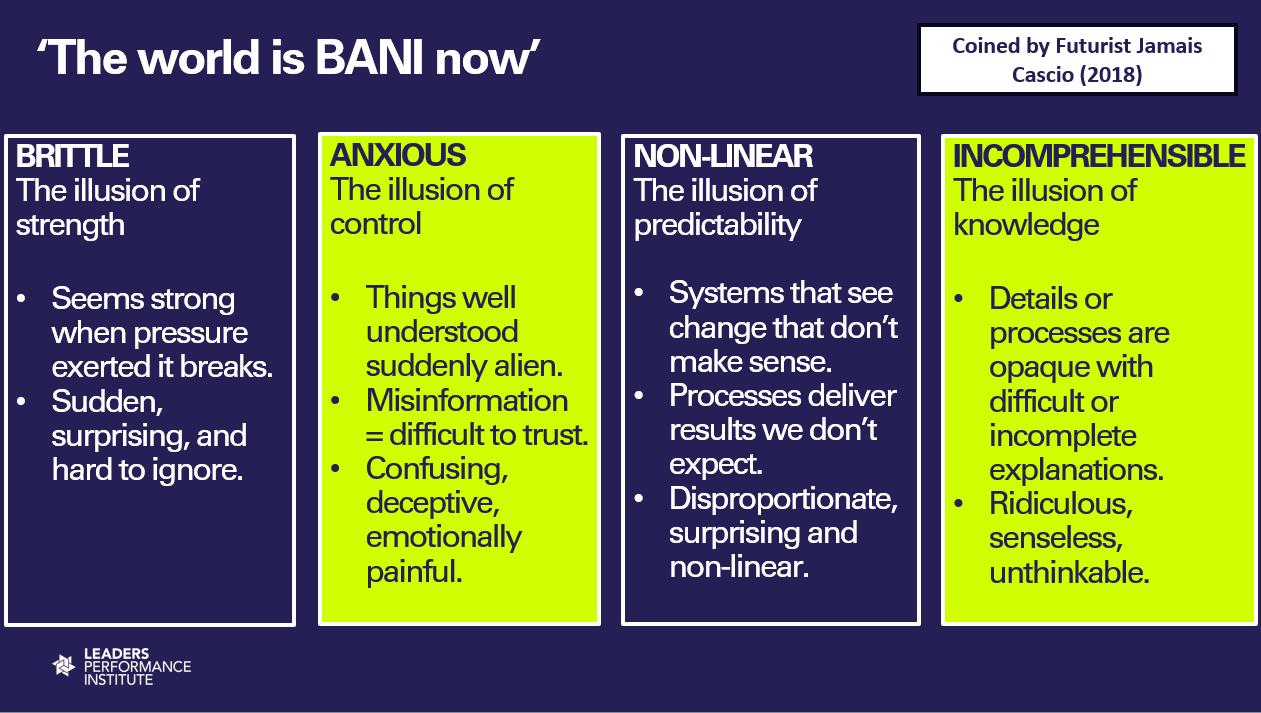
“Cascio sees BANI as parallelling VUCA, but he thinks VUCA is not real enough,” said Tim Cox of Management Futures, the host of a recent Leaders Virtual Roundtable. “He’s not saying BANI replaces VUCA, but he feels that it’s much more up to date with what’s going on at the moment.”
It helped to set the scene for the second session of our three-part Virtual Roundtable series entitled ‘Leading in Complexity’.
Which trap is most common in your organisation?
In part one, we explored how adaptability can increase the chances of an effective response to complexity.
In part two, we turned our attention to four common factors that can inhibit your ability to be adaptable and asked the table to select their most common ‘trap’.
Cox then spoke to each trap in turn.
This trap was cited by the fewest attendees but, as Cox explained, “even in sport we are often hijacked by emotions and we fail to adapt because they override our thinking.”
One must “relax, observe, and make a call”. Cox has some tips on that front:
Nearly half of attendees cited this as the most prominent trap.
It is an enacting metaphor too. “The classic operating from an out-of-date map was the belief that the world was flat,” said Cox. “It limited people and it spread fear in people not to go beyond certain points.”
Without active sense-making, he explained, leaders risk falling into mental ruts that limit adaptability.
Cox recommended the following:
It is a practical method for fostering adaptability and creative problem-solving in complex environments:
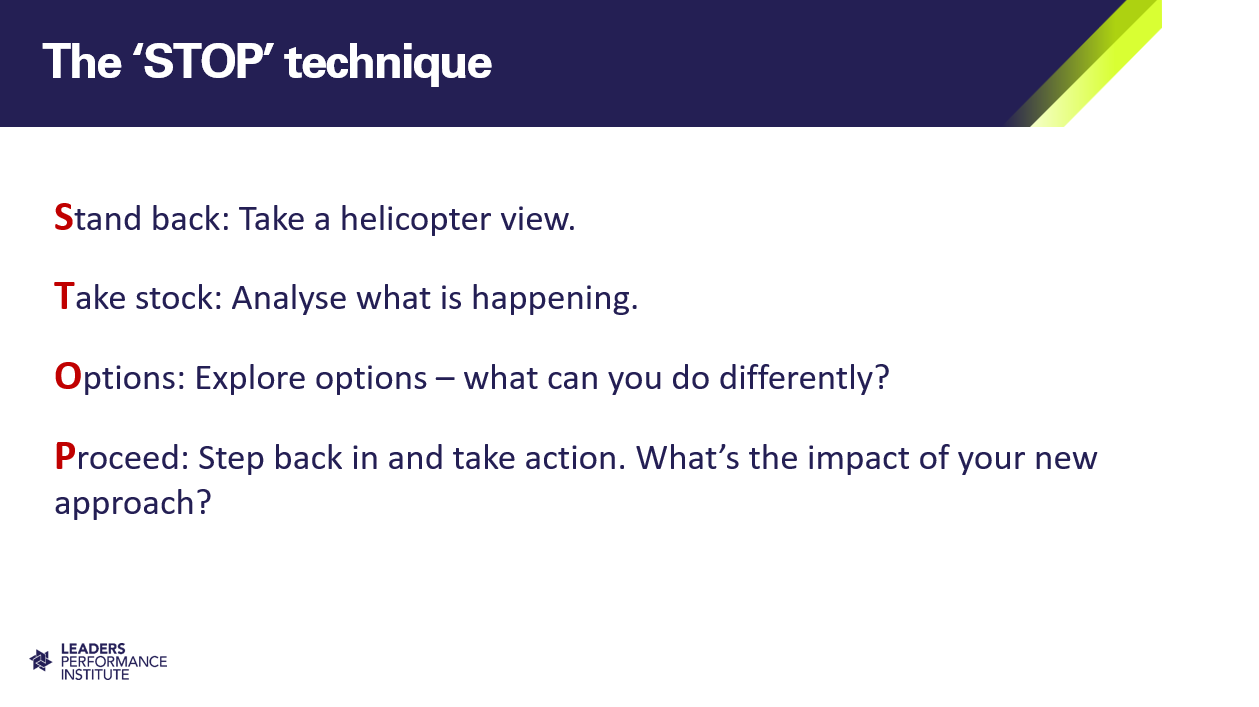
Our poll indicated that more than one in five attendees rank this as their team’s most prominent inhibitor.
“Authoritative leadership has been proven time and time again to be effective in very short bursts,” said Cox, “but it isn’t much good for adaptability.” The reasons are simple enough. “It’s really difficult for one person to be able to think through, be creative, respond to the environment around them when things are changing at a high pace.”
Leaders should:
Focus: The leader must deliver clear, strategic alignment where everyone understands the direction and purpose of their work.
Feedback: Regular feedback and debriefing are essential for learning and continuous improvement, especially in dynamic settings.
Freedom: Give people autonomy and allow them to explore, innovate, and respond to change.
Fusion: This is about building strong relationships and collaboration, both within and beyond your organisation with a view to harnessing collective intelligence
As with authoritative leadership, our poll indicated that more than one in five attendees rank this as their team’s most prominent inhibitor.
Cox had a selection of ideas that leaders might consider:
Other inhibitors cited by Leaders Performance Institute members:
Sign up for Part Three
In the third and final session on 3 July, we will explore building a collective playbook for leading in complexity:
In the first episode of our special three-part series, the Sixers’ VP of Athlete Care discusses the importance of the performance director’s role in establishing clear communication lines, engendering trust and shaping the team’s culture.
A podcast brought to you by our Main Partners

“The issues I’ve seen here, they’re very rarely – almost never – [a result of] things getting missed,” Simon Rice, the Vice President of Athlete Care at the Philadelphia 76ers, tells Teamworks’ Director of Athlete Performance Andrew Trimble and Leaders Performance Institute Editor John Portch.
“Where we run into slight problems is everyone trying to do the right thing with really good intentions,” he continues, citing the hypothetical example of three practitioners on the Sixers’ Health & Performance group prescribing the same loading plan to an athlete and inadvertently tripling their load.
“It often comes back to communication and it comes back to this idea of fitting the puzzle pieces to fully support that player.”
It takes mutual understanding and trust between athlete and coach, as Simon touched upon in the recent Teamworks and Leaders Special Report, entitled High Performance Unpacked: Interconnected Performance Teams, and it was a theme he expanded upon in the first episode of our new three-part series.
Elsewhere, Simon also talks about the role of the performance director as a cultural leader [4:00]; the importance of establishing what’s best for the athlete right now [15:30]; the work of the Health & Performance group with external clinicians [34:00]; and how his team can give athletes confidence in their bodies through its joint decision model [55:00].
Listen above and subscribe today on iTunes, Spotify, Stitcher and Overcast, or your chosen podcast platform.
Dr Edd Vahid of the Premier League outlines the importance of a unified purpose, regular feedback and carefully chosen words.
The US President asked him what he did for NASA. “I’m helping to put a man on the Moon,” the janitor replied.
The Leaders Performance Institute is reminded of the moment by Edd Vahid.
“The janitor did not talk about his day-to-day tasks,” says the Premier League’s Head of Academy Football Operations, “but his contribution to the overall mission”.
This famous line resonates with Vahid and, in Leaders’ recent Trend Report, clarity and alignment were both cited as major influences on the quality of leadership by coaches and practitioners across the globe.
“We know that alignment often comes down to the clarity of expectations and that comes from a strong, unified purpose,” said Vahid, who noted that even well-meaning individuals can be drawn into silos without a guiding hand.
The report also revealed that sport is obsessed with the topic and, in the grand scheme of things, does alignment quite well: almost 50 per cent of respondents saw their teams as ‘somewhat aligned’.
“It’s worth noting that the figure sits at about 20 per cent in other sectors,” said John Bull, the Director & Lead for High Performance Research at Management Futures, in the report.
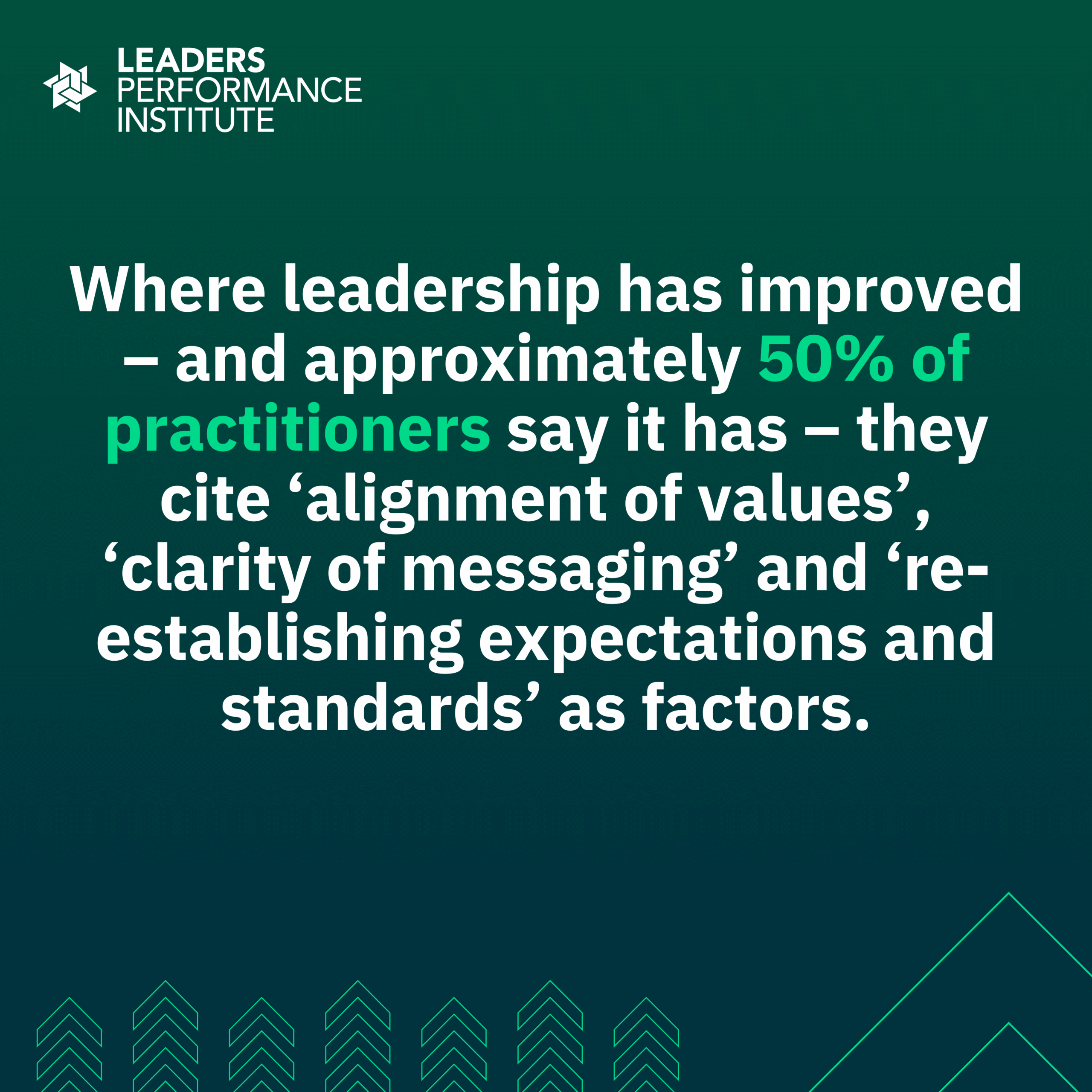
There is still room for improvement: only 12.6 per cent said their organisations are ‘well aligned’.
As Vahid explains, teams could start with the following.
Establish a regular and consistent theme
“Alignment is done best when it’s regular and not just your annual ‘here’s what we’re going after, see you again in 12 months’ time,” says Vahid. “It’s got to be constant. In every meeting there needs to be a regular and consistent theme that people are working towards and, importantly, they know their contribution.”
In 2024, Vahid published A Cultural Hypothesis, which explored the factors that enable a sustained culture of success. One element stood out as a ‘super enabler’ for Vahid: cultural leadership. The term acknowledges that leadership exists on three levels within an organisation:
The guardians, Vahid argues, are critical to alignment. “The reality is that if you’re a senior leader, you’re not going to be on the ground, you’re not going to be able to influence every different scenario – that’s where you need your guardians, your foot soldiers on the ground who are able to distil your message and ensure there is direct alignment to the organisation’s aims.”
NASA’s janitor was a cultural guardian in Vahid’s eyes.
Find the right repeatable words
“Language offers you the opportunity for shared understanding,” says Vahid, “and shared understanding is crucial in alignment, so people know what they’re going after. A leader might not necessarily use the word ‘alignment’, but they’ll be talking about their overall purpose.” NASA’s purpose was simple but powerful. “Your language must be repeatable and resonate with people.”
Vahid also says that high-performing organisations tend to have goals that transcend winning. “It’s important to get everyone behind it. Everyone must believe it is attainable, and it must drive them to want to get out of bed in the morning and come to work.”
What if there’s clarity, but still misalignment?
Vahid explains there could be a few factors at play, all of which point to the importance of feedback:
Staff development needs. If a staff member commits an error of execution, it is an opportunity to deliver developmental feedback. Vahid says: “Does everyone understand what we’re going after? If they do and they step outside of that, then feedback is warranted.”
Psychological safety. “It’s a buzz term,” says Vahid of the commonly used phrase, “but it’s crucial for people to feel they are in a feedback culture.” The leader must show that the intent of feedback is to help the individual to progress. “You’re taking time to give them feedback because you care,” he adds. “You’re then seeking to work with the individual to create that development.”
The leader’s behaviour. Leaders must also demonstrate their willingness to listen to feedback. “They need to provide ‘speak up’ signals,” says Vahid with reference to the work of psychologist Megan Reitz. “The leader needs the skill to understand the position they’re in and the power they carry in that dynamic.”
What to read next
The Brisbane Lions Have Turned Female Athlete Health into a Performance Question. Here’s How
In a recent Leadership Skills Series Session, Jeff Pagliano of Management Futures set out a series of tools, including the trust equation, active listening and ‘flows of knowledge’.
“Influencing is often strictly correlated with the level of knowledge or technical insight we can offer in any given situation and our ability to communicate that knowledge effectively,” said Jeff Pagliano, a consultant with leadership specialists Management Futures.
“However, influencing we believe is much broader than this.”
Pagliano was hosting an ‘influencing skills’ session for Leaders Performance Institute members as part of our Leadership Skills Series.
“A lot of you are employed to lead or influence outcomes, not for your technical knowledge but for your ability to build trust, grasp complex ideas, think rationally, and motivate,” he continued.
“The best influencers are often those who listen carefully to the needs of those around them, ask the right questions, and then communicate a compelling vision. And this has as much to do with credibility as knowledge does and, interestingly, the further you go up in an organisation, the less useful your IQ, your technical knowledge, is and the more useful your EQ, your emotional intelligence.”
Over the course of an hour, Pagliano explained why your ability to build trust, actively listen, and communicate compellingly – areas in which we can all improve – underpins your ability to influence.
‘The trust equation’
To start, Pagliano presented the trust equation to the group:
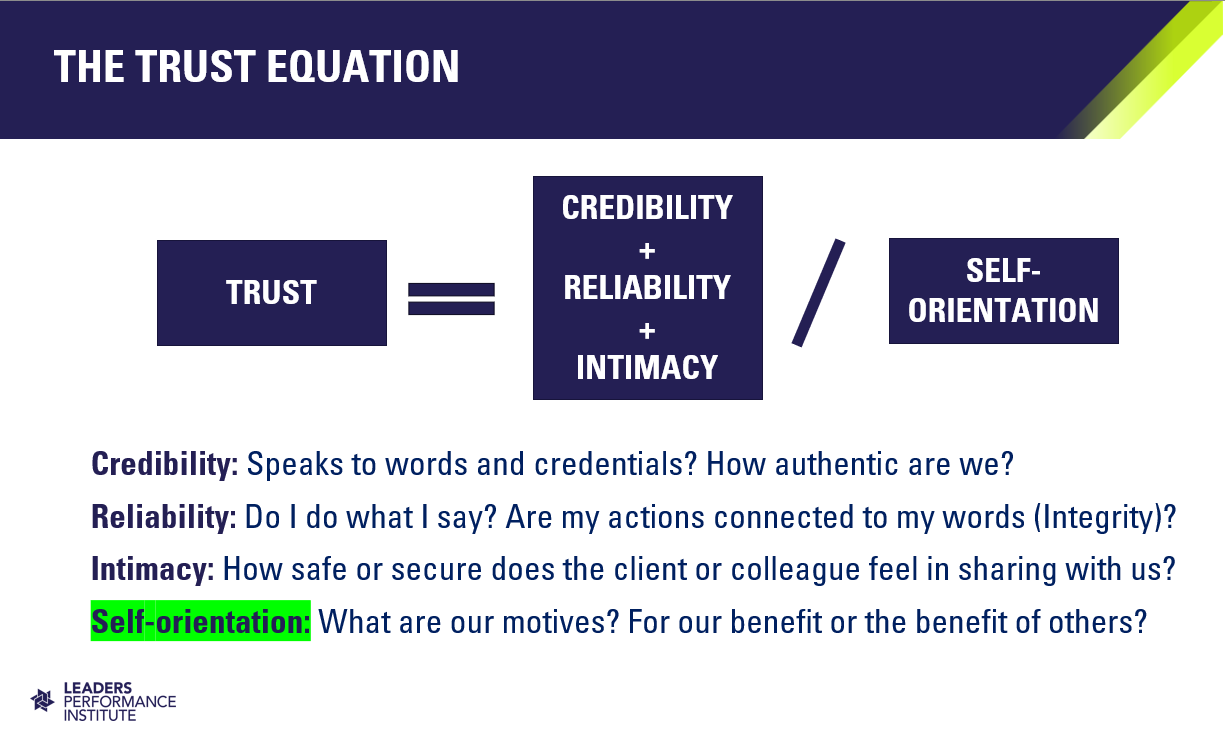
He then explained his thoughts on each:
Trust =
Credibility: “This speaks to both words and credentials. People should be confident that you know what you’re talking about, but it may not be just about the content, it could be how you show up as well. Credibility is a blend of what you know and how you present yourself.”
+
Reliability: “You do what you say you’re going to do. Your actions are connected to your words and your follow through. One thing that’s interesting to note is that people will sometimes over-promise and under-deliver; and it’s a very natural instinct to do that because we naturally want to please or we want to show the best of ourselves but, actually, over the long term, this can really work against you.”
+
Intimacy: “If credibility and reliability are the sort of things that are quite concrete, intimacy is a little more ambiguous. It’s more to do with the sense you have that someone will be there for you, and you try to gauge how emotionally intelligent they are. You’re noticing how well they listen, how much they connect, how much warmth they have, how much understanding. It’s less concrete, but equally important.”
/
Self-orientation: “Anytime you are building trust you do have to have some self-orientation because in any kind of negotiation or where you’re looking to influence, it would feel suspicious if someone thought you were entirely magnanimous about everything and you had no vested interest in anything. It’s about getting the right amount and not letting it overwhelm the other three. That’s why you have the first three divided by self-orientation.”
When you’re focused on being more genuine and interested in the other human being good things are going to flow for that, opportunities flow from that, but if the opportunity is so prevalent in the conversation that you’re trying to jump on it constantly, the other person’s going to feel it.
Active listening
Pagliano then introduced the topic of ‘listening well’, which supports influencing in two specific ways.
“It helps the intimacy part of the trust equation and it gives you the context for a person’s point of view,” he said. “You’re more prepared when the time comes for you to share your knowledge and suggest a course of action.
“Active listening is when you’re not only tuned into what someone says but also what they feel and believe picking up on both their verbal and non-verbal communication is the foundation of intimacy and the antithesis of self-interest.”
He shared the following image to illustrate his point:
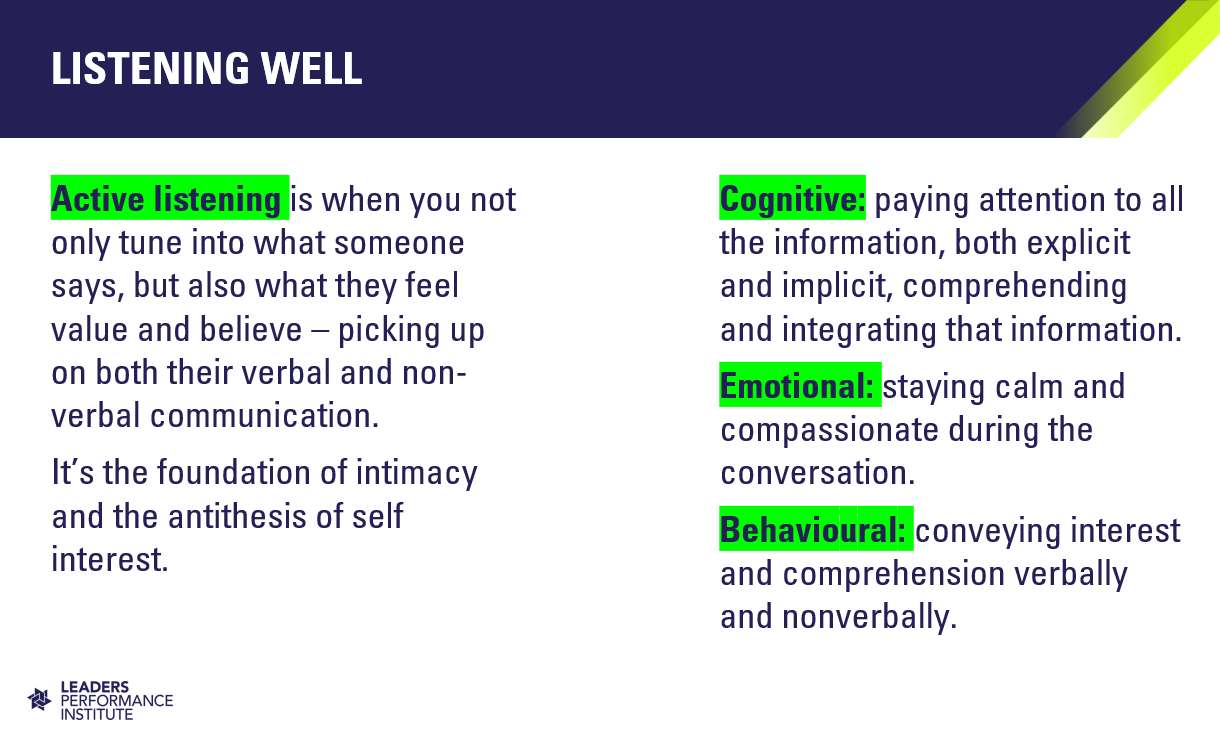
When you’re talking to someone you are hoping to influence it’s always useful to reflect on the goals of each conversation, both what you want and what the other person needs as a way to determine the best way to listen at the moment. And you may realise that a different mode or combinations of modes would be better.
Flows of knowledge
“If the trust equation is where it should be and you have been listening well, you have laid the groundwork to engage with the person you are trying to influence in conversation,” said Pagliano in taking the conversation further. “We have a great framework for you to use: it is called “flows of logic.” Pagliano cited former BBC presenter Stephanie Hughes in his explanation:
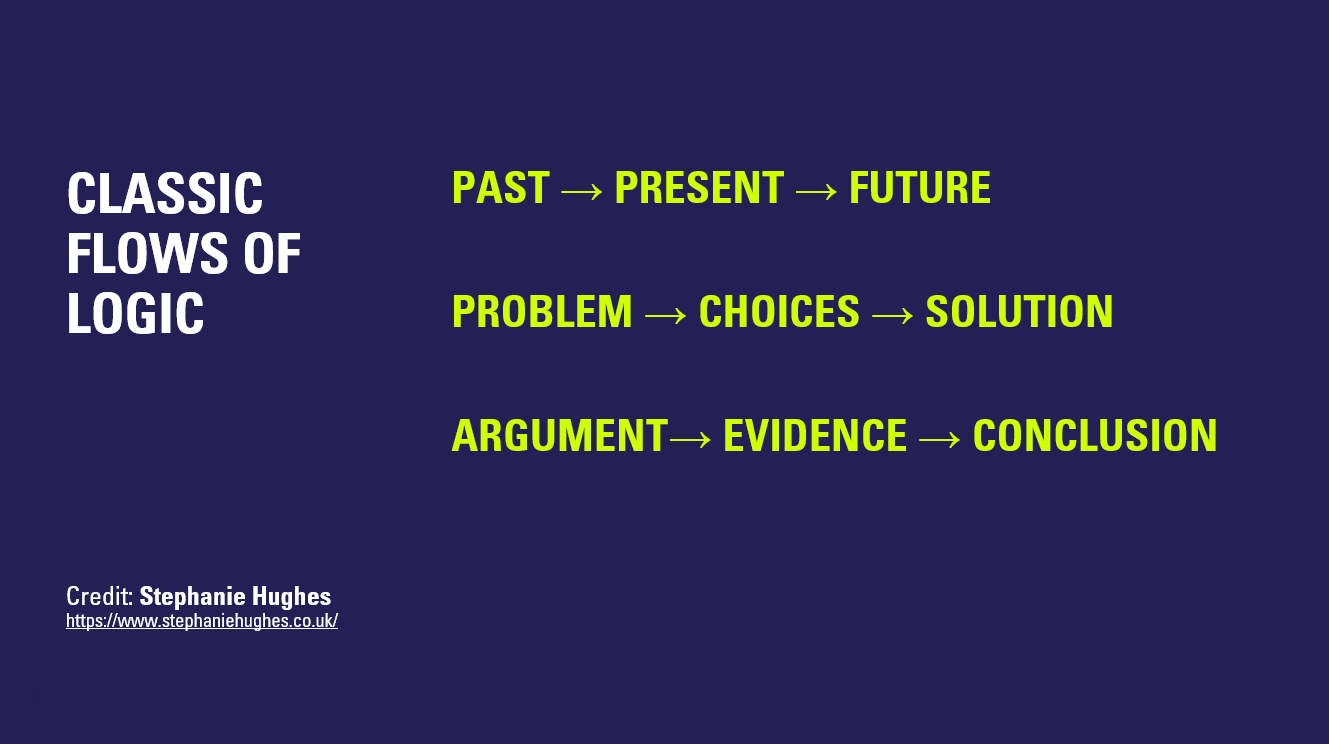
Pagliano explained their value, particularly in non-rehearsed, spontaneous conversations:
Past → Present → Future
“When you go through these phases of logic, it’s the middle word that is important. Like in the first one, if we just say, ‘in the past we did this’ and ‘then in the future, we’re going to do that’ and you don’t give any context for the present, it’s less powerful.”
Problem → Choices → Solution
“[To say] ‘here’s a problem or solution’ – that’s not an influencing tool – that’s just a command. To present choices shows your credibility.”
Argument → Evidence → Conclusion
“The third could happen when you’re pushing back at someone who’s come at you with a different opinion, and here this is where the middle word is important, because if you just say, ‘I believe this and here’s a conclusion’, it’s just an opinion. But if you add evidence, it becomes more than an opinion. It becomes a fact, and it becomes far more concrete. It’s much more objective because it’s based on evidence.”
You want to sound like you know what you’re talking about and you’re not floundering and, if there’s a logic to what you’re saying, the information is more easily understood and retained, so these serve a multitude of purposes.
The final factor: push and pull skills
Pagliano presented a final slide:
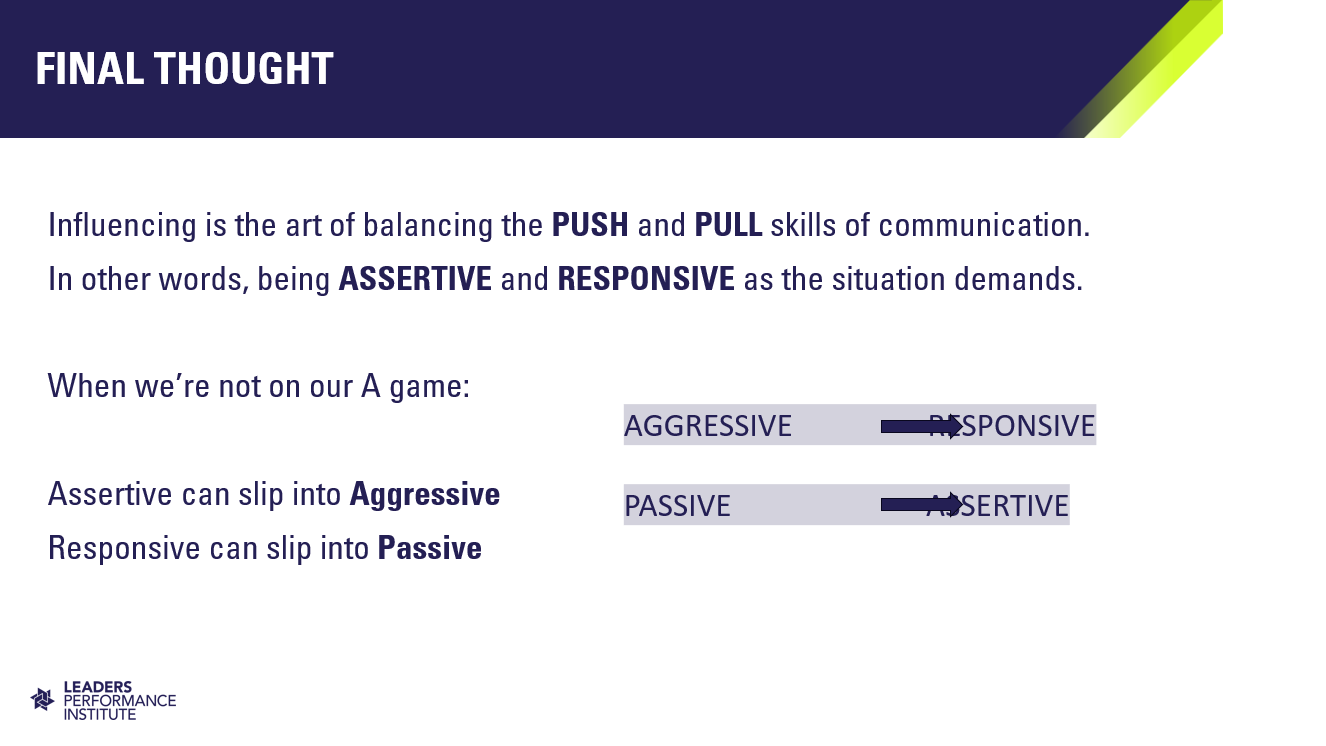
“Effective influencing is our ability to balance those push and pull skills,” he said.
“The ‘push’ would be that flow of logic. When you’re a subject matter expert and you’re trying to communicate your point of view in a way that moves the other to take a recommended course of action, those pull skills [build] that trust equation, the active listening, and it’s good to reflect where we need to focus more.
“Often, ‘push’ comes more naturally for people, and when we’re not on our A game, those of us who have a propensity to be more responsive can slip into passive; and those of us who are more assertive can slip into aggressive.”
Aggressive: go to responsive. Passive: go to assertive. And make sure you’re constantly aware of those push-pull dynamics.
What to read next
Performance Coach Ronan Conway believes that coaches can bring a fresh dimension to team gatherings and help teams tap into their inherent power by adding some facilitation principles and techniques to their skillset.
In recent years I worked with a coach of a football team. He’d regularly vent to me about players not speaking up in meetings, and how the group lacked leaders and energy. So I decided to sit at the back of some player meetings to observe the dynamic.
A clear pattern emerged. Standing at the top of the room, the coach would send waves of golden information and inspiration toward the players in the shape of tactics, opponent analysis, and game plans. His style was to direct, to instruct, and to hand players the answers – because that’s how he was coached, that’s what he excelled at; plus time was of the essence. The players’ role was simple: to listen and absorb.
My feedback was as follows:
“The coach needed to maintain his directive style as a solid foundation, and layer in skills to stimulate group discussion”
My suggestion was to maintain his directive style as a solid foundation, and layer in skills to stimulate group discussion – not to replace his approach, but to complement it.
In the following weeks after delivering his game plan, he practised popping the ball into the players’ court; inviting their thoughts and insight. Within weeks he facilitated a post-game review, opponent analysis, and culture session with the squad. To different degrees, the players played a key part in both sessions. These small shifts had profound results:
To get to this point, it required a big shift in attitude towards his group and his role. It called for him to swap his teacher cap for his facilitator cap.
“The change called for the coach to swap his teacher cap for his facilitator cap.”
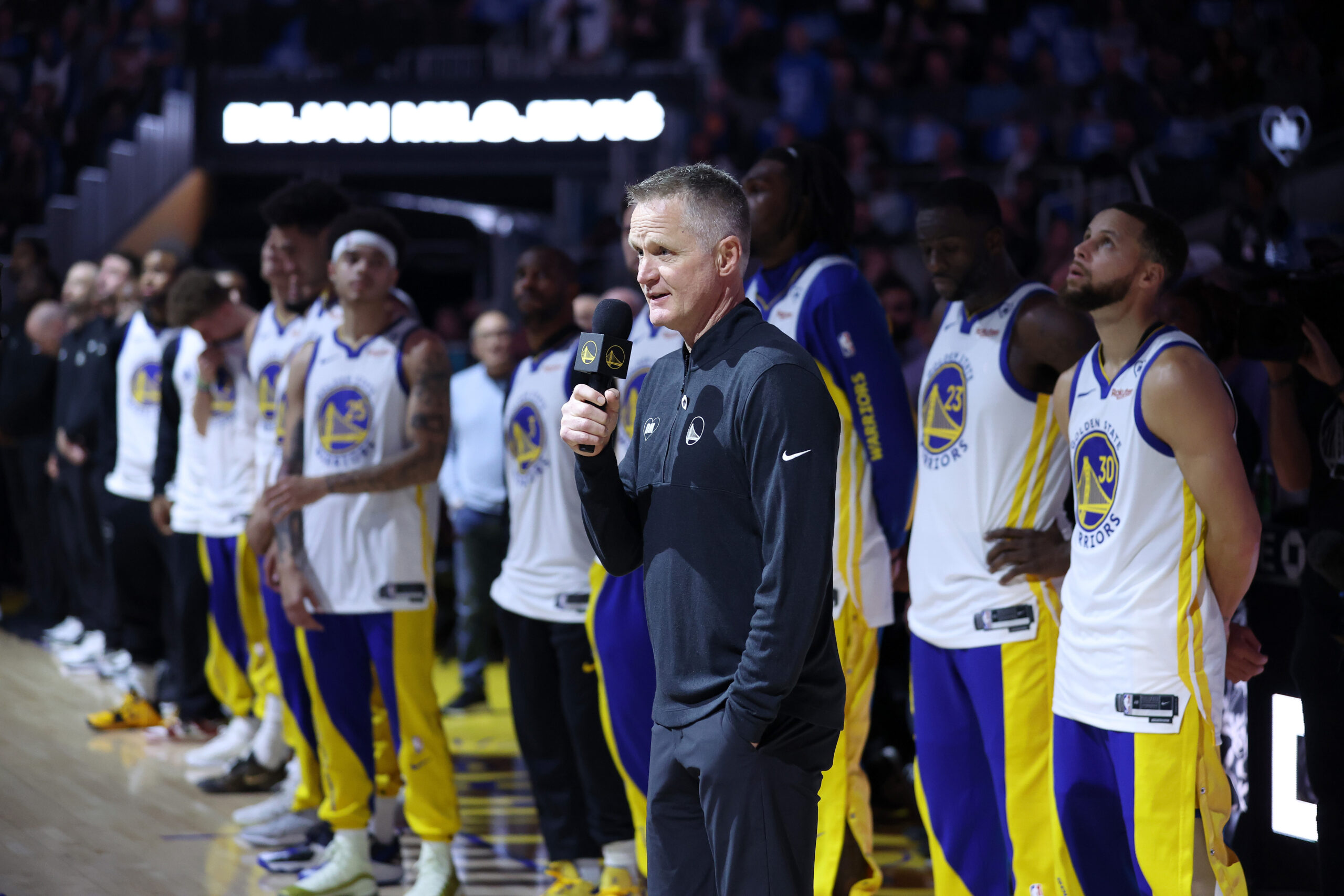
Photo: Ezra Shaw/Getty Images
Before facilitating any meeting, it helps to adopt a group-centred lens. To have a strong belief in the group’s inherent wisdom. When you look at your squad in front of you, you see an ocean of insight, inspiration and breakthroughs. You see teachers rather than students. You see answers in the room.
The transition from a teacher to a facilitator mindset can be tricky. Most coaches are experts in their field, and at times it can suit to simply tell players what they need to know. But as a facilitator it’s not about telling, rather it’s about being curious. It’s about fostering the right conditions for the group to unearth their own answers.
“The transition from teaching to facilitating is about fostering the right conditions for the group to unearth their own answers.”
For some this may require a loosening of the reins, but it doesn’t mean letting go of them. Your direction and leadership is still central, but you’re inviting your squad to step up with you from time to time. It’s important to say that certain players and squads certainly won’t have all the answers. In this case, at least they get to practise critical thinking and to put their own fingerprints on a discussion.
Steve Kerr, the Head Coach of the Golden State Warriors NBA-winning team, is a proponent of player-driven meetings. For Kerr, it’s not about “control”, rather “guiding” or “nudging players in the right direction”. That ‘nudging and guiding’ is the essence of facilitation.

Stimulating any form of response from a group is about moving energy. Moving energy can look like a smile, a nod, a raised hand. Maybe a word. Or a sentence. In time perhaps a rich, flowing discussion. We call this process, ‘getting the water flowing’.
Here are some facilitation tips to get your meetings flowing:
Show of hands: When faced with 30 blank faces, and the energy feels stuck, you can get the water trickling with a show of hands. ‘Hands up if you know’; ‘if you agree’; ‘who relates’; ‘if you’ve experienced this’. Each hand raised or not is a micro-investment in the meeting.
Open-ended questions: Clear open-ended questions are the keys for unlocking the treasure. They typically begin with ‘how’, ‘why’, or ‘what’, and generally elicit deeper insights than closed questions which give yes/no answers. The quality of the question will determine the quality of the response.
Intentional language: ‘The answers are in the room’: use language that reflects this mindset. You are not wondering if they have an answer, you know they do. Instead of ‘does anyone have an answer?’, try ‘who wants to go first/next?’.
Non-verbal communication: Facilitation isn’t just verbal. A nod or some steady eye contact can subtlety signal, ‘I want to hear from you’. You can lightly scan the room, naturally clocking different individuals throughout the meeting. At the very least, these ‘I see you’ moments will keep people checked-in and engaged.
Pair up: Speaking in front of an entire group is a big interpersonal risk to take. Pairing up to speak is a more manageable one. It gets all voices flowing; it builds safety; it serves as a stepping stone to a wider group conversation.
If your questions are met with silence, don’t sweat.
That liminal space between question and answer can be an intense time. When I started out facilitating in schools, most of my questions would hang in the air for what felt like minutes. Time sped up, as did my heart rate. I’d hold my breath. My brow got sweaty. ‘Someone. Please. Say. Something,’ my inner world yelled. The group shuffled awkwardly longing for the same. Until, finally, I’d move things along with a joke, or by answering my own question. Phew.
After enough moments like this, my relationship with silence changed. I found these moments to be a necessary and natural punctuation point; a chance for the room to slow down and to breathe. In the moments when I filled the silence, I wasn’t saving the group from the discomfort, I was in fact saving myself from my own discomfort. Rather than seeing silence as a void to be filled or feared, I started seeing it as a space for gold to be found. Granted not all silences lead to answers, but at least give the group time to gather their thoughts and muster up some courage.
‘Sitting in the silence’ is a useful practice in these moments. Meaning, allowing silence space – trusting it – and remaining as relaxed as possible.

“The more I trust myself to sit in the silence, the more the group trusts themselves to speak up.”
Here are two nuggets which help the process of sitting in the silence:
1. Trust the silence
When a group isn’t responding, a myriad of things can be happening for them. Quite often, they’re just not used to being asked. The silence is almost like a test to gauge ‘is this a token question or a genuine ask?’ In filling the silence, a lack of belief in oneself and the group is communicated. Being willing to ‘sit in the silence’, we signal a strong confidence in the group. You’re saying, ‘I know you know and I’m willing to wait’. It amazes me: the more I trust myself to ‘sit in the silence’, the more the group trusts themselves to speak up.
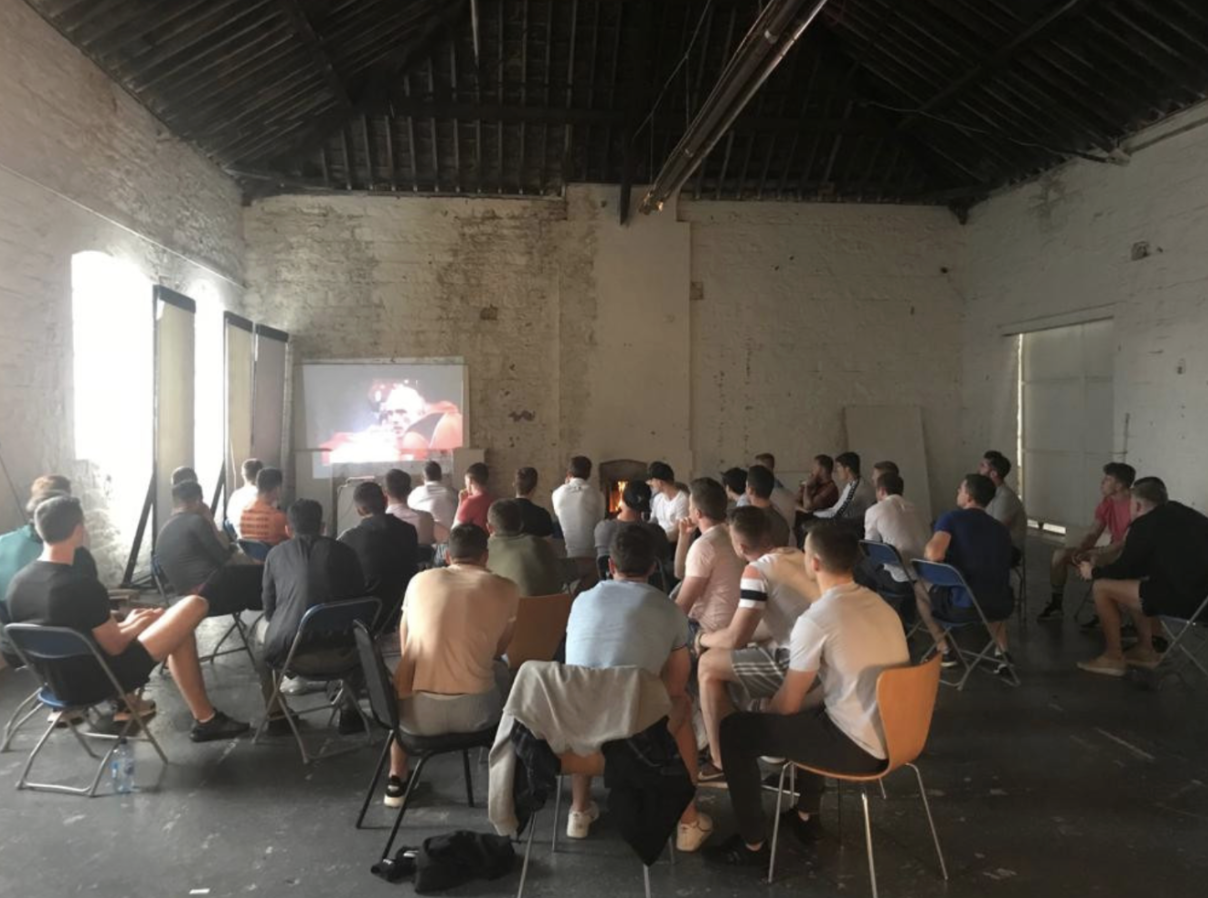
A connection-building workshop facilitated by Ronan Conway.
“The group needs to feel like you can hold yourself before they feel that you can hold them.”
2. Stay grounded
Sitting in the silence isn’t just about waiting it out, it’s about being as relaxed as you can. When we are on edge, stressed, or overly desperate for answers, groups are less willing to engage. The group needs to feel like you can hold yourself (stay calm, regulated, at ease) before they feel that you can hold them.
So before team meetings, or indeed when a wall of silence rises up, I’ll do the following to stay rooted and grounded:
Like a skill, facilitation takes time and deliberate practice. It may take time for everyone to adjust to the new rules of engagement, but once it starts flowing, the impacts can be transformative.
If you try this, I’d love to hear your experience of it.
Hopefully this article serves you and your team’s journey ⛰️
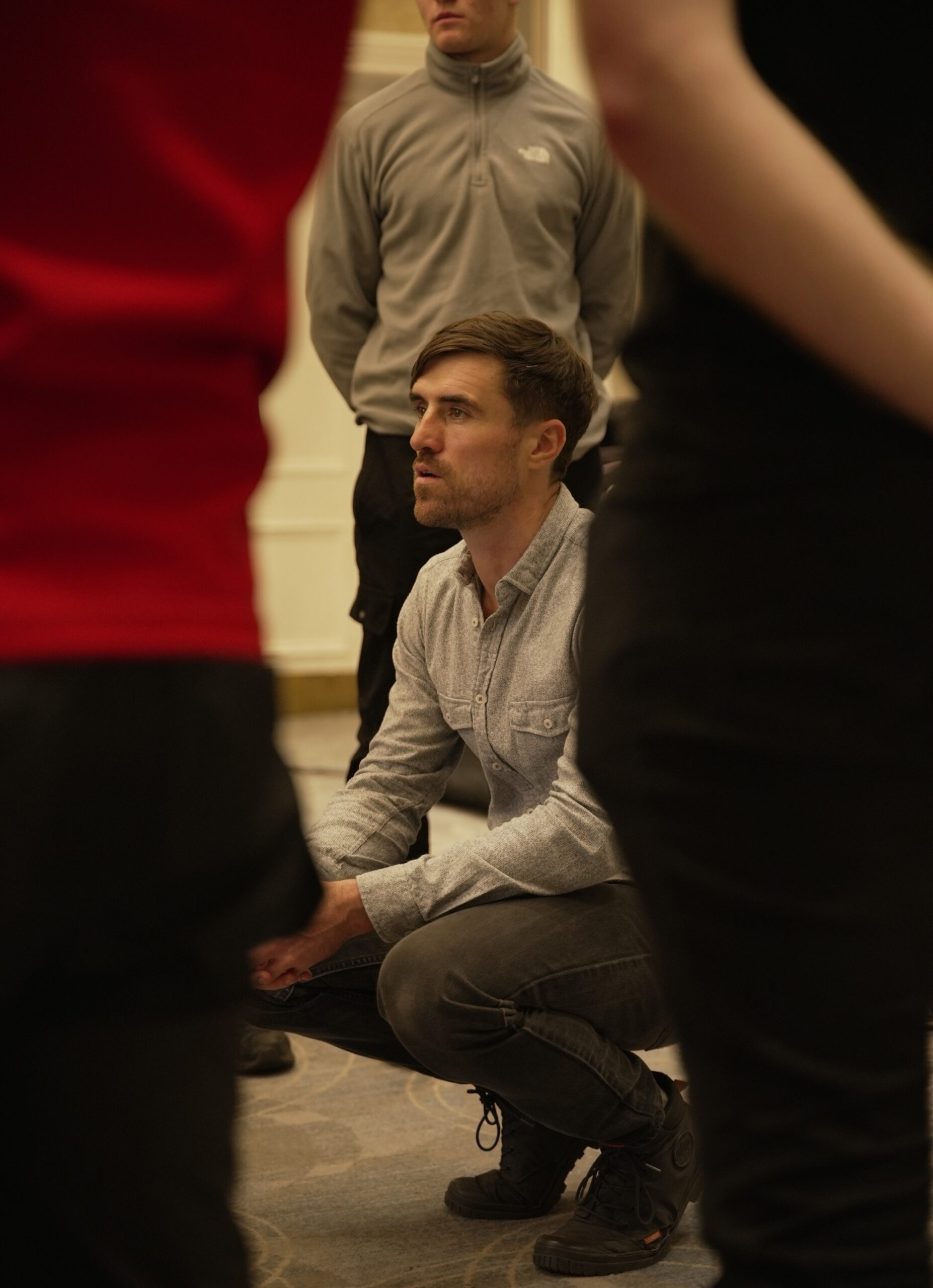
Ronan Conway is a performance coach who specialises in building cohesion and motivation in elite sports teams. He has worked with some of Ireland’s most successful teams, including the Ireland men’s rugby team, Dublin GAA’s five-in-a-row-winning men’s Gaelic football team and, currently, Leinster Rugby.
Ronan has honed his craft as a facilitator since 2012. He believes skilled facilitation can play a key role in empowering players and generating greater buy-in and belonging.
You can read more about Ronan’s work with elite teams here and here . Or you can visit his website at ronanconway.ie and find him on LinkedIn .