Leaders in Business
  • Membership
  • Events
  • Content
  • Virtual Learning
  • Connections
  • Partners
Login
  • Leaders Meet: Innovation
  • Events
    • Leaders Week London
    • Leaders Sports Awards
    • Leaders Club Events
    • Leaders Performance Institute Events
    • Leaders Meet: Innovation
  • Memberships
    • The Leaders Club
    • Leaders Performance Institute
  • About
    • Careers
    • Contact
I’m a sports leader:
  • Off The Field For those focused on the business of the sport View more
  • On The Field For those working with an athlete or elite team View more
  • Login
    • Leaders ClubThe membership for future sport business leaders
    • Leaders Performance InstituteThe membership for elite performance practitioners
  • Newsletters
Performance Institute Leaders Performance Institute Logo
  • Membership
  • Events
  • Content
  • Virtual Learning
  • Connections
  • Partners
Login

17 Jul 2025

Articles

Drama Lesson: How an Actor’s Creativity Flows when the Director Relinquishes Control

Category
Leadership & Culture
Share
Facebook Twitter Email Copy Link
https://leadersinsport.com/performance-institute/articles/drama-lesson-how-an-actors-creativity-flows-when-the-director-relinquishes-control/

British actor Michael Fox explains that the best directors know that the answer can come from anyone in the room.

By John Portch
It is common for athletes to spend much of their time trying to please the coach.

While not a bad thing per se, if the athlete is overly focused on doing what their coach may see as the ‘right’ thing, they’re not focused on performing to the best of their ability. Performance can be suboptimal if the coach imposes a creative straitjacket.

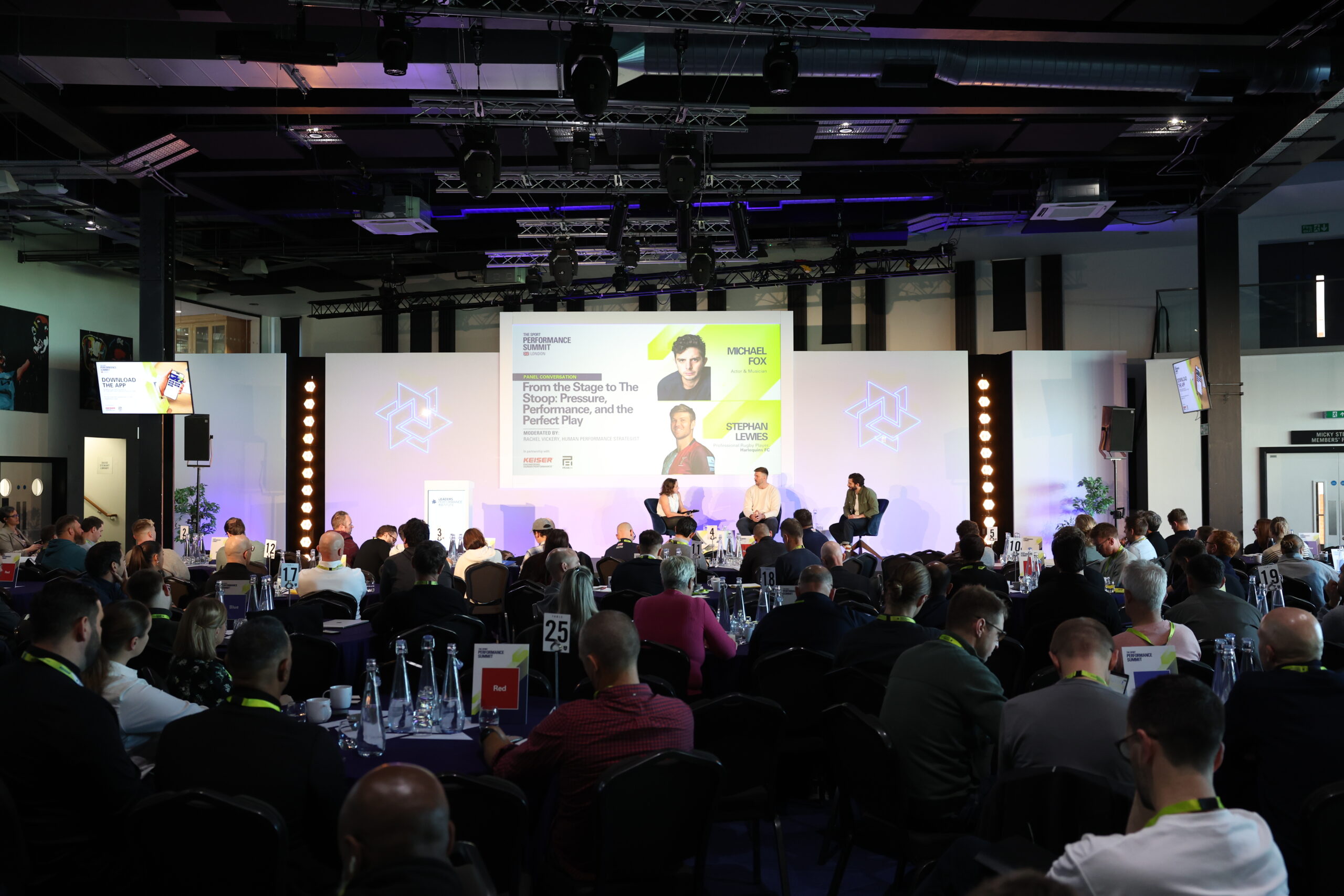
There are parallels between the athlete-coach relationship and the actor-director dynamic in the performing arts, as British actor Michael Fox explains onstage at the 2024 Leaders Sport Performance Summit in London.

“It’s about quality listening,” he says. “The director’s role is to lead, to steer the ship, but the frustrating thing is that you can lose answers if the actors are not able to voice their opinion and put it out into the room.

“It’s good to be heard, and the director can do what they want with it, but if you’re allowed to voice it then you can let it go. You can lose people’s creative instincts if they’re not able to voice their opinion.”

Fox, who is best known for his work on Downton Abbey and Dunkirk, has also appeared in numerous theatre productions and voiced characters in several video games since graduating from the Royal Central School of Speech and Drama.

On occasion in his subsequent career, he has encountered directors who see themselves as “gurus”. “You can make people really shrink around you,” he says of such characters. “Am I just an instrument for you to share with the world how amazing you are?”

Fox’s observations struck a chord with the coaches in the room at the Kia Oval and raised several questions:

Does the responsibility sit solely with the director?

No. In fact, as Fox says, “you have to still value the things that you need to do to make sure that you’re at the top of your game.” His routine includes yoga and meditation and, since he “spends a lot of time unemployed” he must do whatever it takes to ensure he is ready to go following a successful audition.

It sounds quite insular. How does that translate to a company setting?

“You do the work separately and then come and be crafted,” says Fox. “You’re taking the edges off to push in the right direction. You don’t want the director to do all the work.”

Speaking of directors, surely no two are alike?

Not at all. “That first week we just don’t know what we’re expecting,” says Fox. “You have to adapt to their way of working.” He appeared at the summit during the London production of The Fear of 13, which was unique in its genesis. “We were up on the first day and we nearly staged the front half of the play, which is madness, but it was amazing. But most directors talk over a coffee for the first few days.”

What qualities define the best directors, in Fox’s opinion?

“The directors I like working with are the ones that come into the first day of rehearsals and say ‘I don’t have all the answers – we’ll find them together’,” says Fox. “I respond better to that sort of mentality because I think it’s more honest. We don’t have all the answers. The best idea can come from anywhere in the room.”

However, it is still common practice, as he explains, for film call sheets to rank actors by importance on any given day. “That kills creativity, personal agency and instinct,” adds Fox. “They feel like their voice is less important.”

Therefore, “the best directors can give trust and individual agency to the actor over what they’re doing, their artistry, then you feel like you’re growing as an individual.” Critically, “in the moments where you need to be instinctive onstage you’re not thinking about getting it right for them or making a mistake.”
How might this look in practice?

A good example is Sinéad Rushe’s 2023 production of Shakespeare’s Othello in which Fox played the character of Iago.

It was notable for the fact that three actors played Iago onstage at the same time and Othello was given a more prominent role than in traditional stagings.

“We wanted to take Iago’s complicity with the audience away and put Othello much more at the centre of that play,” Fox told The Uncensored Critic Podcast earlier this year. Iago’s famous soliloquys became dialogues between the three aspects of his character rather than the usual series of knowing asides to the audience.

Rushe, who also taught Fox at Central, facilitated creative discussions from the off. “We’ve had two periods of development just of ten days each just to begin to workshop this idea of three actors playing Iago,” Rushe told The Theatre Audience Podcast on the eve of the second preview.

She also wanted to protect actor Martins Imhangbe in the titular role. “There’s a racial dynamic there that’s very problematic and there are these very interesting histories of actors who’ve played Othello over the years of finding it actually quite a distressing experience of feeling like the entire audience is laughing at them through the vehicle of Iago.”

Imhangbe himself also spoke at the time of the company’s work “dismantling” and “reconstructing” the play. “We’re trying to do something different with it, so it means we have to see it with fresh eyes,” he told The Rendition. “We’re trying to bridge the gap between what was written and how it’s relevant today.”

Rushe added that the production provided “a feeling of kindred spirits and people up for working in a collaborative and ensemble way.”

Fox agrees. “It was an unusual take but actually it meant that people could hear the play anew. And I loved it.”

What to read next

How to Transform an Underperforming Environment into a Thriving Hub

Members Only

13 Feb 2025

Articles

The Ability to Perform Under Pressure Is a Skill that Can Be Developed – Here’s Seven Factors to Consider

Category
Human Performance, Leadership & Culture, Premium
Share
Facebook Twitter Email Copy Link
https://leadersinsport.com/performance-institute/articles/the-ability-to-perform-under-pressure-is-a-skill-that-can-be-developed/

We recently hosted a virtual roundtable on the topic with practitioners from across elite sport. Leading the conversation was Rachel Vickery, a renowned specialist in the field.

By John Portch
When it comes to performance under pressure, Rachel Vickery argues that too often teams fall back on what she terms the ‘technical, tactical, hope’ strategy.

“There is so much focus on the technical and tactical aspects of craft, and then people hope that it shows up under pressure,” said Vickery, a high-performance specialist who has worked with a range of elite operators in sports, business, medicine and the military to help them improve their performance under pressure. She was speaking as the host of a recent Leaders virtual roundtable on the topic.

Too often, Vickery added, teams fail to understand “what’s changing in the biomechanics of a person, their situational awareness, their ability to read and see the field; their communication style and strategy, and their decision making” when the pressure mounts.

The key is “being able to help people understand what happens to them in those environments and then being able to train for that” because, as Vickery said, performance under pressure is a skill that can be learned and the trick is “putting actions behind the words”.

Below are seven training and environment-based tips or factors, gleaned from the conversation, to digest and take back to your teams.

  1. Work out what each individual needs

Athletes and coaches want to be able to keep their ‘smart brain’ online in moments of pressure, but no two people are the same. Some are more proficient than others. However, as one participant put it, “all personalities are capable of performing at the highest level, it’s just that some have to be more intentional in their approach” to training. “Have you got enough buffer in the system to absorb that natural increase in arousal state peaking?” said Vickery, who explained that an individual can develop that ‘buffer’ through personalised support and training interventions.

  1. Make it a performance question

Performance under pressure is not some mystical ‘other’. People should be encouraged to work out what enables them to be their best and what detracts from their performance. Get to the bottom of that and you can understand your performance when under pressure. “If it’s something that impacts an athlete or coach’s performance, then it’s fair game for the performance conversation,” said one participant from Major League Baseball. It’s also important to consider the outside elements that contribute to someone’s stress levels. As Vickery said: “Very often it’s less to do with the performance arena than what’s going on outside”.

  1. Develop mental health first-aiders

Stress can lead to burnout and mental ill-health and so people at your team should look out for each other. A participant spoke of their general manager taking part in their team’s compulsory mental first aid programme and, in the act of doing so, helping to normalise the conversation. Another participant spoke of their team’s work to identify personal triggers and cues. Their key question was: ‘what will we see in you when you’re feeling pressure?’

  1. Remember: you’re not just fixing ‘broken’

Vickery issued a timely reminder that mental elements need to be fine-tuned just as much as the physical, technical or tactical. “It’s not just about fixing ‘broken’,” she said. “How do we go on taking things to a higher level?” Giving athletes and coaches a chance to assess their mistakes is critical.

  1. You can train for the feeling, if not the scenario

While you cannot truly replicate high-pressure moments in training, you may be able to replicate the feelings they elicit. One participant with experience of the British sports system spoke of a time his team tested their analysts. They sabotaged the analysts’ equipment 20 minutes before the start of a competition and asked them to identify and fix the problems they created. The key to such tactics is to “review it, learn from it, go again, get your reps.”

  1. A coach’s messages – spoken and unspoken – are critical

A coach’s words and actions are critical in high-pressure moments. “As soon as something is set up as a threat – ‘if we don’t win this we’re not making the playoffs’ – the stress response kicks off,” said Vickery. “If we can flip that to opportunity – and I’m not talking about rainbows, crystals and unicorns – I’m talking about intentional language; ‘how clean can we play this?’ The language is really important in those moments.” She also spoke of a Premier League coach who worked to de-escalate his own arousal state before giving half-time team talks. It is also important for coaches (and their teams) to not fall prey to the notion or narrative that an undemonstrative touch line figure is somehow disinterested.

  1. Bad egos need to be parked

There are various ways to follow that aforementioned Premier League coach’s lead, but it requires trust, humility and a healthy dose of perspective, particularly for coaches to be able to accept feedback from their athletes and to self-reflect. Several participants have set up their coaches with cameras and microphones during training and competition as a learning exercise. During the heat of the moment, Vickery encourages leaders to ask themselves: “The ways I interact with you, my language, instruction and delivery – are they going to set you up for performance or going to detract from performance?”

Members Only

6 Jan 2025

Articles

How Can you Encourage your Athletes to Think About their Strategy on the Fly?

Category
Coaching & Development, Leadership & Culture, Premium
Share
Facebook Twitter Email Copy Link
https://leadersinsport.com/performance-institute/articles/how-can-you-encourage-your-athletes-to-think-about-their-strategy-on-the-fly/

John Bull of Management Futures set out a series of easy-to-adopt measures that could make the difference between winning and losing.

By John Portch
Muhammad Ali famously rope-a-doped George Foreman during their ‘Rumble in the Jungle’ world heavyweight title fight in Zaïre in 1974.

It’s easy to say that, as a battle-weary 32-year-old facing a younger, stronger champion, Ali had little choice when selecting his approach.

Foreman had won 37 of his 40 fights by way of knockout and was confident of adding No 38 to his unbeaten record in the early hours of 30 October at Kinshasa’s packed Stade du Mai 20.

Yet Ali later said his decision to stay on the ropes and allow Foreman to tire, which set him up to secure an eighth-round knockout, was made on the fly. He backed himself to absorb Foreman’s punishing body blows and wait for his moment. Foreman had only been taken to eight rounds four times previously in his career, so there were question marks over his stamina. The longer Ali could last – easier said than done – the greater his chances.

“I didn’t really plan what happened that night,” said Ali in 1989. “But when a fighter gets in the ring, he has to adjust to the conditions he faces.”

That Foreman could be lured into rope-a-dope was at least deemed possible by Ali’s coach, Angelo Dundee, who was seen loosening the ropes (to make leaning back easier) prior to the fighters’ ring walks. But that’s another story.

Ali’s defensive tactics, particularly during the fight’s final rounds, chimed with John Bull, the Director & Lead for High Performance Research at Management Futures (and big Ali fan), as he told an audience at the 2023 Leaders Sport Performance Summit in London.

Of his hero, Bull explained that a wave of fear came over Ali “for the first time in his career” as he sat in his corner at the end of the first round.

“Ali was really scared; and then 20 seconds later said to himself ‘I’m going to need to outthink this guy’,” Bull said.

Outthink Foreman Ali did; and Bull argued that such adaptability could be commonplace in sport with the right approach.

“I do believe some people are more naturally creative, but there are ways and structures that help anyone become more creative,” he continued while likening the process to strengthening muscles.

“What I love about these techniques is you can learn them really quickly. Practise any of these techniques for more than 15 minutes and you will be better than most people.”

These are the techniques Bull shared with the audience.

The STOP process for creative problem-solving

“I love STOP,” said Bull. “It’s a really simple way to get people thinking about ‘how are we doing that?’ How often do we take the STOP moments during a game, during the season etc. It’s a quick, short use of time.”

Bull then presented five strategies for encouraging athletes to adapt to the challenges or opponents facing them.

  1. Redefine or reframe the problem with alternative goals

If you can find new ways to consider your problems, it can open up new ways of thinking.

Bull used the example of an elevator. Perhaps your goal is to make the elevator go faster, but what if your aim was to make the wait less annoying?

“Most hotels will put a mirror beside the elevator,” he said. “That seems to kill time when we’re looking at ourselves in a mirror.”

Bull suggested we “think of at least three different ways we could define our goal, to help open up new ways of thinking about the problem”.

  1. Mind mapping

If you can map the different categories of possible solutions it can prevent you narrowing in on just one type of solution.

Bull asked members of the audience to take a pen and piece of paper and write down as many sports as they could think of in one minute.

He then proposed a rerun of the exercise where the paper includes sub-categories such as ‘team’, ‘individual’ or ‘in or on water’. It might look like this:
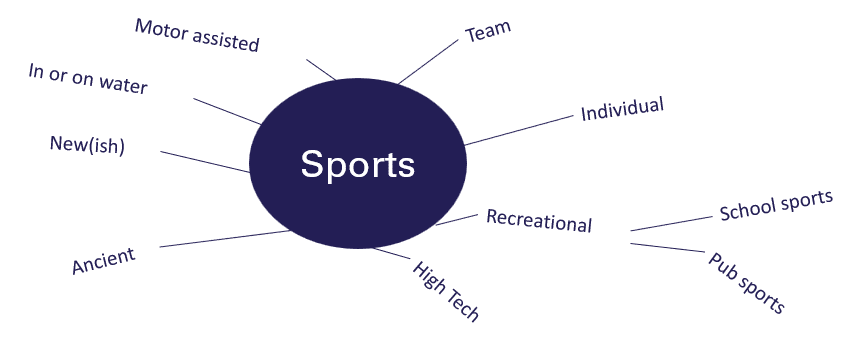
“What mind mapping is very good at doing is getting us to think more broadly,” said Bull. “What we tend to do when we’re being creative is we’ll come up with one or two ideas quickly as you would have been doing there, but then we tend to stay in that same vein of thought. So if I come at this using mind mapping, the first question you ask yourself mind mapping is not what sports can I think of, but what categories. Once you come up with a category, the brain very quickly accesses four to seven ideas.”

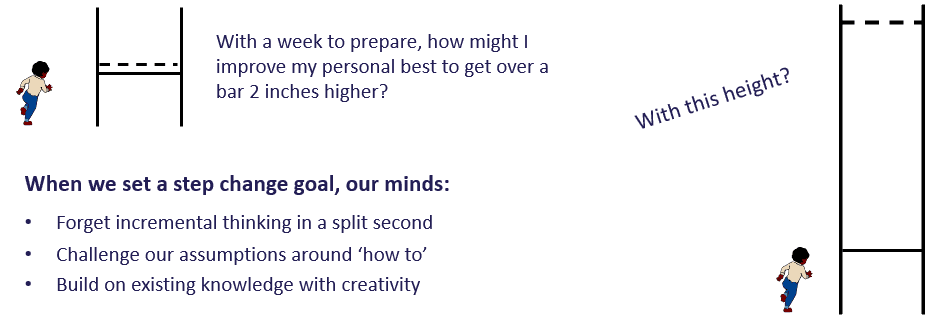
  1. Step change thinking

Step change thinking is the idea of setting a very stretching goal and then thinking how that could be possible.

Bull posed two questions:

  • What would be a ‘step change’ goal you could set yourself?
  • Assuming it is possible, ask yourself ‘what would we need to do to achieve this?’

He shared the following example:


To underline his point, Bull explained that step change goals are common at Google where employees often set – and meet – seemingly impossible goals. “They’ll take any performance measure they want to get creative with and they’ll say ‘times it by ten’ and ask ‘how would we do that at a ridiculous level?’ just to provoke creative approaches.”

  1. Ideal world

This notion is straightforward enough:

  • Describe your absolute ideal outcome
  • Then ask yourself under what circumstances you would get this?

Bull cited the real-world example of paramedics in England. Providers of ambulatory care would like to reach people who suffer heart attacks within eight minutes, which is impossible by road in areas such as rural Norfolk in East Anglia. “You ask ‘how could we make that happen?’ And the answer that came up was you could train someone in every community to be able to keep someone alive until the first-responders arrive.”

Sport is not life and death, but a similar thought process could prove useful.

  1. Related world

Who has already solved your problem and what can you learn from them?

In answering this question, New Zealand rugby, as Bull explained, turned to ballet for help with its lineout lifting.

“Rugby’s been doing this for 25 years in terms of assisted lineouts. Ballet’s been doing this for a few hundred years – they probably know a little bit more about it, so it’s that idea of going outside.”

Members Only

20 Aug 2024

Articles

‘One of our Philosophies Is to Be Less Dysfunctional Than our Opponents’

Category
Leadership & Culture, Premium
Share
Facebook Twitter Email Copy Link
https://leadersinsport.com/performance-institute/articles/one-of-our-philosophies-is-to-be-less-dysfunctional-than-our-opponents/

Australia ‘threw chaos’ at India in the World Cup final, but as Andrew McDonald explained, 18 months of meticulous planning went into their triumph.

By John Portch
Pat Cummins’ decision to put India in to bat first in the 2023 Cricket World Cup final divided opinion.

The Australia captain won the coin toss and defied conventional wisdom by electing to field during the first innings when most teams might have preferred to set their opponents a formidable target. On top of that, the dry conditions on that November afternoon at the Narendra Modi Stadium in Ahmedabad appeared to favour batting first.

“I’d have batted first,” said India captain Rohit Sharma. “It looks a good pitch, it’s a big game, let’s put runs on the board.”

Cummins obviously disagreed. “It looks a bit of a dry wicket; bowl on it during the day and back ourselves to chase whatever we need to,” he said before pointing to the weather. “Dew is one factor, it gets quite dewy here at night. It feels like this venue has got better and better to bat so hopefully the same today.”

Dew can make it easier to bat under the lights as the ball skids onto the bat, but some accused Australia of overthinking the conditions. It is easy to dismiss those criticisms in light of Australia’s subsequent six-wicket victory – and sixth men’s World Cup triumph – but they do point to the traditional thought processes that tend to govern cricket.

Andrew McDonald, Australia’s Head Coach, picked up on this two months later at February’s Leaders Sport Performance Summit in Melbourne. “An important piece is that this group is making decisions not on what’s happened in the past,” he said.

In cricket, the captain is tasked with most on-field team decisions during play and, the day before the final, McDonald and his coaches spent two hours weighing up the pros and cons of batting first and second; and yes, the dew was discussed. “We had great fun solving these problems and then said to Patty: ‘this is our recommendation. Over to you, mate, because ultimately you’re accountable at the toss’.”

There were several factors beyond the dew that supported their recommendation, but the underlying story is one of how McDonald, who was promoted to Head Coach in April 2022, has worked to engender trust between players and coaches while also streamlining the team’s high-performance systems.

“One of our philosophies in the Australia cricket team is on the day you have to be less dysfunctional than your opponent,” said McDonald with a combination of pragmatism and humility.

Here, we explore what that philosophy entails for Australia’s men.

‘Environment’, not ‘culture’

McDonald insists on referring to the team’s ‘environment’ rather than its ‘culture’, even as he admitted that it may just be words. However, given that he had served for three years as an assistant coach to his predecessor, Justin Langer, and could quickly take the pulse of the team upon taking the reins, one should give McDonald the benefit of the doubt.

“We felt as though ‘culture’ was quite rigid and it was almost the players coming in and needing to conform with what the team required,” he said, indicating that he had thought deeply about the idea. “We’ve shifted to ‘environment’ and made sure that people could commit to that.”

The Australia men’s team is on the road for more than 220 days per year and, if they are not competing at home, they are almost always touring in far flung foreign lands from the West Indies to the Asian sub-continent. It can be isolating, stressful and even boring. Therefore, it was a good idea, McDonald argued, to let his players shape their environment.

“We wanted to create some safe spaces for people to operate in and make sure that they could be themselves. Hopefully that shines through in the way our players represent the country,” he continued.

The players and coaches’ families are also free to join them on tour whenever possible; and it works both ways. McDonald encouraged all-rounder Mitchell Marsh to fly home mid-World Cup to visit his ailing grandfather, who passed away during the tournament. Anyone reading that line with reservations should note that Marsh, with the full support of his teammates, returned to hit an unbeaten 177 in his next match against Bangladesh.

Getting the creative juices to flow

Another key decision McDonald made was to complement structured training sessions (coach-driven with the coach at the heart of the work being done) with unstructured sessions where the players choose what they want to do within the wider strategy. His aim was clear: “when you’re trying to build a team to problem-solve under extreme pressure on their own, you’ve got to give them choice in the training activities they do” as this will get their “creative juices flowing”.

This is also dependent on the team having the right players at the outset across the three main formats in which Australia compete. McDonald joins Cricket Australia Chairman George Bailey and former Test all-rounder Tony Dodemaide on the three-person National Selection Panel.

McDonald, however, felt that too often the interested parties operated in silos and true collaboration would only come from sitting the key decision-makers down at the same table. There is now better dialogue between the coaches and the panel, with McDonald serving as the go-between.

He said: “Selectors ultimately have the final decision, but knowing what the coaches and players are trying to achieve, and the style we’re playing, I think it streamlined our decision making and we could move more quickly.”

‘We had to throw chaos at India’

Australia lost their opening two matches in the World Cup group phase. The first, a six-wicket loss to the hosts India in Chennai, offered some mitigation. Afterall, India were the favourites and would eventually reel off ten wins in a row on their way to the final.

The second, an ignominious 134-run defeat to South Africa, provoked greater introspection. Yet the team emerged from the post-match review committed to doubling down on the aggressive style they had adopted in the buildup to the tournament.

The Australians, as McDonald explained, were not going to throw 18 months of collaborative planning down the drain. “Every conversation with coaches was about where we thought games would be won and lost in India,” he said. These conversations were data-informed. “The eye test can lead you towards a certain bias,” he added. “We always have our checks and balances there with our data scientist to make sure that we’re on task.”

Their approach received its first memorable vindication when Australia claimed a 2-1 victory in a one-day international [ODI] series in India six months out from the World Cup. “That checkpoint was important in terms of belief for our playing group.”

It helped them at 0-2 in the group phase and in the World Cup buildup when they lost batter Travis Head to a fractured left hand. Head was given every chance to recover, which is just as well given his match-winning 137 runs off 120 balls in the final.

It did, however, prompt the team to amplify the aggression that led Australia to win their next nine matches, including avenging that opening defeat to India in the final itself.

“We knew that India were probably the better team on paper so we had to throw chaos at them,” said McDonald, explaining that the shift was to a style more akin to short-form T20 cricket. “A lot of things go into building that.”

The team had developed its capabilities in the harshest conditions, seen evidence that their style could win matches, and so they didn’t “throw the baby out with the bath water”.

That meant that come the final, when match referee Andy Pycroft tossed the coin and Cummins called correctly, the Australia captain had every confidence in his planning and preparation when electing to field.

“I think it was a great reflection of the work the data team put in with the coaches and the collaborative approach that Patty invites as a leader,” said McDonald.

“If we keep presenting decent options to him then he’ll keep listening to us. If we don’t, then he’ll probably shut us out. That’s our challenge.”

6 Aug 2024

Articles

The Debrief – a Snapshot of Powerful Discussions Happening Right Now Across the Leaders Performance Institute

Category
Coaching & Development, Leadership & Culture
Share
Facebook Twitter Email Copy Link
https://leadersinsport.com/performance-institute/articles/the-debrief-a-snapshot-of-powerful-discussions-happening-right-now-across-the-leaders-performance-institute-5/

Female athlete health, cultural leadership and improv – just some of the topics raised, debated and pondered in July.

By Luke Whitworth
The Paris Olympics have made history as the first Games where 50 per cent of the medals will go to women.

On top of that, 11-time Olympic medallist Allyson Felix led an initiative to introduce the first-ever nursery for competing mothers and their children at an Olympic village.

These are steps in the right direction at a time when the Games have shown us there is still much work to do to better support female athletes and their health.

One can look at the world records involving the United States’ women swimmers at La Defense Arena in Paris, to name an example close to Leaders Performance Institute hearts, and wonder what potential could be unleashed if the sporting world adopted more female-focused approaches to training, recovery and mental preparation.

On that front, there is some superb work being done by our friends at Sport Wales, who shared insights with Leaders Performance Institute members in early July, and that’s where we begin this edition of the Debrief.

How to increase education around female athlete health

Our Women’s High Performance Sport community group has proven to be a mainstay for the female members of the Leaders Performance Institute.

The community has made it clear that they believe there is a shortfall in education for staff around female athlete health.

With this in mind, we welcomed Dr Natalie Brown, a Research Fellow working as part of a collaboration between Sport Wales and Swansea University with the Welsh Institute of Performance Science [WIPS].

Brown led a rich conversation about her work and suggested some practical ways in which you can make positive inroads when it comes to female athlete health education:

  • Invite people external from your female health and the performance team to come in and join the conversations, raising different questions.
  • Balance individual needs versus sport specific challenges with whole system support.
  • Specialist areas need to consider the female specifics as ‘normal.
  • If you’re working as a lone ranger in this space, consider how things are being embedded, knowledge is being passed on, and progress to creating a team is happening.
  • Language is a really important area. Don’t exclude anyone, but also correct. Underpinning language with evidence has been effective. Language can also be the key to confidence to talk about the topics and roll it out with athletes.
  • Consider behaviour changes and the role of psychology in female health.
  • Always provide the evidence of why behind knowledge, advice, support. Especially considering the volume of information, including misinformation, being shared around these topics at the moment.

Additional reporting by Rachel Woodland, Lottie Wright and Sarah Evans.

A six-step approach to driving cultural change

Those of you who read last month’s Debrief will know we touched on the theme of cultural leadership courtesy of Dr Edd Vahid, who placed the topic at the heart of his three-part Performance Support Series for Leaders members.

In July, he followed sessions one and two with a specific focus on cultural change and the effective steps that can be taken to create and deliver a new culture. In session three, Vahid shared a six-step approach:

  1. Existing status – where are we? Honour the strengths of the existing culture; combine this with data, intelligence and insights, whether that be critical incident reviews, walking the floor, interviews or focus groups. Finally, check in on people’s experience of the four enablers.
  2. Move into the idea of vision and purpose and being able to inspire and aspire. This means giving a clear articulation of where you’re going; matching this with the culture and the strategy. Communicate the value of change. Why are we changing, and how do you create a level of urgency and commitment to seeking change?
  3. Identify those who align to the target culture. The guardians play a fundamental role. John Cotter talks about the idea of a ‘guiding coalition’ and it has real validity here.
  4. Design. What are the short-term wins? Consider the work around removing barriers and instituting change.
  5. Behaviour. What are the critical behaviour shifts you want to see? What are you going to recognise and celebrate and be explicit about in terms of the culture? Consistency and regularity are important.
  6. Continuously monitor your progress to help reinforce the change.

What role can AI play in coach and people development?

An interesting question was posed in one of our coaching community group conversations: how can or is AI supporting work in the field of coaching and people development?

When it comes to coaching and learning in general, AI can be a divisive topic. It is common to hear that there is an art to coaching that needs to be protected and that a machine or technology can never connect with a human being.

Nevertheless, those on the community call in July agreed that there is value and opportunity for technology to support elements of people development. We tried to establish what those might be, whilst also testing what AI could come up with during the session.

Three things in particular stood out:

  1. Efficiencies – many of you who operate in this space will be aware of the amount of time and resource it takes to collate data and identify the best ways to support efficiencies in your teams. AI can smoothen this process and, in some instances, identify trends you might not have thought about.
  2. Access to content – this point does tie to the above quite closely. AI-powered virtual assistants can support by providing instant access to information, answering queries and aggregating trends.
  3. Personalisation – AI enhances e-learning platforms by personalising the learning experience, adapting content to the learner’s pace and style, and providing interactive and engaging materials.

Why improvisation is an underrated leadership skill

Those of you who have been involved in the Leaders Performance Institute membership for a while and have attended some of our events, you’ll likely remember we have dabbled into the world of comedy to see what we can learn from the likes of the Upright Citizens Brigade who feature in Dan Coyle’s Culture Code and also comedian Stuart Goldsmith who spoke at our London Summit back in 2019.

We returned to the topic of improv comedy in July’s Leaders Skills Series session, which began with a line from renowned improv actor Bob Kulhan: ‘improvisation thrives at the pivotal intersection where planning and strategy meet execution’.

The session used Kulhan’s premise, set out in his 2017 book Getting to ‘Yes, And’ to explore how improvisation can enhance your leadership. Below, we explore some of the elements that emerged during the discourse.

How does the ability to improvise elevate performance in both individuals and teams?

There are three elements:

  1. Improvisation develops collaboration skills by raising an individual’s self-awareness of how they interact with others when there is a need for collaboration.
  2. It can build people’s confidence and personal impact when they are speaking up and sharing ideas.
  3. Listening: improvisation can build people’s openness to different perspectives and strengthen their active listening skills.

Neil Mullarkey is another of the world’s premier improv actors and, in 2023, he released his book In the Moment. In it, he details some practical skills to help leaders demonstrate the behaviours that help create the conditions for teams to be more creative.

We also explored Mullarkey’s LASER model during the session:

  • Listen– be curious, notice what is being said and what is not being said.
  • Accept– accepting is not the same as agreeing, be aware of your own agenda.
  • Send– listen-to-link, build momentum with the other persons idea or perspective.
  • Explore– remain curious and explore your ‘filters’ and assumptions.
  • Reincorporate… an earlier idea and build on it.

Members Only

15 Jul 2024

Articles

Self-Awareness, Fear and Resilience – Step Inside Talent Development at a Theatre Company

Category
Coaching & Development, Premium
Share
Facebook Twitter Email Copy Link
https://leadersinsport.com/performance-institute/articles/self-awareness-fear-and-resilience-step-inside-talent-development-at-a-theatre-company/

The Theatre of Others’ Co-Artistic Director Budi Miller explores the psychosocial skills that facilitate talent development in actor training.

By John Portch
Elite sport has long looked to dramatic arts for inspiration and Budi Miller, the Co-Artistic Director at the multi-centred Theatre of Others, sees the parallels.

“An actor is an athlete,” he told an audience at the Leaders Sport Performance Summit at Melbourne’s Glasshouse, while accepting the obvious differences.

“We use our bodies, we use our emotions, we use our intellect, we use our voices – we use everything we can to get you to believe that we are who we say we are.”

Miller took to the stage alongside Kit Wise, the Dean of the School of Art, Design and Social Context at the Royal Melbourne Institute of Technology [RMIT], who shared his own views on the trainable psychosocial skills in talent development in the arts.

Here, we explore Miller’s thoughts on addressing questions of self-awareness, fear and resilience in a learning environment.

Self-awareness: the base for all development

As an actor learns to use their body, emotions, voice and other facets, Miller explained that it “requires a sense of awareness” and “from that awareness we [develop] an authenticity.” This ‘authenticity’ includes the taking of calculated risks as actors stay true to themselves. Miller helps actors to develop a deep awareness of their bodies and actions as well as a healthy attitude towards self-inquiry.

There is also a collective element. “We have an agreement that when we walk through the door we meet each other at our best.” That can be anything on any given day “and then everyone in the room is doing what they’re doing best at this moment; and what happens is they start to work and everyone’s level has increased”.

Fighting fear and constraints

Miller mentioned that fear can get in the way of talent development. In response, he emphasises the role of playfulness and fun in learning environments; that when actors are free of fear, they can stay motivated and free of unnecessary stress and self-consciousness. It’s a process he describes as the “de-socialising of the body”

He also cited the “speed of fun”, which is a concept devised by Miller’s former tutor Christopher Bayes at the David Geffen Yale School of Drama. The concept encourages actors to be present and spontaneous, enhancing their performance by keeping them in a state of flow and playfulness. “Bayes said that ‘fun is faster than worry and louder than the critic’ and it forces you to be on the front of your actions”. It is a primal rhythm that actors use to stay in the moment and maintain a high level of energy and engagement. “As opposed to thinking about the binary of ‘good and bad’ you’re just in. That happened. Get back to the rhythm, get back to the pace.”

Miller also advocates for a “body-first, not psychology” approach. “Psychology is a response to what’s happening in the body,” he said, adding that he will take actors through a series of fear-relieving exercises. “The body is leading me first; so if you have the awareness of understanding your body and how the body works, you can change the pattern that’s getting in the way.”

The role of the coach and collective in building resilience

Miller discussed resilience as it stems from a sense of connection in a supportive environment. The topic was raised in light of the risks posed to actors who chase external validation. “Whenever you use an external stimulus to identify your self-worth you are always secondary,” said Miller, who spoke of actors chasing grades and roles rather than finding internal fulfilment.

It takes an empathetic teacher and Miller made his point by referring to the Hindu faith where the god Shiva told his wife, Parvati, ‘through you I know myself’. Miller sees the struggles of his students and recognises that he was in their shoes once upon a time. “By integrating this empathy you’re able to change them without them even realising they’re being changed just by that energetic connection.” Miller must embody the traits he is training in others if he is to best engage students in their own development. “If I have the courage to have that vulnerability and just allow myself to be present, then we get to look at what the actual problem is, because oftentimes the problem is external.” As with playfulness, there is a collective element. “How can we as a team interact to solve this external problem together without the walls between us?”

‘I Don’t Think I’ll Ever Lose my Job as a Coach to AI, but I Might Lose my Job as a Coach to Somebody who Knows How to Use AI Better than I Do’
Article · 18 Oct 2024

‘I Don’t Think I’ll Ever Lose my Job as a Coach to AI, but I Might Lose my Job as a Coach to Somebody who Knows How to Use AI Better than I Do’

20 Jun 2024

Articles

One Small Step or One Giant Leap: Seven Factors to Fuel your Moonshot

Category
Coaching & Development, Data & Innovation, Human Performance, Leadership & Culture
Share
Facebook Twitter Email Copy Link
https://leadersinsport.com/performance-institute/articles/one-small-step-or-one-giant-leap-seven-factors-to-fuel-your-moonshot/

Adaptive growth sat at the heart of the Leaders Sport Performance Summit in Los Angeles. Discover the insights to propel you to greatness courtesy of the arts, academia and, of course, the world of sport.

An article brought to you by our Event Partners

By the Leaders Performance Institute team
John F Kennedy’s ‘we choose to go to the moon’ speech remains a masterclass in political rhetoric.

“We choose to go to the moon in this decade and do other things, not because they are easy, but because they are hard,” said the US President at Rice University on 12 September 1962.

Those words, undiminished by six decades of distance, might have become a monument to presidential hubris had NASA’s Apollo program failed to land Neil Armstrong and Buzz Aldrin on the moon. Instead, Kennedy’s vision galvanised his nation and, allied to federal resource, gave the program the impetus it needed.

NASA’s ‘moonshot’ has since become a byword for ingenious and audacious projects that showcase adaptive growth. That is: being adaptable in the face of change and challenges, continuously striving for growth and improvement, learning from your experiences and making strategic decisions that drive progress and innovation.

Moonshots were a theme of the recent Leaders Sport Performance Summit at Red Bull in Santa Monica, with Jennifer Allum, who is part of the leadership team at Alphabet’s X, The Moonshot Factory, taking to the stage to discuss an environment where audacity is a prerequisite.

It was a marvellous start to proceedings on the morning of day one but, in truth, other themes discussed across both days, from talent and creativity to strategic thinking and resilience, just as readily point to adaptive growth.

Here, inspired by the worlds of sport, the arts and academia, we touch upon seven factors that can help to fuel your own moonshot, whether you’re taking your first small step, sustaining your early momentum, or looking to make a giant leap.

  1. Fearlessness in the face of failure

Harvard professor Clayton Christensen observed that large, established organisations do not always take advantage of potentially disruptive technologies and trends, while newer and less-established organisations often do. In his 1997 book The Innovator’s Dilemma, he explores the tension between sustaining existing products and embracing disruptive innovations.

Allum discussed the concept onstage in front of an audience where ‘failure’ is a common bedfellow. She understands that Alphabet, the parent company of Google, could easily fall prey to the Innovator’s Dilemma. So while X, The Moonshot Factory performs an instrumental role in delivering ‘moonshot technologies that make the world a radically better place’, there are myriad failures that pile high on their factory floor – and Alphabet wouldn’t have it any other way because they perceive failure as a learning opportunity rather than a threat.

Allum’s top tips for avoiding the Innovator’s Dilemma:

  • Aim for 10x not 10% – use ‘bad idea brainstorms’; practise the behaviours of audacious thinking; put everything on the table.
  • Be scrappy, test early – reject the social norm of refining; find the quickest way to learn that you’re on the wrong path; have a thick skin and be OK with people thinking you’re wrong and weird.
  • Build-in different perspectives – recruit for a growth mindset (high humility, high audacity; people who take risks in their own lives; who think differently and challenge the way problems are solved).
  • Reframe failure as learning – you can’t solve for success, so track what you do, as failures will support future ideas.

“We reward project shutoffs, dispassionate assessments, and intellectual honesty.”

Jennifer Allum, leadership team, X, The Moonshot Factory
  1. Swerve common pitfalls

Long-established teams can all do better, but what of those just starting out, particularly in women’s sport? How can a beginner’s zeal be channelled into establishing a stable, long-term concern? Those are two of the questions currently facing NSWL expansion team Bay FC and their WNBA counterparts the Golden State Valkyries.

It is an exciting time for women’s sport but there are pitfalls to be avoided:

  • It’s important to understand and appreciate the differences between men’s and women’s sport – don’t look to replicate the approach. Bay have, for example, intentionally fashioned a culture that is people-first, player-centric and focused on player health.
  • What skills are required in expansion environments? An entrepreneurial mindset, for one. Embrace the unknown and have empathy.
  • There will be critical moments in the early days, but this is where you can shape the culture. Find moments to demonstrate what is both acceptable and unacceptable.

“Our culture and values are aligned to the name of our team. We want people to be Brave, Accountable and You; underpinned by the idea of bringing your authentic self everyday.”

Lucy Rushton, General Manager, Bay FC

“I am a believer in asking people how they are feeling in terms of a particular climate: are you sunny, happy or cloudy? It’s a simple way to help measure your culture.”

Ohemaa Nyanin, General Manager, Golden State Valkyries
  1. Conditions where creativity can thrive

Is yours a creative learning environment? Either way, you’d do well to listen to the Westside School of Ballet (LA’s most successful public ballet school) and the UCLA Herb Alpert School of Music – what can such schools teach the world of sport about the creation of learning environments that encourage improvisation, experimentation and intrinsic motivation?

It begins with a love for the art form and a welcoming ecosystem that allows the freedom to explore:

  • Open yourself to the notion of ‘winning’ in other ways; you need to allow failure to happen and experimentation to take place so that young people can find different moments in their work.
  • How can you shift your environment to create more challenge and failure, but communicate it in a way, that nurtures solution-minded individuals who can respond to what’s thrown at them in the context of competition?
  • Can you say you understand your young athletes’ intrinsic motivations? If you don’t, it can leave a lot of creative potential on the table.
  • At UCLA, they do not speak about ‘working’ music – they talk about ‘play’.

“We want to foster a love of the art form rather than fear.”

Adrian Blake Mitchell, Associate Executive Director, Westside School of Ballet

“We work on improvisation to get to more fundamental questions – what am I trying to convey? What story is being told?”

Eileen Strempel, Dean, UCLA Herb Alpert School of Music
  1. Leaders skilled at optimising their energy

As a leader, strategic thinking is in your remit, but do you ever include protecting your energy as part of the equation? “An organisation can’t outpace its leaders,” said author Holly Ransom onstage in Santa Monica. “So there’s nothing more important than working on ourselves as leaders.”

How to show up each day:

  • Manage your energy, not your time; and build-in moments of ‘micro recovery’ to support yourself in the moments that matter. We spend too much time in ‘up-regulation’ and we need to find ways to down-regulate’.
  • Make sure your highest energy moments of the day align with your most important tasks so that your return on energy is optimised.
  • Who in your corner is your supporter, sage, sponsor and sparring partner?
  • Remember: you are the Chief Role Model Officer in your team – make sure you live and talk about the things that help people lead themselves in ways that manage their energy.

“Are the habits that you’re leading with still serving you, your career, role and impact?”

Holly Ransom, author, The Leading Edge
  1. Collective resilience

No matter your level of success or the smoothness of your systems, high performance can exact a large toll if your stakeholders are not resilient. As Red Bull US CEO Chris Hunt explained, a leader’s first job is to engender trust amongst their team. There’s no instant solution – you have to advocate for people and stand up for your values time and again.

How can people in high performance develop their resilience?

  • Celebrate examples of resilience within the team.
  • You have to manage your personal and collective fear of tactical failure; allowing for the ability to test and learn from the failings and, simultaneously, build resilience. Look for dynamic interruption and get better at absorbing it.
  • Leadership is not changing, but the context is. What has traditionally grounded teams in the past will still help them now.

“Marginal gains come from resilience, and victory comes from marginal gains time and again.”

Chris Hunt, CEO Red Bull US, Red Bull
  1. Clutch performers

As a big wave surfer, Red Bull’s Ian Walsh is well-placed to discuss performance under pressure. He took to the stage to discuss the strategies that serve him well out on the surf.

Pressure points:

  • Understand how your body reacts when under duress both in sport and beyond. From there you can maintain control.
  • When your work requires you to continually return to moments of risk and pressure you have to ensure that your ambitions, drive, hunger and desire outweigh your fear of failure or injury.
  • At Red Bull, Walsh and his teammates catalogue their good and bad experiences in the moments of pressure and risk – these help to create a lifetime of understanding that can be used the next time they encounter both.

“Pressure is a valuable condition for performing at your highest level.”

Ian Walsh, big wave surfer, Red Bull
  1. The role of tech in decision making

Technology at its best can inform your decision making and, as Fabio Serpiello, a professor at the University of Central Queensland, told the audience at Red Bull, there are steps you can take to ensure you’re using the right technology and datasets.

Ensure you’re staying on top of tech innovations:

  • Is the technology helping us to make better decisions or requiring us to make more decisions? It can be overwhelming so be sure your tech is in service of the former.
  • The future lies in the ability to read and interpret context; personalise recommendations and make decisions easier.
  • Consider using the Cynefin Framework.  This is a conceptual tool used in the field of leadership and decision-making. It was created by management consultant Dave Snowden in 1999 during his tenure at IBM Global Services. The word ‘cynefin’ comes from Welsh and means ‘habitat’ or ‘haunt’.

“Innovation doesn’t necessarily mean impact. We often forget about impact because of the overwhelming amount of consumer tech.”

Fabio Serpiello, Director, Sports Strategy, University of Central Queensland

Members Only

30 Apr 2024

Articles

If you’re Merely Hoping for Creativity to Happen, you’re Wasting your Time

Category
Leadership & Culture, Premium
Share
Facebook Twitter Email Copy Link
https://leadersinsport.com/performance-institute/articles/if-youre-merely-hoping-for-creativity-to-happen-youre-wasting-your-time/

Don’t just wait: encourage creative solutions by providing incentives and permission within your environment.

By Luke Whitworth
“Creativity is an underrated skill. Creativity is just creating more options – with more options you can make better decisions.”

Those were the words of Kirk Vallis, the Global Head of Creative Capability Development at Google, spoken at the 2019 Leaders Sport Performance Summit in London and, if anything, the premium placed on creative thinking has gone through the roof in the intervening years.

“More than 70% of companies surveyed consider creative thinking and analytical thinking to be the skills most expected to rise in importance between 2023 and 2027,” says Statista, the global data and business intelligence platform. They conducted a study that surveyed 11.3 million employees from 803 organisations across the globe between November 2022 and February 2023.

They added: “Cognitive skills are the skills growing in importance most rapidly due to increasing complexities in the workplace.”

The high performance world is similarly moved, with organisations as diverse as the Royal College of Art, IDEO, M&C Saatchi and, of course, Google, proving popular at Leaders summits for their insights into how they enable creativity to thrive in their environments.

In some senses, this comes a little less naturally to people in high performance sport. Nevertheless, a recent Leaders Virtual Roundtable entitled ‘Fostering Creativity in your Environment’ provided a platform to delve into the practical ways we can increase creativity in our environments.

Indeed, as research shared by our speakers suggests, ‘travel’ – exposing yourself to novel and unfamiliar experiences – can increase creativity by up to 25%, while Human Spaces research says that biophilic design can increase creativity by up to 15%.

Five questions to consider when putting in a process to foster creativity

  1. Is yours a conducive environment? it is all well and good talking about being creative – your environment has to be shaped to allow that to happen. It is crucial to create an environment that incentivises and permits creative solutions.
  2. What does ‘creativity’ mean to you and your team? Is it, for example, more time for ideation or more time to make better decisions?
  3. Do you have an intentional structure that encourages creative thinking? Allow thinking time after meetings or even dedicated interventions during the working week. Leaders should provide clear invitations and dedicated time for creativity, whether they connect the dots or allow their team the space to connect those ideas for themselves. You also need to define what you’re looking for because creativity is the process, not the outcome.
  4. Do you understand the barriers in your team? Attendees highlighted common barriers such as the fear of failure, a lack of resources, and a lack of skillsets conducive to creativity.
  5. Is this a one-time-only deal? You need time and the structure to review, follow-up and capture ideas to assess if they’re working in practice. You can ask what went well in the journey of considering an idea through to its execution in order to create a continuous learning cycle.

A summary of solutions – practices that have worked for Leaders members

How many of these ideas have you employed with your team?

A change of environment

Who and what industries do creativity really well? Spend time with people who think differently – step outside the echo chamber and surround yourself with people with different perspectives. Learn from others – ‘borrowed creativity’ – as one member put it. A change of environment allows for a change of stimulus.

Incentivised creative time

Establish a culture that empowers people to be creative and provides the necessary time, place and space. Can you find ‘thinker’ moments during the day where there is perhaps a low to moderate intensity? Try to leave periods of time meeting-free. A member suggested that doing creativity well requires a different mindset to day-to-day delivery – fence off time and remove the distractions.

With this in mind, are you giving your team the best opportunity to get into their flow state before coming together? Are you building-in ‘priming’ time? The best ideas can come to you when you’re running, walking or visiting a coffee shop. You can then reconvene monthly or every two months at set times to tackle performance questions and topics.

Another attendee shared that they outline a list of challenges online or in a forum for team members to see and connect on; they encourage people to collaborate to provide ideas and solutions.

Find your inner child

As one member said, children are noted for their creativity. Have you considered engaging in activities suited to children such as Lego, painting, collage-making, storytelling etc?

26 May 2022

Articles

Leaders Meet: Learning & Cultural Development – the Key Takeaways

Category
Coaching & Development, Leadership & Culture
Share
Facebook Twitter Email Copy Link
https://leadersinsport.com/performance-institute/articles/leaders-meet-learning-cultural-development-the-key-takeaways/

By Luke Whitworth

The focus of our first Stateside Leaders Meet of 2022 was centred around the concepts of Learning and cultural development.

Throughout the day, we sought to learn how to apply new thinking and ideas in practice, explored how we are looking to evolve our respective organisational cultures, we even profiled the Blue Jays’ environment after spending time walking around their new Player Development Complex in Dunedin, Florida, and we wrapped up the day by hearing how Jack Easterby, who is responsible for implementing the core themes of the day at the Houston Texans, where he serves as Executive Vice President of Football Operations, puts them into practice.

Across the day, the group discussed concepts such as the application of learning, learner safety, becoming a cultural architect, belonging and much more. Taking these dynamics in mind, here are the choice insights from the day’s proceedings.

Session 1: Application of Learning

Speaker: Dehra Harris, Assistant Director of High Performance Applied Research, Toronto Blue Jays

  • Continuous Learning: one of the best things you can do for yourself is always be learning. If you aren’t learning, how are you going to help others learn better?
  • Ingredients for Applied Learning Model: specificity, support & perspective taking.
  • Perspective Taking: this is the key to applied learning. Activate the right part of the brain through asking questions.
  • Do vs. Reflect: in high performance sport, there is a culture of doing, but in the process of quality applied learning, we need to reflect on how we do things.
  • Create a Sense of Belonging: people do not fail on purpose – belonging is always at stake and is often something that is overlooked. What actually enables someone to take risks? (Safe environment, trust, relationship building, vulnerability.)
  • Be a Power of Support: how willing are you to become the power of support? There can be a culture of outcome in high performance sport, which is often where our language extends to – that language is often based on the outcome we want.
  • Repetition: repetition is a key component of applied learning.
  • Specificity: specificity is your separator. If we are creating environments for athletes, the more we know them, the more we can drive acceptance.
  • All Behaviour Has Meaning: no matter what the athlete is doing, their mindset is that it is their best solution (it is their version of right).
  • Creating Specificity; Adaptive Learning Environments: core questions to consider around adaptive learning are what decisions do your athletes make? What is involved in that decision? In how we design things, what do they need from us?
  • Coaching becomes the reinforcement because the game does not provide reinforcement.
  • Do you address each element of the tasks they need to perform?
  • Repeatability & Adjustability: how are you dialling in and creating a space for repeatability and adjustability? Input variability into the things people do.
  • Understanding Obstacles: do you understand the obstacles they face? Time, understanding, can’t see it, can’t focus, physically can’t move that way, don’t have resources, don’t fit your model, don’t have support, don’t believe in themselves.
  • Support for Repeatability & Adjustability: how do we build for the above? Support for repeatability and support for adjustability.

Session 2: How Are We Developing Our Cultures & Creating Learner Safety?

  • Group 1: feedback and acting on it. Making it a two-way conversation. Something that has to happen consistently.
  • Group 2: clarity of communication. Providing a clear vision, philosophy and approach. Having two-way communication is a great way to learn. Ownership and vulnerability – owning your mistakes. Trying to now drive a philosophy and approach of empowerment, moving away from authoritarian.
  • Group 3: create time and space for conversations and learning. Do you leverage ‘coaches retreats’ where there is time for safety and understanding? Do you create strategic pauses to assess where we are at? It’s important to have context in decisions and situations. Create value in the human relationship and being conscientious.
  • Group 4: meaningful vulnerability, managing your own reactivity and having a safe environment where you need to trial and be patient. Take the emotion out of it, go to the hard areas and explore the root of the problem. Communication vs. confrontation – do they fully understand and grasp the concept? Break things down and take your time. Think about ‘calling people up or in’ – don’t call people out. Remove the stakes and listen.
  • Group 5: collaboration of input and messaging with influential stakeholders – in pursuit of this mission, these voices are collected at the start and then disseminated. Building structures, ensure that they are clear and the expectations have clarity as well. With this approach, it can create a sense of calm around what was expected. In times of change, don’t clean sweep everything, maybe only 25 per cent needs to change to evolve a learning culture.
  • Group 6: create task alignment. People at the top show vulnerability and accountability, which helps everyone else underneath to feal safer. Do you have a consistent feedback loop? It’s great to have them, but make sure you go through that feedback. Go into others environments and be vulnerable – take yourself out of the comfort zone to develop relationships in an environment that is more natural to them.
  • Group 7: what is safety? It is the healthy environment where we learn to understand vulnerability and take risks without repercussions. To help create those environments, set expectations of working (norms, acceptance, collaboration) – this will set clarity on purpose.
  • Group 8: with culture specifically, peel back layers and keep a constant review of how things are going. Get to know each other more. Have deep discussions around deep pain points of the previous year – how can we get ahead of those?
  • Group 9: vulnerability and the admission of mistakes. To improve learner safety you can ask more questions. Ask the learner how they like to learn – help them to lead their own learning.
  • Group 10: generate a community of belonging – easier to learn, make mistakes and have a safety net. Subject matter experts fear making mistakes. Feedback culture – it’s hard to learn and develop without that feedback; set expectations at the start.
  • Group 11: trust is less a thing and more a pattern of behaviour. You have to behave in a way that you have faith for someone to execute. Creating a common language can support learner safety – something that can be understood by people in an environment to drive inclusion and understanding. What do we mean when we say certain things? Feedback – what does this look like? How are we guiding people through that reflection?

Session 3: Levers for Leading Culture

Speaker: John Bull, Director & Lead for High Performance Research, Management Futures

  • Shifting Culture: 80 per cent of organisations have clearly stated ambitions around how they want their culture to be – approximately 20 per cent act upon that vision. If you look at sustained high performing environments, it’s close to 100 per cent.
  • Defining vs. Instilling: the most common mistake is putting too much energy into defining the culture, but not enough in instilling.

6 levers for leading culture:

  1. Define Aspirational Standards and Communicate in a Way That Sticks (leave the jersey in a better place and bone deep preparation are standards utilised by the New Zealand All Blacks). How sticky is your communication?
  2. Unpick Successes to Codify What Works (Appreciative Enquiry) – when we are at our best, what does that look like?
  3. Develop Skills & Or Processes to Support Intent
  4. Involve People in Reviewing Progress (Culture Conversations)
  5. Feedback (Reinforce Positive / Challenge Negative)
  6. Get the Right People on the Bus
  • Appreciative Inquiry: works well in culture change. This approach builds self-awareness and technique. Identify and share examples where you have been at your best and identify behaviours that stand out and be specific.
  • Intent vs. Skills: having an intent for culture is not enough, it takes skill.

 Four Skills of Effective Collaboration:

  1. Build High Trust Relationships at Pace: act as if there is trust immediately. Research across silos. Focus on shared interests. Invest time and energy in building relationships.
  2. Speaking Up: contribute, share knowledge, insights and ideas. Challenge each other.
  3. Listening Up: situational humility (open to what we don’t know). Proactively seek out and be open to other people’s insights and views. Lead with questions.
  4. Situational Awareness: aware of and take responsibility for how the team is performing. Help the team make good use of time (Diamond Thinking).

Three Types of Thinking Environment In Groups

  1. Open Dialogue: thoughtful debate. What they’re thinking, then listening.
  2. ‘Polite’ / Withholding: people not saying what they’re thinking.
  3. Fixed Position: expressing views, but not listening.

Four Types of Psychological Safety

  1. Inclusion Safety: I feel valued and a sense of belonging. Safe to be myself.
  2. Learner Safety: I feel safe to ask questions, seek guidance, ask for help, admit mistakes and be vulnerable.
  3. Contributor Safety: I feel safe to share my ideas, and trusted to act on my initiative.
  4. Challenger Safety: I feel safe to challenge the status quo.
  • Skilled Candour: create safety and show you care.
  • Skilled Candour: driven by Kim Scott’s research.
  • Ruinous Empathy.
  • Skilled Candour (creating psychological safety and speaking directly).
  • Insincerity (we don’t challenge, because we are often protecting ourselves).

Session 4: Learning & Culture in Practice

Speaker: Jack Easterby, Executive Vice President of Football Operations, Houston Texans

  • People vs. Structure: organisational structures are so different. It is important to study people more so than the structures. You either value people or you don’t.
  • Four Buckets Around People Development: Emotional Intelligence / Intellectual or Curiosity Component / Skills They Have Learnt / Gifts They Have Been Given. After researching those who are thriving or diving, these have now become the four buckets that the Texans use in terms of their people development and recruitment.
  • Use People’s Gifts: with the fourth concept of ‘gift’, if we are to have this as a zone of success and contribution, we all win. Build cultures around what people can be outstanding at.
  • What is Your Curriculum: there had historically been a lot of inefficiency. We explored the ‘curriculums’ of each person in-season, during camp and post-season. From here, it allowed the Texans to identify where things overlapped and create more effective workflow.
  • Ask Questions: be curious and ask questions within your environment. Start where the environment is at. Once you understand this, that’s where your philosophy can begin to have an impact.
  • Thriving: when you are evaluating people, you have to be careful to make sure the result is about a person’s ability to thrive. If we take time and space out of the equation, widen the lens and take away the anxiety that is permeated about fear.
  • Re-Delegate Assignments: one of the big leadership lessons Jack highlighted is the ability to reassign assignments and projects if they are taking the life out of someone and they are not thriving. Take it out of their bucket and give them something else that can help them to thrive, not starve.
  • Nameless & Faceless: when you are trying to either evolve culture and reinforce standards and behaviours, going nameless and faceless is an effective approach. Often there is a debate around whether to start with staff or to start with players – it’s best not to prioritise either, but go nameless and faceless.
  • Onboarding: if you are onboarding, you are equipping and inspiring. There is a curriculum that sits within all of these three phases. Highlight how you attach to the greater good of the organisations.

Members Only

7 Feb 2022

Articles

Lessons from Google and IDEO in Stimulating Creativity

Category
Leadership & Culture, Premium
Share
Facebook Twitter Email Copy Link
https://leadersinsport.com/performance-institute/articles/lessons-from-google-and-ideo-in-stimulating-creativity/

By John Portch
  • Creativity is the generation of ideas, not some dark art – we are all capable of being creative.

  • Seek out analogous systems to find new ways of looking at problems.

  • Find ways to fail cheaply in pursuit of the good ideas.

Demystify creativity – it is not some dark art

Kirk Vallis, Google’s Global Head of Creative Capability Development, has worked with numerous organisations, including many in sport, who he feels misunderstand creativity. “The biggest challenge we have is that it’s a loaded word,” he told the Leaders Performance Institute in 2019. “Most people have been badged as creative or not at some point in their life. It was probably at school, probably by a teacher, probably an out of date definition of what that word means; and so a lot of the work that I have to do is actually demystify creativity. It’s not this dark art and just this ability and habit of looking at things in different ways and coming up with new options to solve problems.”

Seek analogous systems that inspire curiosity and energise

When Jen Panasik spoke at the 2018 Sport Performance Summit in Chicago, she revealed how her company IDEO, where she serves as Partner and Managing Director, brought together a hospital and a NASCAR pit crew. She said: “When working with a hospital system to improve the functioning of their operating room, we spent time immersed with a NASCAR pit crew to better understand how quick decisions are made in fast-paced high stakes environments. The redundancy, high pressure and time constraints and teamwork were all direct parallels and helped to generate meaningful and sometimes unanticipated insights.” Analogous experiences inspire curiosity and can energise. “It’s a creative exercise that stimulates new thinking,” she added.

Don’t be afraid of rules and tools

Tools such as analogous experiences and imposing a set of rules amplifies creativity rather than suppresses it, according to Panasik. “Define the box before asking others to step outside of it,” she said.

She also explained IDEO’s seven rules for its brainstorming process:

  1. Defer judgement – there’s plenty of time for that afterwards.
  2. Wild ideas – you want to go really broad.
  3. Build on the ideas of others – you’ll often hear someone say in an IDEO brainstorm ‘building on that’.
  4. Staying focused on the topic – it gets exciting and people want to venture off into different tangents.
  5. Be visual –it helps to bring an idea out of abstraction.
  6. One conversation at a time – IDEO clients can get really excited during a brainstorming session.
  7. Go for quantity – there’s going to be a lot of throwaway ideas and you never know where the spark is going to come from.

Find your team’s stories and create some metrics to measure creativity

“I never underestimate the power of stories,” said Vallis. “Stories are brilliant for creating legend and culture. ‘This team did this, they tried something a bit different. They went and talked to somebody from totally outside of their context, they totally disrupted the way they looked at the problem’. All of those stories are really good at helping to keep momentum going and role modelling best practice within the organisation. Beyond that, ask: what are we trying to solve for and let’s just agree the metrics.” They don’t need to be ‘hard’ but organisations need something to measure against. “It could be hard cash, it could be performance increase, it could even be as simple as ‘do people leave my team meeting smiling more than they normally do because I’ve changed the way that I think about it?’”

Find ways to fail fast and fail cheaply

“The biggest thing with creativity is there’s no guarantee,” said Vallis. “We can’t just call it ‘creativity’ if it works. As you hear from many artists and creative talent in many different fields, 90 percent of what they create is often rubbish but it’s needed to get 10 percent that’s brilliant.” For Vallis, the ultimate question is: “how do we fail cheaply, fast, and with as little resource as possible so that it’s not costing us lots of time and money?”

Go to home
Follow us on Instagram Follow us on LinkedIn Follow us on X

Contact

Leaders UK

Tuition House
27-37 St George's Road
Wimbledon
SW19 4EU
London
United Kingdom

Enquiries Line: +44 (0)207 806 9817
Switchboard Number: +44 (0)207 042 8666

Leaders US

120 W Morehead St # 400
Charlotte
NC 28202
United States

Enquiries Line: +1 646 350 0449

Leaders

  • Contact
  • About
  • Careers
  • News
  • Privacy Policy
  • CA Privacy Rights
  • Cookie Notice
  • Website Terms of Use

Performance Institute

  • Membership
  • Events
  • Content
  • Virtual Learning
  • Connections
  • Partners

Latest

Intelligence Hub
High Performance Future Trends Research Elite Performance Partners continue to drive the potential in high performance forward through renewed Leaders partnership
Your Privacy Choices

© 2026 Leaders. All rights reserved

  • Privacy Policy

Attendees

x