In February, high performance specialists from across the sporting landscape wrote and spoke about a range of topics including performance systems, coach wellbeing and organisational alignment.
The Chinese-American star, who had just won silver medals in the slopestyle and big air at the Milano Cortina Olympics, had been asked at a press conference if she saw those medals as “silvers earned” or “golds lost”.
She chastised the journalist for his “ridiculous perspective” but her wider comments were more telling.
“How do I say this? Winning a medal at the Olympics is a life-changing experience for every athlete. Doing it five times is exponentially harder because every medal is equally hard for me, but everybody else’s expectations rise, right?” she said.
“I’m showcasing my best skiing. I’m doing things that quite literally have never been done before. So, I think that is more than good enough, but thank you.”
It called to mind the Milwaukee Bucks’ Giannis Antetokounmpo, who was similarly exasperated in a press conference when he was asked about the Bucks’ ‘failure’ upon their elimination from the 2023 NBA Playoffs.
“There’s no failure in sports,” he responded. “There’s good days, bad days, so days you are able to be successful — some days you’re not. Some days it’s your turn, some days it’s not your turn. That’s what sports is about. You don’t always win — so other people are going to win, simple as that. We’re going to come back next year, try to be better, try to build good habits, try to play better.”
Gu, it must be said, won gold in the halfpipe just days later (making it three golds and three silvers in two Olympics) but she and Antetokounmpo (who won the NBA Cup with the Bucks in 2024) hinted at how unhelpful it is to frame high performance as anything less than first place or a gold medal.
Setbacks are inevitable, but as Gu and Antetokounmpo show, athletes, coaches and programmes can choose how they meet the moment. Those that prepare smartly, with the right focus and guidance, can give themselves improved chances of success.
These ideas came up time and again at the Leaders Performance Institute in February. Here is a flavour of what was said.
Insight of the month
The Winter Olympics are on the agenda across the Performance Hub, with high-performance specialist Richard Young telling us what happens when teams stray from their mission:
As the event approached, small adjustments began to appear. Plans were refined again. Extra conversations were added. Senior leaders checked in more frequently. None of it seemed dramatic, yet the clarity that had carried them started to dilute. The athletes felt it before anyone articulated it. The system became busy, and when the moment came the performances were close but the medals did not follow.
The issue was not effort; it was the absence of a shared and protected standard. When everything feels important, the essential things lose their edge. The debrief circled around marginal gains, yet the real margin had slipped much earlier. At some point the team stopped asking whether each decision truly met gold medal quality.
Read more here.
Quote of the month
This month its Peter Hodgkinson, who wrote of his time working as Build Operations Manager for the INEOS Britannia sailing team during the 37th America’s Cup.
Given the youth and inexperience of his build team, psychological safety and intent-based leadership were the order of the day. He wrote:
Surprises are for birthdays and Christmas, in my book. I wanted this young team under pressure to speak up. I wanted them to feel that it was wrong not to say something if they were concerned about a part or a process or were having a problem. I wanted to hear what they had to say, I was desperate to hear what they were thinking, and it was important that I responded productively when they did bring me bad news.
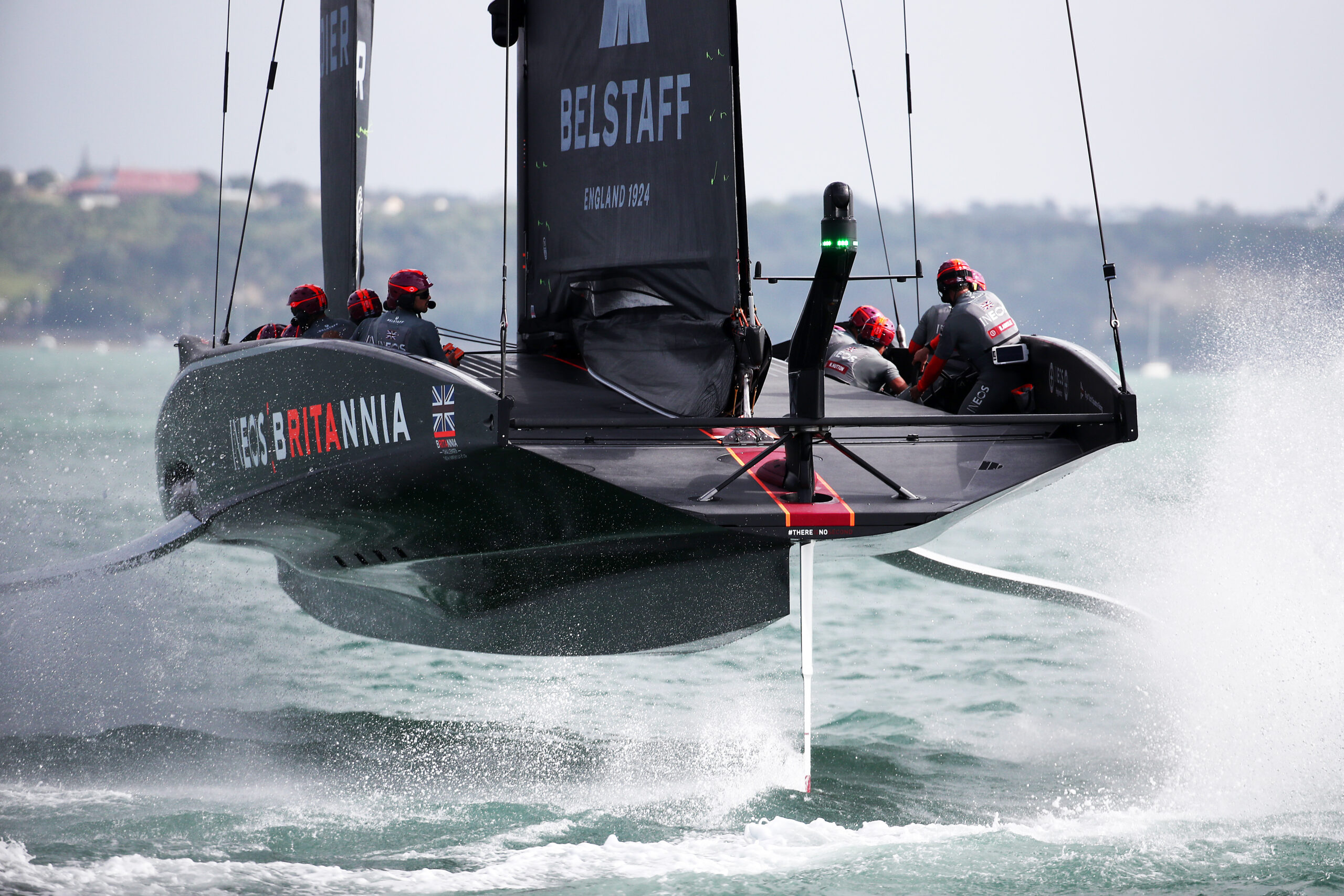
INEOS Britannia in action at the 37th America’s Cup. Photo: Getty Images/Fiona Goodall
Good to know
Pressure doesn’t make you better, but it does reveal what is already here.
That is according to high-performance specialist Rachel Vickery, who led a virtual roundtable for members looking at how they can reduce their athletes and coaches’ allostatic load – that is the cumulative ‘stacking’ of stressors over time that erode the amount of physiological ‘space’ an athlete has between their current arousal level and their personal stress threshold.
The stressors in question can be personal (e.g. a lack of sleep), organisational (e.g. misalignment), performance-based (e.g. being outside your comfort zone), or physiological (e.g. reduced ability to hear or absorb information).
Crucially, as Vickery explained, “as long as your arousal state stays below your threshold, your negative performance will not show up.”
Read more here.
Coach wellbeing
Though often neglected, members of the Leaders Performance Institute gathered to share ideas on how they can better support their coaches.
In one particular World Cup-winning environment, when athletes wanted specialist help, they were asked to book appointments. There was no 24/7 service.
This, their former manager explained, not only developed the self-reliance of the players, but also served to protect coaches and staff members who were all too ready to put themselves out, whether for out-of-hours appointments or “2am emails”.
Read more here.
Aussie rules
In early February we welcomed many of you to Brisbane for Leaders Meet: Australia, where organisations including the Brisbane Lions, Cricket Australia and World Rugby tackled the challenges of the day.
Chief amongst those was the ever-pressing need for alignment.
The Lions’ Senior Coach Chris Fagan favoured strong relationships with senior management; Australian all-rounder Ellyse Perry espoused the value of psychological safety in cricket; and World Rugby Chair Brett Robinson, as an executive, emphasised trust built on clarity from the top.
We picked out five elements for your consideration.
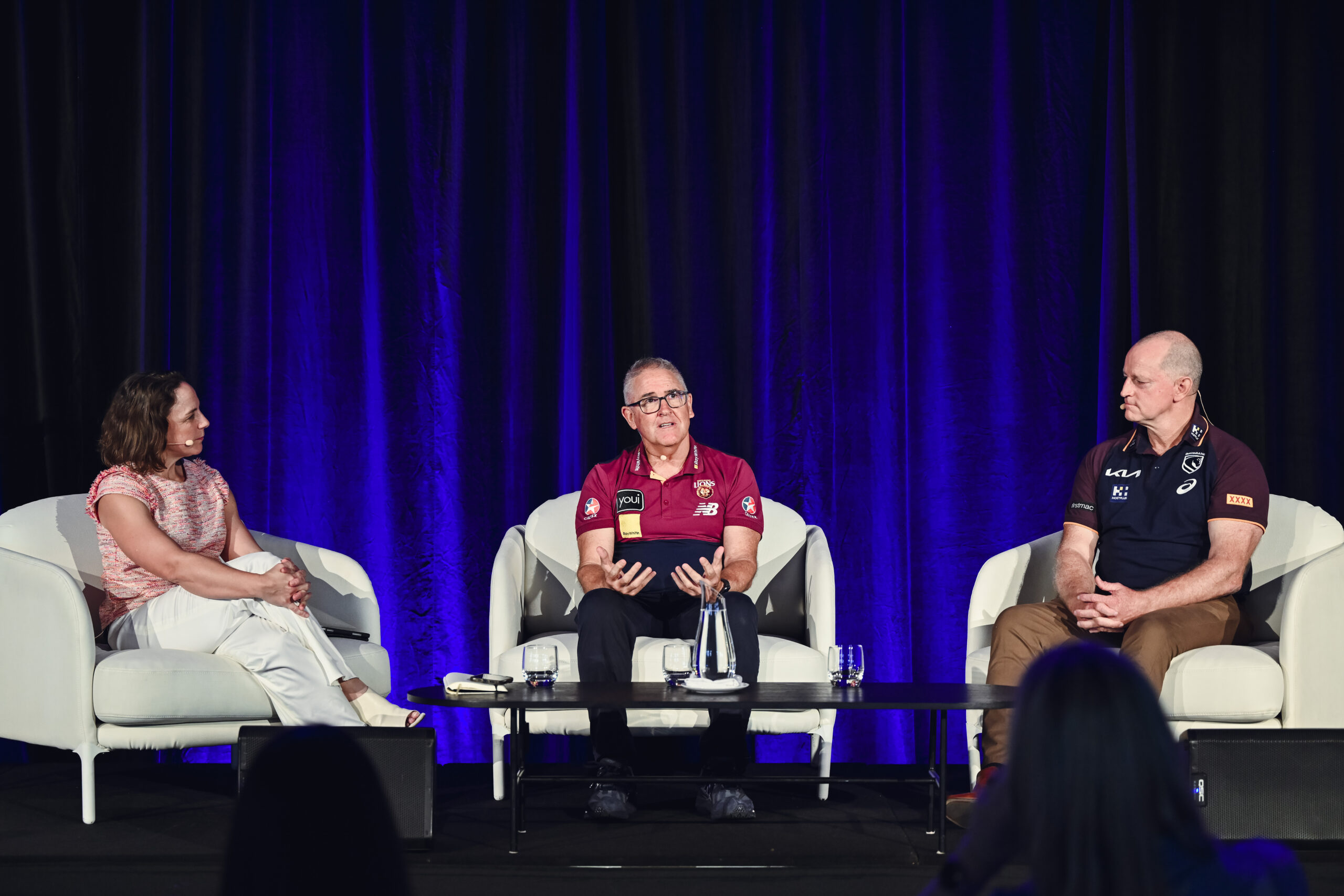
Chris Fagan (centre) in conversation with Michael Maguire (right) and moderator Rachel Vickery. Photo: Albert Perez
One you might have missed
Ben Ashdown and Dr Mustafa Sarkar of Nottingham Trent University pondered the behavioural elements of resilience in young players at football academies in this exclusive interview.
Their research has identified six resilience behaviours:
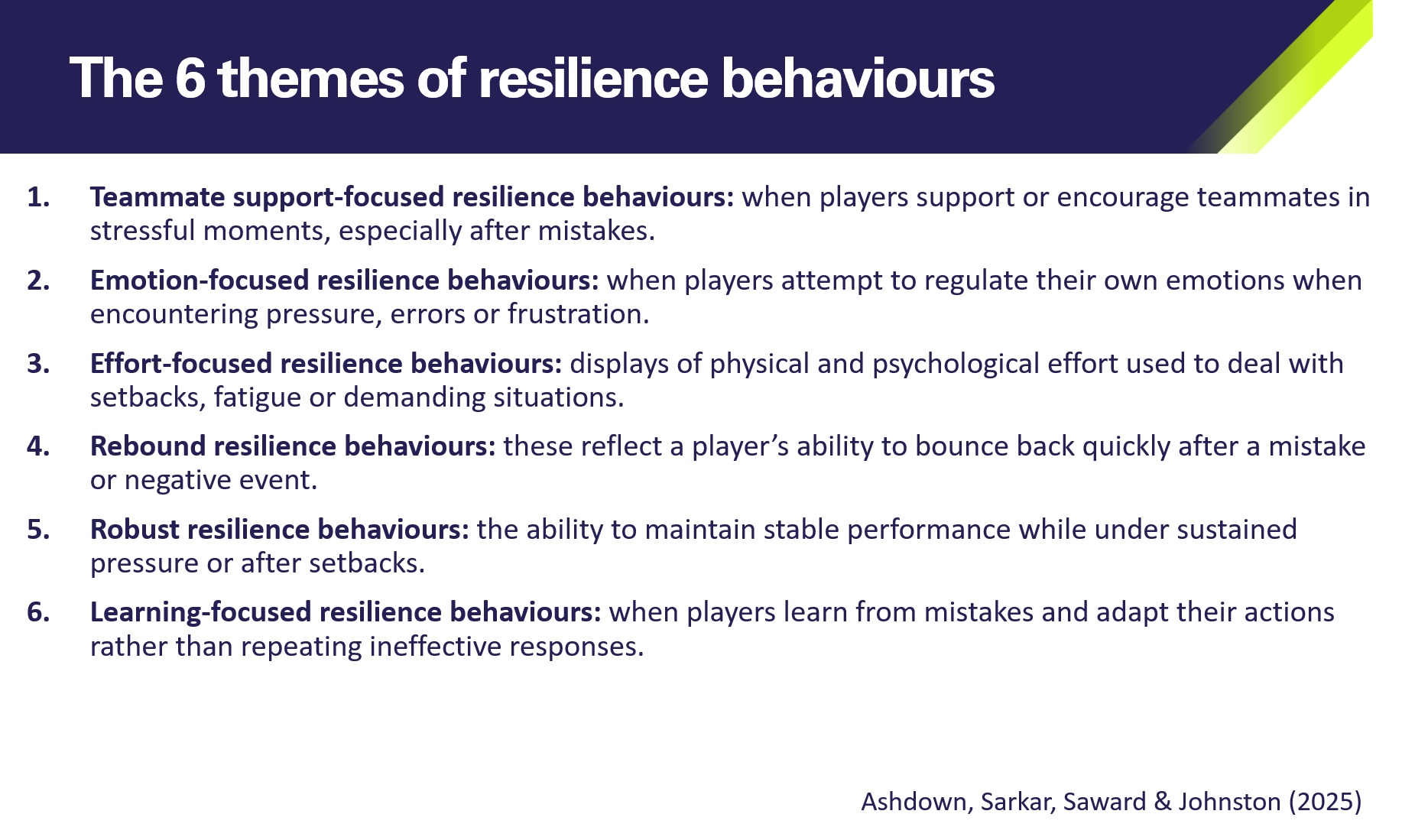
Their hope is to use these six to fashion a tool to help academy staff identify and develop resilience behaviours in their young athletes.
Read more here.
What’s coming up for members
In our latest Leadership Skills session, Jeff Pagliano of Management Futures reframes how organisations should understand, shape and protect their cultures.
Amaechi’s words are shared by Jeff Pagliano, a consultant with Management Futures, who in our latest Leadership Skill Series session, introduced members to tools that will enable them to help shape their team’s culture.
How do cultures develop?
Pagliano began his presentation with a definition:
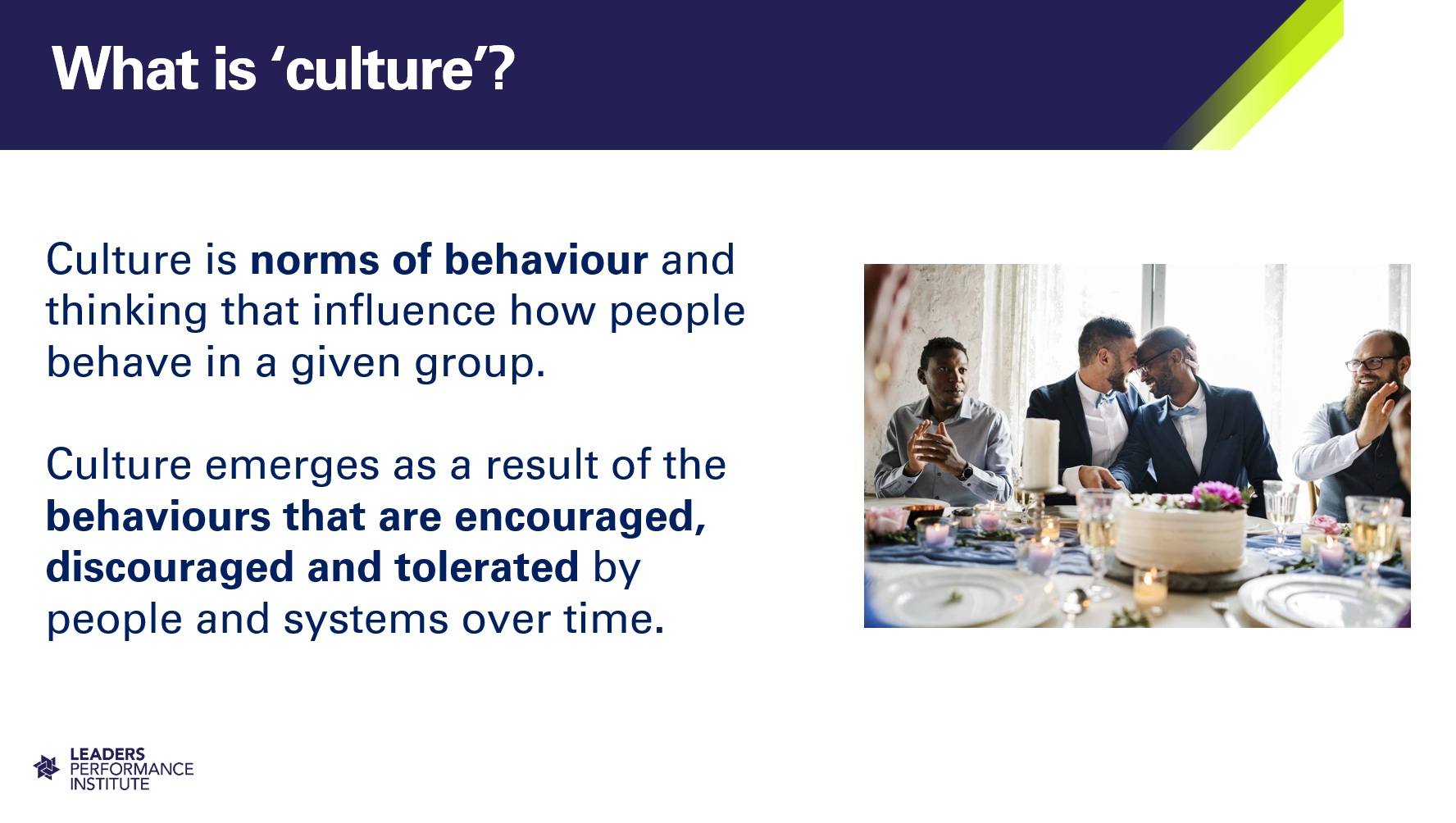
Management Futures uses the analogy of tables at a wedding reception to explain how cultures develop.
“You’ve seen how at a wedding each table develops its own personality,” said Pagliano. “It’s interesting that even in those interactions where some people know each other or some people don’t, a culture begins to form around that table. You can have the rowdy table, the quiet table; some are eager to get up to dance and some are not.”
What we see, what we say, what we believe
Pagliano then shared his ‘cultural iceberg’ model, which has been inspired by Swiss-American psychologist Edgar Schein and his pioneering work on organisational culture:
What we see
“This is literally what we see. So behaviours, systems, and processes,” said Pagliano. This could be how people interact, how leaders comport themselves, what actions are common or repeated. It also includes the physical environment (e.g., office layout or the visibility of team members).
What we say
“These are our goals, values and aspirations.” In other words, the official narrative.
What we believe
“These are the underlying assumptions we have about the organisation.”
The risk of emerging ‘shadow’ values
Underlying assumptions can lead to the emergence of what Pagliano calls ‘shadow’ values – unspoken, unofficial rules.
“Employees are acutely aware of what is rewarded or encouraged in everyday activities,” he said.
Pagliano quoted the British government’s sports funding agency, UK Sport, in making his point.
Therefore, it is important to be able to ‘map’ your team’s cultural influences to better help you understand who shapes your culture and in what ways.
Mapping cultural influences
For this part of the session, Pagliano called upon Dr Edd Vahid’s Cultural Hypothesis, in which he spoke of the importance of ‘sponsors’, ‘architects’, and ‘guardians’ in shaping a culture through a combination of leadership and influence.
Pagliano added two further categories: ‘shareholders’ (“I would argue that everybody who works in an organisation is a shareholder”) and ‘countercultural influences’ (“countercultural influences are negative role models that can be operating at all levels”) and presented the following slide:
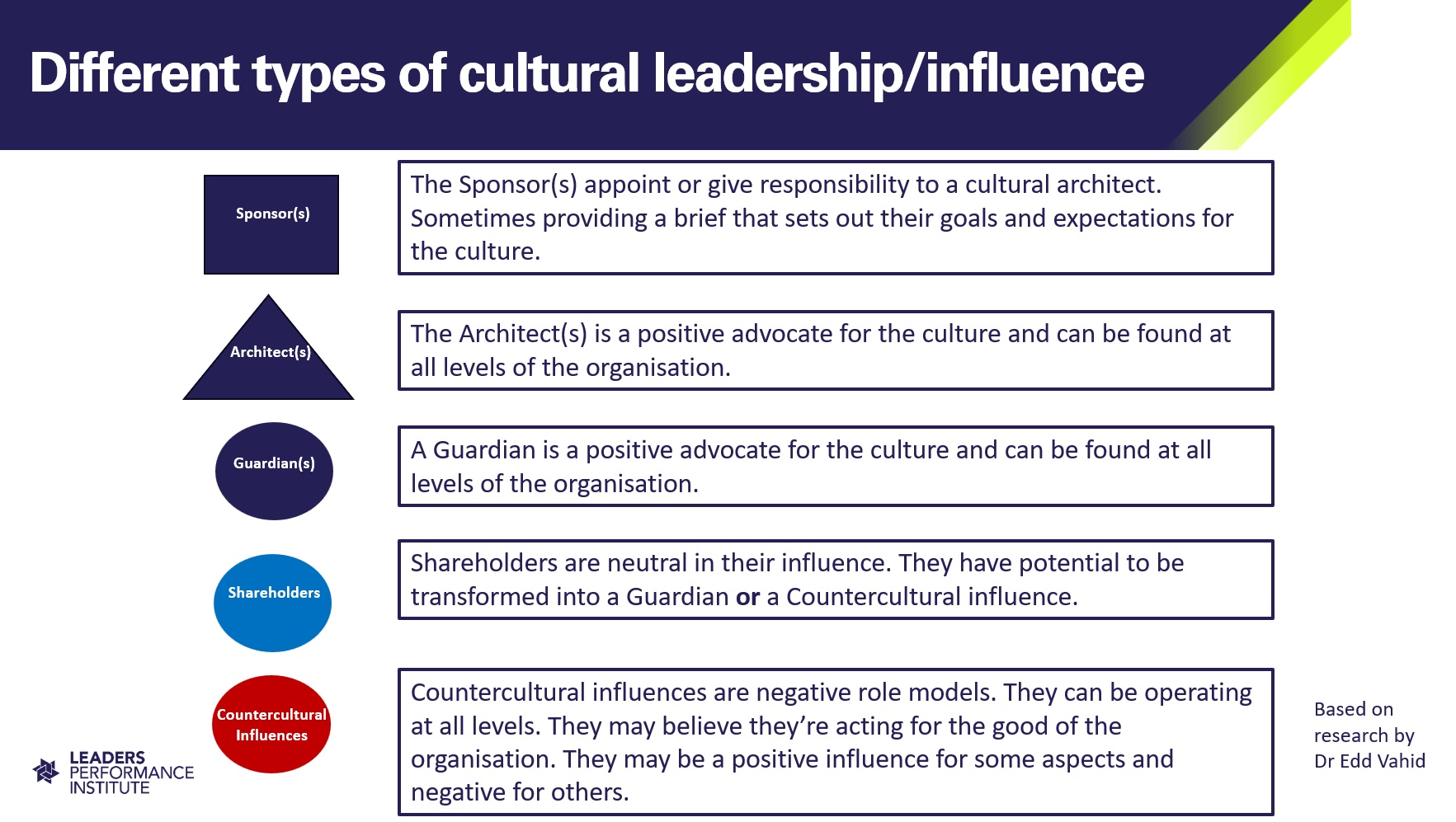
He then shared a hypothetical example of a cultural map that pulls on these five types. The result is a complex diagram:
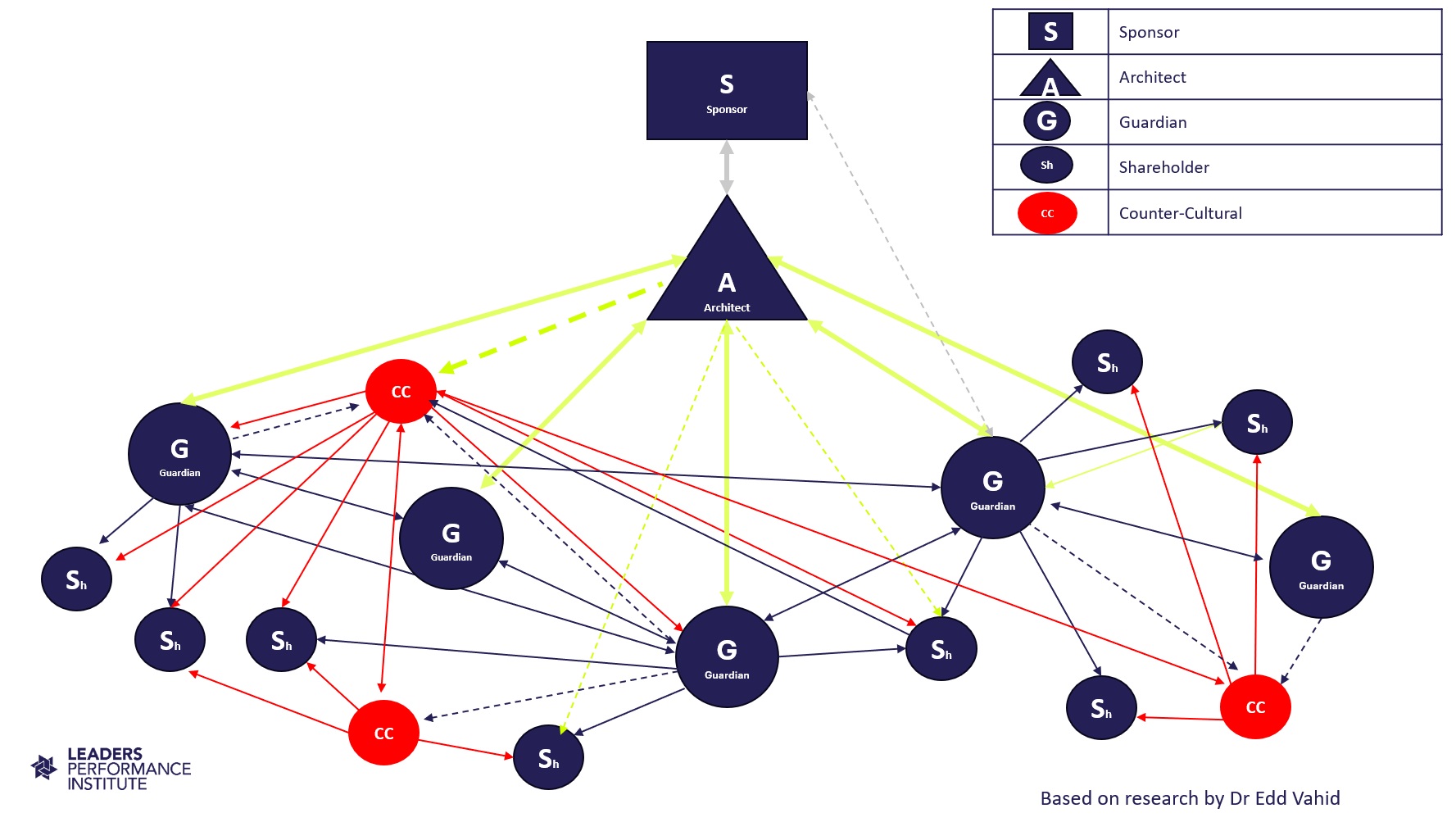
“Your sponsor is at the top,” said Pagliano. “That can be the owner of an organisation, maybe a GM, maybe a coach, but it’s somebody who has the ability to decide whether resources are allocated for building culture.
“Then you have the architect: the one who thinks about ‘see’, ‘say’, and ‘believe’. This is the person who has the ability to influence processes and has decision-making power.
They may or may not be the leader of the organisation, but they certainly have the ear of the leader.
“Then below is where the web gets a little complicated. This is where you can see how certain policies, procedures and aspects of culture can intertwine and be influenced.”
Pagliano concluded this section with a summary:
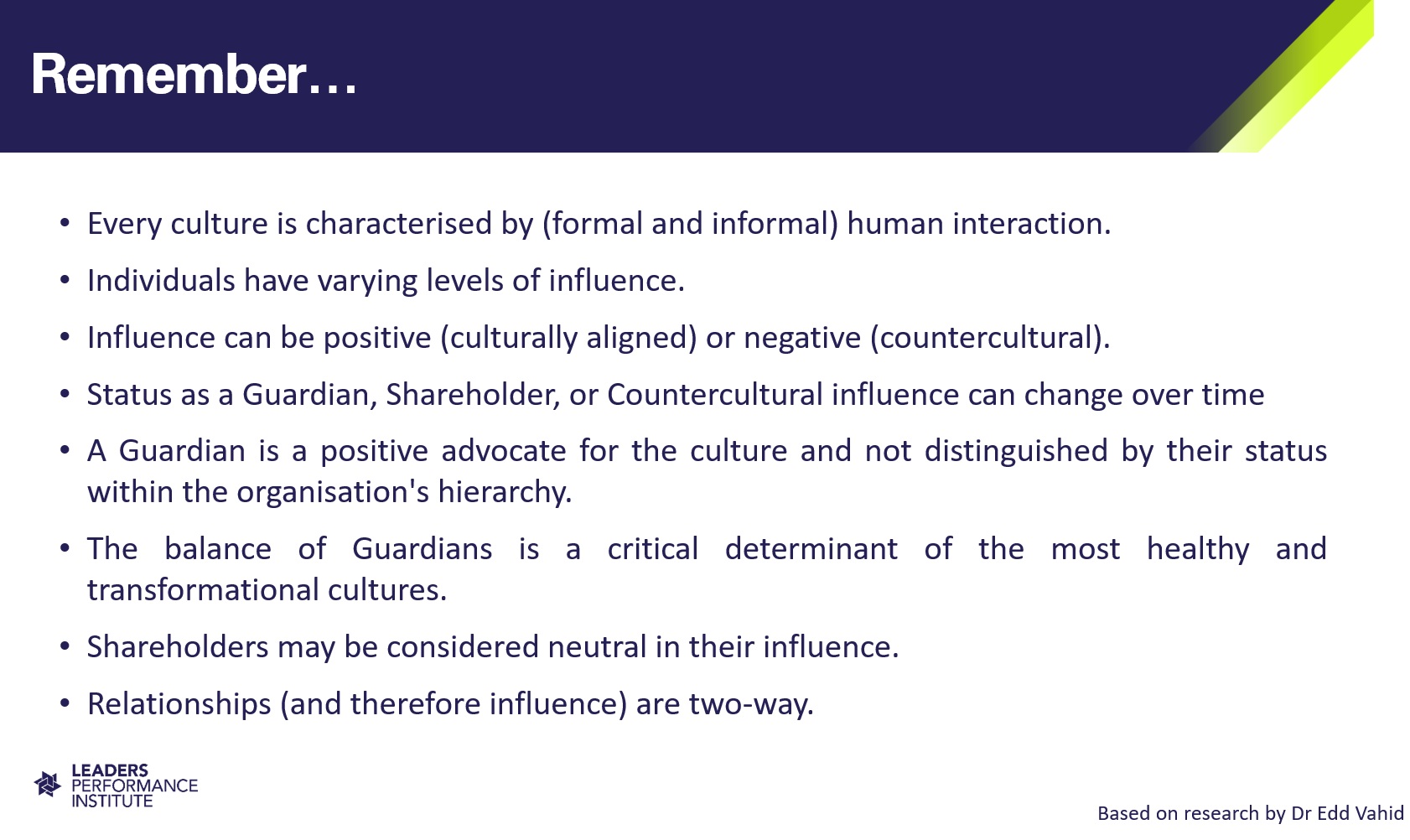
He concluded his presentation with six cornerstones of cultural leadership.
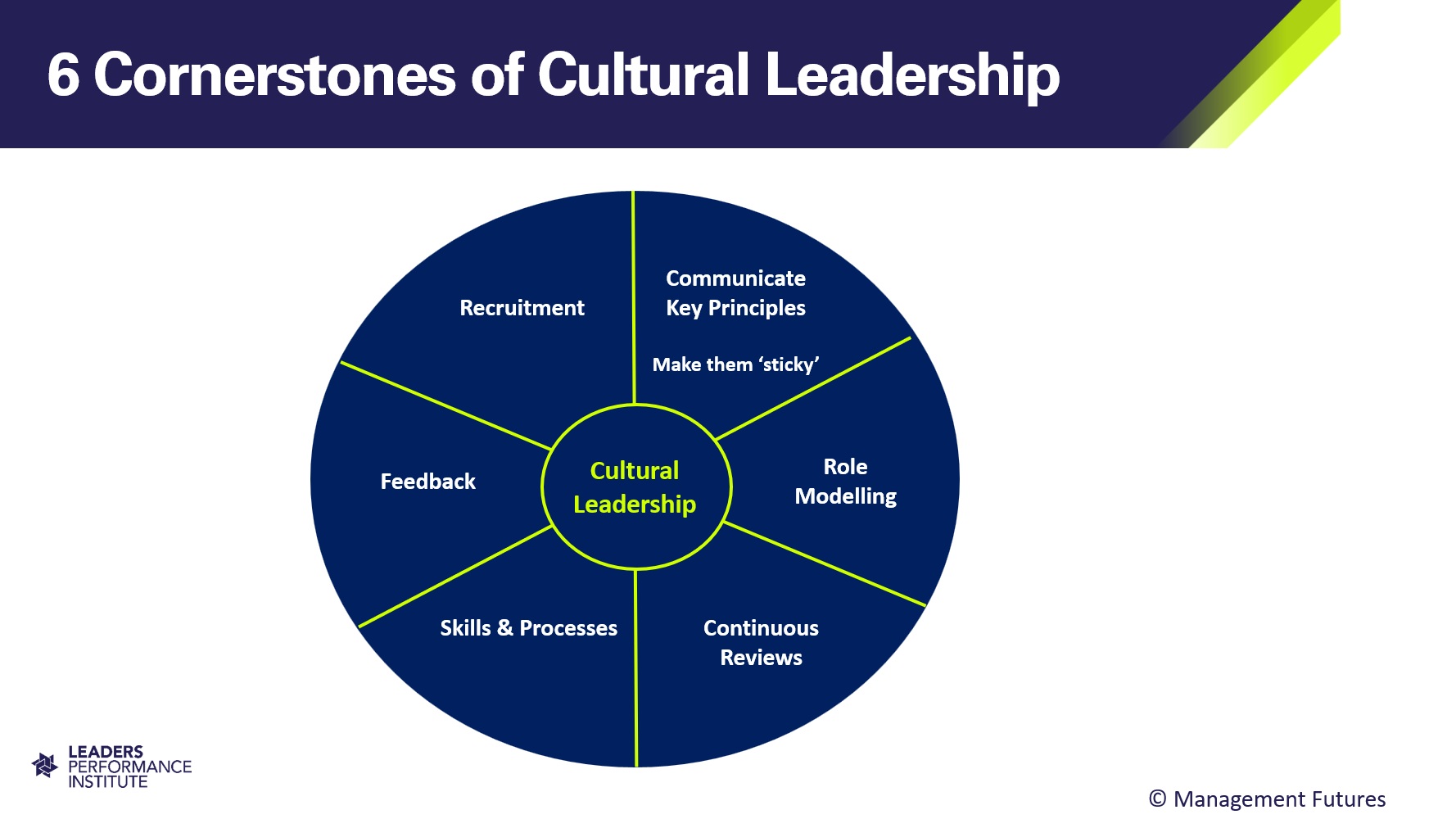
“These are the six levers that any culture leader, whether it’s your sponsor or your architect, can pull to make sure that vision of culture is consistent across your organisation.”
He then gave a real-life example for five of the six.
Communicate key principles – Netflix
“Netflix’s key principle is ‘act in Netflix’s best interests.’ And so their culture of ‘Freedom & Responsibility’ can be captured in these five words,” said Pagliano. “Anytime there’s a decision being made, you can always ask your team, ‘are we acting in Netflix’s best interests?’”
Role modelling – Collingwood FC
Pagliano explained that Collingwood’s Senior Coach, Craig McRae, asks himself daily, “‘to what extent are my day‑to‑day actions equal to our ambition?’” The Melbourne-based club were AFL premiers in 2023.
Continuous reviews – Pixar
“They had this concept of appreciative inquiry,” said Pagliano of Pixar. “It’s all about setting examples of excellence to create a blueprint for future performance.” In testing Toy Story, for example, the relationship between Buzz and Woody wasn’t working. So they went back to the drawing board over the course of six days and created those characters that we know and love today. Further down the line, they would go back and ask, ‘what were we doing right during those six days when we pulled together?’”
Skills and processes – the UK Sports Institute
This example is specifically about their approach to developing their staff members’ “teaming skills”. “This can come down to something as simple as ‘speak up, listen up’ and then a shared responsibility for performance,” said Pagliano. The UKSI wanted to teach “teaming skills across the different groups so that when groups from different parts of the organisation interact with each other, they have a shared language.”
Feedback – Doctors Without Borders/Médecins Sans Frontières
“Their motto is ‘we are intolerant of, but empathetic, when people don’t initially meet our high standards’,” said Pagliano, who explained that employees are given “three strikes”. “Feedback as a continual part of the process is really important to maintaining their culture.”
Recruitment – get the right people on the bus
Pagliano does not give an example for recruitment. Instead, he poses a question: “When you’re looking to hire folks, who do you think is going to buy into your shared cultural values and who is going to be a guardian or an architect of that?”
If you have any further questions around how to understand, shape and protect their cultures, feel free to reach out to Management Futures directly via [email protected]
What to read next
As Warwickshire’s Performance Director James Thomas explains, strategy is not about establishing certainty, it’s about people, collaboration and coherence.
Often the word elicits a raised eyebrow amidst busy training and competition schedules or it alludes to scarce downtime for coaches and practitioners.
It is also associated with corporate language, long documents and theoretical discussions that feel disconnected from the daily reality of training, selection and competition. In high-pressure environments, planning (reviewing and learning) can be seen as a luxury, something to revisit once results improve or uncertainty settles.
My experience has been the opposite. I’m passionate about helping raise awareness of the importance and performance impact of great strategic planning.
Strategy: a precursor to performance
After more than two decades working across Olympic and professional sport, I have come to believe that performance strategy and planning are not distractions from performance, they are precursors to it. In environments often defined by pressure, volatility and constant change, strategy provides something invaluable: direction, connection and a level of continuity.
High-performance sport is inherently unstable. Calendars shift, athletes get injured, form fluctuates, staff move on, leaders change and external demands arrive without warning. In that context, the absence of a clear performance strategy does not create freedom. It creates noise. Decisions become reactive, alignment erodes, and short-term fixes quietly undermine decision-making rooted in the agreed long-term ambition.
The organisations that perform most consistently are not those that plan less. They are those that build solid foundations, plan with intent, adapt with discipline and continue to stay rooted to the agreed values and behaviours when circumstances change.
Planned Olympic success
One of the clearest demonstrations of the value of performance strategy in my career came during my time as Performance Director at British Gymnastics in the build-up to, and during, the delayed Tokyo Olympic Games in 2021.
This period was defined by disruption. The global COVID-19 pandemic fundamentally altered how athletes trained, competed and lived. Lockdowns restricted facility access. Competition schedules collapsed and re-emerged unpredictably. Athlete preparation was fragmented, and long-term planning was constantly challenged.
At the same time, the organisation was navigating a significant cultural crisis. The Whyte Review had been co-commissioned by UK Sport and Sport England in 2020 following allegations of abuse and mistreatment within gymnastics in Britain. Trust had been damaged, scrutiny was intense and the responsibility to rebuild confidence, both internally and externally, sat alongside the imperative to perform on the world’s biggest stage, the Olympic Games.
In that environment, strategy became an anchor.
It provided stability when circumstances were anything but stable. Performance strategy gave athletes, coaches and staff a clear sense of direction at a time when certainty was scarce. It reminded us of our five principles of high performance, our data informed team strategies for qualifications and finals, and created a shared understanding of what mattered most, even as day-to-day plans shifted repeatedly. This anchor also supported me during really challenging times when key staff behaviours or direction of travel didn’t align to our beliefs and approach. It gave me confidence to hold the line and make the tough decisions that leaders are so often faced with.
Rather than attempting to predict an uncertain future, the strategy focused on the team, the people, the data and practitioner-informed principles that we talked about for over three years. It established how decisions would be made, what trade-offs we were prepared to accept and those ‘what if’ scenarios that can always catch you off guard. One of these being the Head Coach breaking their leg 48 hours before heading to Tokyo. We actually had a plan for this!
This allowed the system to adapt without losing its identity.
That experience was one of the most challenging of my career, but always hugely exciting and rewarding. Three planned, but hard-earned medals secured for Team GB reinforced a core belief: strategy is not about certainty. It is about people, collaboration and coherence.
Different sports, same principles for high performance
The same principle holds true in professional football, albeit at a different scale.
During my time as Director of Performance Services at Manchester City, operating within the City Football Group, I saw first-hand how long-term strategic planning can drive sustained performance improvement across an entire ecosystem.
At Manchester City, consistent performance progression was not the product of isolated excellence or short-term cycles. It was anchored in a clear long-term plan that connected the Academy, Women’s and Men’s first teams through shared principles, aligned methodologies and a common performance language.
That plan did not seek to eliminate fluctuation. Ebb and flow were expected. Injuries, form, competition demands, squad evolution and commercial demands were all recognised as natural parts of elite sport. What mattered was that the long-term vision, the direction of travel remained consistent, even as tactics and personnel changed.
Crucially, this strategic clarity extended beyond a single team or season. It flowed across the wider City Football Group model, creating a level of coherence across clubs operating in different countries, cultures and competitive contexts. While local adaptation was encouraged, the underlying performance philosophy remained aligned.
The level of consistent on-pitch success at Manchester City over the last 5-7 years, in many ways, is unparalleled, from Academy player progression and sales to the Men’s first team treble in 2023. Long-term business and performance strategy has a lot to do with this, in my opinion.
Good performance strategy increases speed
Modern high-performance environments are defined by complexity. Multiple competitions, condensed calendars, overlapping priorities and increasingly specialised roles place constant strain on alignment. Planning in these environments is often misunderstood as control. In reality, it is the opposite.
When direction is clear, decisions decentralise. Coaches, athletes and staff can act with confidence because they understand the broader context. When strategy is absent, everything escalates upwards. Decisions slow, responsibility blurs and energy is wasted re-litigating the same conversations week after week.
The VMOST model
At this point, structures and frameworks matter.
One of the most effective ways I have seen performance strategy articulated in high-performance sport is through clear, simple models that translate long-term ambition into day-to-day action.
One such model is VMOST (Vision, Mission, Objectives, Strategy and Tactics).
VMOST was created by business strategist Rakesh Sondhi and first proposed in 1999 book Total Strategy. The framework provides a disciplined way of connecting the big picture of the future to the daily actions, tasks and deliverables required to get there.
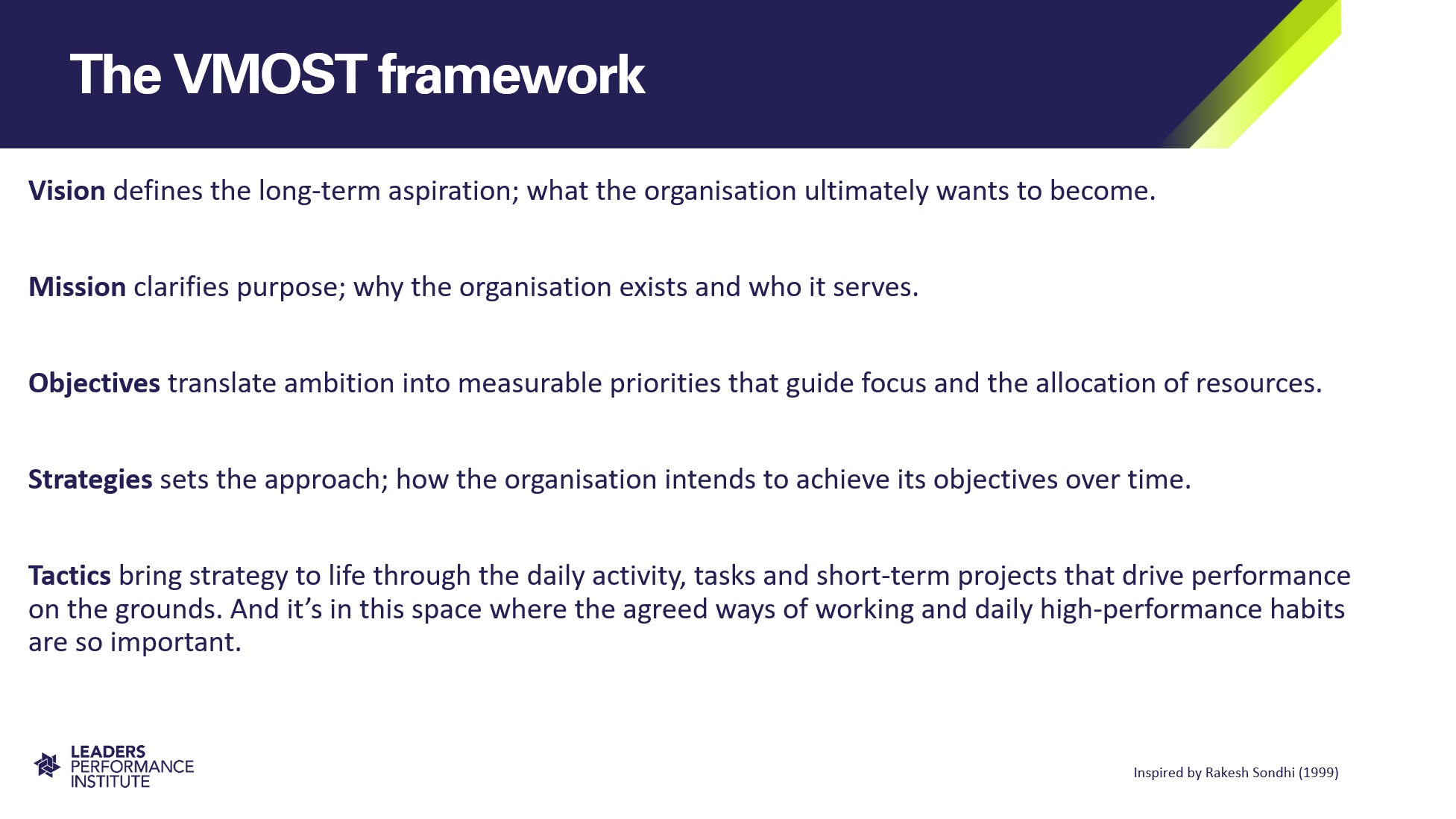
The power of VMOST lies in its simplicity.
In high-performance environments, complexity is already high. Strategy models must reduce cognitive load, not add to it. VMOST creates line of sight. Individuals can see how their daily work connects all the way through to the long-term vision of the team and/or organisation. In my last two roles as a performance director, my VMOST strategy was etched onto a big wall, one which staff members and athletes walked passed regularly. And when curious conversations or even debates took place, we often found ourselves standing around the visual, challenging whether a new idea could really help us achieve a strategy or the mission, or was it something that could derail us and divert energy, with no clear route to helping us win. This is definitely something I am taking into my new role in professional cricket.
When applied well, this kind of structure does not constrain creativity. It enables it. People can feel empowered to adapt, innovate and solve problems within a clear strategic frame.
A new era in professional cricket
In cricket, this strategic clarity is particularly valuable and I’m living this right now as Performance Director at Warwickshire and the Birmingham Phoenix.
Across a single season, players move between formats that demand entirely different physical, technical and psychological outputs. Red-ball cricket rewards patience, control and endurance. Short-form formats demand clarity, aggression and adaptability. Players are selected for specific skill sets, yet all must contribute to a collective performance.
Without a clear strategic framework, these transitions become chaotic. Workloads conflict, roles blur and development stalls. With strategy, complexity becomes more manageable. Individuals understand their role, how it evolves across formats, and how their contribution supports the team’s wider ambition.
At its best, performance strategy connects people.
High-performance sport is full of specialists. Coaches, analysts, medics, strength staff and operations teams all operate in defined roles, and rightly so. The risk is not a lack of expertise, but fragmentation. Excellent work happening in isolation without a clear line of sight to the bigger picture, is one of the biggest risks leaders can face.
A well-articulated strategy creates connection. It allows people to see how their work links through to the final mission and vision of the organisation. Daily decisions gain meaning. Trade-offs become easier to navigate. Autonomy increases because intent is understood.
When people understand why their work matters, they can make better decisions.
Strategy also provides continuity in environments where turnover is inevitable.
Athletes move on. Coaches change. Support staff rotate. In some organisations, meaningful personnel change happens every season. Culture alone cannot carry performance identity through that level of churn.
Strategy creates continuity of thought.
It anchors philosophy, ambition and non-negotiable principles beyond any individual. It allows new people to arrive and quickly understand how performance is built, what standards matter and what success really means in that environment.
In my experience, the strongest systems are those where people can come and go without the performance identity being lost. That does not happen by accident. It happens because strategy has been made explicit, shared and lived.
This requires leadership discipline.
Performance strategy only creates connection and continuity if leaders reference it consistently, use it to explain decisions and hold themselves accountable to it under pressure. When strategy is visible in how leaders talk, select, invest and prioritise, it stops being a document and becomes a shared language.
That language matters when pressure rises.
Under stress, people revert to what they understand. Strategy provides a common frame of reference. It reduces anxiety, accelerates alignment and allows honest conversations about performance without personalising every decision.
Planning also helps organisations say ‘no’.
In elite sport, opportunity is constant. New competitions, new technologies, new interventions and new ideas arrive relentlessly. Without strategy, everything feels urgent, and every new opportunity feels like one we can’t miss out on. With strategy, priorities are clear. Resources are allocated intentionally. Energy is focused where it matters most.
Importantly, you need to find ways to stay flexible, and not become rigid, bound to a strategy you developed years ago.
The best strategies are not scripts. They are frameworks. They define principles, priorities and trade-offs rather than fixed answers. They allow adaptation without drift.
Good performance strategy answers simple but powerful questions:
The human impact of planning is often underestimated.
Clear strategy can reduce uncertainty. It gives people confidence in decision-making. Applied well, it creates psychological safety by replacing ambiguity with intent. Athletes and staff perform better when they understand direction, expectations and how success is defined.
This is particularly important in high-performance environments where accountability is high and pressure is constant.
For leaders looking to build effective performance strategy, a few principles matter.
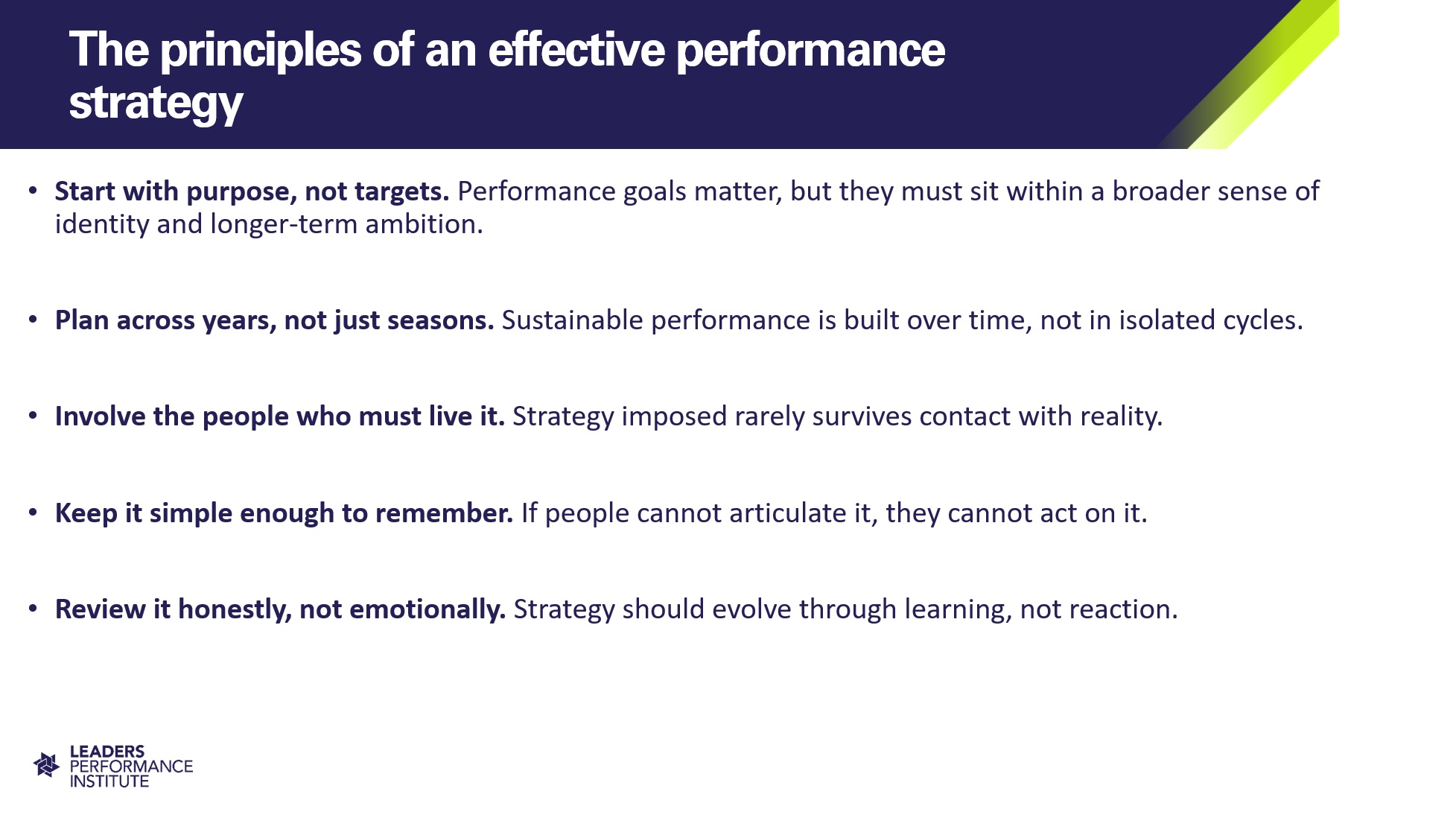
Competitive advantage
Across Olympic and professional sport, one belief has remained constant for me: strategy is a competitive advantage if organisations are willing to treat it as such and invest in the people who are delivering it.
In high-performance sport, change and uncertainty is guaranteed. Strategy does not eliminate it, but it determines whether change becomes a threat or can be used as an advantage.
When planning for performance connects people, aligns ambition, creates continuity and promotes curiosity, performance shifts from reactive winning to sustainable success.
James Thomas is the Performance Director at Warwickshire County Cricket Club and one of sport’s leading high performance experts. If you wish to speak to James, please contact a member of the Leaders Performance Institute team.
More from James Thomas
During his time with the INEOS Britannia sailing team, Peter Hodgkinson built an environment that enabled his young staffers to learn and thrive under pressure. As he explains in this exclusive column, intent-based leadership and psychological safety were at the heart of his approach.
Main Image: Getty Images/Fiona Goodall
We achieved a number of national firsts: the first British team to win the Challenger Series, fending off some tough opponents; the first British team to contest the Match itself in 60 years; and the first British team to score points in the Match for 90 years.
There was no shame in eventually losing 7-2 to Team New Zealand, who claimed their third consecutive victory. We gave it a good go against the team our helmsman, Sir Ben Ainslie, described as “the best team ever”.
This is the story of how we put ourselves in contention.
Assembling a functioning team: the hard part
The INEOS Britannia Team was made up of two organisations: Athena Racing and Mercedes GP. It wasn’t always easy – it was a collision of two different workplace cultures – but the common goal bonded the two companies together and we got on with the job.
I learnt a lot about sailing and the maritime industry and while there are similarities to motorsport, where I have made a career for four decades, there are a number of big differences (that’s a topic best saved for another day).
One of the things I really enjoyed about working on the Cup was that we got to recruit a new Build Logistics Team. Basically the Build Logistics Team are parts chasers; in the Cup they looked after ‘goods in’, ‘stores’, stock checks, parts picking, moving parts through inspection, NDT (non-destructive testing), X ray etc. so it is a fluid and dynamic role with lots of pressure.
The team we recruited had very little or no experience in this type of role but we believed it was more important to have the right mindset, practical intelligence and energy than experience. In the Cup, we didn’t have all the structures, systems and processes in place that you have in an F1 team but we had enough to do the basics well, if we used what we had correctly.
I believe if you have relatively fewer parts then you need additional people to manage those parts as they become more critical. Therefore, we ended up with a team of seven people in Build Logistics, which seems a lot, but considering the workload, I think this was the correct number.
Almost all members of the team we assembled would be considered Gen Z, but I didn’t view them in such narrow terms. I didn’t put them in some kind of box with a label. To me they were a new team that we had to get moving as quickly as possible. This was the hard part.
‘Don’t lose any parts’… and ‘no surprises’
The team’s inexperience was difficult to manage at first but as they were all intelligent it didn’t take long to get them up and running. Don’t get me wrong: we had some very difficult moments and some very challenging conversations, but after a few months we started to see improvements and we were going in the right direction. The energy and passion this group displayed was not seen by the whole team as everyone was flat out, but I could see what they were achieving. I applied what I had learnt in my time in HR (I was Head of Employee Engagement at Mercedes F1 between 2019 and 2022) to this group using intent-based leadership and psychological safety.
I gave the Build Logistics team two simple rules: ‘don’t lose any parts’ and ‘no surprises’. Don’t lose parts almost goes without saying, but it was important to articulate as it gave them a mental priority for what they were responsible for. I wanted them to feel that every part was important because, if we lost something, then we could miss an important test or delay a development item hitting the water, therefore delaying the opportunity to learn.
We did lose some parts but also we did learn from this, and I like to think we didn’t blame the person, as the process (or lack of) allowed it to happen. In most cases during my career, the human being was acting as a sticking plaster due to the lack of a robust process or system.
I used ‘no surprises’ as a tool to try to build psychological safety. Surprises are for birthdays and Christmas, in my book. I wanted this young team under pressure to speak up. I wanted them to feel that it was wrong not to say something if they were concerned about a part or a process or were having a problem. I wanted to hear what they had to say, I was desperate to hear what they were thinking, and it was important that I responded productively when they did bring me bad news. As a Build Logistics Team, we needed to know now if there was an issue, as we simply didn’t have time or resources to bury bad news. We needed to hear their voices and, for me, ‘no surprises’ gave them permission to speak.
We had a daily meeting at 11:00am to go over the plan, projects and new parts – similar to what we did in F1 – and it took a while to truly hear everyone’s voice. I would say to them: ‘I woke up at 2:30am and thought about this, when you woke up last night, what did you think about?’ Sometimes nobody had much to say when I asked this question but on many occasions there was a little nugget of information that came to light.
If you are looking to build psychological safety in your team, try using ‘no surprises’. It gives your team permission to speak and it will help your team grow and develop as they feel they have a voice and will be respected for their contributions.
The 2% vs the 98%
Now this might be a bit controversial: one nugget I gave to the young Build Logistics Team on the America’s Cup was “you are only remembered for the 2% you get wrong, not the 98% you get right”.
If you are really honest and park up all the psychology for a moment, this is probably a pretty true statement.
I am sure plenty of cleverer people than me will disagree with this sentiment, but this is how I see it. It is a bit below the line, but it did focus my mind on my own performance. I believe we remember negative moments or threats to help protect ourselves in the future if we see this type of situation happening again, and therefore it remains fresh in our memories.
Others will have some good memories of some of the things we did but they will remember in detail our mistakes and the moments where we did not behave reliably or with competence. In other words, they lost trust in us. As human beings we will make mistakes, this is how we learn, grow and develop.
Intent-based leadership
Leaders of new young teams need to provide a lot of control and support in the early stages of the team’s development while the team members improve their competence and get aligned to the clarity of the intent. As the team’s competence and clarity increases, the amount of leadership control decreases. This is built on the intent-based leadership theory devised by retired United States Navy captain David Marquet.
This is a snapshot:
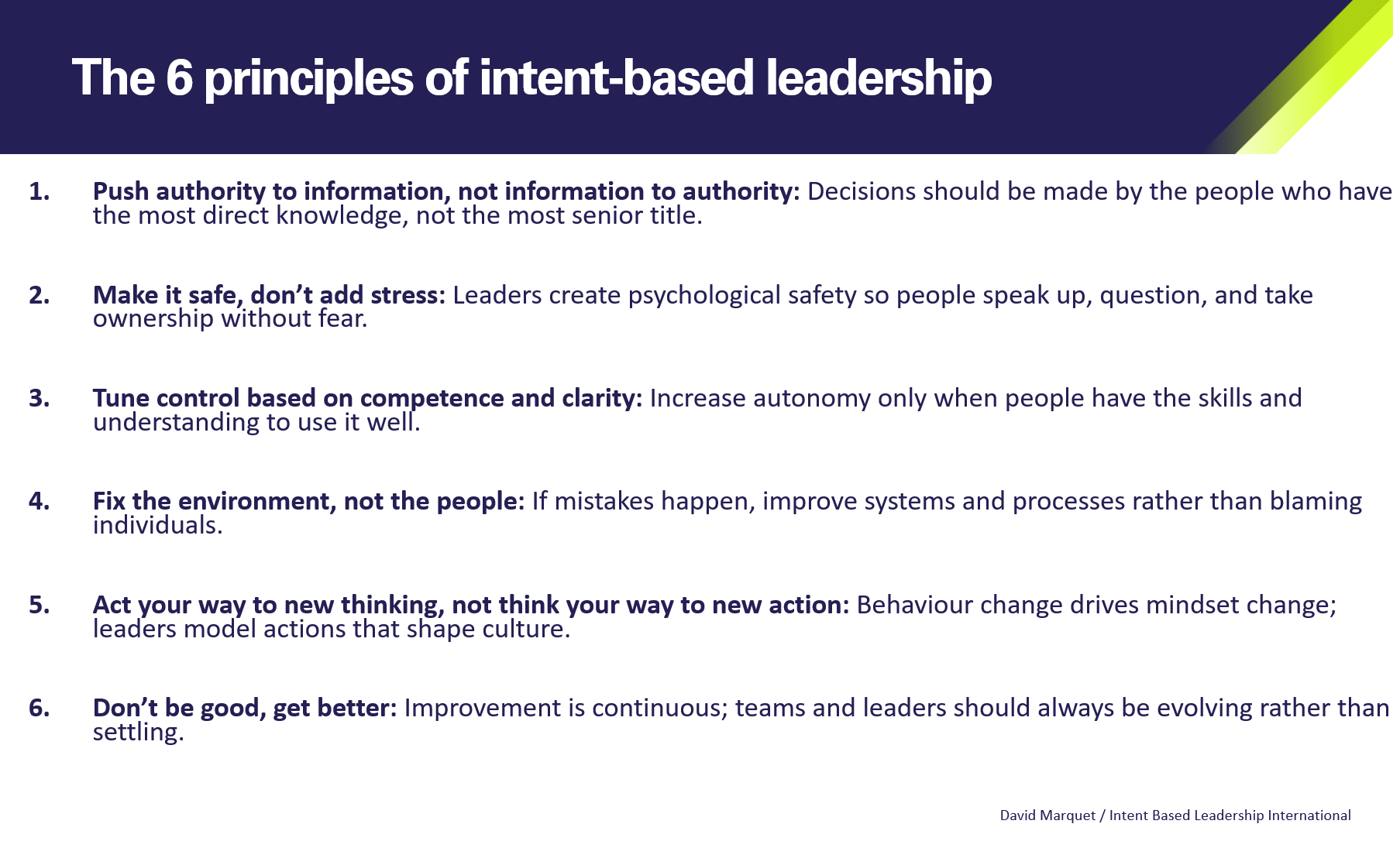
As a leader you are never quite sure what the people around you really think of you or if you have made a difference due to the pace of the world we live in. That said, a former member of the Mercedes F1 Build Logistics Team (and now a successful leader and manager in his own right) recently sent me one of the nicest bits of feedback I have ever received:
Your leadership allowed many young people to grow and now forms a lot of their own leadership and general teamwork skills. The biggest thing I always felt that made you different was your ability to allow others to make mistakes whilst catching them before it was at the detriment of the team. Without that, none of us would have learnt to be independent.
I think the key point from this is: I was catching the mistakes before they hit the 2% category while allowing the team to learn and become independent and responsible.
How is your team learning? Or are you telling them what to do so they don’t make mistakes? You don’t want their mistakes to reflect poorly on you and get you into that 2% category.
I hope this has given you something to think about. I am sure this may go against the grain for some of you but I suppose we can’t all agree on everything.
Peter Hodgkinson is a leadership and performance specialist skilled in helping high-performers become better at what they do. As an accomplished manager and mechanic, Peter has enjoyed almost three decades of success in elite sporting environments. His work in motorsport, as part of winning teams at Le Mans and Daytona, culminated in seven Formula 1 driver’s world championships won at Brawn and Mercedes, where he led car-building operations. Peter was Mercedes’ Head of Build during Lewis Hamilton’s era-defining run of six world titles. After a spell serving as Mercedes’ Head of Employee Engagement, Peter returned to the Factory Floor as Build Operations Manager for the INEOS Britannia sailing team when Mercedes supported their quest for the 37th America’s Cup.
If you would like to speak to Peter, please contact a member of the Leaders Performance Institute team.
The theme of alignment was high on the agenda at February’s Leaders Meet: Australia.
The Shepmates – Australian identical twin brothers Archie and Miles Shepherd – have become internet stars due to their viral videos depicting their high-energy and comedic reinterpretations of dramatic moments of sports commentary.
“I’m not going to pretend like we probably should be offering you guys advice. You’re the best at what you guys do,” Miles told a room of Leaders Performance Institute members at Rivershed in Brisbane. “But hopefully we can inspire you guys, or you take something from our story.”
Their dedication to their art and their fans has taken them to places they never expected. “We’ve found ourselves in a pretty niche part of the internet,” said Archie.
On top of it all, the brothers’ obvious chemistry, as well as their ability to finish each other’s sentences, hinted at the theme of alignment that ran through both days down on the River Brisbane (and it’s a performance trend we’ve tracked for some time).
They were not alone. Others who took to the stage, including the Brisbane Lions, World Rugby and the Queensland Ambulance Service, spoke of their efforts to ensure everyone within their walls is on the same page.
Based on the insights shared onstage across both days, the Leaders Performance Institute highlights how alignment shows up in the work of high-performing teams in at least five ways.
1. Smart coaches who can manage up
In sporting terms, there has never been a better moment for the city of Brisbane, with the Lions defending their AFL premiership and the Broncos winning the NRL in 2025.
Lions Senior Coach Chris Fagan and Broncos Head Coach Michael Maguire have built winning machines in this corner of Queensland, and both were on hand to tell Leaders Performance Institute members how it was done.
Key to their approach is an ability to manage the executives within their organisations. As Fagan said, “I always said to myself, if I was going to be a head coach, that I would make sure I would manage up to that group of people.”
Over the past nine years, Fagan tried to dine once a week with Lions’ CEO Greg Matthews as well as the team’s senior-coach-turned-executive Leigh Matthews.
Chris Fagan
Maguire has adopted a similar approach to prevent any noise or confusion emanating from above.
Michael Maguire
Chris Fagan (centre) in conversation with Michael Maguire (right) and moderator Rachel Vickery. Photo: Albert Perez
2. They seek ‘spine alignment’ too
While coaches can do what they can to ensure information is flowing in all directions, there is a role for both board members and heads of performance on the sports science side too.
Onstage, Peter Horne, the Performance Director at Rugby Australia, made the case for “spine alignment”, of which he said, “if we get true spine alignment of what we’re trying to achieve from a strategy, business and the deliverables [perspective] then we’re more likely to be able to execute.”
Crucially, as he admitted, it is not about agreement on every decision.
Peter Horne
“For the spine to work, you need everyone operating at the right level,” said Brett Robinson, the Chair of World Rugby, who joined Horne for the session. He included himself in that assessment.
Brett Robinson
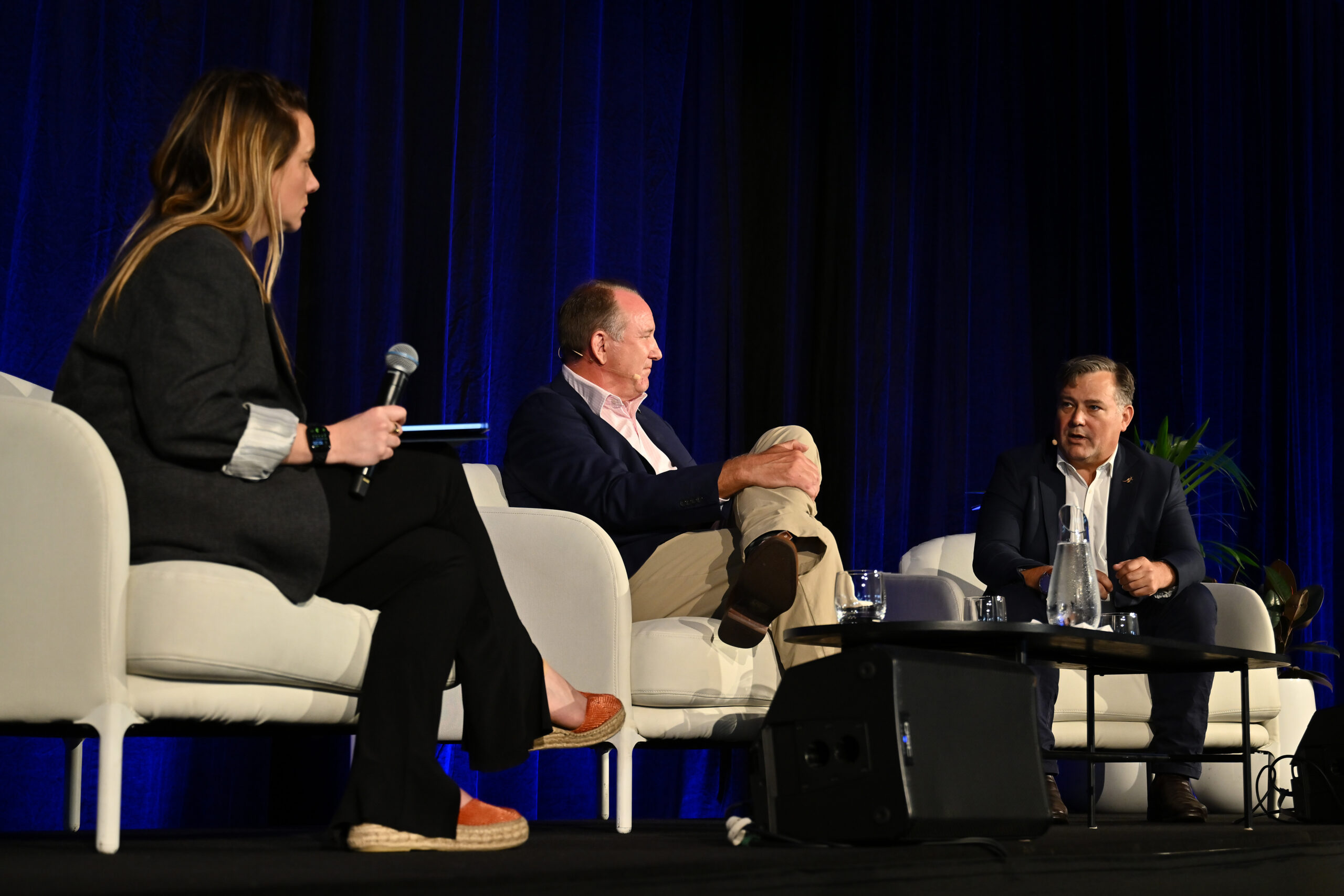
Peter Horne (right) makes his point onstage with Brett Robinson (centre) and Leaders’ Laura McQueen. Photo: Albert Perez
3. They bring their frontline people onboard
Few individuals are as well placed to discuss the concept of a culture driven by a shared purpose than Dr Stephen Rashford, the Medical Director of the Queensland Ambulance Service.
He is proud of his team’s “no excuses” approach too. “When we do our audits, everyone’s in the room, and there’s no making fun of anyone, there’s no bullying. We have honest, open discussions because we all just want to get better.”
Critically, their culture starts with their paramedics.
Dr Stephen Rashford

Dr Stephen Rashford mid presentation. Photo: Albert Perez
4. They have leaders who give their people psychological safety
Australian all-rounder Ellyse Perry is one of the greatest female cricketers of all time (then there’s her career as an international football player to consider). Her career has been underpinned by psychological safety. “When there’s a lot of support around that and real alignment on wanting to grow and improve, that makes a big difference,” she said.
Ellyse Perry
“No matter the position you hold, you don’t know everything, so be open-minded to learning,” said Anna Meares, the double Olympic gold medal-winning track cyclist who served as the Chef de Mission for the Australian Olympic Committee at the Paris Games. She spoke onstage alongside Perry and fellow Olympic gold medallist, the BMX cyclist Saya Sakakibara.
As Chef, Meares decided that open displays of vulnerability from early in the cycle would help to bring athletes and their coaches onboard.
Anna Meares
Psychological safety is just as important in individual sports, as Sakakibara told the audience. The Red Bull athlete won gold in Paris but recounted the story of her awful crash three years earlier in Tokyo and how it encouraged her to start placing her trust in others.
Saya Sakakibara

Anna Meares (second from left) makes her point to session moderator Fabio Serpiello in the company of Ellyse Perry (second from right) and Saya Sakakibara (first on the right). Photo: Albert Perez
5. They use process as a tool of alignment
In his presentation, Scott McLean, an associate professor at the University of the Sunshine Coast, explained that leaders must be aware of how things are connected in the complex systems of sports performance.
Scott McLean

Scott McLean from stage right. Photo: Albert Perez
Interventions should be governed by the performance need rather than results, according to James Thomas, the Performance Director at Warwickshire CCC, who made this case when he spoke onstage.
James Thomas

James Thomas onsite at Leaders Meet: Australia. Photo: Albert Perez
Where we’re going next
Emily Scarratt and John Mitchell knew their England team could be world champions, they just needed the right environment to be able to prove it.
The centre had just competed in her fifth tournament (a joint record in the women’s game), claimed her second winner’s medal, and helped to complete an 11-year quest to bring the World Cup trophy back to England. It was almost the perfect way to bow out after 17 years as an international, 115 caps and a world record 754 points.
Yet she had only played 19 minutes of England’s campaign – all as a second half substitute in the Red Roses’ opening pool match; a 69-7 defeat of the United States in Sunderland.
“I’ve definitely been part of environments before where that kind of non-playing player can become quite negative and toxic,” she told an audience at the 2025 Leaders Sport Performance Summit in London.
“For a large part of my career, I was starting and therefore it’s very easy to say the right things and present in that way when you’re not under the stress of not being selected or not playing as much as you would like.”
Scarratt was joined onstage by England Head Coach John Mitchell, who in early February extended his contract until the 2029 World Cup and added Scarratt to his coaching staff.
The session moderator, Rachel Vickery, asked him what it meant to see Scarratt and her other non-playing teammates (known within the Red Roses setup as “pillar” players) celebrating with such vigour.
“I reflected that we actually hit the sweet spot with the culture,” said Mitchell. “Sometimes you don’t get that sweet spot and we might not get it again.”
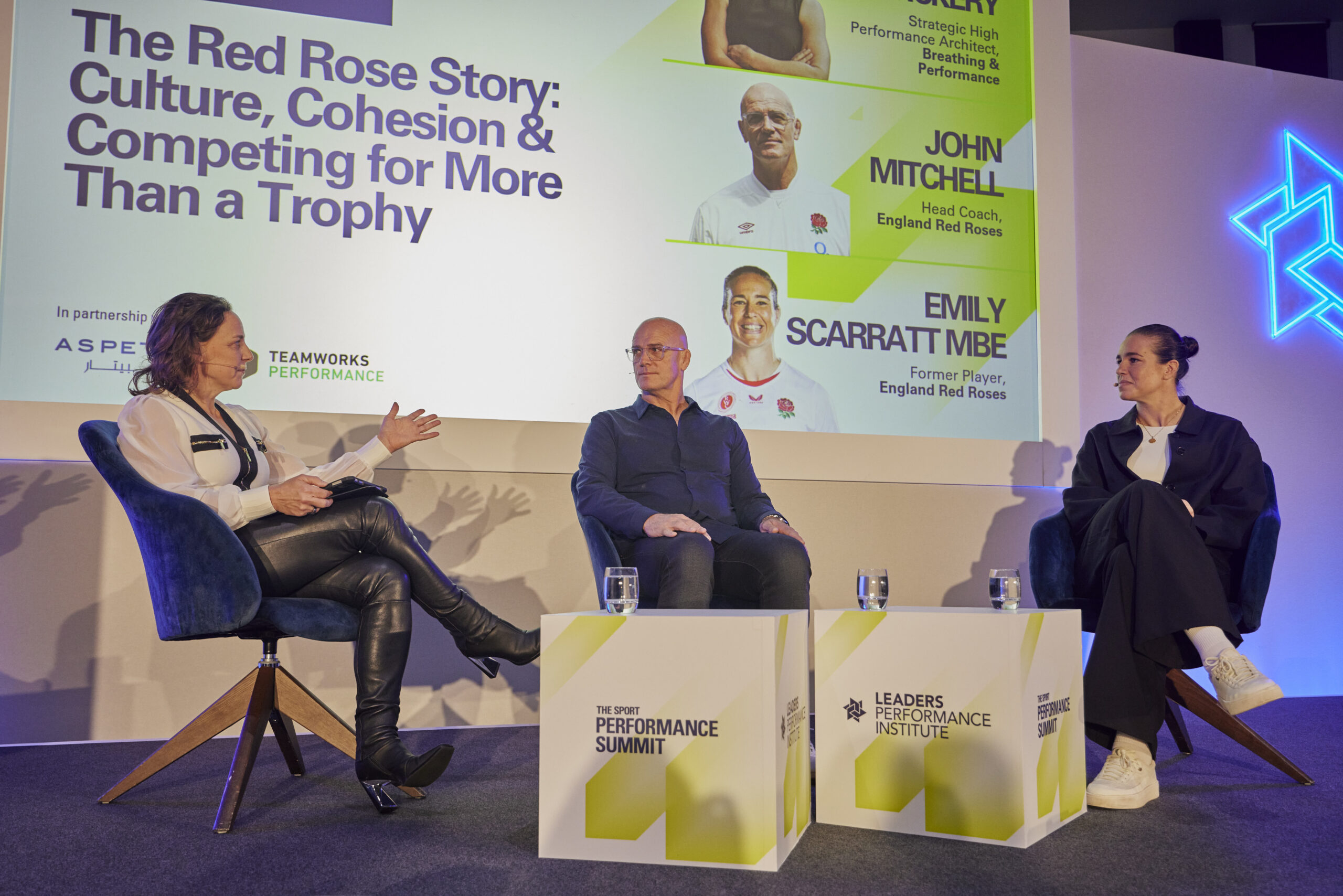
Rachel Vickery (left) talks to John Mitchell (middle) and Emily Scarratt (right) onstage at the 2025 Leaders Sport Performance Summit.
Here we reflect on what Mitchell and the Red Roses got right for 2025.
He spoke up when something wasn’t quite right
When Mitchell signed up to become England Head Coach in 2023, his remit was to win the World Cup. He was a coach with a proven track record in the men’s game who had now been handed the resources and the players to deliver the Women’s World Cup on home soil.
But in 2018 and 2022 England had lost World Cup finals they could, or perhaps should, have won.
“The leading question was how do we get done what we haven’t through the years?” said Mitchell.
It involved integrating young talent (eight players made their World Cup debuts against the US) and tactical tweaks (they had been too reliant on their maul). Both required an environment that enabled the best team on paper to prove they were the best team on grass.
To deliver on that front, Mitchell and the team’s leaders landed on three guiding values: ‘courage’, ‘take the handbrake off’ and ‘be all in’.
These values inspired England’s veterans and new internationals alike. “If the top person genuinely believes that culture is important it makes a difference,” said Scarratt. “Potentially in previous campaigns that hasn’t been the case and culture could get a little bit sidetracked or lost along the way.”
Mitchell even spoke up when he spied a shortcoming in the players’ well-meaning desire to ‘do it for the girls’.
“My thinking was that emphasis might be slightly calibrated towards ‘me’ – not intentionally – but how do I get the girls to calibrate towards ‘we’?” he said. “Because if I inspire you and I’m inspired by you, isn’t that more important, more inspiring to the person next to you? We get the job done and then our voice around our individual ‘why’ will be far greater.”
The cultural tweaking never stopped
“It’s very easy to just pick values, put them somewhere and hope that people live by them,” said Scarratt. “Our values were genuinely threaded through a lot of what we did, whether it was medical presenting or S&C presenting” and, when you witness that, “it’s very easy to buy-in”.
Mitchell held difficult conversations when necessary, but all players and staff, Scarratt said, were expected to speak up when necessary “to nip things in the bud before they became potentially bigger.”
At the suggestion of leadership consultant Patrick Marr, Mitchell would ask his player leadership group and support staff on the eve of each international camp to tell him “who’s going to pull the cart forward? Who’s going to sit on the cart? Who’s going to hold up the cart?”
After an hour he would “come back and I’d see two or three players, plus a couple of staff, where our priority needs to go,” he said, adding “we would then decide on who I would speak to and who they would speak to.” For every player or member of staff, there would be someone who could bridge that gap and “communicate around standards of behaviour”.
Mitchell even danced on TikTok when duty called
If you’re an England supporter, you may have seen the TikTok video of Mitchell dancing with his players.
“I needed to show vulnerability,” he said of such moments, which was not something he considered as a younger coach. “I had to do things that I probably don’t normally do and join in with the girls on certain things.”
Psychological safety may start with players or their head coach dancing in the dressing room, but it ultimately manifests on the pitch during tricky spells or in performance meetings when a staff member has the courage to raise a performance issue.
Mitchell knew he had to lead from the front. “Sometimes you’ve got to be the leader of those actions before somebody else does them.”
That said, his belief in the power of the head coach has been softened (and his self-awareness amplified) by three decades in the sport. “You learn through emotional intelligence that you don’t have to be absolute or right when making decisions. Just use your people. Listen to your people.”
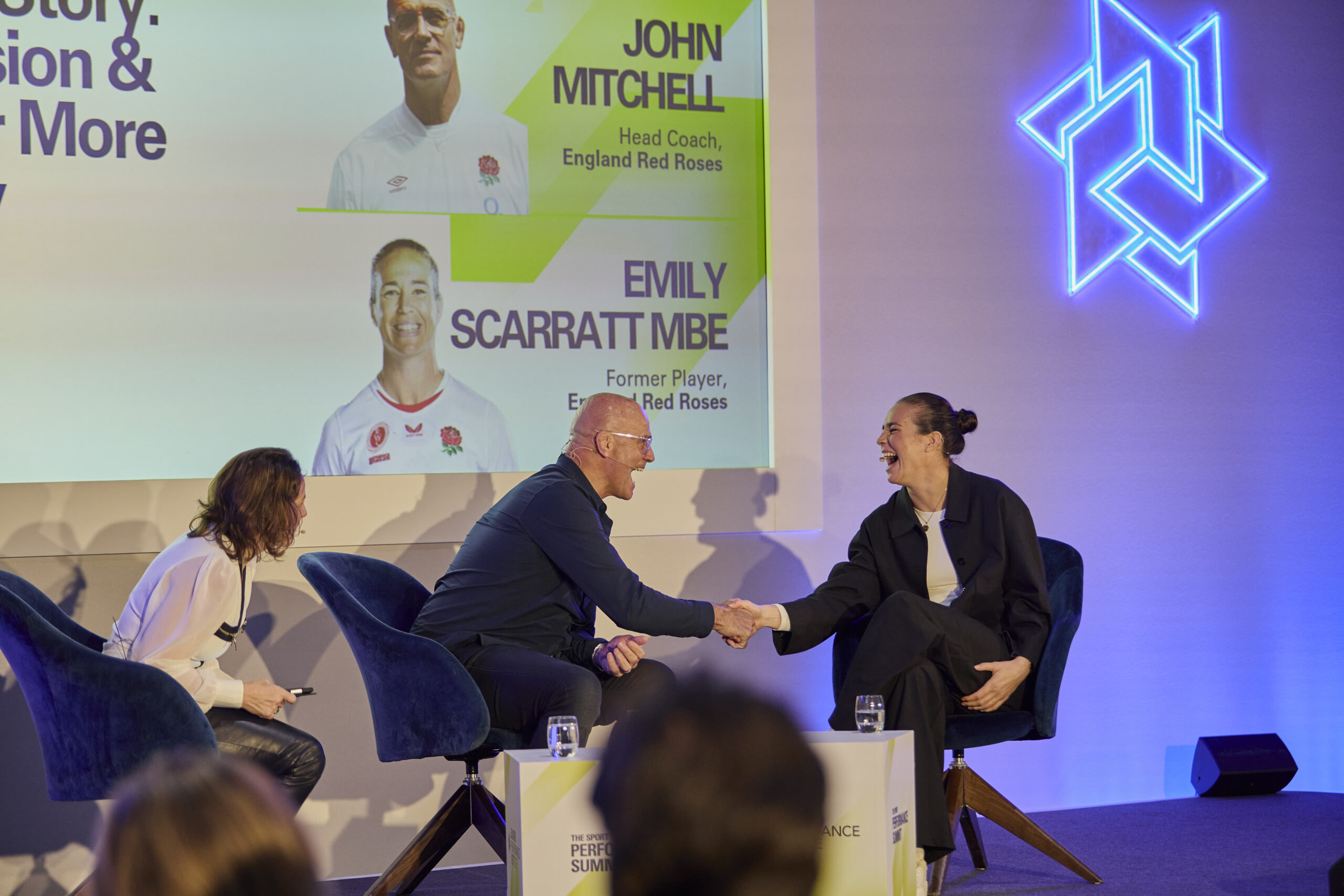
John Mitchell and Emily Scarratt shake hands as their session draws to a close at the 2025 Leaders Sport Performance Summit in London.
The team talked about the pressure they felt
For the first time, England openly spoke about winning the World Cup. It served as a pressure valve and, again, gave voice to their values.
“It might sound a bit silly but we hadn’t done that before,” said Scarratt, implicitly acknowledging how awkward the group felt at first about such an “un-English” sentiment.
As the English media and public latched onto the team ahead of the US match, the pressure grew. The players trained poorly on one occasion but, instead of dismissing it, they discussed it openly.
“I think we did a really good job of dampening it down by not not speaking about it,” Scarratt added. “By actually putting it out there and allowing people to know that other people felt like that.”
And Mitchell’s words after England eased through the gears on the opening night set the tone. He said: “There’s bigger games coming where teams will put even more pressure on us, so let’s take confidence from what we’re building and stacking as we’re going along. Our game doesn’t need to be perfect, it just needs to be effective, and that will win us the tournament.”
He was right and, looking to 2029, their goal is to win back-to-back World Cups, establish a legacy as one of women’s sports greatest teams, and to further grow the women’s game.
These lofty goals provoke three questions that Mitchell and England must answer: “What will earn the right? What will we keep and take forward with us? And then, thirdly, is what we what will we need to start again?”
What to read next
Meaning Does Not Guarantee Medals, But it Strengthens the Behaviours that Make Medals Possible