In a recent Leaders Virtual Roundtable, performance specialist Iain Brunnschweiler led a discussion on strategies more effective learning. We pick out ten below.
With those words host Iain Brunnschweiler, who runs the Focus Performance Consultancy, set the scene for a virtual roundtable discussion during which Leaders Performance Institute members shared the strategies that have facilitated better individual and organisational learning within their teams.
“There’s definitely something about learning being contagious,” he added in expectation. “If credible, valuable members of staff are going after things deliberately like you are, I’d hope that there’s some sort of contagion within your organisation.”
To start proceedings, Brunnschweiler outlined a four-part model of organisational learning. “This is an unpublished model,” he said of it. “This is the world according to me.”
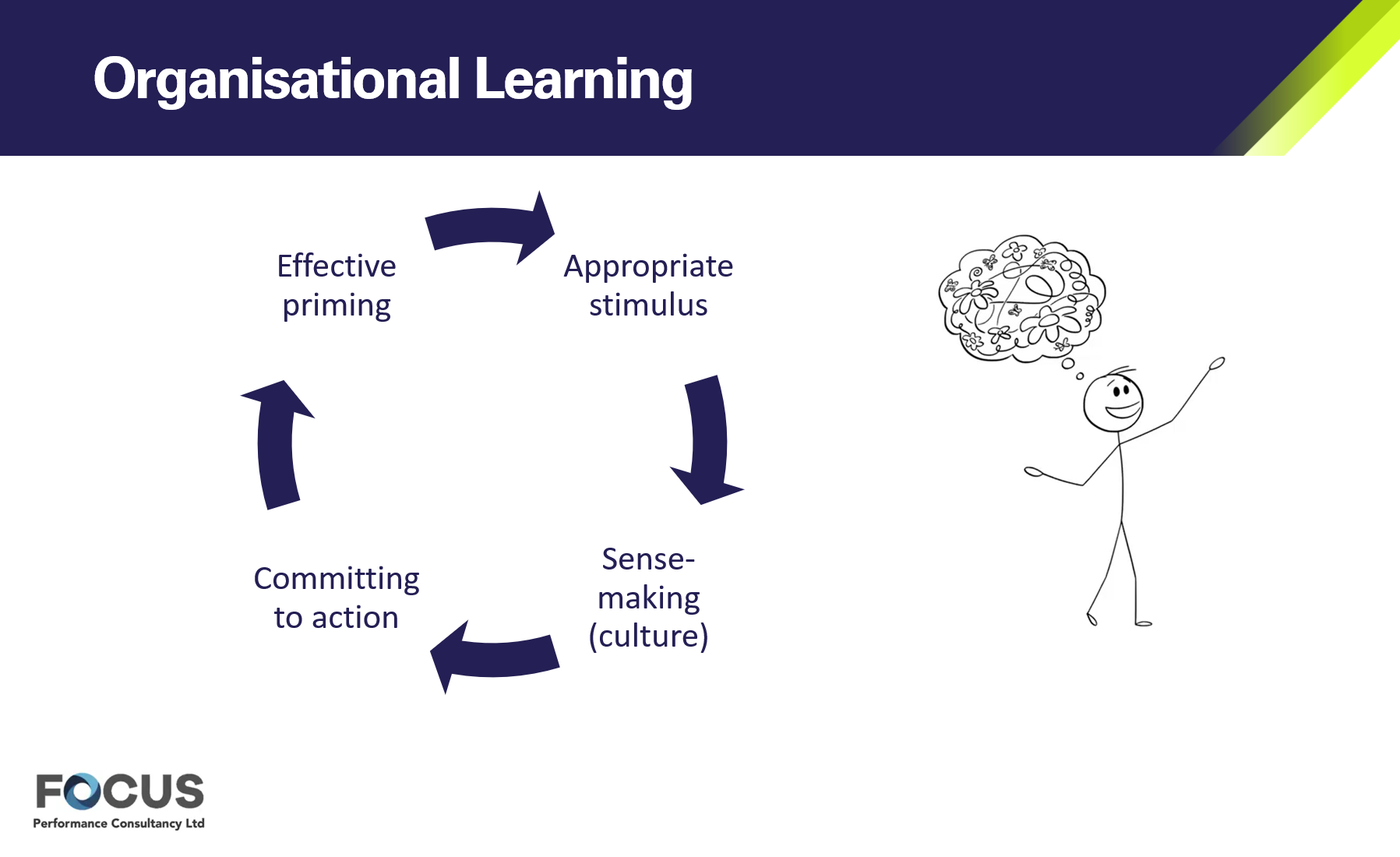
Effective priming
“How can we deliberately set people up for learning? That’s something that I’ve increasingly considered,” said Brunnschweiler, who highlighted one-to-one conversations with staff members as a way to identify their aspirations and their motivations.
Appropriate stimulus
“How do we provide a stimulus to create thought in aspirational people?” In a previous role, Brunnschweiler implemented weekly 30-minute meetings with staff members. He also enlisted external speakers and asked individuals to present on a teaching project.
Sense-making (culture)
“If within your organisational culture there are people and spaces that allow you to have conversations, check and challenge your thinking, that is a really good way of helping the learning to land,” said Brunnschweiler, while emphasising the cultural dynamic.
Committing to action
“Often,” Brunnschweiler said, “the greatest risk here is that we have a brilliant conversation, and then we do nothing about it’. How do we commit to something that’s going to make some sort of change, whether it’s small or large?”
The group then shared ten strategies to encourage more effective individual and organisational learning:
1. Give staff members the freedom to explore learning
“If we want to happy or we want to have happy staff, we need to give them some freedom,” said a sports scientist working in the major US leagues. “And if we want them to be free, then we have to encourage them to be courageous and pursue what they want to have and what they want to do.”
Brunnschweiler said:
“A learning culture starts with recruitment… can we keep shifting that culture by recruiting naturally curious and hungry people and maintain momentum.”
2. Hunger for learning must be role-modelled from the top
Often, staff members are eager to learn, as a psychologist working in the US college system observed, “but having leadership model this is so key”. Only then will staff members carve out the time, as he said:
“If your staff members don’t feel like they have the grace and space to allocate time in the day they’re going to say, ‘I have to do this,’ or ‘I have a meeting’ instead.”
3. Understand people’s motivations
If you can understand someone’s motivations or aspirations then you have an anchor for a conversation about their development. Brunnschweiler explained that it is important to focus on those who want to learn, not those who don’t. He said:
“Some people have little appetite for self-development. And I think we have to be cognisant of our own energy… and accepting of that fact.”
4. Create individual development plans for staff members
The aforementioned psychologist made a convincing case for staff IDPs. He said:
“We talk so much about player development plans, but do we truly have staff development plans, like, ‘here’s where you are, here’s where you can go, here are the gaps to be filled’?”
5. Place staff on secondments when possible
“We don’t put barriers in the way of our people going out on secondment,” said a director of cricket in the English game, where the season is not a 12-month schedule. This is, as Brunnschweiler observed, a cost-effective way of bringing IP back into the building. He said:
“How can we be resourceful? Can we create opportunities for people to visit places and return with knowledge without spending money?”
6. Find your critical friends
Sense-making can be difficult, but sometimes it just takes opening your phonebook. A call with a critical friend is what Brunnschweiler calls a “micro sense-making space”. He said:
“I’ve accrued a small network of people who, for example, when I’m driving, I just phone them up and I know they’ll challenge my thinking and that I’ll learn from that conversation.”
7. Learn from failures
“I’m far more interested in the failures,” said a physiotherapist at a globally renowned organisation. “When my team see me talk about failures, when things have gone wrong, that makes people listen a bit more; and I often think we should prep to fail. Are we ready to fail, so that if we fail, we can look back and say, ‘okay, we did everything we wanted to do?’” Brunnschweiler agreed, adding:
“It’s a good sign if you’ve lost and a staff team are reviewing and reflecting on it and they’re genuinely unpicking and they’re able to call each other out or go, ‘do you know what, I messed up today’. That is a real signature of a place that wants to get better.”
8. Importance of managerial vulnerability
Leaders can role-model learning, but they can also demonstrate vulnerability.
“If you can put your hands up and say, ‘I made a mistake’, that sets the culture, it sets the environment,” said a physiotherapist working in Australian sport. In building on that point, the physiotherapist from No 7 said:
“If we can guarantee that removal of blame, it will encourage us to talk about what we can learn.”
9. Job security
It sounds obvious, but managerial vulnerability goes hand in hand with job security.
“In a fast‑paced environment there is more chance of people getting sacked. I think this could be almost correlated to your hunger for learning,” said the physiotherapist based in Australia. “You might just sit there, be quiet, go insular, and just tick our day‑to‑day off – you don’t want to put your neck out there.” He has witnessed the impact of leaders reiterating that people’s jobs are safe.
“When you are told people aren’t just going to get sacked, it creates the environment for learning.”
10. Appoint a dedicated staff member for learning
“I’ve never worked somewhere that’s had a dedicated head of learning,” said an analyst working in Middle Eastern football. “It always falls on line managers and it’s hit and miss.” Brunnschweiler agreed and added:
“How does any organisation ensure that a PDR process is not just some tick-box exercise, but there’s genuine validity in what you’re going after, what you’re going to commit to, and then it’s followed up on?”
What to read next
Group Captain Emma Keith took to the stage to outline the RAF’s ever-adapting approach to bringing trainee officers up to speed.
“A lot of people hold up self-awareness as the holy grail. ‘I’m really self-aware.’ Brilliant. But it’s a complete waste of your time if you do nothing with that knowledge,” she said.
“Just imagine that I’m the kind of boss that says: ‘When I’m under pressure I can get really stressed and yell’ – I don’t think I am but let’s say that I am – it doesn’t help my team at all that I have that knowledge. What helps them is that I do something about that, which is the hard part.”
Keith, a Royal Air Force Group Captain, is the Commandant of the Tedder Academy of Leadership at the RAF. In 2015 she became the first woman to run RAF Officer Training.
A decade later, she stepped onto the stage at the 2025 Leaders Sport Performance Summit to run through her organisation’s strategies for effective learning.
The Leaders Performance Institute picked five that stand out.
1. The RAF promotes self-leadership
For the RAF, learning is not just about “absorbing information”, as Keith put it, but in establishing the right habits that enable learning. Self-leadership is at the forefront of their approach. It combines that aforementioned self-awareness with self-management. It also feeds into the idea that everyone in the RAF is a leader in their own right.
“Leadership at all levels really matters,” said Keith, who believes it would be all too easy for personnel in non-command positions to absolve themselves of responsibility. “I really don’t like the term ‘follower’. It needs a word in front of it; an engaged follower, a respected or intelligent follower. Nobody just follows, or at least they shouldn’t, and I don’t want someone in my organisation who isn’t a thinking follower. What we’re really talking about is a leader who’s leading themselves with followership skills.”
Character is critical too. “You can teach skills more easily than you can teach character,” said Keith, who is less interested in what a person has done than how they have approached their opportunities.
“For example, if somebody has an amazing profile but they were dropped off at every fixture at school; they were picked up and everything was handed to them, it’s not to take it away from them but I want to see more from that person. But the kid who got on a bus and travelled 40 minutes under their own steam to make hockey practice – that shows me something about their character.”
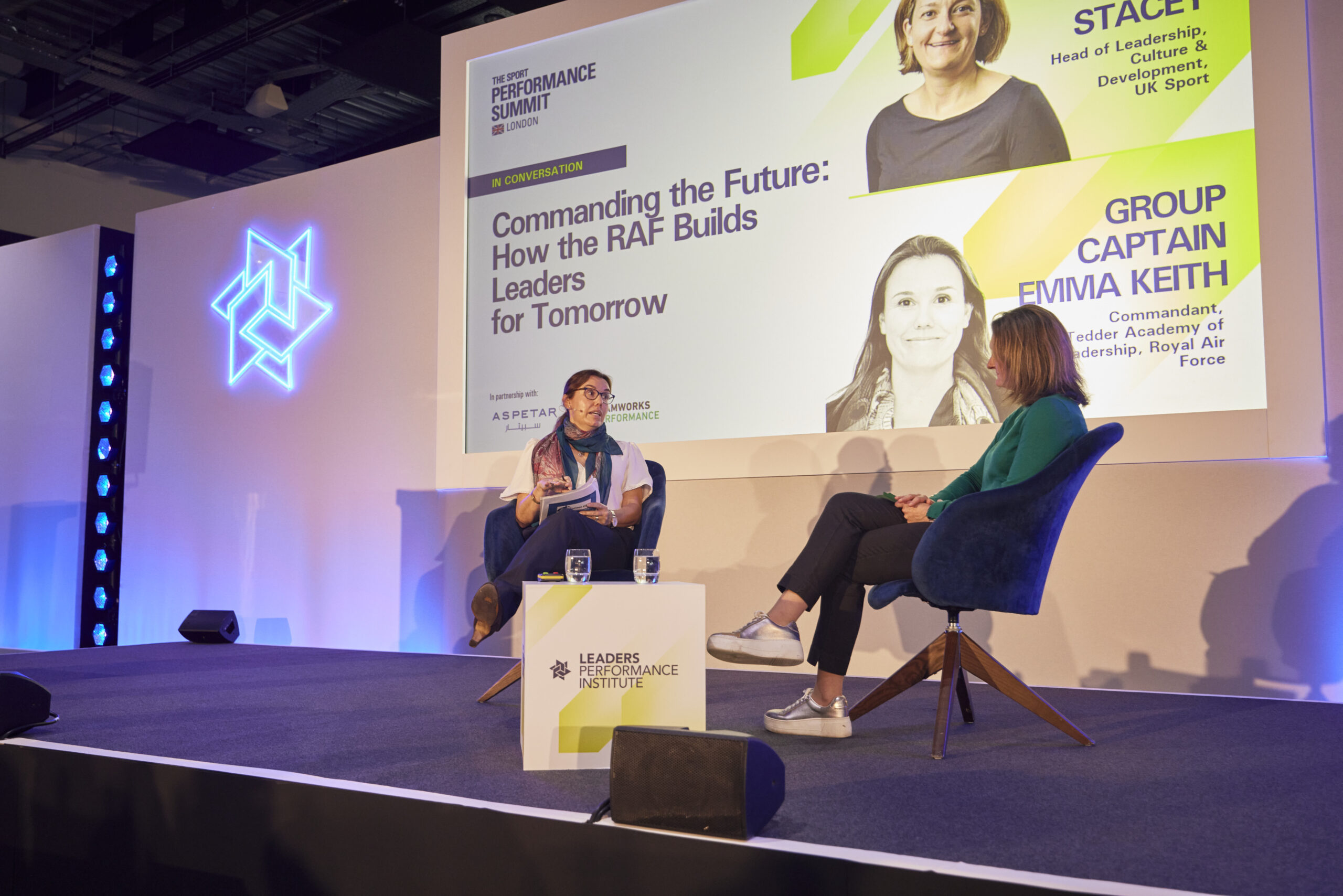
Emma Keith in conversation with Alex Stacey at the 2025 Leaders Sport Performance Summit at the Kia Oval in London.
2. The service positions its values as the ‘carrot’ rather than the ‘stick’
The RAF has a document entitled ‘Air Publication One’. “It’s not a very sexy name, I’m afraid,” said Keith. “Welcome to the military.”
Prosaic title aside, it sets out the RAF’s values of ‘respect’, ‘integrity’, ‘service’ and ‘excellence’. There’s nothing unique in those four – you probably have something similar within your teams – but the devil is in the detail.
Air Publication One is updated from time to time, with the last occasion being in 2019.
“Those updates covered more inclusive imagery and language,” Keith continued. “Thinking about my organisation, that’s probably not that surprising. But another major change that I made to that document, which came from my experience of running officer training, was to shift this from being the stick to the carrot.”
This shift was critical because too often the document was used to browbeat good people. “Actually 99% of my organisation are amazing, they really are, and I wanted a document that was aspirational for them, that they could believe in, that it was the organisation they wanted to be a part of. And we know from all the different behavioural models of change that it only happens when people want to change, not because it’s been forced on them.”
Everyone in the service is asked what these values mean to them. “Even the word ‘discipline’ means something different to me and a 17-year-old who’s just joined up. So, if they feel that they’ve been heard and listened and talked to, I think that’s really important.”
Air Publication One is currently undergoing further revision.
3. They use peer to peer storytelling
As Keith explained, she and her team produced an anthology and a series of videos detailing the stories of RAF personnel. These are not just nice-to-haves but critical learning resources.
She illustrated her point by referring to the ineffectiveness of a top-down approach with a recruit. “With the best will in the world, if I stand up there and tell them all the things they should do, they’re going to look at me and go, ‘thanks very much, Group Captain, you do not live my world, you do not know me and I’m going to switch off. Your lived reality is different to mine’.”
Instead, “if their corporal stands up and says it, someone who’s only a couple years ahead of them, that really is powerful. Who in your organisation can you help sell that message for you?”
4. They accept that learning never ends
The RAF used to approach leadership development for its aspiring officers as something to be taught in one hit. Today, the service adheres to a four-step pathway:
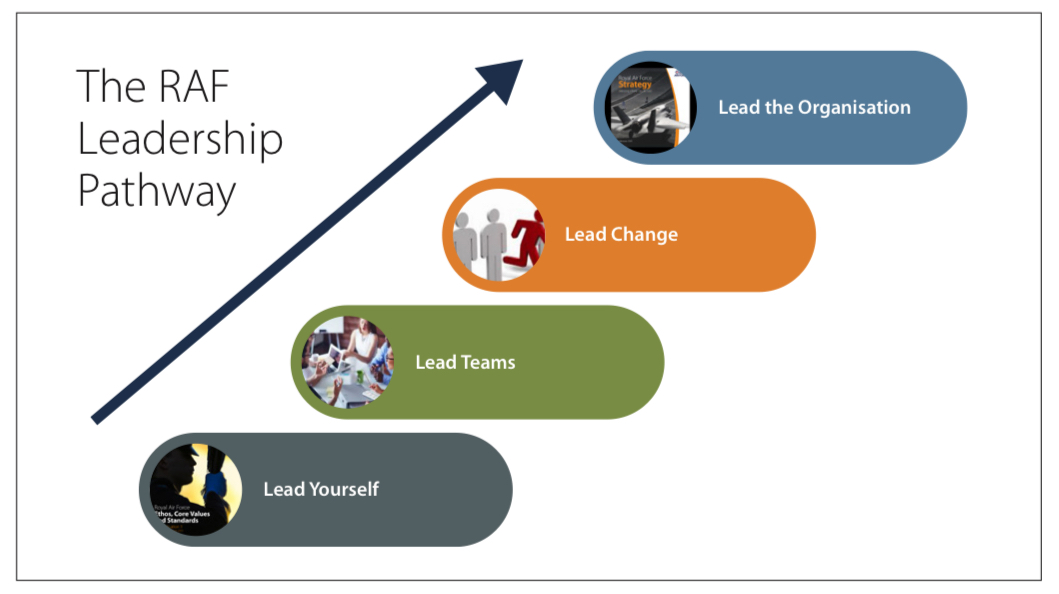
“We’re changing ‘lead teams’ to ‘lead others’ because not everybody has a team, but you lead by role model and example,” said Keith, who also highlighted the pathway’s non-linear nature. “The reality is you will be doing all of these things all of the time. The Chief of the Air Staff is still leading himself. You never stop that.”
She also encourages challenge from younger generations. “It’s about having humility on both sides to have those conversations. That’s where things like mentoring and reverse mentoring can be so powerful. It’s an exchange of ideas that can be so helpful. I mentor a lot of people and, honestly, every time I put the phone down or put the coffee cup down, I’ve learned as much as they have, if not more, I am absolutely sure.”
5. They leave the ‘how’ to their learners
Nestled at the heart of the RAF’s guiding principles is ‘mission command’, which refers to the empowerment of mission leaders.
“In simple terms this is the idea that the leader or whoever’s in charge of the task is set the ‘what’ and the ‘why’, but we really try and keep out of the ‘how’,” said Keith. “What you’re trying to give is as much freedom of manoeuvre for people on the ‘how’ as you can.”
If she needs a team to cross a river to rendezvous with someone on the other side, for example, she will let them decide the ‘how’ so that they are not reliant on returning to her for instruction should things go wrong.
“It allows a speed of decision-making, empowerment for that person. It operates on trust and it crucially frees up headspace for the person in charge. Another wonderful gift you get from that technique is innovation and creativity, because they will probably do things differently to you, which is potentially uncomfortable for you, but also probably helpful.”
More on effective learning strategies
Team culture, coach development and cartoons loomed large as we wrapped up 2025.
Here at Leaders Towers we were delighted to enter 2026 with Lando Norris newly installed as the Formula 1 world champion.
Several of us hope it will be the first of several world titles for the Brit, but my colleagues and I were also struck by the manner in which his McLaren Team Principal, Andrea Stella, spoke of Norris’ holistic development since finishing a distant second in 2024.
“He definitely learned a lot from last year’s mission, even though it didn’t go all the way to the last race,” said Stella in the aftermath. “There were some learning moments, like in Austria. That was tough.”
Stella referred to the moment when Norris collided with Max Verstappen as they vied for the lead at the 2024 Austrian Grand Prix. Norris would not finish the race; Verstappen claimed fifth position and a further ten points as he motored towards his fourth world championship. But Stella believed that something changed for Norris that day.
“I think Lando raised his self-image, along the lines of, ‘I can compete with Max’,” Stella added, warming to the topic.
“In my view, there was another important turning point this season: the way Lando responded to the difficulties at the start of the season. That was the beginning of a structured, holistic process that encompassed personal development, professional driving and racing craftsmanship. And I’m particularly pleased that Lando was able to capitalise on that because I haven’t seen anything like it in terms of the amount of work, the people involved and the speed of development.”
These utterances came just days after a Leaders Performance Institute Virtual Roundtable where members discussed holistic athlete development and alighted on some of the themes raised by Stella including athlete co-ownership, the convergence of performance disciplines, and the increasing emphasis placed on mental performance.
Members can read more here.
There was plenty more besides to engage our members’ during a busy December at the LPI.
Insight of the month:
“One of the things I see, certainly in the corporate world, is that people mistake ‘good’ for high performing. In my experience, genuine high-performing teamwork is much rarer than people would admit.
“We know what it feels like when a team is dysfunctional and something’s not working, but when a team is harmonious and there are fairly good relationships, people mistake that for being a high-performing team.”
The wise words of John Bull, the Head of High Performance at our friends Management Futures. Bull led a session looking at the elements that go into making a high performance team, from the building blocks needed to the human factors that can inhibit your progress.
Best advice:
“Listen to the system and the system will tell you what it needs. I think a large part of where culture can get derailed is where people don’t feel heard and valued.”
So said a performance support specialist from the Australian Olympic and Paralympic system at a virtual roundtable where members discussed how their team cultures are evolving.
They specifically referred to the potential resistance a leader may encounter from long-tenured staff or when dealing with rapid turnover. In any case, your people must feel you are listening to them.
Performer(s) of the month:
We’re within our rights to say Norris here, but December’s accolades go to Bluey Heeler and her friend Rusty.
The second half of that sentence may make little sense if you’re not familiar with the Australian children’s animated series Bluey, but one women’s international cricket team has inaugurated its ‘Rusty Award’ for the best teammate, a gong that is handed to a player at the end of every training camp or block.
“We used an episode to bring to life our ‘embrace change’ value,” said the team’s performance lead at the very same virtual roundtable.
Good to know:
Did you know there are four types of innovation?
That is according to renowned change management specialist Greg Satell and his model of innovation, which Professor Fabio Serpiello, the Director of Sport Strategy at Central Queensland University, shared during the second instalment of his three-part roundtable exploration of tech-supported innovation in sport:
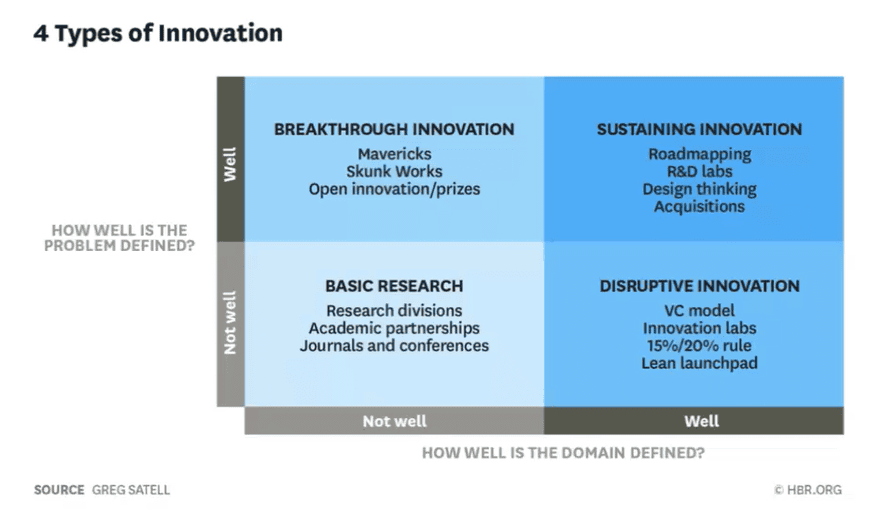
Serpiello then shared his thoughts on each quadrant:
Basic research – a low understanding of both domain and problem: “We don’t really know what the problem is and we don’t really know in which field or area it happens.”
Disruptive innovation – a well-understood domain but poorly understood problem: “In this area you may need something like innovation labs or launch pads.”
Breakthrough innovation – a poorly understood domain but well-defined problem: “This is the reverse of disruptive innovation… the classic example of open innovation.”
Sustaining innovation – a well-understood domain and problem: “The most common form in sport [and often the subject of] continuous research, design thinking or road mapping.”
Members can read more here.
Startling fact of the month:
Serpiello was back at it in the third and final session of his series with further reflections on our 2025 Trend Report.
The report posed the question: do you have a process in place to make sure that the tech you implement is the right one?
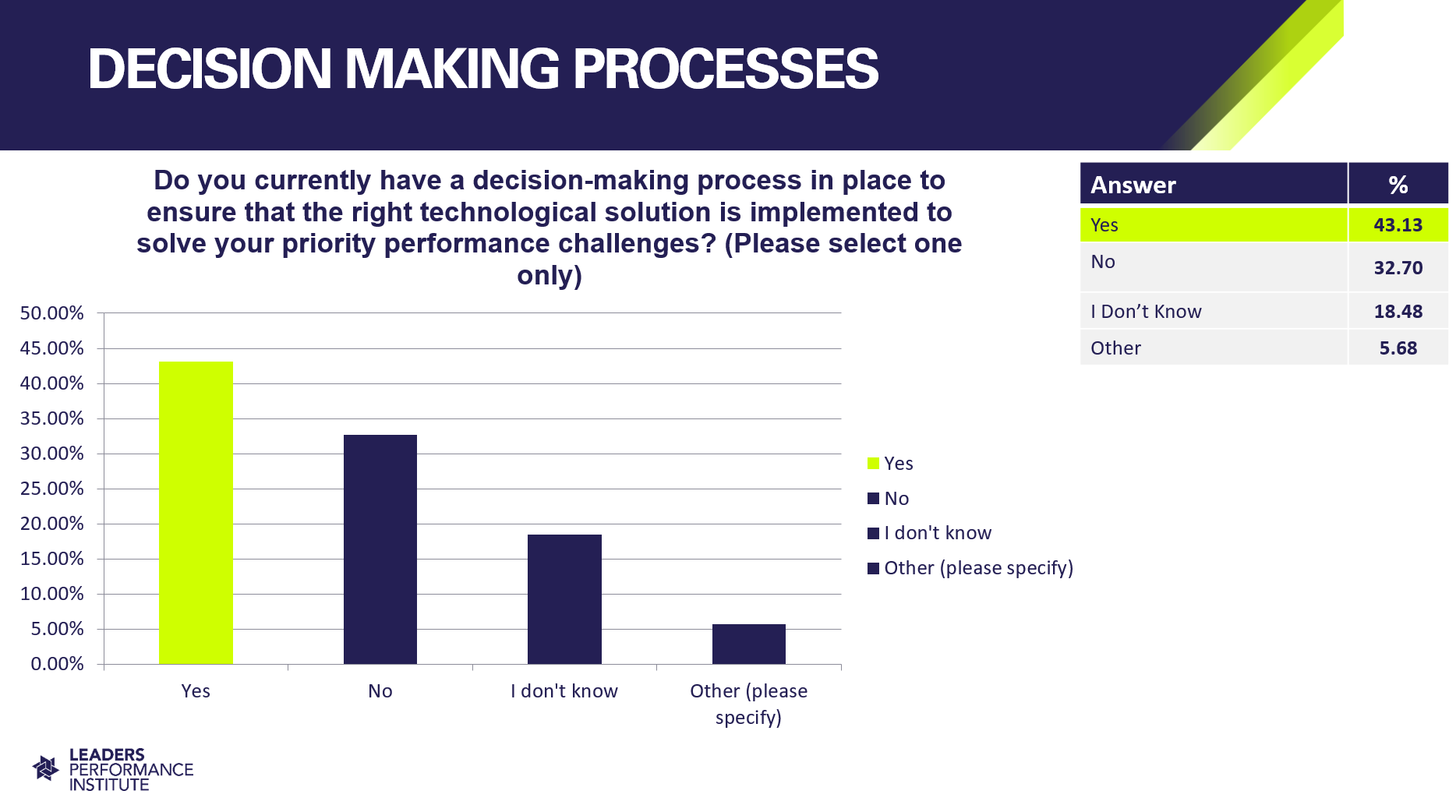
Fewer than half of respondents said ‘yes’, with more than a third saying ‘no’. Curiously, nearly 20 percent said ‘I don’t know’.
“That’s a good chunk,” said Serpiello. “It is probably more interesting than the ‘yes’ and ‘no’ given that most of the people that responded are at the ‘head of’, ‘director of’ or ‘vice president of’ level.”
What followed was an exploration of what a thorough and considered process of procurement should include.
One you might have missed:
Jamie Taylor, an Assistant Professor in Elite Performance at Dublin City University [DCU], used a virtual roundtable to explain to members that coach development too often veers towards less direct practices.
“Similar to what we see in coaching, there has been a view that it’s inappropriate to offer more direct pedagogical approaches,” said Taylor. He believes this is a consequence of sport being influenced by executive coaching practices and adult learning theory. Yet coaching is not C-suite work.
Supported reflection and communities of practice can be useful, but there are limitations. “If the coach hasn’t got the knowledge to reflect, or the coach developer doesn’t have a strong pedagogical capacity, then it can end up being just a nice coffee and a nice chat.”
Read more about the challenge of raising coaches from merely ‘competent’ to genuinely ‘expert’ here.
Finally…
A photo record of the best bits of 2025 at the Leaders Performance Institute.
What’s coming up in January for members:
Check out your 2026 virtual learning calendar at:
John Bull of Management Futures says it as he sees it, but stresses that all teams can improve their teamwork.
“One of the things I see, certainly in the corporate world, is that people mistake ‘good’ for high performing,” said the Head of High Performance at Management Futures. “In my experience, genuine high-performing teamwork is much rarer than people would admit.
“We know what it feels like when a team is dysfunctional and something’s not working, but when a team is harmonious and there are fairly good relationships, people mistake that for being a high-performing team.”
He presented this distinction between dysfunction and high performing as different ends of a continuum:
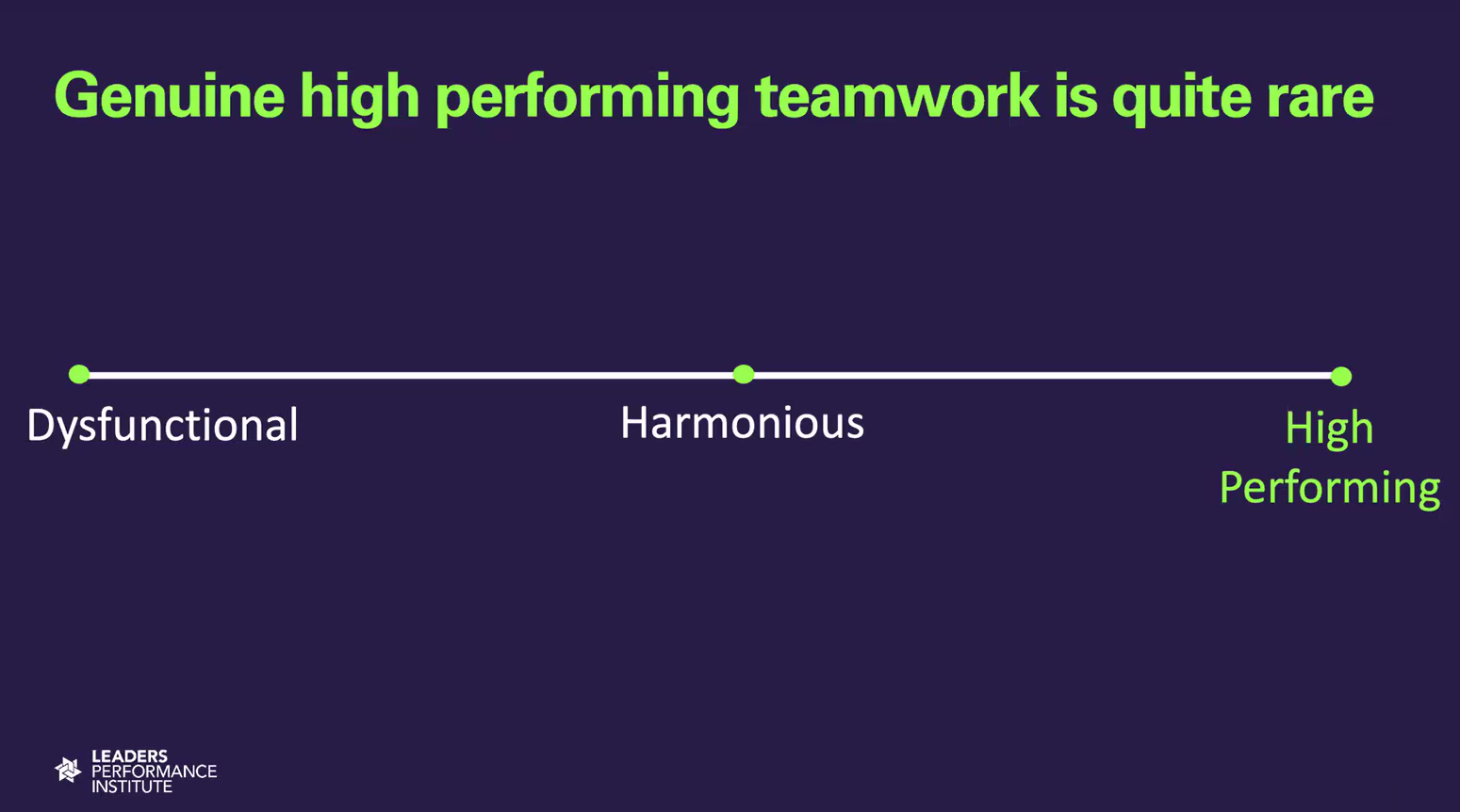
“In order to get to the right-hand side of this continuum, high-performing teamwork requires people to lean into behaviours that don’t come naturally,” added Bull.
He then explained that there is also a risk in over-collaborating. “This is about quality not quantity. Our efforts to get more out of teamwork can sometimes slow down performance.”
There is also a distinction between working within a ‘stable team’ (e.g. a department within a high performance team) and teamwork across boundaries, between people who rarely work together or don’t see themselves as one team (e.g. business and performance functions).
The aviation industry, Bull said, excels at cross-boundary teamwork.
“If you think about when you have a critical incident while flying, you’ve often got people in the crew who don’t know each other. The crew must collaborate with air traffic control on the ground, and they won’t know them,” he continued. He explained that the industry has long valued listening and speaking up.
It has also placed an emphasis on ‘diamond thinking’, which looks like this:
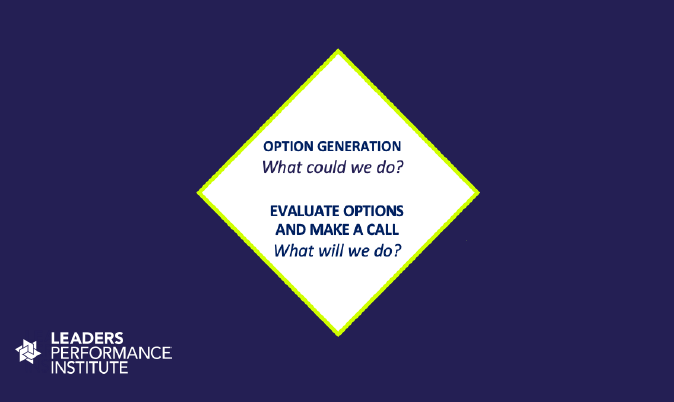
“In aviation, when you have to solve an issue, as a rule of thumb, you should spend 50 percent of the time opening the diamond up,” he said. “You get a lot of input but you’re then clear on who’s going to make the final call. Some of us in the coaching space struggle with the balance between democracy and a leader making a decision. Diamond thinking allows for that.”
Bull then led the table into a discussion on his four building blocks of team performance:
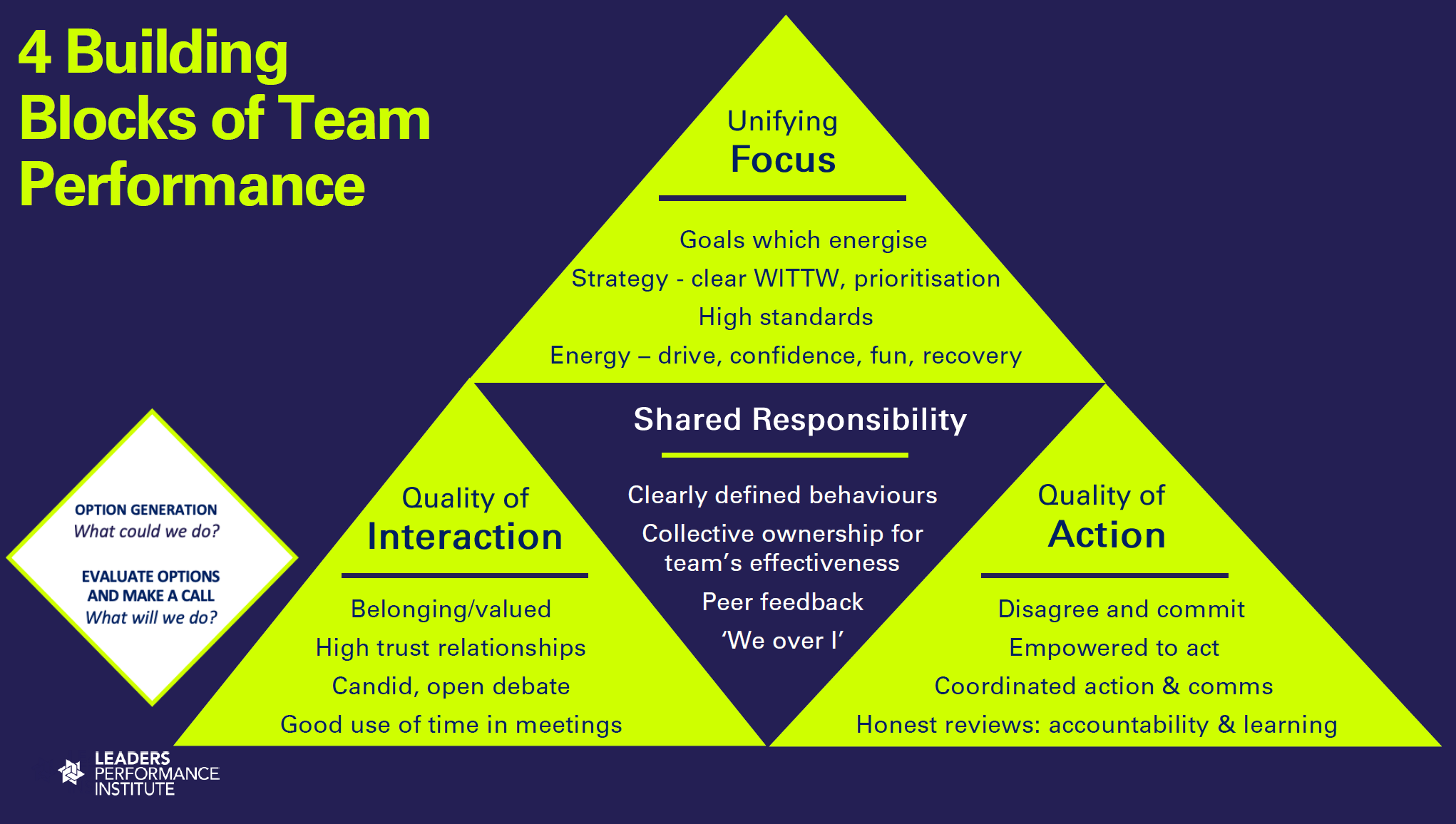
He explained each in turn and their different elements.
1. Unifying focus
“If you don’t have clarity you can’t create any of the other conditions.”
2. Quality of interaction
“Trust enables us to lean into more uncomfortable conversations and have the real performance conversations in a way that doesn’t put those relationships at risk.”
3. Quality of action
“High-performing teamwork emerges when people go for the gap.”
4. Shared responsibility
“It’s getting people to recognise that when the team’s not performing they should feel empowered to step in and say something about it and not just rely on the team leader.”
As a follow on, Bull highlights six human factors that can serve to inhibit team performance:
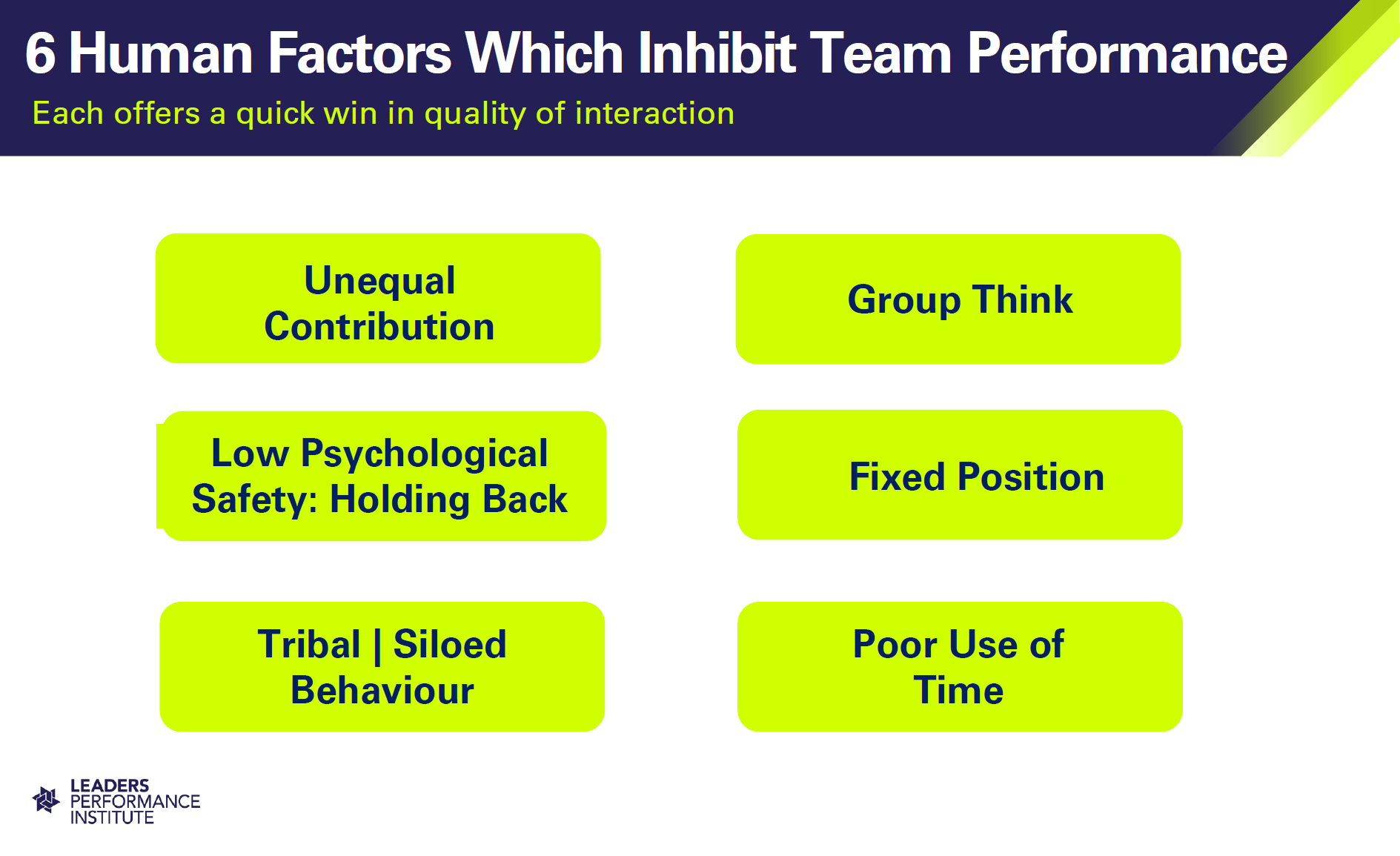
Again, he shared his thoughts on each:
Unequal contribution: “We know from research that if you have a group or a team of eight people 70 percent of the contribution will come from two or three… Status and personality has more of an impact on who speaks than who knows stuff, and that should scare you as a team leader.”
Groupthink: “It’s a hardwired principle of how our brains work that we will conform to the thinking of the group if we don’t have a strong view… One of the best ways to combat groupthink is to get people to think individually before a group discussion.”
Low psychological safety: “Probably the biggest thing that kills team performance is a lack of psychological safety.”
Fixed position: “One of the things that hurts psychological safety the most is defensiveness, where people are in a fixed position. The way you deal with the fixed position that I’ve seen work best is to deal with it one-to-one.”
Tribal or siloed behaviour: “We’re wired as humans to be tribal and there are two types of tribal behaviour. One is where you are deliberately trying to beat the other. What is much more common is you’re not competing but you just don’t think about the other ‘tribe’ as much.”
Poor use of time: “Humans tend to be pretty bad at how we use time together in groups. A quick win is to get the team thinking about when we had our best team meeting, what was it about that, what’s getting in the way of it.”
Bull then returned to the themes of psychological safety and fixed positions when sharing and describing the three types of “thinking environments” in groups and teams as revealed by Management Futures’ research:
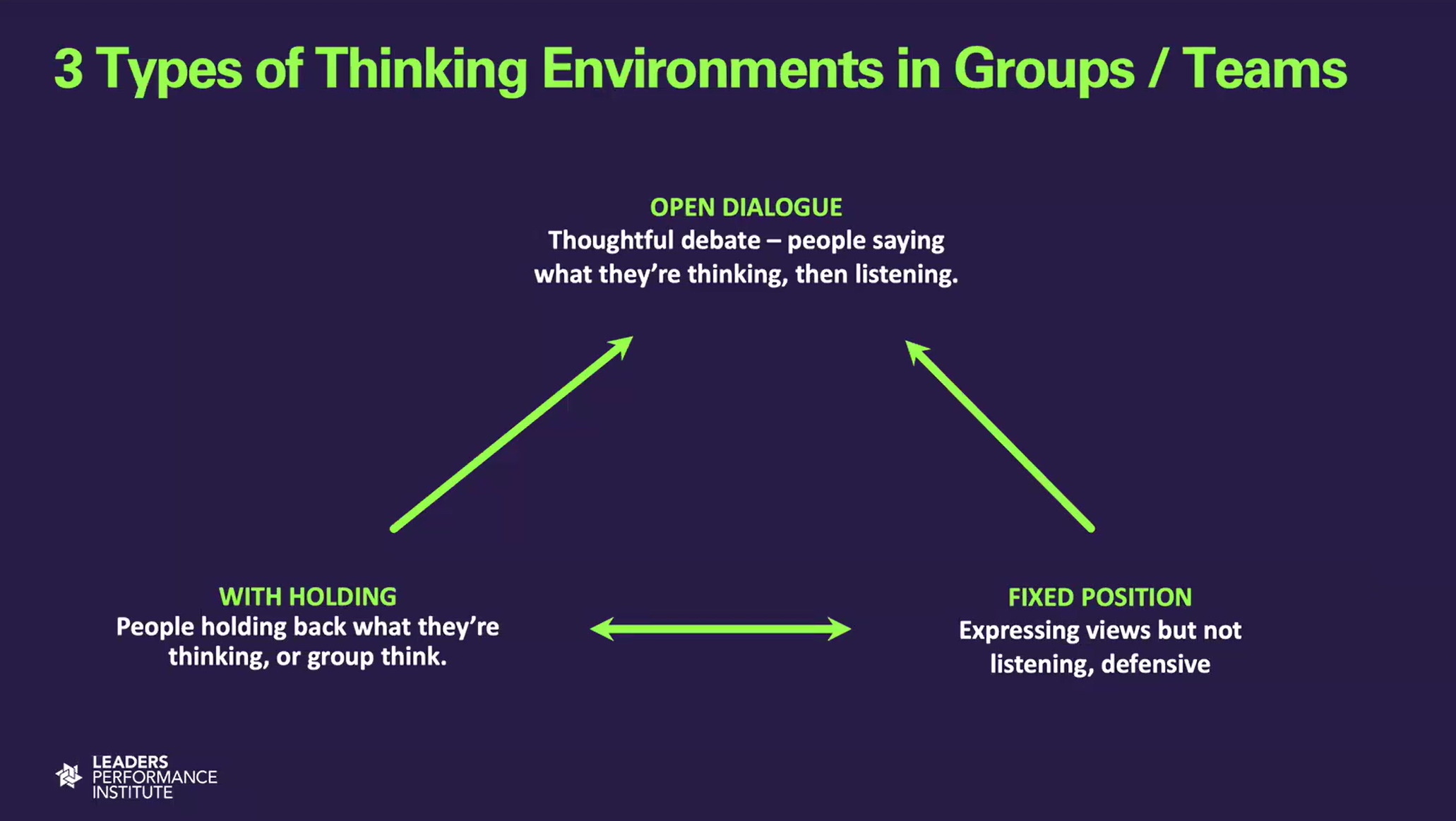
“The bottom two points are ineffective,” said Bull. “The definition of open dialogue is where people are saying what they think, but as soon as they’ve put their view out they’re inviting disagreement. It’s not about trying to win the argument, it’s about trying to get to a collective insight of what we know as a group. It’s very different to trying to influence colleagues.”
With time running out, Bull shared a final slide highlighting four key skills to encourage collaboration, with a series of questions for members to ponder: 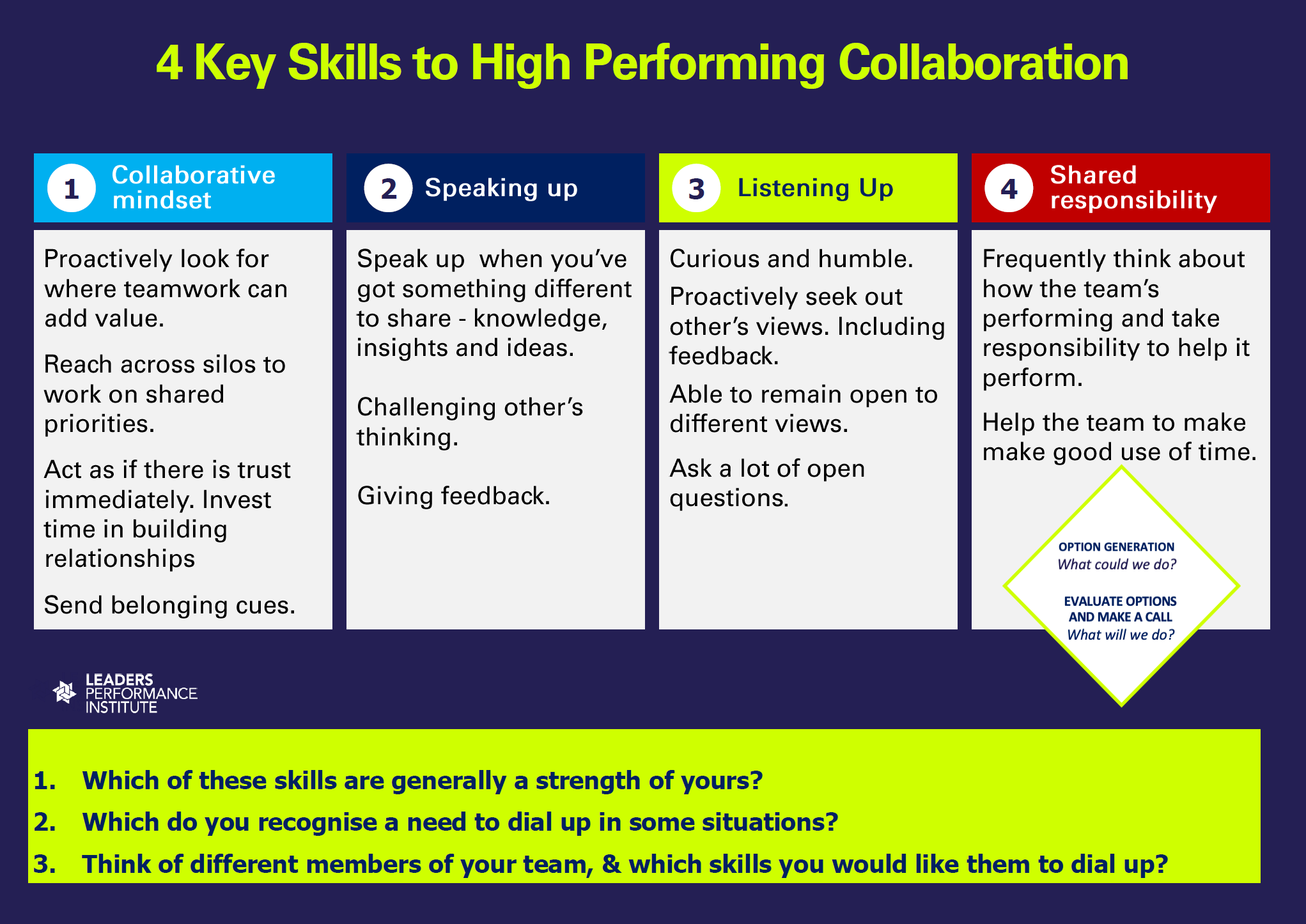
Team standards, the price you pay for poorly delivering feedback, psychology and innovation have all been on the Leaders Performance Institute agenda these past two months.
Michael Maguire’s team were behind at half-time in every game of the finals series but came back to beat the Canberra Raiders (the minor premiers) in the qualifying and elimination finals; they over-turned another half-time deficit to beat the Penrith Panthers in the preliminary finals; and lightning struck thrice in the Grand Final when they faced a 22-12 deficit at the interval.
“I didn’t have to say too much at half-time. I just said to them ‘your best half is about to come’, because we have come from behind over the last month. I said if you go and do that, we win the game,” said Maguire – a former speaker at the Leaders Sport Performance Summit – after the Grand Final.
This was a team whose belief in their ability was forged in adversity. Maguire stuck by his players at tricky moments during the season. At times, following a run of poor results, it seemed unlikely that the club would challenge for its first NRL premiership since 2006.
“I remember Madge’s passion and him sticking up for us midway through the year when we were getting rinsed through the media about the way we go about things, but the care he has for us, no one knows outside the club,” said fullback Reece Walsh.
“The way he looks after us as people, the way he looks after our partners, there is nothing more we could ask for. He demands a lot, as he should demand a lot – we have just won a comp.”
Both Maguire and Walsh hint at the ingredients for high performance – empathetic leadership, high standards and mutual trust – that underpinned the agenda at the Leaders Performance Institute in recent weeks.
Below, we give a flavour of the conversations that commanded attention during that time.
‘The standard you walk past is the standard you accept’
Maguire was in attendance at the Leaders Sport Performance Summit in November where the Broncos appeared onstage courtesy of General Manager Troy Thomson.
We also heard from rugby’s other code, rugby union, as England’s former fullback Emily Scarratt and Red Roses Head Coach John Mitchell explained how the Women’s Rugby World Cup was won; before that, Johann van Graan delved into the transformation he led at English Premiership champions Bath Rugby.
Nestled in between was an inspired presentation by Emma Keith, a group captain, who is the first female to run Royal Air Force officer training.
Hers, much like Maguire’s, was a message of empowerment rooted in accountability and care. She said:
“The standard you walk past is the standard that you accept. That can be poor infrastructure that you don’t report; it could be poor behaviour. If you walk past it, you’re saying it’s okay. And that’s a slow rot from within.”
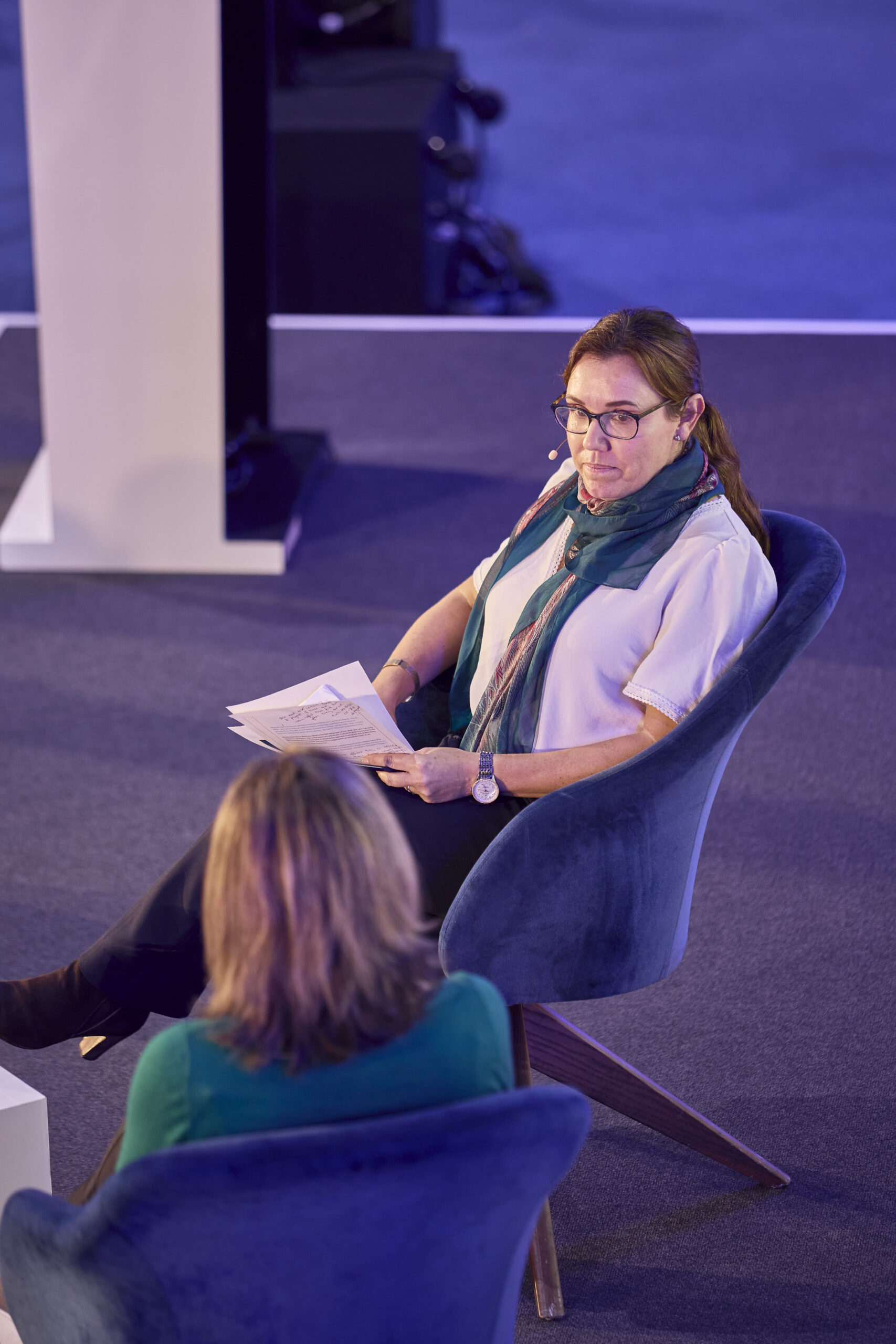
Group Captain Emma Keith talks to UK Sport’s Alex Stacey following her presentation on officer training in the Royal Air Force.
Read more from the summit here.
The price you pay for poorly delivering feedback
“In terms of feedback, we’re quite basic creatures,” said Simon Eastwood. “We will react and respond instinctively to what we perceive as threat or reward.”
As Eastwood, the Head of Leadership Skills at Management Futures, explained, the wrong word, tone, timing or even body language from a coach can trigger a negative reaction when giving an athlete feedback.
Eastwood hosted a virtual roundtable aimed at helping coaches and practitioners to improve how they deliver feedback.
He shared a number of tools on the day, including the SCARF model.
This framework, devised by neuroscientist David Rock, explains five domains that influence human social behaviour and motivation. SCARF stands for:
“It’s a great tool for stepping back and assessing your team and thinking about what really makes them tick,” said Eastwood. “Crucially, it’s not about avoiding that feedback.”
He suggested that leaders should reward these needs through feedback, so people feel valued and motivated rather than threatened and, to illustrate his point, presented a table that set out what ‘threat’ and ‘reward’ may look like in each domain:
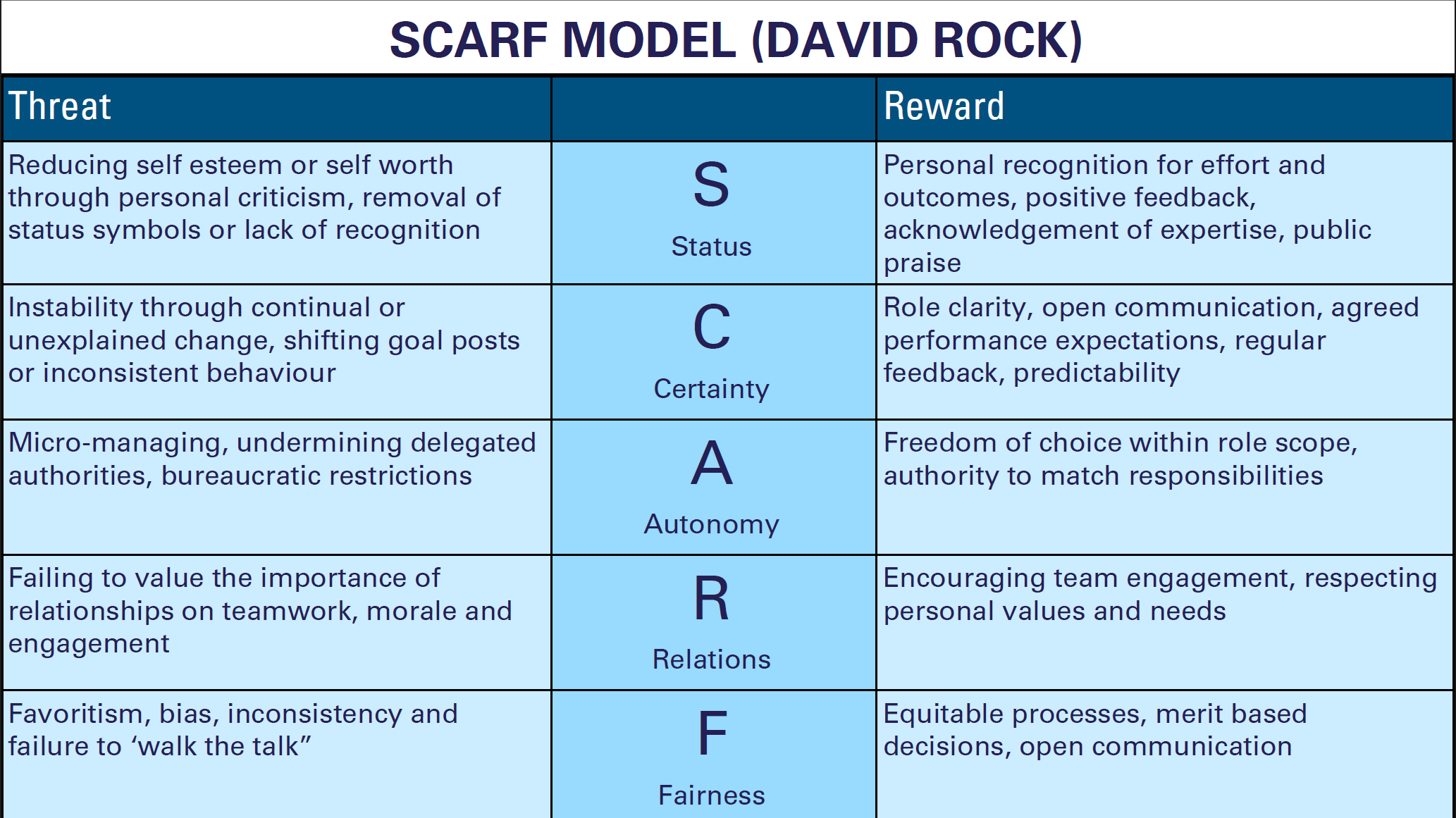
Eastwood then posed a question: “When giving positive feedback, which elements do you find most need to be reinforced?”
Leaders Performance Institute members can read more here.
The evolving work of the psychologist
Elsewhere, Dr David Fletcher, a Professor of Human Performance and Health at Loughborough University, and Dr Danielle Adams Norenberg, the Head of Psychology at the UK Sports Institute co-hosted a roundtable on the evolving role of the psychologist.
They outlined two ways in which a psychologist may be a useful asset for the head coach:
1. The development of the coach’s leadership skillset
A psychologist, Fletcher explained, can help a coach to develop their “time management skills, body language, and communication skills” in the pursuit of better performance.
By the same token, psychologists have been instrumental in facilitating a shift from deficit-based to strengths-based coaching. Adams Norenberg said: “Even if planted within a very generic training session, athletes have the self-awareness, knowledge and autonomy to make the most out of their training session by focusing on developing their strengths.”
2. The development of their psychology skills
Psychology is another string in a coach’s bow. If they understand the types of pressures that athletes experience they can “choose a particular training session to not necessarily develop technique or tactical skills, but psychology skills.” Adams Norenberg cited the example of the VR headsets used in training by Team Europe ahead of the 2025 Ryder Cup. Some players simulated the spectator abuse they would endure at Bethpage Black; others used it not for pressure training but relaxation, such as the Norwegian Viktor Hovland, who recreated the fjords of his homeland.
Leaders Performance Institute members can read more here.
True innovation must have an impact… but what is innovation?
Fabio Serpiello, the Director of Sport Strategy at Central Queensland University, posed this very question at a recent virtual roundtable.
He argues that teams should alight on a shared definition; one that does not conflate the concept with ‘creativity’. (Creativity, as Serpiello explained, is the outcome of an ideation phase, while innovation covers the execution and eventual impact of an idea.)
Then, he made the case that when teams have an agreed definition of what ‘innovation’ means to them then it offers a “clear way to approach and analyse whether the innovation processes in your organisations work or not.”
Greg Satell’s Model of Innovation
Innovation, Serpiello argues, also comes in several shapes and forms depending on the nature of the problem. To make his point, he introduced renowned change management specialist Greg Satell’s Model of Innovation, which provides a practical framework for introducing innovative practices, encourages strategic thinking about problems and helps to facilitate better collaboration.
He presented a diagram of Satell’s model to the table:
Serpiello then shared his thoughts on each quadrant:
Basic research – a low understanding of both domain and problem: “We don’t really know what the problem is and we don’t really know in which field or area it happens.”
Disruptive innovation – a well-understood domain but poorly understood problem: “In this area you may need something like innovation labs or launch pads.”
Breakthrough innovation – a poorly understood domain but well-defined problem: “This is the reverse of disruptive innovation… the classic example of open innovation.”
Sustaining innovation – a well-understood domain and problem: “The most common form in sport [and often the subject of] continuous research, design thinking or road mapping.”
Leaders Performance Institute members can read more here.
At the 2025 Leaders Sport Performance Summit, some of the most respected leaders in high performance set out their plans to build the winning teams of the future.
The South African, then with Munster, had agreed to become the Head Coach at struggling Bath in December 2021.
A few days later, he switched on the TV only to see Bath go 0-28 down after just 25 minutes of their Champions Cup tie with Leinster.
It prompted the Everest comment, as Van Graan told an audience at the 2025 Leaders Sport Performance Summit at the Kia Oval in London.
He eventually took the reins at Bath’s Recreation Ground in July 2022 and, over the next three years, led one of the most remarkable transformations in English rugby history.
In May, Bath lifted the European Challenge Cup, Premiership and Premiership Rugby Cup.
The tale of Van Graan’s ‘Rec Revolution’ set the tone for an international gathering of over 300 high-performance leaders to share knowledge, best practice and inspiration.
The agenda took its lead from our Trend Report in which more than 200 performance leaders from almost 40 sports told us how they expect the industry to develop in the years ahead.
Five trends stood out:
Van Graan is at the vanguard of several of these trends and, across both days, the Leaders Performance Institute delivered a range of guest speakers from organisations including England Rugby, the Royal Air Force, and the Haas F1 team to speak to each trend.
The following is a snapshot of what they said.
1. Alignment is now a competitive advantage
For evidence of the stock placed in being aligned, look no further than Bath’s transformation from a rabble to the best team in England in just three years.
Van Graan said: “I put up a picture of Twickenham on the very first day. I said ‘I can’t tell you how we’re going to get there, but we will get there.”
He wanted his playing group, coaches and other performance staff to coalesce around three values: connection, clarity and commitment. The trick was then bringing those to life.
Johann van Graan
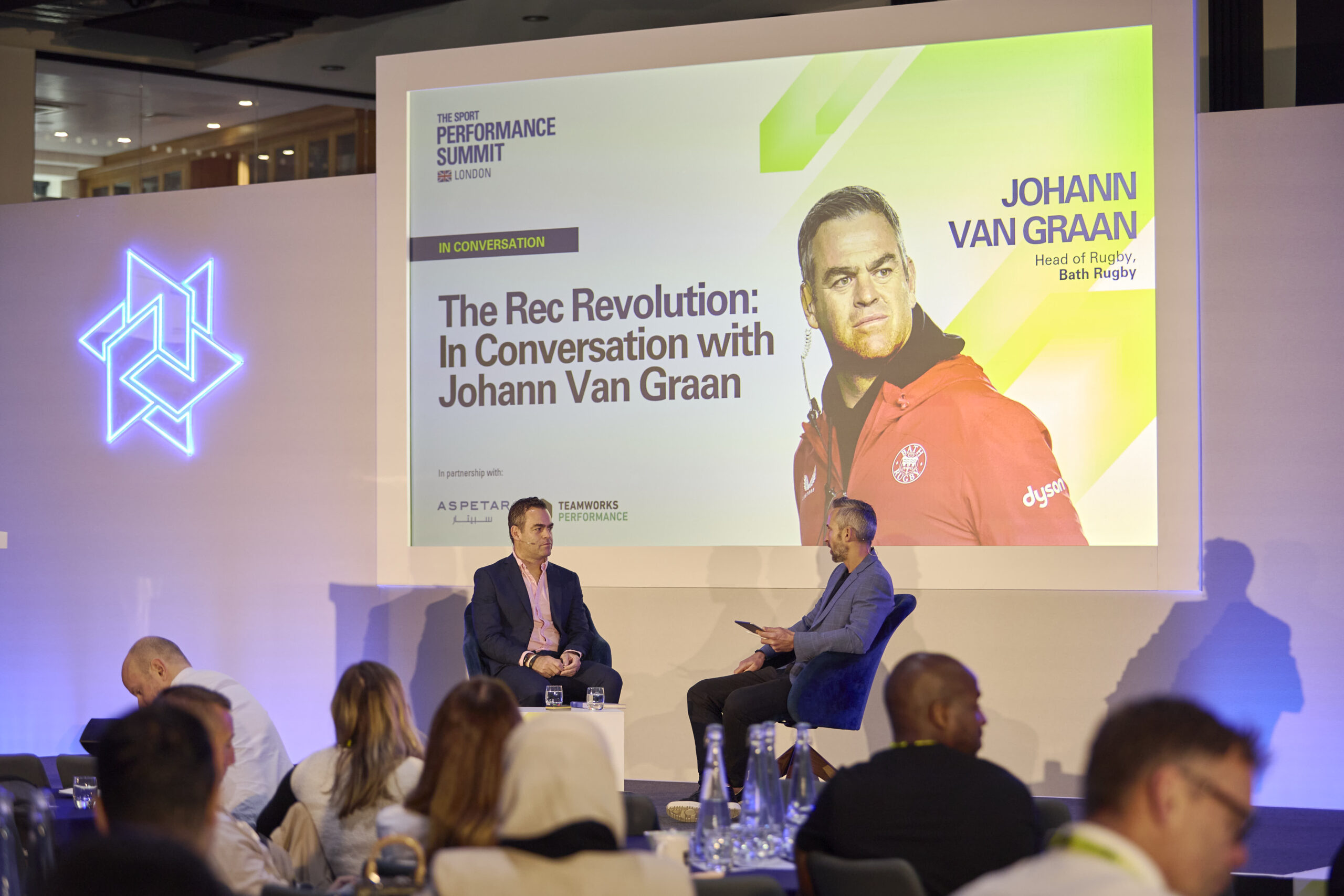
Bath Head Coach Johann van Graan in conversation with host Iain Brunnschweiler.
2. Leaders increasingly seek to empower and collaborate
John Mitchell offered another inspiring story from the world of rugby union.
In 2023, when he signed on as Head Coach of the England women’s national team, it was Mitchell’s first time coaching a women’s team.
The Red Roses had a genuine shot at winning the Women’s Rugby World Cup on home soil in 2025, but a talented team needed an experienced guiding hand.
The team delivered, with Mitchell receiving plaudits for his role as England secured their first world title in 11 years.
Two months on from that achievement, the audience found Mitchell (affectionately known to his peers as ‘Mitch’) in typically reflective mood alongside the recently retired Emily Scarratt, who was part of the Red Roses’ winning squad.
Sport (and rugby union) grows ever more complex and yet, after 30 years, Mitchell feels he has never been better equipped to coach.
“You don’t have the full scope,” he says of his early coaching days in the mid-90s. “You have strengths early on that are recognised but then also you sometimes don’t know the whole of yourself. So you take the time to understand the whole of yourself.”
He came to a critical understanding. “When I was younger, I was going to try and be right. Maybe I was trying to prove myself as a coach.”
John Mitchell

England Red Roses Head Coach John Mitchell shakes hands with former England fullback Emily Scarratt at the conclusion of their panel session.
Emma Keith built on the theme of empowerment in her presentation on officer training in the Royal Air Force.
“Cultures and environments can only grow when everybody takes accountability,” said the Commandant of the RAF’s Tedder Academy of Leadership. Keith, a group captain, is the first female to run RAF officer training.
Emma Keith
Group Captain Emma Keith talks to UK Sport’s Alex Stacey following her presentation on officer training in the Royal Air Force.
3. Teams are prioritising resourcefulness over resources
As Team Principal of MoneyGram Haas F1, Ayao Komatsu knows as well as anyone that his team is competing with better resourced and more illustrious teams.
The team has 375 staff members, which may sound like a lot, but it pales in comparison to the likes of Ferrari, Red Bull and McLaren.
“If we cannot work together, if you’re not supporting each other, if you’re not aligned, we’ve got zero chance against organisations minimum three times our size,” said Komatsu, who had just flown in from the Brazilian Grand Prix in São Paulo where Haas’ Oliver Bearman achieved a creditable top-six finish the weekend before the summit.
Ayao Komatsu
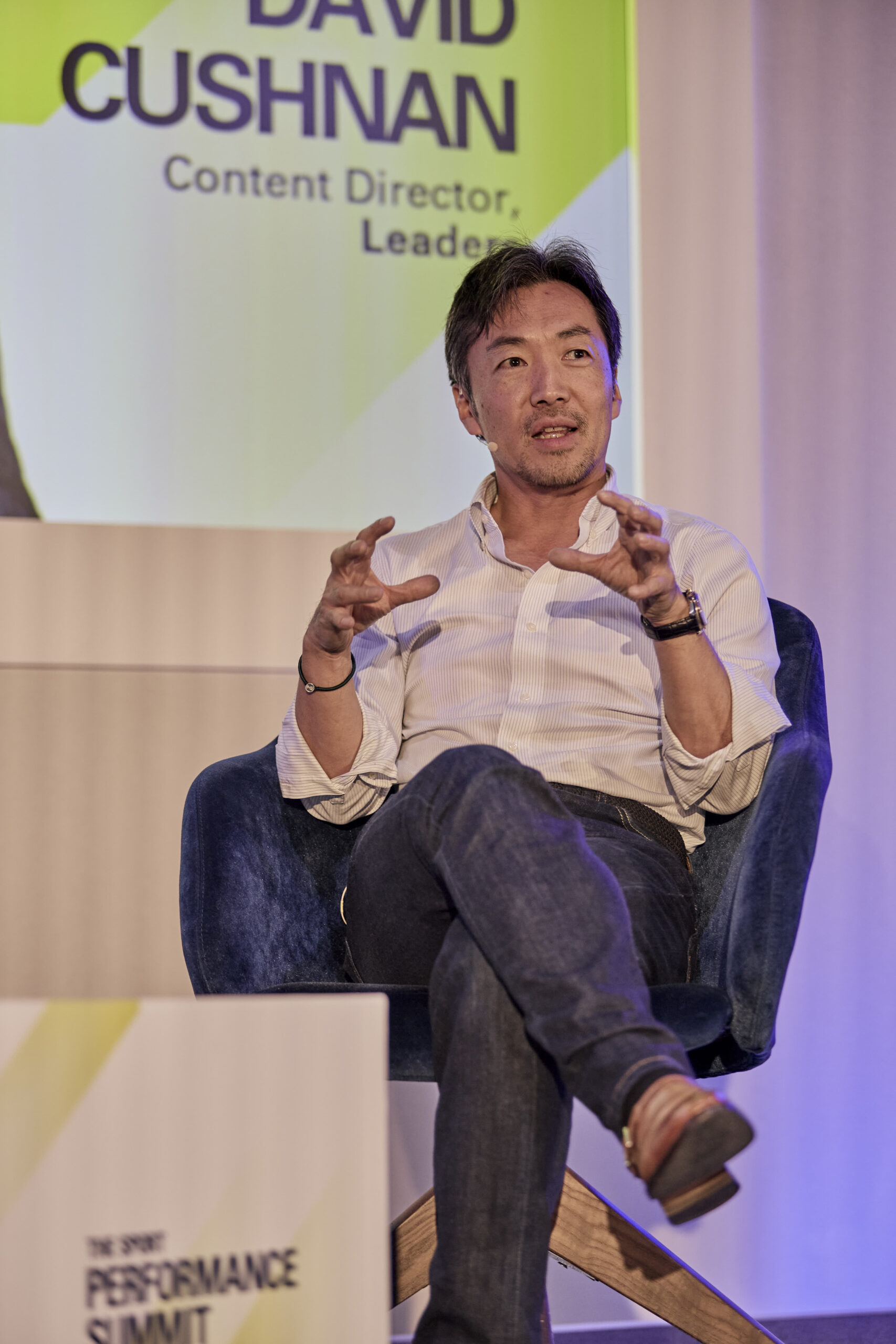
Ayao Komatsu, the Team Principal of Haas F1, shares insights into life in the pitlane.
Similarly, albeit in vastly different circumstances, the Red Cross must make the most of its limited resources when emergencies strike.
Chris Davies, the Director of Crisis Response and Community Resilience at The British Red Cross, cited his team’s core operational process:
Chris Davies
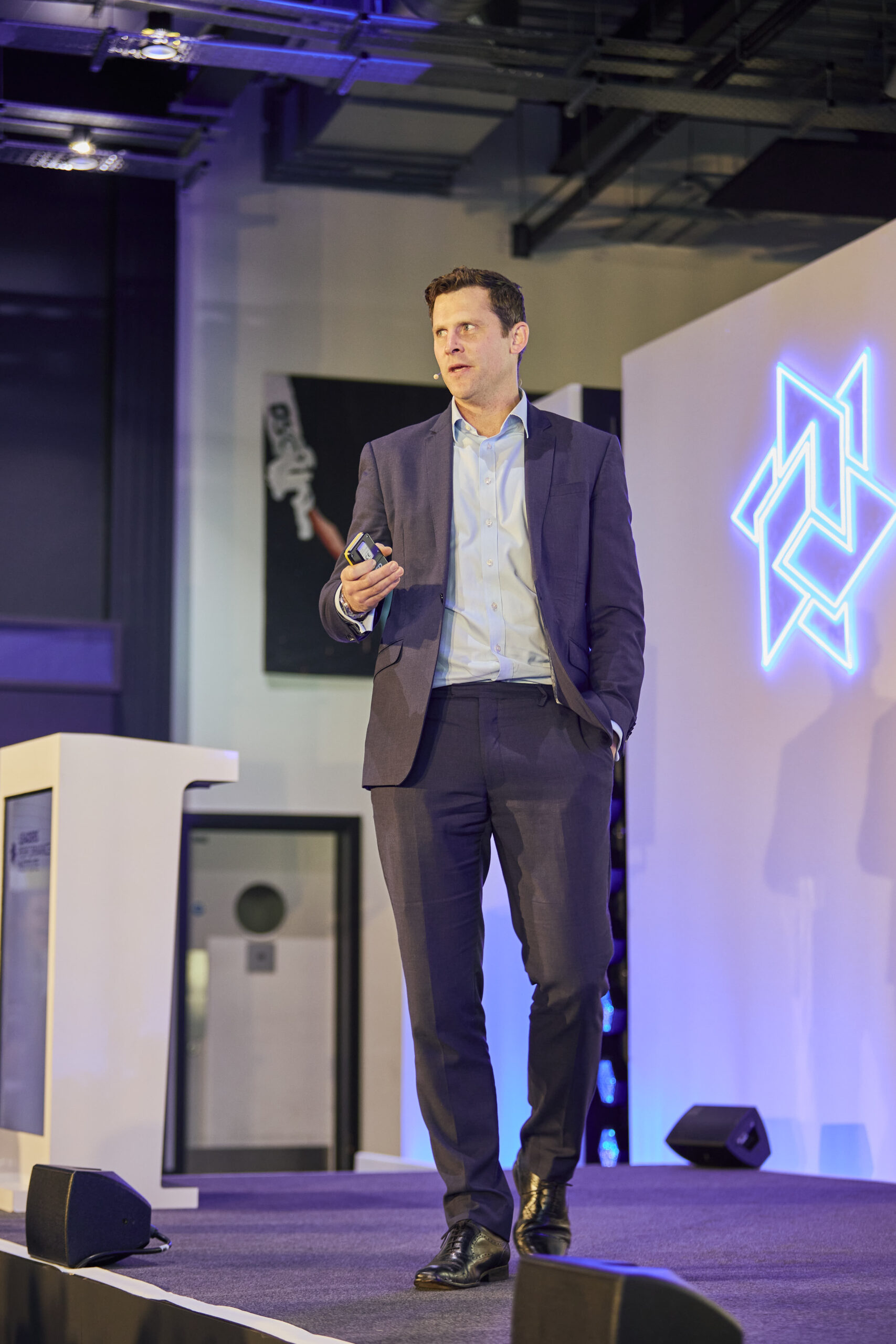
Chris Davies of the British Red Cross in full presentation mode.
4. Psychology will be a game-changer
The mental and behavioural side of performance was an ever-present topic on both days of the summit. Our guests discussed several elements:
The importance of individual expression and acceptance
Johann van Graan
Belonging as a contributor to wellbeing (and performance)
Emily Scarratt
Psychological safety
Ayao Komatsu
5. Teams are engaging in a tech arms race
Professor Tom Crick spoke in his capacity as Chief Scientific Adviser at the UK Government’s Department for Culture, Media and Sport.
He presented on the growth of AI and continually stressed how important it is to keep “the human in the loop” regardless of whatever advances are coming.
To this end he offered Leaders Performance Institute members a series of recommendations.
You must be able to explain why you are using an AI tool…
“You can’t just say ‘the computer says so.’ There has to be some understanding and explainability, and there has to be trust.”
An AI tool should not replace your people…
“AI should not erode or disempower or remove agency for people within your domain. It should augment human capability, not replace it,” said Crick. He added: “It is about co-design, co-decisions and co-evolution as we go forwards – keeping humans embedded in the process.”
Don’t assume your AI tool is right…
“Don’t automatically trust the system. Always ask: is that the right data? Does that feel right? Can we verify and validate it another way?”
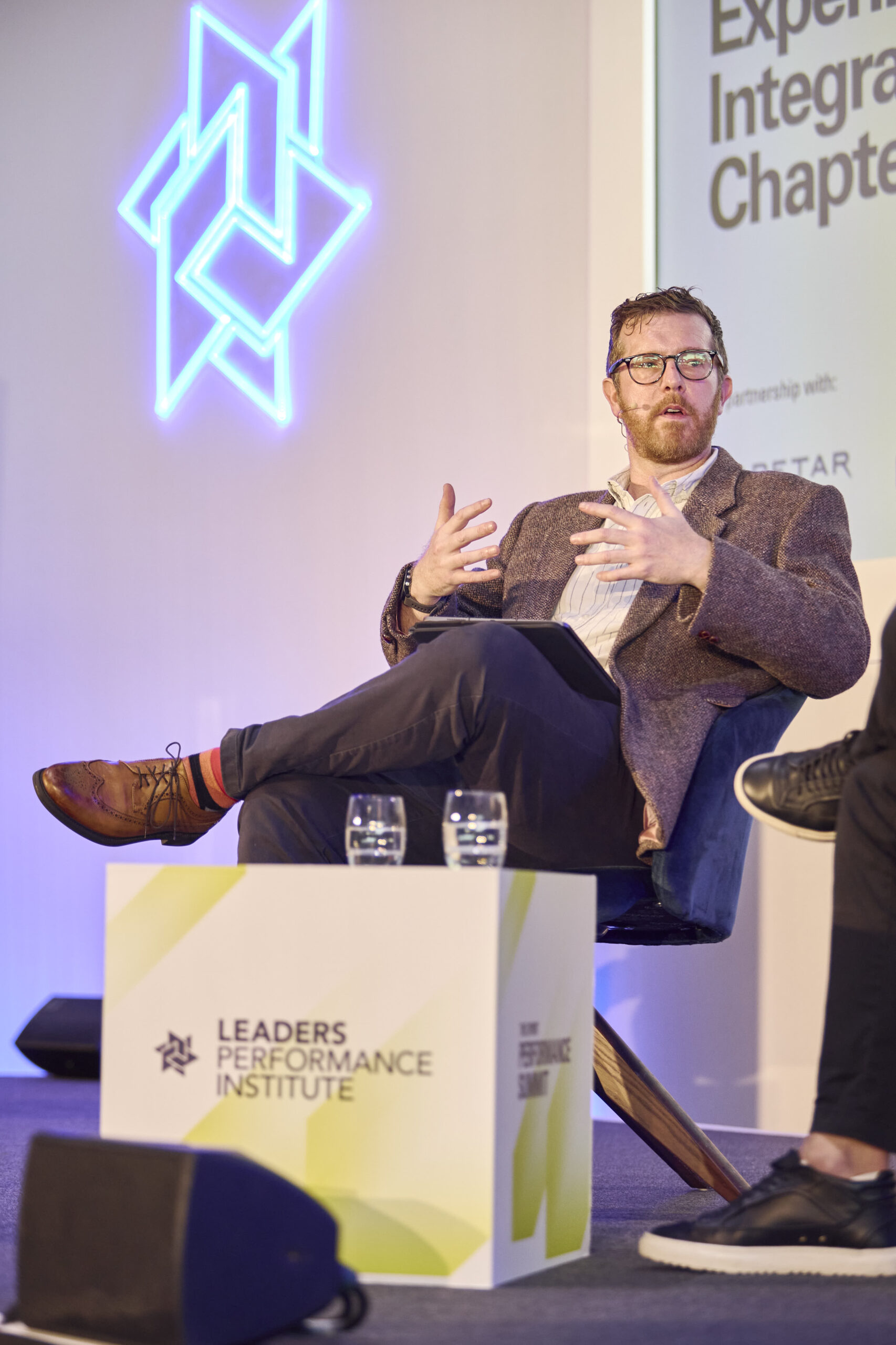
Tom Crick, the Chief Scientific Adviser at the UK Government’s Department for Culture, Media and Sport, answers questions from Leaders Performance Institute members.
Next stop for the Leaders Performance Institute
ESA Director of Science Carole Mundell discusses creativity and problem-solving in volatile environments both in space and here on Earth.
Main Image: European Space Agency
The video depicted a range of space-faring feats performed by the European Space Agency [ESA] as it enjoyed its 50th year.
Mundell, who is the Director of Science at the ESA , brought the room back to Earth again when outlining her efforts to bring together 23 European nations (more specifically their governments) in pursuit of the agency’s interstellar goals.
“Diplomacy is a contact sport,” said Mundell, who is a diplomatic veteran at this stage. She is responsible for a pan-European staff of over 45,000 people, with headquarters in five jurisdictions. You can also throw in the challenges posed by Brexit, the pandemic (when international diplomacy definitely was not a contact sport) and the war in Ukraine.
“The political churn at the moment is unprecedented,” she continued. “From one day to another, we don’t know whether our member state governments will continue to be governments or remain in place for another election.”
This volatility stands in contrast to ESA missions, all of which take decades to devise and tend to last longer than most political careers.
Then there’s the space-based challenges. In her time onstage, Mundell described a range of missions, from explorations of Jupiter’s moons to detailed observations to the surface of Mercury. All require incomprehensible precision.
Take the LISA [Laser Interferometer Space Antenna] mission. Its purpose is to detect gravitational waves in space; the ripples in space-time caused by cosmic events such as black hole collisions.
“They will have three spacecraft flying in convoy, with two and a half million kilometres between each spacecraft,” she said. “They will follow an Earth-Sun orbit and they will rotate and stay in that triangle.”
The lasers in question must be able to point with precision narrower than a proton.
““We’re going to measure the nature of space-time itself. It’s eye-watering technology.”

LISA measuring the properties of gravitational waves (Image: the European Space Agency)
Mundell has become adept at managing the external elements that could derail projects such as LISA. Thanks to her leadership, ESA’s creative and technical minds are able to do their best work in a climate of political uncertainty.
Psychological safety
In space, Mundell told us, things often go wrong. Take the Euclid mission, the purpose of which is to map the ‘dark’ universe. The lens of space telescope, which orbits the sun 1.5 million km from Earth, became contaminated by a strip of ice thinner than a strand of DNA. Mundell’s team had to find a way to defrost the ice without damaging the equipment’s sensitive optics.

Euclid begin its dark universe survey. (Image: European Space Agency)
But if you can reasonably anticipate microscopic space ice then you can devise a plan to defrost it.
“We did that last month,” she said almost matter-of-factly, but the ESA’s staff have built trust in their systems. “At a time of crisis, the first thing you do is check the process.” The system provides a layer of safety that goes beyond the interpersonal dynamics originally associated with the term ‘psychological safety’ (although these remain important; Mundell says: “Please create the best possible cultures you can. Please have the courage to really call out bad behaviour”).
“The cognitive safety comes from the fact that you know there is a process that you’ve all built together.”
This knowledge is also useful when navigating potential cultural differences present in a supranational organisation.
More creative, less expensive, more innovative
On her way to the Kia Oval, Mundell received news that one of an ESA contract negotiation was going backwards.
“My first instinct was to think of a solution,” she said. “And a very calm senior colleague said to me: ‘we don’t need to escalate this’. We don’t always need to go to the nuclear option.”
Such setbacks and budget cuts are par for the course. During his annual press briefing in January, ESA Director General Josef Aschbacher revealed that the ESA budget for 2025 would be €7.68 billion. It was €7.79 billion in 2024, but Germany, Italy and the UK reduced their contributions by a collective €430 million.
“We have to continually innovate and make things more creative, less expensive, but more innovative,” said Mundell, who explained that the ESA must design to cost. While there is room for creativity in day to day problem-solving, the process guides the action taken. “We have a whole quality assurance system where we set our objectives and we say ‘what will we do?’ ‘What did we say we’d do?’ ‘Did we do what we said?’”
Enduring purpose
The ESA was founded to enable European nations to explore the cosmos and further the continent’s knowledge and understanding. It’s an enduring purpose that continues to appeal. On 1 January this year, Slovenia became the 23rd member state, with several others still in the queue to join.
“Our missions are lifetime generational missions,” said Mundell. “You’ll see that people will give a significant fraction of their lifetime to develop, design and fly these missions, and ultimately protect them, to deliver science back to society. Children in school today will use data from our missions.”
She explained that once every three years there is a council meeting of ESA members at a ministerial level to decide the agency’s budget for the next three-year cycle. She shared an image from the 2022 meeting in Paris. It was taken just before she joined:
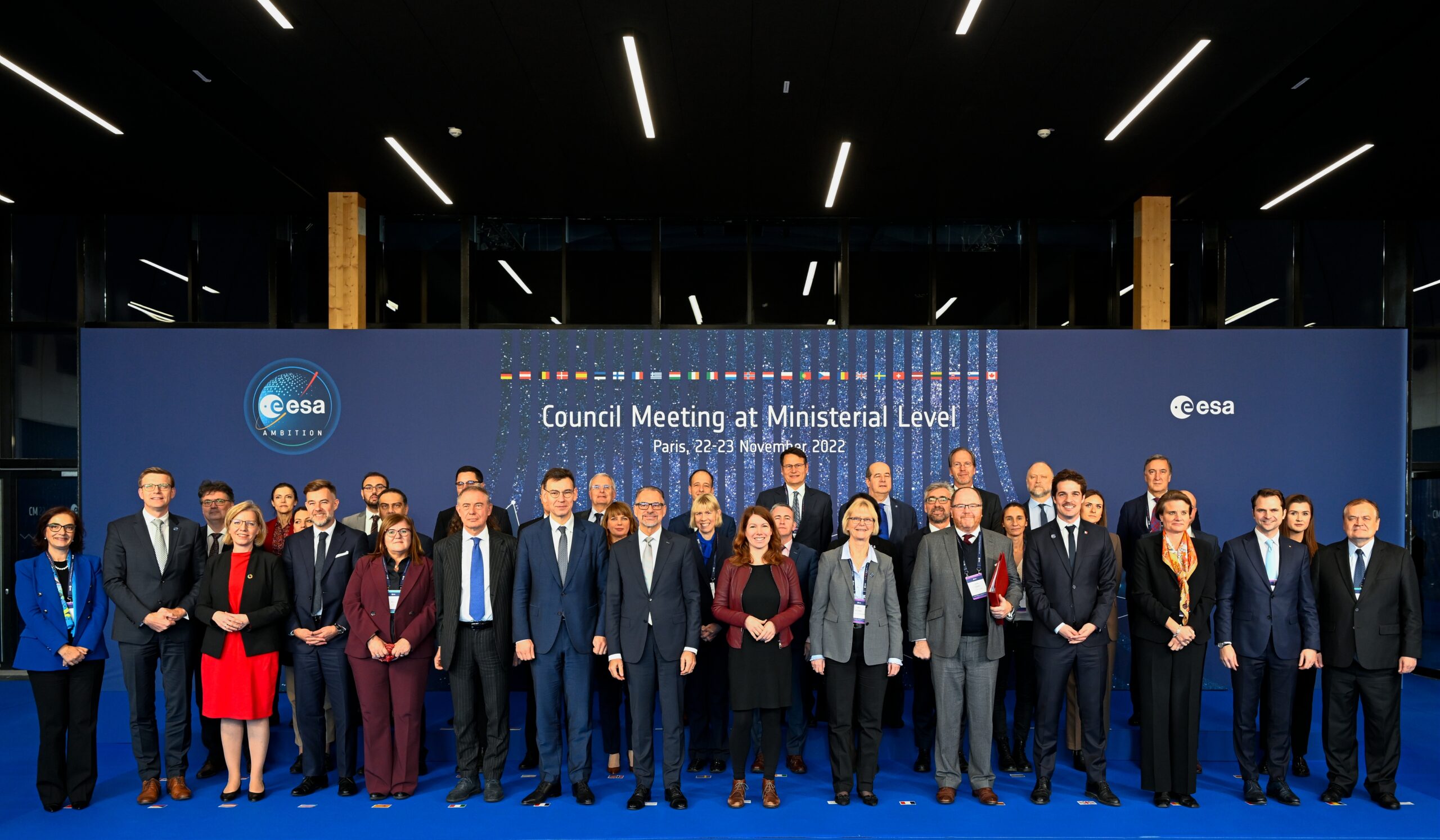
The official portrait of ministers at the 2022 ESA Council Meeting at Ministerial Level. (Photo: Stephane Corvaja / European Space Agency)
“This is a photograph of inspiration,” she said. “These ministers come from all different political backgrounds, they were facing various different challenges at this time. There was cost of living crisis and obviously the war in Ukraine was pushing all sorts of problems across these member states, and yet they all came together and they agreed that space is important.”
Hear more from Carole Mundell