As behavioural finance specialist Dr Benjamin Kelly explains, these four common biases can derail even the best players.
While technical skill and conditioning are paramount, behavioural biases frequently derail even the most talented players. For leaders in sports, understanding these cognitive shortcuts and emotional responses is crucial for optimising athlete performance, coaching strategies, and mental resilience.
I believe that golf, much like financial markets, is fertile ground for behavioural finance – a field integrating psychology and economics to explain irrational decisions. While behavioural finance has profoundly reshaped our understanding of investment behaviour, its application to sports decision-making, particularly in golf, remains remarkably underexplored. This is a significant oversight, as the very same biases impacting trading decisions equally affect decision-making on the golf course.
By examining cognitive shortcuts and emotional responses that derail golfers, we uncover profound lessons applicable to high-pressure environments across sports and business.
My work with investors has consistently demonstrated that reducing ‘bad decisions’ incrementally improves investment returns. This same principle applies directly to golf: eliminating poor choices on the course directly translates to saving shots and enhancing performance.
Overcoming behavioural biases is notoriously difficult; our innate cognitive architecture makes us highly susceptible. Therefore, the optimal path to mitigation is not to fight the bias directly, but to create a step in the process that prevents us from succumbing to it. In trading, a simple yet powerful example is the stop-loss order – a pre-defined instruction to exit a position if it falls to a certain price, removing emotional discretion from a critical decision.
This methodology, involving structured interventions, is evolving for golfers of all abilities.
Below, I illustrate these points with compelling examples, including Robert MacIntyre’s dramatic final round at the 2025 BMW Championship, and propose actionable strategies for correction.
Loss aversion describes our innate tendency to prefer avoiding losses over acquiring equivalent gains; the psychological pain of a loss is often twice as powerful as the pleasure of a gain. In golf, this bias is a primary contributor to the dreaded ‘choke’ phenomenon, particularly when a player holds a significant lead. The shift from playing to win to playing not to lose is a classic manifestation. It leads to tentative play and costly errors.
Consider the ‘final day phenomenon’ in golf, where approximately two-thirds of leading players fail to convert their lead into a win on the final day of a tournament. This represents a conversion rate of roughly 33%. My work with investors has consistently shown that even a modest improvement in decision-making, leading to an increase in success rates from 33% to 45%, can yield material benefits. For a professional golfer, this translates directly into more career victories and significant financial gains. For investors, it means incrementally improved returns and enhanced portfolio performance. This isn’t a sudden decline in skill; it’s a psychological battle. A player leading a tournament, especially on the back nine, often shifts from an aggressive, winning mindset to a conservative, loss-averse one. Instead of continuing the attacking golf that built their lead, they focus on not making mistakes, which leads to tentative swings, reduced pace, and increased unforced errors. The fear of losing the lead becomes more potent than the desire to win. It paralyses their natural game.
Robert MacIntyre at the 2025 BMW Championship provides a vivid illustration. MacIntyre entered the final round with a commanding four-shot lead, having played exceptional golf through the first three rounds (carding 62, 64 and 68 for an average of 64.67 shots). However, in the final round, under immense pressure and with a significant lead to protect, he shot a 73 – eight shots worse than his average for the preceding rounds. This stark difference, which ultimately saw him lose the tournament to Scottie Scheffler, is a textbook example of loss aversion in action. The desire to protect the lead likely led to a more cautious, less assertive approach, resulting in a performance significantly below his demonstrated capability. His post-round comments when he expressed a desire to “smash up my golf clubs,” underscored the emotional toll of such a collapse, which was rooted in the psychological pain of losing what felt like an assured victory.
Correction strategy: process-oriented thinking and positive aggression
Mitigating loss aversion requires a conscious shift from outcome-oriented to process-oriented thinking. Golfers should:
My methodology, applied to investment, focuses on establishing clear, unemotional exit strategies to prevent such value traps, which directly improves returns by eliminating these ‘bad decisions’.
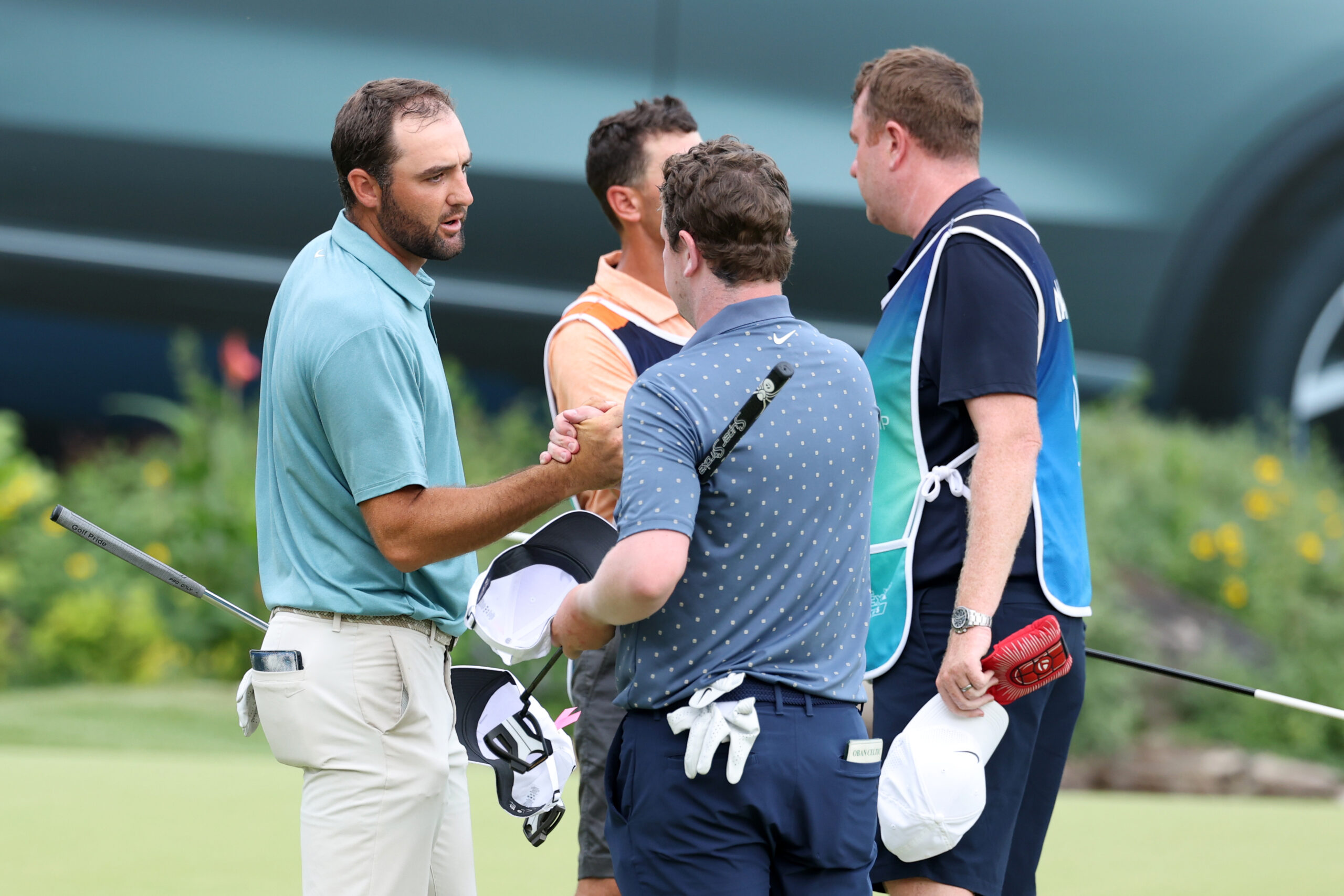
A victorious Scottie Scheffler shakes hands with Robert MacIntyre at the BMW Championship 2025 at Caves Valley Golf Club. (Photo: Kevin C Cox/Getty Images)
This translates to a pre-shot checklist that includes a deliberate assessment of risk vs reward. This ensures the chosen shot aligns with a pre-determined strategy rather than emotional impulse.
Overconfidence bias is the tendency to overestimate one’s abilities, knowledge, and the accuracy of one’s predictions. In golf, this often manifests as the infamous “hero shot” syndrome. Picture a golfer, slightly out of position after a wayward drive, facing a daunting carry over water or a dense thicket of trees to reach the green. A more prudent strategy might involve laying up, accepting a bogey or par. However, the overconfident golfer, convinced of their exceptional skill or believing this is their moment of glory, attempts the low-percentage, high-risk shot. The result is often disastrous: a ball splashed into the water, lost in the woods, or a double bogey that unravels a promising round.
Three-time major champion Pádraig Harrington has openly confessed that overconfidence cost him dearly at the 2025 Senior PGA Championship, particularly on a crucial 15th hole. Despite his vast experience, he felt his confidence and arrogance led him to an ill-advised approach shot, costing him a crucial hole. This mirrors countless amateur golfers who, after a few good shots, attempt to carry a 200-yard water hazard with a 3-wood, only to find their ball sinking to the bottom, convinced their recent success grants them an infallible touch. The allure of the ‘hero shot’ often blinds players to the higher probability of failure, driven by an inflated sense of their current capability.
Correction strategy: objective risk assessment and pre-shot routines
To counteract overconfidence, golfers must:
My investor checklists include a mandatory step for a ‘devil’s advocate’ review of high-conviction trades, forcing a re-evaluation of assumptions. This translates to a ‘reality check’ step in their pre-shot routine, where they explicitly consider the worst-case scenario and whether the reward truly justifies the risk. This step prevents the overconfident ‘hero shot’.
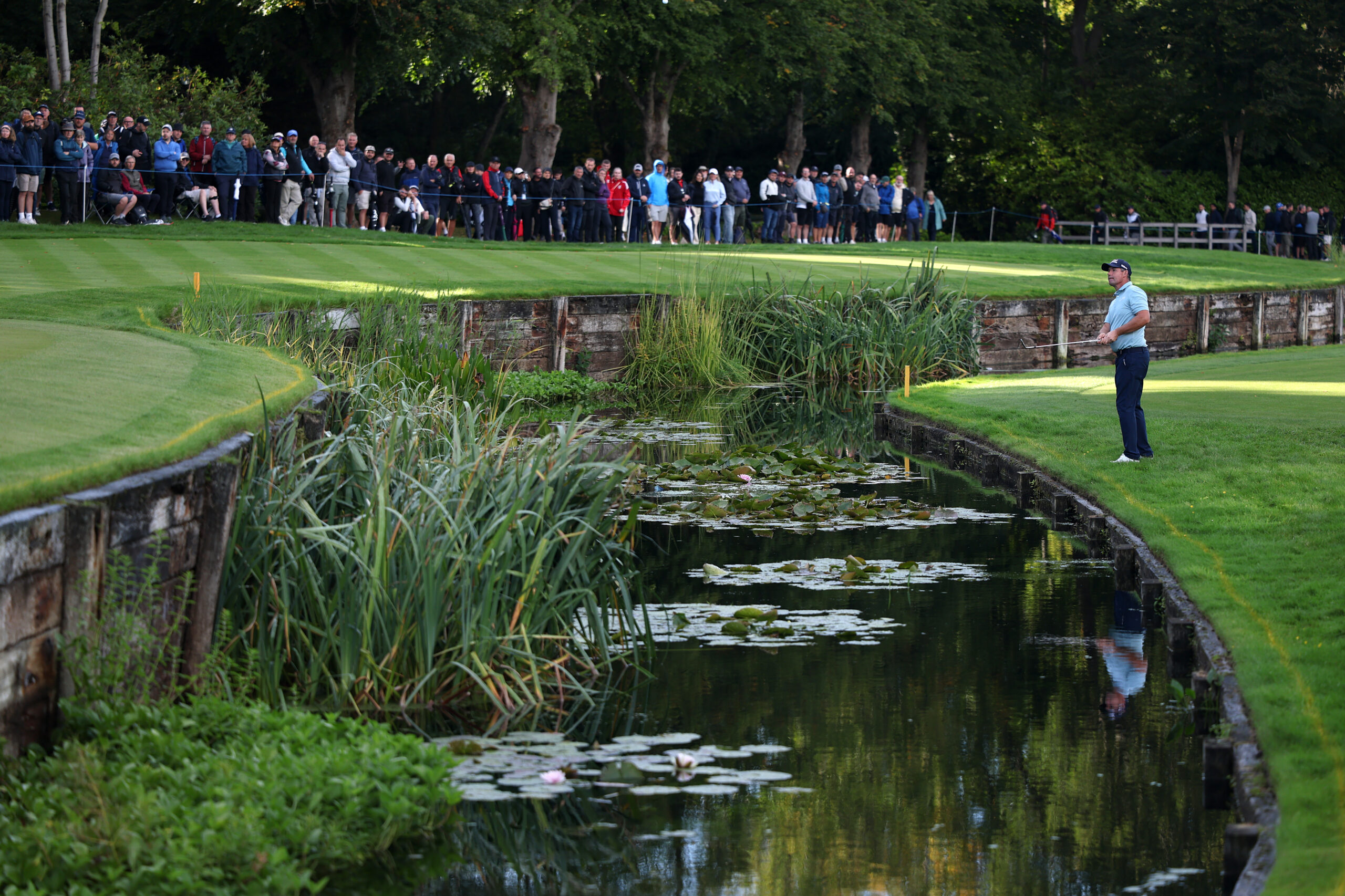
Pádraig Harrington at the 2025 BMW PGA Championship. (Photo: Andrew Redington/Getty Images)
Confirmation bias is the tendency to seek out, interpret, and remember information in a way that confirms one’s pre-existing beliefs or hypotheses. On the golf course, this can lead to flawed self-assessment and persistent errors.
A golfer might believe their slice is due to an ‘outside-in’ swing path, and subsequently only notice instances where their swing appears to confirm this, ignoring other potential causes like an open clubface. This selective attention prevents them from accurately diagnosing and correcting the root cause of their swing fault. Similarly, a player might attribute a good shot to their skill and a bad shot to external factors (a bad bounce, a gust of wind), reinforcing a biased self-perception that hinders genuine improvement.
Correction strategy: objective data and external feedback
To address confirmation bias, golfers should:
My investor checklists mandate seeking out and documenting opposing viewpoints before making a significant investment.
This means a ‘feedback loop’ step where they actively solicit input from their caddy or playing partners on their swing or strategy, or review objective data from launch monitors, rather than relying solely on their internal, potentially biased, assessment.
Anchoring bias occurs when individuals rely too heavily on an initial piece of information (the “anchor”) when making decisions, even if that information is irrelevant. In golf, this can lead to rigid decision-making that fails to adapt to changing conditions.
A common scenario involves a golfer fixating on the yardage provided by a sprinkler head or a course guide at the start of a hole. This initial yardage becomes an anchor, making it difficult to adjust for dynamic factors like wind changes, elevation shifts, or a different pin position that emerges during the round. A player might stubbornly stick to a club choice based on the initial anchor, even when conditions clearly dictate a different approach, leading to shots that are consistently long or short.
Correction strategy: dynamic assessment and multiple data points
Counteracting anchoring requires:
My investor checklists include a mandatory ‘re-anchor’ step, where all previous price points are deliberately ignored, and decisions are made solely on current fundamentals and future projections.
For golfers, this translates to a ‘situational awareness’ step in their routine, where they consciously disregard previous hole outcomes or initial yardage markers, and instead focus on a fresh, comprehensive assessment of all current variables before committing to a shot.

Robert MacIntyre at the 2025 BMW PGA Championship. (Photo: Jasper Wax/Getty Images)
Conclusion: cultivating mental discipline for peak performance
Behavioural biases are an inherent part of human cognition, but their impact on the golf course need not be detrimental.
By understanding how overconfidence, loss aversion, confirmation bias, and anchoring manifest, and by implementing structured strategies to counteract them, golfers can significantly enhance their decision-making capabilities. The journey to mastering the mental game of golf is one of continuous self-awareness, discipline, and a commitment to process over outcome.
Just as my work helps investors reduce the incidence of “bad decisions” to incrementally improve returns, applying these behavioural finance principles to golf can directly lead to saving shots and elevating performance. The critical insight is that overcoming biases is extremely difficult; our innate cognitive architecture makes us highly susceptible.
Therefore, the optimal path to mitigation is not to fight the bias directly, but to create a step in the process that prevents us from succumbing to it. This methodology, evolving from investment to the golf course, empowers athletes of all abilities to make optimal choices when it matters most.
For sports leaders, fostering an environment that encourages objective self-assessment, embraces data-driven insights, and champions structured routines will be key to developing athletes who not only possess exceptional physical talent but also the mental fortitude to make optimal decisions when it matters most.
This approach not only leads to more consistent performance but also a deeper, more rational engagement with the beautiful, challenging game of golf.
Dr Benjamin Kelly advises investors and professional athletes on decision making strategies in high stakes environments. If you would like to speak to Benjamin about his work, please contact a member of the Leaders Performance Institute team.
In an exclusive column, Peter Hodgkinson, the former Head of Build at Mercedes F1, sets out the considerations that helped him to lead in one of sport’s most high-pressured arenas.
Main Image: Getty Images / Mark Thompson
Not only is it difficult to fully see someone’s body language, it also makes it near impossible to see a leaking water pipe at the front of an engine!
In my opinion, you need to be present in a high-performance environment.
I served as Head of Build at Mercedes between 2011 and 2019, an era when we won five driver’s and five constructor’s world championships. It was a period of unprecedented success for the team and for at least part of that time I worked out of a small, tired office in the middle of the team’s factory.
It was a terrible space. It had no natural light, the AC was incredibly bad, and the ceiling tiles were water-stained. Admittedly, I couldn’t see those tiles – or the worn-out carpet, come to think of it – as easily at 7:30am when six or seven people turned up for work and squeezed into a room that was more suitable for four.
I wasn’t sad when that office was finally knocked down as part of a factory refurbishment, but it had been a home away from home. For 20 years I’d spent more time there than I did at home.

Peter Hodgkinson holds the Formula 1 Drivers’ and Constructors’ World Championship trophies in his ‘dreary’ former office at Mercedes HQ in Brackley, Northamptonshire.
This story (at least my schedule, if not the dreary office) probably sounds familiar to many of you. I was routinely on the road at 5:15am and did not leave until 6:30pm most evenings. Of course, I left my phone on just in case.
Such scenarios in high-performance are not going to change any time soon, but there are several things that you can do as a leader to protect yourself and your team from excessive workloads while still delivering the required work.
There are sure to be other things, but these five considerations make a good starting point.
I believe it was important to be seen and to say at least ‘good morning’ to as many of my team as possible. I wanted them to feel that I cared for them and I was interested in what they were working on and the issues that they faced; and it was another opportunity for information gathering.
When we were in the build period or working on a big update, I would try and get to work in time to talk to the nightshift in Build, Compbond, Inspection etc to get an understanding of the current status and get a head start thinking about what I had learnt. This floor walking – asking questions, providing challenge, learning about the current status and building relationships – as I said, I don’t think you can do this as effectively on Teams or Zoom.
I’ve touched upon this before. I never tried to plan more than 30 percent of my day. Most days, meetings were added into my calendar which I needed to attend and, if I had a big gap, I would try and block it out for my work.
We think of work as writing plans, answering emails, attending meetings, doing things, etc but floor walking and talking to people is just as important and is part of the job. It might not feel like work as you have nothing physically to show for it, but it is so important as you are building relationships with your team which is an essential part of the trust equation.
As a leader, you cannot be chained to your desk doing work, looking at your feet and never lifting your head to talk to your team.
Manage your job list by focusing on getting things done. But don’t just keep adding to the job list. Create movement.
Trying to have 70 percent of my day unplanned also meant that I had a pretty good chance of achieving the 30 percent that I did have planned, so I felt like I got stuff done and when I went home, I felt that I had achieved something.
This is important. We all like big, long job lists. It makes us feel valued, but if we just keep adding to them it is soul destroying, as you never feel like you have achieved anything. Try and get three things done each day, completed and finished. This is movement, placing a real mental focus on a task to get it completed. This is what I attempted to do from 6:00am to 8:00am each day. With the 30 percent rule, if there is a crisis that does require your full attention, then you should have some capacity to manage it without impacting too much of your day.
Dr Ceri Evans got me thinking about tasks in this way:
Name it: What is the technical task you are undertaking? Give it a name.
Time it: Add a deadline for when you are going to get this task completed. This adds pressure which gives us energy to perform.
Move it: Time to step in and perform. Complete or complain, it is your choice. Try three times a day for 15 minutes to focus on a task and get it completed. This is movement.
Trust is at the heart of any team’s performance. Trust is choosing to risk making something you value, vulnerable to another person’s actions. It happens in small moments when you have the opportunity to increase your trustworthiness.
For example, I tried to keep meetings to a minimum as I wanted to walk around and talk to people and follow up on issues. It was important to me to be connected to what was going on in the workshops and for the technicians to know that I cared deeply about what they were doing and the effort they were putting into their piece of the puzzle.
After clearing as many emails as possible, I would try and get out the door by 6:30pm and leave the Team Leaders to it. As I said, the phone was always on but, on the whole, it didn’t ring that much in the evenings or at night because the team knew what to do and what was required.
In short, they had my trust. I believe trust is made up of the following:
Reliability: You turn up at the same time every day, you deliver the work, you can be counted on in a crisis to be there. You are present.
Competent: You are knowledgeable and you know how to do the work to the best of your ability.
Relationship: You need to have a relationship with the people you are interacting with. Find out about what they like and dislike; be curious about them as a person.
In F1, I tried to get to a position where 80 percent of what we did was planned and 20 percent was chaos. The chaos makes the job both challenging and fun. It’s one of the reasons you get out of bed in the morning.
When the chaos hits 40 or 50 percent, this is too much and it leads to overload and overwhelm. Cracks will start to show in the team’s behaviours and the quality of the work will decline.
As a leader, you need to manage this carefully and do everything in your power to protect your team as much as possible from the really impossible requests.

Peter Hodgkinson on the factory floor at Mercedes HQ in Brackley, Northamptonshire.
Sometimes you have to say ‘no’, but make sure you have other alternative options ready to present. You can’t just say ‘no’. There is a very fine line between protecting your team from excessive workload and delivering the required work to support the plan so if you do push back, make sure you can fully explain your concerns with facts, not just emotions.
Peter Hodgkinson is a leadership and performance specialist skilled in helping high-performers become better at what they do. As an accomplished manager and mechanic, Peter has enjoyed almost three decades of success in elite sporting environments. His work in motorsport, as part of winning teams at Le Mans and Daytona, culminated in seven Formula 1 driver’s world championships won at Brawn and Mercedes, where he led car-building operations. Peter was Mercedes’ Head of Build during Lewis Hamilton’s era-defining run of six world titles. After a spell serving as Mercedes’ Head of Employee Engagement, Peter returned to the Factory Floor as Build Operations Manager for the INEOS Britannia sailing team when Mercedes supported their quest for the 37th America’s Cup.
If you would like to speak to Peter, please contact a member of the Leaders Performance Institute team.
The Nxt Level Group’s David Clancy explores how the Dublin-based League of Ireland club seeks to build long-term success through reasserting its culture, defining a clear purpose, and engendering a sense of belonging in its players and supporters alike.
Main Image: courtesy of David Clancy
The murals around their home ground Dalymount Park (which is to be renovated in the coming years), the ‘home of Irish football’, speak of solidarity, diversity and inclusion; the terraces hum with the sound of supporters who are not just fans. They are owners of this proud club. The Gypsies. Bohs. The home where Bob Marley and Thin Lizzy played concerts years ago. A team rich in history, rich in story.
Different, rather than better
In a football economy dominated by multi-club groups, billionaires, private equity firms, and global TV rights, Bohs are a club who stand apart. They’ve become a story about what sport can be when it roots itself not just in performance, but in people that care about the team. Their budget isn’t as large as some other clubs’, so they are creative and intentional with what they do in the football market and community.
They offer something different and offer a surprising strategic case study. They show how sustainability and a long-term engagement advantage can emerge from fan ownership, cultural clarity, and humble leadership. They play differently off the pitch. They are a fan-owned club that has survived 135 years, not through scale or capital, but rather through culture, purpose, and belonging.
They recently commissioned and sold jerseys with ‘Oasis’ emblazoned on the front (building on the hype around the band’s August gigs at the Croke Park stadium). Half of the proceeds from sales supported Bohemian FC’s football and community projects, while the other half was split between Music Generation Ireland, which helps young people across Ireland access music, and Irish Community Care Manchester, who work with the Irish community (from which brothers Liam and Noel Gallagher hail) in that city.
This club truly embodies what category design means. They have effectively practised category design and owning a niche by positioning themselves not just as a football club, but as a cultural and social movement, blending sport with music, art, and activism. By creating and owning this unique space of ‘community-powered club’, they’ve differentiated themselves in the growing League of Ireland, attracting fans from Ireland and abroad, plus partners who share those values – rather than competing solely on wins and losses in the league table.
For leaders in leagues like the NBA, NFL, AFL, and Premier League, ‘Dublin’s Originals’ could be more than just a curiosity. A relative outlier, they offer an example of a model of sustainability for a team, one that challenges the dominant logic of growth in more unorthodox ways. Their underlying structure of fan ownership is worth studying. They are a collective of supporters who refuse to separate themselves from the team. Here, sustainability isn’t a corporate ESG initiative, it’s survival, identity, and continuity.
Alignment over expansion
Bohemians filter every strategic decision through a simple lens. They ask: ‘does this strengthen our bond with the community?’ This clarity allows them to stay relevant without necessarily chasing expansion, although supporter clubs are sprouting up across other continents. These fans want the team’s special edition away jersey featuring Dublin band Fontaines DC, which was released in support of the homeless charity Focus Ireland, or their Guinness-sponsored range of merch, the proceeds of which support Refugee and Migrant Solidarity Ireland.
Purpose alignment can be a sharper competitive edge than market dominance. Bohs remind us that sustainability doesn’t come from infinite growth, but from a cycle of reinvestment. Money goes back into facilities, players, and fan experiences, not siphoned off to distant investors. Fan-owned. Fan-run. Fan-driven.
Bohs pioneered blind football, amputee football and walking football in Ireland, and, in 2021, launched their Disability Supporters Association. They were the first League of Ireland team to take part in the Dublin Pride festival. They have teams and run events for young adults with intellectual impairments. They give back because it’s important for them.
For a team still seeking its identity in some shape and form, here are some inflection points from this club study. Replace relative transactional sponsorships with partnerships tied to a community identity (e.g., environmental groups protecting a part of a region). Give players structured time each season for community immersion, not as ‘charity golf appearances’ but as integral to the team’s ethos.
One could measure impact not just in brand impressions but in school programmes launched, parks built, and neighbourhoods revitalised, for instance. This piece of nurturing culture is not for decoration; it could be for leverage. Fans want their teams to win, but also to stand for something. To build something.
NBA franchises could issue community bonds or micro-shares, giving fans a symbolic stake and reinvesting proceeds into grassroots basketball. The result? Loyalty that outlasts market cycles. Premier League clubs could implement ‘golden share’ protections, ensuring fans safeguard cultural assets such as club colours, logos or stadium names. Food for thought.
Culture and ethos
Since the 2010s, Bohs, bohemian by nature, have adopted a left-wing political identity, which one can see in their club branding, language, public messaging and community initiatives. This resembles the philosophy and ideology of the Hamburg-based Bundesliga side St Pauli.
Daniel Lambert, their Chief Operating Officer, has positioned Bohs in support of causes such as Palestinian nationalism, anti-racism, anti-fascism, LGBTQ rights, refugee and homelessness advocacy. Jerseys carry messages from Amnesty International and the Movement of Asylum Seekers in Ireland. This alignment further builds loyalty and that sense of belonging to something, a movement. When fans and supporters are engaged, they likely will spend more on team merchandise too.
The club doesn’t shy away from social concerns and makes a stance. Volunteers run matchdays. Players show up at community events because it’s expected, not mandated and instructed. This is the culture, and these are not just PR moves but deliberate signals. These micro-behaviours strengthen loyalty and differentiate Bohs in a crowded and competitive sports market.
AFL clubs, many still member-owned, could guard against creeping commercialisation by doubling down on symbolic choices that reflect local identity. Of course, one must look at a P&L and the revenue statements, but this is worth contemplating. NFL franchises could reposition sponsorships not merely as transactions but as cultural alignments (health, education, inclusion, etc.).
A team could link sponsorships to civic identity – environmental causes, education initiatives, small business partnerships. Instead of buying attention, they earn trust. In an attention economy, values may outperform advertising in some peoples’ marks.
Imagine if a big franchise used its platform not just for commercial sponsorship, but as a megaphone for the causes their community cares about most. The return on emotional equity might dwarf the return on traditional marketing.
Fans as stakeholders
Bohemians’ ownership model turns belonging into structure. According to the club’s Social Impact report, as of 2023 they had over 3,100 members, up from just over 900 in 2018. There is a ‘one member, one vote’ rule. Membership is open to anyone and everyone, although there are limited season ticket and membership numbers; between seasons if a member does not renew their membership, it is sold on a first-come, first-serve basis. As well as match access, a member can attend and vote at the club’s AGMs and EGMs.
Once a member has hit three years of consecutive service, they are permitted to run for a board position. Thus, there is no outside control. Clear, values-driven, long-term thinking is encouraged over short-term profits; and growing the club and the community always remains the priority. Fans are shareholders; players feel the weight of representing not a brand, but a people. The ethos at the club is that belonging is the bottom line.
Could a Premier League club, say, recapture that intimacy? Could the NBA, with its superstar ‘big player’ economy rediscover the power of collective belonging? Bohs show us it’s possible, although the scale of operation is, of course, different. A team could give fans voting rights on heritage roundel designs or community projects. When supporters are allowed to co-create, membership renewal becomes almost automatic.
Stewardship, not ego
At Bohemians, leadership is custodianship. Senior management, coaches, and volunteers alike work with humility. The aim is not public visibility but leaving the club better than they found it.
Picture a club, now acquired by a new ownership group, flush with new wealth. They could embed ‘custodianship leadership’ programmes for academy coaches and staff, thereby reinforcing the idea that the club belongs to the city, not just its new owners.
Reframing success: The Bohs Scorecard
Bohs prove that success can be measured differently, and how one can rethink what success is. Yes, they want to win games. Qualify for Europe. Fill the stands. But they care about community impact, inclusivity, and the stories they leave behind.
In the NBA or NFL, where victory is often measured in ring counts, marquee signings or franchise valuations, this can sound quaint. But consider the long arc – which clubs will still matter when television deals shrink, when fans demand authenticity, when climate and social pressures force a rejig of what ‘sport’ contributes to society? Bohemians have already answered that question. They matter because they belong to their people.
This scorecard which, for the record, is not affiliated with Bohemian FC in any way, could unpack:
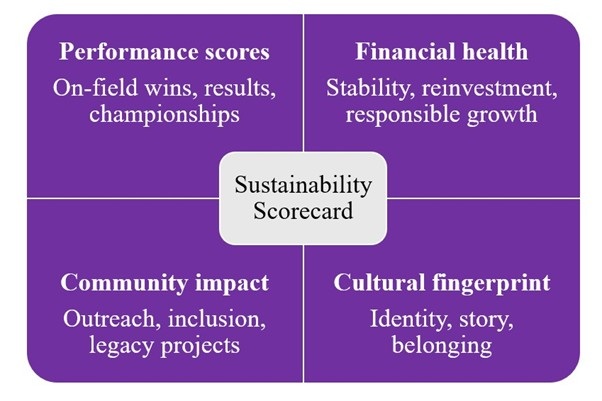
Potential examples of cases in point: cross-league applications
The 4-step Sustainability Playbook for leaders in sport
Why this matters
Front offices, director boards and ownership groups are under scrutiny and pressure: escalating player salaries, volatile media rights, and restless fan bases.
Bohs offer a reminder. Sustainability in sport is not just financial. It can also be cultural. The clubs that flourish in the next era will be those that treat belonging as an asset, culture as leverage, and leadership as stewardship.
David Clancy is the CEO of The Nxt Level Group and host of Essential Skills 2.
One for your diaries
Seán McCabe, the Head of Performance & Sustainability at Bohemian FC, will speak at Essential Skills II at the Irish Museum of Modern Art in Dublin on 28 October as part of a lineup of speakers across high performance sport, business and healthcare.
Tickets are available here.
The 2008 world champion joined Mercedes in 2013 and would win a further six titles with the team. But, as Peter Hodgkinson tells us, things got off to a rough start. What followed as the team rebuilt the car was a case study in performance under pressure. But it started with a quick spot of lunch.
Main Image: Paul Gilham / Getty Images
Lewis’ rear brakes failed on his 16th lap and he careered into a wall at turn six, which is known as ‘Dry Sack’ corner. He emerged from the wreckage unhurt but his car’s front wing assembly, front uprights and the floor were all damaged in the accident and we had no spares at the circuit. To compound matters we also needed to supply a fix for that rear brake failure.
As the Head of Build for Mercedes F1, I was one of the first to receive the bad news from the Race Team in my office back at our HQ in Brackley, Northamptonshire. Not long after I put down the phone, Aldo Costa, our Engineering Director, came to find out the status of available spares.
The crash had only just happened so I did not have all the answers. I told Aldo I would get back to him shortly. I said much the same to Rob Thomas, our COO, when he stopped by. It was not long before a stream of people came to my office looking for answers and a plan. It was a big moment and I could feel the pressure building. I told some to stand by and others to go and gather information.
Then I told everyone I was going to lunch.
I could see the shock on their faces. How can you eat at a time like this?
For my part, I needed to get out of my office. I normally ate lunch at my desk so my trip to the canteen was out of character. People could see that. I sat on my own and ate for 20 minutes but at the same time my mind was going flat out.
When I got back to my office I knew what we needed to do.
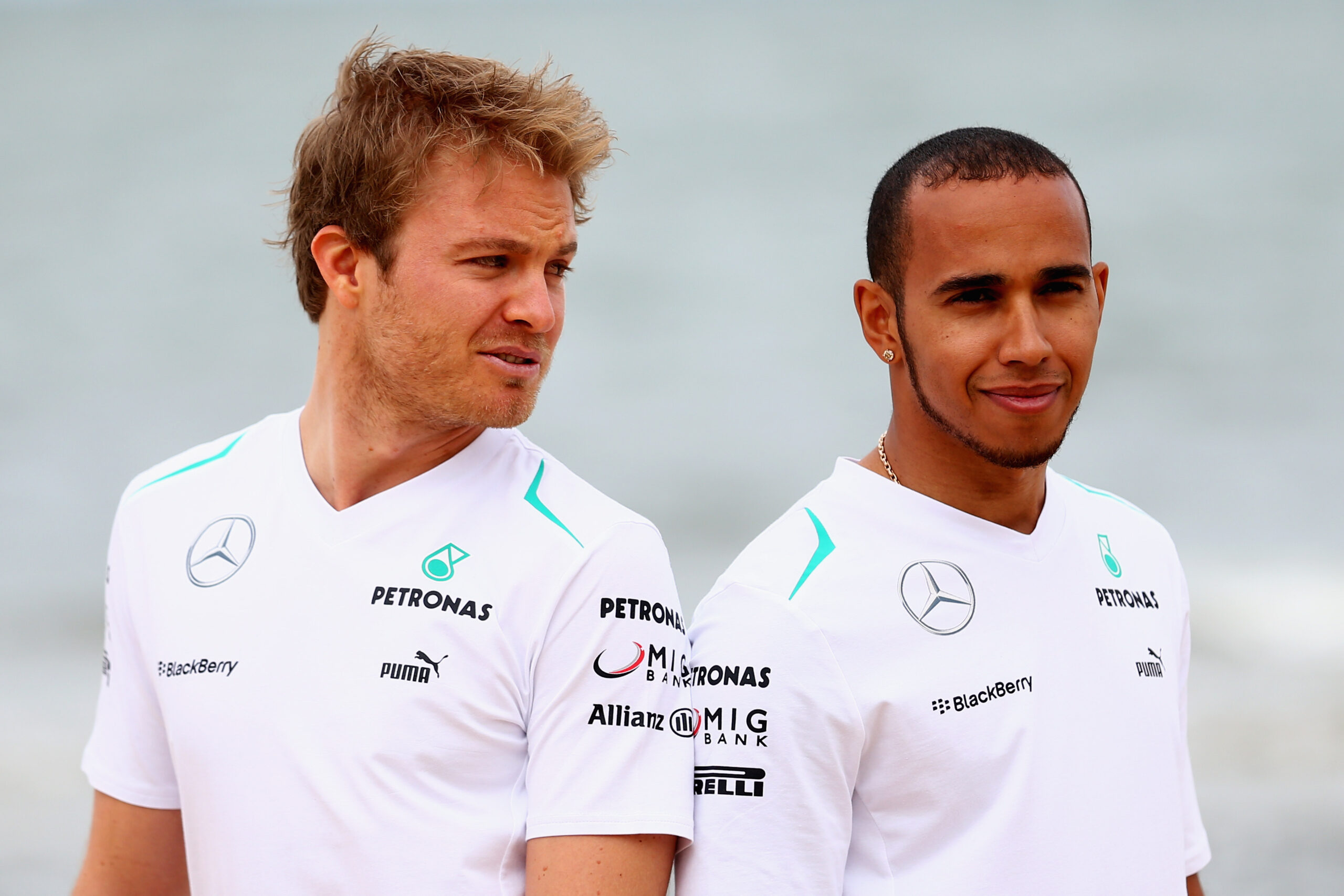
Mercedes teammates Nico Rosberg and Lewis Hamilton in 2013. Photo: Clive Mason / Getty Images
I called everyone to gather around for a short meeting (no one else had moved). We figured out what we knew and what required answers then came up with a basic plan and assigned responsibilities. The Composite Build team looked after the floor and the front wing along with Compbond and the design team. Sub Assembly had to look after the front uprights that were still in the Machine Shop.
I went looking for what we didn’t know because we couldn’t afford any surprises. The Race Team in Jerez needed sufficient time to rebuild the car. I needed to know both the latest the private jet could depart from the airport in nearby Oxford and if a car floor would even fit through the door of the plane. We also booked extra vans to take parts to Jerez and assigned extra people to support repairs at the circuit.
Once we had timings, we were able to understand what we could achieve in the time available. I’d like to think everyone had clearly defined roles and knew their responsibilities. There were so many details to sort out and any one of those could have prevented the car from running the next day.
Instead of meetings – there simply wasn’t time – I walked a thousand miles around the factory gathering and communicating information, asking and answering questions. That communication was dynamic. It was mostly verbal but reinforced with an email when time permitted. I kept Rob and Aldo informed of progress. The late Barry James, who was our Composite Manufacturing Manager, and Darren Burton, our Ops Director, worked with their departments to ensure we got all the support required.
The car ran the next day. It was a true team effort. The damaged parts were returned from Jerez for inspection, repair and service and a fix was sent out for the rear brake issue. It was an amazing recovery from a difficult situation, but that is Formula 1.
So, what did I learn? These moments are important, as the way you react to them is what you will be measured by as a person and a leader. If you think back on your careers, you will have good and bad moments. Some will be short, others will be longer. It will not stay tough forever, it will get better, but nor will it stay under control. Something will happen.
It is important to think about your behaviours in good and bad moments.
Firstly, Lewis’ crash hit five pressure drivers:
So, why I did I go to lunch?
I want to explain my rationale with reference to Dr Ceri Evans’ Red-Blue model, as set out in his 2020 book Perform Under Pressure. I cannot recommend it highly enough for a fuller, clinically-informed account of the principles of performance under pressure and how one can gain emotional control at the times when you need it most.
Ceri proposes a three-step model:
Here, I’ll explain how I approached each in turn after Lewis hit that wall.
The Step Back
I needed to go to lunch. I was under pressure and could feel it. I had to get out of my office and away from the noise. I realised that this was a flight response. I also realised I was under both internal and external pressure. My heartrate was up and you are trying to think of numerous things at the same time. Going to lunch allowed me to move from Step Back to Step Up. It gave me a moment to move away from the emotional response and start to come up with a mental plan of what we were going to do next.
The Step Up
You need to understand what is going on and start coming up with a plan for what you need to do and the desired outcome you seek.
In Step up mode, I was moving from Red mind to Blue mind. This requires a further explanation with a little help from Ceri, who describes two interacting mental systems:
Neither state is ‘good’ or ‘bad’. There must be a balance, as too much Red can make you impulsive, emotional and reactive, while too much Blue can leave you detached and hesitant.
In Step Up mode, I was moving from Red to Blue, from emotions and feelings to logic and planning. I allowed my Blue to dampen the Red. I now had an idea of a plan and what we needed to do and I remember very clearly feeling energised and ready to rock ’n’ roll.
The Step In
You have a plan to start tackling the issue, using the clarity of the Blue combined with the energy of the Red system. Trust you skillset, you are the best in the world at what you do.
We talked through the basic plan and off we went to face the challenges in front of us. During the course of that day, well into the evening, I remember going back to Step Back mode as something went wrong but this was quickly followed by Step Up (planning) and Step In (doing). Red/Blue, Decide and Do.
That day I was in a purple patch, balancing the Red and Blue.
How this impacted my behaviour
I knew that how I behaved and the language I used would impact the people working on this challenge. The pressure was on and one wrong word could trigger a shift back to a Red brain response, which we simply could not afford.
I also felt trusted by Aldo and Rob, who knew I would play my part to help resolve the issues along with the rest of the team. They didn’t interfere with what we were doing and allowed us to get on with the job. We made sure to regularly check-in with them both, providing updates and seeking their thoughts on something in those moments when we were stuck. It was classic Intent-Based Leadership in action.
This was one of many situations we faced weekly at MGP and no F1 team is any different.
You will be judged on how you respond and react to these moments. It is not about placing blame, it is about movement and making extraordinary things happen using the right mindset and behaviours.
Finally, there will always be lessons from these moments, so make the most of them. They are a great opportunity to improve as individuals, teams and organisations.
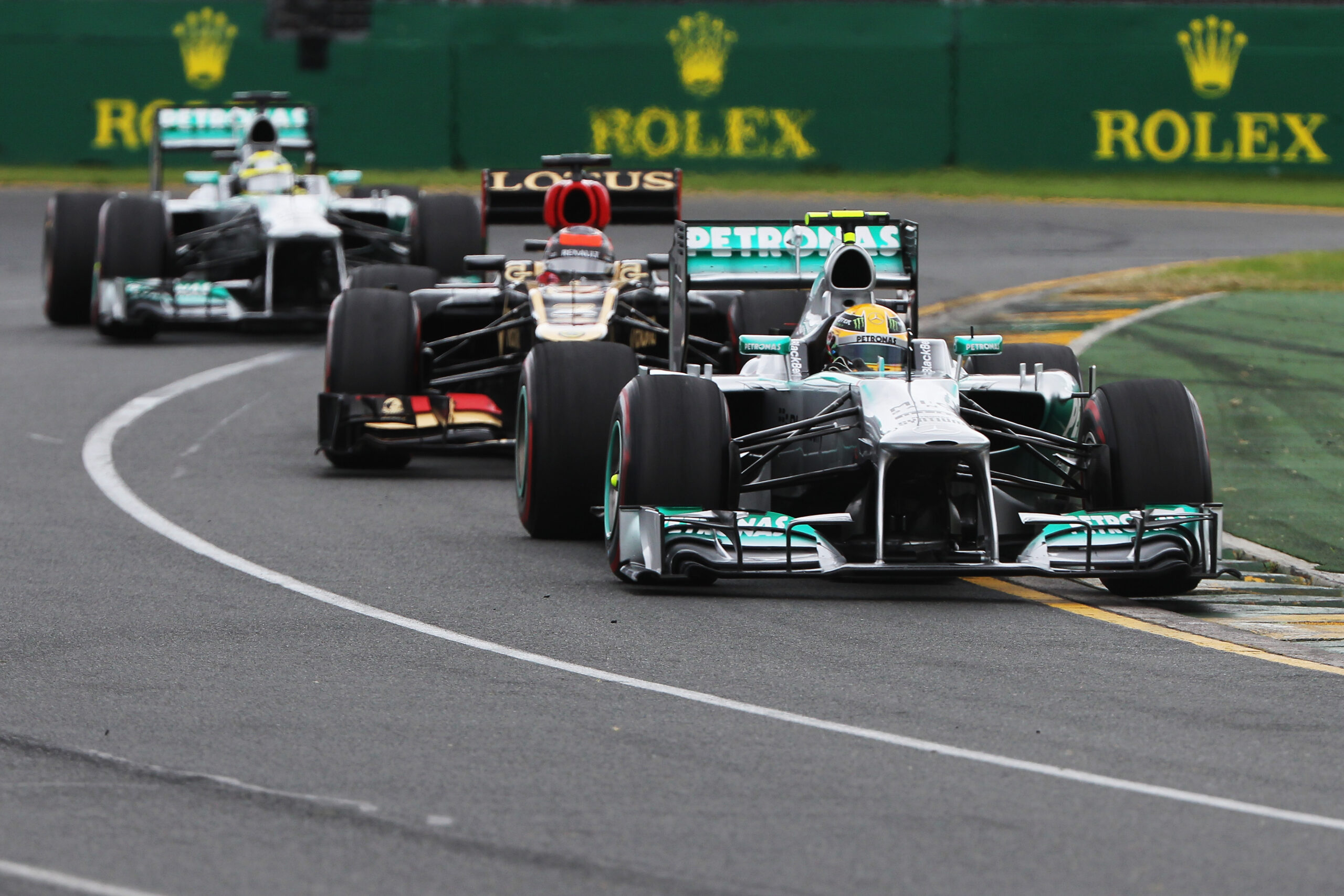
Lewis Hamilton, with Lotus driver Kimi Räikkönen and Mercedes teammate Nico Rosberg on his tail at the 2013 Australian Grand Prix. Photo: Ker Robertson / Getty Images
Peter Hodgkinson is a leadership and performance specialist skilled in helping high-performers become better at what they do. As an accomplished manager and mechanic, Peter has enjoyed almost three decades of success in elite sporting environments. His work in motorsport, as part of winning teams at Le Mans and Daytona, culminated in seven Formula 1 driver’s world championships won at Brawn and Mercedes, where he led car-building operations. Peter was Mercedes’ Head of Build during Lewis Hamilton’s era-defining run of six world titles. After a spell serving as Mercedes’ Head of Employee Engagement, Peter returned to the Factory Floor as Build Operations Manager for the INEOS Britannia sailing team when Mercedes supported their quest for the 37th America’s Cup.
If you would like to speak to Peter, please contact a member of the Leaders Performance Institute team.
In June, performance under pressure, empowered leadership and female athlete health were some of the topics discussed by members of the institute.
“I think the real champions are made in situations when you deal with that pressure,” said Alcaraz at Rolland-Garros in Paris last month. “That’s why I saw my best tennis in crucial moments, and that’s why I saw my best tennis in those difficult situations.”
Performance under pressure was a theme that run through the month of June here at the Leaders Performance Institute, starting with the wise words of Red Bull’s big wave surfer Ian Walsh.
His approach is geared around managing his fear. “Those nerves and everything you fear are natural, and you can use that to elevate your performance,” he said in this article. “It commands every ounce of your being and your focus to deal with what’s coming at you and how you want to navigate it to try and finish on your feet.”
Elsewhere, we returned to the question of alignment, named the common causes of inadaptability, and asked the Brisbane Lions to talk about their approaches to female athlete health.
What if there’s clarity in your communication as a team, but still you suffer from misalignment?
Edd Vahid, the Premier League’s Head of Academy Football Operations, answered this in a recent interview with the Leaders Performance Institute.
He explained there could be a few factors at play, all of which point to the importance of feedback:
Staff development needs. If a staff member commits an error of execution, it is an opportunity to deliver developmental feedback. Vahid says: “Does everyone understand what we’re going after? If they do and they step outside of that, then feedback is warranted.”
Psychological safety. “It’s a buzz term,” says Vahid of the commonly used phrase, “but it’s crucial for people to feel they are in a feedback culture.” The leader must show that the intent of feedback is to help the individual to progress. “You’re taking time to give them feedback because you care,” he adds. “You’re then seeking to work with the individual to create that development.”
The leader’s behaviour. Leaders must also demonstrate their willingness to listen to feedback. “They need to provide ‘speak up’ signals,” says Vahid with reference to the work of psychologist Megan Reitz. “The leader needs the skill to understand the position they’re in and the power they carry in that dynamic.”
The four inhibitors that prevent adaptability in a complex world
Those four inhibitors are discussed in great detail here, but one that will discuss below is when leaders themselves become the bottleneck due to their authoritative approach.
“Authoritative leadership has been proven time and time again to be effective in very short bursts,” said Tim Cox of Management Futures at a recent Leaders Virtual Roundtable, “but it isn’t much good for adaptability.” The reasons are simple enough. “It’s really difficult for one person to be able to think through, be creative, respond to the environment around them when things are changing at a high pace.”
Leaders, Cox said, should:
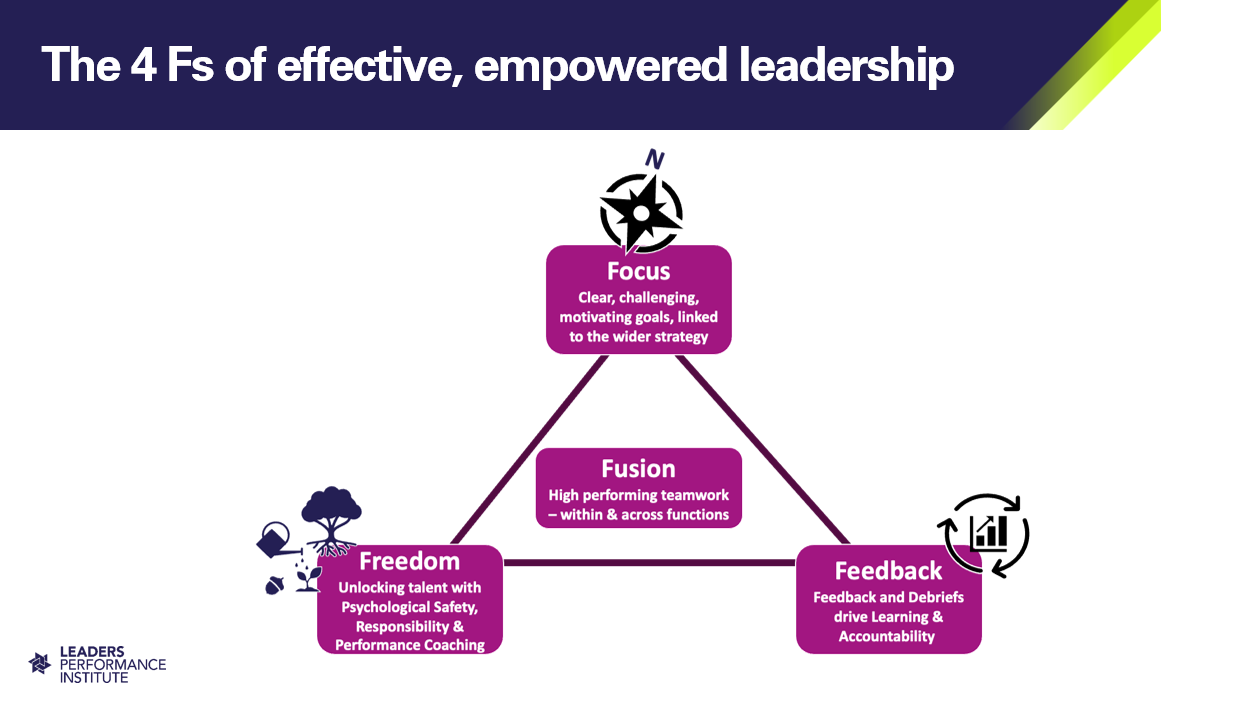 Focus: The leader must deliver clear, strategic alignment where everyone understands the direction and purpose of their work.
Feedback: Regular feedback and debriefing are essential for learning and continuous improvement, especially in dynamic settings.
Freedom: Give people autonomy and allow them to explore, innovate, and respond to change.
Fusion: This is about building strong relationships and collaboration, both within and beyond your organisation with a view to harnessing collective intelligence
Leadership is stagnating
This idea of leadership stagnating was revealed in stark terms in our Trend Report earlier this year.
The Trend Report revealed that 57 per cent of practitioners believe that leadership within their organisation has stayed the same or got worse in recent years.
The primary factors appear to be the shift towards task orientation and the pressure to ‘win now’, which can act to stifle innovation and long-term thinking. Leaders, as a selection of Leaders Performance Institute members agreed during a June roundtable, have less bandwidth, less time for staff development and even less time for staff onboarding.
Ben Baroody of Abilene Christian University, who co-led the session with Edd Vahid, observed that even at organisations that prioritise leadership development, stagnation is still reported. For Baroody, this is compounded by what he sees as the link between alignment and (high) quality leadership.
Vahid questioned whether leaders are giving themselves enough capacity to lead effectively and, as such, he is an advocate of distributed leadership models and leaders who invest in their own development as well as that of their people.
The virtual floor also highlighted the importance of skills including influencing, an ability to hold honest conversations, and active listening.
The Brisbane Lions have turned female athlete health into a performance question
The renewed focus on female athlete health is a direct result of the work of Matt Green, the Lions’ High Performance Manager for AFLW and his team.
As an organisation, the Lions focus on five key, interrelated areas:
When it comes to topics such as developing a performance culture, engendering trust and adroitly using tech, the former defender’s instincts as an athlete stand her in good stead.
A podcast brought to you by our Main Partners

“You feel it,” says the Director of Bayern’s women’s programme. “You already know when you look at their faces. You’re like ‘I think she doesn’t like it’, ‘yeah, she likes it’ and ‘she needs a bit of proof’. It’s like sometimes I see myself sitting on the other side.”
The ‘other side’, as Bianca tells Teamworks’ Andrew Trimble and Leaders’ John Portch, refers to her transition from a Germany international and Frauen-Bundesliga regular to a senior leader of the German champions, whom she represented on the pitch for four years.
“It’s so much harder now when you sit on that side now,” she adds, reflecting on how she used to feel as a player. “I see myself sitting on the other side, like, ‘oh, maybe I have to talk to them again’.”
In this third and final episode of our special series with Teamworks, Bianca touched upon several of the major themes that emerged from our recent Special Report High Performance Unpacked: interconnected performance teams.
She spoke of her role in helping to transform the Bayern culture on and off the pitch [37:00]; keeping the athlete at the centre of the performance jigsaw [14:30]; the importance of sports psychology [31:00]; and the thoughtful integration of technology [21:00].
Listen above and subscribe today on iTunes, Spotify, Stitcher and Overcast, or your chosen podcast platform.
Episode One: Simon Rice, the Philadelphia 76ers
Episode Two: Miranda Menaspà, the Australian Institute of Sport
In a recent Leaders Virtual Roundtable, Tim Cox of Management Futures presents a series of tools for navigating those obstacles.
Many of you will be familiar with VUCA (which stands for ‘volatility’, ‘uncertainty’, ‘complexity’ and ‘ambiguity’) and employed it in your day to day work.
It looks like this:
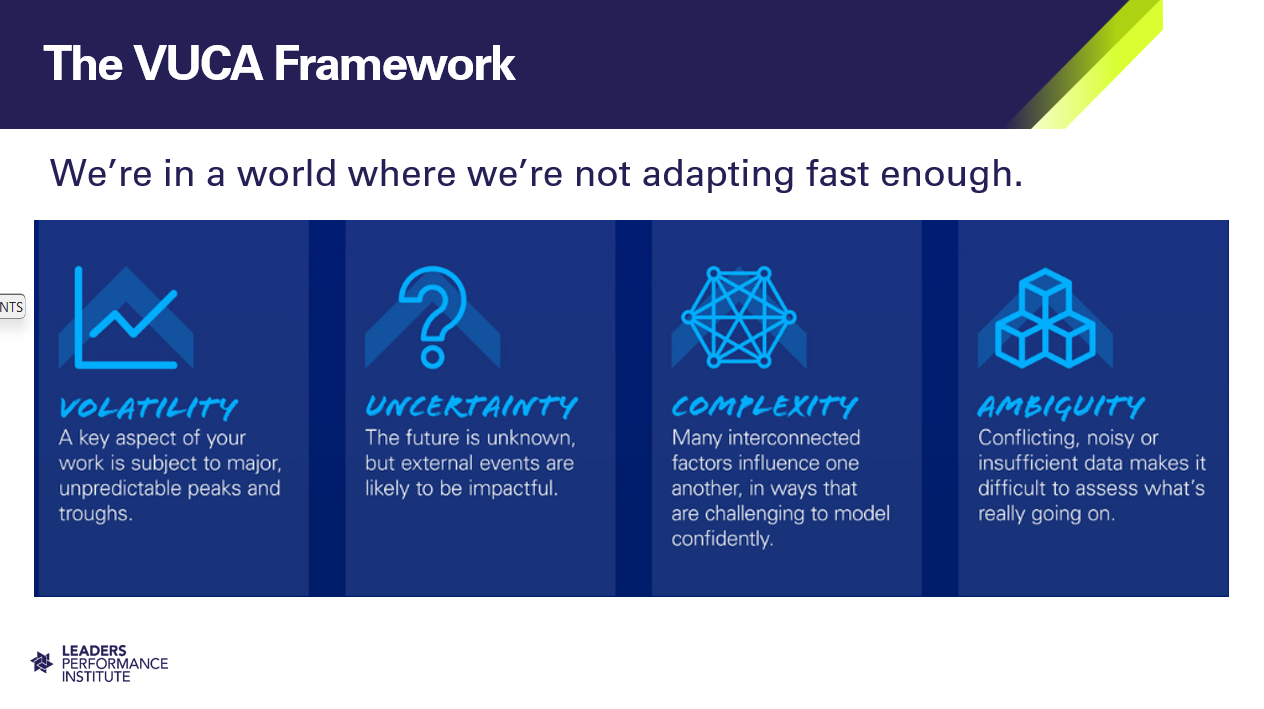
VUCA was devised in military circles in the 1980s as a strategic response to external forces and is both analytical and structural. It remains a useful tool for planning and building resilience.
However, there is a growing consensus that VUCA alone does not capture the emotional and psychological toll as environments become increasingly complex.
In 2018, the author Jamais Cascio, a self-styled ‘futurist’, published his BANI Framework, which is his effort to introduce a more human-centred lens, that emphasises fragility, emotional responses, and the breakdown of linear logic.
Here is an outline:
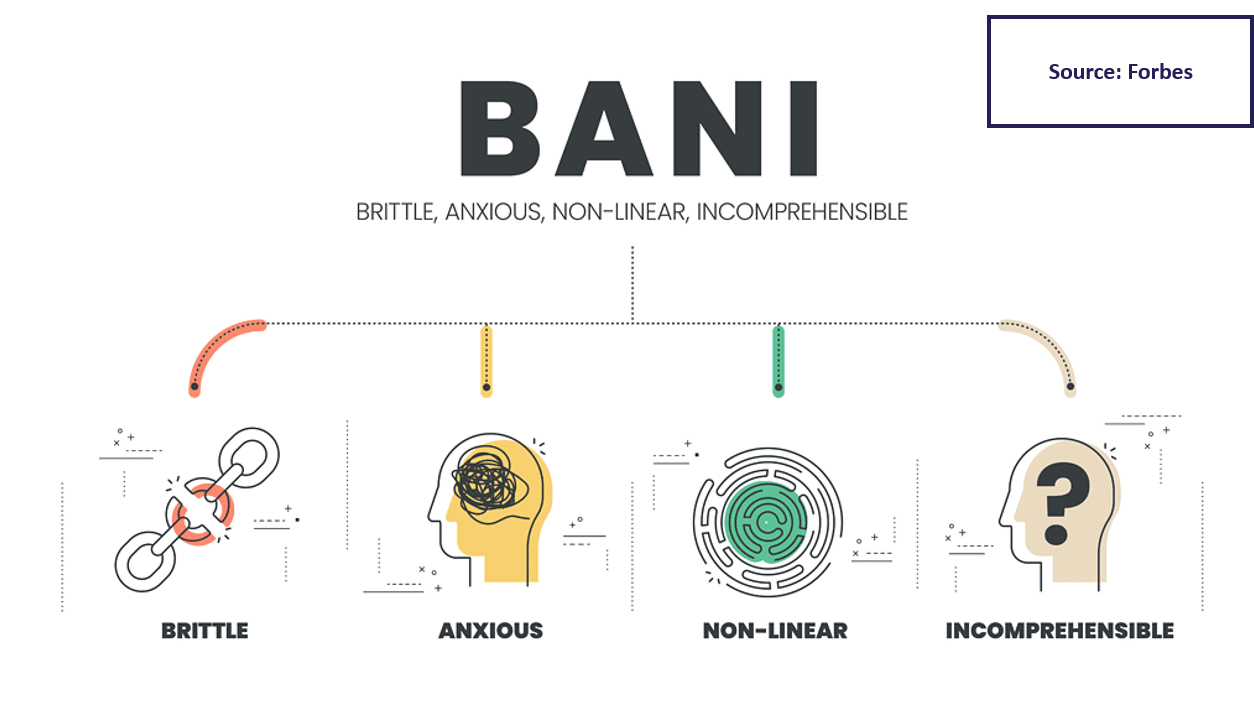
And here is how it may look in your environment:
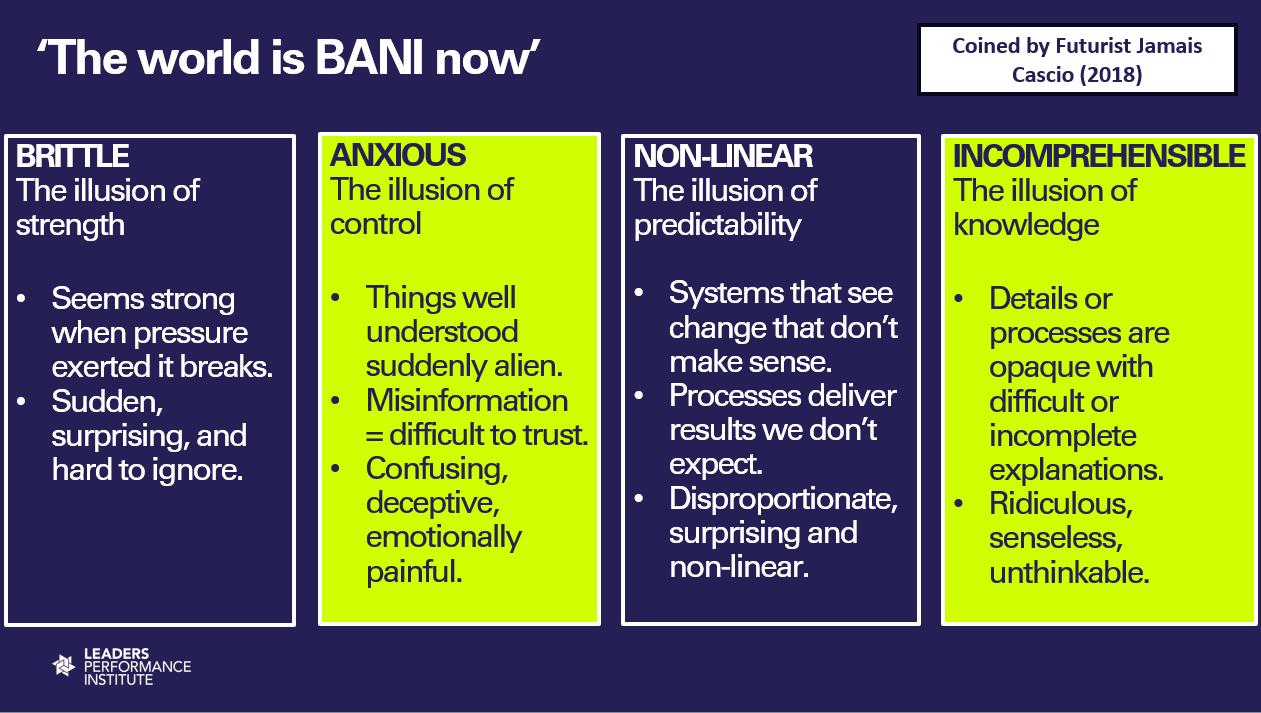
“Cascio sees BANI as parallelling VUCA, but he thinks VUCA is not real enough,” said Tim Cox of Management Futures, the host of a recent Leaders Virtual Roundtable. “He’s not saying BANI replaces VUCA, but he feels that it’s much more up to date with what’s going on at the moment.”
It helped to set the scene for the second session of our three-part Virtual Roundtable series entitled ‘Leading in Complexity’.
Which trap is most common in your organisation?
In part one, we explored how adaptability can increase the chances of an effective response to complexity.
In part two, we turned our attention to four common factors that can inhibit your ability to be adaptable and asked the table to select their most common ‘trap’.
Cox then spoke to each trap in turn.
This trap was cited by the fewest attendees but, as Cox explained, “even in sport we are often hijacked by emotions and we fail to adapt because they override our thinking.”
One must “relax, observe, and make a call”. Cox has some tips on that front:
Nearly half of attendees cited this as the most prominent trap.
It is an enacting metaphor too. “The classic operating from an out-of-date map was the belief that the world was flat,” said Cox. “It limited people and it spread fear in people not to go beyond certain points.”
Without active sense-making, he explained, leaders risk falling into mental ruts that limit adaptability.
Cox recommended the following:
It is a practical method for fostering adaptability and creative problem-solving in complex environments:
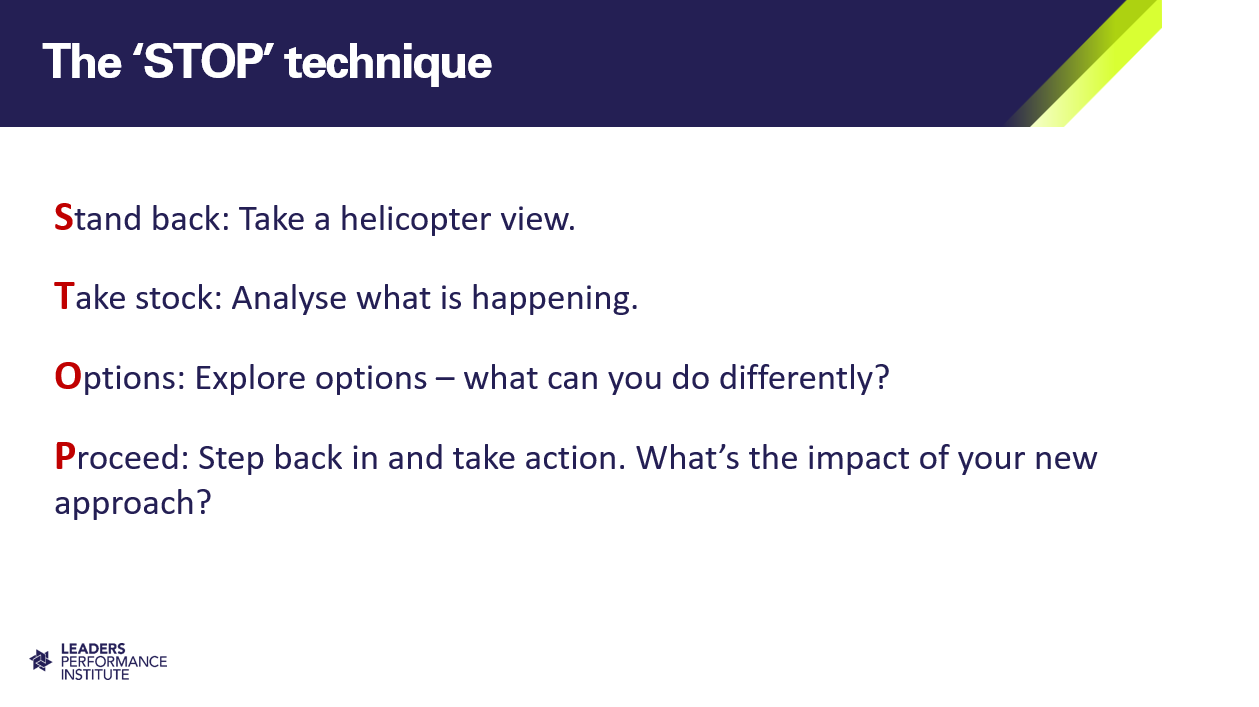
Our poll indicated that more than one in five attendees rank this as their team’s most prominent inhibitor.
“Authoritative leadership has been proven time and time again to be effective in very short bursts,” said Cox, “but it isn’t much good for adaptability.” The reasons are simple enough. “It’s really difficult for one person to be able to think through, be creative, respond to the environment around them when things are changing at a high pace.”
Leaders should:
Focus: The leader must deliver clear, strategic alignment where everyone understands the direction and purpose of their work.
Feedback: Regular feedback and debriefing are essential for learning and continuous improvement, especially in dynamic settings.
Freedom: Give people autonomy and allow them to explore, innovate, and respond to change.
Fusion: This is about building strong relationships and collaboration, both within and beyond your organisation with a view to harnessing collective intelligence
As with authoritative leadership, our poll indicated that more than one in five attendees rank this as their team’s most prominent inhibitor.
Cox had a selection of ideas that leaders might consider:
Other inhibitors cited by Leaders Performance Institute members:
Sign up for Part Three
In the third and final session on 3 July, we will explore building a collective playbook for leading in complexity: