David Clancy, Richard Kosturczak and Ronan Conway explore the identifiers of team cohesion and the fundamental building blocks that separate the great from the good.
Without it, even the most skilled groups falter. As Peter Guber, the CEO of Mandalay Entertainment and Co-Owner of the Golden State Warriors, LA Dodgers and LA FC said, “Without social cohesion, the human race wouldn’t be here. We’re not formidable enough to survive without the tactics, rules, and strategies that allow people to work together.” This principle is as true in modern business organisations and elite sports as it was in our evolutionary history.
High-performing teams aren’t just thrown together without thinking. They are intentionally built through careful design, clear communication, and shared goals. It’s about finding the blend where roles, responsibilities, and diverse perspectives align, allowing every individual to leverage their strengths for the benefit of the collective.
So, how do we achieve that cohesion, especially in environments where team members may not fit neatly into traditional roles? How do we ensure that the whole team operates as a cohesive unit, even when differing opinions and reporting lines exist?
Finding the sweet spot
Cohesive working requires creating an environment where finding the sweet spot means aligning team members’ roles and responsibilities in a way that meets both organisational goals and individual capabilities. It’s about meeting in the middle – ensuring that while everyone contributes their unique expertise, they also respect the collective objective.
Leaders play a pivotal role in facilitating these moments of alignment, ensuring that when opinions or methods differ, the focus stays on finding the most effective solution, rather than reinforcing silos, judgements or personal agendas. In this sense, cohesion is about not just collaboration, but collaboration that works toward shared objectives, adapting as needed to meet challenges in real time.
The building blocks
The foundation of a cohesive team lies in four critical elements:
These building blocks allow for cohesion even in complex or unconventional team structures.
Identifiers of high cohesion
How a team clicks: does it work in harmony? Knowing where to look is essential for identifying how well a team is functioning together. Here are some concepts to look at for indexing this sense of ‘teamwork’.
These markers are crucial for evaluating is a team functioning as a tight unit. You could use these identifiers as a means for tracking and measuring how well the team is doing.
When these indicators are robust, the team’s ability to perform at a high level is elevated.
Ensuring that everyone is on the right bus – and in the right seat on that bus
Ensuring that people have the right roles and responsibilities in a team isn’t as simple as matching a title to a task. Often, it requires rethinking traditional organisational designs. Instead of relying on predefined job descriptions, high-performing teams focus on matching skills, expertise, and interest to the actual needs and musts of a team. This flexibility ensures that individuals are positioned to succeed, even if their role falls outside a traditional org chart.
The best approach is to identify the key outcomes the team needs to achieve and then allocate responsibilities based on who is best suited to drive those outcomes. It’s not uncommon for someone to hold responsibilities that cross functional boundaries, but as long as clarity exists, cohesion can still thrive.
The goal is not to fill predefined slots but to build a dynamic, flexible system that adapts to the needs of the moment, such is the demands of elite sport.
Good on paper vs good in reality
It’s easy to assume that a team looks perfect on paper – each role clearly defined, each person seemingly in the right position. But the reality is often far more nuanced. Good on paper might mean that organisational charts, roles, and responsibilities are technically correct, but it doesn’t account for the personal dynamics, communication styles, or agility of the individuals involved.
Good in reality, on the other hand, refers to teams that function well in practice, in the training room, on the field – when it counts, when pressure comes. This requires fluidity, acknowledging that roles may overlap, opinions may diverge, and people may need to step outside of their ‘assigned’ lanes to help the team succeed. Cohesion in the real world demands malleability, trust, and a willingness to change when necessary.
Managing differing opinions
It’s quite common for teams to have two people with different opinions or views reporting to different leaders. This could be shaped by the individual’s personality predisposition, such as are they more Type A and Type B, for example. These differing views, opinions and traits can create friction – but in high-performing teams, this diversity of thought is seen as a strength, something to be amplified, if positioned well. It pushes the team toward innovation and deeper problem-solving. The key is to ensure that these differing opinions don’t lead to disjointed decision-making and fragmentation.
This is where a decision-making model becomes critical. Leaders should establish processes that guide how decisions are made, who gets the final say, and how differing viewpoints are resolved. For instance, a performance director may not need to make the final call on a return to play decision, but having the A-Z flow will make this decision ‘cleaner’. Each professional stays within their expertise, but they collaborate through a framework that aligns with the team’s overarching goals, such as getting the player back on the pitch after an injury.
Overseeing the decision
Who oversees the decision-making model depends on the structure of the team, but it’s crucial that not every decision needs to reach the top. In well-functioning, cohesive teams, there are levels of authority and autonomy, allowing for faster and more efficient decision-making. Sometimes, well-oiled departments have decentralised command structures, often seen in the military. For example, a doctor doesn’t need the performance director’s approval to prescribe treatment, but the doctor and the PD must work within an established system that ensures consistency and alignment with the team’s overall strategy and vision from a sporting director.
The model should be overseen by those who understand both the day-to-day operational needs and the bigger picture. One needs to be able to zoom in, but also out. This is often a middle ground between front-line team members and senior leadership; this ensures that decisions are informed, timely, and strategic.
Cohesion reading
As a leader, you have likely accumulated a bank of time in teams and groups, from school, university, your organisation, etc. Thus, you have experienced a wide spectrum of people dynamics, cultures and environments. Think of the moments where something felt ‘off’. The energy seemed blunted. People were preoccupied with relational issues, toxic rhetoric, or disgruntlements. In these environments, the task at hand sometimes became secondary. On the flip side, when a team felt closer, it felt ‘right’. In these moments, energy flows… it bends… it adapts like a river. People are locked in, focused on the team vision. Why? Because these relationships are grounded on bone-deep trust and mutual respect.
Call it intuition. Gut feel. Emotional intelligence. This is how you gauge how cohesive a team feels, like a barometer for linkages.
The next time you walk into a team meeting or the changing room, allow yourself a moment to take a reading of the room. Pause and step back. Take a breath. Watch your people. Track their body language and eye contact. How do they greet each other and interact? Listen in. Note the intonation, the laughter, the silence. This is all data.
Is the energy flowing or is it stuck? Notice what you are picking up. Trust it. Take note.
Connection is a separator of great teams
If role clarity, conflict resolution, collaborative decision-making and mutual accountability are the bricks in the house, connection is the cement that binds it all. The quality of our team interactions is heightened when we feel psychologically safe with others, valued and respected. We remain open and engaged and are less likely to shut down or retreat into a corner.
So, how do we foster this connection more?
The elite coaches and managers take no chances in this area. Connection must be intentional. It is not something that one assumes will happen in a performance café or at a team-building Christmas party per se. Just as time is allocated in the weights room to build muscle, elite teams dedicate time to strengthen the collective muscle. This can be bridged by facilitating conversations with individuals to enable them to take stock and interact on a meaningful level. In doing so, they reinforce their connections between teammates, the jersey, their why, legacy and their higher purpose.
A great example of this deliberative connection-building comes from Europe’s Ryder Cup win in 2023 at the Marco Simone Golf and Country Club. Post victory, Rory McIlroy reflected on when his team started to take shape, under the leadership of Luke Donald, their team captain at the time, and European Captain for the 2025 Ryder Cup. On a practice trip in the lead-up to the tournament, putting greens, driving ranges and tactics boards were swapped for an ‘amazing experience’ around a fire pit. The team reflected on topics like ‘why they love the Ryder Cup so much’, and ‘having parents that sacrificed a lot for them’. This moment helped galvanise the European team.
Now to The Last Dance. In 1998, Phil Jackson, the Head Coach of the Chicago Bulls, gathered Michael Jordan, Scottie Pippen, Dennis Rodman, and co. He asked them to write about what their Bulls team meant to them before each player read aloud to the group. After they all had their turn, Jackson symbolically lit the tin cup filled with papers on fire, and all the Bulls watched on and felt more connected. “One of the most powerful things I’ve ever seen”, said current Head Coach of the Golden State Warriors and former Chicago Bull, Steve Kerr. The rest is history.
Final thoughts
Building cohesion and connection is about far more than getting the right people in the right roles – it’s about finding that sweet spot where collaboration thrives, even when team structures or opinions don’t fit the mould.
The successful teams of the past, whether this is Manchester United Football Club under Sir Alex Ferguson, the All Blacks of 2011 to 2015, or the Red Sox after they broke the curse, they all built strong foundations of trust, clear communication, and adaptable roles.
Teams can become great, making decisions that are informed by a diverse range of perspectives yet aligned toward shared goals. By implementing robust decision-making systems and processes, and fostering environments where flexibility, connection and trust are prioritised, high-performing teams can unlock their full potential…navigating complexity with confidence, and a higher sense of team.
David Clancy is a Learning and Development Consultant at the Houston Texans and Director at The Nxt Level Group. He is also the Editor of Essential Skills for Physiotherapists: A Personal and Professional Development Framework, which is available now from Elsevier.
Richard Kosturczak is a Market Specialist at The Nxt Level Group and Specialist Physiotherapist.
Ronan Conway is a Team Connection Facilitator, who has worked with teams including the Ireland men’s rugby team and Dublin GAA, Ireland’s most decorated Gaelic football team.
If you would like to speak to David, Richard and Ronan, please contact a member of the Leaders Performance Institute team.

David Clancy and Richard Pullan set out their strategic and intentional approach to network building in a high-performance world of ever-growing complexity.
In today’s fast-paced world, high-performing individuals and teams face increasingly complex cognitive demands. These challenges are not just about processing information but also about managing stress, navigating uncertainty, and maintaining clarity amid competing priorities. This is where the power of strategic and intentional network building comes into play.
There are several means available to help build this network. They include purposeful twinning with others, developing an ecosystem of critical friends and identifying a web of second-opinion teammates. Each of these connections provides leaders with the means to make more informed and rounded decisions, make perspective shifts as well as provide objective feedback.
Twinning
‘Twinning’ refers to the practice of forming reciprocal partnerships with other teams or organisations that share similar goals, challenges, or conundrums – perhaps they might even be competitors, if the context makes sense. This is a huge part of what the Leaders Performance Institute does, in fact, forging ‘partnerships’ with teams and individuals. This is how the Houston Texans of the NFL became professional friends with the Texas Rangers of MLB, as an example. This symbiotic relationship allows for mutual learning and growth, where both parties can share best practices, resources, and insights. A term we often hear is ‘collaboration over competition’ – we can all row the boat faster if we are willing to exchange protocols, philosophies and pain points.
Professional sports teams all face their unique set of struggles but, oftentimes, there are numerous similarities with these. Sharing best practices and ways to approach challenges is a significant benefit downstream of this pairing. By ‘linking’ with another team, leaders can expand their knowledge base, reduce the isolation often felt in high-pressure roles, and benefit from other viewpoints.
In terms of innovation, if teams are open to sharing what they do (to a degree), how they do it, etc, they can draw on the experience and solutions already implemented elsewhere. This save them time, effort, and energy. Food for thought.
Critical friends
Critical friends play a unique role in leadership, deliberation and decision-making. A critical friend is someone who offers candid, constructive feedback and is unafraid to challenge assumptions. This is ideally someone outside the team/ franchise. They are trusted individuals who can act as a sounding board for ideas, provide a second perspective, and offer checkpoints when needed.
Creating and nurturing these ‘friends’ requires energy and effort, but the payoff can be huge. As an example, if you are ideating a new return-to-play system and method, bouncing ideas off someone with exposure to this in another environment could help make your system better. A no-brainer if you ask us!
We have witnessed the benefit in relation to cognitive demand also, as critical friends offer a safe space to validate thinking and refine or rethink ideas. Critical friends help prevent blind spots, biases and assumptions by encouraging the leader to pause and reflect before executing a critical task. The best critical friends strike a balance between support and challenge. They are not afraid to disagree, but they do so with the intention of helping the leader grow.
Second-opinion teammates
Second-opinion teammates (teammates being a crucial word) serve a similar purpose, offering alternative viewpoints to ensure a more well-rounded decision-making process, such as another set of eyes on an MRI report and image for a hamstring injury.
Particularly in high-stakes environments, seeking a second opinion reduces cognitive stress by distributing the weight of responsibility and allowing leaders to feel more confident in their choices. Knowing that a trusted colleague has reviewed the same data or proposal with rigour and objectivity can provide a sense of reassurance and clarity.
Strive to stock a bullpen of second-opinion teammates. It’s a game-changer.
Mentorship
“The delicate balance of mentoring someone is not creating them in your own image, but giving them the opportunity to create themselves”, said Steven Spielberg. To create themselves entails helping one to find their way. Consider giving a project to a more junior member of staff from a senior ‘mentor’, rather than the ‘easier’ option, of giving the project to a ‘middle manager’ who has done the type of project before. That’s an example of what this could look like.
Mentorship is a timeless strategy – one for managing both the emotional, physical and intellectual demands of leadership. This is typically someone with more experience who can offer guidance, advice, and lessons learned from mistakes, and successes. Great mentors provide leaders with the tools to think more effectively for themselves, enabling them, giving them their own toolkit; this helps them navigate complexity, prioritise, and mitigate stresses. They leave breadcrumbs behind.
Mentors can help leaders manage cognitive demands by offering perspective on what truly matters, helping to sift through the noise and focus on the signal i.e. what is essential. They also provide historical insight, showing leaders that many challenges they face are not new and can be tackled using time-tested methods. This reduces the sense of overwhelm that comes with thinking one must always reinvent the wheel. The issue you are facing has been faced and solved before.
Moreover, mentors are invaluable in helping leaders manage their wellbeing, as they can provide reassurance and encouragement when times get tough and they can acknowledge that these times come with the intense world of competitive sport.
Building a network
In high-pressure environments, leaders often find themselves juggling multiple competing priorities, balancing short-term, ‘urgent’ demands with long-term, ‘important’ goals.
Here are five reasons for nurturing a network to help with this:
What makes a good mentor?
The best ones share several key traits that make them invaluable in helping leaders grow and meet the demands of high-performance sport.
Here are five traits we often see:
And let’s not forget that mentors need mentors. This could be your partner at home, as an example.
So, here’s our challenge for you reading this article today – take on a mentorship role in some capacity, to give back…to pass the ladder down, as it were.
Final thoughts
In today’s fast-paced and ever-evolving landscape in high-performance sport, a leader’s success isn’t just defined by individual strength – but by the strength of their network. Jobs these days in sport are complicated and complex. It is now rarely possible for one individual to serve a function fully without seeking support from other disciplines, to deliver the final solution to a given problem.
By cultivating relationships through twinning, critical friends, second-opinion teammates, and mentorship, leaders create a support system that fosters psychological safety, collaboration, and continuous learning. These connections enable leaders to confidently navigate complexities, make incisive decisions, and lead afront with impact. After all, just as every great athlete stands on the shoulders of their team, no leader can truly flourish without a trusted network standing behind them.
David Clancy is a Learning and Development Consultant at the Houston Texans and Director at The Nxt Level Group. He is also the Editor of Essential Skills for Physiotherapists: A Personal and Professional Development Framework, which is available now from Elsevier.
Richard Pullan is a Director at The Nxt Level Group, the Visionary Founder of The Altitude Centre, and leads the training of clients for flash ascents of Everest and other 8,000m peaks, while also preparing professional athletes and elite sports teams. He is formerly of Sporting Health Group.
If you would like to speak to David and Richard, please contact a member of the Leaders Performance Institute team.
In the first edition of a new miniseries, David Clancy makes the case for learning ecosystems as a crucial factor in taking the best teams from good to great.
The motivations behind a learning ecosystem
You must want to create a learning organisation. It needs to be identified as a strategic and cultural pillar, and modelled from the top down. This gives it a chance.
Imagine the locker room of a Super Bowl-winning team: how does this group go from ‘good to great’, to borrow Jim Collins’ words? The answer lies not just in player availability, exceptional talent or game tactics but also in something more subtle: a learning ecosystem.
In environments where the pursuit of knowledge is seen as important as the pursuit of success, teams are not just built, they’re sculpted, layer by layer, through continuous learning, reflection and adaptation. If we want to develop the players to their highest possible level, we need to develop the staff and coaches too.
The drive behind fostering this goes beyond mere survival in a competitive landscape. It’s about thriving, about ensuring that every individual in the team environment feels compelled to grow, not just for their own sake, but for the collective strength of the group. It’s the difference between a team that reacts to change and one that anticipates it, between a team that executes a plan and one that evolves the plan as they go. Some of the reported benefits of nurturing a learning environment include enhanced adaptability, continuous improvement, increased engagement and motivation, better problem-solving, cohesion and innovation.
High-performing teams understand that learning isn’t a box to be ticked; rather, it’s a pursuit of betterment. It’s a culture, an ethos. Simply understanding that when presented with a similar situation, behaviours may change, is a sign of learning. As an example, ‘Plan, Do, Check, Act’, an iterative four-stage management method for the control and continuous improvement of processes would lead to refinement of how behaviours take place in situations. When learning becomes a core value across a team and its various departments, it nudges forward-thinking, fosters resilience, and can contribute to sustained success.
Five key elements of a learning environment
Building a culture of learning is like constructing a well-oiled machine, where every part has a role to play. At the heart of this are a few critical parts:
Pause for a moment and reflect on these questions:
A further question:
How do you take these components and breathe life into them?
Five strategies to implement
The following strategies are as much about mindset as they are about action:
Three typical obstacles and how to overcome them
No journey of learning is without its hurdles. Here are some common roadblocks and why they may emerge:
Navigating the obstacles
Resistance to learning initiatives is almost inevitable, but it’s how you respond to this resistance that counts. When faced with pushback, consider the following:
Final thoughts
Creating a culture of learning for high performing teams is not just about setting up training sessions or mandating workshops. It’s about embedding learning into the fabric of the team’s identity, mission and their values. Potential outputs range from staff skill enhancement and personal impact development to staff retention, less attrition and increased internal promotions. Increased unity around a performance philosophy and its implementation comes from ‘breaking bread’ over learning moments. The potential for opportunities for horizontal working with coaching, player development and scouting departments is another positive by-product.
If you want to do this right, you need to grasp an understanding of the deep motivations that drive people to grow, to build the structures and processes that support that growth, and to navigate the inevitable obstacles with agility, courage and empathy. High-performing teams aren’t just good at what they do, they keep getting better by reviewing what they do, learning from that and finding the right inputs to move forward.
Systems, processes and people development: it begins with a culture of learning.
David Clancy is a Learning and Development Consultant at the Houston Texans and Director at The Nxt Level Group. He is also the Editor of Essential Skills for Physiotherapists: A Personal and Professional Development Framework, which is available now from Elsevier.
If you would like to speak to David, please contact a member of the Leaders Performance Institute team.
Jide Fadojutimi and Marianne O’Connor of Management Futures explain why ‘skilled candour’ generates psychological safety and lets you show your people that you care.
They may recognise the need to take someone to one side, but if they are unable to broach the topic in a skilled and productive way, then a small problem can quickly escalate.
At the 2023 Leaders Sport Performance Summit in London, Jide Fadojutimi and Marianne O’Connor from Management Futures led an onstage skills session explaining what to do and what not to do when approaching someone to have a ‘courageous conversation’.
What is a ‘courageous conversation’?
The term was coined by executive coach Kim Scott, who argues in her 2017 book Radical Candor: Be a Kick-Ass Boss Without Losing your Humanity that leaders have a ‘moral imperative’ to step into difficult conversations and challenge with skill. This requires courage because it is simply easier to avoid such conversations.
Scott devised a skills grid to illustrate what it takes to lead a courageous conversation. O’Connor and Fadojutimi shared Scott’s grid with the Leaders audience but changed the top-right quadrant from ‘radical candour’ to ‘skilled candour’:
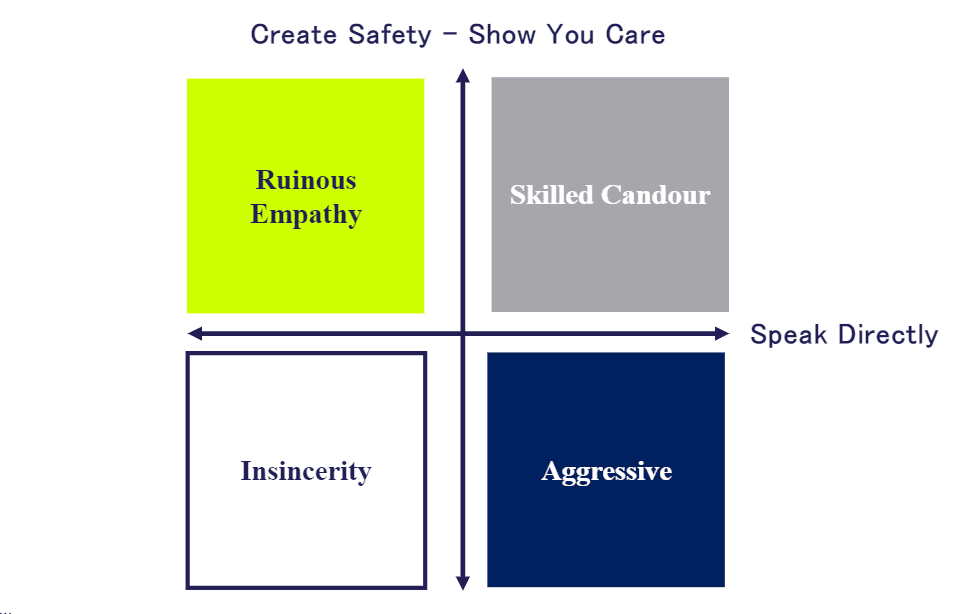
Image: Management Futures
“We’re going with ‘skilled candour’ because it’s a skill we can all learn and build,” said Fadojutimi of Management Future’s way of teaching the topic.
The three pitfalls to avoid
The arrows on the grid suggest that the path to skilled candour lies in giving people a sense of psychological safety and the feeling that you care about them. The grid also suggests three pitfalls, which were discussed at length by Scott in Radical Candor:
The five steps towards skilled candour
O’Connor explained that there are five steps you can take to help develop your ability to approach conversations with skilled candour:
