As they told Leaders Performance Institute members, the Boston Red Sox’s Ben Crockett and Brisbane Broncos’ Troy Thomson believe it is a question of trust, education and collective responsibility.
At the 2025 Leaders Sport Performance Summit in London, he shared a decade-old story about a pitch-tracking technology that had been excitedly introduced by the club’s performance team. “It was a tool to help provide the coaches with more information that would help them in their coaching efforts and provide feedback,” said Crockett, who now serves the Red Sox as a Special Assistant of Basketball Operations.
The project proved to be a flop despite the technology doing exactly what it was supposed to do. Today, Crockett understands where his team went wrong. “We didn’t teach it enough; and we actually installed somebody to help operate it, which we thought would be helpful.” However, “in some ways it actually took away the ownership of our coaches for a solution that was ultimately going to help them.”
The Red Sox pitching coaches carried on doing their own thing; the merits of the technology were irrelevant to them. They didn’t trust, understand or see how it would help. “That was a good lesson in terms of what not to,” added Crockett, who shared the stage with Troy Thomson, the Football Operations Manager at the Brisbane Broncos, who had a cautionary tale of his own.
“Quite often, someone over-promises and under-delivers,” he said. “When you finally get the hardware in, it doesn’t quite have the capabilities you need.” It is no wonder that coaches can be wary of new datasets.
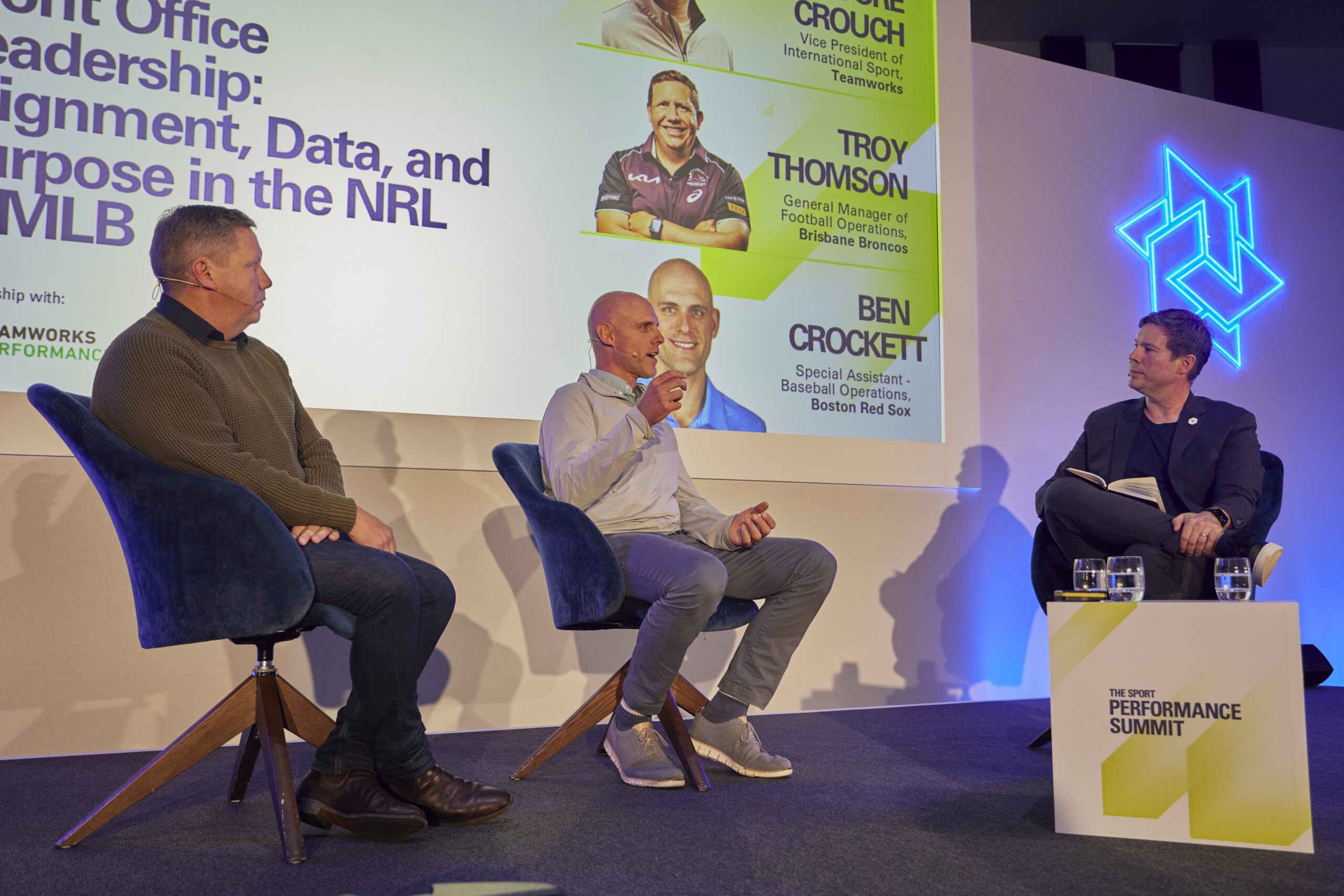
Ben Crockett (centre) speaks onstage at the 2025 Leaders Sport Performance Summit in London alongside Troy Thomson (left).
Over the course of half an hour onstage at the Kia Oval, Crockett and Thomson explained why data is valuable only if it can positively influence decision-making and behaviour. Their efforts to refine their approach point to five common principles: transparency, education, alignment, ownership and storytelling.
Transparency – information only matters if people can see it
Data is most useful when athletes understand the metrics, contribute to the resulting discussion and take responsibility for acting upon the information unearthed.
Transparency at the Red Sox, as Crockett explained, is embedded in a system of “continuous feedback loops within session, after session, after games” between coaches and the players, who develop a “continued understanding of where they stand on chasing specific measurable goals that have been agreed upon between the player and the team.” He added that “the athletes today are much more open to getting that type of information”.
Thomson also noted that Broncos players actively seek feedback on their performance metrics. For example, they now “want to finish the session and come and see what their line speed metrics are,” he said.
Education – data must be understood before it can influence decisions
Data can begin to influence decision-making when people understand both the numbers themselves and the behaviours those numbers are intended to shape. As Crockett noted, “it isn’t a one-time presentation; ‘here’s what everything means’. It’s ongoing.”
At the Broncos, Thomson emphasises the importance of helping players understand what data reveals about their performance. The coaches’ role is one of showing rather than simply telling.
He said: “The coaches also work really hard from a visual point of view as well, so being able to show the players technically how they’ve been working is a really important part of the process.”
Alignment – everyone working towards the same goals
To reach a collective understanding of what success looks like and how it is achieved, teams must first establish what matters most. Data can be a useful tool in that regard.
When Crockett discussed the challenge of coordinating a baseball operation that includes Major League, Minor League and player development programmes, he stressed the importance of “clearly defining key metrics that drive value for us at the Major League level and drive value throughout the industry.” Once those metrics have been identified, the task becomes ensuring everybody is working towards the same outcomes. Crockett described how the Red Sox seek to “help align our player development staff and personnel development staff with the things that were most important to driving that value”.
It is a similar story at the Broncos. “We’ve got a whole heap of different stats that we use; so post-game, there’s some standardised stats that we know if you get those processes right, the result will look after itself,” said Thomson, whose team has put in a lot of work behind the scenes. “To be able to bring the whole collective leadership group on the journey was really important.”
Ownership – data belongs to all stakeholders
Crockett and Thomson both argue that data becomes valuable when the people making decisions feel responsible for using it. Crockett’s pitch-tracking debacle is a prime example of what happens when that ownership is absent. As he recalled: “It ended up becoming a bit more of a ‘well, that’s their information and the pitching coach’s; and I’ll do what I’ve just been doing the whole time’.”
To prevent such scenarios, as Thomson explained, teams must create environments in which practitioners feel comfortable sharing ideas, challenging assumptions and seeking new sources of information. He said: “It’s really important to have a psychologically safe environment where we’re challenging each other on a daily basis to be able to find new metrics or new data sets that can actually enhance the programme.” At the Broncos, the software eventually “became part of a routine for us”.
Storytelling – data is most useful when it explains performance
Behavioural change in a data context depends on the story your numbers tell. Thomson repeatedly stressed the importance of using statistics to tell a story because it “adds to the coaching”.
Not that every stat holds the same weight; coaches have a responsibility to “share the relevant data that tell that story to achieve your outcomes”.
The Broncos’ momentum-tracking software is a case in point, as Thomson explained. While initially unsure how useful it would be, the tool was valued because “it allowed the coaches to be able to present the feel of the game”. By helping coaches explain something they previously struggled to articulate, the data became far more powerful as a catalyst for decision-making.
What to read next
As part of SBJ’s Sandbox Series, Ethan Joyce trialed NTangible’s Clutch Factor assessment to examine if the sports industry can quantify what enables athletes to deliver when the stakes are highest.
Main Image: Getty Images

Normally, it’s my colleague Joe Lemire who experiments with new tech for our recurring Sandbox Series. But this week, it was me dipping my toe into the test zone — and I recoiled with a wounded ego.
When it comes to human performance, clutch is still a polarizing topic. Is it even real? The analytical stat heads say no, but anyone who’s seen a game-winning shot or a career-defining performance by a star athlete may beg to differ. So, what if you could evaluate people based on their likelihood to perform in high-pressure situations?
NTangible has figured out how to measure it.
The platform, which provides mental scouting assessments for athletes for multiple sports, was created by President/CEO Dan Connerty. Its testing, which features open-ended and multiple-choice answers, uses AI to analyze things like thought process, perspective and wording.
Connerty has been on this startup adventure full-time since 2024, with NTangible now in use in 40 NCAA programs (including Boston College and Florida Atlantic). Last year, the company became the official mental fitness partner of RFK Racing to evaluate and support its pit crew members.
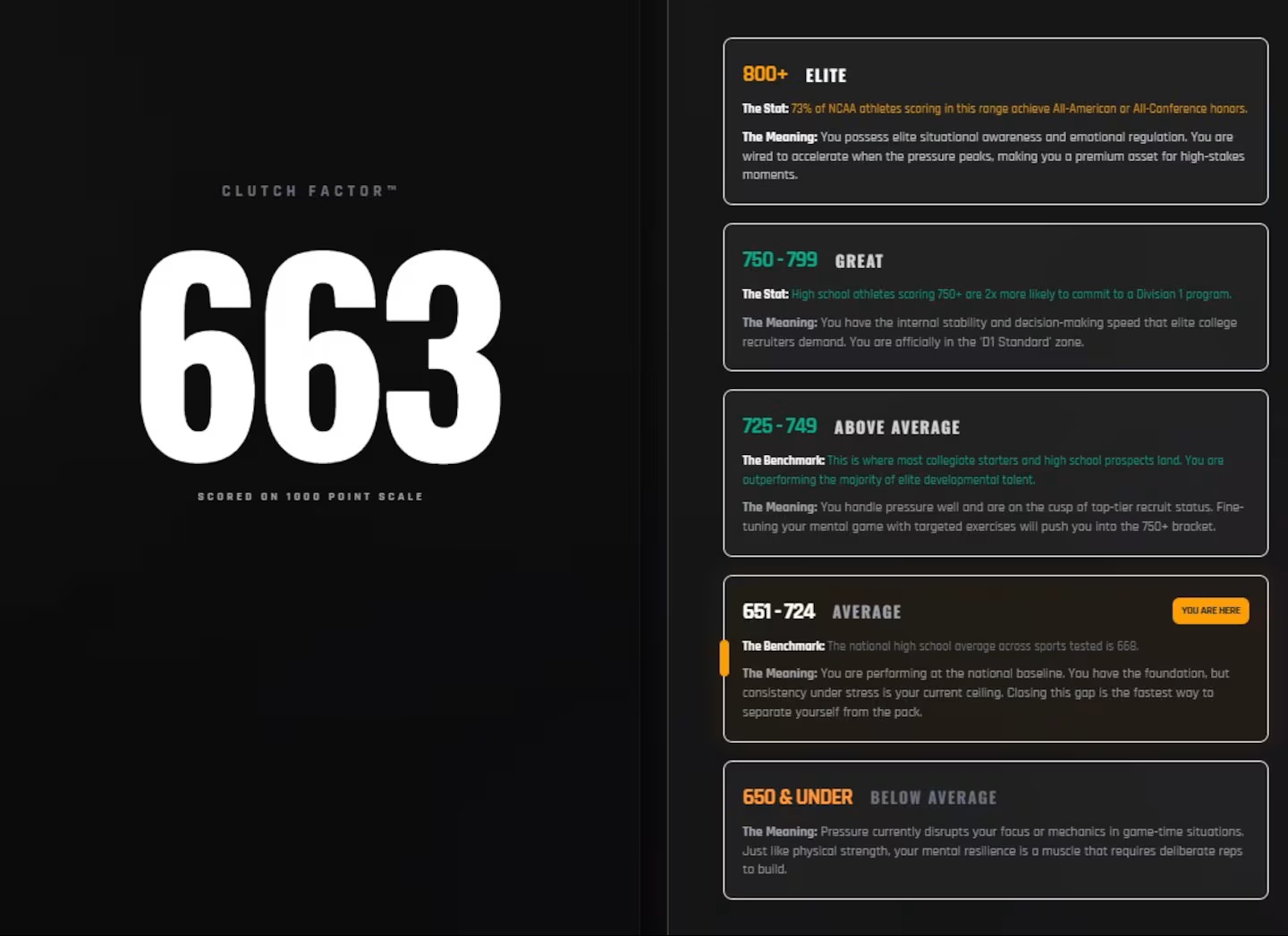
Image: SBJ Tech screenshot
Based in Canada, Connerty spent most of his time in the baseball development space as a former collegiate and pro athlete. He was the principal director of Baseball Development Group from 2017 to 2019, and during that time, he got to know industrial psychologist Ed Levine. And it started this ongoing pursuit.
“At the time I go, ‘We’re going to reach a point where we cap out what we can measure physically — it’s going to happen,’” Connerty recounted to me. “Mental has always been this black box … nobody wants to touch it.”
Enter the Clutch Factor score, which evaluates mental performance in clutch scenarios. In roughly 20 minutes, I ran through a handful of pictures depicting various scenarios. (I did a basketball test since it’s the sport I played the most.) One was an image of a player shooting a free throw, the next was a ball handler staring down a full-court press, and others were similar in-game scenarios. I had a chance to pick my perspective of the play, who I would be and what I’d be planning to do next. I also shared my past experiences of higher-pressure situations.
When I finished the test, I was given a score of 663. That figure is out of 1,000, which placed me in the average category. Connerty said the scores can be quite predictive of college success (NTangible can test athletes as young as 13). The athletes who score in the 750-799 range are twice as likely to play a Division I sport. Above 800? We’re talking a potential all-conference or All-American honoree. Example: Texas freshman P/UT Hannah Wells produced the highest Clutch Factor score in the country. She helped the Longhorns win their second consecutive College World Series softball championship earlier this month.
After sharing my lack of clutchness, I could tell you about my days as a newspaper college football reporter. I was constantly combating the harshest deadlines, filing stories that squeaked in just early enough to make the next day’s edition, some of which I won national awards for. But I won’t do that.
The good news for me (and other users)? Because my clutchness can now be measured, I can also improve it, according to Connerty.
“Our psychologists have said, at minimum, if you wanted to redo it, six months,” he said about retesting. “Usually, this should be an annual test just to see where you are. If you think of the Clutch Factor score as your capacity to perform at your top range, not every day are you going to be there.
“This is something where your score can fluctuate based on experiential parameters.”
That’s totally it! I had an off day. I’m sure of it. Case closed.
This article was brought to you by SBJ Tech, a Leaders Group company. As a Leaders Performance Institute member, you are able to enjoy exclusive access to SBJ Tech content in the field of athletic performance.
As part of SBJ’s Jobs Roundtable series, our friends at SBJ Tech report on the session concerning best practices for AI implementation.
Main Image: Getty Images
Getting comfortable: Minnesota Timberwolves and Lynx CEO Matthew Caldwell was open about his organization being not “very advanced” in its use of AI. To start his personal journey with the technology, Caldwell carved out 10-15 minutes per day for about a month to experiment with Claude and said he was “blown away” by its potential. He later asked his executive team to do the same. “You can’t delegate AI to an innovation group or your IT team,” he said. “It’s got to start with leadership.” The Wolves and Lynx are also amid an ambitious data warehousing project that Caldwell said will give the organization a strong foundation from which to leverage AI internally.
Best practices: Deepali Vyas, ZRG Partners’ Global Head of Data and AI sector, laid out a three-level framework for implementing AI into an organization.
Level 2, Vyas said, is where companies find the most ROI. She used ticketing as an example in sports, drawing on an anecdote Caldwell shared about the Timberwolves/Lynx’s marketing team relying on ticket pricing and inventory data shared manually by their business intelligence team when crafting single-game ticket offers. “The [AI] prompt your marketing team would do is, ‘Take this data and upload it to an agent.’ And your [BI team’s] reports also have an agent behind them,” Vyas said. “Those two agents are talking to each other in real time to update that report for you to make decisions at the end of it.”
Vyas added she’s heard of organizations outside of sports beginning to hire what she calls “chief agent operators,” who are tasked with managing a team of AI agents rather than humans. She estimated these roles fetch between $250,000-$600,000 in annual compensation.
What it means for sports: Playfly Sports President Chris Marinak said that while some sports CTOs are charged with managing their organization’s AI initiatives, he’s also begun to notice sports organizations hiring specific heads of AI or innovation, sometimes outside of their traditional technology structure.
Vyas said the chief AI officer’s reporting structure can be a puzzle because of the role’s focus on ROI. “When you have a chief data officer or a CAIO under the CIO, it creates a lot of friction,” she said. “We’ve advised clients that, dotted line, [a CAIO] should have line of sight to CEO. But if you’re going to operate across business lines, [reporting to the] COO makes a lot of sense.”
Something to chew on: Marinak raised an interesting, sports industry-specific counter to the narrative of AI being an inevitable, disruptive force. “On the sports side, I don’t feel like AI has been very disruptive, because AI has been in the sports side for a long time. ‘Moneyball’ was AI,” he said. The industries being most acutely disrupted, Marinak contended, are the ones that have not historically emphasized data and analytics. “The business side of sports is a bit in between that,” he said. “There’s been improvements with AI. But to date it hasn’t been this massive, massive disrupter.”
USA Sports President Matt Hong agreed, arguing that “as disruptive as AI appears to be relative to media, it’s nothing compared to when digital came along in 2008, 2009, 2010.”
This article was brought to you by SBJ Tech, a Leaders Group company. As a Leaders Performance Institute member, you are able to enjoy exclusive access to SBJ Tech content in the field of athletic performance.
The NFL team believe that those who learn to interpret, question, and integrate AI insights will gain a significant performance advantage.
Main Image: Getty Images
“I call that level one, or horizon one, which is adoption,” Fusillo said, referencing his personal, three-level framework for AI deployment within a company (levels two and three represent deeper levels of workflow automation). “Do we have large business gains from that level one? Not really. But have we changed the culture of the entire front office? Yes. To think AI-first.”
Fusillo projects measurable business results to follow as the Jets step to “level two” of their AI learning curve, which he labels the “workflow automation” stage. There, Fusillo said the Jets are already using AI to aid in areas like sponsor prospecting research, revenue reconciliation and, on the football side, structuring data from physician evaluations of players at the draft combine, among other use cases.
“We have over 20 deployments in level two,” Fusillo said, noting that those are expected to drive double-digit gains in metrics like top-line revenue and productivity. “What many companies don’t realize is if you don’t do level one, those [early adopters] are exactly the right people to identify what level two applications we should be going after.”
Fusillo, who held leadership roles in data and analytics for Pepsico, General Motors, the NFL and American Express before joining the Jets, said his approach to soliciting buy-in from Jets front office members included a listening tour in the team’s cafeteria, speaking with employees about both his and their own AI habits.
He also credited an ongoing partnership with Next League for spearheading the AI education process. Next League Chief AI & Innovation Officer Shripal Shah led a team of six Next League staff — with subject matter expertise ranging from business intelligence to sponsorship to social media marketing — staging AI workshops with Jets employees over several months. The department-level workshops Shah led, Fusillo added, generated more than 60 ideas for AI deployments on the business side and “probably double that” on the football side. Shah used sponsorship prospecting as an example of how Next League looked to foster productive AI dialogue and, ultimately, adoption.
“By using that as the cornerstone example, and you learn how to do that in a fraction of that time, there’s a light bulb — you can see it in people’s body language and faces,” Shah said. “Actually bringing [use-cases] into the workshops was really the accelerator. And the Jets, to their credit, embraced it.”
This article was brought to you by SBJ Tech, a Leaders Group company. As a Leaders Performance Institute member, you are able to enjoy exclusive access to SBJ Tech content in the field of athletic performance.
As our friends at SBJ Tech explain, AI at the San Francisco Unicorns is transitioning from analysis support to an embedded, real-time performance partner. It promises enhanced tactical decisions, player development and talent ID.
Main Image: San Francisco Unicorns
He’s a successful tech entrepreneur and co-owner of the San Francisco Unicorns, a franchise without a link to a larger Indian Premier League club (four MLC teams have a connection with an IPL counterpart, three of which come at the ownership level). “We started with a pretty big gap, if you will,” Harinarayan said.
The Unicorns have muscled their way through early learnings, coming in fifth during the league’s debut season in 2023, with back-to-back playoff appearances (and a 2024 title-game berth). And they’ve done so with a little help from AI.
Sports franchises produce steady examples of new business ventures emerging from initial in-house efforts — think data firm 601 Analytics from the Heat organization, fellow insights provider KAGR from the Kraft Group, or RightsHelper from the Dodgers. And while the Unicorns’ own deployment — called Unicorns.AI, which is a great combo of two different things with mystical powers — is still in its early days, even if it’s helping the team in several areas.
Cameron White, the Unicorns’ coach, said the system informs much of what the club does:
Harinarayan and his Unicorns’ co-owner, Anand Rajaraman, are longtime tech execs, having founded Junglee Corp. in 1996. Amazon went on to acquire that firm, with Rajaraman becoming director of technology at then-Amazon.com and Harinarayan as the company’s general manager. Harinarayan said that Rajaraman was the initial person who suggested doubling down on AI and tech efforts after the club’s first season. The creation came from the Unicorns’ biggest strength: its home in the Bay Area, an AI development hotbed.
It’s academic
Despite its emerging status in the U.S., cricket is a massive sport, with a significant following in regions such as South Asia. That international reach is what ultimately powered this AI development. A 2024 study from the National Science Board estimated that 19% of STEM workers in the U.S. are from abroad, and for doctorate-level scientists and engineers, that figure is 43%. So the Unicorns’ own backyard featured plenty of high-level minds who were also fans who wanted to be around the game.
“We had three or four guys — all Ph.Ds from Stanford who were working in all the big tech companies here who literally were volunteering their time just for the opportunity to work on this,” Harinarayan said. “And you rarely get people of this caliber to work in sports as a full-time sort of gig. … What we found very quickly was these guys were not just making us competitive; they were actually pushing the envelope of analytics and cricket.”
Unicorns.AI has gained more intrigue in the larger cricketing community thanks to the evangelization from Unicorns players like Australian captain Pat Cummins, who played with the franchise in 2024 and saw the firsthand benefits.
While it’s too soon for Harinarayan to say that Unicorns.AI could become a SaaS offering for others to use (the model has increasingly become more sophisticated over the last couple of seasons, he added), he also recognizes how much AI continues to foster many more insights for the wider sports community.
“The best, simplest way for us to think about it is right now [is] you have two entities: You’ve got the GM, and you’ve got the coach,” Harinarayan said. “If you look out five years ahead, you’re going to have the GM, the coach, and the AI.”
This article was brought to you by SBJ Tech, a Leaders Group company. As a Leaders Performance Institute member, you are able to enjoy exclusive access to SBJ Tech content in the field of athletic performance.
As Joe Lemire from SBJ Tech explains, each task has been carefully selected by a collaborative group of NBA and NBPA movement experts to gain insight into individual athlete movement patterns in the pursuit of normative standards that can be used to help prevent injuries and improve performance.
Main Image: NBA / Theia
The SBJ Tech Sandbox series is where we share our experiences testing products, gear, solutions and more in the sports tech space.
Over the next few years, as I got stronger, my vertical inched up further, and I could dunk with a little bit of style — no one was inviting me to dunk contests or narrating my And1 mix tape, but it was still an epic feeling.
You certainly wouldn’t know it now.
The NBA recently invited me to participate in the same quarterly biomechanics screening that all its athletes started doing this season — the first league-wide program in pro sports. It’s a series of jumps and lateral moves, with some closed-eye, one-legged balancing mixed in.
The video may double as my audition for Blue Man Group — the cyan skeleton is part of the Theia software processing to evaluate joint angles and motion. But it also shows my diminished explosiveness as I move along the aging curve.
Each task has been carefully selected by a collaborative group of NBA and NBPA movement experts to gain insight into individual athlete movement patterns and hopefully build normative standards that can be used to help prevent injuries and improve performance.
One note the league makes clear is that biomechanics usually can’t answer questions in isolation — rather, it’s a notable piece of a larger performance puzzle.
“Biomechanics tells you how someone is moving, but it doesn’t tell you why,” said Courtney Chaaban, NBA Sr Manager of biomechanics and engineering. “So I really like to look at it alongside of lots of other information: how strong they are, what their range of motion is, how they’re moving on the court, what their demand is on the court, what their injury history might be.”
I’ve detailed my injury history in these Sandbox stories before — broken bones in my feet, sprains of muscles and ligaments, etc. — and I’ll share that my knees were oddly sore the day of my evaluation. (Of course I have an excuse ready… )
My single-leg jumps were paltry, just 3.7 inches for my left and 3 inches for my right. My two-legged jumps were a bit better. The countermovement jump (CMJ) — in which I started on the force plates, bent down and then leapt straight up — was 11.8 inches, good for 56th percentile in the sample of non-NBA players. My drop vertical jump, in which I step down onto the force plates and immediately spring up, was 13.2 inches, at the 49th percentile.
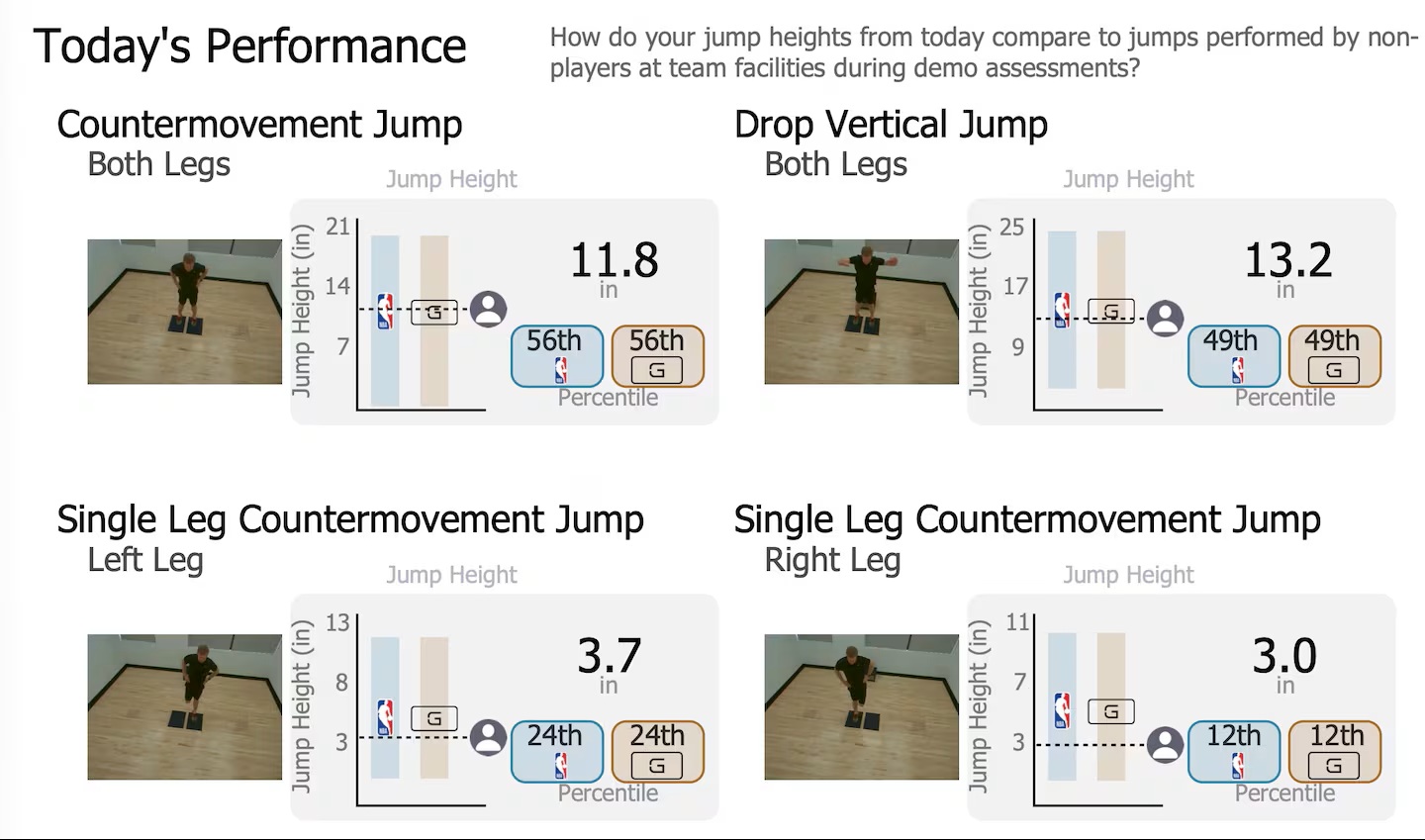
I was hoping for better. Image: NBA
There were diagrams showing how much I use my ankles, knees and hips to absorb forces as I jump or land. Of particular note was my landing strategy: I know my hip flexors are weak due to a previous Springbok Analytics scan, and my knees were achy that day, so it’s little surprise that my ankles worked overtime to mitigate force.
“It’s not to say it’s good or bad,” Chaaban explained. “Maybe that’s just how you move.”
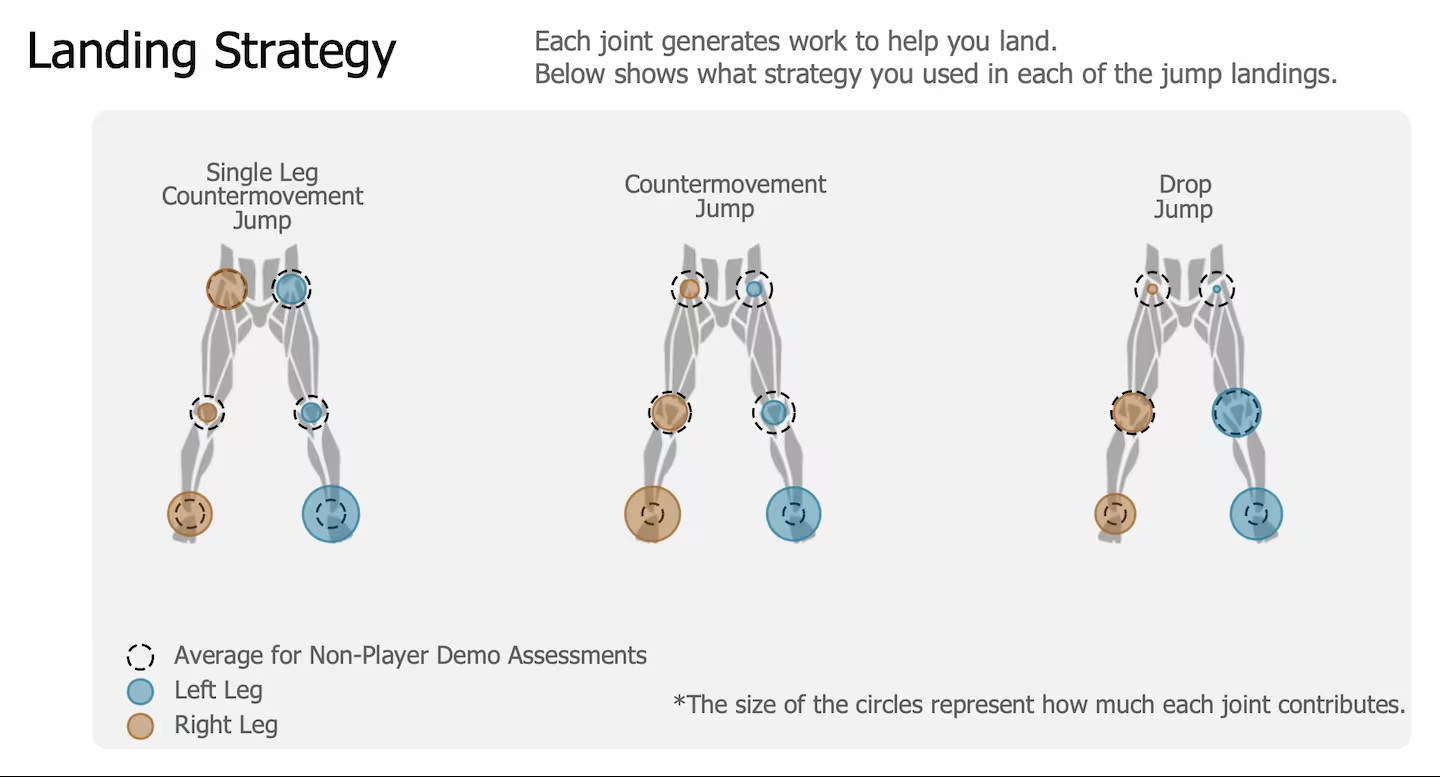
I didn’t skip all of leg day, just the hip and knee lifts. Image: NBA
While recently chatting with Warriors superstar Stephen Curry about a different topic, we started talking about his recovery routine and the notion of career longevity, when I volunteered that I underwent the NBA’s biomechanics protocol.
“You did all the testing?” Curry asked with a bemused smile. I shared the verdict of my data, which is that I’m very much a suburban dad these days. He laughed and then added, “There’s a lot more data available, but the real art is to figure out how to make that useful, right?”
My testing was done at the Nets’ first-rate facility in Brooklyn, but the experience is intentionally universal and would have been the same in Oklahoma City or Sacramento, too. All the same tech vendors are involved: Qualisys motion capture cameras, Bertec force plates, Theia biomechanics software and Breakaway Data for player and team access to the data.
My primary differential: I received a pdf report (rather than the Breakaway Data dashboard) that largely mirrored what the players get but had a few alterations, mostly because I had no historical data from other assessments. My datapoints were compared not to other NBA players but to a handful of team and league staff who underwent the tests.
The reports convey what each metric represents, which is helpful, such as noting that deceleration during the CMJ is “similar to stopping when coming around a screen.”
That CMJ deceleration was my highest asymmetry: my right side produced 20.5% more force than my left. Asymmetry is generally thought to be a problem and a possible injury risk, but there also need to be some allowances for individuals having their own movement signature.
What Curry also told me about applying such high-tech evaluations is the need to surround himself with “as many experts as possible to understand what the data means and then figure out what that is going to do to impact my routine.”
So, kind readers with advanced degrees and extensive pro sports experience, I ask: Who’s going to help me dunk again?
This article was brought to you by SBJ Tech, a Leaders Group company. As a Leaders Performance Institute member, you are able to enjoy exclusive access to SBJ Tech content in the field of athletic performance.
SwingVision’s app is ideal for tennis players who all rely on speed, being able to manage costs, and often operate with limited connectivity on the courts of the world.
Main Image: SwingVision
This article was brought to you by SBJ Tech, a Leaders Group company. As a Leaders Performance Institute member, you are able to enjoy exclusive access to SBJ Tech content in the field of athletic performance.
In a significant development for women’s basketball, the new league’s player-first, development-minded vision has led to significant investment in its sports science personnel and resources.
Main Image: Getty Images
Susan King Borchardt, who has been a fitness consultant to Sue Bird, Kelsey Plum and Breanna Stewart, joined Unrivaled as its Director of Performance and Recovery. Borchardt’s first call was to Lindsey Elizondo, an athletic trainer and physical therapist with the Magic, who joined as Director of Medical.
“We crafted this idea — her coming from the NBA, me working with some of the higher-level individuals privately in the WNBA — and just saying, ‘This should be the standard,’” Borchardt said courtside before the semifinals in Brooklyn. Phantom went on to defeat Mist for the championship 84-70 in Florida on March 4.
Their department has a headcount of about 25 and is supported by an extensive array of technologies, such as Plantiga insole sensors, Kinexon wearables, Springbok Analytics MRI scans and VALD devices for the weight room. Katie Buria, Head Athletic Trainer at the Dream, is Unrivaled’s Director of Sports Science managing the relationships with the tech providers.
“What we’ve seen is that will raise the bar everywhere else that we go,” Elizondo said. “So if we set that bar here, that’s going to feed upward into the W, it’s going to feed into the NWSL, it’s going to feed into all of these other sports and force the hand of this is what it takes to perform at this level.”
The athletes have full ownership of their data and can choose whether to share it with their WNBA teams and personal coaches. Unrivaled didn’t have exact figures available but indicated that the majority of players opted into using the tech, with Borchardt calling it “part of our culture.”
“This is a very player-driven league, and they care about player safety and wellness. The treatment has been top of the line,” said Breeze G Paige Bueckers, praising both the staff and the tech, such as “the data and what we look like on the court with our Plantigas or our [Kinexons] or our chips that measure our asymmetries — little stuff like that goes a long way in basketball.”
Plantiga has made women’s sports a priority, with its CEO Quin Sandler saying of the work with Unrivaled, “Together, we’re not just collecting movement — we’re helping build the future of applied sports science for women.”
Her teammate Cameron Brink, who suffered an ACL tear in June 2024, had her first Springbok scan — which uses AI to turn an MRI into 3D muscle data — while rehabbing with Unrivaled last year and then again before this season.
“Once you have a big injury, you want to learn how to optimize everything, so all these tools really help,” Brink said. “It is really reassuring to get MRIs done like that and just a full body scan. From here you can see how you’ve grown and improved and what areas you still need to work on.”
Elizondo noted the unprecedented position Unrivaled is in by collecting all of this data since the league’s inception. By having access to data for every player, the performance group can identify trends and understand the demands of the elite 3-on-3 game, which are different than 5-on-5. That helps them train the players with more specificity and develop more targeted treatment and recovery protocols.
Tracking longitudinal data enables Unrivaled to share baseline metrics for each player, and for rehabbing players, it helps reinforce the value of the hard work. Borchardt saw it firsthand with one athlete recently.
“For that athlete to have those two visual pictures to be like, ‘Wow, this is actually really working’ — that was so motivating,” she said.
Unrivaled CEO Alex Bazzell emphasized the league’s player-first, development-minded vision as a reason why it has invested so deeply in the personnel and products to make the performance team what it is.
“These players are thinking long term, and the expectation is not just your compensation but resources of off the court,” Bazzell said. “Our staff and who we hire, those are the ones that the players need to trust. You have to build trust in a 10-week period, too. That’s not easy.”
This article was brought to you by SBJ Tech, a Leaders Group company. As a Leaders Performance Institute member, you are able to enjoy exclusive access to SBJ Tech content in the field of athletic performance.
Owl AI’s software would have flipped the gold and silver medalists at the women’s slopestyle in Milano Cortina.
Main Image: AFP via Getty Images
The women’s snowboard slopestyle finish prompted immediate criticism for the judges who awarded Japan’s Mari Fukada the gold (with a score of 87.83) and New Zealand’s Zoi Sadowski-Synnott (87.48) the silver — with notable reactions from NBC analyst Todd Richards and others.
The frustration focused on the inconsistency of scoring on jumps — specifically Fukada’s high scoring on the 720s (two full rotations) in her routine, while Sadowski-Synnott’s attempted more difficult 1080s (three full rotations) as part of her set. And it hit the exact reason why Bloom founded the tech startup to begin with — and in this case, the difference between silver and gold after a rejudging from Owl.
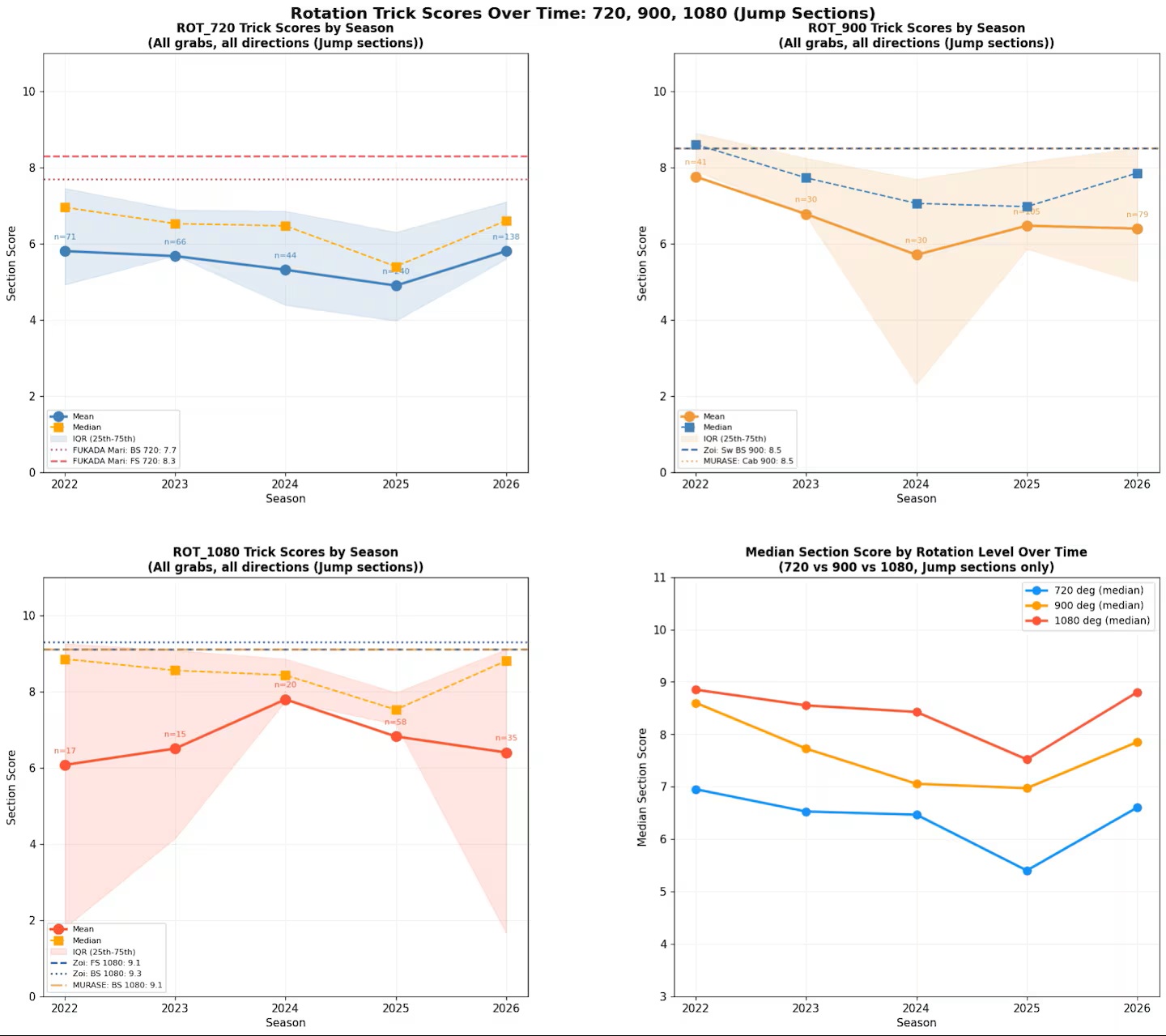
This graph shows the data sets utilized by Owl AI to determine that the women’s snowboard slopestyle at the Milano Cortina Games should have likely flipped the gold and silver finishes for the event. (Graphic used courtesy of Owl AI.)
“I don’t think much needs to be said about how important these moments are for the athletes,” Bloom told SBJ. “They’ve worked their entire lives to just make an Olympic team, let alone put down the best run and either miss the podium or have the wrong color medal for whatever reason.”
To check the medal finish, Owl AI created a data set to look back at the past five years of judging for both 720s and 1080s. What it discovered: The two scores Fukada earned in Milan Cortina on her 720s (7.7 and 8.3, respectively) stood out drastically. The scores on Sadowski-Synnott’s 1080s were also near the peak of scoring for the moves but still very in line historically with the judging from which Owl pulled.
Owl rejudging still slates Kokomo Murase as the bronze winner. But it flipped the finishes of Fukada (with an 86.67 adjusted score) and Sadowski-Synnott’s (89.13).
“This is where we really think we could augment the judges,” said Josh Gwyther, Owl AI’s CEO. “Because if you, as a judge, are putting in a score and immediately saw this deviation, you might be like, ‘Okay, let me see, Is there something there?’ And maybe notate that anomaly.”
Both Bloom and Gwyther have often shared that Owl is not meant to replace judges but to be a helpful tool to set everyone (judges, athletes, fans) up for success around an event. But because judges can vary in their experience, background, and biases, Owl becomes guardrails of context. For example, Bloom pointed out, 720s won the men’s version of this event in the 2006 Olympics. It’s no longer a cutting-edge move, which should be reflected in the score.
Because Olympic moments happen at a four-year frequency, it adds extra pressure to make these decisions as correct as possible.
“On one hand, you want to honor those who won,” said Bloom, a former world champion and two-time Olympic skier. “You want to say, listen, on this day, given this criteria, that’s your gold medal. And any sort of commentary beyond that shouldn’t sort of diminish you because that was their day.
“But at the same time, if that athlete or any athlete would agree that there’s a lot of subjectivity to these sports and everybody would like to push for a more objective world.”
This article was brought to you by SBJ Tech, a Leaders Group company. As a Leaders Performance Institute member, you are able to enjoy exclusive access to SBJ Tech content in the field of athletic performance.
SBJ Tech explains how the USOPC Performance Innovation Fund is propelling American speedskaters to the Olympic podium in Milano Cortina.
Main Photo: Airo
This article was brought to you by SBJ Tech, a Leaders Group company. As a Leaders Performance Institute member, you are able to enjoy exclusive access to SBJ Tech content in the field of athletic performance.