Crystal Palace and Royal Antwerp have developed data storage and visualisation systems that increase athlete availability, enable smarter recruitment, and ensure more efficient workflows.
An article brought to you by our Partners

Dr Cedric Leduc, a sports scientist at English Premier League club Crystal Palace FC, is sharing his experience with practitioners working in athlete monitoring.
It is a natural enough recommendation for a sports scientist to make but the case Leduc makes to the Leaders Performance Institute is compelling. “If you aim to work in a sports club as a practitioner,” he continues, “one of the key things when considering your own learning and development journey is to integrate some of those data skills that will help you to understand what is actually required by an organisation when it comes to data and technology.”
Why a data infrastructure is important
Leduc, who has been at Crystal Palace for almost two years, addresses that question on a daily basis. “How can I refine a thousand possible metrics on the market into a presentation or construct of what I am seeking to present?” As he sees it, there are two viable approaches; firstly, by calling upon his own experience and relationships with colleagues, coaches and athletes; and secondly, by running statistical analyses that enable those selections to be made in an objective way.

Crystal Palace and Royal Antwerp track Player Availability using Smartabase, which enables performance staff and coaches to make informed training and performance decisions. Image: Smartabase
“A combination of both works,” he says. “When you have to turn things around quickly, you might actually use your experience, but when you have time and access to a good historical database, you might be able to run those analyses. There’s a trade-off between short-term actionable points and more long-term objective decisions.”
Leduc and Crystal Palace use human performance optimisation platform Smartabase as a data storage and visualisation solution for all players and staff, from the academy to the first team.
“In a way, building the system from nothing was an advantage because you can build it the way you like and set up the structure” – Peter Catteeuw
To operate without such a system puts a club at a disadvantage, as Dr Peter Catteeuw, the Head of Performance at Belgian Pro League champions Royal Antwerp FC, explains.
“When I arrived at Antwerp in 2017 there were no records of injuries, records of tests with the players, no records of training sessions and so on,” he tells the Leaders Performance Institute. Mindful of how well Smartabase had served him in his previous role at Racing Genk, he began to use their technology at his new club, building a monitoring system for a second time with the help of Smartabase’s agile customer success team.
“In a way, building the system from nothing was an advantage because you can build it the way you like and set up the structure,” he says. “It’s still changing every day and getting better, helping players from the academy to the first team. The team’s management and administration is also coming onboard.”
It is a product of the latitude afforded to Catteeuw and his ability to scale the system. “We needed time to build the system to our own needs and it continues to develop. On the other hand, we can implement changes immediately.”

Smartabase enables the collection of both objective and subjective sources of data relating to athlete wellness. Image: Smartabase
Of advice he would give a team who are starting from scratch, Catteeuw says, “You can easily start with a smaller group within the club, say the academy, and then progress through the organisation as you build the system.”
How accessible and actionable data can improve workflows
Alignment and accessibility are critical for new members of staff. When Leduc arrived at Crystal Palace, his first question was: where is the data and can I access it easily? “Then you start to realise that you have multiple data sources like in any sports organisation,” he says. “What’s important, if you want to make practical use of that data, is to first make sure they are stored in one secured place so that it can be easily accessed – then you can turn that into something actionable.”
“We have a holistic view of the players; what they did in training, what they are doing outside of training, how well they are recovering every day and if they are ready to train or take on more load or not, and if they are ready to play games or not” – Peter Catteeuw
At Royal Antwerp, Catteeuw welcomes the ability to tailor the club’s data management platform to his wishes thanks to Smartabase’s hands-on approach to customer success. A response within hours is the norm. A solution often follows in a day or two. “Most systems are fixed but Smartabase gives you the tools to create your own club system to enable you to work the way you like with physios, strength & conditioning staff, the technical coaches and management. Most companies only make it if it’s interesting for other teams.”

Injury Risk Profiling is an essential area of Catteeuw’s work at Royal Antwerp. Image: Peter Catteeuw / Royal Antwerp FC
Leduc has witnessed the benefit first-hand at Crystal Palace. “A new player signed this summer and the head physio asked me if he can integrate the profile of that new player so that he can start adding notes,” he says. “Another example from pre-season was the request to implement a new technology, integrating its data with their Smartabase storage system.” The organisation was able to facilitate the club’s request. “They are very reactive in trying to understand your needs and not simply relying on what already exists.”
At Royal Antwerp, Catteeuw was able to make the API work in linking the sleep tracker Whoop and Smartabase. “Now it’s up to me to pick the right data, the data we want to see, and make clarifications if necessary,” he says. “I will make the first simple dashboards for ourselves, the medical staff or the coaches to have a quick view every day. In the next days, I will try to combine data we have now from Whoop with the players’ wellness questionnaires and with all the training and game data we collect so that we have a holistic view of the players; what they did in training, what they are doing outside of training, how well they are recovering every day and if they are ready to train or take on more load or not, and if they are ready to play games or not.”
Agility is critical to data-informed decision making
There is the imminent possibility that this process will lead to red flags with some of the players. Perhaps they have not slept well on a consistent basis. This will, however, not lead to an overreaction from Catteeuw and his colleagues.
“We don’t have to take drastic action right away. These alarms just let us say ‘let’s first talk to the player and see what’s going on’ and then maybe check with the physios. Is there something else from the medical staff? Is there something from the training pitch that also raises an alarm?”
Catteeuw recalls an illustrative example from last season when Royal Antwerp used NordBord, ForceFrame and ForceDecks in strength testing. “In every first training session after a match, we ran tests. The data gives us a signal i.e. it’s too slow for these players, the difference between left and right is too large. We won’t pull them out of training immediately but we’ll check the player and see if there’s anything too serious to let them train. But most of the time it means we maybe have to adapt a little bit of training or we need to get an additional session in the gym.”
Access to the initial sources of raw data has enabled Leduc at Crystal Palace to streamline some of his processes. “The initial data collection with a given technology can be pushed into Smartabase in the right format,” he says. “I can then push it to get the right visualisation or run some analysis on it in a very straightforward way. You limit human interaction, which decreases the risk of errors. Having access to the original data enables you to be very agile with the data you’re collecting.”
However you use your databases, the important thing is to understand the needs of your organisation. As Leduc says: “Do you need a storage or visualisation solution? That will depend on your organisation.”

Crystal Palace and Royal Antwerp use Smartabase to track player soreness on a daily basis. Image: Smartabase.
The data landscape is changing and the days of teams failing to track even basic performance metrics are largely consigned to the past. In addition to Crystal Palace and Royal Antwerp, Smartabase clients include both Arsenal and Nottingham Forest in the Premier League, Stoke City in the English Championship, to AS Monaco in the French Ligue 1, Ajax in the Dutch Eredivisie and SL Benfica in the Portuguese Primeira Liga – all clubs looking to make a real difference both in training and in competition by developing a data infrastructure that enables coaches, practitioners and the players themselves to make faster, smarter and better informed decisions.
The world soccer union wants greater education and regulation around data that can help to prevent injury and improve performance.
A Data & Innovation article brought to you by

Such a statement reflects data’s evaluated status in modern sports. Yet while name, image and likeness rights have been commercialized extensively in professional sports, data rights are a nascent field, evolving at varying speeds based on club cooperation, league and union maturity and legal jurisdiction. There’s a wide range of data collected, too, inclusive of GPS vests, optical tracking cameras, force plates, heart rate monitors and more.
FIFPRO, the consortium representing 66 global professional soccer unions, recently announced its grand ambition to tackle the issue itself, serving as an accelerant of a universal solution across soccer. The idea, Baer-Hoffmann said, is to “translate the highest standard of data protection legislation” into a centralized platform whose development is led by FIFPRO with the athletes’ interests at the center.
The Netherlands-headquartered FIFPRO started exploring rights and protections of athlete data about five years ago. A survey it conducted during the 2020-21 season reported that 80% of pro players rated their interest in using data as at least an 8 on a 1-to-10 scale. Only about half, however, had full access to it or even understood why and how it was collected.
This led to the Charter of Player Data Rights that FIFPRO created in collaboration with FIFA and published in September 2022. Athletes’ three primary expectations for data was codified in that document — access, portability and control — and followed the framework of stringent privacy protections instituted by the European Union’s GDPR and others.
FIFPRO’s work is independent of the Project Red Card lawsuit — through which 1,400 cricket, football and rugby players are seeking compensation for what they consider unlawful use of athlete data — but it espouses the same underlying legal reasoning.
The first test case of this plan was the FIFA player app made available to all participants in the men’s World Cup 2022 in Qatar last December and again in July and August this year for the Women’s World Cup 2023 in Australia and New Zealand.
“We obviously have much higher ambitions and ambitions that go well beyond a World Cup environment but really go throughout the entire career parameters of any of the professional players around the world,” Baer-Hoffmann said, “whether it’s club, whether it’s country, whether that’s commercial partners, whether that is high performance coaching, etc., with all the different applications, risks and opportunities that come with it.”
FIFPRO has not announced any technology partners, but the expectation is that one or more third-party vendors will help build the product, which Baer-Hoffmann estimated will take six to nine months. Educating and onboarding athletes across so many leagues and countries will take considerable time as well.
The scope of global soccer makes FIFPRO’s task daunting while some individual unions have begun seeking their own solutions, with the NWSL Players Association partnering last week with BreakAway Data for use of its athlete data passport app.
“One of the things that’s become very clear is that an athlete’s right to have access to their own data is important, but it’s not very practical unless there’s actually a tool to make that access easy,” NWSLPA Executive Director Meghann Burke said.
Baer-Hoffmann contended that most current uses of athlete data by clubs could be easily challenged legally, but he was clear that athletes don’t seek to shut down all such uses and want to preserve the many benefits of preventing injury and improving performance — just with agency over how it’s used. The data platform, he added, can help bring to life the privacy rights that are often “very technocratic, and the enforcement is very, very legalistic.”
“A natural phenomenon that is happening at the minute is that the innovation potential, in the private sector around sports data and technology, is just a whole lot faster than the regulatory response, which is the case in many parts of society, right?” he said. “Usually technology just exponentially grows faster than the regulatory capabilities of institutions that govern the country or a certain sector.”
Basic game stats such as goals scored and shots saved plainly reside in the public domain. MRI results and bloodwork are clearly private medical records. But the performance data in question — biomechanics, movement patterns, heart rate — sits “somewhere in between, and which way should it lean?” BreakAway Data CEO Dave Anderson said.
Volumetric data, such as Hawk-Eye’s ability to track 29 points on the body for 3D motion capture, is an example of the increasingly granular data that prompted Anderson to conclude “that performance data is starting to lean more and more towards health data and that it’s vital to understand, how much wear and tear is on these guys?”
Commercial opportunities for the data are possible, too. The NFLPA is among the unions investigating that market fit, partnering with Sports Data Labs last year to explore possible revenue generation potential.
“We ultimately view your personal data — if you’re an athlete, a patient, a citizen with a watch that collects data — as a digital asset,” Sports Data Labs CEO Mark Gorski said, before cautioning that such assets won’t immediately lead to new income. “Most people want to talk about the end use case. There’s a whole bunch of steps that have to be taken in the right way in order to get there. What we’re spending part of our time with is really helping groups navigate some of those complexities on a global level.”
This article was brought to you by SBJ Tech, a Leaders Group company. As a Leaders Performance Institute member, you are able to enjoy exclusive access to SBJ Tech content in the field of athletic performance.
The NASCAR driver talks tech, using a simulator and partnering with Hurley in his first season racing in the Cup Series.
A Data & Innovation article brought to you by
Gragson, 25, is a Las Vegas native and graduate of the NASCAR Next program for promising drivers. The affable self-proclaimed Mayor of Throttleville is also a two-time ‘most popular driver’ award winner, claiming that honor during the 2018 NASCAR Camping World Truck Series and the 2022 NASCAR Xfinity Series. Among his sponsorship portfolio are Wendy’s, Black Rifle Coffee Company and, most recently, Hurley.
On preparing for race weekend…
It’s a seven-day-a-week job, for sure. You race on Sunday, you fly home Sunday night, we got back at about 2:30am Monday morning this past weekend. Then I headed to the gym, leaving the house at 6:30 in the morning, then meetings the rest of Monday. And then try to get done by 3 or 3:30 and have the rest of the afternoon to relax. Tuesday is working out again. I did simulator this morning for the first half of the morning and had a meeting. Do some interviews like we’re doing. That’s what I’m doing the rest of this afternoon.
Wednesday, it’s usually a workout in the morning time, got pitstop practice, and then it’s more meetings with the race team, going over the race weekend stuff. Thursday morning, we’ll do a workout and then pre-race debrief with the guys in the Chevrolet program with Josh Wise. He runs the Chevrolet program — he’s an ex-driver — and now a lot of Chevrolet drivers will prepare for the races together. So we’ll do more race prep, then we’re either flying out on a Thursday afternoon, or sometimes we have the second half of Thursday off if we’re not in the simulator ’til about 6:30 on Thursday nights.
Then we either fly out Thursday afternoon, Friday morning, go to the racetrack, do tech, do some sponsored stuff, practice, qualify on Saturday, and then again race their Sunday and then back home. And it’s a constant seven-day-a-week job, but I love the process of everything. It’s a lot. It’s definitely time-consuming. But it’s a lot of fun as well.
On his use of the simulator…
It’s helpful, definitely for the Chicago street course, which is a brand new track for NASCAR. They just made it. We’ve never raced on a street course before. We’ve never raised at this particular track so utilizing the simulator and trying to just get some ideas on what you need to focus on for when you go to the real track in real life — how far can I drive in before I have to hit the brakes? What are my visuals looking like? Little stuff like that is what we really use a simulator for helping build up the setups and get the car tuned in on the simulator to give us some ideas when we get to the real racetrack. It’s definitely very beneficial, and we utilize it a couple of days a week for sure.
On his fitness training…
We definitely track our heartrate and everything like that. So when we work out, we’ll do a little warm up and then whether it be a run, row, or the skier or the bike, then we’ll stretch out. Then we get into a daily workout we have. We’re in the gym three days, and then we do karting or other stuff on Tuesdays where there’ll be a trail run or whatnot. But Dan Jansen, the Olympic speedskater, he is our trainer over at Chevrolet. So, man, he loves the leg workouts — they suck — because he comes from the speedskating side and having all that power in his legs. I mean, this dude’s legs are just massive. It’s crazy.
So we do a lot of leg workouts and a lot of heat training on bike rides and runs. Upper body stuff in the gym as well. And then we’ll sit in the sauna for about 30, 45 minutes after the workout just to get some more heat training in. And so that takes about two, two and a half hours a day of in the gym and prepping for the races.
On his use of SMT analytics…
We definitely look at that a lot throughout the week and the race weekend and just finding where we can be better. The majority of the time, it’s during the race weekend and right before practice. We’ll take a look at the prior year and how guys were and where they’re lifting on the gas, how much brake pressure they’re using. We can overlay [data] and compare that.
So that’s a definitely a double-edged sword, I think the SMT data is. Normally you spend your whole racing career figuring out how to go fast, and now it’s like, if you’re in the second group in qualifying, you just look at what the guys in the first group did. And you just go implement that into your driving and try to match up the data to the fast guys. So I think it’s good if you’re first starting to expedite that process of learning the tracks and where you need to be, car placement-wise, how much break, how much throttle you need to use, but at the same time, it kind of takes away a little bit because you just see what the fast guys are doing and you just go copy that.
On partnering with Hurley…
The coolest thing is I grew up surfing, skateboarding, snowboarding. I loved action sports and always wore Hurley stuff at the beach. I remember when they came out with the Phantom swim trunks, in the early 2010s probably. Being a kid, there was a store in Laguna Beach — we’d always go down to Laguna Beach every summer with my family — called 225 Forest or something like that. It was a Hurley and Nike store, and you could customize swim trunks and Nike shoes and Hurley swim trunks and Hurley t-shirts. I just thought that was the coolest thing ever.
I was a little kid running around and would try to do some chores throughout the week so I could get a little spending money. I so got a couple of pairs of custom phantom Hurley swim trunks back in the day and just loved them. I wish I still had them. I think my mom probably threw them away or something. She calls me a hoarder because I like collecting cool stuff and crazy stuff, and my argument to her would be, ‘Those are my first pair of custom swim trunks, c’mon.’ But that was pretty cool. That’s how I got introduced to Hurley and have worn them ever since.
On his creative interests…
[The custom shorts] were pretty wild. It was like a blue and black cow print on one leg — and, I mean, they were wild — and yellow and gray stripes on the other leg with a crazy pocket. I forget exactly, but they were really, really wild looking. I always liked the wild, bright, colored stuff. Now for me from the swim trunks to now designing my own helmets and the paint schemes on my helmets, I really liked getting to do that. So it’s a cool process.
I liked drawing a little bit when I was a kid. I like the helmets because I feel like you can show personality and do some cool stuff and be unique. So yeah, I like art a little bit. I think it’s cool and definitely always loved the designs on race cars, designs on helmets and just cool t-shirts and stuff.
On how he evaluates brand partnerships…
I’ve always told our management group [to pursue] just stuff I believe in, stuff that I enjoy wearing in this scenario or food I like eating. Just stuff I’m passionate about is really the biggest thing. You see so many ambassadors and athletes and whatnot that have partnerships with companies, but they’re just getting a check and they don’t necessarily believe in it or are passionate about it. We turned away deals because I don’t have any passion over this, so why would I want to be an ambassador a spokesperson for this company if I don’t believe in it? It’s a complete opposite with Hurley. I’ve always been a big fan of their stuff. I call myself a swimsuit model for them even though I’m not really.
This article was brought to you by SBJ Tech, a Leaders Group company. As a Leaders Performance Institute member, you are able to enjoy exclusive access to SBJ Tech content in the field of athletic performance.
As the league introduces Hawk-Eye as its new tracking technology, the level of granular detail available to officials is set to grow.
Main Image: Hawk-Eye
A Data & Innovation article brought to you by
To the right is the group overseeing the implementation of the Hawk-Eye player and ball tracking system that is set to replace Second Spectrum as the raw data collector and enhance the offering by providing 3D pose data via 29 points on the body, rather than a single center of mass. To the left is the on-premises replay room, a luxury not typically afforded the NBA Summer League.
The Summer League, which took place between July 7 and July 17, was used as an experiment in innovation, as the league conducted a final test of its new tracking provider while also assessing new avenues of reviewing close calls and then communicating those decisions swiftly to the earpiece or wristwatch of an on-court official.
“Number one is just a dry run of the core tracking system because that’s the lifeblood of team front offices and Sportradar, our partner — we want to make sure that is working because that’s the foundation of all this,” said NBA Basketball Strategy VP Tom Ryan, who oversees technology initiatives. “Building on top of that, we are, for the first time, going to see what a fully-integrated, tracking-plus-video replay system looks like. We’ve never used tracking data live in a replay center.”
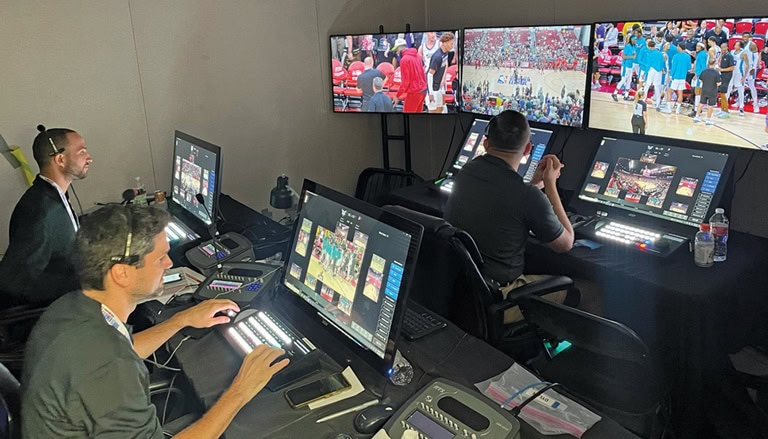
Image: Joe Lemire
The legacy product of Sony-owned Hawk-Eye is its precision ball tracking used to adjudicate line calls in tennis before an expansion to tracking players, their limbs and balls in other sports, like MLB. Its other primary offering is the Synchronized Multi-Angle Replay Technology (SMART) video replay that’s used by the NFL and others.
Now, the NBA is pairing the two with an eye toward generating supplemental evidence to help referees make decisions on goaltending, the primary point of emphasis this year. Foot-on-the-line and last-touched-out-of-bounds calls will be in R&D all year. In the future, those determinations could be fully automated, though that step would require sign off from the Competition Committee and the National Basketball Referees Association.
“Our top objective here at the Summer League is to showcase how all of our different technologies can come together to create this synergy of solutions to provide the NBA with ultimately what they need to better officiate the game,” said Dan Cash, Hawk-Eye’s Managing Director for North America. “We believe that if you couple that [tracking] with replay, which we’re demonstrating here, you have a really powerful tool to be able to officiate the game efficiently and effectively.”
Hawk-Eye installed its optical tracking system in every NBA arena over the course of two months, January to March, this year. It entails 14 cameras with 4K resolution that are expected to operate at 120 frames per second — double the broadcast standard for sports — and could go even higher, although the requisite processing power necessitates a trade-off with latency. A 15th camera may be deployed at times that’s capable of a whopping 1,000 fps with even greater resolution.
What these cameras provide, first and most obviously, are more angles of the action. A questionable three-pointer in the Summer League’s first few days lacked a conclusive broadcast view, but one of the Hawk-Eye cameras had a better angle to confirm the foot was behind the line.
But the tracking data provides a new dimension of analysis. The NBA flew out its usual Secaucus-based replay operators for a trial. “It’s video plus data, which is a new skill to learn,” Ryan said, adding that “we have a different [replay] partner that we’re really happy with,” referring to EVS. Hawk-Eye’s three prior visits to the Summer League were all for testing in the background; this is its first time used in games.
The cameras collect positional data of the basketball and players’ hands, then apply the rules of goaltending and the laws of physics. On the replay operator’s screen are yes-no indicators for the goaltending criteria.
“Goaltending is relatively easy — if the ball passes its apex, if it’s over the cylinder, if it’s touching the backboard — those are all pretty defined use cases, but if we haven’t collected data for a significant amount of time, you don’t have a historical data set to refer to, to understand where your pain points are,” Hawk-Eye Commercial irector Justin Goltz said.
“Realistically, the technology moves in at a pace that it can do it relatively quickly, but there’s a lot of logistics to get it from this broadcast truck, or from the stadium, down to the court that needs to be hashed out over a season or two.”
The operator also sees a second-screen experience with a replay animation similar in spirit to what Hawk-Eye has made famous in tennis. The NBA is still evaluating the best presentation of information and visuals to, first, help make the correct call and, second, show the fans. “A big part of this initiative is just more transparency,” Ryan said.
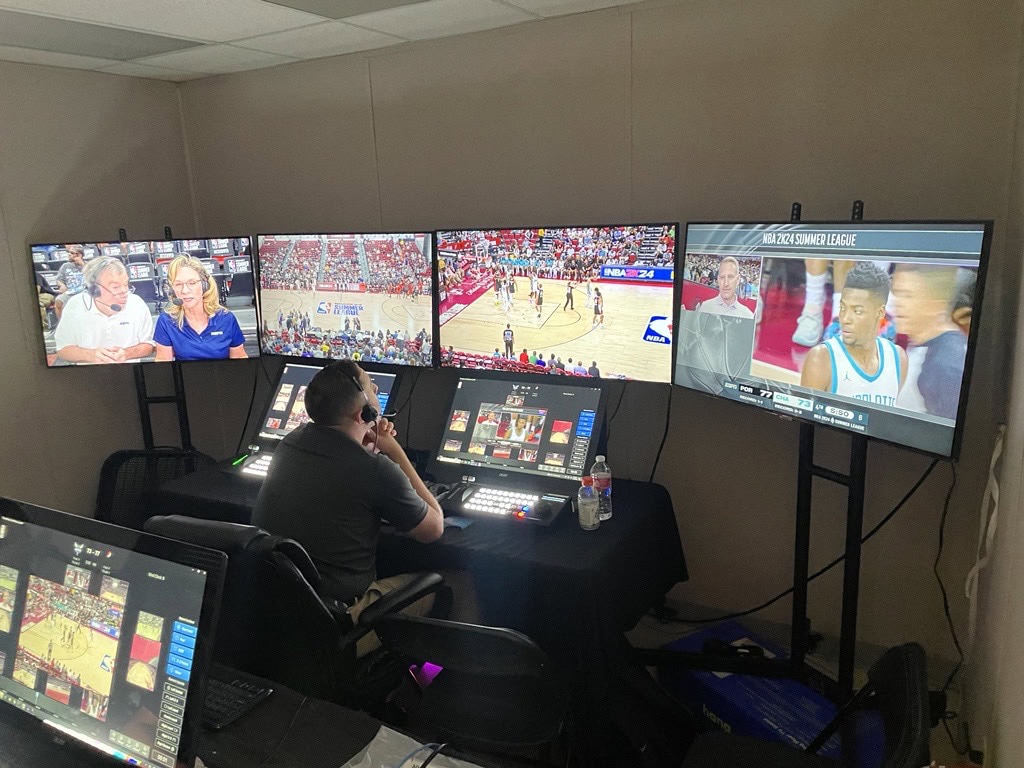
Image: Joe Lemire
Following the same adage that content is king but distribution is queen, so too with this enhanced replay format is that accuracy is paramount, but efficiency is critical, too. The league is testing two methods of communication to its referees: both audible messages to an earpiece or haptic and written transmissions to a watch.
The NBA, for example, introduced a new mechanism for relaying a scoring change from the replay center to the on-court officials last year. If a two-pointer became a three, or vice versa, a blue light would flash at the scorer’s table. The problem: looking in that direction was never part of the usual routine or field of vision. Of about 120 such blue light indicators, only five were organically spotted.
That’s an obvious starting point — and not novel as other sports, such as soccer, have done this for years — but it could lead to other use cases.
“Live communications with the ref is definitely a core component of our strategy because if we’re doing all this work on the automation side,” Ryan said, “you have to be able to communicate that with the ref in real time.”
This article was brought to you by SBJ Tech, a Leaders Group company. As a Leaders Performance Institute member, you are able to enjoy exclusive access to SBJ Tech content in the field of athletic performance.
Smith’founded Crux Sports, a consultancy for women in sports, with a view to grow women’s football and give females the support they need whether in the boardroom or out on the field.
A Data & Innovation article brought to you by
You can’t have a discussion about sports technology today without including athletes in that conversation. Their partnerships, investments and endorsements help fuel the space – they have emerged as major stakeholders in the sports tech ecosystem. The Athlete’s Voice series highlights the athletes leading the way and the projects and products they’re putting their influence behind.
* * * * *
Rebecca (Bex) Smith is among the most connected people in women’s soccer. She captained teams for Duke University, Vfl Wolfsburg and the New Zealand national team, competing with the Football Ferns at two World Cups (2007 and 2011) and two Olympic Games (2008 and 2012). Smith also played professionally in Sweden and Germany before her career ended in 2013 due to a knee injury.
Smith, now 41, went on to work at FIFA for nearly five years as Competitions and Event Manager for all FIFA Women’s World Cups — the flagship event as well as the Under-17 and Under-20 versions. She went on to become the Global Executive Director of the Women’s Game at Copa90, a podcast host co-produced by the BBC, UEFA venue director and now Founder/CEO of Crux Sports, a women’s sports consultancy. In May, Crux Sports published research, in partnership with YouTube, on the value and impact of DAZN making the Women’s Champions League available for free on the social streaming platform.
She earned three degrees, speaks four languages and is either a board member or advisor for numerous companies and programs, including AI-powered injury risk platform Zone7 and the Isokinetic Conference, the largest football medicine conference in the world. Smith will also co-host the daily morning show for Australian broadcaster Optus at the upcoming Women’s World Cup being held in Australia and New Zealand.
On what she’s building with Crux Sports . . .
My company was born out of the fact that I had a very diverse background coming from playing to then governance and managing one of the biggest women’s sporting event on the planet to then going into media content production to then working with big brands to doing branded content and working with athletes. So I really just wanted to have a place where we could help all stakeholders so whether it is brands or governing bodies or content production or athletes themselves to either get into the women’s game or to help fuel it.
So it’s really about driving sustainable positive growth into the women’s game, but then helping stakeholders to increase their bottom line or to work on their marketing or figure out their strategies for integrating women’s sports and female athletes into their propositions as well. So it’s very diverse. I work with YouTube and Google and helped them do a research project, all the way to Champions League to working with big brands like Xero on their partnerships with the FA or FIFA to working with on content production or working with athletes directly, helping them work on their post-career transition and maximizing their commercial opportunities during their career.
On her interest in player health and wellness . . .
It comes from my own experiences in football and sort of more negative experiences, I would say, throughout my career where I found that there was a lack of support. Despite the fact that I had three degrees on the side and was trying to work at the same time — because I was trying to just set myself up for post-[playing career] — I still felt really unsure, insecure, going into that post-career, post-football life and having to do so with a really bad injury. I hurt my knee, and then it was not very properly looked after at my club. And I was continually playing on a very swollen knee. And in the end, I can’t run anymore. So for me, it was really important.
When I was at FIFA, we did a whole medical study on the athletes and players, and what their medical setups were. And in the end, we couldn’t publish it. So I gave it to my buddy at FIFPro. So they did the very first employment study. So it was based off of a lot of the data and research that we had done. And yeah, it’s just really about trying to better the situation for the next generations. And it sounds so hokey, and so cliché, but it’s so important that we continually improve the game for the athletes because they are at the heart of the game.
On her work with athletes . . .
So many people work in and around sports, and they run this or they run marketing, or they run broadcast, and they’re very important, they make loads of money, but at the end of the day, if the athletes are continually getting burnt out and injured and aren’t taken care of properly, then it won’t be sustainable. So for many reasons, one, the health and mental health and safety of athletes because they’re human, but secondly, because it’s a business, and it needs to be sustained as well. And you have to take care of your people in the business. So they’re at the core.
Do I think it’s gotten better? No. I wish I could say that it has. I think in some areas, in some clubs, there’s better medical care and a little bit more investment in that, but I still think that it’s a huge gap, which is one of the reasons why I work with a lot of athletes. I don’t really market it, they just come and I work with them to help them get prepared mentally and also just physically — what are they actually doing to prepare for it. So, ya know, there’s still a really long way that we need to go for that.
On Zone7 . . .
Not just because I’m a strategic adviser to them, but I think something like a Zone7 [can help]. I really wish it was around when I was playing. And I’ve said that before. But to have the technology that we have now — AI — that did not exist when I was playing, or was not, let’s say, mainstream when I was around, and to be able to have those types of algorithms where so much data is going in that is being perfected constantly and tinkered with and filtered down, that you can really get to the point where you can say, ‘This is the percentage of risk that you are at for this type of injury, and therefore you should change your training to do this, this and this.’ It’s mind-blowing.
I come across lots of tech companies or people trying to help out with athletes, and it’s all — even what I do — very time-consuming and very one-on-one, whereas this is a mass market product that that can really help. Now they’re in leagues as well, so it’s not just with individual clubs or teams.
So far, that’s the most incredible thing that I’ve seen that I think would just really help reduce injury in a huge way, really quickly and very significantly. But other than that, there needs to be a lot more investment by clubs and leagues and those that are making money off of athletes. They need to have a certain percentage invested back into the athletes, that would be my standard approach to things. But good luck trying to get them to invest back into their players.
On her recent project for YouTube and Google . . .
I did a research project with them around the Women’s Champions League. So because they put the Women’s Champions League, through the rights with DAZN, on YouTube free-to-air and global, it meant that there were a lot of knock-on effects. What they were measuring was traditionally just the live match number — what’s the audience watching this live match? Which is obviously lower than if it’s on normal TV in in France, but that’s because a lot of people didn’t know it was on YouTube.
So we were really looking at the value and impact more broadly on the different stakeholders. So from media, players, the teams — so I interviewed 15 out of 16 teams that participated in the group stage — got their opinions on things, talked to the players that were involved, talked to media and then we did a big fan survey.
On her work with the Global Esports Federation . . .
That’s quite fun. I sit on the players’ commission, and that’s really interesting because I’m learning more than anywhere else, I’d say. It’s really understanding how athletes in the gaming space are being treated, what their challenges are, how the Global Esports Federation can help support athletes better. From my former career as an athlete, but really looking at gaming as one of the biggest, fastest growing industries on the planet. And my goodness, every kid is involved in it.
On the importance of New Zealand co-hosting the Women’s World Cup . . .
It’s pretty massive and not likely to ever happen again. It really is a one-off opportunity, I think, for a country the size of New Zealand that always punches above its weight anyway in its sports teams, but in terms of the size of the country and being able to host such a massive event, it’s huge. And obviously, co-hosting with Australia has been a large part of that as well and will be truly beneficial for both parties. You still have some of the beauty of New Zealand and a totally different vibe and a little bit closer to be able to travel within the country, as opposed to Australia. I’m hoping that all the fans are going to come and turn out and really support the teams down there.
On the broader growth of the women’s game . . .
What the women’s game has suffered from prior is that we have big, big moments, and then it really drops off. So you have the World Cups and obviously the women’s Euros this last summer in England — and then with England winning, that really pushes everything forward quite quickly. You have 1 billion viewers from the last FIFA Women’s World Cup in France, but then we really have struggled to translate that into the [domestic] leagues and Champions League.
I think this year has been one of the first years where we’ve really seen massive pickups of numbers of people in stadia of sellout crowds. Literally every single week, I’ll open something on my phone, and it’s a record being broken of some club or some stadium being sold out. We had the Arnold Clark cup here. They had it in Coventry, and it was the biggest game they’ve ever had in sports — and that happened to be women’s football.
So it’s just it’s growing massively. So I really think that this Women’s World Cup is no longer going to be just another pinnacle event that will see the drop off after. I just think it will help to increase that level so that the trajectory just keeps going up. Obviously the time zone is going to be a challenge. So I think the on-demand elements of it, the highlights and things will be really, really important.
This article was brought to you by SBJ Tech, a Leaders Group company. As a Leaders Performance Institute member, you are able to enjoy exclusive access to SBJ Tech content in the field of athletic performance.
All MLS first team clubs, as well as MLS Next Pro and MLS Next teams, will have access to the platform to scout players who can upload videos and metrics to the app for free.
A Data & Innovation article brought to you by
“That’s why we think this technology is so powerful because all you need is this [smartphone],” MLS SVP Emerging Ventures Chris Schlosser said, “and suddenly, you can be scouted anywhere at zero cost. You can go do drills in your backyard or your driveway or local park, and that would allow you to get on MLS’s radar.”
MLS and ai.io will begin collecting data this fall to create appropriate benchmarks for evaluating players at various levels before all players gain access to aiScout in January 2024. The aiScout app uses Intel’s 3D Athlete Tracking computer vision technology and assess users’ physical and technical skills. Premier League clubs Chelsea and Burnley, which recently clinched a return to the top tier next season, are both R&D partners.
Fred Lipka, the Technical Director at MLS Next, helped champion the use of technology to eliminate the barriers of cost and geography from talent identification.
“Players’ pathways, as they journey through youth sport, is not necessarily soccer first,” Richard Felton-Thomas, aiScout’s COO and Director of Sport Science, said of the US. “And they didn’t just want to be an organization that’s picking up talent because they haven’t made it somewhere else. They want it to be at the forefront of talent identification, and he very early saw that the way to do this is to be able to make sure we can look at everybody in the country simultaneously and fairly.”
The founding story of ai.io originates from the experience of Founder Darren Peries and his son who, after being released from Tottenham’s academy, had no digital CV — data or video — to share with scouts of other clubs. And that was the case for a promising player who had been competing under the purview of a top-flight club. Many multiples more youth had even less access to the typical sporting infrastructure.
Perhaps the best case study of aiScout’s efficacy is its use by another early client, the Reliance Foundation Young Champs, a leading academy in India. During the pandemic when its scouts were unable to travel, RFYC used aiScout to evaluate 12-year-old players. AiScout was used to whittle down the number of candidates for a tryout — and led to the academy inviting four players from rural areas who weren’t even playing organized soccer at the time and thus never would have been on the radar.
“The nature of talent development can be a bit random,” Ben Smith, formerly Chelsea Football Club’s Head of Research and Innovation, told SBJ last summer before joining BreakAway Data full-time. “So if we can have a technology to work at scale across vast areas, then that our scope and our reach is potentially very substantial.”
MLS clubs will be able to search for talent globally, but the primary goal is to consider continental talent, given some of the regulations around homegrown players and international visas.
The aiScout app was part of FIFA’s innovation program and underwent validation testing at Loughborough University, London and Kingston University. A revamped version of the app was released last year to include more gamification and more content geared toward player development, as opposed to just evaluation.
“We wanted to prove that we were a trusted tool first with the clubs,” Felton-Thomas said. “What the new app does is it brings in more of those elements that players get to see, ‘OK, how do I get better if I’m not good enough today?’ We’ve got a bit more player focus to that journey of development, not just trialing.”
The aiScout app will be the focal point, especially early in the partnership, but the company also maintains mobile sport science centers, aiLabs, that has additional evaluative tools for biomechanics and cognitive function.
As the partnership progresses, each MLS club will be able to customize their use to include additional tests, datapoints and benchmarks that are bespoke to their needs. Schlosser said, to his knowledge, none of the league’s clubs have harnessed computer vision at the amateur level before, but he said they are eager to get started.
“The system is up and running in the UK,” he said. “They’ve done some trials with a couple of UK-based teams, so we have some confidence that this isn’t just fly-by-night stuff. This is real. And we’re excited to roll up our sleeves and then roll this out across the country. We think there are many, many kids that we haven’t seen yet.”
This article was brought to you by SBJ Tech, a Leaders Group company. As a Leaders Performance Institute member, you are able to enjoy exclusive access to SBJ Tech content in the field of athletic performance.
Sportec Solutions’ Tom Janicot stresses the importance of communication and the advantages of the league owning its own system.
It is a question the Leaders Performance Institute poses to Tom Janicot, the Director of Video Solutions at Sportec Solutions, who has invited us to RTL Deutschland’s HQ in Cologne on a January evening to explore the German Football League’s (DFL) Video Assist hub during a round of midweek Bundesliga matches.
“The DFL decided to come here because it’s a broadcasting facility in general,” he says. “From a technical perspective, it’s a place where we’ve got maximum redundancy and maximum security for our technical installations and connections to all the stadiums in Germany.” The centre provides both the comfort – much needed for referees when making high-stakes decisions – and the technical infrastructure.
The VAR system for the Bundesliga, known locally as ‘Video Assist’, was first used across the German top tier during the 2017-18 season. It joined goal line technology, which was introduced during the 2015-16 Bundesliga season, as a staple of the match day experience in Germany. Goal line technology provides an instant, accurate judgement on whether or not a ball has crossed the goal line, resulting in a goal.
The DFL Video Assist HQ is operated at a central hub in the city of Cologne. (Image: Deltatre/Sportec Solutions)
Ahead of the 2022-23 season, in March 2022, the German Football Federation (DFB) appointed the Munich-based Sportec Solutions as the Bundesliga’s officiating technology partner for the next five seasons.
It is a pioneering development, as Sportec Solutions is a joint venture between renowned sports and entertainment technology provider Deltatre and the DFL, who operate Germany’s top two divisions under the auspices of the DFB.
Keeping the Bundesliga’s Fifa-certified VAR and goal line technology in-house affords the league overall control, as Janicot explains. “When it comes to changes in setup or innovative features, there’s a huge advantage to being in control of the road maps and the directions we want to take in the future. This also reduces development and feedback cycles. It is challenging for us but also good for our product that the DFL set a very high bar in terms of standards. It is relatively achievable to get everything to work 98% of the time, but that final 2% – that’s where it costs a lot of time, a lot of effort and a lot of money sometimes to get to that stage.” Sportec Solutions achieves such accuracy using technology designed by its subsidiary, Vieww, which specialises in camera-based systems.
Earlier in the day, Janicot had taken the Leaders Performance Institute to inspect the match day setup at the BayArena ahead of Bayer Leverkusen’s meeting with VfL Bochum. In the Bundesliga, he explained, both VAR and goal line technology are set up according to two camera plans: 19 for some matches and 21 cameras for others. A prominent fixture such as Bayern Munich-Borussia Dortmund may have a camera plan of 23. Additionally, there are 14 ‘intelligent’ cameras within a stadium tracking at 200 frames per second in real-time.
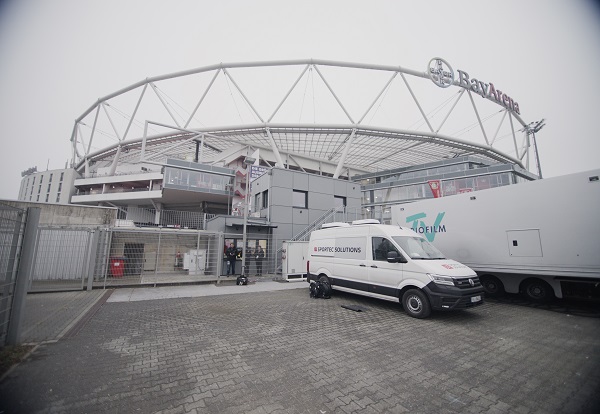
A Sportec Solutions van onsite at the BayArena ahead of Bayer Leverkusen’s meeting with VfL Bochum on 25 January. It is one of 12 all-electric vans in the Sportec Solutions fleet. (Image: Deltatre/Sportec Solutions)
Sportec Solutions will have a team onsite, both in the stadium and the TV compound outside, and will work to provide both images and audio to the VARs and operators back in Cologne. For each match, two match officials – a VAR and an assistant VAR – will work directly with two operators, who themselves are supported by an onsite backroom team.
There are eight screens at every terminal. The two largest screens relay footage from the main camera above the halfway line. The others will relay a variety of angles and enable operators to assemble a quad-split for the VAR officials to review an incident from multiple angles.
While the Bundesliga employs the full system, Vieww’s tech could theoretically be rolled out in more modest circumstances. There are already versions in the Portuguese men’s third division and the Bolivian men’s league. “The system we have built here in the Bundesliga is extremely modular,” says Janicot. “You can reduce it to a bare minimum and you can have a functional system – the processes don’t go away – you’re still going to check a red card exactly the same way. That’s something that’s very important for us, to document all of that to make sure that we have the same standards no matter the size and capability of the competition.”
The system in Germany is refined through regular VAR and operator feedback. “What we want is better decision-making and then you break it down from there. ‘OK, this is what you want to get to, how do you build every single building block to make sure that you support VARs in making the best possible decisions?’” adds Janicot, who says referees are involved in review processes.
“We had a testing phase of about one year of putting a product in front of them, getting them to give us feedback on how they liked it, how it was being used, what they didn’t like especially, and then being able to change that.
“I think it’s a luxury we’ve had in building this product from scratch over the past few years after VAR had been introduced [in German football]. We didn’t create it and then put it live and then figure out we need to change this and that. We went in with a fresh mind having had three or four years’ experience within our team and then using that to build the product as it is now.
“And now, on a weekly basis, we’re still discovering things where we get feedback from the referees or from operators and think, ‘hey, maybe we can add this or change that’. That’s a continuously evolving thing and I think that working so closely with the refereeing department – that’s really the key.”
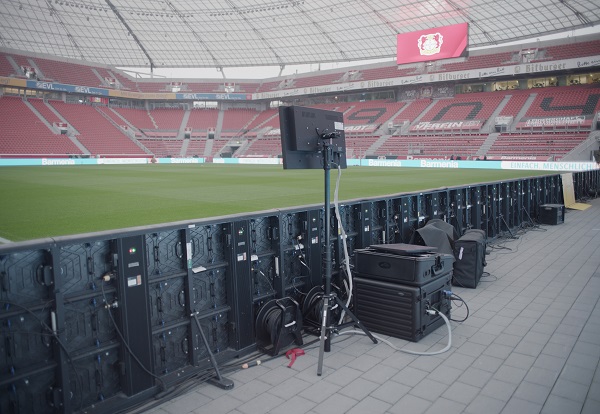
Sportec Solutions deploys its officiating technology across both divisions of the Bundesliga, the German Supercup, and selected matches in the national cup competition, the DFB Pokal. (Image: Deltatre/Sportec Solutions)
This ongoing review process led Sportec Solutions to discard touchscreens for VARs. “If you put technology in front of someone then they’re going to feel like they need to use it,” says Janicot, who explains that VARs were initially able to zoom in on a shot for themselves without the help of an operator. “What we actually found is that it was detrimental to the operation because the operator actually had something else in mind but you had the VAR doing something else. So you had two people to control the system when actually we found it’s better to have just one person who is in charge and the VAR hands-off, simply communicating.
“That’s the thing where you can’t solve everything with technology, you need to think about what the strengths are with the different people that are at the table and what their ultimate goal is or what their role is in the operation and then make sure they have all the tools to be able to fulfil that role.”
Nevertheless, the system still looks complicated to the uninitiated and the Leaders Performance Institute was all at sea when called upon to rule on an offside decision in a trial match-based scenario. Yet any risk of information overload is offset by the VAR and operators’ training, experience and ability to communicate.
“Clear communication is the absolute key to reaching fast, precise decisions,” says Janicot. “The team needs to speak the same language, to trust each other to do their respective jobs, especially when it comes to a complex process like an offside decision.”
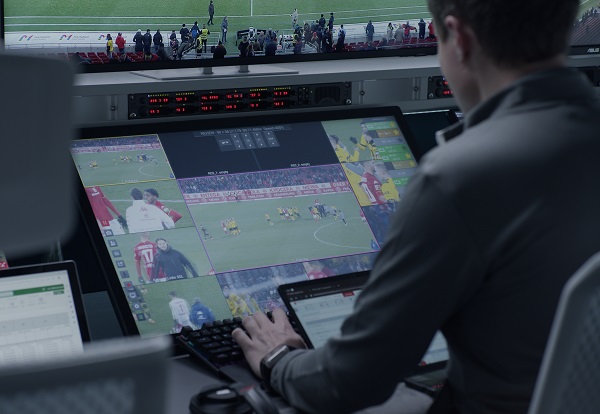
Sportec Solutions’ VAR and goal line technology is provided by its subsidiary, Vieww. (Image: Deltatre/Sportec Solutions)
The DFB has brought in commercial pilots to work with referees and operators to help them to better understand how to engage in clear, direct communication techniques when issuing requests, commands and responses.
But what if the technology itself were to fail? “You need to make sure there are no single points of failure and that’s the whole way along the chain,” says Janicot. “All the way down to a single cable going to a monitor or making sure that you have a separate monitor going through a separate line, going through a separate converter etc. So making sure that you separate the work flows completely to make sure that there’s no one point where anything can fail. That applies to technology and also to people, right. What is your back-up plan if somebody gets ill the day before a match? Or if a van doesn’t make it to a venue the day before a match?
“About a year ago, we spent quite a few hours going through all the different scenarios. We called it a ‘pre-mortem’. Thinking about the absolute worst-case scenario. What happened? How can we fail? Then it’s making sure that you step back from that and going through all the different scenarios and you try as a team to cover as many as possible.”
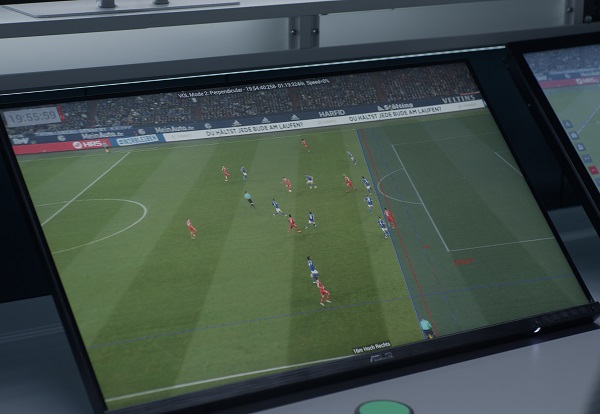
An operator draws the lines during a trial run of the technology that enables VARs to rule on offside decisions. (Image: Deltatre/Sportec Solutions)
What about imminent developments? Where does officiating technology go next? Janicot cites the potential for enhanced player tracking. “Do we at one point want to look at tracking more parts of the body than just the centre of mass?” He also refers to the use of balls containing microchips that support the use of VAR, goal line and semi-automated offside technology in Fifa competitions. “They showed it’s possible that it can be done and at Sportec Solutions we are of course having the discussion, if this is something that we need? What benefits do we get from it? And again, what benefits does it bring to the refereeing world?”
Offside decisions are another area where the DFL and Sportec Solutions are looking to further refine their process, particularly the length of time it takes to reach a verdict and the steps taken to get there. “We are looking at each segment of this decision tree and seeing ‘can we improve this? Can we improve this by work flows between the operators and the VARs or with technology?’ I think that’s something where we can make big steps forward.”
And if money were no object? “Informing the fans in the stadium, I think, is a real key part. Finding a way to do that in the best possible way. I think that’s key.”
He is optimistic for the future of officiating technology in football. “Top leagues have always had high requirements when it comes to precision and it’s also important to us because it’s an elemental part of the game. Afterall, it has influence on the decision-making process, so for us, along the whole way it was very important for us, at the end of this road, that we do get a world-class product where we have the chance to bring in our requirements in terms of quality and reliability but also our wishes and ideas for our future.
“We absolutely feel confident that we are in a very good position right now and in a very good position to develop whatever direction we might want to go in terms of the next years for refereeing technologies.”