In our latest Leadership Skills session, Jeff Pagliano of Management Futures reframes how organisations should understand, shape and protect their cultures.
Amaechi’s words are shared by Jeff Pagliano, a consultant with Management Futures, who in our latest Leadership Skill Series session, introduced members to tools that will enable them to help shape their team’s culture.
How do cultures develop?
Pagliano began his presentation with a definition:
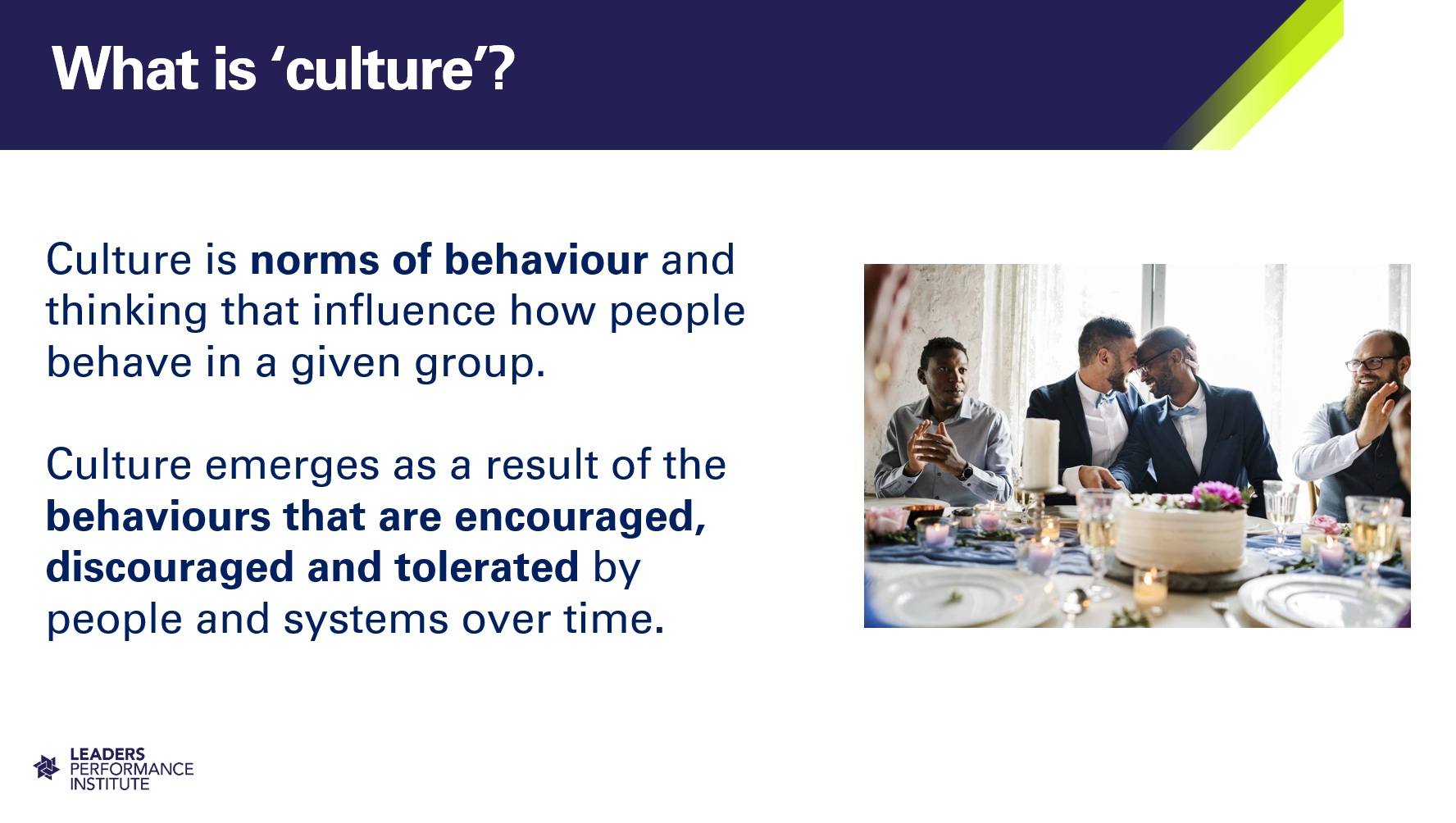
Management Futures uses the analogy of tables at a wedding reception to explain how cultures develop.
“You’ve seen how at a wedding each table develops its own personality,” said Pagliano. “It’s interesting that even in those interactions where some people know each other or some people don’t, a culture begins to form around that table. You can have the rowdy table, the quiet table; some are eager to get up to dance and some are not.”
What we see, what we say, what we believe
Pagliano then shared his ‘cultural iceberg’ model, which has been inspired by Swiss-American psychologist Edgar Schein and his pioneering work on organisational culture:
What we see
“This is literally what we see. So behaviours, systems, and processes,” said Pagliano. This could be how people interact, how leaders comport themselves, what actions are common or repeated. It also includes the physical environment (e.g., office layout or the visibility of team members).
What we say
“These are our goals, values and aspirations.” In other words, the official narrative.
What we believe
“These are the underlying assumptions we have about the organisation.”
The risk of emerging ‘shadow’ values
Underlying assumptions can lead to the emergence of what Pagliano calls ‘shadow’ values – unspoken, unofficial rules.
“Employees are acutely aware of what is rewarded or encouraged in everyday activities,” he said.
Pagliano quoted the British government’s sports funding agency, UK Sport, in making his point.
Therefore, it is important to be able to ‘map’ your team’s cultural influences to better help you understand who shapes your culture and in what ways.
Mapping cultural influences
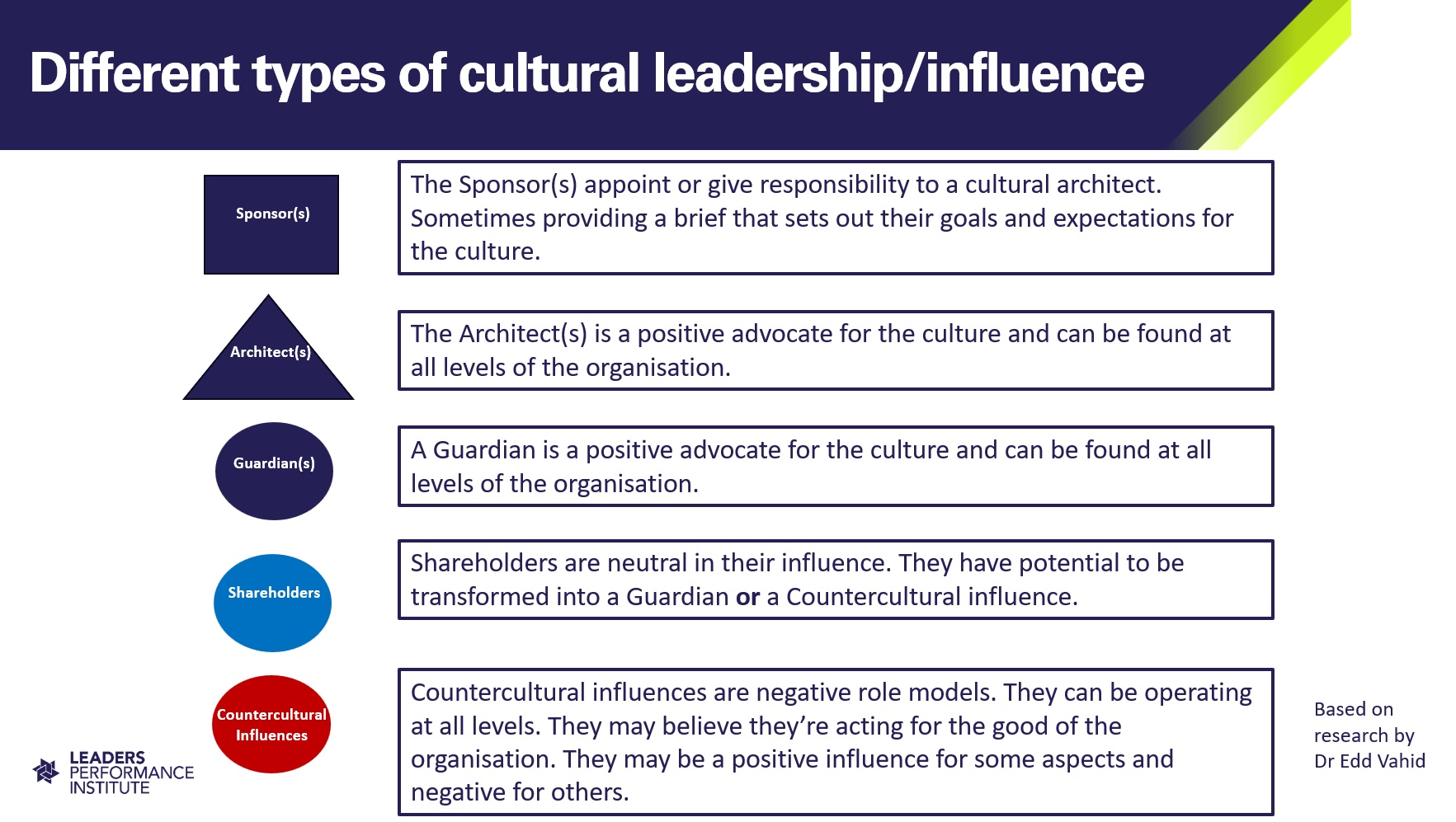
For this part of the session, Pagliano called upon Dr Edd Vahid’s Cultural Hypothesis, in which he spoke of the importance of ‘sponsors’, ‘architects’, and ‘guardians’ in shaping a culture through a combination of leadership and influence.
Pagliano added two further categories: ‘shareholders’ (“I would argue that everybody who works in an organisation is a shareholder”) and ‘countercultural influences’ (“countercultural influences are negative role models that can be operating at all levels”) and presented the following slide:
He then shared a hypothetical example of a cultural map that pulls on these five types. The result is a complex diagram:
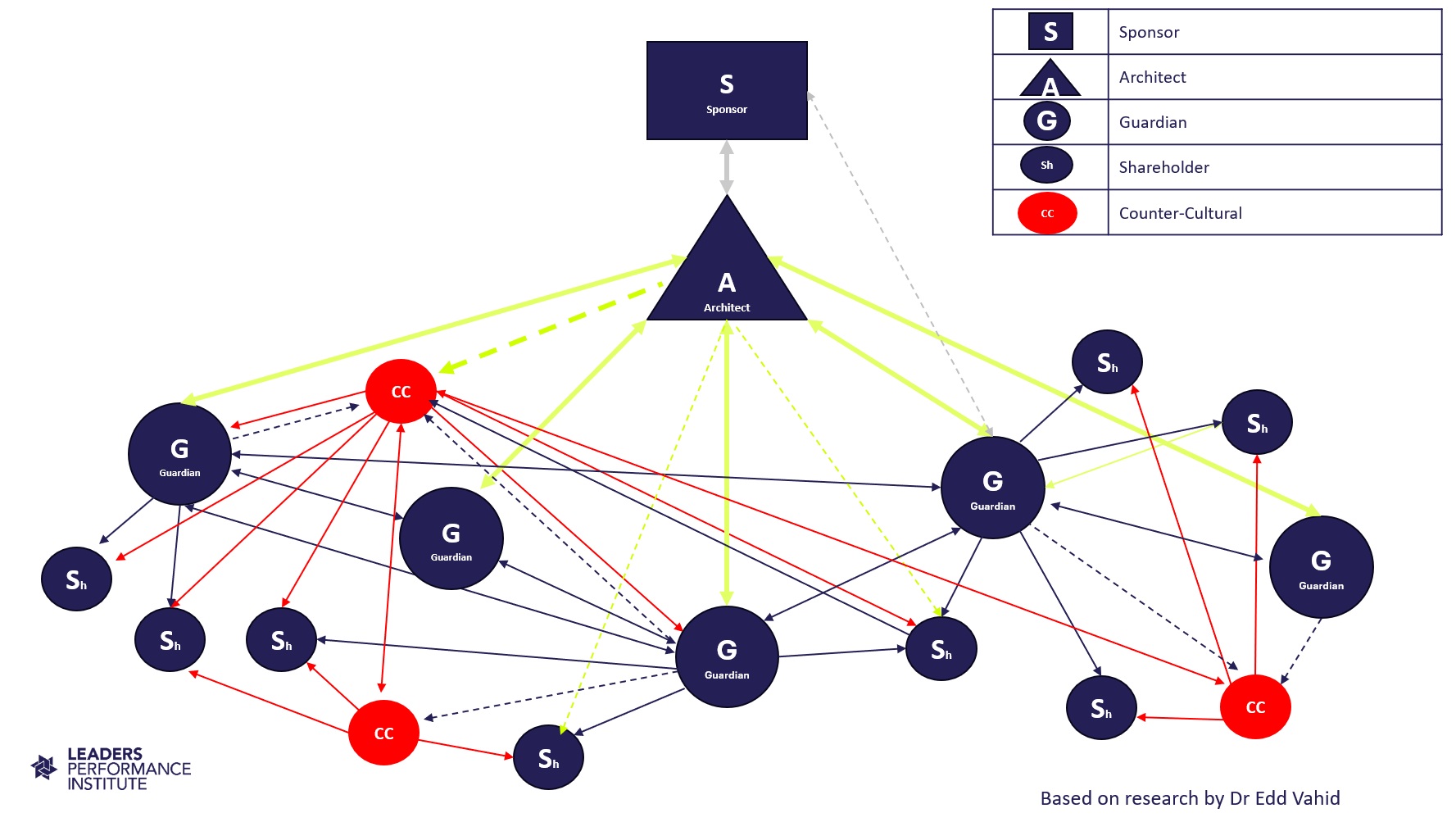
“Your sponsor is at the top,” said Pagliano. “That can be the owner of an organisation, maybe a GM, maybe a coach, but it’s somebody who has the ability to decide whether resources are allocated for building culture.
“Then you have the architect: the one who thinks about ‘see’, ‘say’, and ‘believe’. This is the person who has the ability to influence processes and has decision-making power.
They may or may not be the leader of the organisation, but they certainly have the ear of the leader.
“Then below is where the web gets a little complicated. This is where you can see how certain policies, procedures and aspects of culture can intertwine and be influenced.”
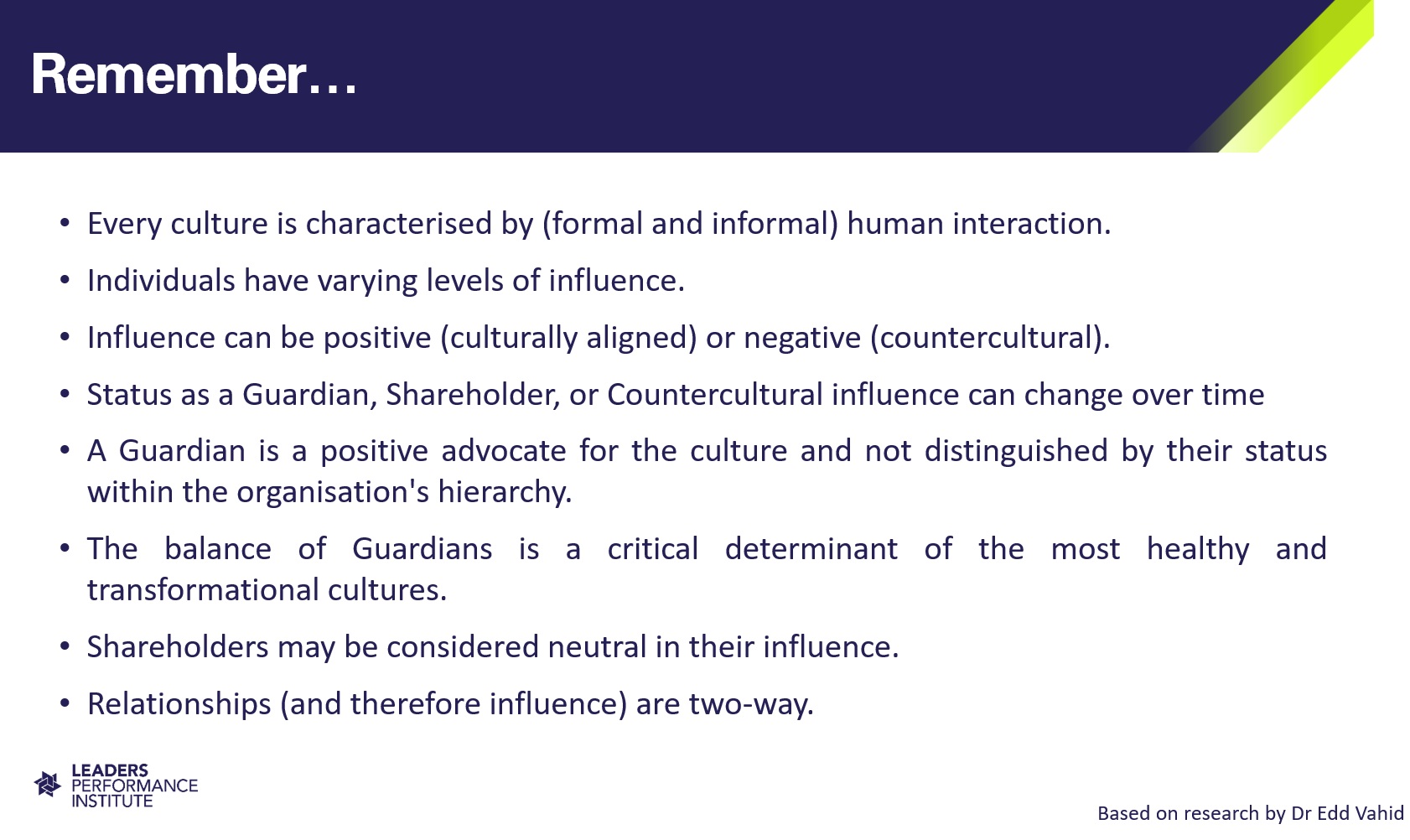
Pagliano concluded this section with a summary:
He concluded his presentation with six cornerstones of cultural leadership.
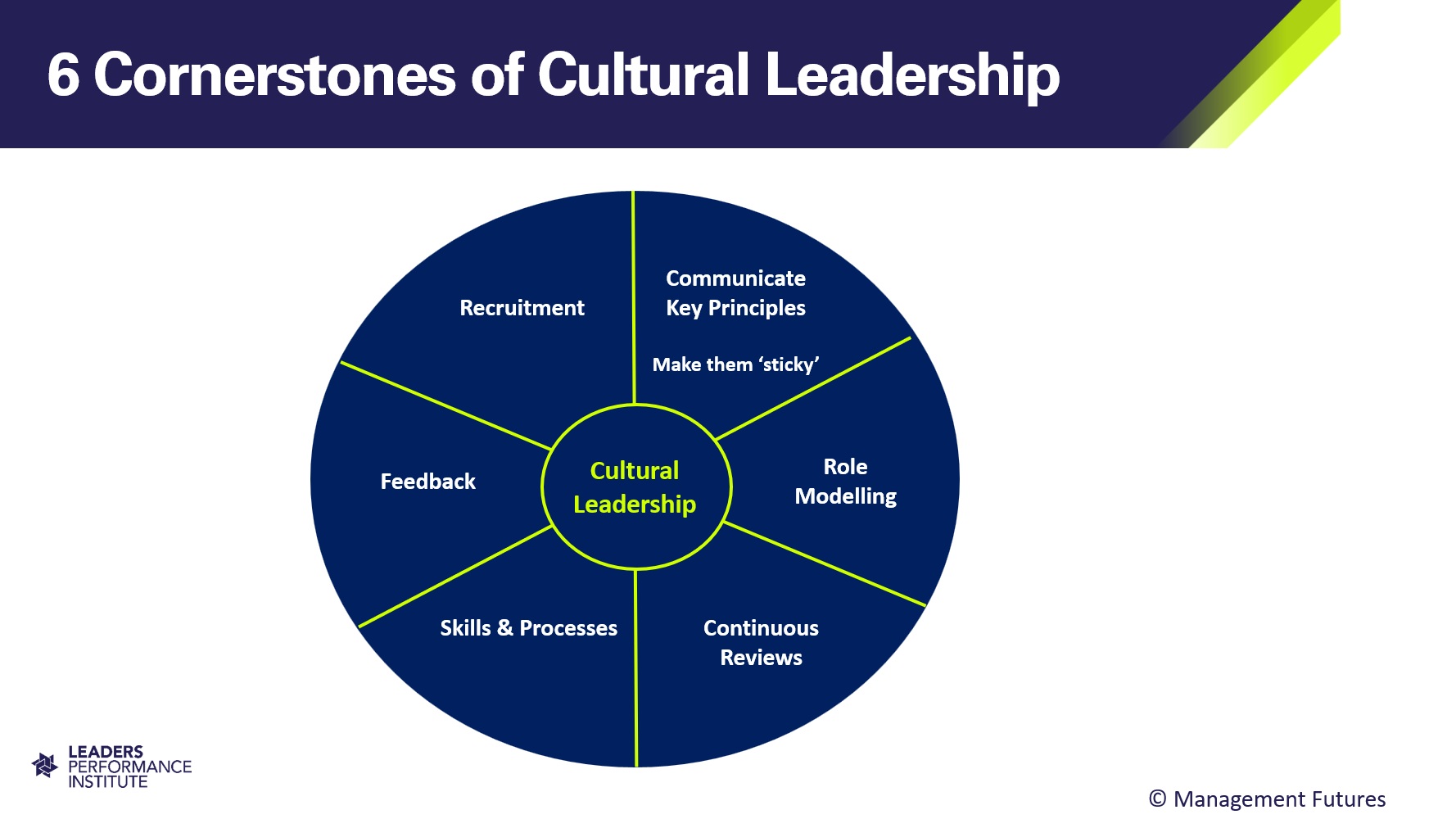
“These are the six levers that any culture leader, whether it’s your sponsor or your architect, can pull to make sure that vision of culture is consistent across your organisation.”
He then gave a real-life example for five of the six.
Communicate key principles – Netflix
“Netflix’s key principle is ‘act in Netflix’s best interests.’ And so their culture of ‘Freedom & Responsibility’ can be captured in these five words,” said Pagliano. “Anytime there’s a decision being made, you can always ask your team, ‘are we acting in Netflix’s best interests?’”
Role modelling – Collingwood FC
Pagliano explained that Collingwood’s Senior Coach, Craig McRae, asks himself daily, “‘to what extent are my day‑to‑day actions equal to our ambition?’” The Melbourne-based club were AFL premiers in 2023.
Continuous reviews – Pixar
“They had this concept of appreciative inquiry,” said Pagliano of Pixar. “It’s all about setting examples of excellence to create a blueprint for future performance.” In testing Toy Story, for example, the relationship between Buzz and Woody wasn’t working. So they went back to the drawing board over the course of six days and created those characters that we know and love today. Further down the line, they would go back and ask, ‘what were we doing right during those six days when we pulled together?’”
Skills and processes – the UK Sports Institute
This example is specifically about their approach to developing their staff members’ “teaming skills”. “This can come down to something as simple as ‘speak up, listen up’ and then a shared responsibility for performance,” said Pagliano. The UKSI wanted to teach “teaming skills across the different groups so that when groups from different parts of the organisation interact with each other, they have a shared language.”
Feedback – Doctors Without Borders/Médecins Sans Frontières
“Their motto is ‘we are intolerant of, but empathetic, when people don’t initially meet our high standards’,” said Pagliano, who explained that employees are given “three strikes”. “Feedback as a continual part of the process is really important to maintaining their culture.”
Recruitment – get the right people on the bus
Pagliano does not give an example for recruitment. Instead, he poses a question: “When you’re looking to hire folks, who do you think is going to buy into your shared cultural values and who is going to be a guardian or an architect of that?”
If you have any further questions around how to understand, shape and protect their cultures, feel free to reach out to Management Futures directly via [email protected]
What to read next
During his time with the INEOS Britannia sailing team, Peter Hodgkinson built an environment that enabled his young staffers to learn and thrive under pressure. As he explains in this exclusive column, intent-based leadership and psychological safety were at the heart of his approach.
Main Image: Getty Images/Fiona Goodall
We achieved a number of national firsts: the first British team to win the Challenger Series, fending off some tough opponents; the first British team to contest the Match itself in 60 years; and the first British team to score points in the Match for 90 years.
There was no shame in eventually losing 7-2 to Team New Zealand, who claimed their third consecutive victory. We gave it a good go against the team our helmsman, Sir Ben Ainslie, described as “the best team ever”.
This is the story of how we put ourselves in contention.
Assembling a functioning team: the hard part
The INEOS Britannia Team was made up of two organisations: Athena Racing and Mercedes GP. It wasn’t always easy – it was a collision of two different workplace cultures – but the common goal bonded the two companies together and we got on with the job.
I learnt a lot about sailing and the maritime industry and while there are similarities to motorsport, where I have made a career for four decades, there are a number of big differences (that’s a topic best saved for another day).
One of the things I really enjoyed about working on the Cup was that we got to recruit a new Build Logistics Team. Basically the Build Logistics Team are parts chasers; in the Cup they looked after ‘goods in’, ‘stores’, stock checks, parts picking, moving parts through inspection, NDT (non-destructive testing), X ray etc. so it is a fluid and dynamic role with lots of pressure.
The team we recruited had very little or no experience in this type of role but we believed it was more important to have the right mindset, practical intelligence and energy than experience. In the Cup, we didn’t have all the structures, systems and processes in place that you have in an F1 team but we had enough to do the basics well, if we used what we had correctly.
I believe if you have relatively fewer parts then you need additional people to manage those parts as they become more critical. Therefore, we ended up with a team of seven people in Build Logistics, which seems a lot, but considering the workload, I think this was the correct number.
Almost all members of the team we assembled would be considered Gen Z, but I didn’t view them in such narrow terms. I didn’t put them in some kind of box with a label. To me they were a new team that we had to get moving as quickly as possible. This was the hard part.
‘Don’t lose any parts’… and ‘no surprises’
The team’s inexperience was difficult to manage at first but as they were all intelligent it didn’t take long to get them up and running. Don’t get me wrong: we had some very difficult moments and some very challenging conversations, but after a few months we started to see improvements and we were going in the right direction. The energy and passion this group displayed was not seen by the whole team as everyone was flat out, but I could see what they were achieving. I applied what I had learnt in my time in HR (I was Head of Employee Engagement at Mercedes F1 between 2019 and 2022) to this group using intent-based leadership and psychological safety.
I gave the Build Logistics team two simple rules: ‘don’t lose any parts’ and ‘no surprises’. Don’t lose parts almost goes without saying, but it was important to articulate as it gave them a mental priority for what they were responsible for. I wanted them to feel that every part was important because, if we lost something, then we could miss an important test or delay a development item hitting the water, therefore delaying the opportunity to learn.
We did lose some parts but also we did learn from this, and I like to think we didn’t blame the person, as the process (or lack of) allowed it to happen. In most cases during my career, the human being was acting as a sticking plaster due to the lack of a robust process or system.
I used ‘no surprises’ as a tool to try to build psychological safety. Surprises are for birthdays and Christmas, in my book. I wanted this young team under pressure to speak up. I wanted them to feel that it was wrong not to say something if they were concerned about a part or a process or were having a problem. I wanted to hear what they had to say, I was desperate to hear what they were thinking, and it was important that I responded productively when they did bring me bad news. As a Build Logistics Team, we needed to know now if there was an issue, as we simply didn’t have time or resources to bury bad news. We needed to hear their voices and, for me, ‘no surprises’ gave them permission to speak.
We had a daily meeting at 11:00am to go over the plan, projects and new parts – similar to what we did in F1 – and it took a while to truly hear everyone’s voice. I would say to them: ‘I woke up at 2:30am and thought about this, when you woke up last night, what did you think about?’ Sometimes nobody had much to say when I asked this question but on many occasions there was a little nugget of information that came to light.
If you are looking to build psychological safety in your team, try using ‘no surprises’. It gives your team permission to speak and it will help your team grow and develop as they feel they have a voice and will be respected for their contributions.
The 2% vs the 98%
Now this might be a bit controversial: one nugget I gave to the young Build Logistics Team on the America’s Cup was “you are only remembered for the 2% you get wrong, not the 98% you get right”.
If you are really honest and park up all the psychology for a moment, this is probably a pretty true statement.
I am sure plenty of cleverer people than me will disagree with this sentiment, but this is how I see it. It is a bit below the line, but it did focus my mind on my own performance. I believe we remember negative moments or threats to help protect ourselves in the future if we see this type of situation happening again, and therefore it remains fresh in our memories.
Others will have some good memories of some of the things we did but they will remember in detail our mistakes and the moments where we did not behave reliably or with competence. In other words, they lost trust in us. As human beings we will make mistakes, this is how we learn, grow and develop.
Intent-based leadership
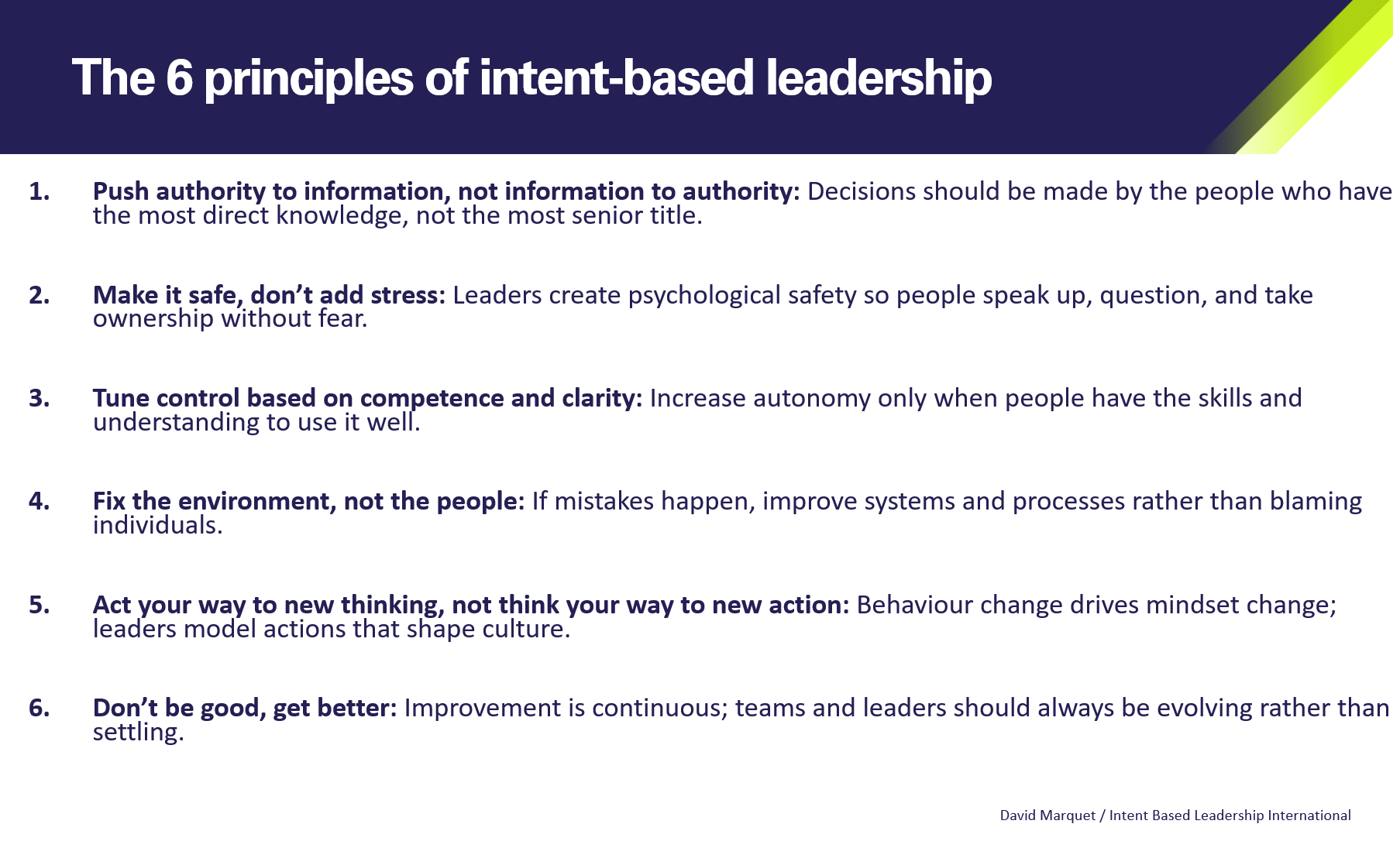
Leaders of new young teams need to provide a lot of control and support in the early stages of the team’s development while the team members improve their competence and get aligned to the clarity of the intent. As the team’s competence and clarity increases, the amount of leadership control decreases. This is built on the intent-based leadership theory devised by retired United States Navy captain David Marquet.
This is a snapshot:
As a leader you are never quite sure what the people around you really think of you or if you have made a difference due to the pace of the world we live in. That said, a former member of the Mercedes F1 Build Logistics Team (and now a successful leader and manager in his own right) recently sent me one of the nicest bits of feedback I have ever received:
Your leadership allowed many young people to grow and now forms a lot of their own leadership and general teamwork skills. The biggest thing I always felt that made you different was your ability to allow others to make mistakes whilst catching them before it was at the detriment of the team. Without that, none of us would have learnt to be independent.
I think the key point from this is: I was catching the mistakes before they hit the 2% category while allowing the team to learn and become independent and responsible.
How is your team learning? Or are you telling them what to do so they don’t make mistakes? You don’t want their mistakes to reflect poorly on you and get you into that 2% category.
I hope this has given you something to think about. I am sure this may go against the grain for some of you but I suppose we can’t all agree on everything.
Peter Hodgkinson is a leadership and performance specialist skilled in helping high-performers become better at what they do. As an accomplished manager and mechanic, Peter has enjoyed almost three decades of success in elite sporting environments. His work in motorsport, as part of winning teams at Le Mans and Daytona, culminated in seven Formula 1 driver’s world championships won at Brawn and Mercedes, where he led car-building operations. Peter was Mercedes’ Head of Build during Lewis Hamilton’s era-defining run of six world titles. After a spell serving as Mercedes’ Head of Employee Engagement, Peter returned to the Factory Floor as Build Operations Manager for the INEOS Britannia sailing team when Mercedes supported their quest for the 37th America’s Cup.
If you would like to speak to Peter, please contact a member of the Leaders Performance Institute team.
Emily Scarratt and John Mitchell knew their England team could be world champions, they just needed the right environment to be able to prove it.
The centre had just competed in her fifth tournament (a joint record in the women’s game), claimed her second winner’s medal, and helped to complete an 11-year quest to bring the World Cup trophy back to England. It was almost the perfect way to bow out after 17 years as an international, 115 caps and a world record 754 points.
Yet she had only played 19 minutes of England’s campaign – all as a second half substitute in the Red Roses’ opening pool match; a 69-7 defeat of the United States in Sunderland.
“I’ve definitely been part of environments before where that kind of non-playing player can become quite negative and toxic,” she told an audience at the 2025 Leaders Sport Performance Summit in London.
“For a large part of my career, I was starting and therefore it’s very easy to say the right things and present in that way when you’re not under the stress of not being selected or not playing as much as you would like.”
Scarratt was joined onstage by England Head Coach John Mitchell, who in early February extended his contract until the 2029 World Cup and added Scarratt to his coaching staff.
The session moderator, Rachel Vickery, asked him what it meant to see Scarratt and her other non-playing teammates (known within the Red Roses setup as “pillar” players) celebrating with such vigour.
“I reflected that we actually hit the sweet spot with the culture,” said Mitchell. “Sometimes you don’t get that sweet spot and we might not get it again.”
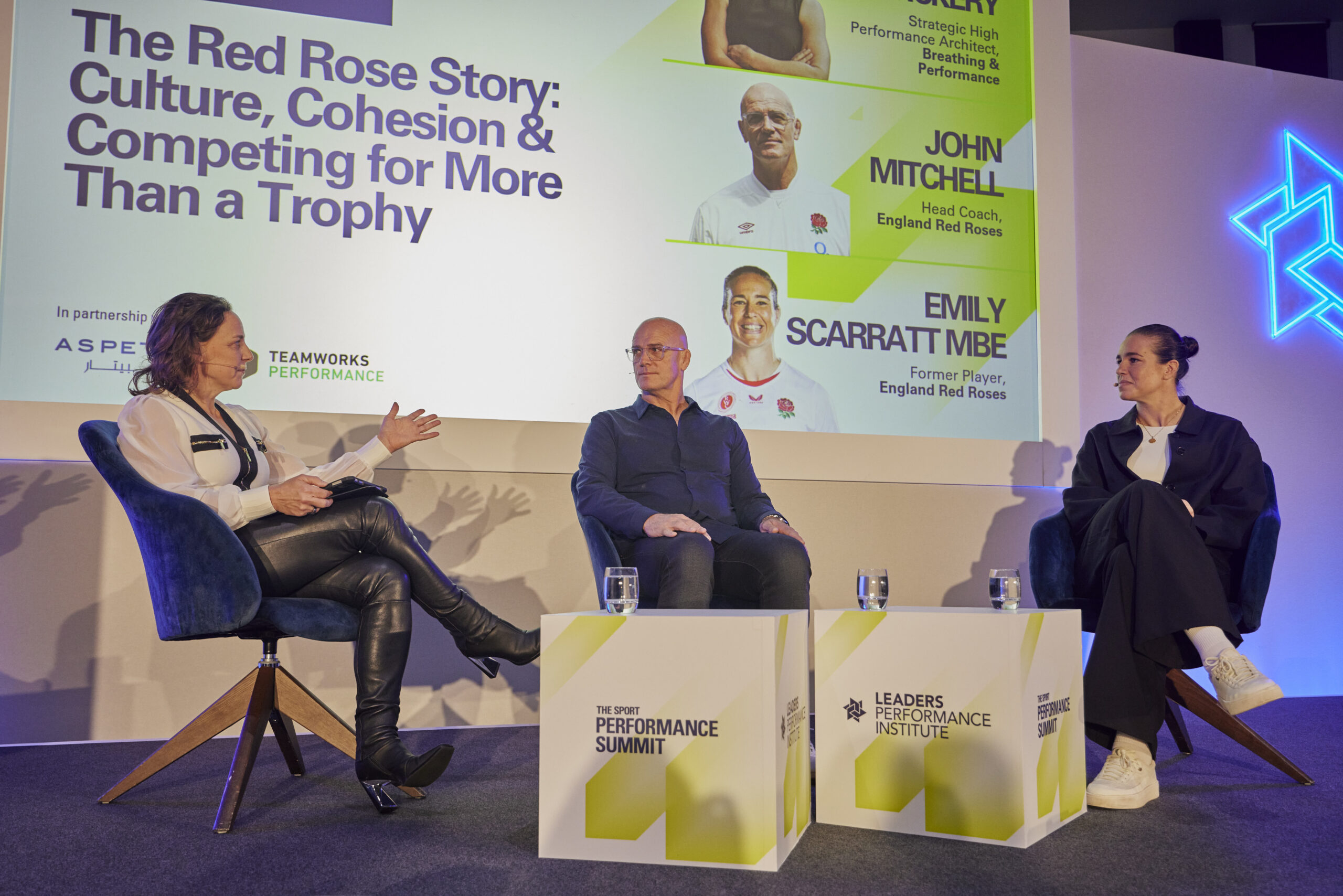
Rachel Vickery (left) talks to John Mitchell (middle) and Emily Scarratt (right) onstage at the 2025 Leaders Sport Performance Summit.
Here we reflect on what Mitchell and the Red Roses got right for 2025.
He spoke up when something wasn’t quite right
When Mitchell signed up to become England Head Coach in 2023, his remit was to win the World Cup. He was a coach with a proven track record in the men’s game who had now been handed the resources and the players to deliver the Women’s World Cup on home soil.
But in 2018 and 2022 England had lost World Cup finals they could, or perhaps should, have won.
“The leading question was how do we get done what we haven’t through the years?” said Mitchell.
It involved integrating young talent (eight players made their World Cup debuts against the US) and tactical tweaks (they had been too reliant on their maul). Both required an environment that enabled the best team on paper to prove they were the best team on grass.
To deliver on that front, Mitchell and the team’s leaders landed on three guiding values: ‘courage’, ‘take the handbrake off’ and ‘be all in’.
These values inspired England’s veterans and new internationals alike. “If the top person genuinely believes that culture is important it makes a difference,” said Scarratt. “Potentially in previous campaigns that hasn’t been the case and culture could get a little bit sidetracked or lost along the way.”
Mitchell even spoke up when he spied a shortcoming in the players’ well-meaning desire to ‘do it for the girls’.
“My thinking was that emphasis might be slightly calibrated towards ‘me’ – not intentionally – but how do I get the girls to calibrate towards ‘we’?” he said. “Because if I inspire you and I’m inspired by you, isn’t that more important, more inspiring to the person next to you? We get the job done and then our voice around our individual ‘why’ will be far greater.”
The cultural tweaking never stopped
“It’s very easy to just pick values, put them somewhere and hope that people live by them,” said Scarratt. “Our values were genuinely threaded through a lot of what we did, whether it was medical presenting or S&C presenting” and, when you witness that, “it’s very easy to buy-in”.
Mitchell held difficult conversations when necessary, but all players and staff, Scarratt said, were expected to speak up when necessary “to nip things in the bud before they became potentially bigger.”
At the suggestion of leadership consultant Patrick Marr, Mitchell would ask his player leadership group and support staff on the eve of each international camp to tell him “who’s going to pull the cart forward? Who’s going to sit on the cart? Who’s going to hold up the cart?”
After an hour he would “come back and I’d see two or three players, plus a couple of staff, where our priority needs to go,” he said, adding “we would then decide on who I would speak to and who they would speak to.” For every player or member of staff, there would be someone who could bridge that gap and “communicate around standards of behaviour”.
Mitchell even danced on TikTok when duty called
If you’re an England supporter, you may have seen the TikTok video of Mitchell dancing with his players.
“I needed to show vulnerability,” he said of such moments, which was not something he considered as a younger coach. “I had to do things that I probably don’t normally do and join in with the girls on certain things.”
Psychological safety may start with players or their head coach dancing in the dressing room, but it ultimately manifests on the pitch during tricky spells or in performance meetings when a staff member has the courage to raise a performance issue.
Mitchell knew he had to lead from the front. “Sometimes you’ve got to be the leader of those actions before somebody else does them.”
That said, his belief in the power of the head coach has been softened (and his self-awareness amplified) by three decades in the sport. “You learn through emotional intelligence that you don’t have to be absolute or right when making decisions. Just use your people. Listen to your people.”
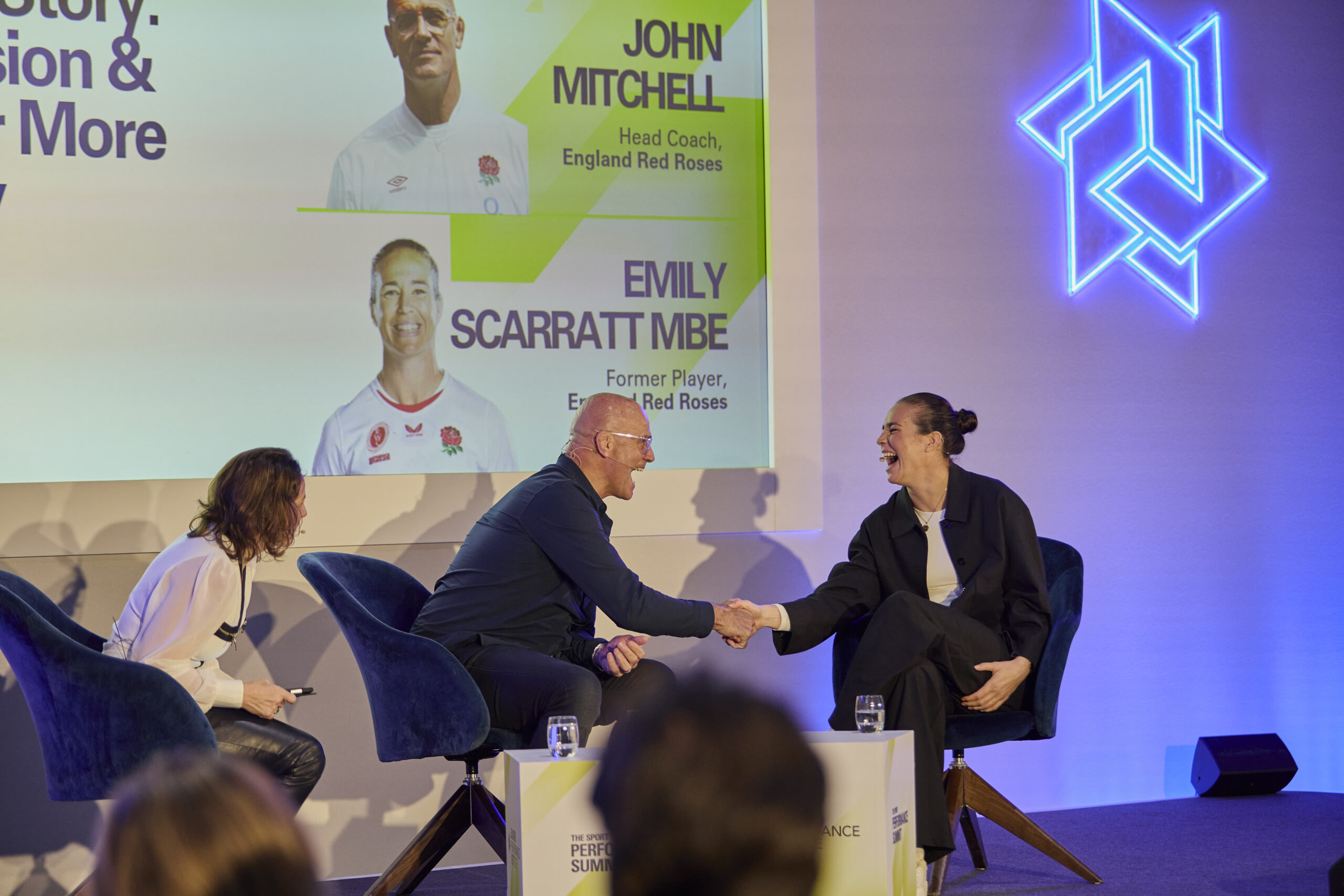
John Mitchell and Emily Scarratt shake hands as their session draws to a close at the 2025 Leaders Sport Performance Summit in London.
The team talked about the pressure they felt
For the first time, England openly spoke about winning the World Cup. It served as a pressure valve and, again, gave voice to their values.
“It might sound a bit silly but we hadn’t done that before,” said Scarratt, implicitly acknowledging how awkward the group felt at first about such an “un-English” sentiment.
As the English media and public latched onto the team ahead of the US match, the pressure grew. The players trained poorly on one occasion but, instead of dismissing it, they discussed it openly.
“I think we did a really good job of dampening it down by not not speaking about it,” Scarratt added. “By actually putting it out there and allowing people to know that other people felt like that.”
And Mitchell’s words after England eased through the gears on the opening night set the tone. He said: “There’s bigger games coming where teams will put even more pressure on us, so let’s take confidence from what we’re building and stacking as we’re going along. Our game doesn’t need to be perfect, it just needs to be effective, and that will win us the tournament.”
He was right and, looking to 2029, their goal is to win back-to-back World Cups, establish a legacy as one of women’s sports greatest teams, and to further grow the women’s game.
These lofty goals provoke three questions that Mitchell and England must answer: “What will earn the right? What will we keep and take forward with us? And then, thirdly, is what we what will we need to start again?”
What to read next
Meaning Does Not Guarantee Medals, But it Strengthens the Behaviours that Make Medals Possible
In a recent Leaders Virtual Roundtable, performance specialist Iain Brunnschweiler led a discussion on strategies more effective learning. We pick out ten below.
With those words host Iain Brunnschweiler, who runs the Focus Performance Consultancy, set the scene for a virtual roundtable discussion during which Leaders Performance Institute members shared the strategies that have facilitated better individual and organisational learning within their teams.
“There’s definitely something about learning being contagious,” he added in expectation. “If credible, valuable members of staff are going after things deliberately like you are, I’d hope that there’s some sort of contagion within your organisation.”
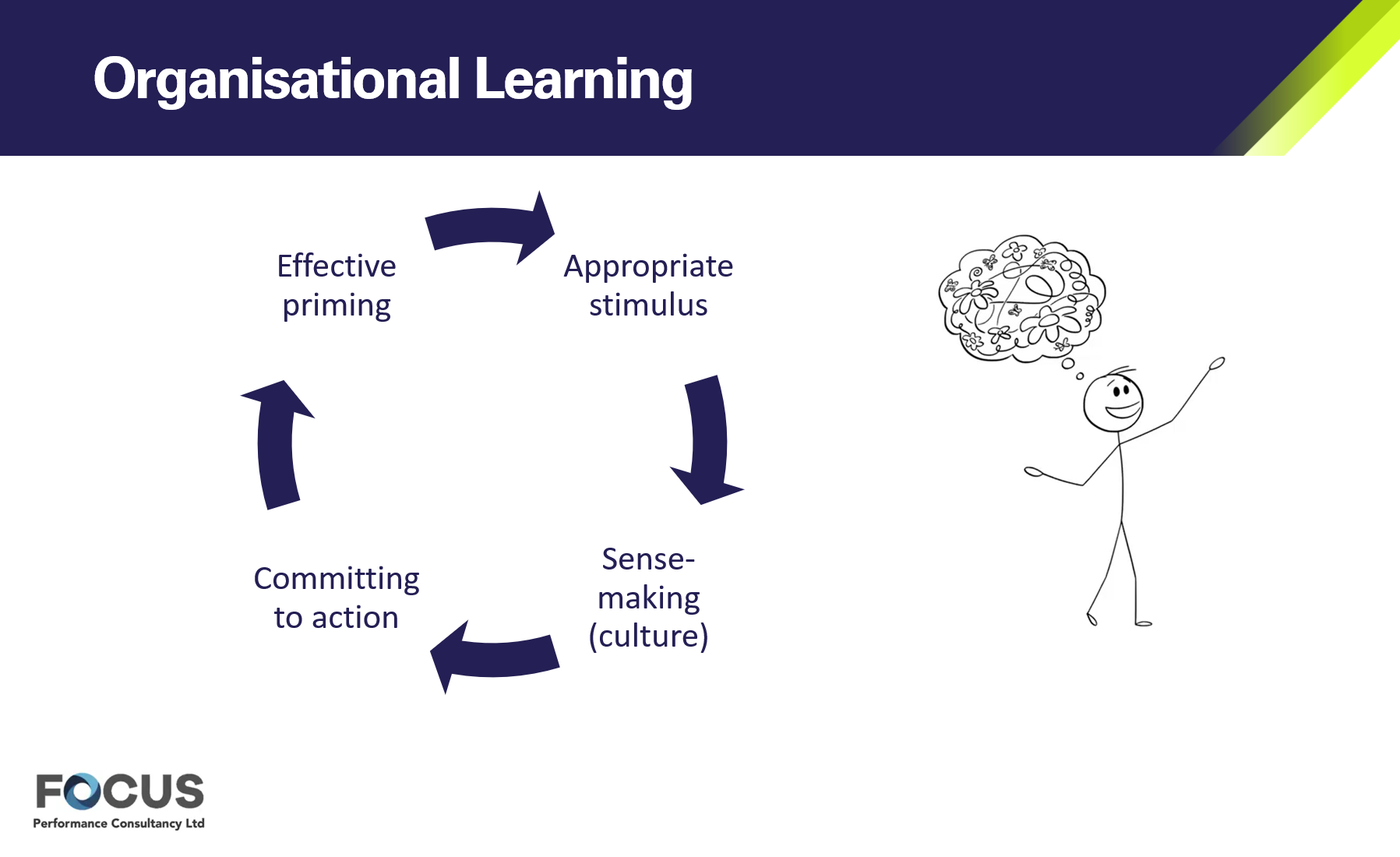
To start proceedings, Brunnschweiler outlined a four-part model of organisational learning. “This is an unpublished model,” he said of it. “This is the world according to me.”
Effective priming
“How can we deliberately set people up for learning? That’s something that I’ve increasingly considered,” said Brunnschweiler, who highlighted one-to-one conversations with staff members as a way to identify their aspirations and their motivations.
Appropriate stimulus
“How do we provide a stimulus to create thought in aspirational people?” In a previous role, Brunnschweiler implemented weekly 30-minute meetings with staff members. He also enlisted external speakers and asked individuals to present on a teaching project.
Sense-making (culture)
“If within your organisational culture there are people and spaces that allow you to have conversations, check and challenge your thinking, that is a really good way of helping the learning to land,” said Brunnschweiler, while emphasising the cultural dynamic.
Committing to action
“Often,” Brunnschweiler said, “the greatest risk here is that we have a brilliant conversation, and then we do nothing about it’. How do we commit to something that’s going to make some sort of change, whether it’s small or large?”
The group then shared ten strategies to encourage more effective individual and organisational learning:
1. Give staff members the freedom to explore learning
“If we want to happy or we want to have happy staff, we need to give them some freedom,” said a sports scientist working in the major US leagues. “And if we want them to be free, then we have to encourage them to be courageous and pursue what they want to have and what they want to do.”
Brunnschweiler said:
“A learning culture starts with recruitment… can we keep shifting that culture by recruiting naturally curious and hungry people and maintain momentum.”
2. Hunger for learning must be role-modelled from the top
Often, staff members are eager to learn, as a psychologist working in the US college system observed, “but having leadership model this is so key”. Only then will staff members carve out the time, as he said:
“If your staff members don’t feel like they have the grace and space to allocate time in the day they’re going to say, ‘I have to do this,’ or ‘I have a meeting’ instead.”
3. Understand people’s motivations
If you can understand someone’s motivations or aspirations then you have an anchor for a conversation about their development. Brunnschweiler explained that it is important to focus on those who want to learn, not those who don’t. He said:
“Some people have little appetite for self-development. And I think we have to be cognisant of our own energy… and accepting of that fact.”
4. Create individual development plans for staff members
The aforementioned psychologist made a convincing case for staff IDPs. He said:
“We talk so much about player development plans, but do we truly have staff development plans, like, ‘here’s where you are, here’s where you can go, here are the gaps to be filled’?”
5. Place staff on secondments when possible
“We don’t put barriers in the way of our people going out on secondment,” said a director of cricket in the English game, where the season is not a 12-month schedule. This is, as Brunnschweiler observed, a cost-effective way of bringing IP back into the building. He said:
“How can we be resourceful? Can we create opportunities for people to visit places and return with knowledge without spending money?”
6. Find your critical friends
Sense-making can be difficult, but sometimes it just takes opening your phonebook. A call with a critical friend is what Brunnschweiler calls a “micro sense-making space”. He said:
“I’ve accrued a small network of people who, for example, when I’m driving, I just phone them up and I know they’ll challenge my thinking and that I’ll learn from that conversation.”
7. Learn from failures
“I’m far more interested in the failures,” said a physiotherapist at a globally renowned organisation. “When my team see me talk about failures, when things have gone wrong, that makes people listen a bit more; and I often think we should prep to fail. Are we ready to fail, so that if we fail, we can look back and say, ‘okay, we did everything we wanted to do?’” Brunnschweiler agreed, adding:
“It’s a good sign if you’ve lost and a staff team are reviewing and reflecting on it and they’re genuinely unpicking and they’re able to call each other out or go, ‘do you know what, I messed up today’. That is a real signature of a place that wants to get better.”
8. Importance of managerial vulnerability
Leaders can role-model learning, but they can also demonstrate vulnerability.
“If you can put your hands up and say, ‘I made a mistake’, that sets the culture, it sets the environment,” said a physiotherapist working in Australian sport. In building on that point, the physiotherapist from No 7 said:
“If we can guarantee that removal of blame, it will encourage us to talk about what we can learn.”
9. Job security
It sounds obvious, but managerial vulnerability goes hand in hand with job security.
“In a fast‑paced environment there is more chance of people getting sacked. I think this could be almost correlated to your hunger for learning,” said the physiotherapist based in Australia. “You might just sit there, be quiet, go insular, and just tick our day‑to‑day off – you don’t want to put your neck out there.” He has witnessed the impact of leaders reiterating that people’s jobs are safe.
“When you are told people aren’t just going to get sacked, it creates the environment for learning.”
10. Appoint a dedicated staff member for learning
“I’ve never worked somewhere that’s had a dedicated head of learning,” said an analyst working in Middle Eastern football. “It always falls on line managers and it’s hit and miss.” Brunnschweiler agreed and added:
“How does any organisation ensure that a PDR process is not just some tick-box exercise, but there’s genuine validity in what you’re going after, what you’re going to commit to, and then it’s followed up on?”
What to read next
Team standards, the price you pay for poorly delivering feedback, psychology and innovation have all been on the Leaders Performance Institute agenda these past two months.
Michael Maguire’s team were behind at half-time in every game of the finals series but came back to beat the Canberra Raiders (the minor premiers) in the qualifying and elimination finals; they over-turned another half-time deficit to beat the Penrith Panthers in the preliminary finals; and lightning struck thrice in the Grand Final when they faced a 22-12 deficit at the interval.
“I didn’t have to say too much at half-time. I just said to them ‘your best half is about to come’, because we have come from behind over the last month. I said if you go and do that, we win the game,” said Maguire – a former speaker at the Leaders Sport Performance Summit – after the Grand Final.
This was a team whose belief in their ability was forged in adversity. Maguire stuck by his players at tricky moments during the season. At times, following a run of poor results, it seemed unlikely that the club would challenge for its first NRL premiership since 2006.
“I remember Madge’s passion and him sticking up for us midway through the year when we were getting rinsed through the media about the way we go about things, but the care he has for us, no one knows outside the club,” said fullback Reece Walsh.
“The way he looks after us as people, the way he looks after our partners, there is nothing more we could ask for. He demands a lot, as he should demand a lot – we have just won a comp.”
Both Maguire and Walsh hint at the ingredients for high performance – empathetic leadership, high standards and mutual trust – that underpinned the agenda at the Leaders Performance Institute in recent weeks.
Below, we give a flavour of the conversations that commanded attention during that time.
‘The standard you walk past is the standard you accept’
Maguire was in attendance at the Leaders Sport Performance Summit in November where the Broncos appeared onstage courtesy of General Manager Troy Thomson.
We also heard from rugby’s other code, rugby union, as England’s former fullback Emily Scarratt and Red Roses Head Coach John Mitchell explained how the Women’s Rugby World Cup was won; before that, Johann van Graan delved into the transformation he led at English Premiership champions Bath Rugby.
Nestled in between was an inspired presentation by Emma Keith, a group captain, who is the first female to run Royal Air Force officer training.
Hers, much like Maguire’s, was a message of empowerment rooted in accountability and care. She said:
“The standard you walk past is the standard that you accept. That can be poor infrastructure that you don’t report; it could be poor behaviour. If you walk past it, you’re saying it’s okay. And that’s a slow rot from within.”
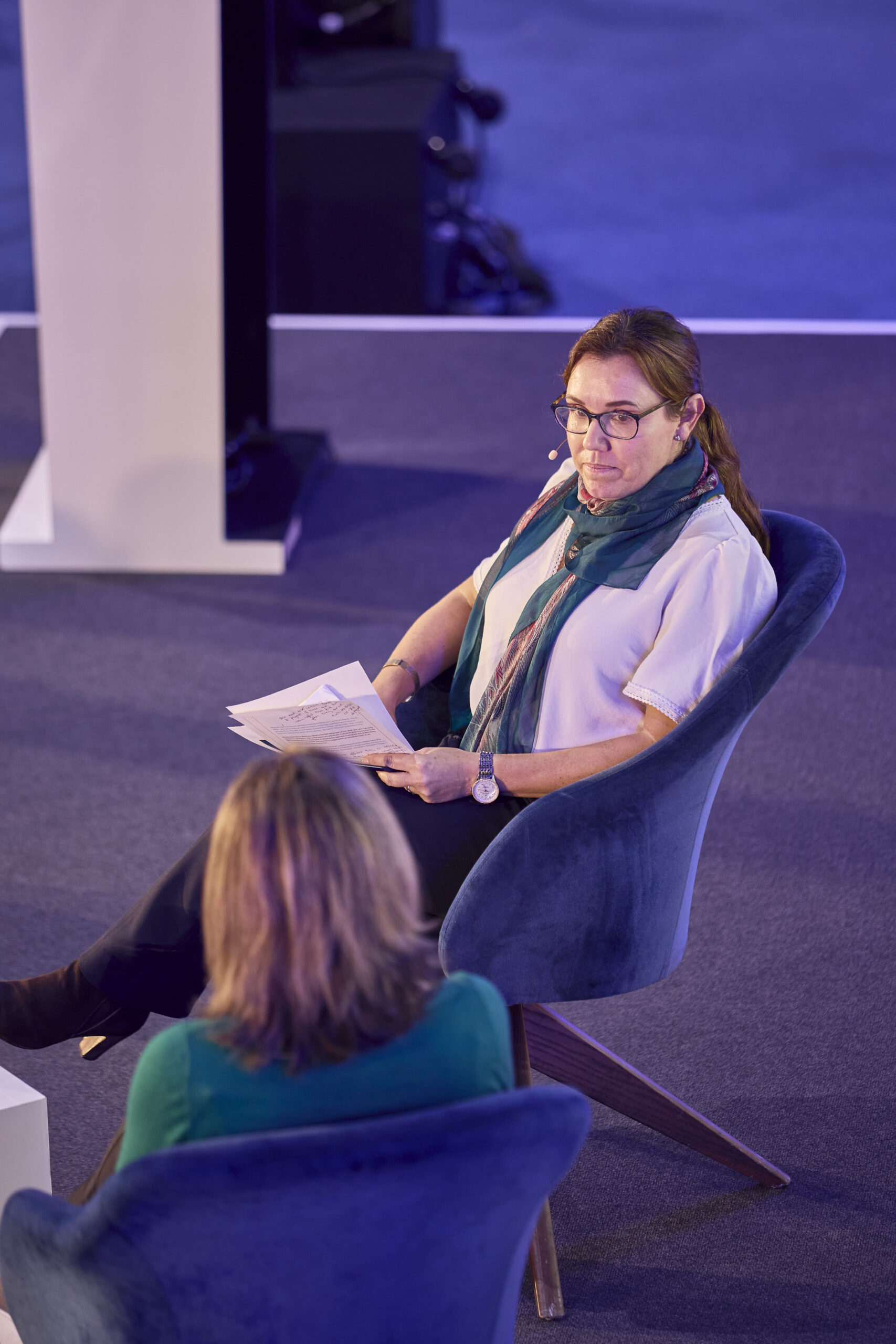
Group Captain Emma Keith talks to UK Sport’s Alex Stacey following her presentation on officer training in the Royal Air Force.
Read more from the summit here.
The price you pay for poorly delivering feedback
“In terms of feedback, we’re quite basic creatures,” said Simon Eastwood. “We will react and respond instinctively to what we perceive as threat or reward.”
As Eastwood, the Head of Leadership Skills at Management Futures, explained, the wrong word, tone, timing or even body language from a coach can trigger a negative reaction when giving an athlete feedback.
Eastwood hosted a virtual roundtable aimed at helping coaches and practitioners to improve how they deliver feedback.
He shared a number of tools on the day, including the SCARF model.
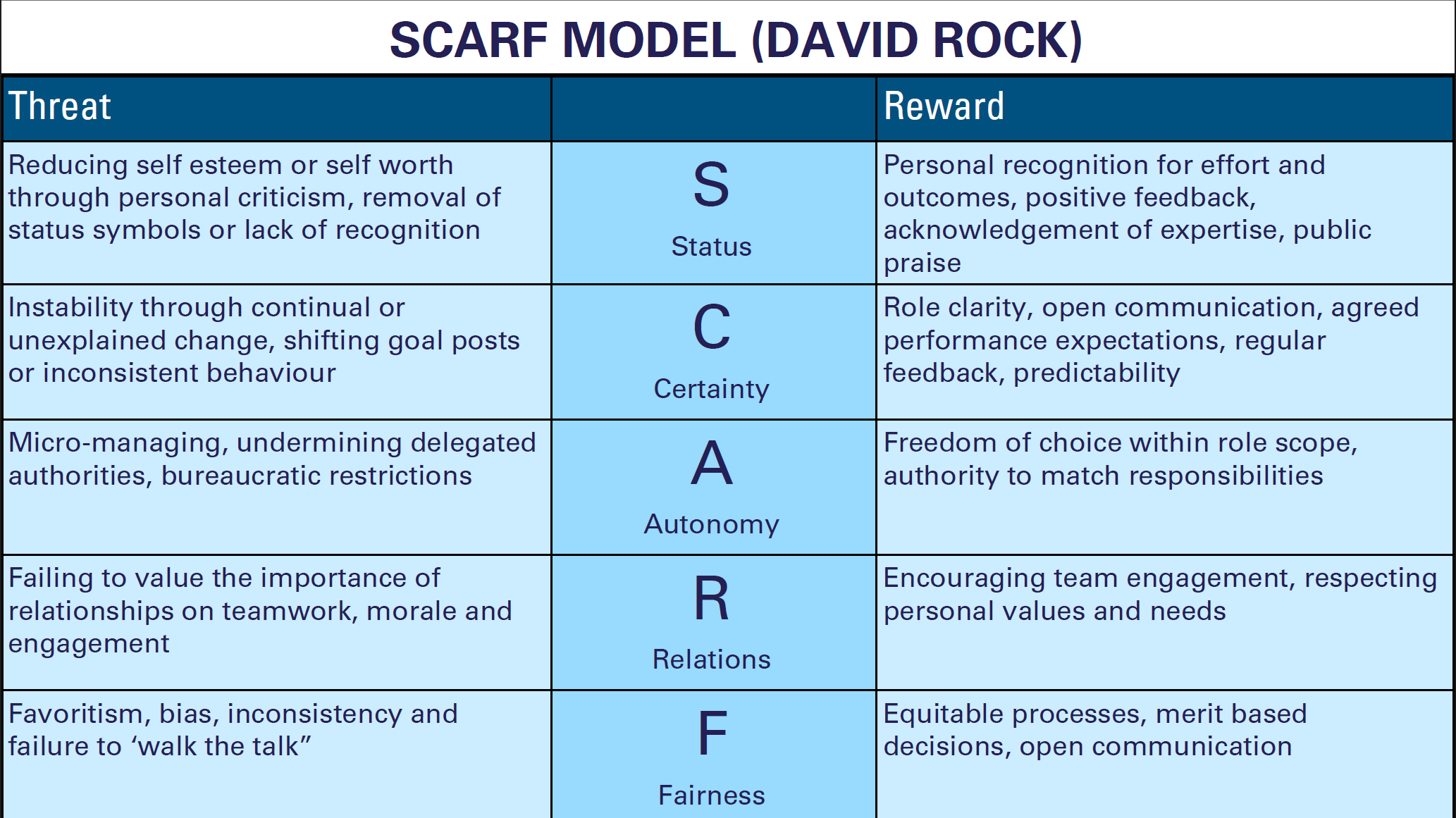
This framework, devised by neuroscientist David Rock, explains five domains that influence human social behaviour and motivation. SCARF stands for:
“It’s a great tool for stepping back and assessing your team and thinking about what really makes them tick,” said Eastwood. “Crucially, it’s not about avoiding that feedback.”
He suggested that leaders should reward these needs through feedback, so people feel valued and motivated rather than threatened and, to illustrate his point, presented a table that set out what ‘threat’ and ‘reward’ may look like in each domain:
Eastwood then posed a question: “When giving positive feedback, which elements do you find most need to be reinforced?”
Leaders Performance Institute members can read more here.
The evolving work of the psychologist
Elsewhere, Dr David Fletcher, a Professor of Human Performance and Health at Loughborough University, and Dr Danielle Adams Norenberg, the Head of Psychology at the UK Sports Institute co-hosted a roundtable on the evolving role of the psychologist.
They outlined two ways in which a psychologist may be a useful asset for the head coach:
1. The development of the coach’s leadership skillset
A psychologist, Fletcher explained, can help a coach to develop their “time management skills, body language, and communication skills” in the pursuit of better performance.
By the same token, psychologists have been instrumental in facilitating a shift from deficit-based to strengths-based coaching. Adams Norenberg said: “Even if planted within a very generic training session, athletes have the self-awareness, knowledge and autonomy to make the most out of their training session by focusing on developing their strengths.”
2. The development of their psychology skills
Psychology is another string in a coach’s bow. If they understand the types of pressures that athletes experience they can “choose a particular training session to not necessarily develop technique or tactical skills, but psychology skills.” Adams Norenberg cited the example of the VR headsets used in training by Team Europe ahead of the 2025 Ryder Cup. Some players simulated the spectator abuse they would endure at Bethpage Black; others used it not for pressure training but relaxation, such as the Norwegian Viktor Hovland, who recreated the fjords of his homeland.
Leaders Performance Institute members can read more here.
True innovation must have an impact… but what is innovation?
Fabio Serpiello, the Director of Sport Strategy at Central Queensland University, posed this very question at a recent virtual roundtable.
He argues that teams should alight on a shared definition; one that does not conflate the concept with ‘creativity’. (Creativity, as Serpiello explained, is the outcome of an ideation phase, while innovation covers the execution and eventual impact of an idea.)
Then, he made the case that when teams have an agreed definition of what ‘innovation’ means to them then it offers a “clear way to approach and analyse whether the innovation processes in your organisations work or not.”
Greg Satell’s Model of Innovation
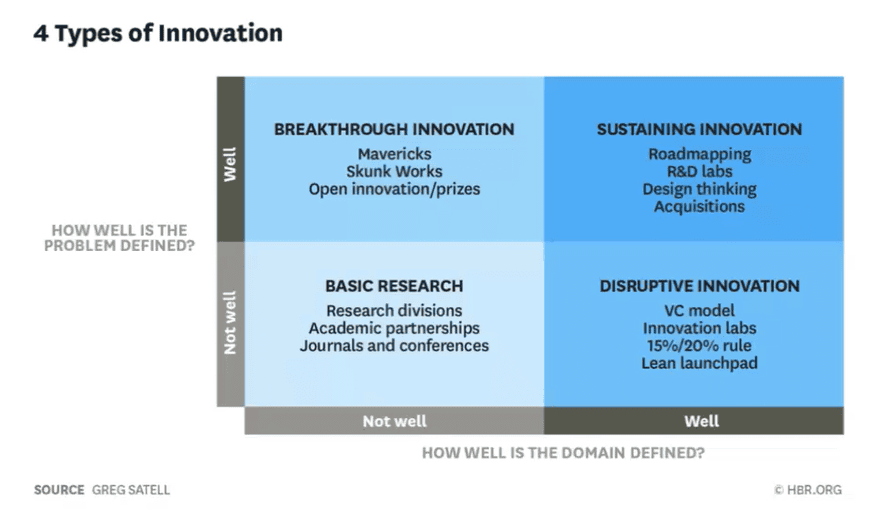
Innovation, Serpiello argues, also comes in several shapes and forms depending on the nature of the problem. To make his point, he introduced renowned change management specialist Greg Satell’s Model of Innovation, which provides a practical framework for introducing innovative practices, encourages strategic thinking about problems and helps to facilitate better collaboration.
He presented a diagram of Satell’s model to the table:
Serpiello then shared his thoughts on each quadrant:
Basic research – a low understanding of both domain and problem: “We don’t really know what the problem is and we don’t really know in which field or area it happens.”
Disruptive innovation – a well-understood domain but poorly understood problem: “In this area you may need something like innovation labs or launch pads.”
Breakthrough innovation – a poorly understood domain but well-defined problem: “This is the reverse of disruptive innovation… the classic example of open innovation.”
Sustaining innovation – a well-understood domain and problem: “The most common form in sport [and often the subject of] continuous research, design thinking or road mapping.”
Leaders Performance Institute members can read more here.
At the 2025 Leaders Sport Performance Summit, some of the most respected leaders in high performance set out their plans to build the winning teams of the future.
The South African, then with Munster, had agreed to become the Head Coach at struggling Bath in December 2021.
A few days later, he switched on the TV only to see Bath go 0-28 down after just 25 minutes of their Champions Cup tie with Leinster.
It prompted the Everest comment, as Van Graan told an audience at the 2025 Leaders Sport Performance Summit at the Kia Oval in London.
He eventually took the reins at Bath’s Recreation Ground in July 2022 and, over the next three years, led one of the most remarkable transformations in English rugby history.
In May, Bath lifted the European Challenge Cup, Premiership and Premiership Rugby Cup.
The tale of Van Graan’s ‘Rec Revolution’ set the tone for an international gathering of over 300 high-performance leaders to share knowledge, best practice and inspiration.
The agenda took its lead from our Trend Report in which more than 200 performance leaders from almost 40 sports told us how they expect the industry to develop in the years ahead.
Five trends stood out:
Van Graan is at the vanguard of several of these trends and, across both days, the Leaders Performance Institute delivered a range of guest speakers from organisations including England Rugby, the Royal Air Force, and the Haas F1 team to speak to each trend.
The following is a snapshot of what they said.
1. Alignment is now a competitive advantage
For evidence of the stock placed in being aligned, look no further than Bath’s transformation from a rabble to the best team in England in just three years.
Van Graan said: “I put up a picture of Twickenham on the very first day. I said ‘I can’t tell you how we’re going to get there, but we will get there.”
He wanted his playing group, coaches and other performance staff to coalesce around three values: connection, clarity and commitment. The trick was then bringing those to life.
Johann van Graan
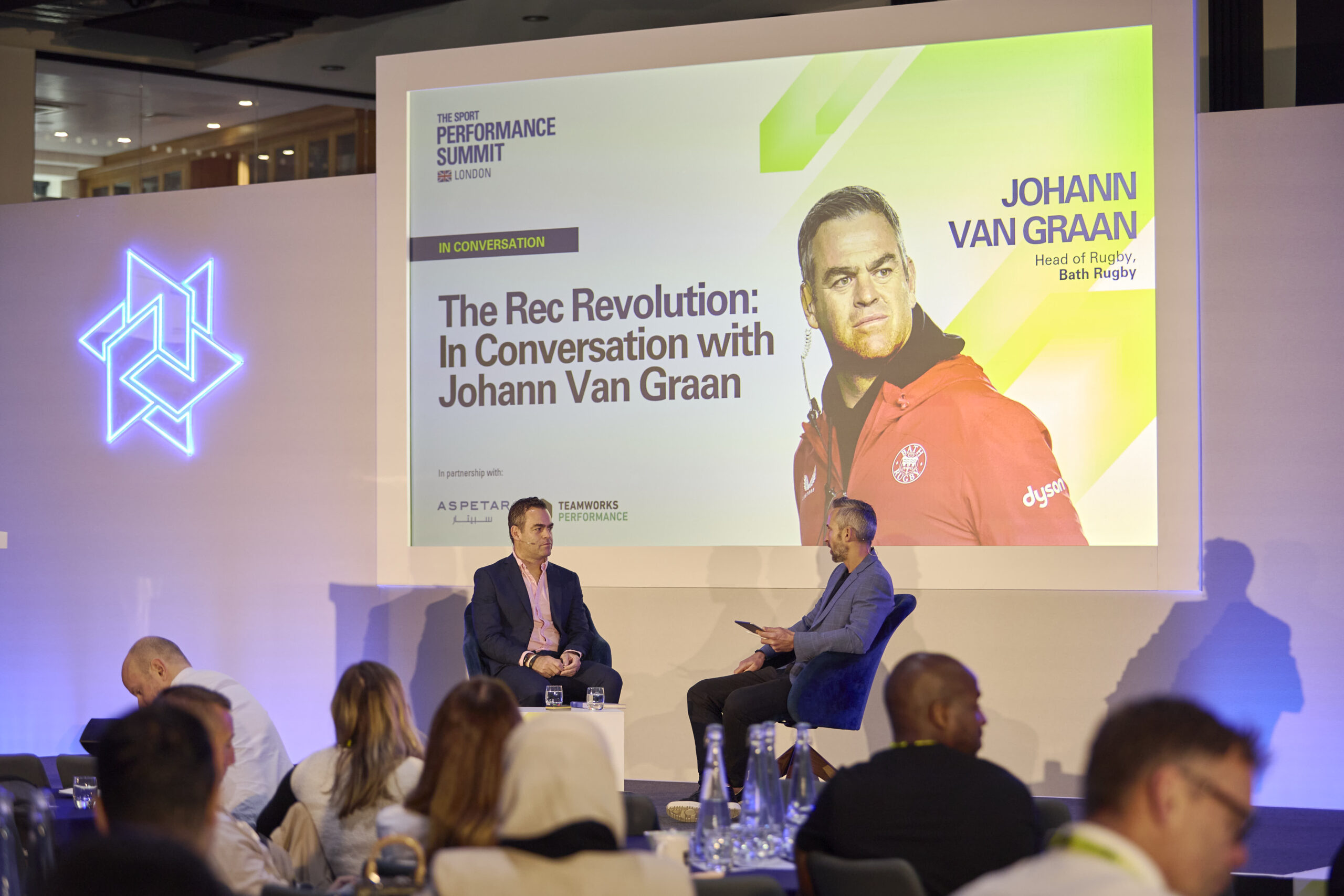
Bath Head Coach Johann van Graan in conversation with host Iain Brunnschweiler.
2. Leaders increasingly seek to empower and collaborate
John Mitchell offered another inspiring story from the world of rugby union.
In 2023, when he signed on as Head Coach of the England women’s national team, it was Mitchell’s first time coaching a women’s team.
The Red Roses had a genuine shot at winning the Women’s Rugby World Cup on home soil in 2025, but a talented team needed an experienced guiding hand.
The team delivered, with Mitchell receiving plaudits for his role as England secured their first world title in 11 years.
Two months on from that achievement, the audience found Mitchell (affectionately known to his peers as ‘Mitch’) in typically reflective mood alongside the recently retired Emily Scarratt, who was part of the Red Roses’ winning squad.
Sport (and rugby union) grows ever more complex and yet, after 30 years, Mitchell feels he has never been better equipped to coach.
“You don’t have the full scope,” he says of his early coaching days in the mid-90s. “You have strengths early on that are recognised but then also you sometimes don’t know the whole of yourself. So you take the time to understand the whole of yourself.”
He came to a critical understanding. “When I was younger, I was going to try and be right. Maybe I was trying to prove myself as a coach.”
John Mitchell

England Red Roses Head Coach John Mitchell shakes hands with former England fullback Emily Scarratt at the conclusion of their panel session.
Emma Keith built on the theme of empowerment in her presentation on officer training in the Royal Air Force.
“Cultures and environments can only grow when everybody takes accountability,” said the Commandant of the RAF’s Tedder Academy of Leadership. Keith, a group captain, is the first female to run RAF officer training.
Emma Keith
Group Captain Emma Keith talks to UK Sport’s Alex Stacey following her presentation on officer training in the Royal Air Force.
3. Teams are prioritising resourcefulness over resources
As Team Principal of MoneyGram Haas F1, Ayao Komatsu knows as well as anyone that his team is competing with better resourced and more illustrious teams.
The team has 375 staff members, which may sound like a lot, but it pales in comparison to the likes of Ferrari, Red Bull and McLaren.
“If we cannot work together, if you’re not supporting each other, if you’re not aligned, we’ve got zero chance against organisations minimum three times our size,” said Komatsu, who had just flown in from the Brazilian Grand Prix in São Paulo where Haas’ Oliver Bearman achieved a creditable top-six finish the weekend before the summit.
Ayao Komatsu
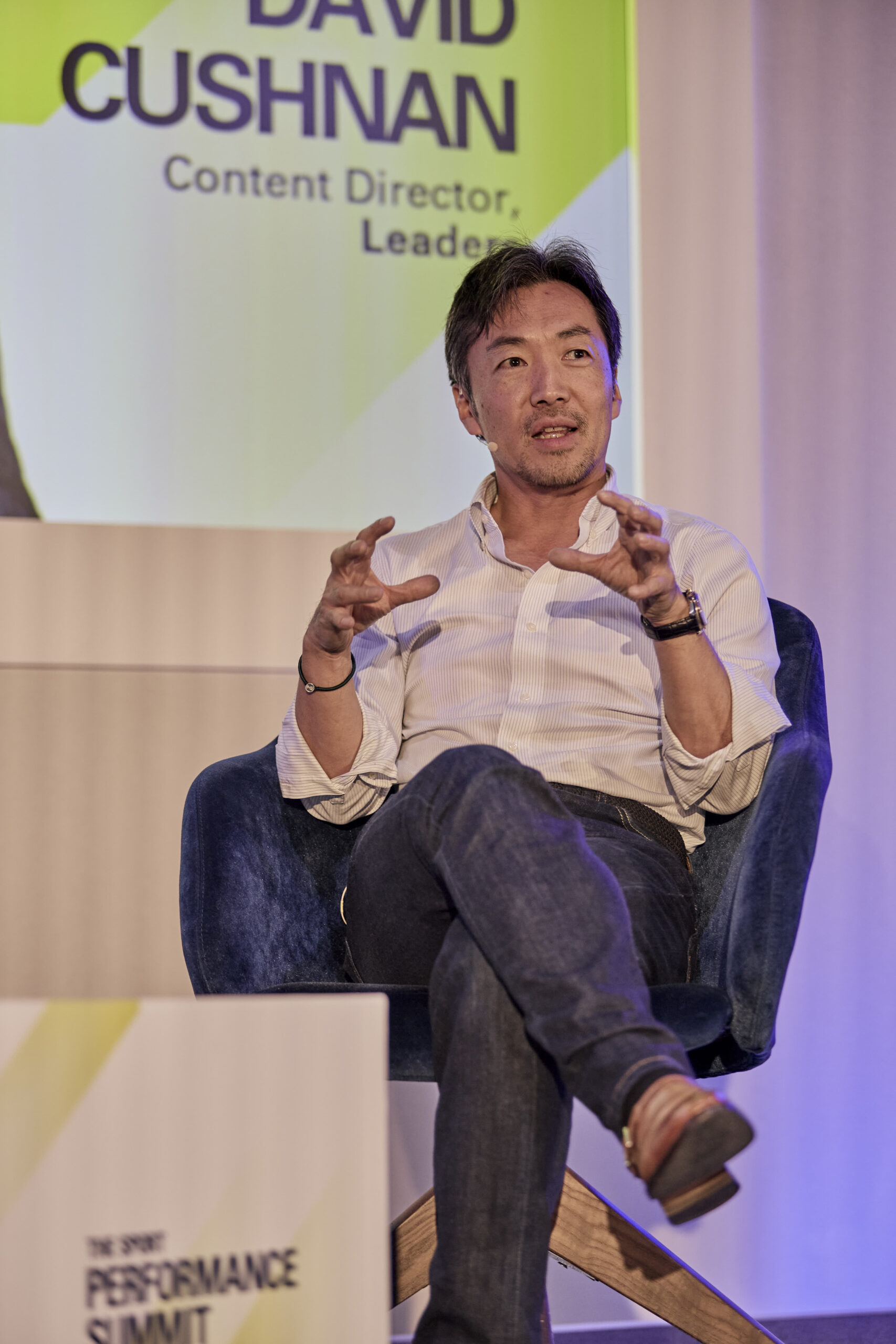
Ayao Komatsu, the Team Principal of Haas F1, shares insights into life in the pitlane.
Similarly, albeit in vastly different circumstances, the Red Cross must make the most of its limited resources when emergencies strike.
Chris Davies, the Director of Crisis Response and Community Resilience at The British Red Cross, cited his team’s core operational process:
Chris Davies

Chris Davies of the British Red Cross in full presentation mode.
4. Psychology will be a game-changer
The mental and behavioural side of performance was an ever-present topic on both days of the summit. Our guests discussed several elements:
The importance of individual expression and acceptance
Johann van Graan
Belonging as a contributor to wellbeing (and performance)
Emily Scarratt
Psychological safety
Ayao Komatsu
5. Teams are engaging in a tech arms race
Professor Tom Crick spoke in his capacity as Chief Scientific Adviser at the UK Government’s Department for Culture, Media and Sport.
He presented on the growth of AI and continually stressed how important it is to keep “the human in the loop” regardless of whatever advances are coming.
To this end he offered Leaders Performance Institute members a series of recommendations.
You must be able to explain why you are using an AI tool…
“You can’t just say ‘the computer says so.’ There has to be some understanding and explainability, and there has to be trust.”
An AI tool should not replace your people…
“AI should not erode or disempower or remove agency for people within your domain. It should augment human capability, not replace it,” said Crick. He added: “It is about co-design, co-decisions and co-evolution as we go forwards – keeping humans embedded in the process.”
Don’t assume your AI tool is right…
“Don’t automatically trust the system. Always ask: is that the right data? Does that feel right? Can we verify and validate it another way?”
Tom Crick, the Chief Scientific Adviser at the UK Government’s Department for Culture, Media and Sport, answers questions from Leaders Performance Institute members.
Next stop for the Leaders Performance Institute
John Bull of Management Futures outlines what it takes to deliver coordinated efforts within a team.
“When you get everyone in a system pushing in the same direction, it can have a multiplier effect. The momentum of each person’s efforts building on each other,” said John Bull, the Director & Lead for High Performance Research at Management Futures.
“It is,” as he adds, “a key area of performance at which we can all get better.”
In his online presentation for members of the Leaders Performance Institute, Bull outlined the common obstacles as well as steps all teams can take to get better at coordinating their efforts.
How alignment affects performance
Alignment – the coordinated efforts of a team – takes several forms. Each has different implications for performance outcomes.
Bull illustrated some of those differences using mathematical symbols (and idea lifted directly from Ineos’s Sir Dave Brailsford).
In an ideal world, each stakeholder’s efforts would multiply the others in this fashion:

“One person’s talent is building on and adding,” says Bull. “The multiplication becomes exponential.”
He used the analogy of a group of people pushing a car up a hill. “It’s also about timing. Are we pushing at exactly the right time, which is really what the multiplication symbol is because you get this amplifier effect.”
Additions are more commonly found, but it’s not true alignment:

“What I would mean by a plus is that two parts of the organisation are still moving in the same direction, still aiming at the same goal, but it’s not joined up. It’s independent activity,” said Bull. “They’re still adding their talent, so it’s still a positive contribution, but you’re not getting that momentum multiplier effect. And we all know what that feels like.”
The risk is that subtractions or divisions rear their ugly head:

“If you’ve got two parts of the organisation with very different interpretations of the strategy, you have it taking away from each other,” said Bull of the subtraction.
As for the division symbol, “that would be where, politically, you’re starting to get factions, briefing to the media, or people actively recruiting allies against another part of the organisation. Or sometimes where you have a board or owner deliberately undermining the coach.”
If teams are to achieve the multiplier effect, Bull highlighted five critical considerations:
1. Who?
Who are you trying to align and what different talents can you bring to bear on a problem? Be sure to involve all relevant parties, including those who may be excluded for fear that they will be distracted.
2. What are you trying to achieve and by when?
Misalignment often arises not from disagreement on the goal itself, but on the timeline and resources needed to achieve it.
3. Alignment on strategy i.e. the ‘how’
The distinction between strategy (high-level direction) and tactics (specific applications) is not always understood.
4. Ways of working
Alignment is an outcome of agreed processes of communication, collaboration and decision-making.
5. Vertical and horizontal dimensions
While vertical alignment (e.g. between board and coach) attracts a lot of focus, horizontal alignment between departments or teams underpins a truly joined-up approach.
Bull then highlighted some common tensions:
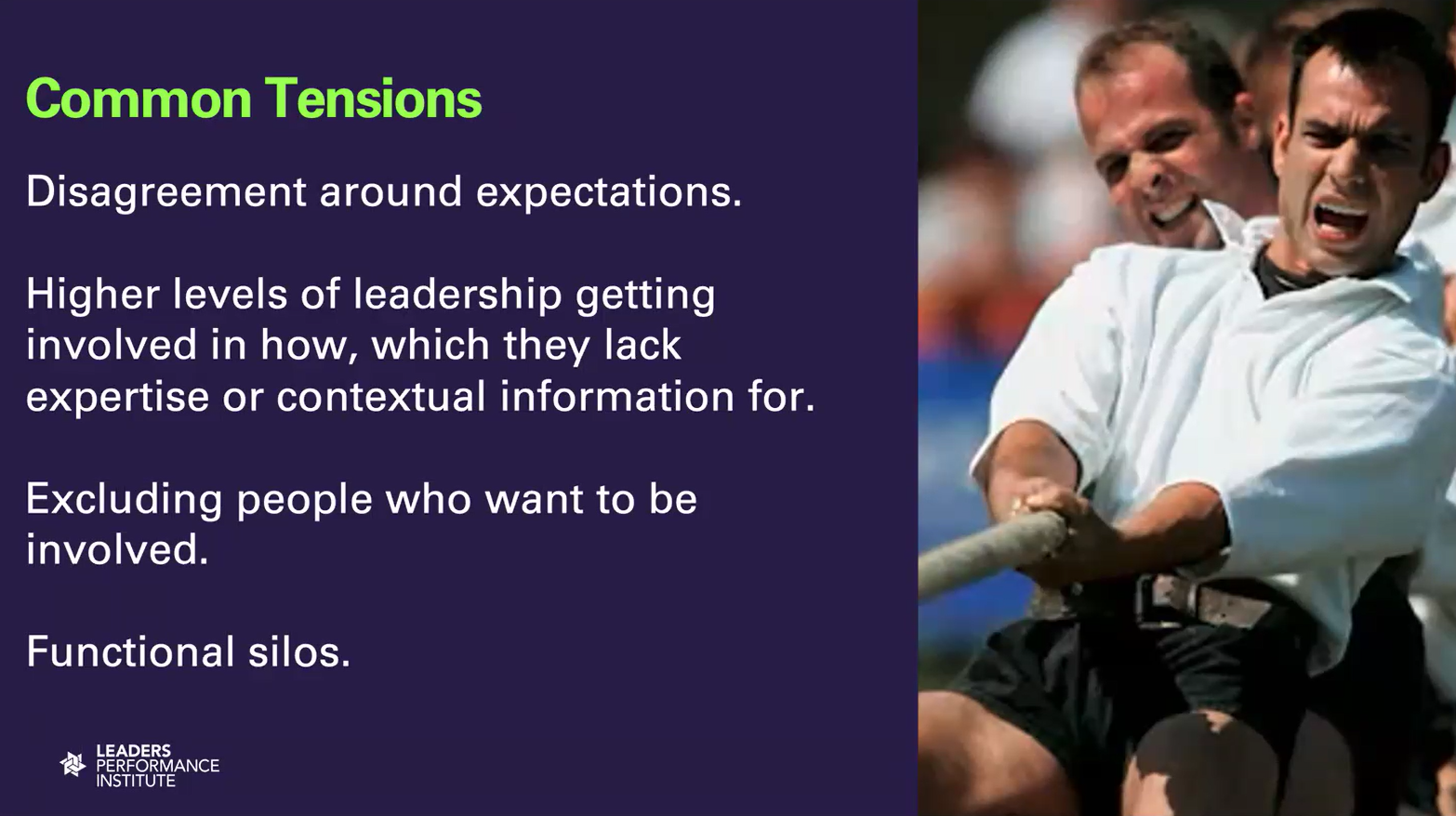
He said: “The reason I want to share these is to highlight where you might go for opportunities for improvement. Where do you see the opportunities for improvement in your environment and what’s your role in that? Where can you make a difference?”
The same goes for tests of alignment:
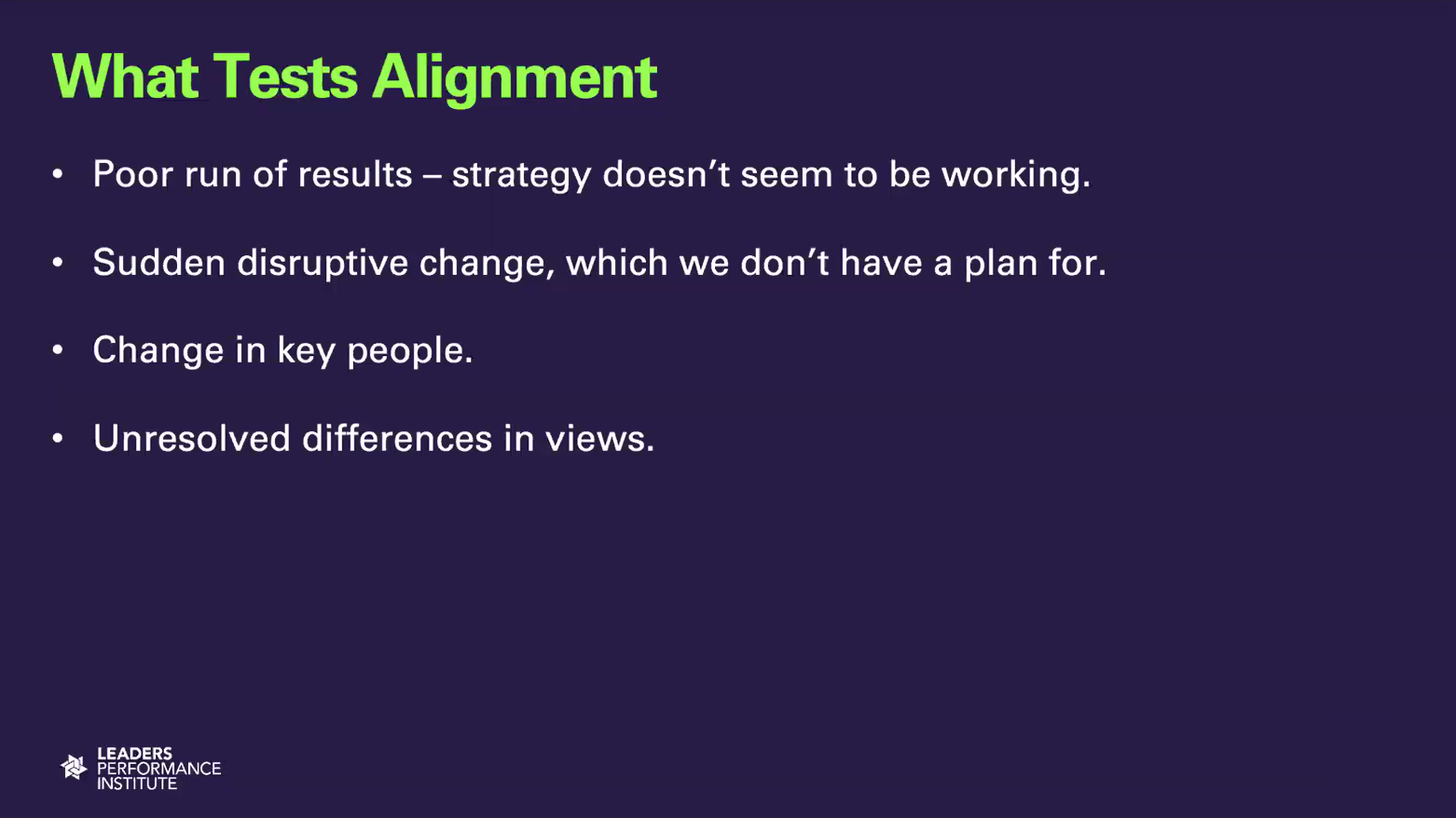
Each type of test presents opportunities to strengthen systems through reflection, planning and proactive leadership if you’re minded to look.
What actually works?
Bull suggested several methods for Leaders Performance Institute members to mull over:
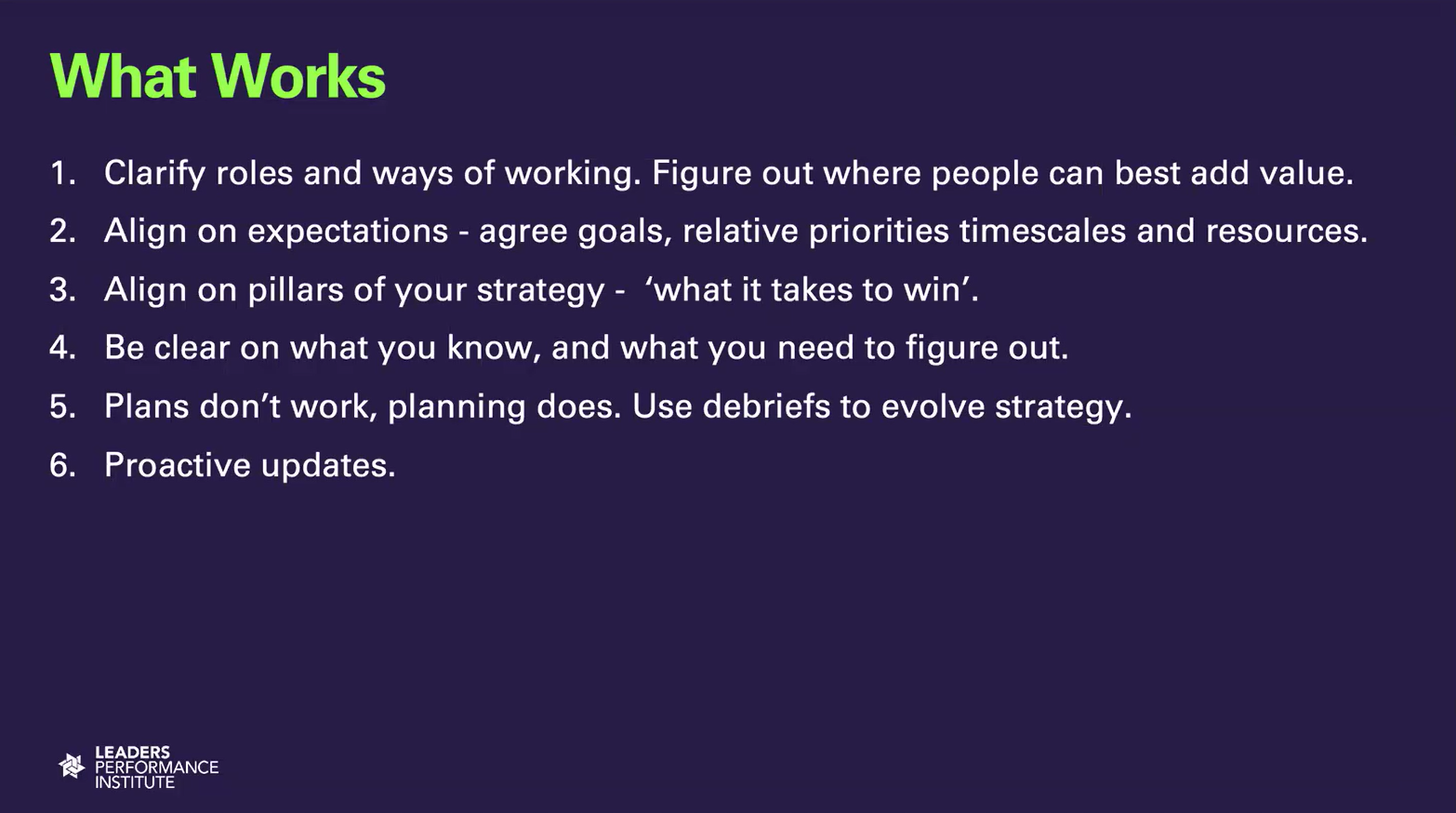
What to read next
Do you Feel your Team Has Plenty of Clarity But Still Suffers from Misalignment?