Leaders in Business
  • Membership
  • Events
  • Content
  • Virtual Learning
  • Connections
  • Partners
Login
  • Leaders Meet: Innovation
  • Events
    • Leaders Week London
    • Leaders Sports Awards
    • Leaders Club Events
    • Leaders Performance Institute Events
    • Leaders Meet: Innovation
  • Memberships
    • The Leaders Club
    • Leaders Performance Institute
  • About
    • Careers
    • Contact
I’m a sports leader:
  • Off The Field For those focused on the business of the sport View more
  • On The Field For those working with an athlete or elite team View more
  • Login
    • Leaders ClubThe membership for future sport business leaders
    • Leaders Performance InstituteThe membership for elite performance practitioners
  • Newsletters
Performance Institute Leaders Performance Institute Logo
  • Membership
  • Events
  • Content
  • Virtual Learning
  • Connections
  • Partners
Login
Members Only

23 Jul 2025

Articles

Why the Words you Choose to Promote your Team Culture Are Interchangeable and Don’t Always Matter

Category
Leadership & Culture, Premium
Share
Facebook Twitter Email Copy Link
https://leadersinsport.com/performance-institute/articles/why-the-words-you-choose-to-promote-your-team-culture-are-interchangeable-and-dont-always-matter/

In one conversation, Dan Jackson of the Adelaide Crows cut to the chase and helped the team’s analysts to recognise – and celebrate – their important contribution to the collective.

By John Portch
Dan Jackson recounts a conversation he had with the analyst team at the Adelaide Crows during the AFL off-season earlier this year.

“There’s a team of six and I asked them what their job was,” the Crows’ General Manager of Player Development and Leadership tells the Leaders Performance Institute.

“Their response was along the lines of ‘we’re there to support the coaches’,” says Jackson, while admitting that this response isn’t wrong. “That is inherently what their job is. They’re looking at the data, they’re putting together PowerPoints. They’re also the ones plugging in all the computers at a game to make sure that the visuals are right. Everything for them is about getting the detail right in the background. If they weren’t there the wheels would fall off.”

Jackson did not find their answer wholly satisfactory. The analyst team’s relative invisibility to everyone else was part of the problem.

Connection to vision and mission

In the analysts’ response, there was no mention of Adelaide’s vision (“to earn the pride of South Australia”) or their mission (“sustained success, winning multiple premierships”).

Jackson reframed his question. He wanted to see if the group could align their work to the bigger picture. “I said: ‘how do you guys see your role? What’s your purpose as an analyst group to help us achieve that vision and mission?’”

A fear for Jackson was that if the analysts see their contribution as little more than background support then others will surely do the same.

First clarity, then alignment

“When you’ve given everyone clarity around what we are trying to achieve, how we’re going to go about it, and how I need you and you and your team to play your role in it – I think that’s what people would say when they feel like there’s alignment,” says Jackson.

The group’s second answer was a step in the right direction:

We help drive performance by supporting, innovating and getting the little details right, so that everyone else can work their job seamlessly.

They hinted at their sense of alignment and already sound more empowered.

“At great organisations, people feel like they have some autonomy to make decisions,” Jackson adds, “but it’s really hard to give that trust over as a leader if you haven’t provided clarity or aligned them to the strategy, the vision and the mission.”

Those three areas have been areas of intense focus for Jackson and his colleagues. The analysts, now emboldened by Jackson’s encouragement, went further:

We play a pivotal role in the team’s performance as we look to earn pride and win.

“Now they’re feeling strongly aligned to how they’re going to help us achieve the vision and the mission. I think that goes a long way to help engagement, retention or even decision making.”

It led to a wider conversation about their roles and contributions.

“One of our values is ‘courage’,” says Jackson, who asked the analysts what that looked like for them. They connected ‘courage’ to their need to balance innovation and risk-taking in their day-to-day work.

For us to get a competitive advantage in how we use the data, present our messaging and tell our stories, we might have to take a risk. For example, we might have to use some new AI platform to enhance our presentations. It may fail once or twice, but if it works really well then we can visualise data better and tell our story better.

Jackson now heard what he had sought. “A small department can be really empowered when they’re aligned to something that they understand of the big picture.”

That said, Jackson guards against any team getting too hung up on words when it’s actions that matter.

He observes that there’s little difference between the values one team puts on their wall and another.

“Around 80 per cent have ‘integrity’ as a value,” he says. “You’re guaranteed to have something like ‘commitment’, ‘hard work’, ‘dedication’ or ‘excellence’.

“Then there tends to be a mindset one. So we have ‘courage’, but it might be ‘ruthlessness’, ‘relentless’ or ‘belief’. Sometimes they have a fourth, which is more unique. It could be like ‘celebrate your authenticity’ but, inherently, every sporting organisation has the same face because there’s no real secret sauce of success.

“With the great teams, it’s not that their words are great: it’s the way they actually go about living, the behaviours that underpin it.”

Jackson has seen it time and again during his career. “I probably spend the least amount of time worrying about whatever words they’ve got,” he says. “Often, I don’t even bother changing them because if you want ‘connection’ or ‘unity’ or ‘team first’ or ‘family’, it doesn’t really matter. What I want to know is the behaviours you’re going to commit to, your system of accountability, and how you drive those behaviours.”

Dan Jackson also features in…

Performance Special Report – High Performance Unpacked


1 Jul 2025

Articles

The Debrief – a Snapshot of Powerful Discussions Happening Right Now Across the Leaders Performance Institute

Category
Human Performance, Leadership & Culture
Share
Facebook Twitter Email Copy Link
https://leadersinsport.com/performance-institute/articles/the-debrief-a-snapshot-of-powerful-discussions-happening-right-now-across-the-leaders-performance-institute-16/

In June, performance under pressure, empowered leadership and female athlete health were some of the topics discussed by members of the institute.

By John Portch
The 2025 French Open men’s champion Carlos Alcaraz is one of a select few to have won a Grand Slam final from match point down.

“I think the real champions are made in situations when you deal with that pressure,” said Alcaraz at Rolland-Garros in Paris last month. “That’s why I saw my best tennis in crucial moments, and that’s why I saw my best tennis in those difficult situations.”

Performance under pressure was a theme that run through the month of June here at the Leaders Performance Institute, starting with the wise words of Red Bull’s big wave surfer Ian Walsh.

His approach is geared around managing his fear. “Those nerves and everything you fear are natural, and you can use that to elevate your performance,” he said in this article. “It commands every ounce of your being and your focus to deal with what’s coming at you and how you want to navigate it to try and finish on your feet.”

Elsewhere, we returned to the question of alignment, named the common causes of inadaptability, and asked the Brisbane Lions to talk about their approaches to female athlete health.

What if there’s clarity in your communication as a team, but still you suffer from misalignment?

Edd Vahid, the Premier League’s Head of Academy Football Operations, answered this in a recent interview with the Leaders Performance Institute.

He explained there could be a few factors at play, all of which point to the importance of feedback:

Staff development needs. If a staff member commits an error of execution, it is an opportunity to deliver developmental feedback. Vahid says: “Does everyone understand what we’re going after? If they do and they step outside of that, then feedback is warranted.”

Psychological safety. “It’s a buzz term,” says Vahid of the commonly used phrase, “but it’s crucial for people to feel they are in a feedback culture.” The leader must show that the intent of feedback is to help the individual to progress. “You’re taking time to give them feedback because you care,” he adds. “You’re then seeking to work with the individual to create that development.”

The leader’s behaviour. Leaders must also demonstrate their willingness to listen to feedback. “They need to provide ‘speak up’ signals,” says Vahid with reference to the work of psychologist Megan Reitz. “The leader needs the skill to understand the position they’re in and the power they carry in that dynamic.”

The four inhibitors that prevent adaptability in a complex world

Those four inhibitors are discussed in great detail here, but one that will discuss below is when leaders themselves become the bottleneck due to their authoritative approach.

“Authoritative leadership has been proven time and time again to be effective in very short bursts,” said Tim Cox of Management Futures at a recent Leaders Virtual Roundtable, “but it isn’t much good for adaptability.” The reasons are simple enough. “It’s really difficult for one person to be able to think through, be creative, respond to the environment around them when things are changing at a high pace.”

Leaders, Cox said, should:
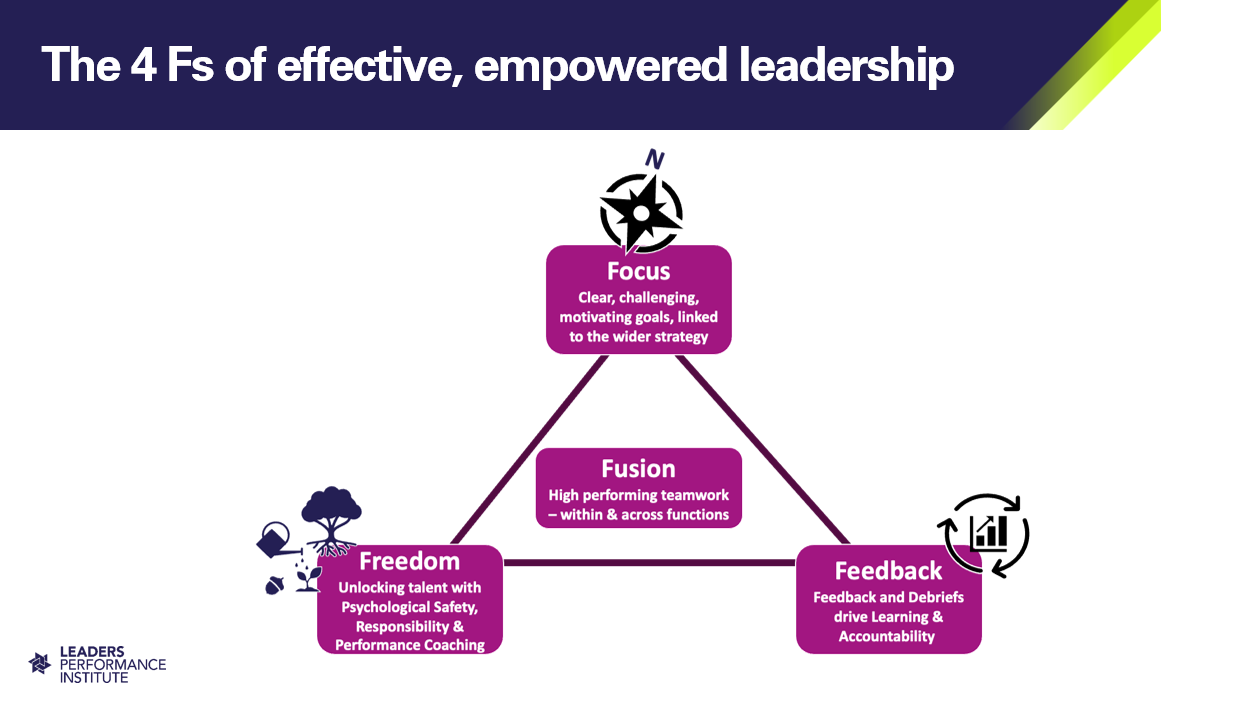
  • Set the ambition or intent but remember: “the empowered leadership style is always more effective.” It fosters motivation, creativity, and collaborative problem-solving.
  • Consider the four Fs of effective, empowered leadership. “Any good model needs a four something or a three something,” said Cox, “and here are the constituent parts, which you will recognise.”

Focus: The leader must deliver clear, strategic alignment where everyone understands the direction and purpose of their work.

Feedback: Regular feedback and debriefing are essential for learning and continuous improvement, especially in dynamic settings.

Freedom: Give people autonomy and allow them to explore, innovate, and respond to change.

Fusion: This is about building strong relationships and collaboration, both within and beyond your organisation with a view to harnessing collective intelligence

Leadership is stagnating

This idea of leadership stagnating was revealed in stark terms in our Trend Report earlier this year.

The Trend Report revealed that 57 per cent of practitioners believe that leadership within their organisation has stayed the same or got worse in recent years.

The primary factors appear to be the shift towards task orientation and the pressure to ‘win now’, which can act to stifle innovation and long-term thinking. Leaders, as a selection of Leaders Performance Institute members agreed during a June roundtable, have less bandwidth, less time for staff development and even less time for staff onboarding.

Ben Baroody of Abilene Christian University, who co-led the session with Edd Vahid, observed that even at organisations that prioritise leadership development, stagnation is still reported.  For Baroody, this is compounded by what he sees as the link between alignment and (high) quality leadership.

Vahid questioned whether leaders are giving themselves enough capacity to lead effectively and, as such, he is an advocate of distributed leadership models and leaders who invest in their own development as well as that of their people.

The virtual floor also highlighted the importance of skills including influencing, an ability to hold honest conversations, and active listening.

The Brisbane Lions have turned female athlete health into a performance question

The renewed focus on female athlete health is a direct result of the work of Matt Green, the Lions’ High Performance Manager for AFLW and his team.

As an organisation, the Lions focus on five key, interrelated areas:

  1. Pelvic health. “This is of primary importance,” said Green. “We want to give women and girls information around what’s normal, what’s not, and what we can actually do about it.” Services include a women’s health specialist physio. These help bring conditions such as stress urinary incontinence to the fore “when a lot of female athletes may be dealing with these issues in silence”.
  2. Breast health. Annual breast-screening and bra fittings (plus the provision of a bra) are now standard. “There’s some damning statistics that more than 50 per cent of female athletes wear an ill-fitting bra,” said Green, who alluded to the increased risk of breast injury when an athlete is not wearing suitable equipment.
  3. Gynaecology. The Lions now have a gynaecologist embedded in their program and the club is “starting to get players thinking about family planning”. This helps normalise the conversation and provides a safe and supportive environment for all athletes thinking about family planning.

Members Only

29 May 2025

Articles

As Sport Grows More Complex, Adaptable Leaders and Teams Will Change the Game

Category
Leadership & Culture, Premium
Share
Facebook Twitter Email Copy Link
https://leadersinsport.com/performance-institute/articles/as-sport-grows-more-complex-adaptable-leaders-and-teams-will-change-the-game/

In the first of a three-part virtual Learning Series, we explore why adaptability is becoming a crucial modern leadership skill.

By Luke Whitworth
“An unwillingness to adapt and evolve is one of the things that stifles great cultures – it stifles great coaches too,” said Dan Jackson.

The General Manager of Player Development & Leadership at the Adelaide Crows was speaking in The Winning Formula for the Future of Performance Sport, our recent Trend Report.

The sentiment struck a chord with Jackson’s fellow contributor, Tim Cox of Management Futures.

“We work in sport and other sectors, and there is that feeling of stifling,” Cox told a recent leaders virtual roundtable. “The pace of change, the demands on us are increasing, and it can feel almost suffocating for leaders sometimes. What do we do here? How can we respond effectively?”

Cox, who co-hosted this Learning Series with the Leaders Performance Institute, hinted at the growing complexity of sport and the ever-increasing importance of being able to lead through complexity, which is the overarching theme of a three-part virtual roundtable series that seeks to help leaders develop the necessary skills.

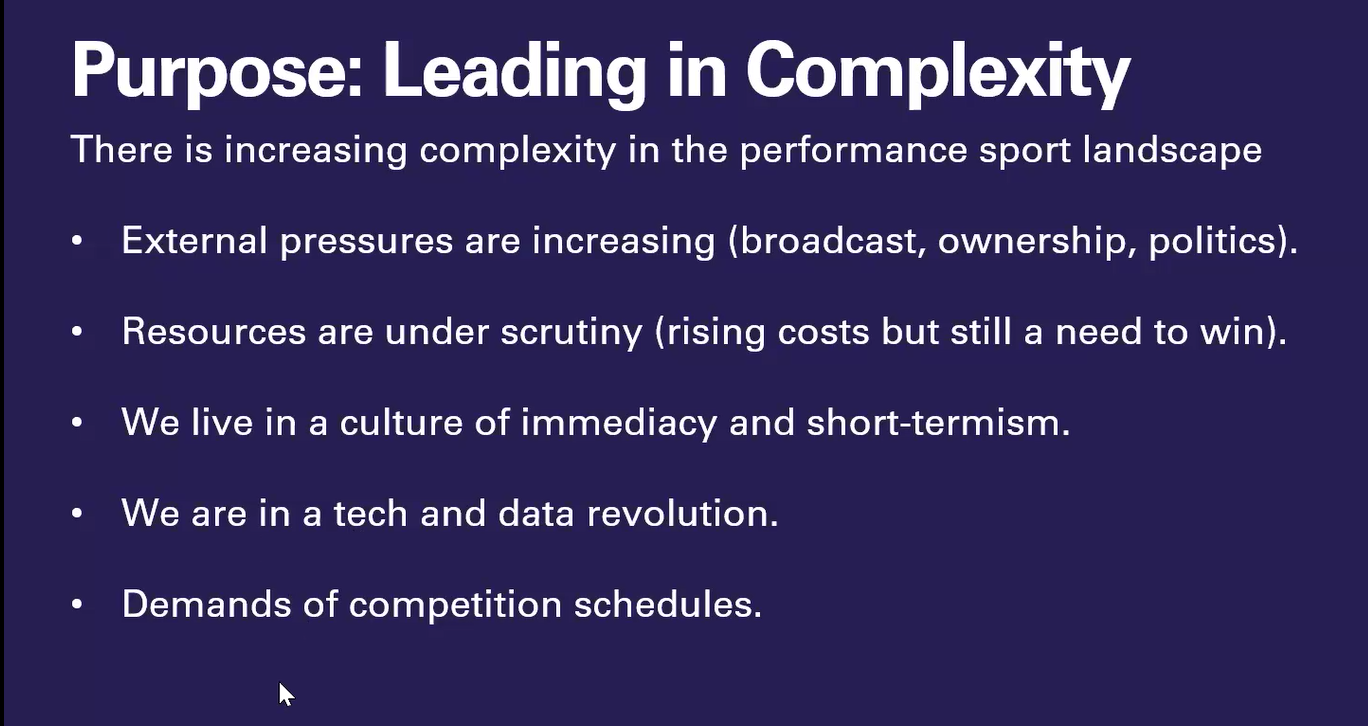
To follow up, we shared five areas where complexity continues to grow in sport. Most if not all will be familiar to athletes, coaches and practitioners alike:
 

Adaptability: a vital skill

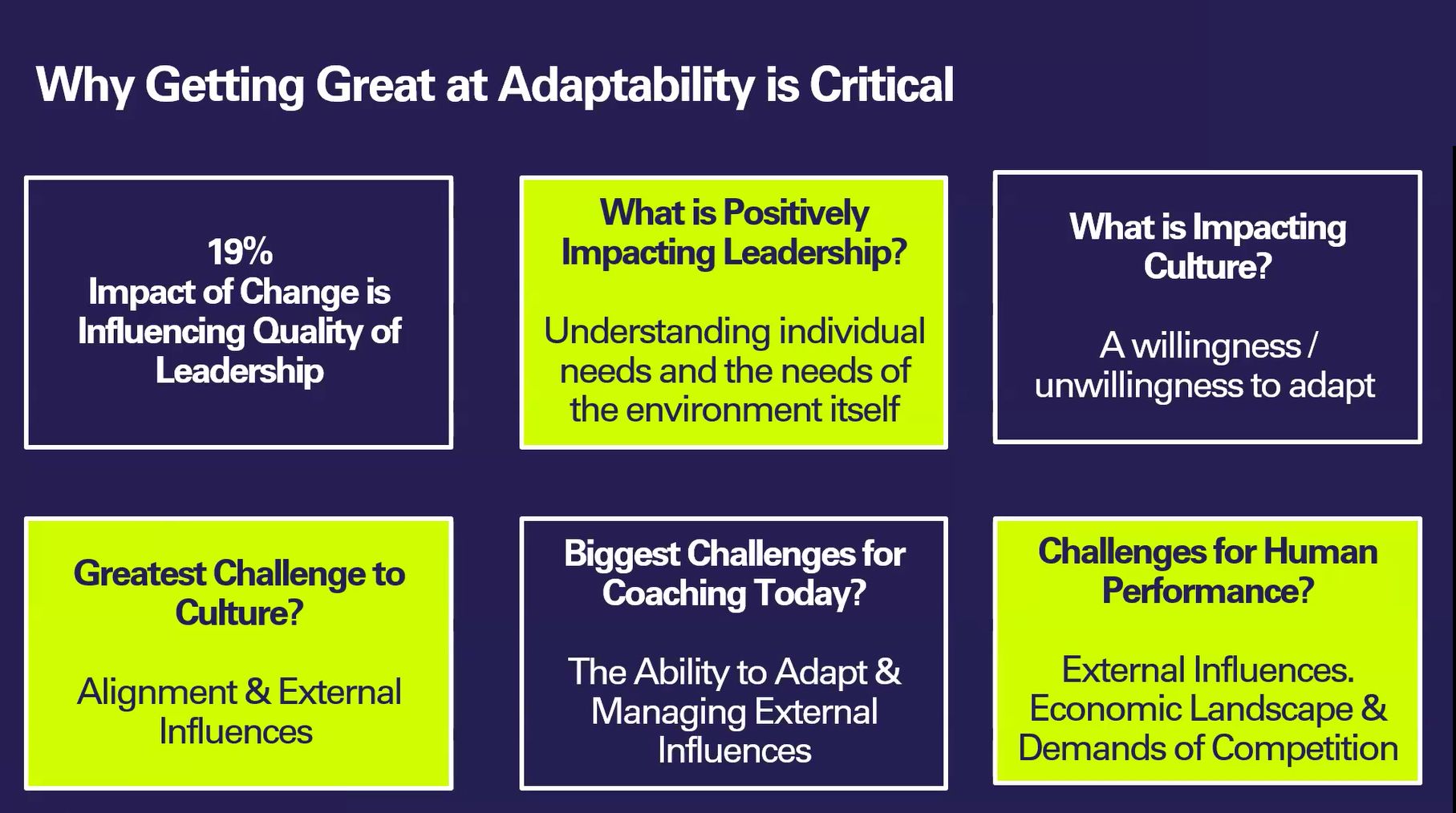
Session one explored the concept of adaptability and how leaders can increase the chance of an effective response from their teams. This came up in the Trend Report. The following also stood out from the report’s findings:
 

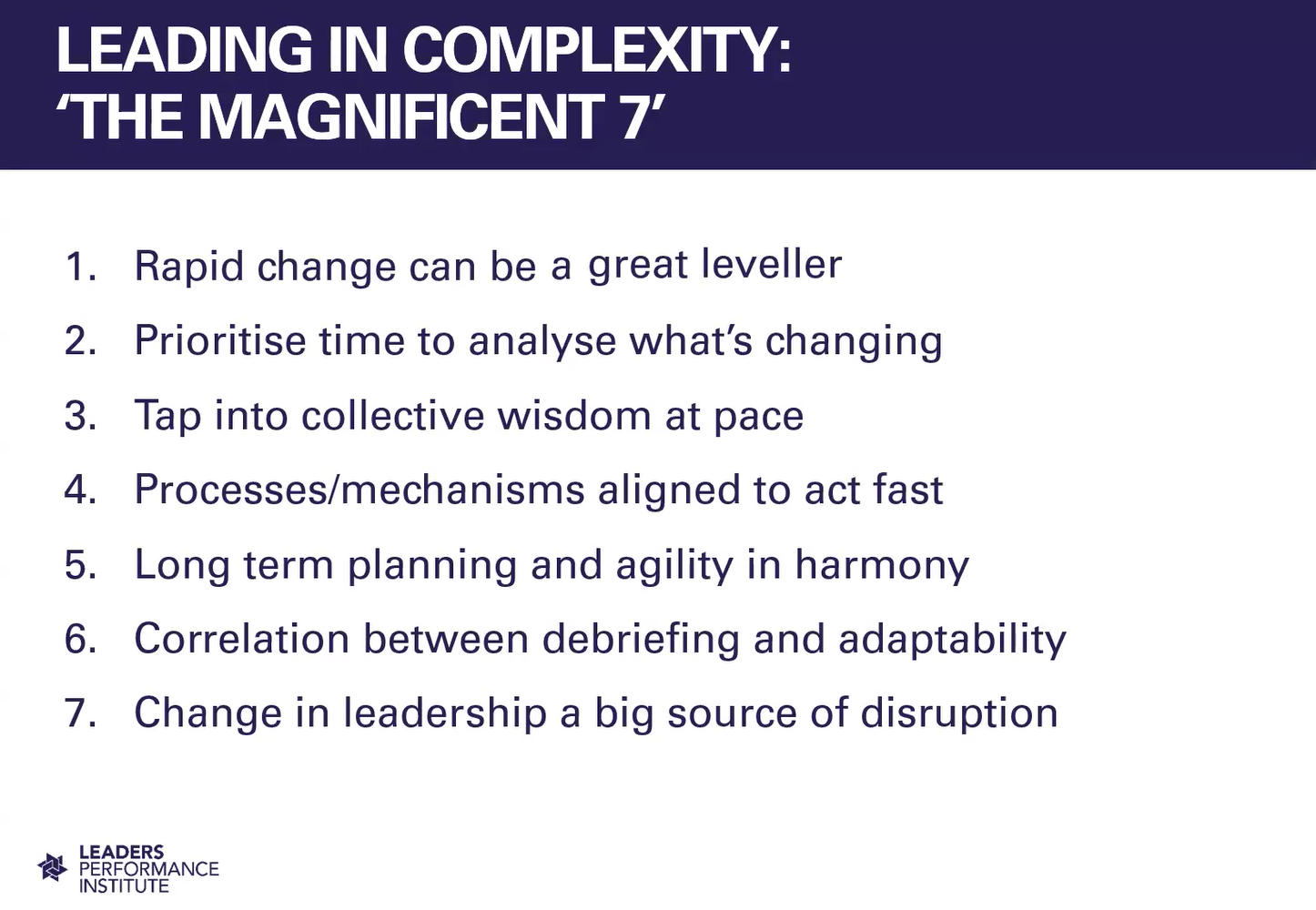
The Magnificent Seven: tips for leading in complexity

Cox distilled his thoughts on the topic into seven ‘magnificent’ areas. “Whether they’re magnificent or not, you’ll be able to make a call on it,” he said.

  1. Rapid change can be a great leveller

In a world where change is constant, smaller or less-resourced teams can gain a competitive edge by being more agile.

  • Mindset is important. Cox said: “We can respond to the disruptions that are there in our world, whether they be internal or external… there’s something to be said for going on the offensive wherever we can, when we’re able to actually disrupt things, certainly in a competition environment. Others are going to have to deal with the disruption that we’re bringing.”
  • Resourcefulness beats resource. Cox shared the example of a fintech CEO with whom Management Futures work. “We’re working with the senior team and he was saying. ‘Do you know they’re doing my head in. They want the pace of change to slow down, they keep saying “we just need to pause, we just need to focus, we just need to do this”. And actually, they’re missing the point: our survival as a smaller player with fewer resources than others actually depends on disruption. It depends on us being really fast and being the drivers of disruption’.”
  1. Prioritise time to analyse what is changing

“This is a simple one: it’s really prioritising time to actually analyse what is changing.”

  • Internal and external scanning. “We have our senses, we’re hardwired to pick up on change and be aware of what’s going on within the environment, whether close to us or outside,” said Cox, with regards to such elements as team morale or performance trends, “but what are the mechanisms for systematically analysing how the wider environment is changing?” These could be shifts in policy, competition rules or tech advancements.
  • What are your existing mechanisms? These matter. “There will be ways in which you’re doing that already. There may be player leadership groups who understand what’s changed within the squad. You may even have player liaison roles.”
  • ‘Upstream’ thinking. Dan Heath’s book Upstream offers a provocation to people working in sport: it challenges us to stop reacting to problems and instead start preventing them. In sport, people pride themselves on being problem-solvers, but how often do we step back to ask why the problem exists in the first place?
  1. Tap into collective wisdom at pace

As one participant said, “adaptive cultures are the ones where everybody has a voice. They can voice feedback, they can push back on ideas, and ultimately, that helps you get to the right idea.”
  • Psychological safety. As Megan Reitz and John Higgins once argued in the Harvard Business Review, managers are more intimidating than they think. Cox cited then built on their point. “I’ve been in lots of environments where just a look from a senior player, just a look from a coach, or a manager, or someone in a senior position has stopped somebody from sharing an opinion that they might have had,” he said. “I’ve also been in environments where I’ve been able to call that out, to stop the conversation and ask ‘what’s just happened?’ and understand from the individual who was just about to share their opinion ‘what was it?’ Very often it is not what the person, the leader, or the senior coach, or the senior player thought it was going to be. It’s much more valuable and it often takes the conversation in a different direction.”
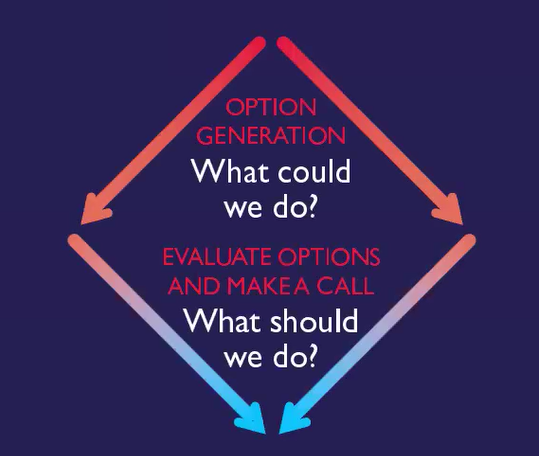
  • The ‘diamond’ tool. Cox proposed the following series of questions as a way of ensuring teams hear from each and every member. It opens up the discourse and then closes it when a decision needs to be made:


  1. Processes and mechanisms aligned to learn fast 

While tapping into collective wisdom is essential, it must be balanced with the ability to make decisions and act quickly. Yet while on-field decisions can be taken in minutes, “off the pitch,” as Cox said, “we can often be inordinately slow in adapting and responding to change.”
  • What processes and systems help your team to align? Cox argued that we might marvel at the organisation and agility of a school of fish, but struggle to replicate such manoeuvres in our own workplaces. “The processes and mechanisms that we’ve got in place can help us to respond much more naturally and much more quickly over time. Whatever you’re using, how can we come together, make decisions, and adapt really quickly?”
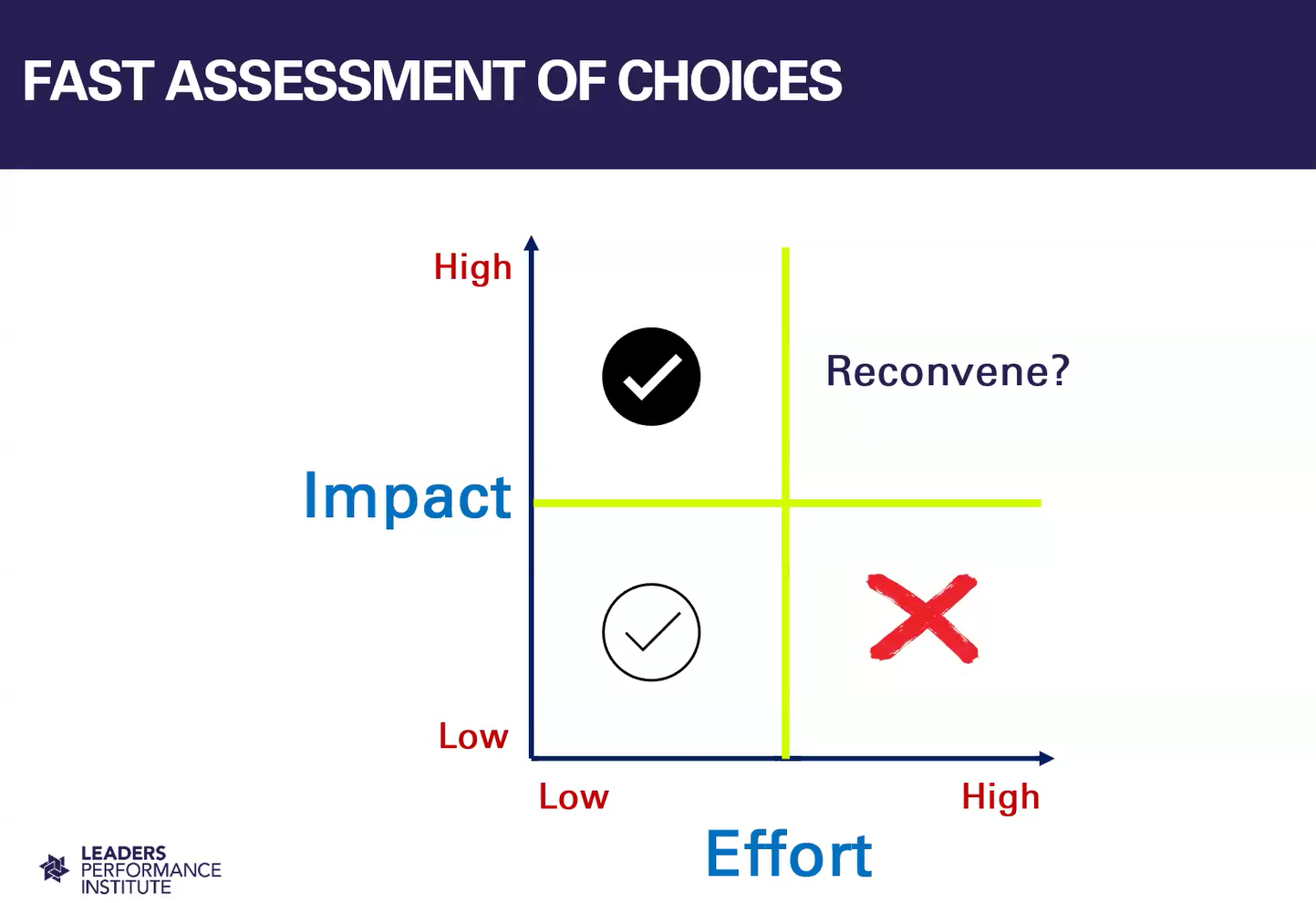
  • Teams often fear that hearing from everyone will slow down decision making. However, this simple matrix, which assesses effort and impact, can help you to arrive at swifter decisions:

The ideal choices are those that are high impact and low effort. These are the quick wins. Conversely, high effort and low impact choices should be avoided as they are distractions and drains on resource.

  1. Long-term planning and agility in harmony

Agility requires action, even in the face of uncertainty. Not knowing everything shouldn’t prevent progress.

You can, however, take a structured approach by recruiting wisely, implementing training programmes and pivoting smartly. Teams, Cox suggested, can ask themselves “what are our skill gaps for now or where are we strong now? What are the skills we’re going to need to make this pivot?”

  1. Correlation between debriefing and adaptability

“To adapt, we’ve got to learn,” said Cox with specific reference to the special forces, “and the better we are at debriefing, then the better we are at learning and then adapting.”

He explained that debriefing should be a deliberate, embedded practice. It’s not just about reviewing what happened – or when responding to a crisis – but extracting lessons to fuel future action.

  1. Leadership change is a big source of disruption

“To what extent can we get these transitions right?” asked Cox. “Because obviously they have big organisational and team impacts, not just on the individuals close to them, they can filter down to the whole organisation.”

Who are your cultural guardians? Cultural guardians, as discussed by Dr Edd Vahid, are the individuals or mechanisms that ensure core values and practices are preserved during leadership changes. They are, as Cox explained, indispensable. “Any new leader is going to want to change things,” he said, “but what are the pieces that we need to absolutely hold on to? What is handed over to the leaders that we know to be true about this culture in this organisation?”

To sum up…
Looking ahead

This session was the first in a three-part series. Future discussions will explore:

Part 2: Inhibitors to adaptability – what gets in the way?

Part 3: Building a collective playbook for leading in complexity

21 May 2025

Articles

Your Ability to Hold a Room of Athletes or Support Staff Can Make or Break you as a Coach

Category
Leadership & Culture
Share
Facebook Twitter Email Copy Link
https://leadersinsport.com/performance-institute/articles/your-ability-to-hold-a-room-of-athletes-or-support-staff-can-make-or-break-you-as-a-coach/

In this exclusive column, performance specialist Iain Brunnschweiler outlines how he fights the inevitable nerves with tools he has picked up during a career spent in elite sport.

By Iain Brunnschweiler
A 15-year-old boy stepped onto the stage. His palms were sweaty. His heart rate elevated. He was about to speak in front of his entire school of around a thousand children for the first time.

The anxiety felt almost totally consuming. His legs felt heavy, and he doubted that any words would come out of his mouth when and if he did attempt to start speaking. His brain was scrambled with a hundred thoughts, which seemed impossible to coordinate into anything helpful.

The year was 1995, and that boy was me.

I honestly cannot remember what I spoke about, but I sure remember how it made me feel.

Everyone was looking at me. I felt so insecure and so nervous it was almost unbearable. It felt very different from the sports field, where I felt at home. On the field of play I felt like I had permission to be myself. But I did not feel it there on that stage.

Fast forward 30 years, and I stepped onto the stage at the Royal College of Music in front of more than 120 sports leaders from around the world at Leaders Meet: The Talent Journey. I was privileged to be afforded the opportunity to facilitate the event for the Leaders Performance Institute.

The nerves were there again, however, over the past 30 years, I have developed a range of resources to allow me to adopt a more preferable state to be able to speak in front of people.

Confidence and humility: a tricky balance

Humans are remarkable things, aren’t they. We’re all individual, all experiencing the world in a unique way, all dealing with themselves on a daily basis and simultaneously seeking to demonstrate something to the outside world. We all have varying levels of self-awareness and varying levels of skill in dealing with the questions being asked of us in our own contexts.

Consider some of the situations a sports leader might find themselves in: starting in a new leadership role, rallying your team during difficult times or times of change, seeking to inspire others through your words or actions. Now for those of us who have seen skilful leaders or coaches in practice, some of these skills can seem effortless. However, behind that skilful act is undoubtedly someone who has wrestled with their own feelings of doubt or insecurity and drawn upon their own experiences in order to choose and deliver an appropriate response to their audience.

Being able to speak up with a balance of confidence and humility can be tricky. And it is a skill that may be the difference in the career trajectory or simply contentment of any aspirational individual.

Actors, agents and authors

I remember being shown some research by a fabulous person, colleague and psychologist, Malcolm Frame, called ‘The Psychological Self as Actor, Agent, and Author’. The paper is written by American psychologist Dan McAdams, whose work talks to the developmental journey of any human. My interpretation of McAdams’ work is that the ‘Actor’ is the social self, the ‘Agent’ is the motivated self, and the ‘Author’ is the narrative self.

As Malcolm told me: “Embracing this cycle each day isn’t just self-improvement – it’s building an unshakable architecture of strength, capacity and resilience within our very operating system.”

As a more novice practitioner I was certainly an Actor. Concerned almost solely with how I was perceived and wanting to be liked by everyone.

For example, when I first accepted the role of a national coach within the England Cricket pathway, I was unsure how to be. I struggled to understand what was required of me. Having to stand up and speak in front of some of the most talented young players in the country, as well as the brilliant support staff that I was working with, felt like a huge stretch.

I felt high anxiety when I was ‘on show’ and witnessing the show going on around me. As I developed and became more experienced, I realised that my motivations and aspirations could not be reached if I was not able to override my anxieties and take action towards my desired outcomes. As an Agent, I was able to step onto ‘the stage’ and make choices that were my own.

After more than 25 years of striving in the elite sporting context, I finally feel that I am able to become more of an Author in my own context. I can control the narrative more effectively to serve me in the way I find helpful. It helps for me to have reflected on my past experiences. Successes and failures, taking learnings from them that can help me in the present, as well as support me in the future.

Nerves are not necessarily a bad thing

Having reached a senior role at a Premier League football club, I was interacting with directors and owners and being asked to make major decisions that would affect numerous people. Whilst never easy, I was more comfortable in doing so, having been on such a journey. The moments of bravery earlier in my career which felt incredibly tough, were now serving me in the moment.

The stories that I now tell myself about my past, help me to feel more well-resourced in the moment. I have accumulated a broad range of experiences which I can draw upon now, and allow me to both enjoy it and embrace however I am feeling. Tactics such as self-talk, the use of perspective, and an acceptance that I prefer to be playful rather than serious, all serve me and allow me to accept my emotions. I have certainly not solved this! However I am very clear on the progress that I have made.

So, as I stepped onto that stage in 1995, my nerves were similar to my nerves in 2025. However, I was now more well-resourced to acknowledge and accept them and even use them to my advantage. Being nervous now lets me now that I care about what I am doing. That it is important to me. And that’s OK.

I don’t think any advice would have helped that boy in 1995. It was stepping up onto that stage that he needed.

Iain Brunnschweiler runs the Focus Performance Consultancy. He is a former professional cricketer, has authored two published books, and previously served as the Head of Technical Development at Southampton Football Club.

What to read next

The Four Phases of Talent Development Decoded


Members Only

12 May 2025

Articles

‘The Best Influencers Listen Carefully, Ask the Right Questions, and Communicate a Compelling Vision’

Category
Leadership & Culture, Premium
Share
Facebook Twitter Email Copy Link
https://leadersinsport.com/performance-institute/articles/the-best-influencers-listen-carefully-ask-the-right-questions-and-communicate-a-compelling-vision/

In a recent Leadership Skills Series Session, Jeff Pagliano of Management Futures set out a series of tools, including the trust equation, active listening and ‘flows of knowledge’.

By John Portch
If you’re a coach you’re also an influencer. But what do we mean by ‘influencing’?

“Influencing is often strictly correlated with the level of knowledge or technical insight we can offer in any given situation and our ability to communicate that knowledge effectively,” said Jeff Pagliano, a consultant with leadership specialists Management Futures.

“However, influencing we believe is much broader than this.”

Pagliano was hosting an ‘influencing skills’ session for Leaders Performance Institute members as part of our Leadership Skills Series.

“A lot of you are employed to lead or influence outcomes, not for your technical knowledge but for your ability to build trust, grasp complex ideas, think rationally, and motivate,” he continued.

“The best influencers are often those who listen carefully to the needs of those around them, ask the right questions, and then communicate a compelling vision. And this has as much to do with credibility as knowledge does and, interestingly, the further you go up in an organisation, the less useful your IQ, your technical knowledge, is and the more useful your EQ, your emotional intelligence.”

Over the course of an hour, Pagliano explained why your ability to build trust, actively listen, and communicate compellingly – areas in which we can all improve – underpins your ability to influence.

‘The trust equation’

To start, Pagliano presented the trust equation to the group:
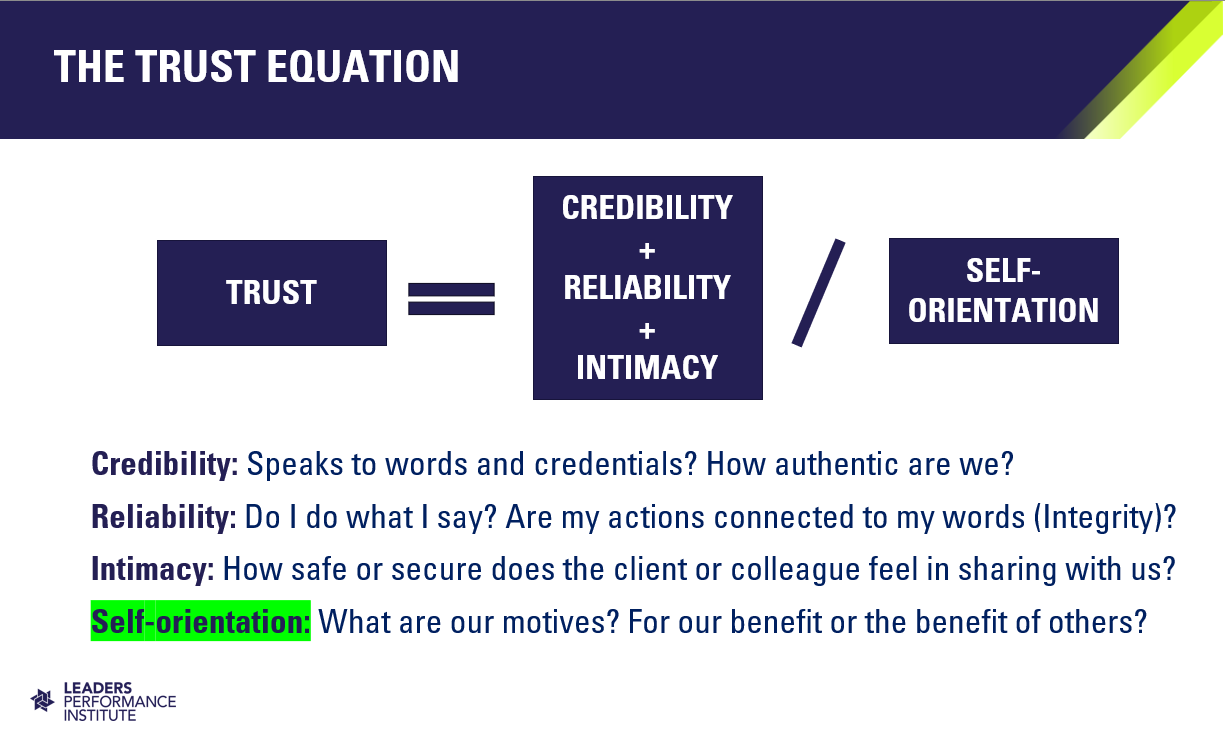

He then explained his thoughts on each:

Trust =

Credibility: “This speaks to both words and credentials. People should be confident that you know what you’re talking about, but it may not be just about the content, it could be how you show up as well. Credibility is a blend of what you know and how you present yourself.”

+

Reliability: “You do what you say you’re going to do. Your actions are connected to your words and your follow through. One thing that’s interesting to note is that people will sometimes over-promise and under-deliver; and it’s a very natural instinct to do that because we naturally want to please or we want to show the best of ourselves but, actually, over the long term, this can really work against you.”

+

Intimacy: “If credibility and reliability are the sort of things that are quite concrete, intimacy is a little more ambiguous. It’s more to do with the sense you have that someone will be there for you, and you try to gauge how emotionally intelligent they are. You’re noticing how well they listen, how much they connect, how much warmth they have, how much understanding. It’s less concrete, but equally important.”

/

Self-orientation: “Anytime you are building trust you do have to have some self-orientation because in any kind of negotiation or where you’re looking to influence, it would feel suspicious if someone thought you were entirely magnanimous about everything and you had no vested interest in anything. It’s about getting the right amount and not letting it overwhelm the other three. That’s why you have the first three divided by self-orientation.”

When you’re focused on being more genuine and interested in the other human being good things are going to flow for that, opportunities flow from that, but if the opportunity is so prevalent in the conversation that you’re trying to jump on it constantly, the other person’s going to feel it.

Active listening

Pagliano then introduced the topic of ‘listening well’, which supports influencing in two specific ways.

“It helps the intimacy part of the trust equation and it gives you the context for a person’s point of view,” he said. “You’re more prepared when the time comes for you to share your knowledge and suggest a course of action.

“Active listening is when you’re not only tuned into what someone says but also what they feel and believe picking up on both their verbal and non-verbal communication is the foundation of intimacy and the antithesis of self-interest.”

He shared the following image to illustrate his point:
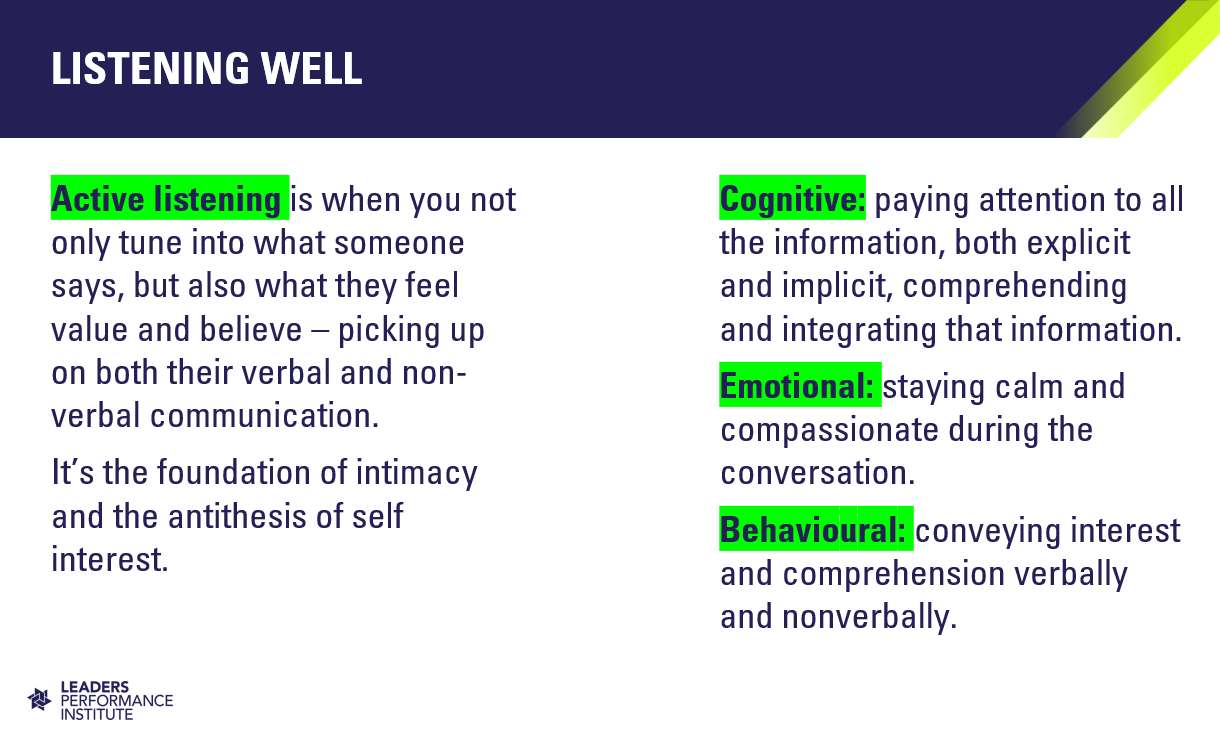
When you’re talking to someone you are hoping to influence it’s always useful to reflect on the goals of each conversation, both what you want and what the other person needs as a way to determine the best way to listen at the moment. And you may realise that a different mode or combinations of modes would be better.

Flows of knowledge

“If the trust equation is where it should be and you have been listening well, you have laid the groundwork to engage with the person you are trying to influence in conversation,” said Pagliano in taking the conversation further. “We have a great framework for you to use: it is called “flows of logic.” Pagliano cited former BBC presenter Stephanie Hughes in his explanation:
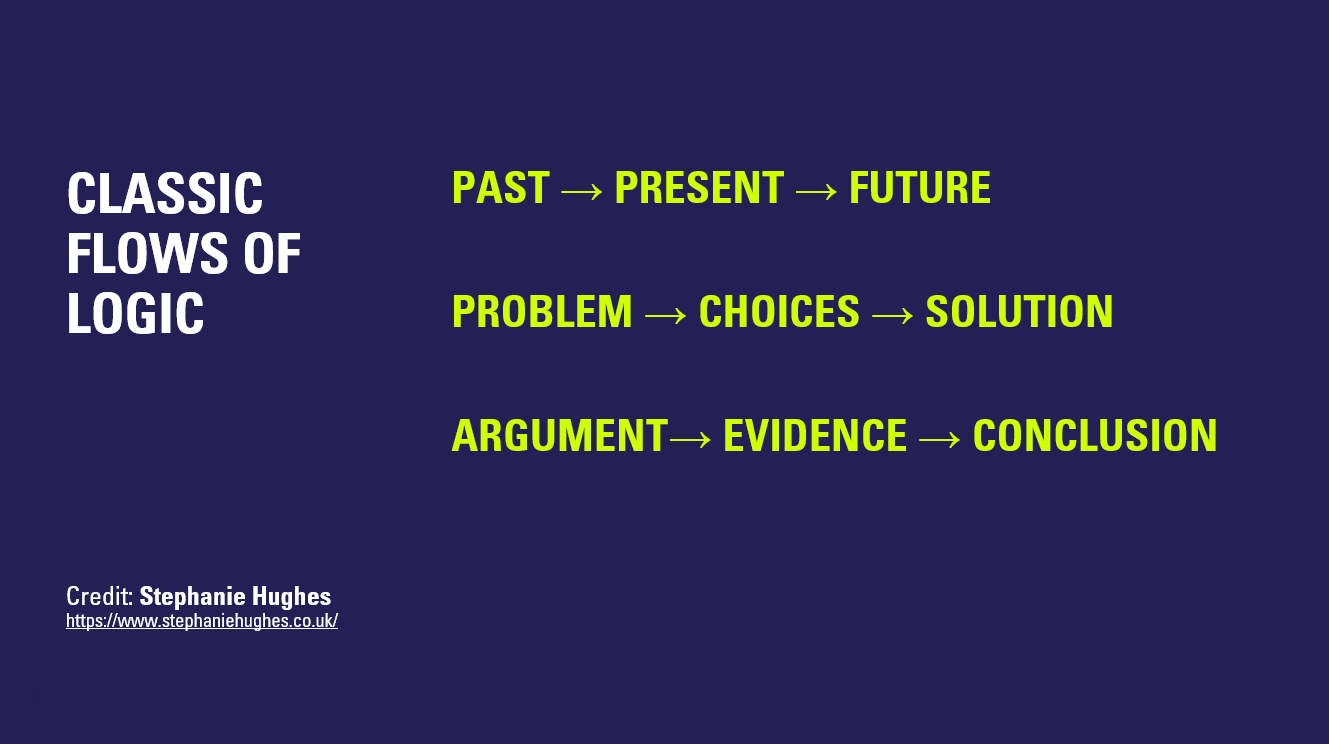
Pagliano explained their value, particularly in non-rehearsed, spontaneous conversations:

Past → Present → Future

“When you go through these phases of logic, it’s the middle word that is important. Like in the first one, if we just say, ‘in the past we did this’ and ‘then in the future, we’re going to do that’ and you don’t give any context for the present, it’s less powerful.”

Problem →  Choices →  Solution

“[To say] ‘here’s a problem or solution’ – that’s not an influencing tool – that’s just a command. To present choices shows your credibility.”

Argument →  Evidence →  Conclusion

“The third could happen when you’re pushing back at someone who’s come at you with a different opinion, and here this is where the middle word is important, because if you just say, ‘I believe this and here’s a conclusion’, it’s just an opinion. But if you add evidence, it becomes more than an opinion. It becomes a fact, and it becomes far more concrete. It’s much more objective because it’s based on evidence.”

You want to sound like you know what you’re talking about and you’re not floundering and, if there’s a logic to what you’re saying, the information is more easily understood and retained, so these serve a multitude of purposes.

The final factor: push and pull skills

Pagliano presented a final slide:
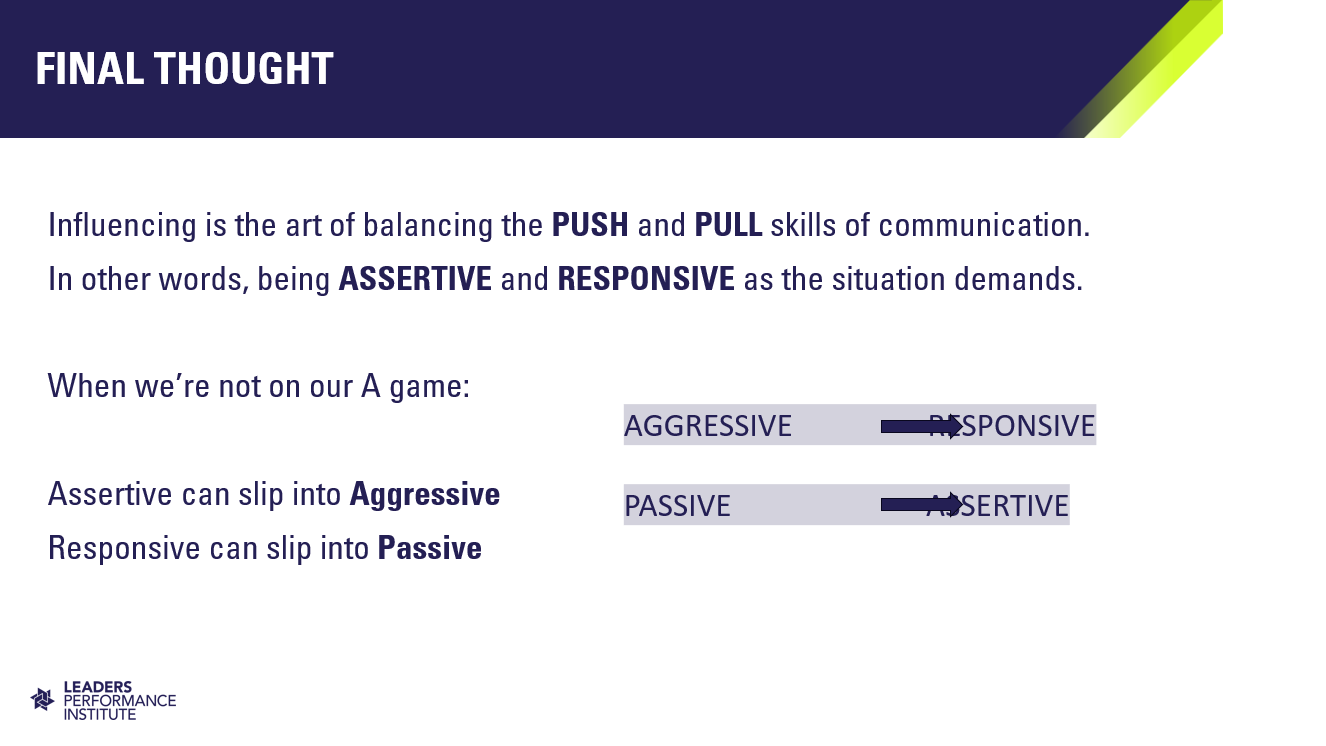
“Effective influencing is our ability to balance those push and pull skills,” he said.

“The ‘push’ would be that flow of logic. When you’re a subject matter expert and you’re trying to communicate your point of view in a way that moves the other to take a recommended course of action, those pull skills [build] that trust equation, the active listening, and it’s good to reflect where we need to focus more.

“Often, ‘push’ comes more naturally for people, and when we’re not on our A game, those of us who have a propensity to be more responsive can slip into passive; and those of us who are more assertive can slip into aggressive.”

Aggressive: go to responsive. Passive: go to assertive. And make sure you’re constantly aware of those push-pull dynamics.

What to read next

The Winning Formula for the Future of Performance Sport

8 May 2025

Articles

Female Leaders in Sport: Unheard Voices and Untold Stories

Category
Coaching & Development, Leadership & Culture
Share
Facebook Twitter Email Copy Link
https://leadersinsport.com/performance-institute/articles/female-leaders-in-sport-unheard-voices-and-untold-stories/

Former netball player Vicki Wilson describes her journey from the court to coaching, high performance and sports administration and offers advice to aspiring female athletes.

By Rachel Woodland
The Women in High Performance Sport Community group aims to provide space to women in the sporting world to tell their stories and to shine a spotlight on some excellent people and their work.

In April, Vicki Wilson, Director at the Brisbane Broncos, joined our group call. Women coaches and practitioners from across the globe gathered to listen to Wilson tell the story of her journey from athlete, to coach, to high performance manager, and now a member of the board of directors at the Broncos. Hers is a story we wanted to share more of and to learn from.

What has propelled Wilson’s career?

From Wilson’s perspective, she believes she has an eye for detail and an ability to plan, whilst wanting the best for athletes. She enjoys imparting knowledge, as well as gathering knowledge to extend her perspectives. She has also always been determined to be better. Having been an international athlete herself, Wilson can also lean on those experiences to guide her work. She’s also adaptable and, since her days playing netball, has always asked questions and seeks to understand ‘why’.

A key lesson was when she was dropped at an early stage in her playing career. It came just as she thought she would be made captain. The lesson she took was to never take anything for granted. This has resonated with Wilson every time she has applied for a role since. It also means she will quickly move on to the next challenge.

What drives success?

To help people succeed Wilson shared some tips:

  1. Your high performance manager and administration team will make you or break you. So pick wisely – always look at who is running the show.
  2. Surround yourself with support – informal mentors, peers etc. and treat them well.
  3. Always have people smarter than you on your team – then let them use their expertise, whilst asking them ‘why?’ too.
  4. Don’t over-commit. Give yourself time to switch off.
  5. Ask questions of people around you e.g. what would they do? How would they find that?
  6. Add perspectives to the pool that you draw on. Change your own if needed.
  7. Share your own learnings with others.
  8. Recognise good work. Celebrate success.

Support your high performance managers

Contrary to instinct, Wilson believes sitting with high performance managers and helping them with their planning is critical. Many will have come from a coaching background and might not know the role fully. It shouldn’t be assumed that they know what’s expected and what needs to be done. Expectations need to be shared clearly before a season starts. It’s about shaping this support around learning, and being their ally and not wanting them to fail, rather than trying to catch them out and needing them to show they know everything already. It really is about eliminating all assumptions.

Wilson’s inspiration

Wilson wanted to mention the women head coaches who were part of the original Australian Institute of Sport. There weren’t many, and they experienced difficult moments. However, they paved the way for others by challenging and contributing when in shared spaces between sports. They were avid readers and learners, many working in academia. They also showed that women coaches can be as successful as men. Wilson has been inspired in particular by Wilma Shakespeare, who was an international athlete, captain, coach, administrator, Queensland Academy of Sport CEO, and eventually travelled to the UK to be the founder and first National Director of the English Institute of Sport [now UK Sports Institute] in 2002. It is Shakespeare that inspired Wilson to explore administrative roles.

Thinking of joining a board of directors?

Wilson spoke about her advice for those who are interested in joining a board. She recommends sitting with someone who has done the role. This will help you fully understand what’s expected, and what’s your purpose in that role. From her experience, it’s about challenging management; making sure they’re doing what they said they would and asking them if it could be done better. It’s also about managing staff and athletes, and getting to know everyone in an organisation at a personal level.

Wilson fielded questions from the group too. They asked about:

Her challenges along the way

Wilson was open enough to share where some of the biggest challenges have laid – fortunately our previous community call attests to changes in ways of working. It has happened that athletes who are closing in on retirement have wanted the decision to be made for them. As you can imagine, that hasn’t made it easier for them to accept said decision. Wilson has also learnt the importance of an administrative team who are supportive and aligned to your values, having lost a role, alongside others, when strong decisions were needed. She is also grateful for the work done by many to have changed the way athlete pregnancy is treated.

Planning for the logistical realities

It’s not always spoke about, but coaches and other staff will make decisions, and have decisions made for them that can leave them unsure of their future and exposed financially. Wilson shared that she has found that when it mattered, things gained positive momentum quickly for her. Small contracts came in, moves to different countries weren’t as terrible as feared. She learnt to be open and once she’d accepted something be all in. Wilson has learnt to not panic, and importantly, to back her own skillset. It helps that she has a positive mindset, and that she’s always been a naturally good connector.

The group reflected on…

1. What their organisations are doing to support them. Answers included:

  • Encouraging them to attend conferences
  • Connecting across sports and organisations
  • Finding the right level challenge – frame it as a positive, even when difficult
  • AIS Women in Leadership Programme Talent Programme (for women executives)
  • WhatsApp groups that support programmes like the one above well beyond their official run dates

2. What they would like to see in a dream world:

  • The head coach, high performance manager, and CEO are connected and aligned to others, and know the value of each other’s skillsets (as well as those of the other staff members)
  • Time protected for CPD
  • Specific roles in projects, to support specific development goals
  • Space to get things wrong and test learnings – for failure to be okay
  • More space given to knowing yourself, as early as possible in your career

3. How they’re supporting others:

  • Through mentoring
  • Supporting and connecting with staff, athletes, and administrators
  • Encouraging people to understand themselves, to know how to work with others
  • Giving people the same time that was given to them, to support them in their careers
  • Celebrating the successes

4. Resources recommended for learning outside of sport:

  • Acting courses
  • Spotlight – profiling from Mindflick
  • Skill development delivered through a different lens:
    • Negotiation skills – from a lawyer
    • Difficult conversations – from the emergency services
    • Leadership skills – from a generic or business perspective

What to read next

The Winning Formula for the Future of Performance Sport

6 May 2025

Articles

The Debrief – a Snapshot of Powerful Discussions Happening Right Now Across the Leaders Performance Institute

Category
Coaching & Development, Human Performance, Leadership & Culture
Share
Facebook Twitter Email Copy Link
https://leadersinsport.com/performance-institute/articles/the-debrief-a-snapshot-of-powerful-discussions-happening-right-now-across-the-leaders-performance-institute-14/

This month we alight upon talent development, courageous conversations, and career pathways for women athletes.

By John Portch
There is only one place to start this month.

The Leaders Performance Institute trend report is available to download.

The Winning Formula for the Future of Performance Sport sets out the trends that are shaping the sports performance landscape.

Over the course of several months, we asked performance leaders and practitioners far and wide to complete an unprecedented survey of the high-performance landscape. More than 200 individuals from nearly 40 sports shared their views on a range of topics from leadership and culture to coaching and human performance.

Providing you with expert analysis into the current and future state of high performance, this report sheds a light on the high-performance conversations that are happening today, that will shape the sport world of tomorrow – helping you to stay ahead of the performance curve.

Download it here.

Right, let’s dig into April happenings here at the Leaders Performance Institute.

The four phases of talent development decoded

The Royal College of Music provided a fitting venue for Leaders Meet: The Talent Journey.

More than 120 members of the Leaders Performance Institute gathered to hear insights from Bundesliga champions Bayern Munich, the Premier League’s Brentford, the Royal Academy of Dance, and F1 talent developers More than Equal.

The focus were the four phases of talent development:

  1. Talent identification and profiling
  2. Preparation and holistic development
  3. Transitions and moments
  4. Continuous improvement

Stephen Torpey, the Academy Director at Brentford, spoke to the second. He explained that Brentford have been innovative in their efforts to compete with better-funded, more renowned academies.

Theirs is a ‘less is more’ approach. Torpey explained that the academy has:

  • Reduced the number of age groups from ten to six. Brentford have merged their under-9s and under-10s; the under-11s, 12s, 13, and 14s compete as one, as do the under-15s and under-16s.
  • Reframed the club’s approach to bio banding. “We don’t say ‘play up’ or ‘down’ because there’s either a negative or positive connotation to that. We talk about playing across,” said Torpey.
  • Reduced the number of players by 40 per cent. Crucially, they haven’t reduced the number of coaches. “Our aim is to work on a one-to-five ratio. We believe that by working in the same way as an independent school with low player-to-staff ratios with high-level people, then we’re going to accelerate the development.”
  • Argued that ‘less is more’ should lead to stretch not stress. “We’re looking at the right experiences, the right challenge, and we don’t want stretch to become stress.”

Read more here.

We can all have ‘courageous conversations’

Courageous conversations came up in the trend report so it was only fair that we dedicated a Leadership Skills Series session to the topic.

There are five key skills to enable your preparation, delivery and summary of a courageous conversation.

  1. Check your assumptions: we make up a lot of stuff about people. We imagine what’s going on in people’s lives, what they think about us, what their motives are. We imagine what they’re going to say in that conversation and how they’re going to react. And then we work our responses around that where we can tie ourselves up in knots, and we’re having a conversation in our heads rather than what’s truly happening. So strip out your assumptions.
  2. Have a clear outcome: declutter the nonsense. What is the outcome that you want to have and what is a good outcome for this conversation? This will help you get an actionable insight.
  3. Manage your body language and tone: so many of us are so busy that we just leak out impatient, stressed and busy signals. Nonverbally, we’re sending out some different signs, so it is important to be present, be composed and give high quality attention. What we don’t want to be doing is to be half in a conversation and half out as people pick up on it. Giving someone your full attention is a gift, and they will feel it, and they will trust you.
  4. Maintain a two-way dialogue: difficult conversations should be two-way. What are your thoughts? This is how I feel. How do you feel? This is what I would like to happen in the future. What are you going to do? What help do you want? Make sure you’re really using your active, listening and really great, powerful, open questions as well.
  5. Agree specific next steps: what are you going to do differently? How are you going to make sure it happens? What support do you need and make sure that it’s specific? Get right down into detail with the actionable insights.

Read more here.

Successful career transitions for women in sport

The first Women in High Performance Sport group call of the year spotlighted three former athletes who have gone on to further build a career in sport.

They were former GB hockey players in Giselle Ansley, a Senior Account Executive with Specialist Sports, and Emily Defroand, the Football Communications Lead at West Ham United.

Joining them in conversation was Women’s Rugby World Cup winner Emma Mitchell, who recently left her position as a Performance Lifestyle Advisor at the UK Sports Institute and who worked directly with the duo during their playing careers.

Over the course of an hour they illustrated the importance of:

  • Support systems: Mitchell, who in her role as a performance lifestyle advisor essentially became a role model to these younger women, was able to support the pair at every turn.
  • Personalised approach: Mitchell worked to understand their individual journeys and provided tailored support. She emphasised the importance of planning early and managing transitions effectively.
  • Transferable skills: athletes will possess valuable skills learned through sport, such as discipline, teamwork, and leadership. All are transferable in careers beyond.
  • Cultural impact: having a performance lifestyle advisor deliver emotional and psychological support helped Defroand and Ansley to better manage their stress and uncertainly, which in turn positively impacted their performance on the field. Moreover, by ensuring athletes were well-prepared for their post-sports careers, Mitchell contributed to the long-term success and stability of the team, as athletes were more likely to remain engaged and motivated during their sporting careers.

Read more here.

And don’t forget to read…

The Winning Formula for the Future of Performance Sport

22 Apr 2025

Articles

From Coach to Facilitator: How to Run Engaging Team Meetings with an Athlete’s Voice

Category
Leadership & Culture
Share
Facebook Twitter Email Copy Link
https://leadersinsport.com/performance-institute/articles/from-coach-to-facilitator-how-to-run-engaging-team-meetings-with-an-athletes-voice/

Performance Coach Ronan Conway believes that coaches can bring a fresh dimension to team gatherings and help teams tap into their inherent power by adding some facilitation principles and techniques to their skillset.

By Ronan Conway

Facilitated meetings: direction to dialogue

In recent years I worked with a coach of a football team. He’d regularly vent to me about players not speaking up in meetings, and how the group lacked leaders and energy. So I decided to sit at the back of some player meetings to observe the dynamic.

A clear pattern emerged. Standing at the top of the room, the coach would send waves of golden information and inspiration toward the players in the shape of tactics, opponent analysis, and game plans. His style was to direct, to instruct, and to hand players the answers – because that’s how he was coached, that’s what he excelled at; plus time was of the essence. The players’ role was simple: to listen and absorb.

My feedback was as follows:

  • His messaging and delivery was very strong. However, energy flow felt too one-directional. Some players appeared to be disempowered and disengaged.
  • Players needed more space to process, understand, and integrate the info.
  • There was hundreds of years of combined experience in the room, bubbling away right beneath the surface. The players seemed hungry to share it, but until now, the invitation hadn’t been strong enough.

“The coach needed to maintain his directive style as a solid foundation, and layer in skills to stimulate group discussion”

My suggestion was to maintain his directive style as a solid foundation, and layer in skills to stimulate group discussion – not to replace his approach, but to complement it.

In the following weeks after delivering his game plan, he practised popping the ball into the players’ court; inviting their thoughts and insight. Within weeks he facilitated a post-game review, opponent analysis, and culture session with the squad. To different degrees, the players played a key part in both sessions. These small shifts had profound results:

  1. Players stood taller – they felt trusted, valued and respected.
  2. With more skin in the game, they took greater ownership of it.
  3. Learning deepened. ‘Tell me and I forget, teach me and I may remember, involve me and I learn.’
  4. Meetings took on a more focused, empowered energy.
  5. Quiet voices grew louder and leaders emerged.

To get to this point, it required a big shift in attitude towards his group and his role. It called for him to swap his teacher cap for his facilitator cap.

“The change called for the coach to swap his teacher cap for his facilitator cap.”

Photo: Ezra Shaw/Getty Images

Facilitator mindset: the answers are in the room

Before facilitating any meeting, it helps to adopt a group-centred lens. To have a strong belief in the group’s inherent wisdom. When you look at your squad in front of you, you see an ocean of insight, inspiration and breakthroughs. You see teachers rather than students. You see answers in the room.

The transition from a teacher to a facilitator mindset can be tricky. Most coaches are experts in their field, and at times it can suit to simply tell players what they need to know. But as a facilitator it’s not about telling, rather it’s about being curious. It’s about fostering the right conditions for the group to unearth their own answers.

“The transition from teaching to facilitating is about fostering the right conditions for the group to unearth their own answers.”

For some this may require a loosening of the reins, but it doesn’t mean letting go of them. Your direction and leadership is still central, but you’re inviting your squad to step up with you from time to time. It’s important to say that certain players and squads certainly won’t have all the answers. In this case, at least they get to practise critical thinking and to put their own fingerprints on a discussion.

Steve Kerr, the Head Coach of the Golden State Warriors NBA-winning team, is a proponent of player-driven meetings. For Kerr, it’s not about “control”, rather “guiding” or “nudging players in the right direction”. That ‘nudging and guiding’ is the essence of facilitation.

Facilitator toolbox: get the water flowing

Stimulating any form of response from a group is about moving energy. Moving energy can look like a smile, a nod, a raised hand. Maybe a word. Or a sentence. In time perhaps a rich, flowing discussion. We call this process, ‘getting the water flowing’.

Here are some facilitation tips to get your meetings flowing:

Show of hands: When faced with 30 blank faces, and the energy feels stuck, you can get the water trickling with a show of hands. ‘Hands up if you know’; ‘if you agree’; ‘who relates’; ‘if you’ve experienced this’. Each hand raised or not is a micro-investment in the meeting.

Open-ended questions: Clear open-ended questions are the keys for unlocking the treasure. They typically begin with ‘how’, ‘why’, or ‘what’, and generally elicit deeper insights than closed questions which give yes/no answers. The quality of the question will determine the quality of the response.

Intentional language: ‘The answers are in the room’: use language that reflects this mindset. You are not wondering if they have an answer, you know they do. Instead of ‘does anyone have an answer?’, try ‘who wants to go first/next?’.

Non-verbal communication: Facilitation isn’t just verbal. A nod or some steady eye contact can subtlety signal, ‘I want to hear from you’. You can lightly scan the room, naturally clocking different individuals throughout the meeting. At the very least, these ‘I see you’ moments will keep people checked-in and engaged.

Pair up: Speaking in front of an entire group is a big interpersonal risk to take. Pairing up to speak is a more manageable one. It gets all voices flowing; it builds safety; it serves as a stepping stone to a wider group conversation.

If your questions are met with silence, don’t sweat.

Sit in the silence: silence is the absence of words, not the absence of communication

That liminal space between question and answer can be an intense time. When I started out facilitating in schools, most of my questions would hang in the air for what felt like minutes. Time sped up, as did my heart rate. I’d hold my breath. My brow got sweaty. ‘Someone. Please. Say. Something,’ my inner world yelled. The group shuffled awkwardly longing for the same. Until, finally, I’d move things along with a joke, or by answering my own question. Phew.

After enough moments like this, my relationship with silence changed. I found these moments to be a necessary and natural punctuation point; a chance for the room to slow down and to breathe. In the moments when I filled the silence, I wasn’t saving the group from the discomfort, I was in fact saving myself from my own discomfort. Rather than seeing silence as a void to be filled or feared, I started seeing it as a space for gold to be found. Granted not all silences lead to answers, but at least give the group time to gather their thoughts and muster up some courage.

‘Sitting in the silence’ is a useful practice in these moments. Meaning, allowing silence space – trusting it – and remaining as relaxed as possible.

“The more I trust myself to sit in the silence, the more the group trusts themselves to speak up.”

Here are two nuggets which help the process of sitting in the silence:

1. Trust the silence

When a group isn’t responding, a myriad of things can be happening for them. Quite often, they’re just not used to being asked. The silence is almost like a test to gauge ‘is this a token question or a genuine ask?’ In filling the silence, a lack of belief in oneself and the group is communicated. Being willing to ‘sit in the silence’, we signal a strong confidence in the group. You’re saying, ‘I know you know and I’m willing to wait’. It amazes me: the more I trust myself to ‘sit in the silence’, the more the group trusts themselves to speak up.
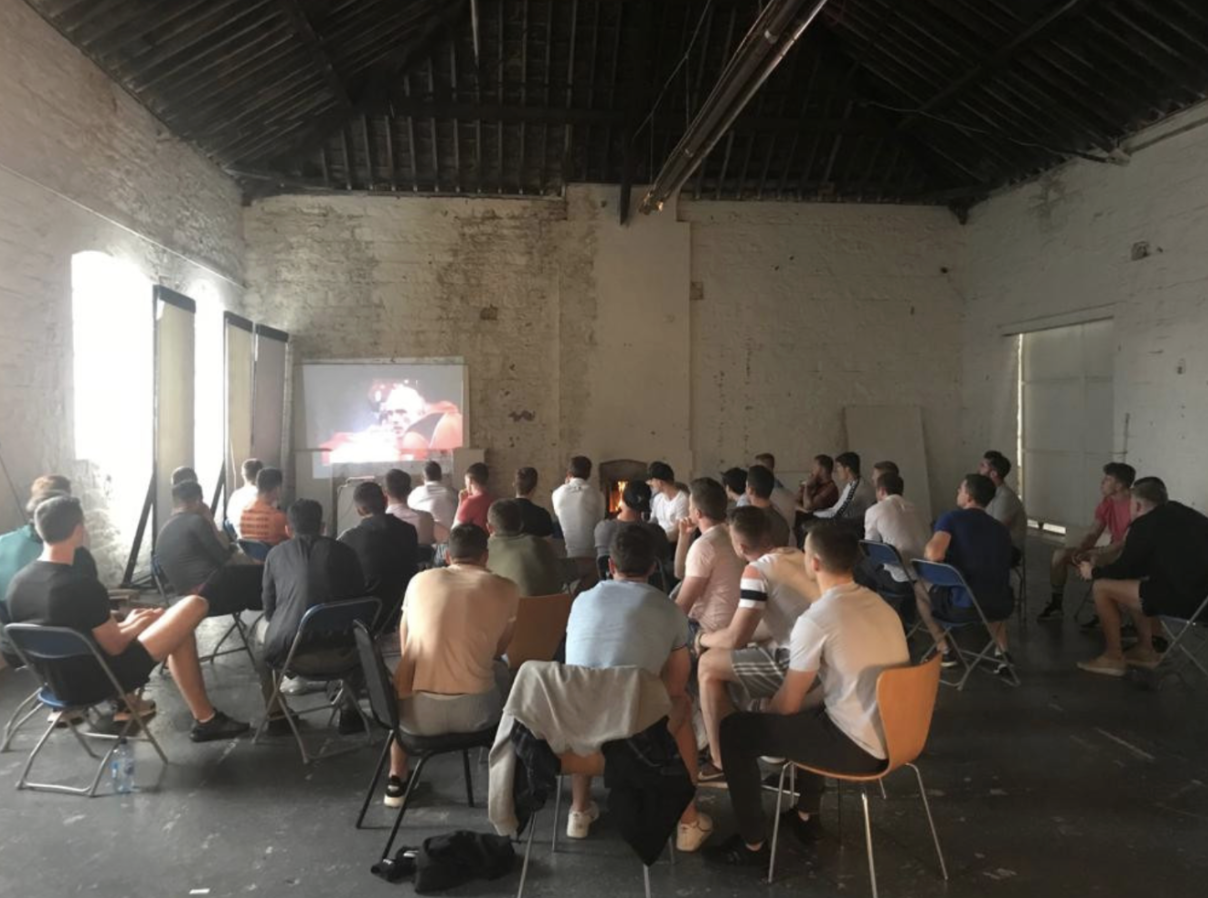
A connection-building workshop facilitated by Ronan Conway.

“The group needs to feel like you can hold yourself before they feel that you can hold them.”

2. Stay grounded

Sitting in the silence isn’t just about waiting it out, it’s about being as relaxed as you can. When we are on edge, stressed, or overly desperate for answers, groups are less willing to engage. The group needs to feel like you can hold yourself (stay calm, regulated, at ease) before they feel that you can hold them.

So before team meetings, or indeed when a wall of silence rises up, I’ll do the following to stay rooted and grounded:

  1. Take long, slow breaths, noticing the journey from inhale to exhale.
  2. I’ll anchor myself, visualising my roots growing into the floor.
  3. I’ll lightly scan the room. I’ll even smile.

Like a skill, facilitation takes time and deliberate practice. It may take time for everyone to adjust to the new rules of engagement, but once it starts flowing, the impacts can be transformative.

Here is a suggestion for an upcoming meeting 💡

  1. Look at your calendar and earmark an upcoming team meeting to practise.
  2. Identify one subject you’d like your team to explore, discuss or understand.
  3. Decide if you’d like the team to fully drive the meeting, or you’d simply like their input.
  4. Either way, have one clearly defined question for discussion (e.g. where are we living our values at the moment?)
  5. Put on your facilitator cap and use the above skills to get the water flowing. Notice how the players respond. Notice your own inner responses.
  6. If silence arises, stay grounded, trust the group. The answers are in the room.

If you try this, I’d love to hear your experience of it.

Hopefully this article serves you and your team’s journey ⛰️
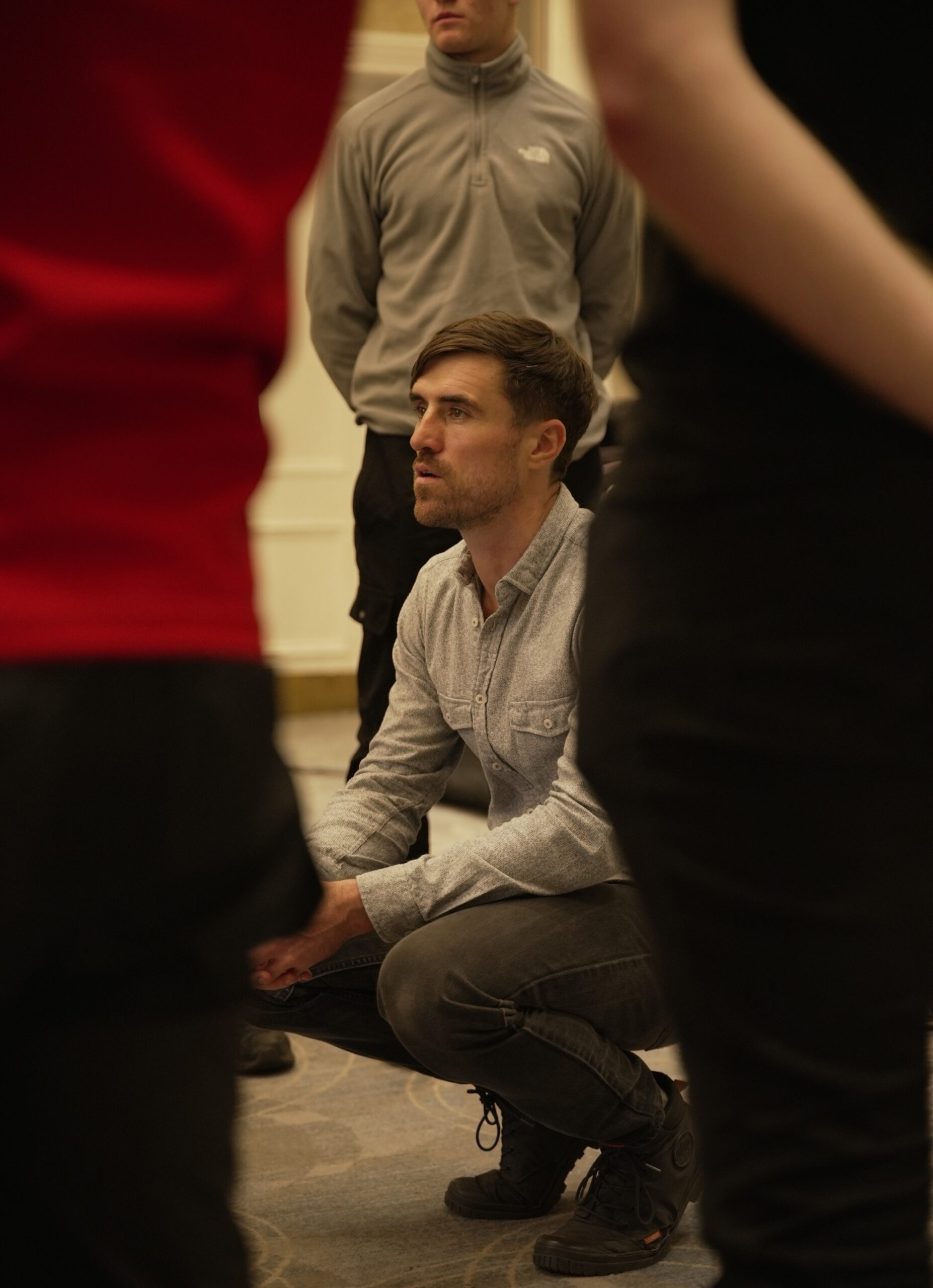

Ronan Conway is a performance coach who specialises in building cohesion and motivation in elite sports teams. He has worked with some of Ireland’s most successful teams, including the Ireland men’s rugby team, Dublin GAA’s five-in-a-row-winning men’s Gaelic football team and, currently, Leinster Rugby.

Ronan has honed his craft as a facilitator since 2012. He believes skilled facilitation can play a key role in empowering players and generating greater buy-in and belonging.

You can read more about Ronan’s work with elite teams here  and here  . Or you can visit his website at ronanconway.ie    and find him on LinkedIn  .

Members Only

15 Apr 2025

Articles

With Practice, Anyone Can Lead a Courageous Conversation… and ‘Skilled Candour’ Can Help

Category
Leadership & Culture, Premium
Share
Facebook Twitter Email Copy Link
https://leadersinsport.com/performance-institute/articles/with-practice-anyone-can-lead-a-courageous-conversation-and-skilled-candour-can-help/

A recent Leadership Skills Series session provided some tools that all leaders and coaches can use with their athletes and colleagues alike.

By Luke Whitworth
The ability to lead courageous conversations is a skill in which all coaches and practitioners can excel, but it requires revisiting from time to time.

That was the premise for this recent Leadership Skills Series session, where members of the Leaders Performance Institute were invited by our friends at Management Futures to explore:

  • How to create the conditions for courageous or difficult conversations
  • How to navigate these conversations effectively

There are two key principles:

  1. It is not enough for you to have the courage to say what it is that you want to say – people must feel safe enough to hear it. In psychologically safe environments, people are more receptive to difficult conversations; and leaders can find more frequent opportunities to explore tricky topics.
  2. We are striving for actionable insight. The point of having important conversations is that something changes in the aftermath. It’s not just an opportunity to download or speak your truth.

What is ‘skilled candour’?

When we have explored this topic in the past, we referenced the term of ‘radical candour’, which coined by executive coach Kim Scott, who argues in her 2017 book Radical Candor: Be a Kick-Ass Boss Without Losing your Humanity that leaders have a ‘moral imperative’ to step into difficult conversations and challenge with skill. This requires courage because it is simply easier to avoid such conversations.

Scott’s idea has influenced Management Futures, who fashioned their own concept: ‘skilled candour’, which underlines the skill behind the action.

On that note, psychological safety is essential so that people know that you are coming from a well-intended place. If there isn’t a belief that there is trust or positive intention, it may well trigger the ‘inner chimp’ (the primitive, emotional part of our brains, which is there to protect you but, in certain circumstances, can arouse feelings of defensiveness).

When the chimp has been triggered it’s unlikely that you will have a productive conversation.

The aim must be to create a sense of safety so we can be honest and speak directly:
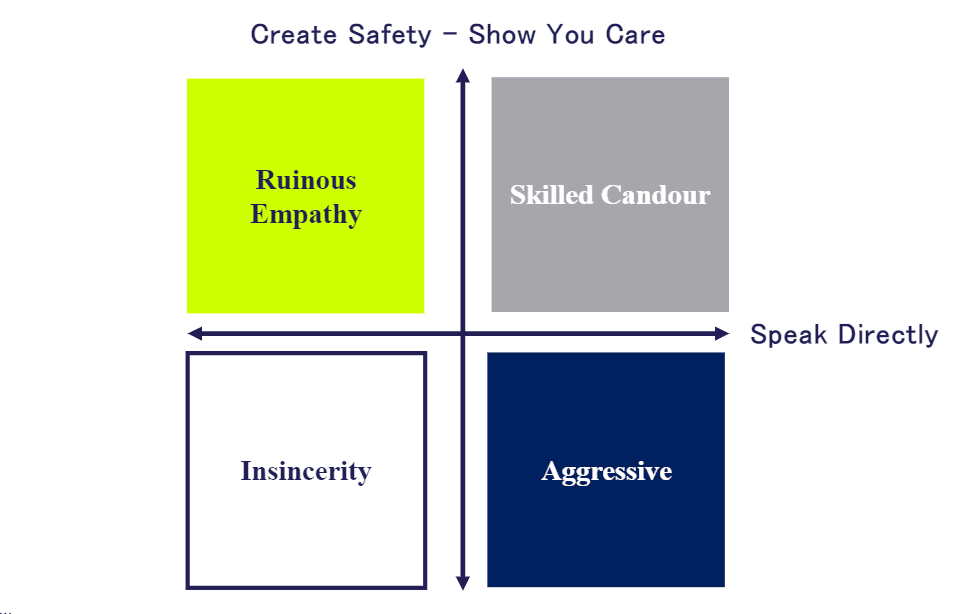
Image: Management Futures

Ruinous empathy: this is where we say what needs to be said in a clear and direct way. When you want to spare someone’s short-term feelings, you don’t tell them something that they need to know. You care personally but fail to challenge them directly, with ruinous consequences.

Insincerity: when you neither care personally nor challenge directly. You offer insincere praise to a person’s face and criticise them harshly behind their back.

Aggressive: when you challenge someone directly, but don’t show you care about them personally. It’s praise that feels insincere and feedback that isn’t delivered kindly.

We asked the practitioners and coaches in attendance where they thought they sat on the skilled candour graph. A straw poll delivered a striking insight:

Ruinous empathy: 45%

Insincerity: 3%

Aggression: 12%

Skilled candour: 39%

There are five key skills to enable your preparation, delivery and summary of a courageous conversation.

  1. Check your assumptions: we make up a lot of stuff about people. We imagine what’s going on in people’s lives, what they think about us, what their motives are. We imagine what they’re going to say in that conversation and how they’re going to react. And then we work our responses around that where we can tie ourselves up in knots, and we’re having a conversation in our heads rather than what’s truly happening. So strip out your assumptions.
  2. Have a clear outcome: declutter the nonsense. What is the outcome that you want to have and what is a good outcome for this conversation? This will help you get an actionable insight.
  3. Manage your body language and tone: so many of us are so busy that we just leak out impatient, stressed and busy signals. Non-verbally, we’re sending out some different signs, so it is important to be present, be composed and give high quality attention. What we don’t want to be doing is to be half in a conversation and half out as people pick up on it. Giving someone your full attention is a gift, and they will feel it, and they will trust you.
  4. Maintain a two-way dialogue: difficult conversations should be two-way. What are your thoughts? This is how I feel. How do you feel? This is what I would like to happen in the future. What are you going to do? What help do you want? Make sure you’re really using your active, listening and really great, powerful, open questions as well.
  5. Agree specific next steps: what are you going to do differently? How are you going to make sure it happens? What support do you need and make sure that it’s specific? Get right down into detail with the actionable insights.

The SBI feedback model

The Center for Creative Leadership’s SBI feedback model is a useful tool for both positive and constructive feedback. ‘SBI’ stands for ‘situation/standard’, ‘behaviour’ and ‘impact’.

Below is a simple example of what this could look like – the key is what we want to get straight to the point:

Situation/standard: To begin, we should guide the person to recall the exact time and place where the action we’re discussing occurred. The more specific we are, the better, as it will help them visualise their surroundings and actions at that moment. This provides the context for the feedback.

Example: ‘It’s really important in team meetings that everybody gets the chance to share their opinions and feels heard’.

Behaviour: Outline the specific actions or behaviours that prompted the feedback. As with the previous part, it’s must be as detailed as possible. We’ll achieve this by providing two key pieces of information:

  1. What was the behaviour?
  2. What did they do specifically that causes you to think that this was the behaviour they were demonstrating?

Example: ‘I’ve noticed in the last couple of meetings that when people have come up with an idea you’ve immediately said something negative about it’.

Impact: We should highlight what we believe the impact of their actions was. This impact could pertain to you, the team or other individuals. As with the previous section, it needs to be detailed and is divided into two parts:

  1. Who did it impact on and how?
  2. Why do you think this was the impact?

 Example: ‘You’ve talked about why it’s not possible and the impact of that is that it’s draining the energy out of the room and stopping people speak up’.

What to read next

Psychological Services at the FC Bayern Campus: ‘We Always Worked Together, but Now our Efforts Are Integrated’

27 Feb 2025

Articles

Soft Skills, AI, and Psychology: the Skills that Will Define the Practitioner of the Future

Category
Coaching & Development, Leadership & Culture
Share
Facebook Twitter Email Copy Link
https://leadersinsport.com/performance-institute/articles/soft-skills-ai-and-psychology-the-skills-that-will-define-the-practitioner-of-the-future/

In this Virtual Roundtable, brought to you in partnership with ESSA, Robin Thorpe and Lyndell Bruce explored four areas where the practitioner of the future will need to excel.

An article brought to you by

By John Portch & Luke Whitworth
Dr Robin Thorpe has instant reservations when performance departments describe themselves as ‘integrated’.

“It’s become a new trend or buzz term in high performance,” said the former Director of Performance at Red Bull. “I’d be really interested to see how many self-proclaimed integrated departments and processes actually are.”

In a truly integrated department, he argued, there has to be “positive and respectful challenge between staff and then between the disciplines” and he is unconvinced that this is always the case in many environments.

“Not to be controversial, but I would think that in some of the areas or places where true integration is preached, there might actually not be any collaboration whatsoever,” Thorpe added. “And so, without collaboration, there might not be any friction points or any challenge, so it might only be perceived as an integrated process.”

Thorpe was speaking at the first session of ‘The Future of Performance Sport’, a three-part Virtual Roundtable series brought to you by the Leaders Performance Institute and Exercise & Sports Science Australia. The first session explored the ‘future practitioner of high performance’.

He was joined on the virtual stage by Deakin University’s Dr Lyndell Bruce, who harbours similar reservations when it comes to integration.

She said: “So often we see with these integrated teams that an athlete has poor performance. So they throw everything that’s been working really well out the window to try and solve why we’re not winning – and that suggests that it’s really not an integrated team.”

The future practitioner will need to find the answers and, here, we detail four considerations, including better integration, that will help to stand them in good stead.

  1. Combined technical knowledge and ‘soft’ skills

Both Bruce and Thorpe believe that the future practitioner will combine technical knowledge and softer skills

“People call them ‘soft’ skills – I like to call them transferable skills, complementary skills,” said Bruce. She also pondered how they might be taught. “It’s challenging because it takes time, it takes effort, and it takes resources. It’s too easy to say students will get that in their work, integrated learning, because we know it’s not the case. They don’t all go to the same environment and we can’t control those environments.”

There are questions to be answered on the technical side too, with Thorpe emphasising the importance of detailed and applied research. “We delve into research articles which might be relevant to what we do, but we also see how they associate with the work that we do,” he said.

Thorpe also believes that generalists will continue to have their place. “Although specialisation will offer a lot more opportunities for younger students and practitioners going forwards, I hope that we don’t lose the more generalist skills that I think are very, very effective currently.”

  1. The impact of AI and technology

Thorpe sees AI as a potential time-saver, but with caveats. “I think we know that AI can certainly support us with is enhancing processing times when it comes to using and working with data that we have,” he said. “We’ve come into this era of plug-and-play technology, which means that our ability to cope with data has become stretched.”

However, he added, “I certainly don’t believe it’ll ever be the silver bullet to a lot of our performance problems or challenges or questions.” It is no surprise that he preaches caution. “I think we still probably need to think about some of the principles of why we’re collecting some of that data in the first place.”

At Deakin, Bruce and her colleagues have gotten used to students using AI to craft responses. She said: “The conversations are leaning towards how we teach students to use this in an advantageous way.”

And, as she observes, “many organisations are using those machine learning models to create outputs, look at different tactical and technical elements of match play, to understand the physiological data that they’re receiving, so I don’t think that’s unique; and I think there’s still a way to go in terms of how we use that and how we implement that more effectively.”

  1. The growth of psychology and mental performance

Wellbeing – and psychology as part of wellbeing – continues to grow in prominence, with all staff members called upon to play their part.

“It’s not a once-off conversation because they flagged on the wellbeing this week and then two weeks later they’re back in their normal range – we continue that conversation and check-in,” said Bruce of her work Deakin. She also noted the growing specialisation in how psychology is used in sport. “We use psychology from a performance perspective and also a clinical perspective.”

Thorpe was responsible for mental performance in his most recent role. “It was very much a pivotal learning opportunity for me; to understand the continuum of how mental performance operates,” he said. This included performance under pressure, helping athletes to deal with increased mental loads in training and competition, and psychological profiling.

  1. Integration

Integration is increasingly difficult in a world of growing specialisation with so many inputs to reconcile, but Thorpe and Bruce both offered some tips.

For his part, Thorpe emphasised objectivity, particularly given the different ‘languages’ that individuals in different fields will speak. He says: “How can we use objectivity as a common language? Good objectivity – not AI-based reams and reams of data – but really solid precision-based objectivity is our vehicle to integrating approaches.”

High performance teams need to understand the desired outcome, then, as he asked, “how do we then fit these experts and specialists to those outcomes rather than coming at it all individually?”

Bruce then argued for consistency. “[The high performance team] operates irrespective of performance, while you might need to innovate and make adjustments along the way,” she said. “But it doesn’t change because of poor performance.”

Further reading:

Sports Science Research: the Strengths, Weaknesses and Opportunities

Go to home
Follow us on Instagram Follow us on LinkedIn Follow us on X

Contact

Leaders UK

Tuition House
27-37 St George's Road
Wimbledon
SW19 4EU
London
United Kingdom

Enquiries Line: +44 (0)207 806 9817
Switchboard Number: +44 (0)207 042 8666

Leaders US

120 W Morehead St # 400
Charlotte
NC 28202
United States

Enquiries Line: +1 646 350 0449

Leaders

  • Contact
  • About
  • Careers
  • News
  • Privacy Policy
  • CA Privacy Rights
  • Cookie Notice
  • Website Terms of Use

Performance Institute

  • Membership
  • Events
  • Content
  • Virtual Learning
  • Connections
  • Partners

Latest

Intelligence Hub
High Performance Future Trends Research Elite Performance Partners continue to drive the potential in high performance forward through renewed Leaders partnership
Your Privacy Choices

© 2026 Leaders. All rights reserved

  • Privacy Policy

Attendees

x