In a recent Leadership Skills Series Session, Jeff Pagliano of Management Futures set out a series of tools, including the trust equation, active listening and ‘flows of knowledge’.
“Influencing is often strictly correlated with the level of knowledge or technical insight we can offer in any given situation and our ability to communicate that knowledge effectively,” said Jeff Pagliano, a consultant with leadership specialists Management Futures.
“However, influencing we believe is much broader than this.”
Pagliano was hosting an ‘influencing skills’ session for Leaders Performance Institute members as part of our Leadership Skills Series.
“A lot of you are employed to lead or influence outcomes, not for your technical knowledge but for your ability to build trust, grasp complex ideas, think rationally, and motivate,” he continued.
“The best influencers are often those who listen carefully to the needs of those around them, ask the right questions, and then communicate a compelling vision. And this has as much to do with credibility as knowledge does and, interestingly, the further you go up in an organisation, the less useful your IQ, your technical knowledge, is and the more useful your EQ, your emotional intelligence.”
Over the course of an hour, Pagliano explained why your ability to build trust, actively listen, and communicate compellingly – areas in which we can all improve – underpins your ability to influence.
‘The trust equation’
To start, Pagliano presented the trust equation to the group:
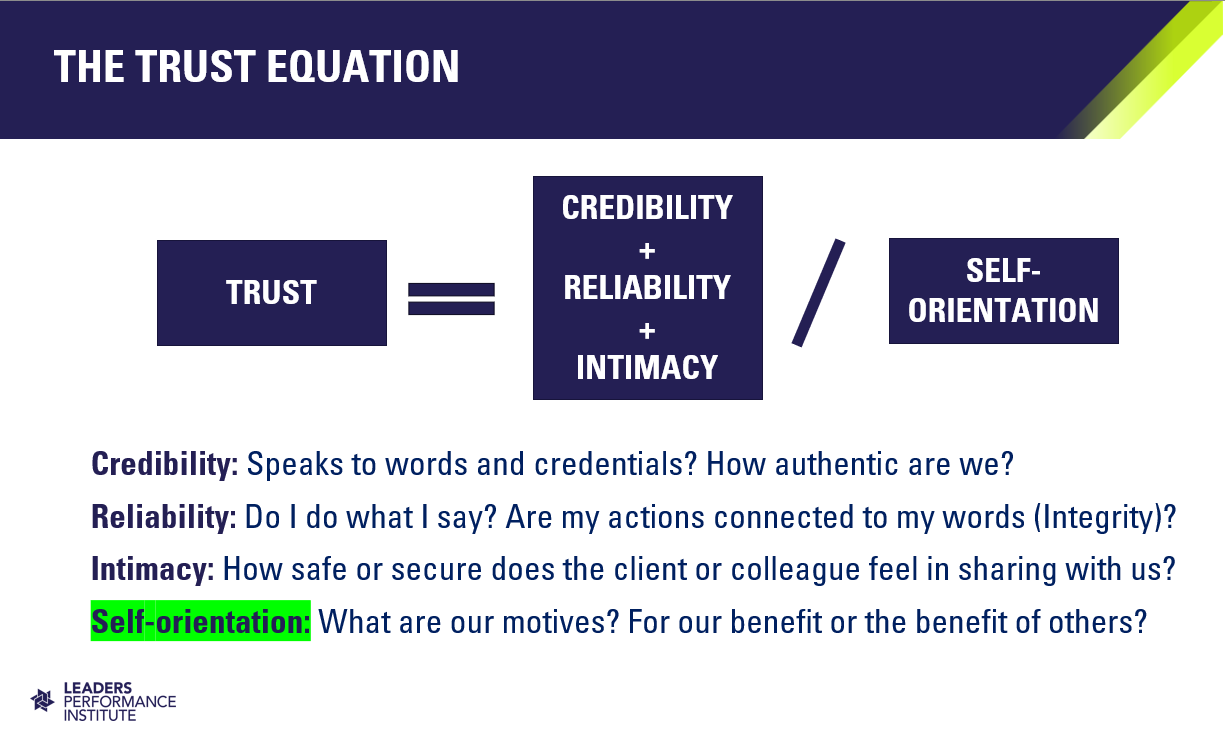
He then explained his thoughts on each:
Trust =
Credibility: “This speaks to both words and credentials. People should be confident that you know what you’re talking about, but it may not be just about the content, it could be how you show up as well. Credibility is a blend of what you know and how you present yourself.”
+
Reliability: “You do what you say you’re going to do. Your actions are connected to your words and your follow through. One thing that’s interesting to note is that people will sometimes over-promise and under-deliver; and it’s a very natural instinct to do that because we naturally want to please or we want to show the best of ourselves but, actually, over the long term, this can really work against you.”
+
Intimacy: “If credibility and reliability are the sort of things that are quite concrete, intimacy is a little more ambiguous. It’s more to do with the sense you have that someone will be there for you, and you try to gauge how emotionally intelligent they are. You’re noticing how well they listen, how much they connect, how much warmth they have, how much understanding. It’s less concrete, but equally important.”
/
Self-orientation: “Anytime you are building trust you do have to have some self-orientation because in any kind of negotiation or where you’re looking to influence, it would feel suspicious if someone thought you were entirely magnanimous about everything and you had no vested interest in anything. It’s about getting the right amount and not letting it overwhelm the other three. That’s why you have the first three divided by self-orientation.”
When you’re focused on being more genuine and interested in the other human being good things are going to flow for that, opportunities flow from that, but if the opportunity is so prevalent in the conversation that you’re trying to jump on it constantly, the other person’s going to feel it.
Active listening
Pagliano then introduced the topic of ‘listening well’, which supports influencing in two specific ways.
“It helps the intimacy part of the trust equation and it gives you the context for a person’s point of view,” he said. “You’re more prepared when the time comes for you to share your knowledge and suggest a course of action.
“Active listening is when you’re not only tuned into what someone says but also what they feel and believe picking up on both their verbal and non-verbal communication is the foundation of intimacy and the antithesis of self-interest.”
He shared the following image to illustrate his point:
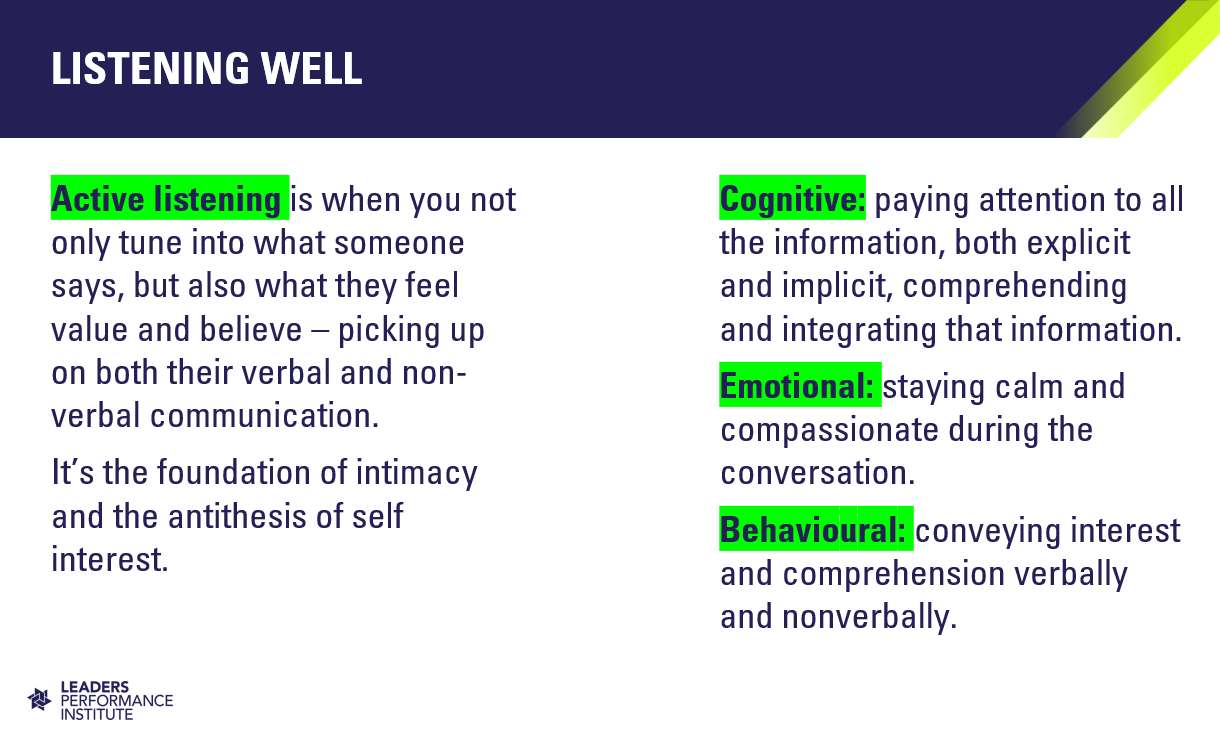
When you’re talking to someone you are hoping to influence it’s always useful to reflect on the goals of each conversation, both what you want and what the other person needs as a way to determine the best way to listen at the moment. And you may realise that a different mode or combinations of modes would be better.
Flows of knowledge
“If the trust equation is where it should be and you have been listening well, you have laid the groundwork to engage with the person you are trying to influence in conversation,” said Pagliano in taking the conversation further. “We have a great framework for you to use: it is called “flows of logic.” Pagliano cited former BBC presenter Stephanie Hughes in his explanation:
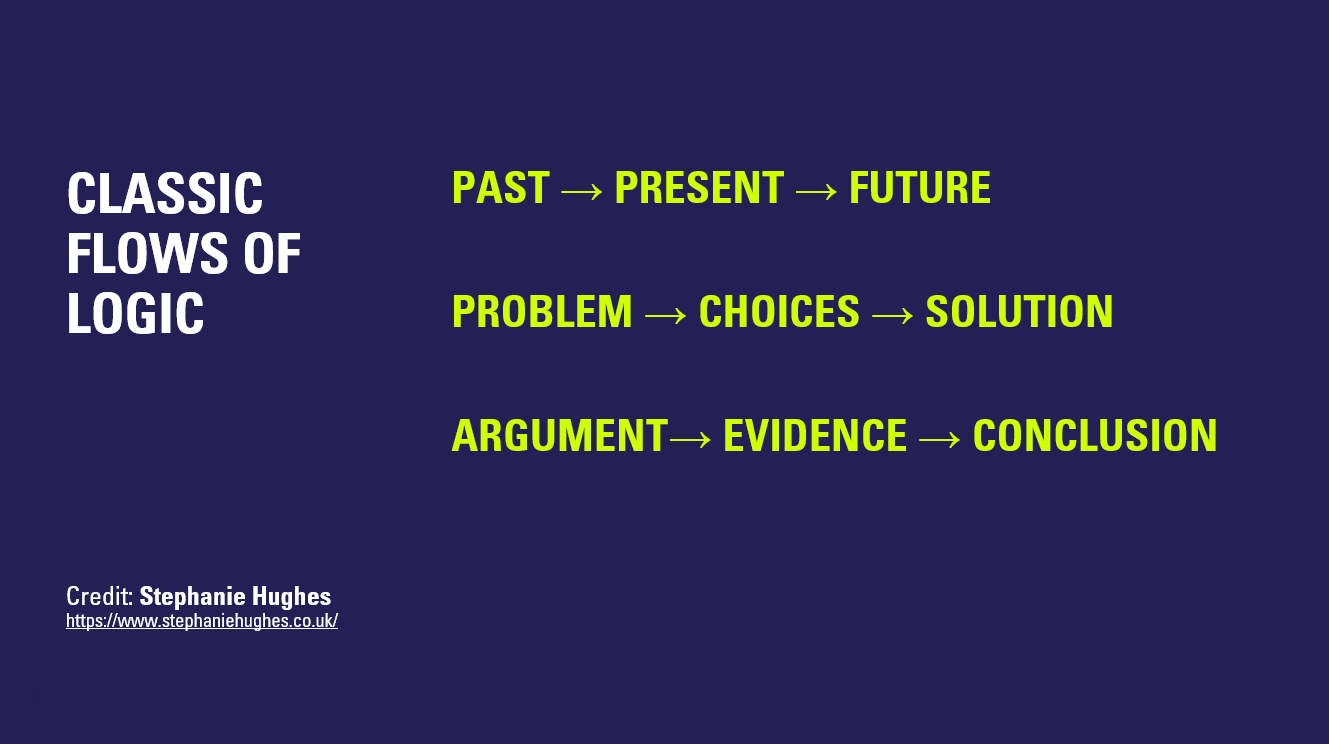
Pagliano explained their value, particularly in non-rehearsed, spontaneous conversations:
Past → Present → Future
“When you go through these phases of logic, it’s the middle word that is important. Like in the first one, if we just say, ‘in the past we did this’ and ‘then in the future, we’re going to do that’ and you don’t give any context for the present, it’s less powerful.”
Problem → Choices → Solution
“[To say] ‘here’s a problem or solution’ – that’s not an influencing tool – that’s just a command. To present choices shows your credibility.”
Argument → Evidence → Conclusion
“The third could happen when you’re pushing back at someone who’s come at you with a different opinion, and here this is where the middle word is important, because if you just say, ‘I believe this and here’s a conclusion’, it’s just an opinion. But if you add evidence, it becomes more than an opinion. It becomes a fact, and it becomes far more concrete. It’s much more objective because it’s based on evidence.”
You want to sound like you know what you’re talking about and you’re not floundering and, if there’s a logic to what you’re saying, the information is more easily understood and retained, so these serve a multitude of purposes.
The final factor: push and pull skills
Pagliano presented a final slide:
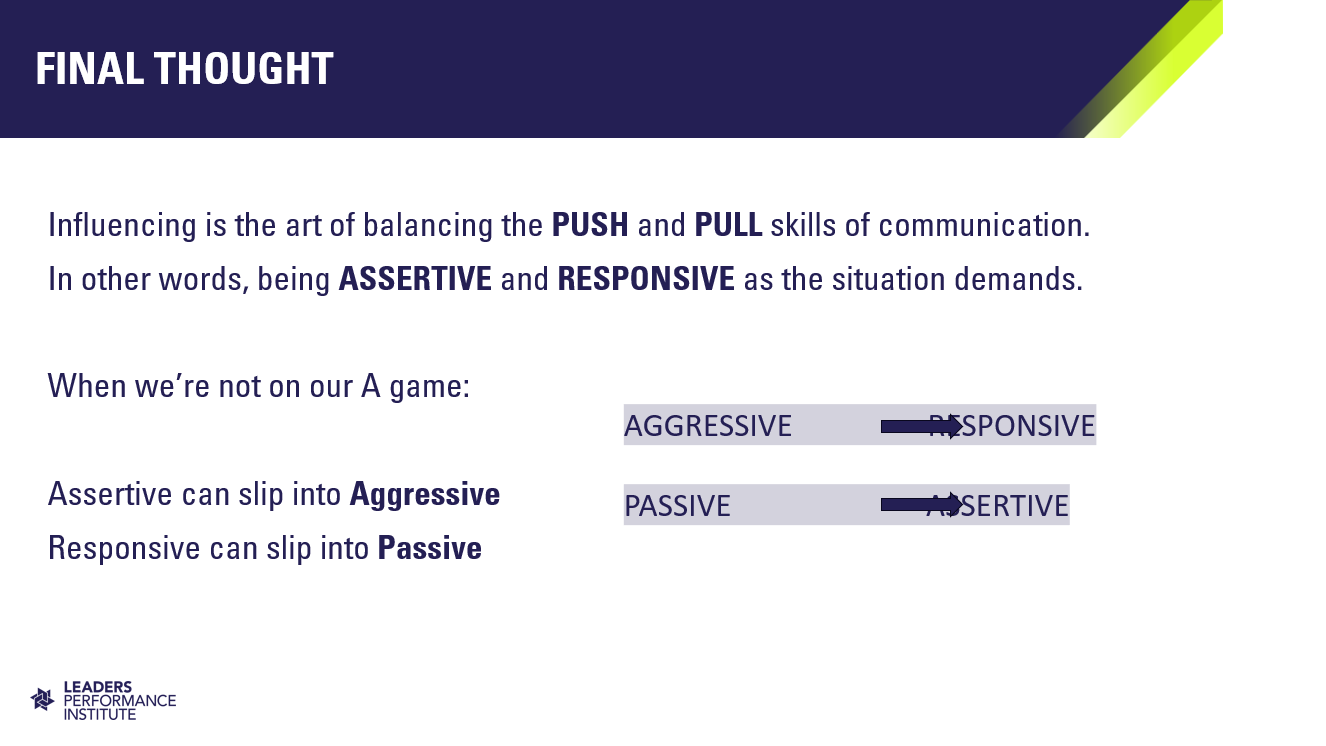
“Effective influencing is our ability to balance those push and pull skills,” he said.
“The ‘push’ would be that flow of logic. When you’re a subject matter expert and you’re trying to communicate your point of view in a way that moves the other to take a recommended course of action, those pull skills [build] that trust equation, the active listening, and it’s good to reflect where we need to focus more.
“Often, ‘push’ comes more naturally for people, and when we’re not on our A game, those of us who have a propensity to be more responsive can slip into passive; and those of us who are more assertive can slip into aggressive.”
Aggressive: go to responsive. Passive: go to assertive. And make sure you’re constantly aware of those push-pull dynamics.
What to read next
Performance Coach Ronan Conway believes that coaches can bring a fresh dimension to team gatherings and help teams tap into their inherent power by adding some facilitation principles and techniques to their skillset.
In recent years I worked with a coach of a football team. He’d regularly vent to me about players not speaking up in meetings, and how the group lacked leaders and energy. So I decided to sit at the back of some player meetings to observe the dynamic.
A clear pattern emerged. Standing at the top of the room, the coach would send waves of golden information and inspiration toward the players in the shape of tactics, opponent analysis, and game plans. His style was to direct, to instruct, and to hand players the answers – because that’s how he was coached, that’s what he excelled at; plus time was of the essence. The players’ role was simple: to listen and absorb.
My feedback was as follows:
“The coach needed to maintain his directive style as a solid foundation, and layer in skills to stimulate group discussion”
My suggestion was to maintain his directive style as a solid foundation, and layer in skills to stimulate group discussion – not to replace his approach, but to complement it.
In the following weeks after delivering his game plan, he practised popping the ball into the players’ court; inviting their thoughts and insight. Within weeks he facilitated a post-game review, opponent analysis, and culture session with the squad. To different degrees, the players played a key part in both sessions. These small shifts had profound results:
To get to this point, it required a big shift in attitude towards his group and his role. It called for him to swap his teacher cap for his facilitator cap.
“The change called for the coach to swap his teacher cap for his facilitator cap.”
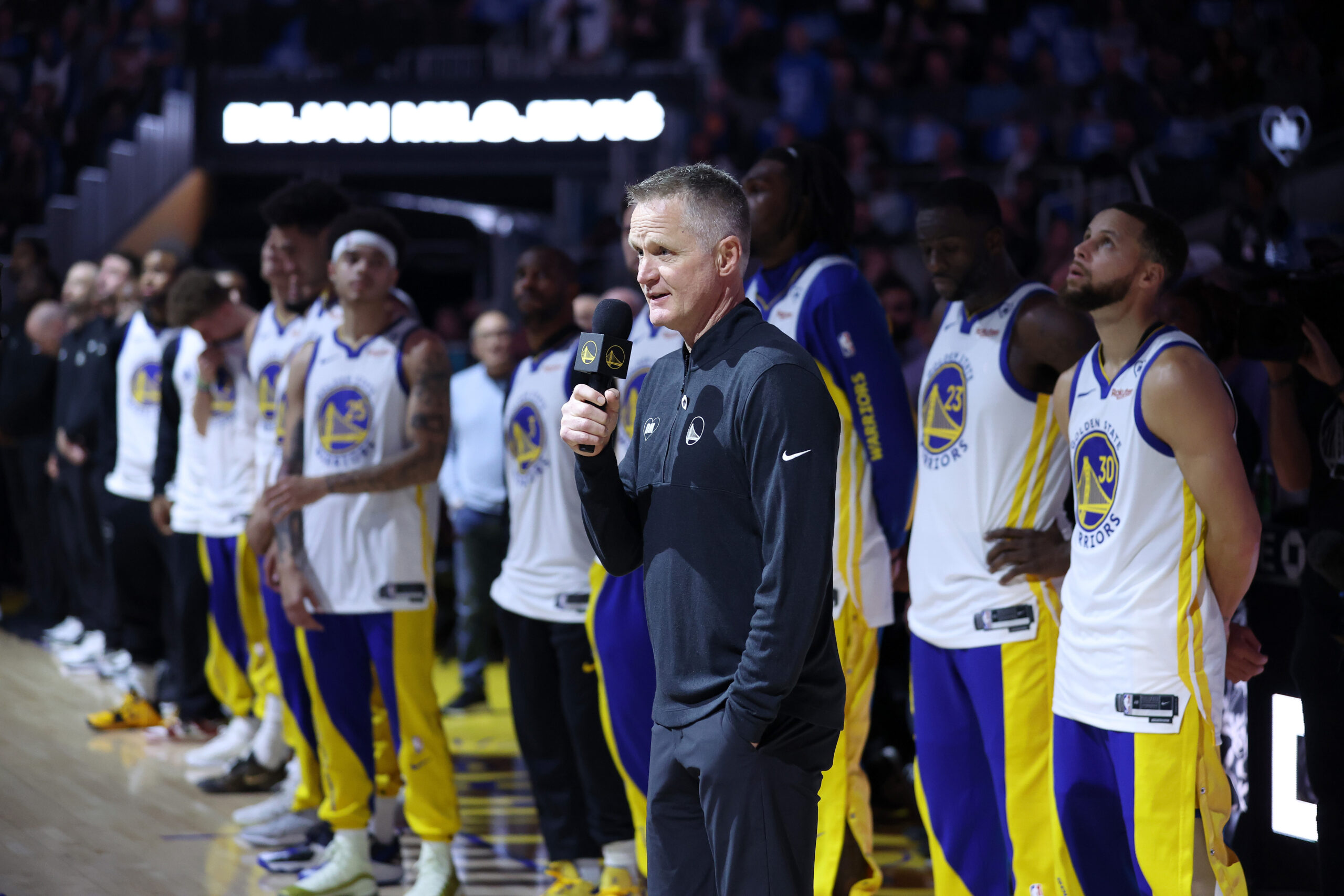
Photo: Ezra Shaw/Getty Images
Before facilitating any meeting, it helps to adopt a group-centred lens. To have a strong belief in the group’s inherent wisdom. When you look at your squad in front of you, you see an ocean of insight, inspiration and breakthroughs. You see teachers rather than students. You see answers in the room.
The transition from a teacher to a facilitator mindset can be tricky. Most coaches are experts in their field, and at times it can suit to simply tell players what they need to know. But as a facilitator it’s not about telling, rather it’s about being curious. It’s about fostering the right conditions for the group to unearth their own answers.
“The transition from teaching to facilitating is about fostering the right conditions for the group to unearth their own answers.”
For some this may require a loosening of the reins, but it doesn’t mean letting go of them. Your direction and leadership is still central, but you’re inviting your squad to step up with you from time to time. It’s important to say that certain players and squads certainly won’t have all the answers. In this case, at least they get to practise critical thinking and to put their own fingerprints on a discussion.
Steve Kerr, the Head Coach of the Golden State Warriors NBA-winning team, is a proponent of player-driven meetings. For Kerr, it’s not about “control”, rather “guiding” or “nudging players in the right direction”. That ‘nudging and guiding’ is the essence of facilitation.

Stimulating any form of response from a group is about moving energy. Moving energy can look like a smile, a nod, a raised hand. Maybe a word. Or a sentence. In time perhaps a rich, flowing discussion. We call this process, ‘getting the water flowing’.
Here are some facilitation tips to get your meetings flowing:
Show of hands: When faced with 30 blank faces, and the energy feels stuck, you can get the water trickling with a show of hands. ‘Hands up if you know’; ‘if you agree’; ‘who relates’; ‘if you’ve experienced this’. Each hand raised or not is a micro-investment in the meeting.
Open-ended questions: Clear open-ended questions are the keys for unlocking the treasure. They typically begin with ‘how’, ‘why’, or ‘what’, and generally elicit deeper insights than closed questions which give yes/no answers. The quality of the question will determine the quality of the response.
Intentional language: ‘The answers are in the room’: use language that reflects this mindset. You are not wondering if they have an answer, you know they do. Instead of ‘does anyone have an answer?’, try ‘who wants to go first/next?’.
Non-verbal communication: Facilitation isn’t just verbal. A nod or some steady eye contact can subtlety signal, ‘I want to hear from you’. You can lightly scan the room, naturally clocking different individuals throughout the meeting. At the very least, these ‘I see you’ moments will keep people checked-in and engaged.
Pair up: Speaking in front of an entire group is a big interpersonal risk to take. Pairing up to speak is a more manageable one. It gets all voices flowing; it builds safety; it serves as a stepping stone to a wider group conversation.
If your questions are met with silence, don’t sweat.
That liminal space between question and answer can be an intense time. When I started out facilitating in schools, most of my questions would hang in the air for what felt like minutes. Time sped up, as did my heart rate. I’d hold my breath. My brow got sweaty. ‘Someone. Please. Say. Something,’ my inner world yelled. The group shuffled awkwardly longing for the same. Until, finally, I’d move things along with a joke, or by answering my own question. Phew.
After enough moments like this, my relationship with silence changed. I found these moments to be a necessary and natural punctuation point; a chance for the room to slow down and to breathe. In the moments when I filled the silence, I wasn’t saving the group from the discomfort, I was in fact saving myself from my own discomfort. Rather than seeing silence as a void to be filled or feared, I started seeing it as a space for gold to be found. Granted not all silences lead to answers, but at least give the group time to gather their thoughts and muster up some courage.
‘Sitting in the silence’ is a useful practice in these moments. Meaning, allowing silence space – trusting it – and remaining as relaxed as possible.

“The more I trust myself to sit in the silence, the more the group trusts themselves to speak up.”
Here are two nuggets which help the process of sitting in the silence:
1. Trust the silence
When a group isn’t responding, a myriad of things can be happening for them. Quite often, they’re just not used to being asked. The silence is almost like a test to gauge ‘is this a token question or a genuine ask?’ In filling the silence, a lack of belief in oneself and the group is communicated. Being willing to ‘sit in the silence’, we signal a strong confidence in the group. You’re saying, ‘I know you know and I’m willing to wait’. It amazes me: the more I trust myself to ‘sit in the silence’, the more the group trusts themselves to speak up.
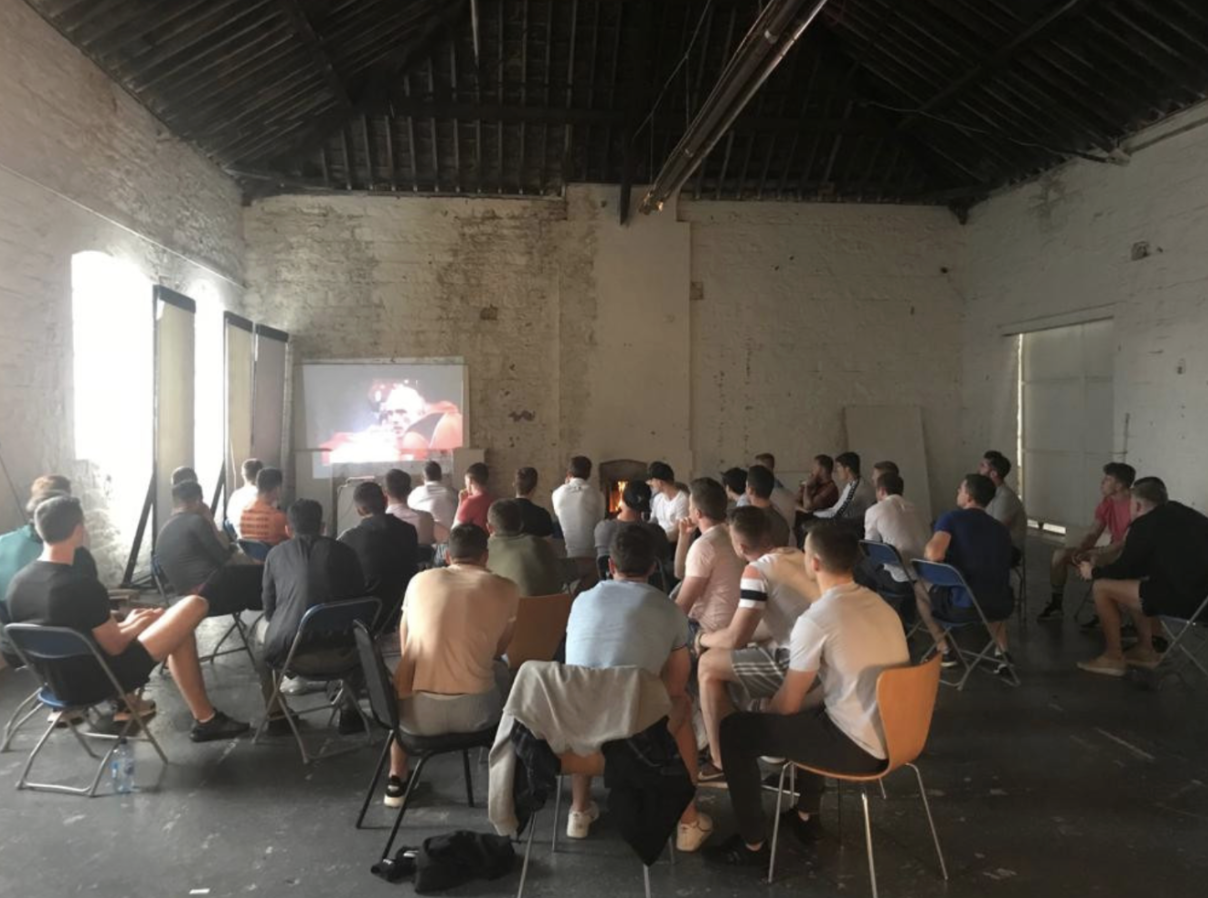
A connection-building workshop facilitated by Ronan Conway.
“The group needs to feel like you can hold yourself before they feel that you can hold them.”
2. Stay grounded
Sitting in the silence isn’t just about waiting it out, it’s about being as relaxed as you can. When we are on edge, stressed, or overly desperate for answers, groups are less willing to engage. The group needs to feel like you can hold yourself (stay calm, regulated, at ease) before they feel that you can hold them.
So before team meetings, or indeed when a wall of silence rises up, I’ll do the following to stay rooted and grounded:
Like a skill, facilitation takes time and deliberate practice. It may take time for everyone to adjust to the new rules of engagement, but once it starts flowing, the impacts can be transformative.
If you try this, I’d love to hear your experience of it.
Hopefully this article serves you and your team’s journey ⛰️
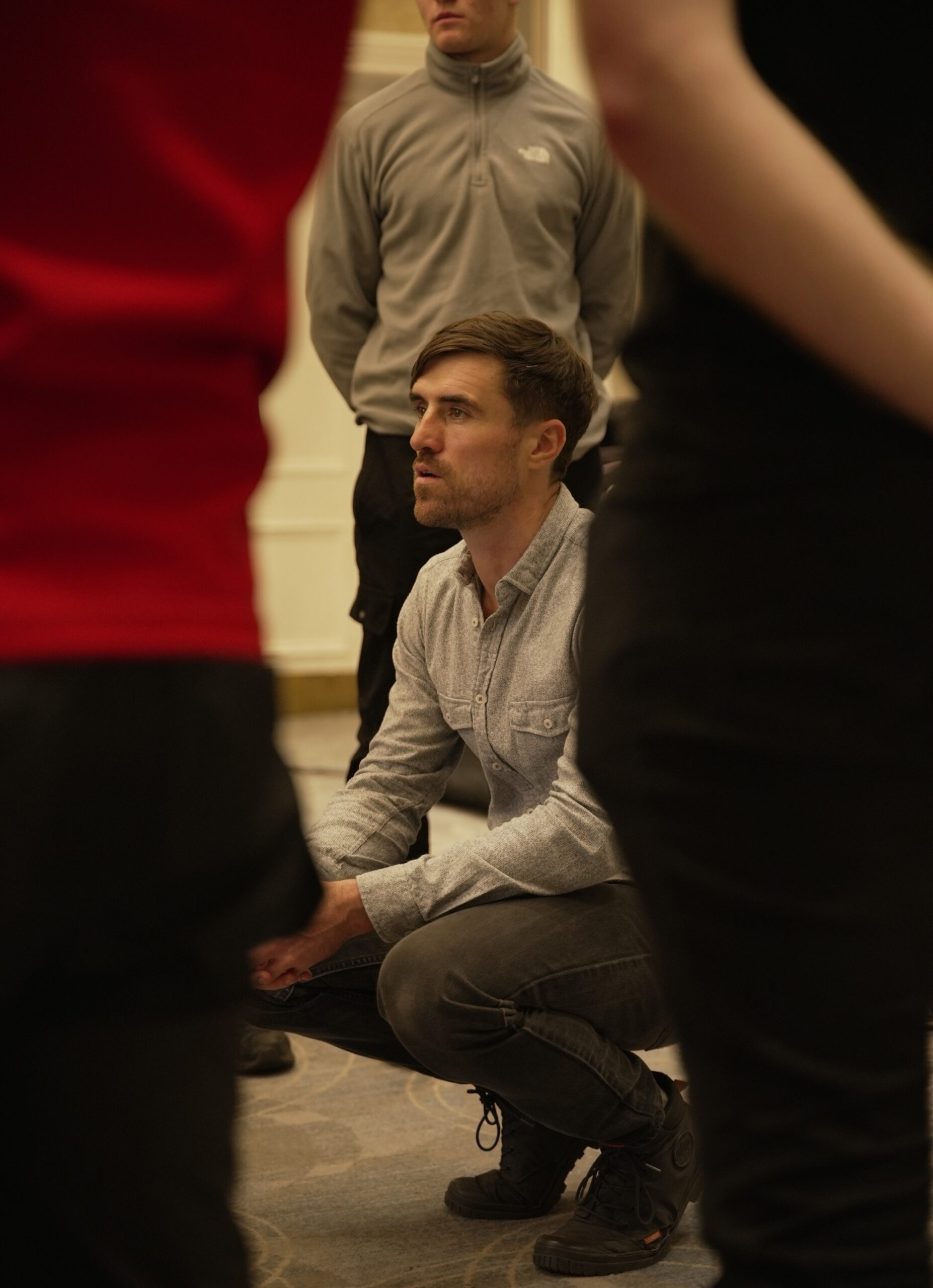
Ronan Conway is a performance coach who specialises in building cohesion and motivation in elite sports teams. He has worked with some of Ireland’s most successful teams, including the Ireland men’s rugby team, Dublin GAA’s five-in-a-row-winning men’s Gaelic football team and, currently, Leinster Rugby.
Ronan has honed his craft as a facilitator since 2012. He believes skilled facilitation can play a key role in empowering players and generating greater buy-in and belonging.
You can read more about Ronan’s work with elite teams here and here . Or you can visit his website at ronanconway.ie and find him on LinkedIn .
A recent Leadership Skills Series session provided some tools that all leaders and coaches can use with their athletes and colleagues alike.
That was the premise for this recent Leadership Skills Series session, where members of the Leaders Performance Institute were invited by our friends at Management Futures to explore:
There are two key principles:
What is ‘skilled candour’?
When we have explored this topic in the past, we referenced the term of ‘radical candour’, which coined by executive coach Kim Scott, who argues in her 2017 book Radical Candor: Be a Kick-Ass Boss Without Losing your Humanity that leaders have a ‘moral imperative’ to step into difficult conversations and challenge with skill. This requires courage because it is simply easier to avoid such conversations.
Scott’s idea has influenced Management Futures, who fashioned their own concept: ‘skilled candour’, which underlines the skill behind the action.
On that note, psychological safety is essential so that people know that you are coming from a well-intended place. If there isn’t a belief that there is trust or positive intention, it may well trigger the ‘inner chimp’ (the primitive, emotional part of our brains, which is there to protect you but, in certain circumstances, can arouse feelings of defensiveness).
When the chimp has been triggered it’s unlikely that you will have a productive conversation.
The aim must be to create a sense of safety so we can be honest and speak directly:
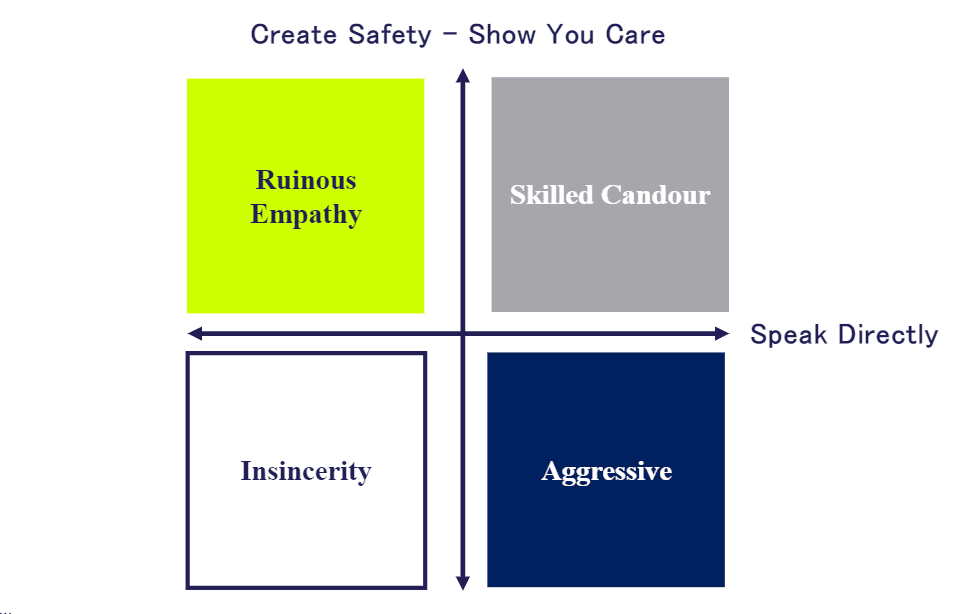
Image: Management Futures
Ruinous empathy: this is where we say what needs to be said in a clear and direct way. When you want to spare someone’s short-term feelings, you don’t tell them something that they need to know. You care personally but fail to challenge them directly, with ruinous consequences.
Insincerity: when you neither care personally nor challenge directly. You offer insincere praise to a person’s face and criticise them harshly behind their back.
Aggressive: when you challenge someone directly, but don’t show you care about them personally. It’s praise that feels insincere and feedback that isn’t delivered kindly.
We asked the practitioners and coaches in attendance where they thought they sat on the skilled candour graph. A straw poll delivered a striking insight:
Ruinous empathy: 45%
Insincerity: 3%
Aggression: 12%
Skilled candour: 39%
There are five key skills to enable your preparation, delivery and summary of a courageous conversation.
The SBI feedback model
The Center for Creative Leadership’s SBI feedback model is a useful tool for both positive and constructive feedback. ‘SBI’ stands for ‘situation/standard’, ‘behaviour’ and ‘impact’.
Below is a simple example of what this could look like – the key is what we want to get straight to the point:
Situation/standard: To begin, we should guide the person to recall the exact time and place where the action we’re discussing occurred. The more specific we are, the better, as it will help them visualise their surroundings and actions at that moment. This provides the context for the feedback.
Example: ‘It’s really important in team meetings that everybody gets the chance to share their opinions and feels heard’.
Behaviour: Outline the specific actions or behaviours that prompted the feedback. As with the previous part, it’s must be as detailed as possible. We’ll achieve this by providing two key pieces of information:
Example: ‘I’ve noticed in the last couple of meetings that when people have come up with an idea you’ve immediately said something negative about it’.
Impact: We should highlight what we believe the impact of their actions was. This impact could pertain to you, the team or other individuals. As with the previous section, it needs to be detailed and is divided into two parts:
Example: ‘You’ve talked about why it’s not possible and the impact of that is that it’s draining the energy out of the room and stopping people speak up’.
What to read next
In this Virtual Roundtable, brought to you in partnership with ESSA, Robin Thorpe and Lyndell Bruce explored four areas where the practitioner of the future will need to excel.
An article brought to you by

“It’s become a new trend or buzz term in high performance,” said the former Director of Performance at Red Bull. “I’d be really interested to see how many self-proclaimed integrated departments and processes actually are.”
In a truly integrated department, he argued, there has to be “positive and respectful challenge between staff and then between the disciplines” and he is unconvinced that this is always the case in many environments.
“Not to be controversial, but I would think that in some of the areas or places where true integration is preached, there might actually not be any collaboration whatsoever,” Thorpe added. “And so, without collaboration, there might not be any friction points or any challenge, so it might only be perceived as an integrated process.”
Thorpe was speaking at the first session of ‘The Future of Performance Sport’, a three-part Virtual Roundtable series brought to you by the Leaders Performance Institute and Exercise & Sports Science Australia. The first session explored the ‘future practitioner of high performance’.
He was joined on the virtual stage by Deakin University’s Dr Lyndell Bruce, who harbours similar reservations when it comes to integration.
She said: “So often we see with these integrated teams that an athlete has poor performance. So they throw everything that’s been working really well out the window to try and solve why we’re not winning – and that suggests that it’s really not an integrated team.”
The future practitioner will need to find the answers and, here, we detail four considerations, including better integration, that will help to stand them in good stead.
Both Bruce and Thorpe believe that the future practitioner will combine technical knowledge and softer skills
“People call them ‘soft’ skills – I like to call them transferable skills, complementary skills,” said Bruce. She also pondered how they might be taught. “It’s challenging because it takes time, it takes effort, and it takes resources. It’s too easy to say students will get that in their work, integrated learning, because we know it’s not the case. They don’t all go to the same environment and we can’t control those environments.”
There are questions to be answered on the technical side too, with Thorpe emphasising the importance of detailed and applied research. “We delve into research articles which might be relevant to what we do, but we also see how they associate with the work that we do,” he said.
Thorpe also believes that generalists will continue to have their place. “Although specialisation will offer a lot more opportunities for younger students and practitioners going forwards, I hope that we don’t lose the more generalist skills that I think are very, very effective currently.”
Thorpe sees AI as a potential time-saver, but with caveats. “I think we know that AI can certainly support us with is enhancing processing times when it comes to using and working with data that we have,” he said. “We’ve come into this era of plug-and-play technology, which means that our ability to cope with data has become stretched.”
However, he added, “I certainly don’t believe it’ll ever be the silver bullet to a lot of our performance problems or challenges or questions.” It is no surprise that he preaches caution. “I think we still probably need to think about some of the principles of why we’re collecting some of that data in the first place.”
At Deakin, Bruce and her colleagues have gotten used to students using AI to craft responses. She said: “The conversations are leaning towards how we teach students to use this in an advantageous way.”
And, as she observes, “many organisations are using those machine learning models to create outputs, look at different tactical and technical elements of match play, to understand the physiological data that they’re receiving, so I don’t think that’s unique; and I think there’s still a way to go in terms of how we use that and how we implement that more effectively.”
Wellbeing – and psychology as part of wellbeing – continues to grow in prominence, with all staff members called upon to play their part.
“It’s not a once-off conversation because they flagged on the wellbeing this week and then two weeks later they’re back in their normal range – we continue that conversation and check-in,” said Bruce of her work Deakin. She also noted the growing specialisation in how psychology is used in sport. “We use psychology from a performance perspective and also a clinical perspective.”
Thorpe was responsible for mental performance in his most recent role. “It was very much a pivotal learning opportunity for me; to understand the continuum of how mental performance operates,” he said. This included performance under pressure, helping athletes to deal with increased mental loads in training and competition, and psychological profiling.
Integration is increasingly difficult in a world of growing specialisation with so many inputs to reconcile, but Thorpe and Bruce both offered some tips.
For his part, Thorpe emphasised objectivity, particularly given the different ‘languages’ that individuals in different fields will speak. He says: “How can we use objectivity as a common language? Good objectivity – not AI-based reams and reams of data – but really solid precision-based objectivity is our vehicle to integrating approaches.”
High performance teams need to understand the desired outcome, then, as he asked, “how do we then fit these experts and specialists to those outcomes rather than coming at it all individually?”
Bruce then argued for consistency. “[The high performance team] operates irrespective of performance, while you might need to innovate and make adjustments along the way,” she said. “But it doesn’t change because of poor performance.”
Further reading:
Sports Science Research: the Strengths, Weaknesses and Opportunities
Nurtured and sustained excellence sat at the heart of proceedings at the 2025 Leaders Sport Performance Summit in Melbourne. Below, discover the insights to help propel you to greatness courtesy of the worlds of medicine, academia, the military and, of course, the world of sport.
Brought to you by our Event Partners

“There are parts of your game going well at a particular time and other parts of your game that are not going well,” he told Fox’s Face to Face in 2023.
“You’re trying to improve these things without sacrificing the things you’re doing well.”
He and Collingwood span those plates with alacrity during the 2023 season, his first as captain: they won the AFL Grand Final. Today, they remain one of the league’s finest teams; and Moore has been praised for his leadership abilities both on and off the field. It was to great acclaim that we welcomed him to the stage at the 2025 Leaders Sport Performance Summit at The Glasshouse in Melbourne.
“Good player leadership is organic and comes from natural respect based on competency, status and character in alignment to the team’s values,” he told an audience of Leaders Performance Institute members.
In addition to Moore, across two insight-laden days, we hosted a range of speakers from organisations including Melbourne FC, Leinster Rugby, the Royal Melbourne Hospital and Royal Australian Air Force. The overarching theme was the approaches one can adopt to give performers the best chance of success.
There were six approaches that stood out.
The athlete-coach relationship is pivotal, whether it’s a long-tenured coach setting up a new leader for success or, conversely, a senior athlete taking steps to put a new coach at ease.
Craig McRae, the Senior Coach at Collingwood, demonstrated the former with his public endorsement following Darcy Moore’s appointment as captain in 2023. “Be yourself, forge your own journey, and take a swerve at what that needs to be,” he told Moore. “Lead from the front and lead your way.”
Across town a year later, Rebekah Stott, a hugely experienced New Zealand international defender with more than 100 A-League appearances under her belt, went out of her way as captain of Melbourne City FC to ensure incoming Manager, Michael Matricciani, felt at home.
“From day one when I signed for the club, from the first conversations I’ve had, she’s only welcomed me with open arms,” said Matricciani. “She’s been a great support and she’s an excellent leader off the pitch.”
Neither Moore nor Stott, who spoke onstage together, believe they’re the finished article. Both spoke of their need to work on confronting teammates and having difficult conversations. In that regard, it helps when the on-field leader feels both comfortable and supported.
Rebekah Stott, Melbourne City FC
Darcy Moore, Collingwood FC
Moore and Stott’s concern with confronting people in emotionally charged environments is a daily feature of life at the Royal Melbourne Hospital, where Brian Le serves as Director of Palliative Care at the Peter MacCallum Cancer Centre. “Preparation is really important,” he said. “I formulate what needs to be spoken about and what my agenda is. But once with the patient, I adjust to what I’m hearing and the clues I’ve picked up in relation to their context.”
Timing is critical too. “Not addressing the situation has its own cost,” said Le, adding that delays are regrettable when the patient likely knows that an emotionally-wrought conversation is coming anyway.
Brian Le, Royal Melbourne Hospital
Data-informed decision-making is preferable, but where does the balance sit between objective and subjective sources? Additionally, what of the balance between disruption and stability? The topic was tackled by Kate Hore, the captain of AFLW team Melbourne FC, who spoke alongside Marcus Wagner, the club’s Chief Innovation Officer & General Manager of Football Operations. The Demons have been using Teamworks Performance as they look to strike that balance.
“You can get a flag from your monitoring that helps a discussion, but the impact really comes from your relationship with the athletes,” said Wagner. “Baseline information helps, but understanding the person is most important.”
When you understand the person, you can ask the right questions (either in-person or via questionnaires) and, if something needs to change based on something that happened in training, staff can swiftly make adaptations (supported by data).
As for the balance between disruption and stability. “It’s fine balance,” added Wagner. “You need to ensure you don’t lose your identity by going too far either way. How we measure is by looking at overall performance internally and externally, how we communicate, and the quality of our data.”
Kate Hore, Melbourne FC
Approximately 95 per cent of Nobel Prize-winning scientists emanate from the same cluster of labs or have enjoyed the proximal influence of past winners. Why? It is their higher minimum standards or greater openness to new (and often bad) ideas?
David Burt, the Director of Entrepreneurship at the University of New South Wales, delivered a presentation in which he lauded the value of exploring ‘terrible ideas’. His rationale was sound: it reduces the negative emotions that can cloud creativity and reduces the impact of power dynamics in a team environment.
He recommends an ‘accountability loop’:
David Burt, University of New South Wales
What must we do to sustain excellence? That was at the centre of Dave Walker’s appearance at the summit. The former naval pilot, who works for the Royal Australian Air Force, spoke of PBED:
PBED, he explained, is a continuous improvement process to table improved error recognition, error reduction or correction, which enables the creation of efficiencies that lead to improved performance. It is an essential tool in an environment where students must learn quickly.
“It’s the quality of interaction in each event that ultimately turns a team of experts into an expert team,” said Walker. “We often find that members do not know how to work or operate as a team – just following a framework does not make a team.”
David Walker, Royal Australian Air Force
Leinster Rugby, one of Europe’s most prominent teams, has a squad that is 86 per cent homegrown – what is the secret to finding and nurturing supreme talent in your region? As Simon Broughton, the Academy Manager at Leinster, explained, the team benefits from a group that has played and developed together in the youth ranks. They have travelled, won and lost as a collective. “So many experiences that strengthens their connection,” said Broughton.
The club has adopted a variety of approaches, including proximal role modelling, which sees younger players spend 80 per cent of their time integrated with older players. Proximal role modelling is “integrated organically into different aspects of their training week, from walking the pitches, to session design, and into analysis rooms.”
Leinster have also latched onto the ‘goldilocks principle’ as 33 per cent of their players are neurodivergent. “This has led to changes in how messages are delivered,” Broughton added. “There are slides, but also video and walkthroughs, and time for reconnecting and breaking mental circuits.”
Simon Broughton, Leinster Rugby