David Clancy of The NXT Level Group and Ivan Peric of Peric & Partners discuss how artificial intelligence can help your performance team to see more clearly, remember more accurately – and learn more quickly.
The morning
At 8:20 on a Monday morning, the sports medicine and performance team gathers around a table. The physio updates the group on a player. The club doctor adds context from the recent scan. The lead S&C coach describe yesterday’s exposure. The sports scientist flags a change in high-speed decelerations. The performance nutritionist has noticed a fuelling issue. The Manager wants a simple answer: Will he train? And when will he be ready to play again?
There is no shortage of expertise in the room. There is no shortage of data either. What is missing is memory. What did the department do the last time this player had this problem? What was expected? What happened? Which decision changed the trajectory? And, with the benefit of hindsight, was it the right one?
Some of that sits in the digital records. Some sits in disconnected files. Much of it lives in the physiotherapist’s memory, or in the conversation that happened beside the treatment table three months ago. Eleven minutes later, a decision is made. By the afternoon, parts of the rationale have already begun to disappear.
That is the real opportunity for AI in elite sport. Not to replace the people around the table. Not to produce an all-knowing injury-risk score. Not to make the return-to-play decision. It is to help the team behind the team see more clearly, remember more accurately – and learn more quickly.
The bill is €3.45 billion, and technology has not moved it
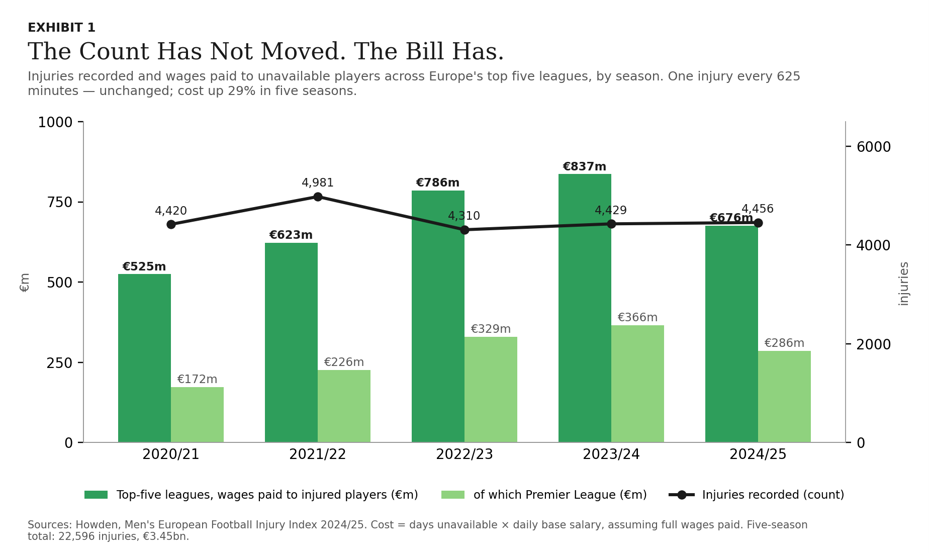
Howden’s Men’s European Football Injury Index counted 22,596 injuries across Europe’s top five leagues over five seasons. The estimated wage cost of players being unavailable was €3.45 billion. The injury rate has barely shifted. One injury every 625 mins. The financial bill has not stood still; it increased by 29% across that five-year period (Exhibit 1).
The injuries are not distributed evenly. Clubs carrying the heaviest fixture demands tend to record more of them. Four clubs sat above the Premier League injury average in every one of the five seasons. Yet the cost of those injuries varies significantly. Manchester City and Liverpool operate with comparable wage commitments, but their estimated injury costs in 2024/25 were €41 million and €15 million respectively (Exhibit 2).
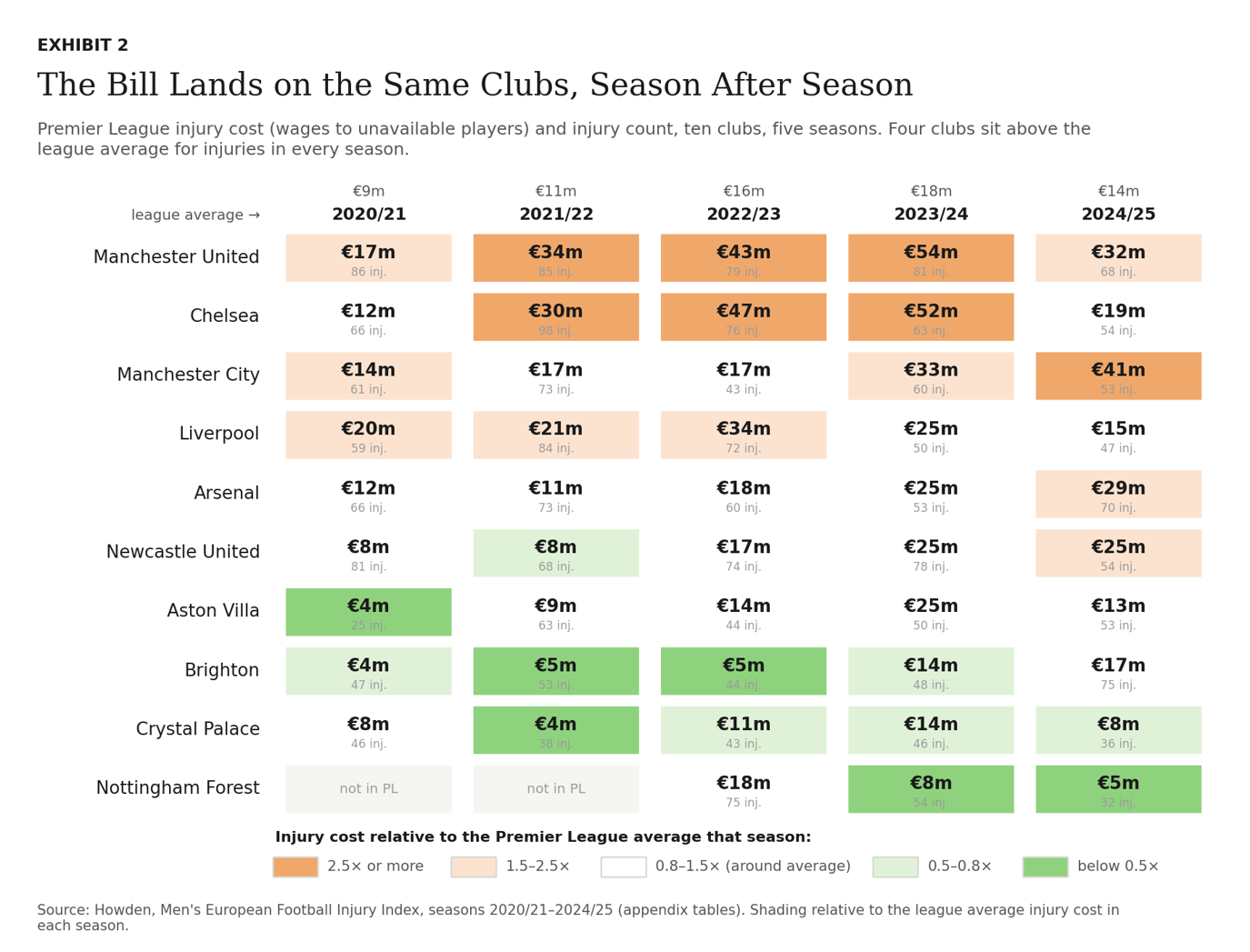
Injury count alone does not explain the difference. Player wage profiles and the type, timing and severity of injuries all matter. But so does the way a department coordinates decisions, progresses rehabilitation phases, manages exposure – and learns from previous cases.
The arithmetic is simple: Cost = days lost × the daily wage of the unavailable player.
The useful question, then, is not whether every injury can be prevented. It is whether a department can reduce avoidable days lost, limit recurrence and prevent a short absence from becoming a long one. Aston Villa halved its injury bill in a year despite recording three more injuries. Average absence fell from 37 days to 15. This is where the conversation becomes uncomfortable.
Elite sport has invested heavily in technology, but that alone has not solved the problem. Teamworks, whose platform sits beneath many elite performance departments, estimates that 75–90% of collected performance data never influences a decision.
More feeds. More dashboards. More alerts. But not necessarily more clarity. And certainly not more organisational memory than the room had a decade ago.
Where AI belongs in the medical / performance department
If injury cost is shaped by human decisions, the strategic question is not simply whether AI can predict an injury. It is where, across the work of the department, AI can improve the conditions in which better decisions are made.
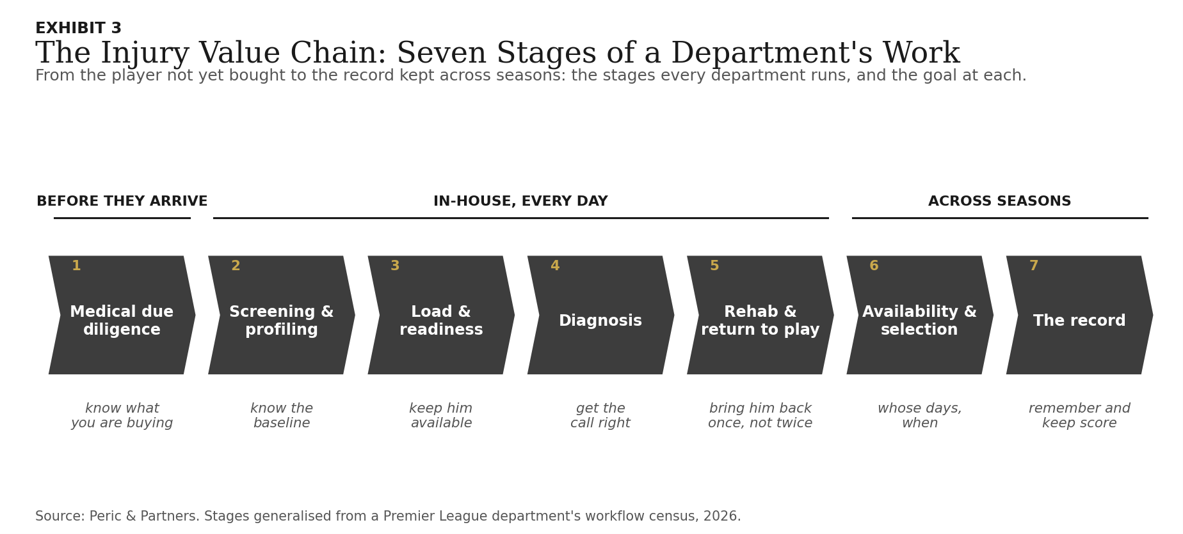
There appear to be approximately seven core stages in a player’s lifecycle, from pre-signing assessment through preparation, availability, rehabilitation, return to play, selection and week-to-week performance (Exhibit 3).
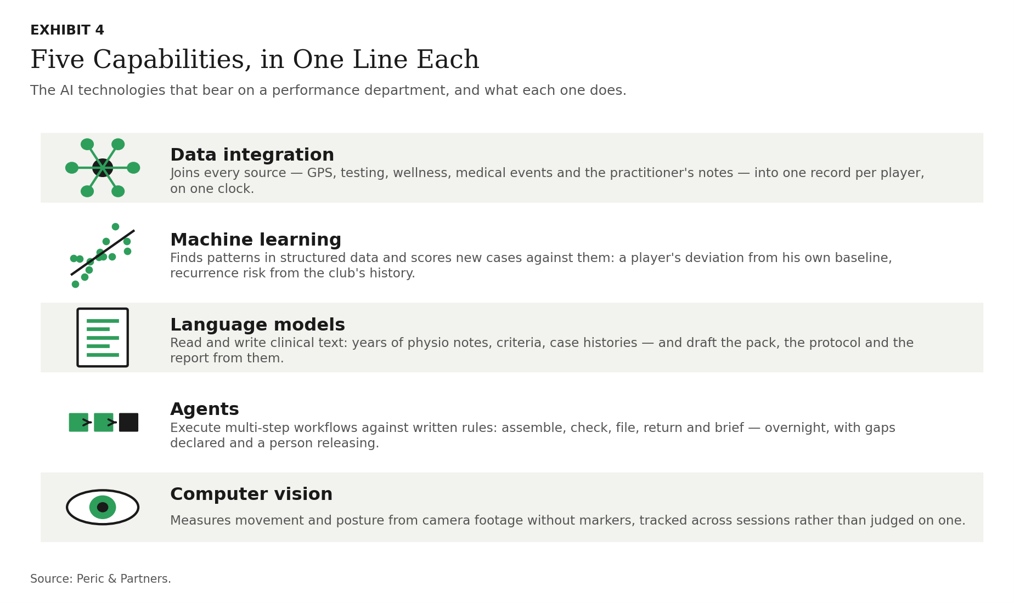
Across that chain, five technology capabilities matter:
They are not interchangeable. They do different jobs, require different controls and carry different risks (Exhibit 4).
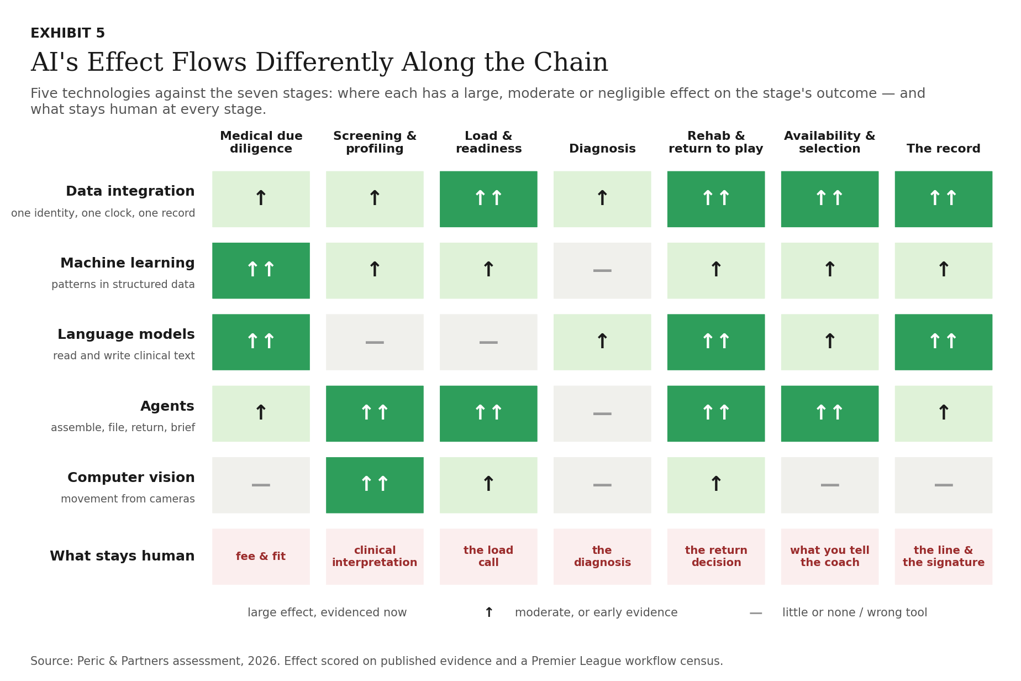
Placed against the seven stages, their value is uneven. That unevenness is the point (Exhibit 5).
Research into AI’s ‘jagged technological frontier’ shows that the same system can improve performance on one task and degrade it on another that appears remarkably similar. In a large field experiment, consultants working with AI completed suitable tasks faster and to a higher standard. Just outside the technology’s capability boundary, however, they were nine percentage points more likely to reach the wrong answer.
In sports medicine, confident error carries a human cost. Summarising a meeting is not interpreting pain. Drafting a case chronology is not diagnosing pathology. Identifying a missing piece of information is not deciding that a player is match ready.
The matrix makes this boundary visible. Data integration, language models and agents have potential around return to play, selection, documentation and organisational memory. Machine-learning injury prediction, the most heavily marketed capability, earns a more cautious place. A first-team squad may experience roughly 50 injuries in a season. That is a small, shifting and highly contextual sample from which to make high-confidence predictions.
AI is often strong in complicated environments where the rules and relationships can be modelled. Injury is complex. The same load does not create the same response in every player, on every day, in every context, at any point of the season. A model can surface a signal and even prompt a better question. It should not make the call. Judgement should never be passed off.
No column in the matrix is empty of people. The technology changes what arrives on the desk – not who carries the decision. Read together, the lifecycle, the capabilities and the matrix point to three opportunities, in ascending order of ambition.
Opportunity one: connect the player’s data to the practitioners
Here is a precondition for everything else. Most clubs have connected parts of the player record: training load, testing, wellness scores, medical events and match exposure. The practitioner record is less connected. Clinical reasoning, return-to-play criteria, changes of plan, and contextual observations are written up in SOAP notes or similar, filed somewhere and maybe surfaced again.
Join both records around one player identity, one timeline and one agreed definition of availability. Then make what has already been written searchable and usable. The challenge is not simply technical. The system needs appropriate consent and permission to read practitioner notes… not merely permission to store them.
Opportunity two: execute the workflows
Once the record is connected, AI agents can complete or prepare routine work. Our task analysis of the rehabilitation stage within a Premier League backroom department identified 22 recurring tasks, consuming roughly 40 hours each week.
Eleven could be produced automatically overnight. Seven could be drafted for a practitioner to review and correct. Two, diagnosis and the return-to-play decisions, should not move from the human. That’s complex terrain.
The prize is not a smaller department. It is approximately a day each week returned to the practitioner. More time with players, more time coaching, more time thinking – and more time discussing the difficult cases.
Opportunity three: reinvent how the department learns
The first two opportunities improve today’s work. The third changes tomorrow’s department.
What if the team recorded what it expected at every major decision point? What if it compared expected against actual at the end of each case? What if similar cases, changes of plan and second opinions could be retrieved in seconds? What if the knowledge of an experienced sports med physician, for example, became part of the department’s memory rather than leaving when that person did?
This is the move from digitising activity to building organisational intelligence and retaining and managing knowledge. It requires more than a new tool or workflow. It requires the will to redesign the week around better systems, not bolt another platform onto an already crowded one.
The importance of strategy
The question most departments ask is, “Which AI tools should we buy?”. What about, “How should our department evolve because AI exists?” That mindset shift matters.
Strategy should begin with a performance problem worth solving. Avoidable games lost to injury, inconsistent return-to-play decisions, excessive admin, or lessons that disappear when a case closes.
It should not begin with a product demonstration. A performance department is a human environment. A wrong call is felt by a player and carried by a practitioner. Adoption must therefore be intentional, governed and connected to the realities of player care and performance.
We recommend five steps, in order, based on recent use case experiences across elite football environments:
Understand how the department works today. Recurring processes, decision points, systems, people, information flows and data gaps.
Compare the department stage by stage against the player lifecycle. Compare its outcomes against an appropriate league and reference set, within the league, and even outside the league/sport.
Decide what to improve first, and which capability is required. Consider the pilot case and how the system will expand once the initial workflow proves useful and gains traction.
Define what AI may produce, what it may only assist and what must remain human-led. Establish the controls around access, consent, review, retention, accountability and escalation. This step is what separates an AI strategy from a technology project.
Track whether the change improves the work. Decide what measures matter, which capabilities the department needs, and how responsibilities, meetings and incentives must evolve.
The jagged frontier must be mapped at task level for each department:
The principle is simple. Automate the task. Augment the practitioner. Never outsource accountability and discernment. That map is not permanent. It should be redrawn frequently, as the tech changes and the department builds its own evidence and relevant use cases.
Five workflows to start with
A credible AI strategy does not need to begin with a moonshot. It can begin with five useful workflows that sit largely inside the frontier, use information the sports med/performance department already holds – and can be piloted within a season.
Produce a concise account of what changed overnight, where each fact came from and what remains unknown. No invented risk score. No automated decision about who trains. Think of this as a shared, sourced starting point for the morning conversation.
Build a living case chronology containing the diagnosis, key milestones, response to loading, changes of plan, criteria, and the rationale behind major decisions.
If the timeline changes, people can see why. If a second opinion is required, the external expert receives a coherent case, not a collection of disconnected files.
Capture decisions, owners, deadlines, unresolved questions and genuine disagreements as the meeting happens. Require the team to review the record before it becomes final. This closes the gap between what the group believes it agreed and what individuals subsequently do.
Draft clinical notes, referrals, rehabilitation updates and other forms of communications at the point of care, with the responsible practitioner reviewing and signing off every record. A 2025 randomised trial found that an ambient AI scribe returned nearly a tenth of documentation time. Across a season, those minutes become hours returned to player-facing care.
Complete an after-action review when a case closes. What did we expect? What happened? Where did the plan change? Which signals mattered? What would we repeat? What would we do differently?
Link similar cases so that a new practitioner can ask, “How have we handled this before?” and receive a sourced answer that will help. That is how knowledge and team IP stops leaking away and starts compounding.
Start small and keep a score
None of this involves pasting player information into a public chatbot. Health data requires approved platforms, appropriate consent, role-based access, retention rules, audit trails and named accountability. Any output capable of affecting care must be traceable to its source and reviewed by a qualified professional.
Start with one workflow. Map the tasks inside it. Define the boundary. Pilot it with the people who do the work. Track time returned, errors caught, and decisions improved. Ask do you trust this. Run an after-action review. Adapt before scaling. This is slow enough to be safe but fast enough to learn.
Remember… AI will not palpate a hamstring. It will not notice the hesitation in a player’s voice. It cannot carry the moral weight of a return-to-play decision. It cannot rebuild trust after a setback. But… it can place the right information in front of the right people. It can preserve why a decision was made. It can return hours to practitioners… give some white space back into a crammed calendar. Free up headspace and offset cognitive load. It can help a department learn from every case rather than simply move on to the next one. Knowledge management.
Several seasons of data suggest the injury count may not change quickly but the days can. The departments that move them will not be those with the most technology and apps. They will be those with the clearest strategy, the strongest judgement, and those constantly monitoring what they are doing.
David Clancy is the CEO of The Nxt Level Group | LinkedIn
Ivan Peric is a Founding Partner of Peric & Partners | LinkedIn
References
Dell’Acqua F, et al. Navigating the Jagged Technological Frontier. Harvard Business School / Organization Science.
Ekstrand J, et al. Hamstring injury rates have increased and now constitute 24% of all injuries: the UEFA Elite Club Injury Study, 2001/02 to 2021/22. British Journal of Sports Medicine, 2022.
Extraction of structured information from clinical notes: International Journal of Medical Informatics, 2025; JMIR Medical Informatics, 2024.
Howden, Men’s European Football Injury Index 2024/25 – five-season review, 2020/21 to 2024/25, including appendix tables by club.
Leckey C, et al. Machine learning approaches to injury risk prediction in sport. British Journal of Sports Medicine, 2025.
Lukac P J, et al. Ambient AI Scribes in Clinical Practice: A Randomized Trial. NEJM AI, 2025.
Task census, chain, matrix and operating-model figures: Peric & Partners analysis of a Premier League performance department, 2026 – estimates, to be corrected against club data.
Teamworks, “The Future of AI in Sports,” citing Dr Robin Thorpe’s survey of elite performance directors.
The organisation has incorporated technology from NeckCare, a wearable head device that measures neck function through sensorimotor exercises and provides insights into the into the return-to-play concussion protocols of athletes at its UFC Performance Institute locations.
Main Photo: Getty Images

Heather Linden, UFC’s Director/Sports Medicine, told SBJ that over the past two years, UFC has collected data from 300-400 athletes, which will be used to establish baseline data on its athlete population’s neck function and inform future assessments.
The impetus behind the collaboration for UFC was to add more objectivity into its head injury assessments.
“It’s very easy to prescribe a knee rehab with — the range of motion is lacking, their peak torque-to-bodyweight [ratio] is this, their isokinetic strength testing is this. It’s really easy to say, ‘You’re not ready to return to sport,’” Linden said. “But in the concussion realm, a lot of times you can’t see the symptoms … By having NeckCare and having that objectivity and showing [athletes], ‘Hey, cognitively you’re performing like this normally and you’re not here’ — that now gives that competitive edge to [athlete] buy-in.”
UFC utilizes two NeckCare devices in the physical therapy clinics of each of its Performance Institute locations in Las Vegas, Mexico City and Shanghai. It uses NeckCare’s range of motion and neck position exercises as a part of its head injury evaluation process, and also for recovery/training purposes, Linden added.
NeckCare CEO Orri Gudmundsson said the primary focus for the company, which went to market about two years ago, is to sell into health clinics, but it also works with multiple NCAA football programs and Twin Cities Orthopedics, which treats NFL and NHL athletes, in addition to UFC.
“If you suffer a concussion, the neck is always involved,” Gudmundsson said. “Cervicogenic [originating from the neck but felt in the head] headaches, cervicogenic dizziness — that’s where we come in with technology that’s been in research and development for more than 20 years, to quantify the function of the neck and how your eyes, your brain and your neck are talking together.”
NeckCare’s devices, which are FDA-listed, price at $6,000 per year. The company overall works with more than 250 providers across North America.
This article was brought to you by SBJ Tech, a Leaders Group company. As a Leaders Performance Institute member, you are able to enjoy exclusive access to SBJ Tech content in the field of athletic performance.
Springbok Analytics’ technology offers the latest develop in preventative health measures for athletes.
Inside, a portable MRI machine needed only 10 minutes to scan the women’s lower bodies, at which point AI algorithms from Springbok Analytics took the 2D imaging and converted them into 3D digital twins that can be used for muscle analysis — establishing baselines that can be used to individualize training and flag latent injury risk.
Unrivaled, the 3-on-3 women’s league that debuted on Jan. 17 in Miami, is the latest league to partner with Springbok Analytics. In the past two years alone, Springbok has collaborated with three of the five biggest North American sports leagues: It graduated from NBA Launchpad; completed data collection on an NFL-funded research project into hamstring injuries; and began the initial phase of an MLB-backed study into pitcher health.
Now boosting Springbok’s rapid growth across pro sports and into broader populations is a newly closed, oversubscribed $5 million Series A led by Transition Equity Partners , which also led a $3 million seed round in 2023. Joining the investment were the NBA, which added to its initial equity stake from Launchpad, and Cartan Capital , a sports tech venture firm led by former pro tennis player CiCi Bellis .
“This is a clear sign that our current and new investors are excited to see us scale all aspects of our business,” Springbok CEO Scott Magargee said, “and from a dollars-in-the-door perspective, it allows us to advance what we believe is our global leadership in the area of muscle analysis for large demographics of athletes and patients across the entire health care landscape.”
The interactive reports Springbok produces are musculoskeletal avatars shaded various hues of red, orange, tan and blue that detail muscle asymmetries, fat infiltration and a proprietary score comparing a person’s muscle size with others of similar sex, size and sport. Springbok recently released sport-specific databases for men’s pro basketball and soccer athletes — a women’s soccer counterpart is planned soon — for more apt comparisons. It received FDA clearance in October on its flagship lower-body scan, and added core and upper-body scans to what previously was lower extremity only.
Such a tool is even more important when the athletes are such physical outliers as in the NBA. More than 100 players are in that database, and in addition to partnering with nearly half the league’s teams, Springbok continues working at the league level during the pre-draft process.
“Their work with us proved that this is a really interesting new dataset in elite sports,” said NBA Senior Vice President Tom Ryan , who oversees Launchpad and all basketball R&D. “Springbok data is starting to become an important piece of the puzzle to help support player health and performance initiatives. That’s really the story: It’s very strategic for us, both at the league and team level.”
The continued strategic relationship helped facilitate the additional funding, NBA Investments Associate Vice President Pat Crouch added. “First and foremost, for companies that come out of the NBA’s Launchpad program, we look for follow-on investment opportunities when there is a continued strategic relationship. We only invest in companies where there’s some type of commercial partnership, at either the league or the team level, that has gained meaningful traction and has upside to continue to grow and expand.”
Notably, Springbok has no true competitor and a 15-year head start on understanding the use of this data, making it “a piece of the puzzle that nobody else is,” said Magargee.
“The fact that our expertise is the technology, but also in human performance and muscle physiology, we know where to keep going with it in a way that’s meaningful,” said Silvia Blemker , Springbok’s chief scientific officer. She added that one recently devised new metric is an objective injury severity score, which can quantitatively assess a strain or sprain rather than rely on a human practitioner to subjectively evaluate it.
Though Springbok Analytics’ work in sports has intensified in recent years, the foundational technology has roots dating back to 2009 and Blemker’s biomedical engineering lab at the University of Virginia. The company’s headquarters remain in Charlottesville, sitting in a nondescript office at one end of its pedestrian-friendly Downtown Mall. Springbok’s dual recognition in 2024 from SBJ Tech — as a Most Innovative Sports Tech company and SBJ Tech Award winner for Best in Athlete Performance — prominently greets visitors.
In those early days, Blemker was working on solutions to aid treatments of cerebral palsy and muscular dystrophy when the lab began developing the machine learning to extrapolate 3D data from MRIs. Those life science use-cases remain a part of Springbok’s mission, while also adding the human performance sector that makes it a highly differentiated product appealing to investors.
“Not only do we really believe in the team, but the technology, we think, is pretty unprecedented, especially with the years of R&D,” Bellis said, “and then the beachhead that they’ve had into the sports market is super interesting, because they can really instantly provide value to these sports teams and instantly give them money back, so to say, by having this preventative health measure for athletes.”
That expediency of the scans — much quicker than what’s needed for traditional MRIs — has helped Springbok amass its large elite athlete databases, including a thousand college and pro American football players, Blemker said. Those were collected to build a hamstring injury predictive index in collaboration with researchers at the University of Wisconsin and Australian Catholic University, and funded by a $4 million grant awarded by the NFL’s Scientific Advisory Board.
It’s that rich dataset, as much as any algorithm or an investment check, that is sparking Springbok’s growth — and the same competitive advantage will only continue to grow the same way it started.
“It’s taken us time,” Magargee said, “and it’s taken us partnerships.”
This article was brought to you by SBJ Tech, a Leaders Group company. As a Leaders Performance Institute member, you are able to enjoy exclusive access to SBJ Tech content in the field of athletic performance.
The pilot program will see biomechanics labs installed at the the Cavaliers, Jazz, Pacers and Suns.
The protocols, as explained in a league-wide memo in January, have been developed in consultation with the NBPA as well as sports medicine and performance experts. Provisions for such a screening program are codified in the current collective bargaining agreement, requiring players to participate in up to four assessments per season.
“It’s one of several major initiatives that we have in the works, including with the Players Association, to try to reduce injuries in the league,” NBA EVP for Operations & Administration David Weiss said, emphasizing its scope and ambition by adding, “We’re not aware of anything quite like this league-wide in the world.”
Planning for this project began long before a perceived uptick in the injury rate over the past year, but it remains set against the backdrop of ongoing conversations around appropriate load management and player participation policies.
The NBA is now in the process of installing biomechanics labs with four pilot teams: the Cavaliers, Jazz, Pacers and Suns. The goal is to have identical setups, with the same technology vendors and the same prescribed athlete motions, to ensure standardized data collection.
The four tech companies that won the league’s RFP are:
P3, a private facility that independently has evaluated the biomechanics of roughly 70% of current NBA players, will work with the league as a consultant to the program. The NBA first hired P3 to assess prospects at the draft combine in 2014. Individual teams can also contract with the firm for additional insights and normative data.
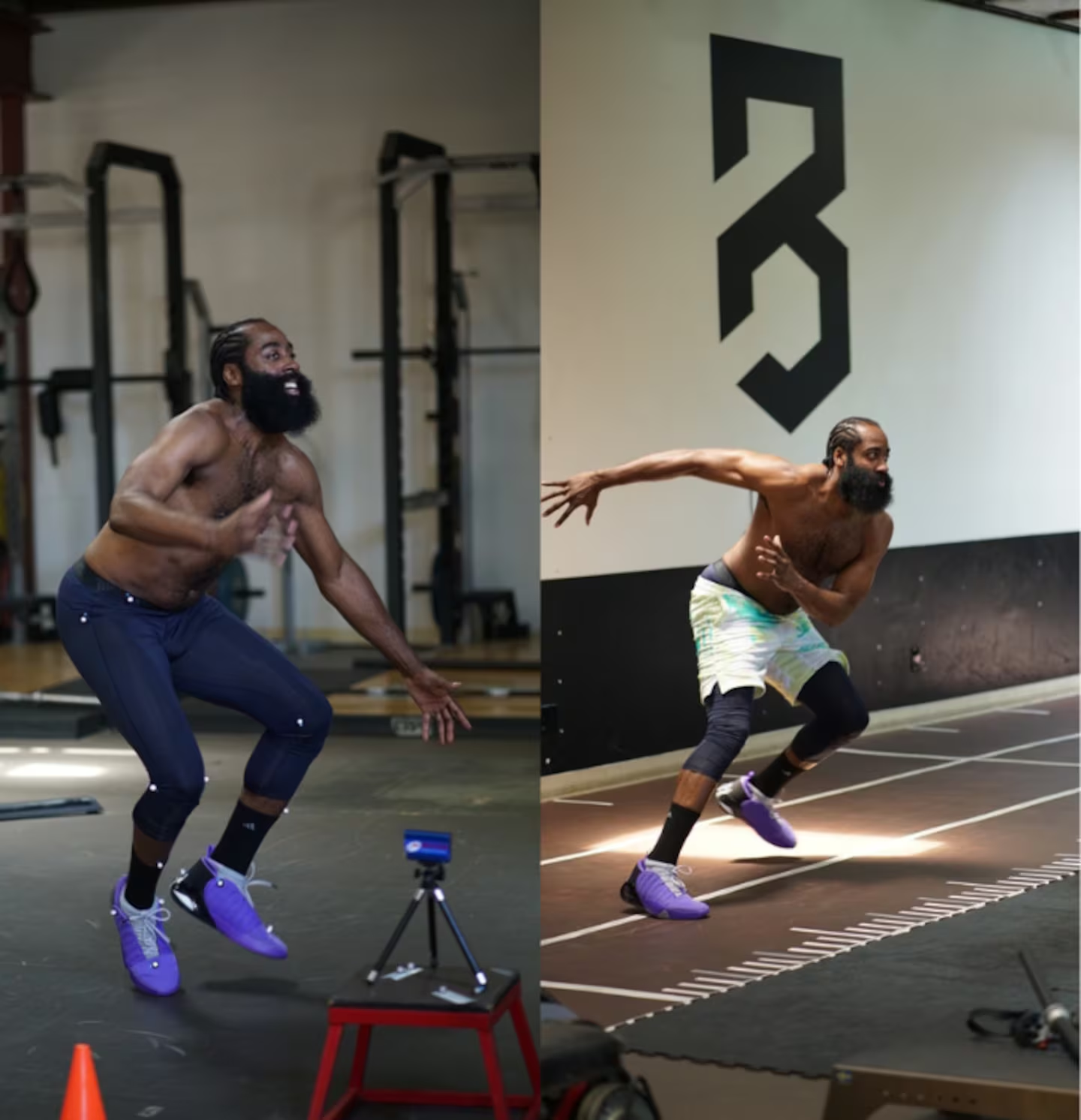
Image courtesy of P3.
“This relationship between how we move and what happens to us is a strong relationship,” P3 founder and director Marcus Elliott said. “It’s stronger than most people realize, which is why we invested all this energy into all of it. And the more we can start actioning that — and not just waiting for bad things to happen — the better it is for everyone: for the players, for the teams, for the league. I’m super bullish on the potential of biomechanics to make lives better and for us to follow these signals.”
Access to the data collected in these biomechanics evaluations will follow similar guidelines to how the NBA handles medical records. Players have full access to their own reports, which they will retain even as they change teams. Coaches, executives and performance staff will be able to see data for players currently on their rosters. Weiss indicated MDs and PhDs conducting vetted research will also be to connect the data with injury information for studies on potential risks.
One source noted a “vast discrepancy” in the way franchises have utilized biomechanics data to date, praising this new program as a way to ensure consistent, efficient and accurate assessments. Some teams have been investing in biomechanics for years while others have yet to allocate any resources toward it. By implementing his program across the league, the NBA can collect in one year as much data as any team could collect in 30 — hastening the pace of understanding what correlations exist between movement and injuries.
Deployment of this program, which is scheduled to last at least through the end of the current CBA in 2030, has been measured to make sure it is properly communicated and rigorous. Evaluating success will take time, too.
“Certainly whether we can reduce injuries long-term or a particular type of injury — that’s going to be one of [the KPIs] — and whether we can connect certain movements or certain changes in the way an individual moves to injury,” Weiss said.
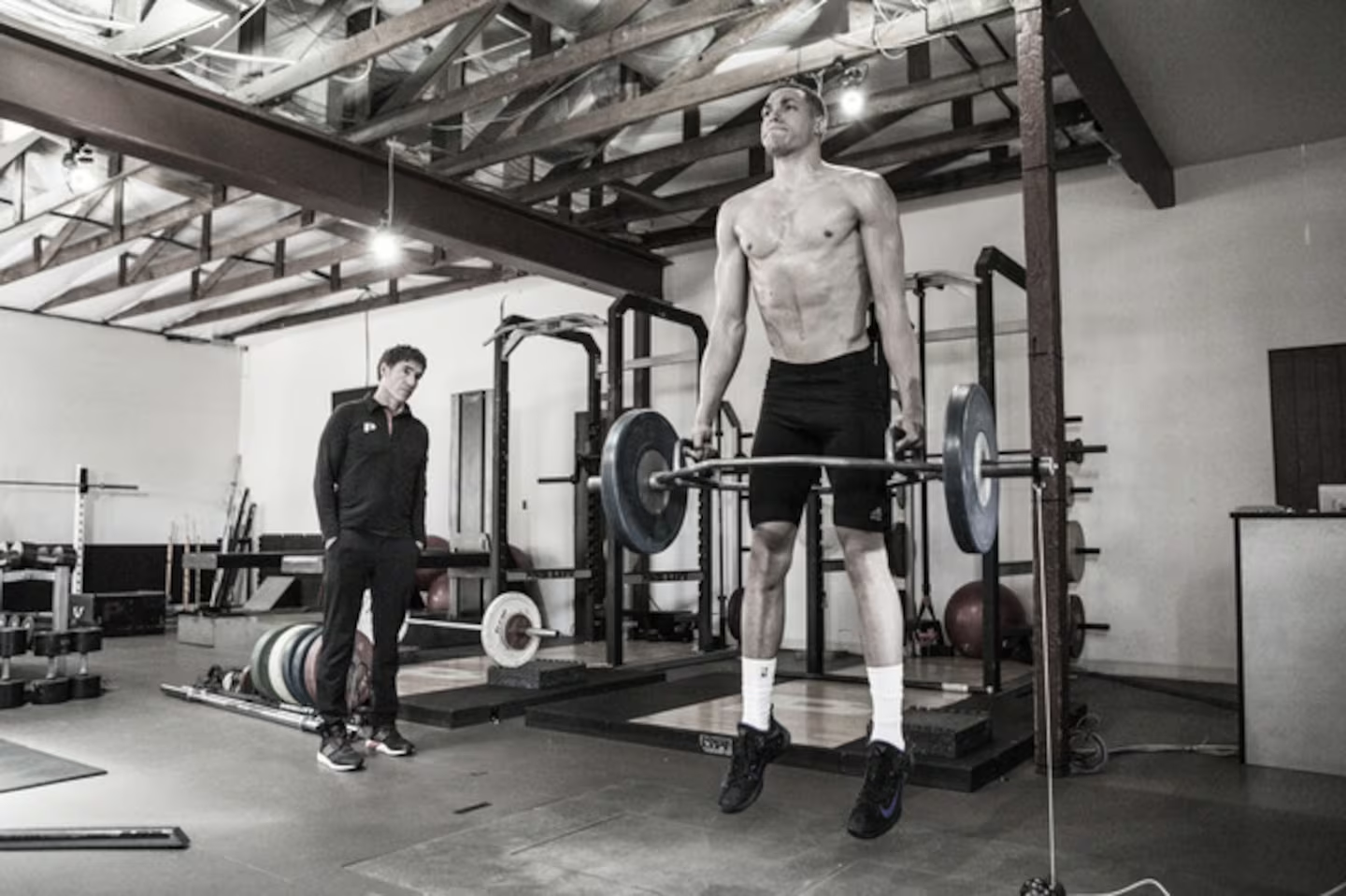
Image courtesy of P3.
Though the NBA’s in-game tracking system — powered by Sony’s Hawk-Eye — is camera-based and collects data on limbs and joint angles, that solution is only nominally a tool for rigorous biomechanics. Sony’s recent acquisition of KinaTrax, the leading baseball biomechanics technology, might help in the long run, but the current in-game tracking system doesn’t have the same fidelity the new lab-based system will provide.
There is a consensus that biomechanics might be an especially helpful tool in a sport like basketball “that certainly requires you to be a pretty impressive, high-flying athlete,” said BreakAway Data CEO Dave Anderson, a former NFL receiver. “The game is played well above the rim in the NBA, so jumping and your ability to land are critical to your career.”
Weiss added that experts with whom the league has conferred, including on its two biomechanics committees, point to “a number of factors — the size of players, the nature of the game, the number of games in the season, the hardcourt surface — that there’s reasons to think about biomechanics could be as helpful in basketball as almost any sport,” he said.

Image courtesy of P3.
These lab assessments are expected to take about 15 minutes, following a pre-scripted set of “motions that are directly applicable to their sport and health,” Theia CEO Marcus Brown said, describing his company’s software as “an accessible tool that also enables standardization within a vast data set. As a generalized neural network, Theia3D doesn’t require additional data for unique movements, environments or outlier athletes.”
It’s a highly technical distinction, but an important one: other motion capture solutions compare movement to various models, which can add to discrepancies when analyzing data from different sources and different seasons. “Having consistency in data collection over a long period of time on a big group of people is just something that I know our customers are looking for,” Qualisys product manager for life sciences Nils Betzler said, praising the “unified approach.”
“They’re really doing a tremendous job trying to better understand player biomechanics, player movement, and overall player health,” added Anderson about the NBA and NBPA. “They’re really trying to use science and numbers and research to make sure that the players are playing at the highest level. And I really appreciate that because a lot of these leagues are just adding games, changing roster sizes, and changing rules, and they just assume the players will figure it out. The NBA is taking this player-first initiative, and that’s just really cool to see.”
This article was brought to you by SBJ Tech, a Leaders Group company. As a Leaders Performance Institute member, you are able to enjoy exclusive access to SBJ Tech content in the field of athletic performance.
Project leads Anna Warren and Tham Wedatilake discuss the factors that enable Insight 360’s data-led approach to athlete management.
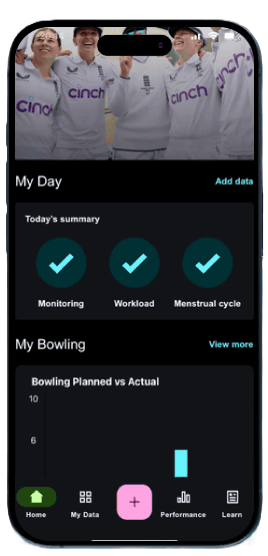
Insight 360 is a data-driven approach to performance management and athlete monitoring. It was launched in February 2024 by the ECB in collaboration with Ascent, their digital services provider, and includes an app for players (to view their data), a dashboard for practitioners (to view data across the board), and a portal that practitioners can use to input data.
“When you see the little research that’s out there, you’ve not got much to hang your hat on,” said Anna Warren, the Head of England Women’s Science & Medicine, at November’s Leaders Sport Performance Summit in London. “We’re using this platform to better understand in depth the female cricketer; what they look like from the academy through to the international cricketer.”
The rollout has been a success and, as the ECB launches phase two (the wider introduction of injury data and more sophisticated use of match data), we highlight the factors that led to its sport-wide take up.
It reflects the concerns of players
Insight 360, as the name suggests, represents a holistic approach to collating athlete data. There is a focus on availability and performance, but there is also a focus their health, home life, and career progression. “Players come to us and discuss their issues quite openly,” said Dr Tham Wedatilake, the Lead Physician for England Women’s Cricket, who joined Warren onstage to discuss the project. “They want to perform without any barriers.”
It is a co-designed platform
Ahead of the launch, the ECB gathered input from practitioners and coaches across the English game. “This means Insight 360 is bespoke for women’s cricket,” said Warren. Players, she said, are happy with an app that allows them to review their own data in as much detail as they like. “This is good for player buy-in, which is always a challenge in relation to athlete monitoring.”
 There is also the power of a co-designed project. UK Sports Institute have found as much with their Project Minerva. Dr Richard Burden, the UKSI’s Co-Head of Female Athlete Health & Performance, said: “Get the practitioners involved, get athletes, get the teams and bring them along with it because if they’re onboard you get easier access to them and you’re going to produce something that’s more translatable, meaningful and applicable to them.”
Warren is on the same page with Insight 360. “You can link loads of different data sources together and start to answer some key performance questions – we’re not looking at everything in isolation.”
It provides a single source of truth
Collaboration can be easier said than done. “When you have so many people pull data together it becomes almost impossible for the human brain to comprehend and then deliver effective, unbiased solutions to players’ needs and expectations,” said Wedatilake.
Insight 360 is the single reference point and it provides continuity. “As soon as one person leaves and another is working with the players, that record gets lost,” said Warren. “We’re really trying to create a joined-up system.”
It is future-proof
Wedatilake explained that Insight 360, as part of its next phase, will include injury data. He said: “It will be a game-changer for us in terms of load and injury risk and other factors such as the menstrual cycle and wellness.” The platform is primed to integrate future sources of data.
He does, however, also temper his excitement with a note of caution. “We didn’t want to get greedy too early,” he added. It was critical to have the right structure and means of integration before adding different elements, whether they are rooted in stats or video.
One of the next steps is further automation, particularly with regards to match data. “That’s the beauty of this system,” said Warren. “It’s so much quicker for people.”
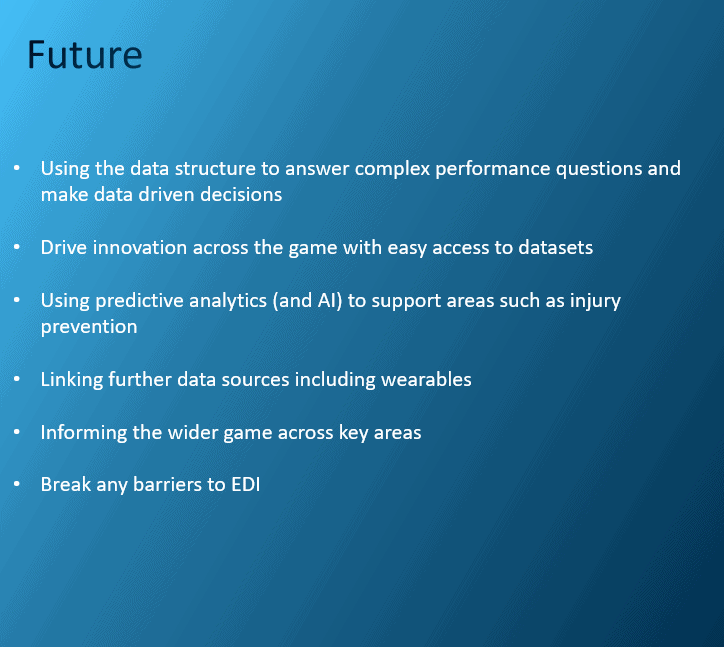
She and Wedatilake wrapped up their presentation by setting out their ambitions for Insight 360:
Lachlan Penfold, the Head of Performance at the Melbourne Storm, describes his conversion at the sight of one of the NBA’s greatest players enjoying what he does. It’s rubbing off on his current work in the NRL.
A podcast brought to you by our Main Partners

Chief amongst them was his realisation that joy is crucial in a high performance environment.
“Joy in a professional sport? That’s a bit strange,” thought Penfold, but it was one of the team’s trademarks and no-one embodied it better than their Head Coach Steve Kerr and illustrious point guard Steph Curry.
“The player that embodies it better than anyone in world sport is Steph Curry in terms of just the absolute joy he gets from playing the game, from training the game,” Penfold continues, “not only from his perspective, but from seeing his teammates have success and do great things, the joy that he gets really invigorates a sporting team.”
It has fed into his work with the Melbourne Storm, who reached the NRL grand final in October. No doubt they’ll go again in 2025, inspired by the family environment described so vividly by Penfold [10:00].
We also spoke about his approach to training and recovery [17:30] and the importance of individualised work [22:30]. Last up, we discussed the year ahead [28:10].
Listen above and subscribe today on iTunes, Spotify, Stitcher and Overcast, or your chosen podcast platform.
The double world champion also spoke about how she uses data monitoring in her daily life and the new series of the podcast she co-hosts with USNT teammate Tobin Heath.
A Data & Innovation article brought to you by
You can’t have a discussion about sports technology today without including athletes in that conversation. Their partnerships, investments and endorsements help fuel the space – they have emerged as major stakeholders in the sports tech ecosystem. The Athlete’s Voice series highlights the athletes leading the way and the projects and products they’re putting their influence behind.
* * * * *
After tearing her ACL in June 2022, Press required four surgeries and an arduous recovery. She returned to her first training session in early June, after which she spoke to SBJ about her rehab and the new season of her podcast. Along with Tobin Heath, Megan Rapinoe and Meghan Klingenberg, Press founded a media and lifestyle brand called RE—INC in 2019. She and Heath are the co-hosts of the The RE-CAP Show podcast, which returned for its third season on June 13. The first episode includes appearances by USWNT legend Abby Wambach and author and podcast host Glennon Doyle.
On returning to the pitch…
I am currently in the car driving home from my first training. I would say the road to recovery happens very slow, and then yet it happens all at once. I have been back in the team environment for almost four months. So it’s been a long time that I’ve been integrated into the environment, and it took four months for me to get ready to be in a warmup and a passing pattern — really simple, basic stuff. And I felt very ready for it. I felt almost underwhelmed by how easy it was because I’ve done a lot more complicated things, and yet it was also entirely overwhelming and joyful to be so connected to my teammates and be celebrated in the way that I have been these last two days.
I’m very grateful for that. They say it’s the hope that kills you, and as I drive home, I just have this big smile on my face because I can’t help it. I can’t help hoping. I can’t help believing that I’m going to make it back, and it’s going to be everything that I see in my head. I’m relentlessly optimistic, I’m naively positive, and I like that about myself, and I don’t intend to change it. I think the way that it left me feeling was just like, yes, I can do this.
On monitoring her rehab…
I’m a person of devices, so I have quite a toolkit, I’d say, of ways that we’re tracking and measuring. The truth is we’re really still working through issues with my knee, and I have chronic scarring of the knee, so I can experience some discomfort and some swelling that could lead to more scarring, which is incredibly rare, because most people don’t scar after a couple months after their surgery. I’m now over nine months for my surgery and still at risk of scarring. So it just means that I have to try very carefully with how much impact my knee can take.
We’re being careful, but we’re progressing. In terms of my overall fitness, what my GPS has said is that I’ve got to like 60% of a match load, which is all that I really need to get in terms of volume. And yet, in the warmup and the passing pattern today, it felt like I played a 90-minute game. I was so fatigued. There’s training, and then there’s really training. There’s no way to get fit for football, except for playing football. And I’ve done a ton of running, I’ve done a ton of lifting, and now it’s time to play.
On how deep she gets into data…
My performance staff would laugh because they said they’ve never worked with a player that cares so much. So right now, I wear a Polar Watch that I was given in like 2015 from the national team. It’s just old school. And I wear my Apple Watch, which is connected to my GPS so I can see all my data live, from heart rate to distance to speed to all that. And then I do sleep with an Oura ring — although I’m not endorsing any of these products, I’m not connected to any of these products — but I do sleep with an Oura ring and track my sleep and my stress levels.
On season three of the podcast…
Our show really is about authenticity, and it’s about creating a more inclusive space for sports and including diversity of perspective. And so that means we have hard conversations, and we have honest conversations and we have vulnerable conversations, and we have a lot of fun — the same spirit and joy that you saw last year during the World Cup edition of the show. We’re back, and we’re bigger than ever.
On the origin of the creating the podcast…
I never thought I would be in media. I think that’s even more true of Tobin. There’s two typical paths for athletes after soccer, and it’s coaching and broadcast. ‘So Christen, do you want to be a coach?’ ‘No.’ ‘So Christen, then you must want to be a broadcaster? I was like, ‘No.’
That’s an interesting part of the story, but first and foremost, we decided to launch this show as current and active players, and that’s unique and different. It’s not really a stepping-back-from-soccer thing. It’s current players trading stories and having a little bit more space to dictate the narrative.
And then secondly, we really approach this as business leaders. This is our business, this is our company. We are a 3C company: content, community and commerce. The most amazing thing about women’s sports is the community, and we’re trying to build the coolest women’s sports community in the world in our membership, and we’re feeding that with amazing content.
And I think because we have such an authentic and vulnerable relationship with our audience that we’ve developed over the last five years that we’ve been building this business, it made sense for Tobin and I to be our first piece of content that was really more large scale and more widely accessible. But the plan will be to find like-minded people that sit at the intersection of sports, progress and equity, to continue to hear stories from an insider’s perspective. It really disrupts the industry in that way.
On topics they plan to cover in season three…
We’re going to be talking about women’s health, particularly in sport, which is obviously a really hot topic, and representation in sport — how we make it more diverse and equitable for more people, be it across the gender spectrum, the orientation spectrum, across different races and classes. I think that’s incredibly important. Soccer in America is an upper-middle class sport, and almost everywhere else in the world, it’s a very accessible sport that’s found on the street. That’s really the spirit of football, so that’s really important to us.
On the role of athletes as activists…
The interesting thing about the community that surrounds women’s sports in particular is they care about a lot more than the sports, and the values transcend beyond the pitch. And that’s about diversity, inclusion, progress. And I think that’s just inherent because it is disruptive in itself to see women embodied, powerful, unapologetic and also very celebrated the way that you do in the professional sports world today. The people that it’s drawing in are the same people that want to march, and they want to create change and they want to stand up for what they believe in.
It’s so embodied in the Angel City culture. The professional team that I play for has just nailed it. And when you’re in the stadium, it’s electric, and win or lose, it’s a different type of vibe than any other sports arena I’ve been in because there’s a connection point for all of the audience. They care about more than the X’s and O’s. They care about what we represent to them, the progress and the opportunity that we as women athletes represent.
On the versatility of women athletes…
It’s always been that way in women’s sports, and it’s just becoming more popularized. I think the expectation is that we would always be multifaceted as women and expected to do multiple jobs in multiple roles, if we were going to have careers. And so it really did take to me and my personality to be a player and also be a leader off the field, on the US women’s national team, going through the Equal Pay lawsuit, going through the reestablishment of our players association.
For me, it was such a balancing sense of purpose that I continue to create space in my life for that, and I think that’s what we’ve done with our business, RE—INC. RE—INC is reimagined, incorporated. We set out, in 2019 when we started this company, to reimagine the status quo, to reimagine the way women are seen and experienced in sports. And it’s a very bold and ambitious goal, and we do it in a multifaceted way. And I’m really, really proud of that.
This article was brought to you by SBJ Tech, a Leaders Group company. As a Leaders Performance Institute member, you are able to enjoy exclusive access to SBJ Tech content in the field of athletic performance.
