Andrea Hudy is one of the individuals posing those questions, as UConn’s Director of Sports Performance for women’s basketball tells The People Behind the Tech podcast.
A Data & Innovation podcast brought to you in collaboration with

She returned to action in November 2023 after 15 months out and drove UConn all the way to the Final Four of the NCAA Women’s Basketball Tournament.
Behind the scenes, Andrea Hudy, the Director of Sports Performance (Women’s Basketball) at UConn, was critical to Bueckers’ convalescence and is working (while pursuing a PhD) to ensure there are fewer such occurrences in the future.
“My passion is trying to understand why people get hurt or the story behind their injuries and keep them strong and resilient for what’s unexpected or the challenges ahead,” she tells The People Behind the Tech podcast.
Andrea speaks from her own experience of injury as a varsity volleyball player. Indeed, when anyone says she “played without an ACL” for six years – as Andrea told Joe Lemire and John Portch – it makes you sit up and take notice.
In the first episode of this new series, we discuss the questions that still need to be asked about female injury occurrence rates [18:00]. We also touch upon Andrea’s career in college athletics, which took in tenures at Texas and Kansas before she returned to UConn three years ago for her second spell [8:40]. Then, we broach her willingness to experiment with new technologies while concurrently seeking better insights from existing datasets [11:40]. Finally, she tells us why she can occasionally see herself as a modern, real-life Icarus [26:30] and much more besides.
Listen above and subscribe today on iTunes, Spotify, Stitcher and Overcast, or your chosen podcast platform.
Ryan Alexander of Atlanta United came on the People Behind the Tech Podcast to discuss understanding the demands of the team, player profiling and brain training.
A Data & Innovation podcast brought to you in collaboration with
“Understanding how the physical demands and fitness is going to be interpreted on the field as it is going to relate to the technical and tactical execution of a certain style of play.”
Alexander, the Director of Sports Science at Atlanta United, was speaking to John Portch and Joe Lemire on the People Behind the Tech podcast ahead of the new MLS season, which began in late February.
He also spoke about the club’s groundbreaking work with i-Brain Tech, a neurofitness training aid that has transformed their skills and cognitive training and led to players having “higher levels of conversations with their technical coaches”.
Elsewhere, Alexander explored:
Listen above and subscribe today on iTunes, Spotify, Stitcher and Overcast, or your chosen podcast platform.
Rugby union’s world governing body has teamed up with Prevent Biometrics to help monitor and protect players across the globe.
Main image courtesy of World Rugby
A Data & Innovation article brought to you by
The sensor-laden mouthguards track linear and angular accelerations, and when a rugby player endures a blow in excess of designated thresholds, an independent medical professional on the sideline receives a Bluetooth alert. That athlete then enters the HIA protocol to be evaluated for a possible concussion and needs clearance for return to play.
The new HIA policy won’t officially go into effect until January 2024. Participants in the international women’s rugby tournament WXV, which took place in October and early November, trialed the technology. World Rugby is also investing $2.4 million into facilitating the universal adoption of the mouthguards.
“It’s a game changer for our sport — it’s bringing tech into the space where it never has been,” World Rugby chief medical officer Éanna Falvey said, noting the overarching mission is to track each athlete’s overall impact load. “The focus of this is about individualizing care.”
Mouthguards are widely seen as the most accurate solution for impact measurement because the upper jaw is affixed to the skull. Prevent Biometrics outfits athletes across multiple continents, sports and age groups with World Rugby having used the technology extensively over the past three years. The instrumented mouthguards are worn in both training and matches in an effort to collect data not only on diagnosed concussions but also the cumulative impact of sub-concussive blows — the accumulation of sub-concussive hits are the most likely culprit of potential long-term damage such as Chronic Traumatic Encephalopathy (CTE).
The sport’s governing body has funded studies conducted by independent researchers at a number of academic institutions, including New Zealand’s University of Otago. Roughly 600 community rugby players in that country, from the Under-13 age group on up through adults, began wearing Prevent Biometrics wearables in 2021. A year later, the devices were offered to all elite English rugby players and all women competing in the Rugby World Cup that took place a year ago.
In all, Falvey reported that World Rugby has collected data from roughly 300,000 head acceleration events. (Across all sports, Prevent Biometrics has collected more than a million impacts.) That dataset is beginning to inform guidelines for the typical frequency and severity of collisions in the sport. He said 60% of those impacts are under a force of 20g, which Falvey described as not much different than normal physical activity.
To start, World Rugby has set alert thresholds at 70g for linear accelerations for men and 55g for women while the trigger for angular acceleration is 4,000 radians per second-squared for both. Falvey said that, of the roughly 80,000 head impacts per match for all players in an elite rugby game, only 0.3% are above that threshold in men’s matches and 0.08% in women’s matches.
For context, he said that equates to about one additional HIA protocol per men’s match that wouldn’t have already been initiated due to other symptoms — importantly, this new technology is meant to supplement what’s already in place.
“If we set a threshold where there are 10 alerts per game, basically, you’re going to have 10 different players removed, the majority of those will not have any clinical manifestation, will pass their test and will go back on again,” Falvey said. “So very quickly, you’re going to have a group of people who become disenchanted with the process and don’t want to engage with it any longer.”
Prevent Biometrics, whose technology was spun out of research from the Cleveland Clinic, processes the data on the mouthguard — “on tooth,” as Falvey described it — meaning an alert would reach the sideline in less than five seconds because there’s no need for it to be transmitted to the cloud first. The speed is important because research from the University of Pittsburgh Medical Center has indicated that, for every 15 minutes an athlete remains in competition after a concussion, the duration of his or her absence before returning to play is extended by three days because of worsening symptoms.
The mouthguard itself isn’t making the diagnosis but helping identify athletes who may be in need of proper evaluation.
“We’re never going to be in a position where you have something like an instrumented mouthguard telling you about concussion,” Falvey said. “But what you will be in a scenario is, I think, you’ll be able to say, here’s a threshold for your age, and for your concussion history and for your previous injury history that, for you, if you get if you get an impact above this level, you should sit it out.”
Prevent Biometrics CEO, Mike Shogren, said continued the latest iteration of the product have followed the simple remit that head impacts “had to be accurate, and the data had to be accessible as fast as possible.” The company raised $5 million in early 2022 to help develop the 2.0 version of the mouthguard, which has a 60% smaller profile than its predecessor and is better able to discern when the device is properly placed to get the most possible information.
“False positives are the biggest distractors of good datasets, and we realized — and it took us an extra two years to get it right — we have to have really good understanding of when this is on your teeth and when it’s not,” Shogren said.
Prior to the last men’s World Cup in 2019, World Rugby began requiring competing nations to create a load passport for each participant, to ensure proper monitoring of player welfare. This new HIA policy stipulates that all elite rugby players wear the instrumented mouthguards, which includes about 8,000 athletes. But Falvey noted that some 8 million play rugby at various levels, and the hope is this safety provisions permeate downstream.
At a recent meeting with experts, including those from BU’s CTE Center in how contact sports can effect neurodegenerative change, Falvey said there was some range of opinions on the severity of certain risk factors, but there was one overwhelming consensus.
“What all eight of the speakers said was, ‘Limit the number of head impacts that occur in your game,’” he said. “That was very encouraging for us, because we’ve spent the last three years working on how we could accurately measure that. Now that we know we can accurately measure it — you’ve got to measure it, to change it. And our job now is to provide the game with the data it needs to actually change that profile.”
Smith’founded Crux Sports, a consultancy for women in sports, with a view to grow women’s football and give females the support they need whether in the boardroom or out on the field.
A Data & Innovation article brought to you by
You can’t have a discussion about sports technology today without including athletes in that conversation. Their partnerships, investments and endorsements help fuel the space – they have emerged as major stakeholders in the sports tech ecosystem. The Athlete’s Voice series highlights the athletes leading the way and the projects and products they’re putting their influence behind.
* * * * *
Rebecca (Bex) Smith is among the most connected people in women’s soccer. She captained teams for Duke University, Vfl Wolfsburg and the New Zealand national team, competing with the Football Ferns at two World Cups (2007 and 2011) and two Olympic Games (2008 and 2012). Smith also played professionally in Sweden and Germany before her career ended in 2013 due to a knee injury.
Smith, now 41, went on to work at FIFA for nearly five years as Competitions and Event Manager for all FIFA Women’s World Cups — the flagship event as well as the Under-17 and Under-20 versions. She went on to become the Global Executive Director of the Women’s Game at Copa90, a podcast host co-produced by the BBC, UEFA venue director and now Founder/CEO of Crux Sports, a women’s sports consultancy. In May, Crux Sports published research, in partnership with YouTube, on the value and impact of DAZN making the Women’s Champions League available for free on the social streaming platform.
She earned three degrees, speaks four languages and is either a board member or advisor for numerous companies and programs, including AI-powered injury risk platform Zone7 and the Isokinetic Conference, the largest football medicine conference in the world. Smith will also co-host the daily morning show for Australian broadcaster Optus at the upcoming Women’s World Cup being held in Australia and New Zealand.
On what she’s building with Crux Sports . . .
My company was born out of the fact that I had a very diverse background coming from playing to then governance and managing one of the biggest women’s sporting event on the planet to then going into media content production to then working with big brands to doing branded content and working with athletes. So I really just wanted to have a place where we could help all stakeholders so whether it is brands or governing bodies or content production or athletes themselves to either get into the women’s game or to help fuel it.
So it’s really about driving sustainable positive growth into the women’s game, but then helping stakeholders to increase their bottom line or to work on their marketing or figure out their strategies for integrating women’s sports and female athletes into their propositions as well. So it’s very diverse. I work with YouTube and Google and helped them do a research project, all the way to Champions League to working with big brands like Xero on their partnerships with the FA or FIFA to working with on content production or working with athletes directly, helping them work on their post-career transition and maximizing their commercial opportunities during their career.
On her interest in player health and wellness . . .
It comes from my own experiences in football and sort of more negative experiences, I would say, throughout my career where I found that there was a lack of support. Despite the fact that I had three degrees on the side and was trying to work at the same time — because I was trying to just set myself up for post-[playing career] — I still felt really unsure, insecure, going into that post-career, post-football life and having to do so with a really bad injury. I hurt my knee, and then it was not very properly looked after at my club. And I was continually playing on a very swollen knee. And in the end, I can’t run anymore. So for me, it was really important.
When I was at FIFA, we did a whole medical study on the athletes and players, and what their medical setups were. And in the end, we couldn’t publish it. So I gave it to my buddy at FIFPro. So they did the very first employment study. So it was based off of a lot of the data and research that we had done. And yeah, it’s just really about trying to better the situation for the next generations. And it sounds so hokey, and so cliché, but it’s so important that we continually improve the game for the athletes because they are at the heart of the game.
On her work with athletes . . .
So many people work in and around sports, and they run this or they run marketing, or they run broadcast, and they’re very important, they make loads of money, but at the end of the day, if the athletes are continually getting burnt out and injured and aren’t taken care of properly, then it won’t be sustainable. So for many reasons, one, the health and mental health and safety of athletes because they’re human, but secondly, because it’s a business, and it needs to be sustained as well. And you have to take care of your people in the business. So they’re at the core.
Do I think it’s gotten better? No. I wish I could say that it has. I think in some areas, in some clubs, there’s better medical care and a little bit more investment in that, but I still think that it’s a huge gap, which is one of the reasons why I work with a lot of athletes. I don’t really market it, they just come and I work with them to help them get prepared mentally and also just physically — what are they actually doing to prepare for it. So, ya know, there’s still a really long way that we need to go for that.
On Zone7 . . .
Not just because I’m a strategic adviser to them, but I think something like a Zone7 [can help]. I really wish it was around when I was playing. And I’ve said that before. But to have the technology that we have now — AI — that did not exist when I was playing, or was not, let’s say, mainstream when I was around, and to be able to have those types of algorithms where so much data is going in that is being perfected constantly and tinkered with and filtered down, that you can really get to the point where you can say, ‘This is the percentage of risk that you are at for this type of injury, and therefore you should change your training to do this, this and this.’ It’s mind-blowing.
I come across lots of tech companies or people trying to help out with athletes, and it’s all — even what I do — very time-consuming and very one-on-one, whereas this is a mass market product that that can really help. Now they’re in leagues as well, so it’s not just with individual clubs or teams.
So far, that’s the most incredible thing that I’ve seen that I think would just really help reduce injury in a huge way, really quickly and very significantly. But other than that, there needs to be a lot more investment by clubs and leagues and those that are making money off of athletes. They need to have a certain percentage invested back into the athletes, that would be my standard approach to things. But good luck trying to get them to invest back into their players.
On her recent project for YouTube and Google . . .
I did a research project with them around the Women’s Champions League. So because they put the Women’s Champions League, through the rights with DAZN, on YouTube free-to-air and global, it meant that there were a lot of knock-on effects. What they were measuring was traditionally just the live match number — what’s the audience watching this live match? Which is obviously lower than if it’s on normal TV in in France, but that’s because a lot of people didn’t know it was on YouTube.
So we were really looking at the value and impact more broadly on the different stakeholders. So from media, players, the teams — so I interviewed 15 out of 16 teams that participated in the group stage — got their opinions on things, talked to the players that were involved, talked to media and then we did a big fan survey.
On her work with the Global Esports Federation . . .
That’s quite fun. I sit on the players’ commission, and that’s really interesting because I’m learning more than anywhere else, I’d say. It’s really understanding how athletes in the gaming space are being treated, what their challenges are, how the Global Esports Federation can help support athletes better. From my former career as an athlete, but really looking at gaming as one of the biggest, fastest growing industries on the planet. And my goodness, every kid is involved in it.
On the importance of New Zealand co-hosting the Women’s World Cup . . .
It’s pretty massive and not likely to ever happen again. It really is a one-off opportunity, I think, for a country the size of New Zealand that always punches above its weight anyway in its sports teams, but in terms of the size of the country and being able to host such a massive event, it’s huge. And obviously, co-hosting with Australia has been a large part of that as well and will be truly beneficial for both parties. You still have some of the beauty of New Zealand and a totally different vibe and a little bit closer to be able to travel within the country, as opposed to Australia. I’m hoping that all the fans are going to come and turn out and really support the teams down there.
On the broader growth of the women’s game . . .
What the women’s game has suffered from prior is that we have big, big moments, and then it really drops off. So you have the World Cups and obviously the women’s Euros this last summer in England — and then with England winning, that really pushes everything forward quite quickly. You have 1 billion viewers from the last FIFA Women’s World Cup in France, but then we really have struggled to translate that into the [domestic] leagues and Champions League.
I think this year has been one of the first years where we’ve really seen massive pickups of numbers of people in stadia of sellout crowds. Literally every single week, I’ll open something on my phone, and it’s a record being broken of some club or some stadium being sold out. We had the Arnold Clark cup here. They had it in Coventry, and it was the biggest game they’ve ever had in sports — and that happened to be women’s football.
So it’s just it’s growing massively. So I really think that this Women’s World Cup is no longer going to be just another pinnacle event that will see the drop off after. I just think it will help to increase that level so that the trajectory just keeps going up. Obviously the time zone is going to be a challenge. So I think the on-demand elements of it, the highlights and things will be really, really important.
This article was brought to you by SBJ Tech, a Leaders Group company. As a Leaders Performance Institute member, you are able to enjoy exclusive access to SBJ Tech content in the field of athletic performance.
The renowned orthopaedic surgeon, who previously served as the Medical Director at the New England Patriots, discusses the art of medical leadership in sports.
A Data & Innovation podcast brought to you in collaboration with
“Fortunately, we had a great coach in Bill Belichick, great ownership in the Krafts, Jonathan and Robert, and I really talked to them around the facility about providing a competitive medical advantage and how we would do that.”
Provencher, who served as the Patriots’ Medical Director between 2013 and 2016 – earning a Super Bowl ring in 2014 – is the latest guest of John Portch and Joe Lemire’s on the People Behind the Tech podcast, which is brought to you by the Leaders Performance Institute and SBJ Tech.
Provencher is one of the foremost orthopaedic surgeons in the world and has treated elite athletes from across the globe at the Steadman Clinic in Vail, Colorado.
In a wide-ranging chat, we also explored:
John Portch Twitter | LinkedIn
Listen above and subscribe today on iTunes, Spotify, Stitcher and Overcast, or your chosen podcast platform.
The US Applied Performance Specialist Manager at Kitman Labs talks about development opportunities for female practitioners and athletes alike while exploring how workflows can be improved in both professional and college sports.
A Data & Innovation podcast brought to you in collaboration with
“The conversation has grown,” says MT Eisner, “but curiouser and curiouser: has the conversation grown because I’m in that circle or has the conversation genuinely grown?”
The US Applied Performance Specialist Manager at Kitman Labs would like to think it’s the latter. “Within Kitman, we talk about it consistently, within the other organisations that we’re helping [we ask] ‘how can we assist with this?’” she continues.
“We had this organisation want to now start tracking menstrual cycles, starting to do X, Y and Z with their athletes. ‘Who else is doing this? What conversations are you having? Who can we tap into?’ and so forth.”
In addition to the increasing focus on female athletes – and the development of female practitioners – our conversation also covered:
John Portch Twitter | LinkedIn
Listen above and subscribe today on iTunes, Spotify, Stitcher and Overcast, or your chosen podcast platform.
The first Briton to compete at both the Winter and Summer Olympics shares her thoughts on the growing significance of recovery practices.
A Human Performance article brought to you by our Main Partners

In competing in the two-woman event in the bobsleigh, alongside teammate Mica McNeill, Douglas became the first Briton to compete at both the Winter and Summer Games.
She had earlier competed in the 100m and 4x100m relay at the 2008 Summer Games, which were also in Beijing.
Douglas made the switch from the Tartan track to the ice in 2016. A number of the skills and attributes that served her well in sprinting lent themselves to the bobsleigh, although she was told that the sport needed “bigger, faster, stronger girls,” as she told RunBlogRun in 2022.
“It also depends what kind of athlete you are,” she continued. “In an Olympic 100m final eight girls line up but they’re different kinds of athletes – some taller, some smaller, some stronger – each with different attributes. Not all of them would necessarily do well in a bob. It depends on what kind of athlete you are and what you’re bringing to the table. People from the outside look at bobsleigh and say ‘Oh, you are running and pushing’ but there’s more to it than just sprinting behind the bob! I had to work on developing my attributes a lot”.
Douglas spoke about her career transition at the 2022 Leaders Sport Performance Summit in London and, when she came offstage, we asked her a few more questions about her approach to recovery and how it might have evolved.
“‘Evolved’ is the correct word,” she says, with a knowing smile. “My attitude towards recovery has definitely evolved, mainly because of transitioning into different sports, different arenas, but also being a more experienced athlete.
“When you’re doing more high intensity work and probably less volume, the way you can bounce back from a session is really important. For me, I probably take it, not a step back, but a different approach to my recovery. Before it was like ‘ice bath, making sure I’m rested’. I had a lot more free time, but with lifestyle, working, balancing being an athlete also with the time travelling to training and things like that, it was 24 hours already sometimes.”
Douglas combines her athletic career with a day job in the student recruitment team at the multinational professional services firm Ernst & Young.
She continues: “It’s always about finding nuances that I can do so that I can recover better. For me, I guess not being too stressed about it as well and worrying that I’m not recovering the best way and that it’s going to look different to how it looked before. In terms of strategies, for me, it’s about really basic things like what I do next when I’m finishing warming down – I was always really bad at doing that when I was training – but the more I got to train differently I then figured that it’s how I reset for the next session that was really important. It’s not always about that session that I’ve just done, it’s actually like ‘I’ve got to go back and do this session later or that session tomorrow, how are you going to get ready for that session?’
“Recovery is not just about what’s gone, it’s about what’s to come. So my thought process around it has changed and I guess it’s become higher quality as opposed to doing more of it. Across the board, I thought ‘what’s the best way I can recover?’ Rather than doing something over and over again.”
Was there a single experience that changed her thinking around recovery?
“When I originally transitioned into my sport, the one thing that really changed in me, thinking about my recovery, was actually the quality of work I was doing and not being able to train consecutively,” she says. “So before I was training six days per week back to back. That came down to about four or five days; so what I realised was that I was not able to produce really high quality work and I couldn’t come back from it, so I was missing out on some key sessions that we put in place because my coach and my team, we just hadn’t realised that I wasn’t able to deliver that quality in such a short window. ‘I can only give you this kind of quality of work, but then you’re going to need 48 or 72 hours before I can give you that high quality work again.’ So in terms of programming, it’s really important to know what you’re putting where because I wasn’t able to come back the next day, even if it was a mild session. I needed more time to give just what you wanted to get. That’s one of the things that definitely sparked ‘how can we do this better? What am I doing that’s not great?’ And I had to put my hands up and say ‘I just can’t do that, that’s not where I am right now as an athlete, but what can I do? What do we need?’ and then we just tick those boxes.”
When Douglas transitioned, her recovery needs changed and, as she points out, no two athletes in the British Winter and Summer Olympics system necessarily has the same requirements.
“I think it varies depending on the sport but also where you are in your career. So if you are a full-time professional athlete, your dedicated job is essentially to perform. So you’re looking at it from the point of view that all the hours in the day serve you to do X and that’s what you should be looking towards; that means your morning routines, whatever you do before and after training, how you recover. Your nutrition, your physiotherapy. All those kinds of physical components are dedicated to that.
“In a different stage of your life where you may not have that kind of flexibility, you might not have that privilege to be a full-time athlete. There’s considerable variables that you have to look at, whether it’s family life, they might have kids or they may have dependents in other ways; they might have jobs. Those things can get in the way. Even if you’re studying, your energy expenditure is completely different to what it was before.
“I think genuinely, wherever you are at that time in your life, athletes in the British system just go according to where they are, but a lot of the time it’s like the grass is greener for a lot of people. When you’re a professional athlete you’re like there’s so much time in the day but you don’t feel like there is because you are looking at your nutrition, you are looking at your physiotherapy, so you feel like you don’t actually have as many hours as you do. But if you wrote it all down, actually, compared to my peer, who works a part-time job 15 hours but does the same thing as me, I’ve actually got a lot more time to dedicate to recovery or performance, but I’m not utilising my time as well. So it depends on the athlete they are, the sport they are in, whether it’s a centralised system, whether you’re doing your own thing ad hoc, it will determine how you approach your recovery.”
How does she see attitudes to recovery continuing to evolve over the next few years?
“I hope that it’s not an afterthought,” she says. “It’s not always what you can produce, but it’s always what you can recover from. I remember training in the States, one of my coaches said to me ‘we’re going to push you really hard, I’m going to push you almost to breaking point, and then I’m going to give you a day off’. At first I thought ‘what on earth is going on?’ But then I got it because it enabled me to train at a higher quality level but just enough to where my body was like ‘I need the time off to adapt to this work and then go back again’. So I’m hoping it goes to the point where people say ‘let’s do quality over quantity’.
“Are you getting the correct amount of sleep? If you’re going to bed at 2am and sleeping for 10 or 12 hours, is that the same amount of quality sleep as if you were going to bed at 10pm and then waking up at 7am? It’s the same time line, but one is possibly quality over quantity. And if you look at it from a performance standpoint, you have to look at the marginal gains, you have to look at the small percentages of improvement that you make – and recovery is absolutely one of them.”
Prevent Biometrics believes its data creates a more accurate depiction of the head impact risks associated with youth sports.

“We have really begun to restate what’s the correct amount and magnitude of head impacts in sports are [and] at young sports it shows they’re pretty safe,” Prevent Biometrics CEO Mike Shogren tells SportTechie. “We’ve shown that less than 1% of all impacts are over 50 gs [g-force] and 50g is big.”
Prevent’s mouthguards measure the g-force of each hit though its built-in accelerometers that collect data such as linear acceleration, rotational acceleration, location on head, direction of impact and total number of impacts.
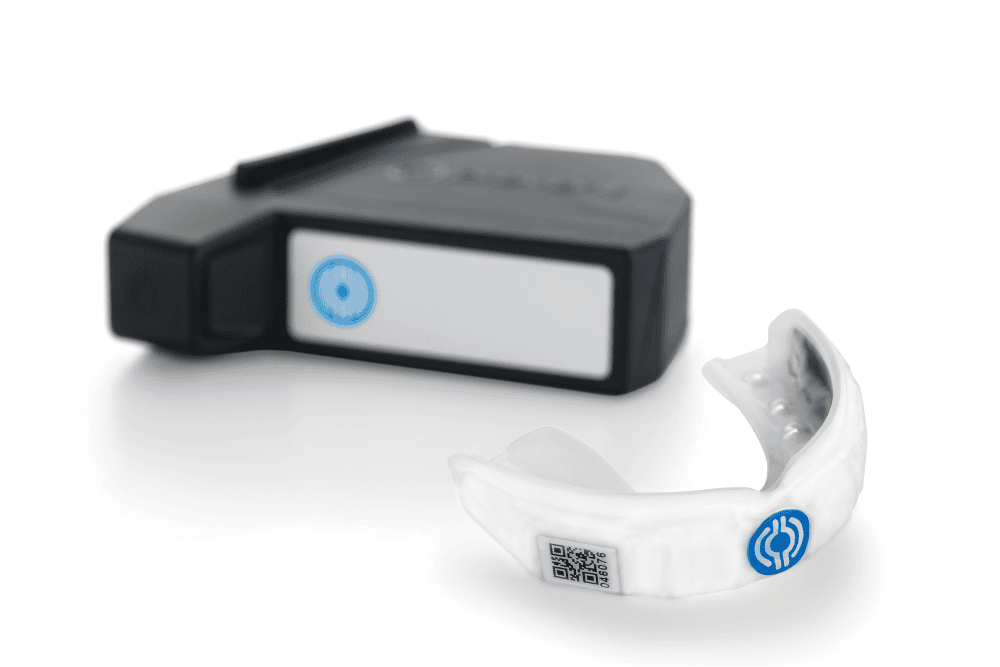
Prevent’s mouthguard’s tight-coupling to the skull is a newer (and possibly more accurate) method to measure head impacts.
“10g is what you do when you sit in a chair, you can stop really hard, and you’ll get five to 10g” Shogren explains. “Ten to 20g are a bump, you might not even know what happened to you, you might not contend you got hit the head, but you had some contact. 20-30g you realize you were hit, that’s a head to the facemask, a small trip and you bump your head. 40g is when you definitely know you got hit, and 50g is bad. And above 50 is we’ve almost shown all of them to be reflective of a person acting in ways you would typically remove someone from a game.”
Minnesota-based Prevent Biometrics is involved in several ongoing studies, including working with Indiana University to equip 160 high school football players with its mouthguards and another study with a suburban Minneapolis youth tackle football organization that equipped 400 players with Prevent’s mouthguard. The University of Nevada is entering year three of a study in which 50 players on the school’s D1 college football team have worn the mouthguard and has thus far collected data on 20,000 head impacts over the past two seasons.
“We’re seeing around an average of six impacts per player. And about 80% of those impacts are below 20g and 90% are below about 25g consistently in the schools that we look at. So less impacts that are smaller is the first finding in almost everything we do,” Shogren says.
Shogren is critical of past methods predominantly used in football to measure head impacts, such as the Head Impact Telemetry System (HITS) developed by Simbex that leading helmet manufacturer Riddell began adding to their helmets around the mid-2000s. That system saw accelerometers placed inside the helmet, but its impact data is less accurate than Prevent’s mouthguard because the helmet sensor system is more susceptible to moving out of place on each impact, effecting the measure of force.
The University of North Carolina at Chapel Hill equipped its football players with Riddel’s HITS-embedded helmet during practices and games from the 2004 to 2006 college football seasons. UNC released a study on the impact data in 2007 that found “In football, a hit can easily jerk the head, for milliseconds, at 50g, and hits above 100g are common,” adding that one player experienced a 168g hit.
“All of the football data you’ve ever seen about how dangerous football is, is about five times too many impacts and way too big. And it’s because the helmets systems they use move,” Shogren says. “All the way up to college and professional levels, we’ve showed that these games are nowhere near as dangerous as the studies have reported in the past. Hits equal to car accidents, this stuff is just not usually true.”
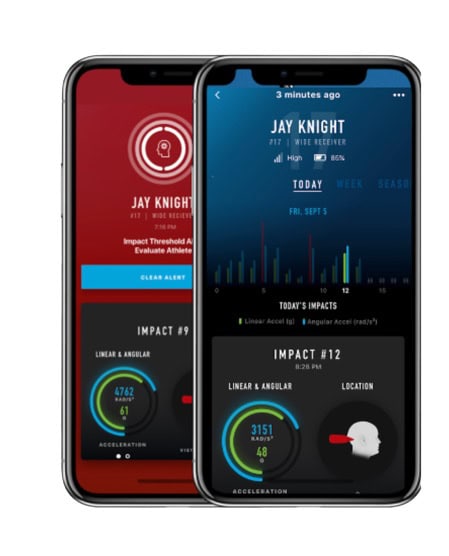
Prevent’s data can be accessed in real time and allows for multiple team users to monitor athletes.
Among the other support of Prevent Biometrics is Dr. Joseph Maroon, who is the Team Neurosurgeon for the Pittsburgh Steelers and medical director for the WWE. The NFL recognized Prevent Biometrics as a finalist at the league’s first and future pitch competition in 2017. Last year, the NFL expanded its impact-sensing mouthguard program from NFL teams to also include players on four college football programs, though that mouthguard device was developed with Virginia-based engineering firm Biocore.
“The data from the HITS system indicated there were 1,000s of hits and huge forces. And it was all erroneous, most of it was erroneous,” Maroon says. “The Prevent [Biometrics] system with fixing the mouthpiece to the upper teeth has been shown to be very accurate.”
Shogren says Prevent sells its mouthguard predominantly to teams with the price now around $300 to outfit an entire team in which each player gets their own device. The company’s biggest partnership to date has been with World Rugby, which began in 2021 with more than 700 youth players in New Zealand outfitted with Prevent’s mouthguards. The deal is now expanding to equip roughly 3,000 rugby players across the world, including players in the women’s Rugby World Cup.
Last month, World Rugby announced that it was extending its return-to-play window for players who got diagnosed with a concession to 12 days, meaning they likely would be forced to miss their next match after being diagnosed. Prevent is also working with World Rugby to establish a score of g-force that would signal when a player has reached an accumulation of impacts that would require evaluation for possible concussion.
“At some point in time, small impacts add up to a dangerous thing. We’re working with World Rugby now on with what we call a load calculation,” Shogren says. So figuring out this number where there will be some threshold where you would also say, ‘Hey, this guy in a football game, took 10 hits that added up to a number and that’s the threshold we want to assess him.’”
World Rugby’s collaboration with Prevent has also found that girl athletes at the youth level tend to sustain bigger head impacts than boys.
“We have seen differences in women, where we think because they start later in certain sports, they end up having more head to ground contacts and bigger impacts because they just don’t seem to go to the ground as well as boys,” Shogren says. We’ve confirmed that’s true that girls can have larger head impacts when they hit the ground, and it looks like it’s something to do with how they fall. So it’s immediately led to World Rugby developing some drills at the younger age for how you take a tackle and go to the ground.”
This article was brought to you by SportTechie, a Leaders Group company. As a Leaders Performance Institute member, you are able to enjoy exclusive access to SportTechie content in the field of athletic performance.
