The tech organization’s innovative wearable technology adds sensors into fabric by weaving circuitry into clothing or other material.

“I thought giving them a sleeve would be a no-brainer: ‘I can tell you your perfect free throw form,’” Sun says. “But they’re more interested in ankle injuries, so that’s why they opted in for socks.”
What Sun has developed is IP around imbuing textiles with electronic properties so that the fabric looks and feels like normal athletic attire while managing to collect data on movements, forces and even biometrics.
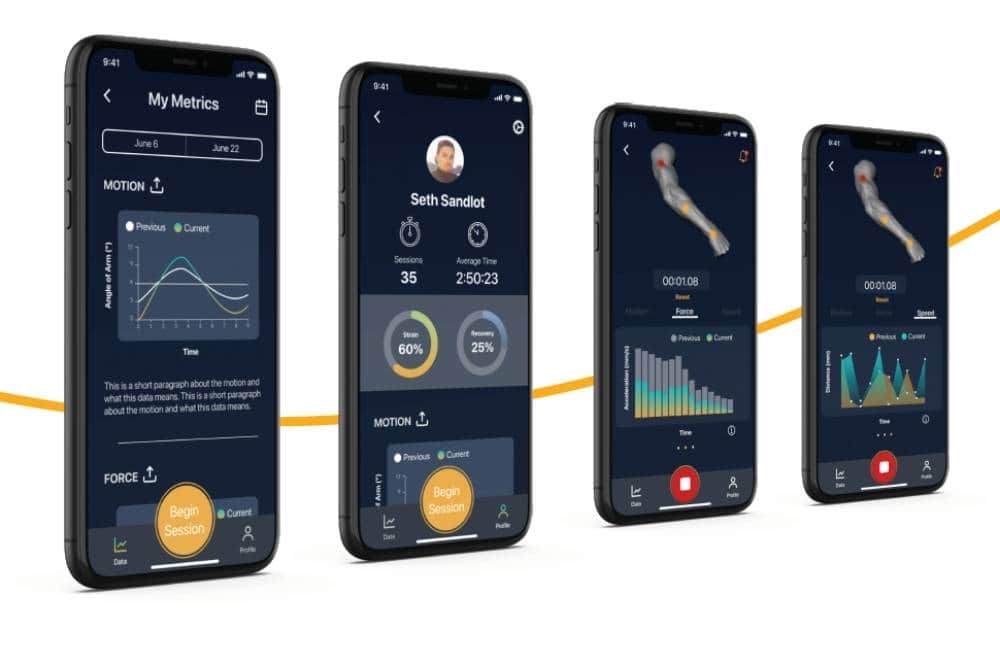
Users can view detailed biometrics tracked by Nextiles’ sensor-laden apparel.
The NBA example is a perfect case study of Nextiles’ B2B2C approach: develop innovative technology and let strategic partners guide the development of features and interface to meet their needs. Since the league selected Nextiles for its inaugural Launchpad startup program, the NBA has become a validator, a customer and now an investor.
Nextiles has raised a $5 million seed round led by Drive by DraftKings and joined by the NBA, Madison Square Garden Sports Corp., Alumni Ventures, SmartSports, Phoenix Capital Ventures, Newlab and Olympic hockey medalist Hilary Knight. Among its other early business partners are baseball training company KineticPro Performance, a tennis company and the US Air Force. The KP Sleeve, which monitors pitching workload and form, is expected to be available late summer.
“We’re not really in the business of guessing and saying, ‘Hey, you need to wear this.’ It’s more of you tell us what you want,” says chief business officer John Peters. “We have the form factor fabric, we have the sewing infrastructure, we have the supply chain set up, everything’s ready to go. And it’s really plug and play at this point.”
When Nextiles first stitched its socks for the NBA—technically, an outer layer to be worn over one’s usual socks—they quickly received more feedback: they foot covers are too small for the basketball player population. Peters laughs as he holds up the new product, which is befitting a man with a size 16 shoe. “So we have a new definition of ‘large’ after that,” he says.
Nextiles received that feedback and turned around the new product quickly. Its core team works out of NewLab, a hardware-focused workspace in the Brooklyn Navy Yard, and its product sewing studio is in New Jersey. The team shares communal resources at NewLab that enable rapid turnarounds.
“I want to ideate really, really quickly—as in, have a drawing, have a sketch and then print it out and touch and feel it to see if it’s the right geometry, the right fit,” Sun says.
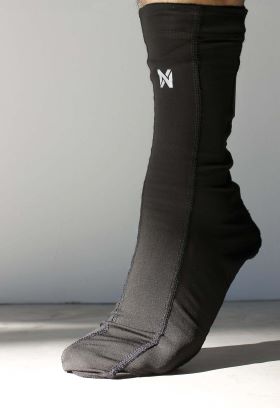
Nextiles stitched socks for the NBA because the league was interested in tracking data related to ankle injuries.
On a recent afternoon, Sun leads a guided tour of the 20th century shipbuilding factory that last decade was transformed into a prototyping studio. The first stop was to a room of 3D printers where, rather than order and shape mannequins to specific needs, Sun will use computer-assisted design to render the precise geometry of a body part he wants to clothe.
Most of the smart textiles his team makes include a patch of fabric with conductive materials covering about 5 or 10% of the garment. Sun uses the 3D printed body parts as a form around which to cut and stitch prototypes. His arts and crafts skills are a departure from his childhood spent tinkering with electronics.
“I used to break things—like, really disassemble things,” he says. “It wasn’t until I went to grad school and I worked for Puma that, yeah, I basically I can hand-sew now. I hot glue things together. I can teach kindergarten pretty well.”
Sun then proceeds to the chemistry lab where he experiments with materials of different ratios, combining metals like copper, stainless steel and silver with threads of polyester and cotton. Based purely on its inherent attributes and position on the periodic table, silver is best situated as the metal of choice, but Sun shies away from using because of both its cost and its inability to be reclaimed for a future iteration.
Instead, Sun prefers working with stainless steel. Because it’s less reactive than silver, it can be extracted from materials. It’s water-resistant. It is, however, a bit thicker and heavier.
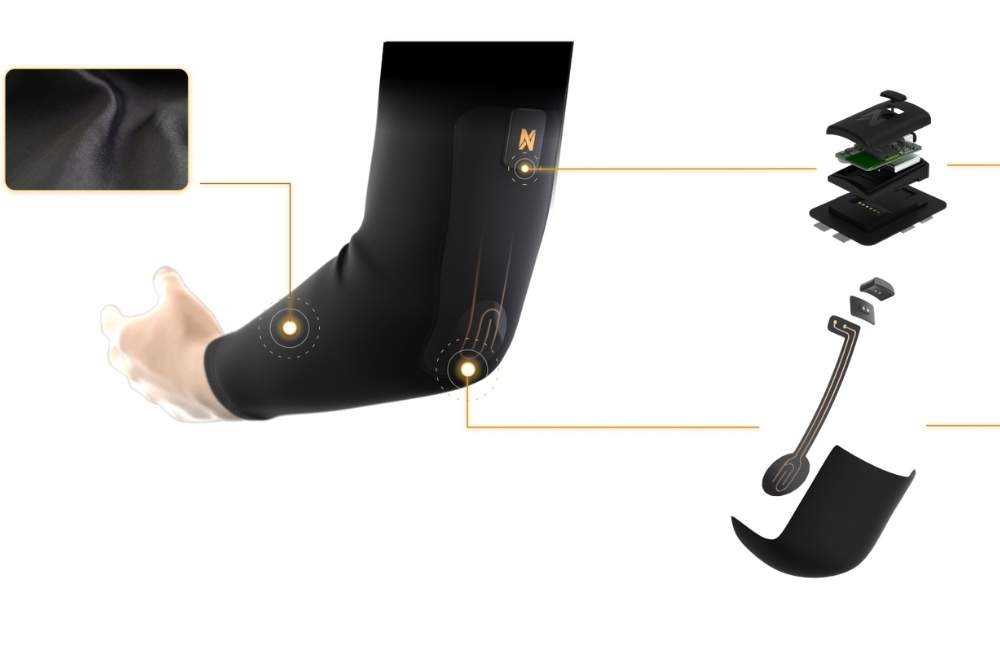
A Nextiles arm sleeve can help tennis players measure torque on their arm and help baseball pitchers manage their workload.
“It has more of a tensile strength than silver, and it’s just easier to sew,” Sun says. Many competitors “have deferred to silver, mainly because you can’t really see it afterwards. It’s so thin, it’s pliable. But for us, we found ways to have some interesting stitching patterns where the stainless steel is not as noticeable.”
From there, Sun walks down the hallway to an electronics testing room. Its benches are lined with soldering irons, voltmeters and the like. Here, he can experiment with signal strength and modulation as based on various twists, bends and folds of the fabric. Once a prototype is complete, one early round of informal testing is done upstairs where Bats-Toi—an MMA-focused mixed reality sports tech company—has a motion capture studio. Nextiles and Bats-Toi work collaboratively on some R&D, Sun says. (Asked to critique his wrestling style, he jokes, “I can’t fight. I go to the fetal position.”)
Back at Nextiles’ open loft space, entrants are greeted by a company nameplate touting a Steve Jobs quote, “Stay Hungry. Stay Foolish.” Inside the space are prototypes, conductive threads and desks for the small but growing team. The software team consists of only two engineers for now—who spend most of their time working on data security and “plumbing,” as Sun calls the encrypted data transmission to the servers—but will likely add at least a half-dozen more in light of the new investment.
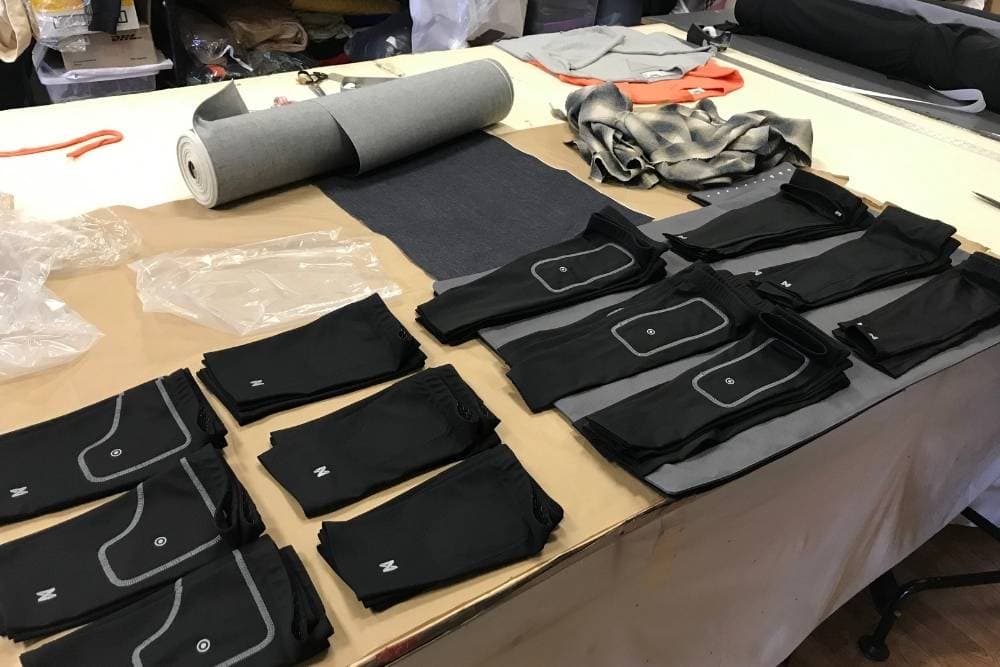
Nextiles uses repurposed sewing technology to merge fabrics and hardware to create a new type of wearable for athletes.
“The next six months is all about developing that software ecosystem,” Sun says. Nextiles still won’t be creating its own user apps, leaving that work for the partners, but much more can be done to organize and interpret the data to help clients gain more insights.
The filtering of all that requires actually quite a bit of analytics on the software and coding side, as well as data science and machine learning to say, ‘Hey, what is actually happening in this range of motion or this muscle movement or activity?’” says CFO Matt Evans. “That’s taking the science and translating it into adjustable outputs? That’s really the key part of what’s going to drive this forward.”
Two black fabric mats lie on the ground. A tablet is affixed to the wall at eye level. Every step or jump on the mats creates Richter Scale reading on the tablet’s digital seismograph-like display. While traditional force plates are heavy and expensive, Nextiles has replicated the concept with lightweight material that can be rolled or folded.
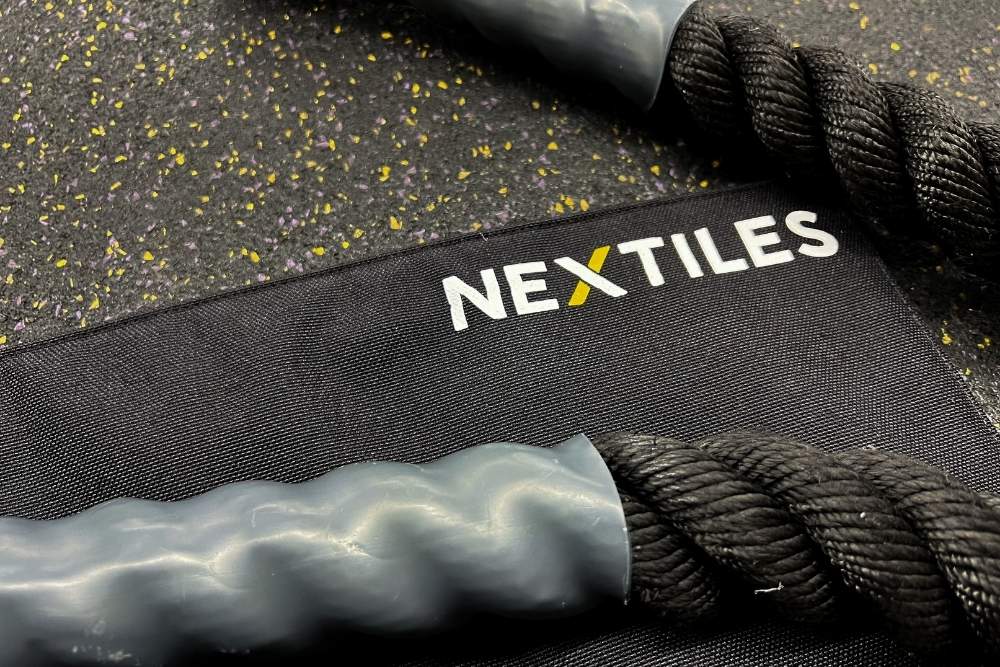
Nextiles created force plates with lightweight material that measure range of motion and muscle movement.
“I used to be a swimmer, so I’m not really a land guy,” says Sun, who swam through high school but stopped upon matriculating to Berkeley for his undergrad degree. “I had to be educated how important ground force was. I was really more about like, ‘Let’s build a body suit, an Iron Man suit.’ But it turns out just two pieces of fabric floor work for that information.”
The value of that data has made force plates a common sight in weight rooms and training rooms across all elite sports. Nextiles wants to deliver it more efficiently.
“We’re not always shooting out datasets that are claiming to be different,” Sun says. “We’re trying to say, ‘OK, our data sets can get the same thing but from a form factor that’s more seamless.’”
The same goes for one of its earliest partners, the US Air Force, who were the second—after the National Science Foundation—to award Nextiles funding (via a grant) following Sun’s PhD work at MIT. What used to be the data-collecting domain of wearable sensors can now be gleaned through fabric.
“The Air Force is looking for more biometrics like skin voltages, heart rate, breath rate, even eye movement,” Sun says. “And so that’s actually a different phase of our company that’s less mechanical and more biometric, and we can do that, actually, just by putting different fabric electrodes on the body, we can actually pick up signals from the skin.”
Eye movement? The human body is essentially a live battery, and the electric currents in the brain, heart and muscle can be detected by EEG, ECG or EMG. EOG, or electrooculogram, can do similar work for the eyes through nodes placed on the surrounding muscles.
The more imminent beachhead in sports will come through noninvasive motion capture and force analysis.
“Our goal is to deliver that experience—like a lab in a box—anywhere,” Peters says.
Nextiles hopes to provide that dataset as a companion to other technologies, all without the need for additional hardware. “Because,” Sun says, “I would hope you remember to wear your clothes.”
This article was brought to you by SportTechie, a Leaders Group company. As a Leaders Performance Institute member, you are able to enjoy exclusive access to SportTechie content in the field of athletic performance.
First-Team Fitness Coach Conall Murtagh explains how Zone7 is helping the club’s monitoring model to optimize individual player care.
An article brought to you by our Partners

Murtagh joined as a sports scientist while studying for his PhD in 2012. He then became the Fitness Coach for the men’s under-18s in 2014, and joined Head Coach Jürgen Klopp’s staff in early 2016. His tenure with the first team coincides with one of the most successful spells in the club’s history.
“When you come through the door each day there is a desire and expectation to be world-class,” he tells the Leaders Performance Institute. “Working under this philosophy is the ultimate motivation for me.”
Recipe for success
Liverpool, who won the League Cup and FA Cup this season, have played the maximum number of games possible – 63 in total and the most of all teams in the Premier League – the first time an English team has competed in every possible match in a single season since Liverpool themselves completed the feat during their FA Cup, League Cup and UEFA Cup-winning 2000-2001 campaign.
The Reds ended the season with almost a full complement of players thanks to the work of Klopp and his multidisciplinary staff which includes Murtagh, a former footballer himself and UEFA A Licence-qualified coach. It is a demanding environment. Murtagh’s fascination with sports science and physiology began long before his own playing days.
“I was obsessed with how the human body worked, particularly how it responded to training and games. That led me down the study of physiology and then sport science. When I was playing as a professional, I had no real knowledge of sports science until I started studying and playing semi-professionally. The individual response to training always intrigued me. How the day after the same session, some players would turn up fresh as a daisy, while others arrived feeling sore and stiff. We could also all do the same gym intervention programmes and yet some players’ sprint or jump performance would shoot through the roof, while others’ stayed the same.”
Murtagh believes that different players inherently have different capacities for physiological adaptation from physical workload. Therefore, they require a stimulus tailored to their individual needs in real-time; something that is very difficult to provide consistently in a team sport environment. That is the challenge Murtagh embraces, as he and the wider staff strive to keep all squad members in peak condition.
Zone7 adoption
Liverpool, much like any Premier League club, has an array of player monitoring and intervention tools at their disposal. For the 2021/22 Premier League season they have also enlisted Zone7, a data-driven artificial intelligence risk forecasting system, to support their development of personalised player workload management processes.
The collaboration, amongst many other important cutting-edge processes adopted at Liverpool, has been a success. Under the watch of club practitioners, Liverpool’s first team – according to Premier Injuries – have seen a 33% drop in days lost to injury this season compared to last. When narrowed to ‘substantial’ injuries (long absences marked by 9+ consecutive days lost), this drop increases to 40%. Goalkeeper and illness-related absences are excluded from the breakdown.
In essence, Zone7 empowers human decision-makers who oversee athlete workloads. These professionals are often tasked with making recommendations in highly pressurised situations. By analysing the extensive, disparate datasets generated and collected in elite sporting environments, Zone7 can detect injury risk patterns that may otherwise be invisible. In some instances, it can go a step further by making proactive recommendations to mitigate the identified injury risk. Importantly, Zone7 will often suggest increasing workloads in particular areas to lower risk. Reducing workloads or simply prescribing rest is not always the right solution.
“We know that adaptation for the human body is a dynamic process,” says Murtagh. “Every time the player performs a training stimulus we must reassess their body’s adaptation balance.”
“As a multidisciplinary team, we assess every player every day. Zone7’s AI works alongside our extensive internal monitoring processes by effectively identifying more complex data patterns that could indicate whether a player has good rhythm or has deviated from it. If our monitoring system identifies that the player is not in optimal rhythm, we intervene accordingly from a multidisciplinary perspective.”
The productive use of Zone7 requires pragmatism. No credible AI solution will claim it is correct all the time and periodic false flags are a natural consequence. Murtagh, however, is unfazed.
“You can never say [a Zone7 risk alert] is a false positive when you’re flagging the player,” he says. “Some players do receive flags and we do not detect anything to suggest they are at an elevated risk. There is such a fine line between someone getting injured or not, we try to identify when the player has sub-optimal rhythm and we intervene appropriately.”
Zone7’s data science team has evolved their solution this year by introducing a new ‘Workload-Simulator’ component, which enables practitioners like Murtagh to input projected workloads and simulate players’ future injury risk in advance.
“The thing I like most about Zone7 is that they’re constantly updating the algorithm, constantly evolving, constantly on the front foot in this field,” added Murtagh. “To have the AI working in our environment to support our internal monitoring system gives us a certain sense of safety around our player management recommendations. The simulator is a brilliant feature, which will be used more and more as the system evolves.”
With a full season behind them, and tangible success metrics to point to, Liverpool and Zone7 have extended their working engagement by another two years, a move that also includes Zone7 adoption across the Liverpool Women’s and Under-23 teams. Rich Buchanan, Zone7 Performance Director, says that “working with Murtagh and Liverpool FC is hugely important to Zone7. It shows that our technology, in the hands of progressive and experienced practitioners, can exist and evolve, in one of the world’s most elite sporting environments.”
A Human Performance article brought to you by our Main Partners

A recent study, led by Jan Ekstrand (2021), analysed trends in injury rates among male professional football players across 18 seasons. They identified a decrease in injury trends as well as an increase in player availability in both training and matches.
In the Australian Football League (AFL), recent results seemed to show stable injury rates and missed matches, as the player-salary costs remained stable too (Eliakam et al, 2020). In the National Basketball Association (NBA) recent results showed an increased in injuries (unique injuries) and games missed due to injuries (Torres-Ronda et al, 2022).
Nonetheless, what seems to be pretty consistent across the industry is that injuries cost money, and a few studies are starting to prove (objectively with data) they cost performance (success) too. And from the team and the individual perspective, every time we hear about a main injury in a player it makes me think, ‘here we go again; how these type of injury still occurs so often?’ or ‘why so many occurrences of this injury?’
The first question I want to pose is: what are we doing wrong when it comes to injuries, and are there steps we can take at an organisational level to buck the trend?
If we study the injury data that has emerged from the NBA in the last four years we can see that the occurrences of injury are increasing despite ever greater resource being poured into injury prevention.
It is in everyone’s interest to fix the situation, given that injuries cost both money and success. Beyond the bottom line, there is also the disruption to your team. When important players are absent it can increase the pressure on the rest of the roster and your coaching staff, as well as increase the working hours of your performance staff behind the scenes.
Risk-reward
Firstly, should we use ‘injury prevention’ or (managing) ‘injury risk’? Sometimes semantics can make us rethink what we’re doing. With ‘injury prevention’, we often see more of a focus on strength training exercises, whereas ‘injury risk’ allows an assessment of the likelihood of an injury occurring and enables decisions to be made to reduce that likelihood.
Of course, an opponent could step on a player’s foot at any time. There are things that we can control and others that we cannot. The schedule is not going to change, so could it come down to minute-management? Is it worth a player playing the second night of back-to-back games, with a high cumulative minutes (for his age, experience, strength levels, team’s season performance)? What other factors are coming into play? I believe decisions should be made in a risk-reward context.
With this in mind, what injury trends are you noticing with your teams? How have your internal review processes evolved to manage those trends? The greater investment in injury prevention has created a lot of moving pieces and still the injury numbers are ticking upwards. In the NBA, it is load-related, with tendon and ligament injuries on the rise (specifically, knee injuries).
There will inevitably be differences between teams, which could come down to playing style, the choices of the coach, or simple bad luck during any given campaign, but this tells me that we should be reviewing internally what we’re doing with our athletes.
With frameworks for decision making and tools such as strength assessments, biomechanics, and ultrasounds, among many other assessment tools for internal and external loads, and players’ subjective perceptions of fatigue ratings, we can have information about many aspects of the athletes’ day to day. But how can we use this information and communicate it to coaches and the various stakeholders to make a better decision around whether or not a player plays tonight or for how many minutes?
When staff are making assessments, are they allowed to do their jobs, and by this I mean, how is your player buy-in context and organisation support? Are we doing the right testing, at the right timings, and analysing the right metrics? Are the players using their time in the right way to promote injury prevention? Is it important to track and classify their drills for injury risk as well as for conditioning and performance? Which types of statistics are we using? Are they correct? Should we review deeply our resources, what we can realistically do and expectations about the risk of injury?
The missing piece
It is also important to consider the culture of a franchise. If a coach has been in tenure for three, five or more years they likely have more trust and stability for long-term processes. Such scenarios stand in contrast to some franchises where ‘you lose three games in a row and the coach is fired’, making the environment more unstable, and depending on how it affects the staff, more volatile. For those coaches, it is hard to say ‘we’re going to develop this player and every 20 games he’s going to rest for one game, depending on the opponent or difficulty of the game.’ They need to be successful today and they’re going to squeeze the sponge or play the cards that they have.
Sticking with the NBA, when a franchise is bringing in college players or players from overseas they will inevitably be impacted by the schedule, which is between two to three times the length (or congested fixtures) than the European average season. How should we manage those players and introduce them to their new context?
When the European competition increased the number of games there was also a spike in injuries and severity. The schedules are unlikely to be reduced in any corner of the globe, so the issue becomes: how do we handle that? Do we need bigger squads? Do we need to have greater rotation? Do these need to be enshrined in the rules?
And what is happening in those moments that we can’t control? What are the athletes eating? What are their habits? Their professionalism? Their education in their own bodies and recovery? I think we’re making steps in general in the sports community because we have more professionals, more education, more investment in food, but then why are injuries increasing, or not significantly decreasing?
In addition, I don’t think we have enough good data to know why injuries are happening. The impact of data collection and analysis is another consideration, particularly when considering risk-reward and decision-making. When using that data, are we being too conservative? Are we using the data against our interests? Or are we pushing too much because of pressures (including players’ desire to play)?
It can also depend on the sport or the league. There are some risk management systems that have access to datasets on multiple teams and sports; they might be able to call upon injury or tracking information.
What are we missing in the analysis? We might be getting better at some things with injuries but there’s still the trend of injuries increasing. Should the leagues be more involved? because nobody wants the star players missing, not teams, fans, media or the broadcasters. As a league, how could we have a database where people submit anonymised information that can lead to analysis? I venture to say that injury analysis is way more complex than the way that we’re attacking it, and that we are probably ‘missing something somewhere’.
Lorena is one of six Leaders Performance Advisors, a group of leading performance thinkers providing more subject expertise to our member-only content and learning resources. To find out more about all our Performance Advisors, click here.