The McLaren driver joined a panel discussion at the Tribeca Festival in New York City and described his use of the simulator and how the team behind his team continues to iterate the tech on his MCL60.
A Data & Innovation article brought to you by

You can’t have a discussion about sports technology today without including athletes in that conversation. Their partnerships, investments and endorsements help fuel the space – they have emerged as major stakeholders in the sports tech ecosystem. The Athlete’s Voice series highlights the athletes leading the way and the projects and products they’re putting their influence behind.
* * * * *
In addition to his racing credentials, Norris is the founder of Quadrant, an esports team and lifestyle brand partnered with Veloce, a racing and gaming media brand. In June, Norris appeared alongside McLaren Racing CEO Zak Brown at the Tribeca Festival in New York City, which was sponsored by McLaren crypto partner OKX.
Norris and Brown discussed how technology is permeating the racing industry, from the extensive use of simulators to weekly enhancements to the car; Brown estimated that 80% of the livery changes over the course of a season. The car is packed with 300 sensors and produces about 1.5 terabytes of data during a race weekend, with McLaren having enlisted DataRobot to help apply AI algorithms to make the best use of that information. (Note: This Athlete’s Voice is primarily derived from a post-panel interview, with some of his on-stage thoughts included as well.)
On playing racing games as a kid…
I started when I was a kid, like a lot of kids do. I was never into the bad games, shooting and all of this. I never played any of these games, my parents didn’t let me. But driving [games], my parents allowed me to do. I guess the basics, understanding the very simple things of how to drive a car — lines, techniques — you learn such simple things at a very early age.
These skill sets develop and continue to develop even to where I am now. I’m still learning things. I’m still trying to perfect whatever I can perfect. And for me, I think it’s an advantage that I played these games, and I did at such an early age — six, seven, eight years old — and that definitely helped me become the person I am and the driver I am today.
On his extensive use of a simulator…
I don’t have to fear driving a simulator compared to real life. Cost is a lot less. So I’m not scared of crashing and not scared of Zak telling me off or something. And the [simulator], you don’t have a different approach to how you want to go and do things. But you’re still learning in every single thing that you do, whether it’s real or fake or whatever. You’re still learning good things and bad things. And then you take that to the track to improve.
I use it, the whole team use it. So many things now are prepared in a simulation before they’re actually done for real because you’re always going to want to test everything you do. Because you can’t afford to make mistakes. Any way you can test something to see how authentic it is and how correct it’s going to be, from driving to designing your front wing and designing the whole car or making decisions on race day. Things are always checked as many times as possible until they actually get into action.
On his involvement with iterating technological changes on the car…
I’ve tried, in a way. I stick to do my job at the end of the day, so I just drive the car. But you try in as many ways as possible to help give whatever indication of advice you can give to the guys, who are some of the smartest guys in the world. These are people who are creating things that have in a way never been created, that are coming up with ideas.
Formula One is all about innovation. There are so many things in normal life now in road cars that everyone drives on a day-to-day basis, which these guys have come up with within Formula One. So in the end of the day, you can use all this information. But it’s only helping us make the decisions — us as humans who are still the ones that are applying it to our everyday work, who are coming up with the actual ideas. And therefore, I still stay firmly in my position on driving the car, but just being as helpful as I can when my words and my advice are needed.
For me, the most important thing is the minds of the humans, us as people who are still the ones who are applying this information, using the information, using AI. But how we apply it, how we use it in filmmaking or designing cars or driving cars. It’s all us in the end of the day, we’re actually doing it. So I think that’s the thing you can never forget.
On whether he can feel the dramatic changes to the car over a season…
It depends. Sometimes you have things which are there to change the driving style. Sometimes that’s where the improvement comes. An improvement can also be something that you don’t even recognize: you just go a little bit quicker when straight, or you just go a little bit quicker in the corner because you just have a bit more grip. So sometimes you’ll notice a massive difference. Sometimes you’ll hardly notice the difference. But it’s also gradually, it’s rare that you bring something in that’s just like, so noticeable. And also, when you do put something on, drivers are, within a few laps, make that feel like it’s normality again.
So when you go from the beginning of the season to the end, because it slowly happens over that whole period, we don’t really notice that much. But if we were to jump back in the car at the beginning, and you’re like, ‘Oh, wow, this has changed a huge amount.’ So you’re reacting to what’s happening and what’s changing, and you’re just getting on top of that. And because you do it so quickly, things become normal very quickly at the same time.
On managing decision-making in the car…
You train yourself. You learn from a really quite an early age, so you kind of get used to it over time. But there’s still times now where there can be an information overload. And I guess it just has to be said to the team, if they’re talking to me too much, or telling me to do too many things. We go to Monaco where you don’t have really any time to think of changing all these dials. You think your strategy, you think of tires, you also just trying to focus on not crashing. There’s a lot of times when there is still so much information, it’s still like, how can you get the most important bits of information across? But it’s just understanding, I guess, everyone has their own limitations or abilities. Maybe sometimes some people can do more, some people can do less, but I’m just making it known when it’s too much or when I can accept more.
On reaction time training…
Yeah, of course, [it’s] one of the most important things, just for natural driving. The start is one of the most important parts of the race so reacting to the lights, the pit stops. Reactions are probably one of the most important things that create a Formula One driver, but it’s also not just a reaction. A lot of people who can’t drive a car can have quick reactions. It’s the knowledge of knowing what you’re reacting to and how to then apply whatever the correction is.
On how he reaches his peak performance…
It is trying to understand how I drive in the best way that I can, whether that’s getting really pumped up before a race or qualifying. For me, it’s more the opposite, the more relaxed, more chilled I can be, the better. The more subconscious I drive, the better. So if I’m consciously thinking, ‘OK, I need to try and brake here, and do this and do that’ — game over, I’m terrible. So the more I can just know subconsciously what I need to do and just not even think of it, the more I can feel like I’m just going for a drive, then you look down, Wow, you’ve done such a good lap. The more you can feel like that, the better it’s going to be. So trying to recreate that and get in that space as many times as often as possible.
I’m just using the people that I have around me — simple as that. I have a very good team, starting with the McLaren side with my engineers, my mechanics, [team principal] Andrea [Stella], Zak. Using everyone in the best way possible, using their connections and relationships. And then from my side, my manager, to my trainer. to my parents. Using the people I have beside me to get the best out of me, with the training with all of these things. I hate training so much. But it’s part of what you’ve got to do if you want to achieve that one goal, which you know will satisfy you more than anything, which is to win a championship. You have to reach these other targets in order to achieve that, and you’ve got to make the sacrifices along the way.
On the vision for his brand Quadrant…
It’s in an early phase, I would say. From what I would love to achieve with it, it’s still got to grow a lot more in several spaces. One, which is the teams that represent Quadrant in various games. At the minute, we have Halo, we have a team for Call of Duty, we have Rocket League. So having, I guess, like a McLaren but within all these different categories, all these different games, because I love them. I’m terrible at a lot of these games, but I know I get very excited watching my own team. I get very nervous, like my heart starts pumping when they’re in a game and so on.
Expanding on the apparel side — that’s probably one of the best things. Just creating stuff that people like to wear. Hats off to [Veloce CEO Daniel Bailey]. Daniel has done a very good job with this side of it. Creating stuff that you or anyone would happily wear it’s just something that’s cool, but trying to sometimes keep racing involved in it, but also sometimes not.
And expand a lot more on the opportunities of working with different people. Whether that’s within programs or different athletes and different things, expanding to working and creating cool things, events or whatever it is. And not just being, say, an esports team that plays games or just makes a video or does that — but expanding much more beyond that and helping athletes discover their talents or further their talent and just creating content out of a lot of these things at the same time.
On his interest in gadgets and tech…
Since I was a kid, I loved and I always was really into computers and games and things. And I loved it probably too much when I was a kid — my parents hated it. But anything, I just find it very fascinating, how just pieces of metal and stuff comes together, and it creates such incredible things. I also enjoy taking it all apart and destroying it at the same time. It’s just that I enjoy it. Puts a smile on my face. It’s fun. Often sharing it with friends, whatever it is, creating competitions out of it, those kinds of things. Just something that brings me joy, so simple as that.
On storytelling via digital media…
You have the two sides. I guess [there’s] the social media side, which is very much just me, who I am — behind the scenes a little bit, things that you don’t probably ever see on Netflix, even on Formula One TV, documentaries. It’s even more just me and what I do, and even though a lot of it is still Formula One-based and pictures of me driving a car, blah, blah. And then I even have my photography page, which is just more me taking photos here, what I do here when I’m just being an old person, and I’m not even in a race car.
And then you have the Netflix side, which is still trying to capture the difference of you as a Formula One driver, and as an athlete, and then you as a person at home with your family, friends, and so on. So I wouldn’t say I do anything different, but it’s how things are captured and portrayed, which is different.
This article was brought to you by SBJ Tech, a Leaders Group company. As a Leaders Performance Institute member, you are able to enjoy exclusive access to SBJ Tech content in the field of athletic performance.
‘Our core is working with the coaches to give actionable insights to the player and coaches between pitches,’ says former MLB pitcher Zach Day, who helped launch NewtForce Mound.
Main Image: NewtForce
A Data & Innovation article brought to you by
A key reason he chose to join LSU’s program was the chance to work with Pitching Coach Wes Johnson and the advanced technologies at his disposal. One of the tools Skenes has credited for his improvement this season is the NewtForce Mound, a sensor-laden, turf-covered slope that tracks a pitcher’s ground forces throughout their delivery.
It’s similar to work Johnson did in his prior role as pitching coach for the Minnesota Twins. After the club traded for pitcher Kenta Maeda in 2020, Johnson recognized that the right-hander’s mechanics were much less efficient out of the windup than out of the stretch. Using NewtForce to quantify the discrepancy, Johnson helped Maeda improve his tempo out of the windup and ultimately finish the season as the AL Cy Young runner up.
Johnson identified the need for the NewtForce Mound as a pioneering coach in the tech-savvy Dallas Baptist baseball program, at a time when ball-flight tracking and motion capture technologies proliferated in the sport, leaving the foot-mound interaction as an unexplored frontier.
“My mind doesn’t stop a whole lot, so I’m constantly trying to find an edge for our guys,” Johnson recounted to MLB Network. “The piece we were missing was ground force.”
For help in solving this need, Johnson turned to one of his oldest friends, Kyle Barker, a former Sylvan Hills High School classmate in Arkansas who started his own aerospace engineering firm, AeroNatique. Former MLB pitcher Zach Day, who met Johnson through his work at TrackMan, joined the founding team and helped launch NewtForce.
The smart mound is used by seven MLB clubs and five college programs, including LSU, who competed in Omaha last month. (Johnson, who recently accepted the head coaching job at Georgia for next season, is not officially affiliated with NewtForce but has been a big supporter of the effort.) There are also installations at private facilities such as P3 in Atlanta and the Florida Baseball Ranch.
The NewtForce mound collects ground reaction data while synced to two high-speed cameras for careful review of granular mechanics. The data and visualizations are available immediately after each pitch so that pitchers can still remember the feeling of that last delivery.
“Real and feel, combined, make all the difference for development,” Day said, referring to the objective data and subjective experience of the pitcher. “Like TrackMan, we provide the actionable data in between pitches. So that’s our foundation, our core, is working with the coaches to give actionable insights to the player and coaches between pitches.”
Unlike competing products available, NewtForce doesn’t use embedded force plates but rather a “cousin technology,” Barker said, that enables the mound to collect force data no matter where the pitcher’s lead foot lands. Barker acknowledged that there were several developmental missteps along the way, but a project in his day job using sensors to gauge reactive forces in aerospace components led to a breakthrough.
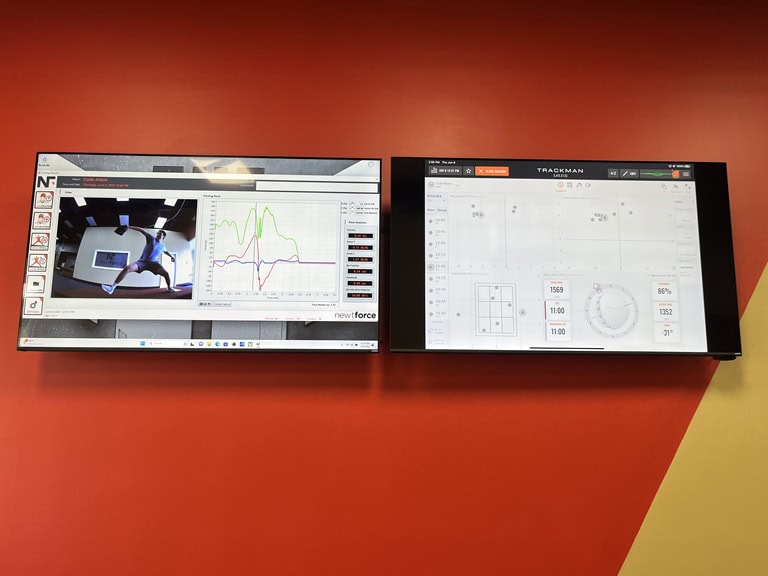
Image: NewtForce
“We were doing some testing for a major aviation manufacturer, and if you took a deep breath and cleared your head and backed up far enough from it, you can envision a way to get ground force reactions out of a surface with what we thought was infinitely more reliability,” Barker said.
Barker declined to get too specific about the company’s proprietary competitive advantage but said the concept of stiffness-to-weight ratio on an aircraft wing — heavily engineered to be strong, yet light — was critical, as was the collaboration of his lab manager, Paul Wanamaker, who is now NewtForce’s hardware lead.
“My aviation background, oddly enough — and it makes no sense to many people — was just perfect for an instrumented pitching mound,” Barker said.
Among the two dozen metrics collected by NewtForce are acceleration and deceleration patterns, impulse (total force over a period of time) and what they call the clawback, which is the duration of time the lead leg is planted on the ground.
Some early machine learning research using data from the NewtForce mound by Randy Sullivan and his team at Florida Baseball Academy suggests that impulse is a key metric for velocity production.
While progression typically takes time, Barker recalled witness some fairly immediate improvement in one particular pitcher during a site visit to an installation at Vanderbilt.
“I’m no coach, but I’ve seen Vanderbilt’s coach take a kid that was, call it 92 and minus command, and intuitively, after seeing the force charts, have some idea about what his kinetic chain was to cue him verbally,” he said. “And then in two or three pitches, you see better velocity, ballistic spin efficiency.”
Particularly younger pitchers, Day said, tend to have under-developed deceleration patterns in their lower halves. Building arm strength is less the issue than efficient movement in the legs and hips.
“Sometimes the eyes are going to deceive us,” Day said. “There’s times that you’re going to think a guy is using the ground well, and the data is just not saying that. So the way guys move can be deceptive. That’s one thing we’re learning is, Yeah, it looks good, and often it actually is good. But there are times that it looks good, and it’s not. And there are times that it looks bad and awful, and it’s like, you have the best lower-half efficiency out of anybody.”
This article was brought to you by SBJ Tech, a Leaders Group company. As a Leaders Performance Institute member, you are able to enjoy exclusive access to SBJ Tech content in the field of athletic performance.
The Gatorade Sports Science Institution will enable athletes to drill down into their unique fueling, rehydration and recovery needs.
A Data & Innovation article brought to you by
The sports drink that became Gatorade was invented nearly 60 years ago, in 1965, but that initial thirst-quenching rehydration solution has evolved into a multi-billion business with more than 50 flavors across a broad portfolio of products supporting active lifestyles before, during and after exercise. The AI-powered algorithms in the Gx app and company website offer more than 91,000 variations of the Gatorade Fuel Plan.
This new facility is GSSI’s clinical research headquarters, situated in the sleepy suburban town of Valhalla, as part of a larger R&D facility operated by parent company PepsiCo. Life sciences is one PepsiCo’s four pillars, and the GSSI is “one of the crown jewels” within the division, Chief Medical Officer Dr Pietro Antonio Tataranni said.
“It’s a group of highly skilled individuals who look at the science out there and tries — most of the time, successfully — to translate it into products, technologies or services,” he added.
The multiple laboratories at the GSSI can assess athletes’ physiology, biochemistry, exercise performance, energy metabolism and mental performance. The research conducted here will support Gatorade’s burgeoning product line, which includes drinks spanning several categories: lifestyle (Propel), energy (Fast Twitch), rehydration (Gatorlyte), refuel (classic Gatorade) and recovery (Muscle Milk and its plant-based protein counterpart, Evolve).
SBJ Tech’s own Joe Lemire underwent several of the aforementioned assessments at the GSSI. You can read his takeaways here in the latest edition of our Sandbox Series.
This shift to a broader Gatorade portfolio was first revealed in a Super Bowl ad and reflects a shift in marketing tone. Brand affinity is born from “a mix of aspirational and attainable,” said Carolyn Braff, Gatorade’s Head of Brand Strategy.
“When Gatorade puts a whole bunch of sweaty football players on all of our ads, we’re excluding half the population,” she said. “We don’t work that way now. So you’re going to see a big step change from us in how we think about athletic performance, athletic wellness, speaking to everyone who’s moving their body with purpose and welcoming them into the Gatorade family.”
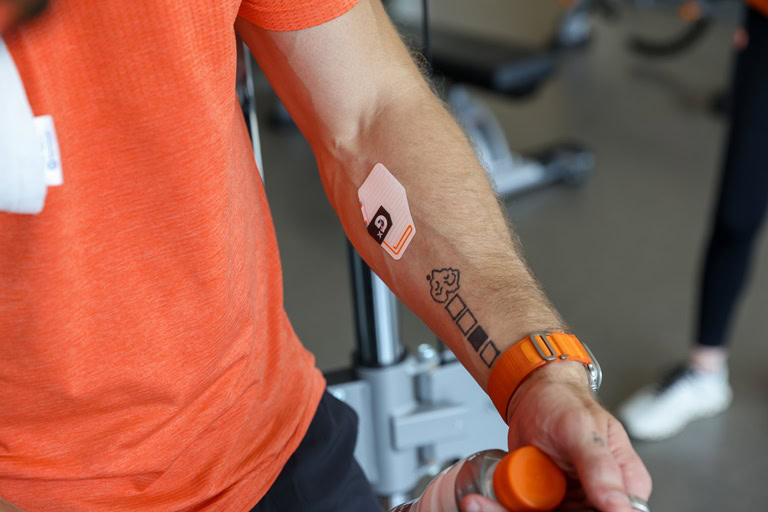
Image: Gatorade
On a recent morning, the two-time Olympic gold medalist and two-time World Cup champion Lloyd visited for an assessment. At one point, she was strapped onto a treadmill, with a respiratory flowmeter affixed around her mouth. Measuring her exhalation can identify the type of energy she’s burning, fat or carbohydrate. (Asked later what she learned, she quipped, “I learned that I’m retired.”)
But Lloyd, a former FIFA World Player of the Year who hung up her cleats in 2021, is a poster child for proper fueling. Overhauling her nutritional intake after criticism from the former US women’s national team coach gave her more energy and led to better performance.
“I remember, it was Pia Sundhage, she was not going to renew my contract in 2009,” Lloyd said. “So I had to do something to make myself better and change. And 2009 was when I really started to change my diet, eating organic, eating healthier — I noticed a huge difference.”
Gatorade’s ambition is to democratize sport science. Members of the media were invited to undergo a similar battery of assessments, testing force production, body composition and muscle fatigue. The Gx Sweat Patch and Gatorade Fuel Plan are mass-market attempts to put, as they say, “a sport scientist in your pocket.”
Matt Pahnke leads the GSSI innovation program, meaning he may be the proverbial sport scientist in everyone’s pocket, has tested elite triathletes competing at the Ironman world championship in Kona. He determined that the average participant lost between 40 and 45 ounces (1.2 and 1.3 liters) of fluid per hour — but individuals ranged from 10 ounces (0.3 liters) to 85 ounces (2.5 liters), a huge discrepancy washed away by the mean.
“That’s why we developed the patch system so that an athlete, on their own, can understand what their individual needs are,” Pahnke said.
Ironmans are grueling affairs, no matter the conditions, but Kona is especially harsh due to the heat. Football players wearing pads during summer two-a-days can relate, whether they are in high school or the NFL. The GSSI includes an environmental chamber to enable heat testing up to 40 degrees Celsius (104 Fahrenheit) with 80% humidity. “Basically, we can mimic any environment,” said GSSI R&D Director Lindsay Baker.
The updated GSSI is now fully open for business, and the broader Life Sciences team is conducting a series of pilots through PepsiCo’s Advanced Personalization Ideation Center. “We have what we aspire to be a platform, and from there, you can bolt on different technologies,” said Tristin Brisbois, noting tech’s potential to “bring a differentiated consumer experience.”
The API Center seeks to operate as a startup within broader PepsiCo, relying on partners in technology and academia and utilizing AI, wearables and more. Its mantra is to “learn first, scale second” with early prototypes undergoing testing.
While the results of the Sweat Patch and Fuel Plan will, of course, refer users back to Gatorade products, it won’t do so exclusively.
“You don’t want your recommendation engine to just push out Gatorade products — you’re going to lose credibility immediately,” Brisbois said. “The products are designed to give you the nutrition and hydration that you need in a short period and a very convenient way. So you could get there with water, banana, and 10 soda crackers, or you could consume this Gatorade. But there is the option there for the consumer to make the choice.”
Her team is concerned not just with innovation but consumer behavior. Users need to find enough value to share data, but the tool can’t require so much that it turns them off either. There’s a “tipping point” they need to find, Brisbois said, adding, “If you’re working in the personalization space, it’s almost like you can over-engineer it. And for a lot of these things, the more complicated it becomes, the more niche it becomes, too.”
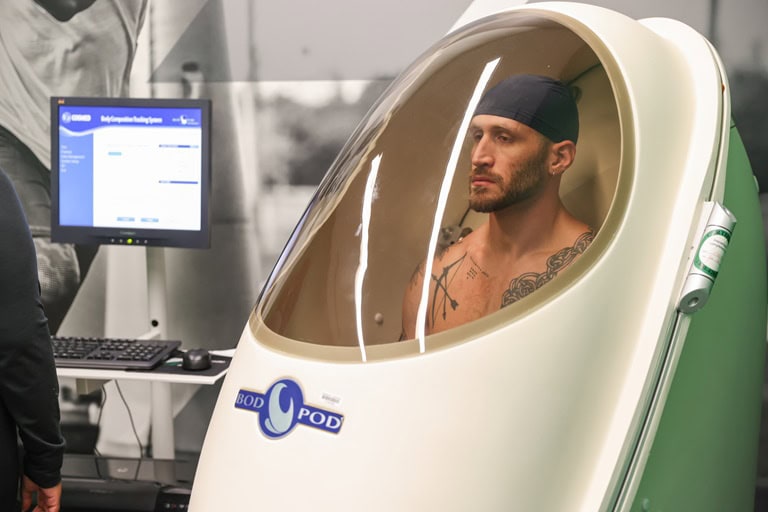
Image: Gatorade
And Gatorade is cognizant that it can’t make its portfolio too convoluted or involved, or else the messaging won’t resonate with the fleeting attention of the average consumer strolling through the grocery aisles.
“Honestly, we learned that when we launched the G series in 2010. We had 01, 02, 03, Prime, Perform, Recover, G Series Fit, G Series Pro, Classic G Series — it was way too complicated,” Braff said. “And so we’re not going to do that again. The best thing we can do is tell consumers what’s in the product and let them choose for themselves. And so our billboarding on the front, primary display panels for all of our products is really simple.”
This article was brought to you by SBJ Tech, a Leaders Group company. As a Leaders Performance Institute member, you are able to enjoy exclusive access to SBJ Tech content in the field of athletic performance.
Smith’founded Crux Sports, a consultancy for women in sports, with a view to grow women’s football and give females the support they need whether in the boardroom or out on the field.
A Data & Innovation article brought to you by
You can’t have a discussion about sports technology today without including athletes in that conversation. Their partnerships, investments and endorsements help fuel the space – they have emerged as major stakeholders in the sports tech ecosystem. The Athlete’s Voice series highlights the athletes leading the way and the projects and products they’re putting their influence behind.
* * * * *
Rebecca (Bex) Smith is among the most connected people in women’s soccer. She captained teams for Duke University, Vfl Wolfsburg and the New Zealand national team, competing with the Football Ferns at two World Cups (2007 and 2011) and two Olympic Games (2008 and 2012). Smith also played professionally in Sweden and Germany before her career ended in 2013 due to a knee injury.
Smith, now 41, went on to work at FIFA for nearly five years as Competitions and Event Manager for all FIFA Women’s World Cups — the flagship event as well as the Under-17 and Under-20 versions. She went on to become the Global Executive Director of the Women’s Game at Copa90, a podcast host co-produced by the BBC, UEFA venue director and now Founder/CEO of Crux Sports, a women’s sports consultancy. In May, Crux Sports published research, in partnership with YouTube, on the value and impact of DAZN making the Women’s Champions League available for free on the social streaming platform.
She earned three degrees, speaks four languages and is either a board member or advisor for numerous companies and programs, including AI-powered injury risk platform Zone7 and the Isokinetic Conference, the largest football medicine conference in the world. Smith will also co-host the daily morning show for Australian broadcaster Optus at the upcoming Women’s World Cup being held in Australia and New Zealand.
On what she’s building with Crux Sports . . .
My company was born out of the fact that I had a very diverse background coming from playing to then governance and managing one of the biggest women’s sporting event on the planet to then going into media content production to then working with big brands to doing branded content and working with athletes. So I really just wanted to have a place where we could help all stakeholders so whether it is brands or governing bodies or content production or athletes themselves to either get into the women’s game or to help fuel it.
So it’s really about driving sustainable positive growth into the women’s game, but then helping stakeholders to increase their bottom line or to work on their marketing or figure out their strategies for integrating women’s sports and female athletes into their propositions as well. So it’s very diverse. I work with YouTube and Google and helped them do a research project, all the way to Champions League to working with big brands like Xero on their partnerships with the FA or FIFA to working with on content production or working with athletes directly, helping them work on their post-career transition and maximizing their commercial opportunities during their career.
On her interest in player health and wellness . . .
It comes from my own experiences in football and sort of more negative experiences, I would say, throughout my career where I found that there was a lack of support. Despite the fact that I had three degrees on the side and was trying to work at the same time — because I was trying to just set myself up for post-[playing career] — I still felt really unsure, insecure, going into that post-career, post-football life and having to do so with a really bad injury. I hurt my knee, and then it was not very properly looked after at my club. And I was continually playing on a very swollen knee. And in the end, I can’t run anymore. So for me, it was really important.
When I was at FIFA, we did a whole medical study on the athletes and players, and what their medical setups were. And in the end, we couldn’t publish it. So I gave it to my buddy at FIFPro. So they did the very first employment study. So it was based off of a lot of the data and research that we had done. And yeah, it’s just really about trying to better the situation for the next generations. And it sounds so hokey, and so cliché, but it’s so important that we continually improve the game for the athletes because they are at the heart of the game.
On her work with athletes . . .
So many people work in and around sports, and they run this or they run marketing, or they run broadcast, and they’re very important, they make loads of money, but at the end of the day, if the athletes are continually getting burnt out and injured and aren’t taken care of properly, then it won’t be sustainable. So for many reasons, one, the health and mental health and safety of athletes because they’re human, but secondly, because it’s a business, and it needs to be sustained as well. And you have to take care of your people in the business. So they’re at the core.
Do I think it’s gotten better? No. I wish I could say that it has. I think in some areas, in some clubs, there’s better medical care and a little bit more investment in that, but I still think that it’s a huge gap, which is one of the reasons why I work with a lot of athletes. I don’t really market it, they just come and I work with them to help them get prepared mentally and also just physically — what are they actually doing to prepare for it. So, ya know, there’s still a really long way that we need to go for that.
On Zone7 . . .
Not just because I’m a strategic adviser to them, but I think something like a Zone7 [can help]. I really wish it was around when I was playing. And I’ve said that before. But to have the technology that we have now — AI — that did not exist when I was playing, or was not, let’s say, mainstream when I was around, and to be able to have those types of algorithms where so much data is going in that is being perfected constantly and tinkered with and filtered down, that you can really get to the point where you can say, ‘This is the percentage of risk that you are at for this type of injury, and therefore you should change your training to do this, this and this.’ It’s mind-blowing.
I come across lots of tech companies or people trying to help out with athletes, and it’s all — even what I do — very time-consuming and very one-on-one, whereas this is a mass market product that that can really help. Now they’re in leagues as well, so it’s not just with individual clubs or teams.
So far, that’s the most incredible thing that I’ve seen that I think would just really help reduce injury in a huge way, really quickly and very significantly. But other than that, there needs to be a lot more investment by clubs and leagues and those that are making money off of athletes. They need to have a certain percentage invested back into the athletes, that would be my standard approach to things. But good luck trying to get them to invest back into their players.
On her recent project for YouTube and Google . . .
I did a research project with them around the Women’s Champions League. So because they put the Women’s Champions League, through the rights with DAZN, on YouTube free-to-air and global, it meant that there were a lot of knock-on effects. What they were measuring was traditionally just the live match number — what’s the audience watching this live match? Which is obviously lower than if it’s on normal TV in in France, but that’s because a lot of people didn’t know it was on YouTube.
So we were really looking at the value and impact more broadly on the different stakeholders. So from media, players, the teams — so I interviewed 15 out of 16 teams that participated in the group stage — got their opinions on things, talked to the players that were involved, talked to media and then we did a big fan survey.
On her work with the Global Esports Federation . . .
That’s quite fun. I sit on the players’ commission, and that’s really interesting because I’m learning more than anywhere else, I’d say. It’s really understanding how athletes in the gaming space are being treated, what their challenges are, how the Global Esports Federation can help support athletes better. From my former career as an athlete, but really looking at gaming as one of the biggest, fastest growing industries on the planet. And my goodness, every kid is involved in it.
On the importance of New Zealand co-hosting the Women’s World Cup . . .
It’s pretty massive and not likely to ever happen again. It really is a one-off opportunity, I think, for a country the size of New Zealand that always punches above its weight anyway in its sports teams, but in terms of the size of the country and being able to host such a massive event, it’s huge. And obviously, co-hosting with Australia has been a large part of that as well and will be truly beneficial for both parties. You still have some of the beauty of New Zealand and a totally different vibe and a little bit closer to be able to travel within the country, as opposed to Australia. I’m hoping that all the fans are going to come and turn out and really support the teams down there.
On the broader growth of the women’s game . . .
What the women’s game has suffered from prior is that we have big, big moments, and then it really drops off. So you have the World Cups and obviously the women’s Euros this last summer in England — and then with England winning, that really pushes everything forward quite quickly. You have 1 billion viewers from the last FIFA Women’s World Cup in France, but then we really have struggled to translate that into the [domestic] leagues and Champions League.
I think this year has been one of the first years where we’ve really seen massive pickups of numbers of people in stadia of sellout crowds. Literally every single week, I’ll open something on my phone, and it’s a record being broken of some club or some stadium being sold out. We had the Arnold Clark cup here. They had it in Coventry, and it was the biggest game they’ve ever had in sports — and that happened to be women’s football.
So it’s just it’s growing massively. So I really think that this Women’s World Cup is no longer going to be just another pinnacle event that will see the drop off after. I just think it will help to increase that level so that the trajectory just keeps going up. Obviously the time zone is going to be a challenge. So I think the on-demand elements of it, the highlights and things will be really, really important.
This article was brought to you by SBJ Tech, a Leaders Group company. As a Leaders Performance Institute member, you are able to enjoy exclusive access to SBJ Tech content in the field of athletic performance.
The Leaders Performance Institute explores approaches at Notre Dame, Penn State and in European Soccer.
An article brought to you by our Partners

“Broadly, one of the gaps is cultural,” John Wagle, the Associate Athletics Director of Sports Performance at the University of Notre Dame, tells the Leaders Performance Institute.
“Highly competent, well-intentioned people who are tasked with providing best-in-class support to athletes in development or preparedness mistakenly use time spent as a proxy for the value of their contribution.”
“If you have a high performance team all operating in that manner you can appreciate quickly that the athlete’s time becomes limited; and that loss of autonomy, that loss of educational opportunity, that loss of ownership leads to a lot of sub-optimal outcomes.”
Athlete recovery is a potential casualty and the situation can be compounded in team sports, as Carwyn Sharp, the Head of Human Performance at Italian Serie A side AS Roma, explains. “Implementing change in a large organization is much more difficult than going to an individual athlete and individual coach,” he tells the Leaders Performance Institute. “Here at Roma, we’ve got to think about how it affects numerous players.”
Sharp currently works with a larger staff than he did during his time working at the United States Olympic & Paralympic Committee between 2018 and 2021. “With the Paralympics, I could just go downstairs and talk with medicine. Here, I’ve got to talk to many individuals in many departments, even though they’re all under my umbrella. Take something like compression wear, I’ve got to talk to IT about how we’re going to implement and monitor its use. As well as the kitmen who will manage handing it out and washing it, as well physiotherapists that will note if the Players are wearing it, and obviously the Sport Science staff and Players.”
The NCAA is a world away from Italian football, but Sam Marsh, who recently finished playing with the Pennsylvania State University men’s volleyball team, had access to a similar array of recovery modalities and needed similar advice, particularly as a student-athlete balancing playing and studying. “It would be wrong to say I knew exactly what to do all the time in terms of preparation and recovery,” he admits. “We have a lot of guidance, resources. The help is there if you need it.”
Here, we explore the steps taken by Notre Dame and Roma to create efficiencies in workflow management, while providing athletes with education and development opportunities around recovery. We also reflect on Marsh’s recent experiences with Penn State as a varsity athlete.
Victory by a thousand conversations
When it comes to recovery modalities, “it tends to be the older or younger guys to engage the most actively in the process,” says Sharp. “We have a number of guys who come here from the primavera, the under-19s. They know it’s tough to get in so they’ll do everything. They’re in the gym doing extra weightlifting, the prehabilitation. I talk to them and they ask ‘what else can I do?’ Then it’s most of the older guys who are at the point where they’re thinking they want to stay as long as they can.
“For these people, we can improve our processes because we’re getting the feedback and it’s easier to monitor them, collect the data, and make sure it’s accurate.”
At astute programs, there are opportunities for education. “We start by identifying student-athletes at higher risk of being fatigued. Using a variety of data from different disciplines, we have processes that help us classify the student-athletes accordingly,” says Wagle of Notre Dame’s approach. “If fatigued, they are directed to a recovery points system that scales up based on severity. We assign more point value to modalities that are more rooted in empirical support and less point value to those that are not as well-studied or have a small effect. We can build systems that simply nudge behavior rather than prescribe in a more transactional or passive manner. That’s a lot more powerful and sustainable because it creates productive conversations. If they ask ‘why is getting eight hours of sleep more points than something else?’ then you get an educational opportunity around sleep hygiene. Maybe prior to that they didn’t have a realization of its impact. It fosters more victories by a thousand conversations than this one-time transaction that happens in many environments.”
At Penn State, Marsh and his teammates understood the value in recovery but favored modalities often depends on your peers. “It generalizes around which guys live together,” he says. “The guys that I came in with, we all lived together. So when we decide we’re going to go into our facilities and get in the contrast tubs or stretch for a little bit, we all go together. It was like a group mentality in that regard because other guys that lived together may do different things.”
Familiarity was not a barrier. “I came here and was using things for recovery that I’d never done,” Marsh adds. “Contrast tubs, compression boots, stretches that our strength & conditioning coach gave us that feel very good in the long run but hurt when we do them. It was new but we were willing to try a lot of things just because of the amount of stress and pressure that we put on our bodies.”
To provide scalability in its processes, Roma introduced its ‘One Roma’ concept across all of its age-group and senior men’s and women’s teams. “We are big believers that the health and viability of our first team doesn’t just sit with our first team,” says Sharp. “We’re going to have a much bigger impact on the health of this club if it’s something we can scale for.”
It also helps with player education and is gradually shifting the culture around recovery. Sharp adds: “With ‘One Roma’, when players move up towards the first team, we want them to know that what they’re doing at 17 or 18 is very close to what the first team are doing. It’s not a big jump and it’s easier to make that transition.”
For the 2022-23 season, Roma also introduced its own internal athlete management system. “We’re now much better at monitoring our recovery strategies on a daily basis and in real time.” This has facilitated better conversations with players, with data complemented by their subjective feedback. “With a better relationship we can ask more of the players and they are willing to do more too.”
Managing trade-offs
Of the potential trade-offs, Wagle returns to the idea of incentivizing athletes. “We’ve been very careful to evaluate the recovery modalities that we deploy alongside the commitment they require,” he says. “Just as we try to incentivize those things that have a greater impact or the most empirical support, when all is equal, we will then prioritize the tactic that takes less time as a secondary feature of sorting for student-athletes.”
However you approach workflows within your organization, Wagle stresses the need for “personal humility and shared ambition”. “Those ingredients together are really going to be meaningful to our athletes because they let you achieve excellence but they also let you sustain it.”
Sharp concurs. “It gives us an opportunity to look at ourselves and say ‘we’ve done a good job educating this player or athlete, because maybe their sense of whether it’s working or not depends on how well we’ve educated them’.”
Are there other metrics of success? “Finding out what the question is,” says Wagle. “Too often we skip ahead and think that we know the right question to ask and the impact ends up being smaller because it was misdirected.”
Sharp believes it comes back to how Roma players feel. “If an injury takes 7-14 days to recover from, based on the literature, and the player recovers in three, we’re beating the average so that’s meaningful,” he says.
“Whether we quantify this with them in some way or not, part of all of this is how they feel about and the job we’re doing. If they feel like they’re improving and getting better, they’re going to have trust and faith in us in the things we’re asking them to do.”
Marsh, for his part, placed his trust in his Assistant Athletic Trainer at Penn State, Brianna McDuffie. He says: “The amount of times we can just go in and say ‘alright Bri, my shoulder’s hurting again. Can we do some rehab?’ And you’ll end up spending every day for the next two weeks with her.”
The messaging was always clear for Marsh and his teammates. “If you put the work in that’s all well and good, but you have to do the other stuff that some people don’t want to do to be able to reap the benefits.”
The startup’s InFlow product can be installed in toilets to measure hydration in real time for users.
Main image courtesy of Intake Health.
A Data & Innovation article brought to you by
SBJ Tech’s Startups series looks at companies and founders who are innovating in the fields of athlete performance, fan engagement, team/league operations and other high-impact areas in sports. If you’d like to be considered for this series, tell us about your mission.
* * * * *
World’s shortest elevator pitch: “Intake Health automates hydration testing for elite sports.”
Company: Intake Health
Location: Raleigh, North Carolina
Year founded: 2016
Website/App: https://www.intake.health/
Funding round to date: “We are self-funded.”
Who are your investors? “We have no external investors. We’ve been invested in with grants, SBIR funding from the National Institutes of Health and National Science Foundation, as well as founder funding. We’ve raised about $2-$3 million.”
Are you looking for more investment? “Not at the moment, but we will need some in probably 12-14 months.”
Tell us about yourself, Co-Founder & CEO Michael Bender: “I’ve always been drawn to technology – I had a computer in the early days – as well as entrepreneurship. Creating, selling things to buy what I needed to as a child. I was always excited about the option of software being low cost and something you could build and solve problems for others. I started companies in college, as well as right out of college. I started working for a software company right out of school for about four years and became an owner of that company. We sold that company three times. I created another software company I ran for 10 years before starting Intake Health. After doing software for so long as an electrical engineer, I thought it might be nice to get back to building physical things and use some of that education. I teamed up with my brother, who is a biomedical PhD engineer out of UCLA. He brought the science to the table, I brought some business experience and funding and electrical computer experience. We merged that together to build Intake Health.”
Who are your co-founders/partners? “My younger brother, Brian, is my Co-Founder. He has a material science undergraduate degree and has a PhD in biomedical engineering. I have experience in entrepreneurship, successful companies. Other people looking to start companies seek you out when you have that kind of background and most people just want you to do it for them. I gave him advice to quit his job. He had come to the table looking to measure his dietary intake. He thought there would be a better way to do it than blood tests with doctors and waiting and scheduling appointments and ‘What am I eating today? I can’t just take pictures and track it.’ That was the genesis of the company – to make it easier to track your intake. I told him to quit his job, he had some interesting ideas and concepts, and to double down on those and research those. That’s where I put up some of the initial funding. We created benchtop results that were successful enough to start landing the grants. What makes him special is his aptitude for science, his ability to understand the bigger business picture in conjunction with that and being a very easy guy to work with.”
How does your product work? “It’s a physical product called InFlow. You buy it and it measures hydration in real time for users. It’s installed in a urinal in just a couple of seconds with suction cups. You get it out of the box, install it in the urinal by pressing it into the back wall. In the locker room, as athletes are coming in and using the bathroom, they urinate on it and it fills up with a little bit of urine and they instantly get a very bright green, yellow or red indication of their hydration status, along with a graphic that goes over the urinal that tells them the next step depending on what that result is they got.”
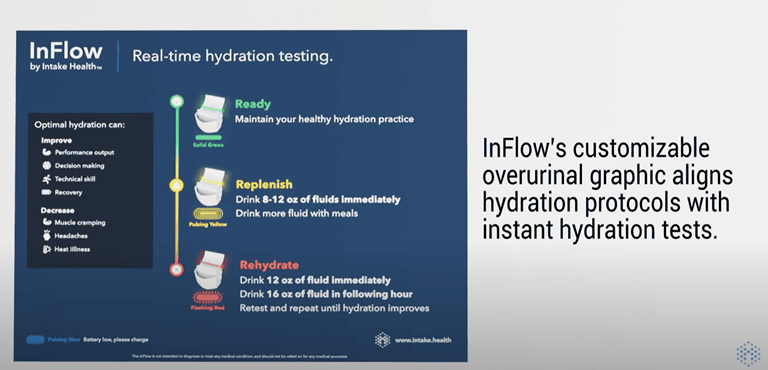
Image: Intake Health
What problem is your company solving? “Hydration testing happens quite a bit in these environments already. Some teams don’t actually have the capacity or resources to do it, even though they would like to do it. Others that have the capacity to find time for hydration testing with their staff can’t really do it frequently enough to change the behaviors of the athletes and keep it top of mind frequently enough to improve the hydration behaviors of their athletes. Proper hydration is really critical to get that extra 1, 2, 3% out of athletes. It improves decision making, keeps them healthier on the field and playing longer. It reduces cramping and injuries and improves recovery. All these things that very elite teams are looking to do is why they have these hydration protocols. Frequently, it starts to become deprioritized or they can’t get to it as often. Our technology allows them to distribute that and automate that process. Now, you have hydration testing in every urinal and the athletes are aware of their results and can act on them immediately instead of waiting for a large number of staff to collect urine samples, do all the testing and write those answers down. There’s a significant lag between existing processes for hydration testing compared to having the instantaneous, hands-free hydration testing in the urinal today. We’re able to bring hydration awareness to the top of mind for athletes and actually change the hydration culture among the team. We’re seeing great results.”
What does your product cost and who is your target customer? “The product is sold primarily through distributor channels. It retails for $2599 for a four pack. Our target customers are elite athletic programs. We sell globally, so professional sports, Division-I universities. Any sports program that can leverage these effectively to improve hydration.”
How are you marketing your product? “For marketing, we started with targeted emails and standard outbound tactics like LinkedIn and calling on people listed on desired customer websites. Since gaining traction, we now see a lot of organic inbound from word of mouth and are shifting to rely on our new distribution partners – Henry Schine, School Health, and Alert Services in the US and Perform Better in the UK – to increase awareness. We also go to conferences quite a bit. You’ll see us at a lot of sports conferences and our distributors will be representing the product. A lot of times, we’ll install the technology at the conferences so people can use it.”
How do you scale, and what is your targeted level of growth? “To scale the company, we are relying on distributors. We’re bringing on more distributors globally to help push the product out. As far as working with our partners to ensure product availability, we have manufacturing partners we’re ramping up to produce the product with the quality we demand, as well as support the customers with the support they deserve as we scale up. There’s a pathway of additional products in what we plan to do next and new markets we intend to take the market to. The sports world is interesting. We want to support it and we’re dedicated to supporting that industry and it’s a very large, global industry. When you’re looking at the elite and the top levels, it’s on the edge of a venture-backable business. Our intent is to get technology that measures wellness on the toilet of everyone in the world. Right now it’s hydration, but there are other indicators. Our strategy is to figure out: ‘How do we get this on everyone’s toilet?’ With hydration products specifically, we are just now looking into workplace safety markets, so construction, mining, warehouses, agriculture. We can have a large impact there keeping people healthy and safe by improving their hydration. We’re also looking at military and tactical environments, like fire, police, first responders. They also have existing hydration protocols and understand and need their people to be hydrated to perform at the level they’re working at. We’re expanding into those markets.”
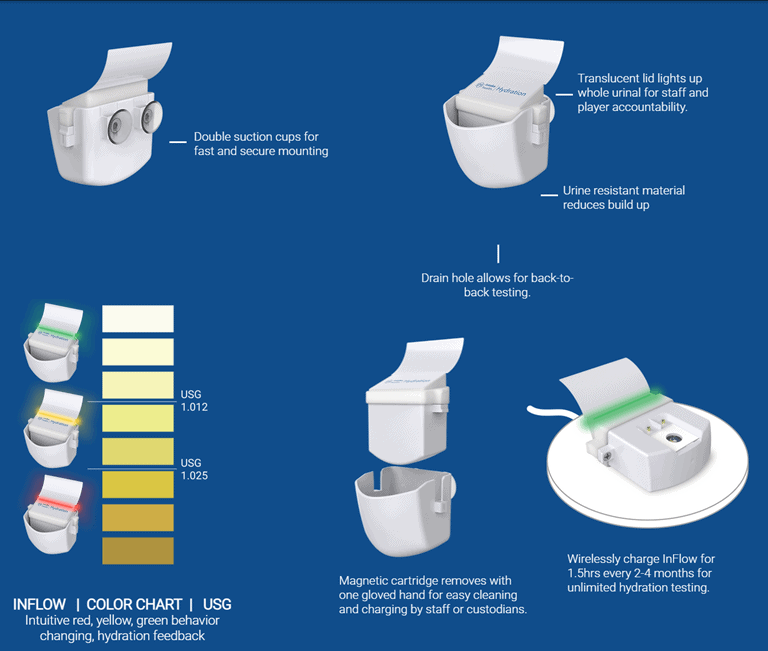
Image: Intake Health
Who are your competitors, and what makes you different? “When it comes to hydration testing, there are competitive options. Most of them are devices, so people are just selling products that help you measure your hydration. I don’t think there is anyone doing real-time hydration monitoring for professional sports in the toilet. Our competition seems to be more status quo, what people are doing today than an actual company producing a competitive product. Our product, when it comes to measuring hydration, whereas for a dipstick or an optical or digital refractometer you don’t have to use your hands. It’s hands-free. No one has to collect a urine sample to use our system to test hydration. The results are instant, so there’s no lag time between running a hydration program and delivering that information and acting on it with the athletes. They can act on it in real time and produce impact before they get to the field instead of often after they hit the field with existing products. The sweat patches can help give a one-time understanding of a person’s sweating capacity and what happens, but it’s not really an ongoing use case that keeps hydration top of mind. That may be more of a symbiotic product instead of a competitive product with a slightly different use case. When looking at other companies that are trying to measure stuff specifically from the toilet, like health indicators not specifically hydration, one thing that sets us apart and is important is privacy. Our technology is standalone, you install it and it does not collect personal, identifiable information nor health data. It’s meant to empower the user in real time. We’re able to bypass a lot of the privacy concerns that some people may have as they’re collecting the data and bringing it up to the internet and doing things like that.”
What’s the unfair advantage that separates your company? “We definitely have patent-pending technology around measuring health indicators from the toilet. The team we’ve built is pretty impressive. We have people from the industry and the sports world specifically that are trying to solve this problem. We have customers that want to come join the team. That’s what it comes down to. We have a good team and novel technology.”
What milestone have you recently hit or will soon hit? “Bringing on the distributors was probably our first milestone. We’ve been able to launch a product, get early traction and then attract distributors. You have to have a product the market cares about in order to have distributors place larger stocking orders. We’ve been able to create a product and validate it. We only launched the product last September, so it hasn’t been very long that we’ve been selling the product. In a very short time period we’ve been able to prove market demand and we have something useful for the market and for our distributors.”
What are the values that are core to your brand? “Transparency and trust are critical. We publish papers and make our data well-known. That is important in this industry, especially where a lot of people try to maybe sell you snake oil. Everyone is looking to get that 1-2 % and some companies take advantage of that. We want to put this on everybody’s toilet and improve health for everyone. Our mission is to help people live healthier longer, instead of us having decades of life at the end of life and degraded health where we can’t do stuff with our grandchildren or we’re going to the doctor’s all the time. We want everybody to be healthy until their final days. Hydration is our starting point but, to get there, trust and transparency is absolutely critical. That’s also why our device does not collect, store or transmit any data. We don’t want to muddy the waters with, ‘What are we doing with all this data we could be collecting on health indications?’ We’ll roll out data collection and connectivity later as customers demand it. Medical rigor is another one. We are not a medical product today, that’s definitely in our future. We appreciate the level of intentionality behind building a medical device and medical product and how the medical industry treats health information and rolls out products to make sure they are safe and efficacious. That’s really critical to us as well.”
What does success ultimately look like for your company? “The entire world living healthy until their final days.”
What should investors or customers know about you — the person, your life experiences — that shows they can believe in you? “We have a good bit of experience already. We’ve built successful companies and I’ve built successful companies. We have customers using the product. We have a history of doing what we say and delivering on what we say, whether that be with this business or previous businesses or life experiences. The team we’ve built is a very credible team with lots of experience in the industry for customers. You don’t get that far in life and build up a reputation without being trustworthy. That goes back to trust and transparency. We’re not new, we’re not the 17-year-old founders out there. We’re 40 years old and have been doing this for a while.”
What examples are there of how Intake Health has benefited a team or partner? “We have a case study with Millwall FC. They adopted our technology. That had an existing hydration protocol in place. After using our technology for a couple of weeks, they saw those results go up and decided they could stop doing their hydration protocol which was time-consuming. They improved their hydration, improving time and money for the organization, which is what we are hoping to do for all teams.”
This article was brought to you by SBJ Tech, a Leaders Group company. As a Leaders Performance Institute member, you are able to enjoy exclusive access to SBJ Tech content in the field of athletic performance.
Hyperice Founder and President Anthony Katz brainstormed his products with a little help from some of the league’s most influential players.
Main image courtesy of Hyperice
A Data & Innovation article brought to you by
During the NBA Playoffs , TV cameras constantly caught marquee players wearing futuristic massage wraps around their backs and knees. It was not to hold their shorts up.
Hyperice and its latest heat + vibration wellness technology has cornered the NBA market more than ever, even though the relationship goes back to an inspirational conversation with the late Kobe Bryant in 2011. The company’s new Venom 2 product has swept through the league this past season with its reverberating, pliable, granulated copper-like material that generates up to 130-degrees of heat — with a who’s who of all-stars on board.
The Lakers’ LeBron James and Anthony Davis and the Celtics’ Jayson Tatum are investors, but that’s not why their respective teams have faltered — the surging Kentavious Caldwell-Pope of the NBA champion Denver Nuggets wears it, too.
“Well, 130 degrees is the maximum heat allowed in a commercial product,” says Anthony Katz, Hyperice’s Founder and President. “Athletes, they always want to push it. If it’s something hot, they want it hot. Or they want it really cold. And if it’s pressure, they want a lot of pressure. If it’s vibration, they want a lot. They want to push their body.”
Hyperice’s journey to the top only proves that everyone’s an entrepreneur at heart and that Katz is open to any and all suggestions. His products — from an original ice simulator to a novel Hyperice X hybrid device just out of the lab — were in part brainstormed by NBA players.
Back in 2011, in an era when players wore sloppy bags of ice late in games on the bench, Katz had already devised a proprietary Velcro cold wrap for his own balky knees. At the time, he was constantly playing pickup games alongside college players at UC Irvine and inevitably would see guys eye-balling the knee contraption. One of his former high school teammates, who happened to be a UC Irvine assistant coach and was charged with letting Kobe Bryant into the gym for 4 a.m. workouts, had a superlative idea.
Show it to Kobe.
Bryant liked Katz’s concept but made suggestions on how to improve it and — if applied — promised to wear it/flaunt it on the Lakers bench. “Inspired me to start the business,” Katz says. “That gave me the motivation to say… I gotta do this now because if he’s gonna wear it, that will trickle down. And if it’s good enough for him, it’ll be good enough for anybody.”
Soon, it was good enough for Blake Griffin and LeBron James, who showed it to his buddies Dwayne Wade, Carmelo Anthony and Chris Paul. Before long, Katz never had to pay for a game ticket again. Griffin and Paul regularly invited him to Clippers games — back when Paul was playing there — and that’s how Katz had his next entrepreneurial moment.
Given access to the Clippers training room, circa 2015, Katz saw how players relied on three modalities: foam rollers, soft tissue massage and vibration. His revelation was to combine them, and he launched the Hyperice Vyper, a product that fitted high amplitude and high frequency vibration into the core of a foam roller. “We went from a company doing not even a million in sales to almost $5 million,” he says.
The next year, in that same Clippers locker room, came his company’s seminal moment. Paul and teammate Matt Barnes told him to think heat, not ice. They said players were now wearing damp hydrocollator pads to stay loose during games, but problem was, they said the pads were “nasty” and would “stink.” They suggested he devise an alternative.
Voila, he developed a vibrating heated pad product, the Venom, that wrapped conveniently around backs, knees and shoulders. The battery, however, would dissipate or detach during games, which was a problem. But Katz was always unafraid to go back to the drawing board. He purchased a company called RecoverX and had engineers incorporate RecoverX’s seamless heating technology into a new completely redesigned vibrating Venom 2.
That product officially launched in August of 2022, in time for this season, ensconcing Hyperice’s role as an official NBA product. During the 2020 Bubble, players were openly using the Hypervolt percussion instrument on the sidelines during games, especially big names such as Milwaukee’s Giannis Antetokounmpo and James. James was also the most prominent proponent of Hyperice’s Normatec air compression system, a lower torso covering that is essentially a lymphatic circulation pump. Post-game, James commonly wears it at home in an easy chair while sipping a glass of wine.
But it was the power-plated Venom 2 back pad that gained the most steam throughout the 2022-23 NBA season. The combination of heat and vibration helped players loosen up swifter — and stay loose. Nearly the entire New York Knicks team took the court wearing it every night. Stars such as Atlanta’s Trae Young couldn’t function without it, while Tatum, Griffin, James and Davis went one step further: they helped bankroll it.
But Denver’s Caldwell-Pope may be the face of the product this June. Or the voice of it. Mic’d up by ABC/ESPN during the NBA Conference Finals, he was on camera wildly exhorting his teammates up and down the sidelines.
Venom coming out of his mouth, Venom 2 wrapped around his back.
This article was brought to you by SBJ Tech, a Leaders Group company. As a Leaders Performance Institute member, you are able to enjoy exclusive access to SBJ Tech content in the field of athletic performance.
The man who helped save Steph Curry’s ankle explains that there are times when athletes can train their movement patterns in the name of performance.
A Data & Innovation podcast brought to you in collaboration with
The Director of Performance at Uplift Labs was on the pod to discuss how the company’s AI can reduce injury risk in athletes.
There is no better candidate to delve into injury prevention and mitigation than the man often credited with saving Steph Curry’s ankle.
We made a whistlestop tour of his work at the Minnesota Timberwolves, Atlanta Hawks and, of course, the Golden State Warriors.
Also on the agenda were:
John Portch Twitter | LinkedIn
Listen above and subscribe today on iTunes, Spotify, Stitcher and Overcast, or your chosen podcast platform.
The company’s Virtual Greens demonstrate that golfers not only win majors with the clubs in their bag, but with actuator modules, infrared line scan cameras and proprietary apps.
Main image courtesy of Full Swing
A Data & Innovation article brought to you by
Leading up to his four-stroke victory in Augusta in April, Rahm relied on a trio of tech-savvy products from Full Swing that helped turn his borderline weaknesses into strengths. It only goes to show that golfers not only win majors with the clubs in their bag, but with actuator modules, infrared line scan cameras and proprietary apps.
“I had been looking into the best way to practice all aspects of my game at home,” Rahm has said of his decision to install Full Swing’s devices, and, as a result, his sprawling home in Arizona is now one of the epicenters of golf.
In one corner of his house sits an approximate 4-by-8 sliver of sophisticated turf that is actually a high-tech “Virtual Green” simulating the quick 12 to 14 breaks of Augusta National. Immersed with dozens of actuator modules — which move to recreate downhill, uphill, right breaks, left breaks, crests, valleys and hills — the interactive putting green enabled Rahm to zero in on one of his main concerns heading into the Masters.
“Jon just wanted to work on little short left or righters,” Ryan Dotters, CEO of Full Swing, told SBJ. “Because that’s what he kind of struggled with in the past. So we put a smaller Virtual Green in for him. He wanted a nice little square one.
“That’s just what he wanted to focus on to get better: these four to five foot putts that are left or right breakers. And we got [the Virtual Green] down to where it’s super fast, it’s Augusta fast in there…We got that one to the 14 [break] that he needed for the Masters.”
Other adaptive putting greens on the market can tilt left and right or forward and back. But none are said to have Full Swing’s patented actuator modules that can simulate any break on any course in the world with the click of a button. The Virtual Greens, which vary in size and are priced between $70,900 and $95,400, are equipped with an accompanying computer, whose software can replicate subtle, moderate or severe breaks on request.
Only about 400 of them have been on the market so far — “It’s expensive to make, expensive to ship, expensive to install,” Dotters said —but Rahm, Tiger Woods and Jason Day actually own three of those 400 — and have all become Full Swing ambassadors. Woods, in fact, has equity in the company.
In another corner of Rahm’s basement is what had Woods originally buying in: the Full Swing simulator. The company, in fact, was birthed circa 2019 with simulators in mind, and early iterations that included highspeed ION3 cameras drew the interest of Rahm’s tech-centric coach Dave Phillips.
As co-founder of the Titleist Performance Institute in Oceanside, Calif., Phillips began offering his insights to Dotters and the company’s engineers on how to advance their Full Swing simulator further. At around the same time, Rahm was living in his home overlooking an Arizona golf course, baking through 110-degree practice rounds. Looking for a cooler, indoor solution, Phillips steered Rahm to the Full Swing simulator, as it continued ideating the latest technology.
Then, last September, the company released its Pro model simulator that leveraged infrared line scan cameras to create virtually a latency-free experience. The overhead ION3 camera tracks the golf ball on impact, and as the ball crosses the infrared line, it triggers the computer to instantly mimic the shot — producing ball speed, launch direction, launch angle and a visual of the ball flight in real time.
Other simulators generally do not have the ability to track a ball without delay because the devices first calculate ball flight, then rotate the screen to where the ball should land and then provide an image. The difference in elapsed time may seem minor, but to a pro like Rahm the Full Swing Pro was a breath of fresh air…less than 110 degrees.
As a result, he was able to replicate Amen Corner at Augusta over and over to prepare for the Masters, and when the weather was amenable, he’d then retreat outside to train with Full Swing’s third and most recent innovation, the KIT Launch Monitor.
Released originally in December of 2021 with incremental input from Woods, the KIT Launch Monitor — placed in close proximity behind the golfer — used a dual radar system to track a ball from impact-to-landing-to-roll while also identifying the dimple dispersion off the front face of the ball along with rotation and seam. The litany of metrics included spin rate, spin axis, ball speed, attack angle and more. But the statistic Rahm most cared about was: carry.
Dotters asked Rahm questions such as: “How can we make these better? What does the interface look like? What’s the app looking like?” Rahm provided feedback, and a new, improved version. “[It was] a 3-to-4-year project that took a lot of testing and a lot of capital to get right,” Dotters says. It was delivered to Rahm months before the Masters.
“The screen was a big one for Jon,” Dotters says. “He wanted to just turn around look and see what the numbers were. But it really came down to carry numbers for him. He needed those to be exact. And we’ve done a really good job of being pinpoint accurate with carry. Whether it’s 350 with a driver or 60 yards with a wedge, carry is just Jon’s biggest metric.
“Sometimes he doesn’t need to hit it 320, he needs to back it down. So he needs to know those carry numbers and we’ve learned we are really good at this. So I think what I can relay —through his conversations with me and his testing — is that it gave him a leg up at the Masters.”
And a certain green jacket.
This article was brought to you by SBJ Tech, a Leaders Group company. As a Leaders Performance Institute member, you are able to enjoy exclusive access to SBJ Tech content in the field of athletic performance.
Move Insoles have been developed by pedorthists who rely on video-motion and automated gait analytics to optimize orthotics for NBA players.
A Data & Innovation article brought to you by
Yes, the kid could have his sneakers. But… he couldn’t have the Move Insoles that were biomechanically designed based on 120,000 foot scans and tedious algorithms for stellar arch support and injury prevention.
So Ingram calmly slipped out the insoles, signed the sneakers, handed them over, received a gracious thank you and found out later the NBA had posted the whole scene on Instagram.
The video went somewhat viral, leading to this random comment underneath: “why do players take out the sole in the shoes then give them away….help me understand.”
Answer: footwear technology.
Move Insoles are an emerging product developed by credentialed pedorthists who rely on video-motion and automated gait analytics to democratize orthotics for NBA players — not to mention the general public — so they don’t have to wear more-restrictive custom inserts.
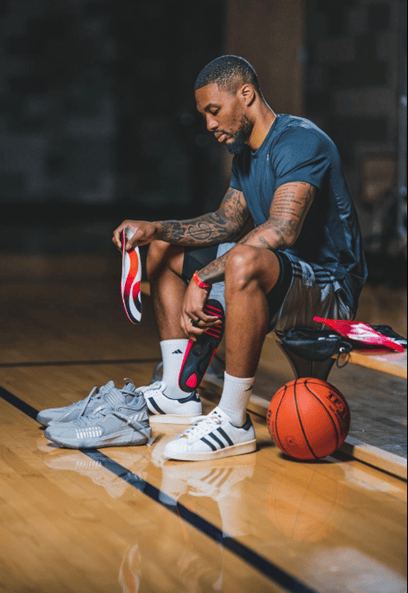
Image courtesy of Moves Insoles.
Roughly a dozen NBA teams have already acquired the insoles in bulk for their respective rosters — the Pelicans purportedly being one — but the company’s Co-Founder and Co-CEO Nate Jones wasn’t sure players such as Ingram had actually adopted the product until the video of the giveaway.
“It was an illuminating moment for us,” Jones said, who brainstormed the business after dealing with his own plantar fasciitis. “We’ve seen players pull out custom orthotics before. But for a player to hold onto our $60 insole — which is not prohibitively expensive for them, they can always order more — because they’ve broken in a pair and want to carry them on to the next game, that was a great story for us.”
Before launching the company, Jones’s goal was to produce an over-the-counter insole for younger, active athletes that was based on data and podiatry science. “I mean, you wouldn’t ever see Dr Scholls in an NBA locker room,” he says. As a long-time sports marketer working under the prominent NBA agent Aaron Goodwin, he fortuitously had access to league players and league intel — and found out which company was doing proprietary foot scans for NBA teams.
That firm was Miami-based Footcare Express, which had performed 120,000 foot scans to create an algorithm for a universal insole that would benefit about 85% of the athletic population.
Leveraging Footcare Express’ video and gait analysis and the company Mat Market’s original equipment manufacturing, Jones recruited former Director of Nike Innovation Aaron Cooper to help with the final design and implementation.
“This is 100% based on the data,” Jones says. “If you have a flatter foot, this will bring your feet into a better position. Basically, there are all kinds of biomechanical issues that could potentially get your feet off kilter: if you’ve got a flatter foot or some other potential issue. Our insoles help aid against those potential issues.”
It also helped that Jones had the perfect person to trial the insoles with: Portland Trail Blazers all-star guard Damian Lillard.
Lillard had broken his foot as a collegiate player at Weber State and had dealt with nagging plantar fasciitis during his fourth season in the NBA. Hyper-sensitive about footcare, Lillard — an Aaron Goodwin client — agreed to wear the Move Insoles during the Tokyo Olympics, which took place in 2021. He left with a gold medal and healthy feet.
Lillard invested in the product, as did fellow NBA All-Star Chris Paul, and the common refrain from both was that Move Insoles’ $60 over the counter Gameday Pro product gave them enough arch support without sacrificing “the feel” of the court.
This article was brought to you by SBJ Tech, a Leaders Group company. As a Leaders Performance Institute member, you are able to enjoy exclusive access to SBJ Tech content in the field of athletic performance.