Leaders in Business
  • Membership
  • Events
  • Content
  • Virtual Learning
  • Connections
  • Partners
Login
  • Leaders Meet: Innovation
  • Events
    • Leaders Week London
    • Leaders Sports Awards
    • Leaders Club Events
    • Leaders Performance Institute Events
    • Leaders Meet: Innovation
  • Memberships
    • The Leaders Club
    • Leaders Performance Institute
  • About
    • Careers
    • Contact
I’m a sports leader:
  • Off The Field For those focused on the business of the sport View more
  • On The Field For those working with an athlete or elite team View more
  • Login
    • Leaders ClubThe membership for future sport business leaders
    • Leaders Performance InstituteThe membership for elite performance practitioners
  • Newsletters
Performance Institute Leaders Performance Institute Logo
  • Membership
  • Events
  • Content
  • Virtual Learning
  • Connections
  • Partners
Login
Members Only

15 Apr 2025

Articles

With Practice, Anyone Can Lead a Courageous Conversation… and ‘Skilled Candour’ Can Help

Category
Leadership & Culture, Premium
Share
Facebook Twitter Email Copy Link
https://leadersinsport.com/performance-institute/articles/with-practice-anyone-can-lead-a-courageous-conversation-and-skilled-candour-can-help/

A recent Leadership Skills Series session provided some tools that all leaders and coaches can use with their athletes and colleagues alike.

By Luke Whitworth
The ability to lead courageous conversations is a skill in which all coaches and practitioners can excel, but it requires revisiting from time to time.

That was the premise for this recent Leadership Skills Series session, where members of the Leaders Performance Institute were invited by our friends at Management Futures to explore:

  • How to create the conditions for courageous or difficult conversations
  • How to navigate these conversations effectively

There are two key principles:

  1. It is not enough for you to have the courage to say what it is that you want to say – people must feel safe enough to hear it. In psychologically safe environments, people are more receptive to difficult conversations; and leaders can find more frequent opportunities to explore tricky topics.
  2. We are striving for actionable insight. The point of having important conversations is that something changes in the aftermath. It’s not just an opportunity to download or speak your truth.

What is ‘skilled candour’?

When we have explored this topic in the past, we referenced the term of ‘radical candour’, which coined by executive coach Kim Scott, who argues in her 2017 book Radical Candor: Be a Kick-Ass Boss Without Losing your Humanity that leaders have a ‘moral imperative’ to step into difficult conversations and challenge with skill. This requires courage because it is simply easier to avoid such conversations.

Scott’s idea has influenced Management Futures, who fashioned their own concept: ‘skilled candour’, which underlines the skill behind the action.

On that note, psychological safety is essential so that people know that you are coming from a well-intended place. If there isn’t a belief that there is trust or positive intention, it may well trigger the ‘inner chimp’ (the primitive, emotional part of our brains, which is there to protect you but, in certain circumstances, can arouse feelings of defensiveness).

When the chimp has been triggered it’s unlikely that you will have a productive conversation.

The aim must be to create a sense of safety so we can be honest and speak directly:
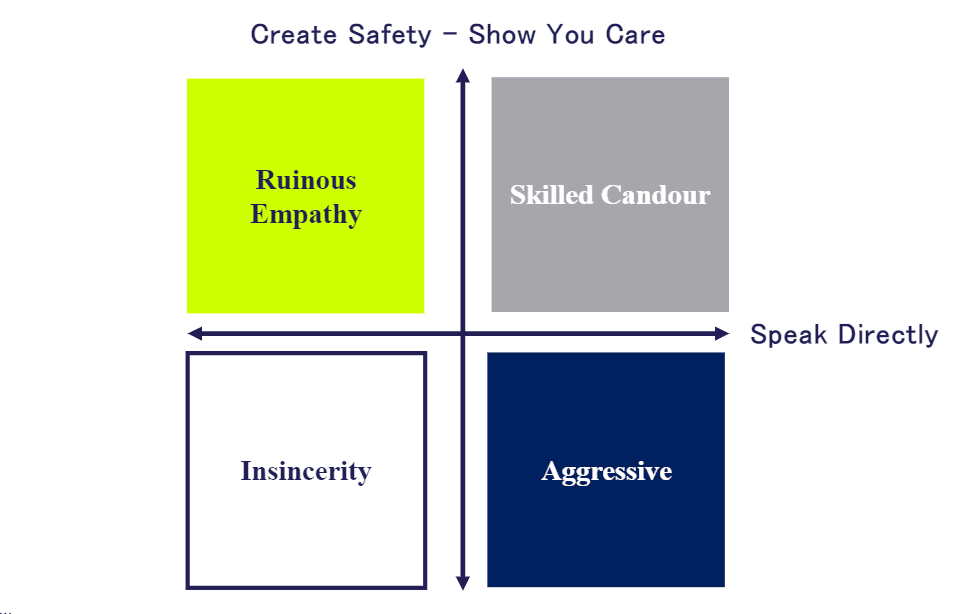
Image: Management Futures

Ruinous empathy: this is where we say what needs to be said in a clear and direct way. When you want to spare someone’s short-term feelings, you don’t tell them something that they need to know. You care personally but fail to challenge them directly, with ruinous consequences.

Insincerity: when you neither care personally nor challenge directly. You offer insincere praise to a person’s face and criticise them harshly behind their back.

Aggressive: when you challenge someone directly, but don’t show you care about them personally. It’s praise that feels insincere and feedback that isn’t delivered kindly.

We asked the practitioners and coaches in attendance where they thought they sat on the skilled candour graph. A straw poll delivered a striking insight:

Ruinous empathy: 45%

Insincerity: 3%

Aggression: 12%

Skilled candour: 39%

There are five key skills to enable your preparation, delivery and summary of a courageous conversation.

  1. Check your assumptions: we make up a lot of stuff about people. We imagine what’s going on in people’s lives, what they think about us, what their motives are. We imagine what they’re going to say in that conversation and how they’re going to react. And then we work our responses around that where we can tie ourselves up in knots, and we’re having a conversation in our heads rather than what’s truly happening. So strip out your assumptions.
  2. Have a clear outcome: declutter the nonsense. What is the outcome that you want to have and what is a good outcome for this conversation? This will help you get an actionable insight.
  3. Manage your body language and tone: so many of us are so busy that we just leak out impatient, stressed and busy signals. Non-verbally, we’re sending out some different signs, so it is important to be present, be composed and give high quality attention. What we don’t want to be doing is to be half in a conversation and half out as people pick up on it. Giving someone your full attention is a gift, and they will feel it, and they will trust you.
  4. Maintain a two-way dialogue: difficult conversations should be two-way. What are your thoughts? This is how I feel. How do you feel? This is what I would like to happen in the future. What are you going to do? What help do you want? Make sure you’re really using your active, listening and really great, powerful, open questions as well.
  5. Agree specific next steps: what are you going to do differently? How are you going to make sure it happens? What support do you need and make sure that it’s specific? Get right down into detail with the actionable insights.

The SBI feedback model

The Center for Creative Leadership’s SBI feedback model is a useful tool for both positive and constructive feedback. ‘SBI’ stands for ‘situation/standard’, ‘behaviour’ and ‘impact’.

Below is a simple example of what this could look like – the key is what we want to get straight to the point:

Situation/standard: To begin, we should guide the person to recall the exact time and place where the action we’re discussing occurred. The more specific we are, the better, as it will help them visualise their surroundings and actions at that moment. This provides the context for the feedback.

Example: ‘It’s really important in team meetings that everybody gets the chance to share their opinions and feels heard’.

Behaviour: Outline the specific actions or behaviours that prompted the feedback. As with the previous part, it’s must be as detailed as possible. We’ll achieve this by providing two key pieces of information:

  1. What was the behaviour?
  2. What did they do specifically that causes you to think that this was the behaviour they were demonstrating?

Example: ‘I’ve noticed in the last couple of meetings that when people have come up with an idea you’ve immediately said something negative about it’.

Impact: We should highlight what we believe the impact of their actions was. This impact could pertain to you, the team or other individuals. As with the previous section, it needs to be detailed and is divided into two parts:

  1. Who did it impact on and how?
  2. Why do you think this was the impact?

 Example: ‘You’ve talked about why it’s not possible and the impact of that is that it’s draining the energy out of the room and stopping people speak up’.

What to read next

Psychological Services at the FC Bayern Campus: ‘We Always Worked Together, but Now our Efforts Are Integrated’

Members Only

26 Mar 2025

Articles

How to Use Data with Confidence in your Coaching

Category
Data & Innovation, Leadership & Culture, Premium
Share
Facebook Twitter Email Copy Link
https://leadersinsport.com/performance-institute/articles/how-to-use-data-with-confidence-in-your-coaching/

In a recent Leaders Virtual Roundtable, members discussed how teams can improve the data literacy of their coaching cohorts.

By John Portch & Luke Whitworth
The performance director glanced at the complicated data on the head coach’s half-time board and later delivered a blunt assessment.

“I said to him: ‘I had you when you were a player – I know you wouldn’t understand any of this – so why are you telling this to our players?’”

The performance director in question shared this story at a recent Leaders Virtual Roundtable entitled ‘Effective Integration and Interpretation of Data in Coaching’.

It quickly dawned on the coach. “He went: ‘yeah, I’m sorry, I hold my hands up’. That was powerful because he could see it.”

Ideally, a coach would have both the working knowledge and the confidence to make targeted and effective data-influenced interventions that remove confusion or ambiguity.

Over the course of an hour, members of the Leaders Performance Institute, drawn from a mixture of analytics, sports science and coaching backgrounds, discussed the steps they are taking to improve the data literacy of coaches at their organisations. They homed in on four factors.

  1. Educate coaches from the outset

Performance practitioners: engage the coach early in their tenure. Data can be another string in their bow. “You don’t want to burden them,” said one participant from the Australian Olympic and Paralympic system, “but how can you elevate them and enhance them as a coach?” The key is to explain that data is there to support their intuition as a coach. Even AI should be no more than a ‘co-pilot’. Data analysis should support the work of the coach and “give them confidence in their decision making.”

Furthermore, as analytics career pathways evolve, more teams are establishing hybrid coaching and analytics roles. “Some of the best analysts are good interpreters and translators for coaches,” said one attendee working in English football, “and some of them have taken that on themselves to think ‘I can go and progress in this’ if they’ve got an interest in pushing on with the coaching area as well.”

  1. Too little or too much? Timing is critical

“Timing is everything with coaches,” said one member, while making the distinction between ‘teaching and developing’ and the ‘telling and giving of answers’. “The timing of when you plant the seed or present something new to a coach is really the start of the success or failure of what you’re trying to do.” Another attendee suggested that a practitioner must consider “what is it that you’re going to provide? And what is it you’re going to hold back?” A third offered an example of this in practice: “We’ve introduced not just new technology, like tools and hardware, but also a large number of new datasets and data metrics for the coaches to understand.” An astute practitioner will foster a curious mindset and understand “when it’s OK to give the coach a little bit more to stretch them and when we will hold something back.”

  1. Highlight the link between data and performance… selectively

When a curiosity-driven coach uses data to support their intuition, they can do their most effective work. “I always tend to try and attach myself quite closely with any analyst to marry up the science and the art,” said an age-group cricket coach in England. “It’s about getting the data and then allowing that coaching gut feel and observation to take place as well.”

From the analysis side, it requires someone able to move beyond their specialisms to communicate readily with the coaching staff and other colleagues. “The positions of technical directors or performance managers within this space are critical to make the decisions about what we translate and how we do that,” said a member. “My experiences of things when they’ve gone well would be with practitioners that have those professional skills to communicate and give what is needed rather than give too much.”

  1. What’s the priority? A coach must decide

It’s on the coach to establish the need for their performance team. “The practitioners shouldn’t overwhelm the coach, but also the coach shouldn’t overwhelm the practitioners,” said a participant from the British Olympic and Paralympic system. “Do they truly have a priority? Do they truly know what it takes to win?” The coach needs to be clear on how the data is to be used, whether it’s to inform development, to pose exploratory questions, or to make a decision. “Coaches can fall into a trap. They want to know everything, but do they truly need to know everything? What are they actually prioritising?” From there the team can decide “what are they going to double down on and ask where the gaps are for exploration.”

What to read next

What Are the Risks when Monitoring Slips into Surveillance?

27 Feb 2025

Articles

Soft Skills, AI, and Psychology: the Skills that Will Define the Practitioner of the Future

Category
Coaching & Development, Leadership & Culture
Share
Facebook Twitter Email Copy Link
https://leadersinsport.com/performance-institute/articles/soft-skills-ai-and-psychology-the-skills-that-will-define-the-practitioner-of-the-future/

In this Virtual Roundtable, brought to you in partnership with ESSA, Robin Thorpe and Lyndell Bruce explored four areas where the practitioner of the future will need to excel.

An article brought to you by

By John Portch & Luke Whitworth
Dr Robin Thorpe has instant reservations when performance departments describe themselves as ‘integrated’.

“It’s become a new trend or buzz term in high performance,” said the former Director of Performance at Red Bull. “I’d be really interested to see how many self-proclaimed integrated departments and processes actually are.”

In a truly integrated department, he argued, there has to be “positive and respectful challenge between staff and then between the disciplines” and he is unconvinced that this is always the case in many environments.

“Not to be controversial, but I would think that in some of the areas or places where true integration is preached, there might actually not be any collaboration whatsoever,” Thorpe added. “And so, without collaboration, there might not be any friction points or any challenge, so it might only be perceived as an integrated process.”

Thorpe was speaking at the first session of ‘The Future of Performance Sport’, a three-part Virtual Roundtable series brought to you by the Leaders Performance Institute and Exercise & Sports Science Australia. The first session explored the ‘future practitioner of high performance’.

He was joined on the virtual stage by Deakin University’s Dr Lyndell Bruce, who harbours similar reservations when it comes to integration.

She said: “So often we see with these integrated teams that an athlete has poor performance. So they throw everything that’s been working really well out the window to try and solve why we’re not winning – and that suggests that it’s really not an integrated team.”

The future practitioner will need to find the answers and, here, we detail four considerations, including better integration, that will help to stand them in good stead.

  1. Combined technical knowledge and ‘soft’ skills

Both Bruce and Thorpe believe that the future practitioner will combine technical knowledge and softer skills

“People call them ‘soft’ skills – I like to call them transferable skills, complementary skills,” said Bruce. She also pondered how they might be taught. “It’s challenging because it takes time, it takes effort, and it takes resources. It’s too easy to say students will get that in their work, integrated learning, because we know it’s not the case. They don’t all go to the same environment and we can’t control those environments.”

There are questions to be answered on the technical side too, with Thorpe emphasising the importance of detailed and applied research. “We delve into research articles which might be relevant to what we do, but we also see how they associate with the work that we do,” he said.

Thorpe also believes that generalists will continue to have their place. “Although specialisation will offer a lot more opportunities for younger students and practitioners going forwards, I hope that we don’t lose the more generalist skills that I think are very, very effective currently.”

  1. The impact of AI and technology

Thorpe sees AI as a potential time-saver, but with caveats. “I think we know that AI can certainly support us with is enhancing processing times when it comes to using and working with data that we have,” he said. “We’ve come into this era of plug-and-play technology, which means that our ability to cope with data has become stretched.”

However, he added, “I certainly don’t believe it’ll ever be the silver bullet to a lot of our performance problems or challenges or questions.” It is no surprise that he preaches caution. “I think we still probably need to think about some of the principles of why we’re collecting some of that data in the first place.”

At Deakin, Bruce and her colleagues have gotten used to students using AI to craft responses. She said: “The conversations are leaning towards how we teach students to use this in an advantageous way.”

And, as she observes, “many organisations are using those machine learning models to create outputs, look at different tactical and technical elements of match play, to understand the physiological data that they’re receiving, so I don’t think that’s unique; and I think there’s still a way to go in terms of how we use that and how we implement that more effectively.”

  1. The growth of psychology and mental performance

Wellbeing – and psychology as part of wellbeing – continues to grow in prominence, with all staff members called upon to play their part.

“It’s not a once-off conversation because they flagged on the wellbeing this week and then two weeks later they’re back in their normal range – we continue that conversation and check-in,” said Bruce of her work Deakin. She also noted the growing specialisation in how psychology is used in sport. “We use psychology from a performance perspective and also a clinical perspective.”

Thorpe was responsible for mental performance in his most recent role. “It was very much a pivotal learning opportunity for me; to understand the continuum of how mental performance operates,” he said. This included performance under pressure, helping athletes to deal with increased mental loads in training and competition, and psychological profiling.

  1. Integration

Integration is increasingly difficult in a world of growing specialisation with so many inputs to reconcile, but Thorpe and Bruce both offered some tips.

For his part, Thorpe emphasised objectivity, particularly given the different ‘languages’ that individuals in different fields will speak. He says: “How can we use objectivity as a common language? Good objectivity – not AI-based reams and reams of data – but really solid precision-based objectivity is our vehicle to integrating approaches.”

High performance teams need to understand the desired outcome, then, as he asked, “how do we then fit these experts and specialists to those outcomes rather than coming at it all individually?”

Bruce then argued for consistency. “[The high performance team] operates irrespective of performance, while you might need to innovate and make adjustments along the way,” she said. “But it doesn’t change because of poor performance.”

Further reading:

Sports Science Research: the Strengths, Weaknesses and Opportunities

3 Feb 2025

Articles

The Debrief – a Snapshot of Powerful Discussions Happening Right Now Across the Leaders Performance Institute

Category
Leadership & Culture
Share
Facebook Twitter Email Copy Link
https://leadersinsport.com/performance-institute/articles/the-debrief-a-snapshot-of-powerful-discussions-happening-right-now-across-the-leaders-performance-institute-11/

This month we touch upon the power of flexibility, relatability and collaboration in leadership and what you need to know to be better in each area.

By John Portch
Did you see January as a time for reflection or a time for pushing on towards your goals?

Ideally, you found time for both and, here, we highlight a selection insights from the first month of 2025 that may help you to consider a problem in a different way or enable you to identify the right people to whom you can turn.

We hope to see some of you in Melbourne later this week for the Leaders Sport Performance Summit.

And, whether or not you can make it to the Glasshouse, here are five thoughts for all leaders to ponder.

  1. Redefine or reframe the problem with alternative goals

If you can find new ways to consider your problems, it can open up new ways of thinking.

In this article, John Bull of Management Futures used the example of an elevator. Perhaps your goal is to make the elevator go faster, but what if your aim was to make the wait less annoying?

“Most hotels will put a mirror beside the elevator,” he said. “That seems to kill time when we’re looking at ourselves in a mirror.”

Bull suggested we “think of at least three different ways we could define our goal, to help open up new ways of thinking about the problem”.

He also share the STOP process for creative problem-solving:

  1. As a leader you’re not bulletproof – don’t try to be

In November, John Longmire called time on his 14 years as Senior Coach of the Sydney Swans. He has taken a new position as the Swans’ Executive Director of Club Performance but, before doing so, he reflected on his tenure as Senior Coach, which brought two AFL flags and four Grand Final appearances in total.

You can read his thoughts here, but here is a snapshot of his desire to remain “connected and relatable” to his players and staff. As he said onstage at November’s Leaders Sport Performance Summit in London, “the coach is no longer looked upon as being bulletproof” whatever their standing may be within the game.

His final speech to the players and staff as Senior Coach attested to that belief. He weaved in personal stories and his voice cracked at times. He wiped away tears too.

It called to mind the weekly ‘storytelling’ sessions that Longmire made a key feature of the Swans’ environment. He told the Leaders audience that players and staff share stories or complete a series of tasks for discussion each week. Recent examples included writing ‘a letter to your 16-year-old self’. These sessions are popular with players and staff alike.

“Sometimes it’s a photo of something that mattered to you and quite often there’s tears involved,” he said. “The way I looked upon coaching 25 years ago is completely different now – these 18, 19, 20-year-olds need to be able to relate to you. If you can show that you’re human, you get a lot more back.”

  1. Performance improves when you match team density, size, and space to the task at hand

The question of team dynamics sits at the heart of The Social Brain: The Psychology of Successful Groups by Tracey Camilleri, Samantha Rockey and Robin Dunbar. The trio has spent decades observing the worlds of academia, business, and government as they look to better understand the workings of high-performing teams.

Camilleri and Rockey came to the summit in London to discuss how their research has its applications in the world of sport. Decision-making was one such area:

For decisions made at speed, you’ll count on five people.

Five is the number of intimate relationships a person can have. Rockey said: “These are the relationships that protect us, make us thrive, and ensure that we go through life in a joyful way. They protect us from ill-health and from some of the psychological challenges that we might have from feeling insecure.” They, of course, occur in intimate spaces.

For more complex decisions, you’ll count on 15 people (including your original five).

The ‘pain’ comes when you look to insert new thinking into complex decision making in a group space. “We spend about 60 per cent of our social time with just 15 people,” said Rockey. “With the 15 in the workplace, they would have built long-term relationships and loyalty to you over time – that’s how we work as humans – so breaking up those people to bring in new thinking is painful.”

According to Dunbar, the upper limit on the number of social relationships we can enjoy is 150

Dunbar suggests that people can have no more than 150 social relationships at any one time. “It’s a very stable number across all societies and cultures,” said Rockey.


From The Social Brain: The Psychology of Successful Groups by Tracey Camilleri, Samantha Rockey, and Robin Dunbar.

  1. Athletes crave individual – and team – development

Young athletes are bolder in stating their desire for belonging and connection than their forebears, but this comes with a paradoxical demand for more personalised training and attention. There are clear implications for the time coaches spend on team dynamics in an era where the power has shifted to the athlete. The topic was discussed on a recent virtual roundtable. “Staff and coaches are more vulnerable,” said one participant, who pondered where the balance needs to sit. “Give the athletes a voice and a choice, give them ownership, have the consultation, but there is a line too.”

Another participant with experience of coaching in European football, highlighted that individual work will mean different things to different people and can be dependent on team selection. They argued that there is room for better management of expectations and, more broadly, a consensus for coaches and athletes alike on what constitutes ‘individual’ training.

  1. The best performance tools are co-designed

In February 2024, the England & Wales Cricket Board launched its Insight 360 platform, which adopts a data-driven approach to athlete and performance management.

Ahead of the launch, the ECB gathered input from practitioners and coaches across the English game. “This means Insight 360 is bespoke for women’s cricket,” said Anna Warren, the Head of England Women’s Science & Medicine. Players, she said in this article, are happy with an app that allows them to review their own data in as much detail as they like. “This is good for player buy-in, which is always a challenge in relation to athlete monitoring.”

There is also the power of a co-designed project. UK Sports Institute have found as much with their Project Minerva. Dr Richard Burden, the UKSI’s Co-Head of Female Athlete Health & Performance, said: “Get the practitioners involved, get athletes, get the teams and bring them along with it because if they’re onboard you get easier access to them and you’re going to produce something that’s more translatable, meaningful and applicable to them.”

Warren is on the same page with Insight 360. “You can link loads of different data sources together and start to answer some key performance questions – we’re not looking at everything in isolation.”

Members Only

23 Jan 2025

Articles

‘Where Do I Focus my Attention: on Leadership, Management or Coaching?’

Category
Leadership & Culture, Premium
Share
Facebook Twitter Email Copy Link
https://leadersinsport.com/performance-institute/articles/where-do-i-focus-my-attention-on-leadership-management-or-coaching/

Racing 92 Head Coach Stuart Lancaster weighs up the balance between being systematic and ‘authentic’.

By John Portch
Stuart Lancaster understood the scale of the challenge that awaited him at Racing 92 when he took the reins as Head Coach in July 2023.

Rebuilds take time and, for all his work behind the scenes, Lancaster’s Racing remain a mid-table team in France’s Top 14.

“When things don’t go well it’s very easy to turn around and say, ‘he’s an Anglo-Saxon, he doesn’t fit our culture’,” he told the audience at November’s Leaders Sport Performance Summit in London.

After signing a four-year contact in September 2022, he saw out his last nine months at Leinster; a winning environment he helped to build. Staying was probably an easier option.

“I’ve always had the desire to challenge myself as a coach,” he continued, “and there’s no bigger challenge than going to a French club as a head coach without being fluent in the language.” The Top 14, which is the wealthiest league in rugby, is known for its sink-or-swim nature for players and coaches alike, particularly those arriving from abroad.

A year and a half into his tenure, Lancaster regularly asks himself: “Where do I focus my attention between leadership, management and coaching?”

‘Tiptoe in or smash the door?’

Upon his arrival at the Paris La Défense Arena, Lancaster was mindful that his new boss was his predecessor as Head Coach, Laurent Travers, who had been promoted to President.

Lancaster asked himself: should he “tiptoe in or just smash the door down?” He alighted somewhere in between.

A quirk of the fixture list meant that Racing had played Lancaster’s Leinster twice in the European Champions Cup in the months after he signed his contract. Leinster won both matches, home and away, by a combined 58 points.

He argued that this was to his advantage when being introduced to Racing’s squad. “The players saw what that environment looked like because they had played against it,” he said. “I was pushing on an open door. They were ready for a change and a new working week.”

Out went the long lunches, in came a revamped playbook, but Lancaster has been careful not to separate the club from its roots. On his coaching staff, he inherited former Racing wing Joe Rokocoko (Skills Coach) and former captain and hooker Dimitri Szarzewski (Forwards Coach), both of whom won the league with the club in 2016. He also drafted in former France scrum-half Frédéric Michalak as his Backs Coach.

It was not about replacing Racing’s “DNA” with Leinster’s but laying foundations as the game shifts. “I had to show the players what good looks like and why it’s good.”

The coach’s search for ‘truth’

Lancaster cited Sarah Langslow’s book Do Sweat the Small Stuff: Harness the power of micro-interactions to transform your leadership. It details how one can connect with people and inspire them to perform. The types of ‘micro-interactions’ Langslow discusses are important to Lancaster given his lack of fluency in French (and the inability of some squad members to speak English).

“You can get a sense of the culture in your one to ones,” he said of his individual meetings with players, coaches, and staff. “You’ve got to dedicate time in your working week for one to ones.”

Lancaster revealed that he had made four phone calls to coaches and staff at Racing prior to his appearance onstage. “I was sense-checking the mood in the camp,” he said, adding that coaches and staff have access to information beyond “the manufactured truth that the head coach gets”.

Softening the performance conversation

Key to Lancaster’s approach has been his efforts to galvanise a squad containing French, English, Welsh, Australian, Argentinian, Fijian and Georgian players. Each week, a different player, coach or staff member will share a personal story in front of the group. Once a month, the players organise a themed dinner for the squad, coaches and staff.

Lancaster has also brought with him the psychological profiling tools he used at Leinster. He believes they can help players to better understand their strengths and weaknesses. To kick things off, he initially shared his own profile in a team meeting.

These efforts all help to soften the performance conversation. “You can be both systematic and authentic by using your meetings in a creative way and not just talking about the technical and the tactical. You can talk about life experiences and how you can learn from failure.”

It has been a quick win. “French rugby is an incredible success story but at the same time it’s behind in certain areas.”

Lancaster makes the point that Racing centre Gaël Fickou could win more than 90 caps for France “yet he’d never even thought about what emotional intelligence or leadership looks like.” Until now.

If Racing can raise their performance levels, they will do so while showing their human face; and that also goes for a coach who has been labelled a ‘robot’ in the French media.

“Often the simplest things are the most powerful: admitting your vulnerability, your mistakes, by showing that human face.”

Members Only

13 Jan 2025

Articles

Ready to Shake Things Up? The Nine Useful Habits of Disruption

Category
Data & Innovation, Leadership & Culture, Premium
Share
Facebook Twitter Email Copy Link
https://leadersinsport.com/performance-institute/articles/ready-to-shake-things-up-the-nine-useful-habits-of-disruption/

John Bull of Management Futures sets out where sources of disruption may prove useful for you and your team.

By John Portch
What is the role of disruption in your environment?

In answering that question, one must consider “the best sources of disruptive thinking in our environment and in our sports,” as John Bull put it.

The Director & Lead for High Performance Research at Management Futures hosted a recent Leaders Virtual Roundtable on the topic.

Bull went on to suggest nine useful habits of disruption that any team can use, but he began by posing another question: where is disruption useful?

“How open are you to disruption and how proactive?” asked Bull, who added that he thinks the answer is often situational.

“I want to put an emphasis on the word ‘useful’; and the balance between disruption and stability is really critical. I think disruption can be really negative if it tips it over into disrupting everything.”

The nine habits

Bull identified nine habits that help to ensure that disruption is useful in your context.

  1. Bring the outside in – seek disruptive experts
  2. Study other environments, pick their brains
  3. Invite them in to observe your environment and offer feedback
  4. Recruit them, either full-time or part-time
  5. Increase cognitive diversity

On that last point, cognitive diversity is important because it allows for a wider range of perspectives and approaches to problem-solving, leading to more innovative solutions, faster decision-making, and a greater ability to adapt to change within a team or organisation.

Bull then referred to the work of MIT professor Alexander ‘Sandy’ Pentland:

“If you look through human civilisation of the last 10,000 years, the pattern Sandy Pentland keeps finding is that you’ll see a core team of people who know each other incredibly well;  where cohesion is really high. But what they do is frequently connect with outside stimulus. There needs to be a team with a lot of cohesion, but they need to be getting external stimulus. And the question is: where are you getting that external stimulus from?”

  1. Invite challenge
  • Dial up ‘challenger safety’. Assess how safe it is for people to challenge the status quo.
  • Mine for challenge: Pixar routinely bring in people who haven’t been working on a film to pick apart the project – it prevents them releasing mediocre work.
  • Ask direct questions: such as ‘what should we be paying more attention to?’
  1. Keep up to date with changes in the external environment

You should, as Bull said, be constantly updating your ‘mental map’. Video rental firm Blockbuster, for example, could have taken the crown currently held by Netflix with more proactivity when streaming came to prominence.

Remember:

If the pace of change in your environment is slower than the pace of change in your external environment, your competitiveness will be going backwards.

Bull cited the OODA Loop (Observe, Orient, Decide, Act) which is commonly used in the US military. He spoke specifically of the Observe and Orient phases:

Observe – taking stock of how are world is changing

  • What is different this year?
  • What’s new?
  • What’s become more important?
  • What ‘outside’ perspectives could we tap into to help us see with fresh eyes?

Orient – thinking about how we should respond

  • Where is our current approach out of sync with what’s needed?
  • What opportunities do we see for us to steal a march on our competitors?
  1. Embrace challenge and crises as seeds of innovation

Bull had the All Blacks in mind here:

“Their best periods have always come after a crisis. Actually a crisis for the New Zealand All Blacks is typically if they lose three games in a row.”

  1. Proactive innovation

Do you have an innovation department or people who can regularly keep themselves in that head space? Bull returned to the theme of front-foot and back-foot innovation and the importance of proactively identifying opportunities for improvement.

Ask yourselves:

  • If you could solve any problem, what would make the greatest difference?
  • What are the greatest sources of frustration in your organisation?
  • What are we accepting because we assume there’s no way to solve it?
  • What are some of the important changes that we’ve not taken time to think about our response to?
  1. Make safe places to experiment – pursue ‘intelligent failure’

Amy Edmonson, the psychologist behind the theory of psychological safety, discusses ‘intelligent failure’ in her new book, Right Kind of Wrong.

Of this idea, Bull said:

“We talk a lot about the importance of failure. What Edmondson brought to that debate is, yes failure is important, but it has to be failure where it’s safe; where the stakes aren’t high. So it’s finding opportunities where you can fail where there aren’t bad consequences.”

  1. Contingency planning – identifying and preparing for ‘what ifs’

Bull suggested four steps to help with contingency planning:

  1. Identify possible ‘what if’ scenarios
  2. Prioritise by likelihood and impact
  3. Develop a plan
  4. Test that plan

As Bull said:

“If you develop a plan but don’t test it, people don’t tend to use. It is one of the things we’ve noticed through research at Management Futures.”

  1. Systemise disruption

Bull cited science-based technology company 3M as a prime example of systemised disruption. “They have a mechanism that says 25 per cent of their profit needs to come from products introduced in the last five years,” he said.

Peer coaching questions

Bull wrapped up the session with some peer coaching questions:

  1. What are your current best sources of disruption?
  2. What aspects of your ways of working could do with being disrupted?
  3. Which of the nine habits are you keen to dial-up?
  4. How might you do that?

18 Dec 2024

Podcasts

Keiser Series Podcast: ‘I Feel We’re Now at a Place Where Change Is About to Happen’

Category
Human Performance, Leadership & Culture
Share
Facebook Twitter Email Copy Link
https://leadersinsport.com/performance-institute/podcasts/keiser-series-podcast-i-feel-were-now-at-a-place-where-change-is-about-to-happen/

Flo Laing of Scotland Rugby discusses her work with the Scotland Women’s national team.

A podcast brought to you by our Main Partners

Flo Laing does not miss a beat in explaining what she’s most excited about heading into 2025.

“It’s got to be the World Cup,” says Scotland women’s Lead Physiotherapist.

The competition will be hosted across the border in England and starts in August. Laing says it has been the Scotland team’s “north star” for several years.

During the course of our conversation – the second of three in this Keiser podcast series – we spoke about her work in women’s rugby at a time where the sport is starting to capture the public’s imagination and performance standards are rising faster than ever for the women players who compete [4:00].

Elsewhere, Laing discusses her leadership style, which is very much about putting people at ease [18:00]; she also talks about the most pressing issues in female athlete health [28:40]; as well as the transferable skills she’s learned from her time working for Sport Scotland [12:30].

Listen above and subscribe today on iTunes, Spotify, Stitcher and Overcast, or your chosen podcast platform.

4 Dec 2024

Articles

The Debrief – a Snapshot of Powerful Discussions Happening Right Now Across the Leaders Performance Institute

Category
Leadership & Culture
Share
Facebook Twitter Email Copy Link
https://leadersinsport.com/performance-institute/articles/the-debrief-a-snapshot-of-powerful-discussions-happening-right-now-across-the-leaders-performance-institute-9/

In November, we discussed those elusive leadership skills, the notion of collaborating with your rivals for the greater performance good, and the question of what it takes to deliver an effective mental skills programme.

By John Portch
Hands up: who came to the Kia Oval last month for the Leaders Sport Performance Summit?

We definitely saw some of you there but, if you didn’t make it, don’t worry. We were sat in the front row with a notepad and, having deciphered our handwriting, compiled a list of six factors for turning setbacks into springboards. It was one of the main themes across both days.

The summit wasn’t all that was happening at the Leaders Performance Institute during November and we reflect on insights into the fields of leadership, coaching, data and human performance and pose five questions.

Perhaps the answers will provide one or two nuggets to help you with your next project.

Do you have all the skills you need to lead?

Perhaps you’ve heard of the of the Peter Principle. The concept, devised by psychologist Laurence J Peter, states that people tend to be promoted to their ‘level of respective incompetence’. Think of the supreme technician who, upon promotion, finds themselves overwhelmed as a manager tasked for the first time with leading people.

Carole Mundell, the Director of Science at the European Space Agency, told the audience at the Oval that while she viewed herself as a creative and independent scientist, that wasn’t going to cut the mustard in an organisation designed by engineers.

“I’m learning to think like an engineer,” she said. “All of ESA’s structures and processes and how we operate comes from the mind of an engineer… We have a whole quality assurance system where we set our objectives and we say ‘what will we do?’ ‘What did we say we’d do?’ ‘Did we do what we said?’”

Take time to consider the missing element that might make you a better leader.

What is to be done during losing streaks?

David Clancy, a Learning and Development Consultant at the Houston Texans and Director at The Nxt Level Group, wrote that the answer lies in purpose. ‘In elite environments, whether you’re a player, coach, or part of the front office, the pressures and expectations are immense,’ he wrote. ‘But the best leaders, those who guide their teams with purpose, know that long-term success is rooted in meaningful work.

‘This drives individuals to not only execute their tasks but also to find value in how those tasks contribute to the big picture. Leaders who strive to inspire meaningful work allow individuals to not just survive pressure, but thrive under it, empowering them to embrace challenges as part of their career journey.’

Clancy highlighted three principles to cultivate meaningfulness in your teams:

  1. Reinforce the ‘why’: Constantly remind yourself and your team of the purpose behind the work.
  2. Connect the dots: Leaders need to help people see the connection between their day-to-day to-dos and the overarching goals. When team members understand how their role directly influences the organisation’s purpose, they are more motivated, energised and engaged.
  3. Celebrate progress, not just results: Recognise the small wins and the milestones achieved on the journey. This acknowledgment reminds individuals that meaningful work is about the process, not just the result.

Who are your friends in high performance?

You don’t need us to tell you how competitive things get at a world championships, Olympics or Paralympics, but there are things that transcend rivalry.

One such area is female athlete health, where the UK Sports Institute, US Olympic and Paralympic Committee, Australian Institute of Sport and High Performance Sport New Zealand have clubbed together to form the Global Alliance. This enables them to share resources and insight in this one particular field.

“We are all under-resourced, we’re overstretched in terms of the time that we’re wanting to spend in this space,” said Dr Rachel Harris, the Lead of the Female Performance & Health Initiative at the AIS. “We really wanted to try and allow the people that are working in our sporting organisations to be more proactive.”

Her peers are just as effusive. “I think it’s a natural step to build an international community; and we do have them, but they’ve been a bit ad hoc,” said Dr Helen Fulcher, the HPSNZ Athlete Performance Support Lead. The Global Alliance is, as she added, an opportunity to raise standards across female sport. “The focus is not just on individuals having great connections but what can we collectively do better for this group of athletes that we all care about.”

The Alliance has every expectation that its membership will grow in the near future.

How do you solve a problem like innovation?

Professor Fabio Serpiello, the Director of Sport Strategy at Central Queensland University, told attendees at Leaders Virtual Roundtable that the best way to approach innovation is to start by defining your problem.

To that end, he employs a range of models, including David J Snowden and Mary E Boon’s Cynefin Framework.

‘Cynefin’, which is pronounced ‘ku-nev-in’, is a Welsh word that signifies ‘the multiple factors in our environment and our experience that influence us in ways we can never understand,’ as Snowden and Boon wrote in their 2007 Harvard Business Review essay titled ‘A Leader’s Framework for Decision Making’.

The Cynefin framework, they continued, ‘helps leaders determine the prevailing operative context so they can make appropriate choices’.

Source: HBR

Snowden and Boone identified five operative contexts – simple, complicated, complex, chaotic and disordered. Serpiello touched upon each:

  • Simple

Simple contexts are stable and one can observe a clear cause-and-effect relationship (although there is a risk of oversimplification).

  • Complicated

Complicated contexts are the world of known unknowns; multiple right answers exist, but they require analysis.

  • Complex

Here, there are unknown unknowns; and cause-and-effect relationships are only apparent in hindsight.

  • Chaotic and disordered

These are domains of no clear cause-and-effect relationships and high turbulence.

Is your mental skills work simple, relevant and applicable?

Mental skills coach Aaron Walsh wanted to understand the perceived gap between value and impact in his field and embarked on a research project.

It furthered his understanding and, as he wrote in an exclusive column for the Leaders Performance Institute, Walsh alighted on three principles for making mental skills work meaningful:

  1. Simple — Psychology is a complex subject; however, there is no need to make the content inaccessible by using language and terms you don’t need to. You don’t need to impress them by demonstrating your knowledge of the subject matter. Additionally, I have made the mistake of presenting too much information. The more information you have, the greater the chances of being confused. If you keep the language simple and try to cover only a little, you enhance the audience’s ability to grasp the key messages.
  2. Relevance — Any content we deliver must apply to the athlete’s needs. The athlete cannot integrate irrelevant mental skills into their performance. Not everything you know will be relevant to what they need. One good question for us to ponder is, “What do they need to know that is relevant to the challenges they will face?”
  3. Applicable — The content needs to be translated into practical solutions. No one wants to be told they are “doing it all wrong” and then not have a roadmap for growth to occur. They should be able to walk out of a session with some tools they can apply to their performance that meet the demands they will face.

28 Oct 2024

Articles

How to Craft Team Cohesion Amid the Chaos of Sport

Category
Leadership & Culture
Share
Facebook Twitter Email Copy Link
https://leadersinsport.com/performance-institute/articles/how-to-craft-team-cohesion-amid-the-chaos-of-sport/

David Clancy, Richard Kosturczak and Ronan Conway explore the identifiers of team cohesion and the fundamental building blocks that separate the great from the good.

By David Clancy, Richard Kosturczak & Ronan Conway
‘If you want to go fast, go alone. If you want to go far, go together.’
African proverb
Cohesion is an invisible thread that binds high-performing teams together.

Without it, even the most skilled groups falter. As Peter Guber, the CEO of Mandalay Entertainment and Co-Owner of the Golden State Warriors, LA Dodgers and LA FC said, “Without social cohesion, the human race wouldn’t be here. We’re not formidable enough to survive without the tactics, rules, and strategies that allow people to work together.” This principle is as true in modern business organisations and elite sports as it was in our evolutionary history.

High-performing teams aren’t just thrown together without thinking. They are intentionally built through careful design, clear communication, and shared goals. It’s about finding the blend where roles, responsibilities, and diverse perspectives align, allowing every individual to leverage their strengths for the benefit of the collective.

So, how do we achieve that cohesion, especially in environments where team members may not fit neatly into traditional roles? How do we ensure that the whole team operates as a cohesive unit, even when differing opinions and reporting lines exist?

Finding the sweet spot

Cohesive working requires creating an environment where finding the sweet spot means aligning team members’ roles and responsibilities in a way that meets both organisational goals and individual capabilities. It’s about meeting in the middle – ensuring that while everyone contributes their unique expertise, they also respect the collective objective.

Leaders play a pivotal role in facilitating these moments of alignment, ensuring that when opinions or methods differ, the focus stays on finding the most effective solution, rather than reinforcing silos, judgements or personal agendas. In this sense, cohesion is about not just collaboration, but collaboration that works toward shared objectives, adapting as needed to meet challenges in real time.

The building blocks

The foundation of a cohesive team lies in four critical elements:

  1. Clear roles: Every member of the team should have a well-defined role, even if that role isn’t conventional or part of a traditional organisational chart. The key is to align the individual’s expertise with their contributions to the team’s goals, ensuring everyone knows what they’re responsible for – and how they contribute to the big picture.
  2. Adaptability: In a dynamic environment, roles may shift depending on the context or challenge at hand. Leaders must ensure that team members are flexible and willing to step outside their comfort zones, taking on responsibilities that might not align with typical job titles.
  3. Trust: Open lines of communication are mission critical for a team to gel. Trust allows for honest dialogue and ensures that differing opinions or approaches are respected, not dismissed.
  4. Decision-making model: A clearly articulated framework for decision-making provides structure and coherence, thus ensuring that everyone understands not just what decisions need to be made, but who is responsible for making them, and how they are executed.

These building blocks allow for cohesion even in complex or unconventional team structures.

Identifiers of high cohesion

How a team clicks: does it work in harmony? Knowing where to look is essential for identifying how well a team is functioning together. Here are some concepts to look at for indexing this sense of ‘teamwork’.

  • Role clarity: Are team members clear on their own responsibilities and those of others?
  • Conflict resolution: How well does the team resolve differences in opinion, methods or strategy?
  • Collaborative decision-making: Are decisions made through collective input, even when the final call rests with one person?
  • Mutual accountability: Do team members hold themselves and each other accountable for delivering on expectations?

These markers are crucial for evaluating is a team functioning as a tight unit. You could use these identifiers as a means for tracking and measuring how well the team is doing.

When these indicators are robust, the team’s ability to perform at a high level is elevated.

Ensuring that everyone is on the right bus – and in the right seat on that bus

Ensuring that people have the right roles and responsibilities in a team isn’t as simple as matching a title to a task. Often, it requires rethinking traditional organisational designs. Instead of relying on predefined job descriptions, high-performing teams focus on matching skills, expertise, and interest to the actual needs and musts of a team. This flexibility ensures that individuals are positioned to succeed, even if their role falls outside a traditional org chart.

The best approach is to identify the key outcomes the team needs to achieve and then allocate responsibilities based on who is best suited to drive those outcomes. It’s not uncommon for someone to hold responsibilities that cross functional boundaries, but as long as clarity exists, cohesion can still thrive.

The goal is not to fill predefined slots but to build a dynamic, flexible system that adapts to the needs of the moment, such is the demands of elite sport.

Good on paper vs good in reality

It’s easy to assume that a team looks perfect on paper – each role clearly defined, each person seemingly in the right position. But the reality is often far more nuanced. Good on paper might mean that organisational charts, roles, and responsibilities are technically correct, but it doesn’t account for the personal dynamics, communication styles, or agility of the individuals involved.

Good in reality, on the other hand, refers to teams that function well in practice, in the training room, on the field – when it counts, when pressure comes. This requires fluidity, acknowledging that roles may overlap, opinions may diverge, and people may need to step outside of their ‘assigned’ lanes to help the team succeed. Cohesion in the real world demands malleability, trust, and a willingness to change when necessary.

Managing differing opinions

It’s quite common for teams to have two people with different opinions or views reporting to different leaders. This could be shaped by the individual’s personality predisposition, such as are they more Type A and Type B, for example. These differing views, opinions and traits can create friction – but in high-performing teams, this diversity of thought is seen as a strength, something to be amplified, if positioned well. It pushes the team toward innovation and deeper problem-solving. The key is to ensure that these differing opinions don’t lead to disjointed decision-making and fragmentation.

This is where a decision-making model becomes critical. Leaders should establish processes that guide how decisions are made, who gets the final say, and how differing viewpoints are resolved. For instance, a performance director may not need to make the final call on a return to play decision, but having the A-Z flow will make this decision ‘cleaner’. Each professional stays within their expertise, but they collaborate through a framework that aligns with the team’s overarching goals, such as getting the player back on the pitch after an injury.

Overseeing the decision

Who oversees the decision-making model depends on the structure of the team, but it’s crucial that not every decision needs to reach the top. In well-functioning, cohesive teams, there are levels of authority and autonomy, allowing for faster and more efficient decision-making. Sometimes, well-oiled departments have decentralised command structures, often seen in the military. For example, a doctor doesn’t need the performance director’s approval to prescribe treatment, but the doctor and the PD must work within an established system that ensures consistency and alignment with the team’s overall strategy and vision from a sporting director.

The model should be overseen by those who understand both the day-to-day operational needs and the bigger picture. One needs to be able to zoom in, but also out. This is often a middle ground between front-line team members and senior leadership; this ensures that decisions are informed, timely, and strategic.

Cohesion reading

As a leader, you have likely accumulated a bank of time in teams and groups, from school, university, your organisation, etc. Thus, you have experienced a wide spectrum of people dynamics, cultures and environments. Think of the moments where something felt ‘off’. The energy seemed blunted. People were preoccupied with relational issues, toxic rhetoric, or disgruntlements. In these environments, the task at hand sometimes became secondary. On the flip side, when a team felt closer, it felt ‘right’. In these moments, energy flows… it bends… it adapts like a river. People are locked in, focused on the team vision. Why? Because these relationships are grounded on bone-deep trust and mutual respect.

Call it intuition. Gut feel. Emotional intelligence. This is how you gauge how cohesive a team feels, like a barometer for linkages.

The next time you walk into a team meeting or the changing room, allow yourself a moment to take a reading of the room. Pause and step back. Take a breath. Watch your people. Track their body language and eye contact. How do they greet each other and interact? Listen in. Note the intonation, the laughter, the silence. This is all data.

Is the energy flowing or is it stuck? Notice what you are picking up. Trust it. Take note.

Connection is a separator of great teams

If role clarity, conflict resolution, collaborative decision-making and mutual accountability are the bricks in the house, connection is the cement that binds it all. The quality of our team interactions is heightened when we feel psychologically safe with others, valued and respected. We remain open and engaged and are less likely to shut down or retreat into a corner.

So, how do we foster this connection more?

The elite coaches and managers take no chances in this area. Connection must be intentional. It is not something that one assumes will happen in a performance café or at a team-building Christmas party per se. Just as time is allocated in the weights room to build muscle, elite teams dedicate time to strengthen the collective muscle. This can be bridged by facilitating conversations with individuals to enable them to take stock and interact on a meaningful level. In doing so, they reinforce their connections between teammates, the jersey, their why, legacy and their higher purpose.

A great example of this deliberative connection-building comes from Europe’s Ryder Cup win in 2023 at the Marco Simone Golf and Country Club. Post victory, Rory McIlroy reflected on when his team started to take shape, under the leadership of Luke Donald, their team captain at the time, and European Captain for the 2025 Ryder Cup. On a practice trip in the lead-up to the tournament, putting greens, driving ranges and tactics boards were swapped for an ‘amazing experience’ around a fire pit. The team reflected on topics like ‘why they love the Ryder Cup so much’, and ‘having parents that sacrificed a lot for them’. This moment helped galvanise the European team.

Now to The Last Dance. In 1998, Phil Jackson, the Head Coach of the Chicago Bulls, gathered Michael Jordan, Scottie Pippen, Dennis Rodman, and co. He asked them to write about what their Bulls team meant to them before each player read aloud to the group. After they all had their turn, Jackson symbolically lit the tin cup filled with papers on fire, and all the Bulls watched on and felt more connected. “One of the most powerful things I’ve ever seen”, said current Head Coach of the Golden State Warriors and former Chicago Bull, Steve Kerr. The rest is history.

Final thoughts

Building cohesion and connection is about far more than getting the right people in the right roles – it’s about finding that sweet spot where collaboration thrives, even when team structures or opinions don’t fit the mould.

The successful teams of the past, whether this is Manchester United Football Club under Sir Alex Ferguson, the All Blacks of 2011 to 2015, or the Red Sox after they broke the curse, they all built strong foundations of trust, clear communication, and adaptable roles.

Teams can become great, making decisions that are informed by a diverse range of perspectives yet aligned toward shared goals. By implementing robust decision-making systems and processes, and fostering environments where flexibility, connection and trust are prioritised, high-performing teams can unlock their full potential…navigating complexity with confidence, and a higher sense of team.

David Clancy is a Learning and Development Consultant at the Houston Texans and Director at The Nxt Level Group. He is also the Editor of Essential Skills for Physiotherapists: A Personal and Professional Development Framework, which is available now from Elsevier.

Richard Kosturczak is a Market Specialist at The Nxt Level Group and Specialist Physiotherapist.

Ronan Conway is a Team Connection Facilitator, who has worked with teams including the Ireland men’s rugby team and Dublin GAA, Ireland’s most decorated Gaelic football team.

If you would like to speak to David, Richard and Ronan, please contact a member of the Leaders Performance Institute team.


 

Members Only

16 Oct 2024

Articles

Do the Habits you Live and Lead by Still Serve you?

Category
Human Performance, Leadership & Culture, Premium
Share
Facebook Twitter Email Copy Link
https://leadersinsport.com/performance-institute/articles/do-the-habits-you-live-and-lead-by-still-serve-you/

As Holly Ransom explains, you’re not ready to lead others if you’re not ready to lead yourself, but help is at hand.

By John Portch
What do the likes of Michelle Obama, Malcolm Gladwell and Matthew McConaughey have in common?

Yes, they’re all respected figures and leaders in their field, but something else sets them apart.

“The most overwhelming thing when you meet these people, when you ask them questions and you start to get an understanding of them, is that they’ve worked on themselves first and they continue to do the work on themselves,” said renowned author of The Leading Edge, Holly Ransom, who has interviewed them all.

She continued: “You can’t actually lead others until you can lead yourself, and you can’t sustain your venture with others unless you’re continuing to challenge the way that you’re leading yourself.”

Ransom was speaking at the Leaders Sport Performance Summit in Melbourne in February where she identified the reason why the Obama approach is easier said than done.

“One thing that’s quite striking is we’re very good at doing the knowing, absorbing, the taking in – and we’re saturated by it. We get constant pings on our phone, we’ve got emails coming in at all hours, we subscribe to all these sorts of channels, people [are] sending us the latest research. Very rarely do we actually pause to go ‘what might that mean for me?’ ‘I’ve just read that really interesting article. What am I going to do with it?’”

It has led, she said, to a gap between leaders’ awareness and application. “Most of us know that there are elements that we could change, that we might want to challenge [but] there’s often a gap with the ‘doing’.”

To underline the point she asked the Leaders Performance Institute members in attendance to join small groups to discuss a time when they changed an opinion or belief in the last 12 months. Most found it difficult to identify an example and one even said the exercise felt “weird”.

Yet here was a room of people whose roles are rooted in leading change (from processes to performance) inadvertently admitting how difficult it is for them to adapt themselves.

For Ransom, who also serves as a Director of Port Adelaide Football Club, the solution lies in establishing good habits. She encouraged the audience to ask themselves: “are my habits still serving me? Are they serving my life? Are they serving my leadership?”

Even if the answer is ‘no’, there are still steps that all leaders can take to re-establish healthy habits.

Manage your energy, not your time

One potential consequence of failing to take care of oneself is burnout, with Ransom revealing that Australia and New Zealand have some of the highest rates of burnout in the world.

She challenged the notion of life as a ‘marathon’ or, if it is, then “it’s a marathon of F45s”. “I think we need to change the way that we’re thinking,” she said. “We need to challenge ourselves to be thinking about managing energy and not thinking about managing time.”

Ransom raised another famous aphorism, that we have the same amount of hours as high achievers such as Leonardo Da Vinci, Pablo Picasso or Thomas Edison and therefore others should be capable of similar feats in their own field. “I think the modern version is that we’ve got as many hours as Beyoncé.”

But it doesn’t work like that. As Ransom pointed out, there is a body of research that revealed that the major difference in sports between the world No 1, No 15 and N 105 was not time spent in the gym or in training (that was roughly equal across the board). Instead, “what was really different was how they manage their energy and specifically how they manage their energy to peak at key performance moments”.

Perform an ‘energy audit’

Ransom suggested that everyone in the room conduct a personal ‘energy audit’, which she rooted in three questions:

  1. What are your natural high energy moments?
  2. What are your natural low energy moments?
  3. How are you currently employing those moments?

Ransom believes people should tackle their most important tasks when their energy is at its highest so that they “get the return on energy they deserve”.

She said: “What can you block that out for? What should that be allocated for? Even experimenting with that alone can fundamentally help you change your results and outcomes.” It provides the basis for good habits, whether you’re a morning person or a night owl (most people in the room were morning people).

On the flip side, numerous people (particularly men) report that their lowest energy levels are between 8am and 10am on Monday, which is often when organisations hold team meetings.

“It doesn’t mean you change it, but it does mean that maybe that time can best be used to manage energy,” she added. “The most powerful thing that you could actually do for that group of people that you lead is think about how we influence that energy in that moment so we don’t get the contagion of that negative energy running through more of the day or more of the week.”

With a little help from your friends

If you can self-reflect with help from your peers, all the better. “One of the things I’ve noticed is that people who do this well have certain people in their corner or in their ‘personal cabinet’,” said Ransom, who then outlined ‘four Ss’ for consideration:

  1. Supporters: “Think about whether you’ve got these people in your corner; or there could be an opportunity to cultivate some new relationships.”
  2. Sages: “Who can you go to and pick the brain of that’s going to help you think through some of the challenges that are on your plate and can be candid and open about how they’ve navigated similar situations before?”
  3. Sponsors: you need people to go into bat for you. “The decision about you or the decision about your project or whether your idea often happens in a room that you’re not even in at a time when you’re not even aware that the conversation is going on.”
  4. Sparring partners: “Who’s the person that’s actually going to push back and give you that critical feedback and say ‘could you’ve done that differently?’ or ‘I’m not sure that message is going to land if you deliver it like that’. We all need someone that can be our sounding board.”

What protects your energy during the day?

Ransom asked the room to think of things that make them happy, that add value to their life. Whatever the answer for each individual, life invariably prevents people doing those things, particularly in high performance where up regulation is usually the order of the day.

“What I’m saying and challenging around this is do not let ‘perfect’ be the end of the world,” she said, explaining that finding three minutes to deregulate is better than holding on for half an hour.

Instead, she recommended “microbreaks” throughout the day. Her idea was that you may not have time to dance or sing along to your favourite song (if such an idea makes you happy or lowers your heartrate), but you can incorporate desired elements into your day.

“What’s the version, the smallest edible snackable version of the thing that you know will add value to your life?” This can be incorporated into your morning coffee or on your way to grab your lunch.

“It’s an easy way of bringing it into the routine and the rhythm of your life.”

‘Chief role model’

Ransom encouraged Leaders Performance Institute members to view themselves as a ‘chief role model’ for their team. As a starting point, she asked everyone to consider one thing they could try doing for the first time – something that it would be good for people to see from their leaders.

She cited examples that leaders often raise: “‘I’ve not been great at practising self-care. I could do with being a little bit more deliberate about showing that to my team’” and “‘I’m not really good at asking for feedback I could do with getting more critical feedback and having a challenger in my network’.”

It is critical to keep doing the things of which you are proud; the things that you role model well because “you know it makes a difference to the environment you’re in [and] it makes a difference to you”.

Go to home
Follow us on Instagram Follow us on LinkedIn Follow us on X

Contact

Leaders UK

Tuition House
27-37 St George's Road
Wimbledon
SW19 4EU
London
United Kingdom

Enquiries Line: +44 (0)207 806 9817
Switchboard Number: +44 (0)207 042 8666

Leaders US

120 W Morehead St # 400
Charlotte
NC 28202
United States

Enquiries Line: +1 646 350 0449

Leaders

  • Contact
  • About
  • Careers
  • News
  • Privacy Policy
  • CA Privacy Rights
  • Cookie Notice
  • Website Terms of Use

Performance Institute

  • Membership
  • Events
  • Content
  • Virtual Learning
  • Connections
  • Partners

Latest

Intelligence Hub
High Performance Future Trends Research Elite Performance Partners continue to drive the potential in high performance forward through renewed Leaders partnership
Your Privacy Choices

© 2026 Leaders. All rights reserved

  • Privacy Policy

Attendees

x