David Clancy and Richard Pullan set out their strategic and intentional approach to network building in a high-performance world of ever-growing complexity.
In today’s fast-paced world, high-performing individuals and teams face increasingly complex cognitive demands. These challenges are not just about processing information but also about managing stress, navigating uncertainty, and maintaining clarity amid competing priorities. This is where the power of strategic and intentional network building comes into play.
There are several means available to help build this network. They include purposeful twinning with others, developing an ecosystem of critical friends and identifying a web of second-opinion teammates. Each of these connections provides leaders with the means to make more informed and rounded decisions, make perspective shifts as well as provide objective feedback.
Twinning
‘Twinning’ refers to the practice of forming reciprocal partnerships with other teams or organisations that share similar goals, challenges, or conundrums – perhaps they might even be competitors, if the context makes sense. This is a huge part of what the Leaders Performance Institute does, in fact, forging ‘partnerships’ with teams and individuals. This is how the Houston Texans of the NFL became professional friends with the Texas Rangers of MLB, as an example. This symbiotic relationship allows for mutual learning and growth, where both parties can share best practices, resources, and insights. A term we often hear is ‘collaboration over competition’ – we can all row the boat faster if we are willing to exchange protocols, philosophies and pain points.
Professional sports teams all face their unique set of struggles but, oftentimes, there are numerous similarities with these. Sharing best practices and ways to approach challenges is a significant benefit downstream of this pairing. By ‘linking’ with another team, leaders can expand their knowledge base, reduce the isolation often felt in high-pressure roles, and benefit from other viewpoints.
In terms of innovation, if teams are open to sharing what they do (to a degree), how they do it, etc, they can draw on the experience and solutions already implemented elsewhere. This save them time, effort, and energy. Food for thought.
Critical friends
Critical friends play a unique role in leadership, deliberation and decision-making. A critical friend is someone who offers candid, constructive feedback and is unafraid to challenge assumptions. This is ideally someone outside the team/ franchise. They are trusted individuals who can act as a sounding board for ideas, provide a second perspective, and offer checkpoints when needed.
Creating and nurturing these ‘friends’ requires energy and effort, but the payoff can be huge. As an example, if you are ideating a new return-to-play system and method, bouncing ideas off someone with exposure to this in another environment could help make your system better. A no-brainer if you ask us!
We have witnessed the benefit in relation to cognitive demand also, as critical friends offer a safe space to validate thinking and refine or rethink ideas. Critical friends help prevent blind spots, biases and assumptions by encouraging the leader to pause and reflect before executing a critical task. The best critical friends strike a balance between support and challenge. They are not afraid to disagree, but they do so with the intention of helping the leader grow.
Second-opinion teammates
Second-opinion teammates (teammates being a crucial word) serve a similar purpose, offering alternative viewpoints to ensure a more well-rounded decision-making process, such as another set of eyes on an MRI report and image for a hamstring injury.
Particularly in high-stakes environments, seeking a second opinion reduces cognitive stress by distributing the weight of responsibility and allowing leaders to feel more confident in their choices. Knowing that a trusted colleague has reviewed the same data or proposal with rigour and objectivity can provide a sense of reassurance and clarity.
Strive to stock a bullpen of second-opinion teammates. It’s a game-changer.
Mentorship
“The delicate balance of mentoring someone is not creating them in your own image, but giving them the opportunity to create themselves”, said Steven Spielberg. To create themselves entails helping one to find their way. Consider giving a project to a more junior member of staff from a senior ‘mentor’, rather than the ‘easier’ option, of giving the project to a ‘middle manager’ who has done the type of project before. That’s an example of what this could look like.
Mentorship is a timeless strategy – one for managing both the emotional, physical and intellectual demands of leadership. This is typically someone with more experience who can offer guidance, advice, and lessons learned from mistakes, and successes. Great mentors provide leaders with the tools to think more effectively for themselves, enabling them, giving them their own toolkit; this helps them navigate complexity, prioritise, and mitigate stresses. They leave breadcrumbs behind.
Mentors can help leaders manage cognitive demands by offering perspective on what truly matters, helping to sift through the noise and focus on the signal i.e. what is essential. They also provide historical insight, showing leaders that many challenges they face are not new and can be tackled using time-tested methods. This reduces the sense of overwhelm that comes with thinking one must always reinvent the wheel. The issue you are facing has been faced and solved before.
Moreover, mentors are invaluable in helping leaders manage their wellbeing, as they can provide reassurance and encouragement when times get tough and they can acknowledge that these times come with the intense world of competitive sport.
Building a network
In high-pressure environments, leaders often find themselves juggling multiple competing priorities, balancing short-term, ‘urgent’ demands with long-term, ‘important’ goals.
Here are five reasons for nurturing a network to help with this:
What makes a good mentor?
The best ones share several key traits that make them invaluable in helping leaders grow and meet the demands of high-performance sport.
Here are five traits we often see:
And let’s not forget that mentors need mentors. This could be your partner at home, as an example.
So, here’s our challenge for you reading this article today – take on a mentorship role in some capacity, to give back…to pass the ladder down, as it were.
Final thoughts
In today’s fast-paced and ever-evolving landscape in high-performance sport, a leader’s success isn’t just defined by individual strength – but by the strength of their network. Jobs these days in sport are complicated and complex. It is now rarely possible for one individual to serve a function fully without seeking support from other disciplines, to deliver the final solution to a given problem.
By cultivating relationships through twinning, critical friends, second-opinion teammates, and mentorship, leaders create a support system that fosters psychological safety, collaboration, and continuous learning. These connections enable leaders to confidently navigate complexities, make incisive decisions, and lead afront with impact. After all, just as every great athlete stands on the shoulders of their team, no leader can truly flourish without a trusted network standing behind them.
David Clancy is a Learning and Development Consultant at the Houston Texans and Director at The Nxt Level Group. He is also the Editor of Essential Skills for Physiotherapists: A Personal and Professional Development Framework, which is available now from Elsevier.
Richard Pullan is a Director at The Nxt Level Group, the Visionary Founder of The Altitude Centre, and leads the training of clients for flash ascents of Everest and other 8,000m peaks, while also preparing professional athletes and elite sports teams. He is formerly of Sporting Health Group.
If you would like to speak to David and Richard, please contact a member of the Leaders Performance Institute team.

3 Sep 2024
ArticlesThe steps needed to build team cohesion and the perennial problem of getting to grips with performance analytics were chief amongst the challenges faced by Leaders Performance Institute members in August.
This powerful quote from the legendary basketball coach Phil Jackson rings as true today as it did in his 1995 book Sacred Hoops.
Trust is a fundamental component of team cohesion – a topic that formed the basis of August’s Leadership Skills Series session for Leaders Performance Institute members.
That session features prominently in this month’s Debrief but, before we get into it, we wanted to thank those of you who have already completed our Future Trends in High Performance survey.
As members of our Institute and community, we’d love for as many of you as possible to complete the survey and, in doing so, gain access to the insights we unearth. You can complete the survey here.
Without any further ado, let’s reflect on some of the key moments for members at the Leaders Performance Institute.
Growing cohesion, quickly
‘Cohesion’ is defined by Gain Line Analytics as ‘the level of understanding between the component parts of a team system’.
Gain Line – who have worked with elite teams in business and sport for the past decade – contributed to last month’s Leadership Skills Series session, which explored the dynamics of team cohesion and the datapoints that can help you to build that cohesion at speed.
They express their findings through an equation: Skill x Cohesion = Capability. They suggest that even if a team has highly skilled individuals, their overall capability will be limited if they lack cohesion. Conversely, a team with lesser skill levels but high cohesion can outperform more skilled but less cohesive teams.
Leaders Performance Institute members were invited to share ways in which they feel cohesion can improve performance. They suggested:
What works when growing cohesion at pace? Here are five recommendations:
1. Create a strong sense of belonging
Send strong belonging cues from the outset and develop your inclusive leadership skills. In fostering belonging, allow people to share their personal story and cultural background, widening your ‘us’ story to encompass everyone’s unique background. It’s important to not overlook the past, so look at connecting the team to its heritage. Shine a light on key moments and individuals from which we can draw inspiration or lessons. Finally, ensure you create a shared vision together for the legacy this generation want to leave behind.
2. Acknowledge shared responsibility for building high trust relationships
Relationship mapping is a practical way to reflect on your relationships with other members of your team and encourages shared responsibility. Base your score on how well you know each other, your openness to each other’s thinking, and the quality of your collaborations. Where are you areas for opportunity to elevate trust or relationships?
3. Teaming skills: speaking, listening and psychological safety
The fastest way to improve collaboration is to get individuals to think about their part in the process and getting good at the balance between speaking and listening within the group. Are people speaking up? Do we have that level of psychological safety? Are they listening?
4. The use of ‘getting to know each other’ questions
Skilled questioning can be powerful in developing relationships and cohesion. What are some examples of ‘getting to know each other’ questions? Here are some examples:
5. Increase knowledge of your ‘A-Game’ strengths and weaknesses
What do your athletes and staff do when they are on their ‘A-Game’? When you are bringing you’re A-Game, what is it that they are bringing too? Knowing this allows everyone in the team to know what they are looking for – then the team has a collective responsibility. Equally, when you are not on your A-Game, what do you see?
Addressing the challenges surrounding performance analysis in high performance environments
Nearly three-quarters of practitioners believe that their organisations could be better at using data to make decisions.
That is according to a straw poll of attendees at a recent Virtual Roundtable hosted by the British Association of Sport & Exercise Sciences [BASES] and the Leaders Performance Institute.
We have collaborated with BASES on a three-part series called Advances in Performance Analysis. We then kicked things off with a first session titled ‘The Influence of Performance Analysis on Organisational Strategy’.
Leading the conversation were Natasha Patel, the Director of Sporting Analytics at US Soccer, and Simon Wilson, the Director of Football at League 1 side Stockport County.
They began by leading a discussion of the biggest challenges facing people who use data analysis in sport. There were four that stood out:
22 Aug 2024
ArticlesWhat’s it like to launch an expansion team? We bring you insights from Bay FC.
That is the view of Lucy Rushton, the former General Manager of NWSL expansion team Bay FC.
“Of the people I know working in male football, 95 per cent probably would never consider coming to the women’s game,” she told an audience at June’s Leaders Sport Performance Summit at Red Bull in Santa Monica. “And, to be honest, they probably wouldn’t be right for the women’s game either. I’ll say that. I think the person that you’re looking for, especially in expansion, is someone who’s willing to challenge themselves, willing to go outside the box.”
Bay represented Rushton’s first role in women’s football. She built her reputation in the men’s game in a series of scouting and analysis roles at the Football Association, Watford and Reading. In 2016, she left her English homeland to join Atlanta United as Head of Technical Recruitment & Analysis. The team won the MLS Cup two years later. Between 2021 and 2022, she served as DC United’s first female GM.
Back at Bay, the team were finding their feet following a tricky start to their inaugural season when Rushton unexpectedly resigned in late-June. Her departure shocked observers, but her achievements during the year she spent in southern California were considerable.
It is an exciting time for the club, who attract average crowds of nearly 15,000 to a stadium that is not their own. They speak enthusiastically of planning a new practice facility and stadium. Crucially, the ownership group have the means and the will to make it all happen.
But beyond supportive owners and astute marketing initiatives, what does it take to get a new team off the ground? The Leaders Performance Institute explores four factors put forward by Rushton.
1. A vision that informs your culture
Bay want to be the best team in the world and renowned for their people-first approach. They plan to get there by adhering to their B-A-Y values (Brave, Accountable, and You). Rushton explained each in turn:
2. Finding the right personalities
Rushton believes it takes a particular type of personality to thrive in an expansion environment. “You have to have someone that’s more risk-OK,” she said. “To bet on themselves to go ‘I can go there and make a difference.” Her appointment of Head Coach Albertin Montoya showed that they can be male. “A lot of males would find it refreshing to come to a female team because it’s a different environment, with a totally different feeling, vibe, boundaries, rules.”
It is crucial, however, that you hire for diversity of background and experience despite the inherent challenges. “It’s much easier to sit in a room with people who are like you,” said Rushton. “It brings added work because you’re taking yourself outside your comfort zone – you have to be willing to do that.”
3. Elevate player care and support
Rushton explained that while male players tend to consider the bottom line above all else, female players are compelled to prioritise their living conditions. It led her and Bay to use all available mechanisms – housing, support staff, medical care – to tempt players to this corner of southern California. “How are we on a day-to-day basis trying to help them a) be in the best position they can be for the longest possible; and b) live a nice lifestyle out of football?”
It has given Bay considerable pulling power beyond the US. Three ceiling-raisers arrived in the form of Barcelona’s Asisat Oshoala, Madrid CFF’s Rachael Kundananji, and Arsenal’s Jen Beattie. Others are sure to follow.
4. Managing challenges and setbacks
Bay have had their fair share of challenges in year one, but the club has not been fazed. They went as far as dropping a player over a disciplinary issue on one occasion. It likely cost them the game, but the senior leadership believed that team values were more important. “It’s in those difficult moments that you set the culture,” said Rushton. “It showed our players and our staff what’s acceptable and what’s not.”
Jide Fadojutimi and Marianne O’Connor of Management Futures explain why ‘skilled candour’ generates psychological safety and lets you show your people that you care.
They may recognise the need to take someone to one side, but if they are unable to broach the topic in a skilled and productive way, then a small problem can quickly escalate.
At the 2023 Leaders Sport Performance Summit in London, Jide Fadojutimi and Marianne O’Connor from Management Futures led an onstage skills session explaining what to do and what not to do when approaching someone to have a ‘courageous conversation’.
What is a ‘courageous conversation’?
The term was coined by executive coach Kim Scott, who argues in her 2017 book Radical Candor: Be a Kick-Ass Boss Without Losing your Humanity that leaders have a ‘moral imperative’ to step into difficult conversations and challenge with skill. This requires courage because it is simply easier to avoid such conversations.
Scott devised a skills grid to illustrate what it takes to lead a courageous conversation. O’Connor and Fadojutimi shared Scott’s grid with the Leaders audience but changed the top-right quadrant from ‘radical candour’ to ‘skilled candour’:
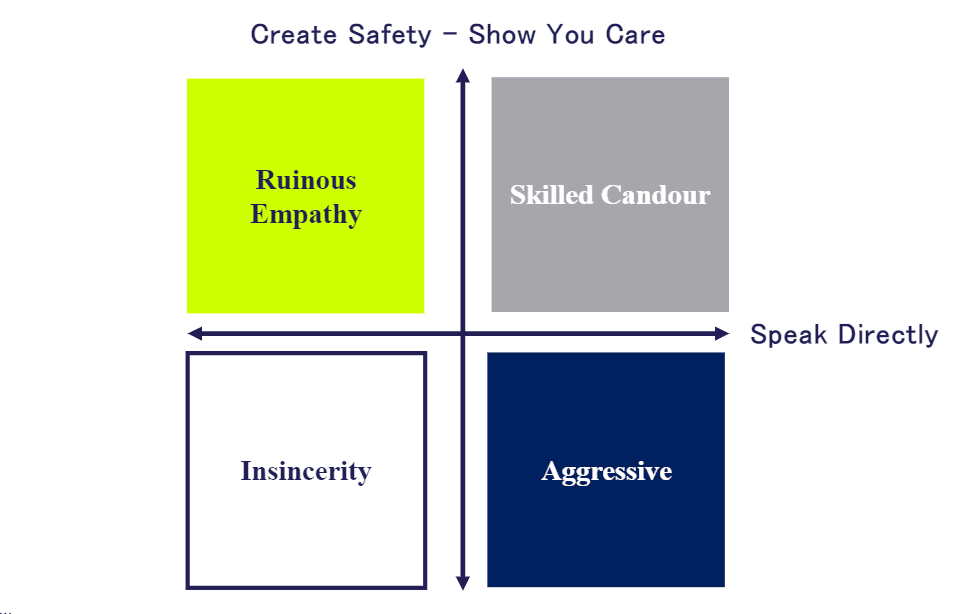
Image: Management Futures
“We’re going with ‘skilled candour’ because it’s a skill we can all learn and build,” said Fadojutimi of Management Future’s way of teaching the topic.
The three pitfalls to avoid
The arrows on the grid suggest that the path to skilled candour lies in giving people a sense of psychological safety and the feeling that you care about them. The grid also suggests three pitfalls, which were discussed at length by Scott in Radical Candor:
The five steps towards skilled candour
O’Connor explained that there are five steps you can take to help develop your ability to approach conversations with skilled candour:
The man responsible for ensuring a pipeline of British talent to the upper echelons of world tennis spoke about his role in delivering a programme based on ‘passion and care’.
The Performance Director of the Lawn Tennis Association [LTA] was a guest on the Leaders Performance Podcast in early July, where he discussed his remit.
“I break it down as if we want to deliver performance, then performance equals the talent that you’ve got multiplied by the exposure you can give that talent to them to develop and grow, minus interference.”
When it comes to high performance, tennis has several traits that separate it from other sports and this is reflected in the LTA’s provisions. For example, the organisation offers full-time multidisciplinary support to players from under-10s through to elite level, but player needs vary from individual to individual. They provide coaching too, at camps and competitions, but players tend to have private coaches.
It is a balance and one that he has been trying to strike during his four years in the role, which began during the first year of the pandemic. “It was a huge learning curve for me,” said Bourne, whose non-tennis background has never held him back.
Here, we reflect on his thoughts about his role.
He has a firm focus on the mission
Bourne, who has worked in sports science for organisations including UK Sport, the UK Sports Institute and the England & Wales Cricket Board, has a clear understanding of what the LTA is trying to achieve and why. “Our mission is to be world-class and respected at player development,” he said. “The slightly longer answer to that is that we create a pathway for our most talented players to go on a journey to becoming elite professional players, whether that’s in the tennis game or wheelchair tennis game.” It requires continuous self-evaluation on both his part and the LTA’s as well as acknowledging how the challenges faced evolve. Bourne emphasised a people-first approach. “However you cut it up, we are a performance-based industry and you have to have great people to do great things.” He spoke of “passion and care”. “We have a team of individuals who deeply care about the journey these players are on”. Passion is one of the LTA’s values and the sight of others in service to players is one Bourne finds “very humbling”.

Michael Bourne, Performance Director at the LTA. (Photo by Shane Anthony Sinclair/Getty Images for LTA)
His role in driving change
In addition to being mission-focused and people-centred, Bourne places a premium on critical thinking. He also believes that having great ideas is one thing, but being able to apply them is quite another. “You can have the greatest thinking and the greatest ideas in the world, but if you can’t drive and implement change, then it’s for naught,” he said. “Ultimately, leadership is about being able to drive and support change.” His team bring their tennnis-specific expertise and Bourne ensures everyone is aligned around the work that needs to be done. “It gets the balance between my background and their backgrounds in the right space.”
He does not assume things will happen on their own
Bourne readily admits his expertise is not rooted in tennis. Nevertheless, the necessary traits and skills are made familiar to him through his staff. He has set up a clear chain of direct reports and basic processes, but it needs constant attention. “Don’t just trust that they’re going to happen all the time – make sure that you’re around enough and verifying whether the communication, the connection that’s supposed to be in place, is actually in place; and if you need to step in and just give the person that support or just give that reminder of what we’re trying to do to prevent those dreaded silos developing people ploughing their own furrow”.
He relishes the daily challenges
Bourne feels that his role is inherently challenging; and that’s alright. “I feel like in these types of jobs, if your job is easy, something is wrong – I don’t think they’re meant to be easy,” he said. “If they’re easy, then you’re missing something or you’re not pushing when you need to push. There’s always more.” It feeds into his attitude towards the challenges faced by the LTA. “It should be unacceptable in a high performance environment to know there is a challenge and to take no steps to do anything about it.” There will often be “brutal facts”, as he put it, “then it’s my job to ensure that we’re all leaning into that and in the right way in a professional way and in a safe way; having the right types of conversations that we need to have.”
Listen to the full interview below:
Listen above and subscribe today on iTunes, Spotify, Stitcher and Overcast, or your chosen podcast platform.
In the first episode of our new series, Michael Bourne describes life as the LTA’s Performance Director.
A podcast brought to you by our Main Partners

“It is core to me,” the Performance Director at the Lawn Tennis Association [LTA] tells the Leaders Performance Podcast, which is brought to you today by our Main Partners Keiser.
Critical thinking is a skill that also served him well in roles at UK Sport and the England & Wales Cricket Board amongst others before he took the reins at the LTA in October 2020 (with Covid restrictions still in place).
“But,” he cautions, “leadership for me is about change and progress, and you can have the greatest thinking and the greatest ideas in the world, but if you can’t drive and implement change, then it’s for naught.”
It starts with taking stock. “As a leader, make sure that you are ensuring everybody else is confronting those brutal facts and you’ve got to be ahead of that,” he says, adding that he too must be open to feedback.
“It should be unacceptable in a high-performance environment to know there is a challenge and to take no steps to do anything about it.”
In the first episode of this new series, Michael explains his mission-driven and people-centred approach to helping produce British tennis players with the means to compete with the world’s best [33:10].
During the conversation, we also touch upon the challenges the LTA faces and the benchmarks set [8:30]; his belief in the unique qualities of British tennis [14:30]; why the flow of information cannot be taken for granted at the LTA [38:30]; and the enduring power of the Lion King to move him [48:00].
Henry Breckenridge X | LinkedIn
Listen above and subscribe today on iTunes, Spotify, Stitcher and Overcast, or your chosen podcast platform.
3 Jul 2024
ArticlesMoonshots, how leaders can work on themselves, and the pathway to better collaboration – just some of the topics that featured on the June agenda at the Institute.
It is always wonderful to see the great and the good of the Leaders Performance Institute gathered to discuss the pressing performance challenges of the day.
Speaking of which, the happenings at Red Bull were far from the only opportunities on offer at the Institute in June, with roundtables and community calls packed with members sharing both challenges and best practices on a range of topics.
Many are covered in this month’s Debrief. As ever, do check out our upcoming events and virtual learning sessions, which are designed to help you to connect, learn and share with your fellow members from across the globe.
Right, let’s get into some reflections on June.
What we learned at the Sport Performance Summit in LA
We had a great couple of days with those of you who made the trip; and there was plenty of thought-provoking content for us to get our teeth stuck into (full account here). Below are a few snippets that particularly caught our attention:
Four tips for avoiding the ‘Innovator’s Dilemma’
The Innovator’s Dilemma is a 1997 book by Harvard Professor Clayton Christensen that explores the tension between sustaining existing products and embracing disruptive innovations. It resonated with Jen Allum, from X, the Moonshot Factory and Alphabet, the parent company of Google, who understand they could easily fall prey to the Innovator’s Dilemma. Onstage, Allum shared their four top tips for avoiding this scenario:
Allum added that X, the Moonshot Factory “rewards project shutoffs, dispassionate assessments, and intellectual honesty” in the work they do.
How to optimise your energy as a leader
As a leader, strategic thinking is in your remit, but do you ever include protecting your energy as part of the equation? “An organisation can’t outpace its leaders,” said author Holly Ransom onstage. “So there’s nothing more important than working on ourselves as leaders.” Here are her thoughts on how leaders should show up each day:
The biomarkers of a healthy culture
Back to the myriad insights gleaned from our June Virtual Roundtables, starting off with the latest segment of our series of learning centred around culture and change. The sessions highlight findings from a recent research project by the Premier League’s Edd Vahid titled ‘Cultural Hypothesis’. The project examines the key components of cultures that have been able to sustain themselves.
Vahid posits astute leadership as a ‘super enabler’. Indeed, as Donald and Charles Sull wrote in the MIT Sloane Management Review in 2022: ‘A lack of leadership investment was, by far, the most important obstacle to closing the gap between cultural aspirations and current reality.’
What are some strategies we can consider?
Vahid’s also research reveals that cultural leadership operates on three levels:
Four features of a great debrief
Effective debriefing skills was the top of conversation for our latest Leadership Skills Series session. If you are interested to join roundtable sessions centred around developing your own leadership, there are some great topics coming up around strategy and cohesion you can find on the Member’s Area.
To keep this section punchy, a section of our discussion focused on some top line considerations for what constitutes a great debrief. Are you doing these well in your environments?
The pathway to better collaboration and multidisciplinary working
Finally, we wanted to highlight some interesting insights and perspectives from our topic-led roundtable on functioning more effectively as multidisciplinary teams, which is often a very popular topic of interest across the Institute when speaking to many of you.
Do check out the complete summary. Below are a handful of ideas from members on the call that they feel are currently missing or need to be given more attention in the quest to do this well:
New Zealand Rugby’s Mike Anthony lays out why the All Blacks and Black Ferns are always ‘restless’, ‘uncomfortable’ and ‘itchy’.
The former first five-eighth (fly-half), who won back to back Rugby World Cups with New Zealand in 2011 and 2015, was one of a “legacy group” of former players invited in August 2023 to observe the team’s preparations and answer any questions the younger players might have ahead of their World Cup campaign.
“It’s a new bunch and you guys know pretty well that when you finish playing, you get invited back into the changing rooms or the team room and it’s quite awkward,” Carter told former England internationals James Haskell and Mike Tindall on The Good, The Bad & The Rugby podcast.
It was a changing room Carter had shared with a number of that All Blacks squad. “I don’t know if you guys feel it but going back into that environment, you kind of feel like a spare wheel.”
At no point was this the perception of the players, coaches or the All Blacks’ high performance team. In fact, two months later Carter, Keven Mealamu, Richie McCaw, Conrad Smith, and Liam Messam were invited to return at the Rugby World Cup in France, which took place in October and November.
“Talking to our team’s leaders, they got the most from the legacy group because the players are the ones who are having to drive along with that in the environment and the playing group would look up to them,” said Mike Anthony, New Zealand’s Head of High Performance, at February’s Leaders Sport Performance Summit at Melbourne’s Glasshouse.
Here were some of the most-esteemed guardians of the All Blacks culture coming back to reinforce the connection between all those who have worn the jersey.
Anthony continued: “That group had been through adversity. They’d lost World Cups and won World Cups. They knew what it took. The legacy piece for us is important.”
Legacy – a word long-associated with the All Blacks – is crucial in bringing to life the ambitions across the ‘teams in black’ i.e. the All Blacks, the Black Ferns (current women’s world champions) and both programmes’ sevens teams.
Their three core ambitions are:
These ambitions help to plot the path towards a performance culture described by Anthony as “unwavering at it’s core, it’s inspiring, it’s empowering, it’s inquisitive, and it’s responsive to change.”
The last point is critical. “How do you bring it to life day to day and how do you refresh it so that’s it’s relevant to your current group?” asked Anthony. “I’ve observed teams being successful and then they continue to run with what worked before as the group changes. It comes down to induction: how do you make sure your vision is relevant for your current group?”
Here, we unpack how the ambitions of the teams in black are brought to life through their behaviours and habits.
The building of a legacy: the All Blacks have won three World Cups; the Black Ferns have won six of the last seven Women’s World Cups. This enduring excellence burnishes their legacy year on year. “We talk of leaving the jersey in a better place,” said Anthony. “You’re the guardian for a short time, so when you leave it to the next person, you hope to add value.”
A team-first attitude: this is a challenge for New Zealand Rugby as a whole, with the growth of individual brands and the often more lucrative opportunities on offer abroad. Yet New Zealand’s best players invariably remain at home during their peak years to pull on the black jersey. The allure runs deep and it requires selflessness. “You’ve got to be selfless,” said Anthony. “You’re an All Black or Black Fern 24/7 and it’s in the little things you do when no one’s watching. You’ve all heard the analogy ‘sweep the sheds’ – it is genuinely something that our guys do. It’s not the job of somebody who’s paid to clean up after us and we take pride in how we do that.”
A player-driven environment: Anthony explains that buy-in is at “100 percent” amongst the players and that some players “never want to leave” New Zealand. This is in part because the team is intentional in its efforts to encourage players to speak up and contribute to the culture (“you have to create something pretty special to keep players here”) but it is also due to the increasingly creative ways that players are incentivised. “We give guys sabbaticals to go away because we know the money’s good; then we bring them back and that’s worked really well,” said Anthony.
Alignment: it is obvious that no two people are alike but that does not necessarily prevent them sharing a common vision. Said Anthony: “For me, ‘alignment’ is when people understand and are deeply connected to your vision.”
It is also a consequence of effective leadership, which he distilled into several traits while adding the caveat that you have to, above all else, play well. “I think we sometimes burden our leaders and they feel cluttered,” he said. “We want the spine of the team playing well first because, generally, they’re your best players. You have to get the balance right there.”
In New Zealand rugby, leaders embody…
Humility. As Anthony said, “you’ve got to be humble and vulnerable because that’ll encourage others to step into that space and contribute.”
Inclusivity. Anthony felt that although teams want everyone to have a voice, there is too little focus on schooling people in how to give and receive feedback. “If we want our players to challenge their peers, we’ve got to give them the tools”.
A growth mindset. There is always a performance gap; always a challenge. “It’s never about ‘we’ve arrived’,” said Anthony. “That gap creates that discomfort and itch that you want in a high performance environment.”
Ownership. Being an All Black or Black Fern is a 24/7 commitment. Anthony described Richie McCaw as the embodiment of that view. “It’s doing the unseen things,” he said. “It’s easy to sweat, but when you go home, what you’re eating, your sleep, how you present around your family – those are key.”
Finally… he tāngata, he tāngata, he tāngata
Anthony wrapped up his presentation with a whakataukī (Māori proverb):
He aha te mea nui? Māku e kii atu, he tāngata, he tāngata, he tāngata.
What is the most important thing in the world? Well, let me tell you, it is people, it is people, it is people.
“The price of entry is technical knowledge,” said Anthony, “but get the people right and hopefully you can build the right environment for a performance culture that supports the athletes.”
As Jen Overbeck explained, we can make people change or we can persuade them to change. We should choose deliberately and we should be clear about what makes people listen to us.
“Here’s the situation,” she said. “You have an idea born out of your expertise; a lightbulb moment. Maybe it’s something that’s developed over time and you bring it to somebody you think is going to benefit, whether that’s an athlete, someone in your organisation or somebody who works with you.
She continued: “You’re explaining it with all your passion and they say ‘yeah, nah, I’m not excited about that at all. I don’t think I want to do that.’ Has that ever happened?”
A few individuals tentatively raised their hands in the audience at Melbourne’s Glasshouse.
“OK, good, because otherwise you should be up here teaching instead of me!”
Overbeck, a Professor of Management at Melbourne Business School, was speaking at February’s Leaders Sport Performance Summit.
Over the course of half an hour she explored the social and psychological elements that affect how people react to requests to change and why, as a leader, that reaction can depend on your power and influence.
Power v influence
Overbeck used the example of Phil Jackson as someone sports coaches and practitioners might aspire to emulate. She lifted a passage from his 2013 book Eleven Rings where he wrote about ‘benching the ego’:
‘After years of experimenting, I discovered that the more I tried to exert power directly, the less powerful I became. I learned to dial back my ego and distribute power as widely as possible without surrendering final authority. Paradoxically, this approach strengthened my effectiveness because it freed me to focus on my job as keeper of the team’s vision.’
Jackson came to recognise that power and influence sit on a spectrum. As such, the NBA’s most-decorated coach, provided the perfect case study for Overbeck to define those terms.
“‘Power’ is your ability to get somebody to do something that they don’t want to do,” she said.
This is set in contrast to ‘influence’. “You could also call it ‘persuasion’,” she added. “This is all about how much credibility and persuasiveness you have to influence people to go where you want them to and they’re going there willingly.”
There are few coaches in the high performance community that would prefer to increase their power at the expense of their influence and Overbeck stressed that you are free to make your choice.
“When you understand the differences and what drives them, you can make those choices deliberately – and that’s generally better for ourselves, our athletes and our organisations.”
How to elicit change
Overbeck explained that there are three types of behavioural strategy:
She says: “That’s when you’re using a great deal of power; you’re not using a great deal of influence. You’re basically trying to make the person change.”
This emerges in a space where a leader has more moderate power and influence. “We’re giving people some choice, but we’re not giving up on our power altogether.”
“This is a very big word,” said Overbeck, “because it means you’re completely leaving it in the other person’s hands; you’re exerting no power whatsoever.”
The best scenario for a leader, as Jackson understood, is to be negotiating. Overbeck posed a series of questions that leaders can ask themselves when moving away from either dominating or supplicating:
The tactics available to a leader
Overbeck ran through some of the tactics available to ‘negotiators’ and asked the audience to raise their hand if they’d employed any of the following:
The six types of capital available to leaders
None of the tactics described above are particularly unusual. “We know a lot about the tactics we’ve been told will be helpful for pursuing change,” said Overbeck, adding, “we don’t know what kind of power and influence we need to have ready and available with us in order for these tactics to succeed.”
She returned to the example of Jackson, who managed to elicit the very best from Michael Jordan during their time together at the Chicago Bulls in the 1990s.
“Phil Jackson may not have led with power but it was in what he did,” she said. “He was using what was available to him.”
He was, in essence, aware of his ‘capital’, as Overbeck put it. “Power comes from the resources that you control.” There are six kinds of resources, or ‘capital’. The first three are easily explained:
The final three must be used carefully because they can be sourced into power:
Social and intellectual capital
Overbeck homed in on social and intellectual capital because while leaders in sport may want to have power in the background, you probably will not want to lead with that power.
Instead, you’ll want to dial up your influence and credibility, which can come from various sources, such as trust and belief in your abilities as a coach due to your track record and reputation; that your place is not a result of political chicanery or nepotism.
“I’m going to talk about it as ‘tribal membership’,” said Overbeck. “When people are deciding whether to accept your influence, the No 1 thing they are assessing is: are you with me? Are you part of my team?” She makes it clear that ‘team’ may not be the literal team but your alignment with an individual’s personal values. Without that, they may reject you out of hand. “The first thing we have to do is make sure that we’re telegraphing to the other person that ‘even if we have those differences in terms of those things that you most cherish and value, I honour those things, and I’m not going to get in the way of them. I’m going to work with them, not against them’.”
Once you loosely establish yourself in the same tribe, you then need to demonstrate how your expertise can be of value – that’s your intellectual capital.
Overbeck said: “When we’re trying to build credibility, it’s our job to build that bridge and make sure that the other person understands.”
She likens it to a credit account. “The higher your credit limit, the more you’re able to go out and spend.” However, it must be kept topped up. “Once we’re good, we always have to be thinking: ‘am I getting over my limit?’” You have to continuously demonstrate your credibility or you will lose people.
Final questions to ask yourself:
Adaptive growth sat at the heart of the Leaders Sport Performance Summit in Los Angeles. Discover the insights to propel you to greatness courtesy of the arts, academia and, of course, the world of sport.
An article brought to you by our Event Partners


“We choose to go to the moon in this decade and do other things, not because they are easy, but because they are hard,” said the US President at Rice University on 12 September 1962.
Those words, undiminished by six decades of distance, might have become a monument to presidential hubris had NASA’s Apollo program failed to land Neil Armstrong and Buzz Aldrin on the moon. Instead, Kennedy’s vision galvanised his nation and, allied to federal resource, gave the program the impetus it needed.
NASA’s ‘moonshot’ has since become a byword for ingenious and audacious projects that showcase adaptive growth. That is: being adaptable in the face of change and challenges, continuously striving for growth and improvement, learning from your experiences and making strategic decisions that drive progress and innovation.
Moonshots were a theme of the recent Leaders Sport Performance Summit at Red Bull in Santa Monica, with Jennifer Allum, who is part of the leadership team at Alphabet’s X, The Moonshot Factory, taking to the stage to discuss an environment where audacity is a prerequisite.
It was a marvellous start to proceedings on the morning of day one but, in truth, other themes discussed across both days, from talent and creativity to strategic thinking and resilience, just as readily point to adaptive growth.
Here, inspired by the worlds of sport, the arts and academia, we touch upon seven factors that can help to fuel your own moonshot, whether you’re taking your first small step, sustaining your early momentum, or looking to make a giant leap.
Harvard professor Clayton Christensen observed that large, established organisations do not always take advantage of potentially disruptive technologies and trends, while newer and less-established organisations often do. In his 1997 book The Innovator’s Dilemma, he explores the tension between sustaining existing products and embracing disruptive innovations.
Allum discussed the concept onstage in front of an audience where ‘failure’ is a common bedfellow. She understands that Alphabet, the parent company of Google, could easily fall prey to the Innovator’s Dilemma. So while X, The Moonshot Factory performs an instrumental role in delivering ‘moonshot technologies that make the world a radically better place’, there are myriad failures that pile high on their factory floor – and Alphabet wouldn’t have it any other way because they perceive failure as a learning opportunity rather than a threat.
Allum’s top tips for avoiding the Innovator’s Dilemma:
Jennifer Allum, leadership team, X, The Moonshot Factory
Long-established teams can all do better, but what of those just starting out, particularly in women’s sport? How can a beginner’s zeal be channelled into establishing a stable, long-term concern? Those are two of the questions currently facing NSWL expansion team Bay FC and their WNBA counterparts the Golden State Valkyries.
It is an exciting time for women’s sport but there are pitfalls to be avoided:
Lucy Rushton, General Manager, Bay FC
Ohemaa Nyanin, General Manager, Golden State Valkyries
Is yours a creative learning environment? Either way, you’d do well to listen to the Westside School of Ballet (LA’s most successful public ballet school) and the UCLA Herb Alpert School of Music – what can such schools teach the world of sport about the creation of learning environments that encourage improvisation, experimentation and intrinsic motivation?
It begins with a love for the art form and a welcoming ecosystem that allows the freedom to explore:
Adrian Blake Mitchell, Associate Executive Director, Westside School of Ballet
Eileen Strempel, Dean, UCLA Herb Alpert School of Music
As a leader, strategic thinking is in your remit, but do you ever include protecting your energy as part of the equation? “An organisation can’t outpace its leaders,” said author Holly Ransom onstage in Santa Monica. “So there’s nothing more important than working on ourselves as leaders.”
How to show up each day:
Holly Ransom, author, The Leading Edge
No matter your level of success or the smoothness of your systems, high performance can exact a large toll if your stakeholders are not resilient. As Red Bull US CEO Chris Hunt explained, a leader’s first job is to engender trust amongst their team. There’s no instant solution – you have to advocate for people and stand up for your values time and again.
How can people in high performance develop their resilience?
Chris Hunt, CEO Red Bull US, Red Bull
As a big wave surfer, Red Bull’s Ian Walsh is well-placed to discuss performance under pressure. He took to the stage to discuss the strategies that serve him well out on the surf.
Pressure points:
Ian Walsh, big wave surfer, Red Bull
Technology at its best can inform your decision making and, as Fabio Serpiello, a professor at the University of Central Queensland, told the audience at Red Bull, there are steps you can take to ensure you’re using the right technology and datasets.
Ensure you’re staying on top of tech innovations:
Fabio Serpiello, Director, Sports Strategy, University of Central Queensland