A recent Leadership Skills Series session provided some tools that all leaders and coaches can use with their athletes and colleagues alike.
That was the premise for this recent Leadership Skills Series session, where members of the Leaders Performance Institute were invited by our friends at Management Futures to explore:
There are two key principles:
What is ‘skilled candour’?
When we have explored this topic in the past, we referenced the term of ‘radical candour’, which coined by executive coach Kim Scott, who argues in her 2017 book Radical Candor: Be a Kick-Ass Boss Without Losing your Humanity that leaders have a ‘moral imperative’ to step into difficult conversations and challenge with skill. This requires courage because it is simply easier to avoid such conversations.
Scott’s idea has influenced Management Futures, who fashioned their own concept: ‘skilled candour’, which underlines the skill behind the action.
On that note, psychological safety is essential so that people know that you are coming from a well-intended place. If there isn’t a belief that there is trust or positive intention, it may well trigger the ‘inner chimp’ (the primitive, emotional part of our brains, which is there to protect you but, in certain circumstances, can arouse feelings of defensiveness).
When the chimp has been triggered it’s unlikely that you will have a productive conversation.
The aim must be to create a sense of safety so we can be honest and speak directly:
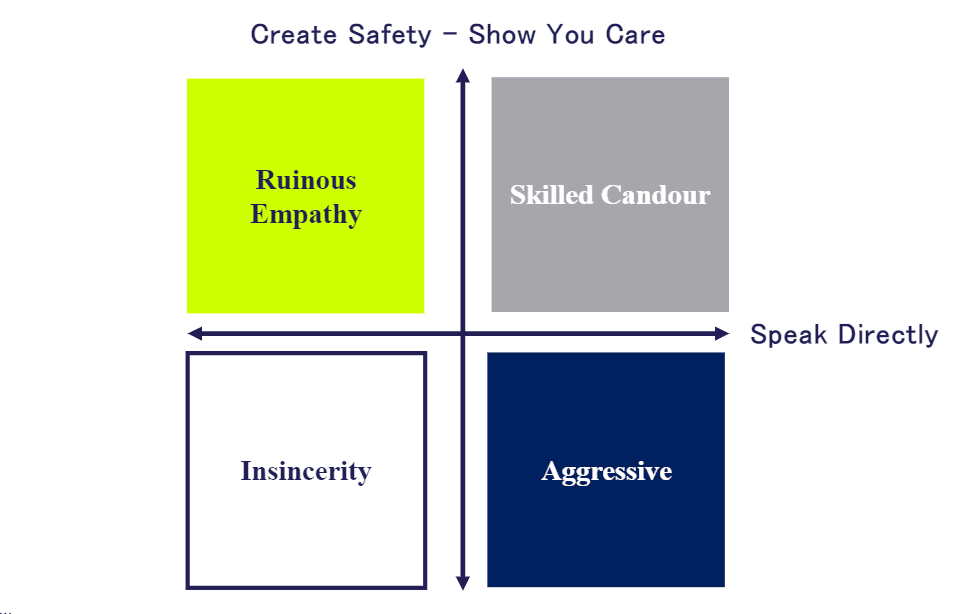
Image: Management Futures
Ruinous empathy: this is where we say what needs to be said in a clear and direct way. When you want to spare someone’s short-term feelings, you don’t tell them something that they need to know. You care personally but fail to challenge them directly, with ruinous consequences.
Insincerity: when you neither care personally nor challenge directly. You offer insincere praise to a person’s face and criticise them harshly behind their back.
Aggressive: when you challenge someone directly, but don’t show you care about them personally. It’s praise that feels insincere and feedback that isn’t delivered kindly.
We asked the practitioners and coaches in attendance where they thought they sat on the skilled candour graph. A straw poll delivered a striking insight:
Ruinous empathy: 45%
Insincerity: 3%
Aggression: 12%
Skilled candour: 39%
There are five key skills to enable your preparation, delivery and summary of a courageous conversation.
The SBI feedback model
The Center for Creative Leadership’s SBI feedback model is a useful tool for both positive and constructive feedback. ‘SBI’ stands for ‘situation/standard’, ‘behaviour’ and ‘impact’.
Below is a simple example of what this could look like – the key is what we want to get straight to the point:
Situation/standard: To begin, we should guide the person to recall the exact time and place where the action we’re discussing occurred. The more specific we are, the better, as it will help them visualise their surroundings and actions at that moment. This provides the context for the feedback.
Example: ‘It’s really important in team meetings that everybody gets the chance to share their opinions and feels heard’.
Behaviour: Outline the specific actions or behaviours that prompted the feedback. As with the previous part, it’s must be as detailed as possible. We’ll achieve this by providing two key pieces of information:
Example: ‘I’ve noticed in the last couple of meetings that when people have come up with an idea you’ve immediately said something negative about it’.
Impact: We should highlight what we believe the impact of their actions was. This impact could pertain to you, the team or other individuals. As with the previous section, it needs to be detailed and is divided into two parts:
Example: ‘You’ve talked about why it’s not possible and the impact of that is that it’s draining the energy out of the room and stopping people speak up’.
What to read next
In this Virtual Roundtable, brought to you in partnership with ESSA, Robin Thorpe and Lyndell Bruce explored four areas where the practitioner of the future will need to excel.
An article brought to you by

“It’s become a new trend or buzz term in high performance,” said the former Director of Performance at Red Bull. “I’d be really interested to see how many self-proclaimed integrated departments and processes actually are.”
In a truly integrated department, he argued, there has to be “positive and respectful challenge between staff and then between the disciplines” and he is unconvinced that this is always the case in many environments.
“Not to be controversial, but I would think that in some of the areas or places where true integration is preached, there might actually not be any collaboration whatsoever,” Thorpe added. “And so, without collaboration, there might not be any friction points or any challenge, so it might only be perceived as an integrated process.”
Thorpe was speaking at the first session of ‘The Future of Performance Sport’, a three-part Virtual Roundtable series brought to you by the Leaders Performance Institute and Exercise & Sports Science Australia. The first session explored the ‘future practitioner of high performance’.
He was joined on the virtual stage by Deakin University’s Dr Lyndell Bruce, who harbours similar reservations when it comes to integration.
She said: “So often we see with these integrated teams that an athlete has poor performance. So they throw everything that’s been working really well out the window to try and solve why we’re not winning – and that suggests that it’s really not an integrated team.”
The future practitioner will need to find the answers and, here, we detail four considerations, including better integration, that will help to stand them in good stead.
Both Bruce and Thorpe believe that the future practitioner will combine technical knowledge and softer skills
“People call them ‘soft’ skills – I like to call them transferable skills, complementary skills,” said Bruce. She also pondered how they might be taught. “It’s challenging because it takes time, it takes effort, and it takes resources. It’s too easy to say students will get that in their work, integrated learning, because we know it’s not the case. They don’t all go to the same environment and we can’t control those environments.”
There are questions to be answered on the technical side too, with Thorpe emphasising the importance of detailed and applied research. “We delve into research articles which might be relevant to what we do, but we also see how they associate with the work that we do,” he said.
Thorpe also believes that generalists will continue to have their place. “Although specialisation will offer a lot more opportunities for younger students and practitioners going forwards, I hope that we don’t lose the more generalist skills that I think are very, very effective currently.”
Thorpe sees AI as a potential time-saver, but with caveats. “I think we know that AI can certainly support us with is enhancing processing times when it comes to using and working with data that we have,” he said. “We’ve come into this era of plug-and-play technology, which means that our ability to cope with data has become stretched.”
However, he added, “I certainly don’t believe it’ll ever be the silver bullet to a lot of our performance problems or challenges or questions.” It is no surprise that he preaches caution. “I think we still probably need to think about some of the principles of why we’re collecting some of that data in the first place.”
At Deakin, Bruce and her colleagues have gotten used to students using AI to craft responses. She said: “The conversations are leaning towards how we teach students to use this in an advantageous way.”
And, as she observes, “many organisations are using those machine learning models to create outputs, look at different tactical and technical elements of match play, to understand the physiological data that they’re receiving, so I don’t think that’s unique; and I think there’s still a way to go in terms of how we use that and how we implement that more effectively.”
Wellbeing – and psychology as part of wellbeing – continues to grow in prominence, with all staff members called upon to play their part.
“It’s not a once-off conversation because they flagged on the wellbeing this week and then two weeks later they’re back in their normal range – we continue that conversation and check-in,” said Bruce of her work Deakin. She also noted the growing specialisation in how psychology is used in sport. “We use psychology from a performance perspective and also a clinical perspective.”
Thorpe was responsible for mental performance in his most recent role. “It was very much a pivotal learning opportunity for me; to understand the continuum of how mental performance operates,” he said. This included performance under pressure, helping athletes to deal with increased mental loads in training and competition, and psychological profiling.
Integration is increasingly difficult in a world of growing specialisation with so many inputs to reconcile, but Thorpe and Bruce both offered some tips.
For his part, Thorpe emphasised objectivity, particularly given the different ‘languages’ that individuals in different fields will speak. He says: “How can we use objectivity as a common language? Good objectivity – not AI-based reams and reams of data – but really solid precision-based objectivity is our vehicle to integrating approaches.”
High performance teams need to understand the desired outcome, then, as he asked, “how do we then fit these experts and specialists to those outcomes rather than coming at it all individually?”
Bruce then argued for consistency. “[The high performance team] operates irrespective of performance, while you might need to innovate and make adjustments along the way,” she said. “But it doesn’t change because of poor performance.”
Further reading:
Sports Science Research: the Strengths, Weaknesses and Opportunities
This month we touch upon the power of flexibility, relatability and collaboration in leadership and what you need to know to be better in each area.
Ideally, you found time for both and, here, we highlight a selection insights from the first month of 2025 that may help you to consider a problem in a different way or enable you to identify the right people to whom you can turn.
We hope to see some of you in Melbourne later this week for the Leaders Sport Performance Summit.
And, whether or not you can make it to the Glasshouse, here are five thoughts for all leaders to ponder.
If you can find new ways to consider your problems, it can open up new ways of thinking.
In this article, John Bull of Management Futures used the example of an elevator. Perhaps your goal is to make the elevator go faster, but what if your aim was to make the wait less annoying?
“Most hotels will put a mirror beside the elevator,” he said. “That seems to kill time when we’re looking at ourselves in a mirror.”
Bull suggested we “think of at least three different ways we could define our goal, to help open up new ways of thinking about the problem”.
He also share the STOP process for creative problem-solving:

In November, John Longmire called time on his 14 years as Senior Coach of the Sydney Swans. He has taken a new position as the Swans’ Executive Director of Club Performance but, before doing so, he reflected on his tenure as Senior Coach, which brought two AFL flags and four Grand Final appearances in total.
You can read his thoughts here, but here is a snapshot of his desire to remain “connected and relatable” to his players and staff. As he said onstage at November’s Leaders Sport Performance Summit in London, “the coach is no longer looked upon as being bulletproof” whatever their standing may be within the game.
His final speech to the players and staff as Senior Coach attested to that belief. He weaved in personal stories and his voice cracked at times. He wiped away tears too.
It called to mind the weekly ‘storytelling’ sessions that Longmire made a key feature of the Swans’ environment. He told the Leaders audience that players and staff share stories or complete a series of tasks for discussion each week. Recent examples included writing ‘a letter to your 16-year-old self’. These sessions are popular with players and staff alike.
“Sometimes it’s a photo of something that mattered to you and quite often there’s tears involved,” he said. “The way I looked upon coaching 25 years ago is completely different now – these 18, 19, 20-year-olds need to be able to relate to you. If you can show that you’re human, you get a lot more back.”
The question of team dynamics sits at the heart of The Social Brain: The Psychology of Successful Groups by Tracey Camilleri, Samantha Rockey and Robin Dunbar. The trio has spent decades observing the worlds of academia, business, and government as they look to better understand the workings of high-performing teams.
Camilleri and Rockey came to the summit in London to discuss how their research has its applications in the world of sport. Decision-making was one such area:
For decisions made at speed, you’ll count on five people.
Five is the number of intimate relationships a person can have. Rockey said: “These are the relationships that protect us, make us thrive, and ensure that we go through life in a joyful way. They protect us from ill-health and from some of the psychological challenges that we might have from feeling insecure.” They, of course, occur in intimate spaces.
For more complex decisions, you’ll count on 15 people (including your original five).
The ‘pain’ comes when you look to insert new thinking into complex decision making in a group space. “We spend about 60 per cent of our social time with just 15 people,” said Rockey. “With the 15 in the workplace, they would have built long-term relationships and loyalty to you over time – that’s how we work as humans – so breaking up those people to bring in new thinking is painful.”
According to Dunbar, the upper limit on the number of social relationships we can enjoy is 150
Dunbar suggests that people can have no more than 150 social relationships at any one time. “It’s a very stable number across all societies and cultures,” said Rockey.

From The Social Brain: The Psychology of Successful Groups by Tracey Camilleri, Samantha Rockey, and Robin Dunbar.
Young athletes are bolder in stating their desire for belonging and connection than their forebears, but this comes with a paradoxical demand for more personalised training and attention. There are clear implications for the time coaches spend on team dynamics in an era where the power has shifted to the athlete. The topic was discussed on a recent virtual roundtable. “Staff and coaches are more vulnerable,” said one participant, who pondered where the balance needs to sit. “Give the athletes a voice and a choice, give them ownership, have the consultation, but there is a line too.”
Another participant with experience of coaching in European football, highlighted that individual work will mean different things to different people and can be dependent on team selection. They argued that there is room for better management of expectations and, more broadly, a consensus for coaches and athletes alike on what constitutes ‘individual’ training.
In February 2024, the England & Wales Cricket Board launched its Insight 360 platform, which adopts a data-driven approach to athlete and performance management.
Ahead of the launch, the ECB gathered input from practitioners and coaches across the English game. “This means Insight 360 is bespoke for women’s cricket,” said Anna Warren, the Head of England Women’s Science & Medicine. Players, she said in this article, are happy with an app that allows them to review their own data in as much detail as they like. “This is good for player buy-in, which is always a challenge in relation to athlete monitoring.”
There is also the power of a co-designed project. UK Sports Institute have found as much with their Project Minerva. Dr Richard Burden, the UKSI’s Co-Head of Female Athlete Health & Performance, said: “Get the practitioners involved, get athletes, get the teams and bring them along with it because if they’re onboard you get easier access to them and you’re going to produce something that’s more translatable, meaningful and applicable to them.”
Warren is on the same page with Insight 360. “You can link loads of different data sources together and start to answer some key performance questions – we’re not looking at everything in isolation.”
Flo Laing of Scotland Rugby discusses her work with the Scotland Women’s national team.
A podcast brought to you by our Main Partners

“It’s got to be the World Cup,” says Scotland women’s Lead Physiotherapist.
The competition will be hosted across the border in England and starts in August. Laing says it has been the Scotland team’s “north star” for several years.
During the course of our conversation – the second of three in this Keiser podcast series – we spoke about her work in women’s rugby at a time where the sport is starting to capture the public’s imagination and performance standards are rising faster than ever for the women players who compete [4:00].
Elsewhere, Laing discusses her leadership style, which is very much about putting people at ease [18:00]; she also talks about the most pressing issues in female athlete health [28:40]; as well as the transferable skills she’s learned from her time working for Sport Scotland [12:30].
Listen above and subscribe today on iTunes, Spotify, Stitcher and Overcast, or your chosen podcast platform.
In November, we discussed those elusive leadership skills, the notion of collaborating with your rivals for the greater performance good, and the question of what it takes to deliver an effective mental skills programme.
We definitely saw some of you there but, if you didn’t make it, don’t worry. We were sat in the front row with a notepad and, having deciphered our handwriting, compiled a list of six factors for turning setbacks into springboards. It was one of the main themes across both days.
The summit wasn’t all that was happening at the Leaders Performance Institute during November and we reflect on insights into the fields of leadership, coaching, data and human performance and pose five questions.
Perhaps the answers will provide one or two nuggets to help you with your next project.
Do you have all the skills you need to lead?
Perhaps you’ve heard of the of the Peter Principle. The concept, devised by psychologist Laurence J Peter, states that people tend to be promoted to their ‘level of respective incompetence’. Think of the supreme technician who, upon promotion, finds themselves overwhelmed as a manager tasked for the first time with leading people.
Carole Mundell, the Director of Science at the European Space Agency, told the audience at the Oval that while she viewed herself as a creative and independent scientist, that wasn’t going to cut the mustard in an organisation designed by engineers.
“I’m learning to think like an engineer,” she said. “All of ESA’s structures and processes and how we operate comes from the mind of an engineer… We have a whole quality assurance system where we set our objectives and we say ‘what will we do?’ ‘What did we say we’d do?’ ‘Did we do what we said?’”
Take time to consider the missing element that might make you a better leader.
What is to be done during losing streaks?
David Clancy, a Learning and Development Consultant at the Houston Texans and Director at The Nxt Level Group, wrote that the answer lies in purpose. ‘In elite environments, whether you’re a player, coach, or part of the front office, the pressures and expectations are immense,’ he wrote. ‘But the best leaders, those who guide their teams with purpose, know that long-term success is rooted in meaningful work.
‘This drives individuals to not only execute their tasks but also to find value in how those tasks contribute to the big picture. Leaders who strive to inspire meaningful work allow individuals to not just survive pressure, but thrive under it, empowering them to embrace challenges as part of their career journey.’
Clancy highlighted three principles to cultivate meaningfulness in your teams:
Who are your friends in high performance?
You don’t need us to tell you how competitive things get at a world championships, Olympics or Paralympics, but there are things that transcend rivalry.
One such area is female athlete health, where the UK Sports Institute, US Olympic and Paralympic Committee, Australian Institute of Sport and High Performance Sport New Zealand have clubbed together to form the Global Alliance. This enables them to share resources and insight in this one particular field.
“We are all under-resourced, we’re overstretched in terms of the time that we’re wanting to spend in this space,” said Dr Rachel Harris, the Lead of the Female Performance & Health Initiative at the AIS. “We really wanted to try and allow the people that are working in our sporting organisations to be more proactive.”
Her peers are just as effusive. “I think it’s a natural step to build an international community; and we do have them, but they’ve been a bit ad hoc,” said Dr Helen Fulcher, the HPSNZ Athlete Performance Support Lead. The Global Alliance is, as she added, an opportunity to raise standards across female sport. “The focus is not just on individuals having great connections but what can we collectively do better for this group of athletes that we all care about.”
The Alliance has every expectation that its membership will grow in the near future.
How do you solve a problem like innovation?
Professor Fabio Serpiello, the Director of Sport Strategy at Central Queensland University, told attendees at Leaders Virtual Roundtable that the best way to approach innovation is to start by defining your problem.
To that end, he employs a range of models, including David J Snowden and Mary E Boon’s Cynefin Framework.
‘Cynefin’, which is pronounced ‘ku-nev-in’, is a Welsh word that signifies ‘the multiple factors in our environment and our experience that influence us in ways we can never understand,’ as Snowden and Boon wrote in their 2007 Harvard Business Review essay titled ‘A Leader’s Framework for Decision Making’.
The Cynefin framework, they continued, ‘helps leaders determine the prevailing operative context so they can make appropriate choices’.

Source: HBR
Snowden and Boone identified five operative contexts – simple, complicated, complex, chaotic and disordered. Serpiello touched upon each:
Simple contexts are stable and one can observe a clear cause-and-effect relationship (although there is a risk of oversimplification).
Complicated contexts are the world of known unknowns; multiple right answers exist, but they require analysis.
Here, there are unknown unknowns; and cause-and-effect relationships are only apparent in hindsight.
These are domains of no clear cause-and-effect relationships and high turbulence.
Is your mental skills work simple, relevant and applicable?
Mental skills coach Aaron Walsh wanted to understand the perceived gap between value and impact in his field and embarked on a research project.
It furthered his understanding and, as he wrote in an exclusive column for the Leaders Performance Institute, Walsh alighted on three principles for making mental skills work meaningful:
David Clancy, Richard Kosturczak and Ronan Conway explore the identifiers of team cohesion and the fundamental building blocks that separate the great from the good.
Without it, even the most skilled groups falter. As Peter Guber, the CEO of Mandalay Entertainment and Co-Owner of the Golden State Warriors, LA Dodgers and LA FC said, “Without social cohesion, the human race wouldn’t be here. We’re not formidable enough to survive without the tactics, rules, and strategies that allow people to work together.” This principle is as true in modern business organisations and elite sports as it was in our evolutionary history.
High-performing teams aren’t just thrown together without thinking. They are intentionally built through careful design, clear communication, and shared goals. It’s about finding the blend where roles, responsibilities, and diverse perspectives align, allowing every individual to leverage their strengths for the benefit of the collective.
So, how do we achieve that cohesion, especially in environments where team members may not fit neatly into traditional roles? How do we ensure that the whole team operates as a cohesive unit, even when differing opinions and reporting lines exist?
Finding the sweet spot
Cohesive working requires creating an environment where finding the sweet spot means aligning team members’ roles and responsibilities in a way that meets both organisational goals and individual capabilities. It’s about meeting in the middle – ensuring that while everyone contributes their unique expertise, they also respect the collective objective.
Leaders play a pivotal role in facilitating these moments of alignment, ensuring that when opinions or methods differ, the focus stays on finding the most effective solution, rather than reinforcing silos, judgements or personal agendas. In this sense, cohesion is about not just collaboration, but collaboration that works toward shared objectives, adapting as needed to meet challenges in real time.
The building blocks
The foundation of a cohesive team lies in four critical elements:
These building blocks allow for cohesion even in complex or unconventional team structures.
Identifiers of high cohesion
How a team clicks: does it work in harmony? Knowing where to look is essential for identifying how well a team is functioning together. Here are some concepts to look at for indexing this sense of ‘teamwork’.
These markers are crucial for evaluating is a team functioning as a tight unit. You could use these identifiers as a means for tracking and measuring how well the team is doing.
When these indicators are robust, the team’s ability to perform at a high level is elevated.
Ensuring that everyone is on the right bus – and in the right seat on that bus
Ensuring that people have the right roles and responsibilities in a team isn’t as simple as matching a title to a task. Often, it requires rethinking traditional organisational designs. Instead of relying on predefined job descriptions, high-performing teams focus on matching skills, expertise, and interest to the actual needs and musts of a team. This flexibility ensures that individuals are positioned to succeed, even if their role falls outside a traditional org chart.
The best approach is to identify the key outcomes the team needs to achieve and then allocate responsibilities based on who is best suited to drive those outcomes. It’s not uncommon for someone to hold responsibilities that cross functional boundaries, but as long as clarity exists, cohesion can still thrive.
The goal is not to fill predefined slots but to build a dynamic, flexible system that adapts to the needs of the moment, such is the demands of elite sport.
Good on paper vs good in reality
It’s easy to assume that a team looks perfect on paper – each role clearly defined, each person seemingly in the right position. But the reality is often far more nuanced. Good on paper might mean that organisational charts, roles, and responsibilities are technically correct, but it doesn’t account for the personal dynamics, communication styles, or agility of the individuals involved.
Good in reality, on the other hand, refers to teams that function well in practice, in the training room, on the field – when it counts, when pressure comes. This requires fluidity, acknowledging that roles may overlap, opinions may diverge, and people may need to step outside of their ‘assigned’ lanes to help the team succeed. Cohesion in the real world demands malleability, trust, and a willingness to change when necessary.
Managing differing opinions
It’s quite common for teams to have two people with different opinions or views reporting to different leaders. This could be shaped by the individual’s personality predisposition, such as are they more Type A and Type B, for example. These differing views, opinions and traits can create friction – but in high-performing teams, this diversity of thought is seen as a strength, something to be amplified, if positioned well. It pushes the team toward innovation and deeper problem-solving. The key is to ensure that these differing opinions don’t lead to disjointed decision-making and fragmentation.
This is where a decision-making model becomes critical. Leaders should establish processes that guide how decisions are made, who gets the final say, and how differing viewpoints are resolved. For instance, a performance director may not need to make the final call on a return to play decision, but having the A-Z flow will make this decision ‘cleaner’. Each professional stays within their expertise, but they collaborate through a framework that aligns with the team’s overarching goals, such as getting the player back on the pitch after an injury.
Overseeing the decision
Who oversees the decision-making model depends on the structure of the team, but it’s crucial that not every decision needs to reach the top. In well-functioning, cohesive teams, there are levels of authority and autonomy, allowing for faster and more efficient decision-making. Sometimes, well-oiled departments have decentralised command structures, often seen in the military. For example, a doctor doesn’t need the performance director’s approval to prescribe treatment, but the doctor and the PD must work within an established system that ensures consistency and alignment with the team’s overall strategy and vision from a sporting director.
The model should be overseen by those who understand both the day-to-day operational needs and the bigger picture. One needs to be able to zoom in, but also out. This is often a middle ground between front-line team members and senior leadership; this ensures that decisions are informed, timely, and strategic.
Cohesion reading
As a leader, you have likely accumulated a bank of time in teams and groups, from school, university, your organisation, etc. Thus, you have experienced a wide spectrum of people dynamics, cultures and environments. Think of the moments where something felt ‘off’. The energy seemed blunted. People were preoccupied with relational issues, toxic rhetoric, or disgruntlements. In these environments, the task at hand sometimes became secondary. On the flip side, when a team felt closer, it felt ‘right’. In these moments, energy flows… it bends… it adapts like a river. People are locked in, focused on the team vision. Why? Because these relationships are grounded on bone-deep trust and mutual respect.
Call it intuition. Gut feel. Emotional intelligence. This is how you gauge how cohesive a team feels, like a barometer for linkages.
The next time you walk into a team meeting or the changing room, allow yourself a moment to take a reading of the room. Pause and step back. Take a breath. Watch your people. Track their body language and eye contact. How do they greet each other and interact? Listen in. Note the intonation, the laughter, the silence. This is all data.
Is the energy flowing or is it stuck? Notice what you are picking up. Trust it. Take note.
Connection is a separator of great teams
If role clarity, conflict resolution, collaborative decision-making and mutual accountability are the bricks in the house, connection is the cement that binds it all. The quality of our team interactions is heightened when we feel psychologically safe with others, valued and respected. We remain open and engaged and are less likely to shut down or retreat into a corner.
So, how do we foster this connection more?
The elite coaches and managers take no chances in this area. Connection must be intentional. It is not something that one assumes will happen in a performance café or at a team-building Christmas party per se. Just as time is allocated in the weights room to build muscle, elite teams dedicate time to strengthen the collective muscle. This can be bridged by facilitating conversations with individuals to enable them to take stock and interact on a meaningful level. In doing so, they reinforce their connections between teammates, the jersey, their why, legacy and their higher purpose.
A great example of this deliberative connection-building comes from Europe’s Ryder Cup win in 2023 at the Marco Simone Golf and Country Club. Post victory, Rory McIlroy reflected on when his team started to take shape, under the leadership of Luke Donald, their team captain at the time, and European Captain for the 2025 Ryder Cup. On a practice trip in the lead-up to the tournament, putting greens, driving ranges and tactics boards were swapped for an ‘amazing experience’ around a fire pit. The team reflected on topics like ‘why they love the Ryder Cup so much’, and ‘having parents that sacrificed a lot for them’. This moment helped galvanise the European team.
Now to The Last Dance. In 1998, Phil Jackson, the Head Coach of the Chicago Bulls, gathered Michael Jordan, Scottie Pippen, Dennis Rodman, and co. He asked them to write about what their Bulls team meant to them before each player read aloud to the group. After they all had their turn, Jackson symbolically lit the tin cup filled with papers on fire, and all the Bulls watched on and felt more connected. “One of the most powerful things I’ve ever seen”, said current Head Coach of the Golden State Warriors and former Chicago Bull, Steve Kerr. The rest is history.
Final thoughts
Building cohesion and connection is about far more than getting the right people in the right roles – it’s about finding that sweet spot where collaboration thrives, even when team structures or opinions don’t fit the mould.
The successful teams of the past, whether this is Manchester United Football Club under Sir Alex Ferguson, the All Blacks of 2011 to 2015, or the Red Sox after they broke the curse, they all built strong foundations of trust, clear communication, and adaptable roles.
Teams can become great, making decisions that are informed by a diverse range of perspectives yet aligned toward shared goals. By implementing robust decision-making systems and processes, and fostering environments where flexibility, connection and trust are prioritised, high-performing teams can unlock their full potential…navigating complexity with confidence, and a higher sense of team.
David Clancy is a Learning and Development Consultant at the Houston Texans and Director at The Nxt Level Group. He is also the Editor of Essential Skills for Physiotherapists: A Personal and Professional Development Framework, which is available now from Elsevier.
Richard Kosturczak is a Market Specialist at The Nxt Level Group and Specialist Physiotherapist.
Ronan Conway is a Team Connection Facilitator, who has worked with teams including the Ireland men’s rugby team and Dublin GAA, Ireland’s most decorated Gaelic football team.
If you would like to speak to David, Richard and Ronan, please contact a member of the Leaders Performance Institute team.