In July the art of listening, coach and staff wellbeing, and the postpartum return of athletes were top of the conversational agenda.
Nestled in between the myriad elements that contributed to their success was the team’s sense of being “proper English”.
The trope was first aired in February following England’s 1-0 defeat of Spain (who were also their opponents in the Euro 2025 final), with defenders Millie Bright and captain Leah Williamson hailing a “properly English” performance.
Winger Chloe Kelly repeated it during the Euros, and several players were asked to define what it meant as the tournament went on. No-one gave exactly the same answer.
“It’s that we give everything, we run ourselves into the ground,” said midfielder Keira Walsh. For forward Alessia Russo it means “we’ll stick together”. For defender Lucy Bronze it means “if push comes to shove, we can win in any means possible”.
For England’s Dutch Head Coach, Sarina Wiegman, it means “passing with purpose”.
Perhaps it doesn’t really matter one way or another. Much like words on the wall of your changing room, it is more about the feelings they generate than the actual words used.
That is certainly the opinion of Dan Jackson, the General Manager of Player Development and Leadership at the AFL’s Adelaide Crows. He has spent his post-playing career working with teams on their culture. The words on the wall are often a focus.
“I probably spend the least amount of time worrying about whatever words they’ve got,” he told the Leaders Performance Institute in an article that appeared last month.
“Often, I don’t even bother changing them because if you want ‘connection’ or ‘unity’ or ‘team first’ or ‘family’, it doesn’t really matter. What I want to know is the behaviours you’re going to commit to, your system of accountability, and how you drive those behaviours.”
It was one of several nuggets of insight on offer, member to member, across the Leaders Performance Institute in July.
Are you a soldier or a scout?
“Some of the skills of adaptive leadership are more obvious, but that doesn’t make them easier to learn,” said John Bull.
The Director & Lead for High Performance Research at Management Futures hosted the third and final session of our Virtual Roundtable series entitled ‘Leading in Complexity’.
Bull wanted to encourage Leaders Performance Institute members to reflect on their own role as an adaptive leader and pinpoint some areas for self-development.
He introduced the table to the work of philosopher Julia Galef, who has outlined what she calls ‘scout’ and ‘soldier’ mindsets:
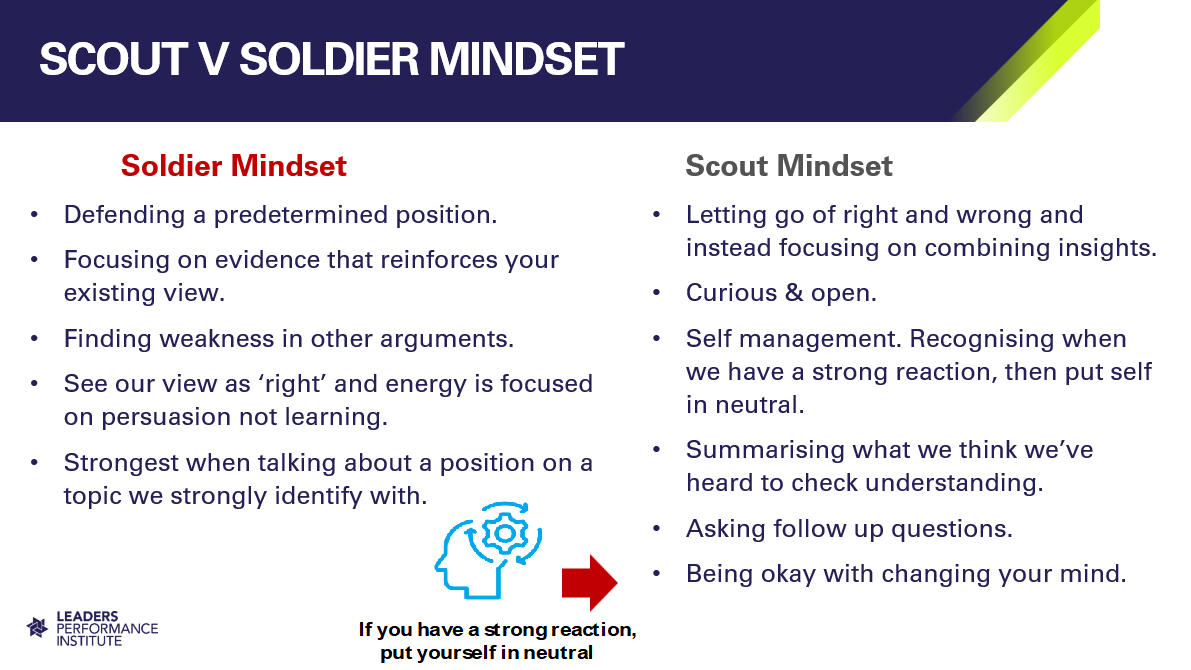
A scout mindset, such as when a scout might draw a map, is essential when learning and adapting. “It’s about acknowledging we might know some elements of the map, but large parts of the map are still undrawn,” added Bull. “It’s not ignoring that we have expertise, but it’s looking for what’s missing.”
On the other hand, a soldier mindset is counterproductive because, as Bull said, “most of our energy is going to influencing other people to see things our way as opposed to learning from what we’re missing.” It can also help, as Shona Crooks, a colleague of Bull’s from Management Futures says, to ‘put your brain in neutral’.
What kind of listener are you?
It was a question posed by Management Futures’ Jeff Pagliano during July’s Leadership Skills Series session.
There are at least four different types of listener, as Pagliano pointed out, but anyone can become better at listening at depth.
He illustrated his rationale with this graphic:
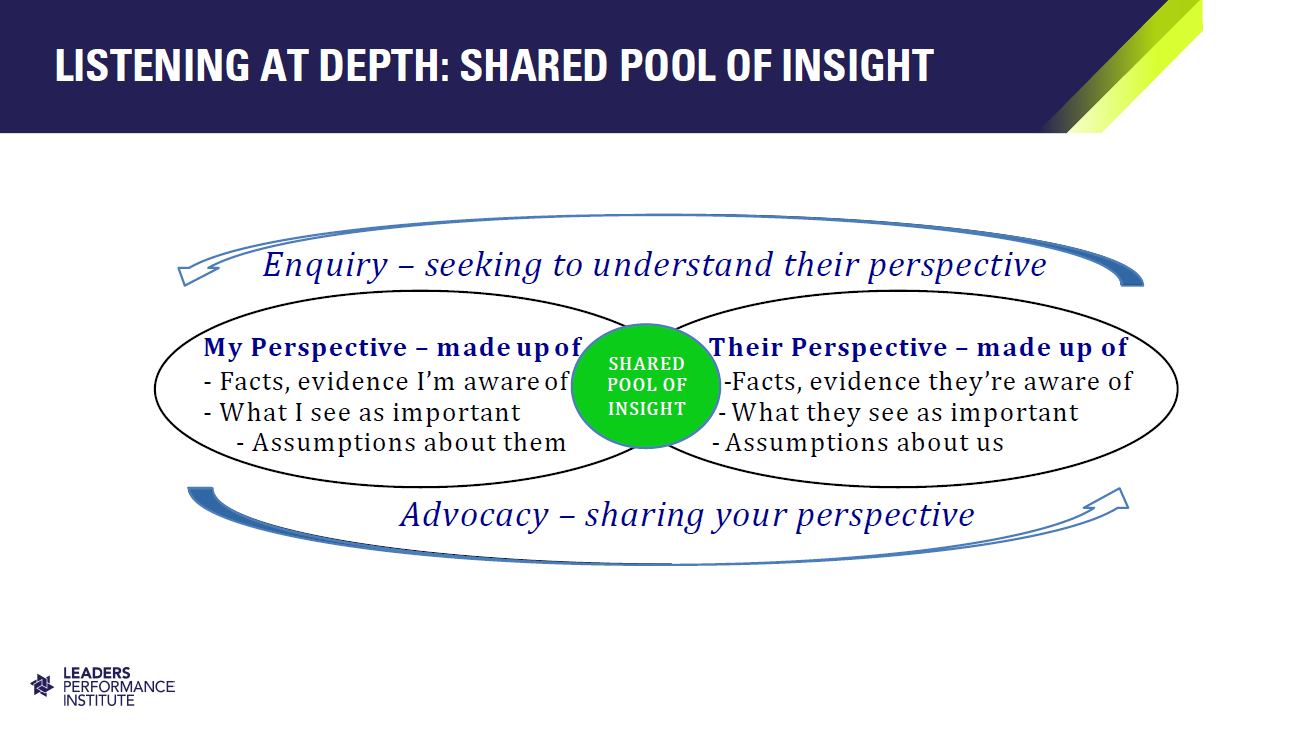
“Usually when we’re trying to persuade someone, it’s all about sharing our perspective. We call that ‘advocacy’,” said Pagliano. Your advocacy will be made up of the facts known to you, things you see as important, and any assumptions you make about the other person.
That person will have facts, thoughts and assumptions of their own, which is why we must add ‘inquiry’ to help bring those to the fore. “And when you bring those two things together that’s where you get that shared pool of insight.”
Listening at depth has other benefits too:
Do you care enough about your coach and staff wellbeing?
“We’ve had athlete wellbeing and engagement in place for more than ten years. We still don’t have coach wellbeing and engagement in place at all.”
This observation, offered at a Leaders Virtual Roundtable on the topic, is by no means unique.
Members of the Leaders Performance Institute have seen the following approaches help:
Read a full account here.
The postpartum return of British athletes
This was a theme of last month’s Women’s High Performance Sport community call, which featured Esme Matthew, the Head of Physiology at the UKSI, and Dr Kate Hutchings, who works with the UKSI’s leading clinical services for all world-class-funded Olympic and Paralympic athletes.
Early and open communication helps athletes and their teams set expectations and create tailored return-to-performance plans, with support from performance lifestyle advisors.
These help to place the athlete at the centre of their own decision-making.
Pelvic floor education and support are essential for postpartum recovery.
Each athlete’s requires unique and flexible plans informed by health monitoring and any necessary practical adjustments. It is key to enable them to stay connected to their sport.
Mental health support is vital as athletes adjust to motherhood.
Informal peer networks, such as WhatsApp groups, offer valuable emotional and practical support, helping athletes share experiences and reduce isolation during pregnancy and postpartum.
Click here for a fuller insight.
Rakesh Patel is tasked with helping floundering NHS hospitals in England. He believes the answer lies in cultural transformation, empathetic teaching, and smarter feedback.
Having read that, you may think that just as readily applies to the world of sport.
“How can we transform underperforming environments into thriving ones?”
That is the question Rakesh Patel, a nephrological surgeon who works at Barts Hospital in London, asked the audience at last November’s Leaders Sport Performance Summit.
His remit includes working on the NHS’s Recovery Support Programme [recently renamed the Provider Improvement Programme], which is designed to support underperforming hospitals and medical providers who have been placed in ‘special measures’.
Patel and his colleagues will work with these hospitals to help identify systemic issues that lead to habitual failures. They will implement evidence-based interventions and build local capacity to sustain improvements once they’ve left the building.
Away from clinical practice, Patel is a professor at Queen Mary University, where 2,300 medical students matriculate at any one time.
As such, he has given a lot of thought to learning and failure in the NHS, which is the ‘sacred cow’ of British society.
What does the Recovery Support Programme do?
Its aim is to mitigate crises and enable people to learn from their mistakes. For Patel, it has to start with rethinking underperformance, because jumping to conclusions helps no one.
“We only see the world as we see it, but not how others see it,” he says. “In a performance role, if we’re assessing someone, we often see the world as we think it should be and not actually how it is.”

Underperformance, whether in experienced clinicians or medical students, cannot always be attributed to a lack of skill or effort.
Just as distractions, pressure, poor communication or emotional stress are prevalent in sport, their presence is felt with greater consequence in medical settings.
Take this feedback from medical students when reflecting on video footage of their mistakes:
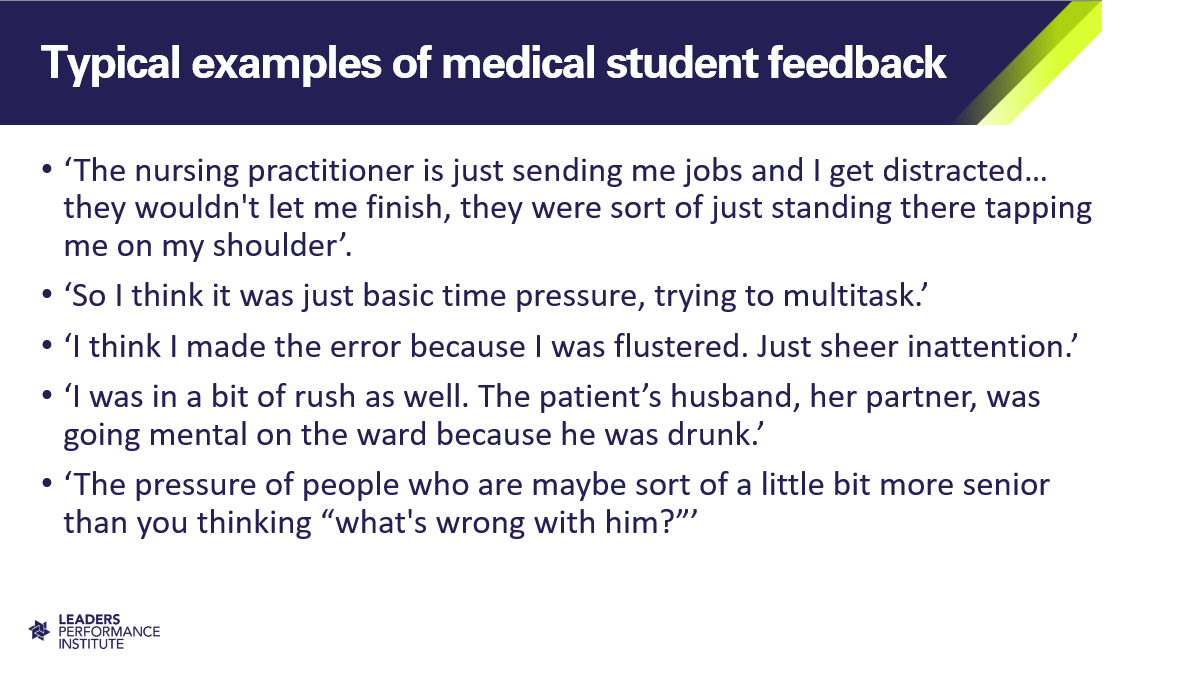
“The last one upset me most as a doctor,” says Patel, who later added that judgement can degenerate into reported cases of outright hostility. “I found it upsetting that these doctors were coming in to do work and we’re being nasty to them and that was why they were underperforming.”
At some level, as Patel explains, these errors point to the human limitations of working memory.
He cites The Magical Number Seven, Plus or Minus Two, the highly regarded 1956 paper by psychologist George A Miller, who said that a person has a working memory capacity for five chunks of information, plus or minus two. That means placing the working memory under too much strain will lead to (often avoidable) errors.
Patel says: “Any threat to working memory will impair performance. If you need your brain and you need to think through things, it’s likely you’re going to have underperformance.”
It follows then that to enable better learning – and prevent avoidable errors – there needs to be less pressure on people’s working memory.
“If you add up all those bits contextual things – inattention, distraction – you can see why memory matters,” says Patel. “You can literally only remember three to seven things and, in that moment, when it hits your eyes and your ears, if you do not do something with it in the first half a second to three seconds, it’s gone. That’s why in high pressure situations when we’re under stress is when our memory gets hit. We can only focus on what we need to.”
That is why medicine values reps and evaluation as much as any team. “When things get complex, you don’t need to think about it.”
With this in mind, it is easier to choose the right form of feedback.
“We all talk about feedback and there’s probably more books on feedback than anything else,” says Patel. “There is an evidence base around how you give it and we wanted to give the best feedback, in the way that it needed to hit and cut through.”
This was tricky to navigate in hospitals placed under special measures. “They weren’t the easiest characters to work with,” he adds, “but it depends on what’s important. If there’s the greater good and we’re going to work together, then even the biggest ego you can get down to your level and work through.
“And we only went into hospitals if we had CEO buy-in and everyone was going to engage. So we taught them how to give feedback better.”
He highlighted four formats favoured in the NHS:
1. Facilitated self-reflection
“One of the most important interventions you can ever do is ask someone ‘how do you think that went?’ And if you do that before they start and you say ‘how well do you think you’re going to do before you start?’ You then get them to calibrate what they think with what you think.”
It was, as Patel says, “the lightbulb moment”. He also underlines the value of sitting with doctors as they watch themselves on video. “It’s not about telling them what they’ve done but asking them; ‘these are your notes, you wrote them, tell me what you were thinking at the table’. You don’t dictate, but get them to reflect.”
2. Revisit video assessments at periodic intervals
Patel and his colleagues test doctors and students from the outset and provide instant feedback. More critically, however, they will also revisit feedback at regular intervals over the following weeks.
“I’ve told you about working memory and fear – they’re going to forget it,” he says of that instant appraisal. “So we videoed everything and we drip fed the feedback over time. Why was that important? Because I don’t know if you’ve ever done it, but watching yourself make a mistake three or four weeks down the line when you know you’ve made that mistake, and being reminded of it, is really powerful.”
3. Peer to peer learning
Sometimes Patel takes himself out of the equation. “We often forget what it’s like to be a novice. That’s why peer-to-peer works really well. So if you’ve got someone new, get someone who’s of a similar age that can explain it better.”
4. Ask them to ‘teach it back’
“We do this when we teach clinical skills,” says Patel, alluding to evidence pointing to the efficacy of this approach to learning. “There’s something about having the confidence plus the competence to be able to explain a skill to someone else.”
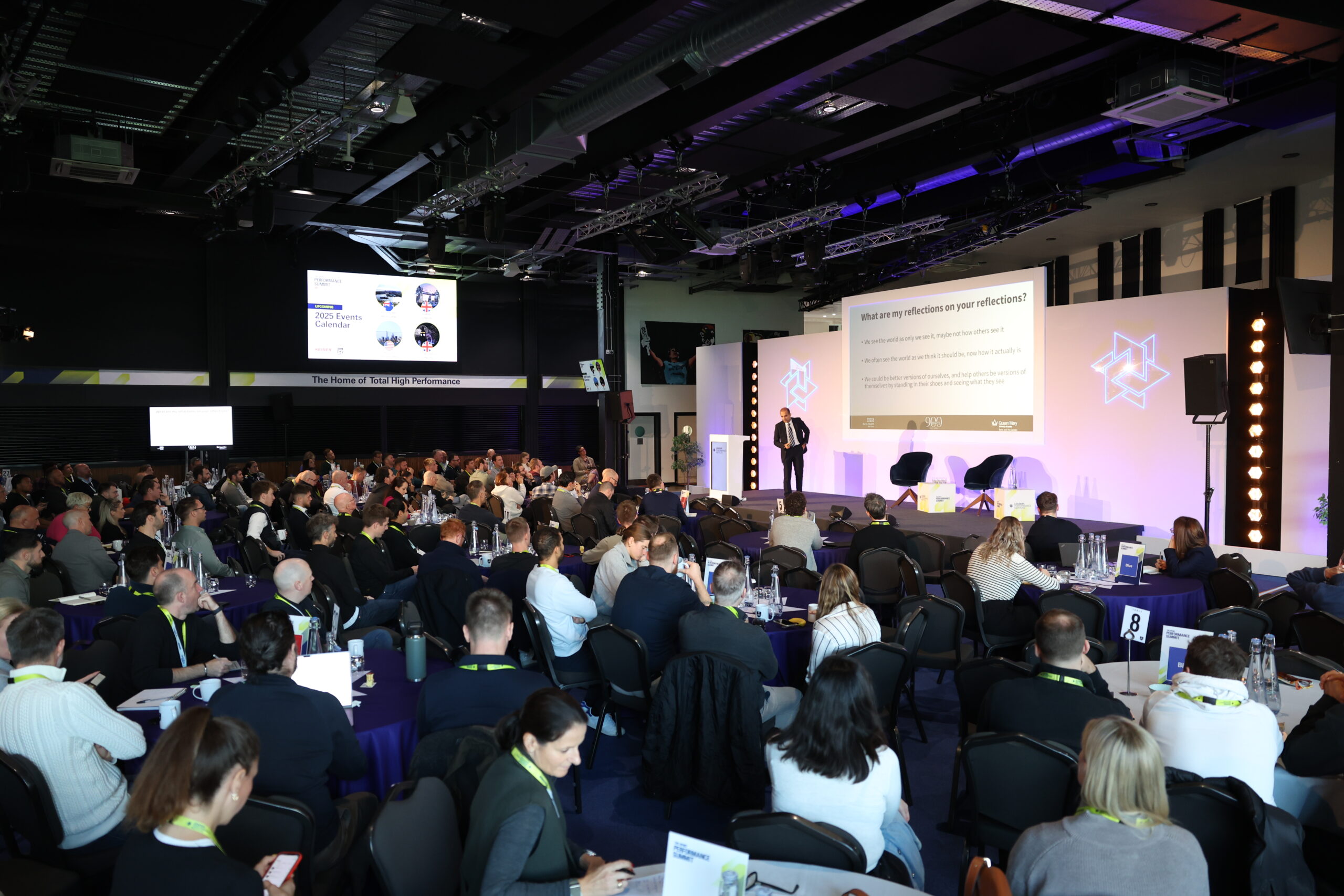
The Recovery Support Programme approach is scalable too.
“I couldn’t go into all these hospitals, and this training model needed to be scaled,” says Patel, who explains that pharmacists were uniquely placed within hospitals to deliver the model in his stead. For one, a large proportion of the noted errors were prescription-based.
And it worked. Doctors trained by Patel’s team and those who have taken the training model make fewer mistakes. “We trained them to be resistant to all the trauma and all the nonsense around them, to still focus on the task.”
What to read next
Talent ID and Development: The Race to Deliver Formula 1’s First Female World Champion
In a recent Leadership Skills Series session, Management Futures’ Jeff Pagliano presented ways to prioritise ‘listening at depth’ in a fast-moving environment.
Jeff Pagliano, a consultant with leadership specialists Management Futures, posed this question at the outset of a recent online Leadership Skills Series session.
The Leaders Performance Institute members in attendance could select one of the following:
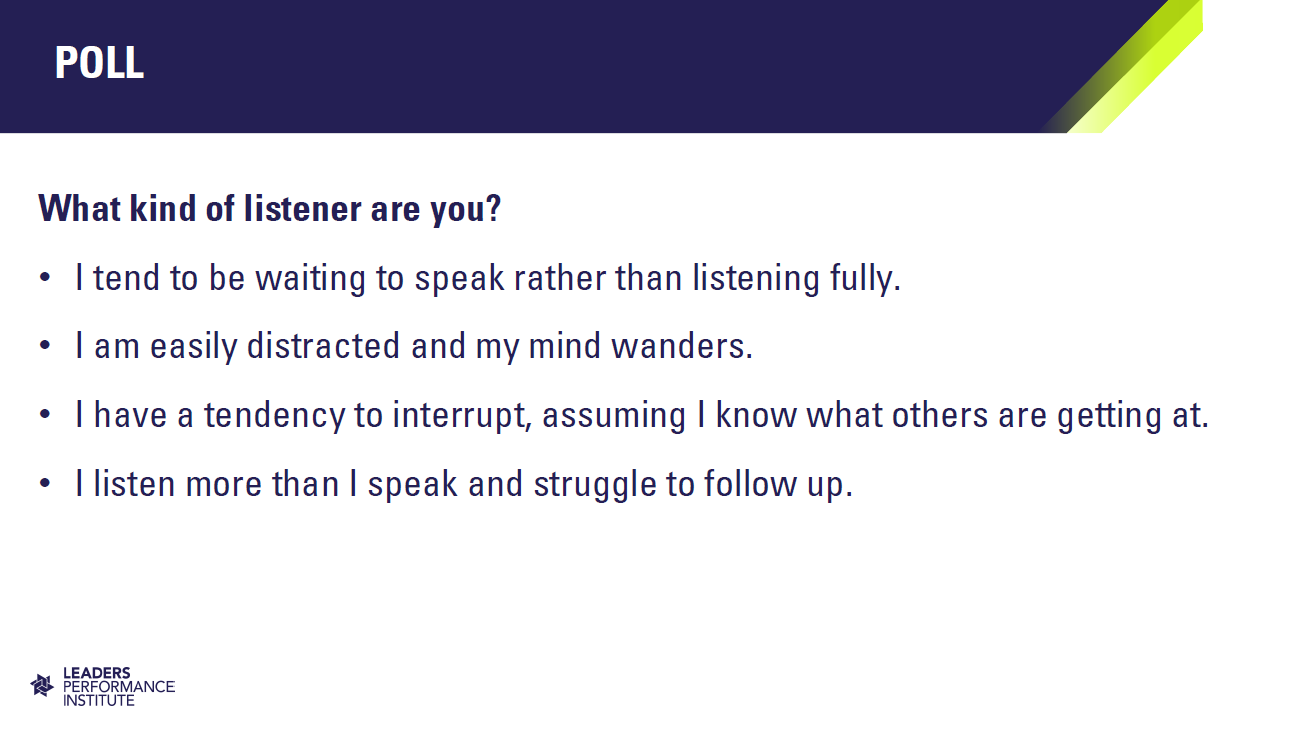
“This might be difficult because, as I said in our previous session on influencing skills, when we talk about communication, we really only think of it as how we express our ideas in a way that’s more persuasive,” Pagliano continued. “Do we stop and consider the important role that listening plays in that?”
He admitted that the description that fits him best is ‘I am easily distracted and my mind wanders’.
“I definitely feel my mind going in a couple of different directions when someone’s talking,” said one attendee. “I think I could have ticked all of those responses because sometimes the mind wanders to interrupting, waiting to answer.”
Pagliano empathised. “I think it is a product of the digital age,” he said. “My own thought is that we’re all easily distracted because we have so many stimuli constantly coming at us.”
Another member spoke of their tendency to be waiting to speak rather than listen fully.
He said: “Part of our roles is to try and be solutions-based and help our people with whatever they’re working their way through.” He reflected that it is a point of pride for people in his position. “Waiting to speak comes from the idea of being able to say ‘I think I have an answer or a suggestion that might be able to help you in this’. But I do think that at some point it detracts from the overall quality of the conversation and the connection piece that you then share with that person because you’re not fully present.”
Again, Pagliano highlighted the good intentions. “That tendency to come up with solutions comes from a very good place, but it’s about also trying to know when it’s appropriate.”
He added: “listening is what’s needed.”
The impact of listening at depth
Pagliano posed two further questions to help set the scene:
This provoked varied responses but the table agreed that people expect to be heard and leaders are expected to listen:
Pagliano also pointed out the importance of body language, eye contact and verbal cues.
The obstacles were just as recognisable:
Next, Pagliano explained why one of the benefits of listening at depth is what he calls a ‘shared pool of insight’. He illustrated his answer with this graphic:
“Usually when we’re trying to persuade someone, it’s all about sharing our perspective. We call that ‘advocacy’,” said Pagliano. Your advocacy will be made up of the facts known to you, things you see as important, and any assumptions you make about the other person.
That person will have facts, thoughts and assumptions of their own, which is why we must add ‘inquiry’ to help bring those to the fore. “And when you bring those two things together that’s where you get that shared pool of insight.”
Listening at depth has other benefits too:
“Erin Meyer”, as Pagliano explained, “has written a lot about collaborations across cultures and how sometimes when we’re listening if we’re missing something, it isn’t because we’re not working hard enough or we haven’t harnessed our listening skills, it’s because the cultural context that the other person is coming from is different than our own. And when I say ‘cultural context’, what I’m referring to is the education system, where they were raised and where they grew up.”
This led to a discussion of ‘low context’ and ‘high context’ cultures, which Pagliano outlined:
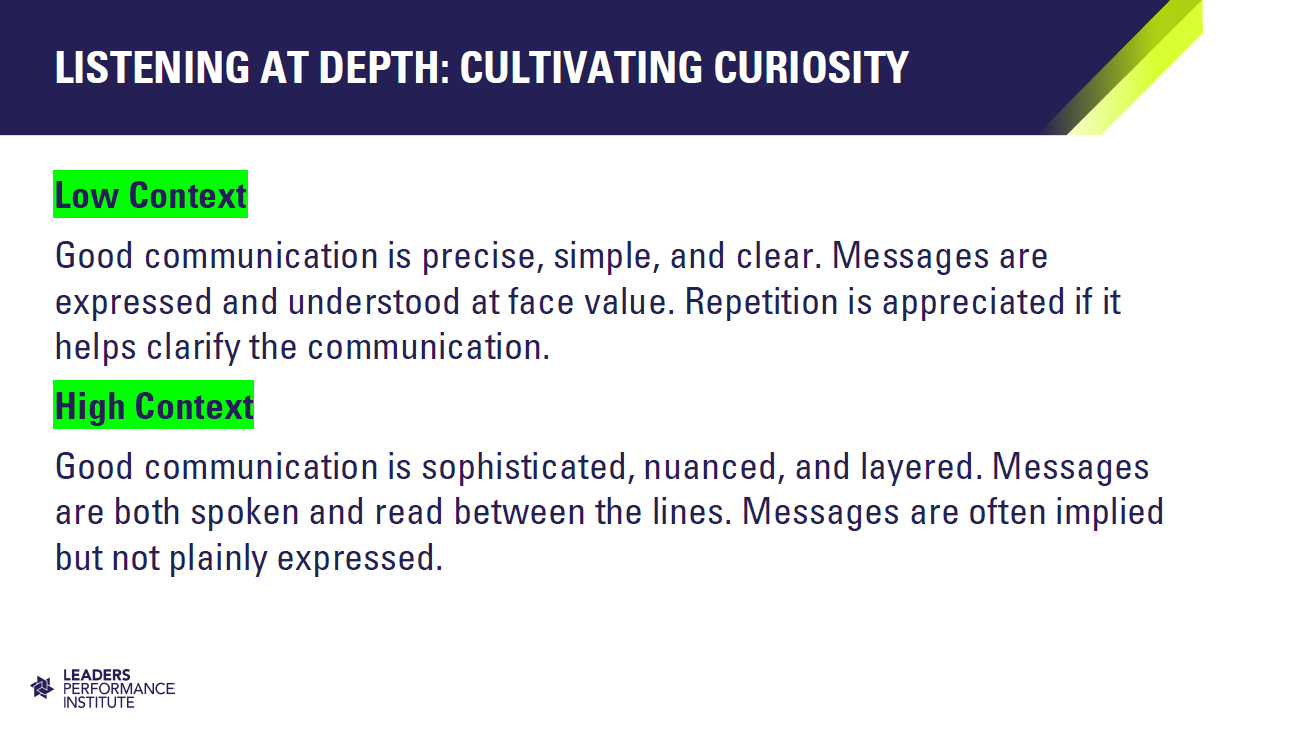
Real-life examples, he explained, could be a comparison of the United States and United Kingdom.
“The US would be considered a low context culture,” said Pagliano. “An American is going to tell you what they’re going to tell you, they’re going to tell you, and they’re going to tell you what they just told you. So they’re going to say it three times.
“The UK would be a high context culture. So if you’ve ever had a situation where you are listening, but you leave an interaction feeling as though you missed something, potentially, for myself as an American, it’s because I’m talking to someone from a high context culture.
“My listening hasn’t suffered, it’s not that I’m not putting as much effort into it, it’s that I don’t understand the context of the other person who’s communicating with me.
“I didn’t miss anything, but I wasn’t listening the right way.”
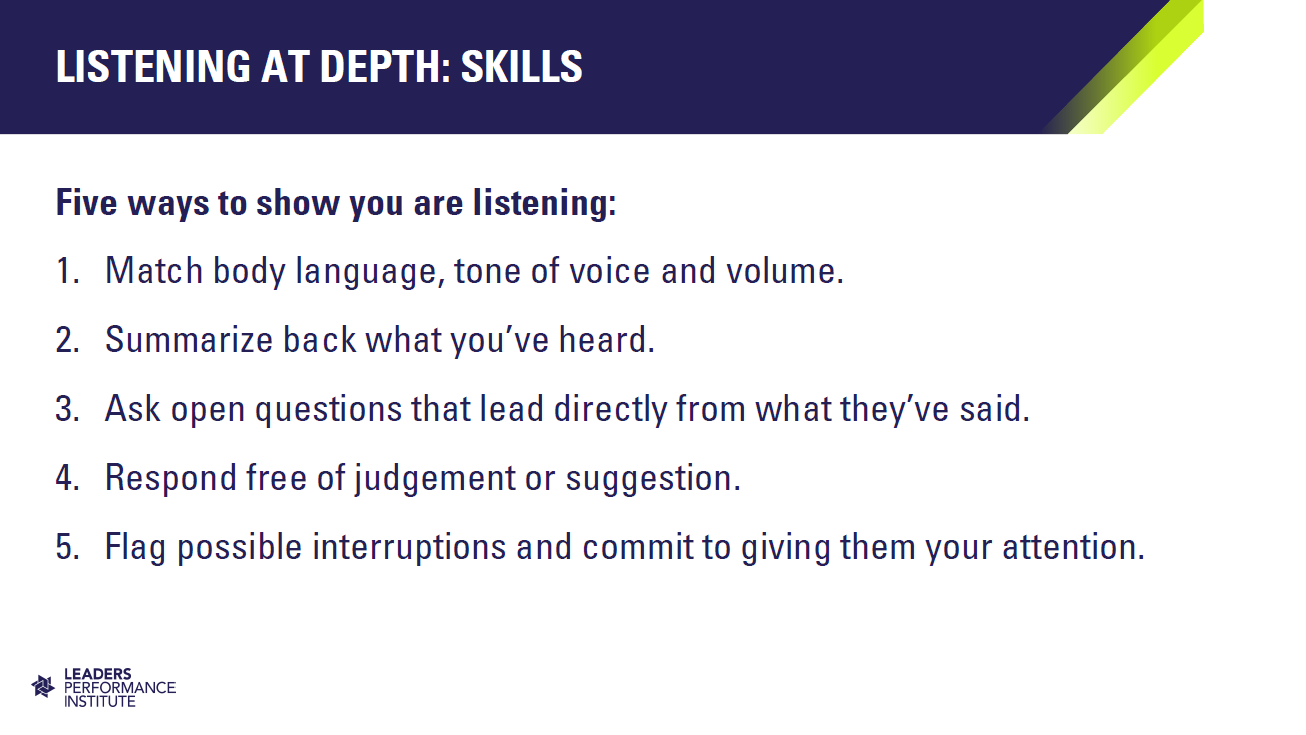
Five ways to show you are listening at depth
The virtual room included people working abroad and other environments where the coaches originate from a range of cultures.
This creates a spectrum of cultural norms around such elements as reporting lines, feedback and trust, which has implications for athletes and team dynamics. We can, however, demonstrate that we are listening at depth.
Pagliano has five tips:
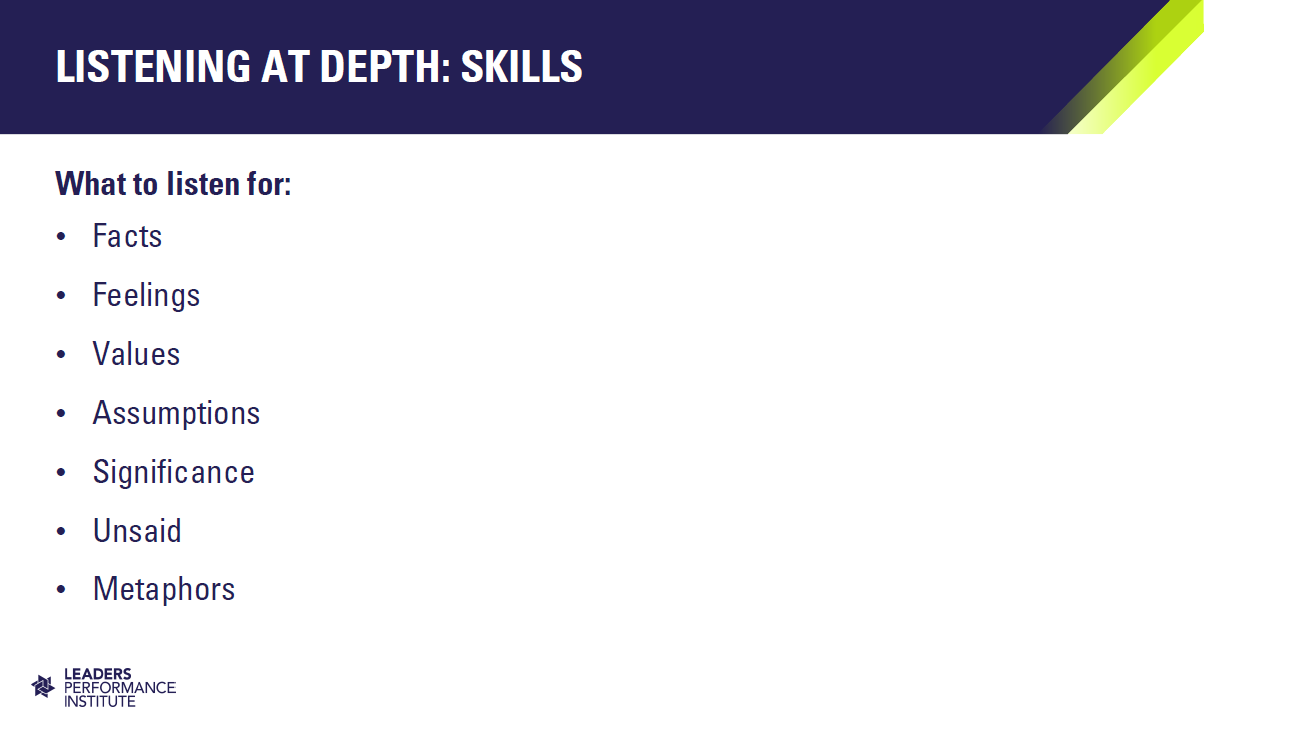
He also suggests that people look out for the following:
Pagliano wrapped up the session with some final tips:
What to read next
When it comes to topics such as developing a performance culture, engendering trust and adroitly using tech, the former defender’s instincts as an athlete stand her in good stead.
A podcast brought to you by our Main Partners

“You feel it,” says the Director of Bayern’s women’s programme. “You already know when you look at their faces. You’re like ‘I think she doesn’t like it’, ‘yeah, she likes it’ and ‘she needs a bit of proof’. It’s like sometimes I see myself sitting on the other side.”
The ‘other side’, as Bianca tells Teamworks’ Andrew Trimble and Leaders’ John Portch, refers to her transition from a Germany international and Frauen-Bundesliga regular to a senior leader of the German champions, whom she represented on the pitch for four years.
“It’s so much harder now when you sit on that side now,” she adds, reflecting on how she used to feel as a player. “I see myself sitting on the other side, like, ‘oh, maybe I have to talk to them again’.”
In this third and final episode of our special series with Teamworks, Bianca touched upon several of the major themes that emerged from our recent Special Report High Performance Unpacked: interconnected performance teams.
She spoke of her role in helping to transform the Bayern culture on and off the pitch [37:00]; keeping the athlete at the centre of the performance jigsaw [14:30]; the importance of sports psychology [31:00]; and the thoughtful integration of technology [21:00].
Listen above and subscribe today on iTunes, Spotify, Stitcher and Overcast, or your chosen podcast platform.
Episode One: Simon Rice, the Philadelphia 76ers
Episode Two: Miranda Menaspà, the Australian Institute of Sport
May shone a spotlight on ‘influencing skills’, leading in complex environments, coach development and finding the right ways to test tech solutions.
“We want to keep on building from this,” said Slegers after her side had defeated Barcelona Femení 1-0 in May’s Uefa Women’s Champions League final.
“We believe in who we are and what we do and we want to keep on building and keep on going next season.”
Slegers, who is less than a year into her first head coaching role, knows the risk of standing still, both as a team and as a head coach.
Throughout the fifth month, the Leaders Performance Institute was on hand to deliver a selection of sessions to help members further hone their leadership skills, from the art of influencing to introducing and managing more efficient processes for testing tech.
Here are some of the choicest cuts.
To influence, you need to listen
Jeff Pagliano of Management Futures hosted an ‘influencing skills’ session for Leaders Performance Institute members as part of our Leadership Skills Series.
He introduced the topic of ‘listening well’, which supports influencing in two specific ways.
“It helps the intimacy part of the trust equation and it gives you the context for a person’s point of view,” he said. “You’re more prepared when the time comes for you to share your knowledge and suggest a course of action.
“Active listening is when you’re not only tuned into what someone says but also what they feel and believe picking up on both their verbal and non-verbal communication is the foundation of intimacy and the antithesis of self-interest.”
He shared the following image to illustrate his point:
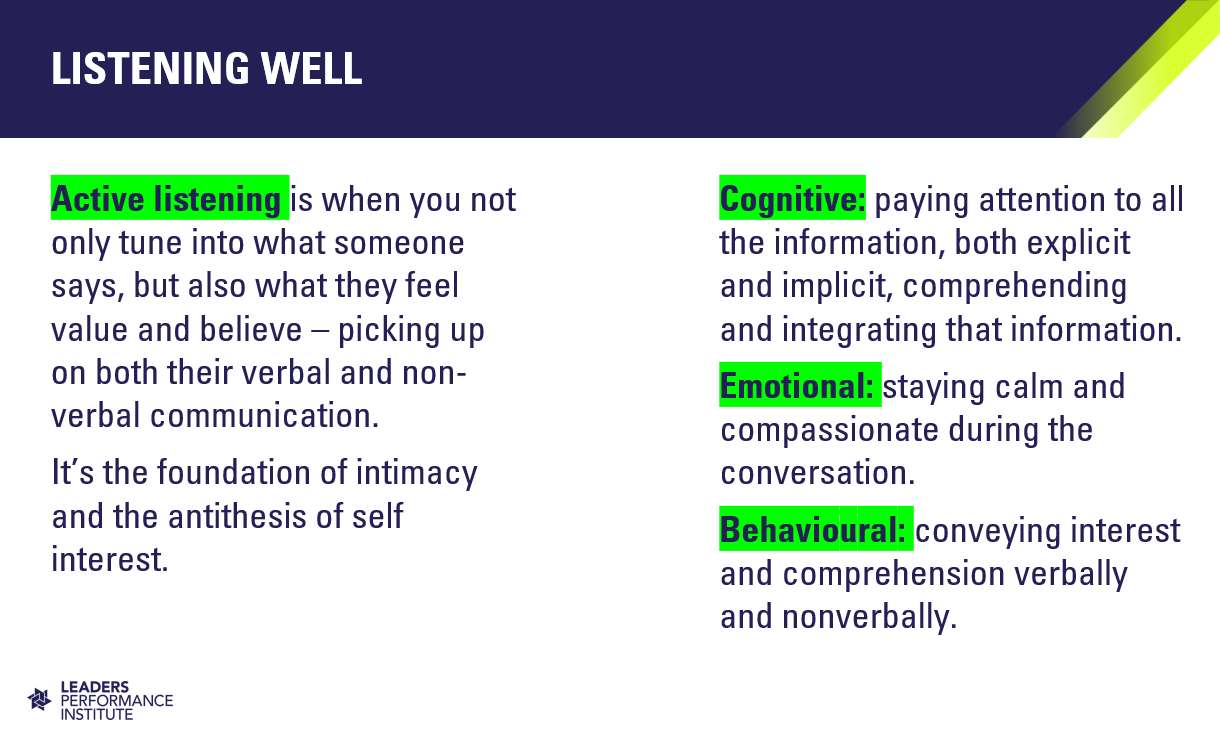
When you’re talking to someone you are hoping to influence it’s always useful to reflect on the goals of each conversation, both what you want and what the other person needs as a way to determine the best way to listen at the moment. And you may realise that a different mode or combinations of modes would be better.
Jeff Pagliano, Management Futures
Top tips for leading in complexity
In May, we also launched a Learning Series that explored adaptability in the complex world of high performance. In the first session, Tim Cox of Management Futures offered a series of seven tips, including: prioritise time for analysing what is changing.
Here’s what that entails:
Read all seven tips here.
Are you able to thoroughly assess tech solutions?
At the beginning of May, we published our Trend Report entitled ‘The Winning Formula for the Future of Performance Sport’.
The report delves into the barriers that prevent organisations adopting new technologies and is informed by more than 200 individuals from nearly 40 sports. While cost was predictably high on the list, three other challenges emerged as equally, if not more, critical.
It was the perfect opportunity to run a virtual roundtable discussing the systems and processes that members have in place at their teams. The table identified a number of critical success factors.
While much of the conversation focused on systems and structures, several participants emphasised the importance of culture and communication as critical to the success of these processes. One high performance manager noted that their organisation is “risk-averse” when it comes to new tech, not because of a lack of interest, but because of a desire to protect core business functions. “If there’s anything we can use to get all the noise out of other people’s way so they can actually do the day-to-day job better, then we’re normally onboard with that.”
Another pointed out the generational divide in digital fluency. Younger staff are digital natives and eager to adopt new tools. Older staff, by contrast, may be more cautious or feel overwhelmed. Bridging this gap requires not just training, but empathy and thoughtful change management.
Additionally, performance sport may need to rethink its leadership structures. In other industries, CTOs and innovation directors play a critical role in aligning technology with strategy. In sport, these roles are rare but increasingly necessary.
Without someone to “own” the innovation agenda, organisations risk falling into reactive patterns and chasing shiny new tools without a clear sense of purpose. As one contributor put it, “We need someone who can sit above the noise and guide us forward.”
Coach development cannot be separated from athlete development
Another virtual roundtable looked at helping athletes to bridge the gap from the youth to senior ranks.
While discussing an array of approaches, the table underlined the importance of investing in coach development as a key influence on transition experiences for athletes. One element of this is ensuring coaches are equipped to recognise and understand different transitions as they occur in different contexts and, therefore, deal with them more effectively.
An environment within the Olympic system explained how their decentralised programme has witnessed new performance records at junior level due in part to their consistent approach to coach development. Their heightened emphasis on coach support and development extends not only to their current athletes but those next on the pathway.
Also, coach-to-coach exchanges enable individuals to discuss both common transitions and those lesser-considered transitions that are nevertheless challenging, such as injuries.
Additional reporting by Luke Whitworth.
Read the Trend Report now
In the first of a three-part virtual Learning Series, we explore why adaptability is becoming a crucial modern leadership skill.
The General Manager of Player Development & Leadership at the Adelaide Crows was speaking in The Winning Formula for the Future of Performance Sport, our recent Trend Report.
The sentiment struck a chord with Jackson’s fellow contributor, Tim Cox of Management Futures.
“We work in sport and other sectors, and there is that feeling of stifling,” Cox told a recent leaders virtual roundtable. “The pace of change, the demands on us are increasing, and it can feel almost suffocating for leaders sometimes. What do we do here? How can we respond effectively?”
Cox, who co-hosted this Learning Series with the Leaders Performance Institute, hinted at the growing complexity of sport and the ever-increasing importance of being able to lead through complexity, which is the overarching theme of a three-part virtual roundtable series that seeks to help leaders develop the necessary skills.
To follow up, we shared five areas where complexity continues to grow in sport. Most if not all will be familiar to athletes, coaches and practitioners alike:
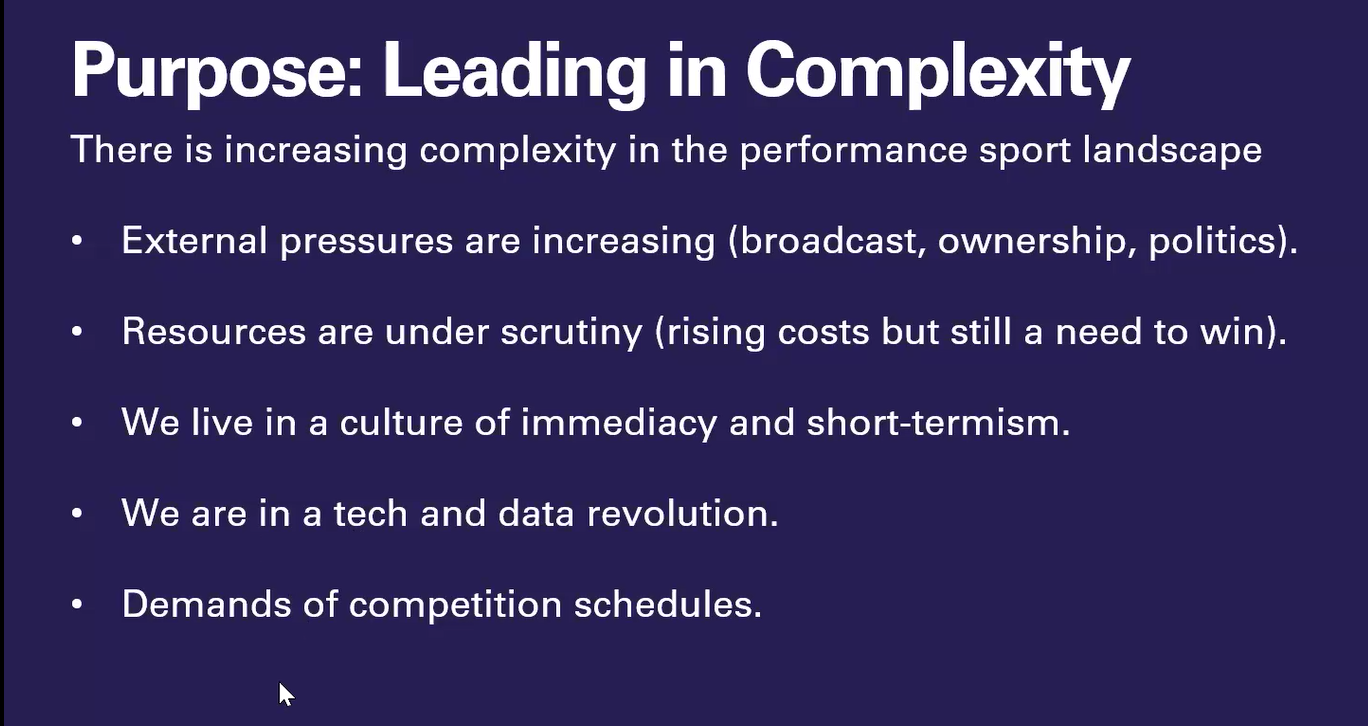
Adaptability: a vital skill
Session one explored the concept of adaptability and how leaders can increase the chance of an effective response from their teams. This came up in the Trend Report. The following also stood out from the report’s findings:
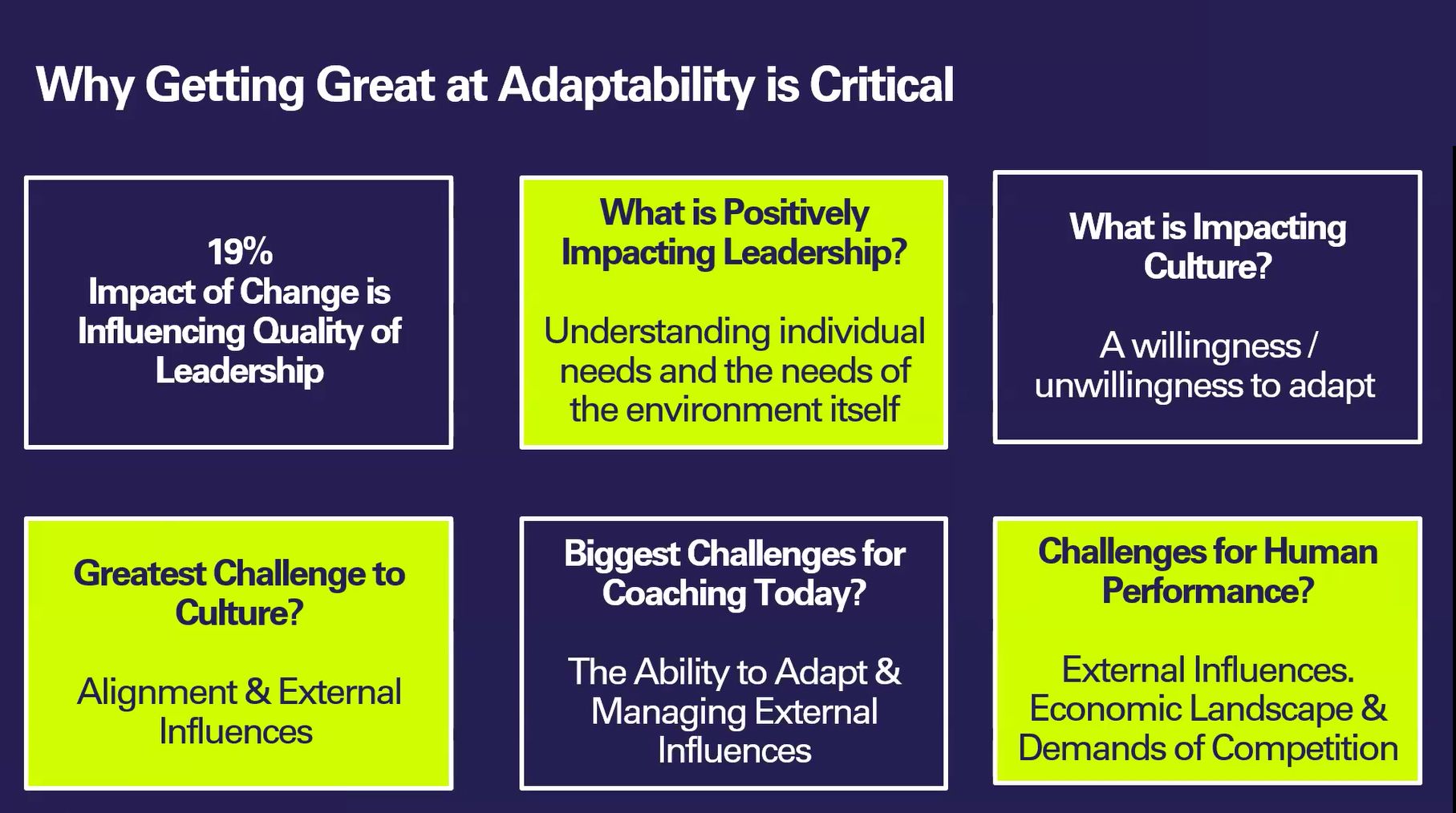
The Magnificent Seven: tips for leading in complexity
Cox distilled his thoughts on the topic into seven ‘magnificent’ areas. “Whether they’re magnificent or not, you’ll be able to make a call on it,” he said.
In a world where change is constant, smaller or less-resourced teams can gain a competitive edge by being more agile.
“This is a simple one: it’s really prioritising time to actually analyse what is changing.”
As one participant said, “adaptive cultures are the ones where everybody has a voice. They can voice feedback, they can push back on ideas, and ultimately, that helps you get to the right idea.”
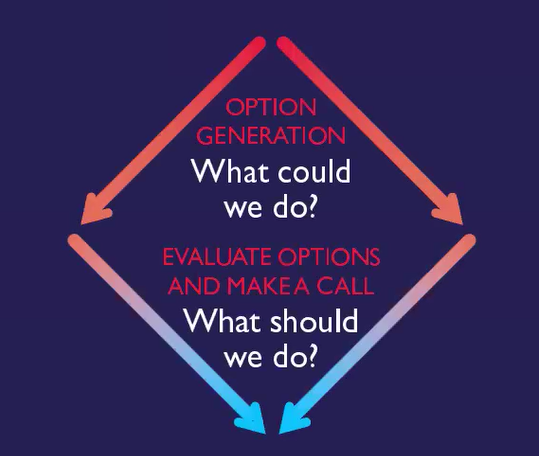
While tapping into collective wisdom is essential, it must be balanced with the ability to make decisions and act quickly. Yet while on-field decisions can be taken in minutes, “off the pitch,” as Cox said, “we can often be inordinately slow in adapting and responding to change.”
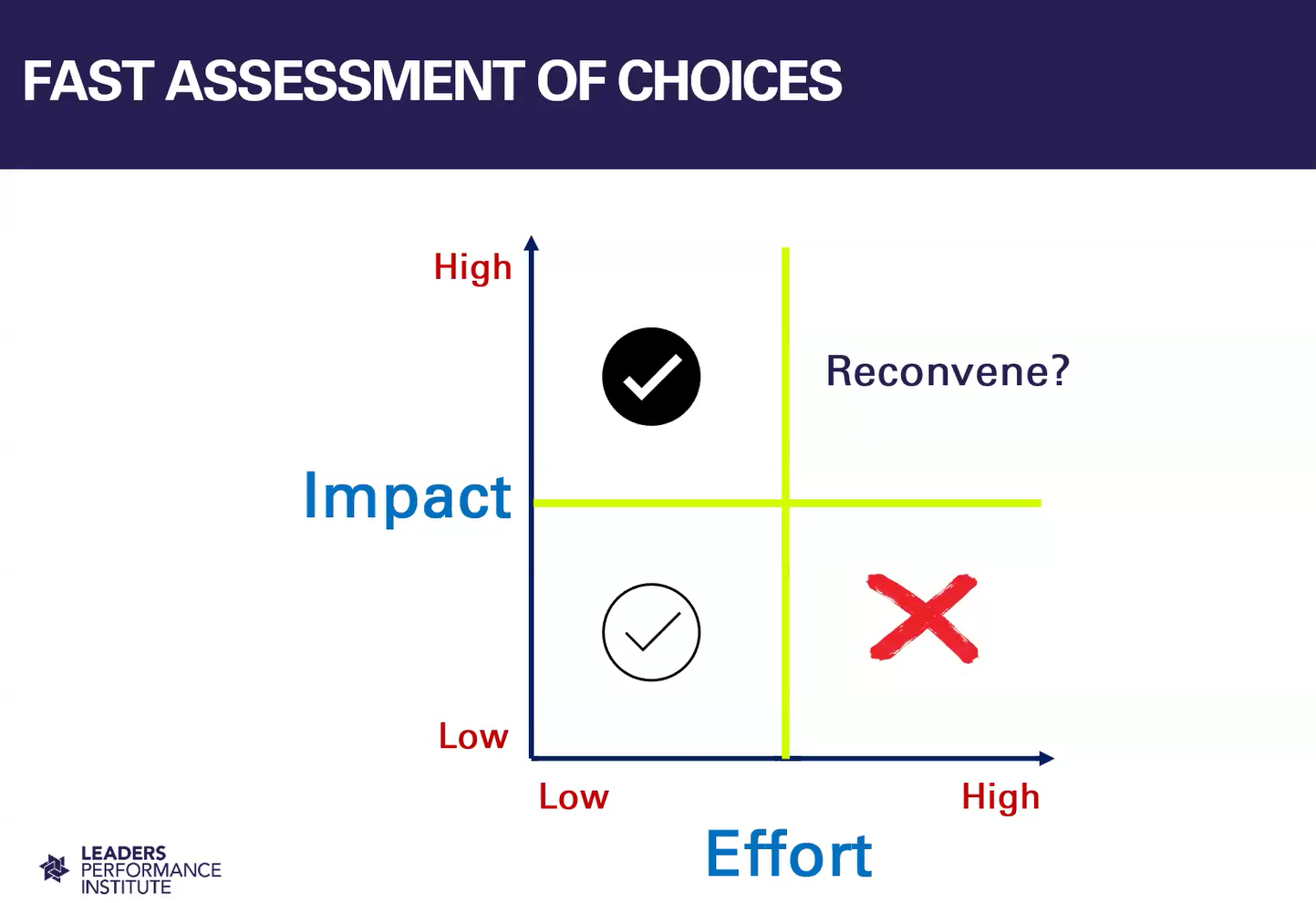
The ideal choices are those that are high impact and low effort. These are the quick wins. Conversely, high effort and low impact choices should be avoided as they are distractions and drains on resource.
Agility requires action, even in the face of uncertainty. Not knowing everything shouldn’t prevent progress.
You can, however, take a structured approach by recruiting wisely, implementing training programmes and pivoting smartly. Teams, Cox suggested, can ask themselves “what are our skill gaps for now or where are we strong now? What are the skills we’re going to need to make this pivot?”
“To adapt, we’ve got to learn,” said Cox with specific reference to the special forces, “and the better we are at debriefing, then the better we are at learning and then adapting.”
He explained that debriefing should be a deliberate, embedded practice. It’s not just about reviewing what happened – or when responding to a crisis – but extracting lessons to fuel future action.
“To what extent can we get these transitions right?” asked Cox. “Because obviously they have big organisational and team impacts, not just on the individuals close to them, they can filter down to the whole organisation.”
Who are your cultural guardians? Cultural guardians, as discussed by Dr Edd Vahid, are the individuals or mechanisms that ensure core values and practices are preserved during leadership changes. They are, as Cox explained, indispensable. “Any new leader is going to want to change things,” he said, “but what are the pieces that we need to absolutely hold on to? What is handed over to the leaders that we know to be true about this culture in this organisation?”
To sum up…
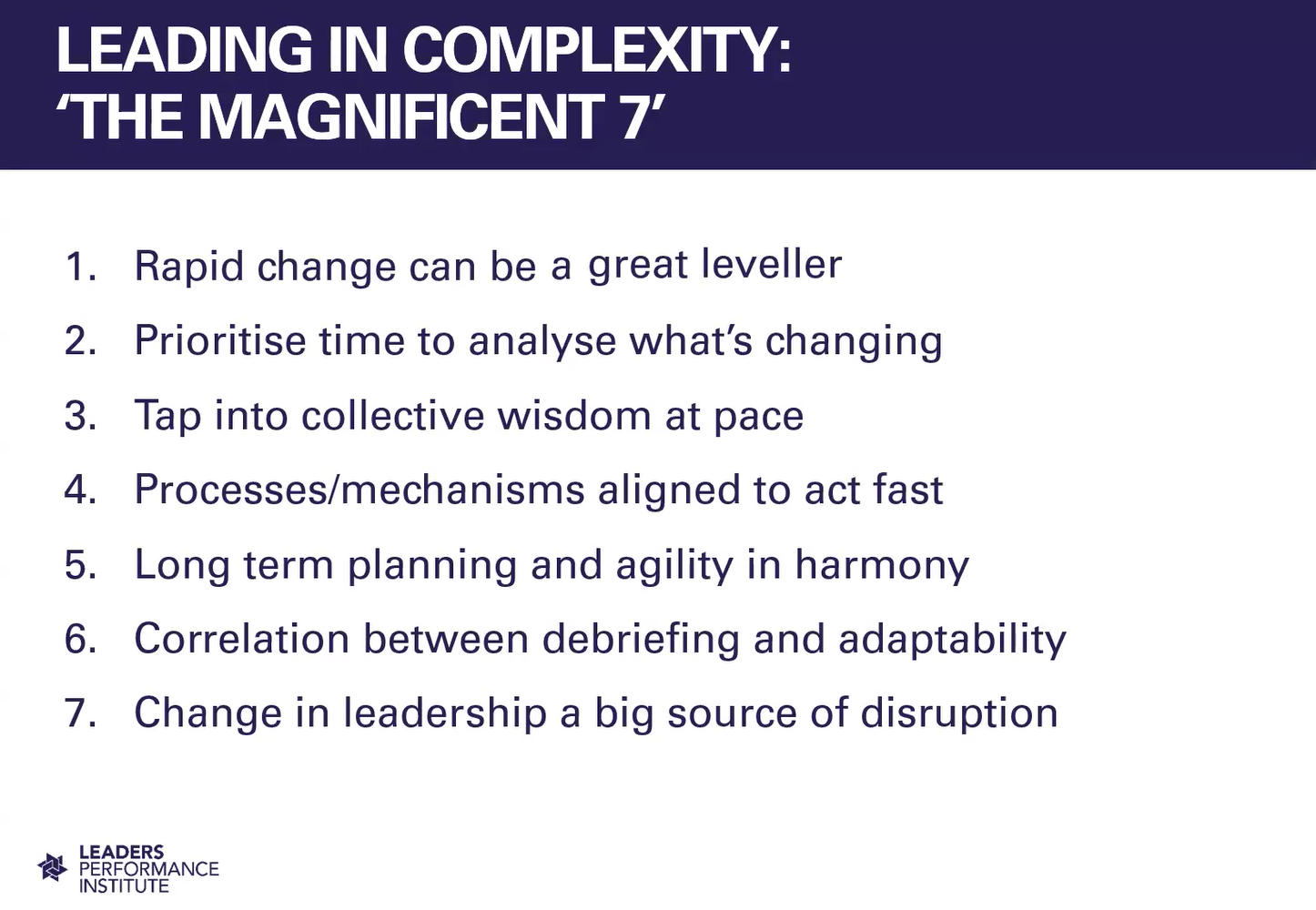
Looking ahead
This session was the first in a three-part series. Future discussions will explore:
Part 2: Inhibitors to adaptability – what gets in the way?
Part 3: Building a collective playbook for leading in complexity
In a recent Leadership Skills Series Session, Jeff Pagliano of Management Futures set out a series of tools, including the trust equation, active listening and ‘flows of knowledge’.
“Influencing is often strictly correlated with the level of knowledge or technical insight we can offer in any given situation and our ability to communicate that knowledge effectively,” said Jeff Pagliano, a consultant with leadership specialists Management Futures.
“However, influencing we believe is much broader than this.”
Pagliano was hosting an ‘influencing skills’ session for Leaders Performance Institute members as part of our Leadership Skills Series.
“A lot of you are employed to lead or influence outcomes, not for your technical knowledge but for your ability to build trust, grasp complex ideas, think rationally, and motivate,” he continued.
“The best influencers are often those who listen carefully to the needs of those around them, ask the right questions, and then communicate a compelling vision. And this has as much to do with credibility as knowledge does and, interestingly, the further you go up in an organisation, the less useful your IQ, your technical knowledge, is and the more useful your EQ, your emotional intelligence.”
Over the course of an hour, Pagliano explained why your ability to build trust, actively listen, and communicate compellingly – areas in which we can all improve – underpins your ability to influence.
‘The trust equation’
To start, Pagliano presented the trust equation to the group:
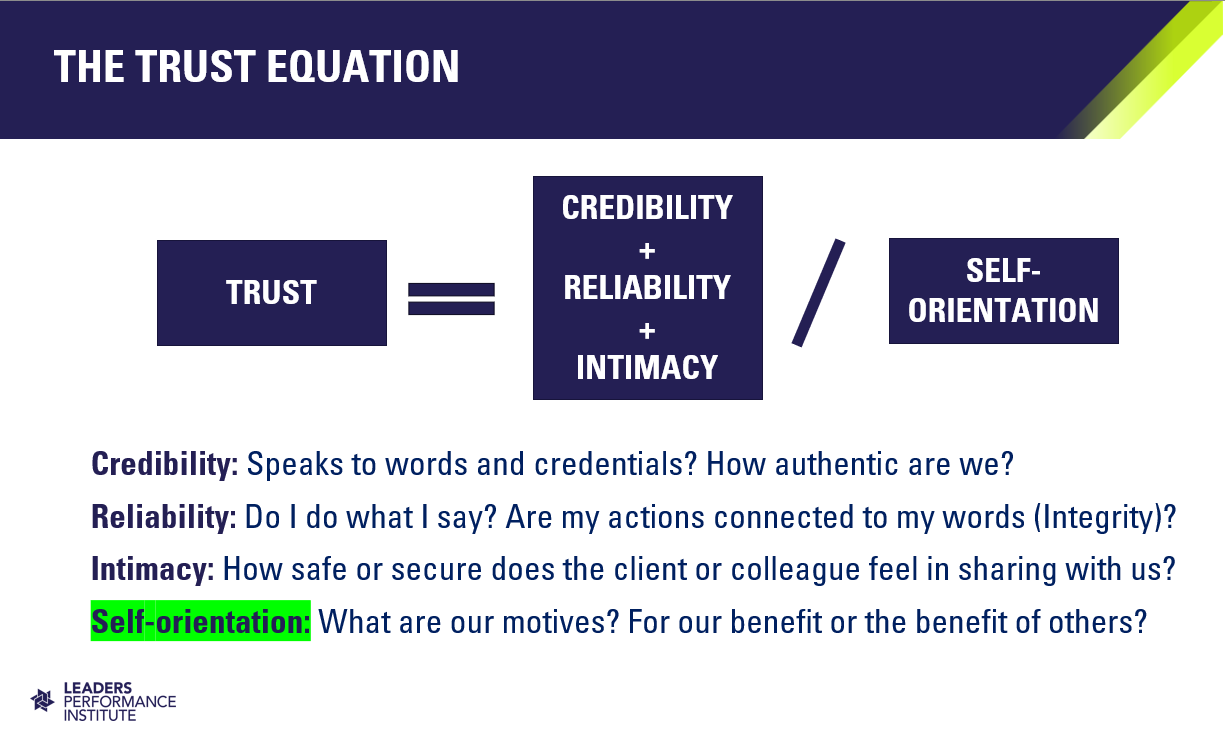
He then explained his thoughts on each:
Trust =
Credibility: “This speaks to both words and credentials. People should be confident that you know what you’re talking about, but it may not be just about the content, it could be how you show up as well. Credibility is a blend of what you know and how you present yourself.”
+
Reliability: “You do what you say you’re going to do. Your actions are connected to your words and your follow through. One thing that’s interesting to note is that people will sometimes over-promise and under-deliver; and it’s a very natural instinct to do that because we naturally want to please or we want to show the best of ourselves but, actually, over the long term, this can really work against you.”
+
Intimacy: “If credibility and reliability are the sort of things that are quite concrete, intimacy is a little more ambiguous. It’s more to do with the sense you have that someone will be there for you, and you try to gauge how emotionally intelligent they are. You’re noticing how well they listen, how much they connect, how much warmth they have, how much understanding. It’s less concrete, but equally important.”
/
Self-orientation: “Anytime you are building trust you do have to have some self-orientation because in any kind of negotiation or where you’re looking to influence, it would feel suspicious if someone thought you were entirely magnanimous about everything and you had no vested interest in anything. It’s about getting the right amount and not letting it overwhelm the other three. That’s why you have the first three divided by self-orientation.”
When you’re focused on being more genuine and interested in the other human being good things are going to flow for that, opportunities flow from that, but if the opportunity is so prevalent in the conversation that you’re trying to jump on it constantly, the other person’s going to feel it.
Active listening
Pagliano then introduced the topic of ‘listening well’, which supports influencing in two specific ways.
“It helps the intimacy part of the trust equation and it gives you the context for a person’s point of view,” he said. “You’re more prepared when the time comes for you to share your knowledge and suggest a course of action.
“Active listening is when you’re not only tuned into what someone says but also what they feel and believe picking up on both their verbal and non-verbal communication is the foundation of intimacy and the antithesis of self-interest.”
He shared the following image to illustrate his point:
When you’re talking to someone you are hoping to influence it’s always useful to reflect on the goals of each conversation, both what you want and what the other person needs as a way to determine the best way to listen at the moment. And you may realise that a different mode or combinations of modes would be better.
Flows of knowledge
“If the trust equation is where it should be and you have been listening well, you have laid the groundwork to engage with the person you are trying to influence in conversation,” said Pagliano in taking the conversation further. “We have a great framework for you to use: it is called “flows of logic.” Pagliano cited former BBC presenter Stephanie Hughes in his explanation:
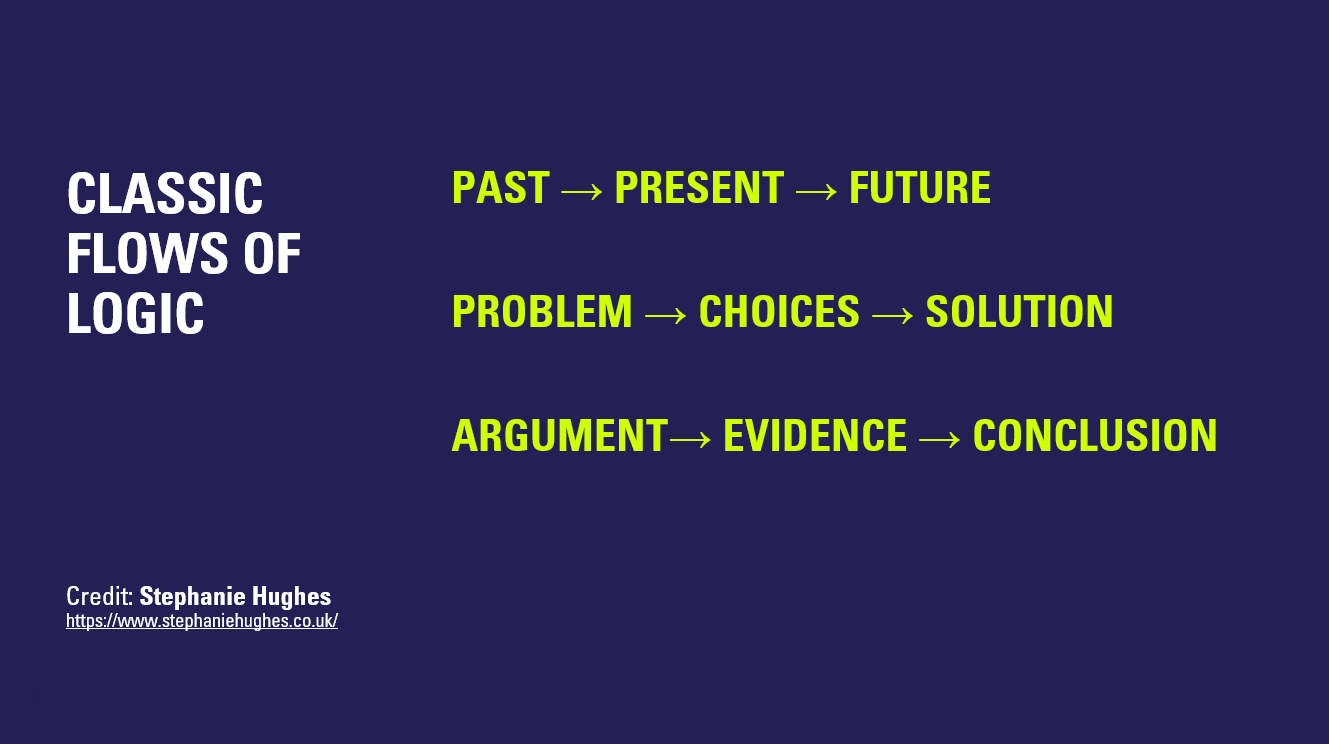
Pagliano explained their value, particularly in non-rehearsed, spontaneous conversations:
Past → Present → Future
“When you go through these phases of logic, it’s the middle word that is important. Like in the first one, if we just say, ‘in the past we did this’ and ‘then in the future, we’re going to do that’ and you don’t give any context for the present, it’s less powerful.”
Problem → Choices → Solution
“[To say] ‘here’s a problem or solution’ – that’s not an influencing tool – that’s just a command. To present choices shows your credibility.”
Argument → Evidence → Conclusion
“The third could happen when you’re pushing back at someone who’s come at you with a different opinion, and here this is where the middle word is important, because if you just say, ‘I believe this and here’s a conclusion’, it’s just an opinion. But if you add evidence, it becomes more than an opinion. It becomes a fact, and it becomes far more concrete. It’s much more objective because it’s based on evidence.”
You want to sound like you know what you’re talking about and you’re not floundering and, if there’s a logic to what you’re saying, the information is more easily understood and retained, so these serve a multitude of purposes.
The final factor: push and pull skills
Pagliano presented a final slide:
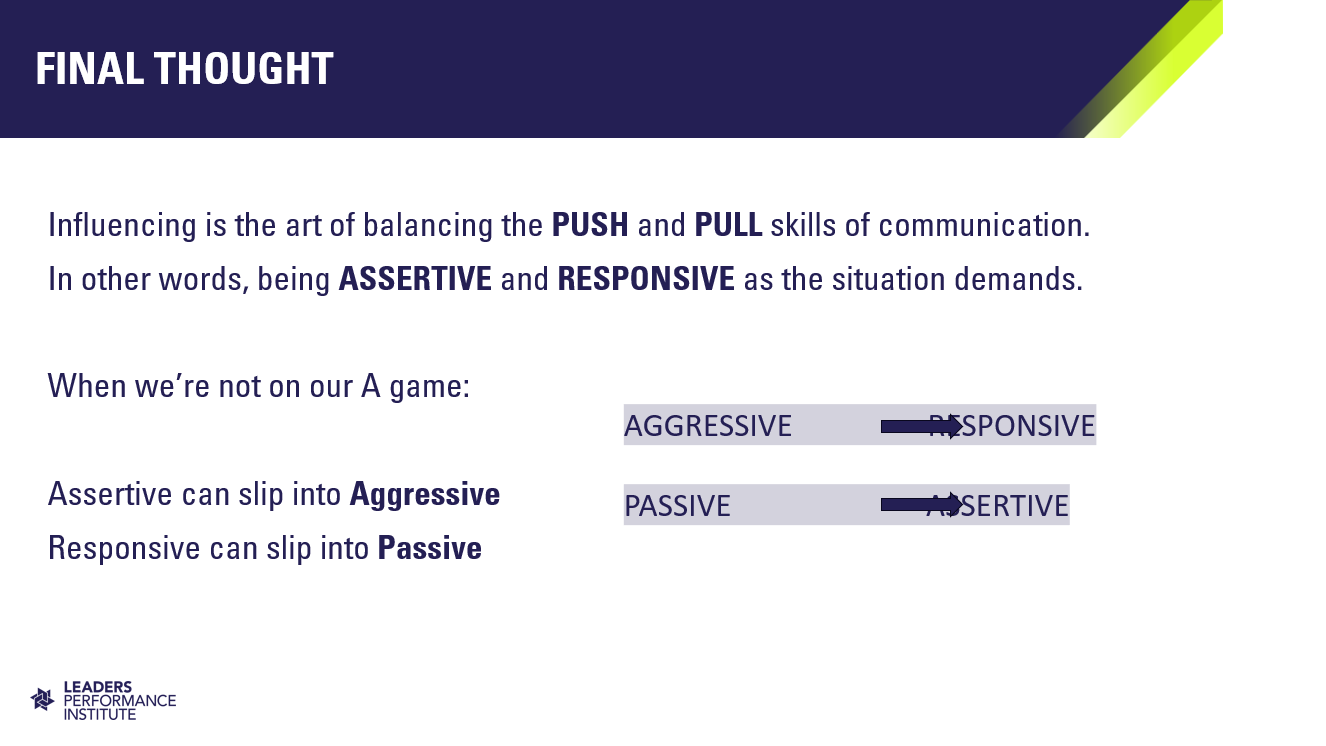
“Effective influencing is our ability to balance those push and pull skills,” he said.
“The ‘push’ would be that flow of logic. When you’re a subject matter expert and you’re trying to communicate your point of view in a way that moves the other to take a recommended course of action, those pull skills [build] that trust equation, the active listening, and it’s good to reflect where we need to focus more.
“Often, ‘push’ comes more naturally for people, and when we’re not on our A game, those of us who have a propensity to be more responsive can slip into passive; and those of us who are more assertive can slip into aggressive.”
Aggressive: go to responsive. Passive: go to assertive. And make sure you’re constantly aware of those push-pull dynamics.
What to read next