In a recent Leaders Virtual Roundtable, members discussed how teams can improve the data literacy of their coaching cohorts.
“I said to him: ‘I had you when you were a player – I know you wouldn’t understand any of this – so why are you telling this to our players?’”
The performance director in question shared this story at a recent Leaders Virtual Roundtable entitled ‘Effective Integration and Interpretation of Data in Coaching’.
It quickly dawned on the coach. “He went: ‘yeah, I’m sorry, I hold my hands up’. That was powerful because he could see it.”
Ideally, a coach would have both the working knowledge and the confidence to make targeted and effective data-influenced interventions that remove confusion or ambiguity.
Over the course of an hour, members of the Leaders Performance Institute, drawn from a mixture of analytics, sports science and coaching backgrounds, discussed the steps they are taking to improve the data literacy of coaches at their organisations. They homed in on four factors.
Performance practitioners: engage the coach early in their tenure. Data can be another string in their bow. “You don’t want to burden them,” said one participant from the Australian Olympic and Paralympic system, “but how can you elevate them and enhance them as a coach?” The key is to explain that data is there to support their intuition as a coach. Even AI should be no more than a ‘co-pilot’. Data analysis should support the work of the coach and “give them confidence in their decision making.”
Furthermore, as analytics career pathways evolve, more teams are establishing hybrid coaching and analytics roles. “Some of the best analysts are good interpreters and translators for coaches,” said one attendee working in English football, “and some of them have taken that on themselves to think ‘I can go and progress in this’ if they’ve got an interest in pushing on with the coaching area as well.”
“Timing is everything with coaches,” said one member, while making the distinction between ‘teaching and developing’ and the ‘telling and giving of answers’. “The timing of when you plant the seed or present something new to a coach is really the start of the success or failure of what you’re trying to do.” Another attendee suggested that a practitioner must consider “what is it that you’re going to provide? And what is it you’re going to hold back?” A third offered an example of this in practice: “We’ve introduced not just new technology, like tools and hardware, but also a large number of new datasets and data metrics for the coaches to understand.” An astute practitioner will foster a curious mindset and understand “when it’s OK to give the coach a little bit more to stretch them and when we will hold something back.”
When a curiosity-driven coach uses data to support their intuition, they can do their most effective work. “I always tend to try and attach myself quite closely with any analyst to marry up the science and the art,” said an age-group cricket coach in England. “It’s about getting the data and then allowing that coaching gut feel and observation to take place as well.”
From the analysis side, it requires someone able to move beyond their specialisms to communicate readily with the coaching staff and other colleagues. “The positions of technical directors or performance managers within this space are critical to make the decisions about what we translate and how we do that,” said a member. “My experiences of things when they’ve gone well would be with practitioners that have those professional skills to communicate and give what is needed rather than give too much.”
It’s on the coach to establish the need for their performance team. “The practitioners shouldn’t overwhelm the coach, but also the coach shouldn’t overwhelm the practitioners,” said a participant from the British Olympic and Paralympic system. “Do they truly have a priority? Do they truly know what it takes to win?” The coach needs to be clear on how the data is to be used, whether it’s to inform development, to pose exploratory questions, or to make a decision. “Coaches can fall into a trap. They want to know everything, but do they truly need to know everything? What are they actually prioritising?” From there the team can decide “what are they going to double down on and ask where the gaps are for exploration.”
What to read next
27 Feb 2025
ArticlesIn this Virtual Roundtable, brought to you in partnership with ESSA, Robin Thorpe and Lyndell Bruce explored four areas where the practitioner of the future will need to excel.
An article brought to you by

“It’s become a new trend or buzz term in high performance,” said the former Director of Performance at Red Bull. “I’d be really interested to see how many self-proclaimed integrated departments and processes actually are.”
In a truly integrated department, he argued, there has to be “positive and respectful challenge between staff and then between the disciplines” and he is unconvinced that this is always the case in many environments.
“Not to be controversial, but I would think that in some of the areas or places where true integration is preached, there might actually not be any collaboration whatsoever,” Thorpe added. “And so, without collaboration, there might not be any friction points or any challenge, so it might only be perceived as an integrated process.”
Thorpe was speaking at the first session of ‘The Future of Performance Sport’, a three-part Virtual Roundtable series brought to you by the Leaders Performance Institute and Exercise & Sports Science Australia. The first session explored the ‘future practitioner of high performance’.
He was joined on the virtual stage by Deakin University’s Dr Lyndell Bruce, who harbours similar reservations when it comes to integration.
She said: “So often we see with these integrated teams that an athlete has poor performance. So they throw everything that’s been working really well out the window to try and solve why we’re not winning – and that suggests that it’s really not an integrated team.”
The future practitioner will need to find the answers and, here, we detail four considerations, including better integration, that will help to stand them in good stead.
Both Bruce and Thorpe believe that the future practitioner will combine technical knowledge and softer skills
“People call them ‘soft’ skills – I like to call them transferable skills, complementary skills,” said Bruce. She also pondered how they might be taught. “It’s challenging because it takes time, it takes effort, and it takes resources. It’s too easy to say students will get that in their work, integrated learning, because we know it’s not the case. They don’t all go to the same environment and we can’t control those environments.”
There are questions to be answered on the technical side too, with Thorpe emphasising the importance of detailed and applied research. “We delve into research articles which might be relevant to what we do, but we also see how they associate with the work that we do,” he said.
Thorpe also believes that generalists will continue to have their place. “Although specialisation will offer a lot more opportunities for younger students and practitioners going forwards, I hope that we don’t lose the more generalist skills that I think are very, very effective currently.”
Thorpe sees AI as a potential time-saver, but with caveats. “I think we know that AI can certainly support us with is enhancing processing times when it comes to using and working with data that we have,” he said. “We’ve come into this era of plug-and-play technology, which means that our ability to cope with data has become stretched.”
However, he added, “I certainly don’t believe it’ll ever be the silver bullet to a lot of our performance problems or challenges or questions.” It is no surprise that he preaches caution. “I think we still probably need to think about some of the principles of why we’re collecting some of that data in the first place.”
At Deakin, Bruce and her colleagues have gotten used to students using AI to craft responses. She said: “The conversations are leaning towards how we teach students to use this in an advantageous way.”
And, as she observes, “many organisations are using those machine learning models to create outputs, look at different tactical and technical elements of match play, to understand the physiological data that they’re receiving, so I don’t think that’s unique; and I think there’s still a way to go in terms of how we use that and how we implement that more effectively.”
Wellbeing – and psychology as part of wellbeing – continues to grow in prominence, with all staff members called upon to play their part.
“It’s not a once-off conversation because they flagged on the wellbeing this week and then two weeks later they’re back in their normal range – we continue that conversation and check-in,” said Bruce of her work Deakin. She also noted the growing specialisation in how psychology is used in sport. “We use psychology from a performance perspective and also a clinical perspective.”
Thorpe was responsible for mental performance in his most recent role. “It was very much a pivotal learning opportunity for me; to understand the continuum of how mental performance operates,” he said. This included performance under pressure, helping athletes to deal with increased mental loads in training and competition, and psychological profiling.
Integration is increasingly difficult in a world of growing specialisation with so many inputs to reconcile, but Thorpe and Bruce both offered some tips.
For his part, Thorpe emphasised objectivity, particularly given the different ‘languages’ that individuals in different fields will speak. He says: “How can we use objectivity as a common language? Good objectivity – not AI-based reams and reams of data – but really solid precision-based objectivity is our vehicle to integrating approaches.”
High performance teams need to understand the desired outcome, then, as he asked, “how do we then fit these experts and specialists to those outcomes rather than coming at it all individually?”
Bruce then argued for consistency. “[The high performance team] operates irrespective of performance, while you might need to innovate and make adjustments along the way,” she said. “But it doesn’t change because of poor performance.”
Further reading:
Sports Science Research: the Strengths, Weaknesses and Opportunities
In a recent Leaders Virtual Roundtable, we explored five considerations for teams looking to bridge generational gaps in their ranks.
It provokes a question that was explored in a recent Leaders Virtual Roundtable: how can senior leaders work to create an environment where different generations can co-exist?
Beyond age, different generations have unique sets of beliefs, values and attitudes, which has implications for their work and the ways they work with others.
The challenge lies in finding the common ground. First, let’s take a look at the general characteristics of different generations:
By the same token, there are obvious similarities, as the table noted.
“We don’t want to put people into boxes,” said one participant. “We don’t want to make assumptions of groups of people that make you, as a leader, behave in a certain way that’s not appropriate for that person.”
Five key considerations for leaders
Going back to the generational differences, and knowing what we know, the virtual table explored five leadership considerations:
Practical strategies
In the quest for better collaboration and alignment, several participants spoke of practical strategies in their environments.
Try to understand people’s experiences and intentions
One environment, in preparation for the 2026 Commonwealth Games, is asking its athletes and coaches a series of questions as they seek to bridge the generational gaps.
“We’ve been getting athletes into a room and asking: ‘how are you experiencing this environment?’” said the attendee who shared the story. “We ask ‘do you feel like you’re developing?’ And ‘do you feel like you’re successful?’ along with ‘is your wellbeing looked after?’” They ask coaches: “’What is your intention in terms of the environment or the experience that you’re trying to create for athletes?’”
There have been some positive outcomes. “This insight has led to some activities that coaches and athletes can engage in to bridge that gap and make it more likely that people are collaborating efficiently and effectively on the path to get that goal.”
Invite people to share their story
One participant working in the British system spoke of their organisation’s ‘life stories’ project. “We get somebody to share their life story. The benefits are clear: “it highlights the different things that people have experienced, that have contributed to where they are in their life right now. It really helps people to see others’ journeys; and it really connects people because they understand somebody a little bit more.”
Launch a ‘cultural reboot’
It can be difficult to cultivate a unified culture when you are working in the service of ten sports, each with their own culture. One participant, who works for a British university renowned for its sporting heritage, spoke of the school’s efforts to develop that unified culture through an ongoing “cultural reboot”.
They are “asking the student-athletes, and even the academics who may not be involved in terms of sport delivery, but have regular communication and contact with a lot of our students, what they think the culture is of the sports programmes.”
Reverse mentoring
Implementing reverse mentoring and buddy systems can help bridge generational gaps. For example, younger employees can mentor senior staff on digital tools, while senior staff can share their experience and knowledge.
Establish ‘cells’ based on common interests
Some interests are cross-generational – a fact to which one Premier League club is leaning. This club, as your correspondent told the virtual table, identified common interests among their staff and encouraged them to form small groups (cells) to collaborate, share ideas, and learn from each other. These groups would meet regularly to discuss their interests and progress.
A recent Leaders Skills Series session explored cultural leadership and how we might improve our cultures one step at a time.
The label was used by sports psychologist Willi Railo, who worked as a consultant in the early 2000s for Sven-Göran Eriksson, the England men’s national team Manager at the time.
“He has grown to become a cultural architect,” said Railo of then England captain Beckham in a BBC documentary titled The England Patient, which was broadcast ahead of the 2002 Fifa World Cup.
“[Beckham] has today a very great influence on the attitudes of the other players and he is thinking along the same lines as Sven-Göran Eriksson. So he’s a very good tool for Sven.”
According to Railo, cultural architects are “people that are able to change the mind-set of other people. They’re able to break barriers, they have visions, they are self-confident and they are able to transfer their own self-confidence to a group of people”.
Present day cultural architects include figures such as the Phoenix Mercury’s Diana Taurasi, Australia men’s cricket captain Pat Cummins, and Chelsea Women captain Millie Bright. The list is endless when you dig down.
Your cultural architects can be coaches or staff members too. They can be anyone who pays enormous attention to culture. Critically, while they are not always the most senior leader, they do have to have the ear of those leading.
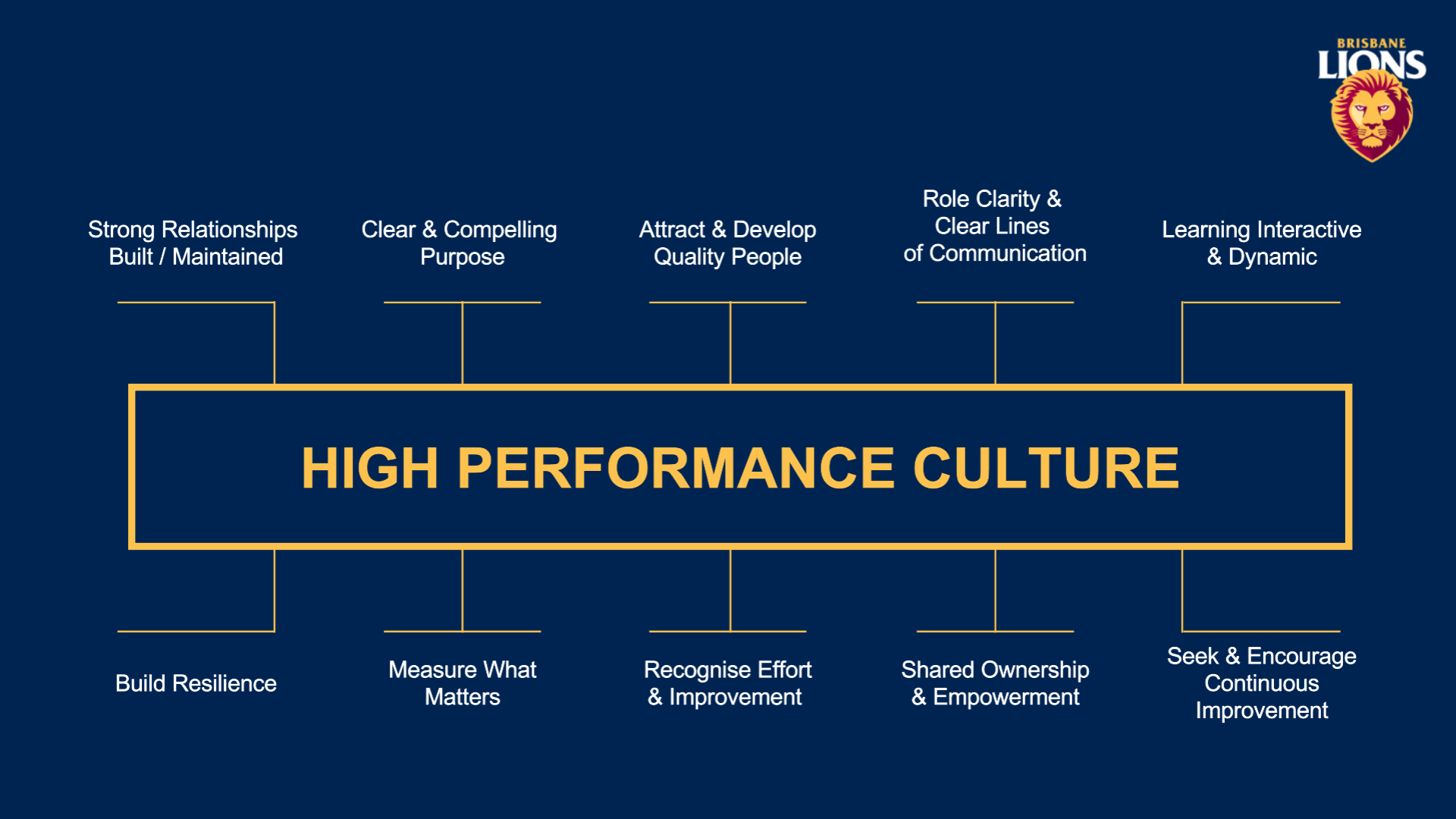
The idea that cultural architects can emanate from anywhere gave real impetus to a recent Leadership Skills Series session, where members of the Leaders Performance Institute explored various interventions and the value of adopting a strengths-based approach to building culture.
Current cultural goals
What established goals do you have in your organisations that relate to your wider organisational culture?
One of the trends we’re noticing when it comes to cultural leadership is a focus on one specific aspect of culture at a time. The participants in the session identified a series of culture-strengthening goals that, if achieved, would deliver a competitive advantage:
When you align behind a goal, progress can be swift.
The six levers needed to lead a cultural change
In the session, we revisited six key levers for leading cultural change.
1. Make the key principles ‘sticky’
A message needs to be heard at least six times for a person to take it in and, if the principles are ‘sticky’, they naturally become easier to remember. Consider your straplines or strategy: do they meet that level of ‘stickiness’? A good example from the Olympic world is the question: ‘will it make the boat go faster?’ Another is the All Blacks’ ‘leave the jersey in a better place’.
2. Role models
This is the classic example of ‘words on the wall’ versus living the values. If the leaders and cultural leaders really model those behaviours, it’s what people will experience and lead by. Research in the field of inclusive leadership shows that leaders can influence the people, the athletes, the organisation around them by up to 70 per cent with their behaviours.
3. Culture conversations
A team must constantly review their organisation and culture and reflect on their current status. Ask yourself: where are our gaps? Where are our strengths? How can we improve? You can use a system rating scale from 1-4 to guide some of these insights. These system rating scales create an opportunity for those culture conversations to emerge and they provide an insight into the health of the culture at a specific moment in time.
4. Develop skills and processes to support intent
Take psychological safety: it is important to enable people to speak up. If you provide such opportunities it supports the intent to make positive change.
5. Feedback
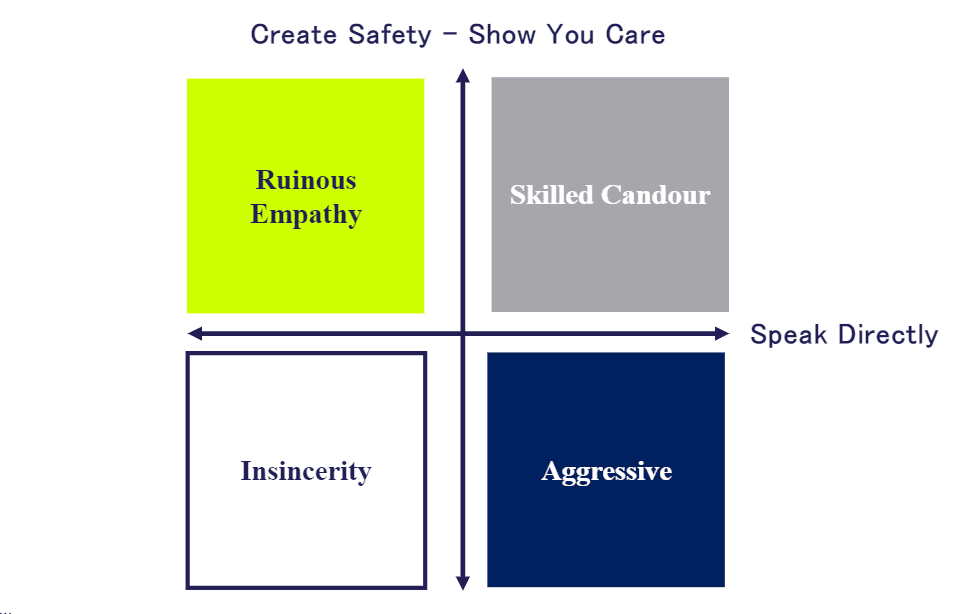
Feedback is critical, yet people do not always deliver skilful feedback. Too often it can feel personal, it provokes defensiveness and is ultimately counterproductive. It is better to create a feedback loop and a culture of ‘skilled candour’ (a twist on Kim Scott’s ‘radical candour’) so that people are able to deliver feedback in a skilful manner.
6. Get the right people on the bus
When engaging in culture change, do you have the right people in your environment? It may come to a time when you have to make a decision about who needs to be on the bus – and who doesn’t.
The power of AI (appreciative inquiry)
Appreciative inquiry is a social constructivist-informed model that seeks to engage people in self-determined change. The model, which was devised in the 1980s by David Cooperrider and Suresh Srivastva, is inherently positive. It focuses on discovering and amplifying the best of what already exists (individually and collectively) within a system or organisation. It stands in contrast to most change models, which tend to identify problems and seek to fix them.
What are some of the benefits of appreciative inquiry?
The model:
How we do it:
Here are some reflective questions you can use within your environments when considering what aspects of your culture you want to develop:
A recent Leaders Virtual Roundtable touched on the themes of connection, individual development, and the athlete’s role in decision-making.
That is not necessarily true, but young athletes today do tend to have more autonomy and wider horizons.
If they decide they do not want to be on this pathway or that programme, others will welcome them with open arms. Even if an athlete does commit to your programme: are you providing the wellbeing, learning and social support they increasingly demand?
This generational shift – and the challenges it poses coaches and staff – set the terms for a virtual roundtable titled ‘What Are our Athletes Telling us?’ where we invited members of the Leaders Performance Institute from across the globe to answer four questions:
Their responses pointed to four trends in the athlete-coach-team dynamic.
1. Athletes are increasingly expressing their desire for belonging and connection
Teams should consider the psychosocial elements of an athlete’s development. Emerging athletes wish for meaningful experiences and want a sense of belonging and connection. “It’s about where are they enjoying themselves the most and where they see the opportunities,” said one participant, who spoke of Australia’s women’s rugby sevens.
The programme takes teams of emerging athletes on tour to far flung places. Therein lies the opportunity for community-based activities where players will meet locals, in circumstances often far removed from their own and, in contributing to social and environmental causes, continue to develop a more rounded perspective of their own lives and development.
This builds on the fine work being done in Australia to develop the “whole athlete”, as one participant with knowledge of the environment explained. The Australian system, they said, has prioritised mental health support for Olympic and Paralympic athletes at the behest of the athletes themselves.
2. Athletes crave individual – and team – development
The desire of younger athletes for belonging and connection comes with a paradoxical demand for more personalised training and attention. This has implications for the time coaches spend on team dynamics in an era where the power has shifted to the athlete. “Staff and coaches are more vulnerable,” said one participant, who pondered where the balance needs to sit. “Give the athletes a voice and a choice, give them ownership, have the consultation, but there is a line too.”
Another participant with experience of coaching in European football, highlighted that individual work will mean different things to different people and can be dependent on team selection. They argued that there is room for better management of expectations and, more broadly, a consensus for coaches and athletes alike on what constitutes ‘individual’ training.
3. Athletes want a formal voice in decision-making
Athletes want to have a say in decisions that affect them. A participant working at the Premier League spoke of their members’ club captains being increasingly forthright in their views on league-sponsored initiatives.
They said there need to be clear systems and processes for engaging athletes and ensuring their feedback is considered, with the caveat that any outcomes may be unclear or unformed, depending on the complexity of the issue.
To this latter point, another participant spoke of the athlete advisory committee with whom they work. “We’re trying to provide agency and elevate that athlete voice, which in a lot of ways is really valuable and adds a lot of benefit,” they said. “But there’s risk associated with that. You are letting the ‘good’ in with the ‘bad’ to an extent depending on what topic it relates to, particularly in terms of managing expectations.”
4. Athletes want to explore opportunities beyond the sporting arena
One participant noted that athlete care roles have developed from being “concierge-style to far more hands-on”. That might include helping young overseas athletes settle in a new country with their close family or it might mean supporting leadership development, media skills training, or helping athletes to explore other professional opportunities beyond their sporting careers.
The Australian sports system, for example, is getting better at providing educational and career opportunities of the kind that enable athletes to be more “job-ready”.
However, it is not just those athletes in (typically) lower-income Olympic and Paralympic sports seeking wider professional development: LinkedIn has seen an exponential increase in major league athletes using its platform. As one participant noted, this interest in business and entrepreneurship is not a surprise given the levels of disposable income available to some athletes. It invites the question: how might teams and leagues support players in these endeavours?
Racing 92 Head Coach Stuart Lancaster weighs up the balance between being systematic and ‘authentic’.
Rebuilds take time and, for all his work behind the scenes, Lancaster’s Racing remain a mid-table team in France’s Top 14.
“When things don’t go well it’s very easy to turn around and say, ‘he’s an Anglo-Saxon, he doesn’t fit our culture’,” he told the audience at November’s Leaders Sport Performance Summit in London.
After signing a four-year contact in September 2022, he saw out his last nine months at Leinster; a winning environment he helped to build. Staying was probably an easier option.
“I’ve always had the desire to challenge myself as a coach,” he continued, “and there’s no bigger challenge than going to a French club as a head coach without being fluent in the language.” The Top 14, which is the wealthiest league in rugby, is known for its sink-or-swim nature for players and coaches alike, particularly those arriving from abroad.
A year and a half into his tenure, Lancaster regularly asks himself: “Where do I focus my attention between leadership, management and coaching?”
‘Tiptoe in or smash the door?’
Upon his arrival at the Paris La Défense Arena, Lancaster was mindful that his new boss was his predecessor as Head Coach, Laurent Travers, who had been promoted to President.
Lancaster asked himself: should he “tiptoe in or just smash the door down?” He alighted somewhere in between.
A quirk of the fixture list meant that Racing had played Lancaster’s Leinster twice in the European Champions Cup in the months after he signed his contract. Leinster won both matches, home and away, by a combined 58 points.
He argued that this was to his advantage when being introduced to Racing’s squad. “The players saw what that environment looked like because they had played against it,” he said. “I was pushing on an open door. They were ready for a change and a new working week.”
Out went the long lunches, in came a revamped playbook, but Lancaster has been careful not to separate the club from its roots. On his coaching staff, he inherited former Racing wing Joe Rokocoko (Skills Coach) and former captain and hooker Dimitri Szarzewski (Forwards Coach), both of whom won the league with the club in 2016. He also drafted in former France scrum-half Frédéric Michalak as his Backs Coach.
It was not about replacing Racing’s “DNA” with Leinster’s but laying foundations as the game shifts. “I had to show the players what good looks like and why it’s good.”
The coach’s search for ‘truth’
Lancaster cited Sarah Langslow’s book Do Sweat the Small Stuff: Harness the power of micro-interactions to transform your leadership. It details how one can connect with people and inspire them to perform. The types of ‘micro-interactions’ Langslow discusses are important to Lancaster given his lack of fluency in French (and the inability of some squad members to speak English).
“You can get a sense of the culture in your one to ones,” he said of his individual meetings with players, coaches, and staff. “You’ve got to dedicate time in your working week for one to ones.”
Lancaster revealed that he had made four phone calls to coaches and staff at Racing prior to his appearance onstage. “I was sense-checking the mood in the camp,” he said, adding that coaches and staff have access to information beyond “the manufactured truth that the head coach gets”.
Softening the performance conversation
Key to Lancaster’s approach has been his efforts to galvanise a squad containing French, English, Welsh, Australian, Argentinian, Fijian and Georgian players. Each week, a different player, coach or staff member will share a personal story in front of the group. Once a month, the players organise a themed dinner for the squad, coaches and staff.
Lancaster has also brought with him the psychological profiling tools he used at Leinster. He believes they can help players to better understand their strengths and weaknesses. To kick things off, he initially shared his own profile in a team meeting.
These efforts all help to soften the performance conversation. “You can be both systematic and authentic by using your meetings in a creative way and not just talking about the technical and the tactical. You can talk about life experiences and how you can learn from failure.”
It has been a quick win. “French rugby is an incredible success story but at the same time it’s behind in certain areas.”
Lancaster makes the point that Racing centre Gaël Fickou could win more than 90 caps for France “yet he’d never even thought about what emotional intelligence or leadership looks like.” Until now.
If Racing can raise their performance levels, they will do so while showing their human face; and that also goes for a coach who has been labelled a ‘robot’ in the French media.
“Often the simplest things are the most powerful: admitting your vulnerability, your mistakes, by showing that human face.”
Leadership specialists Tracey Camilleri and Samantha Rockey explain how matching team density, size, and space to the task at hand can boost performance.
Reid’s celebrated right-hand men, including Offensive Coordinator Matt Nagy and Defensive Coordinator Steve Spagnuolo, are in demand for newly vacant head coaching roles elsewhere now that the NFL regular season has concluded.
Time will tell whether Nagy or Spagnuolo can assemble winning rosters of the kind that delivered the Chiefs back-to-back Super Bowls (with a third still on the cards), but they will have a better chance of ticking all the right boxes if they can surround themselves with the right people.
On that note, the question of team dynamics sits at the heart of The Social Brain: The Psychology of Successful Groups by Tracey Camilleri, Samantha Rockey and Robin Dunbar. The trio has spent decades observing the worlds of academia, business, and government as they look to better understand the workings of high-performing teams.
“We wrote this book because we were fascinated with the question: what is it that makes a group of people more than the sum of their parts?” said Camilleri when addressing the audience at November’s Leaders Sport Performance Summit in London.
“In our world, the unit of identification is most often the individual – if you think about how we hire, how we promote,” she continued. “Very rarely is the focus the team.”
Camilleri and her co-authors redress that balance in The Social Brain and here we explore how leaders can amplify the collective in the pursuit of better decision making.
‘The rocket fuel for performance impact and innovation’
The Social Brain applies theories of evolutionary biology to groups of high performers.
“We’ve been interested in what doesn’t change,” said Camilleri of this lens of enquiry. “When humans are part of small groups they can take advantage of their collective intelligence as well as a sense of safety, reciprocity and shared obligation.”
Camilleri, Rockey and Dunbar devised their ‘Thrive Model’, which sets out six foundational conditions for high-performing teams that consider social health (in addition to physical and mental health) as a prerequisite of wellbeing.
Onstage, Rockey defined these conditions as “the rocket fuel for performance impact and innovation.”

From The Social Brain: The Psychology of Successful Groups by Tracey Camilleri, Samantha Rockey, and Robin Dunbar.
What do the numbers in the circle mean?
As Rockey explained, it is important for leaders to know where to focus their energy most effectively.
“All of us have the same amount of time in a day and we use it differently, but what doesn’t change for each individual in this room is how many relationships that we can have at any given time,” she said. Our brains are only so big, “so we can’t have endless relationships”.
She used Dunbar’s number, which was devised by her co-author in the 1990s, to illustrate her point:

Dunbar’s number has long been influential across several fields, from government and administration to business and academia.
Five, 15 or 150 people? Performance improves when you match team density, size, and space to the task at hand
For decisions made at speed, you’ll count on five people.
Five is the number of intimate relationships a person can have. Rockey said: “These are the relationships that protect us, make us thrive, and ensure that we go through life in a joyful way. They protect us from ill-health and from some of the psychological challenges that we might have from feeling insecure.” They, of course, occur in intimate spaces.
For more complex decisions, you’ll count on 15 people (including your original five).
The ‘pain’ comes when you look to insert new thinking into complex decision making in a group space. “We spend about 60 per cent of our social time with just 15 people,” said Rockey. “With the 15 in the workplace, they would have built long-term relationships and loyalty to you over time – that’s how we work as humans – so breaking up those people to bring in new thinking is painful.”
According to Dunbar, the upper limit on the number of social relationships we can enjoy is 150
Dunbar suggests that people can have no more than 150 social relationships at any one time. “It’s a very stable number across all societies and cultures,” said Rockey.

From The Social Brain: The Psychology of Successful Groups by Tracey Camilleri, Samantha Rockey, and Robin Dunbar.
Camilleri and Rockey wrapped up their presentation by offering nine ‘social hacks’ for building relationships swiftly:

From The Social Brain: The Psychology of Successful Groups by Tracey Camilleri, Samantha Rockey, and Robin Dunbar.
Rockey then homed in on five…
Synchrony: “Sport has done this brilliantly. The perception of pain is reduced when we’re doing something together. When you’re running with a partner it feels less painful.”
Laughing together: “A fantastic way of finding a group”.
Engaging with strangers: “When we have conversations with people we don’t know, it has a positive effect on us – I encourage you to meet people that you don’t know today.”
Giving and receiving kindness: “A New York-based study saw that when young people were able to engage with strangers and be helpful to them, they saw an uptick in their mental health.”
Eating together: “There’s something very magical about breaking bread together. You have about 30 minutes when you’re having food together in which you have a sense of wellbeing and positive vibes towards your dining partners. So if you want to do something difficult, eat with your group first and then go to the difficult meeting.”
The Social Brain: The Psychology of Successful Groups by Tracey Camilleri, Samantha Rockey, and Robin Dunbar is available now from Penguin.

16 Jan 2025
ArticlesFour nuggets of wisdom from John Longmire, who recently signed off as Senior Coach of the Sydney Swans after 14 seasons.
Having fashioned a reputation as one of the finest coaches in the league during his 14 seasons in charge, Longmire has taken a new position as the Swans’ Executive Director for Club Performance. He handed the coaching reins to his assistant, Dean Cox, as the club’s succession plan swung into action.
“I couldn’t get rid of the feeling that maybe it’s time,” Longmire told his players in a moving farewell speech. He had first discussed the idea of stepping away with the team’s management 18 months earlier and returned to the topic midway through the 2024 AFL season.
Longmire’s 333rd and last game in charge turned out to be October’s Grand Final, which Sydney lost to Brisbane. Overall, he took the Swans to four Grand Finals and won one flag, in 2012.
The Swans’ list and performance infrastructure are the envy of most in the league. In fact, few departing coaches ever leave their successor a team in such good shape.
This may have been on Longmire’s mind at the Kia Oval – a ground where, as a 16-year-old back in 1987, he played in an infamous exhibition game for North Melbourne against Carlton.
“It was labelled the ‘Battle of Britain’,” he said while directing Leaders Performance Institute members towards the YouTube highlights. Those that click through can expect a litany of violent fouls.
“It was my first game, and I was absolutely petrified,” he said with a smile.
Longmire then returned to his time as Senior Coach and we’ve picked out four nuggets of wisdom.
1. Don’t become set in your ways
Injury put paid to Longmire’s playing career in 1999 (he won the AFL flag in his final game for North Melbourne) and, three years later, he became an assistant to Sydney’s then Senior Coach, Paul Roos.
Longmire was 31 years old at the time – still young enough to be a contemporary of the players he was now coaching. By 2024, both he and the sport had changed.
“The older we get, the further we get from that age demographic,” he said, “and the more rigid, the more set we can become in our ways and our beliefs – that’s the real danger.”
Longmire consciously moved with the times, but his wisdom would have counted for little if his players did not pay attention. “I know what it takes for a successful organisation to stay competitive,” he continued, “but I am the one that has to bend and move.”
One example was his gradual shift from focusing on the team’s leadership group to spending more time with the younger players. Longmire would watch and listen to them without judgement and, when necessary, “bring them back to where you know high performance teams like to operate.”
2. Find your truthtellers
“The best cultures are the ones that keep moving and adjusting to the ecosystem,” said Longmire, who emphasised the coach’s role in that process.
“I walk amongst our playing group during our warm-ups and that’s a case of sensing the mood, working out who’s talking to who and what they’re talking about.”
He also leaned heavily on his most empathetic players (“those that don’t just walk past your office – they walk in and say: ‘how are you going, coach?’”). The relationships he shared with those players were “ever more valuable” because they were his best eyes and ears in the changing room.
“Make sure you water those relationships because they’re the ones that will keep you in a job.”
3. You’re not bulletproof – don’t try to be
For all his stature as a coach, Longmire was keen to remain “connected and relatable” to his players and staff. As he said onstage in London, “the coach is no longer looked upon as being bulletproof” whatever their standing may be within the game.
His final speech to the players and staff as Senior Coach attested to that belief. He weaved in personal stories and his voice cracked at times. He wiped away tears too.
It called to mind the weekly ‘storytelling’ sessions that Longmire made a key feature of the Swans’ environment. He told the Leaders audience that players and staff share stories or complete a series of tasks for discussion each week. Recent examples included writing ‘a letter to your 16-year-old self’. These sessions are popular with players and staff alike.
“Sometimes it’s a photo of something that mattered to you and quite often there’s tears involved,” he said. “The way I looked upon coaching 25 years ago is completely different now – these 18, 19, 20-year-olds need to be able to relate to you. If you can show that you’re human, you get a lot more back.”
4. Look beyond winning and losing
Winning cannot be everything, even for a proven winner.
“If we measure ourselves on the ultimate success, there’s a lot of years of being unhappy,” said Longmire. A coach must find other factors, such as the personal development of players or staff. He said it is critical to have more in the ‘plus’ column than the ‘negative’.
“Identify, enjoy, and celebrate those moments. And make sure you get joy out of the journey.”
John Bull of Management Futures sets out where sources of disruption may prove useful for you and your team.
In answering that question, one must consider “the best sources of disruptive thinking in our environment and in our sports,” as John Bull put it.
The Director & Lead for High Performance Research at Management Futures hosted a recent Leaders Virtual Roundtable on the topic.
Bull went on to suggest nine useful habits of disruption that any team can use, but he began by posing another question: where is disruption useful?
“How open are you to disruption and how proactive?” asked Bull, who added that he thinks the answer is often situational.
“I want to put an emphasis on the word ‘useful’; and the balance between disruption and stability is really critical. I think disruption can be really negative if it tips it over into disrupting everything.”
The nine habits
Bull identified nine habits that help to ensure that disruption is useful in your context.
On that last point, cognitive diversity is important because it allows for a wider range of perspectives and approaches to problem-solving, leading to more innovative solutions, faster decision-making, and a greater ability to adapt to change within a team or organisation.
Bull then referred to the work of MIT professor Alexander ‘Sandy’ Pentland:
“If you look through human civilisation of the last 10,000 years, the pattern Sandy Pentland keeps finding is that you’ll see a core team of people who know each other incredibly well; where cohesion is really high. But what they do is frequently connect with outside stimulus. There needs to be a team with a lot of cohesion, but they need to be getting external stimulus. And the question is: where are you getting that external stimulus from?”
You should, as Bull said, be constantly updating your ‘mental map’. Video rental firm Blockbuster, for example, could have taken the crown currently held by Netflix with more proactivity when streaming came to prominence.
Remember:
If the pace of change in your environment is slower than the pace of change in your external environment, your competitiveness will be going backwards.
Bull cited the OODA Loop (Observe, Orient, Decide, Act) which is commonly used in the US military. He spoke specifically of the Observe and Orient phases:
Observe – taking stock of how are world is changing
Orient – thinking about how we should respond
Bull had the All Blacks in mind here:
“Their best periods have always come after a crisis. Actually a crisis for the New Zealand All Blacks is typically if they lose three games in a row.”
Do you have an innovation department or people who can regularly keep themselves in that head space? Bull returned to the theme of front-foot and back-foot innovation and the importance of proactively identifying opportunities for improvement.
Ask yourselves:
Amy Edmonson, the psychologist behind the theory of psychological safety, discusses ‘intelligent failure’ in her new book, Right Kind of Wrong.
Of this idea, Bull said:
“We talk a lot about the importance of failure. What Edmondson brought to that debate is, yes failure is important, but it has to be failure where it’s safe; where the stakes aren’t high. So it’s finding opportunities where you can fail where there aren’t bad consequences.”
Bull suggested four steps to help with contingency planning:
As Bull said:
“If you develop a plan but don’t test it, people don’t tend to use. It is one of the things we’ve noticed through research at Management Futures.”
Bull cited science-based technology company 3M as a prime example of systemised disruption. “They have a mechanism that says 25 per cent of their profit needs to come from products introduced in the last five years,” he said.
Peer coaching questions
Bull wrapped up the session with some peer coaching questions:
18 Dec 2024
PodcastsFlo Laing of Scotland Rugby discusses her work with the Scotland Women’s national team.
A podcast brought to you by our Main Partners
“It’s got to be the World Cup,” says Scotland women’s Lead Physiotherapist.
The competition will be hosted across the border in England and starts in August. Laing says it has been the Scotland team’s “north star” for several years.
During the course of our conversation – the second of three in this Keiser podcast series – we spoke about her work in women’s rugby at a time where the sport is starting to capture the public’s imagination and performance standards are rising faster than ever for the women players who compete [4:00].
Elsewhere, Laing discusses her leadership style, which is very much about putting people at ease [18:00]; she also talks about the most pressing issues in female athlete health [28:40]; as well as the transferable skills she’s learned from her time working for Sport Scotland [12:30].
Listen above and subscribe today on iTunes, Spotify, Stitcher and Overcast, or your chosen podcast platform.