Team USA’s Managing Director tells us what it takes to enable the athletes of one of America’s greatest sporting success stories to thrive in the pressure cooker environment of an Olympic Games.
A podcast brought to you by our Main Partners

So says Lindsay Mintenko, the Managing Director of USA Swimming’s National Team, in the second episode of this new series of the Leaders Performance Podcast, which is brought to you by our Main Partners Keiser.
“Just being able to sit with an athlete; sometimes you don’t even have to talk,” she continues, “it’s just so they know you are there.”
It is difficult to imagine many of her predecessors demonstrating such empathy with athletes whether they’re a multi-medal winner like Michael Phelps or Katie Ledecky or a swimmer who came agonisingly close in some of sport’s most competitive trials. The top-two finishers are guaranteed a spot on the roster; those in third – who would likely medal with other nations – are almost certain to miss out.
“After the trials, our main job is to make sure our athletes are focused on Paris, but we don’t always take a step back and look at those who came third by a hundredth of a second. That’s a tough place to be; so we really need to make sure that we do a better job of looking out for those athletes afterwards.”
It is perhaps no surprise that USA Swimming is currently the only national governing body in the US to have an in-house licensed clinician on staff.
This has happened on the watch of Lindsay, a two-time Olympic gold medallist in the 4x200m freestyle.
She is the first former athlete and first woman to serve as Team USA’s Managing Director, but as she tells Henry Breckenridge and John Portch, it is not about her but serving her athletes and their coaches.
Lindsay also spoke about her role being analogous to that of a general manager in the major leagues [8:00] and the importance of providing a challenging but safe environment [17:40].
Elsewhere, she elaborates on the importance of providing mental health support for her athletes [29:50] and explains how her swimming career began when as a six-year-old Lindsay fell out of a tree [5:30].
Henry Breckenridge X | LinkedIn
Listen above and subscribe today on iTunes, Spotify, Stitcher and Overcast, or your chosen podcast platform.
The man responsible for ensuring a pipeline of British talent to the upper echelons of world tennis spoke about his role in delivering a programme based on ‘passion and care’.
The Performance Director of the Lawn Tennis Association [LTA] was a guest on the Leaders Performance Podcast in early July, where he discussed his remit.
“I break it down as if we want to deliver performance, then performance equals the talent that you’ve got multiplied by the exposure you can give that talent to them to develop and grow, minus interference.”
When it comes to high performance, tennis has several traits that separate it from other sports and this is reflected in the LTA’s provisions. For example, the organisation offers full-time multidisciplinary support to players from under-10s through to elite level, but player needs vary from individual to individual. They provide coaching too, at camps and competitions, but players tend to have private coaches.
It is a balance and one that he has been trying to strike during his four years in the role, which began during the first year of the pandemic. “It was a huge learning curve for me,” said Bourne, whose non-tennis background has never held him back.
Here, we reflect on his thoughts about his role.
He has a firm focus on the mission
Bourne, who has worked in sports science for organisations including UK Sport, the UK Sports Institute and the England & Wales Cricket Board, has a clear understanding of what the LTA is trying to achieve and why. “Our mission is to be world-class and respected at player development,” he said. “The slightly longer answer to that is that we create a pathway for our most talented players to go on a journey to becoming elite professional players, whether that’s in the tennis game or wheelchair tennis game.” It requires continuous self-evaluation on both his part and the LTA’s as well as acknowledging how the challenges faced evolve. Bourne emphasised a people-first approach. “However you cut it up, we are a performance-based industry and you have to have great people to do great things.” He spoke of “passion and care”. “We have a team of individuals who deeply care about the journey these players are on”. Passion is one of the LTA’s values and the sight of others in service to players is one Bourne finds “very humbling”.

Michael Bourne, Performance Director at the LTA. (Photo by Shane Anthony Sinclair/Getty Images for LTA)
His role in driving change
In addition to being mission-focused and people-centred, Bourne places a premium on critical thinking. He also believes that having great ideas is one thing, but being able to apply them is quite another. “You can have the greatest thinking and the greatest ideas in the world, but if you can’t drive and implement change, then it’s for naught,” he said. “Ultimately, leadership is about being able to drive and support change.” His team bring their tennnis-specific expertise and Bourne ensures everyone is aligned around the work that needs to be done. “It gets the balance between my background and their backgrounds in the right space.”
He does not assume things will happen on their own
Bourne readily admits his expertise is not rooted in tennis. Nevertheless, the necessary traits and skills are made familiar to him through his staff. He has set up a clear chain of direct reports and basic processes, but it needs constant attention. “Don’t just trust that they’re going to happen all the time – make sure that you’re around enough and verifying whether the communication, the connection that’s supposed to be in place, is actually in place; and if you need to step in and just give the person that support or just give that reminder of what we’re trying to do to prevent those dreaded silos developing people ploughing their own furrow”.
He relishes the daily challenges
Bourne feels that his role is inherently challenging; and that’s alright. “I feel like in these types of jobs, if your job is easy, something is wrong – I don’t think they’re meant to be easy,” he said. “If they’re easy, then you’re missing something or you’re not pushing when you need to push. There’s always more.” It feeds into his attitude towards the challenges faced by the LTA. “It should be unacceptable in a high performance environment to know there is a challenge and to take no steps to do anything about it.” There will often be “brutal facts”, as he put it, “then it’s my job to ensure that we’re all leaning into that and in the right way in a professional way and in a safe way; having the right types of conversations that we need to have.”
Listen to the full interview below:
Listen above and subscribe today on iTunes, Spotify, Stitcher and Overcast, or your chosen podcast platform.
In the first episode of our new series, Michael Bourne describes life as the LTA’s Performance Director.
A podcast brought to you by our Main Partners
“It is core to me,” the Performance Director at the Lawn Tennis Association [LTA] tells the Leaders Performance Podcast, which is brought to you today by our Main Partners Keiser.
Critical thinking is a skill that also served him well in roles at UK Sport and the England & Wales Cricket Board amongst others before he took the reins at the LTA in October 2020 (with Covid restrictions still in place).
“But,” he cautions, “leadership for me is about change and progress, and you can have the greatest thinking and the greatest ideas in the world, but if you can’t drive and implement change, then it’s for naught.”
It starts with taking stock. “As a leader, make sure that you are ensuring everybody else is confronting those brutal facts and you’ve got to be ahead of that,” he says, adding that he too must be open to feedback.
“It should be unacceptable in a high-performance environment to know there is a challenge and to take no steps to do anything about it.”
In the first episode of this new series, Michael explains his mission-driven and people-centred approach to helping produce British tennis players with the means to compete with the world’s best [33:10].
During the conversation, we also touch upon the challenges the LTA faces and the benchmarks set [8:30]; his belief in the unique qualities of British tennis [14:30]; why the flow of information cannot be taken for granted at the LTA [38:30]; and the enduring power of the Lion King to move him [48:00].
Henry Breckenridge X | LinkedIn
Listen above and subscribe today on iTunes, Spotify, Stitcher and Overcast, or your chosen podcast platform.
Here we explore why effective debriefing can enable you to squeeze as much as possible out of your athletes, coaches and staff members’ experience.
For learning to take place, people need to both reflect on and make sense of the experience; then they can think through how they will apply the knowledge gained.
Therefore, it follows that one of the most powerful applications of coaching is to facilitate learning through an effective debriefing process; to squeeze as much richness out of the experience as possible.
Done well, it can drive a very steep learning curve, build responsibility and confidence, and increase the focus on results.
In short, the high performance organisations that best sustain success know how to debrief.
What the literature says…
Debriefing was at the heart of the most recent Leadership Skills Series session, where members of the Leaders Performance Institute spent time considering some academic findings on the topic.
A 2008 study in the International Journal of Performance Analysis in Sport found that coaches only recall between 16.8 per cent and 52.9 per cent of events. This underlines the notion that if coaches don’t debrief consistently well, they are missing out on potentially rich conversations and insights.
Here are some further numbers:
The positive effects of good debriefing
What Leaders members are doing well in this space
During the session, members were invited to rate their teams’ debriefing skills on a scale of one to five and the mean was 2.8. Much room for improvement, no question, but there were a list of things that people believe they are doing well:
Six steps towards an effective structure for debriefing
The following is a six-step approach to debriefs. Consider each when designing the structure that works for you and your team:
David Kolb’s learning styles model
The session explored the work of educational theorist David Kolb, who devised a structured approach to understanding how individuals learn from their experiences. It involves a four-stage cycle and four separate learning styles. Much of Kolb’s theory concerns the learner’s internal cognitive processes, therefore can be a useful model to consider when thinking about both individual and collective debriefs.
The four stages of learning:
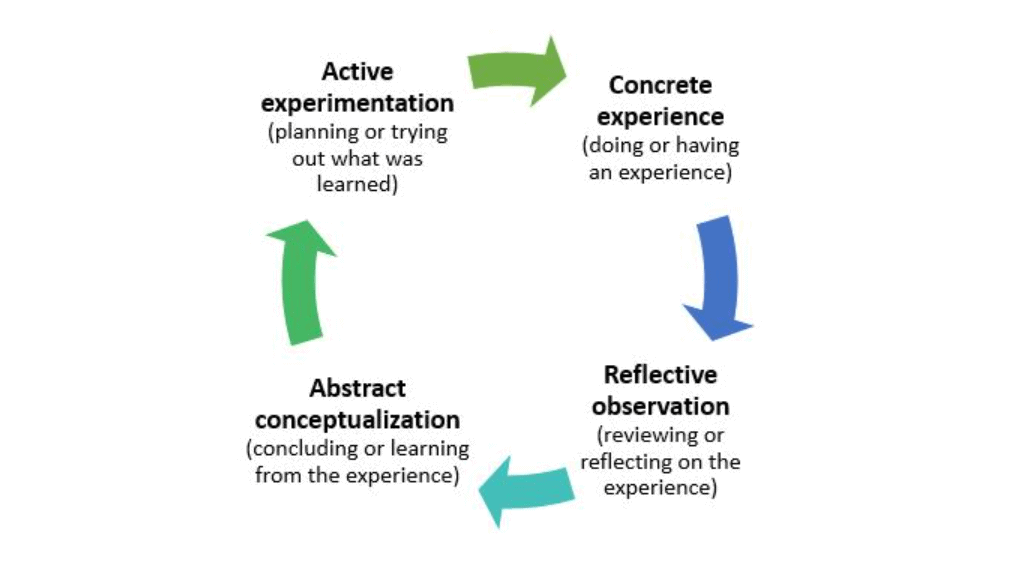
1. Concrete experience
The learner encounters a concrete experience. This might be a new experience or situation, or a reinterpretation of existing experience in the light of new concepts.
2. Reflective observation
The learner reflects on the new experience in light of their existing knowledge. Of particular importance are any inconsistencies between experience and understanding.
3. Abstract conceptualization
Reflection gives rise to a new idea or a modification of an existing abstract concept (the person has learned from their experience).
4. Active experimentation
The newly created or modified concepts give rise to experimentation. The learner applies their idea(s) to the world around them to see what happens.
Kolb developed his four learning styles to illustrate different ways people naturally take in information:
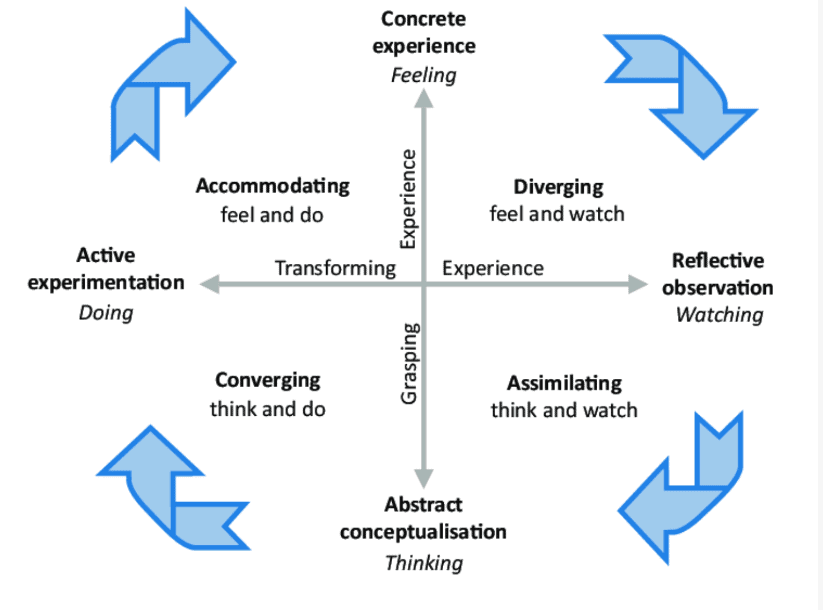
1. Diverging (concrete experience/reflective observation)
Learners who prefer the diverging style are best at viewing concrete situations from multiple perspectives. They prefer to watch rather than do, tending to gather information and use imagination to solve problems.
2. Assimilating (abstract conceptualization/reflective observation)
Assimilating learners prefer a concise, logical approach. They require a clear explanation rather than practical opportunity. They excel at understanding wide-ranging information and organising it in a clear logical format.
3. Converging (abstract conceptualization/active experimentation)
Learners with a converging style can solve problems and will use their learning to find practical applications for ideas and theories. They prefer technical tasks, and are less concerned with people and interpersonal aspects.
4. Accommodating (concrete experience/active experimentation)
Accommodating learners are ‘hands-on’, and rely on intuition rather than logic. They use other people’s analysis, and prefer to take a practical, experiential approach. They are attracted to new challenges and experiences.
The STOP model for live debriefs during the event
The session also discussed the STOP model, which is useful for ‘in the moment’ debriefing (sometimes known as ‘hot debriefing’).
Stand back: take a helicopter view of a situation or problem.
Take stock: analyse what is happening in the moment.
Options: explore options around what you can do differently.
Proceed: step back in and take action. Then assess what impact your new approach has.
The features of a great debrief

As Jen Overbeck explained, we can make people change or we can persuade them to change. We should choose deliberately and we should be clear about what makes people listen to us.
“Here’s the situation,” she said. “You have an idea born out of your expertise; a lightbulb moment. Maybe it’s something that’s developed over time and you bring it to somebody you think is going to benefit, whether that’s an athlete, someone in your organisation or somebody who works with you.
She continued: “You’re explaining it with all your passion and they say ‘yeah, nah, I’m not excited about that at all. I don’t think I want to do that.’ Has that ever happened?”
A few individuals tentatively raised their hands in the audience at Melbourne’s Glasshouse.
“OK, good, because otherwise you should be up here teaching instead of me!”
Overbeck, a Professor of Management at Melbourne Business School, was speaking at February’s Leaders Sport Performance Summit.
Over the course of half an hour she explored the social and psychological elements that affect how people react to requests to change and why, as a leader, that reaction can depend on your power and influence.
Power v influence
Overbeck used the example of Phil Jackson as someone sports coaches and practitioners might aspire to emulate. She lifted a passage from his 2013 book Eleven Rings where he wrote about ‘benching the ego’:
‘After years of experimenting, I discovered that the more I tried to exert power directly, the less powerful I became. I learned to dial back my ego and distribute power as widely as possible without surrendering final authority. Paradoxically, this approach strengthened my effectiveness because it freed me to focus on my job as keeper of the team’s vision.’
Jackson came to recognise that power and influence sit on a spectrum. As such, the NBA’s most-decorated coach, provided the perfect case study for Overbeck to define those terms.
“‘Power’ is your ability to get somebody to do something that they don’t want to do,” she said.
This is set in contrast to ‘influence’. “You could also call it ‘persuasion’,” she added. “This is all about how much credibility and persuasiveness you have to influence people to go where you want them to and they’re going there willingly.”
There are few coaches in the high performance community that would prefer to increase their power at the expense of their influence and Overbeck stressed that you are free to make your choice.
“When you understand the differences and what drives them, you can make those choices deliberately – and that’s generally better for ourselves, our athletes and our organisations.”
How to elicit change
Overbeck explained that there are three types of behavioural strategy:
She says: “That’s when you’re using a great deal of power; you’re not using a great deal of influence. You’re basically trying to make the person change.”
This emerges in a space where a leader has more moderate power and influence. “We’re giving people some choice, but we’re not giving up on our power altogether.”
“This is a very big word,” said Overbeck, “because it means you’re completely leaving it in the other person’s hands; you’re exerting no power whatsoever.”
The best scenario for a leader, as Jackson understood, is to be negotiating. Overbeck posed a series of questions that leaders can ask themselves when moving away from either dominating or supplicating:
The tactics available to a leader
Overbeck ran through some of the tactics available to ‘negotiators’ and asked the audience to raise their hand if they’d employed any of the following:
The six types of capital available to leaders
None of the tactics described above are particularly unusual. “We know a lot about the tactics we’ve been told will be helpful for pursuing change,” said Overbeck, adding, “we don’t know what kind of power and influence we need to have ready and available with us in order for these tactics to succeed.”
She returned to the example of Jackson, who managed to elicit the very best from Michael Jordan during their time together at the Chicago Bulls in the 1990s.
“Phil Jackson may not have led with power but it was in what he did,” she said. “He was using what was available to him.”
He was, in essence, aware of his ‘capital’, as Overbeck put it. “Power comes from the resources that you control.” There are six kinds of resources, or ‘capital’. The first three are easily explained:
The final three must be used carefully because they can be sourced into power:
Social and intellectual capital
Overbeck homed in on social and intellectual capital because while leaders in sport may want to have power in the background, you probably will not want to lead with that power.
Instead, you’ll want to dial up your influence and credibility, which can come from various sources, such as trust and belief in your abilities as a coach due to your track record and reputation; that your place is not a result of political chicanery or nepotism.
“I’m going to talk about it as ‘tribal membership’,” said Overbeck. “When people are deciding whether to accept your influence, the No 1 thing they are assessing is: are you with me? Are you part of my team?” She makes it clear that ‘team’ may not be the literal team but your alignment with an individual’s personal values. Without that, they may reject you out of hand. “The first thing we have to do is make sure that we’re telegraphing to the other person that ‘even if we have those differences in terms of those things that you most cherish and value, I honour those things, and I’m not going to get in the way of them. I’m going to work with them, not against them’.”
Once you loosely establish yourself in the same tribe, you then need to demonstrate how your expertise can be of value – that’s your intellectual capital.
Overbeck said: “When we’re trying to build credibility, it’s our job to build that bridge and make sure that the other person understands.”
She likens it to a credit account. “The higher your credit limit, the more you’re able to go out and spend.” However, it must be kept topped up. “Once we’re good, we always have to be thinking: ‘am I getting over my limit?’” You have to continuously demonstrate your credibility or you will lose people.
Final questions to ask yourself:
21 Jun 2024
ArticlesThe NSWL’s Bay FC and the WNBA’s Golden State Valkyries are two expansion teams and both have women GMs. Here, we bring you the views Bay’s Lucy Rushton and the Golden State’s Ohemaa Nyanin.
In March, Bay FC began their inaugural NWSL campaign to great fanfare.
The club was co-founded by former US women’s national team stars Brandi Chastain, Aly Wagner, Danielle Slayton and Leslie Osborne, who propelled the project from an ambitious idea to a grand reality.
They hired Lucy Rushton as General Manager. Rushton, who was the second woman to serve as GM in MLS when she joined DC United in 2021, spoke at this month’s Leaders Sport Performance Summit at Red Bull in Santa Monica.
Rushton is no stranger to the Leaders stage having also spoken during her time at Atlanta United, whom she joined following excellent spells with Watford, Reading and the Football Association in her native England.
She sat next to another trail blazer, Ohemaa Nyanin, the newly appointed GM of WNBA expansion franchise the Golden State Valkyries, who will join the league in 2025.
Nyanin, a Ghanian-American, had been with the New York Liberty for five years, most recently as Assistant GM, jumped at the chance to bring further basketball prestige to this corner of southern California. She previously served as Assistant Director of the US women’s national team and helped Team USA to Olympic gold in 2016 and World Cup gold in 2018.
The duo delivered insights into how they are shaping the cultures of their nascent organisations; how they’re working or planning on working with their athletes; how they’ve chosen to lead; how they’re supporting their staff; as well as how they’re changing the sporting landscape.
Owners must establish the culture and values
The Bay culture was clear well before Rushton had even accepted her position: everything is about the people, from the staff to the players. The owners want everyone to be B-A-Y. That is:
Brave – the ownership want the franchise to be bold in the industry, pushing boundaries, breaking barriers by being innovative.
Accountable – the staff turn up everyday and are responsible for their actions and drive, and push themselves forward.
You – Bay FC also celebrate themselves as individuals and bring their true authentic selves to work every day.
The three concepts have helped shape the mindset each day and give the staff and players something tangible to hold onto. The organisation’s vision is to be a global sport franchise at the head of innovation and change.
How can these be measured? For Rushton, “it’s the feeling when you go to bed or wake up and how you feel about going to work the next day or that morning”. She believes the staff feel good and know they can influence what is happening; they know it’s a positive environment and everyone is striving for the same things.
Women’s sport should not simply replicate men’s sport
Rushton’s experience of men’s football taught her a valuable lesson. “Coming into a women’s franchise, it’s so important that we understand and appreciate the difference to men’s sport and don’t try and replicate it,” she said. The club has been intentional on that since day one and strives to be people-first, player-centric, and celebrates and promotes good female health.
With Bay midway through their first season, Rushton reflected on how the staff live the values every day. They all want to work hard, but care, kindness, and mutual support are just as critical for an expansion team. You need people who want to be there, who have the grit to go through the ups and downs, but support each other when you might not have the same resources as the teams that are 5 or 10 years old.
“How we approach training everyday and present ourselves to the players gives them energy,” she continued. “Which in turn the players buy into and end up energised and galvanised.” The key is how you present yourself and how you turn up and how you live by the standards that have been set, and the biggest factor is togetherness and collaboration of all departments.
Measure success through environment and collective wellbeing
Nyanin left a household name in the New York Liberty, but her goal is not to merely recreate that team in the Bay Area. Nor does she simply want to recreate the Golden State Warriors (Valkyries co-owner Joe Lacob is also the majority owner of the Warriors). Nyanin wants the Golden State Valkyries to stand alone.
She needs to find people that are interested in a vision of winning championships, in alignment with the ownership group. Success will ultimately be measured in trophies. They are the first WNBA expansion team since 2008, so Nyanin is considering what it looks like to build a successful organisation. She said: “We need to find individuals who are interested in being challenged every day, leaning into the team. Do you want to come to work everyday, and serve the athletes everyday in a way that provides for an innovative space, that provides for us to do what we know we can do, and how quickly can we get there?”
With this question in mind, Nyanin reflected on the qualities she seeks out as the Valkyries hire and write job descriptions. “Being an expansion team means you have to be entrepreneurial. By embracing the unknown can you be empathetic too,” she added.
Rushton asked Nyanin about measuring success from a cultural perspective rather than through championships. In response Nyanin said it is about the climate of the people that come in the door. “When we ask how you are doing they might say ‘I’m fine’ or ‘I’m good’, but if you say ‘how are you doing in the terms of a climate?’; so ‘sunny, or ‘cloudy’, or ‘rainy’ – it adds depth. A way of measuring success is how we can collectively come up with our non-results-based success criteria, how do we make it such so that everyone is sunny?”
For Nyanin, ‘sunny’ doesn’t mean super excited, or super extroverted – you can be introverted but still be sunny. Success is ultimately defined by how the Golden State Valkyries create their own definitions of safety in the workplace; it stems from executives to coordinators, to players, and even changing the way agents and external stakeholders engage with the organisation.
A culture born of diversity
We all know the saying about the best-laid plans, so Rushton and Nyanin spoke of the importance of allowing culture to shape itself. For Rushton, the critical moments are when things haven’t gone to plan. “How you react to things not going to plan is how you create culture. Actions taken in those moments show the players and staff what’s acceptable and what’s not,” she said.
Some decisions have been made that may have impacted performance outcomes but certainly reinforced their culture and values. They might have been a “nightmare” at times, but they’re critical. The backing of the ownership and the Head Coach, Albertin Montoya, helped give Rushton the confidence to go ahead. Showing the group that the leaders are aligned was powerful and gave them the confidence that it was the right thing to do and that the leaders had each others’ backs.
For Nyanin, it is important to give newly-hired executives their own blank slate to contribute to the masterpiece. She said: “If everyone has a different background, you have to listen to their ideas as they’re all coming from different spaces. So it’s still being architected from all different walks and types of cultural differences.”
This means that it’s important to Nyanin to have each executive bring their own unique experience. Through these different experiences and backgrounds the culture develops. This will bring challenges and added work, as you have forces leaders out of their comfort zones. It also means that you have to be willing to think differently.
“It’s like explaining basketball to children, who all ask ‘why?’ People from different backgrounds are going to ask why do we need to execute things this way, and will ask good questions, and bring contributions beyond asking ‘why?’”
In return, Nyanin believes that the athlete will benefit, especially the female athlete who comes with different complexities. “If your own staff can challenge you and ask you why before the athlete does, then you’re giving the athlete a space for them to feel safe to be elite at their sport.”
Athlete care is paramount
What about their appeal to female players? Bay spoke with the potential recruits about player-centricity of club and how they were going to elevate player care. From starting from a blank slate, they were able to accelerate mechanisms that can help with impacting the salary cap through player housing for example. The club emphasised treating them like the athlete they are in comparison to some of their poor experiences in other environments.
In Rushton’s experience, the priorities are very different to male athletes, where pay often dictates the direction of negotiations. With females, it’s about living standards and how the organisation will elongate their career. It’s important to give them confidence in the staff who would give them the best care, medical treatment, and infrastructure. Rushton is proud that, as far as she knows, the players have no complaints about the level of care and how the organisation treats them as female athletes.
On a day to day basis it boils down to two things in her mind. Firstly, helping them be in the best position they can be for the longest time possible and, secondly, to help them live a nice lifestyle outside of football.
This focus on player care resonated with Nyanin, who was pleasantly surprised at the rapid expansion of the NWSL given her own experience of the WNBA. Bringing it back to athlete experience is hugely important because, in WNBA, athlete experience tends to focus on ‘how you do get elite talent to come through?’ Nyanin explained that longevity in the sport is different, although is it changing, because the majority of the athletes play six months in the WNBA and then go and play overseas where the conditions are often worse, but they’re getting paid more money. “Understanding the motivations of the athlete prior to them coming to your organisation and engaging in your space is important,” she said.
Attracting elite practitioners from male sport
How might top level practitioners be attracted from historically better-funded male sports? Both Nyanin and Rushton believe that efforts must be based on the vision, culture and concepts the organisations trying to build.
For the Valkyries, as Nyanin explained, the vision is to “build the best, to be the most elite, to build a space where people feel they’re being heard and their ideas being executed in a way that results in excellence. Why wouldn’t you want to come? How can I create an environment for you to thrive, and how can we do that together?”
Rushton agreed. She said: “it shouldn’t be about the gender. It does matter though – many wouldn’t be right for women’s sport. I want to make you the best practitioner in what you do, and give you the platform to excel in your specialisation.”
New franchises means recruiting for those who are willing to challenge themselves and go outside the box with their thinking. It becomes about finding the people who are comfortable with the associated risk in order to better themselves. Rushton believes they have to “believe that they can go there and make a difference.” Rushton also observed that, “a lot of males would find it refreshing to come to a female athlete team because it’s a totally different environment, with totally different feeling and vibe.”
For Rushton herself, when she moved from men’s to women’s football there were two main factors that drew her in:
How fans contribute to a team culture
There remains another crucial component of a team culture: the fans.
The final moments of the session were used to discuss how both Nyanin and Rushton, and their organisations, are forging connections with their fans. As Nyanin said, fans expect communications, but there are times when you can’t share with them. This is a dilemma considering that the fans are also investing in the franchise and so they deserve communication. It becomes about finding the balance around what to do when things aren’t going well. Working on being honest in their communications so that the fans understand that the leaders and everybody involved is working to solve any issues.
Similarly, Rushton and Bay have been deliberate in how they present the organisation to the fans. The Business Operations team at Bay go to the fans and ask them to bring the energy and passion; to be part of their story. They seek to empower the fans and have them be part of the journey. Bay have gone out to the community, had fans come and watch training, and prioritised outward action in the build-up to launch. People now want to be a part of their journey.
Rushton spoke of how Bay deliberately tell the stories of their players. This means that people become invested in the emotional side of who the player is, so if the team lose a game, the fans are more invested in the person than the result. The outcome is one of which she is proud and the Valkyries hope to emulate. “The fans have fallen in love with the team, despite the record.”
Results will surely follow but, here and now, both women are intent on proving that new women’s sports teams are not only viable but can thrive.
Some cultural leaders are front and centre, but many work from the wings to deliver the success their teams crave. Here are some steps you can take to ensure your team has its cultural leaders too.
Those leaders can be athletes, such as England captain Harry Kane, who will lead the Three Lions in their Euro 2024 campaign. Or Breanna Stewart, the New York native who returned home in 2022 and led the Liberty to the 2023 WNBA Finals; bagging the league’s MVP in the process.
Kane and Stewart are the embodiment of local heroes who have done well, particularly if you include Kane’s remarkable spell at Tottenham Hotspur.
Then there are coaches who represent an expression of the systems that enable their programmes to excel. On that front, one can point to Kane’s international manager, Gareth Southgate, who has overseen England’s most successful spell since the mid-1960s.
Cultural leaders, however, need not be so high profile. They operate at all levels of an organisation, independent of job title or seniority. Do you recognise the cultural leaders in your team? What steps can you be a better cultural leader?
Cultural leadership – the super enabler
The link between leadership and sustained success is the centrepiece of a research project run by Edd Vahid, the Head of Football Academy Operations at the Premier League.
In June 2022, the business and leadership consultancy commissioned Vahid to undertake a piece of research to discover the ‘secrets of culture’. Two years later, this project, titled ‘Cultural Hypothesis’, is on the cusp of publication.
Ahead of its release, Vahid is leading a three-part Performance Support Series at the Leaders Performance Institute that seeks to explore the enablers in high performing cultures.
The first session, which took place in early May, was a useful way of testing the importance and relevance of the four enablers highlighted by Vahid in the Cultural Hypothesis: purpose, psychological safety, belonging and cultural leadership.
The second, which took place in early June, homed in on cultural leadership, specifically how leaders might change or sustain a culture. The concept is, as Vahid described, a “super enabler” for your sense of purpose, belonging or even psychological safety.
Culture should be an accelerator and energiser
In the session, Vahid observed that organisations are increasingly deliberate and intentional about culture because they see it as a competitive advantage. It is not a one-time annual event – it’s a regular part of ongoing conversations.
This is lost on some organisations, as Jon R Katzenbach, Illona Steffen and Caroline Kronley wrote in the Harvard Business Review in 2012:
‘All too often, leaders see cultural initiatives as a last resort. By the time they get around to culture, they’re convinced that a comprehensive overhaul of the culture is the only way to overcome the company’s resistance to major change. Culture thus becomes an excuse and a diversion rather than an accelerator and energiser’.
Four ways to get to grips with your culture
To understand culture you need keen observation and data collection. Vahid proposed several useful tools:
During the Korean War, John Boyd, an American military strategist and fighter pilot, devised the OODA Loop as a decision-making process designed to emphasise adaptation and agility in four stages:
Organisations can apply the OODA Loop to assess and respond effectively to cultural dynamics.
Vahid also pointed to other efforts to collect data around culture, such as UK Sport’s ‘cultural health check’ or retail giant Selfridges using data to better understand their most culturally-stressed communities.
Vahid also stressed the importance of critical incident reviews to help observe culture during specific moments such as exits, inductions, wins and losses.
Teams can also find their place on the Sigmoid Curve, a common model for tracking organisational growth and decline. At each stage, expectations can change, which affects what we see, hear and feel.
Five Steps Towards Cultural leadership
Vahid explored five steps that can help a team to develop cultural leaders.
As this session of the Leadership Skills Series demonstrated, we can all become better leaders by developing trusting relationships.
For the latest edition of our Leadership Skills Series, we explored the art of persuasion. All leaders in sport have the potential to influence others’ thoughts, feelings or actions through effective communication and interpersonal techniques.
The session highlighted four related areas of focus.
Trust is rightfully acknowledged as the cornerstone of effective leadership and the foundation of relationship-building. To unpack all of that we turned to the Trust Equation. It is a conceptual formula used to describe the components that build trust in professional and personal relationships. It’s often represented as: 
This is what each component means:
Credibility speaks to words and credentials. How authentic are we?
Reliability is the perception of a person’s integrity. Do you do what you say? Are your actions connected to your words?
Intimacy involves the feeling of safety or security when sharing information with someone. How safe or secure does the client or colleague feel in sharing with us?
Self-orientation reflects the degree to which a person’s focus is directed towards themselves as opposed to being focused on others. What are our motives? For our benefit or the benefit of others?
The higher the numerator (credibility, reliability, intimacy), the greater the trust. Conversely, the higher the self-orientation, the lower the trust. Ultimately, the equation serves as a mindful tool to enrich discussions, elevate trust levels, and deepen relationships within our teams.
When leading a team or a department, it matters how you are perceived by others. The ability to self-assess your personal status is another strategic tool wielded by seasoned leaders to convey confidence and authority. It includes an assessment of your:
Such elements can be ranked on a scale from 1 (‘low status’) to 10 (‘high status’) and, when done sincerely, this can be an invaluable guide for navigating various workplace scenarios and can even foster emotional intelligence, which is pivotal in forging genuine connections with athletes and team members. It can also facilitate the development of more impactful leadership skills that inspire and motivate with greater efficiency.
Flows of logic are the pathways our minds create to connect ideas and evidence to reach a reasoned conclusion. They are essential in critical thinking, problem-solving, and, of course, forming persuasive arguments. Flows of logic involve a sequence of statements or steps that follow one another in a rational and coherent manner. These frameworks can take three different forms, depending on your scenario:
These can be indispensable guides when constructing persuasive arguments. By grounding our narratives in these logical flows, we enhance storytelling capabilities and foster deeper connections with our teams. This pragmatic approach ensures proactive, relevant support while avoiding unnecessary complexity, thereby maintaining clarity and engagement, particularly in high-pressure situations where decisive leadership is paramount.
If you can put those three factors together then you can be better at delivering your message. Mindful communication is another tool upon which you can rely. This idea urges leaders to remain present and deliberate when communicating. It can help a person to:
The members in attendance discussed the success and failure of these elements in the context of people that ‘think to speak,’ and those that ‘speak to think’.
Here are some effective mantras to keep in mind:
Final reflections
As members reflected on the transformative potential of incorporating these persuasion techniques into their leadership repertoire, they described the following as essential steps towards mastering persuasiveness in your leadership approach:
29 Jan 2024
ArticlesFrom the English Premier League to the NBA via the AFL, the Leaders Performance Institute Think Tank gives coaches, managers and directors the opportunities to share lessons and ideas around the performance questions of the day.
The Think Tank is designed to connect general managers, coaches and directors of performance – the people with responsibility at the highest levels of world – sport with each other and the ideas that have served their peers best.
The discussions on the day were wide ranging, as the participants delved into five common problems and identified possible approaches and solutions.
Renewal is a continuous process in sport, which is not to say that it is always easy, frictionless and without complications. If you are the person tasked with delivering upon your team’s vision, consider:
It is often incumbent on the head coach to provide the energy to the playing group, but who is looking out for the energy of the coach? At a time when coaches fear coming across as ‘weak’, here are some tips for coaches seeking to protect their personal energy.
Succession planning is hard, particularly when one considers that generation-defining coaches are more a product of circumstance than formal programmes. Nevertheless, how can we give aspiring coaches a better chance?
No one has the fully come to terms with talent development pathways, hence the ever-present questions around attributes, development gaps and purpose. What can we do to better identify and then develop our young athletes?
No other area is as widely misunderstood by coaches and practitioners as artificial intelligence and its role in sport. There is, however, no need to stray from your performance principles in putting them into practice. Remember:
Participants
Mo Bobat, Director of Cricket, Royal Challengers Bangalore
Michael Bourne, Performance Director, Lawn Tennis Association
Matti Clements, Executive General Manager, Australian Institute of Sport
Steve Cooper, football manager
Chris Fagan, Senior Coach, Brisbane Lions
Rob Key, Managing Director of Cricket, England & Wales Cricket Board
Marc-Oliver Kochan, Managing Director, Red Bull Athlete Performance
Sean Marks, General Manager, Brooklyn Nets
Tabai Matson, Director of Performance & Development, Harlequin RFC
Sara Symington, Head of Olympic & Paralympic Programmes, British Cycling
Jess Thirlby, Head Coach, England Netball
Simon Timson, Performance Director, Manchester City FC
Gregor Townsend, Head Coach, Scotland men’s rugby team
23 Jan 2024
ArticlesMembers of the Leaders Performance Institute answered this question from their own experience and shared responses ranging from environmental renewal to the power of positive storytelling.
The notion of ‘belonging’ can be simply defined as ‘a sense of connectedness to others and what you are doing’. The Cambridge English Dictionary extends the definition of belonging to ‘a feeling of being happy or comfortable as part of a particular group and having a good relationship with the other members of the group because they welcome you and accept you’.
Psychology research shows that in cultures and environments that show autonomy, competence and belonging, individuals will elevate their engage in tasks and activities they are asked to commit to.
It’s clear from both the literature and lived experiences of the group that creating belonging is a powerful tool for a harmonious and high-functioning environment. The aim of this particular roundtable was to share best practices and examples of how we are trying to foster belonging in our environments.
It starts at the induction stage
In one of the breakout groups, they reinforced the idea that the process of creating positive belonging starts at the induction or onboarding phase and how important it is to dedicate time and intent towards this process to set the right tone. The work to create belonging continues week on week during this onboarding phase, with the acknowledgement and value that an individual or individuals bring to the team. From a team perspective, it is an opportunity to acknowledge the variety and diversity of backgrounds, skills and views of those in the department or organisation from the outset.
In summarising this first point, there was an excellent reflection that how we make people or an individual feel is the most important thing. Every interaction matters and what you do is about making them feel the way you want them to feel.
Setting the stall out around the culture
There were a number of reflections on how to give your environment the best opportunity for positive belonging. Identify the values and culture expected of individuals within your environment, and perhaps most importantly, find practical ways to instil them. Is everyone in the environment crystal clear on what the behaviours and expectations are? If you have this in place, there can be collective accountability. Similarly, it is important to be consistent in positively reinforcing, noticing and celebrating positive examples of those behaviours.
A couple of people on the call also suggested that coach buy-in is really crucial in this process. If the head coach buys into the values then the majority of people in the environment tend to follow, such is the influence the head coach carries.
In setting yourselves up for success, create opportunities for athletes, coaches and staff to convene and build the culture together. Creating opportunities for discussion on values and behaviours supports the idea of creating a sense of belonging. It is widely acknowledged that engagement, contribution and a love for what you do leads to a sense of belonging, therefore lies the challenge in ensuring we are bringing this to life.
Finally, there was a discussion around language and its importance. There was a fantastic phrase shared on the call that ‘above-the-line language is powerful, but below-the-line language is powerless’. There is a responsibility to own the standards of the language.
The power of storytelling
A common response from the group around effective ways to instil belonging was utilising the power of story. Find the story that connects to the people that you’re working with, whilst recognising the significant cultural differences that exist in the environment. The story that you use must align with the culture. One environment on the call shared how they leant on metaphor in creating an overarching theme that is reframed every year.
Story also presents the opportunity to connect those across the backroom staff, athlete population and other forward-facing roles. There was a suggestion this should also extend to family members of those involved, bringing them into the culture and environment, knowing the importance of the environment off the field. Do they feel that sense of belonging as well?
Finally, we also discussed the impact story can have around connecting individuals to the cultural environment of the country that you are in. It also presents the opportunity to embrace the culture that individual is bringing into the environment.
Create opportunities for shared experiences & collective input
Responses from the group indicate that every interaction matters and it is important to be mindful of that. Therefore, how are you intentionally creating opportunities for shared experiences and opportunities for collective input from different stakeholders?
A simple initiative to instil is celebrating ‘the good’ when done well and highlighting small wins and successes.
Encourage active listening and understanding of everyone’s opinions – providing a space and opportunity for everyone to have a voice in key decisions is found to be an effective way of supporting belonging in an environment. To ensure the above is both effective and a success, organisational leaders require an openness and receptivity to ensure the environment is designed to be safe.
There were also a number of reflections around the power of ‘inclusive initiatives and rituals’ that bring people together. Finally on this point: are you formally capturing information from the stakeholders in your environment in a consistent way? This is a simple tactic to remain on the pulse of the environment, ensure those in the organisation have a chance to provide feedback and contribute to decision-making and the state of play on the culture.
Providing space to better understand the ‘whole person’
One of the final key buckets of discussion around instilling a sense of belonging in your environment was formal and informal opportunities to better understand the whole person. We should strive to provide space to celebrate authenticity and our true selves. Does your environment provide an opportunity for employees to breathe and express themselves?
A foundation stone of the High Performance Strategy in the Australian Olympic System is the athlete’s voice. The idea is to provide opportunities to understand one’s journey, both as an athlete and as a person. The self-determination theory concept is something that is really key in this piece and its relatedness to belonging. Creating opportunities to understand the whole person allows for further insight around ones intrinsic motivation and the opportunity for honest, open conversations within the environment.
Final reflections
At our Leaders Meet: High Performance Environments event in Melbourne back in 2023, we ran an Open Spaces session on this exact topic. The aim of the session was to allow the audience on the day to share stories, experiences and perspectives on belonging. Five things came through strongly from those in the room that day around what we can do to enhance belonging in our environment.