A Data & Innovation article brought to you by

You can’t have a discussion about sports technology today without including athletes in that conversation. Their partnerships, investments and endorsements help fuel the space – they have emerged as major stakeholders in the sports tech ecosystem. The Athlete’s Voice series highlights the athletes leading the way and the projects and products they’re putting their influence behind.
* * * * *
Barkley is a two-time Pro Bowl selection, earning the honor after his rookie campaign in which he ran for 1,307 yards and caught 91 passes as well as in 2022 when he ran for 1,312 yards and had 57 catches in his return to stardom two years after tearing his ACL. Barkley could be a free agent as the Giants weigh whether to place the franchise player tag on him for a second straight season.
Last week, Barkley added his latest brand partnership with Silk, a producer of plant-based products. He joined the Feel Planty Good Challenge, a campaign to incorporate Silk in breakfast every day for a week. He has done a wide range of deals in his career, including with blue chips like Nike, Pepsi, Toyota and Visa.
On the partnership with Silk…
I’m excited and happy to be partnering with Silk and doing the Silk Feel Planty Good Challenge. I think it’s a fun challenge for everyone to get involved. It’s healthy. It’s an easy, quick way to add plant-based [food] in your diet, especially breakfast. I think people overthink breakfast too much. When you could have a quick, easy, simple, tasty breakfast and get your day started off right.
I’m doing the challenge myself. I think it’s important for me too with my diet and nutrition, especially after coming off a long year. You want to start off right and get the body back into the right form so I can have the best offseason I can so I can attack the next year.
On when he started getting more serious about his nutrition…
I would say even when I tore my knee three or four years ago. But the year [2021] where [Brian Daboll] and Joe Schoen [arrived] and we moved off from [Joe] Judge and we got into our phase with Dabes, so two years ago, was really when the focus changed for me. I feel like my career was at a point where I was coming off the ACL and didn’t have the year that I wanted to have.
And, man, I wanted to do it again, I want to be dominant. I want to have a major impact on the game for my team, and I was able to have another Pro Bowl year. I thought I had a pretty good year this year, too, just the ankle injury kind of slowed me down a little bit. But definitely with the way I’ve changed my diet and my training has definitely helped me up to this point.
On how prior offseasons compared to this one…
I trained in Arizona at Exos. I think I’m going to stay around a little more in Jersey. My daughter is in school now. So definitely going to be out here a little longer. I feel like that’s important, too — get back to the grind of it by yourself, in a basement, blast music, kind of like I’m in high school again, get that mindset to give me back ready for the season. When I’m able to get out there, I’ll go out there and work on my techniques and everything to get back to the player I know I am.
I just redid my gym downstairs, so I’m excited to get down there and get to work. I’m going to add a little boxing, too. My little brother is going to become a boxer and definitely going to be with him and training him a little bit too. Also I’m going to lose a little weight. I’m going to play a little lighter next year.
On why Exos is such a good fit…
It’s just relationships. I’m a big relationships guy when it comes to the training side — when it comes to anything, to be honest. I feel like that’s the most important thing. I have a trainer there, Nic Hill, who’s great. But I respect him more as a person. I know he’s going to challenge me. I know he’s going to hold me accountable. And I know he’s going to push me.
Also I had a couple of my teammates out there. You have Deebo, Hop, Odell [Deebo Samuel, DeAndre Hopkins, Odell Beckham]. When you have guys like that, and you’re in a gym or you’re on a track, you’re talking crap and you push each other — it pulls the best out of each other too. So those are the real main focuses why. Obviously Exos has an unbelievable facility and all the great equipment, but for me personally, that’s what matter most.
On how much he tracks his training data…
Yeah, I do, especially we do a lot with the team. We’ve got Catapult to track your speeds, track the mileage you have, how much wear and tear you put on your body, your balances. Especially working with Ryan [Flaherty], he is really data-driven. I got to learn a lot from him. But the biggest thing I learned from him, I wouldn’t even say it’s the data stuff. It’s more just that he’s been with all the best. He’s been with the LeBrons, the Kobes, the Serenas — all the people who did it at the highest level. So he knows what it takes, he knows the mentality it will take.
On when he is at peak performance…
I probably felt my best coming into a season my third year. I was in unbelievable shape coming into the year I tore my knee. I felt amazing. But that’s when we had Covid. I was locked away in house, in a gym and on a treadmill. That’s when I got to really my peak — everything was where I wanted it to be.
When I play my best is when I’m free. When I just let loose, don’t care. It’s hard when you battled injuries. Even when you want to be this tough guy and be like, ‘No, I don’t think about it.’ But it’s your body. It’s impossible. When there’s a disconnect in your mind and your body, and you can see that you’re taking extra steps or doing this and you’re like, ‘Why am I doing that?’
But it’s just your body and mind have got to be connected. So I feel like I had my body and my mind connected after my knee [rehab] last year, which I had a pretty good year. And I felt good, I felt great coming into this year, too. But when I’m playing free, to answer your question. When I’m playing free and it’s no F’s given, as they say. That’s when I’m at my best, season-wise and in the game.
On training his mental game and using a mental performance coach…
That’s something I think I’m going to add this year — I might add a mental coach. That definitely can help. But for me, the way I do it [now], how I challenge myself, is to throw yourself in the fire. When that’s working out, when it’s training, when it’s conditioning, put yourself in uncomfortable positions to have that mindset that, ‘You know what, I’m going to get through it.’
That’s more to be mentally ready for that moment or that play or that game, but the [mind and body] disconnect is all about just trust. You’ve got to put your body in those situations. You’ve got to go through it. Eventually, you’ll know because, boom, you make a cut or you do something. It’s like, ‘OK, that’s back. And everything feels free.’ You’re not thinking about it. Every decision I make is right, but I’m not thinking, ‘OK, I’m running inside a zone. The front-side linebacker to the play side jumped inside, now I’ve got to do this.’ No, it’s just boom, boom, and I’m there. OK, one-on-one with the safety. Am I going to attack the safety?’ Nope, my body already knows what I’m doing. I watch film. I know what he’s going to do.
On how he responds to those who devalue running backs…
Yeah, I can go into that in two ways. I can sit there and bring up stats and numbers for myself, but I will keep myself out of it. I would use Christian McCaffrey as an example, who I’m a big fan, who I think is the best running back in NFL right now — right now, I’m going to get him soon, but right now. He’s MVP-caliber, just what he’s able to bring to that team.
It’s all trends. When you talk about the value of the running back position, it’s all because in recent years, backs that got paid high money, they had an injury histories. And so now it’s the trend. It just unfortunately sucks for guys like me, and it sucks for other guys that also have to go through it. They can do that for any position. So in 5 or 10 years and we’re paying wide receivers all that money, if three, four, five of the seven guys who are the highest paid end up getting injured and are not producing, then they’re going to be able to do the same thing to the wide receivers position.
And then if you want to talk about value of positions of just anything, it’s a team sport. We give credit to too much people anyway, to be completely honest. And we’re fortunate enough to get paid a lot of money — some more than others — but the reality of it is that’s the truth: it is a team sport. One of the best quarterbacks in the NFL right now was the last pick of the draft. You could find talent anywhere.
On how he evaluates deals with brands…
Authentic. Early in my career, there was some stuff that I did that wasn’t authentic. And that’s no diss or anything to any one of the brands — I’m thankful and grateful for any brand that I have partnered with, but for me now, it’s more authentic. Silk matches up with everything that I align with and what I want to do.
This recent Leaders Virtual Roundtable gave Leaders Performance Institute members the opportunity to define mental skills and discuss their application in their environments and what we can all be doing to optimise their implementation.
A Human Performance article brought you by our Main Partners

Providing some additional content and provocation for the start of the roundtable, we listened to some of the thoughts and experiences of Dr Duncan Simpson who is currently serving as the Director of Personal Development at IMG Academy – Duncan is also on the Executive Board for the Association of Applied Sports Psychology in a Research & Practice position. The premise of the first section of the roundtable was to engage in some stimulus around the ’what’, ‘why’ and ‘how’ as it pertains to mental skills training.
The ‘why’ of mental skills
Simpson kicked us off by sharing this definition of mental skills training: ‘The systematic and consistent practice of psychological skills aimed at enhancing performance and personal well-being’ (Vealey 2007). There are two key components to this definition – the systematic and consistent practice and the other focusing on what is the purpose of that practice? When we think about mental skills, if you just do it without an intended outcome or purpose, it will lack any impact or substance.
Now we’ve explored a definition of mental skills and some core considerations, why is this topic of much interest and relevance to the high performance sport industry?
Recent meta analyses corroborate decades of research regarding mental skills training having a positive effect on sports performance and vital psychological factors (Brown & Fletcher, 2017; Lochbaum et al., 2022).
However, some coaches and athletic directors have not adopted mental skills training due to perceived barriers, such as lack of time, cost, and concerns over relinquishing control (Wrisberg et al., 2010; Zakrajsek et al., 2013).
To summarise this first segment of the roundtable – we know that mental skills is important because there is a significant body of research outlining the positive impacts, but we also know it’s not being implemented across all levels of sport consistently.
What? ‘Questions are the shepherds of your mind’
We have to begin thinking about the implementation of mental skills. We may want to ask ourselves some questions because these will help direct where we want to go without on programming. Below are some considerations Duncan shared when thinking about the programming of our mental skills training:
What does the athlete or team want? What are we hearing from them around what they want? Do they want to become more resilient, confident or focus – what are the areas they want? This is a really important step, in particular having the connection with the athlete to collate that feedback. Where we have seen mental skills not work is when we put the programming to the athlete and try to make them receptive to it.
What does the athlete or team need? An audit or a needs analysis, working with coaches and support staff to understand what they actually need. When we start to collate the information around what they want and need, we are much better informed around what the programming and training needs to look like.
When you think about the sport in the context in which you work, what’s the greatest return on investment? If we want to improve the resilience of the team, is that going to have the biggest impact upon performance and wellbeing? Are we strictly focused on performance or is it a combination of both? We need to evaluate what is actually going on in order to make a difference.
It’s also worth thinking about an opposing question such as ‘what’s the lowest hanging fruit?’ What’s the easiest thing, not just the greatest thing? What are the things that are no brainers?
Addition and subtraction. When we think about organisations and teams, a lot of times coaches have this idea of needing to do more; and mental skills training is another one of those things we have to do, work and focus on – it’s an addition. We can actually reframe this. Mental skills and psychological work can actually be about subtraction. Here’s an example to bring this to life – if we are to focus on team building and culture working through the lens of subtraction, an element of this might be that when we make a mistake, we don’t criticise each other. We’re not doing anything extra, we’re just stopping criticism.
Finally, and when thinking about the ‘what’ behind mental skills’, what can you provide? What are your areas of competence?
What do we mean by ‘mental skills’?
Skills, in this case mental, is an ability and capacity acquired through deliberate, systematic, and sustained effort. Below are a number of key mental skills we often seen aligned to the practice.
Mental attributes
Attributes are qualities or characteristics of a person or team. Below are some of the things you may hear from coaches or support staff around how we want our athletes to be. The below examples are the outcome, this is what we are leading towards and we’re going to practise some mental skills in the aim to reach these outcomes:
Behaviours
A behaviour is the way a person acts or reacts in response to a particular situation or stimulus. They are observable actions that express psychological attributes. What does it look like when somebody is confident, when somebody is resilient?
Collaboration and agreement between performer, coach and support staff is an important aspect here. Ultimately, it doesn’t matter whether your definition of an attribute is slightly different to another member of staff or the athlete, the collaboration and agreement is the most important.
It’s also important to be sport-specific. What does that behaviour look like in your context? We are also in a position now where we can be objectively recording and capturing data based on these behaviours.
Skill learning is a relatively permanent change in behaviour as a result of practice (Magill, 2016). If we are just psycho-educating our athletes and they don’t actually change their behaviours, they probably haven’t learned it. Seeing a change in behaviour is key.
Consider this flow: one of the outcomes is that we want an athlete to take more calculated risks. When we can define what that means based on the sporting context, what do we need to allow that to happen? We need the athletes to be more confident (the attribute), what are the skills that can support that confidence (self-talk)?
Skill = Self-Talk → Attribute = Confidence → Behaviour: Take More Calculated Risks
In practice reflection
Think about reflection. Below are some questions we can ask ourselves as performance support staff and coaches.
Ultimately, when you are looking at your team, organisation and athletes:
Group reflections & insights
At the end of the call, attendees were asked to share a key reflection from the roundtable that they’d like to take forward:
Leaders Performance Advisor Rachel Vickery explored breathwork and ‘default breathing’ in the third and final session of her Performance Support Series.
A Human Performance article brought you by our Main Partners
Part one, which looked at better understanding athletes’ physiological responses under pressure, is available here.
Part two explored how you can train your athletes’ physiological responses to pressure and can be found here.
We moved into the third and final session where the focus shifted to thinking around:
Relationship between breathing & performance
Before exploring some specific elements around how effective breathing can help to control arousal state and support performance, do we actually understand how pressure can influence breathing and vice versa?
In high pressure environments, inevitably we will see changes in breathing mechanics. If we want to be intentional and strategic in setting teams, organisations and ourselves up to be able to execute really well under pressure, efficient breathing is a powerful tool to support the control of operating state and to optimise physical, mental and emotional performance under pressure.
We need to avoid situations where things fall apart and then try to fix the problem – we will talk about the importance of front loading below, but to witness positive developments in this space, it takes time to become effective and second nature. We are seeking to keep our arousal state below the threshold for performance where you can perform well and in your sweet spot, as opposed to ‘crossing the red line’ where performance starts to fall apart. Approaches to breathing and other physiological support mechanisms can help to calm the nervous system for a more sustained approach to performance.
A really critical piece that’s often missing for teams and for individuals, is that we don’t get the chance to work with the arousal state in an environment that is not actually the performance arena whenever – whenever it is practised, there tends to be other things to be thinking about.
Importance of ‘front load buffer’
Throughout this series, we have reinforced the notion that performance under pressure is less to do with what you do in the moment of pressure. The concept of ‘front loading’ is something Rachel has woven throughout the sessions – it’s something she believes is a key determinant in controlling the pressure that will inevitably occur around competition time.
When we consider ‘front loading’, we are talking about the techniques and tools that can be used before a game or away from competition. Around ‘go time’ there is always going to be an increase in arousal state, driven by uncertainty, the unknown, high consequence, responsibility of outcome, being outside of the comfort zone and, even from a physiological perspective, the respiratory response to exertion.
A technique that can have a real positive impact is the ‘Theory of Fours’ breathing technique. This is a technique lasting four minutes, and includes breathing in for four seconds and out for six seconds across the four-minute period. There is strong evidence behind the science around its ability to bring the heartrate down. In high performance environments, it can be a useful practice to be used in the locker room both before and even after a game to reduce arousal. It’s also important to understand that the biomechanics of performance can be supported through effective breathing – there are more performance factors to be impacted than just heartrate control.
Front loading and giving yourself ‘buffer’ techniques can also help to manage arousal state in other instances, for example managing difficult conversations or other interactions away from the field. In the moment, if you are breathing calmly, your shoulders will relax, tone of voice lowers and the body doesn’t give a signal of stress. If you are able to do this, the other person you are interacting with doesn’t perceive the interaction as a threat and the communication is going to stay calmer and a lot more open. If you are carrying a lot of stress, you can carry it into a conversation with someone else.
Distinguishing breathwork & default breathing
Breathing isn’t just a key part of controlling arousal state, but it plays a significant role in optimising the physical and biomechanical aspects of performance, alongside mental and emotional performance under pressure. When it comes to breathing, there are two types to consider: breathwork and default or automatic breathing.
Breathwork in Rachel’s words is the ‘vitamins’, helping to give you a boost to more effective breathing. Default or automatic breathing is the ‘nutrition’, day-to-day breathing which is going to have the most impact in terms of optimisation – ‘if you have good nutrition, the vitamins can give you an additional edge’. There are huge performance gains through optimising breathing, which is different from breathwork.
If you have an athlete or are an inefficient breather yourself, you can miss out on the three factors below:
The final point in this section is the potential parasympathetic backlash that can occur for people operating in high pressure environments consistently. This is more commonly known as burnout. This is a downside of high performers who are typically very emotionally, mentally, physically, and virtually resilient. They can keep pushing a long way down the road before their physiology finally goes. Effective breathing, starting with default and topped up through breathwork, has been shown to help control the possible parasympathetic backlash that can occur.
Getting the basics right: what are the non-negotiables?
We have discussed the effectiveness of breathing techniques in helping to control responses to stress and pressure. There are a number of other factors that are important to get right to optimise human performance – they are the basics and non-negotiables which need to be focused on consistently. If we have these foundations well squared away, we can operate in a calmer nervous system state.
How can we de-escalate arousal states intentionally?
Rachel encouraged the group on the call to think about the importance of consistent de-escalating, especially in sports where there are repeat events, which is most. If we don’t strategically de-escalate between each game or aspect of the game, the arousal state will continue to creep up. This is where we can begin to see more mistakes occur. We can also do this for post-game to bring the arousal state down.
What are some of the things you can consider or implement to support this process:
De-escalate, don’t distract / escape.
Leaders Performance Advisor Rachel Vickery explored essential considerations and strategies in the second session of her Performance Support Series.
A Human Performance article brought you by our Main Partners
Part one, which looked at better understanding athletes’ physiological responses under pressure, is available here.
We moved into the second session where the focus shifted to content and thinking around:
Working with the nervous system
As we explored in session one, there is a need to spend time working on our physiological response to pressure. Do your people and athletes really know what it feels like when you experience that adrenaline surge and what changes in the body? How are we working with the nervous system so we can become comfortable being uncomfortable? Giving more tolerance for people to be uncomfortable feeds into this, however it doesn’t actually give them the skill or the tool in their toolkit to understand how to work with the physiology when it gets out of control – we want to develop strategies and deployable skills to take control of the arousal state.
As part of the session, we explored the theme of ‘identity statements’. This is another layer that gives athletes a very powerful identity statement to say that they have earned the right to be able to say, ‘I’m someone who does difficult things’ – it’s actually a really powerful statement when we’re trying to counter unimpactful self-talk that some athletes will try to convince themselves of.
Creative strategies
A really simple but effective strategy for those operating in daily training environments is the use of ice baths or plunge pools. It’s a resourceful strategy – when you get in, the huge adrenaline rush will be present. Breathing tightens, shoulders tense and the heart will begin pounding. We typically see athletes in particular use them for physical recovery, but it’s a great way of dovetailing this with training the physiological response.
How to make this really effective? Don’t do any specific breathing techniques or practices in advance. The reality of the performance arena is that you will need to control your arousal state in that specific moment – there isn’t time to prepare in advance of it. Through consistent training, eventually an athlete or person will get to the point of calm – when it gets to this stage, look to get creative once again through introducing cognitive tasks and intensifying the challenge. Rachel shared that within elite military environment settings, the challenge is ramped up considerably including complex maths questions or communication and translation of a foreign language.
Finally, you might also like to introduce something such as a fine motor skill aligned to an element of performance in your sport; an example being to relax your hand whilst training the response to integrate some performance orientation.
Threat focus
Where’s the threat? Where’s the danger? When considering pressure, the magic is not to buy into the panic. We are striving for situations when the body and mind are trying to do something, you are able to take control because you have learnt how to control it when it kicks in. The only time a stress response kicks in is when we’ve actually got another response that we need to handle and execute on, this concept is known as ‘threat focus’. In most performance environments, we don’t have enough time to notice, think about the what and the go to strategy.
Creating awareness for athletes or others around threat focus is important, it’s powerful to ask athletes in particular ‘what did you notice about yourself? What was your go to?’ You will hear responses such as a feeling of tension through the shoulders, the heart pounding or ‘my mind went into a victim mindset’. Provide space for those self-awareness moments and exposure.
Coaches and performance staff should also look to be involved in this process. You will often here coaching staff wanting their athletes to improve at handling and staying calm under pressure. An interesting insight shared within the roundtable was how many coaches do this work as well? Many coaches and performance staff don’t think they need to do it.
Mental rehearsal
The notion of mental rehearsal isn’t new to high performance environments. However, relating to the topic for this Performance Support Series, this is not mental rehearsal from the perspective of generic visualisation. This rehearsal is visualising yourself in the performance arena right now and working on ways to get into a calm state so that the brain waves are in a more optimal state. The practice is visualising yourself doing the difficult thing and experiencing how your strategies impact the difficult thing. This is where consistency of training neurophysiologically is important to ensure there isn’t a movement towards the ‘fear track’ and instead stay in the ‘calm track’.
Weaving strategies in skills training
We have already discussed the importance of building the muscle of the nervous system in training environments. What are some practical things we can do:
A Human Performance article brought to you by our Main Partners
There is an appetite for self-reporting
When Tish Guerin served as the Carolina Panthers’ Director of Player Wellness between 2018 and 2020 she was one of the first in the NFL. Yet far from finding herself at a loose end, she was able to hit the ground running. “One of the things I found interesting was the immediate self-reporting,” she told an audience at the 2020 Leaders Sport Performance Summit in Charlotte. “That was how I really started to measure the psychological wellbeing of our players.” Guerin was also proactive in her approach. “I had to make sure I was at the forefront, that they knew they could come to me and get that confidential interaction with me.” It worked. “Players came to me pretty much within my first week and they weren’t necessarily talking about the weather or their favourite restaurants – they were talking about real life issues that they were dealing with and wanted to combat those.”
Work out their normal
Right from the moment then-Head Coach Ron Rivera invited Guerin to address his players in the locker room, Guerin was visible around the practice facility come hail, rain or shine and joined the players at mealtimes. They knew they could check in at any stage and it enabled her to establish “behavioural baselines”, as she puts it, for each player, which is no mean feat on a roster of 53 athletes. “I know what their normal is,” she said. “I know what it looks like when a player has a good mindset and is emotionally balanced because I know what their levels are and I see them every day. That’s the benefit of being able to interact with them day in and day out.
“It’s about being able to recognise if, during a play, they struggled and I know it’s not something they struggled with typically. That’s where I’m able to go in and say, ‘hey, I noticed you hesitated before you made that block and in this play that’s not normally something you would do. Why is that?’ That’s addressing that potential performance anxiety and working through it.”
They may best respond to someone else
“One of the things that’s been important for me is acknowledging that players may not respond to me,” she said. “That meant I couldn’t come in and have an ego about that. When Coach Rivera brought me in, he let me get up in front of the team and give my spiel and I let them know right off: ‘if you prefer a male, that’s perfectly fine. I’m happy to refer you to wherever you’ll get the best treatment from’. You have to be aware of who you are serving, who those athletes are, who they might best respond to.”
Life beyond sport
Guerin explained the importance of providing players with coping skills, which are, “just those things you do to help you keep calm; that give you balance. You want to encourage activities that give the person a sense of peace, balance and a way to relax.” She also delved into tackling the ever-present threat of performance anxiety. “You want to change the thought process so that instead of a player thinking ‘I’m not going to make this block because this guy has two inches on me and about 30lbs’ you think ‘I’m going to keep my feet planted on the ground, I’m going to dig in all the way through and I’m going to hold them off with everything I have in me.’”
“Changing how you look at things can be instrumental in helping to decrease performance anxiety,” she continued. “We encourage our athletes to look outside of their discipline to something else that gives them joy. I don’t care if it’s a cooking class; we’ve had a player who’s learning to be a pilot; one guy was interested in being a glass blower. ‘I don’t know why but, hey, do your thing.’
“It helps the creative process and it helps them to buy-in more to being on the football field because now they have some balance.”
This recent Leaders Virtual Roundtable brought together members of the Leaders Performance Institute to discuss the coaching and application of mental skills.
A Human Performance article brought to you by our Main Partners
Recommended reading
Psychology and Purpose: Creating a Thriving Team Environment
How Do you Get that Little Bit Extra Out of a Person’s Performance?
Framing the topic
The practice of psychology or mental skills is always a field of interest across the Leaders Performance Institute – there is always a curiosity to learn about how others are integrating and influencing the practice across different environments. Therefore, within this topic-led roundtable discussion we wanted to delve into our members’ current thinking around what is making the most impact and what some of the associated barriers are to embedding effective psychological practice.
Due to the popularity of the topic, we split the group into two to cover more of the detail.
Group 1:
Group 2:
Professor Dan Lerner spoke of the power of positive psychology and its ability to help us achieve excellence.
A Human Performance article brought to you by our Main Partners
Success and happiness very rarely go together at all.
“Often people who are incredibly successful, and have worked extremely hard at their chosen profession or sport, are not happy,” stated Dan Lerner, Co-Professor of The Science of Happiness Course at New York University at the 2017 Leaders Sport Performance Summit in Chicago. So Lerner sought to find people who were both successful and happy to understand how you can balance the two. He posed the audience a question: “Some of the most successful people in sport and business have proven you don’t need to be happy to be excellent, but there are some who are able to balance success and happiness and so shouldn’t we aim for this?” He gave examples of people who have proven that you can be both successful and happy, such as Richard Branson and Maya Angelou. Lerner quoted Richard Branson: ‘Most people would assume my business success and the wealth that comes with it have brought me happiness, but they haven’t. In fact it’s the reverse, I am successful, wealthy, and connected because I am happy.’
Do you have an advantage as a positive coach?
“We have lived in this world where success comes before happiness,” said Lerner, “but we have started to see exemplars creep into our culture that show us that’s not necessarily the case. There are tremendous advantages when we put happiness before success.” Lerner went on to describe many studies that proved if people were positively stimulated before an event they produced better performance. One study which Lerner explained, was undertaken on doctors, where they were split into three groups; one not primed at all, one group positively primed and the final group negatively primed. They were then given 50 symptoms to diagnose. “Those that were primed positively, diagnosed with 20% more accuracy than those that were primed negatively. Something happens to us when we are primed with positive emotions which enables us to operate differently” he added. Another study which directly relates to athletes, was an eye tracking study. When athletes were negatively primed before taking the eye tracking test, they were found to have a much more narrowed vision and focus, compared to the athletes who were given positive emotions before the test, who showed their vision remained far broader and they were able to take in information from their peripheral vision. “Do you want your quarter back to hone in on one person or them seeing the entire field?” Lerner asked. “Positive emotion is not only allowing us to operate differently, it’s allowing us to see the world differently and operate at a higher level.”
How do we cultivate positive emotions?
“When we have more positive interactions than negative interactions is when we take advantage of that positive emotion,” said Lerner. “Every time you criticise someone, you have to have at least two or three positive interactions to get the best from that person”. However there is a limit to this. Lerner also went on to highlight that if you give too much positive emotion, it becomes unreal, and it feels fake. “If there is no criticism they aren’t hearing ways to get better.” What can you do to cultivate these positive emotions? Lerner explains that it is essential to provide interventions for your athletes or staff that take no more than five minutes per day. Below are four examples Lerner provides to help increase positive emotions.
Dr Kate Hays, now of the Football Association, discusses the psychology around skill execution and why confidence must be viewed holistically.
A Human Performance article brought to you by our Main Partners
Develop a confidence bank
Confidence is multifaceted and people can be confident about different things, which is why, according to psychologist Dr Kate Hays, it is important for athletes to develop what she calls a “a robust confidence bank” ahead of any setbacks or moments of self-doubt. “What we try to do is ensure they’re pulling their confidence in from lots of different places,” Hays told an online audience at Virtual Leaders Meet: Evolution of Leadership in June 2021 when she was still serving as Head of Psychology at the English Institute of Sport. “We know that athletes gain a huge amount of confidence from performance accomplishments whether that’s in training or in competitive settings. We know that they derive a huge amount of confidence from coaching, social support and holistic preparation, whether that’s physical or mental. The more proactive people can be in terms of self-reflection and developing confidence from a multiple of sources, the more likely it is to be robust when they have those peaks and troughs.”
Normalise a bad day at the office
Hays, who is currently the Head of Women’s Psychology at the Football Association, tried to dispel the myth that you are either confident or you are not. “That’s just not true,” she said, explaining that no one is immune to self-doubt or negative thinking. We can all have a bad day at the office, as Dr Wendy Borlabi, the Director of Performance & Mental Health at the Chicago Bulls, has said. Hays added: “I think it’s a myth that we see the professional athletes and these Olympic athletes line up and they look so well-rehearsed – and they are – but it’s not true to think that some of them are not standing on that start line wishing they were not anywhere else in the world.” Athletes need to accept the inevitable and not fall prey to the myth. “It’s so important then that you’re able to go back to your evidence base and the preparation and your process to be able to cope with that in the moment and to enable you to still perform when the pressure is on. Confidence is not about positive thinking, confidence is about a set of evidence-based beliefs developed from really good preparation.”
The value in constraints-based coaching
What is happening when athletes are unable to execute under pressure? “If the skill is not transferring, there is a difference in the pattern, behaviour, the emotions or the cognitive thought processes that are taking place,” said Hays. She believes the path to the solution lies in constraints-based coaching. “It’s creating as many different environments and as many different circumstances and helping people understand their processes. But it doesn’t matter what you’re faced with, if you’ve got a consistent process that works for you, you can transfer it into any environment and you start to build confidence in your skill execution. I’m a massive believer in constraints-based coaching and how you develop psychological principles through technical and tactical coaching. Just having sessions day to day about learning; ‘so you’re going to make some mistakes and that’s OK.’”
“Confidence is an essential part of the make-up of the very best performers; of course, the key question is how can belief be developed so that it remains robust under pressure? As Dr Hays says, one of the best ways of doing this is to help performers draw their confidence from various foundations, with their previous accomplishments being at the core of this. The notion of a ‘confidence bank’ is one that many top performers use because, just like our personal income and finances, we can generate confidence from multiple sources, we can invest and expand our belief portfolio over time, and we can make withdrawals when we need them most. But, similar to financial management, performers require support from coaches, family, experts and others, on how to best manage their own experiences and environment in such a way to strengthen their confidence. Certainly, focusing on personal mastery experiences, particularly success in difficult tasks that have occurred recently, is critically important for performing at our best.
“Just because the best performers can develop their confidence to high levels, this does not make them immune from intense anxieties. In other words, performers can simultaneously have strong belief in their ability (i.e., high levels of self-confidence) whilst being uncertain, or even doubting, if they will achieve some of their goal(s) (i.e., high levels of competitive anxiety). This is the performance equivalent of what the novelist, George Orwell, termed ‘doublethink’: the acceptance of contrary opinions or beliefs at the same time. It is not uncommon, for example, for performers to believe that they are capable of a great performance but be uncertain of whether it will be enough to win – hence being self-confident and anxious at the same time. The good news though is that some doubts can serve to keep high levels of confidence in check and prevent arrogance and/or complacency. It is, in part, for these reasons that performers should use some constraints-based coaching and pressure training to help them learn how to draw on and maintain their self-belief when they are under pressure and some doubts will likely creep in.”
NeuroPeak Pro is helping elite athletes to reach their potential through precision breathing, heart rate variability monitoring and neurofeedback.

Bryson DeChambeau has been setting new driving distance records in each of the past two seasons, setting a new standard with a nearly 324-yard average in 2021.
In the tee box prior to the drive, he often paces around to get the blood pumping faster and then focuses very carefully on the pace and force of his respiration. “Breathing helps quite a bit,” he has said.
Helping golfers like DeChambeau and Jordan Spieth for the past several years has been NeuroPeak Pro, a sports science company focusing on helping its users perform better, particularly under pressure, through precision breathing, heart rate variability monitoring and neurofeedback.
Its latest tool monitors heart rate and HRV through an ECG belt worn around the sternum with added IMU sensors (accelerometer and gyroscope) to track movements of the diaphragm due to breathing. This newly released device, the NTEL belt, replaces what previously required a full briefcase of medical-grade equipment.
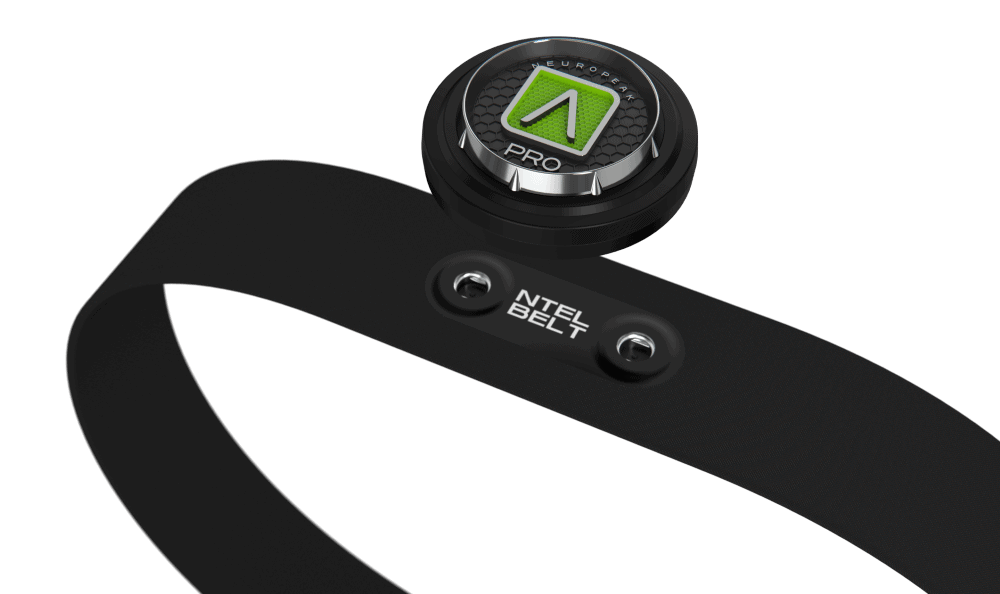
NeuroPeak Pro’s NTEL belt is more of a trainer than a wearable.
Unlike other Bluetooth fitness wearables, this one isn’t intended for around-the-clock usage to passively collect data.
“The NTEL belt is a trainer, and it’s not a tracker,” says NeuroPeak Pro’s Director of Golf Performance Andy Matthews.
NeuroPeak Pro Vice President of Performance Programs Nick Bolhuis shared a recent story of a PGA Tour golfer who had grown discouraged when his Whoop registered a lower-than-expected recovery score. But using the NTEL belt allowed him to be proactive, with the NeuroPeak app providing scores on a scale of 0 to 100. Before the golfer’s final round at the Players Championship, he did two breathing sessions a couple hours apart, registering scores of 93 and 95, before completing the tournament with a strong showing.
“We gamified breathing,” Bolhuis says.
Matthews describes the NTEL belt as the missing link between those two, helping athletes transcend an immutable recovery assessment. “I did everything I was supposed to do yesterday,” Matthews says, “and I woke up with a 71% recovery score. But I need to perform at 100% of myself today. How do I bridge that gap between those two?”
After starring at the University of Michigan, Matthews played several years of pro golf, mostly in Canada. He won the 2010 Corona Mazatlan Mexican PGA Championship while using NeuroPeak’s tools, and that experience helped him appreciate the value of learning effective breathing technique.
“The precision breathing practice is just like one would practice their golf swing or their putting stroke,’’ Matthews says. “You set aside that time to really dial in and start to really hone in on your muscle control, your respiration rate and allow all those heart rate metrics that are connected to your physical breath start to follow in and unlock that zone-like performance state.’’
The NeuroPeak app has tutorial videos to help athletes learn to control their breathing, and premium packages include personal instruction. Breathing can be used for focus or for recovery. DeChambeau has previously discussed how, after a poorly executed shot, he can use the methodology to re-center himself. “When my heart rate got up, I was able it to control it and get it back down, based on breathing,” said DeChambeau.
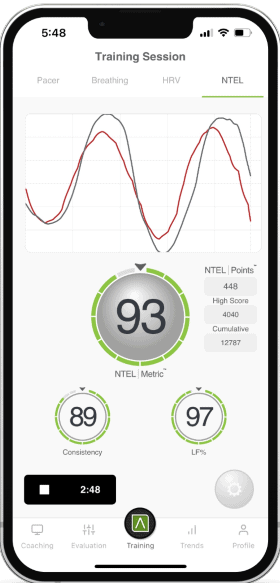
The NeuroPeak Pro app.
Asked in late 2018 how important this training had been to his success, DeChambeau told a writer for the PGA Tour website, ““There’s a reason why I’ve won four times this year. That’s my statement on that.”
Golf has been the beachhead for NeuroPeak, but the company counts pro athletes in all sports as users. Minnesota Vikings quarterback Kirk Cousins, San Francisco Giants pitcher Matthew Boyd and New York Islanders center Brock Nelson are among the other notable users.
The demands of each sport are unique, of course, and NeuroPeak caters to each. There’s foundational breathing everyone must master, after which “we’ll be very specific and prescriptive, based upon your sport in the needs,” Bolhuis says.
Bolhius was recently working with tennis players, who will invoke their precision breathing between sets. They need only two or three deep breaths, typically taken in 10-second cycles—four-second inhale, one-second transition, four-second exhale and another one-second transition—to reset themselves. In that half-minute, they won’t return all the way to their resting heart rate, of course, but they can conserve themselves.
“It’s the difference of being at 150 and getting that down to like 120 or 110, as opposed to staying at 150 the whole time and just redlining it,” Bolhius says. “Because then you get impacts on your cortisol output and all these different things physiologically. So, it’s how quickly can I take my foot off that accelerator and get that braking mechanism in place and conserve energy?”
This article was brought to you by SportTechie, a Leaders Group company. As a Leaders Performance Institute member, you are able to enjoy exclusive access to SportTechie content in the field of athletic performance.