A very different version of Golden State would appear on the court. Instead of the masterclass in group flow, fluidity, risk-taking, and creativity that the team had become known for, passes tightened up, players hesitated, threw air balls and missed routine passes and shots. Cleveland came out dominant, while Golden State made seven significant passing, handling or shot errors in the first three minutes alone. They never recovered, losing the game 101-115. They lost the final game and lost the Championship.
Golden State’s inability to recover when they were in a corner and the pressure came on was devastating but not unique in high performance arenas. How could a team who had the physical skills to execute some of the most creative basketball seen to that point in history not read the court, mishandle the ball, miss shots they could usually take with their eyes closed, and lose all semblance of composure and control?
While some may say they choked, a more objective view would identify negative changes related to the human physiological stress or threat response. When a human crosses their threshold for pressure in a given scenario, they may experience loss of peripheral vision, reduced fine motor skills, biomechanical timing changes, lack of intelligent decision-making, and emotional regulation. The negative consequences of these changes in pressure situations can be devastating yet are highly preventable with strategic awareness and intentional training.
Unfortunately, many high-performing teams misinterpret momentum, past results, and winning streaks, believing this means by default that they can execute under pressure. In many instances, it’s more likely they have just never been tested.
When a lost game does not negatively impact the season’s outcome, a team can afford to be creative, try new things, and take risks because the consequence of failure is not a threat to the season’s result. However, if a team has ignored the critical skill of learning how to work with the changes that occur when the pressure is on, the stakes are high, and the consequence of failure becomes real, the cracks will show.
Most readers are familiar with the difference in play between a team aiming to win and one trying not to lose. A team playing to win exhibits creativity, fluidity, clear communication, confidence and risk-taking. A team focused on not losing plays with a fear-driven approach, tight technique, hesitation, self-doubt, and blaming others – not qualities that result in a high performing organisation.
There is a significant human, financial and reputational cost of not being able to execute in high-pressure moments that impact coaches and athletes, executives, leadership, and support staff. The focus is often on the people in the performance arena being able to execute their roles. But it is imperative for sound governance, intelligent decision making, career longevity, optimal communication, organisational reputation, trust and ethical elite high performance that learning these skills extends to every human in a high performance role. This education must include front office, leadership, support staff and board members.
By not strategically and intentionally setting individuals and teams up with an awareness of:
a) how their bodies and minds physically change in different pressure and threatening situations,
b) skills to acutely deploy in the moment of pressure if needed and
c) front loading strategies to prevent them from getting into that situation in the first place, high performers are set up for failure by “hoping” this skill shows up. To borrow a term from the military, ‘hope is not a course of action’.
The reality of high performance environments is magic happens outside of your comfort zones, not within. You can’t be a world champion by being average. You can’t lead a team through unprecedented times using your old, familiar approaches. You can’t set a personal best anything without pushing past the boundaries of what you’ve previously thought possible for yourself. By definition, being outside one’s comfort zone feels uncomfortable. Unfortunately, humans, by nature, don’t like to be uncomfortable!
In ancient times, being outside one’s comfort zone signalled the possibility of life-threatening danger. In modern times, while the triggers are usually not life-threatening, the response remains the same as some part of our ancient brain remembers or still believes that being out of our comfort zone is ‘unsafe’. If left uncontrolled, this response derails performance in high pressure but potentially magic situations.
Most people recognise their experience when outside their comfort zone, and their ‘fright and flight’ response (sympathetic nervous system) kicks in. Their heart beats faster, their breathing tightens up, they feel tenser, their vision may narrow, they lose fine motor skills, and they can’t think or speak as clearly. These are all consequences of the physiological threat response – a very ancient and normal survival response, hardcoded into every human to prime us for action and protect us from danger.
What is less appreciated is the impact these changes have on performance and execution in critical moments if this response is uncontrolled. Consider players who:
However, this physiological response in and of itself does not have to result in poor performance. When a person’s control of their physiological response means their operating state or arousal state stays under their threshold or ‘redline’ in a given situation, they will be aware of the heightened response but without the negative consequences to performance.
To use the threat response advantageously, without misinterpreting it as ‘something bad is about to happen’ or letting it derail performance, requires skill and training. The magic of harnessing this response lies in early identification of when it kicks in, navigating it for optimal performance and preventing it from crossing the threshold where performance is compromised. Achieving this requires a combination of skills to deploy in the critical moment, skills to increase one’s threshold and front-loading strategies to put a buffer in the system in the first place.
There are several misconceptions about performance in high-pressure environments and an individual’s ability to execute or not. These misconceptions can leave significant performance gains on the table and the discard of valuable people too early. However, these misconceptions also point to where teams can make improvements.
1. ‘Performance under pressure is a psychological skill, taught by psychologists’
Human neurophysiology, human behaviour, and a physiological threat response thousands of years old drive reactions and responses to high pressure and threat perception. Our ancient and automatic responses can undermine even the best psychological training despite modern technology and awareness. Further, positioning performance under pressure as solely a psychological skill deters many alpha and elite performers from exploring understandings and ways to manage the negative consequences of a heightened operating state for fear of being seen as mentally or emotionally weak.
2. ‘Performing under pressure is determined solely by what you experience and do in the moment of pressure’
There is a cumulative effect to the threat response, with many things that elevate someone’s operating state as having nothing to do with the ‘thing’ itself. Think about your reaction if an idiot cuts you off in traffic on your drive to work. If life is humming and you’re feeling good, you’ll likely respond differently than if you haven’t slept well, argued with your partner, your team has performed poorly all season, you’re running late for an important meeting, and it’s rush hour. If you have a different reaction in these two scenarios, you’re not reacting to the idiot driver; you’re reacting to the accumulation and escalation before the idiot cuts you off. The performance arena works the same way. For most high performers, the performance arena is their relative comfort zone. They love competition and the opportunity to test their abilities. However, pressures related to (as examples) contracts, travel, young families, media and fan feedback, battles with self-worth, value and identity cause many high performers to enter their performance arena in an already elevated operating state. The normal and expected elevation of their operating state by a couple more notches at “go time” can be enough to push them across their threshold, and the cracks show.
Front-loading skills and strategies, rather than solely focusing on learning skills for the critical moment, are crucial to account for this accumulation and put a buffer into the system.
Typically, the problem is brought to awareness or focus in one of three areas (right-hand lower corner of Diagram 1) – the breakdown of task execution and outcomes, the heightened perception of pressure/anxiety, or the self-medicating/self-sabotaging behaviours.
3. ‘If a human fails to perform under pressure, it’s anxiety, and it’s in their head / they are mentally weak’
See the two points above. Irrespective of the performance arena, many high performers have the mental and emotional resilience to handle, excel and thrive in high pressure. But their physiology can still get out of control underneath the surface, leading to the negative consequences outlined previously. If someone can execute skills in lower arousal environments but not under pressure, assuming or labelling the problem as “anxiety” ignores the impact that a myriad of other physiological drivers will have on escalating the threat response that has nothing to do with “anxiety”. And it often has nothing to do with the performance arena, either! Part II of this article series will explain this point in more detail.
4. ‘People can either handle pressure, or they can’t’
Executing under pressure is a highly trainable skill, just like any other sport-specific skill. Unfortunately, it is often omitted in training during early career development, meaning performers get a long way through their careers due to natural talent or early physical development before this gap appears and the problems show. The assumption mistakenly gets made at this point that the operator can’t handle pressure. Most people who falter in high-pressure situations have just not learnt specific skills to prevent or recover from when their operating state crosses their threshold.
Additionally, a person’s threshold will differ between scenarios. An exceptionally qualified black belt martial artist will comfortably face down an opponent in a dark alley but get a dry mouth and sweaty palms at the thought of giving a speech in front of a thousand people. A seasoned firefighter will move confidently into a structural fire with no fear for their safety but momentarily freeze and move forward with heart palpitations and fast breathing when confronted with performing CPR on a young baby.
5. ‘Performance Under Pressure just “shows up’
There is a mistaken belief that operators can do the technical and tactical training, turn up in a big moment, and perform when the pressure and stakes are high simply because of their technical excellence. Coaches and team managers will often bemoan the sub-par performance that falls well short of potential without realising there is a skill gap. Most high performers do not automatically know what to do or expect mentally or physiologically when in high-pressure situations. Without intentionally learning skills to control their state in these situations, they fall victim to the negative performance changes outlined above.
In the most simplistic view, consistent elite performance in high pressure and high stakes moments requires two things:
Many of the negative consequences of high pressure and high stakes environments, and the strategies employed to overcome them, are linked to the human threat response (particularly the sympathetic nervous or fright or flight system). How an individual breathes when they aren’t thinking about breathing will also impact this response by signalling whether there is a threat or everything is safe. These two areas directly affect the other – either positively when trained strategically and with intent; or negatively when left to chance. Consistent elite performance in high-pressure environments needs both areas to be trained intentionally in a coordinated way and in advance of ‘go time’.
We see the following negative interactions when these two factors are not well controlled.
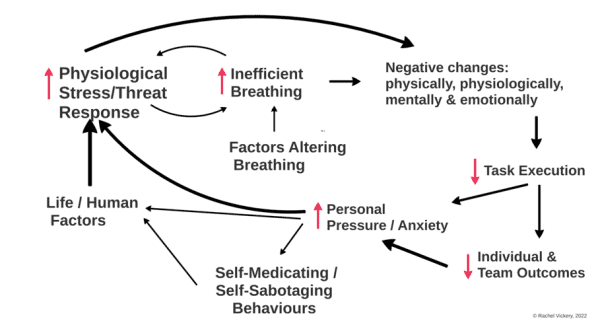
Diagram 1
Typically, the problem is brought to awareness or focus in one of three areas (right-hand lower corner of Diagram 1) – the breakdown of task execution and outcomes, the heightened perception of pressure/anxiety, or the self-medicating/self-sabotaging behaviours.
Some of the changes to task execution and performance for athletes are identified earlier in this article. The same concept applies to coaches, executive teams and support staff in their respective roles, although how it shows up may vary. The subsequent increase in pressure and anxiety for the individual, team, coaches or team management related to poor performance; and the impact of negative media and public criticism leads some individuals to self-medicate or self-sabotage. Any combination of alcohol, drugs, porn, gambling, food, missing training, out-of-arena altercations, excessive work hours, neglecting family, affairs, and unethical decision making may be present. Unsurprisingly poor mental health and suicidal tendencies sit in this mix also.
Teams will often try to fix the problem in one of these three areas. If a player misses kicks – they spend more time on their kicking technique (unfortunately, often in a relatively relaxed, no-pressure state). If a person – particularly coaches and management personnel- struggles with anxiety, they either keep it to themselves, are medicated, or receive insufficient expert guidance. If a person has an addiction or behavioural problems, they are disciplined, sent to rehab or hide it in shame.
This traditional approach is fundamentally flawed. Waiting for performance issues in pressure environments to show up (whilst hoping they don’t) and then reactively fixing them does not result in excellence and consistent high performance. Punishing poor performance under pressure in the absence of a front-loaded strategy of skill acquisition in this area is akin to throwing a bunch of humans who don’t know how to swim into a pool and then yelling at them to stop drowning.
Consistent elite high performance in high stakes and high-pressure environments means going “left of boom”, understanding the situation for what it is, and front-loading strategies to set up for success, thus avoiding a negative response. Normalising the physiological, cognitive and biological reactions that humans have in high-pressure environments and training and optimising for it is far more impactful on performance than just wishing or pretending it wasn’t there or reacting to the fallout after the event.
Part II of this series will dive deeper into how the human stress response works in high-pressure situations, how it disrupts performance and some skills and strategies to thrive in high pressure and high stakes environments.
Rachel is one of six Leaders Performance Advisors, a group of leading performance thinkers providing more subject expertise to our member-only content and learning resources. To find out more about all our Performance Advisors, click here.

The question is on the mind of Jeremy Bettle, the Performance Director at New York City FC, who won the MLS Cup in December last year, when the Leaders Performance Institute and Dave Slemen and Anna Edwards of Elite Performance Partners [EPP] sat down with him to discuss the steps performance directors can take to become better leaders.
Joining Bettle in conversation are Darren Burgess, the High Performance Manager of the Adelaide Crows who also leads EPP’s search offering in Australia, and James Thomas, the Performance Director at British Gymnastics. The trio work in three different sports and geographies, with systems and structures that vary in their approach, but each brings a sense of vulnerability, self-awareness, and an understanding of the importance of the culture and context they are working within. Their leadership capabilities bind together a great strategy and strong culture, which is essential if teams and organisations are to retain their shape when pressure is applied. Of the expectations and pressure now thrust upon NYCFC, Bettle says: “It’s certainly going to be something new for our club this year.”
Bettle, Burgess and Thomas all have a deep desire to keep learning, which has driven them to the top of their fields and each played a part in a series of ‘firsts’ in 2021. NYCFC’s MLS Cup triumph was the club’s first, while Burgess was serving as Performance Manager of the Melbourne Demons when they won their first AFL Grand Final in 57 years. Also, under Thomas’ stewardship, Great Britain won their first Olympic medal in the women’s gymnastics team event for 93 years.
Thomas tackles the question of pressure from the athletes’ perspective. “It’s been the biggest risk or success factor of the last four years,” he says. “When we look at our gymnasts, they’re phenomenal athletes. They have the ability to execute phenomenal technical skills and they can do it day-in and day-out in the training environment. Where I see the athletes either struggle or excel is that ability to step into a competition environment and deliver it there. With every sport, you’ve got great examples of people who can do it either in a one-off or can do it repeatedly, or they can do it in training and they can’t do it in competition.
“We’ve actually put a lot of time and resource into different pressure environments whether it’s changing training set-ups, whether it’s manipulating timings just to put athletes under more pressure, less warm-up, less time between apparatus, we’ve brought in surprise friends and family to come on the balcony and watch and cheer. We try to exhaust almost all of our coaches and psychologists’ views of manipulating the training environment.” Nevertheless, as Thomas admits, “you can never quite replicate the actual competition environment.”
Burgess, who last year won the AFL Grand Final with Melbourne and previously worked in the English Premier League with Liverpool and Arsenal, finds the same applies to professional team sports. “It’s very hard to simulate pressure, especially with games happening every three or four days in the Premier League, particularly when you’re also competing in European competitions.”
His mind goes back to the two-week period in September before Melbourne took on the Western Bulldogs in the AFL Grand Final. The consensus amongst the fans and media was that Melbourne had the better team but were undermined by the fact that their route through the playoffs meant that they had played one game in 28 days.
“We decided to take the high risk of playing a match simulation,” says Burgess. “It probably cost us a couple of players who were on the fringe of being selected, but in the end, that was how we decided to simulate that pressure as much as we could. We had umpires in, full mouth guards, so it was part of our thought process to try and simulate that as much as we could. We even built up a bit of a rivalry between the ‘possibles’ and ‘probables’ and tried to manufacture that so that the ‘possibles’ put up a good fight.”
Bettle approves of such approaches. “I’m a big believer in exposing people to pressure versus shielding them from it,” he says. “I think there can be a balance there but you’ve got to get used to pressure and have strategies to deal with it. I’m a big believer in process and having done it before; and trying to make these environments a lot more automatic.”
He recalls his time working at the NBA’s Brooklyn Nets between 2011 and 2015 when there were few opportunities to generate pressure because the games came thick and fast. He was struck by the veteran players. “They show very little emotion win, lose or draw. I think because it’s so automatic to them, it really helps them to perform on a nightly basis.” By contrast, however, New York City practised penalties as they progressed through the MLS Playoffs. “Having the guys line up on halfway and having them walk out on their own; and because they’ve gone through it over and over and over again, when we actually get into the scenario, which we did twice in the playoffs, it just felt more normal to us. The guys executed it excellently when it came to it and maybe it helped, maybe it didn’t, but it made me feel better about it anyway!”
The approach is far from universal in soccer, as Slemen points out. Penalties are one of the few closed skills in football that can be practised but the prevailing culture has often been reluctant.
Bettle and New York City Head Coach Ronny Deila also tried to factor an element of fun into the team’s progression through the season and post-season. Though he has often been sceptical of organised fun in a team context, he explains that Deila’s decision to organise team dinners reaped dividends.
“I think the coach did a great job this year of recognising that our team didn’t do well when they didn’t have an opportunity to relax,” says Bettle. “So we started doing team dinners when we go on the road, on match day minus two. They’d have a glass of wine, and we’d have just a really fun night out that felt authentic and not forced. Giving the players an opportunity to enjoy it and not be so disciplined was a bit of a departure from my mindset, but I’ve come to recognise it’s been one of the most valuable things that we did last year, to put a focus on joy and fun and enjoying the experience. I think building that environment, recognising who your players are and how they’re going to respond versus having some really rigid thoughts around ‘this isn’t high performance, we can’t drink wine two days before a game’ it actually helped us.”
Much like in soccer or basketball, Thomas explains that in gymnastics the success of any rituals largely depends on the skill of the coach. He says: “Where I probably see the magic happen it’s been where coaches have managed to really understand the team and the group of athletes they’ve got, where they’re positioned.
“For the men’s gymnastics team, it was very clear in the build-up to Tokyo, they were probably fourth or fifth in the world, and it was very cleverly done by our coach to position them as the underdogs that were going to create the big upset rather than ‘we can’t achieve that’ or ‘we’re world No 1’. It was ‘let’s go on the hunt’. They really put this mindset into the gymnasts that this final 12-week prep was really just about closing the gap. You could see every day that the gymnasts came in with the bit between their teeth about closing the gap. It wasn’t necessarily about winning the medal, it was about ‘how do we get as close as we possibly can?’
“There was a sense of realism, a sense of togetherness towards something and it really pulled them together. It did feel like a team and the feedback that we had from some of the gymnasts who had been to multiple games, said it was the best team environment because they had a really clear purpose and it was really cleverly orchestrated by the coach. That’s where I’ve seen it work its best, through the coach, with a little bit of a framework of what they’re working towards and that purpose.”
Thomas has witnessed scenarios where the use of rituals does not work and puts it down to authenticity, which chimes with Burgess’ views on the matter. “It’s a really risky practice if there’s not authenticity about the ritual, the practice or the theme,” he says. “If there’s not complete buy-in, then you really are in trouble. Let’s say, for example, that your ritual, your belief is ‘selflessness’ and you want everybody to act selflessly throughout everything, the minute that your star No 10 player decides to miss a training session or turn up late or act selfishly in some way, are you going to drop that player? You have to stick to it and then it becomes part of your team’s identity and everybody respects that. Yes, it can work, but it has to work in the right environment and I’ve seen both.”
