In a recent Leaders Virtual Roundtable, members discussed how teams can improve the data literacy of their coaching cohorts.
“I said to him: ‘I had you when you were a player – I know you wouldn’t understand any of this – so why are you telling this to our players?’”
The performance director in question shared this story at a recent Leaders Virtual Roundtable entitled ‘Effective Integration and Interpretation of Data in Coaching’.
It quickly dawned on the coach. “He went: ‘yeah, I’m sorry, I hold my hands up’. That was powerful because he could see it.”
Ideally, a coach would have both the working knowledge and the confidence to make targeted and effective data-influenced interventions that remove confusion or ambiguity.
Over the course of an hour, members of the Leaders Performance Institute, drawn from a mixture of analytics, sports science and coaching backgrounds, discussed the steps they are taking to improve the data literacy of coaches at their organisations. They homed in on four factors.
Performance practitioners: engage the coach early in their tenure. Data can be another string in their bow. “You don’t want to burden them,” said one participant from the Australian Olympic and Paralympic system, “but how can you elevate them and enhance them as a coach?” The key is to explain that data is there to support their intuition as a coach. Even AI should be no more than a ‘co-pilot’. Data analysis should support the work of the coach and “give them confidence in their decision making.”
Furthermore, as analytics career pathways evolve, more teams are establishing hybrid coaching and analytics roles. “Some of the best analysts are good interpreters and translators for coaches,” said one attendee working in English football, “and some of them have taken that on themselves to think ‘I can go and progress in this’ if they’ve got an interest in pushing on with the coaching area as well.”
“Timing is everything with coaches,” said one member, while making the distinction between ‘teaching and developing’ and the ‘telling and giving of answers’. “The timing of when you plant the seed or present something new to a coach is really the start of the success or failure of what you’re trying to do.” Another attendee suggested that a practitioner must consider “what is it that you’re going to provide? And what is it you’re going to hold back?” A third offered an example of this in practice: “We’ve introduced not just new technology, like tools and hardware, but also a large number of new datasets and data metrics for the coaches to understand.” An astute practitioner will foster a curious mindset and understand “when it’s OK to give the coach a little bit more to stretch them and when we will hold something back.”
When a curiosity-driven coach uses data to support their intuition, they can do their most effective work. “I always tend to try and attach myself quite closely with any analyst to marry up the science and the art,” said an age-group cricket coach in England. “It’s about getting the data and then allowing that coaching gut feel and observation to take place as well.”
From the analysis side, it requires someone able to move beyond their specialisms to communicate readily with the coaching staff and other colleagues. “The positions of technical directors or performance managers within this space are critical to make the decisions about what we translate and how we do that,” said a member. “My experiences of things when they’ve gone well would be with practitioners that have those professional skills to communicate and give what is needed rather than give too much.”
It’s on the coach to establish the need for their performance team. “The practitioners shouldn’t overwhelm the coach, but also the coach shouldn’t overwhelm the practitioners,” said a participant from the British Olympic and Paralympic system. “Do they truly have a priority? Do they truly know what it takes to win?” The coach needs to be clear on how the data is to be used, whether it’s to inform development, to pose exploratory questions, or to make a decision. “Coaches can fall into a trap. They want to know everything, but do they truly need to know everything? What are they actually prioritising?” From there the team can decide “what are they going to double down on and ask where the gaps are for exploration.”
What to read next
30 Jan 2025
ArticlesProject leads Anna Warren and Tham Wedatilake discuss the factors that enable Insight 360’s data-led approach to athlete management.
Insight 360 is a data-driven approach to performance management and athlete monitoring. It was launched in February 2024 by the ECB in collaboration with Ascent, their digital services provider, and includes an app for players (to view their data), a dashboard for practitioners (to view data across the board), and a portal that practitioners can use to input data.
“When you see the little research that’s out there, you’ve not got much to hang your hat on,” said Anna Warren, the Head of England Women’s Science & Medicine, at November’s Leaders Sport Performance Summit in London. “We’re using this platform to better understand in depth the female cricketer; what they look like from the academy through to the international cricketer.”
The rollout has been a success and, as the ECB launches phase two (the wider introduction of injury data and more sophisticated use of match data), we highlight the factors that led to its sport-wide take up.
It reflects the concerns of players
Insight 360, as the name suggests, represents a holistic approach to collating athlete data. There is a focus on availability and performance, but there is also a focus their health, home life, and career progression. “Players come to us and discuss their issues quite openly,” said Dr Tham Wedatilake, the Lead Physician for England Women’s Cricket, who joined Warren onstage to discuss the project. “They want to perform without any barriers.”
It is a co-designed platform
Ahead of the launch, the ECB gathered input from practitioners and coaches across the English game. “This means Insight 360 is bespoke for women’s cricket,” said Warren. Players, she said, are happy with an app that allows them to review their own data in as much detail as they like. “This is good for player buy-in, which is always a challenge in relation to athlete monitoring.”
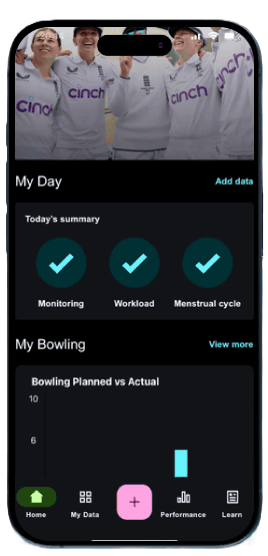
There is also the power of a co-designed project. UK Sports Institute have found as much with their Project Minerva. Dr Richard Burden, the UKSI’s Co-Head of Female Athlete Health & Performance, said: “Get the practitioners involved, get athletes, get the teams and bring them along with it because if they’re onboard you get easier access to them and you’re going to produce something that’s more translatable, meaningful and applicable to them.”
Warren is on the same page with Insight 360. “You can link loads of different data sources together and start to answer some key performance questions – we’re not looking at everything in isolation.”
It provides a single source of truth
Collaboration can be easier said than done. “When you have so many people pull data together it becomes almost impossible for the human brain to comprehend and then deliver effective, unbiased solutions to players’ needs and expectations,” said Wedatilake.
Insight 360 is the single reference point and it provides continuity. “As soon as one person leaves and another is working with the players, that record gets lost,” said Warren. “We’re really trying to create a joined-up system.”
It is future-proof
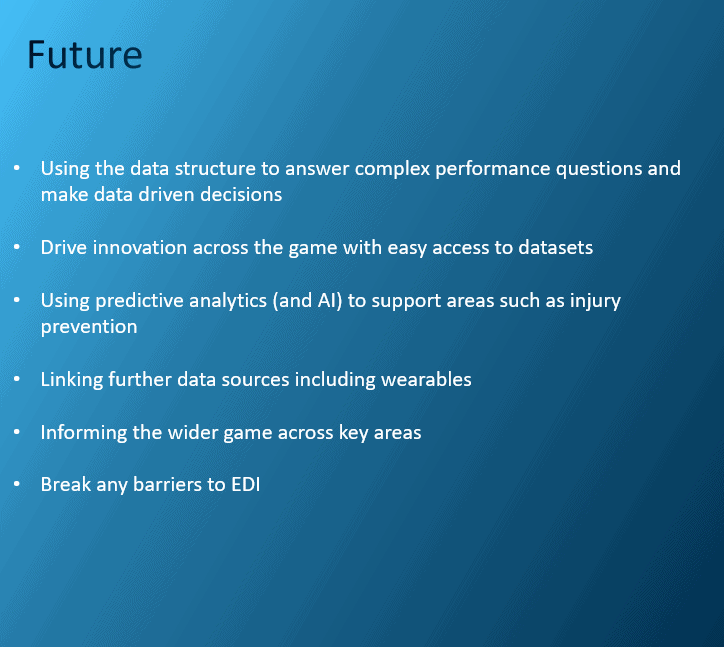
Wedatilake explained that Insight 360, as part of its next phase, will include injury data. He said: “It will be a game-changer for us in terms of load and injury risk and other factors such as the menstrual cycle and wellness.” The platform is primed to integrate future sources of data.
He does, however, also temper his excitement with a note of caution. “We didn’t want to get greedy too early,” he added. It was critical to have the right structure and means of integration before adding different elements, whether they are rooted in stats or video.
One of the next steps is further automation, particularly with regards to match data. “That’s the beauty of this system,” said Warren. “It’s so much quicker for people.”
She and Wedatilake wrapped up their presentation by setting out their ambitions for Insight 360:

We discuss the Cynefin framework and how it can help coaches to adapt their behaviour and their decisions.
In time, the coach transforms the fortunes of their team and it sparks a wealth of imitators who try to mimic their winning ‘philosophy’. Think Bill Belichick, Dawn Staley or Pep Guardiola: big personalities whose decisive actions (and coaching talent) have led to sustained success.
In their 2007 Harvard Business Review essay titled ‘A Leader’s Framework for Decision Making’, David J Snowden and Mary E Boone did not discuss sport, nor did they use the word ‘philosophy’, but they did reference leadership ‘recipes’ that tend to ‘arise from examples of good crisis management’. In that sense, sport and business are similar.
Snowden and Boone believed this trend was a mistake and not only because crises are rare. ‘Leaders who are highly successful in chaotic contexts,’ they argued, ‘can develop an overinflated self-image and become legends in their own mind’.
Snowden and Boone’s treatise lodged in the mind of Peter Brown, the Assistant Director of Workforce and Organisational Development at NHS Wales’ Aneurin Bevan University Health Board.
Brown, who spent a decade working in high performance sport, most notably at the UK Sports Institute, came to Leaders Meet: Teaching & Coaching at Millfield School in April to discuss problem-solving in organisational contexts.
As he explained, “the problem with problem solving is this phrase: problem solving”. No two problems are the same; some have solutions, some do not, and the context is different each time.
Instead, Brown advocates moving towards “sense-making”. He said: “Sense-making is about our understanding; everything that’s going on around us; orientating ourselves within that and then moving towards action”. It encompasses analytical thinking which, as he reminded the audience, was listed No 1 in 2023 by the World Economic Forum Future of Jobs report on their list of essential skills for the next five years.
One of Brown’s favoured sense-making tools is Snowden and Boone’s Cynefin framework (outlined in their essay). Cynefin, which is pronounced ‘ku-nev-in’, is a Welsh word that signifies ‘the multiple factors in our environment and our experience that influence us in ways we can never understand’.
The Cynefin framework ‘helps leaders determine the prevailing operative context so they can make appropriate choices’. Snowden and Boone identified five operative contexts – simple, complicated, complex, chaotic and disordered – but argued that few leaders are adept in more than a couple.
‘Many leaders lead effectively – though usually in only one or two domains,’ they wrote, ‘and few, if any, prepare their organisations for diverse contexts’.
Onstage, Brown explored each in turn.
Simple
Simple contexts are stable and one can observe a clear cause-and-effect relationship. The risk with simple problems is that they risk being incorrectly labelled as such due to oversimplification. ‘Leaders who constantly ask for condensed information, regardless of the complexity of the situation, particularly run this risk,’ wrote Snowden and Boone, who also referred to ‘entrained thinking’ when leaders are closed to new perspectives.
Of the risk of bias, Brown said: “If I’ve only got my own experiences to fall back on I’m going to interpret [problems] in a way that is predetermined.”
Things may well be running smoothly, with each and every problem presenting a simple solution, but there is a risk of complacency, a drop-off in performance, and a descent into chaos. “It’s really important to get the voices of others,” added Brown. Belichick, Staley or Guardiola may seem like auteurs, but they all have their trusted assistants.
“We want to make sense of our world and get all these different perspectives; when someone says something to you, what else are they thinking? What else aren’t they telling you? Then multiply that by the people in the room.”
Complicated
Complicated contexts are found in “the realm of good practice” said Brown. “There’s still a right answer but you might not know it at that particular time. There might be better or worse ways of getting the same thing.” He cited altitude training for athletes as an example: you could arrange an alpine camp, set up altitude tents, or use a combination of both.
In their essay, Snowden and Boone explained that entrained thinking is also a risk in complicated contexts but ‘it is the experts (rather than the leaders) who are prone to it, and they tend to dominate the domain’. Sense-making can fall by the wayside. ‘When this problem occurs, innovative suggestions by nonexperts may be overlooked or dismissed.’
Complex
In complex contexts, “the cause-and-effect isn’t knowable except in retrospect,” said Brown. “What works here may not actually work somewhere else because the conditions are different.” It is again incumbent on the leader to create the conditions that enable the team to move forward. ‘Instructive patterns,’ wrote Snowden and Boone, ‘can emerge if the leader conducts experiments that are safe to fail’.
“In this space, you just start putting things in place,” added Brown. “We call them ‘enabling constraints’. A constraint is not always something that stops things.” A coach, he said, might request that a wall be removed in a changing room to reduce the walking distance to the training pitch. “That’s an example of something in complexity to see if it makes a difference; to see if a pattern of behaviour emerges.”
Again, there are risks in complex contexts. Snowden and Boone warned of ‘the temptation to fall back into traditional command-and-control management styles’.
Chaotic and disordered
Chaotic contexts are scenarios where, as Brown said, “all hell has broken loose – here you want to try to take swift action to try to nudge us into something else”. The leader, as Snowden and Boone argued, must strive to find order, work out what is stable and what is not, and work to shift from chaos to complexity as ‘the identification of emerging patterns can both help prevent future crises and discern new opportunities’. Again, they must approach the chaos in an egoless fashion.
Finally, Brown touched upon disordered contexts. These probably require the least explanation. “You just try different things, try to gather information, try to understand where you might be sitting,” he said, adding in jest, “that’s where I tend to be most of the time.”
The key is the leader’s behaviour. As Snowden and Boone wrote: ‘Truly adept leaders will know not only how to identify the context they’re working in at any given time but also how to change their behaviour and their decisions to match their context’.
As Dr Daryl L Jones explains, crises are best handled by organisations whose people are able to both flourish and perform at their best.
You may recognise the signs from your own experience; from elements of high risk and disruption to the instability and the potential for internal clashes.
They’re all familiar signs, but do you truly understand how crises emerge? It is often assumed that crises are the outcome of events that cannot be managed – but nothing can be further from the truth.
That is the view of Dr Daryl Jones, the VP of Sports Leadership at Abilene Christian University, who wrote a white paper in 2017 entitled Sports Leaders, Sensemaking, and Self-Preservation: Uncovering the Real Crisis in Sport.
Jones, during a recent Virtual Roundtable for members of the Leaders Performance Institute, explained that crises emerge as a complex interplay of behaviours, processes and emotions.
Reconceptualising what we understand by ‘crisis’
Jones honed in on three specific areas that provide the terms for analysing crises in sport:
Common misconceptions of crises in sports organisations
Jones points to four common misconceptions:
Organisational elements conducive to crisis
Crises are not strictly outcomes – they are induced by behaviours, processes and emotions. They are highly disruptive, often leading to demise for the brand, organisation and culture. They garner passive responses from leaders because they are operating in self-preservation mode, while attempting to reconcile winning today and building for the future; we often subconsciously operate from fear as opposed to strength.
Additionally, crises are accompanied by apathy and myopia. What does this mean? We tend to develop a system of rewards for people to not be innovative, but to solve for today.
During the session, Jones shared some reflections from sporting leaders who were interviewed for the research:
Six of the behavioural, process, emotion-based factors most frequently associated with crisis
The research project led by Jones uncovered the six behavioural, process, and emotion-based factors (BPE) most frequently associated with organisational crises in the sports industry. Curiously, the first factor was not even a point of consideration in his initial theory-building process:
Taking steps towards learning the behaviours and practices that promote a flourishing organisational culture
What does this research tell us? It tells us we can start to proactively manage crisis as leaders; but it’s going to require that shift from self-preservation to flourishing. Jones’ assumption was that the most frequently associated response would be job performance. However, the research revealed that no matter who the leader was or where they were operating, or in what capacity, there was some form of self-preservation that at some point entered into their workflow.
Self-preservation tend to raise its head in the following scenarios:
To wrap up, Jones offered some recommendations:
25 Jun 2024
ArticlesThere are some persistent challenges but intentional leaders and their teams can find ways to flourish.
The chances are that for all your fine work fostering a collaborative multidisciplinary team there are challenges you still face daily.
At a recent Leaders Virtual Roundtable, we encouraged members to reflect on areas where there is room for improvement and areas where they have made real inroads.
Some responses, such as limited time, busy schedules and the decentralised nature of some programmes were raised by members time and again but, below, we focus on communal challenges.
Common issues that prevent efficient collaboration
Misalignment of needs, expectations and responsibilities: such issues still endure, as evidenced by the number of members who mentioned the lack of alignment within departments and teams. One mentioned a lack of role clarity and, in turn, knowing with they should collaborate or bring into the conversation at the right times. Some cited the challenge of matching the expectations of individual staff and the collective needs of the team. Others noted situations where there are competing objectives and priorities.
Expertise bias: a Leaders member cited ‘discipline protectionism’, which resonated with most attendees. There are enduring examples of intellectual arrogance from some disciplines or an expertise bias that impacts communication, information sharing and can reduce general curiosity. These are all collaboration killers.
Team makeup: there are several elements here. Firstly, when team members are hired in at different stages there is a natural impact on the functionality of the team. There are also different personalities and communication preferences. Several attendees also noted that some environments are geared towards individuals highlighting their own impact and values as opposed to the greater good of the team.
Other considerations: the leader’s ego; a lack of psychological safety; finding the space and time for reflection; a lack of understanding about what optimal multidisciplinary work looks like.
Potential pathways to better collaboration
Centralised communication: can lead to a higher quality of comms between all stakeholders. Perhaps you can profile your team members and better communicate agreed expectations.
Consistent data capturing: when multiple departments are capturing data consistently, instead of sporadically, it can create more alignment around communication and collaboration with other disciplines.
Humble leadership: the leader or leadership team must be humble enough to accept when change or re-organisation is required. They need the humility to step back, evaluate their approach as a leader, as well as the situation, and enact change. This is where clearly defined needs and a common understanding are useful.
Clear standard operating procedures: a well-functioning system promotes better asynchronous information sharing. If you can outline standard operating procedures for communication between platforms it can prevent key information and messages being missed.
Team structure and role clarity: as a team leader, it’s worth considering the effectiveness of your onboarding and offboarding approach to minimise the impact. Diversity of thought is also essential, but it’s worth considering how to feed this into the design and operation of the team. One roundtable attendee suggested hiring an independent auditor to help outline role clarity, the sharing of best practices and, in general, promoting leadership – in essence, they act as a critical friend. Additionally, discipline or team leaders can create networks within their teams to enable such sharing. Another member explained that they have adopted a ‘team of teams’ approach e.g. a structure based on a ‘constellation’ of smaller teams that work together closely. It has yielded some positive results. Finally, in an effort to encourage a team-first approach, consider how you profile team members and communication of expectations.
What’s missing and what are the further opportunities?
Support for new leaders
How are you supporting new leaders in your teams? Often we see those in technical expertise or ‘tactician’ roles move up to a leadership position but lack the requisite skills to lead effectively. The role inevitably changes, so what are you or we doing to help them ‘lead’ their teams and embed true collaboration?
Robust and thoughtful feedback
Be intentional in creating a robust and thoughtful feedback mechanism that allows for variations of approach. Detailed feedback can support team learning on a consistent and ongoing basis. True, it can be a challenge, but therein lies the opportunity.
Psychological safety and empowerment
How can we better empower people more effectively to take targeted risks within their roles, whilst still feeling safe and secure? There needs to be a team-wide understanding of what psychological safety means and what it looks like in your environment.
Self-development, difficult conversations and allyship were on the agenda for the latest Women’s High Performance Community call.
We spoke about self, or personal, development, as well as career development, and the place for each before turning our attention towards difficult conversations and allyship.
There is no doubting that those who joined the call are committed to their development. However, no one felt like they have a well-structured development plan that they simply were not following.
Currently, there’s a general sense that a lot of effort is driven by the individual – reflecting upon this, it’s potentially what those guiding us are told to do.
However, there is a request for more structure, confidence, time and opportunity from above to elevate the impact of our development.
It also came across from the call that many have big obvious blocks of learning, through courses or further education, but struggle to have a clear plan if those aren’t in place or if they are between courses. There are also those, who are doing a lot of learning simply by doing their job each day, which is where reflective tools and support from above can be powerful.
The Women’s Community suggested these five ideas as ways to make development as impactful as possible:
Other examples that we’ve seen work too:
Visits to different organisations – and having others visit you. This helps avoid echo chambers and benchmarks our practices against others. This becomes increasingly important if our only working experiences are in a single organisation.
Whole team development on specific skills. Having a whole team approach can help avoid siloed learning and contribute to learnings sticking.
It’s always good to remember that we need to leave space for stretch and being in uncomfortable positions. Again, these moments become more impactful if we can reflect on them and shape our development plans as a consequence. Finally, remember: some people’s development is focusing on saying no.
The Community once again spoke about the importance of our networks and brands to career development and shared the following reflections:
The Community then shared advice for when having difficult conversations:
Difficult conversations can take several forms – they do not necessary involved conflicts or saying no. There’s a range: it could be talking to a new person or even when you are taking steps to change the dynamics and the way things have always been done.
There are stories of female coaches in an otherwise male coaching team stepping out of their comfort zones because their approach to coaching is different. In one particular case, the female coach boosted her confidence by reminding herself that she’s adding to the discourse, providing different inputs and possibilities, and a platform for conversation.
We know that women are different, and that in sport women are often in a minority; so it would be easy to understand why we might doubt ourselves in these moments. However, we can retrain ourselves to not think in this way.
One additional approach that can help us is to have the conversation as part of a regular update session, so it’s not ‘singled out’ as having the need for a difficult conversation.
So what would we want an ally to support us with to enable us to be our most confident selves going into these conversations? These were some of the group’s suggestions:
Don’t just wait: encourage creative solutions by providing incentives and permission within your environment.
Those were the words of Kirk Vallis, the Global Head of Creative Capability Development at Google, spoken at the 2019 Leaders Sport Performance Summit in London and, if anything, the premium placed on creative thinking has gone through the roof in the intervening years.
“More than 70% of companies surveyed consider creative thinking and analytical thinking to be the skills most expected to rise in importance between 2023 and 2027,” says Statista, the global data and business intelligence platform. They conducted a study that surveyed 11.3 million employees from 803 organisations across the globe between November 2022 and February 2023.
They added: “Cognitive skills are the skills growing in importance most rapidly due to increasing complexities in the workplace.”
The high performance world is similarly moved, with organisations as diverse as the Royal College of Art, IDEO, M&C Saatchi and, of course, Google, proving popular at Leaders summits for their insights into how they enable creativity to thrive in their environments.
In some senses, this comes a little less naturally to people in high performance sport. Nevertheless, a recent Leaders Virtual Roundtable entitled ‘Fostering Creativity in your Environment’ provided a platform to delve into the practical ways we can increase creativity in our environments.
Indeed, as research shared by our speakers suggests, ‘travel’ – exposing yourself to novel and unfamiliar experiences – can increase creativity by up to 25%, while Human Spaces research says that biophilic design can increase creativity by up to 15%.
Five questions to consider when putting in a process to foster creativity
A summary of solutions – practices that have worked for Leaders members
How many of these ideas have you employed with your team?
A change of environment
Who and what industries do creativity really well? Spend time with people who think differently – step outside the echo chamber and surround yourself with people with different perspectives. Learn from others – ‘borrowed creativity’ – as one member put it. A change of environment allows for a change of stimulus.
Incentivised creative time
Establish a culture that empowers people to be creative and provides the necessary time, place and space. Can you find ‘thinker’ moments during the day where there is perhaps a low to moderate intensity? Try to leave periods of time meeting-free. A member suggested that doing creativity well requires a different mindset to day-to-day delivery – fence off time and remove the distractions.
With this in mind, are you giving your team the best opportunity to get into their flow state before coming together? Are you building-in ‘priming’ time? The best ideas can come to you when you’re running, walking or visiting a coffee shop. You can then reconvene monthly or every two months at set times to tackle performance questions and topics.
Another attendee shared that they outline a list of challenges online or in a forum for team members to see and connect on; they encourage people to collaborate to provide ideas and solutions.
Find your inner child
As one member said, children are noted for their creativity. Have you considered engaging in activities suited to children such as Lego, painting, collage-making, storytelling etc?

![]()
One of the primary motivations for this Performance Special Report, which is brought to you by our Main Partners Keiser, is to address the issues that affect female individuals within high performance sport, because they have been neglected for far too long. There are numerous issues – far too many to address in this report – but the Leaders content team took it upon themselves to shine a light on some of the admirable work being done for female athletes and coaches across the globe.
Complete this form to access your free copy of this Special Report, to discover the untapped potential that lies across girls’ and women’s sport, from the grassroots through to the elite level, and the individuals working to unlock that potential.