9 Oct 2025
ArticlesIn this recent virtual Learning Series roundtable, Drs David Fletcher and Danielle Adams Norenberg explain why there is now more to the role than individual counselling.
An article brought to you in partnership with

“Just this last year I’ve had many more enquiries than I have had in the last 18 years around how my experience and background can help across the institution,” he said.
Once upon a time, it was primarily athletes who requested Fletcher’s time. Today it is just as likely to be a senior coach or performance director.
“Another space is the development of a multidisciplinary team,” he continued. “There’s also a demand for support getting people from technical expertise into leadership-type roles. The other space is working at board level around systems, structures and processes.”
Fletcher co-presented the second part of a Leaders Virtual Roundtable Learning series entitled ‘How Do we Enhance the Impact of Psychology in Performance Environments?’
For all that the role of psychology in performance is expanding, there are enduring challenges.
Wider perceptions for one. “Coaches haven’t necessarily been able to spend the time to truly understand what it is that sports psychology can do,” said Dr Danielle Adams Norenberg, the Head of Psychology at the UK Sports Institute, who joined Fletcher on hosting duties.
“We are still seeing some differences in who is hired, how they’re hired, what support they’re getting.”
Over the course of an hour, the duo set out those challenges before exploring the key role that performance psychologists can play in providing improved coach education and systemic-level support.
Common challenges in sports psychology
Coaches broadly accept the ‘80:20’ idea, which posits that 20 percent of performance is psychological (even if people quibble with the exact balance). Yet relatively few organisations provide the necessary service support.
To compound matters, the psychologists themselves are often at a disadvantage due to:
While these challenges persist, perceptions are shifting. The next part of the conversation focused on the ways a psychologist can support coach development and other system-level elements.
The performance psychologist’s role in coach development
“It’s hard to separate the technical and tactical from psychological, mental decisions coaches have to make,” said a performance manager from the New Zealand system.
Fletcher corroborated this observation. “Without doubt I’ve been doing much more work with coaches than one-to-one sessions with athletes,” he said. However, he finds coach education programmes to be “extremely hit and miss” both within national governing bodies and professional environments.
“A national governing body of sport might have a pretty solid coach education to go through your level one, level two, to get out in the field. But then when you’re working at Olympic level, what support is there?”
Fletcher and Adams Norenberg then outlined the two areas where psychologists can ensure more hits than misses:
A psychologist, as Fletcher explained, can help a coach to develop their “time management skills, body language, and communication skills” in the pursuit of better performance.
By the same token, psychologists have been instrumental in facilitating a shift from deficit-based to strengths-based coaching. Adams Norenberg said: “Even if planted within a very generic training session, athletes have the self-awareness, knowledge and autonomy to make the most out of their training session by focusing on developing their strengths.”
Psychology is another string in a coach’s bow. If they understand the types of pressures that athletes experience they can “choose a particular training session to not necessarily develop technique or tactical skills, but psychology skills.” She cited the example of the VR headsets used in training by Team Europe ahead of the 2025 Ryder Cup. Some players simulated the spectator abuse they would endure at Bethpage Black; others used it not for pressure training but relaxation, such as the Norwegian Viktor Hovland, who recreated the fjords of his homeland.
A performance psychologist can also help to ensure your actions match your words
Adams Norenberg refers to individual psychology work (in the absence of a wider remit) as little more than “icing the collapsing cake”.
It is unnecessarily limiting, as Fletcher illustrated using this common scenario. “If you’re hired as a sports psyche to do lots of athlete one-to-one work, the athlete leaves the room or steps off the track after a training session that’s been supported by a performance psychologist only for some organisational communication to come out that takes away all of that work.”
The solution lies in “working with our leaders to try and help them see that psychology can support them in the alignment of decisions to values and can help them communicate those decisions in ways that that land in a way with athletes that they see and value the support”.
Performance psychology v clinical psychology
There has been a trend towards pathologising psychological issues, which causes clinical psychologists to misunderstand the day to day work of performance counterparts.
With this issue in mind, Adams Norenberg recently hosted a forum for the clinical psychologists in the UKSI’s referral network outlining what performance psychologists do. “I have worked more with the network to try and build up a better relationship and understanding of what the sports psychologist’s roles and skillset is.”
What to read next
‘Sports Psychologists Cannot Just Sit and Wait for Work to Come in the Door’
As Esme Matthew and Dr Kate Hutchings explain, the reality is you won’t always find the answers in research Papers. Dialogue and individualised plans are critical.
Our recent Women’s High Performance Sport Community call featured the UK Sports Institute sharing how organisations can better support athletes returning to performance postpartum.
We were delighted to be joined by:
The conversation focused on the structures UKSI have put in place to support athletes, including the role multidisciplinary teams (MDTs) have, which practices are having a positive impact on athletes, and what was learnt in the most recent Games cycle.
Six core themes emerged around what is involved in guiding an athlete successfully through pregnancy and their postpartum return. We also discussed what can be done where resources are limited.
The timing of when an athlete chooses to inform their coach and support team of their pregnancy will vary, but having conversations as early as possible during pregnancy is essential to map out return-to-performance plans. It’s advised that athletes establish support networks and define expectations with their teams before delivery. This could include what they expect in terms of communication from their coach, when they’re hoping to train, and how they’d like to stay connected to their sport or team. The panel recommended putting this in contract form and falling back on the initial discussion when necessary.
In their experiences, Matthew and Hutchings have found that Performance Lifestyle Advisors play a pivotal role in helping athletes navigate logistics like childcare, breastfeeding, and travel. It might also be that the Performance Lifestyle Advisor is the team member the athlete lets know first of their plans to have a child, and signposted the athlete to the resources offered by the Female Athlete Performance Programme.
Deciding what will be monitored before giving birth will help with this planning process and ensure shared expectations postpartum. The monitoring plan will also help shape MDT support. More on each to come.
It won’t surprise you to hear that effective return requires collaboration between many people, including but not limited to:
That being said, the athlete must be central to all decisions, with support teams adapting to their evolving needs. It also won’t surprise you that no athlete return is the same as any other, even if it isn’t the athlete’s first child. Ultimately it comes down to who they trust to help them make decisions. Even if the goal is to have the athlete make final decisions, they’ll seek input and guidance along the way.
A key learning from more recent years has come from athletes wanting to test and push the boundaries of what’s possible when pregnant. For Matthew and Hutchings, the health and wellbeing of the athlete and baby are the first priority. But athletes are not used to that being a default mindset. It’s not that they don’t care about their own wellbeing or the wellbeing of their baby, but they are used to continuously thinking about how they are going to be better athletes. How can they return faster? How can they get themselves in the best possible shape pre-delivery so that their postpartum period is as easy as possible. Alongside this, MDTs will need to come together to help support an athlete through some really difficult questions. For example, ‘can I go on this training camp in warm weather?’, ‘can I still compete at this week of my pregnancy?’ or ‘can I still do my sport?’ The reality is that you are not going to find an answer to these questions in a research article.
A further reality is that these questions will always be asked, and that a standard FAQ section won’t suffice. Instead, the duo recommend talking through the risk.
Typical questions:
The aim is to have the athlete answer these question for themselves. The MDT needs to be able to provide guidelines for athletes to be able to consider that for themselves, given that some examples, such as ‘can I go on this training camp to Australia, where we know it’s going to be really hot?’ and ‘can I still do a competition while it’s still really hot if I feel OK?’ can’t be answered ahead of time. They have to be able to answer it on the day given how many factors might change. But we should be educating them in how to make that decision.
One way to approach this is to talk through the theory with the athlete. With the heat example, that’s explaining blood flow and where else blood will be directed beyond the placenta. If they understand the theory of it, it can make it easier for them to make decisions for themselves.
Beyond this, a couple of things to definitely avoid were shared too:
The UKSI are also really clear with the athletes that they don’t provide any sort of obstetric support. So they’re not there to be midwives or health visitors.
Then there are additional considerations to think of for who might be part of the athlete’s support team. For example, Hutchings is working with a Paralympian and she had to leave a meeting because she was going to a session where her hearing dog was going to be trained to listen for a newborn baby’s cry. There are situations where the planning for post-natal is even more considered.
Involving a partner can also be an excellent addition to support teams. It gives them more information for when the athlete needs them to fight the traditional athlete mentality to push through. There can also be a discussion about how hard this transition might be and that the athlete is going to need support through their decision making. It can provide another check and challenge for them when questioning if they really need to push that hard today or offer observations such as ‘I can see you feel really tired. Why don’t you just have a day off?’ It’s not an athlete’s mindset. Their mindset is more likely ‘I feel a bit off, but I’m going to carry on anyway’. Matthew shared that, “having someone that’s there with them on a day-to-day that can really help with that has been really useful”.
It’s also important to train staff. Matthew added that ahead of the Paris cycle, the learning module for staff across the UKSI was rewritten. Para athlete support was interwoven across the module rather than being a separate section, as it had been previously.
On the call, we also spoke about any instances where an athlete might prefer to talk to Matthew or Hutchings about her pregnancy, rather than her MDT in her sport and her coach, and everything that goes with it. Both have found this to be quite rare. If it has happened it’s normally been where they are the only female support they have, or when the team haven’t known about the pregnancy yet. In response to this, they’d focus on brining everyone together to be aligned with the initial message to the athlete being a reminder that Matthew and Hutchings are there as an extra layer of support for both the athlete and their support team within the sport. This is usually followed up with an MDT webinar. This would cover what their training and pregnancy would look like. Talking through training plans postpartum with all of their support team with the athlete in the room. Typically this gels and brings everyone together.
Matthew and Hutchings were quick to point out that some of the best examples of support teams have been all male apart from themselves. They’ve been incredibly understanding, and couldn’t do enough for the athletes. It’s just trying to bring everyone together and get them on the same page.
The other time this can happen is before an athlete is pregnant, but they would like to talk about what training might look like during pregnancy or what return timelines might look like for them in their sport, and they might not want to talk to the sport about it yet because they don’t feel comfortable.
So Matthew and Hutchings would always encourage them to tell their sport as early as possible, but it does at least give like a bit of a safety net for that.
When asked around practices that have a positive impact on athlete return postpartum, pelvic floor education and support before and after birth was repeatedly described as transformative for any female athlete, given its impact on incontinence and strength training.
From research around the Commonwealth Games in 2022 one in five athletes reported urinary incontinence. They were planning for adapting to this through kit changes or fluid restrictions. The stats for urinary incontinence postpartum, regardless of mode of delivery, is at one in three athletes; and faecal incontinence is one in 10. “It’s such an important area for us to get right and that’s why we always work very closely with pelvic health physios,” said Hutchings. “If you keep up and do all your pelvic floor exercises, if you’ve got good pelvic health antenatally, you reduce your risk of urinary incontinence by 40 per cent postpartum, regardless of the method delivery.”
Athletes are encouraged to use tools like the NHS Squeezy app and see a pelvic health specialist pre- and postnatally if something bespoke is needed.
As a group we also discussed being careful with the interrelatedness of symptoms of pelvic floor weaknesses and REDs. With it being important to stay diligent around REDs given changes to nutritional needs, if breastfeeding; plus changes in bone density linked to giving birth. All with the added complexity that athletes remain on the register for drugs testing in their sports and will need to be sensible with supplements.
Given that no two athletes’ journeys are the same. Plans must be flexible and responsive to daily changes in health and energy. Monitoring will play an important role here, with the likes of readiness scores, subjective wellness, sub-max testing guiding training and return.
It’s important to have awareness about each athlete’s training environment. Especially as each athlete will stop full training at different stages antenatally for a variety of reasons. That could also impact when they reengage postpartum too. This awareness, allied to open communication, is even more important if they’re the only pregnant athlete in a squad or sport.
This is important for thinking about athletes feeling disconnected, and how we can continue to keep them in the same spaces as other athletes, but with a different programme, for example in the gym, or continuing to attend squad meetings, even if they’re not training at the same capacity.
As mentioned earlier, having some really clear markers as part of an athlete’s individualised plan is also helpful. This would include discussing what you would like to measure postpartum before you get there. This can useful for the coach too. Matthew and Hutchings also always work hard on helping the athlete connect with detraining while accepting that some of the markers that they would keep track of normally are going to go down. There are also conversations about things like blood volume and endurance levels. For example, some endurance athletes will panic about losing fitness and when these conversations happen, Matthew and Hutchings talk about the physiological principles that sit around pregnancy that actually support a maintenance of economy and supporting systems. So having those markers lets the athlete and MDT talk through the pregnancy, what are you expecting to see, and managing those expectations and then, postpartum, what would you look to be monitoring when you come back and when would you look to do that?
An example where this work well, is in rowing and Jack Brown’s work with Olympic double sculls bronze medallist Mathilda Hodgkins-Byrne. They included clear physiological markers and sub-max testing to guide return. Together they put some good markers in place around sub-max testing to look at economy. They had some clear markers in the sand that the sport wanted the athlete to meet but did some nice monitoring around that. This included morning monitoring, which is quite tricky to get done when the athlete is having to get up and look after her child. Her first thought is to talk about what can work and potential practical solutions that you can look at. It could be that starting with just a readiness score for training for the day can be tracked and then over time you can start to build others back in. For example, resting heart rate in the morning when that feels really important, say, six months postpartum.
We discussed options to support training, including blood flow restriction. However, there are other things that can be done that are just really sound training principles around muscle hypertrophy postpartum that could be harder to implement than previously; therefore focus could be on those first. It could be as basic as doing good training and recovery. It can be quite difficult for athletes to do the training postpartum when they’ve got so much going on, like getting to training, being able to take the time out to do it, finding childcare, sorting all of their nutrition. So that’s a really big focus for the UKSI postpartum, the planning and organisation. With nutrition, this might be have you got something in the car that you can eat on the way home? Because once you get home the baby is back to you and you’re in full-on Mum mode.
Further, if an athlete or coach wants to use methods such as BFR because they want to accelerate their return, it’s known that from a pelvic floor point of view the UKSI doesn’t get people running much before 12 weeks anyway. Thus, you could accelerate other areas such as muscle development, but it’s the pelvic floor that you want to engage. And that takes time.
Both Matthew and Hutchings advocate for mental health support, and work with a psychologist for pregnant and postpartum athletes. The change they face is vast, likely moving from a very regimented and structured training life to one full of unpredictability and many unknowns and firsts. There can be a struggle with the dual identity of being a new mother and an elite performer. As Hutchings said: “I think that’s really important for us to recognise and have those conversations and then feeling comfortable to say to their team. Actually, I don’t feel all right today or I’m a bit tearful, I’m struggling or I don’t feel like I fit in.”
It’s important for the MDT to recognise that an athlete might feel disconnected as they return to their sporting environment. They might be the first (or only current) athlete to be pregnant.
A simple support mechanism has been the creation of a WhatsApp group for pregnant and postpartum athletes to foster peer mentorship and shared learning. This informal network has been highly valued for emotional support and practical advice.
What about those with fewer resources?
Smaller sports often lack in-house expertise. UKSI fills this gap by offering bespoke support and education.
How might you take advantage of the UKSI’s experiences in athlete return postpartum?
9 Jun 2025
ArticlesAs Matt Green explains, the club has shifted the conversation from ‘why female athletes are limited’ to being performance-focused through a range of care and education initiatives.
This is despite a reported 93 per cent of female athletes experiencing negative symptoms associated with their menstrual cycle and 51 per cent perceiving that their training and performance is negatively impacted by their period.
“These stats are widely known,” said Matt Green, the Brisbane Lions’ High Performance Manager for AFLW, but, at the same time, as he explained, “the menstrual cycle can be a taboo subject, even if it’s starting to get significantly better.”
Green was the first guest on the Leaders Performance Institute’s new online Sprint Session series, which enables coaches and practitioners from across the community to share insights into their work in a concise fashion.
“I’ll talk about what we’re doing at the coalface,” continued Green, who leads Brisbane’s efforts to better support its female athletes, from 13-year-olds in the academy through to the senior list.
Here, we detail the club’s approach to tackling those taboos, plugging gaps in knowledge, and empowering their female players.
As an organisation, the Lions focus on five key, interrelated areas:
These five key areas inform the Lions’ delivery on the ground:
The Lions needed a club-wide approach to not only break down perceptions of female health being solely an AFLW issue but also to deliver the structural support outlined below. The creation of their Female Health Working Group was a major step. “This is a multidisciplinary group that enables a holistic approach,” said Green, who added that the working group also includes past players. “We also removed the word ‘athlete’ before ‘female health’ so that support is delivered across the board, from female staff in our football department through to the all departments within the football club”.
The club created a Female Health Hub, which enables 24-7 access to a range of resources. “If someone delivers a presentation, it is quickly made available to all athletes and staff,” said Green. The Lions’ female health education complemented by a range of multimedia resources, including podcasts and player vlogs. “Death by PowerPoint is not a thing anymore.”
Obstetrics and gynaecology services are fully integrated, with biannual health screenings with the club doctor now the norm. The AFLW players can check-up on issues including their cervical health, skin health, breast health and nutritional status. This then leads to questions about fertility and family planning. Green said: “We want to open up that conversation to ensure they feel supported.” Players and staff also have access to psychological services.
Additionally, the Lions introduced a new athlete management system 18 months ago, which has enabled an increase in collaboration for menstrual tracking, providing a user-friendly interface, and enables better scenario planning for performance staff and players. “This tracking gives us a significant insight into how they’re managing their symptoms. We then integrate this information with our standard wellness questionnaires.” The players have welcomed the real-time feedback and they have become more reflective. They are encouraged to keep journals, which further aids scenario planning. “It’s about getting them to understand their body and the changes they might be seeing.”
The Lions adhere to the AFLW’s Pregnancy and Parental Management Travel Policy, which states: ‘The AFL respects the rights of women who are pregnant, breastfeeding or the carer of a child to participate in the AFLW competition, and is committed to providing supports to assist them to do so.’
Green said: “The AFL have an excellent pregnancy policy that allows us to support our players. We are continuing to evolve our support and contextualising our pregnancy policy with the timings of the season, when the athlete returns to play, and what that looks like rather than them thinking about having a baby at the ‘right’ time of the season. It’s more about what’s right for them”.
“Puberty and body image is particularly important for our academy players, aged 13-19,” said Green, who has heard a few hurtful insults thrown around in his time. “We’ve put in a lot of time and effort with our dietitians and performance psychologists around what that looks like.” The club can also call upon senior players. “Most do vlogs about what they eat in a day and it’s helped us to navigate issues around body image.”
Together, the Lions hope these elements are shifting the narrative around female health.
“I want it to be performance-oriented rather than chasing ‘why female athletes are limited’,” said Green. “We want to give them access to things they can embed in their daily practice.”
Matt Green featured in our recent Special Report
In this recent edition of SBJ Tech’s Athlete’s Voice, the veteran Colombian midfielder is using Omorpho’s micro-weighted athletic apparel to maintain his fitness levels.
Main photo: Getty Images

The 39-year-old Colombian ranks in the top-10 in MLS history for games started and minutes played, and as he has gotten older, Chará has made training and recovery more of a priority. He recently became a brand ambassador for Omorpho, which places micro-weights on athletic apparel for training.
An Oregon-based company, Omorpho is a partner of Tracktown USA in Eugene and counts Olympic track and field athletes Michael Johnson and Vashti Cunningham among its other ambassadors. In May, Omorpho also partnered with Orangetheory Fitness.
On his introduction to Omorpho…
Last year I saw one of my teammates, Larrys Mabiala, using one of the G-vests from Omorpho, and I started looking for the shorts. I received a pair of shorts from Omorpho last year and started using them in the preseason. I was talking about the shorts with the fitness coach, and he told me it could be a good opportunity to start using those shorts in preseason. I got used to it, and I really like it because it helps a lot to keep the same fitness level, which is important for me for every game.

Diego Chará joins Olympic track and field athletes Michael Johnson and Vashti Cunningham as ambassadors for Omorpho. (Photo: Getty Images)
On how it feels to wear them…
They have micro-weights so in warmups it really brings that effort. I usually use those short for 30 minutes and warmup session. Once I take them off, I start feeling kind of light and that continues into the practice during the day.
On the effect of wearing them…
I saw they helped me a lot to keep the physical level. Because I play as a midfielder, I have to be a powerful guy, and I feel with the shorts, I find a way to keep the same level in the games as during trainings. At the same time, I noticed the shorts —after using for a period of time — helped me to improve in my bone density. This is trying to prevent injuries, and at the same time that density gives the players [the ability] to do harder loads and work out.
On why he tests new tech…
For me, it’s really important and more in this moment of my career because I just turned 39. It is a little bit harder to keep in the game. And for me using now the technology for Omorpho has been really good, amazing, and that helped me to keep in the game.

Chará, 39, ranks in the top-10 in MLS history for games started and minutes played. (Photo: Getty Images)
What else he has tried…
In my career it is many things right now. It’s not just the technology. It is used getting good health habits — sleeping well, getting diet — and now the team is using the [Oura] ring to [measure] how you sleep and the recovery process. I think that technology helps a lot.
On what he’d tell a younger version of himself about career longevity…
It’s no secret formula, but I think the effort, the discipline, has been crucial in my career. Giving that effort and at the same time be mentally strong that helped to get a long career.
This article was brought to you by SBJ Tech, a Leaders Group company. As a Leaders Performance Institute member, you are able to enjoy exclusive access to SBJ Tech content in the field of athletic performance.
27 May 2025
ArticlesThe topic was tackled head on in a recent Leaders Virtual Roundtable, where Leaders Performance Institute members discussed their systems and processes as well as the areas where they currently fall short.
“So there’s not really intentional innovation and evolution. It’s a lot of accidental innovation, whether it’s a needs-based or a gap-based scenario.”
In one fell swoop, a practitioner with experience of the British Olympic and Paralympic system highlighted the problem faced by many in sport when it comes to technology.
Sport finds itself at a crossroads in a rapidly evolving technological landscape. The tools and innovations that promise to redefine athlete development, coaching, and organisational efficiency are more powerful and complex than ever. So how do we build the infrastructure to harness the power and reduce the complexity?
“There’s some things that we’ve rolled out across all of the programmes and all of the sports,” added the aforementioned practitioner, “but then there’s also like little scatter gun or ripple effect areas. So somebody will introduce something, and somebody else says, ‘oh, that’s quite good. Can we do that in our sport?’”
For an hour, members of the Leaders Performance Institute discussed the processes and structures that let them keep their finger on the pulse of advancing technology, while also candidly admitting where they need to implement change to stay ahead of the game.
What are the challenges?
At the beginning of May, we published our Trend Report entitled ‘The Winning Formula for the Future of Performance Sport’.
The report delves into the barriers that prevent organisations adopting new technologies and is informed by more than 200 individuals from nearly 40 sports. While cost was predictably high on the list, three other challenges emerged as equally, if not more, critical.
1. Technological literacy and integration. Many organisations struggle not with acquiring new tools, but with understanding how to use them effectively and how to integrate them into existing systems. This lack of clarity often leads to fragmented tech inventory and underused platforms.
2. The constraints of organisational structure and personnel. Without dedicated roles or departments focused on innovation, the responsibility for technology adoption often falls between the cracks. Some participants noted the absence of roles akin to chief technology officers (CTOs) or directors of innovation. Such positions are standard in other industries but are few and far between in elite sport.
3. Leadership buy-in. This was perhaps the most fundamental factor. The disconnect between senior decision-makers and technical staff is a recurring theme. While the latter may understand the potential of a new tool, the former may lack the context or confidence to support its adoption. This misalignment can stall progress and foster frustrations across departments.
Is your approach more evidence-based or exploratory?
Encouragingly, the Trend Survey that preceded and informed the report revealed that over 60 percent of organisations are guided by scientific research and evidence when adopting new tools. However, nearly 40 percent admitted to relying more on trial-and-error or informal experimentation.
This divide reflects a broader tension in performance sport: the need to balance rigorous, evidence-based decision-making with the agility to test and iterate. Some organisations lean into frameworks, while others embrace a more exploratory mindset. Both approaches have merit, but the consensus was clear in that there is a need for greater intentionality across the board.
The challenge of integration
Integration, the group agreed, must be a priority, not just in terms of software, but in aligning workflows, data streams, and communication channels. It was perhaps the most resonant theme of the discussion.
As one participant put it, “We’re creating a complete mess with our tech stack.” Many organisations have accumulated a patchwork of tools. These are valuable in isolation but collectively inefficient and difficult to manage.
The problem isn’t just technical but strategic. Without a clear plan for how technologies should work together, organisations risk duplicating efforts, missing insights, and overwhelming staff.
Putting the foundations in place
There are two main approaches to meeting the challenge of technology integration:
1. Create a dedicated team or department
This is the approach of one football club in the Persian Gulf, where the performance department has established a centralised Data, Technology & Innovation team. The team, which sits at the heart of the organisation, seeks to bridge the performance, medical, coaching, and academy departments. “The team is responsible for creating the dashboards or the visuals that go from one team to the other,” said a sports scientist from the club in question. “Then the performance team has control of what is shown and the coaches can guide how it is shown.” By centralising decision-making and aligning data outputs with the club’s strategic goals, the team has broken down silos and improved cross-department collaboration.
2. Forge academic partnerships
Some environments are turning to academic partnerships to fill resource gaps. One English football club on the call is working with a local university to audit its data systems and develop a long-term strategy, including internships that bring in fresh expertise while building internal capacity. “I would just jump in on that and absolutely preach it,” said the participant from said club. “We’ve had success with our local university – I was from our local university – and we’ve had numerous interns that became full-time members of staff.”
Critical success factors
While much of the conversation focused on systems and structures, several participants emphasised the importance of culture and communication as critical to the success of these processes. One high performance manager noted that their organisation is “risk-averse” when it comes to new tech, not because of a lack of interest, but because of a desire to protect core business functions. “If there’s anything we can use to get all the noise out of other people’s way so they can actually do the day-to-day job better, then we’re normally onboard with that.”
Another pointed out the generational divide in digital fluency. Younger staff are digital natives and eager to adopt new tools. Older staff, by contrast, may be more cautious or feel overwhelmed. Bridging this gap requires not just training, but empathy and thoughtful change management.
Additionally, performance sport may need to rethink its leadership structures. In other industries, CTOs and innovation directors play a critical role in aligning technology with strategy. In sport, these roles are rare but increasingly necessary.
Without someone to “own” the innovation agenda, organisations risk falling into reactive patterns and chasing shiny new tools without a clear sense of purpose. As one contributor put it, “We need someone who can sit above the noise and guide us forward.”
Less can be more
The overall message was clear: technology should serve performance not distract from it.
With so many tools available, the temptation is to do more yet the real opportunity often lies in doing less, but more effectively. As one participant aptly put it, “We don’t have all the answers – but we know the questions we need to ask”.
One participant captured the collective imagination in describing their club’s establishment of a “tasting garden” where new technologies are trialled in a controlled environment before being scaled.
Another emphasised the importance of using existing tools to their full potential before adding new ones.
Now read the report
23 May 2025
ArticlesFlyKitt has been adopted by US Soccer and numerous players traveling to and from Europe during international breaks. It uses algorithms to prescribe a protocol of supplements, blue light-blocking glasses and recommendations on meal and sleep timing to mitigate jet lag from international travel.
Main image: courtesy of FlyKitt

That product, built from the data collection and personal coaching services of what was known as Fount, worked so effectively — better than 90% success rate — that its sales quintupled in a six-month period last year. At that point, CEO Andrew Herr decided to focus more intently on helping people travel, and along with CTO Clayton Kim, developed FlyKitt Fit, an app-based AI tool that generates custom exercise plans for travelers.
With FlyKitt Fit, a user can take photos of a hotel gym — or any fitness center — and the app will automatically identify the available machinery. Someone then needs to enter exercise goals, time available and current muscle soreness, and then FlyKitt Fit will generate a workout program.
“One of the big conclusions from our work was that travel was a top three challenge to people’s health, and no one was addressing it,” Herr said. “With that rapid growth, we just saw the opportunity to really use all of the accumulated data and knowledge to build products to go after travel, and so what we’re doing is we’re building the toolkit to solve every part of the health challenges of travel.”
Over time, FlyKitt Fit will include more domestic travel aid and be more deeply intertwined with the jet lag product with inputs based on one’s circadian adjustment and optimal exertion based on recent rest. “We’re moving towards integrating this more into the FlyKitt program, but right now it’s really focused on getting you the best workout you can get when you’re on the road,” Herr said.
The genesis of FlyKitt originates from Herr’s time as a human performance specialist in the US Army — he was twice honored with a ‘Mad Scientist’ award — and his understanding that flying creates an inflammatory response akin to what divers experience at great depths. Suppressing that underlying inflammation allows circadian rhythms to more easily adjust. The parent company raised a $12 million Series A in 2023.
US Soccer is one of the known sports users of the FlyKitt product, both for team travel to international matches and for shuttling European-based players to and from camps back in the States.
Also on the product roadmap is FlyKitt Food. The tool, which is currently in beta, helps users find healthy meal options while traveling. The technology ingests publicly available menus and can recommend not just a certain restaurant but even a specific dish, complete with modifications such as whether to get the dressing on the side.
“We know from our coaching service both the types of meals that are going to be most effective at powering people when they travel,” Herr said. “It’s a generally healthy protocol, but it’s also really the optimal stuff to be eating when you travel. We know all the food sensitivities and food issues that make it hard not just to find a healthy restaurant, but find a healthy restaurant for you.”
This article was brought to you by SBJ Tech, a Leaders Group company. As a Leaders Performance Institute member, you are able to enjoy exclusive access to SBJ Tech content in the field of athletic performance.
Former NFL hopeful Ryan Rossner turned his attention to science, particularly longevity and gene therapy science
Main image: Minicircle

When he didn’t break through, he returned to school and went on to earn a PhD in molecular aging, studying under University of Washington professors Brian Kennedy and Matt Kaeberlein and pursuing research with Scott Leiser.
Now 42, Rossner is the Director of Longevity at Minicircle, a gene therapy startup in Austin, where he recently met SBJ and spoke about his career.
On his college experience…
I studied philosophy and political science, and I took football very seriously. I 100% wanted an NFL career. I wanted to make enough money to have financial freedom, but the NFL was very hard, and I was probably not mature enough to grind it out at that point.
On returning to school…
I took two years, bounced around the NFL, went right back to school [to complete my degree]. The NFL was that pressure cooker — I learned so many performance and discipline skills. I finished with straight As in school for the first time. I finished in philosophy and poli sci. But while pursuing football, I had the chance to read a lot, and I got exposed to popular science books about the exponential progress of technology through history. This grabbed me like nothing had before. I was like science is the answer to all these philosophical questions. And I can do science forever. It’s inexhaustible. So I got my BA and moved to Seattle to do science.
On his academic interest…
I focused on longevity, probably for two reasons: one, one of the formative events in my life was to watch my mom go through cancer. That’s why I got into philosophy. I wanted to understand why that happened. Philosophy doesn’t really answer that, but science empowers us to change that, specifically molecular biology. The other reason was all the exciting technological developments of the future, we get to experience them more if we’re around — longevity is like the big limiter.
On the start of his research…
I started working under this post-doc, Scott Leiser. He’s a former college football player, and we were studying how low oxygen exposure can increase lifespan in lab animals. Athletes train at altitudes, and then some of the mechanisms that are turned on by low oxygen are also turned on by fasting, which is like the foundational longevity intervention. So I started defining some of those mechanisms that were shared by low-oxygen, low-calorie longevity interventions.
On scientific breakthroughs versus football glory…
Ecstatic — nothing is better than discovering new scientific stuff. It’s the coolest feeling imaginable. At our rivals’ homecoming, [I hit] a clock-expiring, 54-yard field goal to silence the crowd. That was also cool. But science is like you’re seeing the secrets of the universe.
On his next career step…
The Air Force recruited me a few months before I ended my PhD to work on the DARPA biostasis project, which is basically drug-induced human hibernation. I could not pass that up — super interesting. We really were studying extreme metabolism, which applies a lot to sports. So I went and did that in on Lackland Air Force Base in San Antonio for six months post-doc.
On lessons he’s learned and how he’d train differently for football now…
A million. I would train slower and smarter, just roll things out slow. I was always in a rush. I wanted to be Superman in six weeks, so [I had] a lot of overuse injuries. I would have drilled more when I got to the NFL. They made me start drilling instead of just kicking, and that was the first time I became really, really consistent at mid-distance kicks. And then, to be honest, I would have partied less.
On his work now…
This gene therapy basically increases fat free mass, decreases body fat, rewinds cellular epigenetic age, and our method of delivering it is what’s specific to us. So we adopted an irrationally neglected gene therapy mode called plasmid gene therapy. It’s simpler, safer, maybe a little less powerful than viral gene therapy, but our goal is to make something simple and accessible and safe.
On clarifying popular misconceptions…
Longevity science and gene therapy science, in particular, are very real. A lot of people think of them as sci-fi still — they are very real. We figured out how aging works, mostly in the 90s and early 2000s to a great degree. It’s worth learning about.
The other thing is, for athletes, and really just for anybody, data collection is really undervalued. You can have your whole genome sequenced for $400, and most people don’t know that’s possible. And then people are like, what am I going to do with that? You have the rest of your life to figure that out? You can get all 3 billion digits of code that you run on. This is like seeing behind the matrix. Get your code, get all the data you can on yourself to inform your health decisions.
This article was brought to you by SBJ Tech, a Leaders Group company. As a Leaders Performance Institute member, you are able to enjoy exclusive access to SBJ Tech content in the field of athletic performance.
There is a time for high levels of observation, monitoring and professionalism, but let’s consider when this might be appropriate.
Whilst this is well-intended, imagine having your every output filmed, your individual footage analysed and, in many cases, your every performance graded, your distance and speed outputs tracked using high tech GPS systems, and every weight you lift being measured and monitored. Every six weeks your bosses (your parents) are brought in for a performance review and update, with figures discussed and plans updated.
Just pause for a moment and consider: how might this make you feel if you were in their shoes?
Clearly, there are some significant positives. Youth development, when delivered effectively, will always include some form of monitoring and review processes that allow coaches, support staff and those investing in the system to gain an insight into how their efforts are trending from a player development perspective. Video footage, match grades and player reviews can be a hugely useful tool in providing feedback to all stakeholders.
But imagine if this level of scrutiny was the norm in your adult working environment. My sense is that this would bring up different emotions for different readers. For some, this would excite them with the level of professionalism involved; precise numbers and figures indicating an elite performance environment. For others, this could evoke feelings of anxiety and possibly fear, considering the level of scrutiny being applied.
Mastery and joy
Academy in football in the UK is a major business. Huge amounts of money are being spent in order to unearth the ‘next big thing’ and I’m certain that these dynamics will drive some potentially unhelpful adult behaviours.
I’ve also seen some incredible efforts. At a recent visit to a Premier League club, I witnessed some absolutely brilliant work from the U9-U10 lead coach. She has brought in music, dancing, and a sense of childlike joy to the footballing environment – the group even had a pumpkin carving night! – whilst also encouraging the players to engage in 1v1 battles and high levels of competition. She encourages a sense of joy as they enhance their mastery of the ball.
This highly skilful coach has positioned herself as an appropriate resource to the young people in her care, sensing that they probably don’t need any additional pressure than is already present simply by engaging with academy football. I did not get such a sense of surveillance at this place compared to others and I suspect it will yield better talent development outcomes.
I am aware that in some industries there is rigorous monitoring of time on task and productivity. I have, however, been fortunate to have operated predominantly in roles where I had guidance from senior leaders and a level of autonomy that allows me to deliver my role in my own personal manner.
This autonomy was not simply given without direction. My manager ensured that I was clear on the overarching mission that we were all in it for, as well as my part of the puzzle. I was the recipient of weekly or fortnightly catchups where progress in my area was discussed in a manner which felt safe to me, whilst also holding me to account.
However, this has not always been the case. I have also experienced at close hand senior leaders seemingly ruling with fear and overt scrutiny, rather than an appropriate level of challenge and support. My experience of this was that it was much more unhelpful than helpful. It caused anxiety in many and actually resulted in the more stubborn folk still doing things the way they wanted, when out of sight!
Surveillance shows up in many different ways. The French philosopher Michel Foucault studied the impact of how surveillance is used to control society. His 1975 book Discipline and Punish built on the theory of British philosopher Jeremy Bentham’s ‘panopticon’ as a metaphor for how power circulates through the use of surveillance, but it also talks to the positive impact upon self-discipline. (I recommend an internet search if you want to know more.)
The right balance of challenge and support
I wonder what the level of surveillance is within your environment. To what extent have you considered the consequences (intended or otherwise) of this subtle force on those within your care and guidance?
How does surveillance, and indeed pressure of any kind, show up in your environment?
For any of us who have read some research around optimal performance states, one is likely to agree that having a level of perceived pressure is probably useful, but too much can be challenging or even catastrophic to an individual or individuals. Think of the ‘inverted-U’ theory in the Yerkes-Dodson law, which is beautifully simple and has stuck with me since my undergraduate degree many, many years ago.
Of course, this subject talks to some complex topics and provokes several questions for leaders:
Your answers may lead to consider how much surveillance might be helpful and how much deliberate pressure you apply.
As the proud father of a 12-year-old and a 9-year-old who both love playing football, I am not convinced that the level of surveillance I have described above would be optimal for them. I watch the joy in their faces when they play sport, as well as the moments of intense anger, sadness and frustration when things don’t go their way.
I approach my role as a parent to sit alongside them on this rollercoaster, seeking to be a resource rather than an added pressure. I love seeing them explore what is possible, rather than playing with a level of scrutiny and fear that might constrain them.
There is a time for extremely high levels of observation, monitoring and professionalism, but let’s consider when this might be appropriate… both for children and adults.
Iain Brunnschweiler runs the Focus Performance Consultancy. He is a former professional cricketer, has authored two published books, and previously served as the Head of Technical Development at Southampton Football Club.
What to read next
20 Mar 2025
ArticlesAs Angus Mugford and Rich Hampson explained in a recent Leaders Virtual Roundtable, it begins with teams better serving the psychologists on their books.
This is all according to a straw poll of Leaders Performance Institute members during a recent Virtual Roundtable.
“I’m not surprised,” said Angus Mugford, the former Senior Vice President of Player Development & Performance at the New Jersey Devils. “I would be curious to ask the group what kind of services and provisions you have because the thing that always jumps out when you mention sports psychology or psychological services is that it means different things to every stakeholder.”
That’s the first problem. “You’re often setting your services up for failure.”
Mugford was joined by Rich Hampson, the Head of Psychology on the men’s side at the Football Association, to discuss why psychological services are not set up to succeed and to propose some ideas for redressing the balance.
Better developmental pathways for psychologists
Sometimes, through no fault of their own, psychologists are ill-prepared for careers in sports performance and, when things go wrong, Hampson feels they can be scapegoated for structural failures elsewhere. “It’s almost like they’re going from reception [kindergarten] into year one of school,” he said.
There should be better pathways for aspiring practitioners once they walk through the door. “The first thing you’d want is close supervision, guidance, the opportunity to observe and be observed in your practice,” Hampson continued. “There’s a lot to be desired in terms of the number of touchpoints in those first two years of applied practice and the kind of supervision that should go alongside that.”
It is not hard to see why problems can mount without true accountability. “It is leaving practitioners with a load of uncertainty or potentially false confidence.” Or rather than focusing on their practice and its impact, they are potentially more focused on navigating the political landscape – “the things that keep them in a job”.
Mugford, while serving as President of the Association of Applied Sports Psychology [AASP], oversaw the development of a certification pathway for mental performance consultants. However, there are few internship opportunities on offer in both professional and US college sports. “The system has not caught up with the pathway yet,” he said, adding, “there’s also a difference in the way the clinical pathway is creating and fostering development versus the mental skills pathway.”
Teams must establish what is required of their psychological services
A team’s psychological services are a common point of misalignment. “If you think of the people that drive a job search, even just the definition. Let’s say we have a GM, head coach and director player of development talking about sports psychology, I’d be willing to bet each of their definitions and perspectives are different,” says Mugford.
Hampson has observed this in job adverts. “You know they’re saying ‘we’re not sure’ because the job description lists key responsibilities and includes vague psychology words,” he said. “It’ll probably be ‘help with mental health’ and then something about ‘wellbeing’, then ‘athlete performance’ and ‘coach performance’.”
For leaders tempted to type those words, he has some advice. “Consider: what is this helping us to achieve?” If it’s still unclear, you might instruct a consultant to complete an assessment. “What is going to make the biggest impact here in the short to medium term? Let’s go after that. If nothing else, you’re then clear on what success looks like and you’re actually clear on the skillset you need – it will help your hiring process to be more specific. It’s not because they’re ‘good’ or ‘bad’. This person might be the best fit here, but they may not fit what we’re going after here.”
For Mugford, it is critical to decide who is running the hiring process and who to ask for their input. In his time at AASP, he developed a decision-making tree (see image below) to help provide clarity when developing a performance programme:
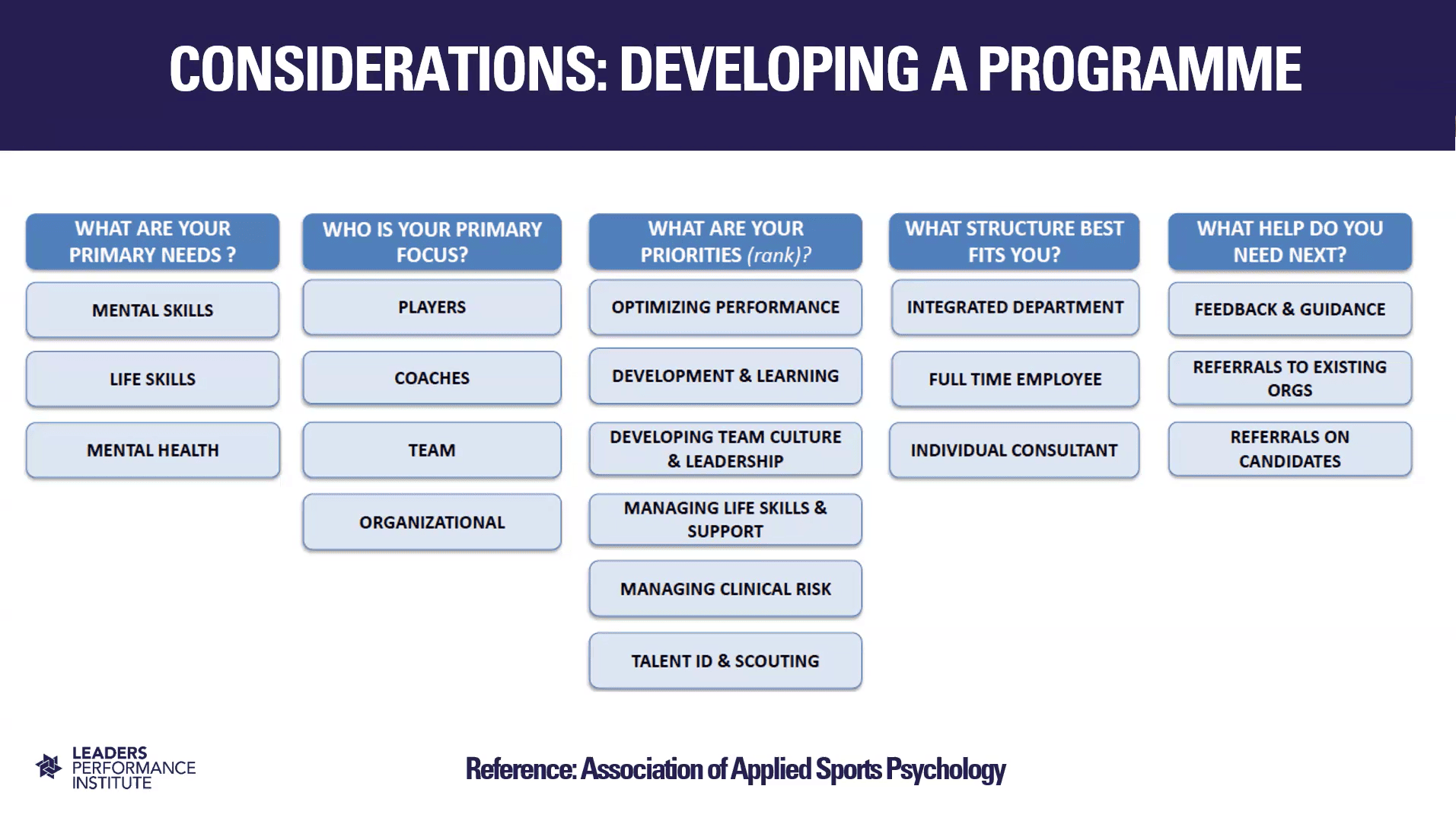
Mugford said: “What information do you need to gather and seek? [After using a decision-making framework] I often find there might be a search and interview process that organisations sometimes put on hold because they realise they have now got a different decision to make.”
Embed psychology as another performance service
“High-profile sports environments are unforgiving,” said Mugford. “It’s like you put someone in a room and, if they fail, their credibility and trust may be done.” Psychologists have fallen into this trap in the absence of a proper induction.
He argued that it is on key stakeholders to manage inductions and help the psychologist to build trust, particularly in environments where they might be unaware of social or sports norms. “It can create havoc and a longer pathway to building relationships,” he added. “The onboarding process can really minimise the downside and accelerate the positives. We underestimate that window.”
The work can be hard and lonely, as Hampson explained. A psychologist might be spread thin due to budgetary reasons or because their role is too broad and ill-defined. “It’s always really hard to be in the helicopter and going ‘what is psychology trying to achieve here?’ and simultaneously be on the ground driving things forward while being a really good practitioner.”
For Hampson, the solution is a leader able to set the direction, to bring in people with the right skillsets and develop them against established markers. Then, the psychologist “can deliver with the guidance of the person above them”.
That structure is critical, as Mugford explained. “Organisations will often over-index on fit, personality and EQ, whereas building a team or programme, even language that sticks for a culture, that goes beyond an individual’s preference or training is something for teams to think about.”
Find ways to track, test and refine your psychology work
Some people in sport openly lament the perceived lack of metrics in psychology. This frustrates Hampson: “I see psych fall down because it’s not defined well enough early enough.” However, if you are clear at the beginning, “90 per cent of it can be tracked. The broader you are, the less defined you are, it’s harder to ask: ‘is this actually having impact?’”
Benchmarking tends to be an area where sport excels, but not when it comes to psychological services. Hampson said: “I think sports should be more confident in going ‘if we’re clear on what we’re doing, more often than not, we’ll be able to give you an indicator here, whether that has done what we want it to do’; and then, like any science experiment, if your first intervention doesn’t lead to the outcome that you want, it gives you a real good platform to go ‘OK, why did that not work? And what do we need to adapt and change?’
“I think that’s really hard to do in a really objective way when you’re not setting that in the first place.”
What to read next
Sports Science Research: the Strengths, Weaknesses and Opportunities
John Bull of Management Futures set out a series of easy-to-adopt measures that could make the difference between winning and losing.
It’s easy to say that, as a battle-weary 32-year-old facing a younger, stronger champion, Ali had little choice when selecting his approach.
Foreman had won 37 of his 40 fights by way of knockout and was confident of adding No 38 to his unbeaten record in the early hours of 30 October at Kinshasa’s packed Stade du Mai 20.
Yet Ali later said his decision to stay on the ropes and allow Foreman to tire, which set him up to secure an eighth-round knockout, was made on the fly. He backed himself to absorb Foreman’s punishing body blows and wait for his moment. Foreman had only been taken to eight rounds four times previously in his career, so there were question marks over his stamina. The longer Ali could last – easier said than done – the greater his chances.
“I didn’t really plan what happened that night,” said Ali in 1989. “But when a fighter gets in the ring, he has to adjust to the conditions he faces.”
That Foreman could be lured into rope-a-dope was at least deemed possible by Ali’s coach, Angelo Dundee, who was seen loosening the ropes (to make leaning back easier) prior to the fighters’ ring walks. But that’s another story.
Ali’s defensive tactics, particularly during the fight’s final rounds, chimed with John Bull, the Director & Lead for High Performance Research at Management Futures (and big Ali fan), as he told an audience at the 2023 Leaders Sport Performance Summit in London.
Of his hero, Bull explained that a wave of fear came over Ali “for the first time in his career” as he sat in his corner at the end of the first round.
“Ali was really scared; and then 20 seconds later said to himself ‘I’m going to need to outthink this guy’,” Bull said.
Outthink Foreman Ali did; and Bull argued that such adaptability could be commonplace in sport with the right approach.
“I do believe some people are more naturally creative, but there are ways and structures that help anyone become more creative,” he continued while likening the process to strengthening muscles.
“What I love about these techniques is you can learn them really quickly. Practise any of these techniques for more than 15 minutes and you will be better than most people.”
These are the techniques Bull shared with the audience.
The STOP process for creative problem-solving

“I love STOP,” said Bull. “It’s a really simple way to get people thinking about ‘how are we doing that?’ How often do we take the STOP moments during a game, during the season etc. It’s a quick, short use of time.”
Bull then presented five strategies for encouraging athletes to adapt to the challenges or opponents facing them.
If you can find new ways to consider your problems, it can open up new ways of thinking.
Bull used the example of an elevator. Perhaps your goal is to make the elevator go faster, but what if your aim was to make the wait less annoying?
“Most hotels will put a mirror beside the elevator,” he said. “That seems to kill time when we’re looking at ourselves in a mirror.”
Bull suggested we “think of at least three different ways we could define our goal, to help open up new ways of thinking about the problem”.
If you can map the different categories of possible solutions it can prevent you narrowing in on just one type of solution.
Bull asked members of the audience to take a pen and piece of paper and write down as many sports as they could think of in one minute.
He then proposed a rerun of the exercise where the paper includes sub-categories such as ‘team’, ‘individual’ or ‘in or on water’. It might look like this:
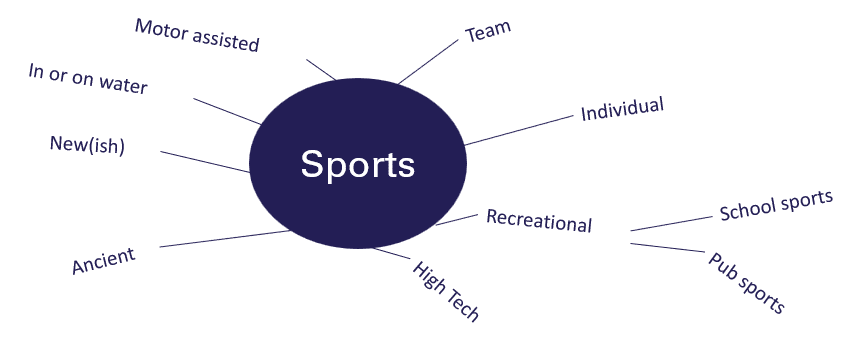
“What mind mapping is very good at doing is getting us to think more broadly,” said Bull. “What we tend to do when we’re being creative is we’ll come up with one or two ideas quickly as you would have been doing there, but then we tend to stay in that same vein of thought. So if I come at this using mind mapping, the first question you ask yourself mind mapping is not what sports can I think of, but what categories. Once you come up with a category, the brain very quickly accesses four to seven ideas.”
Step change thinking is the idea of setting a very stretching goal and then thinking how that could be possible.
Bull posed two questions:
He shared the following example:
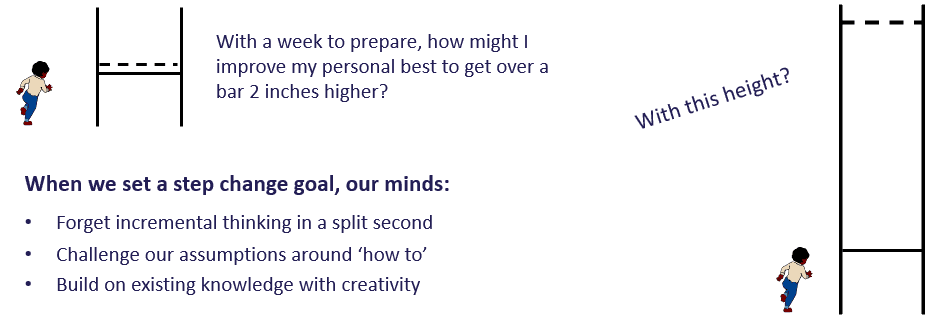
To underline his point, Bull explained that step change goals are common at Google where employees often set – and meet – seemingly impossible goals. “They’ll take any performance measure they want to get creative with and they’ll say ‘times it by ten’ and ask ‘how would we do that at a ridiculous level?’ just to provoke creative approaches.”
This notion is straightforward enough:
Bull cited the real-world example of paramedics in England. Providers of ambulatory care would like to reach people who suffer heart attacks within eight minutes, which is impossible by road in areas such as rural Norfolk in East Anglia. “You ask ‘how could we make that happen?’ And the answer that came up was you could train someone in every community to be able to keep someone alive until the first-responders arrive.”
Sport is not life and death, but a similar thought process could prove useful.
Who has already solved your problem and what can you learn from them?
In answering this question, New Zealand rugby, as Bull explained, turned to ballet for help with its lineout lifting.
“Rugby’s been doing this for 25 years in terms of assisted lineouts. Ballet’s been doing this for a few hundred years – they probably know a little bit more about it, so it’s that idea of going outside.”