Here are a selection of best practice tips from members of the Leaders Performance Institute.
Former US President Dwight D Eisenhower wrote that line in a letter to a US diplomat in 1950 and repeated the sentiment throughout his eight years in the White House.
The line was quoted by Patrick Mannix, the Sports Science Senior Manager at US Soccer, at a presentation to Leaders Performance Institute members in 2025.
“The idea behind this quote is that high-performance teams don’t necessarily have a static plan,” said Mannix.
“The plan is constantly evolving as new information comes to light, whether that’s in relation to the tournament that we’re playing in, the players that we’re working with, and a variety of other contexts that are relevant to the world of international soccer.”
With a considered plan, a leader can align their people and allocate their resources effectively. With a structured review process, improvements can be sustained.
That is the message at the heart of a forthcoming case study virtual roundtable hosted by Mannix’s US Soccer colleague, Teena Murray, who will speak in her capacity as the organisation’s Director of Performance and from her experience of leading performance programmes at the NBA and NHL.
Here, we foreground Murray’s presentation with a selection of five best practice insights in the realms of planning and reviewing delivered by members of the Leaders Performance Institute.
1. The VMOST framework
‘The organisations that perform most consistently are not those that plan less,’ wrote James Thomas. ‘They are those that build solid foundations, plan with intent, adapt with discipline and continue to stay rooted to the agreed values and behaviours when circumstances change.’
Thomas, the Performance Director at Warwickshire County Cricket Club, wrote these words in February.
He argued that while planning is often perceived as control, he believes it to be the opposite:
When the direction is clear, planning is decentralised. Coaches, athletes and staff can act with confidence because they understand the broader context. When strategy is absent, everything escalates upwards. Decisions slow, responsibility blurs and energy is wasted re-litigating the same conversations week after week.
Thomas then introduced business strategist Rakesh Sondhi’s VMOST (Vision, Mission, Objectives, Strategy and Tactics) framework, which ‘provides a disciplined way of connecting the big picture of the future to the daily actions, tasks and deliverables required to get there’: 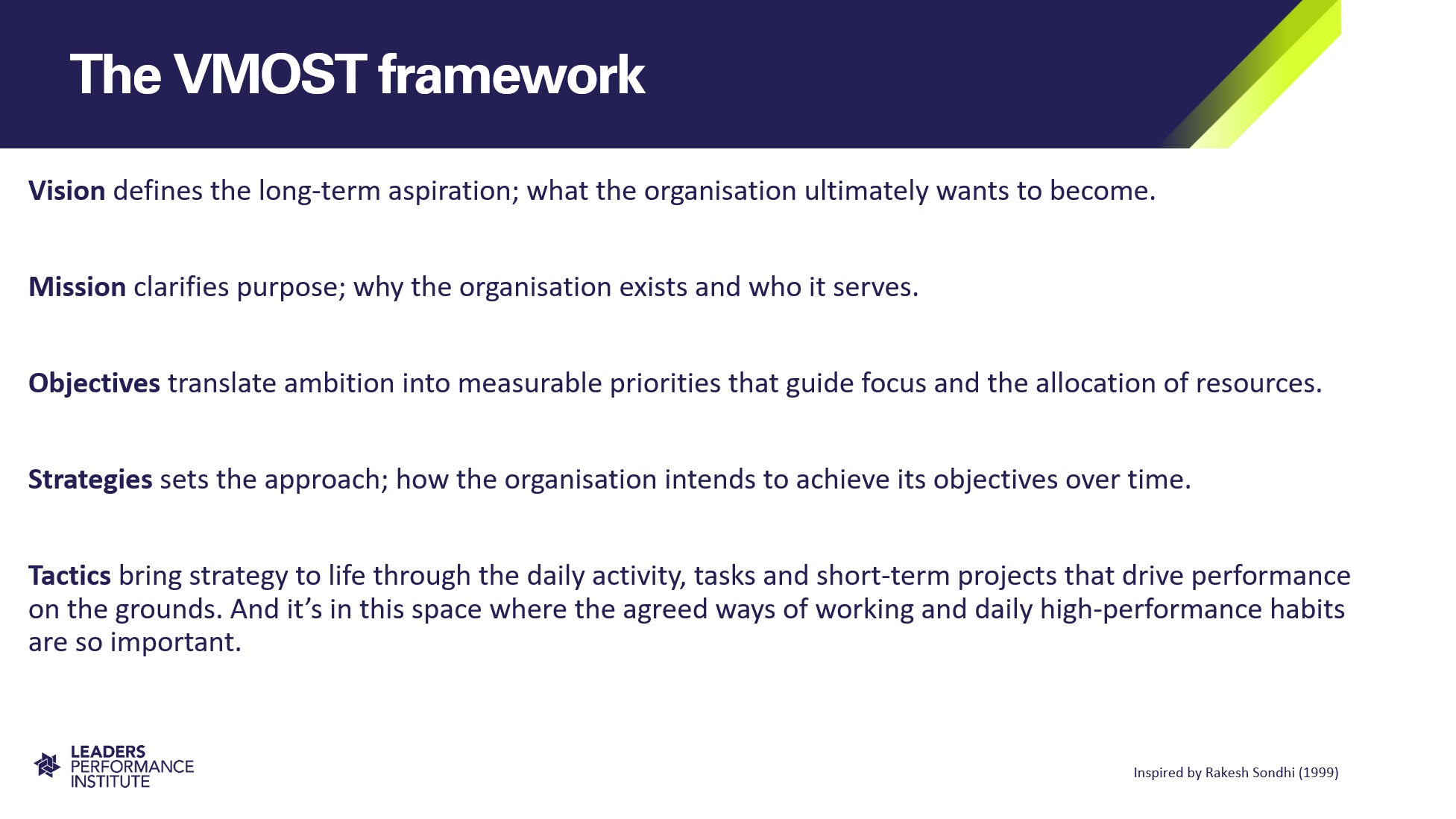
‘The power of VMOST lies in its simplicity,’ Thomas continued. ‘In high-performance environments, complexity is already high. Strategy models must reduce cognitive load, not add to it. VMOST creates line of sight. Individuals can see how their daily work connects all the way through to the long-term vision of the team and/or organisation.’
Finally, ‘when applied well, this kind of structure does not constrain creativity. It enables it. People can feel empowered to adapt, innovate and solve problems within a clear strategic frame’.
2. Find the right time for athlete education
Paul Ford, the outgoing Head of Performance at the British Olympic Association, explained in a recent article that an Olympic Games environment ‘is the worst possible place for trying to get people to peak and perform to the best of their capabilities’. He wrote:
Athletes are compacted into a brand-new village of more than 16,000 people who are all subject to a constrained competition schedule in what amounts to 52 world championships in 17 days, all in the same city.
It’s almost like they are being set up to fail when they’re expected to deliver the best performance of their lives.
The key, he argued, is tapping into the bits of the Olympic experience that build you up and not the elements that can detract from your performance. Athlete education is a critical element of the BOA’s fixed Games plan and comes in the form of discussions. ‘When to land these discussions is the next question,’ wrote Ford, before adding:
[Ahead of the 2028 Los Angeles Olympics] some sports, such as sailing and canoeing, will know their Olympians as early as September 2027; others, such as track and field, won’t select until May 2028. So the education journey we go on with the sailors and canoeists is long; we can plan out and get that right and drip feed it at the right times. Whereas the track and field athletes don’t want to hear anything about the Games because they’re not necessarily going. We must be smart in making the education bespoke and fit for purpose for each sport. Equally, some will want us to sit down and talk it through while others just want those short videos and podcasts. It’s finding out how the different cohort of athletes’ best digest information.
3. It is critical to learn from failure
In October, Everton’s Head of Sport Science, Jack Nayler, penned his thoughts on what it takes to look at a failure and ensure lessons are learned (primarily in the context of complexity in sports high-performance systems).
He shared his reflections on the late Richard Cook of the University of Chicago, specifically his treatise entitled How Complex Systems Fail.
Nayler wrote:
Around this time, I was challenged by a friend in the industry to put together my thoughts on building a performance department for a sports team. I found it challenging just to make an org chart and list positions without giving the background and rationale for why and how the department existed in that structure as well as its philosophical construct. This exercise of transferring ideas from my head on to paper forced me to critically confront my assumptions and crystallised my thoughts on how I believe we need to operate in the complex environment of elite professional team sports (specifically football as this has been my professional experience).
4. Embed review mechanisms
Mannix and his colleagues at US Soccer continually face the club vs country balance. In his aforementioned presentation, he spoke of the process that takes place when American players report for international duty.
“Building rapport and trust with those clubs is massively important because that helps us drive a lot of the exchange of information,” he said. “We need to know when our equipment and staff are arriving and where our players are coming from.”
Some may be in better shape than others, which underlines the need to review ahead of a session. Mannix said:
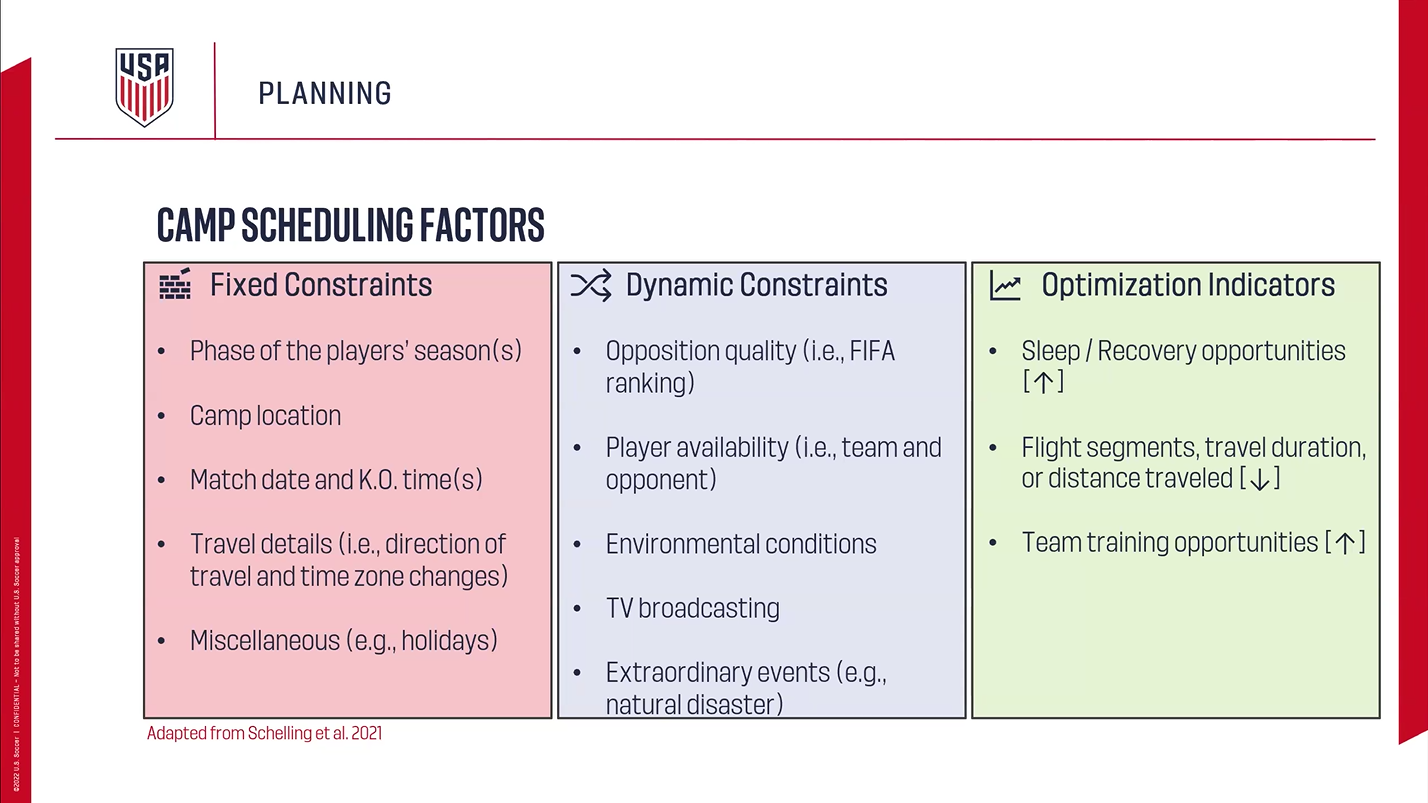
When a coach is trying to build out the session plan, the right hand is a good sports scientist or a performance coach, and the left hand is the first assistant, and those three individuals are working very closely to ensure that there’s a good plan in place for every training session. There’s good understanding as to what the availability of the players is going to be, particularly in the first two days of training, because what we’ve found through communication with clubs is we sometimes have to be flexible when players are coming into our environment simply because although Europe observes FIFA windows, we have to work with our partners in MLS on when players are released to come and join our environment.
Mannix and his colleagues understand the range of fixed and dynamic constraints they face. They use that understanding to find ‘optimization indicators’:
5. Pursue collaborative planning where possible
Where can you pool your resources with others for the collective good?
In 2024, the UK Sports Institute, US Olympic and Paralympic Committee, Australian Institute of Sport and High Performance Sport New Zealand formed the Global Alliance, which enables them to share sports science research and best practice when it comes to their female athletes.
The Global Alliance is a case study in what can be achieved in time and resource-limited environments when organisations collaborate in areas with little impact on competition itself (they still want to beat each other).
The Alliance’s main objectives, as explained on a Leaders Community Call in November 2024, include…
Additional reporting by Sarah Evans, Rachel Woodland and Lottie Wright.
In the first of a three-part virtual roundtable examining tech-focused innovation, Leaders Performance Institute members discussed how to turn creative thinking into tangible outcomes.
The figure surprised both the Leaders team and Professor Fabio Serpiello, the Director of Sport Strategy at Central Queensland University, because most of the survey’s respondents work for well-resourced professional teams. It was reasonable, we felt, to assume that they’ve progressed beyond such concerns.
“We thought this warranted further discussion,” said Serpiello, who led the first of a three-part virtual roundtable series aimed at exploring the dynamics of tech-supported innovation in sport.
We must point out that none of the Leaders Performance Institute members in attendance contradicted the survey’s findings (which you can read in our Trend Report). Some recounted the type of problems they encounter when it comes to innovation.
“Some problems can definitely be too big,” said one experienced high performance specialist working with military units in the US.
“You may not get support because of the priorities of the major decision makers that control the purse strings.”
What is ‘innovation’?
Serpiello believes the first step is simply to define ‘innovation’.
Even more importantly, he argues that teams should alight on a shared definition; one that does not conflate the concept with ‘creativity’. (Creativity, as Serpiello explained, is the outcome of an ideation phase, while innovation covers the execution and eventual impact of an idea.)
He makes the case that when teams have an agreed definition of what ‘innovation’ means to them then it offers a “clear way to approach and analyse whether the innovation processes in your organisations work or not.”
Serpiello himself likes the definition proffered by Scott Anthony in his 2011 Little Black Book of Innovation: ‘Innovation is something different that has impact’.
He then asked the practitioners and coaches at the table for their definitions. Answers ranged from the refinement and optimisation of processes to the value of novelty and pursuit of greater efficiency.
“These are all linked to a practical outcome,” said Serpiello.
Greg Satell’s Model of Innovation
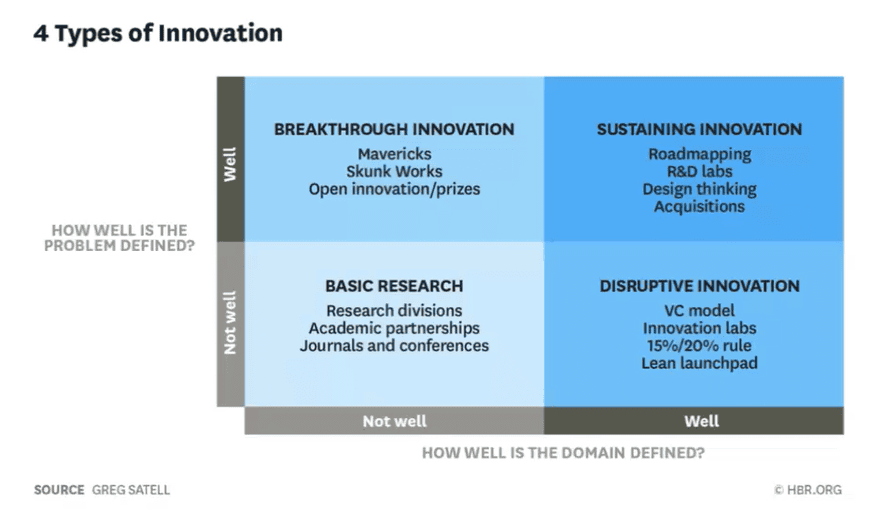
Innovation, Serpiello argues, comes in several shapes and forms depending on the nature of the problem. To make his point, he introduced renowned change management specialist Greg Satell’s Model of Innovation, which provides a practical framework for introducing innovative practices, encourages strategic thinking about problems and helps to facilitate better collaboration.
He presented a diagram of Satell’s model to the table:
Serpiello then shared his thoughts on each quadrant:
Basic research – a low understanding of both domain and problem: “We don’t really know what the problem is and we don’t really know in which field or area it happens.”
Disruptive innovation – a well-understood domain but poorly understood problem: “In this area you may need something like innovation labs or launch pads.”
Breakthrough innovation – a poorly understood domain but well-defined problem: “This is the reverse of disruptive innovation… the classic example of open innovation.”
Sustaining innovation – a well-understood domain and problem: “The most common form in sport [and often the subject of] continuous research, design thinking or road mapping.”
There were three areas in particular where the table thought Satell’s model could prove useful:
As Serpiello wrapped up proceedings, he set the scene for session two, which will focus on decision-making frameworks in the context of technology-driven innovation.
What to read next
Wars, Pandemics and Brexit. How the European Space Agency Manages Uncertainty
In the first part of a miniseries exploring complexity in sport, Everton’s Head of Sport Science Jack Nayler explains how a watershed moment transformed his approach to his work.
However, in a truly complex manner, it was the combination of my lived experience to that point, my educational background and the reading I was doing in my own time around the subject that led to my appreciation of complexity and its implications for those concerned with sporting performance.
Over the course of four articles, I want to explain how I see the world of elite sport, the complex system at its heart, and the most effective way I currently see of managing performance within that context.
I will delve into the implications for sports and the operations within teams before outlining what this all means for leaders in this space.
But first, I want define what a complex system actually is and set out its characteristics.
Learning from failure
My real understanding came, inevitably, in learning from failure.
The white paper by the late Dr Richard Cook of the University of Chicago entitled How Complex Systems Fail was instrumental in helping me to understand the ramifications of complexity on the undertaking of performance in a sports setting.
Dr Cook was an anaesthetist and simultaneously and internationally respected researcher. His short treatise is regarded as one of the most influential works in the field of patient medical safety. It was this understanding of how systems fail that brought together everything else I had seen and learnt and began to change the way I saw performance management in professional sports.
Around this time, I was challenged by a friend in the industry to put together my thoughts on building a performance department for a sports team. I found it challenging just to make an org chart and list positions without giving the background and rationale for why and how the department existed in that structure as well as its philosophical construct. This exercise of transferring ideas from my head on to paper forced me to critically confront my assumptions and crystallised my thoughts on how I believe we need to operate in the complex environment of elite professional team sports (specifically football as this has been my professional experience).
So, what do we mean by complex?
Dave Snowden is a researcher in the field of knowledge management and is the creator of the Cynefin Framework that helps us to make sense of the different types of environments in which we operate.
‘Cynefin’, which is pronounced ‘ku-nev-in’, is a Welsh word explaining there are multiple factors in our environment and our experience that influence us in ways we can never understand.
The model contains five domains, all of which can exist at any given moment, and we move between them:

Source: HBR
The clear domain has obvious cause and effect and well-established best practice. There are many examples of this in elite sports, for instance, data hygiene when downloading and analysing GPS data or packing medical equipment for an away match.
In the complicated domain, there are correct answers to problems, but they may take some expertise or understanding to deliver and there are governing constraints within which the answer will lie.
An example from sport would be developing a fuelling strategy for a player in a match. We need learned expertise in nutrition and we need to do some analysis on the demands that player faces in match play, as well as understand how their physiology responds to those demands. There are then governing constraints (carbohydrate is the main fuel source in performance) but within those constraints, the solution will be different depending on the sport and the athlete, but the solution can be determined.
I find the easiest way to consider the difference between a complicated and a complex environment is by using the analogy of a car.
A car is an extremely complicated piece of technology. The first practical automobile was invented by Karl Benz in 1885 and had several hundred components. The modern family car by comparison contains over 30,000 parts on average.
Despite this huge number of component parts, should one of them fail and the car stop working, the defective component can be replaced and the performance of the car restored. The performance of the car in this case is its ability to move with you on board and there is a linear process from depressing your foot on the accelerator to make that car move. A skilled technician should be able to completely take the car apart, rebuild it and restore its performance.
Take that same car and ask it to transport you across a city such as London and it enters a complex system where the performance of the car (the time it takes to transport you from point A to point B) is no longer determined by the car itself (it would make little difference if you drove a Ferrari or a Fiat), but in the interaction of the inter-connected parts that make up the complex system. These include the status of the driver (in how much of a hurry they are and their relative stress level), the other cars and their respective drivers, traffic signals, roadworks, cyclists, pedestrians, emergency services, major events going on that day, the time of day and the weather etc. There are many other potential components to the system, not all of which are obvious when sat in the car itself.
The performance of the car (how quickly it reaches its destination) will emerge from the interaction of all these components and each one is concurrently performing at the centre of their own complex system.
So, the first thing to know is that in a complex environment, performance emerges from between the components an in inter-dependent manner, and not from the summation of the performance of each component in isolation.
The next part to understand about complexity is that it is fractal. Fractals are geometric shapes that contain the same detailed structure at ever smaller scales. This means that complex systems exist at smaller and larger scales and nest within one another. They simultaneously are affected by the scale below and affect the scale above.
Below the scale of our car, the driver is their own complex system, and their performance is determined by (amongst other things) their genetics, upbringing, education, wellbeing, as well as how well they have slept last night, what they had for breakfast and whether they are running late or not.
At a larger scale, the performance of the traffic system designed by city planners is affected by the performance of all the cars on the roads.
The person closest to the action in the complex system has the greatest chance to affect it at any given moment, in this example it is the driver of the car. Each decision they make will create a new reality and alter the course of the complex system (for reference see the film Sliding Doors). The decision to put your foot down to get through an amber light rather than braking in anticipation of a red light will affect the course of the complex system and other components within it.
This person closest to the action may have the greatest chance to influence the performance of the system, but they also have the narrowest focus and least ability to see the big picture. This is where external information can help inform their decision (SatNav, Waze or radio traffic reports). Ultimately though, it remains their decision.
Because performance emerges in real time as we navigate through the city and react to what we encounter in front of us, we cannot with complete accuracy predict what will happen in the future as we set out on the journey, or how good our performance (the journey time) will be.
All decisions taken by the driver therefore contain an element of risk and are (hopefully educated) gambles. These decisions are being made on a moment-by-moment basis are determined in part by what has already happened and will influence what is to come.
As all the components in the system are simultaneously operating in their own individual complex system, agreement between them isn’t perfect. Thus, complex systems are never perfect, they operate in a sub-optimal mode. No route across London provides a perfect path where you will be able to drive without braking or even coming to a stop. The challenge is that we cannot know exactly where the imperfections will lie.
Once we have finished our journey and the performance is determined, the impact of all our decisions is laid bare. With hindsight our choices take on a sequential profile and we can fall victim to a narrative fallacy, where each decision makes sense in context of what came after it. What we need to remember is that at the time we made each decision, we were blind to the future and couldn’t know exactly the outcome. That left turn that led to roadworks suddenly becomes a disaster that caused all our problems, whilst the decision to cut through the backstreets, a moment of genius. However, we will never know the alternate realities of the other options we could have selected.
The last part of complex systems I wish to convey is that the more we try to control the system, the more we leave ourselves open to system errors adversely affecting our progress in the long-term.
By control I mean to attempt to force or determine an outcome. The decision to jump a red light or speed along a section of road can lead to being pulled over by the police, which will cause a delay that greatly outweighs the seconds saved through our actions. The right way to operate in the system will emerge by experimentation, trying different routes, times of day or even modes of transport to complete the journey.
To bring us out of an over-extended analogy and back into the real world I want to emphasise that we should not be fatalistic about complexity. I don’t want to come across like the system will determine the outcome, regardless of what we do to affect it. I believe we are an integral component in any system with the chance to affect its direction and outcomes (just remember they might not be perfect).
If we are also able to step back and appreciate the interaction between systems at larger and smaller scales than that in which we are currently operating, we can be very powerful.
Chaos and Confusion
The final two domains in the Cynefin framework are Chaos and Confusion. Chaos is where there are no clear rules or cause and effect at all, even with hindsight, and it is better to act now and think later, shooting more from the hip.
Confusion is the dark centre of the framework, when you aren’t sure which of the other four domains you are currently in.
Most of the time in elite sports I believe we deal with complexity and thus I think it is the most important to try and understand. In the next two parts I will go on to discuss the implications of operating in this domain for sporting organisations, and what that means for leaders in this space.
Summary
References
Cook, R.I., 2000. How Complex Systems Fail. [online] Available at: https://how.complexsystems.fail/ [Accessed 29 September 2025]
The Cynefin Company (n.d.) The Cynefin Framework. The Cynefin Co. Available at: https://thecynefin.co/about-us/about-cynefin-framework/ (Accessed: 1 October 2025)
We spoke to Arianna Criscione of Como Women, Sarah Smith of Angel City FC, and Kitman Founder Stephen Smith about the most pressing issues in women’s football.
A podcast brought to you by our Partners

That is the view of Arianna Criscione, the Head of Football Operations at Mercury/13 and Como Women. “It’s not enough,” she tells this Kitman Labs podcast. She explains that there are a range of services, from nutrition to psychology, that need to be tailored to women players.
Criscione continues: “You also have to have access to medical [support], but a lot of clubs don’t have access to a gynaecologist, which is a major part of the female body and really needs to be addressed a lot more.”
Dentistry is another area of oft-neglected consideration. “If you have an off-bite, that can actually affect your structure and how you’re running, which could cause injury.”
It is, as Sarah Smith says, about “making sure that we have a good foundation of support around our athletes.” Smith, who is the Director of Medical and Performance at Angel City FC in the NWSL, joins the conversation alongside Stephen Smith, the Founder of Kitman Labs.
In addition to discussing holistic female player development [10:45], the trio delve into bridging the gap in data and understanding in women’s football [15:45]; how talent identification is evolving [20:15]; as well as the existing disparities in data collection [28:10] from club to club and league to league.
This is episode two of a three-part series. Please go back and check out episode one, where the Leaders Performance Institute and Stephen Smith spoke to Paul Prescott of the International Football Group and Morten Larsen of Danish Superliga side Aarhus discussing talent pathways in the Premier League and beyond.
Further listening:
Kitman Labs Podcast: What Factors Drive Talent Development in the Premier League and Beyond?
Listen above and subscribe today on iTunes, Spotify, Stitcher and Overcast, or your chosen podcast platform.
In the second part of our miniseries, mental performance coach Aaron Walsh explains the importance of a vision, philosophy and framework.
Do we focus on increasing capability or reducing interference as a primary strategy?
In theory, most would agree with increasing capability but, in practice, our coaching models are often dominated by reducing interference.
There’s a time and a place for work-ons but, from a mental perspective, when we overfocus on weaknesses, players can become oversensitive to threats that could impact performance. Their thoughts drift towards what could go wrong and how those weaknesses could be exposed.
When we focus on their strengths, they are more likely to look for opportunities to express those positive points of difference. Rather than being anxious about performing, they are excited.
Your mental performance work should align with your overall performance philosophy and beliefs about how we get the most out of the people we leads, but once a team has decided on an approach to increasing its mental performance, there needs to be some strategy around the work. To do this, there are three questions to guide us:
Creating a vision for the work
Let’s start with the end in mind. What would success look like if we nail this work?
This question lets us capture something tangible and provides strategic direction with clear outcomes. It anchors us in reality while buffering us from the temptation to be reactive when various challenges arise.
Here is an example of a vision statement we can use:
‘We want to produce self-sufficient athletes who can embrace the demands of being a professional athlete while delivering their best when it matters the most.’
Success is clear. There is no ambiguity, and everyone involved in the program can align around this vision.
Capturing your philosophy
Secondly, having a philosophy about how we will achieve the vision is vital. This is more about ‘how’ we will approach the work and what will guide the delivery of the program. This should capture and reflect our broader high-performance beliefs around growth and development.
There is an equation we can use to help us define this.
High Performance = Capability – Interference
This definition poses a critical question for everyone in the performance space.
As asked above, when finding the most effective way to develop our people, do we focus on increasing capability or reducing interference as a primary strategy?
We can all think of coaches who start a review with clips about poor aspects of the team’s performance and it is normal for players to have those aforementioned work-ons at the beginning of each week.
This is not to say that there is no place for this, but we select players because of what they can do. It’s their strengths and their ability to impact the game that make them valuable members of a team. Furthermore, if all we give them are areas of their game to work on and if they change week by week depending on their game, then we endanger development through inconsistency.
Whatever your agreed approach to mental performance, it should align with our overall performance philosophy and beliefs about how to get the most out of the people we lead.
The right framework
With the vast nature of subjects and focus areas within sports psychology, it is often daunting for providers and teams to know where to start. However, a simple framework can create a strategic approach that brings clarity and direction to the work. This prevents the provider from bouncing around different subjects weekly and not building anything of substance.

The framework above is anchored in the philosophy introduced previously, which states mental skills exist to help people grow and maximise their capability. It intentionally starts with foundational subjects that build upon each other. The reason for this is linked to the growing prominence of the mental side of performance. With more discussions occurring, more articles being written, and the emergence of social media, there is a danger of replacing foundations with tools.
Here’s what I mean: subjects like mindfulness, breathing, and visualisation are helpful and, in some cases, necessary. However, they are just tools that can help under pressure. Dealing with pressure will be much more effective if these tools are married to other critical mental skills. This framework aims to introduce these skills systematically and purposely so the athlete is well equipped for the various challenges they will face. From experience, athletes who know how to grow themselves and their mindset find pressure, something they can face and overcome. Giving a few tools won’t accomplish that.
Grow yourself
The first aspect of the framework lays the foundation for mental performance. When discussing this with an athlete, we can introduce and define it by asking five questions.
Purpose: We want athletes connected to a purpose that fuels their performance. Every athlete will face challenging periods throughout their career, whether it’s injury, non-selection, or a loss of form; there are moments where doubt emerges that can potentially derail their journey. Being connected to why they play the sport and accessing that passion provides perseverance and focus during these difficult times.
Goals: Knowing what you are trying to accomplish is vital for any athlete. To understand this, here is a simple analogy. When we want to get somewhere in our vehicles, we set the destination in our GPS. We do this so we don’t get lost and waste time getting to where we want to. This is the same for an athlete; without clear goals, they can spend much time going in different directions and not get closer to their desired destination.
Planning: Once we know where we are going, we must understand how we will get there. This is where a good plan is invaluable. To continue the analogy above, a GPS provides clear steps so we arrive at the right place at the right time. Many athletes set goals and fail to determine what they must do to get there. A performance roadmap creates a focus on the right areas of development that will be critical to achieving what the athlete has set out to do
Ownership: I was recently asked what characteristics are shared among the best athletes I have worked with. Though there are many that they share, one sticks out. They take ownership of their careers. They drive the different aspects of performance and see those around them as key supporters. They don’t make excuses or play “victim” if things don’t go their way. One key aspect of this is how they use their time; they have a weekly schedule that is linked to the goals they have and the plans they have in place. They are purposeful and hold themselves accountable.
Support: The final aspect of growing yourself is about support. Throughout their career, athletes will have numerous and different perspectives offered by coaches, support staff, and agents. They need to be clear about what voices are essential. Having a clear support circle is critical so they stay on track and have the encouragement to get where they want to be.
Grow your mindset
The second aspect of the framework is grow your mindset. American psychologist Michael Gervais defines mindset as “how we see ourselves and the world we live in.” This is critical for athletes. Here are a few examples of the power of the mindset
Constant Improvement: Are athletes focused on getting better every day? Do they have a process in place to achieve this? Can they be consistent regardless of what happened the day or week before? Can they manoeuvre through the highs and lows of the game and remain anchored to their pursuit of being their best? They can reduce all the noise of competing by returning to a simple question: “How do I get better today?”
Opportunity-focused: Do they view themselves as competent, and is it an opportunity to express themselves? Or do they see themselves as imposters, and is the game a place where they get exposed? One mindset produces trust and excitement, while the other produces doubt and anxiety, both significantly impacting performance.
Antifragile: Author Nassim Nicholas Taleb defines antifragility ‘as something beyond resilience or robustness. The resilient resists shocks and stays the same; the antifragile gets better.’ This is particularly relevant for athletes, as adversity, disappointment, and failure are common obstacles they will face. Do they see this as something that destroys them or something they can learn from and be better than ever? Their mindset towards challenges is a significant indicator of future decline or growth.
Growing under pressure
The final aspect of the framework is how we deal with pressure. Most people see pressure as something to be avoided at all costs. Certain situations cause deeply uncomfortable feelings. Without the right strategy, pressure can feel unmanageable and, at times, paralysing. For athletes, there is no option to avoid pressure if they want to be successful. Therefore, they must have the tools to approach it confidently and believe it is a place where they can succeed.
As mentioned above, there are many practices and tools related to pressure. Once we have the foundations in place, they are valuable. For the sake of brevity, I won’t go into all the tools, but there is a clear outcome no matter what we use.
We want to be able to deliver our best when it matters the most.
Below are three things we can focus on to help our athletes be at their best in the big moments
1. Get calm: Under pressure, the nervous system can cause chaos. Our minds begin to race, and our bodies react. Our first port of call is getting calm so we can deal with the moment in front of us.
2. Get clear: Once we are calm, we need to manage our focus. Often, under pressure, there is a temptation to go to the outcome of a game or the consequence of getting things wrong. We want to eliminate that distraction and focus on the task at hand.
3. Let go: The final reality that can help us when pressure is present is letting go. This requires us to trust what we have at that moment and surrender. The more we try to control, the less instinctive we will become. Athletes are at their best when they are free, trust their skillset, and play what’s in front of them.
In conclusion, a mental performance program will only be effective if there is a clear strategy behind it. Here are a few questions to help stimulate this:
Further reading from Aaron Walsh:
Why the Upswell in Demand for Mental Skills Is Not Being Translated into Effective Work
Team Manager Lee Stutely explains that no stone was left unturned as the team prepared for Paris.

The team narrowly lost their bronze medal match at the Paris Paralympics 50-48 against Australia, but captain Gavin Walker was positive.
“If you’d have asked me two years ago, I’d have probably snatched your hand off for the experience of playing for a bronze medal,” he said, mindful of the transition the team has been in since winning gold in Tokyo.
“We go into another rebuilding process, another four years ahead of us and looking towards LA now,” he continued. “[We will be] growing the sport, putting time into grassroots and developing the team going forward.”
Not that any stone was left unturned in the build-up. “Our performance in Paris highlighted the progress we are making and confirmed that we remain at the forefront of wheelchair rugby,” says Lee Stutely, Great Britain’s Team Manager.
She is speaking to the Leaders Performance Institute about Great Britain’s two team camps that took place at St George’s Park in Staffordshire before the Games. The first, a seven-day visit in January, focused on their continuing preparations; the second, a four-day camp in August, represented the final taper towards Paris.
Both were a result of smart planning, with Stutely taking a lead on the logistics of the camps. “We came and rec’ed, just me and our Head of Performance Support & Science Barry Mason,” adds Stutely. “Then the coaches came with some athletes to check the playing surfaces.” From there, the coaches and performance team came together with Walker and vice-captain Stu Robinson to map out the sessions and structure.
All reflect with satisfaction on the work that was done in the last cycle. “The team’s trajectory is clearly on the right path toward further medal success,” says Stutely, “and we are driven by our commitment to high standards and continuous improvement.”
The team will conduct a post-Paris debrief to identify its strengths and weaknesses. “We will be hoping to learn if the systems and processes in place were effective,” adds Stutely, who emphasises how important it is to retain and refine successful strategies. “We will also examine what can be improved and what we should stop doing. As Paris showed, there is little between the top teams. We need to identify where can we get our marginal gains and what can increase our competitive edge in the next cycle.”

Chris Bond of team Australia is on the ground after a clash with Aaron Phipps of Team Great Britain during the Wheelchair Rugby Group B game Australia vs Great Britain. (Photo: Marco Mantovani/Getty Images)
The home of England
Great Britain qualified for Paris by finishing runners-up at the 2023 European Championships.
With their passage secured, the team could step up their preparations. While happy with their usual training facility at the Lilleshall National Sports Centre in Shropshire, Stutely and her colleagues felt that a change of scenery could reset minds and take players out of their comfort zones.
The 330-acre facility at SGP fitted the bill. Stutely says: “It made them more aware that they were moving onto a competition and preparing for something special rather than just being their home from home training environment.”
SGP is also the home of 24 England football teams. “We have quite a few football fans within our team so they were excited,” adds Stutely. “It’s historic and other senior teams have trained here, such as the England women’s rugby team. The venue is awesome for us because it’s accessible; and everything – training facilities and accommodation – is in one location.”
In addition to an onsite Hilton Hotel, the complex boasts 14 state-of-the-art football pitches, which can be configured for a variety of sports, as well as a range of indoor facilities including a full 3G pitch, a multifunctional sports hall, gym, hydrotherapy pools and a cryotherapy chamber.
The SGP team were on hand to allay any concerns. “Kevin Sanders was very good to us,” says Stutely of SGP’s Elite Sport & Partnerships Manager. The team could count on court time, gym time, meeting rooms and private dining rooms. “The Hilton were also very good at making sure we had as many accessible rooms as possible and that everything was suitable for our athletes’ needs.”
SGP is the home of England’s Para football teams and has long been committed to ensuring that the nation’s disability and impaired teams have equal access to the complex’s high performance facilities. It’s a point of pride for SGP, even if this process remains a work in progress, as Becky Bullock, the SGP Customer Account Lead at the Football Association, tells the Leaders Performance Institute.
“We acknowledge there is always more we can do,” she says. “We are continually learning, listening and striving to improve, and we remain dedicated to incorporating best practice into the future design and development of our facilities to be accessible for all.”

Aaron Phipps of Team Great Britain competes during Bronze medal match between Australia and Great Britain. (Photo: Aitor Alcade/Getty Images for IPC)
The future
The Great Britain team is aware of its legacy beyond the court, with Walker taking the opportunity after the bronze medal match to address the audience watching at home in the UK.
“For fans out there and people who are watching this, we’re all playing this sport after starting life with a disability or going through some sort of traumatic injury,” he said. “The fact that any athlete in the Paralympics is competing shows they’ve overcome adversity and everyone should be proud of any performance. I guess that’s the main message for anyone out there that is struggling – this is something that can get you out of those dark times.”
Wheelchair rugby, as Walker alluded to, is an egalitarian sport. It is built on ensuring that players with different care needs can compete together. Players are assigned a points-based value based on their functional ability ranging from 0.5 (those with the highest support needs) to 3.5 points (those with the fewest). The total point value of a four-player team cannot exceed 8.0 points unless it includes a female player, which affords a team an extra 0.5 points, taking the maximum total to 8.5 points.
“Some team bonding happens because of accessibility issues, the whole ‘no-one is left behind’ thing,” says Stutely. “They always look after each other.”
The British Paralympic Association works with Games authorities to ensure that athlete accommodation at all Paralympics is suitable for their teams’ needs. Stutely, who took part in her fifth Games in Paris, believes that environments have generally improved since the London 2012 Games raised the bar.
“As staff and athletes, we spend a lot of time being adaptable to the environment we enter,” she says. “Overcoming any challenges and learning how to control people’s mindsets when things are not going the right way is so important.”
Looking further ahead, Stutely is excited for Great Britain’s prospects. “We also have a promising depth of young and talented athletes. This blend of experience and emerging talent positions us well to continue competing at the highest level and achieve even greater accomplishments on the world stage.”
Further reading:
Pre-Season Preparations: Why a Home from Home Can Make All the Difference