Leaders in Business
  • Membership
  • Events
  • Content
  • Virtual Learning
  • Connections
  • Partners
Login
  • Leaders Meet: Innovation
  • Events
    • Leaders Week London
    • Leaders Sports Awards
    • Leaders Club Events
    • Leaders Performance Institute Events
    • Leaders Meet: Innovation
  • Memberships
    • The Leaders Club
    • Leaders Performance Institute
  • About
    • Careers
    • Contact
I’m a sports leader:
  • Off The Field For those focused on the business of the sport View more
  • On The Field For those working with an athlete or elite team View more
  • Login
    • Leaders ClubThe membership for future sport business leaders
    • Leaders Performance InstituteThe membership for elite performance practitioners
  • Newsletters
Performance Institute Leaders Performance Institute Logo
  • Membership
  • Events
  • Content
  • Virtual Learning
  • Connections
  • Partners
Login

30 Oct 2024

Articles

Why the Upswell in Demand for Mental Skills Is Not Being Translated into Effective Work

Category
Human Performance, Leadership & Culture
Share
Facebook Twitter Email Copy Link
https://leadersinsport.com/performance-institute/articles/why-the-upswell-in-demand-for-mental-skills-is-not-being-translated-into-effective-work/

In the first of a new miniseries, mental performance coach Aaron Walsh makes the case for greater integration.

By Aaron Walsh
In recent years, there has been a focus on the mind’s crucial role in achieving peak performance.

It is almost impossible to listen to an interview with or watch a documentary about successful individuals and teams and not hear them refer to the role of mental skills and their significant impact on performance.

As this awareness has grown, we have seen roles created and resources dedicated to help drive and support this vital work.

But is this upswell in demand being translated into effective work? I was curious and began to ask other mental performance coaches I knew and enjoyed some valuable interactions.

From these conversations, something quite clear and surprising emerged: though the work had been normalised, it needed to be integrated better, and as a result, the impact that both these coaches and the teams they were engaged with was not occurring to the level they hoped.

This graphic from the 2016 Rio Olympics captures this perfectly:

Image: Aaron Walsh

I wanted to understand the perceived gap between value and impact and embarked on a research project, which I’ll discuss throughout this series.

Each article will build upon the next. Here, I will define my approach to mental skills; the second will examine the need to have a framework in place for delivery; the third will capture the content that needs to be in place; the fourth will address the actual delivery of the work; and the final instalment will help you to find the right person for your team.

The mental side of performance is not 90 per cent, but it’s not insignificant either

Where does the mental side sit within a team’s overall performance?

Many coaches and athletes say it is 90 per cent but I think the real figure is much lower and, in my view, we need to correct this discrepancy because it significantly shapes the work at hand.

To compete at the highest level, your athletes must be physically capable, possess the necessary skill level, and have an effective game plan. We can measure this for most teams and benchmark ourselves against the best we play against. Sports science as well as game film and analysis give us tremendous insight into this; and we can track the growth of our teams. You can’t outthink a lousy body, lack of skill and poor strategy.

However, when everything is equal, a mysterious performance aspect relates to your ability to deliver your best when it matters the most. It’s hard to measure and quantify at times, but we all know it makes a difference.

In the insanely competitive world of high performance, the mental aspect is a competitive advantage, and if you are not investing in it, you are leaving performance on the table.

My research

I contacted 35 head coaches and performance directors and asked three questions.

The first two were yes/no questions:

Do you think mental skills play an important role in the overall performance of your team?

Do you currently have a strategy to integrate this work into your team environment?

As you can imagine, 100 per cent answered ‘yes’ to the first question, but only four (11 per cent) answered ‘yes’ to the second question.

The responses I received showed that mental skills were acknowledged as necessary, yet integrating this work effectively remains challenging for many teams.

The last question was open-ended, and I wanted to know what prevented these teams from integrating this crucial work:

What major obstacles prevent mental skills from being integrated into your team?

From this question, four major themes emerged:

  1. Lack of support from key stakeholders.
  2. The work often became siloed.
  3. The provider did not understand the demands of the environment.
  4. The information presented was often too complex and not relevant to the needs of the athletes.

The research also revealed two critical realities:

  1. Most teams don’t know where to begin

Most organisations and teams, though genuine in their desire to equip their teams with mental support, did not know where to begin.

When a team did engage with a potential provider, the nature of that work was often unclear. The work could become random, misaligned, and therefore ineffective.  As a result, the provider frequently felt siloed and isolated and usually lacked alignment with the core messages of others in the environment.

Alongside this, the lack of understanding, support and buy-in from key stakeholders (coaches, players, and support staff) created confusion about what the provider was there to do; in some cases, their role was reduced to fixing underperforming athletes, far from an ideal model and approach.

  1. A lack of clear application

Secondly, a provider who engaged with a team without integration felt a lack of connection to the needs within the environment. This meant the information they presented to the team was only sometimes relevant. The theories were acceptable, but the ability to translate them into simple information for the athletes to apply was lacking. The failure to integrate meant providers, at times, were throwing darts at a board and hoping they’d hit the bullseye.

The research raised an important question: how can we integrate this work more effectively? After all, teams value the work but are unsure how it fits within their setting.

To better understand the challenges facing most teams, it is worth exploring the five broad approaches to mental skills services:

  1. No program

Recognition of the need is almost universal, but knowing how to address it is challenging. Some teams struggled to find the right person, to have a model that fits their needs or to have a budget to invest in mental skills. They would often conclude that no program is better than one without clarity, intent, and appropriate resources. They are right.

  1. The Minimalist approach

Someone engages with the environment intermittently. They may do a few workshops. The workshops may be helpful, but they must be more strategic and embedded into the environment with follow-up for impact to occur.

The danger with this approach is that it stirs up the possibility of growing in the mental side of performance but does not effectively answer the need.

What this looks like: someone in the environment 3-4 times a year for 1-2 days

  1. The Deficit approach

This is the most common approach for teams who have begun some work. Mental skills are presented as something that is reserved for players/ teams that are struggling. This approach further drives the negative stigma associated with the mental side.

With this model, mental space can quickly become a performance scapegoat. If the team does not perform, it’s a mental issue, but the ability to address it and grow can’t occur with a deficit approach.

What this looks like: someone in the environment a few hours a week or when needs arise

  1. The Skill approach

A skill-based approach is when a team sees mental skills as something everyone needs to work on. The scope of the work consists of the team’s general mindset, providing tools to help people grow, and doing a lot of one-on-one work.

The result, however, can still be siloed from the rest of the coaching team; it is still person-dependent rather than program-dependent. Rather than having a strategy and model that shapes the provider’s work, the work relies on a person to come into a context and decide what needs to occur.

What this looks like: someone in the environment 2-3 days a week or on important tours/ fixtures etc.

  1. The Integrated approach

This is the optimal scenario and most immersed model. There is a clear strategy that everyone agrees on, buys into, and drives. Mental skills are a critical pillar of performance, and financial resources and time reflect this. They work across the whole team. The focus areas would be coaching performance, coaching the other coaches, coaching the way culture is developed and lived, and coaching the leaders in the environment.

What this looks like: they are fully integrated into the team and viewed as critical to success as a skilled coach. They are part of the environment regularly, have genuine input, and are seen as a valuable resource.

Questions to ask yourselves:

  • Does your team currently have a mental performance strategy?
  • What approach best suits your team and meets the mental demands it faces?
  • Are you setting up your providers to be successful and have an impact?

Aaron Walsh is performance coach and consultant. He is currently the Mental Skills Coach for Chiefs Rugby in New Zealand and Scotland Rugby. If you would like to speak to him, please contact a member of the Leaders Performance Institute team.

29 Oct 2024

Articles

‘Female-Specific Considerations Should Be Part of Normal Practice’

Category
Human Performance, Leadership & Culture
Share
Facebook Twitter Email Copy Link
https://leadersinsport.com/performance-institute/articles/female-specific-considerations-should-be-part-of-normal-practice/

Esther Goldsmith and Dr Natalie Brown explain how Sport Wales provides embedded support for Welsh athletes.

By Esther Goldsmith and Dr Natalie Brown
We know that females are different to males, and that we need to take that into account when working with female athletes – but what does this really mean in practice?

As we mentioned previously, there is a lot of myths and confusion about what you should or shouldn’t be doing as a practitioner or coach in sport when working with females. Unfortunately, similar to all sports science practices, there is no ‘one-size-fits-all’ approach. Every athlete that you work with is going to be different, and female athletes are no exception. In fact, when it comes to menstrual cycles, we know that this increases variation as every individual will have a different experience of their menstrual cycle, and this might even change from cycle to cycle.

At Sport Wales we work internally and externally to ensure that every female athlete in Wales can access support when it comes to female athlete health. However, this looks different depending on the context.. We have a dedicated team of practitioners who work together to provide a multidisciplinary approach to support female health and performance. As a team, we have four aims:

  1. Enhance knowledge and awareness
  2. Establish open and supportive environments
  3. Embed positive behaviours
  4. Equip with solutions and management strategies

Whilst menstrual cycles have previously been a big focus of research and delivery at Sport Wales, we also appreciate that this isn’t the only area that female athletes need support in! Pelvic health, pregnancy, breast support, female puberty, menopause and RED-S [relative energy deficiency in sport] are areas that we have expertise around and are working with sports to consider. We also make sure that female-specific factors are considered across all practitioner disciplines, and collaborate with other teams in Sport Wales, such as the coaching team, for consistency and a whole organisation approach.

Female-specific factors do not have to be standalone or demand a lot of time and resource. Instead, we promote integrating and embedding into ongoing work to support the individual athlete. Some good examples of this might be:

  • A nutritionist considering menstrual cycle symptoms alongside their nutrition advice (a female athlete may experience premenstrual nausea that means she finds it hard to fuel)
  • An S&C coach factoring in menstrual cycle phase to physical testing notes for an individual who experiences considerable fatigue during her period to account for any changes in testing results

Another approach focusses on providing education to athletes and sharing the importance of considering and talking about the menstrual cycle. The menstrual cycle has been, and still often is, a taboo or topic that isn’t often discussed, the first step to working with female athletes is to help them feel comfortable talking about periods!

This is even more of a challenge when talking about pelvic floor health and stress incontinence. We encourage female athletes to track their own menstrual cycle so that female athletes understand what their cycle means for themselves; what symptoms they experience, how that relates to training and competition and how to manage or reduce symptoms. In addition, we help support female athletes to understand the importance of having a regular menstrual cycle and when to seek help if periods become irregular or symptoms are severe. Tracking can also be a useful starting point to initiate conversations about female health.

We also work with coaches and support staff to educate them about the menstrual cycle; we have created four online e-modules that any sport and practitioner across Wales can access. Whilst education for athletes, coaches and practitioners helps improve their knowledge which we know can help everyone feel more confident to have conversations, we also provide education and support on ‘how’ and ‘what to do next’ to encourage conversations and support to be translated into practice.

From a behaviour change perspective, education and training are two possible interventions. However, enablement and environmental restructuring are additional interventions and approaches we take to support female health and performance.  For example, helping sports contemplate the environment they provide and whether it is set up for a menstruating athlete (e.g. are there period products available during camps?).

Over the last five years, there has been a lot of progress internally amongst the practitioner team at Sport Wales to better support female athletes in Wales. We have worked hard on:

  • Increasing normalised conversations related to female health internally and externally
  • Engaging sports around female-specific monitoring (and facilitating this)
  • Challenging practitioners to consider sport science and medicine support through a female athlete and health lens
  • Building trust with athletes to talk about female-specific topics
  • Creating an open culture where people are receptive to learning and asking questions

Embedding female health support into practice does not have to be complicated or require additional time and resource – it should not be an ‘extra thing’. It is important to support the individual athlete, and female-specific considerations should be incorporated into this as normal practice. A huge amount of support can be provided through open conversations and environments between the athlete, coaches and practitioners.

In our next article we will explore conversations with female athletes in more detail.

24 Oct 2024

Articles

Your Coach and Analyst Disagree? That’s No Bad Thing

Category
Data & Innovation, Leadership & Culture
Share
Facebook Twitter Email Copy Link
https://leadersinsport.com/performance-institute/articles/your-coach-and-analyst-disagree-thats-no-bad-thing/

As Vignesh Jayanth of AS Monaco explains, when data is integral to your performance conversations, the analyst can better place themselves at the service of the team.

By John Portch
When the Leaders Performance Institute asks Vignesh Jayanth what tool would enable him to do his job better, his answer is both light-hearted and instructive.

“I’d like a robot that could do my job and I just tell it what to do,” says the Head of Sporting Insights at AS Monaco with a laugh.

Time, resource and support are precious commodities for data analysts. They can only be earned through trust and belief in the value of the insights they provide.

“Data can help to make decisions, set directions and add value to people’s opinions,” Jayanth continues, “and it’s also there to ask the right questions. The important thing is to create a holistic picture to help a player or coach understand what they’re doing and why they should be doing it.

“Numbers sometimes speak louder than simply saying things.”

But what makes those numbers the right numbers? With Jayanth’s help, we explore how your analysis team can turn insights into a critical performance edge.

For better integration consider: is your insight ‘great-to-know’ or ‘good-to-know’?

How integrated is data analysis within your multidisciplinary work? If you struggle you’re not alone; it is arguably the analyst’s most enduring challenge. Where it exists, integrated analysis can provide insights that will inform decision-making, both for the match at the weekend and looking further ahead.

But it’s often tricky to reach that point. “Maybe overtime you gain that sort of trust, but in football, it’s quite hard because there can be lot of turnover,” says Jayanth of European football in general.

How can the analyst better help themselves in a volatile world? A clear data strategy with the right support structure helps but, too often, data analysts struggle when making the distinction between what Jayanth terms “great-to-know” (“something that could influence the next few games or the next two to three months”) and “good-to-know” (“something that could influence future practice”).

“Analysts get pulled into the tendency of everyone putting their heads down and working towards the weekend ahead,” he continues. “It’s always nice to take a step back and look at things from a global perspective.” Indeed, you should reiterate those good-to-knows occasionally. The frequency may depend on whether or not you are running data analysis from your academy through to your senior team or whether you are part of a wider team quietly running models in the background.

Take athletes and coaches through a ‘process of realisation’

Data must be relevant and consumable at the right times. The data, in Jayanth’s case, needs to be football-relevant and, ideally, will be “encapsulated in one or two points.”

There is what he calls a “process of realisation” for coaches and performance staff. He says: “What I’ve learned over time is it’s better to ask questions with information that you have and then the coach can try to understand what’s needed by themselves. It has to be a process of realisation because no-one wants to be told what to do”.

As a coach begins to make their decision, they might also bring other members of staff into the conversation. “Eventually, it’s like a circle where you say ‘I found something interesting, what do you think?’ and then the coach gives you their perspective, which could be completely different from what you’ve been thinking about.”

Such a difference in opinion is not necessarily a bad thing, even when pursuing coach or athlete buy-in. “It helps you, once you build that relationship, to go back and analyse elements for the future; and you can always bring back this conversation and say ‘this is what you mentioned, this is what I took away, and this is what we analysed’.”

Here, Jayanth’s advice for analysts is simple. “Know your audience,” he says. “Know exactly what their role is and what they are doing and eventually see how you could give them an impactful suggestion or an impactful way of making yourself more useful.”

‘No-one cares how, they just want it done – so prioritise’

As a data analyst, what is the key to working under pressure? “Prioritising helps,” says Jayanth, referring back to the great-to-know versus good-to-know balance. “It also depends on how you’re structured as an organisation”, he adds, alluding to the fact that no two clubs are the same.

Moreover, if the performance team comes to you with a request that sidelines your current projects, it is an opportunity to strengthen the standing of your work.

“The idea is to be able to communicate clearly and find a solution at that point, so if there’s something that breaks down in the process, you can just tell them ‘OK, let’s find another way’ and continue to include them in that process; but ultimately no-one cares how it’s done, they just want it done, so prioritising really helps.”

To wrap up, the Leaders Performance Institute asks Jayanth for one mistake he’s made that other analysts should avoid. “I would say finding the right place to speak to someone at the right time and then picking your battles.”

23 Oct 2024

Articles

Pre-Season Preparations: Why a Home from Home Can Make All the Difference

Category
Coaching & Development, Leadership & Culture
Share
Facebook Twitter Email Copy Link
https://leadersinsport.com/performance-institute/articles/pre-season-preparations-why-a-home-from-home-can-make-all-the-difference/

Watford, West Brom and Sheffield Wednesday all decamped to St George’s Park in July. We explore five factors that informed their choice.

Main photo: Watford FC/Alan Cozzi

By John Portch
There is rarely people lining up to praise the English weather, but the coaches and performance staff of Watford, West Bromwich Albion and Sheffield Wednesday have their reasons.

The three Championship clubs held pre-season training camps at St George’s Park in July when a number of their counterparts were visiting foreign climes.

“You can guarantee that the weather isn’t going to impact training loads,” says Watford Head Coach Tom Cleverley, who took his side to SGP between 22 and 27 July. “Sometimes you can go to Spain, Portugal and it’s too hot to get the intensities that you want.”

It was the week of pre-season where Watford started their out-of-possession work and intensity was a must. “You can’t be intense the whole pre-season because you’ll burn them out,” Cleverley tells the Leaders Performance Institute, “but for one week of pre-season, we identified that week where we could work twice a day on the pitch; we could have a meeting every day in the morning about what we’re going after; and then a meeting in the evening about a target that we’ll set for the season.”

Tony Strudwick is of a similar mindset, as he tells the Leaders Performance Institute of SGP. “We’re guaranteed a consistent weather pattern,” says West Brom’s Director of Medical. “We want to try to create that level of consistency in pre-season.”

The 330-acre Staffordshire facility, which includes a Hilton Hotel, boasts 14 state-of-the-art football pitches, which can be configured for a variety of sports, as well as a range of indoor facilities including a full 3G pitch, a multifunctional sports hall, gym, hydrotherapy pools and a cryotherapy chamber. It suited West Brom to a tee. “The one-site solution is perfect for us,” Strudwick adds.

West Brom spent 13 to 20 July at SGP – hot on the tails of Sheffield Wednesday, whose camp took place between 8 and 13 July.

“You literally come off the training pitch, you’re into recovery, lunch, you can maybe get your feet up for an hour or two and be ready for the next session and then it’s the same in the morning,” Neil Thompson, the Assistant Manager at Sheffield Wednesday, tells the Leaders Performance Institute.

Here, we explore three clubs with five similar reasons for choosing SGP for part of their pre-season work.

  1. An escape from monotony

Monotony was a big issue for Championship clubs in an off-season that for those not involved in the play-offs ran from the last day of the 2023-24 season (4 May) to the opening day of the 2024-25 season (10 August).

The gap led to an extended pre-season. “A seven-week pre-season is longer than usual,” says Cleverley, who explains that the club’s own training ground “can become monotonous if you’re doing double sessions every day for seven weeks”. SGP, on the other hand, is “second to none” in his view.

“It can freshen things up a bit and create an impact,” says Strudwick, adding that it allowed West Brom’s own training pitches a further week to recover. “It doesn’t sound like a long time, six or seven weeks, but given that you’re going to be at the training ground for the next 38 weeks, it does make sense to create something unique and special.”

Tom Cleverley, the Head Coach of Watford, explains tactics to his players. (Photo: Watford FC/Alan Cozzi)

  1. Enhanced bonding activities

SGP enabled all three teams the opportunity to promote team bonding, which is particularly critical early in pre-season when new players and staff are settling in.

“You’re there and living in each other’s pockets for a week,” says Thompson. “You might speak to an individual who you’ve never spoken to in depth.”

There are nurmeous “breakout areas” around the Hilton too, as Strudwick explains. “There are plenty of opportunities for players and coaches to interact and engage.”

“The team spirit aspect, I really enjoy,” says Cleverley. “So keeping guys together between sessions, they’re not on their digital devices, they’re together in the evenings, they’re eating together, they’re not going straight back to their rooms – they want to be around each other for that week – which really builds something to move forward for the whole season.”

Neil Thompson, the Assistant Manager of Sheffield Wednesday. (Photo: Jacques Feeney/Getty Images) 

  1. Increased training opportunities

There is real value in English teams booking camps in southern and central Europe – Sheffield Wednesday also arranged camps in Germany and Austria – but there is something to be said for having everything on hand at one site at a familiar venue. It is instructive that each of Watford, West Brom and Wednesday previously held pre-season camps at SGP.

“I’m keen to go back there,” says Cleverley, who is already onto the Watford team secretary about the idea. “I’ve had a lot of experience of St George’s Park as an international player, as a club player. I’ve played there, done a camp there with Watford, and now, as a coach.”

“We’re looking at doing the same next year,” says Strudwick of West Brom. “We wanted to reduce travel time and maximise the training opportunities. We didn’t have to get on early flights, go through airports, we don’t lose training days, we don’t lose match prep days.

“We’ve had two years of St George’s Park and both experiences have been fantastic.”

The same works in reverse, with overseas teams such as SL Benfica and AS Monaco enjoying similar benefits in the Staffordshire countryside.

  1. Complete control for clubs

Not only is there favourable training weather and pitches at SGP (“the ground staff were putting the sprinklers on at the right times,” says Cleverley), but teams have the full ability to tweak schedules as necessary or make adjustments.

Cleverley, for example, split his Watford squad in two midway through their camp in order to play Scottish Premiership side Hibernian in Edinburgh. The fixture was arranged as part of Ryan Porteous’ move from Hibs to Hertfordshire in 2023. “It was a unique week,” says Cleverley, who was still satisfied with the camp’s outcome.

A team’s plans are subject to “constant iteration” in pre-season, as Strudwick explains. He says: “We’ll have certain priorities that we want to hit, we’ll have certain individual players that need managing, and players coming back into the training process. But I’ve been in football long enough now to understand that the plan you have in early May often changes come mid-July.”

He also discusses the challenge of working in an environment where players employ external practitioners, particularly as there is no firm guidance for clubs. In any case, “it means you can’t switch off. You’ve got to be in constant contact with the players and tracking them outside of the season now.”

Darnell Furlong of West Bromwich Albion is all smiles in the gym during his club’s pre-season training camp day two at St George’s Park on July 16, 2024. (Photo: Adam Fradgley/West Bromwich Albion FC via Getty Images) 

  1. Behind-closed-doors matches

As pre-season focuses continue to evolve from conditioning to game-based, there is an increasing need to test ideas out on the grass in realistic conditions. With this in mind, the facilities at SGP can be primed for behind-closed-doors matches, which West Brom used to their advantage this summer.

The Baggies’ first two pre-season friendlies, against Bolton Wanderers and Peterborough United, were held onsite. The team played a further two fixtures behind-closed-doors (versus Blackpool and RCD Mallorca) at their West Bromwich Albion Training Ground.

The matches at SGP ticked many performance boxes for Strudwick and his colleagues. “You don’t want to go into your first game and expose the players to a 70,000 crowd,” he says. “You still have your referees but it allows you to be more flexible in playing minutes.” This is not just in terms of minutes per player, but reducing half lengths to 30 minutes, or even extending them to 60. “It gives you a lot more flexibility to nail down what you want from a team perspective.”

22 Oct 2024

Articles

How Sport Wales Is Enabling Female Athletes to Succeed on the World Stage

Category
Human Performance, Leadership & Culture
Share
Facebook Twitter Email Copy Link
https://leadersinsport.com/performance-institute/articles/how-sport-wales-is-enabling-female-athletes-to-succeed-on-the-world-stage/

The institute’s Female Health & Performance Team sets out some of the most important considerations for female athletes from grassroots through to elite level.

By John Portch
A regular menstrual cycle is generally a sign of good health in female athletes – although not all female athletes are necessarily aware of this.

“There are still female athletes who see it as a positive if their periods stop when they’re training,” Dr Natalie Brown, a Research Associate at the Welsh Institute of Performance Science, tells the Leaders Performance Institute on Teams.

“This is because it’s easier and more convenient; they’ve not got to deal with the symptoms or the bleeding.”

Yet the impact on their short and long term health, let alone performance, could be significant. “It’s an indicator that they do not have enough energy for those basic bodily functions.”

Nevertheless, such myths have grown to fill the void left by a lack of education and awareness across sport.

Brown is part of the Sport Wales Female Health & Performance Team who are working to redress that balance by seeking to identify how the Welsh sports system can better support female athletes in their health and performance.

In the first of a series of articles exploring the work of Sport Wales’ Female Health & Performance Team, we discuss some of the major health and performance considerations for female athletes as well as some of the common myths that endure.

Female athletes: long overlooked

It was encouraging to see a 50:50 split between male and female athletes at an Olympic Games for the first time in Paris earlier this year, but the stark reality is that just 22 per cent of leadership positions in sport are held by women.

This is a symptom of a wider gender imbalance. Sport, much like society, has been geared towards males, with female sport often overlooked and under-resourced.

“Females are participating more, and that’s great to see, but the environments in which they are participating have not necessarily been set up for females,” says Esther Goldsmith, who both works alongside Brown within the Female Health & Performance Team and joins her on the call.

A girls’ rugby team, for example, may not have access to suitable changing rooms or toilets. “That means they have to arrive prepared and, if they’ve not got access to toilets, what does that mean if you’ve got someone on her period?” says Brown.

“Even in just focusing on the menstrual cycle you’re ignoring the bigger picture around women’s experiences of sport and how the system that we’ve designed doesn’t enable women to thrive in sport because they’re trying to thrive in a male system.”

She continues: “Girls go through puberty earlier than boys and so they have experienced hormonal changes at a time when they’re very unlikely to have been exposed to a strength stimulus and an appropriate movement at a young age when they would really benefit from it.”

“The other thing is access to physios,” says Goldsmith. “Most female teams don’t have access to a full-time physio, whereas male teams do.” Inevitably, female teams suffer more time lost to injuries than their male peers. “In a male setup you might have a physio input that means that there’s no time loss as a result of a niggle.”

This is compounded by the lack of sports science research on female athletes.

“Females have different biological and physical makeups,” says Goldsmith. “We know our hearts, circulation and hormones are different, our anatomy is different, and therefore our biomechanics are different.”

As long as the performance community overlooks this, from the grassroots to elite level, female athletes will leave both health and performance potential on the table.

Education

The Female Health & Performance Team is focused on trying “to provide practical, tangible things that you can do to support your female athletes without it becoming too complicated or time-consuming to achieve,” as Brown puts it.

Education is a significant lever. “A lot of teams say ‘we need education’ but then they don’t necessarily know how to deliver it,” says Goldsmith. “I will deliver some classes to athletes, coaches and practitioners and work with them to help them take responsibility for themselves.”

Sport Wales is aiming to create a culture where everyone, from board members to volunteers, considers the importance of female health. Goldsmith and her colleagues work with athletes and coaches to address health, wellbeing and performance questions.

It might involve classroom discussions but it could also take in one-to-one sessions. “If you’re working with an athlete there’s a bit of that ‘we’ve got to work on this together’ because every female body is completely different and everyone will respond in a different way,” she adds.

“You’ll go into some sports and work with some female athletes and they’ll respond to or act differently with you to how they might in their day-to-day training environment because you’re external and not part of their setup.”

Goldsmith will also adapt her approach depending on to whom she speaks. “Classes will look different depending on what part of the pathway you’re working on because a 14-year-old is going to respond very differently to a 25-year-old.”

She and her colleagues also strive to go beyond “surface level” initiatives and have carried out behavioural mapping. “How do we actually change behaviour so that females are considered, whether that’s with the athletes themselves or with the coaches and performance directors to look at actionable ideas?”

Myth busting

Around 90 per cent of athletes who menstruate report some symptoms including pain, reduced motivation and fatigue. Brown uses this stat to set the scene for an illuminating story: “I once asked an athlete if their menstrual cycle affects their training and they said: ‘no, not at all. I just miss training if I’m really struggling’. I just had to sit there and say ‘OK, we’re going to have to take a step back here’.”

Brown and her colleagues routinely dispel common misunderstandings and myths.

One such myth is the supposed need to periodise training according to an athlete’s menstrual cycle. “There is inconsistent evidence  that you should completely adjust all of your training based on phases of the menstrual cycle,” she says.

Media headlines suggesting links between ACL injuries and the menstrual cycle have not helped. “I’ve worked with some athletes who are petrified of training in a certain way at a certain time because of those headlines and their anxiety,” says Goldsmith. Another persistent myth is the idea that stopping the use of hormonal contraceptives will restart someone’s cycle (they may experience a withdrawal bleed, which is not the same as a menstrual bleed).

Coaches are just as susceptible to these myths. “You could see them, especially with team sports, asking ‘well, if I’ve got two athletes in that phase and two athletes in that phase and 20 in that phase, how do I make sure that they’re all training based on their phases?’” All are relieved to hear there is an alternative solution to providing female-specific support.

One might also assume that a female coach would be more sympathetic to the needs of a female athlete but that is not always the case. “Some female coaches or practitioners, for example, never had any menstrual symptoms,” says Brown. “Some of them therefore don’t have the automatic motivation to consider it, and sometimes both male and female coaches can perceive athletes as using their symptoms as an excuse.”

It is important that it is not just females either, particularly as the majority of coaches are male. Some have a wealth of knowledge in the area, others don’t. “If you ask male coaches if they think there should be equal opportunities for males and females they wouldn’t say ‘no’,” says Goldsmith. “But that doesn’t mean they’ve factored some of the things we’ve talked about into their practice. They just haven’t developed that understanding. But when you start communicating it as a performance thing, they’re like ‘OK, this applies to the world I live in’.”

To further help athletes, as well as their GPs, Sport Wales Medical Consultant, Dr Katy Guy, has prepared a letter that female athletes can take to their GPs if they were to notice a change in their menstrual cycle. “We know GPs are under the cosh and have a lot to think and know about, so we’re just trying to create a resource to help bust that myth beyond our institute,” says Goldsmith.

For all the obstacles that remain, both Brown and Goldsmith are optimistic.

“In the last two years there’s been quite a shift,” says Brown. “Before that, the conversation was starting and there was some awareness but it was more around what was not being provided. There’s been an increase in both research and support in the last two years.

“The increased visibility of women’s sport has also supported that shift. So rather than us saying ‘this is important, you need to consider it, this is why’, I feel like we’ve shifted towards sports, athletes and coaches saying ‘we know it’s important. What can we do?’”

Stay tuned for upcoming articles where Brown and Goldsmith provide practical suggestions and solutions for supporting female athletes, from enhancing knowledge and establishing supportive environments to embedding positive behaviours and suitable management strategies.

Further reading:

‘Female-Specific Considerations Should Be Part of Normal Practice’


3 Oct 2024

Articles

The Debrief – a Snapshot of Powerful Discussions Happening Right Now Across the Leaders Performance Institute

Category
Leadership & Culture
Share
Facebook Twitter Email Copy Link
https://leadersinsport.com/performance-institute/articles/the-debrief-a-snapshot-of-powerful-discussions-happening-right-now-across-the-leaders-performance-institute-7/

In September we addressed the pressing questions of making meetings more useful and your data more impactful.

By Luke Whitworth
Let’s begin this month’s Debrief with a question.

How many meetings did you attend in September and how many of those meetings were useful or productive?

On second thoughts, you may want to keep your counsel on that front. If you do happen to feel that your meetings were, let’s say, sub-optimal, you’re not alone.

A 2017 report in the Harvard Business Review laid out some stark facts that ring just as true today:

  • 71 % of senior managers believe meetings are inefficient.
  • 40% of employees consider unproductive meetings to be the highest cost to their organisations.
  • 50% of all meeting time is found to be effective, well used and engaging. This percentage is even lower for remote meetings.

All were discussed in a recent Leadership Skills Series session, which kicks off the September Debrief, before segueing into performance analysis.

Before we get into it, we want to thank those of you who completed our Future Trends in High Performance survey. We’re excited to dissect the findings and begin condensing this into a report which we hope you will find valuable – keep your eyes peeled for this later in the year.

Making your meetings more impactful

Let’s cut to the chase: what we can we be doing practically to make our meetings better? We set out some simple but actionable tactics to deploy right away in our September Leadership Skills Series session.

Before the meeting :

  • Ask at the outset, is a meeting actually required for this particular item? Too often we see meetings happen for meetings’ sake. Be diligent and reflective of the purpose and desired outcome.
  • If it is agreed that meeting would be useful, clearly define the purpose of the meeting before bringing the relevant people together and create an agenda with those involved. Is the purpose to make a decision? Is the purpose to brainstorm or solve a problem? On the whole, what is it and is everyone clear?
  • Create an agenda. This sounds simple but it’s important as many meetings skip this part, which can often derail the quality of the discussions. Start and finish on time. Consider allocating time for items so ‘less is more’ and identify a specific aim for each to give direction – what specifically do we need to take away from this agenda item?
  • Identify the required resources and pre-reading required for the meeting or each agenda item.
  • Instead of inviting everyone, who do we want in the room who is going to enable the decision or enable the best thinking?
  • Assign roles: a chair or facilitator? Who is leading each topic and who is the note taker? Often what happens is the expert or leader of the team ends up defaulting to the chair and facilitator. Look to vary this to bring fresh voices in.

During the meeting:

  • Start well. Start with positivity and be mindful of your body language and the impression you’re creating, as we know about the emotional contagion this can create.
  • The chair or facilitator should look to set out the ground rules from the outset, do this nice and early: share what the plan is, that there will be equal opportunity, expect interruption if the direction of travel isn’t where it needs to be, and be rigorous, especially around timings.
  • Check for buy-in and permission at the beginning of the meeting to stick to the above as this takes away some people feeling a bit nervous about coming in and stopping the conversation or moving it on.
  • Consider ‘mini diamonds’. Each agenda item becomes a mini diamond. At the top of the diamond, you look to open up the conversation and bring different people in and then the chair or facilitator needs to bring it to the end point. What were the actions and ideas that came out of the conversation?

After the meeting:

  • This is where meetings can lose their impact. A really good discussion is had, there are some actions that come out of it, but by the time we actually get the notes from it, the momentum has been lost.
  • In an ideal world, the note taker has some time immediately after the meeting where the notes can be summarised and circulated.
  • Ensure all actions have a specific person – not a department – assigned to them.
  • Ask for feedback. If you haven’t gone out to your teams or the organisation to review what people think of meetings recently, how effectively they’re being used, what’s working and what isn’t working, it’s perhaps an idea to do that.

Mobilising performance analysis: solutions for common challenges

In last month’s debrief, we touched on some of the learnings and reflections from part one of our series titled Advances in Performance Analysis. As part of that first session, we asked attendees to reflect on some of the common challenges they are facing in the space. As a refresher, these were:

  1. Integration: efficiently setting up datasets that allow for different data points to intertwine with one another.
  2. Communication of the data: consider: how good are you at data visualisation and storytelling?
  3. Buy-in: how strong is the understanding around the value of performance analysis across the organisation to show return on investment? How well are you showing and measuring the impact?
  4. Data management: given the amount of metrics being collected, is there clarity and prioritisation of what matters?

The aim of session two, was to explore these challenges in more detail and, by leaning into a couple of case studies from different environments, share some ideas and solutions to shift the dial. Those case studies were provided by the UK Sports Institute’s Head of Performance Analysis, Julia Wells, and Wolverhampton Wanderers’ Head of Performance Insights & Data Strategy, Mat Pearson. Both shared some useful ideas.

Integrating and connecting data

  • Focus on data skill development. This means upskilling the relevant staff involved, from the right data, correct formats and in the right places, before the interrogation and analysis even begins. Go back to basics and upskill everyone in the team.
  • Structures can support this too. There is clear data strategy and leadership within the UKSI environment, all geared towards supporting performance planning. Roles such as Data & Insight Lead and Performance Data Lead are embedded within the organisation to help those leading programmes with the direction and the integration of their data.
  • Do not underestimate the importance of clear strategy as part of your performance planning. Know what needs collating and why within your team.

Data collation

  • Taking the time to pause and critically reflect is really important in the process as it can be very easy to stay on the hamster wheel and just keep collecting.
  • Ask quality questions: why are we creating the data, what is its purpose, what decisions is it informing, particularly in the coaching process? Do this periodically and continue to plan, do and review.
  • Engage in conversations with key leaders in the environment to discuss what to start, continue and stop. It’s important to intentionally carve out those opportunities as part of your performance planning.

Communication of data

  • Communication is a critical skill. Wells suggested that some people would say that communication is a non-technical skill, but it is highly technical, in her opinion. Therefore, it is really important to upskill those working in this space considering the critical nature of human engagement in the process.
  • At the UKSI, staff work closely with the psychology team to help elevate understanding of self and others. If we can better understand the people we work with, it will support how to get the best out of each other. They’ve tapped into better understanding one another’s preferences to be more impactful in how they support each other.

Buy-in

  • Alignment to the sport’s strategy helps to provide a clearer connection. If this alignment and connection isn’t there, you’ll naturally get disconnection so it will be more challenging to get the buy-in.
  • Relationships are key. Invite key stakeholders and leaders into your world and shadow them. When they immerse themselves to better understand the process you’ll find that it can quickly lead to them becoming a voice for you in wider conversations.

Data literacy

This is a bonus challenge and set of solutions, which does have some relevance to communication and buy-in.

  • Often practitioners can suffer in silence when looking for solutions. In the latest Olympic cycle, the team at UKSI have introduced an internal online data community that provides access to resources. This accessibility allowed them to be able to connect with others in the network and share good practice.
  • The UKSI team put together a Data Leadership Programme which was focused on pulling together the data leaders in their sports to look at opportunities, challenges and future direction. Courses and best practices, called ‘Data Camp’, ‘Project Automate’ and ‘Code School’, were created to improve skills and processes for coaches and practitioners to help them be more efficient.

Members Only

1 Oct 2024

Articles

Make Meetings Work for you and your Team

Category
Leadership & Culture, Premium
Share
Facebook Twitter Email Copy Link
https://leadersinsport.com/performance-institute/articles/make-meetings-work-for-you-and-your-team/

Well-chaired and well-structured meetings can make a difference. Here’s how you can instantly improve yours.

By Luke Whitworth
We spend copious amounts of time in meetings and yet only 50 per cent of all meeting time is found to be well used and engaging – that percentage drops further for remote meetings.

Furthermore, 71 per cent of senior managers believe meetings are inefficient and more than 37 per cent of employees consider unproductive meetings to be the highest cost to their organisations.

These stats derive from surveys conducted across the business world and, in a recent Leadership Skills Series session, members of the Leaders Performance Institute indicated there was considerable room for improvement in their environments.

The case for more effective meetings

The Leadership Skills Series session sought to explore and discuss best practice for effective meetings, share top tips, and promote practical ideas to trial in your environment.

We started with some potential benefits when meetings are well-chaired and well-structured:

  • Improved communication.
  • Enhanced collaboration and creativity.
  • Increased accountability.
  • More effective decision making.
  • A boost in employee engagement.
  • Greater alignment of goals and priorities.

What works in meetings?

Attendees were invited to reflect on what they think works and what frustrates them in their usual meetings. Ideally, you’d double down on what works and adapt what isn’t working.

The group suggested the following as important:

  • Have a clear agenda.
  • Appoint a good moderator.
  • Ensure there is engagement from everyone.
  • Establish pre-reading or preparation to elevate productivity.
  • Ensure there is clear alignment / positioning between the goals of the meeting and the title.
  • Establish the purpose of the meeting: is it a discussion or decision focused?
  • Make sure that actions and next steps are completed and communicated.
  • Be considered in making sure that the right people are in the room.
  • Implement an agreed set of acceptable behaviours.

What frustrates in meetings?

The group believed that the following got in the way of effective meetings. If you can avoid these eventualities you should see an immediate uplift:

  • When there is a conversation between two people but there are ten in the room.
  • A lack of engagement and agreements around expectations.
  • A lack of preparation from others.
  • If last minute cancellations occur but the meeting is still run it often means the same conversations need to happen twice.
  • People ‘spectating’ or not contributing to discussions.
  • Personal agendas hijacking objectives.

Best practice: before, during and after meetings

The session provided some tactics to provide right away.

Before the meeting:

Firstly, is a meeting actually required for this particular item? Too often we see meetings occur for meetings’ sake. Be diligent and reflective on the purpose and desired outcome.

If it is agreed that meeting would be useful, clearly define the purpose of the meeting before bringing the relevant people together and create an agenda with those involved. Is the purpose to make a decision? Is the purpose to brainstorm or solve a problem? On the whole, what is it and is everyone clear?

Create an agenda. This sounds simple but it’s important as many meetings skip this part which can often derail the quality of the discussions. Start and finish on time. Avoid blocks of time – calendars on laptops and phones work in blocks, but if only ten minutes is needed or 40 minutes is better, take the time it needs and not how your calendar is designed. Similarly, in the creation of the agenda, consider allocating time for items so less is more and identify a specific aim for each to give direction – what specifically do we need to take away from this agenda item? We should be able to answer that clearly and make that obvious for the people who are attending.

Identify the required resources and pre-reading required for the meeting or each agenda item.

Instead of inviting everyone, who do we want in the room who is going to enable the decision or enable the best thinking? You don’t need everyone in the room all of the time. When there is alignment on who needs to be there, assign roles: a chair or facilitator, who is leading each topic and a note taker.

Often what happens is the expert or leader of the team ends up defaulting to the chair and facilitator, look to vary this to bring fresh voices in.

During the meeting:

Start well. Start with positivity and be mindful of your body language and the impression you’re creating. We know about the emotional contagion this can create.

The chair or facilitator should look to set out the ground rules from the outset. Do this nice and early: share what the plan is, that there will be equal opportunity, expect interruption if the direction of travel isn’t where it needs to be; and be rigorous, especially around timings. It’s important for those in the room to have confidence around the agenda.

Check for buy-in and permission (at the beginning of the meeting) to stick to the above as this takes away some people feeling a bit nervous about coming in and stopping the conversation or moving it on.

Consider ‘mini diamonds’. Each agenda item becomes a mini diamond. At the top of the diamond, you look to open up the conversation and bring different people in and then the chair or facilitator needs to bring it to the end point. What were the actions and ideas that came out of the conversation?

The note taker should not be passive. They should be pushing for actions, especially if there is an agenda item being discussed with no clear actions coming out of it.

After the meeting:

This is where meetings can lose their impact. A really good discussion is had, there are some actions that come out of it, but by the time we actually get the notes from it, the momentum has been lost.

In an ideal world, the note taker has some time immediately after the meeting where the notes can be summarised and circulated. This is really useful for clear actions: who’s doing it? By when? If these can’t be done immediately afterwards, ideally it should be the same day and certainly within 24 hours or our memory starts to fade, and we’re not capturing what we need to.

Ensure all actions have a specific person is assigned to them – not a department. And ask for feedback. If you haven’t gone out to your teams or the organisation to review what people think of meetings recently, how effectively they’re being used, what’s working and what isn’t working, it’s perhaps an idea to do that.

Some final top tips to try:

  1. ‘Peel away’

Nina Sunday is a renowned expert in workplace culture and someone who specialises in meetings. She talks about the notion of ‘peeling away’. Sunday suggests that if you organise your agenda well enough, relevant people can leave after each specific agenda item if there isn’t a need for them to be there. It prevents people from sitting in the meeting and going through the motions, plus those that have got out of the meeting what they needed.

  1. Vote

Often in meetings, there is a decision to be made, but what can materialise if a question is opened up on that decision, is that you hear from everybody in the room and it just becomes a conversation based on opinion that doesn’t help to make a decision. Before asking, check-in to see who thinks they know what decision they’ve already made to get a sense of if collating opinions is actually needed. You can ask for a show of hands or use different technologies, which is something that can help cut to the chase around the actual decision.

  1. OPUR

OPUR stands for ‘one person ultimately responsible’. Make one person responsible for an agenda item or a particular action. It keeps things clean.

  1. Fast assessment of choices

This tactic may save a lot of time but it may also prolong a meeting. On the whole, though, it will save a lot of time in the long run. Do a fast assessment of choices that considers the impact and energy of doing something. If something is low effort and it has high impact, it’s going to be a big bang. If something is going to take a lot of effort, but has high impact, it’s something that might need to be evaluated a bit more to have clarity on how it is going to be approached.

  1. Stand

Finally, hold stand up meetings. The evidence shows that it brings, focus, energy and often makes meetings shorter.

Members Only

18 Sep 2024

Articles

A Case Study in Change Management: ‘We showed them the numbers and it hit them between the eyes’

Category
Leadership & Culture, Premium
Share
Facebook Twitter Email Copy Link
https://leadersinsport.com/performance-institute/articles/a-case-study-in-change-management-we-showed-them-the-numbers-and-it-hit-them-between-the-eyes/

As Head Coach of the Australia Women’s cricket team, Shelley Nitschke was tasked with changing a winning side. She did so in four steps.

By John Portch
When Australia retained the Women’s Ashes in the English summer of 2023, there were mixed feelings for future captain Alyssa Healy.

“It feels a bit dirty in a way, but we got the result we were after,” said Healy in the aftermath. “I think the gap’s not necessarily been there as much as everyone has spoke about.”

There was a sense amongst Australia’s players that their success owed to a quirk in the format. Yes, they had won the series’ only Test match, but they had lost both limited-overs series 2-1 to England. Nevertheless, the scoring system was weighted in favour of the Test and, at the series’ conclusion, the teams were tied on eight points each, which meant Australia retained the Ashes as holders.

It was not the type of emphatic victory to which Australia and their Head Coach Shelley Nitschke had become accustomed. After years of blazing a trail and lifting trophies galore, Australia’s rivals were beginning to bridge the gap.

“There were just a few signs along the way that the game was changing and other teams were getting close to us,” Nitschke told an audience at February’s Leaders Sport Performance Summit at Melbourne’s Glasshouse.

She also spoke of her team’s resilient but laboured performances in their 2022 Commonwealth Games semi-final and final. Those matches against South Africa and India, respectively, could have gone the other way were it not for decisive moments of inspiration from Australia’s serial winners.

“We were finding ourselves in those positions more often than I would have liked,” Nitschke continued.

She had led Australia into the Commonwealths as Interim Head Coach and was appointed on a permanent basis after the competition. For all the planning that went into retaining the Ashes, the drawn series rang alarm bells in Nitschke’s mind, and the post-tour debrief was not going to her liking.

“We were happy to bring the Ashes home, but we knew there was work to do heading into the T20 World Cup [taking place in the UAE in October] and the discussions just weren’t moving the dials as much as I was hoping.”

Nitschke responded by pushing for change and her efforts have so far been vindicated by Australia’s subsequent results. The holders enter the World T20 as the favourites to defend their title.

Here, we explore the four steps Nitschke has taken to keep Australia ahead of the chasing pack.

1. She found the reason for change

Nitschke had noted Australia’s opponents’ increased aggression and strategic use of powerplays [ten-over spells in an innings where the fielding team is restricted in the number of players they can place outside of a 30-yard circle around the batting team’s wicket]. Without adaptation, Australia’s approach would not cut it at the highest level for much longer. “I went to the analysts and started to crunch the numbers and have a look at what other teams were doing and where we fared in regards to the rest of the world,” said Nitschke. “We like to think that we would have been ahead of the game, particularly around powerplays, but there were certain parts of the game where we just weren’t.” It led to a fresh set of winning measurements and KPIs; and Nitschke had her vision for change.

2. Then she found the right words

It would not be what Nitschke said but how she said it. As she prepared her pitch for change she first presented to her Team Psychologist Peter Clarke, a popular figure within the playing group. Nitschke said: “He was really useful in recommending the language to use; saying ‘don’t dumb it down and ‘don’t say it’s not a huge challenge’ or ‘just a few tweaks’.” Clarke guided Nitschke in her use of words and reassured her that in several key elements, such as assessment, stakeholder analysis and change strategy, she and Australia had already made a start. Armed with the right delivery, Nitschke could begin to instil the team’s revamped style and strategy.

3. She asked for input

After the initial pitch, Nitschke would deliver a data-informed dossier to every player during Australia’s October 2023 series with the West Indies. The coaches had already decided it was not the moment to implement wholesale change. “We contacted them and just let it stick with them for a while – it probably would have hit a few between the eyes.” It was a frank admission and not without risks. The trick was to ask each player for their opinion. “It led to some really good suggestions,” said Nitschke, who also consulted her staff, several of whom chipped in with ideas from beyond cricket.

4. She identified her change agent

When leading a transition, you need influential people to have your back when enduring setbacks. “We’ve lost a few games we ordinarily may have won,” said Nitschke, who was keen to take advantage of the relatively low stakes series following the Ashes. She would lean heavily on Alyssa Healy, who was appointed Australia captain in December 2023. “Alyssa was involved from the start in driving [the change] through the playing group.” Nitschke would need to call upon every bond of trust developed between the duo in their six years working together. She continued: “There were some senior players that were probably challenged a little bit through being asked to play a little differently than what they had been for the last few years, even though they’d been successful. It could have gone in a completely different direction because if we didn’t have buy-in from the captain then we probably weren’t going to get buy-in from the rest of the team.”

Members Only

11 Sep 2024

Articles

Debriefs and Accelerated Learning: Transferable Lessons from the World of Medicine – Part II

Category
Coaching & Development, Premium
Share
Facebook Twitter Email Copy Link
https://leadersinsport.com/performance-institute/articles/debriefs-and-accelerated-learning-transferable-lessons-from-the-world-of-medicine-part-ii/

In the second of a two-part series, Sonal Arora, an experienced surgeon, outlines how teams can do more to help their athletes as learners.

By John Portch
“What is the difference between feedback and debriefing?”

Sonal Arora, a Consultant Emergency Surgeon with the Chelsea & Westminster NHS Trust in London, posed the question to an audience at last year’s Leaders Sport Performance Summit.

“Feedback is when I am telling you what you should do,” she said following a pause. “Debriefing is a two-way process.”

Over the course of 30 minutes onstage, Arora laid out how, in a joint research project, Imperial College and its peers working in operating theatres across the United States and Australia alighted on better feedback and debriefing as the solution to improved learning and performance.

She spoke about the OSAD [Objective Structured Assessment Tool for Debriefing] and how coaches in sport might learn from the way debriefs are conducted post-surgery.

“The real secret is to try and get [the learner] to identify what their performance gaps are and how they feel, or how the team feel, they can work better to improve it for next time,” Arora continued.

“Your role as a facilitator is to wrap all of this up at the end and determine how they are going to take what they’ve learned from this session and apply it to their future practice.”

“Now let’s come back to the real world.”

OSAD, she admitted, is too detailed for working surgeons who need something accessible and appealing if they are going to open themselves up to a debrief during a busy and often chaotic day.

“How can we take those lessons [from OSAD] and translate them into something short and simple that anybody can understand?”

Arora and her peers settled upon the SHARP tool.

What is SHARP?

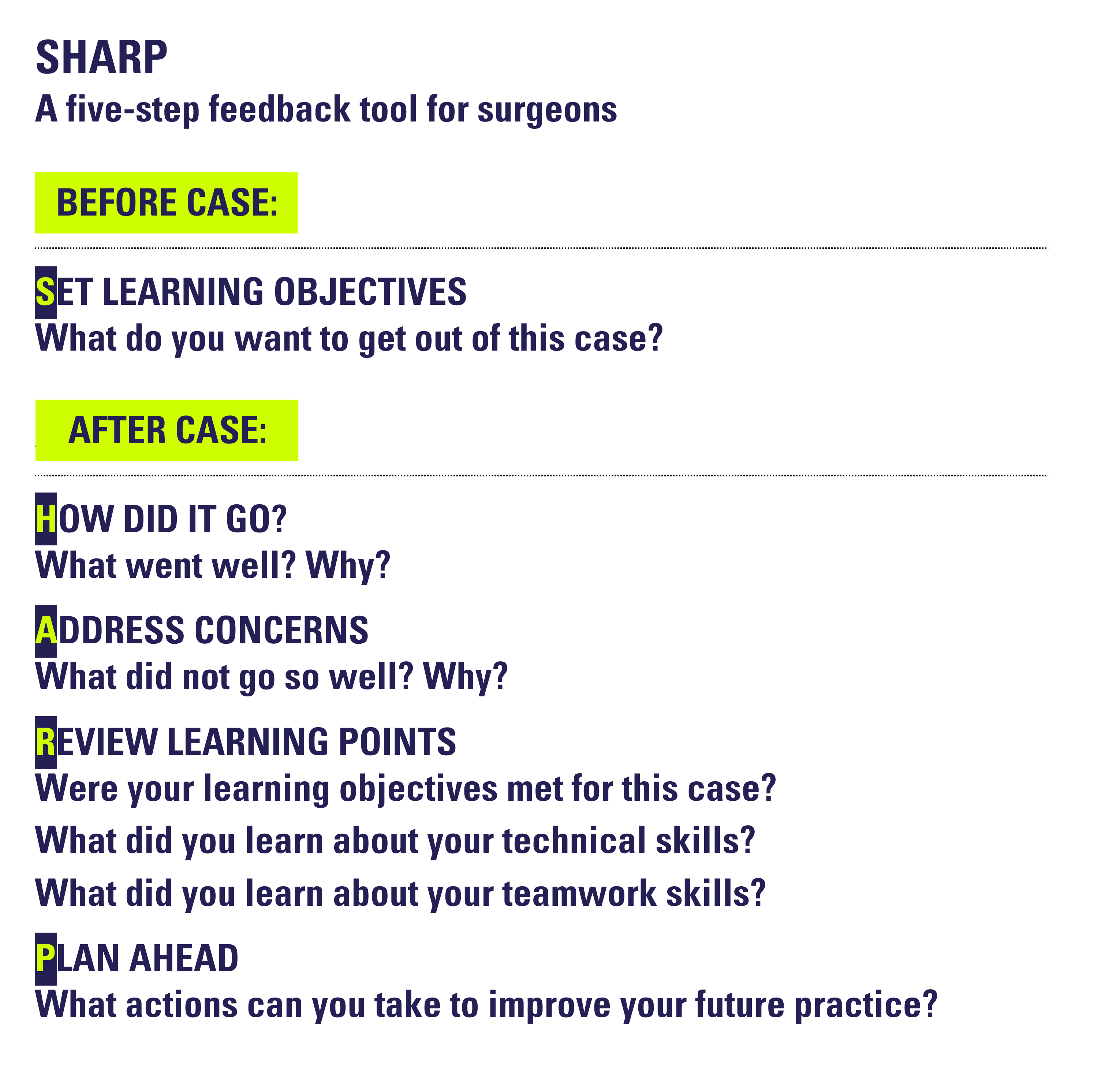
SHARP was first use in 2013 and remains popular in surgical settings; there are written and verbal elements. The acronym stands for:

S – Set learning objectives

H – How did it go?

A – Address concerns

R – Review learning points

P – Plan ahead

Why is SHARP effective?

It’s quick. “It takes two minutes; so it really stops that ‘I don’t have time for this’,” said Arora, mindful that athletes and coaches are often time-poor. “We looked at feedback, debriefing and performance for cases before we introduced SHARP as a baseline; then we measured all of those outcomes afterwards. What we found was that feedback significantly increased, much more feedback was provided, learning objectives were set, but also the quality of debriefing significantly improved.”

Here is a typical structured assessment using SHARP:
How does SHARP differ from standard feedback?

As Arora said, feedback is too often a one-way street. “We could see beforehand if there was feedback, it was just ‘yes, that’s great’ or ‘no, we should have done this’ or ‘next time, just do it’,” she said. “It was very didactic, very unidimensional, very much one person or 10 dressing down another.”

SHARP encourages learner engagement. “It was much more, ‘what do you want to take away from this?’ And afterwards it’s ‘OK, you did this bit very well. It was a difficult case, but next time try and make a better use of your assistants’.”

There is an element of feedback but “you can pick up what’s important to them, not what I think they didn’t do right.”

Doesn’t surgery use ‘hot debriefs’?

Yes, usually at the end of the day. There will also be a hot debrief within 15 minutes of a catastrophic or fatal event. “If it’s so awful that the patient dies on the table unexpectedly, the rest of the list is cancelled because nobody in the team is in the right frame of mind; it’s not fair and it’s not safe to operate on people when you are thinking about what’s gone on,” said Arora.

In such scenarios, a SHARP debrief is held seven days later. “That’s critical following a terminal event.”

Members Only

5 Sep 2024

Articles

Debriefs and Accelerated Learning: Transferable Lessons from the World of Medicine – Part I

Category
Coaching & Development, Leadership & Culture, Premium
Share
Facebook Twitter Email Copy Link
https://leadersinsport.com/performance-institute/articles/debriefs-and-accelerated-learning-transferable-lessons-from-the-world-of-medicine-part-i/

In the first of a two-part series, Sonal Arora, an experienced surgeon, outlines how any coach can become a better facilitator.

By John Portch
Sonal Arora’s description of an operating theatre during surgery is, frankly, alarming.

“You would think that the environment in which we do this is very contained, very prescriptive, nice and quiet; that you’re allowed to get on with it and everything works,” she said. “Unfortunately, that’s not the case.”

Arora is a Consultant Emergency Surgeon with the Chelsea & Westminster NHS Trust in London. She told an audience at last November’s Leaders Sport Performance Summit at the Kia Oval that the picture can be particularly bad during emergency procedures.

“Lots of research looking into stress in surgery has shown that things break down in almost all cases,” she continued. “We have the door to the operating theatre opening and closing every other minute. You are trying to do this difficult procedure. The patient is bleeding. The anaesthetic machine is beeping and somebody is just coming in and out talking about whatever it is that they want to talk about. The noise can be so loud it’s almost as much as a motorway. So it’s not that sterile setting that you would think.”

Inevitably, as Arora explained, this has consequences. “One in ten patients who come into our hospital will suffer from iatrogenic harm – that means harm due to the healthcare that they are receiving, not the pathology.” In some cases, iatrogenic harm can be fatal.

Despite improved simulation tools, the situation persists. “We thought: how can we accelerate this learning? How can we get people to perform better, faster, safer in a way that would take little resource and maximise what we were already doing?”

Over the course of 30 minutes, Arora laid out how, in a joint research project, Imperial College and its peers working in operating theatres across the United States and Australia alighted on better feedback and debriefing as the solution to improved learning and performance.

Here, the Leaders Performance Institute returns to her presentation in a two-part feature. In part one, we set out how Imperial’s OSAD [Objective Structured Assessment Tool for Debriefing] can assist those individuals responsible for facilitating post-performance reviews.

In part two, we will shift the focus to Imperial’s SHARP [Structured, Healthcare, Assessment, Review, and Performance] tool, which is more geared towards the learners themselves.

‘Why not optimise learning that’s already happened?’

As mentioned above, Imperial settled upon revamping its approach to feedback and debriefing. “Why not optimise the learning that has already happened?” said Arora. “We had the perfect setup; we had all the recordings, we used to video everybody’s performance and simulation, but we were doing nothing with these videos. People would just turn up, have their simulation, a quick chat. ‘How was it?’ ‘Alright.’ ‘Great. See you next time.’ Ad infinitum.

“So we all know that debriefing is crucial; we know it’s part of the learning process; we know that it’s a way of reflecting upon performance.”

Yet it is too readily dismissed as a soft skill. “We look so carefully at our performance in so many different domains, but nobody’s looking at how well we are performing in giving effective feedback; and the idea was that if we can improve the quality of our feedback, we could improve performance.”

The process also needs to be embedded. “People need ring-fenced time for this. It can’t just be an add-on that somebody is doing well, other people are doing it off the cuff at the end of the game, at the end of an operation, at the end of the week. It needs to be given the time and the importance, and that comes from the top down.”

OSAD: the Objective Structured Assessment Tool for Debriefing

In 2012, Arora was part of a team that developed the OSAD tool. It was designed to improve debriefing practices in surgery and other areas of healthcare by providing a structured, evidence-based approach to evaluating the quality of debriefings.

To this day, it remains a useful tool. “The real secret is to try and get [the learner] to identify what their performance gaps are and how they feel, or how the team feel, they can work better to improve it for next time,” said Arora. “Your role as a facilitator is to wrap all of this up at the end and determine how they are going to take what they’ve learned from this session and apply it to their future practice.”

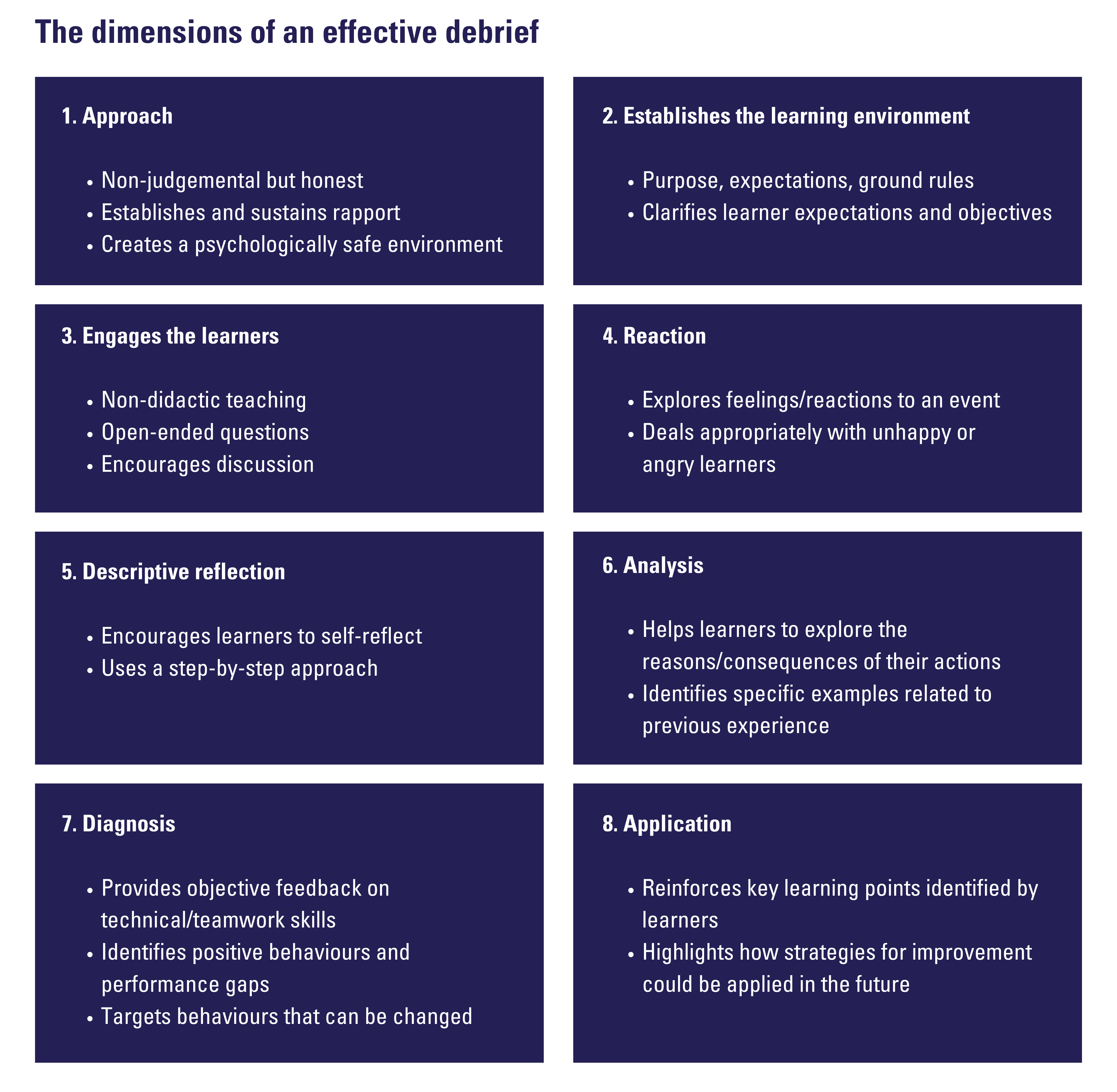
OSAD, which is based on eight elements enables people to reflect on their own debriefing practice and train others to more effectively deliver feedback. Those elements are:

  1. Approach: The method and style used to conduct the debriefing.
  2. Learning environment: The setting and atmosphere that facilitates learning.
  3. Learner engagement: The involvement and participation of learners in the debriefing process.
  4. Reaction: The immediate responses and feedback from learners.
  5. Reflection: Encouraging learners to think critically about their performance.
  6. Analysis: Breaking down the events and actions to understand what happened and why.
  7. Diagnosis: Identifying the strengths and areas for improvement.
  8. Application: Applying the lessons learned to future practice.

Facilitators are invited to score themselves on a scale of one (poor) to five (very good) on each of those elements.

Using OSAD, Arora explored each element in setting out the characteristics of an effective debrief:
OSAD can be used and adapted as required, whether you are new to the space or a seasoned debriefer. It has proven to be a game-changer, but it is not perfect. Not if you’re a learner anyway.

“If we tried to give that eight-thing item with lots of small writing to our surgeons who are in the middle of life-saving surgery, they’re going to tell you to get lost,” said Arora.

“How can we take those lessons and translate it into something really short, really simple that anybody can understand?”

In part two, we explore how Imperial answered that question through the development of its SHARP tool.

Go to home
Follow us on Instagram Follow us on LinkedIn Follow us on X

Contact

Leaders UK

Tuition House
27-37 St George's Road
Wimbledon
SW19 4EU
London
United Kingdom

Enquiries Line: +44 (0)207 806 9817
Switchboard Number: +44 (0)207 042 8666

Leaders US

120 W Morehead St # 400
Charlotte
NC 28202
United States

Enquiries Line: +1 646 350 0449

Leaders

  • Contact
  • About
  • Careers
  • News
  • Privacy Policy
  • CA Privacy Rights
  • Cookie Notice
  • Website Terms of Use

Performance Institute

  • Membership
  • Events
  • Content
  • Virtual Learning
  • Connections
  • Partners

Latest

Intelligence Hub
High Performance Future Trends Research Elite Performance Partners continue to drive the potential in high performance forward through renewed Leaders partnership
Your Privacy Choices

© 2026 Leaders. All rights reserved

  • Privacy Policy

Attendees

x