Dr Kate Hays, now of the Football Association, discusses the psychology around skill execution and why confidence must be viewed holistically.
A Human Performance article brought to you by our Main Partners

Develop a confidence bank
Confidence is multifaceted and people can be confident about different things, which is why, according to psychologist Dr Kate Hays, it is important for athletes to develop what she calls a “a robust confidence bank” ahead of any setbacks or moments of self-doubt. “What we try to do is ensure they’re pulling their confidence in from lots of different places,” Hays told an online audience at Virtual Leaders Meet: Evolution of Leadership in June 2021 when she was still serving as Head of Psychology at the English Institute of Sport. “We know that athletes gain a huge amount of confidence from performance accomplishments whether that’s in training or in competitive settings. We know that they derive a huge amount of confidence from coaching, social support and holistic preparation, whether that’s physical or mental. The more proactive people can be in terms of self-reflection and developing confidence from a multiple of sources, the more likely it is to be robust when they have those peaks and troughs.”
Normalise a bad day at the office
Hays, who is currently the Head of Women’s Psychology at the Football Association, tried to dispel the myth that you are either confident or you are not. “That’s just not true,” she said, explaining that no one is immune to self-doubt or negative thinking. We can all have a bad day at the office, as Dr Wendy Borlabi, the Director of Performance & Mental Health at the Chicago Bulls, has said. Hays added: “I think it’s a myth that we see the professional athletes and these Olympic athletes line up and they look so well-rehearsed – and they are – but it’s not true to think that some of them are not standing on that start line wishing they were not anywhere else in the world.” Athletes need to accept the inevitable and not fall prey to the myth. “It’s so important then that you’re able to go back to your evidence base and the preparation and your process to be able to cope with that in the moment and to enable you to still perform when the pressure is on. Confidence is not about positive thinking, confidence is about a set of evidence-based beliefs developed from really good preparation.”
The value in constraints-based coaching
What is happening when athletes are unable to execute under pressure? “If the skill is not transferring, there is a difference in the pattern, behaviour, the emotions or the cognitive thought processes that are taking place,” said Hays. She believes the path to the solution lies in constraints-based coaching. “It’s creating as many different environments and as many different circumstances and helping people understand their processes. But it doesn’t matter what you’re faced with, if you’ve got a consistent process that works for you, you can transfer it into any environment and you start to build confidence in your skill execution. I’m a massive believer in constraints-based coaching and how you develop psychological principles through technical and tactical coaching. Just having sessions day to day about learning; ‘so you’re going to make some mistakes and that’s OK.’”
“Confidence is an essential part of the make-up of the very best performers; of course, the key question is how can belief be developed so that it remains robust under pressure? As Dr Hays says, one of the best ways of doing this is to help performers draw their confidence from various foundations, with their previous accomplishments being at the core of this. The notion of a ‘confidence bank’ is one that many top performers use because, just like our personal income and finances, we can generate confidence from multiple sources, we can invest and expand our belief portfolio over time, and we can make withdrawals when we need them most. But, similar to financial management, performers require support from coaches, family, experts and others, on how to best manage their own experiences and environment in such a way to strengthen their confidence. Certainly, focusing on personal mastery experiences, particularly success in difficult tasks that have occurred recently, is critically important for performing at our best.
“Just because the best performers can develop their confidence to high levels, this does not make them immune from intense anxieties. In other words, performers can simultaneously have strong belief in their ability (i.e., high levels of self-confidence) whilst being uncertain, or even doubting, if they will achieve some of their goal(s) (i.e., high levels of competitive anxiety). This is the performance equivalent of what the novelist, George Orwell, termed ‘doublethink’: the acceptance of contrary opinions or beliefs at the same time. It is not uncommon, for example, for performers to believe that they are capable of a great performance but be uncertain of whether it will be enough to win – hence being self-confident and anxious at the same time. The good news though is that some doubts can serve to keep high levels of confidence in check and prevent arrogance and/or complacency. It is, in part, for these reasons that performers should use some constraints-based coaching and pressure training to help them learn how to draw on and maintain their self-belief when they are under pressure and some doubts will likely creep in.”
NeuroPeak Pro is helping elite athletes to reach their potential through precision breathing, heart rate variability monitoring and neurofeedback.

Bryson DeChambeau has been setting new driving distance records in each of the past two seasons, setting a new standard with a nearly 324-yard average in 2021.
In the tee box prior to the drive, he often paces around to get the blood pumping faster and then focuses very carefully on the pace and force of his respiration. “Breathing helps quite a bit,” he has said.
Helping golfers like DeChambeau and Jordan Spieth for the past several years has been NeuroPeak Pro, a sports science company focusing on helping its users perform better, particularly under pressure, through precision breathing, heart rate variability monitoring and neurofeedback.
Its latest tool monitors heart rate and HRV through an ECG belt worn around the sternum with added IMU sensors (accelerometer and gyroscope) to track movements of the diaphragm due to breathing. This newly released device, the NTEL belt, replaces what previously required a full briefcase of medical-grade equipment.
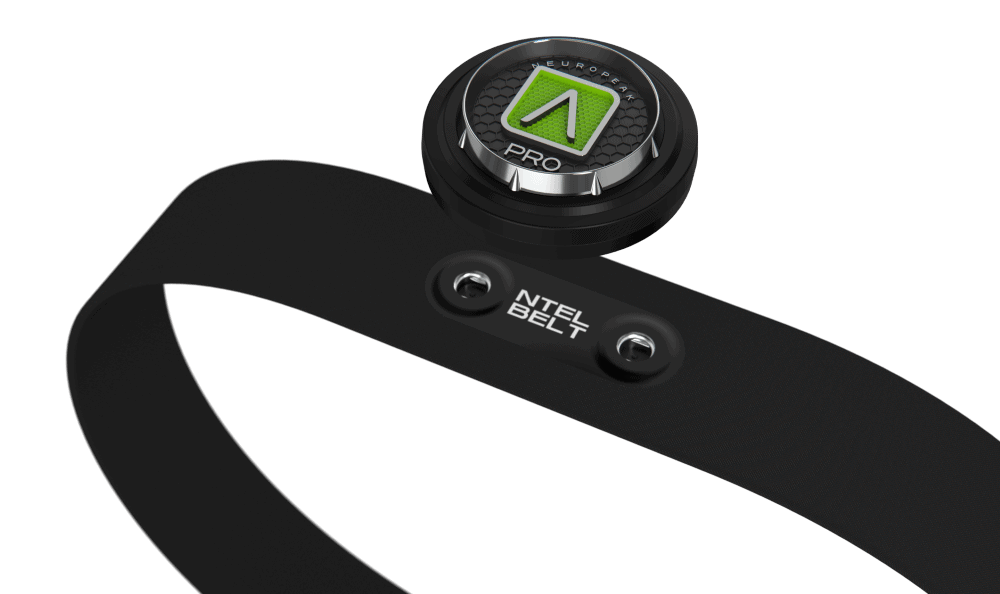
NeuroPeak Pro’s NTEL belt is more of a trainer than a wearable.
Unlike other Bluetooth fitness wearables, this one isn’t intended for around-the-clock usage to passively collect data.
“The NTEL belt is a trainer, and it’s not a tracker,” says NeuroPeak Pro’s Director of Golf Performance Andy Matthews.
NeuroPeak Pro Vice President of Performance Programs Nick Bolhuis shared a recent story of a PGA Tour golfer who had grown discouraged when his Whoop registered a lower-than-expected recovery score. But using the NTEL belt allowed him to be proactive, with the NeuroPeak app providing scores on a scale of 0 to 100. Before the golfer’s final round at the Players Championship, he did two breathing sessions a couple hours apart, registering scores of 93 and 95, before completing the tournament with a strong showing.
“We gamified breathing,” Bolhuis says.
Matthews describes the NTEL belt as the missing link between those two, helping athletes transcend an immutable recovery assessment. “I did everything I was supposed to do yesterday,” Matthews says, “and I woke up with a 71% recovery score. But I need to perform at 100% of myself today. How do I bridge that gap between those two?”
After starring at the University of Michigan, Matthews played several years of pro golf, mostly in Canada. He won the 2010 Corona Mazatlan Mexican PGA Championship while using NeuroPeak’s tools, and that experience helped him appreciate the value of learning effective breathing technique.
“The precision breathing practice is just like one would practice their golf swing or their putting stroke,’’ Matthews says. “You set aside that time to really dial in and start to really hone in on your muscle control, your respiration rate and allow all those heart rate metrics that are connected to your physical breath start to follow in and unlock that zone-like performance state.’’
The NeuroPeak app has tutorial videos to help athletes learn to control their breathing, and premium packages include personal instruction. Breathing can be used for focus or for recovery. DeChambeau has previously discussed how, after a poorly executed shot, he can use the methodology to re-center himself. “When my heart rate got up, I was able it to control it and get it back down, based on breathing,” said DeChambeau.
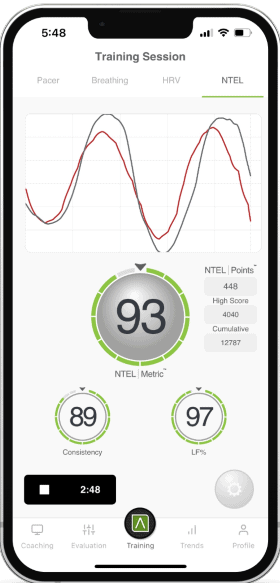
The NeuroPeak Pro app.
Asked in late 2018 how important this training had been to his success, DeChambeau told a writer for the PGA Tour website, ““There’s a reason why I’ve won four times this year. That’s my statement on that.”
Golf has been the beachhead for NeuroPeak, but the company counts pro athletes in all sports as users. Minnesota Vikings quarterback Kirk Cousins, San Francisco Giants pitcher Matthew Boyd and New York Islanders center Brock Nelson are among the other notable users.
The demands of each sport are unique, of course, and NeuroPeak caters to each. There’s foundational breathing everyone must master, after which “we’ll be very specific and prescriptive, based upon your sport in the needs,” Bolhuis says.
Bolhius was recently working with tennis players, who will invoke their precision breathing between sets. They need only two or three deep breaths, typically taken in 10-second cycles—four-second inhale, one-second transition, four-second exhale and another one-second transition—to reset themselves. In that half-minute, they won’t return all the way to their resting heart rate, of course, but they can conserve themselves.
“It’s the difference of being at 150 and getting that down to like 120 or 110, as opposed to staying at 150 the whole time and just redlining it,” Bolhius says. “Because then you get impacts on your cortisol output and all these different things physiologically. So, it’s how quickly can I take my foot off that accelerator and get that braking mechanism in place and conserve energy?”
This article was brought to you by SportTechie, a Leaders Group company. As a Leaders Performance Institute member, you are able to enjoy exclusive access to SportTechie content in the field of athletic performance.
A very different version of Golden State would appear on the court. Instead of the masterclass in group flow, fluidity, risk-taking, and creativity that the team had become known for, passes tightened up, players hesitated, threw air balls and missed routine passes and shots. Cleveland came out dominant, while Golden State made seven significant passing, handling or shot errors in the first three minutes alone. They never recovered, losing the game 101-115. They lost the final game and lost the Championship.
Golden State’s inability to recover when they were in a corner and the pressure came on was devastating but not unique in high performance arenas. How could a team who had the physical skills to execute some of the most creative basketball seen to that point in history not read the court, mishandle the ball, miss shots they could usually take with their eyes closed, and lose all semblance of composure and control?
While some may say they choked, a more objective view would identify negative changes related to the human physiological stress or threat response. When a human crosses their threshold for pressure in a given scenario, they may experience loss of peripheral vision, reduced fine motor skills, biomechanical timing changes, lack of intelligent decision-making, and emotional regulation. The negative consequences of these changes in pressure situations can be devastating yet are highly preventable with strategic awareness and intentional training.
Unfortunately, many high-performing teams misinterpret momentum, past results, and winning streaks, believing this means by default that they can execute under pressure. In many instances, it’s more likely they have just never been tested.
When a lost game does not negatively impact the season’s outcome, a team can afford to be creative, try new things, and take risks because the consequence of failure is not a threat to the season’s result. However, if a team has ignored the critical skill of learning how to work with the changes that occur when the pressure is on, the stakes are high, and the consequence of failure becomes real, the cracks will show.
Most readers are familiar with the difference in play between a team aiming to win and one trying not to lose. A team playing to win exhibits creativity, fluidity, clear communication, confidence and risk-taking. A team focused on not losing plays with a fear-driven approach, tight technique, hesitation, self-doubt, and blaming others – not qualities that result in a high performing organisation.
There is a significant human, financial and reputational cost of not being able to execute in high-pressure moments that impact coaches and athletes, executives, leadership, and support staff. The focus is often on the people in the performance arena being able to execute their roles. But it is imperative for sound governance, intelligent decision making, career longevity, optimal communication, organisational reputation, trust and ethical elite high performance that learning these skills extends to every human in a high performance role. This education must include front office, leadership, support staff and board members.
By not strategically and intentionally setting individuals and teams up with an awareness of:
a) how their bodies and minds physically change in different pressure and threatening situations,
b) skills to acutely deploy in the moment of pressure if needed and
c) front loading strategies to prevent them from getting into that situation in the first place, high performers are set up for failure by “hoping” this skill shows up. To borrow a term from the military, ‘hope is not a course of action’.
The reality of high performance environments is magic happens outside of your comfort zones, not within. You can’t be a world champion by being average. You can’t lead a team through unprecedented times using your old, familiar approaches. You can’t set a personal best anything without pushing past the boundaries of what you’ve previously thought possible for yourself. By definition, being outside one’s comfort zone feels uncomfortable. Unfortunately, humans, by nature, don’t like to be uncomfortable!
In ancient times, being outside one’s comfort zone signalled the possibility of life-threatening danger. In modern times, while the triggers are usually not life-threatening, the response remains the same as some part of our ancient brain remembers or still believes that being out of our comfort zone is ‘unsafe’. If left uncontrolled, this response derails performance in high pressure but potentially magic situations.
Most people recognise their experience when outside their comfort zone, and their ‘fright and flight’ response (sympathetic nervous system) kicks in. Their heart beats faster, their breathing tightens up, they feel tenser, their vision may narrow, they lose fine motor skills, and they can’t think or speak as clearly. These are all consequences of the physiological threat response – a very ancient and normal survival response, hardcoded into every human to prime us for action and protect us from danger.
What is less appreciated is the impact these changes have on performance and execution in critical moments if this response is uncontrolled. Consider players who:
However, this physiological response in and of itself does not have to result in poor performance. When a person’s control of their physiological response means their operating state or arousal state stays under their threshold or ‘redline’ in a given situation, they will be aware of the heightened response but without the negative consequences to performance.
To use the threat response advantageously, without misinterpreting it as ‘something bad is about to happen’ or letting it derail performance, requires skill and training. The magic of harnessing this response lies in early identification of when it kicks in, navigating it for optimal performance and preventing it from crossing the threshold where performance is compromised. Achieving this requires a combination of skills to deploy in the critical moment, skills to increase one’s threshold and front-loading strategies to put a buffer in the system in the first place.
There are several misconceptions about performance in high-pressure environments and an individual’s ability to execute or not. These misconceptions can leave significant performance gains on the table and the discard of valuable people too early. However, these misconceptions also point to where teams can make improvements.
1. ‘Performance under pressure is a psychological skill, taught by psychologists’
Human neurophysiology, human behaviour, and a physiological threat response thousands of years old drive reactions and responses to high pressure and threat perception. Our ancient and automatic responses can undermine even the best psychological training despite modern technology and awareness. Further, positioning performance under pressure as solely a psychological skill deters many alpha and elite performers from exploring understandings and ways to manage the negative consequences of a heightened operating state for fear of being seen as mentally or emotionally weak.
2. ‘Performing under pressure is determined solely by what you experience and do in the moment of pressure’
There is a cumulative effect to the threat response, with many things that elevate someone’s operating state as having nothing to do with the ‘thing’ itself. Think about your reaction if an idiot cuts you off in traffic on your drive to work. If life is humming and you’re feeling good, you’ll likely respond differently than if you haven’t slept well, argued with your partner, your team has performed poorly all season, you’re running late for an important meeting, and it’s rush hour. If you have a different reaction in these two scenarios, you’re not reacting to the idiot driver; you’re reacting to the accumulation and escalation before the idiot cuts you off. The performance arena works the same way. For most high performers, the performance arena is their relative comfort zone. They love competition and the opportunity to test their abilities. However, pressures related to (as examples) contracts, travel, young families, media and fan feedback, battles with self-worth, value and identity cause many high performers to enter their performance arena in an already elevated operating state. The normal and expected elevation of their operating state by a couple more notches at “go time” can be enough to push them across their threshold, and the cracks show.
Front-loading skills and strategies, rather than solely focusing on learning skills for the critical moment, are crucial to account for this accumulation and put a buffer into the system.
Typically, the problem is brought to awareness or focus in one of three areas (right-hand lower corner of Diagram 1) – the breakdown of task execution and outcomes, the heightened perception of pressure/anxiety, or the self-medicating/self-sabotaging behaviours.
3. ‘If a human fails to perform under pressure, it’s anxiety, and it’s in their head / they are mentally weak’
See the two points above. Irrespective of the performance arena, many high performers have the mental and emotional resilience to handle, excel and thrive in high pressure. But their physiology can still get out of control underneath the surface, leading to the negative consequences outlined previously. If someone can execute skills in lower arousal environments but not under pressure, assuming or labelling the problem as “anxiety” ignores the impact that a myriad of other physiological drivers will have on escalating the threat response that has nothing to do with “anxiety”. And it often has nothing to do with the performance arena, either! Part II of this article series will explain this point in more detail.
4. ‘People can either handle pressure, or they can’t’
Executing under pressure is a highly trainable skill, just like any other sport-specific skill. Unfortunately, it is often omitted in training during early career development, meaning performers get a long way through their careers due to natural talent or early physical development before this gap appears and the problems show. The assumption mistakenly gets made at this point that the operator can’t handle pressure. Most people who falter in high-pressure situations have just not learnt specific skills to prevent or recover from when their operating state crosses their threshold.
Additionally, a person’s threshold will differ between scenarios. An exceptionally qualified black belt martial artist will comfortably face down an opponent in a dark alley but get a dry mouth and sweaty palms at the thought of giving a speech in front of a thousand people. A seasoned firefighter will move confidently into a structural fire with no fear for their safety but momentarily freeze and move forward with heart palpitations and fast breathing when confronted with performing CPR on a young baby.
5. ‘Performance Under Pressure just “shows up’
There is a mistaken belief that operators can do the technical and tactical training, turn up in a big moment, and perform when the pressure and stakes are high simply because of their technical excellence. Coaches and team managers will often bemoan the sub-par performance that falls well short of potential without realising there is a skill gap. Most high performers do not automatically know what to do or expect mentally or physiologically when in high-pressure situations. Without intentionally learning skills to control their state in these situations, they fall victim to the negative performance changes outlined above.
In the most simplistic view, consistent elite performance in high pressure and high stakes moments requires two things:
Many of the negative consequences of high pressure and high stakes environments, and the strategies employed to overcome them, are linked to the human threat response (particularly the sympathetic nervous or fright or flight system). How an individual breathes when they aren’t thinking about breathing will also impact this response by signalling whether there is a threat or everything is safe. These two areas directly affect the other – either positively when trained strategically and with intent; or negatively when left to chance. Consistent elite performance in high-pressure environments needs both areas to be trained intentionally in a coordinated way and in advance of ‘go time’.
We see the following negative interactions when these two factors are not well controlled.
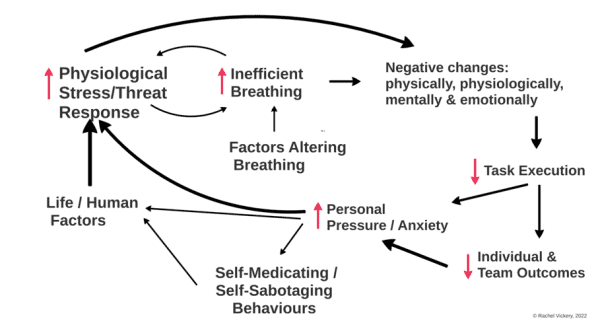
Diagram 1
Typically, the problem is brought to awareness or focus in one of three areas (right-hand lower corner of Diagram 1) – the breakdown of task execution and outcomes, the heightened perception of pressure/anxiety, or the self-medicating/self-sabotaging behaviours.
Some of the changes to task execution and performance for athletes are identified earlier in this article. The same concept applies to coaches, executive teams and support staff in their respective roles, although how it shows up may vary. The subsequent increase in pressure and anxiety for the individual, team, coaches or team management related to poor performance; and the impact of negative media and public criticism leads some individuals to self-medicate or self-sabotage. Any combination of alcohol, drugs, porn, gambling, food, missing training, out-of-arena altercations, excessive work hours, neglecting family, affairs, and unethical decision making may be present. Unsurprisingly poor mental health and suicidal tendencies sit in this mix also.
Teams will often try to fix the problem in one of these three areas. If a player misses kicks – they spend more time on their kicking technique (unfortunately, often in a relatively relaxed, no-pressure state). If a person – particularly coaches and management personnel- struggles with anxiety, they either keep it to themselves, are medicated, or receive insufficient expert guidance. If a person has an addiction or behavioural problems, they are disciplined, sent to rehab or hide it in shame.
This traditional approach is fundamentally flawed. Waiting for performance issues in pressure environments to show up (whilst hoping they don’t) and then reactively fixing them does not result in excellence and consistent high performance. Punishing poor performance under pressure in the absence of a front-loaded strategy of skill acquisition in this area is akin to throwing a bunch of humans who don’t know how to swim into a pool and then yelling at them to stop drowning.
Consistent elite high performance in high stakes and high-pressure environments means going “left of boom”, understanding the situation for what it is, and front-loading strategies to set up for success, thus avoiding a negative response. Normalising the physiological, cognitive and biological reactions that humans have in high-pressure environments and training and optimising for it is far more impactful on performance than just wishing or pretending it wasn’t there or reacting to the fallout after the event.
Part II of this series will dive deeper into how the human stress response works in high-pressure situations, how it disrupts performance and some skills and strategies to thrive in high pressure and high stakes environments.
Rachel is one of six Leaders Performance Advisors, a group of leading performance thinkers providing more subject expertise to our member-only content and learning resources. To find out more about all our Performance Advisors, click here.
A human performance article brought to you by our Main Partners
Wendy Borlabi, the Director of Performance & Mental Health at the Chicago Bulls, has spied a noticeable shift.
Less than a decade ago, she says, there was a desire for, “having a coach with the credentials to take you from point A to point B. [Athletes] were looking for coaches who could do that; they hired coaches who could get you from A to B, it wasn’t about the relationship.”
“Now,” she continues, “I see more of the connection with the coach; they want to have that relationship. In my opinion, a lot of it has to do with the age. In the NBA we’re seeing younger players; they’re coming into the NBA at 17 years old. They’re babies, they need that nurturing, they need someone who’s going to take them under their wing that’s going to help them do the everyday pieces, that’s going to look after them, that’s going to ask about them, come and visit them at their house and be there to sit with their parents. They’re looking for that because they’re so young and when that’s there and that trust is there then I think that they’re able to expand on that, that they’re able to ask them to do things outside of their comfort zone and challenge them because now they’ve got a trust and it’s built on more social and emotions than [the question] can the coach move me from Point A to Point B.
“This shift is happening and I know we’ve talked about it that we used to see it a lot with female athletes as opposed to male athletes, but not now I think it’s more age-related as opposed to gender.”
As those coach-athlete relationships shift, so too does the role of the sports psychologist, which was a major theme of Borlabi’s appearance at June’s Virtual Leaders Meet: Evolution of Leadership alongside Kate Hays, the former Head of Performance Psychology at the English Institute of Sport [EIS]. The duo joined moderator Dehra Harris, the Assistant Director of High Performance Operations at the Toronto Blue Jays, to discuss the stability of an athlete’s confidence as well as the athlete’s ability to root confidence in a firm understanding of their strengths.
“For me, there’s been a real shift in sports psychology and how it’s delivered,” says Hays.
“When I think back to when I qualified, the focus was still so much on mental skills training and a lot of work at individual level and there’s certainly been a huge shift now. A lot of the work that the psychologist is doing around the team is facilitating environments that are psychologically informed and working alongside the coaching, sports science and sports medicine team as a collaborative effort; and I think that talks to the culture of people as well.
“It requires an entire sports organisation to be aligned in terms of the mission, behaviours, the philosophy around coaching, whether we take strengths-based approaches etc. when it has worked really well and you have athletes that have given the opportunity to learn, develop and grow, it’s because you’ve got a collaborative group of people that are coming together and working really effectively; and I think these things are difficult to do in isolated pockets.”
Borlabi also elaborated on the ways in which her work has changed. She says: “My role is so different now to when I first started. I need to teach athletes some very basic pieces of socialisation and emotion before we even get to the performance piece, because there’s these things that they don’t even know that.
“Besides working with the Bulls, I have a consulting business on the side and work with [Olympic] athletes as well. I think of so many times I spend the first four sessions just helping them understand that we’re not returning a call or text to their coach.”
Mental skills and learning to problem-solve
Harris asks Borlabi and Hays a question about the mental skills that athletes need to be working on. Both have already discussed emotional intelligence and self-awareness and it is a theme to which they both return.
“In working with younger athletes, it is establishing who they are,” says Borlabi. “One of the things I’ve always wanted them to try to figure out is how they like to be coached. I don’t think that they know that or how can they improve, and when do they listen the most, and what is the aspect they value the most in a coach and teammates.
“You miss that piece when you’re younger, so when they become professionals, I want them to try and think about that. It’s definitely something we learnt with the Olympic [athletes], they’d think about the coach. How are they coached? How will they work with their teammates? And how do they work at their best?
“Another aspect of that is their support system. Wanting them to be able to know who is in their support system and who gives them what kind of support and who do they gravitate towards? Who reinforces what they’re trying to do and who brings them down? I think that’s important because they don’t know that at a young age and it’s helping them to figure that piece out that helps them to grow as athletes.”
Hays shares her own experiences on the matter. “I’ve learnt a lot in diving [she worked with British Diving for more than a decade], which is an early-starter sport,” she says. “You’re quite often working with young athletes, aged 9, 10 etc. Obviously their cognitive ability is not the same as an adult and one of the most important things, very gently and slowly, is getting them to start to self-reflect.
“Quite often, they’ll go in, and the coach will direct them in what they’re doing, they’ll execute the training session, they’ll have a great one, and then they’ll get in the car and tell mum and dad how brilliant it was. But then they’ll go in the next day and the same thing will happen. It’s because they haven’t necessarily taken the time to take a step back.
“It’s a slow process, particularly when you’re dealing with younger athletes, but that process of self-reflection, the earlier that can start, the more robust athletes are in terms of what happened today; ‘why do I think that happened, and what does that tell me about what I need to do tomorrow?’ It encourages that problem-solving, that reflection, and that thought. Essentially, it’s a cyclical process, you get to that point where you’re able to recreate the things that you do well and lose the things that you’re not doing as well.
“With the youngsters, it’s about getting them into the habit of just asking questions around ‘why?’ and then figure out how they’re going to problem-solve and how they’re going to figure out the different things that they could try. So that the failing becomes part of the learning process rather than something to be worried or scared about. It’s that real message around failing smart and learning fast. How you make sense of your experiences and utilise that information. At this stage, it’s not about performance.”
Download the latest Performance Special Report – Winning With Nutrition
Long relegated to the side lines, nutrition is finally getting the attention it deserves when it comes to helping athletes achieve peak performance. Download our latest Special Report, produced in partnership with Science in Sport and featuring NBA champions the Milwaukee Bucks, the NFL’s Dallas Cowboys, and English Premier League club Aston Aston Villa.