Springbok Analytics’ technology offers the latest develop in preventative health measures for athletes.

Inside, a portable MRI machine needed only 10 minutes to scan the women’s lower bodies, at which point AI algorithms from Springbok Analytics took the 2D imaging and converted them into 3D digital twins that can be used for muscle analysis — establishing baselines that can be used to individualize training and flag latent injury risk.
Unrivaled, the 3-on-3 women’s league that debuted on Jan. 17 in Miami, is the latest league to partner with Springbok Analytics. In the past two years alone, Springbok has collaborated with three of the five biggest North American sports leagues: It graduated from NBA Launchpad; completed data collection on an NFL-funded research project into hamstring injuries; and began the initial phase of an MLB-backed study into pitcher health.
Now boosting Springbok’s rapid growth across pro sports and into broader populations is a newly closed, oversubscribed $5 million Series A led by Transition Equity Partners , which also led a $3 million seed round in 2023. Joining the investment were the NBA, which added to its initial equity stake from Launchpad, and Cartan Capital , a sports tech venture firm led by former pro tennis player CiCi Bellis .
“This is a clear sign that our current and new investors are excited to see us scale all aspects of our business,” Springbok CEO Scott Magargee said, “and from a dollars-in-the-door perspective, it allows us to advance what we believe is our global leadership in the area of muscle analysis for large demographics of athletes and patients across the entire health care landscape.”
The interactive reports Springbok produces are musculoskeletal avatars shaded various hues of red, orange, tan and blue that detail muscle asymmetries, fat infiltration and a proprietary score comparing a person’s muscle size with others of similar sex, size and sport. Springbok recently released sport-specific databases for men’s pro basketball and soccer athletes — a women’s soccer counterpart is planned soon — for more apt comparisons. It received FDA clearance in October on its flagship lower-body scan, and added core and upper-body scans to what previously was lower extremity only.
Such a tool is even more important when the athletes are such physical outliers as in the NBA. More than 100 players are in that database, and in addition to partnering with nearly half the league’s teams, Springbok continues working at the league level during the pre-draft process.
“Their work with us proved that this is a really interesting new dataset in elite sports,” said NBA Senior Vice President Tom Ryan , who oversees Launchpad and all basketball R&D. “Springbok data is starting to become an important piece of the puzzle to help support player health and performance initiatives. That’s really the story: It’s very strategic for us, both at the league and team level.”
The continued strategic relationship helped facilitate the additional funding, NBA Investments Associate Vice President Pat Crouch added. “First and foremost, for companies that come out of the NBA’s Launchpad program, we look for follow-on investment opportunities when there is a continued strategic relationship. We only invest in companies where there’s some type of commercial partnership, at either the league or the team level, that has gained meaningful traction and has upside to continue to grow and expand.”
Notably, Springbok has no true competitor and a 15-year head start on understanding the use of this data, making it “a piece of the puzzle that nobody else is,” said Magargee.
“The fact that our expertise is the technology, but also in human performance and muscle physiology, we know where to keep going with it in a way that’s meaningful,” said Silvia Blemker , Springbok’s chief scientific officer. She added that one recently devised new metric is an objective injury severity score, which can quantitatively assess a strain or sprain rather than rely on a human practitioner to subjectively evaluate it.
Though Springbok Analytics’ work in sports has intensified in recent years, the foundational technology has roots dating back to 2009 and Blemker’s biomedical engineering lab at the University of Virginia. The company’s headquarters remain in Charlottesville, sitting in a nondescript office at one end of its pedestrian-friendly Downtown Mall. Springbok’s dual recognition in 2024 from SBJ Tech — as a Most Innovative Sports Tech company and SBJ Tech Award winner for Best in Athlete Performance — prominently greets visitors.
In those early days, Blemker was working on solutions to aid treatments of cerebral palsy and muscular dystrophy when the lab began developing the machine learning to extrapolate 3D data from MRIs. Those life science use-cases remain a part of Springbok’s mission, while also adding the human performance sector that makes it a highly differentiated product appealing to investors.
“Not only do we really believe in the team, but the technology, we think, is pretty unprecedented, especially with the years of R&D,” Bellis said, “and then the beachhead that they’ve had into the sports market is super interesting, because they can really instantly provide value to these sports teams and instantly give them money back, so to say, by having this preventative health measure for athletes.”
That expediency of the scans — much quicker than what’s needed for traditional MRIs — has helped Springbok amass its large elite athlete databases, including a thousand college and pro American football players, Blemker said. Those were collected to build a hamstring injury predictive index in collaboration with researchers at the University of Wisconsin and Australian Catholic University, and funded by a $4 million grant awarded by the NFL’s Scientific Advisory Board.
It’s that rich dataset, as much as any algorithm or an investment check, that is sparking Springbok’s growth — and the same competitive advantage will only continue to grow the same way it started.
“It’s taken us time,” Magargee said, “and it’s taken us partnerships.”
This article was brought to you by SBJ Tech, a Leaders Group company. As a Leaders Performance Institute member, you are able to enjoy exclusive access to SBJ Tech content in the field of athletic performance.
The pilot program will see biomechanics labs installed at the the Cavaliers, Jazz, Pacers and Suns.
The protocols, as explained in a league-wide memo in January, have been developed in consultation with the NBPA as well as sports medicine and performance experts. Provisions for such a screening program are codified in the current collective bargaining agreement, requiring players to participate in up to four assessments per season.
“It’s one of several major initiatives that we have in the works, including with the Players Association, to try to reduce injuries in the league,” NBA EVP for Operations & Administration David Weiss said, emphasizing its scope and ambition by adding, “We’re not aware of anything quite like this league-wide in the world.”
Planning for this project began long before a perceived uptick in the injury rate over the past year, but it remains set against the backdrop of ongoing conversations around appropriate load management and player participation policies.
The NBA is now in the process of installing biomechanics labs with four pilot teams: the Cavaliers, Jazz, Pacers and Suns. The goal is to have identical setups, with the same technology vendors and the same prescribed athlete motions, to ensure standardized data collection.
The four tech companies that won the league’s RFP are:
P3, a private facility that independently has evaluated the biomechanics of roughly 70% of current NBA players, will work with the league as a consultant to the program. The NBA first hired P3 to assess prospects at the draft combine in 2014. Individual teams can also contract with the firm for additional insights and normative data.
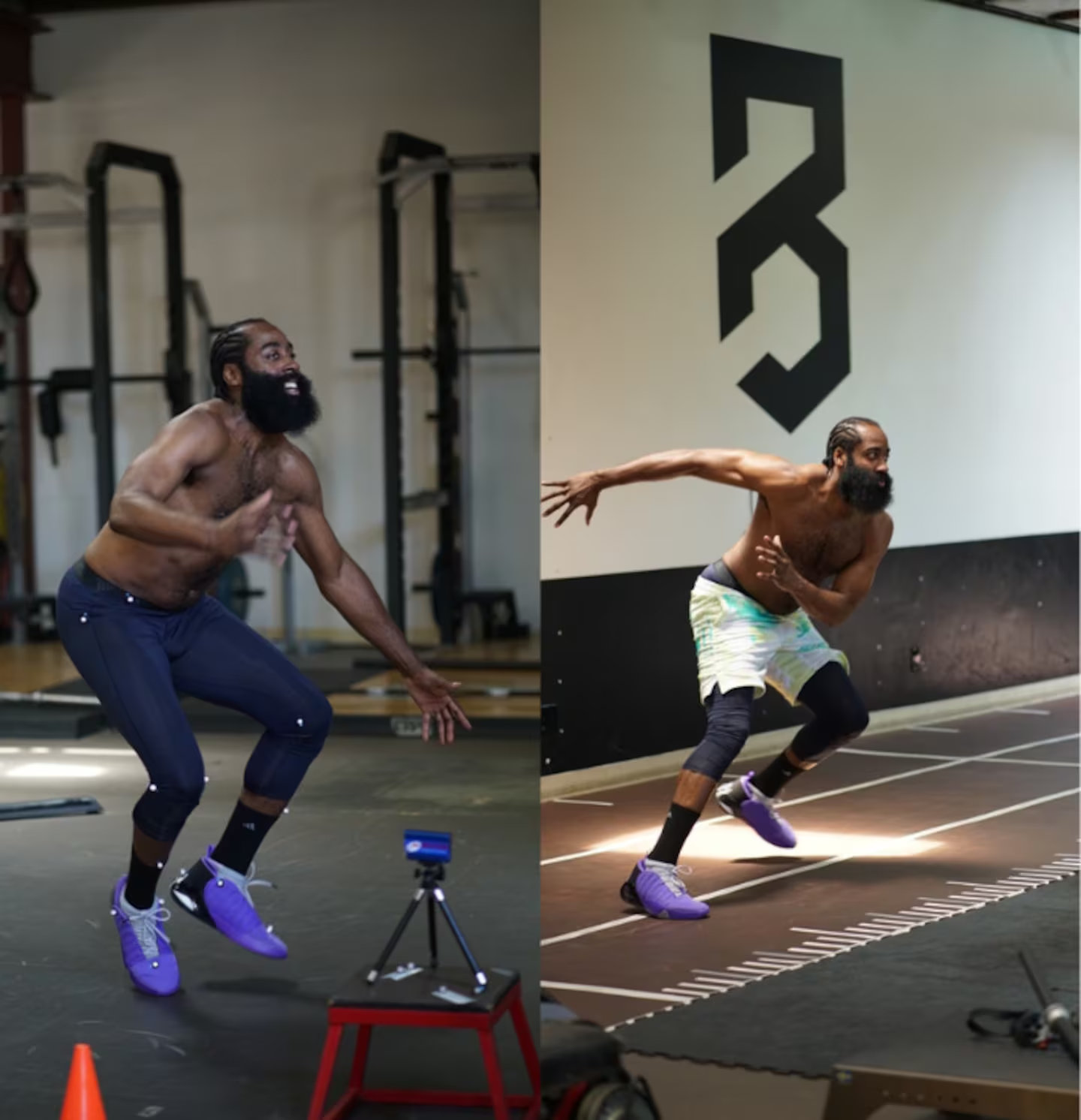
Image courtesy of P3.
“This relationship between how we move and what happens to us is a strong relationship,” P3 founder and director Marcus Elliott said. “It’s stronger than most people realize, which is why we invested all this energy into all of it. And the more we can start actioning that — and not just waiting for bad things to happen — the better it is for everyone: for the players, for the teams, for the league. I’m super bullish on the potential of biomechanics to make lives better and for us to follow these signals.”
Access to the data collected in these biomechanics evaluations will follow similar guidelines to how the NBA handles medical records. Players have full access to their own reports, which they will retain even as they change teams. Coaches, executives and performance staff will be able to see data for players currently on their rosters. Weiss indicated MDs and PhDs conducting vetted research will also be to connect the data with injury information for studies on potential risks.
One source noted a “vast discrepancy” in the way franchises have utilized biomechanics data to date, praising this new program as a way to ensure consistent, efficient and accurate assessments. Some teams have been investing in biomechanics for years while others have yet to allocate any resources toward it. By implementing his program across the league, the NBA can collect in one year as much data as any team could collect in 30 — hastening the pace of understanding what correlations exist between movement and injuries.
Deployment of this program, which is scheduled to last at least through the end of the current CBA in 2030, has been measured to make sure it is properly communicated and rigorous. Evaluating success will take time, too.
“Certainly whether we can reduce injuries long-term or a particular type of injury — that’s going to be one of [the KPIs] — and whether we can connect certain movements or certain changes in the way an individual moves to injury,” Weiss said.
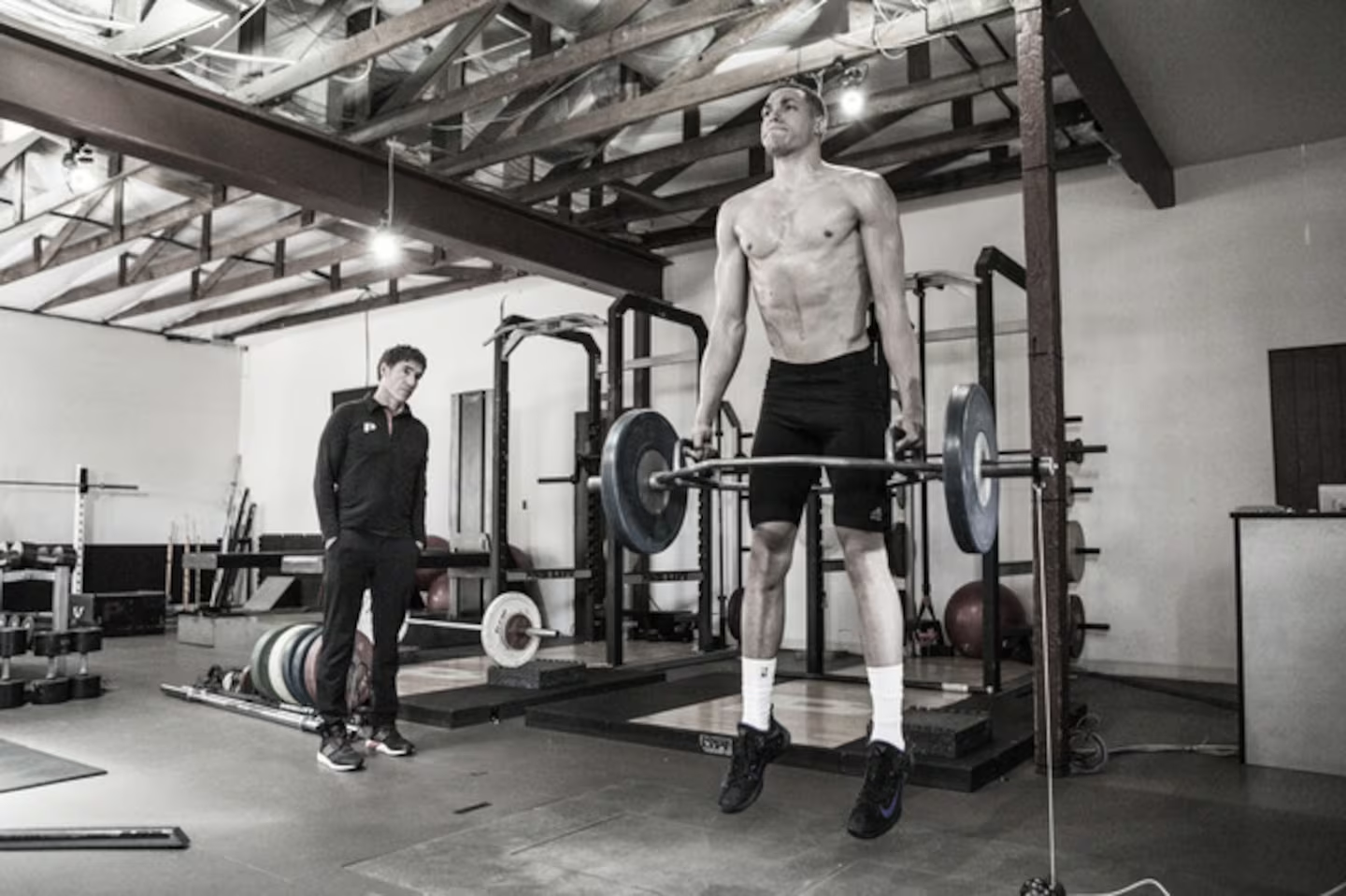
Image courtesy of P3.
Though the NBA’s in-game tracking system — powered by Sony’s Hawk-Eye — is camera-based and collects data on limbs and joint angles, that solution is only nominally a tool for rigorous biomechanics. Sony’s recent acquisition of KinaTrax, the leading baseball biomechanics technology, might help in the long run, but the current in-game tracking system doesn’t have the same fidelity the new lab-based system will provide.
There is a consensus that biomechanics might be an especially helpful tool in a sport like basketball “that certainly requires you to be a pretty impressive, high-flying athlete,” said BreakAway Data CEO Dave Anderson, a former NFL receiver. “The game is played well above the rim in the NBA, so jumping and your ability to land are critical to your career.”
Weiss added that experts with whom the league has conferred, including on its two biomechanics committees, point to “a number of factors — the size of players, the nature of the game, the number of games in the season, the hardcourt surface — that there’s reasons to think about biomechanics could be as helpful in basketball as almost any sport,” he said.
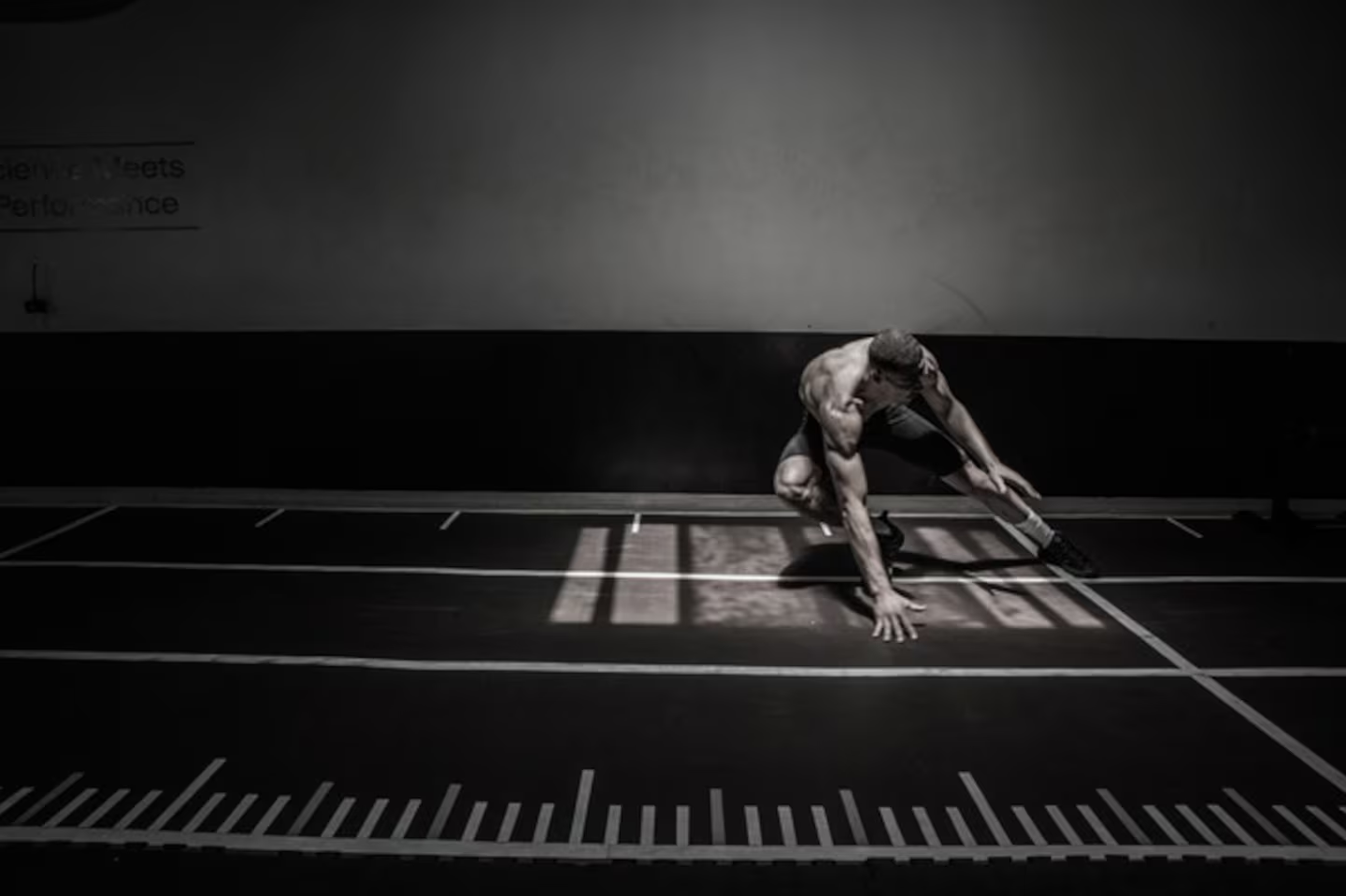
Image courtesy of P3.
These lab assessments are expected to take about 15 minutes, following a pre-scripted set of “motions that are directly applicable to their sport and health,” Theia CEO Marcus Brown said, describing his company’s software as “an accessible tool that also enables standardization within a vast data set. As a generalized neural network, Theia3D doesn’t require additional data for unique movements, environments or outlier athletes.”
It’s a highly technical distinction, but an important one: other motion capture solutions compare movement to various models, which can add to discrepancies when analyzing data from different sources and different seasons. “Having consistency in data collection over a long period of time on a big group of people is just something that I know our customers are looking for,” Qualisys product manager for life sciences Nils Betzler said, praising the “unified approach.”
“They’re really doing a tremendous job trying to better understand player biomechanics, player movement, and overall player health,” added Anderson about the NBA and NBPA. “They’re really trying to use science and numbers and research to make sure that the players are playing at the highest level. And I really appreciate that because a lot of these leagues are just adding games, changing roster sizes, and changing rules, and they just assume the players will figure it out. The NBA is taking this player-first initiative, and that’s just really cool to see.”
This article was brought to you by SBJ Tech, a Leaders Group company. As a Leaders Performance Institute member, you are able to enjoy exclusive access to SBJ Tech content in the field of athletic performance.
TempleOrthotics believe their proprietary compound could be the crucial difference in helping a player return to their peak post-ACL injury.
A Data & Innovation article brought to you by
Temple OrthoBiologics has created a proprietary compound called TX-33 that has shown good results in preventing fibrosis in abdominal and pelvic surgeries and is on track for human trials in knees as part of the FDA approval process in late 2025 or early 2026.
ACL tears rank among the most devastating injuries to athletes, particularly among girls and women, typically requiring a year of rehab and no guarantee of a full return to pre-injury performance. Understanding the mechanism of injury is a growing focus among researchers, with FIFPRO and the Women’s Super League among those who recently commissioned a study.
Temple OrthoBiologics is announcing its formation on International Arthrofibrosis Awareness Day. It has been privately by its co-founders to date.
“We have a technology that can make a difference in the knee,” said Temple OrthoBiologics CEO Sanj Singh. “The scar tissue that forms in the knee does several things. It prohibits proper function. The stiffness leads to pain and also inhibits good rehab.”
Renowned orthopedic surgeon Dr. Riley Williams — who practices at the Hospital for Special Surgery and leads surgical care for the Brooklyn Nets, New York Liberty and New York Red Bulls — is such a strong supporter of the drug’s potential that he joined as a co-founder.
Williams said he completes between 100 and 115 ACL reconstructions annually. The typical post-operative scar rate is 4-5%, but he noted the importance of reducing it further because, among his patients, “that’s four people” who might have that excessive scar response.
“The formation of scar in and around these surgeries is a very poorly understood phenomena, but it has real-life consequences in surgery,” Williams said, adding: “It’s very exciting because that in a very clean and unfettered way can help to dampen that [inflammatory] response without dampening the natural immune response.”
TX-33 can be injected after an injury or at the time of surgery and, by inhibiting excessive scar tissue from forming, healthy tissue can regenerate instead. Williams predicted that, following a successful trial and FDA approval, it will “become standard care very quickly.”
Another orthopedic surgeon backing the Temple drug is Dr. Vinod Dasa, who chairs the orthopedic surgery department at LSU, and has joined the company as an advisor.
“From a sports perspective, reducing scar tissue will definitely enhance return to play and faster recoveries,” Dasa said. “If it’s an issue in terms of scar formation, in terms of that ligament healing after a sports injury, maybe this will allow that natural healing to progress more appropriately.”
Retired Canadian Olympic bobsledder Neville Wright, who now owns and operates Wright Performance & Therapy, is a speed consultant and trainer for the Canadian men’s World Cup team who now advises Temple OrthoBiologics. (Bobsledder Emily Renna is the other athlete advisor.)
“Surgery is always a fear for a lot of athletes.” Wright said, noting the concern of post-traumatic osteoarthritis and its impact on full-fledged return to performance. “If I’m off a degree in regards to flexion of my knee, that can be a difference of running a really fast time to being outside of that high-performing category.”
Interest in sports is acute, but there is broader potential to help the general population, particularly with total knee replacements. “The age demographic of arthritis is slowly moving to the left,” Dasa said, referring to a trend of younger patients needing interventions.
Big Pharma doesn’t typically get involved in orthopedics, he added, noting the large opportunity for a drug like Temple’s. Dasa also noted that “non-surgical management of arthritis has essentially been non-existent. The lack of treatment options has implications on particular demographics, too.
“We see differences in fibrosis based on health disparities, so based on race, socioeconomic status, and a few other things,” Dasa said. “So if we can improve fibrosis, we may actually improve some of the health inequities and disparities that we see as well.”
This article was brought to you by SBJ Tech, a Leaders Group company. As a Leaders Performance Institute member, you are able to enjoy exclusive access to SBJ Tech content in the field of athletic performance.
The double world champion also spoke about how she uses data monitoring in her daily life and the new series of the podcast she co-hosts with USNT teammate Tobin Heath.
A Data & Innovation article brought to you by
You can’t have a discussion about sports technology today without including athletes in that conversation. Their partnerships, investments and endorsements help fuel the space – they have emerged as major stakeholders in the sports tech ecosystem. The Athlete’s Voice series highlights the athletes leading the way and the projects and products they’re putting their influence behind.
* * * * *
After tearing her ACL in June 2022, Press required four surgeries and an arduous recovery. She returned to her first training session in early June, after which she spoke to SBJ about her rehab and the new season of her podcast. Along with Tobin Heath, Megan Rapinoe and Meghan Klingenberg, Press founded a media and lifestyle brand called RE—INC in 2019. She and Heath are the co-hosts of the The RE-CAP Show podcast, which returned for its third season on June 13. The first episode includes appearances by USWNT legend Abby Wambach and author and podcast host Glennon Doyle.
On returning to the pitch…
I am currently in the car driving home from my first training. I would say the road to recovery happens very slow, and then yet it happens all at once. I have been back in the team environment for almost four months. So it’s been a long time that I’ve been integrated into the environment, and it took four months for me to get ready to be in a warmup and a passing pattern — really simple, basic stuff. And I felt very ready for it. I felt almost underwhelmed by how easy it was because I’ve done a lot more complicated things, and yet it was also entirely overwhelming and joyful to be so connected to my teammates and be celebrated in the way that I have been these last two days.
I’m very grateful for that. They say it’s the hope that kills you, and as I drive home, I just have this big smile on my face because I can’t help it. I can’t help hoping. I can’t help believing that I’m going to make it back, and it’s going to be everything that I see in my head. I’m relentlessly optimistic, I’m naively positive, and I like that about myself, and I don’t intend to change it. I think the way that it left me feeling was just like, yes, I can do this.
On monitoring her rehab…
I’m a person of devices, so I have quite a toolkit, I’d say, of ways that we’re tracking and measuring. The truth is we’re really still working through issues with my knee, and I have chronic scarring of the knee, so I can experience some discomfort and some swelling that could lead to more scarring, which is incredibly rare, because most people don’t scar after a couple months after their surgery. I’m now over nine months for my surgery and still at risk of scarring. So it just means that I have to try very carefully with how much impact my knee can take.
We’re being careful, but we’re progressing. In terms of my overall fitness, what my GPS has said is that I’ve got to like 60% of a match load, which is all that I really need to get in terms of volume. And yet, in the warmup and the passing pattern today, it felt like I played a 90-minute game. I was so fatigued. There’s training, and then there’s really training. There’s no way to get fit for football, except for playing football. And I’ve done a ton of running, I’ve done a ton of lifting, and now it’s time to play.
On how deep she gets into data…
My performance staff would laugh because they said they’ve never worked with a player that cares so much. So right now, I wear a Polar Watch that I was given in like 2015 from the national team. It’s just old school. And I wear my Apple Watch, which is connected to my GPS so I can see all my data live, from heart rate to distance to speed to all that. And then I do sleep with an Oura ring — although I’m not endorsing any of these products, I’m not connected to any of these products — but I do sleep with an Oura ring and track my sleep and my stress levels.
On season three of the podcast…
Our show really is about authenticity, and it’s about creating a more inclusive space for sports and including diversity of perspective. And so that means we have hard conversations, and we have honest conversations and we have vulnerable conversations, and we have a lot of fun — the same spirit and joy that you saw last year during the World Cup edition of the show. We’re back, and we’re bigger than ever.
On the origin of the creating the podcast…
I never thought I would be in media. I think that’s even more true of Tobin. There’s two typical paths for athletes after soccer, and it’s coaching and broadcast. ‘So Christen, do you want to be a coach?’ ‘No.’ ‘So Christen, then you must want to be a broadcaster? I was like, ‘No.’
That’s an interesting part of the story, but first and foremost, we decided to launch this show as current and active players, and that’s unique and different. It’s not really a stepping-back-from-soccer thing. It’s current players trading stories and having a little bit more space to dictate the narrative.
And then secondly, we really approach this as business leaders. This is our business, this is our company. We are a 3C company: content, community and commerce. The most amazing thing about women’s sports is the community, and we’re trying to build the coolest women’s sports community in the world in our membership, and we’re feeding that with amazing content.
And I think because we have such an authentic and vulnerable relationship with our audience that we’ve developed over the last five years that we’ve been building this business, it made sense for Tobin and I to be our first piece of content that was really more large scale and more widely accessible. But the plan will be to find like-minded people that sit at the intersection of sports, progress and equity, to continue to hear stories from an insider’s perspective. It really disrupts the industry in that way.
On topics they plan to cover in season three…
We’re going to be talking about women’s health, particularly in sport, which is obviously a really hot topic, and representation in sport — how we make it more diverse and equitable for more people, be it across the gender spectrum, the orientation spectrum, across different races and classes. I think that’s incredibly important. Soccer in America is an upper-middle class sport, and almost everywhere else in the world, it’s a very accessible sport that’s found on the street. That’s really the spirit of football, so that’s really important to us.
On the role of athletes as activists…
The interesting thing about the community that surrounds women’s sports in particular is they care about a lot more than the sports, and the values transcend beyond the pitch. And that’s about diversity, inclusion, progress. And I think that’s just inherent because it is disruptive in itself to see women embodied, powerful, unapologetic and also very celebrated the way that you do in the professional sports world today. The people that it’s drawing in are the same people that want to march, and they want to create change and they want to stand up for what they believe in.
It’s so embodied in the Angel City culture. The professional team that I play for has just nailed it. And when you’re in the stadium, it’s electric, and win or lose, it’s a different type of vibe than any other sports arena I’ve been in because there’s a connection point for all of the audience. They care about more than the X’s and O’s. They care about what we represent to them, the progress and the opportunity that we as women athletes represent.
On the versatility of women athletes…
It’s always been that way in women’s sports, and it’s just becoming more popularized. I think the expectation is that we would always be multifaceted as women and expected to do multiple jobs in multiple roles, if we were going to have careers. And so it really did take to me and my personality to be a player and also be a leader off the field, on the US women’s national team, going through the Equal Pay lawsuit, going through the reestablishment of our players association.
For me, it was such a balancing sense of purpose that I continue to create space in my life for that, and I think that’s what we’ve done with our business, RE—INC. RE—INC is reimagined, incorporated. We set out, in 2019 when we started this company, to reimagine the status quo, to reimagine the way women are seen and experienced in sports. And it’s a very bold and ambitious goal, and we do it in a multifaceted way. And I’m really, really proud of that.
This article was brought to you by SBJ Tech, a Leaders Group company. As a Leaders Performance Institute member, you are able to enjoy exclusive access to SBJ Tech content in the field of athletic performance.
In the last episode of this series of the People Behind the Tech podcast, the Magic’s Harjiv Singh discusses smart practice design, targeted data visualization, and the cognitive elements of motor learning.
A Data & Innovation podcast brought to you in collaboration with
Hot on the heels of Andrea Hudy, who recounted her own story of ACL troubles in episode one, Harjiv told the tale of a pickup basketball game that ended with him tearing his ACL and meniscus while also suffering an avulsion fracture.
The 16 months of rehab stoked an interest in sports science that not only led him to the NBA but, since January, roles at the Grand Rapids Rise women’s volleyball team, as Director of Performance Science, and the University of Michigan, where Harjiv teaches out of the Human Performance and Sports Science Center.
John Portch and Joe Lemire could not have wished for a more engaging guest on this finale to this People Behing the Tech podcast series, where Harjiv delved into the sports science principles that define his work.
He also shared his thoughts on training drill design [15:39] and the transferability in competition – a relatively new area of enquiry. “It could be as simple as, in basketball, you’re putting a defender in front of you,” he says. “But it can also be as complex as the angle and the approach of that defender, the people in the vicinity of the athlete, where the athlete is starting from, their position on the court. And that’s merely the introductory part of this.”
Then there’s his thoughts on the “neglected” cognitive component to ACL injuries [6:41]; the need to know your audience when visualizing data [27:38]; and his ability to ask applied questions in the lab at Michigan.
Check out episode two:
Five Years on from the USWNT Introducing Menstrual Cycle Tracking, Sports Science for Female Athletes Remains Under-Developed. So What Can Athletes and Practitioners Do about it?
Listen above and subscribe today on iTunes, Spotify, Stitcher and Overcast, or your chosen podcast platform.
Andrea Hudy is one of the individuals posing those questions, as UConn’s Director of Sports Performance for women’s basketball tells The People Behind the Tech podcast.
A Data & Innovation podcast brought to you in collaboration with
She returned to action in November 2023 after 15 months out and drove UConn all the way to the Final Four of the NCAA Women’s Basketball Tournament.
Behind the scenes, Andrea Hudy, the Director of Sports Performance (Women’s Basketball) at UConn, was critical to Bueckers’ convalescence and is working (while pursuing a PhD) to ensure there are fewer such occurrences in the future.
“My passion is trying to understand why people get hurt or the story behind their injuries and keep them strong and resilient for what’s unexpected or the challenges ahead,” she tells The People Behind the Tech podcast.
Andrea speaks from her own experience of injury as a varsity volleyball player. Indeed, when anyone says she “played without an ACL” for six years – as Andrea told Joe Lemire and John Portch – it makes you sit up and take notice.
In the first episode of this new series, we discuss the questions that still need to be asked about female injury occurrence rates [18:00]. We also touch upon Andrea’s career in college athletics, which took in tenures at Texas and Kansas before she returned to UConn three years ago for her second spell [8:40]. Then, we broach her willingness to experiment with new technologies while concurrently seeking better insights from existing datasets [11:40]. Finally, she tells us why she can occasionally see herself as a modern, real-life Icarus [26:30] and much more besides.
Listen above and subscribe today on iTunes, Spotify, Stitcher and Overcast, or your chosen podcast platform.
Here are 10 factors that can increase the effectiveness of your recovery practices.
An article brought to you by our Partners

Those two are inseparable as far as Skylar Richards is concerned. He says: “As technology has improved, to allow us to have interventions to help the best they can off the field, that has really given us the ability to look into what’s effective, what’s efficient, and how we can individualise those sorts of treatments to make sure we’re as optimal as possible.”
In Early August, Richards who is an Athletic Trainer with the US Soccer Federation, spoke at a KYMIRA Webinar titled ‘The Evolution of Athlete Recovery’ where he was joined by Mark Pavlik, the Head Coach of the Penn State men’s volleyball team, and session moderator Johnny Parkes, the Lead National Coach at the United States Tennis Association.
“So much in sports science and medicine, we worry not so much about the medicine side of things as much as the optimisation,” Richards continues. “And so really keeping people as healthy as possible is the focus with recovery but also then the art of how to do that consistently within their regime.”
Here, we discuss 10 factors raised during the webinar to consider when seeking to establish optimal, consistent recovery practices with your athletes.
Do you need to prioritise passive or active modalities? Your athletes’ culture of recovery – practices and habits – should tell you. In his time at FC Dallas between 2012 and 2019, Richards noted differences between his younger players, who were happy to visit the recovery lab while they watched tape, and those players in their mid-30s who had families and, frankly, far less time and cognitive capacity. “Those become the tricky puzzles to figure out,” he says. “How can I help them recover in their lives and support them in that? That can be the difference between applying an active modality versus a passive one, a wearable or something like that. It helps them to do it all the time no matter what life throws at them.”
Whatever an athlete’s preferred combination of recovery modalities, there is an important question to ask. “What gives you the biggest dosage of all those things put together in one package, which is easy to manage and to be consistent?” says Richards. “You don’t want them to burn out having to think about stuff all the time.”
A veteran may have a busy life but, as a cohort of largely self-driven individuals, Richards can work with soccer players to “scratch that itch” around self-improvement. “Something that I’ve found I can do well with my older athletes: I’ll say ‘why don’t we try to instal a recovery room at your house? It gives you an hour away from the kids and the craziness to go in, watch some videos, and now read a book. Whatever you need to do justify it as your job’.” Now, the athlete has a consistent pattern of recovery and doesn’t feel the need to, say, go on an evening run that may well clear their minds but has a detrimental effect on their physiology. “We scratch the same itch by helping you rather than sacrificing something.”
The success of Richards’ approach with his veterans has enabled them to take that message to the rest of the team. “Getting them to talk about that approach to the younger players really helps them to buy-in,” he says. With men’s volleyball at Penn State, it sits with Pavlik and his colleagues to educate the archetypal 18-year-old who “doesn’t know what they don’t know yet from a recovery standpoint”. He says: “They’re coming off of club or high school practices at most three times a week, they’re living at home with mum and dad when they wander into our gym, it’s my job to ensure that the educational points that we’re trying to drive home so they can have a longstanding, successful collegiate career, and those that continue to move on through the professional ranks and international ranks with men’s volleyball have something in their background.”
That aforementioned education is best delivered by a friend. In that regard, Pavlik ensures that his student-athletes are surrounded by smart and passionate people who make an effort to build relationships. “We do a pretty good job of getting these people around my team early in their career and, let’s face it, the adage of ‘the team doesn’t care what you know until they know that you care’ [is true],” he says. “When you have these types of experts having relationships with our players; coming to practice, just being around the water cooler during water breaks, being able to just say ‘how’s it going?’ Then when the guys are in a position to listen to what the expert is saying they’re no longer experts – they’re friends, they’re buddies.”
Are there opportunities for you around game day? “It’s always been crazy to me that we control every other variable with athletes all the time, but the one day we completely flip the schedule is game day,” says Richards. “Those older guys love those moments of recovery on the road. For them, it’s less chaotic, it’s easier to focus. So much so that we’ve had a lot of success with having players to stay at a hotel the night before a home game or have that option, so that they can get into that rhythm and we change those practice times to the same as game times so they can get that day before the game rhythm into their bodies and their minds.” The benefits are palpable. “Allowing them to get into that rhythm early on, sleep, get out of that chaos, get their recovery mode early and have time to do any modalities that they want is crucial.”
Customisation is important and, at Penn State, it goes beyond age (i.e. an athlete at 18 versus an athlete at 23). “We look at the age and the experience of the athlete, then we take a look at what their on-court responsibilities are,” says Pavlik. “Some max jump much more often than others on the court during the match or practices. There are going to be some that have to get up the floor a lot more than other guys. What we try to do here is make sure with our training staff and med staff that we understand what we’re asking them to go through.” For Richards, it involves asking better questions. “What is the question for that athlete that we can solve the best? All physiology is too much of a blanket statement,” he says. “Is it overall energy? Is it mental fatigue? Is it truly physical fatigue? Is it something masking as another [marker]? And how can we hit those?”
As moderator Johnny Parkes says, “With all these physical modalities we can use, I think we sometimes forget about the things we can control the most, which is our level of sleep recovery, hygiene and the effect of resetting the body for the next day.” For Richards, good sleep can be an outcome of a holistic approach to recovery. “That’s when you get the most synergistic effect out of all of them,” he says while asking, “Can we create that cycle of measurements to enhance individualisation and effectiveness?” He once again cites the idea of players staying in hotels the night before a game. “It really ties this together in a practical way in terms of ‘let’s get you good sleep in an environment I can go in early and control, make sure the sleep hygiene is there, giving you the time to implement those things well and then tie-in any other recovery modalities you want at the same time’.”
According to Richards, both younger and older athletes are interested in the gamification of recovery, but in different ways. “Younger players thrive for the most part on comparing what they’re doing and being effective versus their peers,” he says. “For an older athlete, I’ve found they’ve passed that point in their life, they’ve been saturated by that already and what you come to is the gamification comes from comparing them to themselves. Can they get a high score? Can they see what’s most effective for them? What patterns help them to be the most consistent over time? Scoring that on a streak becomes the better motivator for them.”
What don’t teams consider as much as they should in recovery and how do we overcome them? “Anything is better than nothing,” says Richards. “We have a huge market for recovery tools and methodologies but I haven’t seen a huge move towards a blend of that. That’s where I’ve been pushing a lot of companies on their research. Can we let the monitoring devices drive the intervention; the duration, the velocity, the frequency and occurrence? Can we use measuring sticks to drive it for individuals; its appropriateness, effectiveness and sufficiency on an individual level? Until we do that I don’t think we’re doing the best we can do to figure out the puzzle, which is an athletic body.”
The renowned orthopaedic surgeon, who previously served as the Medical Director at the New England Patriots, discusses the art of medical leadership in sports.
A Data & Innovation podcast brought to you in collaboration with
“Fortunately, we had a great coach in Bill Belichick, great ownership in the Krafts, Jonathan and Robert, and I really talked to them around the facility about providing a competitive medical advantage and how we would do that.”
Provencher, who served as the Patriots’ Medical Director between 2013 and 2016 – earning a Super Bowl ring in 2014 – is the latest guest of John Portch and Joe Lemire’s on the People Behind the Tech podcast, which is brought to you by the Leaders Performance Institute and SBJ Tech.
Provencher is one of the foremost orthopaedic surgeons in the world and has treated elite athletes from across the globe at the Steadman Clinic in Vail, Colorado.
In a wide-ranging chat, we also explored:
John Portch Twitter | LinkedIn
Listen above and subscribe today on iTunes, Spotify, Stitcher and Overcast, or your chosen podcast platform.
The first Briton to compete at both the Winter and Summer Olympics shares her thoughts on the growing significance of recovery practices.
A Human Performance article brought to you by our Main Partners

In competing in the two-woman event in the bobsleigh, alongside teammate Mica McNeill, Douglas became the first Briton to compete at both the Winter and Summer Games.
She had earlier competed in the 100m and 4x100m relay at the 2008 Summer Games, which were also in Beijing.
Douglas made the switch from the Tartan track to the ice in 2016. A number of the skills and attributes that served her well in sprinting lent themselves to the bobsleigh, although she was told that the sport needed “bigger, faster, stronger girls,” as she told RunBlogRun in 2022.
“It also depends what kind of athlete you are,” she continued. “In an Olympic 100m final eight girls line up but they’re different kinds of athletes – some taller, some smaller, some stronger – each with different attributes. Not all of them would necessarily do well in a bob. It depends on what kind of athlete you are and what you’re bringing to the table. People from the outside look at bobsleigh and say ‘Oh, you are running and pushing’ but there’s more to it than just sprinting behind the bob! I had to work on developing my attributes a lot”.
Douglas spoke about her career transition at the 2022 Leaders Sport Performance Summit in London and, when she came offstage, we asked her a few more questions about her approach to recovery and how it might have evolved.
“‘Evolved’ is the correct word,” she says, with a knowing smile. “My attitude towards recovery has definitely evolved, mainly because of transitioning into different sports, different arenas, but also being a more experienced athlete.
“When you’re doing more high intensity work and probably less volume, the way you can bounce back from a session is really important. For me, I probably take it, not a step back, but a different approach to my recovery. Before it was like ‘ice bath, making sure I’m rested’. I had a lot more free time, but with lifestyle, working, balancing being an athlete also with the time travelling to training and things like that, it was 24 hours already sometimes.”
Douglas combines her athletic career with a day job in the student recruitment team at the multinational professional services firm Ernst & Young.
She continues: “It’s always about finding nuances that I can do so that I can recover better. For me, I guess not being too stressed about it as well and worrying that I’m not recovering the best way and that it’s going to look different to how it looked before. In terms of strategies, for me, it’s about really basic things like what I do next when I’m finishing warming down – I was always really bad at doing that when I was training – but the more I got to train differently I then figured that it’s how I reset for the next session that was really important. It’s not always about that session that I’ve just done, it’s actually like ‘I’ve got to go back and do this session later or that session tomorrow, how are you going to get ready for that session?’
“Recovery is not just about what’s gone, it’s about what’s to come. So my thought process around it has changed and I guess it’s become higher quality as opposed to doing more of it. Across the board, I thought ‘what’s the best way I can recover?’ Rather than doing something over and over again.”
Was there a single experience that changed her thinking around recovery?
“When I originally transitioned into my sport, the one thing that really changed in me, thinking about my recovery, was actually the quality of work I was doing and not being able to train consecutively,” she says. “So before I was training six days per week back to back. That came down to about four or five days; so what I realised was that I was not able to produce really high quality work and I couldn’t come back from it, so I was missing out on some key sessions that we put in place because my coach and my team, we just hadn’t realised that I wasn’t able to deliver that quality in such a short window. ‘I can only give you this kind of quality of work, but then you’re going to need 48 or 72 hours before I can give you that high quality work again.’ So in terms of programming, it’s really important to know what you’re putting where because I wasn’t able to come back the next day, even if it was a mild session. I needed more time to give just what you wanted to get. That’s one of the things that definitely sparked ‘how can we do this better? What am I doing that’s not great?’ And I had to put my hands up and say ‘I just can’t do that, that’s not where I am right now as an athlete, but what can I do? What do we need?’ and then we just tick those boxes.”
When Douglas transitioned, her recovery needs changed and, as she points out, no two athletes in the British Winter and Summer Olympics system necessarily has the same requirements.
“I think it varies depending on the sport but also where you are in your career. So if you are a full-time professional athlete, your dedicated job is essentially to perform. So you’re looking at it from the point of view that all the hours in the day serve you to do X and that’s what you should be looking towards; that means your morning routines, whatever you do before and after training, how you recover. Your nutrition, your physiotherapy. All those kinds of physical components are dedicated to that.
“In a different stage of your life where you may not have that kind of flexibility, you might not have that privilege to be a full-time athlete. There’s considerable variables that you have to look at, whether it’s family life, they might have kids or they may have dependents in other ways; they might have jobs. Those things can get in the way. Even if you’re studying, your energy expenditure is completely different to what it was before.
“I think genuinely, wherever you are at that time in your life, athletes in the British system just go according to where they are, but a lot of the time it’s like the grass is greener for a lot of people. When you’re a professional athlete you’re like there’s so much time in the day but you don’t feel like there is because you are looking at your nutrition, you are looking at your physiotherapy, so you feel like you don’t actually have as many hours as you do. But if you wrote it all down, actually, compared to my peer, who works a part-time job 15 hours but does the same thing as me, I’ve actually got a lot more time to dedicate to recovery or performance, but I’m not utilising my time as well. So it depends on the athlete they are, the sport they are in, whether it’s a centralised system, whether you’re doing your own thing ad hoc, it will determine how you approach your recovery.”
How does she see attitudes to recovery continuing to evolve over the next few years?
“I hope that it’s not an afterthought,” she says. “It’s not always what you can produce, but it’s always what you can recover from. I remember training in the States, one of my coaches said to me ‘we’re going to push you really hard, I’m going to push you almost to breaking point, and then I’m going to give you a day off’. At first I thought ‘what on earth is going on?’ But then I got it because it enabled me to train at a higher quality level but just enough to where my body was like ‘I need the time off to adapt to this work and then go back again’. So I’m hoping it goes to the point where people say ‘let’s do quality over quantity’.
“Are you getting the correct amount of sleep? If you’re going to bed at 2am and sleeping for 10 or 12 hours, is that the same amount of quality sleep as if you were going to bed at 10pm and then waking up at 7am? It’s the same time line, but one is possibly quality over quantity. And if you look at it from a performance standpoint, you have to look at the marginal gains, you have to look at the small percentages of improvement that you make – and recovery is absolutely one of them.”