Leaders in Business
  • Membership
  • Events
  • Content
  • Virtual Learning
  • Connections
  • Partners
Login
  • Leaders Meet: Innovation
  • Events
    • Leaders Week London
    • Leaders Sports Awards
    • Leaders Club Events
    • Leaders Performance Institute Events
    • Leaders Meet: Innovation
  • Memberships
    • The Leaders Club
    • Leaders Performance Institute
  • About
    • Careers
    • Contact
I’m a sports leader:
  • Off The Field For those focused on the business of the sport View more
  • On The Field For those working with an athlete or elite team View more
  • Login
    • Leaders ClubThe membership for future sport business leaders
    • Leaders Performance InstituteThe membership for elite performance practitioners
  • Newsletters
Performance Institute Leaders Performance Institute Logo
  • Membership
  • Events
  • Content
  • Virtual Learning
  • Connections
  • Partners
Login
Members Only

20 Jan 2026

Articles

‘If you Don’t Take yourself Out of your Comfort Zone Once a Day you’re Not Doing your Job’

Premium
Share
Facebook Twitter Email Copy Link
https://leadersinsport.com/performance-institute/articles/if-you-dont-take-yourself-out-of-your-comfort-zone-once-a-day-youre-not-doing-your-job/

Haas F1 Team Principal Ayao Komatsu manages pressure and expectations at his team with a blend of challenge and support.

By John Portch
Ayao Komatsu is a recurring presence on the popular Netflix series Drive to Survive.

Not that he watches it, as he told the audience at the 2025 Leaders Sport Performance Summit.

“When I’m doing my job, if I even for a moment think about what I say or how I behave or how I’m perceived by a TV audience, then I can’t do that job,” said the Team Principal of the Haas Formula One team.

Those inhibitions, he explained, “could be the difference between me making the right decision or not” during a race.

Not that Komatsu is unaware of the influence he has as a leader. Google his name and the images that spring up tend to depict him holding a microphone at a press conference or media engagement. In that sense, Komatsu’s onstage appearance in London – just days after November’s Brazilian Grand Prix and a 12-hour flight – is no different.

“When you’re doing a media session that is an opportunity for us to tell our story, who we are,” he added.

Who they are is Formula One’s smallest team, both in terms of staff size, budget and infrastructure, but with a hard-earned reputation for punching above their weight under Komatsu’s stewardship.

In the year prior to his elevation, Haas finished tenth out of ten, which was in keeping with their size but below the expectations of team owner Gene Haas.

Komatsu, who previously served as Haas’ Chief Race Engineer, took the reins from Gunther Steiner ahead of the 2024 World Championship and led the team to seventh in the Constructors’ Standings; in 2025, they finished eighth.

He puts it down to an organisational structure that “promotes and forces communication and helps people to get to know each other”. “If we cannot work together, we’re not supporting each other, if we’re not aligned, we’ve got zero chance against organisations that are a minimum three times, sometimes four times larger”.

Ayao Komatsu onstage at the 2025 Leaders Sport Performance Summit at the Kia Oval in London.

Over the course of 35 minutes, Komatsu set out what it takes to manage the pressure and expectations of building on Haas’ successes while keeping in touch with Formula One’s leading lights.

Komatsu understands that you can’t chase results under pressure

Chronic pressure eventually leads to diminished performance. Komatsu found this out to his cost at the 2025 British Grand Prix at Silverstone.

“My mindset approaching the race was completely wrong,” he said. “I was really trying to force the result because I knew we should be scoring lots of points.”

Haas had spent considerable time and resource developing their car prior to Silverstone and knew that their drivers, Oliver Bearman and Esteban Ocon, could claim high finishes. Instead, the duo collided on the 43rd lap and finished pointless.

“What happened was really instead of letting the race come to you, doing your best, focusing on yourself, you are just focused on the result.”

It was a rare misstep for a leader who tries to give his staff “breathing space” and “a chance to think more about what they do rather than chasing it, because that’s not sustainable”.

Nevertheless, he pushes people out of their comfort zone each day

Komatsu said: “Our people are not afraid of failure. If you’re afraid of failure, nobody’s going to move.”

The right balance of challenge and support can enhance both focus and motivation.

“You’ve got to give people a clear message that, ‘come on, you’ve got to take yourself out of your comfort zone every day’,” he added. This is Komatsu’s non-negotiable. “If you haven’t taken yourself out of your comfort zone once a day, actually, I don’t think you’ve done your job.”

Komatsu encourages calculated risks that build confidence

Whenever crisis strikes, Komatsu has a well-planned contingency to relieve collective stress.

One such occasion was at the first race of the 2025 season, in Melbourne, where the Haas cars just “did not function”. Ocon qualified in last position, while Bearman could not even set a qualifying time and was required to start the race from the pit lane.

“That was a really testing time,” said Komatsu. But the team had discussed this very possibility for the past four months. They knew the car would either fly, flop or achieve something in between. In the event, the car flopped.

Their response to that race weekend was governed by the new car regulations coming in for the 2026 season. Most teams began to focus on their 2026 cars not long after Melbourne. Haas, with their comparatively modest resources, had no choice but to develop their 2025 car further because, as Komatsu said, “one place in the Constructors’ Championship is worth millions”. “So to make next year’s budget work, with brand new regulations, you’ve got to keep spending money to develop the car.”

He is proud of what happened next. “We just got on with it,” he continued. “I gave the team a clear objective; what is not acceptable, what we need to achieve. I didn’t tell them how. I listened to them and they came up with the solution and took the risk.”

While the true outcome “will only be known in January or February”, the 2025 car did improve and so did the team’s standing.

“For me, more than that sporting result, more than the lap time we gained, the important thing is the confidence this gives the people of the organisation; it’s priceless.”
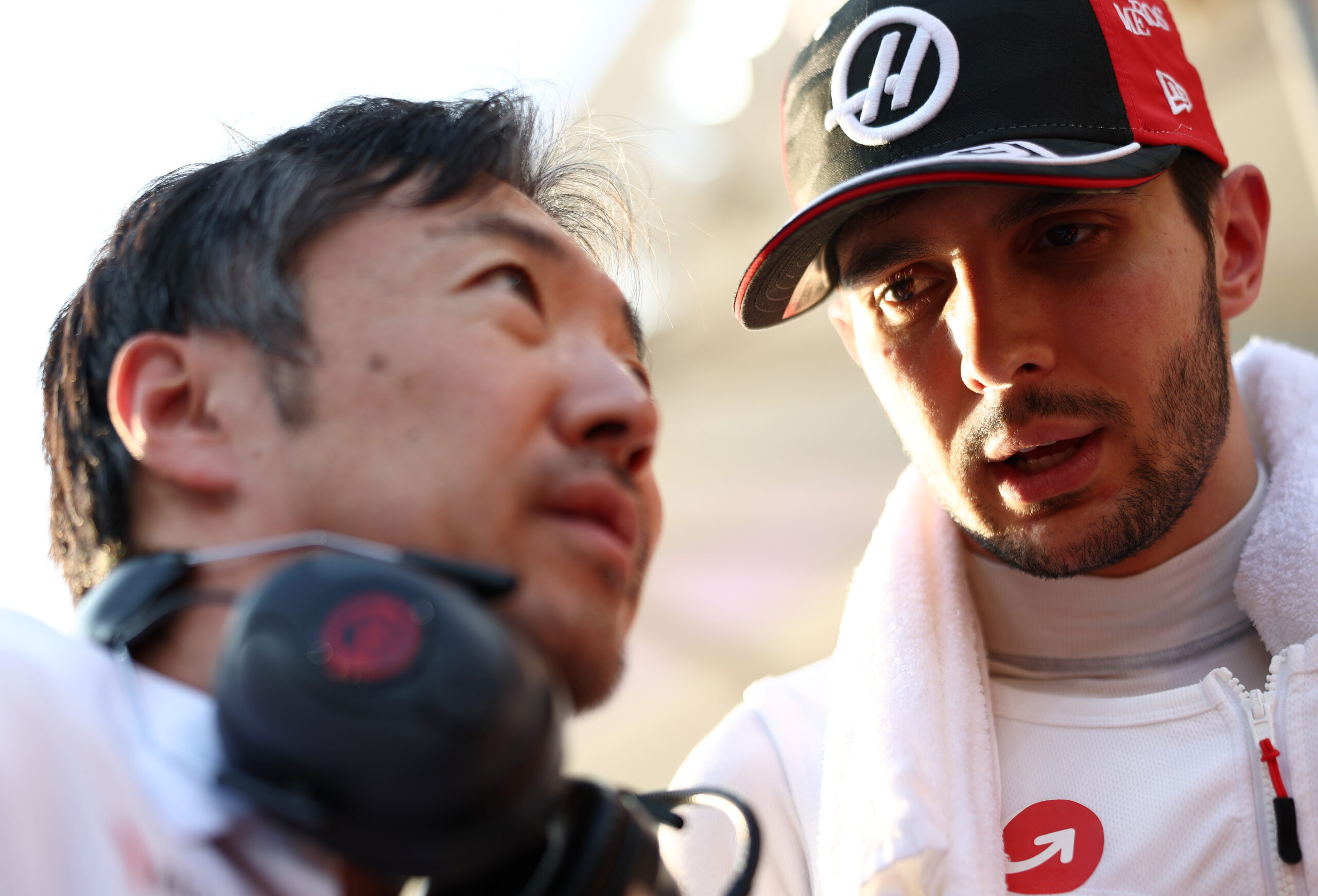
Ayao Komatsu and Esteban Ocon talk on the grid prior to the F1 Grand Prix of Abu Dhabi at Yas Marina Circuit in December 2025.

He has also cultivated a ‘no blame’ culture

In removing the fear, providing breathing space, and giving people latitude to solve their own problems, Komatsu has cultivated a ‘no blame’ culture.

He took public responsibility for the collision at Silverstone but later spoke to Bearman and Econ about what went wrong. He let them air their grievances and decide the future rules of engagement when their cars are in close proximity mid-race.

“I said, ‘look, until the next race, we’ve got two weeks. Take your time, you put everything on the table and, by next week, can you come to an agreement? If you don’t come to an agreement, I’ll tell you what we need to do’,” said Komatsu while fully aware that neither driver wants to be told what to do by anyone else.

“The important thing here is that full transparency,” he added. “I don’t have any other agenda than wanting both of you to perform; the team to perform. I’m not biased towards one driver or the other, but then again, sometimes I have to make a decision that will disadvantage one of the drivers, but as long as this guy knows that I was making that decision purely based on the interest of the team, as long as you’ve got that respect and transparency, it’s fine.”

When Ocon signed with Haas ahead of the 2025 season, some external observers harboured reservations due to his supposedly difficult character. Komatsu, having worked with Ocon for more than a year, is having none of that.

“I knew that it’s got a lot to do with the respect between the team and the driver, transparency, and then providing that safe space. I was very confident that we could provide that environment.”

What to read next

Even the Best Tennis Players in the World Are Worse When the Stakes Rise – and it’s Not Just Down to Random Variance or Bad Luck

20 Nov 2024

Articles

Fierce Foes Become Friends for the Greater Good of Female Athlete Health

Category
Human Performance, Leadership & Culture
Share
Facebook Twitter Email Copy Link
https://leadersinsport.com/performance-institute/articles/fierce-foes-become-friends-for-the-greater-good-of-female-athlete-health/

The Global Alliance is a novel collaboration of some of sport’s most decorated rivals.

By Sarah Evans, Rachel Woodland & Lottie Wright
You might have thought that UK Sports Institute, US Olympic and Paralympic Committee, Australian Institute of Sport and High Performance Sport New Zealand were the fiercest of rivals and would be unlikely allies in sharing high performance practice and intelligence.

However, the quartet have formed an unlikely partnership for the good of female athletes across the globe and with the aim of pushing forwards advancements in female health research and practice.

The result is the Global Alliance and, on our most recent Women’s High Performance Sport Community call, we were joined by Dr Helen Fulcher from HPSNZ, Dr Amber Donaldson from USOPC, Dr Rachel Harris from the AIS, and Dr Richard Burden from UKSI, to discuss how it works.

All four institutes have made their own way in providing additional focus and resource for female athlete health, starting at different points in time across the last ten years.

All four have focused on education. The AIS, UKSI and USOPC have had further branches into research. HPSNZ have looked at processes and systems linked to technology; and the USOPC have had to consider partnerships that help navigate a geographically large country and complex health system.

However, all four acknowledge that despite their positions of privilege there are limits to time and resource in this area, and all four are aware of what improving health for females, who typically suffer more injuries and illnesses than males, could do for raising levels of competition. The opportunity the group of four are close to bringing to reality is for an alliance to support globally with raising minimum levels of understanding when it come to female athlete health.

The formation of the Global Alliance

The world of elite sport is quite small, so when travelling to conferences and talks on these spaces, the group realized that they are all doing the same things, with limited resources and time. So the premise of the Alliance is to combine resources and save time across the group. After all, as Burden asked, “what’s the point in spending lots of money people don’t have on education resources when it already exists publicly?” Whilst bumping into one another, the group organically had conversations on how they can work together to increase efficiencies without crossing boundaries of competition. “We are all under-resourced, we’re overstretched in terms of the time that we’re wanting to spend in this space,” said Harris. “We really wanted to try and allow the people that are working in our sporting organisations to be more proactive.”

Traditionally seen as rivals, these organisations are now collaborating for the benefit of female athletes across the globe. The primary goal is to collaborate on female health initiatives, leveraging each organisation’s expertise and resources. This collaboration aims to enhance the health and performance of female athletes by sharing knowledge and best practices across regions.

The Alliance’s main objectives include…

  • Sharing best practices and resources: “You can’t do everything on your own,” said Burden, “or your organisation can’t be everything to everybody.” By pooling their collective knowledge, Alliance members can develop and implement the most effective health initiatives and signpost others towards the best practice or research already implemented by their colleagues in different regions. The dream is to be able to give people one place to come to, and then to be directed to other places. Ultimately, no individual person can be an expert in everything, and we should always remain open to the idea that someone might know more than we do.
  • Benchmarking and baseline efforts: The goal, as Fulcher explained, is to “create a baseline that is higher”. Members of the Alliance will regularly assess and combine their efforts to ensure continuous improvement which, in theory, should result in healthier female athletes and higher levels of competition.
  • Addressing misinformation: Simultaneously the alliance would ensure that accurate and reliable information about female health has the potential to reach all athletes, especially those in regions with limited access to such information. The group are passionate on making sure that the information available would be representative of the global athlete population, and therefore diverse, whilst being evidence-based. You want to be able to say “‘as of now, this is the best way to treat X’,” said Donaldson. Athletes from different nations will also help spread accurate information about health topics, such as menstrual cycles and nutrition, through their platforms. The Alliance recognizes the influence of social media and aims to create content that can be shared widely to reach a broader audience.
  • Speeding up progress: As a collective the alliance can move practices along more quickly, be that through raising baseline levels faster, or by being able to increase sample sizes.  The group have an inherent belief that the collective is greater than the individual. They also want to make sure that as relatively well-resourced nations with greater access, they welcome in their colleagues in countries where access and resources may be more limited.
  • Conducting collaborative research: One approach to speeding up progress would be to continue the research work that is currently happening in silos. There is potential in multicenter research projects, as Burden explained. He said: “If you can combine multicenter research, with those multicenters being in different countries around the globe, then you are naturally going to get a more diverse, rich database and, therefore, the insights that we’re going to be able to get from that are going to be just way more valuable for everybody”. It’s still a competitive environment. “We still absolutely want to beat all of the other people in the Alliance that we’re forming here on the medal table,” said Harris, “but we certainly see that the things that we’re doing in this space are not about state secrets.”
  • Providing a blueprint: The aim is to develop a central repository of trustworthy information to which athletes, stakeholders, and organisations can refer. It’s not often that cross-country collaboration happens but, by bringing this Alliance together, a blueprint for collaboration, and how to ‘do’ it, can be created; from ideation to doing; sharing learnings as they emerge, especially when they are collaborating on an important topic area. They want to show how a collaboration can start and, ultimately, how to ensure longevity beyond the four current members.

The Alliance faces several challenges, including:

  • Getting things through layers of bureaucracy. The solution is commitment to sticking with it, but then being inventive with methods of information dissemination.
  • Ensuring that the resources and information generated are visible and accessible to athletes and other stakeholders globally. This involves understanding and appealing to the way in which athletes take on and digest information. It will also require strategic communication and collaboration with local leaders and organisations.
  • The need to combat misinformation. The alliance will provide rigorous, trustworthy information that cuts through the noise of inaccurate or misleading content. It will be able to share aligned messaging globally.
  • Resources are not limitless. Hence the need to come together to collaborate and combine resources for a scale of economies effect.
  • Time is precious. In addition, the numbers of athletes going through some of the specific female health experiences can be quite small, so to learn and provide advancements could take much more time if each institute tried to do so on their own. The multicenter research projects should counter this.
  • To be truly representative globally, the Alliance will have to grow to be culturally diverse and account for different languages and time zones. The group recognize that this will be a challenge and it might take grit and determination to make it happen.

The alliance is committed to overcoming all of these challenges by building robust, reliable resources and ensuring they are effectively communicated and accessible to all athletes.

A proactive and inclusive strategy

The Global Alliance is a comprehensive approach to enhancing female athlete health that prioritises:

  • Collaboration: The Alliance is built on shared values, humility, and a commitment to improving female athlete health through collective effort. “We’re all in exactly the same position and we’re all really wanting to do the same thing,” said Harris.
  • Education and resources: A key focus is on creating and sharing educational materials that are accessible and evidence-based. As Harris said: “We felt that by ensuring we could create some of these resources, they could put more of that time into looking after their athletes.”
  • Future vision: The Alliance is aiming for a sustainable, impactful approach that can adapt and grow to meet the needs of female athletes globally and improve female health for athletes. It wants to raise the standards of competition along the way and, through its multicenter research, increase the number and diversity of research participants and insights. The Alliance may not be everyone’s answer, but could be a connector, with a central platform for sharing information gathered across the board.

Top tips

Just start! If you’re working in a small organisation where you can’t produce education modules or you can’t fund research, there’s no harm in just starting a conversation. Build your own networks, forge connections, and don’t be isolated.

Find people with the same values and intent. “And that’s not to say that there is no kind of diverse thinking within our group,” said Burden. “But the underpinning values within the Global Alliance and the work that we’re trying to do are all shared.”

It’s not about ‘us’ but a bigger purpose. Fulcher spoke of building communities within your area of expertise or within your own nation, but then taking that further. “That’s within your specialty, within your area or your nation,” she said. “I think it’s a natural step to build an international community; and we do have them, but they’ve been a bit ad hoc.” The Global Alliance is, as she added, an opportunity to raise standards across female sport. “The focus is not just on individuals having great connections but what can we collectively do better for this group of athletes that we all care about.”

Stay curious and be friendly. “One of the biggest things is to be humble,” said Donaldson. “Really coming to this platform being  humble and wanting to learn, wanting to contribute is key.”

Find out what works for you. You can learn from others but try to ascertain what works for you in your context too. Donaldson said: “I can tell you exactly what we do, but you’re not going to be able to replicate it like for like.”

Those in-person moments can be critical. “Those in-person conversations can help build relationships,” said Donaldson, who explained that the Alliance meets periodically. “You can also get more done when you have those conversations.”

Involve coaches in the education piece. Fulcher said: “Make sure coaches feel comfortable enough so that if a certain issue is brought up, they know where to direct traffic and tell people where to go for help.”

13 Nov 2024

Articles

Your Team’s Mental Performance Program Will Only Be Effective with a Clear Strategy. Here’s What you Should Do

Category
Human Performance, Leadership & Culture
Share
Facebook Twitter Email Copy Link
https://leadersinsport.com/performance-institute/articles/your-teams-mental-performance-program-will-only-be-effective-with-a-clear-strategy-heres-what-you-should-do/

In the second part of our miniseries, mental performance coach Aaron Walsh explains the importance of a vision, philosophy and framework.

By Aaron Walsh
What do we believe to be the most effective way to develop our people?

Do we focus on increasing capability or reducing interference as a primary strategy?

In theory, most would agree with increasing capability but, in practice, our coaching models are often dominated by reducing interference.

There’s a time and a place for work-ons but, from a mental perspective, when we overfocus on weaknesses, players can become oversensitive to threats that could impact performance. Their thoughts drift towards what could go wrong and how those weaknesses could be exposed.

When we focus on their strengths, they are more likely to look for opportunities to express those positive points of difference. Rather than being anxious about performing, they are excited.

Your mental performance work should align with your overall performance philosophy and beliefs about how we get the most out of the people we leads, but once a team has decided on an approach to increasing its mental performance, there needs to be some strategy around the work. To do this, there are three questions to guide us:

  1. What is the vision for the work?
  2. What philosophy will drive the work?
  3. What framework will we build the work upon?

Creating a vision for the work

Let’s start with the end in mind. What would success look like if we nail this work?

This question lets us capture something tangible and provides strategic direction with clear outcomes. It anchors us in reality while buffering us from the temptation to be reactive when various challenges arise.

Here is an example of a vision statement we can use:

‘We want to produce self-sufficient athletes who can embrace the demands of being a professional athlete while delivering their best when it matters the most.’

Success is clear. There is no ambiguity, and everyone involved in the program can align around this vision.

Capturing your philosophy

Secondly, having a philosophy about how we will achieve the vision is vital. This is more about ‘how’ we will approach the work and what will guide the delivery of the program. This should capture and reflect our broader high-performance beliefs around growth and development.

There is an equation we can use to help us define this.

High Performance = Capability – Interference

This definition poses a critical question for everyone in the performance space.

As asked above, when finding the most effective way to develop our people, do we focus on increasing capability or reducing interference as a primary strategy?

We can all think of coaches who start a review with clips about poor aspects of the team’s performance and it is normal for players to have those aforementioned work-ons at the beginning of each week.

This is not to say that there is no place for this, but we select players because of what they can do. It’s their strengths and their ability to impact the game that make them valuable members of a team. Furthermore, if all we give them are areas of their game to work on and if they change week by week depending on their game, then we endanger development through inconsistency.

Whatever your agreed approach to mental performance, it should align with our overall performance philosophy and beliefs about how to get the most out of the people we lead.

The right framework

With the vast nature of subjects and focus areas within sports psychology, it is often daunting for providers and teams to know where to start. However, a simple framework can create a strategic approach that brings clarity and direction to the work. This prevents the provider from bouncing around different subjects weekly and not building anything of substance.

The framework above is anchored in the philosophy introduced previously, which states mental skills exist to help people grow and maximise their capability. It intentionally starts with foundational subjects that build upon each other. The reason for this is linked to the growing prominence of the mental side of performance. With more discussions occurring, more articles being written, and the emergence of social media, there is a danger of replacing foundations with tools.

Here’s what I mean: subjects like mindfulness, breathing, and visualisation are helpful and, in some cases, necessary. However, they are just tools that can help under pressure. Dealing with pressure will be much more effective if these tools are married to other critical mental skills. This framework aims to introduce these skills systematically and purposely so the athlete is well equipped for the various challenges they will face. From experience, athletes who know how to grow themselves and their mindset find pressure, something they can face and overcome. Giving a few tools won’t accomplish that.

Grow yourself

The first aspect of the framework lays the foundation for mental performance. When discussing this with an athlete, we can introduce and define it by asking five questions.

  1. Why do you play the sport? (Purpose)
  2. What are you trying to accomplish? (Goals and aspirations)
  3. How will you get there? (Creating a performance plan)
  4. When will you do the work? (Self-management and Ownership)
  5. Who is in your circle? (Support)

Purpose: We want athletes connected to a purpose that fuels their performance. Every athlete will face challenging periods throughout their career, whether it’s injury, non-selection, or a loss of form; there are moments where doubt emerges that can potentially derail their journey. Being connected to why they play the sport and accessing that passion provides perseverance and focus during these difficult times.

Goals: Knowing what you are trying to accomplish is vital for any athlete. To understand this, here is a simple analogy. When we want to get somewhere in our vehicles, we set the destination in our GPS. We do this so we don’t get lost and waste time getting to where we want to. This is the same for an athlete; without clear goals, they can spend much time going in different directions and not get closer to their desired destination.

Planning: Once we know where we are going, we must understand how we will get there. This is where a good plan is invaluable. To continue the analogy above, a GPS provides clear steps so we arrive at the right place at the right time. Many athletes set goals and fail to determine what they must do to get there. A performance roadmap creates a focus on the right areas of development that will be critical to achieving what the athlete has set out to do

Ownership: I was recently asked what characteristics are shared among the best athletes I have worked with. Though there are many that they share, one sticks out. They take ownership of their careers. They drive the different aspects of performance and see those around them as key supporters. They don’t make excuses or play “victim” if things don’t go their way. One key aspect of this is how they use their time; they have a weekly schedule that is linked to the goals they have and the plans they have in place. They are purposeful and hold themselves accountable.

Support: The final aspect of growing yourself is about support. Throughout their career, athletes will have numerous and different perspectives offered by coaches, support staff, and agents. They need to be clear about what voices are essential. Having a clear support circle is critical so they stay on track and have the encouragement to get where they want to be.

Grow your mindset

The second aspect of the framework is grow your mindset. American psychologist Michael Gervais defines mindset as “how we see ourselves and the world we live in.” This is critical for athletes. Here are a few examples of the power of the mindset

Constant Improvement: Are athletes focused on getting better every day? Do they have a process in place to achieve this? Can they be consistent regardless of what happened the day or week before? Can they manoeuvre through the highs and lows of the game and remain anchored to their pursuit of being their best? They can reduce all the noise of competing by returning to a simple question: “How do I get better today?”

Opportunity-focused: Do they view themselves as competent, and is it an opportunity to express themselves? Or do they see themselves as imposters, and is the game a place where they get exposed? One mindset produces trust and excitement, while the other produces doubt and anxiety, both significantly impacting performance.

Antifragile: Author Nassim Nicholas Taleb defines antifragility ‘as something beyond resilience or robustness. The resilient resists shocks and stays the same; the antifragile gets better.’ This is particularly relevant for athletes, as adversity, disappointment, and failure are common obstacles they will face. Do they see this as something that destroys them or something they can learn from and be better than ever? Their mindset towards challenges is a significant indicator of future decline or growth.

Growing under pressure

The final aspect of the framework is how we deal with pressure. Most people see pressure as something to be avoided at all costs. Certain situations cause deeply uncomfortable feelings. Without the right strategy, pressure can feel unmanageable and, at times, paralysing. For athletes, there is no option to avoid pressure if they want to be successful. Therefore, they must have the tools to approach it confidently and believe it is a place where they can succeed.

As mentioned above, there are many practices and tools related to pressure. Once we have the foundations in place, they are valuable. For the sake of brevity, I won’t go into all the tools, but there is a clear outcome no matter what we use.

We want to be able to deliver our best when it matters the most.

Below are three things we can focus on to help our athletes be at their best in the big moments

1. Get calm: Under pressure, the nervous system can cause chaos. Our minds begin to race, and our bodies react. Our first port of call is getting calm so we can deal with the moment in front of us.

2. Get clear: Once we are calm, we need to manage our focus. Often, under pressure, there is a temptation to go to the outcome of a game or the consequence of getting things wrong. We want to eliminate that distraction and focus on the task at hand.

3. Let go: The final reality that can help us when pressure is present is letting go. This requires us to trust what we have at that moment and surrender. The more we try to control, the less instinctive we will become. Athletes are at their best when they are free, trust their skillset, and play what’s in front of them.

In conclusion, a mental performance program will only be effective if there is a clear strategy behind it. Here are a few questions to help stimulate this:

  1. Do you have a clear vision for the program?
  2. What philosophies will undergird and guide the work?
  3. What framework is best for your team?

Further reading from Aaron Walsh:

Why the Upswell in Demand for Mental Skills Is Not Being Translated into Effective Work

12 Nov 2024

Articles

How the Centre of Excellence for Women in Sport Is Plugging the Research Gap For Female Athletes

Category
Human Performance
Share
Facebook Twitter Email Copy Link
https://leadersinsport.com/performance-institute/articles/how-the-centre-of-excellence-for-women-in-sport-is-plugging-the-research-gap-for-female-athletes/

Dr Richard Burden, Professor Kirsty Elliott-Sale and Olympian Heidi Long addressed the topic in a recent Women’s High Performance Sport Community call.

By Rachel Woodland, Lottie Wright & Sarah Evans
The research gap – or gender gap in research – is one of the most enduring challenges in women’s sport.

Not only is there less research on female athletes, often that which does exist is of poor quality and is limited in its application to athletes.

To compound matters, much of the tech available does not have female athletes in mind, which calls for greater levels of safeguarding for those athletes.

The Centre of Excellence for Women in Sport is a space in which to address all of those challenges. It addresses the unique needs of female athletes, focusing on health and performance support for Olympic and Paralympic sports, as well as professional sport. The Centre also aims to bridge the gap between academic research and practical application in elite sports, ensuring that female athletes receive tailored support based on rigorous scientific research.

Opened in March 2024, the Centre is a collaboration between the UK Sports Institute [UKSI] and Manchester Metropolitan University.

In several key ways it is an ideal marriage. On one hand, the UKSI brings its sports knowledge and knowhow, and understanding of the complex environment of elite athletes and sports. On the other, Manchester Met brings their research expertise and both quality assurance and scientific rigour.

Leading the project are Dr Richard Burden, the UKSI’s Female Health & Performance Lead, and Kirsty Elliott-Sale, Professor of Endocrinology & Exercise Physiology at the Institute of Sport at Manchester Met.

Their hope is to generate richer information that is more valuable and applicable to the athlete, coach and the sport – all of which should lead to greater engagement from everyone.

Both joined the Women in High Performance Sport community call that took place in early October. It was the first of two in partnership between the UKSI and the Leaders Performance Institute. Joining the duo was rower Heidi Long, who won bronze in the women’s eights at the Paris Olympics this summer.

The Centre of Excellence for Women in Sport has three key purposes:

  1. Thought leadership and collaboration

The Centre aims to be a hub for thought leadership in women’s sport, setting the agenda for elite female athletes in the UK. Experts from various fields are involved, ensuring that research is co-designed with athletes and coaches. It is then the duty of the Centre to ensure that its findings are relevant and applicable.

Part of this is building a network within elite sport so that the data can be picked up and used again. Then planning the research so that there can be intentional overlaps between sports and a pipeline of future users.

  1. Standards and quality assurance

High-quality research is a must. The Centre is committed to producing credible and impactful data that can be translated into practical applications. This involves rigorous methodological standards and continuous feedback loops with athletes and coaches.

Knowing the sport specifics to focus on that help uncover necessary insights, but with the right overlaps to other projects so that the science and sample sizes increase to build the science.

  1. Adapting research at the pace of high performance

With research traditionally taking time, the Centre is a live example of research adapting to the needs and wants and context of the sport without losing the scientific robustness that we so need and that’s constantly evolving. For example, exploring less invasive ways of measuring ovarian hormone profiles using saliva and urine based methods.. Whilst taking any measurements can feel time consuming for the athletes, it’s a balancing act of beneficial learning versus over imposing on the athletes..

Realtime feedback has been a key advancement of engaging the sports with the research, and to be able to make changes based on findings before the full project is completed in the run up to an Olympic or Paralympic Games.

All of which raises standards as the data collected is credible, with the potential to be translatable, which in turn increases its utility and potential impact.

Project Minerva is a prime example of this process in practice.

Introducing Project Minerva

Project Minerva – named after the Roman goddess of wisdom, justice and strategic war – is an ongoing research project started by the GB Rowing team in collaboration with the UKSI, Manchester Met and several external stakeholders.

It has set out to investigate the relationship between the women’s squad training programme characteristics (e.g. training volume, intensity distribution and frequency), internal training load (heart rate, RPE, and blood lactate monitoring) and hormone function, on the menstrual cycle and overall health.

For GB Rowing, project  Minerva has been an iterative process, and ,  working with the UKSI Female Athlete Programme, Man Met, and in collaboration with the athletes, has increased the research capability and scientific rigour, so it now provides a valuable resource within the UK sports system, as Dr Burden and Prof. Elliott-Sale explained alongside Long, who shared her experience of Minerva as an athlete during the Paris Olympic cycle.

Project Minerva has led to…

… increased athlete and coach engagement through education and a focus on purpose / the why. The more performance-based something is, the more likely an athlete will be to engage. Heidi Long and her teammates were keen to know what they could glean from the research.

… better communication and understanding between athletes and coaches. This allows for more personalised training and performance strategies (that can be tweaked due to embedded real-time research and data). They could see the results of applied research – and the data that was personalised for each athlete – which was further motivation for a cohort of goal and results-driven athletes.

… the debunking of common myths, particularly those around the menstrual cycle. There is no supporting evidence to suggest that an athlete’s phases impact her ability to train. Minerva – in an unplanned moment of feedback – demonstrated to athletes they could perform – and win – in different phases of their cycle.

… increased use of useful tech. Minerva can call upon technology developed by the UKSI and its partners, such as Intel. Data collection is less arduous and much more accessible as a consequence.

Three questions to ask yourselves when embarking on such projects:

  1. Your female-specific research: is it being conducted from a health perspective, a performance perspective, or both?
  2. Do your performance team have the bandwidth, the funding, the right people with the knowledge and experience, and capacity develop and deliver to make changes based on the results?
  3. Is it useful or merely interesting? Understand the question you want to ask; where it’s come from and why it needs answering.

The Centre of Excellence for Women in Sport’s ultimate vision is to pioneer innovative and impactful research that accelerates the development of women’s sport. This includes:

  • Ensuring that research findings are directly applicable to athletes’ training and competition.
  • Leaving a lasting legacy through credible data sets, resources, and educational initiatives that benefit future generations of female athletes.
  • To allow every female athlete to train and compete to her potential.
  • By generating and showing cases resources that can be used, raising awareness that starts now and continues through all future generations.
  • Providing trustworthy, reliable, rigorous education tools. Filling the void around female athlete health that is too often filled with nonsense.
  • Continue to be a place for athletes, coaches, and all staff to have deeper conversations, as understanding is deepened and academic application expanded.
  • Be a hub for colleagues and allies across the world, not just a UK-based centre, but something that becomes truly global. There’s a lot to be learned from one another.

Final question: is any research better than no research?

Not all research is good research. Research can bring beneficial interest in an area, but poor-quality research can lead to misinformation (particularly on social media) as well as misdirected efforts and resources, which is a significant concern in the context of limited budgets and time.

Research has to meet standards in terms of methods, equipment and protocols (all of which can be expensive or time-consuming). Moderate research may have its uses but it’s nuances must be clearly signposted.

Prof. Elliott-Sale explained that research can never be one-size-fits-all. It is important to work with individual athletes, establish their response (if there is one) to stimulus and whether or not theirs is a consistent response. Either way, you can leverage a positive response and mitigate an adverse response.

7 Nov 2024

Articles

How St George’s Park Met the Support Needs of GB Wheelchair Rugby

Category
Coaching & Development, Leadership & Culture
Share
Facebook Twitter Email Copy Link
https://leadersinsport.com/performance-institute/articles/how-st-georges-park-met-the-support-needs-of-gb-wheelchair-rugby/

Team Manager Lee Stutely explains that no stone was left unturned as the team prepared for Paris.

By John Portch
When Great Britain’s wheelchair rugby team came off the court in Paris, their disappointment was mixed with immense pride.

The team narrowly lost their bronze medal match at the Paris Paralympics 50-48 against Australia, but captain Gavin Walker was positive.

“If you’d have asked me two years ago, I’d have probably snatched your hand off for the experience of playing for a bronze medal,” he said, mindful of the transition the team has been in since winning gold in Tokyo.

“We go into another rebuilding process, another four years ahead of us and looking towards LA now,” he continued. “[We will be] growing the sport, putting time into grassroots and developing the team going forward.”

Not that any stone was left unturned in the build-up. “Our performance in Paris highlighted the progress we are making and confirmed that we remain at the forefront of wheelchair rugby,” says Lee Stutely, Great Britain’s Team Manager.

She is speaking to the Leaders Performance Institute about Great Britain’s two team camps that took place at St George’s Park in Staffordshire before the Games. The first, a seven-day visit in January, focused on their continuing preparations; the second, a four-day camp in August, represented the final taper towards Paris.

Both were a result of smart planning, with Stutely taking a lead on the logistics of the camps. “We came and rec’ed, just me and our Head of Performance Support & Science Barry Mason,” adds Stutely. “Then the coaches came with some athletes to check the playing surfaces.” From there, the coaches and performance team came together with Walker and vice-captain Stu Robinson to map out the sessions and structure.

All reflect with satisfaction on the work that was done in the last cycle. “The team’s trajectory is clearly on the right path toward further medal success,” says Stutely, “and we are driven by our commitment to high standards and continuous improvement.”

The team will conduct a post-Paris debrief to identify its strengths and weaknesses. “We will be hoping to learn if the systems and processes in place were effective,” adds Stutely, who emphasises how important it is to retain and refine successful strategies. “We will also examine what can be improved and what we should stop doing. As Paris showed, there is little between the top teams. We need to identify where can we get our marginal gains and what can increase our competitive edge in the next cycle.”

Chris Bond of team Australia is on the ground after a clash with Aaron Phipps of Team Great Britain during the Wheelchair Rugby Group B game Australia vs Great Britain. (Photo: Marco Mantovani/Getty Images)

The home of England

Great Britain qualified for Paris by finishing runners-up at the 2023 European Championships.

With their passage secured, the team could step up their preparations. While happy with their usual training facility at the Lilleshall National Sports Centre in Shropshire, Stutely and her colleagues felt that a change of scenery could reset minds and take players out of their comfort zones.

The 330-acre facility at SGP fitted the bill. Stutely says: “It made them more aware that they were moving onto a competition and preparing for something special rather than just being their home from home training environment.”

SGP is also the home of 24 England football teams. “We have quite a few football fans within our team so they were excited,” adds Stutely. “It’s historic and other senior teams have trained here, such as the England women’s rugby team. The venue is awesome for us because it’s accessible; and everything – training facilities and accommodation – is in one location.”

In addition to an onsite Hilton Hotel, the complex boasts 14 state-of-the-art football pitches, which can be configured for a variety of sports, as well as a range of indoor facilities including a full 3G pitch, a multifunctional sports hall, gym, hydrotherapy pools and a cryotherapy chamber.

The SGP team were on hand to allay any concerns. “Kevin Sanders was very good to us,” says Stutely of SGP’s Elite Sport & Partnerships Manager. The team could count on court time, gym time, meeting rooms and private dining rooms. “The Hilton were also very good at making sure we had as many accessible rooms as possible and that everything was suitable for our athletes’ needs.”

SGP is the home of England’s Para football teams and has long been committed to ensuring that the nation’s disability and impaired teams have equal access to the complex’s high performance facilities. It’s a point of pride for SGP, even if this process remains a work in progress, as Becky Bullock, the SGP Customer Account Lead at the Football Association, tells the Leaders Performance Institute.

“We acknowledge there is always more we can do,” she says. “We are continually learning, listening and striving to improve, and we remain dedicated to incorporating best practice into the future design and development of our facilities to be accessible for all.”

Aaron Phipps of Team Great Britain competes during Bronze medal match between Australia and Great Britain. (Photo: Aitor Alcade/Getty Images for IPC)

The future

The Great Britain team is aware of its legacy beyond the court, with Walker taking the opportunity after the bronze medal match to address the audience watching at home in the UK.

“For fans out there and people who are watching this, we’re all playing this sport after starting life with a disability or going through some sort of traumatic injury,” he said. “The fact that any athlete in the Paralympics is competing shows they’ve overcome adversity and everyone should be proud of any performance. I guess that’s the main message for anyone out there that is struggling – this is something that can get you out of those dark times.”

Wheelchair rugby, as Walker alluded to, is an egalitarian sport. It is built on ensuring that players with different care needs can compete together. Players are assigned a points-based value based on their functional ability ranging from 0.5 (those with the highest support needs) to 3.5 points (those with the fewest). The total point value of a four-player team cannot exceed 8.0 points unless it includes a female player, which affords a team an extra 0.5 points, taking the maximum total to 8.5 points.

“Some team bonding happens because of accessibility issues, the whole ‘no-one is left behind’ thing,” says Stutely. “They always look after each other.”

The British Paralympic Association works with Games authorities to ensure that athlete accommodation at all Paralympics is suitable for their teams’ needs. Stutely, who took part in her fifth Games in Paris, believes that environments have generally improved since the London 2012 Games raised the bar.

“As staff and athletes, we spend a lot of time being adaptable to the environment we enter,” she says. “Overcoming any challenges and learning how to control people’s mindsets when things are not going the right way is so important.”

Looking further ahead, Stutely is excited for Great Britain’s prospects. “We also have a promising depth of young and talented athletes. This blend of experience and emerging talent positions us well to continue competing at the highest level and achieve even greater accomplishments on the world stage.”

Further reading:

Pre-Season Preparations: Why a Home from Home Can Make All the Difference

7 Nov 2024

Articles

Female Athlete Health: Five Top Tips When Discussing the Menstrual Cycle and Other Issues

Category
Human Performance
Share
Facebook Twitter Email Copy Link
https://leadersinsport.com/performance-institute/articles/female-athlete-health-five-top-tips-when-discussing-the-menstrual-cycle-and-other-issues/

Esther Goldsmith and Dr Natalie Brown from Sport Wales offer their best advice for beating taboos, finding the right words, and picking the opportune moment.

By Esther Goldsmith & Dr Natalie Brown
Talking to female athletes can feel challenging and uncomfortable; and sometimes concerns of safeguarding practices can exist.

This results from historic perceptions of the menstrual cycle and female-specific factors such as pelvic health being personal, secretive and related to feelings of embarrassment, shame and uncleanliness.

However, female health and topics such as the menstrual cycle are normal biological functions related to hormonal control, the same as heart rate, breathing, and appetite.

From speaking to practitioners and coaches, as members of the Sport Wales Female Health & Performance Team, we know there are additional influences on comfort levels when having conversations with female athletes about the menstrual cycle. For example, knowledge of the topic, appropriateness, gender of practitioner, experiences (professional and personal) and perceived relevance (both to athletes and performance).

Previously reported barriers to conversation include:

  • [Male] coaches feel that it’s inappropriate or an invasion of privacy
  • Cultural taboos resulting in shame and embarrassment
  • Confusing messages in the media
  • Not having resources or education to know what to say and when
  • [Female] coaches’ previous experience of menstrual cycles not affecting performance/training
  • Perception that discussion of menstrual cycles and hormonal contraceptives are outside of the coaching role
  • Lack of a female practitioner
  • Lack of structure in place for education or support
  • Lack of time in a season for proper education
  • In addition, practitioners and coaches are sometimes paralysed because they don’t know the right questions to ask, the right language to use or how to start the conversation with the female athletes that they work with

Here are our top tips…

1. Acknowledge that everyone feels different

It is important to acknowledge and have awareness that some athletes may feel comfortable to talk openly about their menstrual cycles whereas some may feel like it’s the worst thing in the world to start with. This could be influenced by their culture, age, family, and social surroundings.

2. Think about language

One thing that is important to be aware of is the language that you use. We’ve all grown up using euphemisms for lots of different things, whether that is for parts of the body or biological functions that we are embarrassed to talk about. There are lots of period euphemisms or ‘code words’ but using these can reinforce the perception of awkwardness, embarrassment and the negative stigma that is historically related to menstruation. We encourage using the terms menstrual cycle, menstruation, periods, and period products.

3. Consider the who, what, where, when and how

Before initiating conversations with female athletes about their menstrual cycle or other aspects of female health, have a think about the ‘who’, ‘what’, ‘where’ and ‘when’ and ‘how’…

Who – Who is best to have the conversation? Do you want support from another coach/team member to improve comfort of the first conversation e.g. is there someone the athlete is familiar with. Dependent on the age of the athlete, this may be a parent or guardian.

What – It’s OK to let the participant know that you’re not an expert. Explain the reasons why you want to talk about menstrual cycles – that they are key factors in health and wellbeing and may also affect training and performance. Avoid statements such as ‘don’t need to know any more detail’. Remember to be clear, to use evidence and to listen to what they are saying back to you.

Where – Be aware that there may be cultural barriers that prevent people feeling comfortable talking about these topics and let them know that they are in a safe space outside of these barriers. Try to avoid it being an afterthought to a conversation that you’re already having that might be interrupted or have a time limit to it.

When – Is there an opportune moment to bring it up rather than a formal conversation? Think about when you approach an athlete to talk, when is the best time? When they’re tired and hungry after training?! Probably not, but don’t just ignore it! Remember that it is important for long-term health and performance of the athlete.

And finally, here are some ideas for ‘how’ to start the conversation:

  • ‘Do you think your training is affected by your menstrual cycle/hormonal contraceptives?’
  • ‘Do you track your menstrual cycle?’
  • ‘Do you experience any symptoms such as menstrual pain, lower back pain, fatigue related to your menstrual cycle that affects you in training or competition?’
  • ‘Have you got any management strategies in place for bleeding on competition day or to manage any related symptoms that are associated with the menstrual cycle?’

4. Think about actions

Following on from a conversation with a female athlete about their menstrual cycle, how could you action outcomes of the conversation and improve support? You don’t have to have all the solutions, but following up on actions promptly is important. This will help with positive experiences of talking openly about female specific factors. An example of this could be an athlete with heavy periods is extremely worried about leaking through the white shorts, so you put motions in place to change the colour of the kit.

5. Consider all the stakeholders

Whilst conversations with female athletes are the first step engaging all stakeholders in that athletes’ support network is important. This includes parents/guardians/carers, other coaches, support staff, teammates and medical practitioners.

Sometimes athletes respond better to an older athlete talking about their experiences with their menstrual cycle. Encouraging senior athletes to talk to junior athletes may be helpful in your sporting environment.

These approaches and principles can be applied to other female specific areas such as sports bras, pelvic floor health/incontinence and menopause. For further advice on conversations with female athletes, complete our Menstrual cycle openness and conversations e-module.

Further reading:

How Sport Wales Is Enabling Female Athletes to Succeed on the World Stage

Members Only

31 Oct 2024

Articles

Performance Analysis: Forget Looking for ‘Unicorn’ Practitioners

Category
Data & Innovation, Leadership & Culture, Premium
Share
Facebook Twitter Email Copy Link
https://leadersinsport.com/performance-institute/articles/performance-analysis-forget-looking-for-unicorn-practitioners/

Drs John Francis and Denise Martin highlight gaps and identify potential opportunities when recruiting performance analysts for teams across sport.

An article brought to you in collaboration with


By Luke Whitworth
While it is important for analysts to have a minimum technical skillset, it is not the be-all and end-all – emotional intelligence and interpersonal skills are just as important.

This is just one of the misapprehensions that continue to dog the world of performance analysis; a range that spans from data collection and reliability to value capture and integration.

All were addressed in the third and final session of a virtual roundtable series hosted by the British Association of Sport & Exercise Sciences [BASES] and the Leaders Performance Institute.

Dr John Francis of the University of Worcester and Dr Denise Martin from Atlantic Technological University in Ireland were on hand to lead a discussion titled ‘Advances in performance analysis: what the research is telling us’ that sought to provide insightful tips for attendees.

Integrating practitioner and academic expertise

In a straw poll, more than half of attendees declared that use academic resources to support processes and projects. It’s a promising start, but Francis was in no doubt that the applied world and academia can and should work closer together.

He and his colleagues surveyed 175 analysts on the time they spent collecting good, accurate and meaningful data and how they tested that data before providing key insights to the end user. The cohort delivered several insights:

  • Experienced practitioners excel in aligning KPIs, team goals, data systems and accuracy due to their expertise.
  • That said, both experienced practitioners and those early in their careers need refined operational definitions and firm reliability checks to ensure KPIs reflect true performance and provide actionable insights.
  • System familiarisation and reliability checks take time – streamlined processes and adequate time are both crucial.
  • The same system familiarisation and reliability checks differ from user to user. Standardised training and reliability testing methods could improve consistency and accuracy.
  • Regular data checks could make data clearer and crisper – too many teams test only at the start or end of the season.

The PRECISE Framework

Francis and his colleagues have devised a framework aimed at delivering recommendations related to validity, familiarisation and reliability. Their research is currently subject to peer review but does shed light on the question of integrated approaches.

The PRECISE Framework addresses those issues listed above:

  • Promote collaboration – in practice sessions; periodic manual checks.
  • Rely on expertise – deliver regular feedback; rely on automated processes.
  • Employ video clips – guarantee exposure time and ensure an efficient resolution process.
  • Customise adaptability – encourage collaborative learning and continuous cross checks.
  • Illuminate definitions – enable incremental learning; reliability standards should be individualised.
  • Synthesise philosophy – provide structured learning; pursue the systematic identification of issues.
  • Ensure effective software processes – set comprehensive guidelines; enhance with video.

Who writes your team’s job descriptions?

As discussed, the search for unicorns is counterproductive, but then that is often a by-product of poorly-conceived job descriptions. Is enough time being spent on positioning them in the right way?

Attendees swiftly pointed out a series of challenges:

  • The HR challenge: too often there is a lack of understanding from those without the expertise. Other times, the issues is the creation of the job description and the hiring process.
  • The pursuit of ‘unicorns’: it bears repeating. Emphasise soft skills – hardly any descriptions mention soft or interpersonal skills.
  • Verbal and visual communication: those softer skills in action – good communication skills are integral to building good working relationships as part of a broad team.
  • Who needs to be involved? It depends on the context, but you may need the performance director, technical leads, research & development and HR when hiring an analyst.

The research of Francis and his colleagues also observed that too few job advertisements provide a feel for the environment in which someone will be entering.

On this front, they have recommendations for both organisations and applicants across four areas:

  1. Employer familiarity information

Organisation: outline values and goals, provide infrastructure, staffing and philosophy.

Applicant: understand the organisation’s goals and how to contribute.

  1. Description of job-related tasks & personal specification

Organisation: list job-specific tasks and required skills; list specific academic or coaching knowledge and software competencies; emphasise evidence-informed processes and the need to understand feedback and learning strategies.

Applicant: gain clarity on role tasks and responsibilities; highlight relevant experiences in application and determine their fit. Identify areas for personal and professional growth.

  1. Salary & renumeration

Organisation: clearly present salary bands and rewards.

Applicant: assess job value and potential rewards.

  1. Opportunity for advancement

Organisation: detail career progression and CPD activities.

Applicant: make informed decisions about career path within the organisation; consider your long-term aspirations.

Ensuring value capture in applied performance analysis

Martin and her colleagues have conducted research into value capture in performance analysis and alighted on three key questions:

What? Organisational capability to generate, curate and translate data to co-create knowledge and insight.

How? Skills and contextual intelligence allow practitioners to embed effectively in the performance ecosystem.

Why? These lead to what Martin calls the ‘lightbulb moments’ – where value is added to decision-making processes and contributes to performance.

The ‘Lighthouse Model’ for practice

Martin explored her ‘Lighthouse Model’, which seeks to showcase the ‘how’ (the base of the lighthouse) and the ‘what’ (the tower). As you reach the top, the ‘light’ emphasises the learning opportunities derived from understanding and better-informed judgements.

“Developing a Framework for Professional Practice in Applied Performance Analysis”

😎Very proud to see the capstone project from my PhD published this morning.

👉We define the role of an Applied PA, the components of practice and the expertise which underpins this pic.twitter.com/32vMGSYxN7

— Denise Martin (@deniseanalysis) July 26, 2021

To do the ‘what’, you need to establish the ‘how’, which includes:

  • Contextual awareness
  • Building relationships
  • Performance analysis and sport expertise
  • Technical expertise
  • Professional behaviours

Martin emphasised contextual awareness i.e. what is needed from your environment to then have an impact on athletes, coaches and executives – those you are trying to create the ‘lightbulb’ moments for.

The following are cornerstones for the ‘what’:

  • Establish relationship and define roles
  • Needs analysis and service planning
  • System design
  • Data collection and reliability checking
  • Data management
  • Analysis
  • Report to coaching team
  • Facilitation of feedback

Gaps and opportunities: how do you get the lightbulb to shine?

  • Identify learning opportunities: there is a lack of knowledge and guidance on how to best design learning opportunities and environments in sport.
  • Develop a ‘service mindset’: there is too little service review and evaluation, which limits value capture.
  • Find ways to showcase ROI: seek ways to better develop the profession in the eyes of both practitioners and those leading performance departments.

29 Oct 2024

Articles

‘Female-Specific Considerations Should Be Part of Normal Practice’

Category
Human Performance, Leadership & Culture
Share
Facebook Twitter Email Copy Link
https://leadersinsport.com/performance-institute/articles/female-specific-considerations-should-be-part-of-normal-practice/

Esther Goldsmith and Dr Natalie Brown explain how Sport Wales provides embedded support for Welsh athletes.

By Esther Goldsmith and Dr Natalie Brown
We know that females are different to males, and that we need to take that into account when working with female athletes – but what does this really mean in practice?

As we mentioned previously, there is a lot of myths and confusion about what you should or shouldn’t be doing as a practitioner or coach in sport when working with females. Unfortunately, similar to all sports science practices, there is no ‘one-size-fits-all’ approach. Every athlete that you work with is going to be different, and female athletes are no exception. In fact, when it comes to menstrual cycles, we know that this increases variation as every individual will have a different experience of their menstrual cycle, and this might even change from cycle to cycle.

At Sport Wales we work internally and externally to ensure that every female athlete in Wales can access support when it comes to female athlete health. However, this looks different depending on the context.. We have a dedicated team of practitioners who work together to provide a multidisciplinary approach to support female health and performance. As a team, we have four aims:

  1. Enhance knowledge and awareness
  2. Establish open and supportive environments
  3. Embed positive behaviours
  4. Equip with solutions and management strategies

Whilst menstrual cycles have previously been a big focus of research and delivery at Sport Wales, we also appreciate that this isn’t the only area that female athletes need support in! Pelvic health, pregnancy, breast support, female puberty, menopause and RED-S [relative energy deficiency in sport] are areas that we have expertise around and are working with sports to consider. We also make sure that female-specific factors are considered across all practitioner disciplines, and collaborate with other teams in Sport Wales, such as the coaching team, for consistency and a whole organisation approach.

Female-specific factors do not have to be standalone or demand a lot of time and resource. Instead, we promote integrating and embedding into ongoing work to support the individual athlete. Some good examples of this might be:

  • A nutritionist considering menstrual cycle symptoms alongside their nutrition advice (a female athlete may experience premenstrual nausea that means she finds it hard to fuel)
  • An S&C coach factoring in menstrual cycle phase to physical testing notes for an individual who experiences considerable fatigue during her period to account for any changes in testing results

Another approach focusses on providing education to athletes and sharing the importance of considering and talking about the menstrual cycle. The menstrual cycle has been, and still often is, a taboo or topic that isn’t often discussed, the first step to working with female athletes is to help them feel comfortable talking about periods!

This is even more of a challenge when talking about pelvic floor health and stress incontinence. We encourage female athletes to track their own menstrual cycle so that female athletes understand what their cycle means for themselves; what symptoms they experience, how that relates to training and competition and how to manage or reduce symptoms. In addition, we help support female athletes to understand the importance of having a regular menstrual cycle and when to seek help if periods become irregular or symptoms are severe. Tracking can also be a useful starting point to initiate conversations about female health.

We also work with coaches and support staff to educate them about the menstrual cycle; we have created four online e-modules that any sport and practitioner across Wales can access. Whilst education for athletes, coaches and practitioners helps improve their knowledge which we know can help everyone feel more confident to have conversations, we also provide education and support on ‘how’ and ‘what to do next’ to encourage conversations and support to be translated into practice.

From a behaviour change perspective, education and training are two possible interventions. However, enablement and environmental restructuring are additional interventions and approaches we take to support female health and performance.  For example, helping sports contemplate the environment they provide and whether it is set up for a menstruating athlete (e.g. are there period products available during camps?).

Over the last five years, there has been a lot of progress internally amongst the practitioner team at Sport Wales to better support female athletes in Wales. We have worked hard on:

  • Increasing normalised conversations related to female health internally and externally
  • Engaging sports around female-specific monitoring (and facilitating this)
  • Challenging practitioners to consider sport science and medicine support through a female athlete and health lens
  • Building trust with athletes to talk about female-specific topics
  • Creating an open culture where people are receptive to learning and asking questions

Embedding female health support into practice does not have to be complicated or require additional time and resource – it should not be an ‘extra thing’. It is important to support the individual athlete, and female-specific considerations should be incorporated into this as normal practice. A huge amount of support can be provided through open conversations and environments between the athlete, coaches and practitioners.

In our next article we will explore conversations with female athletes in more detail.

22 Oct 2024

Articles

How Sport Wales Is Enabling Female Athletes to Succeed on the World Stage

Category
Human Performance, Leadership & Culture
Share
Facebook Twitter Email Copy Link
https://leadersinsport.com/performance-institute/articles/how-sport-wales-is-enabling-female-athletes-to-succeed-on-the-world-stage/

The institute’s Female Health & Performance Team sets out some of the most important considerations for female athletes from grassroots through to elite level.

By John Portch
A regular menstrual cycle is generally a sign of good health in female athletes – although not all female athletes are necessarily aware of this.

“There are still female athletes who see it as a positive if their periods stop when they’re training,” Dr Natalie Brown, a Research Associate at the Welsh Institute of Performance Science, tells the Leaders Performance Institute on Teams.

“This is because it’s easier and more convenient; they’ve not got to deal with the symptoms or the bleeding.”

Yet the impact on their short and long term health, let alone performance, could be significant. “It’s an indicator that they do not have enough energy for those basic bodily functions.”

Nevertheless, such myths have grown to fill the void left by a lack of education and awareness across sport.

Brown is part of the Sport Wales Female Health & Performance Team who are working to redress that balance by seeking to identify how the Welsh sports system can better support female athletes in their health and performance.

In the first of a series of articles exploring the work of Sport Wales’ Female Health & Performance Team, we discuss some of the major health and performance considerations for female athletes as well as some of the common myths that endure.

Female athletes: long overlooked

It was encouraging to see a 50:50 split between male and female athletes at an Olympic Games for the first time in Paris earlier this year, but the stark reality is that just 22 per cent of leadership positions in sport are held by women.

This is a symptom of a wider gender imbalance. Sport, much like society, has been geared towards males, with female sport often overlooked and under-resourced.

“Females are participating more, and that’s great to see, but the environments in which they are participating have not necessarily been set up for females,” says Esther Goldsmith, who both works alongside Brown within the Female Health & Performance Team and joins her on the call.

A girls’ rugby team, for example, may not have access to suitable changing rooms or toilets. “That means they have to arrive prepared and, if they’ve not got access to toilets, what does that mean if you’ve got someone on her period?” says Brown.

“Even in just focusing on the menstrual cycle you’re ignoring the bigger picture around women’s experiences of sport and how the system that we’ve designed doesn’t enable women to thrive in sport because they’re trying to thrive in a male system.”

She continues: “Girls go through puberty earlier than boys and so they have experienced hormonal changes at a time when they’re very unlikely to have been exposed to a strength stimulus and an appropriate movement at a young age when they would really benefit from it.”

“The other thing is access to physios,” says Goldsmith. “Most female teams don’t have access to a full-time physio, whereas male teams do.” Inevitably, female teams suffer more time lost to injuries than their male peers. “In a male setup you might have a physio input that means that there’s no time loss as a result of a niggle.”

This is compounded by the lack of sports science research on female athletes.

“Females have different biological and physical makeups,” says Goldsmith. “We know our hearts, circulation and hormones are different, our anatomy is different, and therefore our biomechanics are different.”

As long as the performance community overlooks this, from the grassroots to elite level, female athletes will leave both health and performance potential on the table.

Education

The Female Health & Performance Team is focused on trying “to provide practical, tangible things that you can do to support your female athletes without it becoming too complicated or time-consuming to achieve,” as Brown puts it.

Education is a significant lever. “A lot of teams say ‘we need education’ but then they don’t necessarily know how to deliver it,” says Goldsmith. “I will deliver some classes to athletes, coaches and practitioners and work with them to help them take responsibility for themselves.”

Sport Wales is aiming to create a culture where everyone, from board members to volunteers, considers the importance of female health. Goldsmith and her colleagues work with athletes and coaches to address health, wellbeing and performance questions.

It might involve classroom discussions but it could also take in one-to-one sessions. “If you’re working with an athlete there’s a bit of that ‘we’ve got to work on this together’ because every female body is completely different and everyone will respond in a different way,” she adds.

“You’ll go into some sports and work with some female athletes and they’ll respond to or act differently with you to how they might in their day-to-day training environment because you’re external and not part of their setup.”

Goldsmith will also adapt her approach depending on to whom she speaks. “Classes will look different depending on what part of the pathway you’re working on because a 14-year-old is going to respond very differently to a 25-year-old.”

She and her colleagues also strive to go beyond “surface level” initiatives and have carried out behavioural mapping. “How do we actually change behaviour so that females are considered, whether that’s with the athletes themselves or with the coaches and performance directors to look at actionable ideas?”

Myth busting

Around 90 per cent of athletes who menstruate report some symptoms including pain, reduced motivation and fatigue. Brown uses this stat to set the scene for an illuminating story: “I once asked an athlete if their menstrual cycle affects their training and they said: ‘no, not at all. I just miss training if I’m really struggling’. I just had to sit there and say ‘OK, we’re going to have to take a step back here’.”

Brown and her colleagues routinely dispel common misunderstandings and myths.

One such myth is the supposed need to periodise training according to an athlete’s menstrual cycle. “There is inconsistent evidence  that you should completely adjust all of your training based on phases of the menstrual cycle,” she says.

Media headlines suggesting links between ACL injuries and the menstrual cycle have not helped. “I’ve worked with some athletes who are petrified of training in a certain way at a certain time because of those headlines and their anxiety,” says Goldsmith. Another persistent myth is the idea that stopping the use of hormonal contraceptives will restart someone’s cycle (they may experience a withdrawal bleed, which is not the same as a menstrual bleed).

Coaches are just as susceptible to these myths. “You could see them, especially with team sports, asking ‘well, if I’ve got two athletes in that phase and two athletes in that phase and 20 in that phase, how do I make sure that they’re all training based on their phases?’” All are relieved to hear there is an alternative solution to providing female-specific support.

One might also assume that a female coach would be more sympathetic to the needs of a female athlete but that is not always the case. “Some female coaches or practitioners, for example, never had any menstrual symptoms,” says Brown. “Some of them therefore don’t have the automatic motivation to consider it, and sometimes both male and female coaches can perceive athletes as using their symptoms as an excuse.”

It is important that it is not just females either, particularly as the majority of coaches are male. Some have a wealth of knowledge in the area, others don’t. “If you ask male coaches if they think there should be equal opportunities for males and females they wouldn’t say ‘no’,” says Goldsmith. “But that doesn’t mean they’ve factored some of the things we’ve talked about into their practice. They just haven’t developed that understanding. But when you start communicating it as a performance thing, they’re like ‘OK, this applies to the world I live in’.”

To further help athletes, as well as their GPs, Sport Wales Medical Consultant, Dr Katy Guy, has prepared a letter that female athletes can take to their GPs if they were to notice a change in their menstrual cycle. “We know GPs are under the cosh and have a lot to think and know about, so we’re just trying to create a resource to help bust that myth beyond our institute,” says Goldsmith.

For all the obstacles that remain, both Brown and Goldsmith are optimistic.

“In the last two years there’s been quite a shift,” says Brown. “Before that, the conversation was starting and there was some awareness but it was more around what was not being provided. There’s been an increase in both research and support in the last two years.

“The increased visibility of women’s sport has also supported that shift. So rather than us saying ‘this is important, you need to consider it, this is why’, I feel like we’ve shifted towards sports, athletes and coaches saying ‘we know it’s important. What can we do?’”

Stay tuned for upcoming articles where Brown and Goldsmith provide practical suggestions and solutions for supporting female athletes, from enhancing knowledge and establishing supportive environments to embedding positive behaviours and suitable management strategies.

Further reading:

‘Female-Specific Considerations Should Be Part of Normal Practice’


Members Only

11 Sep 2024

Articles

Debriefs and Accelerated Learning: Transferable Lessons from the World of Medicine – Part II

Category
Coaching & Development, Premium
Share
Facebook Twitter Email Copy Link
https://leadersinsport.com/performance-institute/articles/debriefs-and-accelerated-learning-transferable-lessons-from-the-world-of-medicine-part-ii/

In the second of a two-part series, Sonal Arora, an experienced surgeon, outlines how teams can do more to help their athletes as learners.

By John Portch
“What is the difference between feedback and debriefing?”

Sonal Arora, a Consultant Emergency Surgeon with the Chelsea & Westminster NHS Trust in London, posed the question to an audience at last year’s Leaders Sport Performance Summit.

“Feedback is when I am telling you what you should do,” she said following a pause. “Debriefing is a two-way process.”

Over the course of 30 minutes onstage, Arora laid out how, in a joint research project, Imperial College and its peers working in operating theatres across the United States and Australia alighted on better feedback and debriefing as the solution to improved learning and performance.

She spoke about the OSAD [Objective Structured Assessment Tool for Debriefing] and how coaches in sport might learn from the way debriefs are conducted post-surgery.

“The real secret is to try and get [the learner] to identify what their performance gaps are and how they feel, or how the team feel, they can work better to improve it for next time,” Arora continued.

“Your role as a facilitator is to wrap all of this up at the end and determine how they are going to take what they’ve learned from this session and apply it to their future practice.”

“Now let’s come back to the real world.”

OSAD, she admitted, is too detailed for working surgeons who need something accessible and appealing if they are going to open themselves up to a debrief during a busy and often chaotic day.

“How can we take those lessons [from OSAD] and translate them into something short and simple that anybody can understand?”

Arora and her peers settled upon the SHARP tool.

What is SHARP?

SHARP was first use in 2013 and remains popular in surgical settings; there are written and verbal elements. The acronym stands for:

S – Set learning objectives

H – How did it go?

A – Address concerns

R – Review learning points

P – Plan ahead

Why is SHARP effective?

It’s quick. “It takes two minutes; so it really stops that ‘I don’t have time for this’,” said Arora, mindful that athletes and coaches are often time-poor. “We looked at feedback, debriefing and performance for cases before we introduced SHARP as a baseline; then we measured all of those outcomes afterwards. What we found was that feedback significantly increased, much more feedback was provided, learning objectives were set, but also the quality of debriefing significantly improved.”

Here is a typical structured assessment using SHARP:

How does SHARP differ from standard feedback?

As Arora said, feedback is too often a one-way street. “We could see beforehand if there was feedback, it was just ‘yes, that’s great’ or ‘no, we should have done this’ or ‘next time, just do it’,” she said. “It was very didactic, very unidimensional, very much one person or 10 dressing down another.”

SHARP encourages learner engagement. “It was much more, ‘what do you want to take away from this?’ And afterwards it’s ‘OK, you did this bit very well. It was a difficult case, but next time try and make a better use of your assistants’.”

There is an element of feedback but “you can pick up what’s important to them, not what I think they didn’t do right.”

Doesn’t surgery use ‘hot debriefs’?

Yes, usually at the end of the day. There will also be a hot debrief within 15 minutes of a catastrophic or fatal event. “If it’s so awful that the patient dies on the table unexpectedly, the rest of the list is cancelled because nobody in the team is in the right frame of mind; it’s not fair and it’s not safe to operate on people when you are thinking about what’s gone on,” said Arora.

In such scenarios, a SHARP debrief is held seven days later. “That’s critical following a terminal event.”

Go to home
Follow us on Instagram Follow us on LinkedIn Follow us on X

Contact

Leaders UK

Tuition House
27-37 St George's Road
Wimbledon
SW19 4EU
London
United Kingdom

Enquiries Line: +44 (0)207 806 9817
Switchboard Number: +44 (0)207 042 8666

Leaders US

120 W Morehead St # 400
Charlotte
NC 28202
United States

Enquiries Line: +1 646 350 0449

Leaders

  • Contact
  • About
  • Careers
  • News
  • Privacy Policy
  • CA Privacy Rights
  • Cookie Notice
  • Website Terms of Use

Performance Institute

  • Membership
  • Events
  • Content
  • Virtual Learning
  • Connections
  • Partners

Latest

Intelligence Hub
High Performance Future Trends Research Elite Performance Partners continue to drive the potential in high performance forward through renewed Leaders partnership
Your Privacy Choices

© 2026 Leaders. All rights reserved

  • Privacy Policy

Attendees

x