As Warwickshire’s Performance Director James Thomas explains, strategy is not about establishing certainty, it’s about people, collaboration and coherence.
Often the word elicits a raised eyebrow amidst busy training and competition schedules or it alludes to scarce downtime for coaches and practitioners.
It is also associated with corporate language, long documents and theoretical discussions that feel disconnected from the daily reality of training, selection and competition. In high-pressure environments, planning (reviewing and learning) can be seen as a luxury, something to revisit once results improve or uncertainty settles.
My experience has been the opposite. I’m passionate about helping raise awareness of the importance and performance impact of great strategic planning.
Strategy: a precursor to performance
After more than two decades working across Olympic and professional sport, I have come to believe that performance strategy and planning are not distractions from performance, they are precursors to it. In environments often defined by pressure, volatility and constant change, strategy provides something invaluable: direction, connection and a level of continuity.
High-performance sport is inherently unstable. Calendars shift, athletes get injured, form fluctuates, staff move on, leaders change and external demands arrive without warning. In that context, the absence of a clear performance strategy does not create freedom. It creates noise. Decisions become reactive, alignment erodes, and short-term fixes quietly undermine decision-making rooted in the agreed long-term ambition.
The organisations that perform most consistently are not those that plan less. They are those that build solid foundations, plan with intent, adapt with discipline and continue to stay rooted to the agreed values and behaviours when circumstances change.
Planned Olympic success
One of the clearest demonstrations of the value of performance strategy in my career came during my time as Performance Director at British Gymnastics in the build-up to, and during, the delayed Tokyo Olympic Games in 2021.
This period was defined by disruption. The global COVID-19 pandemic fundamentally altered how athletes trained, competed and lived. Lockdowns restricted facility access. Competition schedules collapsed and re-emerged unpredictably. Athlete preparation was fragmented, and long-term planning was constantly challenged.
At the same time, the organisation was navigating a significant cultural crisis. The Whyte Review had been co-commissioned by UK Sport and Sport England in 2020 following allegations of abuse and mistreatment within gymnastics in Britain. Trust had been damaged, scrutiny was intense and the responsibility to rebuild confidence, both internally and externally, sat alongside the imperative to perform on the world’s biggest stage, the Olympic Games.
In that environment, strategy became an anchor.
It provided stability when circumstances were anything but stable. Performance strategy gave athletes, coaches and staff a clear sense of direction at a time when certainty was scarce. It reminded us of our five principles of high performance, our data informed team strategies for qualifications and finals, and created a shared understanding of what mattered most, even as day-to-day plans shifted repeatedly. This anchor also supported me during really challenging times when key staff behaviours or direction of travel didn’t align to our beliefs and approach. It gave me confidence to hold the line and make the tough decisions that leaders are so often faced with.
Rather than attempting to predict an uncertain future, the strategy focused on the team, the people, the data and practitioner-informed principles that we talked about for over three years. It established how decisions would be made, what trade-offs we were prepared to accept and those ‘what if’ scenarios that can always catch you off guard. One of these being the Head Coach breaking their leg 48 hours before heading to Tokyo. We actually had a plan for this!
This allowed the system to adapt without losing its identity.
That experience was one of the most challenging of my career, but always hugely exciting and rewarding. Three planned, but hard-earned medals secured for Team GB reinforced a core belief: strategy is not about certainty. It is about people, collaboration and coherence.
Different sports, same principles for high performance
The same principle holds true in professional football, albeit at a different scale.
During my time as Director of Performance Services at Manchester City, operating within the City Football Group, I saw first-hand how long-term strategic planning can drive sustained performance improvement across an entire ecosystem.
At Manchester City, consistent performance progression was not the product of isolated excellence or short-term cycles. It was anchored in a clear long-term plan that connected the Academy, Women’s and Men’s first teams through shared principles, aligned methodologies and a common performance language.
That plan did not seek to eliminate fluctuation. Ebb and flow were expected. Injuries, form, competition demands, squad evolution and commercial demands were all recognised as natural parts of elite sport. What mattered was that the long-term vision, the direction of travel remained consistent, even as tactics and personnel changed.
Crucially, this strategic clarity extended beyond a single team or season. It flowed across the wider City Football Group model, creating a level of coherence across clubs operating in different countries, cultures and competitive contexts. While local adaptation was encouraged, the underlying performance philosophy remained aligned.
The level of consistent on-pitch success at Manchester City over the last 5-7 years, in many ways, is unparalleled, from Academy player progression and sales to the Men’s first team treble in 2023. Long-term business and performance strategy has a lot to do with this, in my opinion.
Good performance strategy increases speed
Modern high-performance environments are defined by complexity. Multiple competitions, condensed calendars, overlapping priorities and increasingly specialised roles place constant strain on alignment. Planning in these environments is often misunderstood as control. In reality, it is the opposite.
When direction is clear, decisions decentralise. Coaches, athletes and staff can act with confidence because they understand the broader context. When strategy is absent, everything escalates upwards. Decisions slow, responsibility blurs and energy is wasted re-litigating the same conversations week after week.
The VMOST model
At this point, structures and frameworks matter.
One of the most effective ways I have seen performance strategy articulated in high-performance sport is through clear, simple models that translate long-term ambition into day-to-day action.
One such model is VMOST (Vision, Mission, Objectives, Strategy and Tactics).
VMOST was created by business strategist Rakesh Sondhi and first proposed in 1999 book Total Strategy. The framework provides a disciplined way of connecting the big picture of the future to the daily actions, tasks and deliverables required to get there.
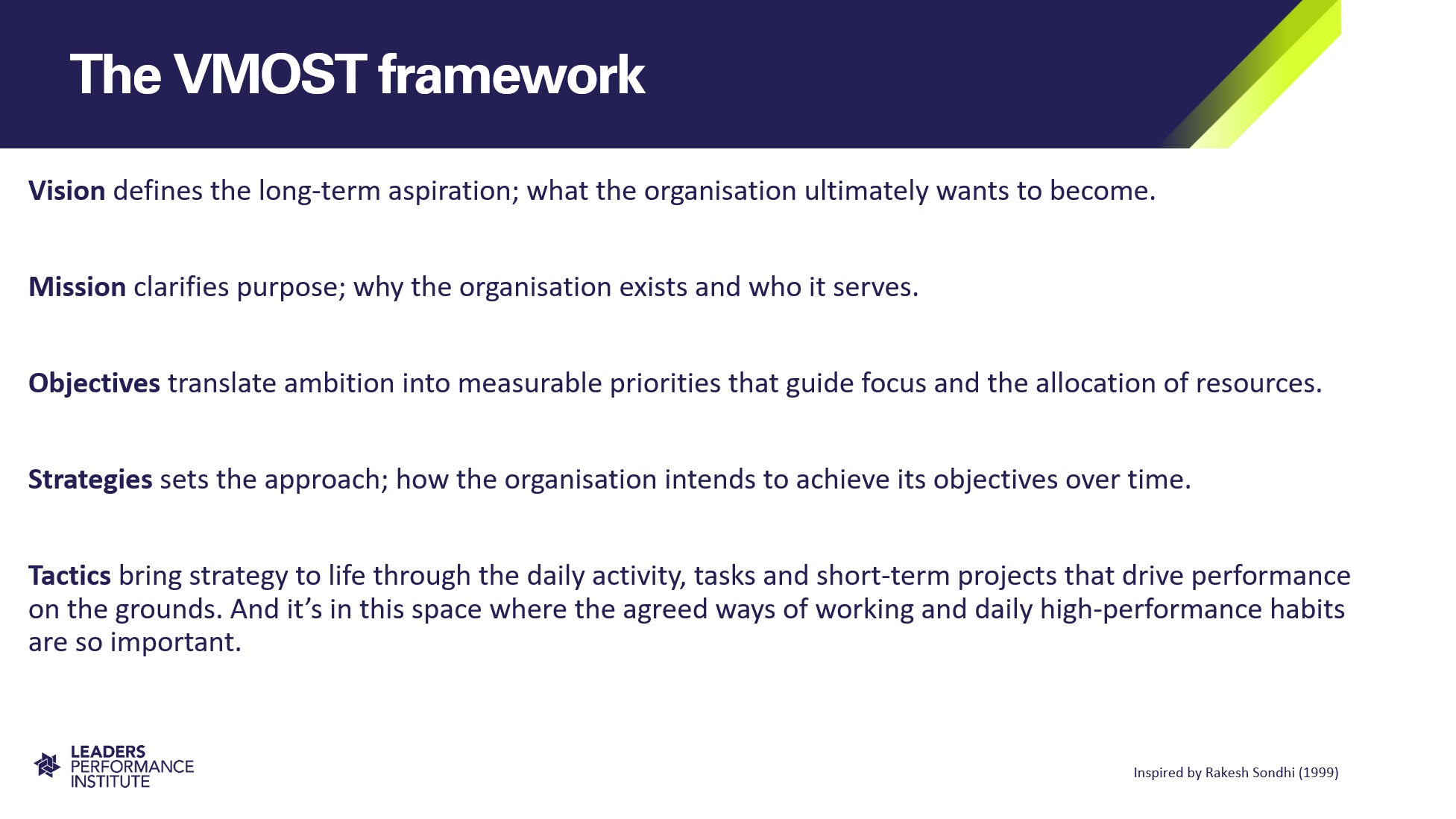
The power of VMOST lies in its simplicity.
In high-performance environments, complexity is already high. Strategy models must reduce cognitive load, not add to it. VMOST creates line of sight. Individuals can see how their daily work connects all the way through to the long-term vision of the team and/or organisation. In my last two roles as a performance director, my VMOST strategy was etched onto a big wall, one which staff members and athletes walked passed regularly. And when curious conversations or even debates took place, we often found ourselves standing around the visual, challenging whether a new idea could really help us achieve a strategy or the mission, or was it something that could derail us and divert energy, with no clear route to helping us win. This is definitely something I am taking into my new role in professional cricket.
When applied well, this kind of structure does not constrain creativity. It enables it. People can feel empowered to adapt, innovate and solve problems within a clear strategic frame.
A new era in professional cricket
In cricket, this strategic clarity is particularly valuable and I’m living this right now as Performance Director at Warwickshire and the Birmingham Phoenix.
Across a single season, players move between formats that demand entirely different physical, technical and psychological outputs. Red-ball cricket rewards patience, control and endurance. Short-form formats demand clarity, aggression and adaptability. Players are selected for specific skill sets, yet all must contribute to a collective performance.
Without a clear strategic framework, these transitions become chaotic. Workloads conflict, roles blur and development stalls. With strategy, complexity becomes more manageable. Individuals understand their role, how it evolves across formats, and how their contribution supports the team’s wider ambition.
At its best, performance strategy connects people.
High-performance sport is full of specialists. Coaches, analysts, medics, strength staff and operations teams all operate in defined roles, and rightly so. The risk is not a lack of expertise, but fragmentation. Excellent work happening in isolation without a clear line of sight to the bigger picture, is one of the biggest risks leaders can face.
A well-articulated strategy creates connection. It allows people to see how their work links through to the final mission and vision of the organisation. Daily decisions gain meaning. Trade-offs become easier to navigate. Autonomy increases because intent is understood.
When people understand why their work matters, they can make better decisions.
Strategy also provides continuity in environments where turnover is inevitable.
Athletes move on. Coaches change. Support staff rotate. In some organisations, meaningful personnel change happens every season. Culture alone cannot carry performance identity through that level of churn.
Strategy creates continuity of thought.
It anchors philosophy, ambition and non-negotiable principles beyond any individual. It allows new people to arrive and quickly understand how performance is built, what standards matter and what success really means in that environment.
In my experience, the strongest systems are those where people can come and go without the performance identity being lost. That does not happen by accident. It happens because strategy has been made explicit, shared and lived.
This requires leadership discipline.
Performance strategy only creates connection and continuity if leaders reference it consistently, use it to explain decisions and hold themselves accountable to it under pressure. When strategy is visible in how leaders talk, select, invest and prioritise, it stops being a document and becomes a shared language.
That language matters when pressure rises.
Under stress, people revert to what they understand. Strategy provides a common frame of reference. It reduces anxiety, accelerates alignment and allows honest conversations about performance without personalising every decision.
Planning also helps organisations say ‘no’.
In elite sport, opportunity is constant. New competitions, new technologies, new interventions and new ideas arrive relentlessly. Without strategy, everything feels urgent, and every new opportunity feels like one we can’t miss out on. With strategy, priorities are clear. Resources are allocated intentionally. Energy is focused where it matters most.
Importantly, you need to find ways to stay flexible, and not become rigid, bound to a strategy you developed years ago.
The best strategies are not scripts. They are frameworks. They define principles, priorities and trade-offs rather than fixed answers. They allow adaptation without drift.
Good performance strategy answers simple but powerful questions:
The human impact of planning is often underestimated.
Clear strategy can reduce uncertainty. It gives people confidence in decision-making. Applied well, it creates psychological safety by replacing ambiguity with intent. Athletes and staff perform better when they understand direction, expectations and how success is defined.
This is particularly important in high-performance environments where accountability is high and pressure is constant.
For leaders looking to build effective performance strategy, a few principles matter.
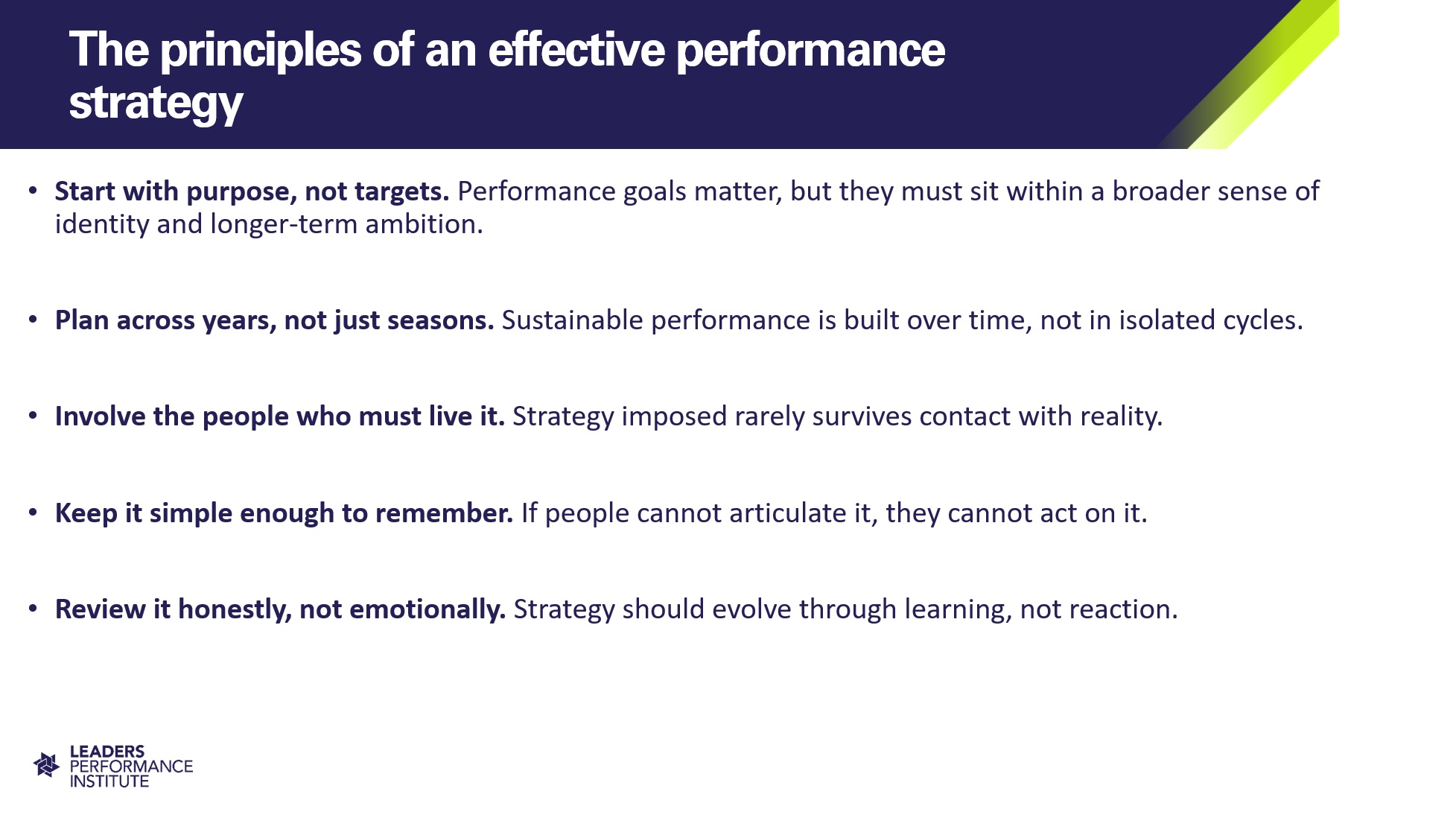
Competitive advantage
Across Olympic and professional sport, one belief has remained constant for me: strategy is a competitive advantage if organisations are willing to treat it as such and invest in the people who are delivering it.
In high-performance sport, change and uncertainty is guaranteed. Strategy does not eliminate it, but it determines whether change becomes a threat or can be used as an advantage.
When planning for performance connects people, aligns ambition, creates continuity and promotes curiosity, performance shifts from reactive winning to sustainable success.
James Thomas is the Performance Director at Warwickshire County Cricket Club and one of sport’s leading high performance experts. If you wish to speak to James, please contact a member of the Leaders Performance Institute team.
More from James Thomas
Haas F1 Team Principal Ayao Komatsu manages pressure and expectations at his team with a blend of challenge and support.
Not that he watches it, as he told the audience at the 2025 Leaders Sport Performance Summit.
“When I’m doing my job, if I even for a moment think about what I say or how I behave or how I’m perceived by a TV audience, then I can’t do that job,” said the Team Principal of the Haas Formula One team.
Those inhibitions, he explained, “could be the difference between me making the right decision or not” during a race.
Not that Komatsu is unaware of the influence he has as a leader. Google his name and the images that spring up tend to depict him holding a microphone at a press conference or media engagement. In that sense, Komatsu’s onstage appearance in London – just days after November’s Brazilian Grand Prix and a 12-hour flight – is no different.
“When you’re doing a media session that is an opportunity for us to tell our story, who we are,” he added.
Who they are is Formula One’s smallest team, both in terms of staff size, budget and infrastructure, but with a hard-earned reputation for punching above their weight under Komatsu’s stewardship.
In the year prior to his elevation, Haas finished tenth out of ten, which was in keeping with their size but below the expectations of team owner Gene Haas.
Komatsu, who previously served as Haas’ Chief Race Engineer, took the reins from Gunther Steiner ahead of the 2024 World Championship and led the team to seventh in the Constructors’ Standings; in 2025, they finished eighth.
He puts it down to an organisational structure that “promotes and forces communication and helps people to get to know each other”. “If we cannot work together, we’re not supporting each other, if we’re not aligned, we’ve got zero chance against organisations that are a minimum three times, sometimes four times larger”.
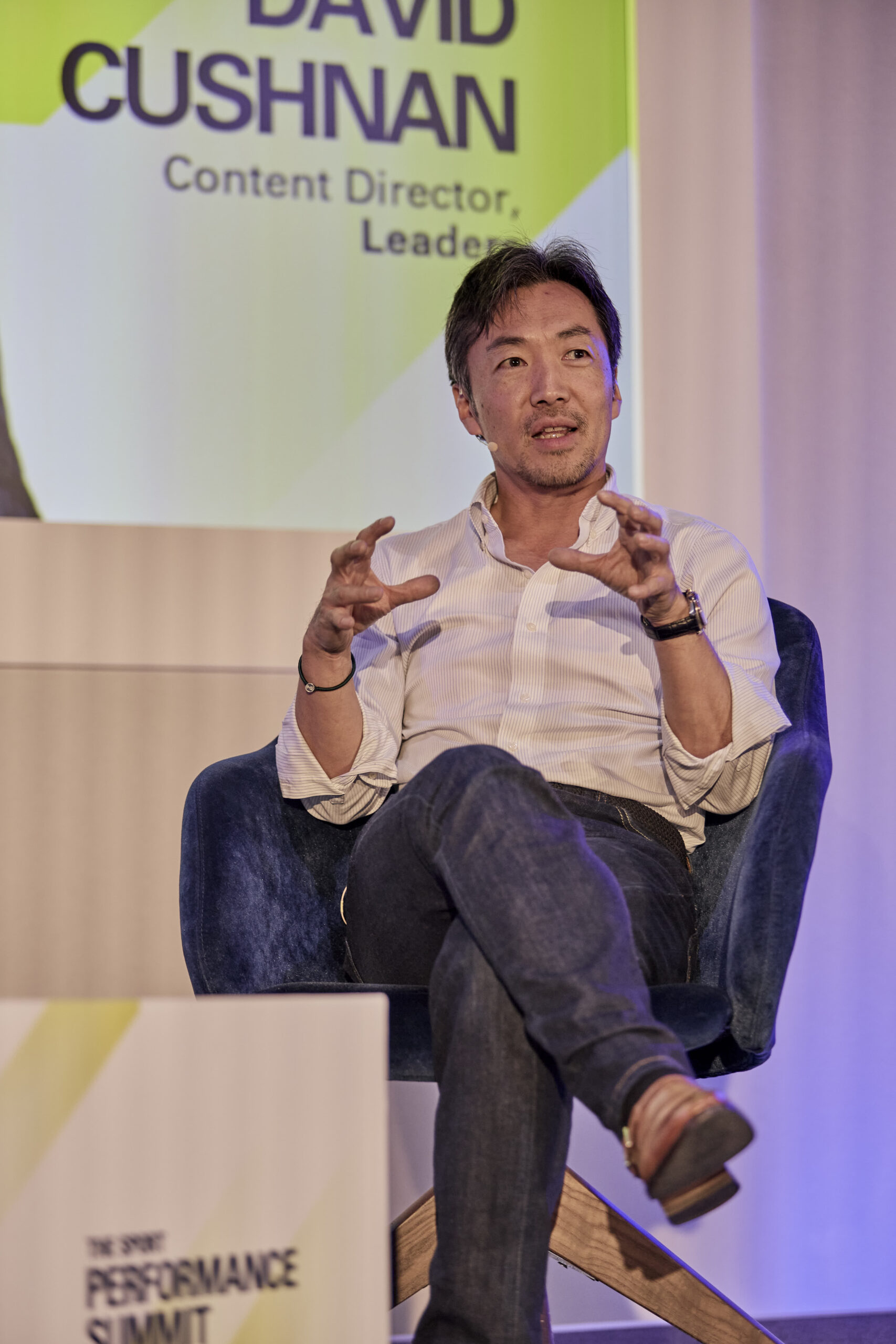
Ayao Komatsu onstage at the 2025 Leaders Sport Performance Summit at the Kia Oval in London.
Over the course of 35 minutes, Komatsu set out what it takes to manage the pressure and expectations of building on Haas’ successes while keeping in touch with Formula One’s leading lights.
Komatsu understands that you can’t chase results under pressure
Chronic pressure eventually leads to diminished performance. Komatsu found this out to his cost at the 2025 British Grand Prix at Silverstone.
“My mindset approaching the race was completely wrong,” he said. “I was really trying to force the result because I knew we should be scoring lots of points.”
Haas had spent considerable time and resource developing their car prior to Silverstone and knew that their drivers, Oliver Bearman and Esteban Ocon, could claim high finishes. Instead, the duo collided on the 43rd lap and finished pointless.
“What happened was really instead of letting the race come to you, doing your best, focusing on yourself, you are just focused on the result.”
It was a rare misstep for a leader who tries to give his staff “breathing space” and “a chance to think more about what they do rather than chasing it, because that’s not sustainable”.
Nevertheless, he pushes people out of their comfort zone each day
Komatsu said: “Our people are not afraid of failure. If you’re afraid of failure, nobody’s going to move.”
The right balance of challenge and support can enhance both focus and motivation.
“You’ve got to give people a clear message that, ‘come on, you’ve got to take yourself out of your comfort zone every day’,” he added. This is Komatsu’s non-negotiable. “If you haven’t taken yourself out of your comfort zone once a day, actually, I don’t think you’ve done your job.”
Komatsu encourages calculated risks that build confidence
Whenever crisis strikes, Komatsu has a well-planned contingency to relieve collective stress.
One such occasion was at the first race of the 2025 season, in Melbourne, where the Haas cars just “did not function”. Ocon qualified in last position, while Bearman could not even set a qualifying time and was required to start the race from the pit lane.
“That was a really testing time,” said Komatsu. But the team had discussed this very possibility for the past four months. They knew the car would either fly, flop or achieve something in between. In the event, the car flopped.
Their response to that race weekend was governed by the new car regulations coming in for the 2026 season. Most teams began to focus on their 2026 cars not long after Melbourne. Haas, with their comparatively modest resources, had no choice but to develop their 2025 car further because, as Komatsu said, “one place in the Constructors’ Championship is worth millions”. “So to make next year’s budget work, with brand new regulations, you’ve got to keep spending money to develop the car.”
He is proud of what happened next. “We just got on with it,” he continued. “I gave the team a clear objective; what is not acceptable, what we need to achieve. I didn’t tell them how. I listened to them and they came up with the solution and took the risk.”
While the true outcome “will only be known in January or February”, the 2025 car did improve and so did the team’s standing.
“For me, more than that sporting result, more than the lap time we gained, the important thing is the confidence this gives the people of the organisation; it’s priceless.”
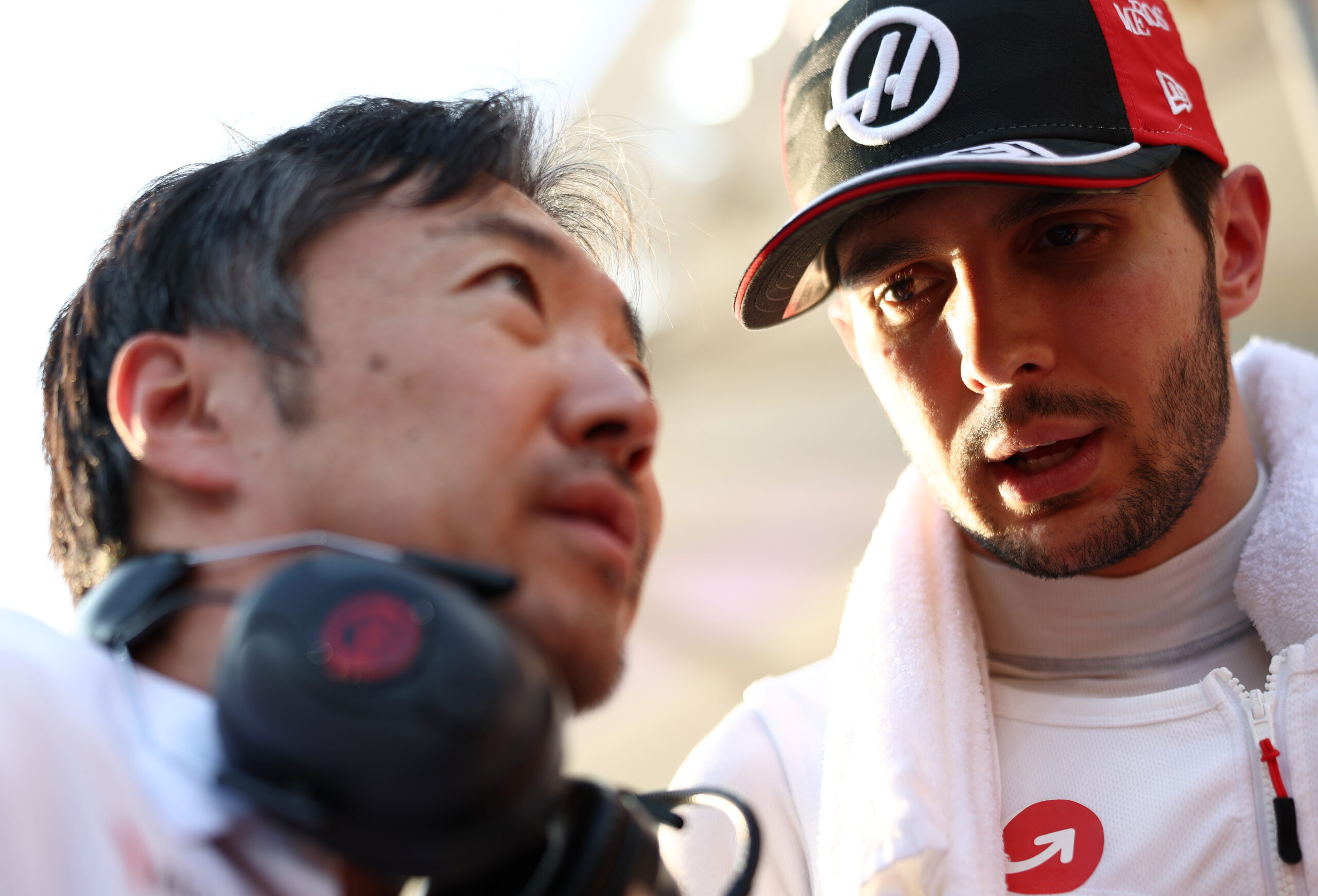
Ayao Komatsu and Esteban Ocon talk on the grid prior to the F1 Grand Prix of Abu Dhabi at Yas Marina Circuit in December 2025.
He has also cultivated a ‘no blame’ culture
In removing the fear, providing breathing space, and giving people latitude to solve their own problems, Komatsu has cultivated a ‘no blame’ culture.
He took public responsibility for the collision at Silverstone but later spoke to Bearman and Econ about what went wrong. He let them air their grievances and decide the future rules of engagement when their cars are in close proximity mid-race.
“I said, ‘look, until the next race, we’ve got two weeks. Take your time, you put everything on the table and, by next week, can you come to an agreement? If you don’t come to an agreement, I’ll tell you what we need to do’,” said Komatsu while fully aware that neither driver wants to be told what to do by anyone else.
“The important thing here is that full transparency,” he added. “I don’t have any other agenda than wanting both of you to perform; the team to perform. I’m not biased towards one driver or the other, but then again, sometimes I have to make a decision that will disadvantage one of the drivers, but as long as this guy knows that I was making that decision purely based on the interest of the team, as long as you’ve got that respect and transparency, it’s fine.”
When Ocon signed with Haas ahead of the 2025 season, some external observers harboured reservations due to his supposedly difficult character. Komatsu, having worked with Ocon for more than a year, is having none of that.
“I knew that it’s got a lot to do with the respect between the team and the driver, transparency, and then providing that safe space. I was very confident that we could provide that environment.”
What to read next
In the second part of his virtual roundtable series looking at tech-supported innovation in sport, CQU’s Professor Fabio Serpiello turns the light on the widespread lack of structured decision-making processes in sport.
The Director of Sport Strategy at Central Queensland University led the second instalment of a three-part Leaders Virtual Roundtable series aimed at exploring the dynamics of tech-supported innovation in sport.
As host, Serpiello wanted to “provide frameworks and stimulate discussion on how to select the right technology for performance challenges, ensuring decisions align with strategy and context.”
The Leaders Trend Report earlier this year highlighted that fewer than half of practitioners can point to a structured decision-making process within their organisation. Many have lamented this with Serpiello, which stands to reason as nearly all respondents in the report perceive such a structure as important.
It starts with a clear performance question, as a sports scientist working in European football put it.
She said: “If we’re going to make a decision, we have to have something well-structured. We need to ask what do we want from what we’re collecting or what do we want from what we’re asking the athletes to do.”
Another attendee, with oversight of several sports, recalled their own situation with problem clarification. “The solution looked like the key, but many sports were unclear on the problem.”
Serpiello presented the group with two models to address this issue.
Greg Satell’s Model of Innovation
Innovation, Serpiello argues, comes in several shapes and forms depending on the nature of the problem. To make his point, he introduced renowned change management specialist Greg Satell’s Model of Innovation, which provides a practical framework for introducing innovative practices, encourages strategic thinking about problems and helps to facilitate better collaboration.
He presented a diagram of Satell’s model to the table:
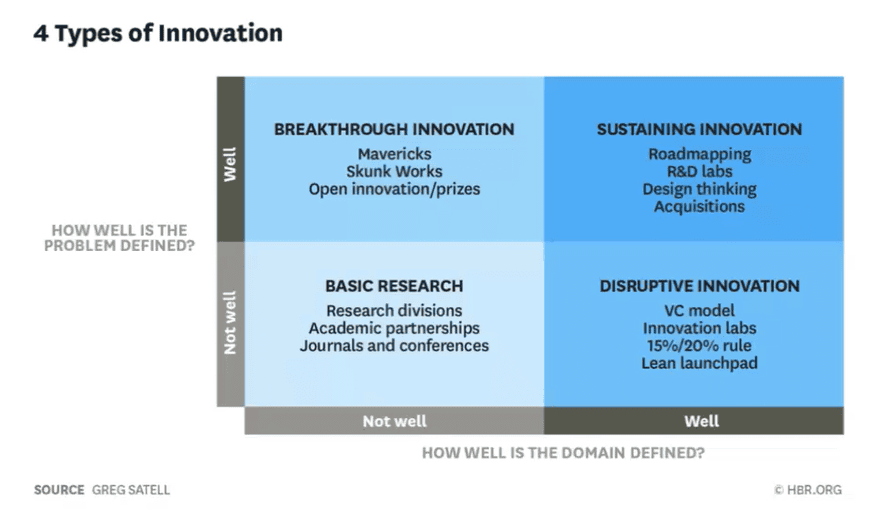
Serpiello had previously shared his thoughts on each quadrant:
Basic research – a low understanding of both domain and problem: “We don’t really know what the problem is and we don’t really know in which field or area it happens.”
Disruptive innovation – a well-understood domain but poorly understood problem: “In this area you may need something like innovation labs or launch pads.”
Breakthrough innovation – a poorly understood domain but well-defined problem: “This is the reverse of disruptive innovation… the classic example of open innovation.”
Sustaining innovation – a well-understood domain and problem: “The most common form in sport [and often the subject of] continuous research, design thinking or road mapping.”
A fuller account can be found here.
A general manager of a successful Paralympic programme gave an example of breakthrough innovation in their work supporting totally blind swimmers:
“We’re working with our institute partners and also reaching out to universities to understand if there’s interest in terms of product development and research in this space.”
There is a clear problem, the domain is less defined, and the organisation is piloting new concepts.
Another attendee working in the Olympic and Paralympic system spoke of an example of disruptive innovation when their team sought coaching tools, primarily:
“The piloting was done with the university [engineering department]… the final year project has to be sponsored, innovative, and they’re graded on the finish of the product and customer satisfaction… they were constantly in touch with us, so in terms of getting clear on the problem and implementing a solution, they were fantastic, these young engineers… The projects that succeeded were embedded into sport, and it was because the engineer was back and forth with the client, with us, and with the athletes.”
The Cynefin Framework
Serpiello then reacquainted the table with the Cynefin Framework.
‘Cynefin’, which is pronounced ‘ku-nev-in’, is a Welsh word that signifies ‘the multiple factors in our environment and our experience that influence us in ways we can never understand,’ as Snowden and Boon wrote in their 2007 Harvard Business Review essay titled ‘A Leader’s Framework for Decision Making’.
The Cynefin Framework, they continued, ‘helps leaders determine the prevailing operative context so they can make appropriate choices’.

Source: HBR
The framework classifies decision-making contexts into five domains:
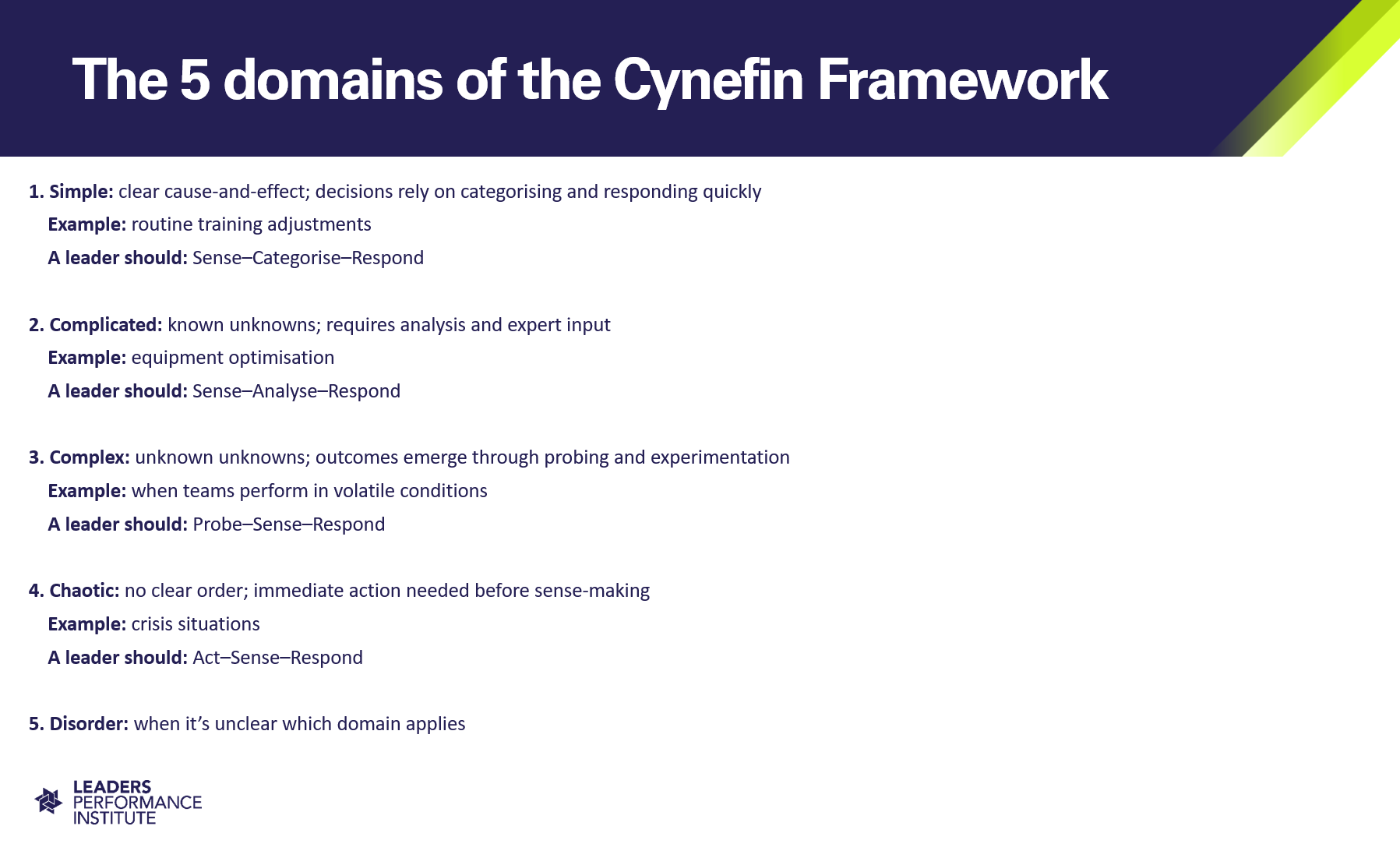 “The Cynefin Framework essentially classifies decision-making on the continuum between order and unordered conditions,” said Serpiello, adding, “because if you make the wrong decision, or if you use the wrong quadrant, you may waste a lot of time without actually getting to the right answer.”
He cited the example of tracking tech companies selling their wares as the answer to complicated and complex problems. “What tracking technology should do really well, in my opinion, is give you the ability to quickly categorise what’s happening in training and then respond properly, whether it is a load management, readiness or a recovery response.”
Other ideas
What to read next
In the first of a three-part virtual roundtable examining tech-focused innovation, Leaders Performance Institute members discussed how to turn creative thinking into tangible outcomes.
The figure surprised both the Leaders team and Professor Fabio Serpiello, the Director of Sport Strategy at Central Queensland University, because most of the survey’s respondents work for well-resourced professional teams. It was reasonable, we felt, to assume that they’ve progressed beyond such concerns.
“We thought this warranted further discussion,” said Serpiello, who led the first of a three-part virtual roundtable series aimed at exploring the dynamics of tech-supported innovation in sport.
We must point out that none of the Leaders Performance Institute members in attendance contradicted the survey’s findings (which you can read in our Trend Report). Some recounted the type of problems they encounter when it comes to innovation.
“Some problems can definitely be too big,” said one experienced high performance specialist working with military units in the US.
“You may not get support because of the priorities of the major decision makers that control the purse strings.”
What is ‘innovation’?
Serpiello believes the first step is simply to define ‘innovation’.
Even more importantly, he argues that teams should alight on a shared definition; one that does not conflate the concept with ‘creativity’. (Creativity, as Serpiello explained, is the outcome of an ideation phase, while innovation covers the execution and eventual impact of an idea.)
He makes the case that when teams have an agreed definition of what ‘innovation’ means to them then it offers a “clear way to approach and analyse whether the innovation processes in your organisations work or not.”
Serpiello himself likes the definition proffered by Scott Anthony in his 2011 Little Black Book of Innovation: ‘Innovation is something different that has impact’.
He then asked the practitioners and coaches at the table for their definitions. Answers ranged from the refinement and optimisation of processes to the value of novelty and pursuit of greater efficiency.
“These are all linked to a practical outcome,” said Serpiello.
Greg Satell’s Model of Innovation
Innovation, Serpiello argues, comes in several shapes and forms depending on the nature of the problem. To make his point, he introduced renowned change management specialist Greg Satell’s Model of Innovation, which provides a practical framework for introducing innovative practices, encourages strategic thinking about problems and helps to facilitate better collaboration.
He presented a diagram of Satell’s model to the table:
Serpiello then shared his thoughts on each quadrant:
Basic research – a low understanding of both domain and problem: “We don’t really know what the problem is and we don’t really know in which field or area it happens.”
Disruptive innovation – a well-understood domain but poorly understood problem: “In this area you may need something like innovation labs or launch pads.”
Breakthrough innovation – a poorly understood domain but well-defined problem: “This is the reverse of disruptive innovation… the classic example of open innovation.”
Sustaining innovation – a well-understood domain and problem: “The most common form in sport [and often the subject of] continuous research, design thinking or road mapping.”
There were three areas in particular where the table thought Satell’s model could prove useful:
As Serpiello wrapped up proceedings, he set the scene for session two, which will focus on decision-making frameworks in the context of technology-driven innovation.
What to read next
Wars, Pandemics and Brexit. How the European Space Agency Manages Uncertainty
In the first part of a miniseries exploring complexity in sport, Everton’s Head of Sport Science Jack Nayler explains how a watershed moment transformed his approach to his work.
However, in a truly complex manner, it was the combination of my lived experience to that point, my educational background and the reading I was doing in my own time around the subject that led to my appreciation of complexity and its implications for those concerned with sporting performance.
Over the course of four articles, I want to explain how I see the world of elite sport, the complex system at its heart, and the most effective way I currently see of managing performance within that context.
I will delve into the implications for sports and the operations within teams before outlining what this all means for leaders in this space.
But first, I want define what a complex system actually is and set out its characteristics.
Learning from failure
My real understanding came, inevitably, in learning from failure.
The white paper by the late Dr Richard Cook of the university of Chicago entitled How Complex Systems Fail was instrumental in helping me to understand the ramifications of complexity on the undertaking of performance in a sports setting.
Dr Cook was an anaesthetist and simultaneously and internationally respected researcher. His short treatise is regarded as one of the most influential works in the field of patient medical safety. It was this understanding of how systems fail that brought together everything else I had seen and learnt and began to change the way I saw performance management in professional sports.
Around this time, I was challenged by a friend in the industry to put together my thoughts on building a performance department for a sports team. I found it challenging just to make an org chart and list positions without giving the background and rationale for why and how the department existed in that structure as well as its philosophical construct. This exercise of transferring ideas from my head on to paper forced me to critically confront my assumptions and crystallised my thoughts on how I believe we need to operate in the complex environment of elite professional team sports (specifically football as this has been my professional experience).
So, what do we mean by complex?
Dave Snowden is a researcher in the field of knowledge management and is the creator of the Cynefin Framework that helps us to make sense of the different types of environments in which we operate.
‘Cynefin’, which is pronounced ‘ku-nev-in’, is a Welsh word explaining there are multiple factors in our environment and our experience that influence us in ways we can never understand.
The model contains five domains, all of which can exist at any given moment, and we move between them:
Source: HBR
The clear domain has obvious cause and effect and well-established best practice. There are many examples of this in elite sports, for instance, data hygiene when downloading and analysing GPS data or packing medical equipment for an away match.
In the complicated domain, there are correct answers to problems, but they may take some expertise or understanding to deliver and there are governing constraints within which the answer will lie.
An example from sport would be developing a fuelling strategy for a player in a match. We need learned expertise in nutrition and we need to do some analysis on the demands that player faces in match play, as well as understand how their physiology responds to those demands. There are then governing constraints (carbohydrate is the main fuel source in performance) but within those constraints, the solution will be different depending on the sport and the athlete, but the solution can be determined.
I find the easiest way to consider the difference between a complicated and a complex environment is by using the analogy of a car.
A car is an extremely complicated piece of technology. The first practical automobile was invented by Karl Benz in 1885 and had several hundred components. The modern family car by comparison contains over 30,000 parts on average.
Despite this huge number of component parts, should one of them fail and the car stop working, the defective component can be replaced and the performance of the car restored. The performance of the car in this case is its ability to move with you on board and there is a linear process from depressing your foot on the accelerator to make that car move. A skilled technician should be able to completely take the car apart, rebuild it and restore its performance.
Take that same car and ask it to transport you across a city such as London and it enters a complex system where the performance of the car (the time it takes to transport you from point A to point B) is no longer determined by the car itself (it would make little difference if you drove a Ferrari or a Fiat), but in the interaction of the inter-connected parts that make up the complex system. These include the status of the driver (in how much of a hurry they are and their relative stress level), the other cars and their respective drivers, traffic signals, roadworks, cyclists, pedestrians, emergency services, major events going on that day, the time of day and the weather etc. There are many other potential components to the system, not all of which are obvious when sat in the car itself.
The performance of the car (how quickly it reaches its destination) will emerge from the interaction of all these components and each one is concurrently performing at the centre of their own complex system.
So, the first thing to know is that in a complex environment, performance emerges from between the components an in inter-dependent manner, and not from the summation of the performance of each component in isolation.
The next part to understand about complexity is that it is fractal. Fractals are geometric shapes that contain the same detailed structure at ever smaller scales. This means that complex systems exist at smaller and larger scales and nest within one another. They simultaneously are affected by the scale below and affect the scale above.
Below the scale of our car, the driver is their own complex system, and their performance is determined by (amongst other things) their genetics, upbringing, education, wellbeing, as well as how well they have slept last night, what they had for breakfast and whether they are running late or not.
At a larger scale, the performance of the traffic system designed by city planners is affected by the performance of all the cars on the roads.
The person closest to the action in the complex system has the greatest chance to affect it at any given moment, in this example it is the driver of the car. Each decision they make will create a new reality and alter the course of the complex system (for reference see the film Sliding Doors). The decision to put your foot down to get through an amber light rather than braking in anticipation of a red light will affect the course of the complex system and other components within it.
This person closest to the action may have the greatest chance to influence the performance of the system, but they also have the narrowest focus and least ability to see the big picture. This is where external information can help inform their decision (SatNav, Waze or radio traffic reports). Ultimately though, it remains their decision.
Because performance emerges in real time as we navigate through the city and react to what we encounter in front of us, we cannot with complete accuracy predict what will happen in the future as we set out on the journey, or how good our performance (the journey time) will be.
All decisions taken by the driver therefore contain an element of risk and are (hopefully educated) gambles. These decisions are being made on a moment-by-moment basis are determined in part by what has already happened and will influence what is to come.
As all the components in the system are simultaneously operating in their own individual complex system, agreement between them isn’t perfect. Thus, complex systems are never perfect, they operate in a sub-optimal mode. No route across London provides a perfect path where you will be able to drive without braking or even coming to a stop. The challenge is that we cannot know exactly where the imperfections will lie.
Once we have finished our journey and the performance is determined, the impact of all our decisions is laid bare. With hindsight our choices take on a sequential profile and we can fall victim to a narrative fallacy, where each decision makes sense in context of what came after it. What we need to remember is that at the time we made each decision, we were blind to the future and couldn’t know exactly the outcome. That left turn that led to roadworks suddenly becomes a disaster that caused all our problems, whilst the decision to cut through the backstreets, a moment of genius. However, we will never know the alternate realities of the other options we could have selected.
The last part of complex systems I wish to convey is that the more we try to control the system, the more we leave ourselves open to system errors adversely affecting our progress in the long-term.
By control I mean to attempt to force or determine an outcome. The decision to jump a red light or speed along a section of road can lead to being pulled over by the police, which will cause a delay that greatly outweighs the seconds saved through our actions. The right way to operate in the system will emerge by experimentation, trying different routes, times of day or even modes of transport to complete the journey.
To bring us out of an over-extended analogy and back into the real world I want to emphasise that we should not be fatalistic about complexity. I don’t want to come across like the system will determine the outcome, regardless of what we do to affect it. I believe we are an integral component in any system with the chance to affect its direction and outcomes (just remember they might not be perfect).
If we are also able to step back and appreciate the interaction between systems at larger and smaller scales than that in which we are currently operating, we can be very powerful.
Chaos and Confusion
The final two domains in the Cynefin framework are Chaos and Confusion. Chaos is where there are no clear rules or cause and effect at all, even with hindsight, and it is better to act now and think later, shooting more from the hip.
Confusion is the dark centre of the framework, when you aren’t sure which of the other four domains you are currently in.
Most of the time in elite sports I believe we deal with complexity and thus I think it is the most important to try and understand. In the next two parts I will go on to discuss the implications of operating in this domain for sporting organisations, and what that means for leaders in this space.
Summary
References
Cook, R.I., 2000. How Complex Systems Fail. [online] Available at: https://how.complexsystems.fail/ [Accessed 29 September 2025]
The Cynefin Company (n.d.) The Cynefin Framework. The Cynefin Co. Available at: https://thecynefin.co/about-us/about-cynefin-framework/ (Accessed: 1 October 2025)
Patrick Mannix, the federation’s Sports Science Senior Manager, shared his insights with Leaders Performance Institute members at a recent virtual roundtable.
Eisenhower liked the sentiment enough to repeat variations during his time in the White House and the appeal to people working in elite sport is obvious.
In fact, Patrick Mannix, the Sports Science Senior Manager at US Soccer, began his recent presentation to Leaders Performance Institute members with that very line.
“The idea behind this quote is that high-performance teams don’t necessarily have a static plan,” said Mannix.
“The plan is constantly evolving as new information comes to light, whether that’s in relation to the tournament that we’re playing in, the players that we’re working with, and a variety of other contexts that are relevant to the world of international soccer.”
With those words, Mannix set the scene for a discussion that centered on performance planning in the international game, specifically the development of camp training plans for players who join up from their respective clubs in the US and beyond.
First, he offered a summary:
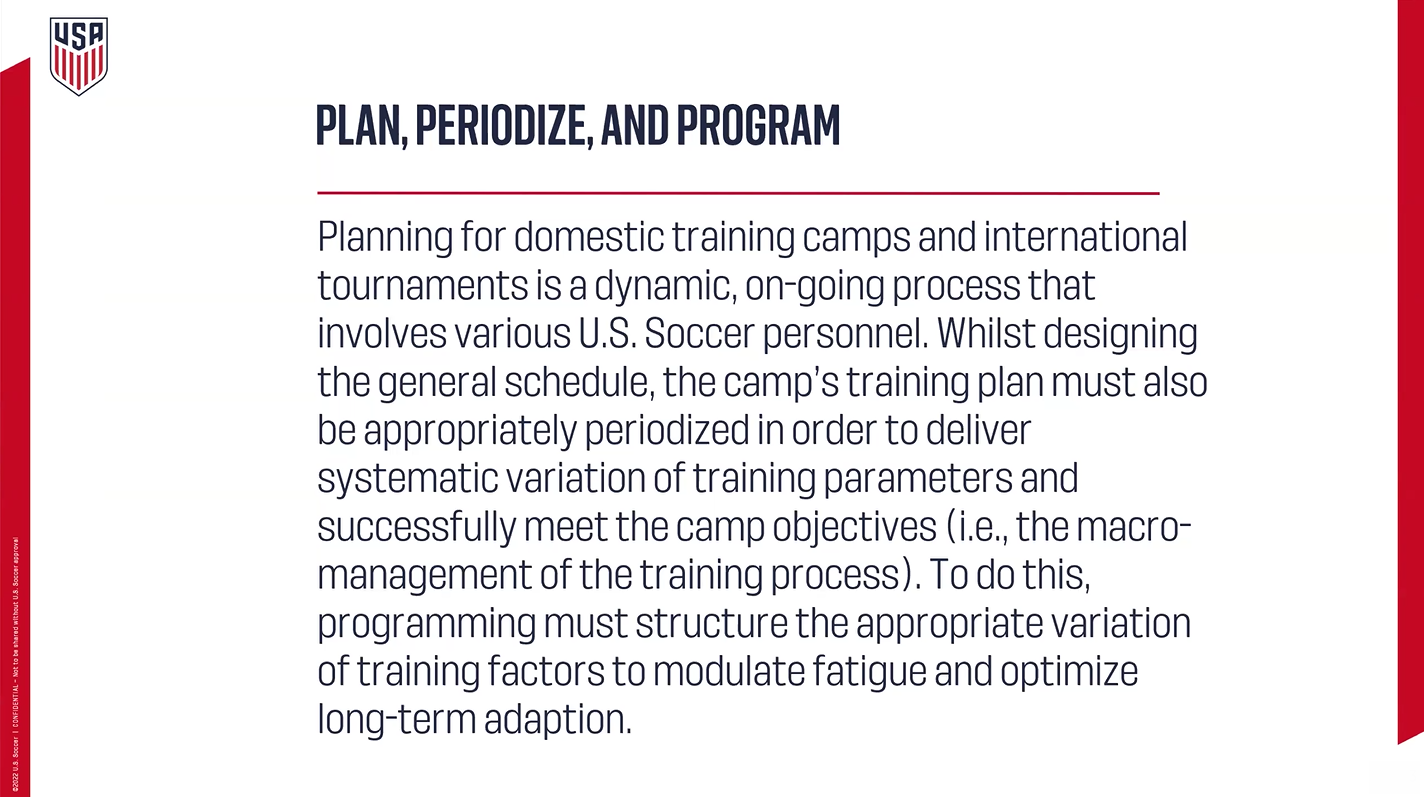
Mannix then shared how he and his colleagues approach international training camps from a sports science and medicine perspective with the help of this cycle:
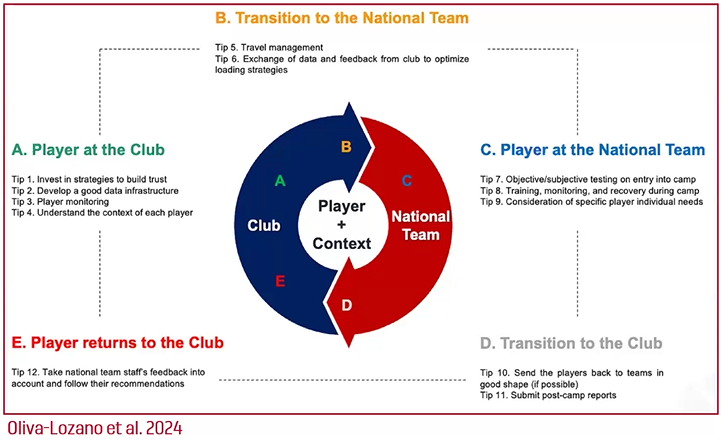
“Building rapport and trust with those clubs is massively important,” said Mannix, “because that helps us drive a lot of the exchange of information.”
He then outlined the common challenges he and his team face in the realms of communication, health & safety and load management:
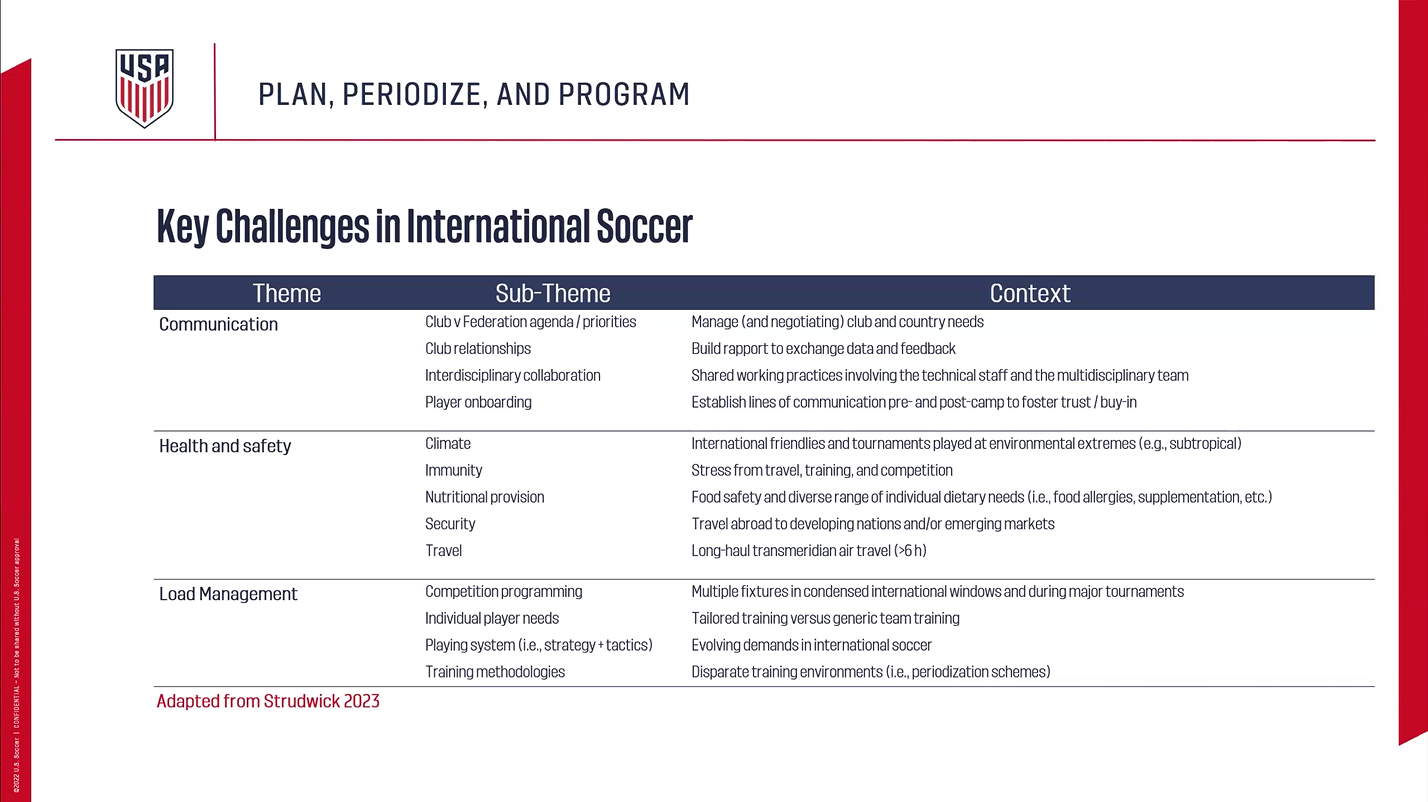
In explaining how they meet those challenges, Mannix focused on three areas in particular:
1. Club and country alignment
The US national teams draw on players from across the globe and, even for matches in the US itself, such is the size of the country that most personnel will have made a long-haul journey.
This map, which depicts the travel schedule of the US men’s team during the 2025 Concacaf Gold Cup, provides some idea of the challenges present even in a domestic setting:

“We need to know when our equipment and staff are arriving and where our players are coming from,” said Mannix in reflection on this map. It calls for close collaboration between the technical/coaching staff, the high performance team and the operations team.
“When a coach is trying to build out the session plan, the right hand is a good sports scientist or a performance coach, and the left hand is the first assistant, and those three individuals are working very closely to ensure that there’s a good plan in place for every training session,” Mannix continued.
“There’s good understanding as to what the availability of the players is going to be, particularly in the first two days of training, because what we’ve found through communication with clubs is we sometimes have to be flexible when players are coming into our environment simply because although Europe observes FIFA windows, we have to work with our partners in MLS on when players are released to come and join our environment.”
Mannix and his colleagues understand the range of fixed and dynamic constraints they face. They use that understanding to find optimization indicators.
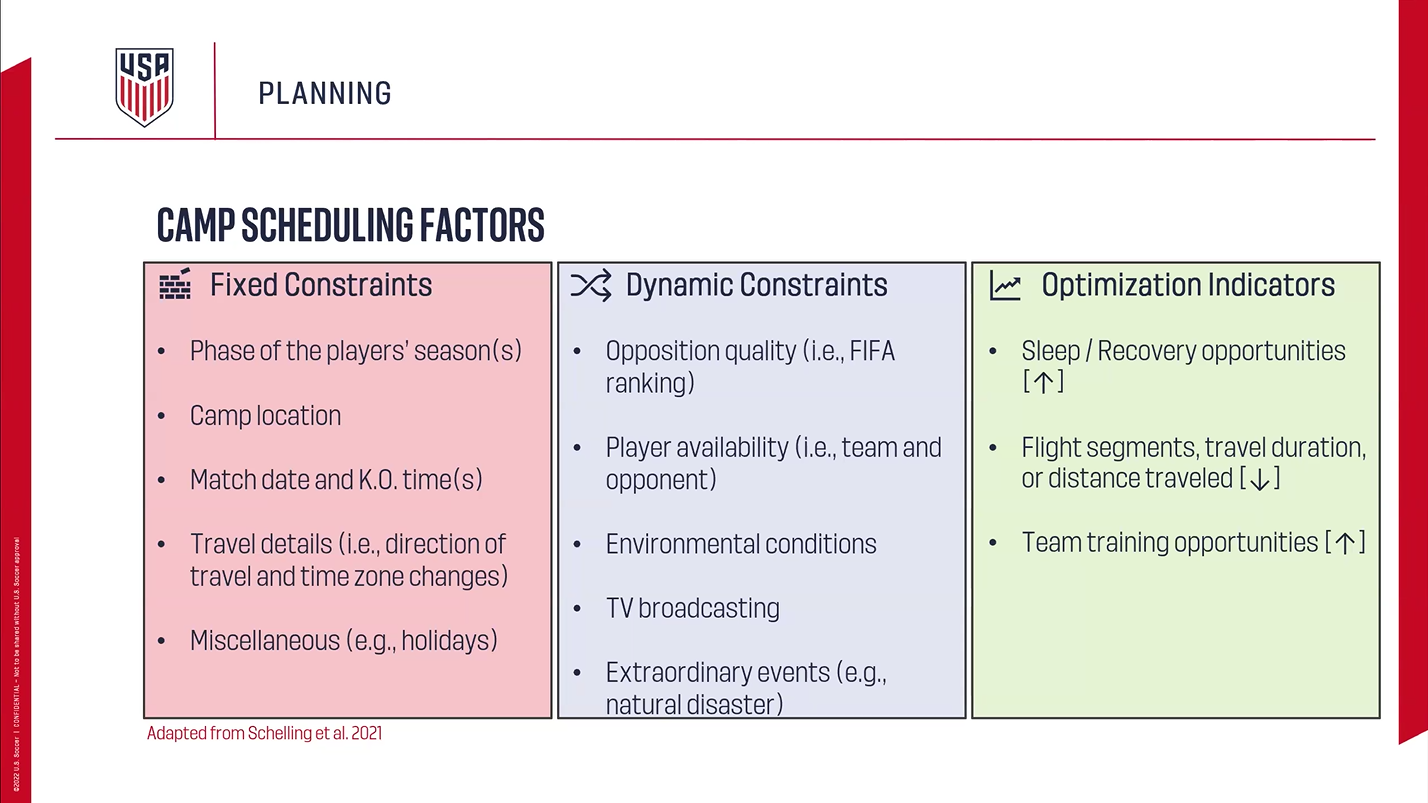
2. Time of year
The leagues of North America operate on a different seasonal calendar to their European counterparts, which requires tailored approaches to preparation and recovery for each player.
Staggered arrivals in camp is a prime example. Players may be excluded from certain match days depending on their status.
Additionally, the federation will try to use domestic camps “to address the identity of the team” and “hybrid camps where we look to go abroad, ideally to play opponents from Africa, Asia, and Europe so we get a variety of different opponents of the kind that we could potentially face in a World Cup.”
Travel logistics are a focus too. “We try to increase our sleep and recovery opportunities, decrease the number of flights to hopefully avoid a situation where the players have to get up at the crack of dawn to hop on a plane,” said Mannix.
Then there are cultural considerations. “The November window for the women’s national team will overlap with the Thanksgiving holiday,” he said, adding, “we’re working with chefs to ensure that we can put together a really creative Thanksgiving meal so the team feel like they have that communal or family experience.”
Ultimately, when it comes to periodizing camps, US teams have eight time scales to consider:
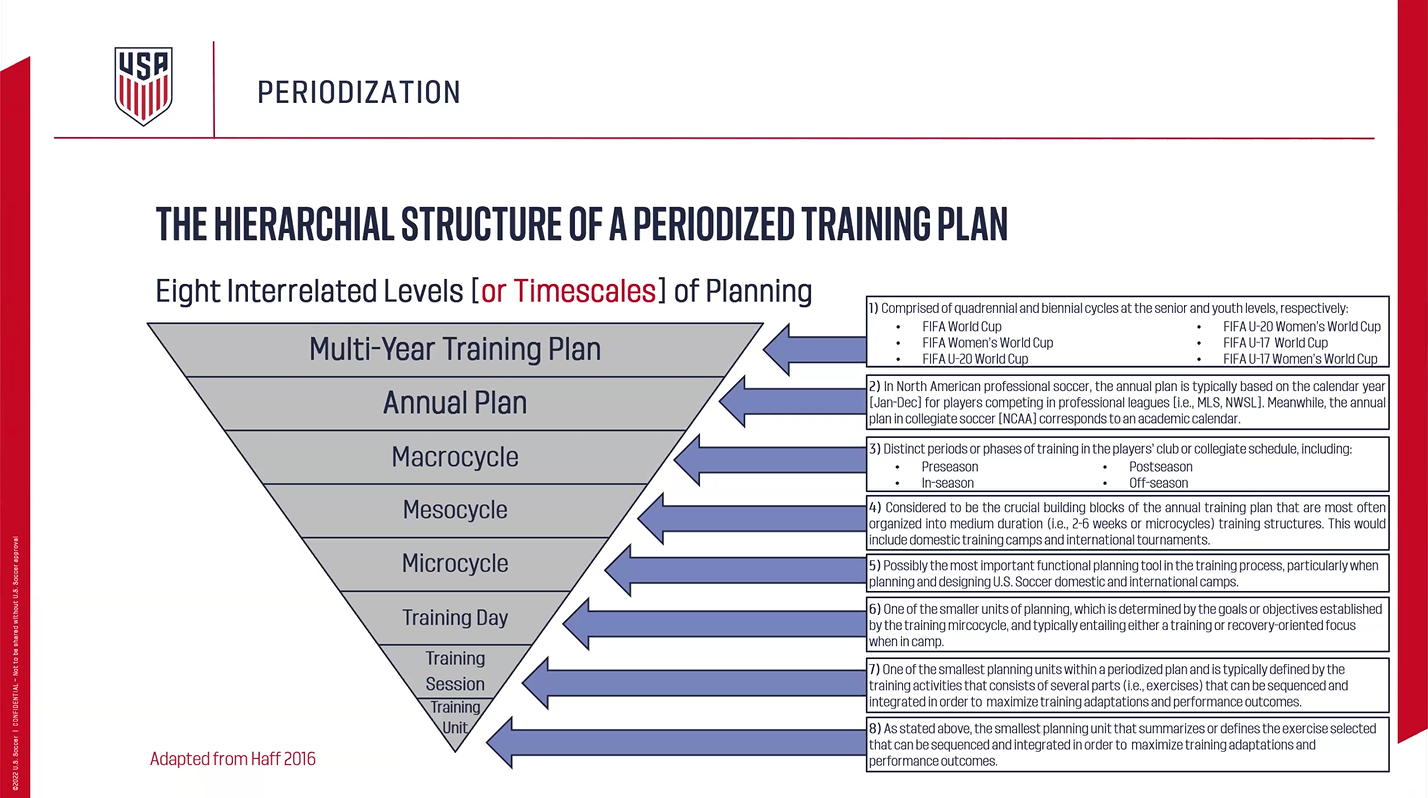
These come with several potential challenges:
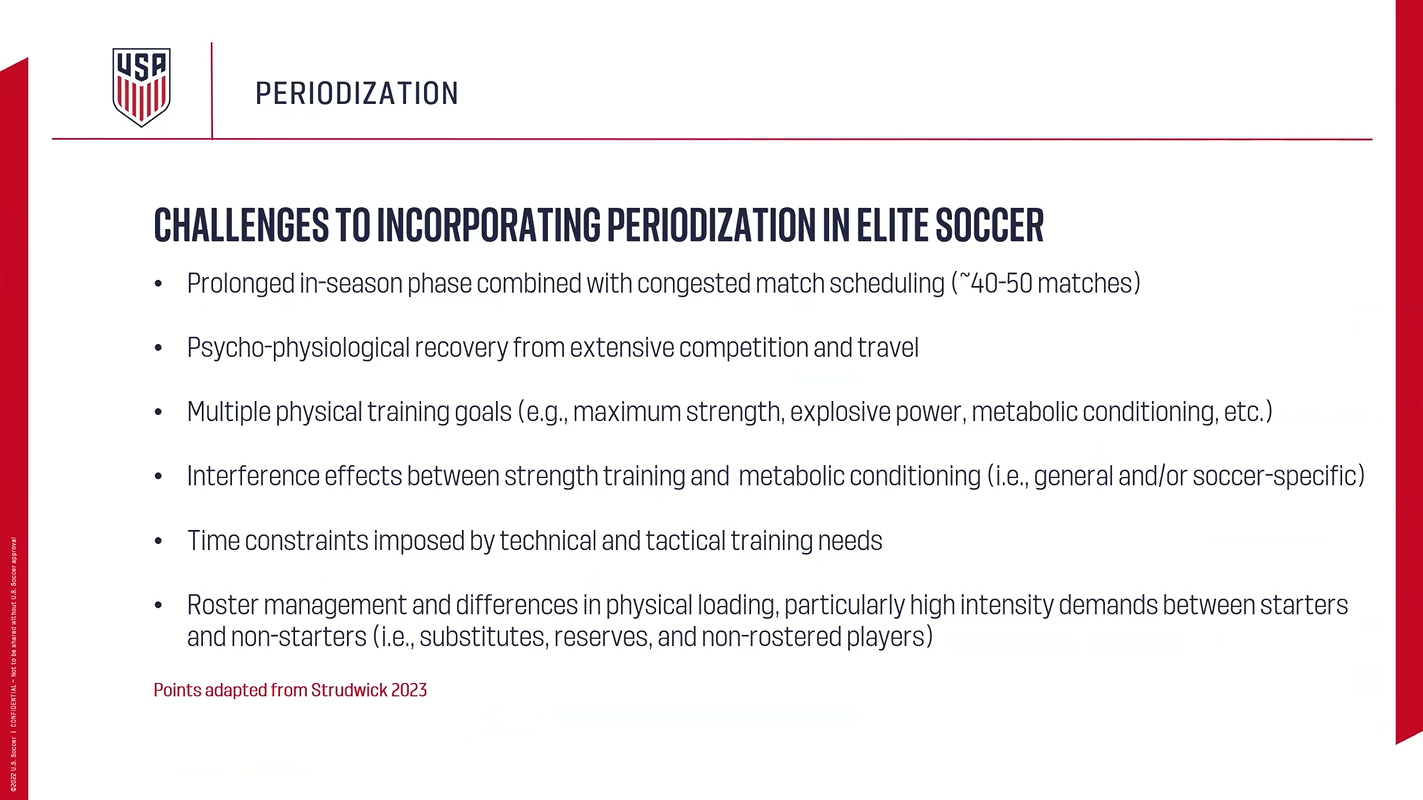
Mannix shared the example of a convalescing player joining the men’s national team for the 2024 Olympic football tournament. “In close collaboration with the club, we mapped out the tissue healing process, what the rehab was going to look like and then also what his reintegration into his team training back in his club environment would be,” he said.
“Then we had to negotiate if he were to join us in the Olympics what his match exposure would look like once he joined us, because his first time competing in official competition following the injury would be under our care. So it was super important for US Soccer that this individual was included in the roster because of his long-term trajectory within the national team.”
The coaches and support staff at US Soccer develop training plans three weeks prior to a camp, with session plans devised two weeks out once player arrival times are confirmed.
“We will design things from a team level, but then we also have to look at matters very closely at an individual level when we’re trying to safely integrate players into our national team environments.”
Mannix also spoke of periodization (the macro-level planning of when and why) and programming (the micro-level execution of what and how). He explained the distinction using the following table:
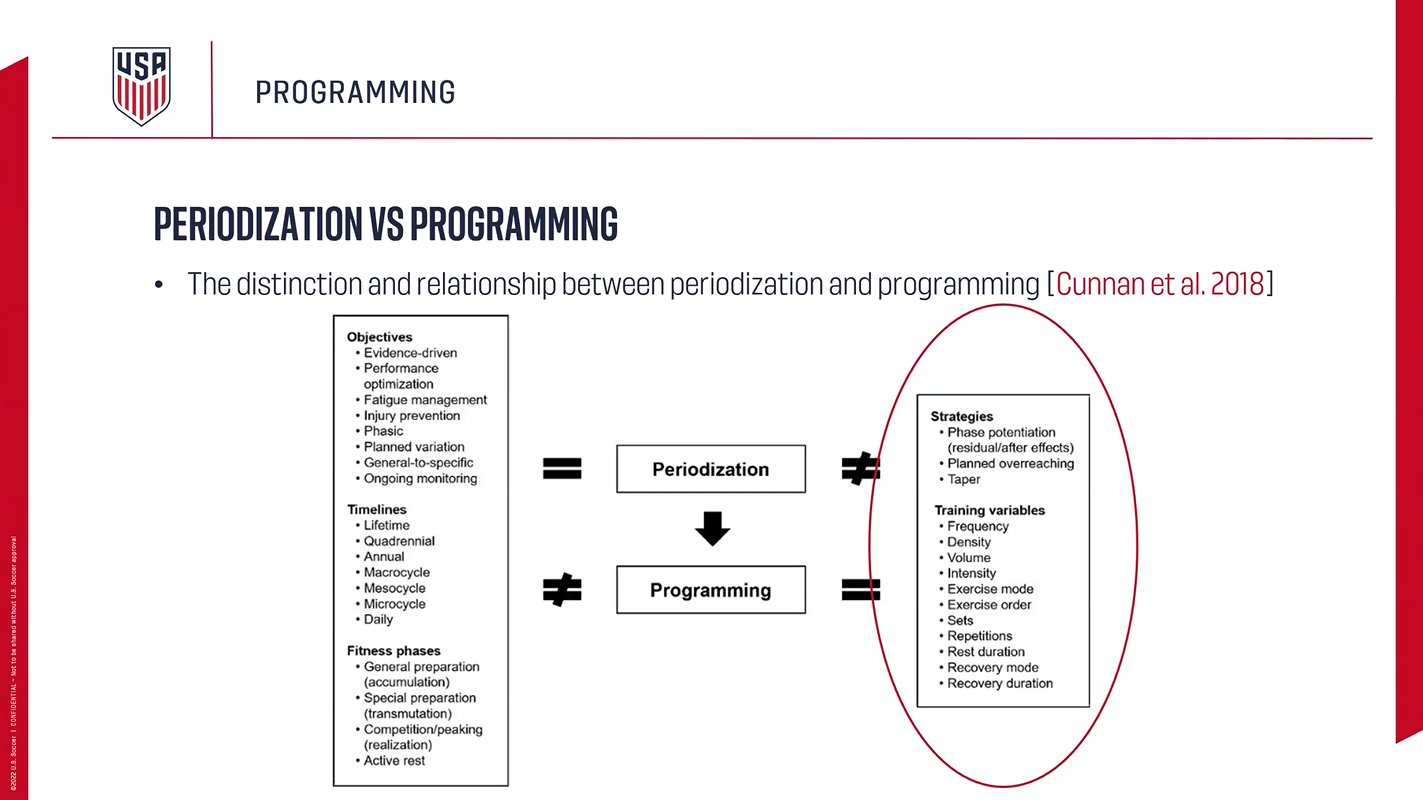
“Most of the time, we are dealing with tapering strategies and figuring out how can we optimize players’ readiness going into competition,” he said. “So it’s often an exercise in fatigue management when they’re coming into our environment and not necessarily trying to drive fitness adaptations, but, on the flip side, we’re also there to potentially facilitate a lot of those long-term physiological adaptations that are occurring.
“When it comes to planning, some of these training variables are super important. Things like training frequency, density, volume, and intensity, ensuring that those are squared away and, with our coaching staff, exercise order. So when it comes to building out session plans, making sure that the sessions are sequenced in the correct fashion.
“Again, I think that’s a lot of close communication and collaboration with primarily our head coach and our first assistant.”
What to read next
Transparency, Empathy and Empowerment: Five Ways Teams Are Serving their People in 2025