There is a time for high levels of observation, monitoring and professionalism, but let’s consider when this might be appropriate.
Whilst this is well-intended, imagine having your every output filmed, your individual footage analysed and, in many cases, your every performance graded, your distance and speed outputs tracked using high tech GPS systems, and every weight you lift being measured and monitored. Every six weeks your bosses (your parents) are brought in for a performance review and update, with figures discussed and plans updated.
Just pause for a moment and consider: how might this make you feel if you were in their shoes?
Clearly, there are some significant positives. Youth development, when delivered effectively, will always include some form of monitoring and review processes that allow coaches, support staff and those investing in the system to gain an insight into how their efforts are trending from a player development perspective. Video footage, match grades and player reviews can be a hugely useful tool in providing feedback to all stakeholders.
But imagine if this level of scrutiny was the norm in your adult working environment. My sense is that this would bring up different emotions for different readers. For some, this would excite them with the level of professionalism involved; precise numbers and figures indicating an elite performance environment. For others, this could evoke feelings of anxiety and possibly fear, considering the level of scrutiny being applied.
Mastery and joy
Academy in football in the UK is a major business. Huge amounts of money are being spent in order to unearth the ‘next big thing’ and I’m certain that these dynamics will drive some potentially unhelpful adult behaviours.
I’ve also seen some incredible efforts. At a recent visit to a Premier League club, I witnessed some absolutely brilliant work from the U9-U10 lead coach. She has brought in music, dancing, and a sense of childlike joy to the footballing environment – the group even had a pumpkin carving night! – whilst also encouraging the players to engage in 1v1 battles and high levels of competition. She encourages a sense of joy as they enhance their mastery of the ball.
This highly skilful coach has positioned herself as an appropriate resource to the young people in her care, sensing that they probably don’t need any additional pressure than is already present simply by engaging with academy football. I did not get such a sense of surveillance at this place compared to others and I suspect it will yield better talent development outcomes.
I am aware that in some industries there is rigorous monitoring of time on task and productivity. I have, however, been fortunate to have operated predominantly in roles where I had guidance from senior leaders and a level of autonomy that allows me to deliver my role in my own personal manner.
This autonomy was not simply given without direction. My manager ensured that I was clear on the overarching mission that we were all in it for, as well as my part of the puzzle. I was the recipient of weekly or fortnightly catchups where progress in my area was discussed in a manner which felt safe to me, whilst also holding me to account.
However, this has not always been the case. I have also experienced at close hand senior leaders seemingly ruling with fear and overt scrutiny, rather than an appropriate level of challenge and support. My experience of this was that it was much more unhelpful than helpful. It caused anxiety in many and actually resulted in the more stubborn folk still doing things the way they wanted, when out of sight!
Surveillance shows up in many different ways. The French philosopher Michel Foucault studied the impact of how surveillance is used to control society. His 1975 book Discipline and Punish built on the theory of British philosopher Jeremy Bentham’s ‘panopticon’ as a metaphor for how power circulates through the use of surveillance, but it also talks to the positive impact upon self-discipline. (I recommend an internet search if you want to know more.)
The right balance of challenge and support
I wonder what the level of surveillance is within your environment. To what extent have you considered the consequences (intended or otherwise) of this subtle force on those within your care and guidance?
How does surveillance, and indeed pressure of any kind, show up in your environment?
For any of us who have read some research around optimal performance states, one is likely to agree that having a level of perceived pressure is probably useful, but too much can be challenging or even catastrophic to an individual or individuals. Think of the ‘inverted-U’ theory in the Yerkes-Dodson law, which is beautifully simple and has stuck with me since my undergraduate degree many, many years ago.
Of course, this subject talks to some complex topics and provokes several questions for leaders:
Your answers may lead to consider how much surveillance might be helpful and how much deliberate pressure you apply.
As the proud father of a 12-year-old and a 9-year-old who both love playing football, I am not convinced that the level of surveillance I have described above would be optimal for them. I watch the joy in their faces when they play sport, as well as the moments of intense anger, sadness and frustration when things don’t go their way.
I approach my role as a parent to sit alongside them on this rollercoaster, seeking to be a resource rather than an added pressure. I love seeing them explore what is possible, rather than playing with a level of scrutiny and fear that might constrain them.
There is a time for extremely high levels of observation, monitoring and professionalism, but let’s consider when this might be appropriate… both for children and adults.
Iain Brunnschweiler runs the Focus Performance Consultancy. He is a former professional cricketer, has authored two published books, and previously served as the Head of Technical Development at Southampton Football Club.
What to read next
13 Feb 2025
ArticlesWe recently hosted a virtual roundtable on the topic with practitioners from across elite sport. Leading the conversation was Rachel Vickery, a renowned specialist in the field.
“There is so much focus on the technical and tactical aspects of craft, and then people hope that it shows up under pressure,” said Vickery, a high-performance specialist who has worked with a range of elite operators in sports, business, medicine and the military to help them improve their performance under pressure. She was speaking as the host of a recent Leaders virtual roundtable on the topic.
Too often, Vickery added, teams fail to understand “what’s changing in the biomechanics of a person, their situational awareness, their ability to read and see the field; their communication style and strategy, and their decision making” when the pressure mounts.
The key is “being able to help people understand what happens to them in those environments and then being able to train for that” because, as Vickery said, performance under pressure is a skill that can be learned and the trick is “putting actions behind the words”.
Below are seven training and environment-based tips or factors, gleaned from the conversation, to digest and take back to your teams.
Athletes and coaches want to be able to keep their ‘smart brain’ online in moments of pressure, but no two people are the same. Some are more proficient than others. However, as one participant put it, “all personalities are capable of performing at the highest level, it’s just that some have to be more intentional in their approach” to training. “Have you got enough buffer in the system to absorb that natural increase in arousal state peaking?” said Vickery, who explained that an individual can develop that ‘buffer’ through personalised support and training interventions.
Performance under pressure is not some mystical ‘other’. People should be encouraged to work out what enables them to be their best and what detracts from their performance. Get to the bottom of that and you can understand your performance when under pressure. “If it’s something that impacts an athlete or coach’s performance, then it’s fair game for the performance conversation,” said one participant from Major League Baseball. It’s also important to consider the outside elements that contribute to someone’s stress levels. As Vickery said: “Very often it’s less to do with the performance arena than what’s going on outside”.
Stress can lead to burnout and mental ill-health and so people at your team should look out for each other. A participant spoke of their general manager taking part in their team’s compulsory mental first aid programme and, in the act of doing so, helping to normalise the conversation. Another participant spoke of their team’s work to identify personal triggers and cues. Their key question was: ‘what will we see in you when you’re feeling pressure?’
Vickery issued a timely reminder that mental elements need to be fine-tuned just as much as the physical, technical or tactical. “It’s not just about fixing ‘broken’,” she said. “How do we go on taking things to a higher level?” Giving athletes and coaches a chance to assess their mistakes is critical.
While you cannot truly replicate high-pressure moments in training, you may be able to replicate the feelings they elicit. One participant with experience of the British sports system spoke of a time his team tested their analysts. They sabotaged the analysts’ equipment 20 minutes before the start of a competition and asked them to identify and fix the problems they created. The key to such tactics is to “review it, learn from it, go again, get your reps.”
A coach’s words and actions are critical in high-pressure moments. “As soon as something is set up as a threat – ‘if we don’t win this we’re not making the playoffs’ – the stress response kicks off,” said Vickery. “If we can flip that to opportunity – and I’m not talking about rainbows, crystals and unicorns – I’m talking about intentional language; ‘how clean can we play this?’ The language is really important in those moments.” She also spoke of a Premier League coach who worked to de-escalate his own arousal state before giving half-time team talks. It is also important for coaches (and their teams) to not fall prey to the notion or narrative that an undemonstrative touch line figure is somehow disinterested.
There are various ways to follow that aforementioned Premier League coach’s lead, but it requires trust, humility and a healthy dose of perspective, particularly for coaches to be able to accept feedback from their athletes and to self-reflect. Several participants have set up their coaches with cameras and microphones during training and competition as a learning exercise. During the heat of the moment, Vickery encourages leaders to ask themselves: “The ways I interact with you, my language, instruction and delivery – are they going to set you up for performance or going to detract from performance?”
5 Dec 2024
PodcastsWe bring you the views of the International Football Group’s Paul Prescott, Aarhus’ Morten Larsen, who sees one of Denmark’s best academies up close, and Kitman’s own Stephen Smith.
A podcast brought to you by our Partners
It wasn’t always thus. “English clubs were basically funding talent development models in Spain or in Brazil because English talent wasn’t seen to be at the same level as players from those countries,” Paul Prescott, the Managing Director of the International Football Group, told this Kitman Labs podcast.
That situation persisted until recently and is starting to change in part due to the introduction of the Elite Player Performance Plan [EPPP] in 2012.
“We are seeing that some of the decisions that were made maybe 10-12 years ago are beginning to bear fruit,” added Prescott, who was joined by Morten Larsen, the Head of Methodology & Development at Danish Superliga club Arhus, and Stephen Smith, the Founder of Kitman Labs.
Aarhus share the Premier League’s emphasis on talent development, albeit in different circumstances, as Larsen explains [5:30].
“Denmark is a small country and the league is a small league,” he says. “So there’s only one thing we can do to compete with the other clubs in Europe.”
Elsewhere, Smith sets out the differences in approach between leagues and clubs [16:25]; Larsen explains the impact of data on decision-making processes in the Aarhus academy [24:10]; and Prescott ponders whether EPPP was an outcome or a catalyst [36:30].
Listen above and subscribe today on iTunes, Spotify, Stitcher and Overcast, or your chosen podcast platform.
14 Aug 2024
ArticlesWe bring you four lessons in nurturing young talent at two renowned performing arts schools.
“My teacher was extremely intimidating and that’s how he got good work out of us,” he told an audience at June’s Leaders Sport Performance Summit at Red Bull.
Mitchell teaches at the highly regarded Westside Ballet School, which is just across the road from Red Bull on Stewart Street in Santa Monica.
“Our training approach is really very much about fostering their love of the art form,” he continued. Rather than teaching from fear or intimidation, this “results in better artists, kinder and healthier people at the end of it”.
Those words chimed with Leaders Performance Institute members at the summit, where Mitchell spoke alongside Eileen Strempel, the Inaugural Dean at the prestigious Herb Alpert School of Music, at UCLA.
Here, we pick out four lessons in how the performing arts nurture their young talent.
1. The teachers must engender a sense of playfulness in students
If a love of art is essential, then it follows that the teacher – or coach – has to fit the bill just as much as any prospective student. “We’re also hiring teachers and thinking about the ecosystem,” said Strempel. The Herb Alpert offers a range of courses from musicology and ethnomusicology to composition and conducting. “What energies are those faculty bringing into our school?” She explained her belief that a love of art stems from playfulness. “We don’t actually talk about ‘working’ in music – we play music – and retaining that sense of play is absolutely integral.” The key is to foster an environment where the students are “playing with and inspired by each other”.
2. Individual development is about finding ‘other ways to win’
Ballet and music, much like sport, are ensemble activities and the risk is that the development of the individual can be overlooked. The Westside and Herb Alpert counter this by surfacing a student’s intrinsic motivation. Strempel said: “The solution to a problem might be X or Y, but we try to bring more profound questions such as ‘what is this piece of music about? What am I trying to convey? What am I bringing to this piece as an artist?’”
It speaks to what Mitchell called “winning in other ways”. He said: “This ties into the idea of improvisation and allowing us to experiment and find different moments in our work that can create success.”
3. They provoke failure
From the coach’s perspective, individual progress is about trying to develop solution-minded individuals who can adapt, adjust and improvise on the fly. This can lead to increased rates of failure, which the Westside readily accepts. “Sometimes when I’m really pushing my students we will repeat a variation three or four times without a break; no corrections,” said Mitchell. It provokes a level of fatigue akin to a performance but in a lower-stakes setting. “It’s important for that experience to be out of the way for them.”
At the Herb Alpert, teachers might introduce violin students to one of the two Stradivarius violins in their possession. Such is the difference in sound, colour, breadth and depth that it takes even an accomplished player six months to get to grips with the vintage instrument. Or if a student has been practising in the western symphonic orchestral tradition the school might introduce them to the completely different world of Afro Latin jazz. “The challenge is finding ways to expand the range of possibilities that allows an individual to extend themselves,” said Strempel.
4. They connect that failure with motivation and resilience
The Herb Alpert’s approach to creating a caring and nurturing environment does much to foster resilience but, as Strempel explained, it also comes back to a student’s intrinsic motivation. “If you keep it on the level of ‘I just want a great performance’ or ‘I just want to win the game’ that leaves so much creative potential on the table,” she said, being sure to include a sporting analogy. “You have to tap into intrinsic motivation to do that right, whether it’s because you want to give back to your community or because you’ve got something you want to say. It’s not about being a better musician, dancer or athlete but being a better human being”.
Kit Wise of the Royal Melbourne Institute of Technology discusses his approach to talent development through the lens of psychosocial skills.
Nevertheless, the Leaders Performance Institute decided to raise the topic with two distinguished individuals: Kit Wise, the Dean of the School of Art, Design and Social Context at the Royal Melbourne Institute of Technology [RMIT], and Budi Miller, the Co-Artistic Director at the Melbourne-based Theatre of Others.
Both took to the stage at Melbourne’s Glasshouse in February to discuss their approaches to talent development as well as managing challenges as they emerge.
Here, we explore Wise’s work with art and design students at RMIT, where he readily admits his role is to “damage their minds just enough”.
Inspiration, aspiration, expectation
Wise’s philosophy of talent development in art and design is configured to help students further develop mental and social skills such as cognitive reframing, goal-setting, self-talk, and the coping skills needed to move beyond expertise into the realms of creative productivity or eminence[1].
It boils down to three things:
Risk-taking and raising expectations
Wise argues that risk-taking – another psychosocial skill – is a crucial part of an artist’s creative process and he sees certain parallels between the worlds of art, design and sport. “Risk is fundamental,” he said. “It’s how you innovate, it’s how you come up with something that hasn’t been done before.” Risk-taking is an accompaniment to traits such as openness to experience, tolerance for ambiguity and an ability to move beyond one’s earlier ideas with courage[2].
Wise wants artists to step out of their comfort zones and dare to do something different or unexpected. That includes deliberately setting out to break the rules. “There’s a quote from Picasso – a very problematic figure for me – who said: ‘good artists copy. Great artists steal’. What he means by that is that good artists imitate; great artists take all the knowledge and experience of others and repurpose it.” Risk is about challenging people and pushing them to achieve more than they thought they could. It is also about raising expectations progressively as people become creative.
Navigating RMIT’s ‘critiquing culture’
Risk is about transformation and change; moving people, impacting them and changing their thinking. With this is mind, Wise advocates for a “critiquing culture” that enables students to develop their mental skills, including, mastering anxiety and distractions, tactful self-promotion, and knowing how to play the game[3]. “Almost by definition, it sounds like an attack. Of course, it’s how you challenge and grow and do that damaging I talked about.” He has developed a culture at RMIT, defined by its shared language, trust and a series of team dynamics that create a safe environment that breeds confidence and gives everyone in the room a voice.
All that said, it is not a comfort zone, which raises its own challenge. “Empathy has to be central,” said Wise. “So the role of care alongside risk. I guess it’s a bit like flow state where you have the pain end of the spectrum and the comfort end of the spectrum; and you’re pushing things up towards the pain as much as you can.” He draws the line by setting ground rules for interpersonal conduct and, as a tutor, a simple but important reading of the room for social cues. Still, it can be close to the bone. “I’m on record saying that ‘every art student should cry once’,” added Wise. “It’s about transformation, it’s about change. If they hadn’t experienced something that really does move them or impact them or change their thinking, I haven’t done my job – that’s [on me to do] that in a caring as well as risky way.”
Fun and playfulness
For all the talk of tears, there is fun and playfulness inherent in this process of talent development. On one hand, that means being embodied and engaging in what one wants to do, whether that’s painting or playing sport. “Pleasure is part of that process,” said Wise. On the other hand, there is fun in risk-taking. “That transgression: it’s rule-breaking; it’s another word for innovation and creativity. You can’t do that rule breaking if you’re in a body that’s rule-bound.”
[1] Olszewski-Kubilius P, Subotnik RF, Davis LC, Worrell FC. Benchmarking Psychosocial Skills Important for Talent Development. New Dir Child Adolesc Dev. 2019 Nov;2019(168):161-176. doi: 10.1002/cad.20318. Epub 2019 Oct 29. PMID: 31663255.
[2] Ibid.
[3] Ibid.
We all know a story of an athlete or coach affected by gambling harm.
In this Performance Special Report, which is brought to you by our Partners EPIC Global Solutions, we detail the urgency with which the National Collegiate Athletic Association [NCAA] is coming to terms with the explosion in sports wagering across the US.
Our contributors, who hail from the NCAA, Clemson and Michigan, tell us why draconian measures of enforcement are only going to get you so far and why all stakeholders should be smarter in their efforts to prevent gambling harm. We also focus on EPIC Global Solutions, who have made lived experience facilitation – presentations by individuals who courageously share their personal experiences related to gambling – the cornerstone of their gambling harm prevention programmes.
Finally, we hear from a lived experience facilitator – a current athlete and former student-athlete in the US – who shares a powerful personal story. The US gambling market serves as a warning to us all.
Complete this form to access your free copy of Taking on an Invisible Rival and discover the steps we can all be taking to better prepare our people for an often-unseen foe.
30 May 2024
ArticlesSimon Broughton and Huw Jennings were both onstage at Leaders Meet: Teaching & Coaching and happy to share their wisdom.
Their opponents, Toulouse, would win 31-22 at London’s Tottenham Hotspur Stadium, but Frawley’s contribution at fly-half had echoes of his illustrious former teammate, Jonny Sexton, who retired last year.
Both Frawley and Sexton are graduates of Leinster’s esteemed academy, which has propelled the club to the elite of European rugby.
A remarkable 90 per cent of Leinster’s squad was born in Ireland or born to Irish parents abroad, as Simon Broughton, Leinster’s Academy Manager, told the audience at April’s Leaders Meet: Teaching & Coaching at Millfield School. More remarkable still, Leinster provides the backbone of Ireland’s national team, which is currently ranked second in the world of men’s rugby.
Broughton was joined by Huw Jennings, the Head of Football Development at English Premier League club Fulham. The south-west London club enjoy Category One status under the Elite Player Performance Plan and have long been renowned for the calibre of players to pass through their doors. It stretches from Johnny Haynes and World Cup-winner George Cohen in the 1950s to more recent graduates such as Moussa Dembélé, Ryan and Steven Sessegnon and Harvey Elliot.
Bridging the gap between academy and senior level is uppermost in the minds of both academies, but it is not the be-all and end-all.
“We have to have an effective end result for everyone that comes through the programme,” said Jennings, who built his reputation for youth development at Southampton in the early 2000s. “For some, that might be an early exit, but as long as they’ve had an experience they’ve benefited from, learnt from and, hopefully, enjoyed, then that’s a decent return.”
Below, we pick out six reasons why Leinster and Fulham are doing better than most.
Both Leinster and Fulham prepare their players for a well-rounded future. Academic study tends to motivate young athletes intellectually and helps them deal with challenges, setbacks and even injuries. Leinster recruit players for their academy at aged 17-20 from clubs across the 12 counties of their province. They have adopted a ‘dual career’ model, where players pursue their studies alongside their rugby. Approximately seven or eight players are selected each year to join Leinster’s senior squad, which means the others must have something else to fall back on.
This is perhaps even more important at Fulham, whose academy recruits players at a much younger age (9 and upwards), with even fewer players making the grade as professional footballers. The club partner with sixth forms such as Raynes Park High School and Ark Globe Academy, both in south London, where older academy players can pursue A-Levels or BTEC qualifications.
Leinster and Fulham both engineer their environments to facilitate learning and development. Broughton, an experienced player and coach, was appointed Leinster’s Academy Manager in 2021 and has been instrumental in leading the programme at their Ken Wall Centre of Excellence, which opened in 2019. They place an emphasis on teamwork, commitment, integrity, and communication.
The Fulham Academy, which has been led by Jennings since 2008, promotes individual growth within a high-performance setting. Players receive personalised attention, focusing on technical skills, physical conditioning and mental resilience.
Additionally, all players at Fulham, from the younger Foundation Phase up to under-23s, adhere to the academy’s core values, which are known as the 3Hs: honesty, humility and hard work. The club also seeks out diversity in its players and staff to help ensure that their academy better reflects modern society.
Staff provide support at both clubs, but players are expected to take charge of their own development. Inspired by the Royal Academy of Dramatic Art, Leinster use the phrase ‘the athletes are at work’ as one of their underlying principles. It’s up to the player to put in the work and the team around the athlete will provide them with the tools they need. The club uses blended learning to appeal to the modern academy player in 2024, which means an array of videos, music, open conversations, and presentations to inspire creativity in their players.
At Fulham, Jennings and his colleagues say it is crucial for players to be able to manage their disappointment. They also believe the players that do this best can make the most of the opportunities that come their way. They increasingly find that those perceived to be high-achievers early in their academy journey find it hard to be high-achievers at the end of that journey. “The question to ask yourself is which players can deal with disappointment and, frankly, who can’t,” Jennings told the audience at Millfield.
However, he also emphasised the importance of academy coaches reflecting on their own practice. “We have to adapt to the athlete – not the other way around,” he added. “It’s about learning, it’s about understanding. It’s not referring to it as ‘back in the day’ – it’s about understanding where the athlete is in their journey so that we can relate to them.”
There are 60 players in the Leinster building everyday, 20 of whom are in their academy. It enables Broughton and his colleagues to use what they call “proximal role-modelling”. Once upon a time, academy players used their own changing room, whereas now they are fully integrated into the squad. They are able to observe pro athletes each day both on the training pitch and in meetings. “It helps to accelerate their learning and development,” said Broughton, who also spoke of the value in the informal conversations that take place en route to and from the training pitch.
Too often, staff in academy settings put off frank conversations about an athlete’s progress. That is not the case at Fulham. Difficult conversations need to be on the agenda from the off and, according to Jennings, “everything should be couched in positive language – but not at the expense of leaving out the critical message.”
Both clubs increasingly bring parents into the fold, fully acknowledging the role of family in the development of young athletes. For their part, Fulham recognise that young athletes are staying closer to their parental unit than in previous generations. It can be a challenge, as Jennings readily admitted, but the club tries to think of it as a learner who has just passed their driving test. “The parent is invited into the car but they’re not driving the vehicle. It’s not about exclusion: if the individual wants family members included, the club have to manage that,” he said.
1 May 2024
ArticlesNeurodivergence is not the blocker that some coaches perceive it to be and neurodivergent athletes are some of the best-equipped to perform – with the right coaching.
The term ‘neurodivergence’ can often be perceived to be a blocker in sport, but as Dr Julie White, Head of Learning Support at Millfield School, put it to our members at Leaders Meet: Teaching & Coaching, “neurodivergence is when there are differences from the ‘neurotypical’ as opposed to perceived weaknesses”.
In fact, neurodiverse learners have been known to display high levels of perseverance and demonstrate transferrable resilience into the classroom. They embody the words of Harvey Blume, who was one of the first journalist to cover neurodivergence. In 1998, in the Atlantic, he wrote:
Neurodiversity may be every bit as crucial for the human race as biodiversity is for life in general. Who can say what form of wiring will be best at any given moment?
You may be familiar or have heard of neurodivergence through familiarity with such terms as dyslexia, dyspraxia (cognitive learning and gross motor skills), autism (speech, communication and language processing), ADHD (social, emotional and mental health difficulties). But, a lot of the time, the signs and symptoms of these conditions are hidden or less obvious for coaches to pick up on.
It’s critical for coaches and practitioners to have a baseline understanding to ensure they know a) what to look out for; and b) how the various conditions affect decision-making and subsequent performance.
White breaks down one of the core neurodiverse challenges into two areas related to speed of thinking and recall:
Many neurodivergent people will have a weakness in one or both of these areas, regardless of their label.
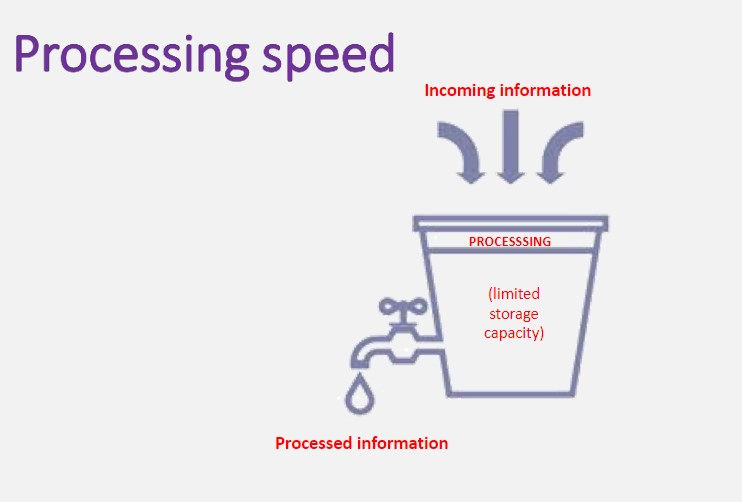
It’s easiest to think about it as a bucket.
For most of us: information comes in the top, there’s a steady flow. It’s being processed in the middle section at a good speed, and it comes out of ‘the tap’.
But if your processing speed is slow, your ‘tap’ lets out a lot less water. The info comes in at a fair speed, the bucket fills up very quickly, it can’t drain quickly enough and so it overflows. That’s what happens in young people’s brains where they can’t take in any more information, and they feel overwhelmed.
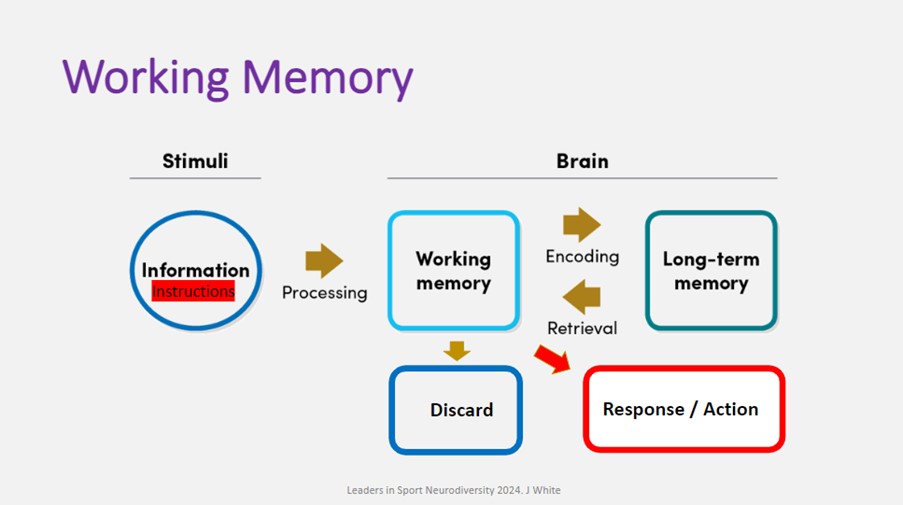
On the field/pitch/training, you might see this as:
As a coach, you need to…
Pay attention to the language you use and the quantity of information you give:
You have to make adaptations. We’re not all the same. It’s about equity and giving them equal access.
Dr Julie White, Head of Learning Support, Millfield School
Coaching checklist
Don’t assume you know the full picture – many players will not acknowledge that they have a difficulty, because:
A coach should:

In the second part of our interview with RADA’s Director of Actor Training Lucy Skilbeck, we discuss breaking habits, expanding capacity and self-reflection.
The Director of Actor Training at the Royal Academy of Dramatic Art [RADA] is speaking to the Leaders Performance Institute for a two-part interview.
The first focused on the teachers, the second instalment hones in on the students themselves, those coming in on the ‘ground floor’. RADA enrols a talented cohort of 28 acting students each year and works for three years to raise their ceiling.
“What we identify is the talent and the potential for growth, development and passion,” Skilbeck continued. “They are all talented, there’s no question, and they have all done really interesting things before they’ve come to RADA. What the training does is expand the instrument.”
Here, we explore the five most important factors underpinning that process.
This is the key point. Skilbeck, who also spoke at the 2023 Leaders Sport Performance Summit in London, believes that that everyone, including actors is constrained by their habits. “All of which we have developed from earliest infancy,” she said. “These are vocal and physical habits, mental habits, habits of the imagination, and emotional habits.” They can impair an actor’s work. “In other words, you can’t embody someone with an enormous emotional range, that has to go on an enormous emotional journey, if you’re habitually protective of your emotions and not [able] to go to anger, to distress, to passion, then you can’t take the character there either.” The students’ talents are, as Skilbeck explained, “held within whatever the constraints of their own habits”.
RADA’s actor training aims to break those habits and expand the acting students’ technical, emotional and imaginative capacity. “Really, what we’re training is how to be a human being and how to embody human experience in imaginary circumstances,” said Skilbeck, adding, “the only way I think that can be done is through the expansion of the self so that there’s access to the vulnerability that allows people to be open and exposed in a way that acting is asking them to do.” There are potential consequences of this approach to training, namely raising fears and psychological trauma.
Skilbeck admitted there is an element of risk in encouraging students to be vulnerable. As such, RADA offers its Student Wellbeing Service through its Student and Academic Services department. The service consists of two main teams: their Disability Service and, of particular interest in a discussion of habits, their Counselling Service. Skilbeck acknowledges that breaking habits can be a difficult process and can potentially being up fears or trauma from past experiences. “We work with a psychologist who hosts sessions with students on resilience early in their training,” she said. “It is both psych ed and giving them strategies for managing what might be potentially overwhelming traumas.” The psychologist is also working with the teaching faculty to develop trauma-informed teaching spaces and practices so that teachers know how to respond and the material is less likely to provoke overwhelming responses for students. “The challenge, which I’m sure is found everywhere, is that people don’t always know what traumas they’ve had until they begin to surface some kind of emotional content that has potentially not surfaced for a while,” Skilbeck continued. “There’s no way we can prevent that entirely, but we do have as many structures around us as we feel we’re able to at the moment. We’re constantly questioning and trying to develop those structures to create those spaces that feel sufficiently secure for the students.”
Reflective practice is another key component of expanding capacity. “In reflective practice, I work with students on taking the observer position so that they can create some space from the sensation, the experience of the release, as much as possible,” said Skilbeck. It is a useful means for acting students to “develop the skills” to reflect on their progress and development and RADA also encourages its students to keep reflective journals. As discussed in part one, RADA reins in formal feedback for the most part in years one and two. A recent course review suggested that even more time be carved out for self-reflection. That can be easier said than done. “That’s like the $64,000 question,” said Skilbeck, who explained that RADA has cleared the calendars for three hours on Thursday afternoons for first and second-year students. She noted that much of the curriculum contributes to the development of independent practice but “we haven’t tied that together sufficiently for students to come out the other way end going ‘I’m really clear on what my skills for independence practice are’.” To this end, RADA has been exploring a second-year project for self-led work. The goal is “to make sure students are confident in their understanding of what ultimately becomes the capacity to create, devise and lead on their own project work and production work, if they so choose to do.”
Just as Skilbeck believes teachers will get things wrong in their practice, so will students – and this is to be embraced. “This is something we talk about a lot because we’re encouraging people to not to try and get it right and to allow failure to be part of one’s creative practice,” she said. “You can’t have a creative practice if you’re not willing to fail. You can only have a complacent practice because you’ll only try the things that you know will succeed. To have a creative practice you have to be willing to accept a degree of failure – and I think that goes for all of us – those trying to lead, run and develop courses as well as those who are participating on them.”
Further reading:
‘At RADA we Want Teachers to Follow the Students as Well as Guide them’
In the first of a two-part interview, Lucy Skilbeck, the school’s Director of Actor Training, discusses their evolving approach to teaching and building a curriculum.
RADA no longer relies upon online classes as it did in 2020 and 2021, but, as Lucy Skilbeck, their Director of Actor Training, explained in a recent interview, “we have made changes not only to the curriculum but how we consider the curriculum and some of our approaches to teaching.”
One such change was inspired by the Black Lives Matter movement, which grew in prominence during that first year of the pandemic as systemic inequalities became evident in the higher infection and mortality rates in globe majority communities in the US, UK and beyond. Compounding matters was the succession of highly publicised, racially-motivated, tragic incidents involving Ahmaud Arbery, Breonna Taylor, and George Floyd.
The student body at RADA felt moved to speak up. “The students began to question our processes, some of our approaches, and some of our choices of material,” Skilbeck told the Leaders Performance Institute.
As the pandemic pushed everything online, Skilbeck’s students were working on three Restoration-era texts (plays written in England, Scotland and Ireland between 1660 and 1710). While this era was a time of revival in the dramatic arts – theatres had been closed for 18 years under Puritan rule prior to the restoration of the Stuart monarchy – there is a problematic link between Restoration drama and the Atlantic slave trade. RADA students raised the probability that some patrons of the Restoration-era arts benefited directly from the sale of enslaved African people for labour.
“One group chose to continue doing the Restoration project,” Skilbeck continued. “Two groups said they didn’t want to continue working with that material, so we made adaptations on the spot.”
Four years later, RADA continues to teach Restoration material (“that’s one of the reasons students come to RADA”) but has added a contextual evaluation of all texts – not just the Restoration era – for students and RADA project leaders.
“One of the big changes is how we contextualise how we discuss, how we critically examine and reflect on what the challenges are with any of the material we’re using.
“We’ve got more work to do, no question, but students are now saying they feel confident doing the work because the conversations can happen, are happening, are considered. That was the really big piece we weren’t doing before. We weren’t considering the impact of that work on globe majority students separately to the impact on white students.
“We were informally trying to make sure that was a consideration. Now we’ve made that a formal commitment.”
As Skilbeck once said during a Leaders webinar in 2021: “At RADA, we want teachers to follow the students as well as guide them”.
Contextual evaluation in the wake of Black Lives Matter is but one example of how this plays out at RADA. We discuss the others in the first of a two-part interview with Skilbeck. In the second, we focus on student development.
Listen to learners – they’ll tell you what they need
The Leaders Performance Institute asked Skilbeck to explain the dynamic of RADA tutors both following and guiding their students.
“The rationale is that the best teachers are the ones who are continually learning and who can be in a learner’s or a beginner’s mind,” she said. “In order to do that, one has to be willing to learn from the people we are teaching; and we will continually learn from the students because they are bringing the world now as it is for young people.
“That comes with them distinctly each year – and it changes year on year, as the world does – and so there’s a lot of learning to be done by listening to the students, by engaging with the students, by allowing students to educate us on what the world is for them and what they need in a learning environment.”
It does not mean Skilbeck and her colleagues always get it right. “Like all human activity, it is imperfect,” she said. “Sometimes it feels like things really develop and grow and, as a result, we move towards something more progressive; and sometimes it feels like they don’t. I don’t think there’s any way around that.”
Allow for meaningful engagement and contributions
It is tempting to view a dramatic production as akin to a team strategy or gameplan. There are parallels and both are ensemble activities. At RADA, it is another area where project leaders – managers of educational programmes, theatrical productions, or development initiatives – bring people together.
“Speaking as a director, which is my professional background, one of the roles of the director and the rehearsal process is to bring everybody into the same world so that everybody is in the play at the same time. That can sometimes be a struggle because there might be people with very strong ideas in one direction and others having strong ideas in another.”
The key is allowing cast members to contribute meaningfully. “A way we would begin to do that is close, detailed work on the story we want to tell collectively, because any play has an infinite number of possible interpretations, stories or emphases contained within it; and any production has to make a choice that it’s going to tell a particular part of that story.”
RADA uses ‘yes and’ work as it “develops the capacity to be ‘in response to’; so one is being reactive rather than generating one’s own action. A lot of that is built through gradually training people’s capacity to be working within an ensemble rather than standing to the side of an ensemble.
“A big part of what we do is trying to bring people to that place where they go ‘I can be here in a way that serves you’ and we talk about that quite explicitly.”
No right answer
At RADA, first and second-year acting students are no longer marked. “One of the big things we have to do early and throughout the training is really try and undo – it’s a really harsh way of putting it – some of the damage that the traditional school system does,” said Skilbeck, who was quick to explain that she is supportive of numerous elements of the scholastic system.
It is, however, a challenge for students. “We’re saying there isn’t a right answer – we’re not asking for the right answer,” she continued. Instead, “what we’re looking for is a much more holistic development of the whole person because that’s what an actor needs. Not ‘yes, I can’.
“I want them to have the capacity to interpret material but it doesn’t have to be the way that I would do it. What we want to do is develop their capacity to learn and to grow themselves and, therefore, be able to recognise and experience their own growth and development.”
Further reading:
Five Ways RADA Is Raising the Performance Ceiling of its Acting Students