John Bull of Management Futures says it as he sees it, but stresses that all teams can improve their teamwork.
“One of the things I see, certainly in the corporate world, is that people mistake ‘good’ for high performing,” said the Head of High Performance at Management Futures. “In my experience, genuine high-performing teamwork is much rarer than people would admit.
“We know what it feels like when a team is dysfunctional and something’s not working, but when a team is harmonious and there are fairly good relationships, people mistake that for being a high-performing team.”
He presented this distinction between dysfunction and high performing as different ends of a continuum:
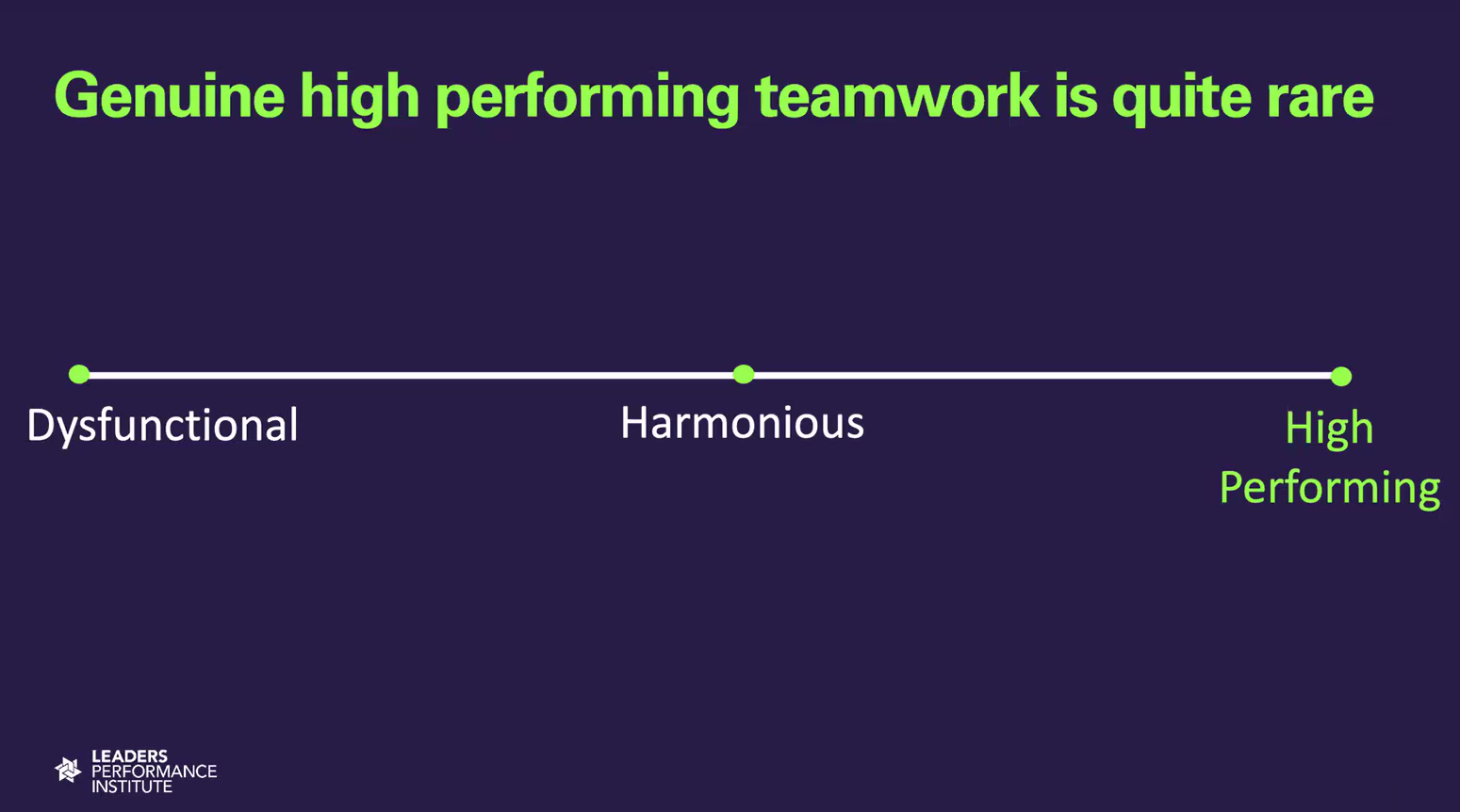
“In order to get to the right-hand side of this continuum, high-performing teamwork requires people to lean into behaviours that don’t come naturally,” added Bull.
He then explained that there is also a risk in over-collaborating. “This is about quality not quantity. Our efforts to get more out of teamwork can sometimes slow down performance.”
There is also a distinction between working within a ‘stable team’ (e.g. a department within a high performance team) and teamwork across boundaries, between people who rarely work together or don’t see themselves as one team (e.g. business and performance functions).
The aviation industry, Bull said, excels at cross-boundary teamwork.
“If you think about when you have a critical incident while flying, you’ve often got people in the crew who don’t know each other. The crew must collaborate with air traffic control on the ground, and they won’t know them,” he continued. He explained that the industry has long valued listening and speaking up.
It has also placed an emphasis on ‘diamond thinking’, which looks like this:
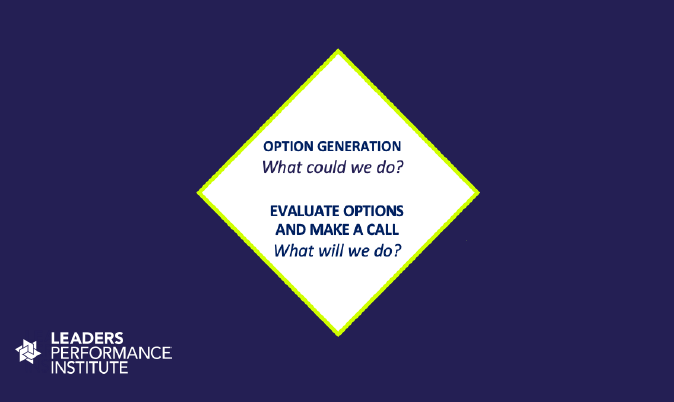
“In aviation, when you have to solve an issue, as a rule of thumb, you should spend 50 percent of the time opening the diamond up,” he said. “You get a lot of input but you’re then clear on who’s going to make the final call. Some of us in the coaching space struggle with the balance between democracy and a leader making a decision. Diamond thinking allows for that.”
Bull then led the table into a discussion on his four building blocks of team performance:
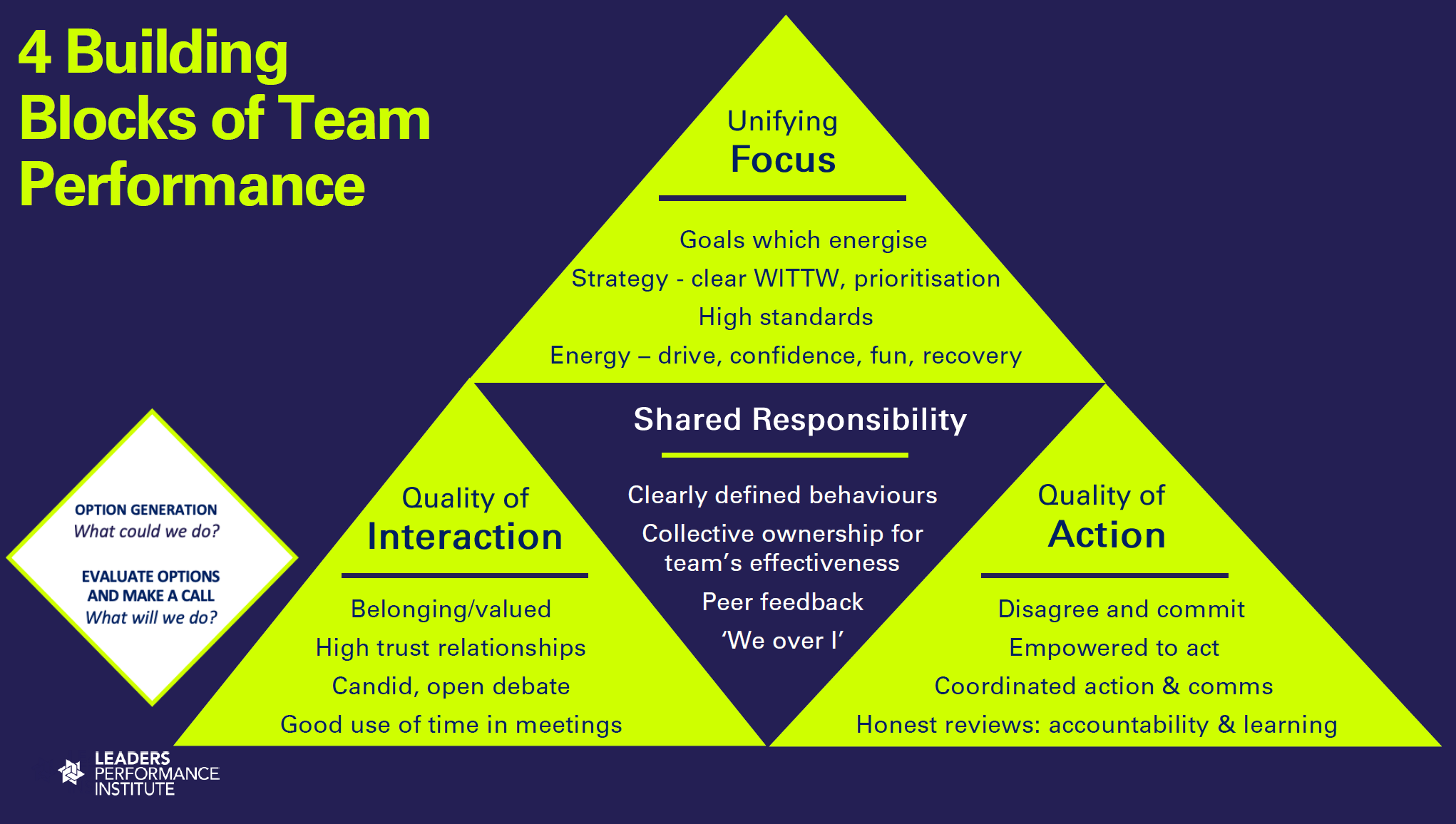
He explained each in turn and their different elements.
1. Unifying focus
“If you don’t have clarity you can’t create any of the other conditions.”
2. Quality of interaction
“Trust enables us to lean into more uncomfortable conversations and have the real performance conversations in a way that doesn’t put those relationships at risk.”
3. Quality of action
“High-performing teamwork emerges when people go for the gap.”
4. Shared responsibility
“It’s getting people to recognise that when the team’s not performing they should feel empowered to step in and say something about it and not just rely on the team leader.”
As a follow on, Bull highlights six human factors that can serve to inhibit team performance:
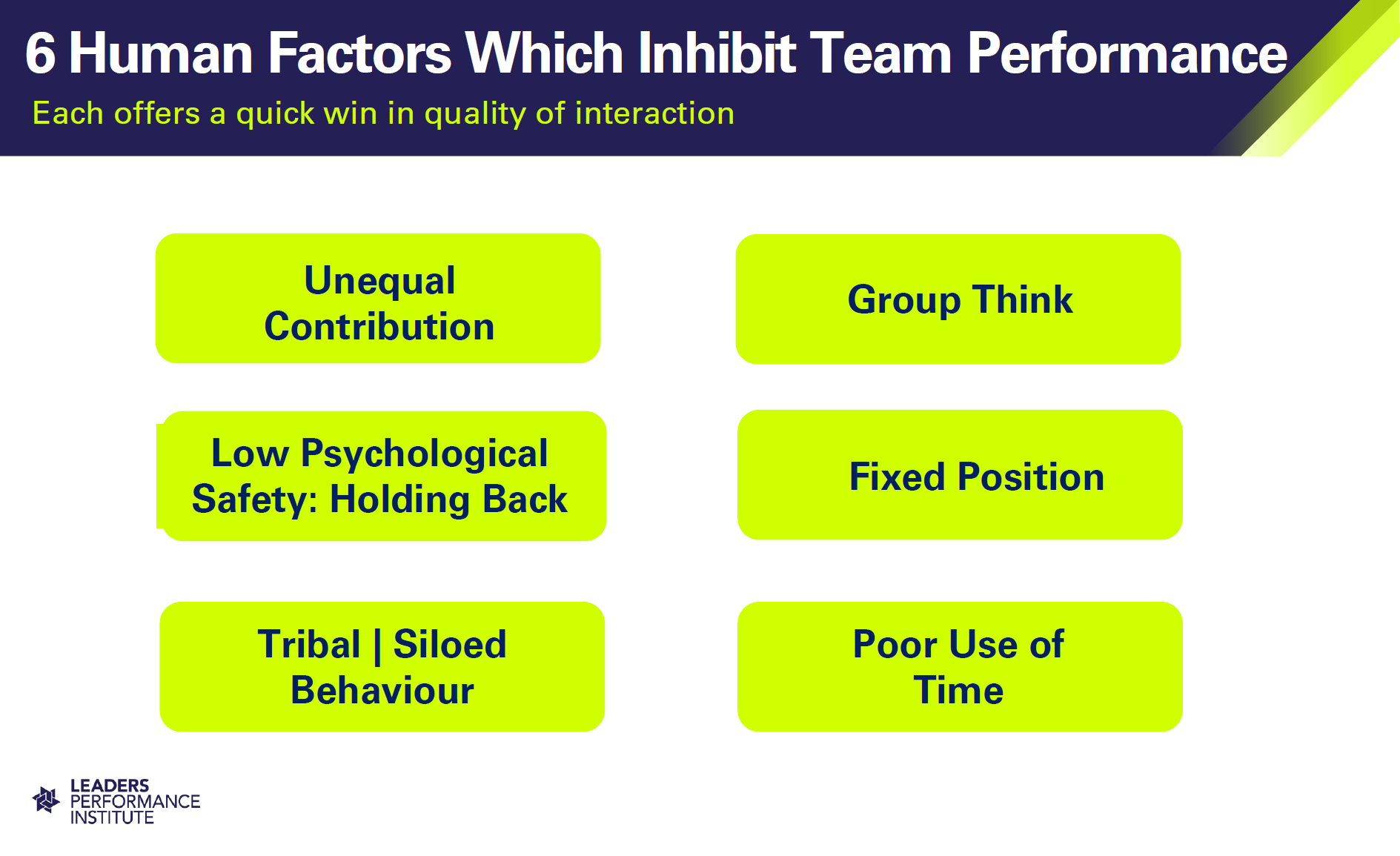
Again, he shared his thoughts on each:
Unequal contribution: “We know from research that if you have a group or a team of eight people 70 percent of the contribution will come from two or three… Status and personality has more of an impact on who speaks than who knows stuff, and that should scare you as a team leader.”
Groupthink: “It’s a hardwired principle of how our brains work that we will conform to the thinking of the group if we don’t have a strong view… One of the best ways to combat groupthink is to get people to think individually before a group discussion.”
Low psychological safety: “Probably the biggest thing that kills team performance is a lack of psychological safety.”
Fixed position: “One of the things that hurts psychological safety the most is defensiveness, where people are in a fixed position. The way you deal with the fixed position that I’ve seen work best is to deal with it one-to-one.”
Tribal or siloed behaviour: “We’re wired as humans to be tribal and there are two types of tribal behaviour. One is where you are deliberately trying to beat the other. What is much more common is you’re not competing but you just don’t think about the other ‘tribe’ as much.”
Poor use of time: “Humans tend to be pretty bad at how we use time together in groups. A quick win is to get the team thinking about when we had our best team meeting, what was it about that, what’s getting in the way of it.”
Bull then returned to the themes of psychological safety and fixed positions when sharing and describing the three types of “thinking environments” in groups and teams as revealed by Management Futures’ research:
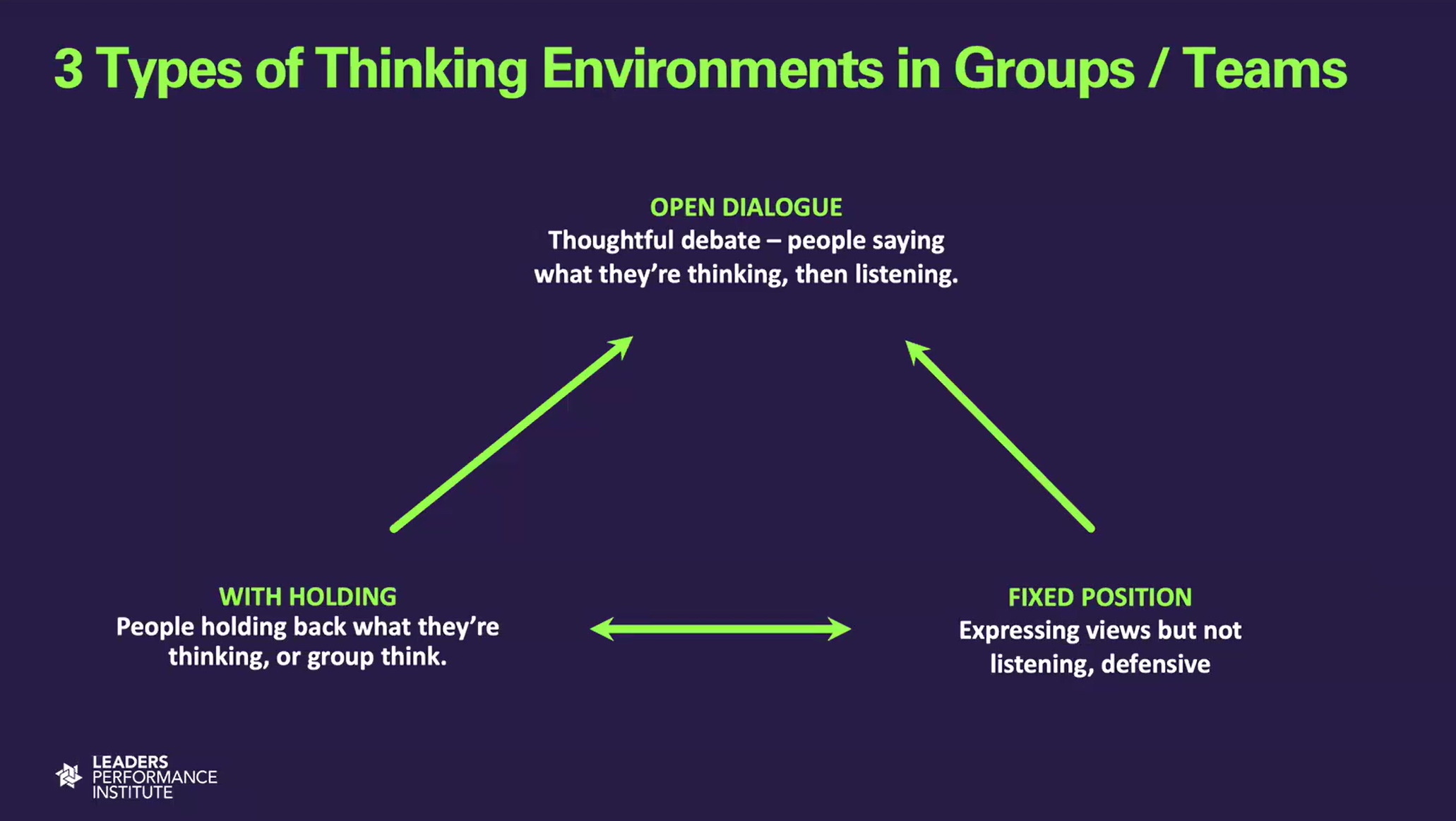
“The bottom two points are ineffective,” said Bull. “The definition of open dialogue is where people are saying what they think, but as soon as they’ve put their view out they’re inviting disagreement. It’s not about trying to win the argument, it’s about trying to get to a collective insight of what we know as a group. It’s very different to trying to influence colleagues.”
With time running out, Bull shared a final slide highlighting four key skills to encourage collaboration, with a series of questions for members to ponder: 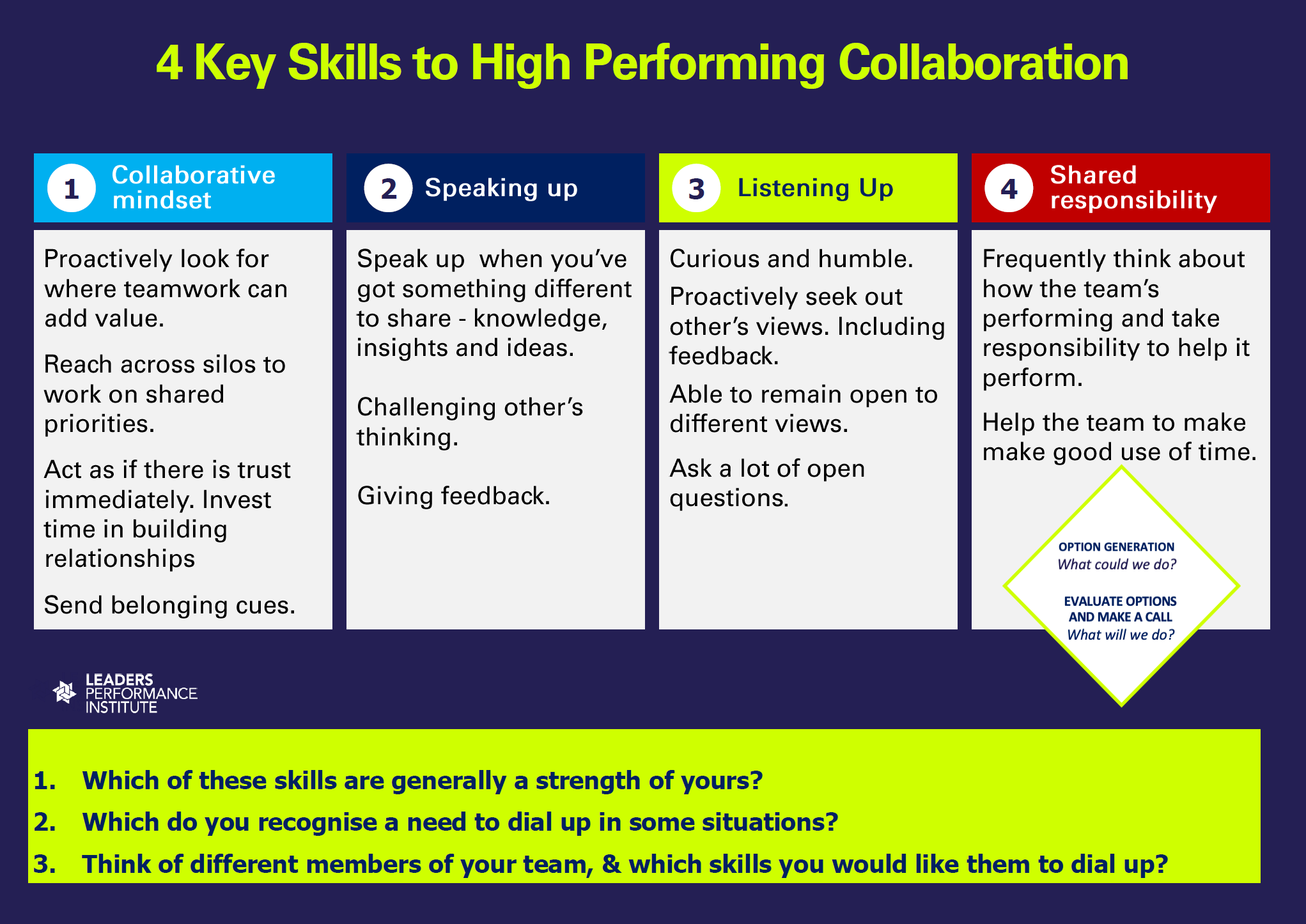
ESA Director of Science Carole Mundell discusses creativity and problem-solving in volatile environments both in space and here on Earth.
Main Image: European Space Agency
The video depicted a range of space-faring feats performed by the European Space Agency [ESA] as it enjoyed its 50th year.
Mundell, who is the Director of Science at the ESA , brought the room back to Earth again when outlining her efforts to bring together 23 European nations (more specifically their governments) in pursuit of the agency’s interstellar goals.
“Diplomacy is a contact sport,” said Mundell, who is a diplomatic veteran at this stage. She is responsible for a pan-European staff of over 45,000 people, with headquarters in five jurisdictions. You can also throw in the challenges posed by Brexit, the pandemic (when international diplomacy definitely was not a contact sport) and the war in Ukraine.
“The political churn at the moment is unprecedented,” she continued. “From one day to another, we don’t know whether our member state governments will continue to be governments or remain in place for another election.”
This volatility stands in contrast to ESA missions, all of which take decades to devise and tend to last longer than most political careers.
Then there’s the space-based challenges. In her time onstage, Mundell described a range of missions, from explorations of Jupiter’s moons to detailed observations to the surface of Mercury. All require incomprehensible precision.
Take the LISA [Laser Interferometer Space Antenna] mission. Its purpose is to detect gravitational waves in space; the ripples in space-time caused by cosmic events such as black hole collisions.
“They will have three spacecraft flying in convoy, with two and a half million kilometres between each spacecraft,” she said. “They will follow an Earth-Sun orbit and they will rotate and stay in that triangle.”
The lasers in question must be able to point with precision narrower than a proton.
““We’re going to measure the nature of space-time itself. It’s eye-watering technology.”

LISA measuring the properties of gravitational waves (Image: the European Space Agency)
Mundell has become adept at managing the external elements that could derail projects such as LISA. Thanks to her leadership, ESA’s creative and technical minds are able to do their best work in a climate of political uncertainty.
Psychological safety
In space, Mundell told us, things often go wrong. Take the Euclid mission, the purpose of which is to map the ‘dark’ universe. The lens of space telescope, which orbits the sun 1.5 million km from Earth, became contaminated by a strip of ice thinner than a strand of DNA. Mundell’s team had to find a way to defrost the ice without damaging the equipment’s sensitive optics.

Euclid begin its dark universe survey. (Image: European Space Agency)
But if you can reasonably anticipate microscopic space ice then you can devise a plan to defrost it.
“We did that last month,” she said almost matter-of-factly, but the ESA’s staff have built trust in their systems. “At a time of crisis, the first thing you do is check the process.” The system provides a layer of safety that goes beyond the interpersonal dynamics originally associated with the term ‘psychological safety’ (although these remain important; Mundell says: “Please create the best possible cultures you can. Please have the courage to really call out bad behaviour”).
“The cognitive safety comes from the fact that you know there is a process that you’ve all built together.”
This knowledge is also useful when navigating potential cultural differences present in a supranational organisation.
More creative, less expensive, more innovative
On her way to the Kia Oval, Mundell received news that one of an ESA contract negotiation was going backwards.
“My first instinct was to think of a solution,” she said. “And a very calm senior colleague said to me: ‘we don’t need to escalate this’. We don’t always need to go to the nuclear option.”
Such setbacks and budget cuts are par for the course. During his annual press briefing in January, ESA Director General Josef Aschbacher revealed that the ESA budget for 2025 would be €7.68 billion. It was €7.79 billion in 2024, but Germany, Italy and the UK reduced their contributions by a collective €430 million.
“We have to continually innovate and make things more creative, less expensive, but more innovative,” said Mundell, who explained that the ESA must design to cost. While there is room for creativity in day to day problem-solving, the process guides the action taken. “We have a whole quality assurance system where we set our objectives and we say ‘what will we do?’ ‘What did we say we’d do?’ ‘Did we do what we said?’”
Enduring purpose
The ESA was founded to enable European nations to explore the cosmos and further the continent’s knowledge and understanding. It’s an enduring purpose that continues to appeal. On 1 January this year, Slovenia became the 23rd member state, with several others still in the queue to join.
“Our missions are lifetime generational missions,” said Mundell. “You’ll see that people will give a significant fraction of their lifetime to develop, design and fly these missions, and ultimately protect them, to deliver science back to society. Children in school today will use data from our missions.”
She explained that once every three years there is a council meeting of ESA members at a ministerial level to decide the agency’s budget for the next three-year cycle. She shared an image from the 2022 meeting in Paris. It was taken just before she joined:

The official portrait of ministers at the 2022 ESA Council Meeting at Ministerial Level. (Photo: Stephane Corvaja / European Space Agency)
“This is a photograph of inspiration,” she said. “These ministers come from all different political backgrounds, they were facing various different challenges at this time. There was cost of living crisis and obviously the war in Ukraine was pushing all sorts of problems across these member states, and yet they all came together and they agreed that space is important.”
Hear more from Carole Mundell
As behavioural finance specialist Dr Benjamin Kelly explains, these four common biases can derail even the best players.
While technical skill and conditioning are paramount, behavioural biases frequently derail even the most talented players. For leaders in sports, understanding these cognitive shortcuts and emotional responses is crucial for optimising athlete performance, coaching strategies, and mental resilience.
I believe that golf, much like financial markets, is fertile ground for behavioural finance – a field integrating psychology and economics to explain irrational decisions. While behavioural finance has profoundly reshaped our understanding of investment behaviour, its application to sports decision-making, particularly in golf, remains remarkably underexplored. This is a significant oversight, as the very same biases impacting trading decisions equally affect decision-making on the golf course.
By examining cognitive shortcuts and emotional responses that derail golfers, we uncover profound lessons applicable to high-pressure environments across sports and business.
My work with investors has consistently demonstrated that reducing ‘bad decisions’ incrementally improves investment returns. This same principle applies directly to golf: eliminating poor choices on the course directly translates to saving shots and enhancing performance.
Overcoming behavioural biases is notoriously difficult; our innate cognitive architecture makes us highly susceptible. Therefore, the optimal path to mitigation is not to fight the bias directly, but to create a step in the process that prevents us from succumbing to it. In trading, a simple yet powerful example is the stop-loss order – a pre-defined instruction to exit a position if it falls to a certain price, removing emotional discretion from a critical decision.
This methodology, involving structured interventions, is evolving for golfers of all abilities.
Below, I illustrate these points with compelling examples, including Robert MacIntyre’s dramatic final round at the 2025 BMW Championship, and propose actionable strategies for correction.
Loss aversion describes our innate tendency to prefer avoiding losses over acquiring equivalent gains; the psychological pain of a loss is often twice as powerful as the pleasure of a gain. In golf, this bias is a primary contributor to the dreaded ‘choke’ phenomenon, particularly when a player holds a significant lead. The shift from playing to win to playing not to lose is a classic manifestation. It leads to tentative play and costly errors.
Consider the ‘final day phenomenon’ in golf, where approximately two-thirds of leading players fail to convert their lead into a win on the final day of a tournament. This represents a conversion rate of roughly 33%. My work with investors has consistently shown that even a modest improvement in decision-making, leading to an increase in success rates from 33% to 45%, can yield material benefits. For a professional golfer, this translates directly into more career victories and significant financial gains. For investors, it means incrementally improved returns and enhanced portfolio performance. This isn’t a sudden decline in skill; it’s a psychological battle. A player leading a tournament, especially on the back nine, often shifts from an aggressive, winning mindset to a conservative, loss-averse one. Instead of continuing the attacking golf that built their lead, they focus on not making mistakes, which leads to tentative swings, reduced pace, and increased unforced errors. The fear of losing the lead becomes more potent than the desire to win. It paralyses their natural game.
Robert MacIntyre at the 2025 BMW Championship provides a vivid illustration. MacIntyre entered the final round with a commanding four-shot lead, having played exceptional golf through the first three rounds (carding 62, 64 and 68 for an average of 64.67 shots). However, in the final round, under immense pressure and with a significant lead to protect, he shot a 73 – eight shots worse than his average for the preceding rounds. This stark difference, which ultimately saw him lose the tournament to Scottie Scheffler, is a textbook example of loss aversion in action. The desire to protect the lead likely led to a more cautious, less assertive approach, resulting in a performance significantly below his demonstrated capability. His post-round comments when he expressed a desire to “smash up my golf clubs,” underscored the emotional toll of such a collapse, which was rooted in the psychological pain of losing what felt like an assured victory.
Correction strategy: process-oriented thinking and positive aggression
Mitigating loss aversion requires a conscious shift from outcome-oriented to process-oriented thinking. Golfers should:
My methodology, applied to investment, focuses on establishing clear, unemotional exit strategies to prevent such value traps, which directly improves returns by eliminating these ‘bad decisions’.
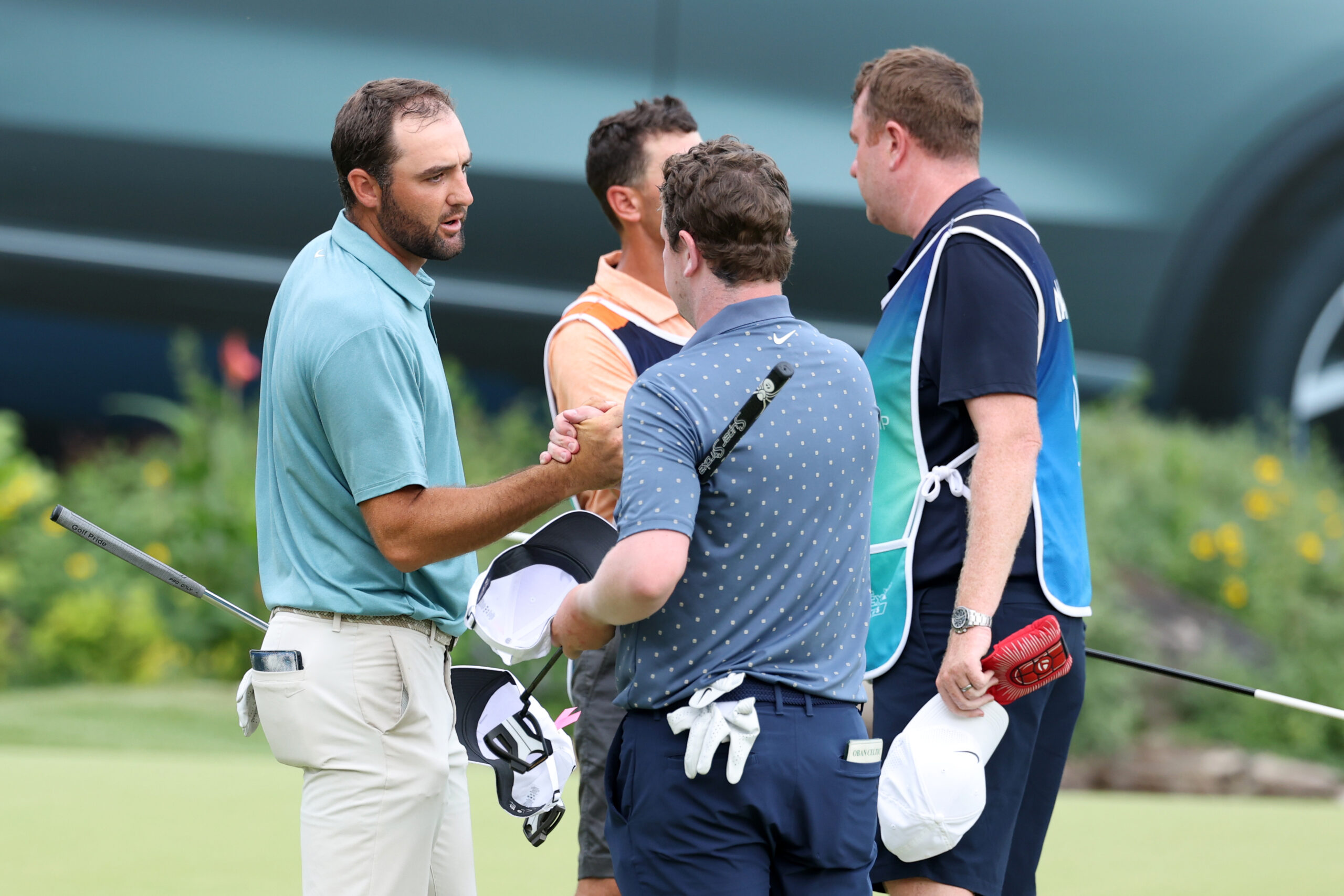
A victorious Scottie Scheffler shakes hands with Robert MacIntyre at the BMW Championship 2025 at Caves Valley Golf Club. (Photo: Kevin C Cox/Getty Images)
This translates to a pre-shot checklist that includes a deliberate assessment of risk vs reward. This ensures the chosen shot aligns with a pre-determined strategy rather than emotional impulse.
Overconfidence bias is the tendency to overestimate one’s abilities, knowledge, and the accuracy of one’s predictions. In golf, this often manifests as the infamous “hero shot” syndrome. Picture a golfer, slightly out of position after a wayward drive, facing a daunting carry over water or a dense thicket of trees to reach the green. A more prudent strategy might involve laying up, accepting a bogey or par. However, the overconfident golfer, convinced of their exceptional skill or believing this is their moment of glory, attempts the low-percentage, high-risk shot. The result is often disastrous: a ball splashed into the water, lost in the woods, or a double bogey that unravels a promising round.
Three-time major champion Pádraig Harrington has openly confessed that overconfidence cost him dearly at the 2025 Senior PGA Championship, particularly on a crucial 15th hole. Despite his vast experience, he felt his confidence and arrogance led him to an ill-advised approach shot, costing him a crucial hole. This mirrors countless amateur golfers who, after a few good shots, attempt to carry a 200-yard water hazard with a 3-wood, only to find their ball sinking to the bottom, convinced their recent success grants them an infallible touch. The allure of the ‘hero shot’ often blinds players to the higher probability of failure, driven by an inflated sense of their current capability.
Correction strategy: objective risk assessment and pre-shot routines
To counteract overconfidence, golfers must:
My investor checklists include a mandatory step for a ‘devil’s advocate’ review of high-conviction trades, forcing a re-evaluation of assumptions. This translates to a ‘reality check’ step in their pre-shot routine, where they explicitly consider the worst-case scenario and whether the reward truly justifies the risk. This step prevents the overconfident ‘hero shot’.
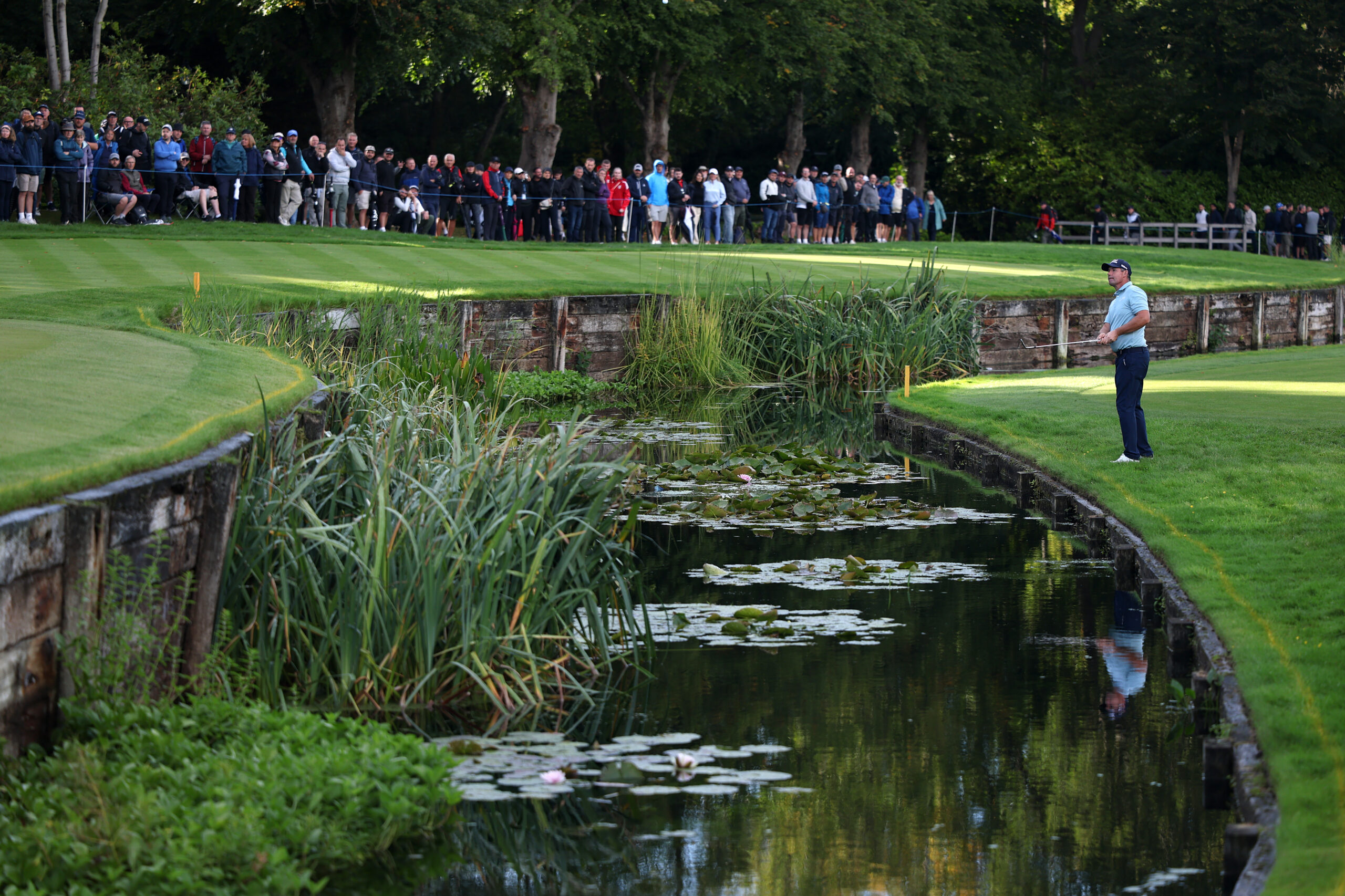
Pádraig Harrington at the 2025 BMW PGA Championship. (Photo: Andrew Redington/Getty Images)
Confirmation bias is the tendency to seek out, interpret, and remember information in a way that confirms one’s pre-existing beliefs or hypotheses. On the golf course, this can lead to flawed self-assessment and persistent errors.
A golfer might believe their slice is due to an ‘outside-in’ swing path, and subsequently only notice instances where their swing appears to confirm this, ignoring other potential causes like an open clubface. This selective attention prevents them from accurately diagnosing and correcting the root cause of their swing fault. Similarly, a player might attribute a good shot to their skill and a bad shot to external factors (a bad bounce, a gust of wind), reinforcing a biased self-perception that hinders genuine improvement.
Correction strategy: objective data and external feedback
To address confirmation bias, golfers should:
My investor checklists mandate seeking out and documenting opposing viewpoints before making a significant investment.
This means a ‘feedback loop’ step where they actively solicit input from their caddy or playing partners on their swing or strategy, or review objective data from launch monitors, rather than relying solely on their internal, potentially biased, assessment.
Anchoring bias occurs when individuals rely too heavily on an initial piece of information (the “anchor”) when making decisions, even if that information is irrelevant. In golf, this can lead to rigid decision-making that fails to adapt to changing conditions.
A common scenario involves a golfer fixating on the yardage provided by a sprinkler head or a course guide at the start of a hole. This initial yardage becomes an anchor, making it difficult to adjust for dynamic factors like wind changes, elevation shifts, or a different pin position that emerges during the round. A player might stubbornly stick to a club choice based on the initial anchor, even when conditions clearly dictate a different approach, leading to shots that are consistently long or short.
Correction strategy: dynamic assessment and multiple data points
Counteracting anchoring requires:
My investor checklists include a mandatory ‘re-anchor’ step, where all previous price points are deliberately ignored, and decisions are made solely on current fundamentals and future projections.
For golfers, this translates to a ‘situational awareness’ step in their routine, where they consciously disregard previous hole outcomes or initial yardage markers, and instead focus on a fresh, comprehensive assessment of all current variables before committing to a shot.
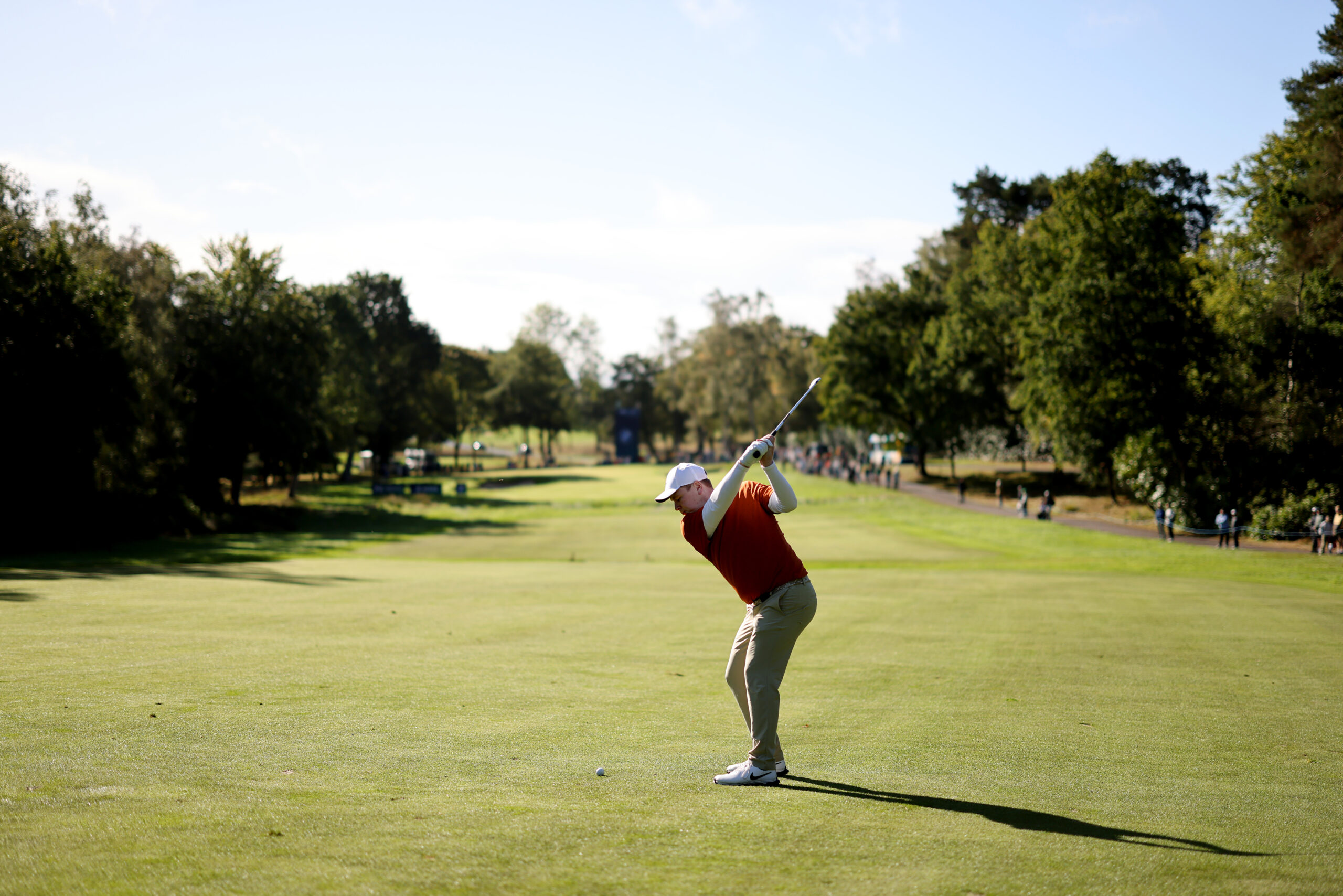
Robert MacIntyre at the 2025 BMW PGA Championship. (Photo: Jasper Wax/Getty Images)
Conclusion: cultivating mental discipline for peak performance
Behavioural biases are an inherent part of human cognition, but their impact on the golf course need not be detrimental.
By understanding how overconfidence, loss aversion, confirmation bias, and anchoring manifest, and by implementing structured strategies to counteract them, golfers can significantly enhance their decision-making capabilities. The journey to mastering the mental game of golf is one of continuous self-awareness, discipline, and a commitment to process over outcome.
Just as my work helps investors reduce the incidence of “bad decisions” to incrementally improve returns, applying these behavioural finance principles to golf can directly lead to saving shots and elevating performance. The critical insight is that overcoming biases is extremely difficult; our innate cognitive architecture makes us highly susceptible.
Therefore, the optimal path to mitigation is not to fight the bias directly, but to create a step in the process that prevents us from succumbing to it. This methodology, evolving from investment to the golf course, empowers athletes of all abilities to make optimal choices when it matters most.
For sports leaders, fostering an environment that encourages objective self-assessment, embraces data-driven insights, and champions structured routines will be key to developing athletes who not only possess exceptional physical talent but also the mental fortitude to make optimal decisions when it matters most.
This approach not only leads to more consistent performance but also a deeper, more rational engagement with the beautiful, challenging game of golf.
Dr Benjamin Kelly advises investors and professional athletes on decision making strategies in high stakes environments. If you would like to speak to Benjamin about his work, please contact a member of the Leaders Performance Institute team.
The Nxt Level Group’s David Clancy explores how the Dublin-based League of Ireland club seeks to build long-term success through reasserting its culture, defining a clear purpose, and engendering a sense of belonging in its players and supporters alike.
Main Image: courtesy of David Clancy
The murals around their home ground Dalymount Park (which is to be renovated in the coming years), the ‘home of Irish football’, speak of solidarity, diversity and inclusion; the terraces hum with the sound of supporters who are not just fans. They are owners of this proud club. The Gypsies. Bohs. The home where Bob Marley and Thin Lizzy played concerts years ago. A team rich in history, rich in story.
Different, rather than better
In a football economy dominated by multi-club groups, billionaires, private equity firms, and global TV rights, Bohs are a club who stand apart. They’ve become a story about what sport can be when it roots itself not just in performance, but in people that care about the team. Their budget isn’t as large as some other clubs’, so they are creative and intentional with what they do in the football market and community.
They offer something different and offer a surprising strategic case study. They show how sustainability and a long-term engagement advantage can emerge from fan ownership, cultural clarity, and humble leadership. They play differently off the pitch. They are a fan-owned club that has survived 135 years, not through scale or capital, but rather through culture, purpose, and belonging.
They recently commissioned and sold jerseys with ‘Oasis’ emblazoned on the front (building on the hype around the band’s August gigs at the Croke Park stadium). Half of the proceeds from sales supported Bohemian FC’s football and community projects, while the other half was split between Music Generation Ireland, which helps young people across Ireland access music, and Irish Community Care Manchester, who work with the Irish community (from which brothers Liam and Noel Gallagher hail) in that city.
This club truly embodies what category design means. They have effectively practised category design and owning a niche by positioning themselves not just as a football club, but as a cultural and social movement, blending sport with music, art, and activism. By creating and owning this unique space of ‘community-powered club’, they’ve differentiated themselves in the growing League of Ireland, attracting fans from Ireland and abroad, plus partners who share those values – rather than competing solely on wins and losses in the league table.
For leaders in leagues like the NBA, NFL, AFL, and Premier League, ‘Dublin’s Originals’ could be more than just a curiosity. A relative outlier, they offer an example of a model of sustainability for a team, one that challenges the dominant logic of growth in more unorthodox ways. Their underlying structure of fan ownership is worth studying. They are a collective of supporters who refuse to separate themselves from the team. Here, sustainability isn’t a corporate ESG initiative, it’s survival, identity, and continuity.
Alignment over expansion
Bohemians filter every strategic decision through a simple lens. They ask: ‘does this strengthen our bond with the community?’ This clarity allows them to stay relevant without necessarily chasing expansion, although supporter clubs are sprouting up across other continents. These fans want the team’s special edition away jersey featuring Dublin band Fontaines DC, which was released in support of the homeless charity Focus Ireland, or their Guinness-sponsored range of merch, the proceeds of which support Refugee and Migrant Solidarity Ireland.
Purpose alignment can be a sharper competitive edge than market dominance. Bohs remind us that sustainability doesn’t come from infinite growth, but from a cycle of reinvestment. Money goes back into facilities, players, and fan experiences, not siphoned off to distant investors. Fan-owned. Fan-run. Fan-driven.
Bohs pioneered blind football, amputee football and walking football in Ireland, and, in 2021, launched their Disability Supporters Association. They were the first League of Ireland team to take part in the Dublin Pride festival. They have teams and run events for young adults with intellectual impairments. They give back because it’s important for them.
For a team still seeking its identity in some shape and form, here are some inflection points from this club study. Replace relative transactional sponsorships with partnerships tied to a community identity (e.g., environmental groups protecting a part of a region). Give players structured time each season for community immersion, not as ‘charity golf appearances’ but as integral to the team’s ethos.
One could measure impact not just in brand impressions but in school programmes launched, parks built, and neighbourhoods revitalised, for instance. This piece of nurturing culture is not for decoration; it could be for leverage. Fans want their teams to win, but also to stand for something. To build something.
NBA franchises could issue community bonds or micro-shares, giving fans a symbolic stake and reinvesting proceeds into grassroots basketball. The result? Loyalty that outlasts market cycles. Premier League clubs could implement ‘golden share’ protections, ensuring fans safeguard cultural assets such as club colours, logos or stadium names. Food for thought.
Culture and ethos
Since the 2010s, Bohs, bohemian by nature, have adopted a left-wing political identity, which one can see in their club branding, language, public messaging and community initiatives. This resembles the philosophy and ideology of the Hamburg-based Bundesliga side St Pauli.
Daniel Lambert, their Chief Operating Officer, has positioned Bohs in support of causes such as Palestinian nationalism, anti-racism, anti-fascism, LGBTQ rights, refugee and homelessness advocacy. Jerseys carry messages from Amnesty International and the Movement of Asylum Seekers in Ireland. This alignment further builds loyalty and that sense of belonging to something, a movement. When fans and supporters are engaged, they likely will spend more on team merchandise too.
The club doesn’t shy away from social concerns and makes a stance. Volunteers run matchdays. Players show up at community events because it’s expected, not mandated and instructed. This is the culture, and these are not just PR moves but deliberate signals. These micro-behaviours strengthen loyalty and differentiate Bohs in a crowded and competitive sports market.
AFL clubs, many still member-owned, could guard against creeping commercialisation by doubling down on symbolic choices that reflect local identity. Of course, one must look at a P&L and the revenue statements, but this is worth contemplating. NFL franchises could reposition sponsorships not merely as transactions but as cultural alignments (health, education, inclusion, etc.).
A team could link sponsorships to civic identity – environmental causes, education initiatives, small business partnerships. Instead of buying attention, they earn trust. In an attention economy, values may outperform advertising in some peoples’ marks.
Imagine if a big franchise used its platform not just for commercial sponsorship, but as a megaphone for the causes their community cares about most. The return on emotional equity might dwarf the return on traditional marketing.
Fans as stakeholders
Bohemians’ ownership model turns belonging into structure. According to the club’s Social Impact report, as of 2023 they had over 3,100 members, up from just over 900 in 2018. There is a ‘one member, one vote’ rule. Membership is open to anyone and everyone, although there are limited season ticket and membership numbers; between seasons if a member does not renew their membership, it is sold on a first-come, first-serve basis. As well as match access, a member can attend and vote at the club’s AGMs and EGMs.
Once a member has hit three years of consecutive service, they are permitted to run for a board position. Thus, there is no outside control. Clear, values-driven, long-term thinking is encouraged over short-term profits; and growing the club and the community always remains the priority. Fans are shareholders; players feel the weight of representing not a brand, but a people. The ethos at the club is that belonging is the bottom line.
Could a Premier League club, say, recapture that intimacy? Could the NBA, with its superstar ‘big player’ economy rediscover the power of collective belonging? Bohs show us it’s possible, although the scale of operation is, of course, different. A team could give fans voting rights on heritage roundel designs or community projects. When supporters are allowed to co-create, membership renewal becomes almost automatic.
Stewardship, not ego
At Bohemians, leadership is custodianship. Senior management, coaches, and volunteers alike work with humility. The aim is not public visibility but leaving the club better than they found it.
Picture a club, now acquired by a new ownership group, flush with new wealth. They could embed ‘custodianship leadership’ programmes for academy coaches and staff, thereby reinforcing the idea that the club belongs to the city, not just its new owners.
Reframing success: The Bohs Scorecard
Bohs prove that success can be measured differently, and how one can rethink what success is. Yes, they want to win games. Qualify for Europe. Fill the stands. But they care about community impact, inclusivity, and the stories they leave behind.
In the NBA or NFL, where victory is often measured in ring counts, marquee signings or franchise valuations, this can sound quaint. But consider the long arc – which clubs will still matter when television deals shrink, when fans demand authenticity, when climate and social pressures force a rejig of what ‘sport’ contributes to society? Bohemians have already answered that question. They matter because they belong to their people.
This scorecard which, for the record, is not affiliated with Bohemian FC in any way, could unpack:
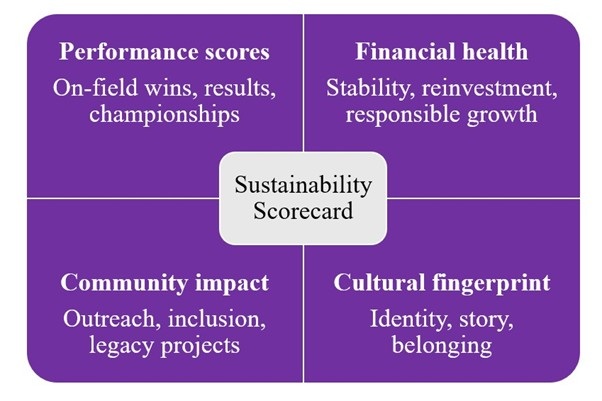
Potential examples of cases in point: cross-league applications
The 4-step Sustainability Playbook for leaders in sport
Why this matters
Front offices, director boards and ownership groups are under scrutiny and pressure: escalating player salaries, volatile media rights, and restless fan bases.
Bohs offer a reminder. Sustainability in sport is not just financial. It can also be cultural. The clubs that flourish in the next era will be those that treat belonging as an asset, culture as leverage, and leadership as stewardship.
David Clancy is the CEO of The Nxt Level Group and host of Essential Skills 2.
One for your diaries
Seán McCabe, the Head of Performance & Sustainability at Bohemian FC, will speak at Essential Skills II at the Irish Museum of Modern Art in Dublin on 28 October as part of a lineup of speakers across high performance sport, business and healthcare.
Tickets are available here.
As Harlequins’ lock Stephan Lewies explains, the key lies in collaboration – bring your athletes into the fold.
Quins’ 17-10 victory at the Twickenham Stoop ended five years of frustration and marked a complete turnaround from the 2023-24 Premiership Rugby season when they conceded 90 points in losing both home and away to Saracens.
Stephan Lewies, the lock who captained Quins to their long-awaited victory, had also endured every one of those losses. The run was particularly galling given the relative parity between the teams during that period. Quins were themselves Premiership champions in 2021.
So what was different this time? “Coming off a record like that in your derby game, in a way you go looking for answers in the wrong places,” Lewies told an audience several weeks later at the Leaders Sport Performance Summit in London.
“In the past, we’d review what’d gone wrong, and the coaches – who often feel pressure in a different way to the players – would go ‘let’s change this and let’s add that’ because Saracens are brilliant.”
It took eight reverses for Lewies and his team to work out why. “We’d always changed our tactics for Saracens,” he continued. “We would change how we structured our week.”
Quins, he explained, usually worked off an 80:20 game model where it is “80 per cent us and 20 per cent we change for the other team”. However, “we often went 50:50 against Saracens; training 50 per cent on us and 50 per cent on them.”
They did things differently ahead of the October 2024 match. Firstly, the players and coaches met independently before convening to discuss what was needed. The club had adopted a similar approach in their successful quest for the Premiership title in 2021. Their director of rugby [the de facto head coach] departed mid-season and the players worked with the remaining coaches to devise a winning formula after the club decided to wait until the off-season to appoint a replacement.
Once again it gave the team clarity in their convictions. “We said we’ve been constantly changing for this opposition because of the pressure that’s mounting on us,” said Lewies, “and we agreed that we should go back to what we do and just try to do that better.” That meant “doubling down” and going almost “90:10” in the week building up to the match. “That created clarity and alignment from the coaches to the players. And when the pressure came in this game, we could turn to something we’d done for the whole season, and basically for years, versus something new in a pressured moment.
“It’s much easier to stuff up something new under pressure versus something you’ve done for a long time because it’s already second nature.”
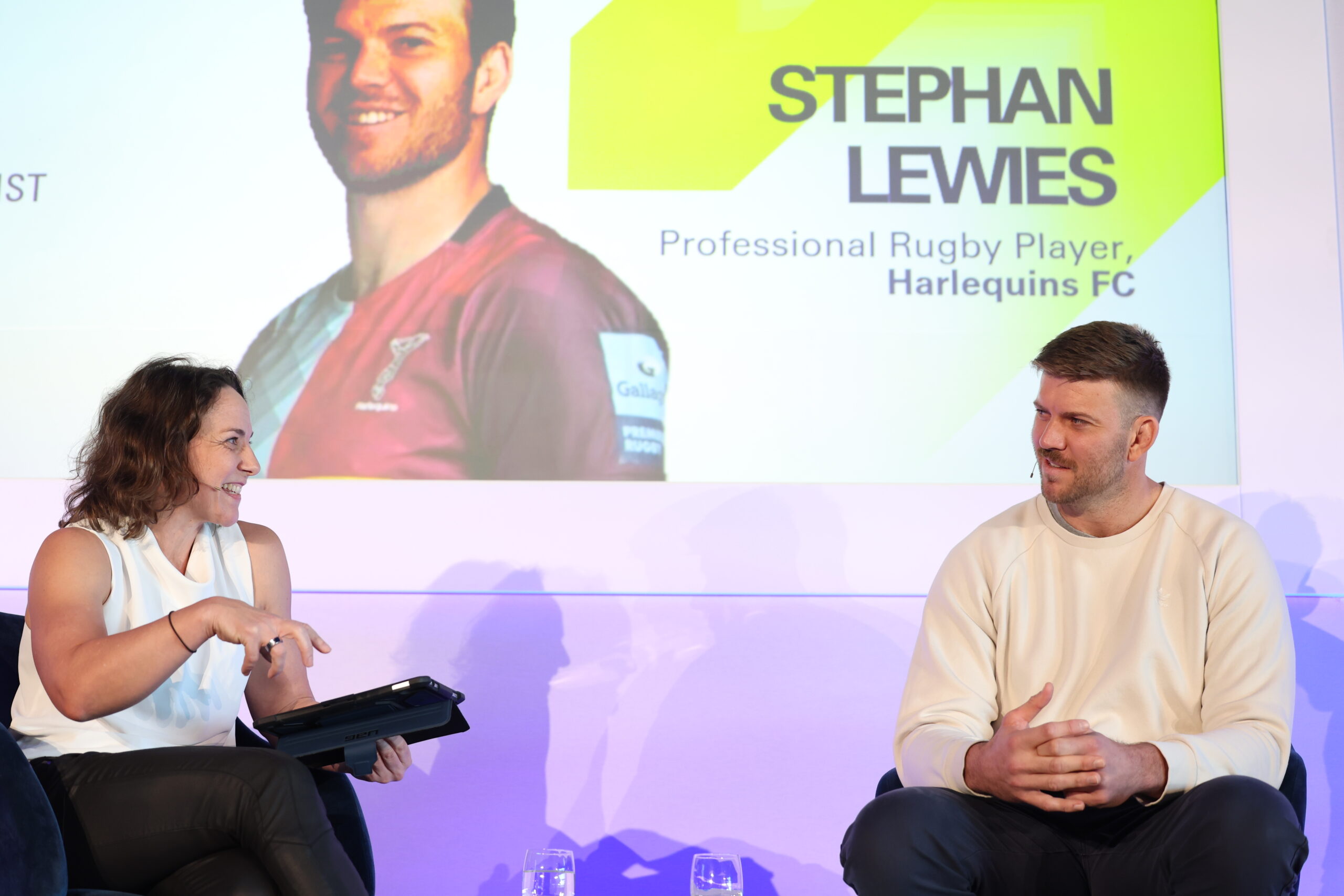
Stephan Lewies in conversation with Rachel Vickery onstage at the 2024 Leaders Sport Performance Summit at the Kia Oval.
Lewies’ reflections chimed with session moderator Rachel Vickery, a high-performance specialist helping teams in the worlds of sport, business and the military perform under pressure.
“So much of pressure is what happens off the pitch. When you’re on the pitch that’s actually your comfort zone in many ways and so you’re more prepared for that,” she said.
“Many teams have a monkey on their back around a particular opponent and that can change how the game is approached, which adds a lot of pressure.”
Lewies agreed and felt that being process rather than results-driven was ultimately what led to the result that day.
“It gives you freedom on the pitch to just go out and play,” he said. “You know your prep is done. Go out and express yourself. When you have clarity and alignment with the coaches you’re not asking yourself on the pitch ‘what’s the coach thinking?’ whenever there’s a tough decision. You almost know the answer to the question before it happens because you’re totally aligned in what you want to achieve in the game and at different stages of the game.”
It is an attitude Lewies takes into difficult conversations, which he faced often during his four years as Quins captain. The key was to be well prepared and, more often than not, those conversations would not be as tough as anticipated.
“If you kick the can down the road it can become a bigger problem. It can be scary to have that tough conversation in the moment, but that’s where growth happens, in that adversity. You grow closer as people and as teams.”
He recounted the story of a teammate who once skipped training and was suspended. Lewies endorsed the punishment but was labelled a ‘Judas’ by the player in question. The pair eventually made up after a frank exchange of views when it was clear that Lewies would listen to what his teammate had to say. It stopped matters escalating further and, as Lewies happily explained, made their relationship stronger.
“Getting him back on board and understanding him was critical for us.”
It was in such moments that the bonds, self-belief and confidence were forged that would eventually see off Saracens.
“There is so much value in creating opportunities to collaborate.”
What to read next
How Do you Develop the Most Expert Coaching Workforce in World Football?