Leaders in Business
  • Membership
  • Events
  • Content
  • Virtual Learning
  • Connections
  • Partners
Login
  • Leaders Meet: Innovation
  • Events
    • Leaders Week London
    • Leaders Sports Awards
    • Leaders Club Events
    • Leaders Performance Institute Events
    • Leaders Meet: Innovation
  • Memberships
    • The Leaders Club
    • Leaders Performance Institute
  • About
    • Careers
    • Contact
I’m a sports leader:
  • Off The Field For those focused on the business of the sport View more
  • On The Field For those working with an athlete or elite team View more
  • Login
    • Leaders ClubThe membership for future sport business leaders
    • Leaders Performance InstituteThe membership for elite performance practitioners
  • Newsletters
Performance Institute Leaders Performance Institute Logo
  • Membership
  • Events
  • Content
  • Virtual Learning
  • Connections
  • Partners
Login

26 Aug 2025

Articles

Transparency, Empathy and Empowerment: Five Ways Teams Are Serving their People in 2025

Category
Coaching & Development, Data & Innovation, Human Performance, Leadership & Culture
Share
Facebook Twitter Email Copy Link
https://leadersinsport.com/performance-institute/articles/transparency-empathy-and-empowerment-five-ways-teams-are-serving-their-people-in-2025/

Teams as diverse as the Philadelphia 76ers, Gotham FC and USA Gymnastics explain that if you discount the people on your teams you will inevitably harm their performance too.

By the Leaders Performance Institute team
Inevitably AI was top of the agenda at the Leaders Sport Performance Summit in Philadelphia last month.

Michael Jabbour, the AI Innovation Officer at Microsoft Education, was on hand to explain that while our futures will look different, there will be simple steps we can all take within our daily practices to integrate AI in useful and supportive ways.

“Quality use of AI comes from communication,” Jabbour tells the audience at the Wells Fargo Center, while running through some of the different types of AI, from simple to advanced and from retrieval to autonomous.

Fundamentally, he speaks to the human side of AI usage. Jabbour is a firm believer that with the right prompts AI is a superb teaching tool. “You’re going to have to fight for friction in order to grow,” he continues. Content generation, summary, code generation and advanced search are all areas where the right prompt can reap dividends.

Whatever the AI’s form, however you use it, “great communicators are excellent in what they get out of AI.”

The same can be said for coaching and high-performance work in general, with speakers from teams including the Philadelphia 76ers, Flyers, Gotham FC, USA Gymnastics and US Soccer joining the University of Pennsylvania and the American School of Ballet to discuss how we can better support the people we serve.

Here, we pick out five things to think about in promoting better alignment, more people-focused approaches to performance, and more thoughtful use of data.

1. Be transparent in your decision making

It is perhaps only in retirement from competition – and in going on to assume admin positions in sport – that Yael Averbuch West and Li Li Leung fully understood the value in organisational transparency.

West has been the General Manager and Head of Soccer Operations at Gotham since 2021, while Leung has served as President and CEO of USA Gymnastics since 2019 (before that she was a Vice President at the NBA).

Both have enjoyed success and endured tough times during their tenures and both explain that without transparency, there can be no alignment. And without alignment, you’ll never be able to establish your priorities, set a course and make big decisions.

There is opportunity in moments of hardship, as Leung explains. “Never let a crisis go to waste,” she says, repeating the words of American political theorist Saul Alinsky. There are obvious moments when it’s right to make a change and align people behind a strategy but, Leung adds, “it’s tougher when you’re deciding whether you need to push through and commit to a process or change.”

“The decisions I’m most proud of are the ones that were the most difficult to make – and often they’re the ones with the clearest answer…”

Yael Averbuch West

“… and you’ll still get crucified for it.”

Li Li Leung

“It can be difficult to commit to a process and find a way, rather than start again, but it’s often the right thing to do.”

Li Li Leung

2. Cut through the noise around the athlete

Alignment is key because the simple fact is that athletes increasingly ask for support beyond their sport and performance. Everyone must be on the same page.

“Do you think the modern athlete has changed or has it always been like this, but as performance staff, have we failed to notice it?” asks Simon Rice, the Vice President of Athlete Care at the Philadelphia 76ers.

“We think it is 50:50 as there is no denying that they are more informed because of more information being available,” he adds, “but this does create noise.”

The remedy requires trust as players in the modern era tend to ask for an explanation more often. The Sixers talk to their players and they talk to them early as they seek to understand what’s important to them. “Do not shut things down right away, work with them to find solutions.”

There is, however, a limit. “It is important to have your non-negotiables so they know where the line is too.”

“The guiding light is that everything that we do needs to help players thrive at NHL level,” says Ian McKeown, the Vice President of Athletic Performance & Wellness at the Philadelphia Flyers, who sat next to Rice. “We are being very intentional in using [the concept of] ‘thriving’ in our language.”

It is important to meet athletes where they’re at, understand their wants and needs, and to involve them in the decision-making process.

And lean into change. See it as comforting – it doesn’t automatically mean that what you did before didn’t work.

“As the person overseeing the performance programme, it is important to listen well and be curious about what is going on across different departments and relationships in that environment. I sought to explore the physical barriers and other impacts of what was going on and I intentionally adapted the flow of the environment to change this.”

Ian McKeown

3. Better leader = better human

“Social and cultural connection is the secret to our success as a species.”

So says Dr Michael Platt, the Director of the Wharton Neuroscience Initiative at the University of Pennsylvania. “If you want to be a better leader, be a better human.”

He speaks to the importance of the social brain network, which is a set of interconnected brain regions involved in understanding, interpreting and responding to social information. This could be recognising emotions, understanding others’ intentions or navigating social interactions.

To that end, he encourages leaders to employ perspective thinking. This can be as simple as writing down five things that illustrate your point of view before then attempting to think about them from another person’s perspective.

Platt also encourages eye contact and deep, rich conversations as starting points on the path to greater connection. Neuroscience explains that good relationships emerge when our brains are synchronised and there is a pattern of activity aligned to the other person.

“Your social brain network is like a muscle: the more you use it, the bigger it gets, so it’s critical to exercise it.”

Michael Platt

4. A programme should protect and empower

Ian McKeown at the Flyers made the point about helping players to thrive. Similarly, the notion of holistic support underpins the work of the American School of Ballet with its students.

“We want students to develop so that they are thriving and not just training,” says Katy Vedder, the school’s Director of Student Life, when speaking of their Whole Dancer Approach.

“We acknowledge their adolescent brain and try to create a sense of belonging as they discover who they are and what they value. We want to support their humanistic needs too and their competencies beyond performance, including self-awareness, peer connections and a healthy comparison framework.”

Wellness isn’t supplementary – it’s central to performance, identity and longevity.

Integral to this reframing has been a realignment of performance priorities, with re-education around cross training and strength & conditioning helping to reduce injury rates while better considering wellness and recovery.

“We can’t work in silos,” says Aesha Ash, the school’s Head of Artistic Health & Wellness. There were several nodding heads in agreement around the room. “The dancers have to be at the artistic centre and we have to work to collaborate in support of them.”

“Our students are not just artists or athletes, they intersect both and need a support system that honours their full, true identity.”

Katy Vedder

“We have to challenge the definition of success at a systemic level. We celebrate those not pursuing becoming a professional dancer, widening the parameters of success.”

Aesha Ash

5. Use data, but don’t discount the person

We close the circle by returning to the question of technology, specifically data.

Both Sam Gregory, the Director of Data & Analytics at US Soccer and John Boyles, the Director of Research & Development at the Sixers, make the point that data isn’t here to take from a coach’s systems or expertise, but to elevate it.

“We want to help you do what you’re best at and take away the parts humans aren’t as good at,” says Gregory. “We’re not trying to replace the system and the expertise.”

That means presenting data in robust but useful formats that never lose track of the human subjects at the centre. With this in mind, it is a good practice to exhibit caution in overcommunicating the data and what the numbers are saying.

Analysts should focus on connection, communication and clarity, especially with those departments and individuals who perceive data as a challenge to their daily workflows.

Finally, infrastructure readiness is critical. There is a lot of noise in the ether when it comes to data and technology, with numerous vendors trying to pitch the exclusivity of their datasets. To abate the noise it is important to build robust strategies and infrastructure to ensure that the noise doesn’t find its way into programmes.

“The aim is to get to the point where data is available to support every decision made, even if it’s not used for every decision.”

Sam Gregory

“We need to think about the importance of what’s visible when discussions are happening. The insight displayed can have an effect on the conversation.”

John Boyles

What to read next

‘We’ve Lost Athletes Because of this’: When Support Descends into Surveillance

Members Only

23 Jul 2025

Articles

Why the Words you Choose to Promote your Team Culture Are Interchangeable and Don’t Always Matter

Category
Leadership & Culture, Premium
Share
Facebook Twitter Email Copy Link
https://leadersinsport.com/performance-institute/articles/why-the-words-you-choose-to-promote-your-team-culture-are-interchangeable-and-dont-always-matter/

In one conversation, Dan Jackson of the Adelaide Crows cut to the chase and helped the team’s analysts to recognise – and celebrate – their important contribution to the collective.

By John Portch
Dan Jackson recounts a conversation he had with the analyst team at the Adelaide Crows during the AFL off-season earlier this year.

“There’s a team of six and I asked them what their job was,” the Crows’ General Manager of Player Development and Leadership tells the Leaders Performance Institute.

“Their response was along the lines of ‘we’re there to support the coaches’,” says Jackson, while admitting that this response isn’t wrong. “That is inherently what their job is. They’re looking at the data, they’re putting together PowerPoints. They’re also the ones plugging in all the computers at a game to make sure that the visuals are right. Everything for them is about getting the detail right in the background. If they weren’t there the wheels would fall off.”

Jackson did not find their answer wholly satisfactory. The analyst team’s relative invisibility to everyone else was part of the problem.

Connection to vision and mission

In the analysts’ response, there was no mention of Adelaide’s vision (“to earn the pride of South Australia”) or their mission (“sustained success, winning multiple premierships”).

Jackson reframed his question. He wanted to see if the group could align their work to the bigger picture. “I said: ‘how do you guys see your role? What’s your purpose as an analyst group to help us achieve that vision and mission?’”

A fear for Jackson was that if the analysts see their contribution as little more than background support then others will surely do the same.

First clarity, then alignment

“When you’ve given everyone clarity around what we are trying to achieve, how we’re going to go about it, and how I need you and you and your team to play your role in it – I think that’s what people would say when they feel like there’s alignment,” says Jackson.

The group’s second answer was a step in the right direction:

We help drive performance by supporting, innovating and getting the little details right, so that everyone else can work their job seamlessly.

They hinted at their sense of alignment and already sound more empowered.

“At great organisations, people feel like they have some autonomy to make decisions,” Jackson adds, “but it’s really hard to give that trust over as a leader if you haven’t provided clarity or aligned them to the strategy, the vision and the mission.”

Those three areas have been areas of intense focus for Jackson and his colleagues. The analysts, now emboldened by Jackson’s encouragement, went further:

We play a pivotal role in the team’s performance as we look to earn pride and win.

“Now they’re feeling strongly aligned to how they’re going to help us achieve the vision and the mission. I think that goes a long way to help engagement, retention or even decision making.”

It led to a wider conversation about their roles and contributions.

“One of our values is ‘courage’,” says Jackson, who asked the analysts what that looked like for them. They connected ‘courage’ to their need to balance innovation and risk-taking in their day-to-day work.

For us to get a competitive advantage in how we use the data, present our messaging and tell our stories, we might have to take a risk. For example, we might have to use some new AI platform to enhance our presentations. It may fail once or twice, but if it works really well then we can visualise data better and tell our story better.

Jackson now heard what he had sought. “A small department can be really empowered when they’re aligned to something that they understand of the big picture.”

That said, Jackson guards against any team getting too hung up on words when it’s actions that matter.

He observes that there’s little difference between the values one team puts on their wall and another.

“Around 80 per cent have ‘integrity’ as a value,” he says. “You’re guaranteed to have something like ‘commitment’, ‘hard work’, ‘dedication’ or ‘excellence’.

“Then there tends to be a mindset one. So we have ‘courage’, but it might be ‘ruthlessness’, ‘relentless’ or ‘belief’. Sometimes they have a fourth, which is more unique. It could be like ‘celebrate your authenticity’ but, inherently, every sporting organisation has the same face because there’s no real secret sauce of success.

“With the great teams, it’s not that their words are great: it’s the way they actually go about living, the behaviours that underpin it.”

Jackson has seen it time and again during his career. “I probably spend the least amount of time worrying about whatever words they’ve got,” he says. “Often, I don’t even bother changing them because if you want ‘connection’ or ‘unity’ or ‘team first’ or ‘family’, it doesn’t really matter. What I want to know is the behaviours you’re going to commit to, your system of accountability, and how you drive those behaviours.”

Dan Jackson also features in…

Performance Special Report – High Performance Unpacked


27 Jun 2025

Podcasts

Teamworks Podcast: ‘Being a Director Is Much Harder than Playing’ – Bianca Rech, FC Bayern Munich

Category
Leadership & Culture
Share
Facebook Twitter Email Copy Link
https://leadersinsport.com/performance-institute/podcasts/teamworks-podcast-being-a-director-is-much-harder-than-playing-bianca-rech-fc-bayern-munich/

When it comes to topics such as developing a performance culture, engendering trust and adroitly using tech, the former defender’s instincts as an athlete stand her in good stead.

A podcast brought to you by our Main Partners

When Bianca Rech shares a decision with FC Bayern’s players, she knows instantly how it has landed.

“You feel it,” says the Director of Bayern’s women’s programme. “You already know when you look at their faces. You’re like ‘I think she doesn’t like it’, ‘yeah, she likes it’ and ‘she needs a bit of proof’. It’s like sometimes I see myself sitting on the other side.”

The ‘other side’, as Bianca tells Teamworks’ Andrew Trimble and Leaders’ John Portch, refers to her transition from a Germany international and Frauen-Bundesliga regular to a senior leader of the German champions, whom she represented on the pitch for four years.

“It’s so much harder now when you sit on that side now,” she adds, reflecting on how she used to feel as a player. “I see myself sitting on the other side, like, ‘oh, maybe I have to talk to them again’.”

In this third and final episode of our special series with Teamworks, Bianca touched upon several of the major themes that emerged from our recent Special Report High Performance Unpacked: interconnected performance teams.

She spoke of her role in helping to transform the Bayern culture on and off the pitch [37:00]; keeping the athlete at the centre of the performance jigsaw [14:30]; the importance of sports psychology [31:00]; and the thoughtful integration of technology [21:00].

Listen above and subscribe today on iTunes, Spotify, Stitcher and Overcast, or your chosen podcast platform.

Episode One: Simon Rice, the Philadelphia 76ers

Episode Two: Miranda Menaspà, the Australian Institute of Sport

22 Apr 2025

Articles

From Coach to Facilitator: How to Run Engaging Team Meetings with an Athlete’s Voice

Category
Leadership & Culture
Share
Facebook Twitter Email Copy Link
https://leadersinsport.com/performance-institute/articles/from-coach-to-facilitator-how-to-run-engaging-team-meetings-with-an-athletes-voice/

Performance Coach Ronan Conway believes that coaches can bring a fresh dimension to team gatherings and help teams tap into their inherent power by adding some facilitation principles and techniques to their skillset.

By Ronan Conway

Facilitated meetings: direction to dialogue

In recent years I worked with a coach of a football team. He’d regularly vent to me about players not speaking up in meetings, and how the group lacked leaders and energy. So I decided to sit at the back of some player meetings to observe the dynamic.

A clear pattern emerged. Standing at the top of the room, the coach would send waves of golden information and inspiration toward the players in the shape of tactics, opponent analysis, and game plans. His style was to direct, to instruct, and to hand players the answers – because that’s how he was coached, that’s what he excelled at; plus time was of the essence. The players’ role was simple: to listen and absorb.

My feedback was as follows:

  • His messaging and delivery was very strong. However, energy flow felt too one-directional. Some players appeared to be disempowered and disengaged.
  • Players needed more space to process, understand, and integrate the info.
  • There was hundreds of years of combined experience in the room, bubbling away right beneath the surface. The players seemed hungry to share it, but until now, the invitation hadn’t been strong enough.

“The coach needed to maintain his directive style as a solid foundation, and layer in skills to stimulate group discussion”

My suggestion was to maintain his directive style as a solid foundation, and layer in skills to stimulate group discussion – not to replace his approach, but to complement it.

In the following weeks after delivering his game plan, he practised popping the ball into the players’ court; inviting their thoughts and insight. Within weeks he facilitated a post-game review, opponent analysis, and culture session with the squad. To different degrees, the players played a key part in both sessions. These small shifts had profound results:

  1. Players stood taller – they felt trusted, valued and respected.
  2. With more skin in the game, they took greater ownership of it.
  3. Learning deepened. ‘Tell me and I forget, teach me and I may remember, involve me and I learn.’
  4. Meetings took on a more focused, empowered energy.
  5. Quiet voices grew louder and leaders emerged.

To get to this point, it required a big shift in attitude towards his group and his role. It called for him to swap his teacher cap for his facilitator cap.

“The change called for the coach to swap his teacher cap for his facilitator cap.”
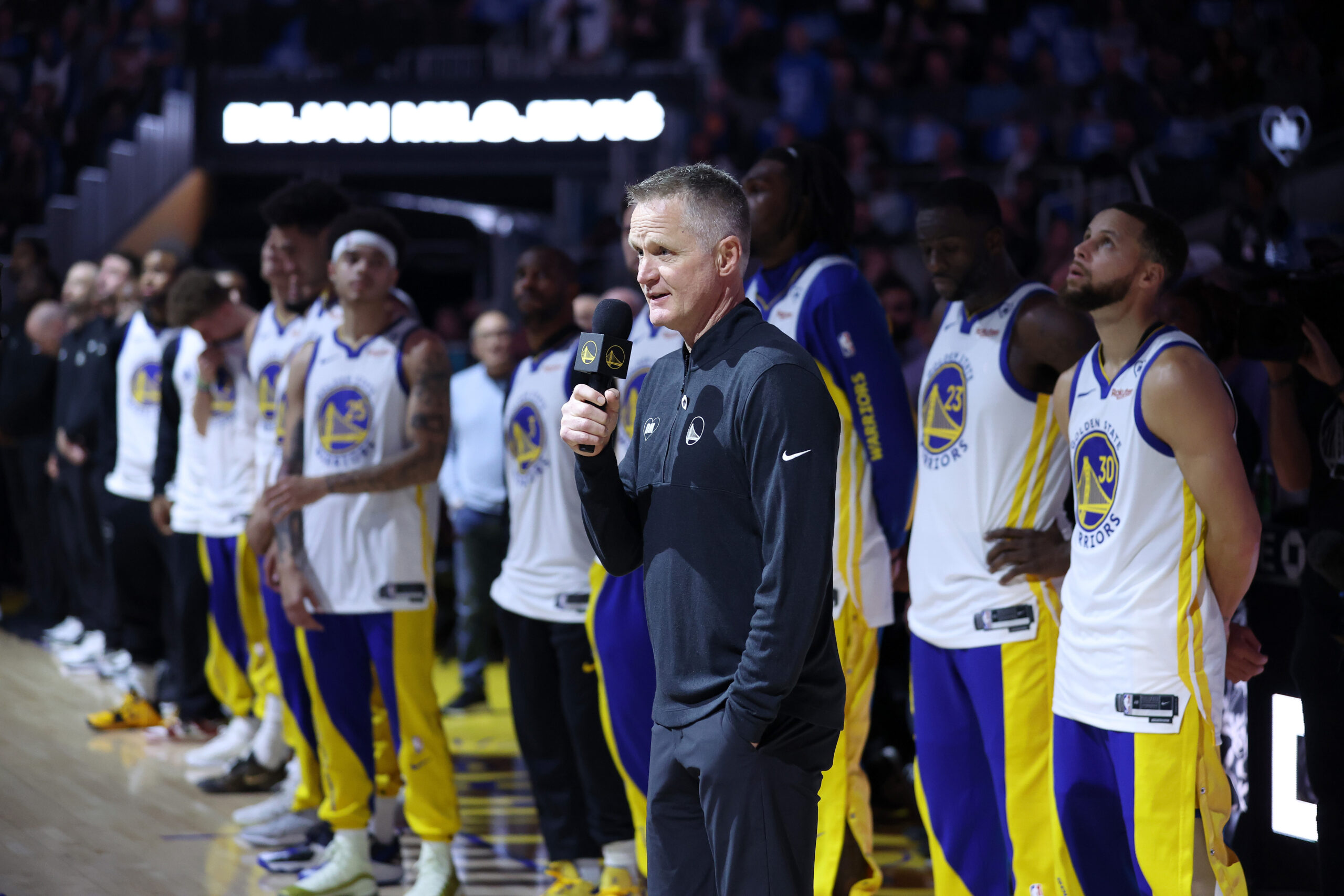
Photo: Ezra Shaw/Getty Images

Facilitator mindset: the answers are in the room

Before facilitating any meeting, it helps to adopt a group-centred lens. To have a strong belief in the group’s inherent wisdom. When you look at your squad in front of you, you see an ocean of insight, inspiration and breakthroughs. You see teachers rather than students. You see answers in the room.

The transition from a teacher to a facilitator mindset can be tricky. Most coaches are experts in their field, and at times it can suit to simply tell players what they need to know. But as a facilitator it’s not about telling, rather it’s about being curious. It’s about fostering the right conditions for the group to unearth their own answers.

“The transition from teaching to facilitating is about fostering the right conditions for the group to unearth their own answers.”

For some this may require a loosening of the reins, but it doesn’t mean letting go of them. Your direction and leadership is still central, but you’re inviting your squad to step up with you from time to time. It’s important to say that certain players and squads certainly won’t have all the answers. In this case, at least they get to practise critical thinking and to put their own fingerprints on a discussion.

Steve Kerr, the Head Coach of the Golden State Warriors NBA-winning team, is a proponent of player-driven meetings. For Kerr, it’s not about “control”, rather “guiding” or “nudging players in the right direction”. That ‘nudging and guiding’ is the essence of facilitation.

Facilitator toolbox: get the water flowing

Stimulating any form of response from a group is about moving energy. Moving energy can look like a smile, a nod, a raised hand. Maybe a word. Or a sentence. In time perhaps a rich, flowing discussion. We call this process, ‘getting the water flowing’.

Here are some facilitation tips to get your meetings flowing:

Show of hands: When faced with 30 blank faces, and the energy feels stuck, you can get the water trickling with a show of hands. ‘Hands up if you know’; ‘if you agree’; ‘who relates’; ‘if you’ve experienced this’. Each hand raised or not is a micro-investment in the meeting.

Open-ended questions: Clear open-ended questions are the keys for unlocking the treasure. They typically begin with ‘how’, ‘why’, or ‘what’, and generally elicit deeper insights than closed questions which give yes/no answers. The quality of the question will determine the quality of the response.

Intentional language: ‘The answers are in the room’: use language that reflects this mindset. You are not wondering if they have an answer, you know they do. Instead of ‘does anyone have an answer?’, try ‘who wants to go first/next?’.

Non-verbal communication: Facilitation isn’t just verbal. A nod or some steady eye contact can subtlety signal, ‘I want to hear from you’. You can lightly scan the room, naturally clocking different individuals throughout the meeting. At the very least, these ‘I see you’ moments will keep people checked-in and engaged.

Pair up: Speaking in front of an entire group is a big interpersonal risk to take. Pairing up to speak is a more manageable one. It gets all voices flowing; it builds safety; it serves as a stepping stone to a wider group conversation.

If your questions are met with silence, don’t sweat.

Sit in the silence: silence is the absence of words, not the absence of communication

That liminal space between question and answer can be an intense time. When I started out facilitating in schools, most of my questions would hang in the air for what felt like minutes. Time sped up, as did my heart rate. I’d hold my breath. My brow got sweaty. ‘Someone. Please. Say. Something,’ my inner world yelled. The group shuffled awkwardly longing for the same. Until, finally, I’d move things along with a joke, or by answering my own question. Phew.

After enough moments like this, my relationship with silence changed. I found these moments to be a necessary and natural punctuation point; a chance for the room to slow down and to breathe. In the moments when I filled the silence, I wasn’t saving the group from the discomfort, I was in fact saving myself from my own discomfort. Rather than seeing silence as a void to be filled or feared, I started seeing it as a space for gold to be found. Granted not all silences lead to answers, but at least give the group time to gather their thoughts and muster up some courage.

‘Sitting in the silence’ is a useful practice in these moments. Meaning, allowing silence space – trusting it – and remaining as relaxed as possible.

“The more I trust myself to sit in the silence, the more the group trusts themselves to speak up.”

Here are two nuggets which help the process of sitting in the silence:

1. Trust the silence

When a group isn’t responding, a myriad of things can be happening for them. Quite often, they’re just not used to being asked. The silence is almost like a test to gauge ‘is this a token question or a genuine ask?’ In filling the silence, a lack of belief in oneself and the group is communicated. Being willing to ‘sit in the silence’, we signal a strong confidence in the group. You’re saying, ‘I know you know and I’m willing to wait’. It amazes me: the more I trust myself to ‘sit in the silence’, the more the group trusts themselves to speak up.
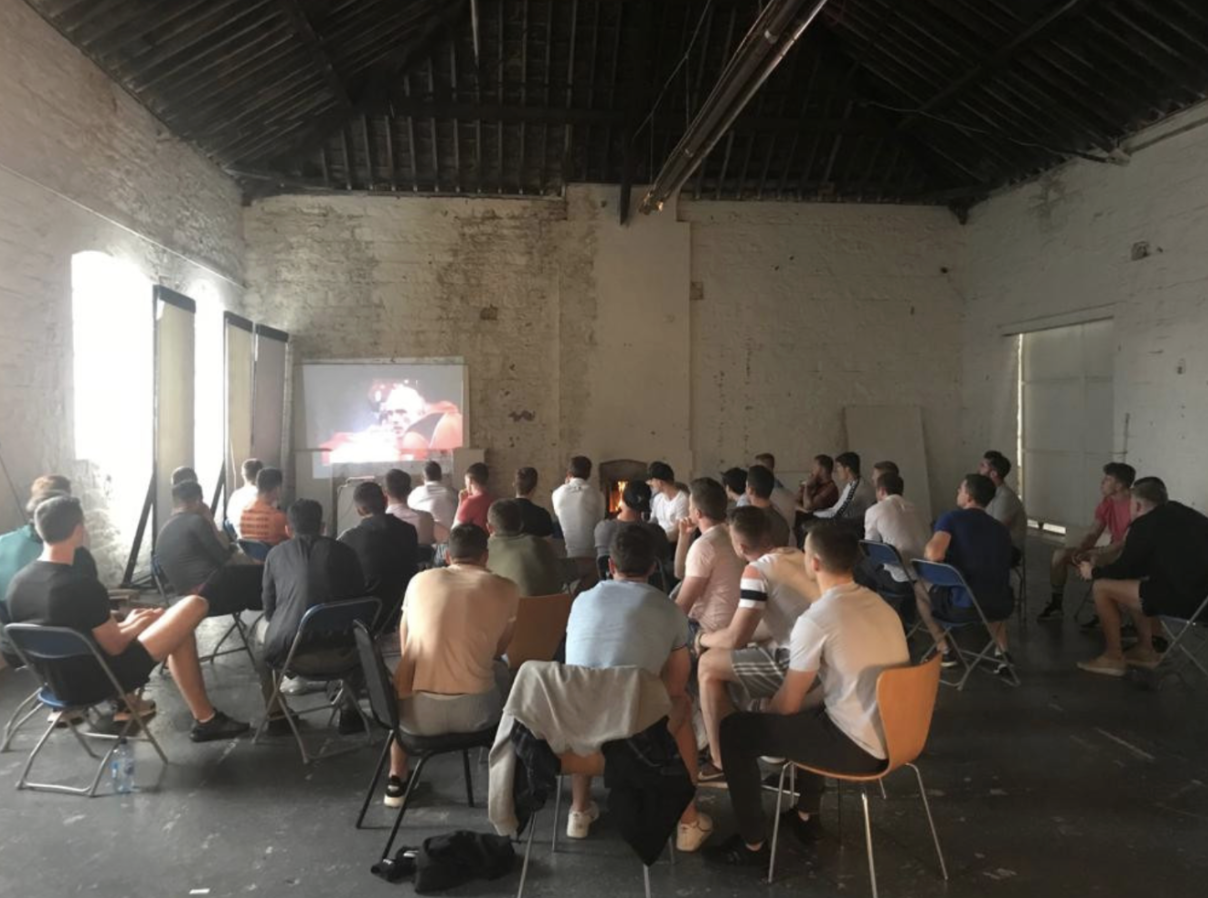
A connection-building workshop facilitated by Ronan Conway.

“The group needs to feel like you can hold yourself before they feel that you can hold them.”

2. Stay grounded

Sitting in the silence isn’t just about waiting it out, it’s about being as relaxed as you can. When we are on edge, stressed, or overly desperate for answers, groups are less willing to engage. The group needs to feel like you can hold yourself (stay calm, regulated, at ease) before they feel that you can hold them.

So before team meetings, or indeed when a wall of silence rises up, I’ll do the following to stay rooted and grounded:

  1. Take long, slow breaths, noticing the journey from inhale to exhale.
  2. I’ll anchor myself, visualising my roots growing into the floor.
  3. I’ll lightly scan the room. I’ll even smile.

Like a skill, facilitation takes time and deliberate practice. It may take time for everyone to adjust to the new rules of engagement, but once it starts flowing, the impacts can be transformative.

Here is a suggestion for an upcoming meeting 💡

  1. Look at your calendar and earmark an upcoming team meeting to practise.
  2. Identify one subject you’d like your team to explore, discuss or understand.
  3. Decide if you’d like the team to fully drive the meeting, or you’d simply like their input.
  4. Either way, have one clearly defined question for discussion (e.g. where are we living our values at the moment?)
  5. Put on your facilitator cap and use the above skills to get the water flowing. Notice how the players respond. Notice your own inner responses.
  6. If silence arises, stay grounded, trust the group. The answers are in the room.

If you try this, I’d love to hear your experience of it.

Hopefully this article serves you and your team’s journey ⛰️
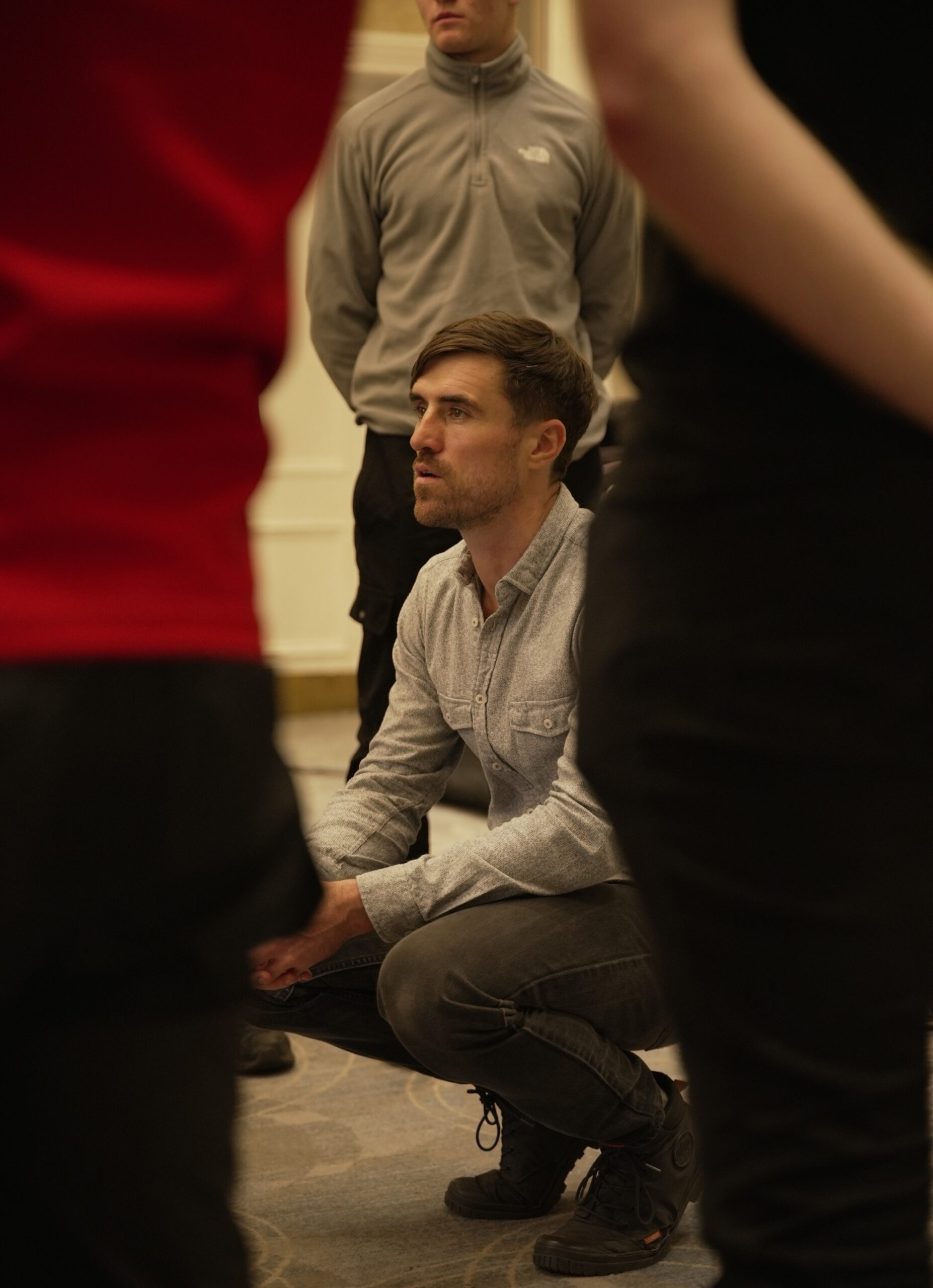

Ronan Conway is a performance coach who specialises in building cohesion and motivation in elite sports teams. He has worked with some of Ireland’s most successful teams, including the Ireland men’s rugby team, Dublin GAA’s five-in-a-row-winning men’s Gaelic football team and, currently, Leinster Rugby.

Ronan has honed his craft as a facilitator since 2012. He believes skilled facilitation can play a key role in empowering players and generating greater buy-in and belonging.

You can read more about Ronan’s work with elite teams here  and here  . Or you can visit his website at ronanconway.ie    and find him on LinkedIn  .

Members Only

16 Apr 2025

Articles

What’s Next When you’re No Longer the Disruptor in your Sport?

Here are five tips from Chelsea and the Ineos Grenadiers in their pursuits of future success.

By John Portch
“The most successful teams change when they are on top,” said Dr Scott Drawer at November’s Leaders Sport Performance Summit in London.

Drawer had just completed his first season as the Performance Director of the Ineos Grenadiers cycling team – a team with whom he enjoyed immense success in their previous incarnation as Team Sky between 2016 and 2018.

In recent seasons, the Grenadiers’ success has tailed off. Drawer’s return is part of the team’s attempt to restore their lustre.

“You look for these elements of when the team was super strong and maybe some of the changes needed at that time didn’t necessarily happen,” he added in reflection.

Drawer was speaking with Chelsea’s Director of Performance Bryce Cavanagh, who also inherited a team treading water in 2023.

“Our situation is probably slightly different as they’ve been through so much turmoil,” said Cavanagh of Chelsea, who underwent a change of ownership in extraordinary circumstances in 2022. It marked the end of an era in which Chelsea’s successes underlined a shift away from the traditional powerhouses of English football.

Back in 2003, Chelsea were disruptors in their field. The same could be said of Team Sky in the 2010s when they transformed road cycling through their innovative approach to performance.

Both have since retreated into the pack, with Cavanagh admitting that entrepreneurial spirit was lacking in Chelsea’s performance department when he arrived. “There was probably a scenario where the change is seen as a threat,” he said. While there was a desire and willingness from the club’s new owners to deliver change, “people saw that as a risk that created vulnerability in their roles.”

The challenge is clear, but Cavanagh combined with Drawer to offer five tips to performance directors charged with restoring the good times.

1. Look for ‘clarity, competence and community’

Cavanagh, who in addition to the more traditional elements of his role has been tasked with a “cultural reboot”, immediately set his stall out at Chelsea with his stated desire for ‘clarity, competence and community’.

He asked two questions as he began to address the clarity piece:

  • Do people have clarity around the goal that they have to perform and how it interacts with everyone else?
  • In what structure are people operating?

Cavanagh also sought to understand the competence of the system (not individuals) with further questions:

  • Are we delivering what we’re meant to be delivering and to what standard? Is it really best in class?
  • If someone comes to visit, what would they see?
  • Is what we’re doing what we’re meant to be doing? And is it at the level someone else is doing?

Additionally, Cavanagh’s conception of community is as an outcome of the values, behaviours and definitions agreed by the collective.

“We had to really define where we wanted to go and what the bus looked like because then people ended up self-selecting,” he said.

2. Set standards… slowly but surely

Do not assume that high performance standards are a given across the board. Variations are common and a performance director must be prepared to ask, as Cavanagh did, “what are the things that you walk past? That you are willing to accept?”

Many have been tempted to emulate revered environments such as the New Zealand All Blacks’, but that wasn’t necessarily going to help Cavanagh at Chelsea in the summer of 2023.

“I tend to look at it like an election where you’ve just got to get the majority, and if the majority starts to [behave a certain way], that’s the culture that end up in power and every vote that gets laid is slowly going towards that,” he said.

“We weren’t the All Blacks. They’ve laid down their votes over 100 years and any new person who walks into that environment knows what’s accepted. Our environment wasn’t like that, so we’ve had to slowly and surely create it. We’re not there yet, but we’re on our way.”

3. Pay attention to your people

Drawer craved data insights that demonstrated how the sport of road cycling had developed in his six years away from the sport, but he also takes time to speak to his people – the ones working on the front line.

“Lots of staff wanted to share opinions, ideas or anecdotes in meetings around ‘the sport’s changed, it’s a bit like this’,” said Drawer, who welcomed their views. “Data and evidence is just as much people sharing opinions, ideas and observations as it is studies into how our team may be training, changes in racing patterns, probabilities.” He is “building this wealth of understanding and insight around what’s going on.”

4. Celebrate successes, however small

Cavanagh freely admits that his instinct is to go for the performance gap, but he has had to check himself because he has seen the value in celebrating wins, however small.

That goes for his department, but it also goes for the players. “Every player in our club now has an individual development plan at a first team level,” he said. “They work on that every day that they come into the club, which is quite unique.” When targets are hit, whether in the gym or on the pitch, it is a cause for celebration.

5. Decide the stories you tell about yourselves

No sports organisation can control what people say and think, but they can influence the internal narrative. And the more positive it is the better.

“This is more of an entrepreneurial time for us,” said Drawer. “We have adopted a startup mentality and will say ‘let’s try stuff. If it doesn’t work, what’s the worst that can happen?’ Because we’re not where we want to be at the moment and I think that’s just beginning to happen.

“Hopefully when the season starts we come out fighting in a very different way. We’ve spoken about it last year, but the idea of feeling that you can never crack it is the mentality that we need.”

What to read next

With Practice, Anyone Can Lead a Courageous Conversation… and ‘Skilled Candour’ Can Help

Members Only

3 Apr 2025

Articles

‘Many of our Players Preferred to Be in Rehab than Playing – it Was Safer There’

Category
Coaching & Development, Leadership & Culture, Premium
Share
Facebook Twitter Email Copy Link
https://leadersinsport.com/performance-institute/articles/many-of-our-players-preferred-to-be-in-rehab-than-playing-it-was-safer-there/

Head Coach Chris Fagan laid the foundations for the Brisbane Lions’ 2024 AFL Grand Final success with three big steps.

By John Portch
When Chris Fagan’s Brisbane Lions won the AFL in 2024 it completed their transformation under his stewardship.

Their premiership success was not a bolt from the blue – they had reached the Grand Final a year earlier – but it was a far cry from the 18th place finish the Lions managed in 2017, which was Fagan’s first campaign at the helm.

He appeared at the 2023 Leaders Sport Performance Summit in London – just weeks after Brisbane narrowly lost the Grand Final to Collingwood.

There were no guarantees that they would make the decider again in 2024 but Fagan, who had his doubters in Australia, transmitted confidence from the Oval stage. “Last year [2022], we lost the preliminary final by 71 points. A lot of people said we wouldn’t recover from that,” he said. “This year, we made a Grand Final and lost it by four points. I said to the players, ‘we’re getting better, we’re getting closer. We’ve been the most successful team over the last few years. Be proud of that. The team we played in the Grand Final is older and more experienced, so that’ll be good for us.”

So it was to prove. But the focus here is those early years, when Fagan worked to turnaround a faltering team. It was only in year three, when the team jumped from 15th to 2nd in the AFL ladder, that his methods were vindicated by points and victories.

There were three factors that underpinned Fagan’s approach.

  1. He sought partners in the process

In 2017, Fagan arrived with his vision for a high performance culture. In outline it bore some familiar features:
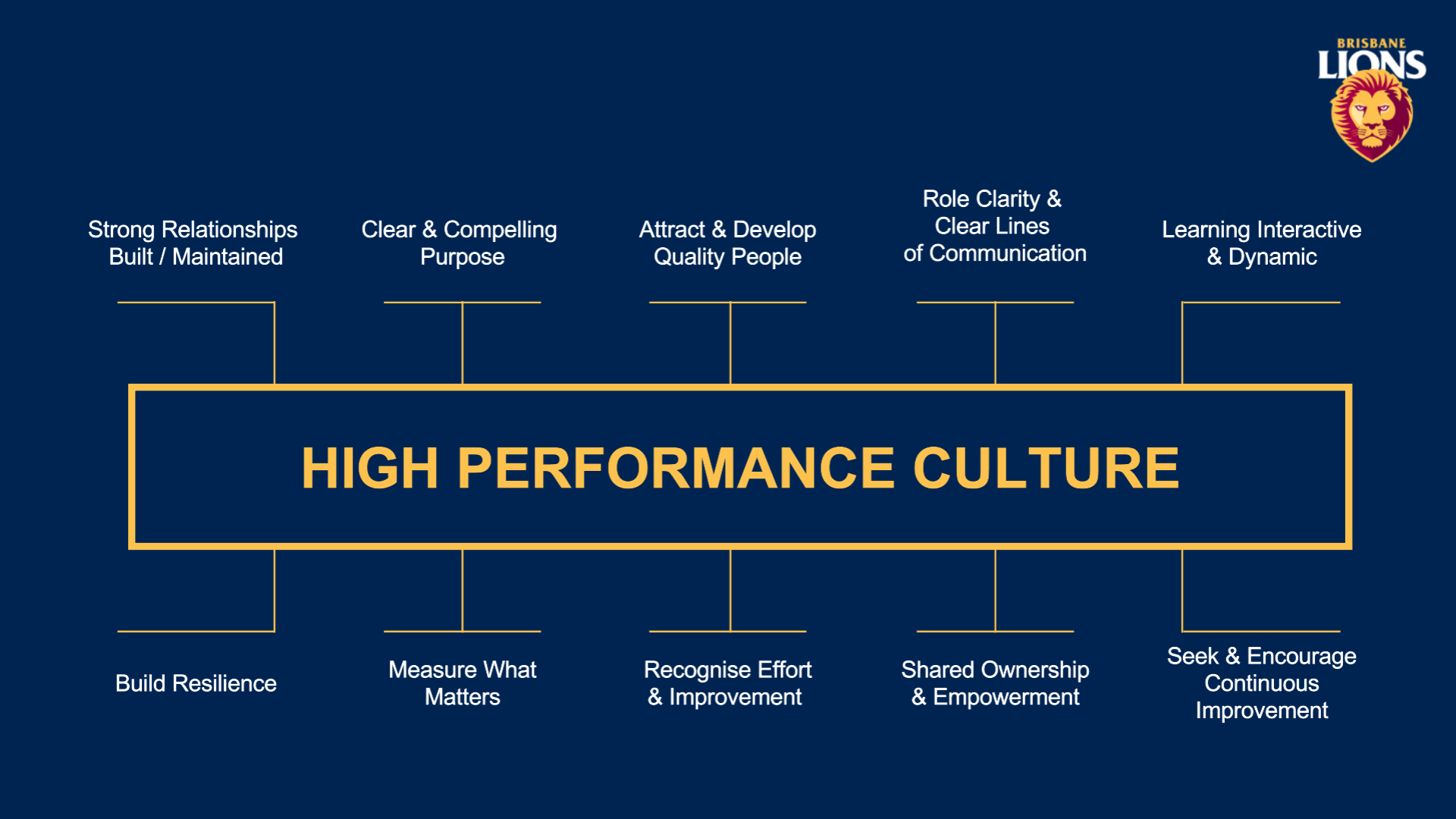
But in order to deliver this through a strategic plan, Fagan needed everyone onside. It wouldn’t be easy in what had become a “poor bugger, me” environment. “I discovered that many of our players preferred to be in rehab than to be actually playing – it was safer there,” he said.

Over the course of four weeks he solicited the views of every player and member of staff. “I wanted to send a message to everyone at the club that they would be listened to, that it wasn’t just me coming in and telling them what was going to happen,” he added. “I wanted to find out what they thought the club needed to do to become better because they needed to be partners with me in the process. I think they appreciated that because they hadn’t had a process for a long time. They’d just been told what to do.”

This brought him trust and credibility during those first two seasons when there was barely a flicker of improvement in scoreboard terms.

  1. The team became ‘the happiest bunch of losers’

Fagan is a big believer in high challenge, high support for players in pursuit of their goals. The challenges were plain to see in 2017, and the first measure of support came from Fagan himself. “I see myself as the chief energy and psychological safety officer,” he said onstage. “I want to build an environment where the players and staff feel trusted and motivated, because that certainly wasn’t the case when I turned up.”

Even as the poor results endured, the team’s morale did not falter. “You’d have said we were the happiest bunch of losers during the early years,” says Damien Austin, the club’s High Performance Manager. “We celebrated everything because we were such a young team.” That included winning quarters of games, strength gains or running PBs in training. “We were always striving for progression,” he continues. “And if there wasn’t progression there’s a reason why, and I think like any young kids today, you’ve got to take them on a journey.”

It chimes with Fagan’s emphasis on growth mindsets and, as a former teacher himself, the importance of learning day in day out. As ever in a Fagan team it comes with a human face. His list has a WhatsApp group chat called ‘Moments of greatness’ where players celebrate examples of their teammates setting new standards.

  1. Fagan worked to increase his team’s ‘leadership density’

AFL veteran Luke Hodge joined the Lions’ journey for Fagan’s first two years. The new coach’s first big recruitment decision was to bring in the man he regarded as “the greatest captain to ever play the game” from Hawthorn, the club from which Fagan himself had joined Brisbane.

“He was well and truly at the end of his career,” said Fagan of the four-time premiership player. “But I just wanted somebody to come in and role model great leadership to a young group of players.”

Additionally, Fagan worked with leadership consultant Simon Fletcher to devise a leadership development programme for senior and emerging leaders. “The first thing he did was establish a trademark, which was a reference point for leadership.”

To this day the Lions’ trademark is built around the concepts of ‘brotherhood’, ‘heart’ and ‘selflessness’:

But Fagan knows as well as anyone that these are just words on a wall without the behaviours that drive and sustain these ideas. “The players come up with those and we drive it,” said Fagan of the Lions coaching staff.

“After a game, the players have to send me a text the day after and one of the things they need to rate is their compliance to the trademark for that game.” Usually, the better the result and performance, the higher the rate of compliance. It can go the other way when the team loses. In any case, “we have a vision of it being done well and we also show a vision of when it’s not so good”. Additionally, the Lions hand out a ‘brother of the week’ award, where players are invited to vote via WhatsApp for the player who best demonstrated the trademark behaviours that week.

In summary…

Fagan understands that if your environment is highly demanding then it must also be highly supportive. He has clear ideas on what motivates people that go back to his days as a teacher:
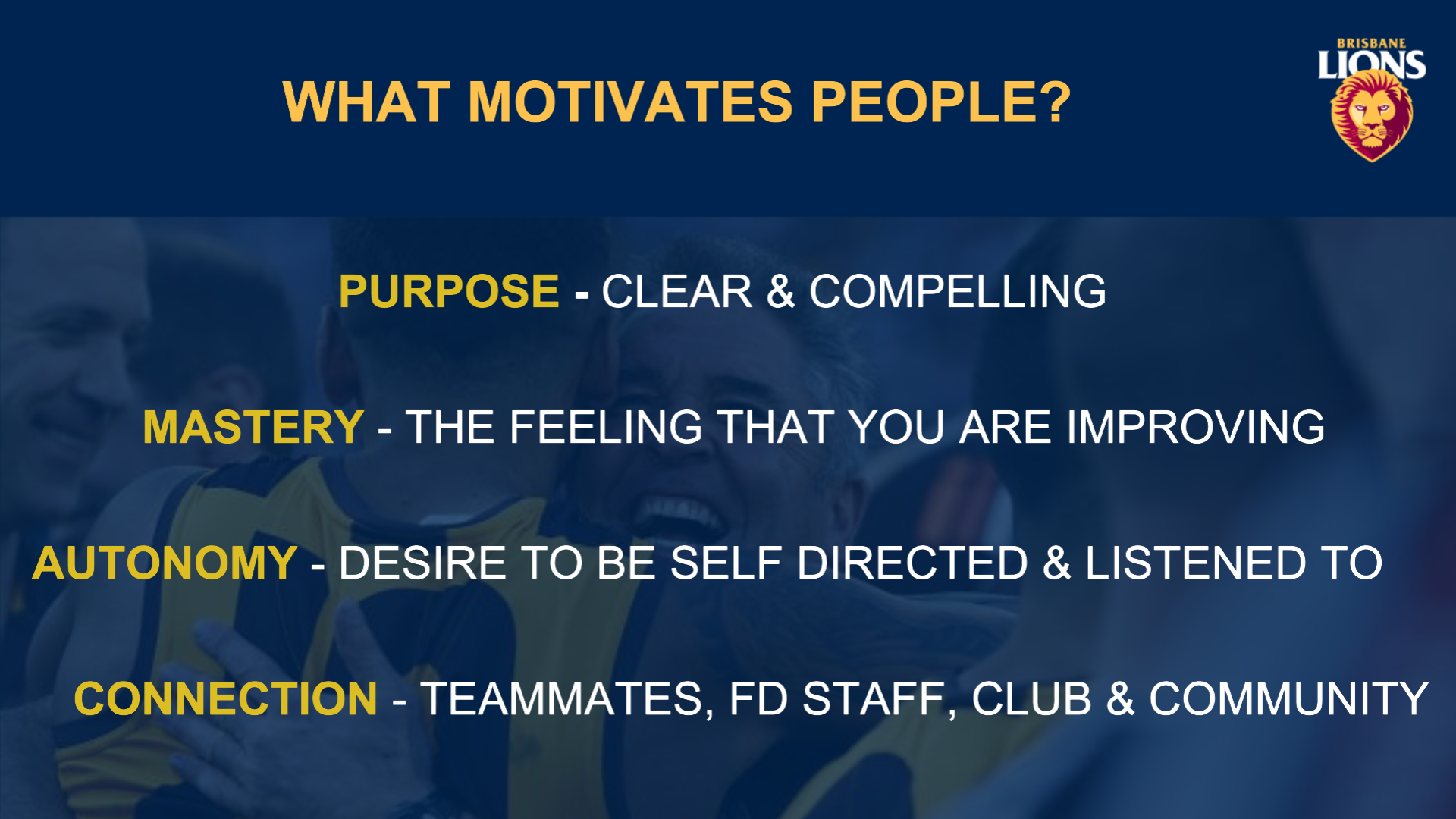
He said: “To be motivated, you have to have a clear purpose, that feeling that you’re improving, which I think our guys hadn’t felt for a long, long time. There is a desire to be listened to and to be a participant in your own growth and development; and that connection with teammates, staff and community.

“I put that model up as areas we would spend a lot of time on over the next few years, trying to grow our culture and team into a better place.”

What to read next

Performance Special Report – High Performance Unpacked

6 Mar 2025

Articles

Organisational Alignment Takes Effort – Here’s Some Advice from our Members

Category
Leadership & Culture
Share
Facebook Twitter Email Copy Link
https://leadersinsport.com/performance-institute/articles/organisational-alignment-takes-effort-heres-some-advice-from-our-members/

Tips gleaned from a Leaders Virtual Roundtable titled ‘Generating organisational alignment: what to consider and work works’.

By John Portch & Luke Whitworth
“I very rarely see organisations that are genuinely working towards the same goal.”

Alignment is perhaps more crucial than ever in high performance, yet as this practitioner noted, it is absent too often.

They were speaking at a Leaders Virtual Roundtable that dug into the topic.

“We’ve got a large team of staff, whether that’s coaches, practitioners, athletes, and that starting point of knowing where you’re going or what you’re aiming for is really important,” said one attendee who works for a Premier League team. “Then we build a strategy around that. So what we’re looking to do and the type of things we’re trying to do – and the things we’re not going to try and do.”

“I think the point of making it intentional is a huge one for us,” said another participant who works in the NWSL. “That’s been a huge emphasis with us as a staff this year – just making sure that we are all aligned and all on the same page.”

It takes time and effort and, over the course of the conversation, the participants shared their experiences and offered some best practice tips to help you and your team.

Alignment starts at the top

The consensus was that alignment flows from the top of an organisation. The table said that senior leaders must articulate an organisation’s goals and consistently reinforce them.

“Ownership has come in and been very clear about the goal of the club,” said the practitioner from the NWSL. “We want to be a leading global sports franchise, not just within the soccer space, not just within the women’s football space.” It is a lofty aspiration but all staff members understand the aim.

Find the low-hanging fruit

Next is identifying the obstacles, “the low-hanging fruit”, which means “each department approaching the general structure of practice by identifying what’s important and then identifying how you’re going to measure those things,” as a participant working in Major League Baseball explained. “Then you break that down into its subcomponents and figure out how you’re going to identify where the lowest-hanging fruit is to then solve those problems.”

Frequent check-ins

Find opportunities to check against your team’s objectives. As one attendee said of their team’s meetings, “we started with the end goal for the end of the season and how we are going to break that up.”

It requires “crystal clarity,” as another attendee put it. They said: “do we reduce the amount of interpretation, and then on the back of that, how are we checking for understanding?” It cannot just be a case of the leader “broadcasting” messages of expectation or definitions. “What’s actually being heard and understood? How frequently do we check that?”

Develop a common lexicon

Words are critical in ensuring that athletes are presented with a united front. “That comes with knowing what are the goals, the mission, the vision of the club,” said the same attendee, “and then all being able to speak from a common language.”

“It’s in how we use strategy and try and bring it to life,” said another attendee. “I’ve seen staff buy-in, not only in one-to-one meetings or annual reviews, but day to day. They are using the language that exists in our strategy – we’re talking the same way, and we’re trying to achieve the same things.”

Let staff shape how your vision comes to life

As a leader, it is also critical to understand staff motivations and aspirations. “There’s so many compartmentalised pieces to some environments,” said one attendee with knowledge of the British sports system. “How do we actually align where there are different motivations and aspirations?”

“If you get buy-in from people and input from day one, I always find that more impactful,” offered one participant. When people are invested it leads to smarter ideas and strategies – and everyone understands how they can help to achieve them.

Make accountability the norm

Each department must articulate their goals within the bigger picture. One attendee said: “We all have a vision of what each department is working towards and who’s going to be responsible for those elements.” A team can also ask, “‘this is what this department is working on – is that getting us to where we want to go?’”

Where your values are on the wall, they can serve as a useful conversation-starter. One attendee, who works as a director of performance, spoke of approaching a staff member “standing in front of our strategy and saying, ‘where’s the work you’re doing? Where does it fit in our strategy? The acid test is they say, ‘oh, yeah, I work on this, and I know I contribute to that’. If they can’t do it then that’s on me, because we haven’t made it really clear where their work fits.”

Where there’s progress, you can celebrate the wins. “People get the chance to be appreciated. ‘OK, this is what you’re working on, this is how it’s going’” said the participant from a club in the NWSL, “and we can celebrate the victories where we’ve started to move the needle towards that ultimate goal.”

Be agile in your programmes

Alignment is not fixed, it requires constant revisiting. As one attendee said, “when we start to add more staff and the structure sometimes becomes redundant” as reporting lines change. The risk is “you have people who are tied to titles and roles that may not function anymore.”

Therefore, it is important to move beyond grand gestures of alignment and place emphasis on those day to day interactions. “The behaviour layer”, as one attendee phrased it. “‘If we do this well, we would see this, this and this’. So now you actually have things to hold people to or, if they are demonstrating it, celebrate it. ‘Great! Let’s have more of that’. If they’re falling short, ‘let’s have a conversation. Why aren’t we seeing some of that? It’s taking it from the grand gesture to the day to day: ‘demonstrate it, live it, breathe it’.”

Members Only

26 Feb 2025

Articles

The Secret to Managing Multi-Generational Teams

Category
Leadership & Culture, Premium
Share
Facebook Twitter Email Copy Link
https://leadersinsport.com/performance-institute/articles/the-secret-to-managing-multi-generational-teams/

In a recent Leaders Virtual Roundtable, we explored five considerations for teams looking to bridge generational gaps in their ranks.

By Luke Whitworth
The generational gap in sport applies to athletes and coaches, but the term just as readily applies to coaching and performance staffs.

It provokes a question that was explored in a recent Leaders Virtual Roundtable: how can senior leaders work to create an environment where different generations can co-exist?

Beyond age, different generations have unique sets of beliefs, values and attitudes, which has implications for their work and the ways they work with others.

The challenge lies in finding the common ground. First, let’s take a look at the general characteristics of different generations:

  • Baby Boomers (c. 1944-1960): This generation often faces challenges in bridging the beliefs, values and attitudes gap with younger generations. These differences can lead to misunderstandings and conflicts.
  • Gen X (c. 1961-1980): This generation shares some similarities with younger generations, such as a culture of immediacy (an expectation for quick responses and rapid results). However, they also value group solidarity, which can differ from the more individualistic approach of younger generations.
  • Gen Y / Millennials (c. 1981-2000): Known for their respect for diversity and a desire to acquire new skills, this generation often has a low commitment to organisations. They seek to be valued and acknowledge.
  • Gen Z (c. 2001-Present): Digital natives; this generation is collaborative, creative, and values honest feedback. They are often impatient and overstimulated, which requires a novel approach to engagement and communication.

By the same token, there are obvious similarities, as the table noted.

“We don’t want to put people into boxes,” said one participant. “We don’t want to make assumptions of groups of people that make you, as a leader, behave in a certain way that’s not appropriate for that person.”

  • A desire for immediacy: younger generations share Generation X’s liking for quick responses and immediate results.
  • Everyone values teamwork: the supposed Generation X trait of valuing teamwork is visible in today’s athletes, even if they lean towards more individual characteristics.
  • Flexible work environments: many staff members, regardless of their generation, seek flexibility in their roles.
  • A liking for feedback: both older and younger generations value feedback, especially when it is honest and transparent. The differences emerge in frequency and manner.

Five key considerations for leaders

Going back to the generational differences, and knowing what we know, the virtual table explored five leadership considerations:

  1. Respect and dialogue: leaders should foster an environment of mutual respect, collaboration and open dialogue.
  2. Understanding the world of work: Leaders need to understand the evolving rules of the world of work and learn from experience to identify and explore common interests.
  3. Inclusive work environments: Creating inclusive work environments that perceive differences as a source of improvement is crucial. This involves leaning into diversity as a strength rather than a challenge.
  4. Reconciling interests and expectations: Leaders should focus on reconciling the interests and expectations of different generations by finding commonalities and leveraging them to foster co-existence. They should encourage continuous learning and adaptation.
  5. Distinct generational traits: Recognise that there has never been such a distinction in traits between generations as there is now, and use this understanding to inform your leadership strategies.

Practical strategies

In the quest for better collaboration and alignment, several participants spoke of practical strategies in their environments.

Try to understand people’s experiences and intentions

One environment, in preparation for the 2026 Commonwealth Games, is asking its athletes and coaches a series of questions as they seek to bridge the generational gaps.

“We’ve been getting athletes into a room and asking: ‘how are you experiencing this environment?’” said the attendee who shared the story. “We ask ‘do you feel like you’re developing?’ And ‘do you feel like you’re successful?’ along with ‘is your wellbeing looked after?’” They ask coaches: “’What is your intention in terms of the environment or the experience that you’re trying to create for athletes?’”

There have been some positive outcomes. “This insight has led to some activities that coaches and athletes can engage in to bridge that gap and make it more likely that people are collaborating efficiently and effectively on the path to get that goal.”

Invite people to share their story

One participant working in the British system spoke of their organisation’s ‘life stories’ project. “We get somebody to share their life story. The benefits are clear: “it highlights the different things that people have experienced, that have contributed to where they are in their life right now. It really helps people to see others’ journeys; and it really connects people because they understand somebody a little bit more.”

Launch a ‘cultural reboot’

It can be difficult to cultivate a unified culture when you are working in the service of ten sports, each with their own culture. One participant, who works for a British university renowned for its sporting heritage, spoke of the school’s efforts to develop that unified culture through an ongoing “cultural reboot”.

They are “asking the student-athletes, and even the academics who may not be involved in terms of sport delivery, but have regular communication and contact with a lot of our students, what they think the culture is of the sports programmes.”

Reverse mentoring

Implementing reverse mentoring and buddy systems can help bridge generational gaps. For example, younger employees can mentor senior staff on digital tools, while senior staff can share their experience and knowledge.

Establish ‘cells’ based on common interests

Some interests are cross-generational – a fact to which one Premier League club is leaning. This club, as your correspondent told the virtual table, identified common interests among their staff and encouraged them to form small groups (cells) to collaborate, share ideas, and learn from each other. These groups would meet regularly to discuss their interests and progress.

19 Feb 2025

Articles

Six Approaches to Help Set Athletes for Success

Category
Coaching & Development, Leadership & Culture
Share
Facebook Twitter Email Copy Link
https://leadersinsport.com/performance-institute/articles/six-ways-to-help-set-athletes-for-success/

Nurtured and sustained excellence sat at the heart of proceedings at the 2025 Leaders Sport Performance Summit in Melbourne. Below, discover the insights to help propel you to greatness courtesy of the worlds of medicine, academia, the military and, of course, the world of sport.

Brought to you by our Event Partners
By the Leaders Performance Institute team
Collingwood captain Darcy Moore once compared preparing to play Australian rules football to spinning plates.

“There are parts of your game going well at a particular time and other parts of your game that are not going well,” he told Fox’s Face to Face in 2023.

“You’re trying to improve these things without sacrificing the things you’re doing well.”

He and Collingwood span those plates with alacrity during the 2023 season, his first as captain: they won the AFL Grand Final. Today, they remain one of the league’s finest teams; and Moore has been praised for his leadership abilities both on and off the field. It was to great acclaim that we welcomed him to the stage at the 2025 Leaders Sport Performance Summit at The Glasshouse in Melbourne.

“Good player leadership is organic and comes from natural respect based on competency, status and character in alignment to the team’s values,” he told an audience of Leaders Performance Institute members.

In addition to Moore, across two insight-laden days, we hosted a range of speakers from organisations including Melbourne FC, Leinster Rugby, the Royal Melbourne Hospital and Royal Australian Air Force. The overarching theme was the approaches one can adopt to give performers the best chance of success.

There were six approaches that stood out.

  1. Prioritise the athlete-coach relationship

The athlete-coach relationship is pivotal, whether it’s a long-tenured coach setting up a new leader for success or, conversely, a senior athlete taking steps to put a new coach at ease.

Craig McRae, the Senior Coach at Collingwood, demonstrated the former with his public endorsement following Darcy Moore’s appointment as captain in 2023. “Be yourself, forge your own journey, and take a swerve at what that needs to be,” he told Moore. “Lead from the front and lead your way.”

Across town a year later, Rebekah Stott, a hugely experienced New Zealand international defender with more than 100 A-League appearances under her belt, went out of her way as captain of Melbourne City FC to ensure incoming Manager, Michael Matricciani, felt at home.

“From day one when I signed for the club, from the first conversations I’ve had, she’s only welcomed me with open arms,” said Matricciani. “She’s been a great support and she’s an excellent leader off the pitch.”

Neither Moore nor Stott, who spoke onstage together, believe they’re the finished article. Both spoke of their need to work on confronting teammates and having difficult conversations. In that regard, it helps when the on-field leader feels both comfortable and supported.

“It is every player in the team’s job to lead in their own way, however they can do that.”

Rebekah Stott, Melbourne City FC

“What makes a good coach? The coach knowing their players, having good relationships and understanding what they need – this sets you up for success. They also let talented people around them do their jobs. This is particularly important when the pressure comes and you need to remember that everyone is there for a reason.”

Darcy Moore, Collingwood FC
  1. Build trust at pace and communicate with care

Moore and Stott’s concern with confronting people in emotionally charged environments is a daily feature of life at the Royal Melbourne Hospital, where Brian Le serves as Director of Palliative Care at the Peter MacCallum Cancer Centre. “Preparation is really important,” he said. “I formulate what needs to be spoken about and what my agenda is. But once with the patient, I adjust to what I’m hearing and the clues I’ve picked up in relation to their context.”

Timing is critical too. “Not addressing the situation has its own cost,” said Le, adding that delays are regrettable when the patient likely knows that an emotionally-wrought conversation is coming anyway.

“When I started to apply what I had learnt, as I’ve matured in my career, I’ve realised it’s not about me but the person I’m looking after. My job is to apply what I know to help the person, listen more and let them lead more – it’s more effective than leading with knowledge and expertise.”

Brian Le, Royal Melbourne Hospital
  1. Balance disruption and stability

Data-informed decision-making is preferable, but where does the balance sit between objective and subjective sources? Additionally, what of the balance between disruption and stability? The topic was tackled by Kate Hore, the captain of AFLW team Melbourne FC, who spoke alongside Marcus Wagner, the club’s Chief Innovation Officer & General Manager of Football Operations. The Demons have been using Teamworks Performance as they look to strike that balance.

“You can get a flag from your monitoring that helps a discussion, but the impact really comes from your relationship with the athletes,” said Wagner. “Baseline information helps, but understanding the person is most important.”

When you understand the person, you can ask the right questions (either in-person or via questionnaires) and, if something needs to change based on something that happened in training, staff can swiftly make adaptations (supported by data).

As for the balance between disruption and stability. “It’s fine balance,” added Wagner. “You need to ensure you don’t lose your identity by going too far either way. How we measure is by looking at overall performance internally and externally, how we communicate, and the quality of our data.”

“I really like the idea of having a dropdown [list] of someone you may want to speak to as a follow on from completing [the team’s wellness questionnaires]. [As a player] you may value speaking to a different person each time depending on how you are feeling.”

Kate Hore, Melbourne FC
  1. Give a platform to ‘terrible ideas’

Approximately 95 per cent of Nobel Prize-winning scientists emanate from the same cluster of labs or have enjoyed the proximal influence of past winners. Why? It is their higher minimum standards or greater openness to new (and often bad) ideas?

David Burt, the Director of Entrepreneurship at the University of New South Wales, delivered a presentation in which he lauded the value of exploring ‘terrible ideas’. His rationale was sound: it reduces the negative emotions that can cloud creativity and reduces the impact of power dynamics in a team environment.

He recommends an ‘accountability loop’:

  • Build
  • Measure
  • Learn

“Terrible ideas allow you to develop new skills and meet different people in the process. There is a surprising amount of value in implementing a little bit of resource in them to drive another layer of growth.”

David Burt, University of New South Wales
  1. Sustained excellence does not happen by accident

What must we do to sustain excellence? That was at the centre of Dave Walker’s appearance at the summit. The former naval pilot, who works for the Royal Australian Air Force, spoke of PBED:

  • Plan
  • Brief
  • Execute
  • Debrief

PBED, he explained, is a continuous improvement process to table improved error recognition, error reduction or correction, which enables the creation of efficiencies that lead to improved performance. It is an essential tool in an environment where students must learn quickly.

“It’s the quality of interaction in each event that ultimately turns a team of experts into an expert team,” said Walker. “We often find that members do not know how to work or operate as a team – just following a framework does not make a team.”

“We must give people the ‘how’ – it is not enough to say ‘this is what you have to do’ – people will learn at a higher rate when you give them the ‘how’.”

David Walker, Royal Australian Air Force
  1. Proximal role modelling for the next generation

Leinster Rugby, one of Europe’s most prominent teams, has a squad that is 86 per cent homegrown – what is the secret to finding and nurturing supreme talent in your region? As Simon Broughton, the Academy Manager at Leinster, explained, the team benefits from a group that has played and developed together in the youth ranks. They have travelled, won and lost as a collective. “So many experiences that strengthens their connection,” said Broughton.

The club has adopted a variety of approaches, including proximal role modelling, which sees younger players spend 80 per cent of their time integrated with older players. Proximal role modelling is “integrated organically into different aspects of their training week, from walking the pitches, to session design, and into analysis rooms.”

Leinster have also latched onto the ‘goldilocks principle’ as 33 per cent of their players are neurodivergent. “This has led to changes in how messages are delivered,” Broughton added. “There are slides, but also video and walkthroughs, and time for reconnecting and breaking mental circuits.”

“We use proximal role modelling so that less experienced players have social interactions with more experienced players. [This is] to create an environment where learning and development can take place without a coach or a member of staff.”

Simon Broughton, Leinster Rugby


Members Only

7 Feb 2025

Articles

Are you a Team of Experts or an Expert Team?

Catergory
Leadership & Culture, Premium
Share
Facebook Twitter Email Copy Link
https://leadersinsport.com/performance-institute/articles/are-you-a-team-of-experts-or-an-expert-team/

John Wagle of Notre Dame explains how the question of sleep enabled true interdisciplinary work to emerge at the school’s athletic department.

By John Portch
Are you a team of experts or an expert team?

As you reflect on your team or department, you may be moved to ask a question of your own: what’s the difference?

According to John Wagle, in a ‘team of experts’, “everyone has their job, they do it well, and the execution of their role doesn’t directly impact another person”. He cited a Formula 1 pit crew as an example.

An ‘expert team’, on the other hand, refers to groups where “the work of an individual may directly impact that of another person”. Wagle’s example was a US Navy SEALs team.

In illustrating this distinction onstage at November’s Leaders Sport Performance Summit in London, Wagle, the Senior Athletics Director for Sports Performance at the University of Notre Dame, highlighted the distinction between multidisciplinary and interdisciplinary.

Wagle was hired by Notre Dame in 2022 to lead an athletic department that was unable to consistently deliver an interdisciplinary approach despite the best intentions of all staff members.

“We needed a catalyst,” he continued. “The challenge as a performance director is to set the stage to solve a problem at scale in your environment.”

‘Constraints push you into new places’

Student-athletes continuously juggle their sport, academic studies and lives on campus – a situation Wagle described as “suboptimal”.

However, as he said, “these operational constraints push us into new places. They push our boundaries of how we can create solutions and I believe the best way to do that is to bring together two largely opposed ideals: knowledge and belief.”

Knowledge v belief

Knowledge, as Wagle explained, stems from a practitioner’s formal training as well as any external and internal research. He said: “the more common terminology for people in this room is evidence-based practice”.

Belief is different. It is an aggregate of a practitioner’s experiences from working in the field, athlete values and preferences, and the matter of risk tolerance and uncertainty management. “There is an element in belief that you’ve got to harness and steer into uncertainty.”
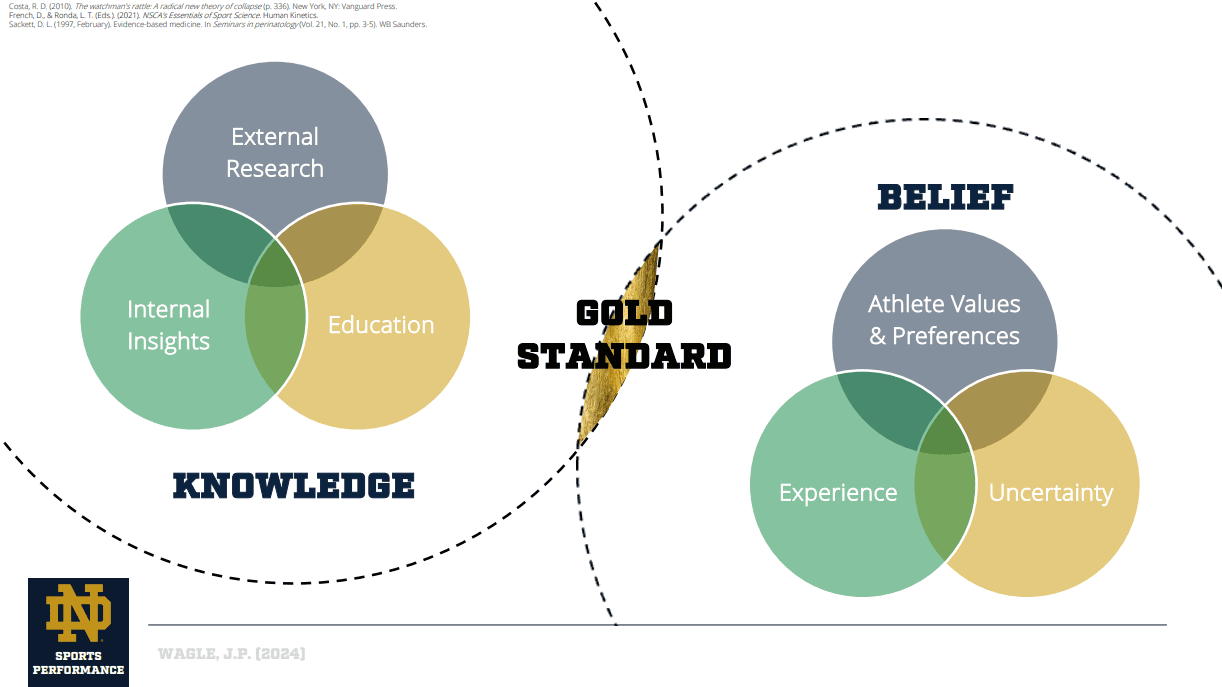
“These don’t need to be opposing viewpoints,” Wagle added, despite admitting that people “gravitate towards their tendency”.

“This is the true power of interdisciplinarity and, if we don’t bring these pieces together, we run the risk of being blind to what a lot of our athletes are experiencing.”

He spoke of the student-athlete being in a “complex adaptive system” where the interaction of different elements leads to either a health or a performance outcome, with the ‘gold standard’ somewhere in the middle.

Sleep = the catalyst

Wagle admitted that Notre Dame’s athletic department oscillated between knowledge and belief despite concerted efforts to bring both together.

“There were members of our team that no matter what the problem was were always on the knowledge side and there were members of our team who were always on the belief side,” he said. “It did not necessarily manifest in conflict – it manifested in avoidance – because I think every problem we tried to solve was inherently biased towards a discipline and it was easier to run away from that problem.”

They needed a catalyst to underline the power of interdisciplinary work and alighted upon sleep.

“We chose sleep because it is inherently lacking a discipline,” Wagle continued. “It can be owned by psychology, by nutrition, by strength & conditioning, by medical. There’s no obvious lead person in that.”

Everyone was able to meet the challenge that Wagle set: to be the best sleep support ecosystem in the whole of college sports. The knowledge people combined their data-driven approaches and devised a sleep screening tool. “We were able to get more granularity on our sleep habits and behaviours.” The belief people “brought to the table the ebbs and flows of the academic year.”

Remember: you could be part of the problem

Notre Dame’s approach to sleep has proven a game-changer in their approach to interdisciplinary work. Staff members recognised their biases, let go when necessary, and committed to collaboration.

Wagle said: “If we don’t acknowledge that ‘we could be part of the problem’, that’s where culture and alignment suffer; and resources fail to be allocated properly.”

Go to home
Follow us on Instagram Follow us on LinkedIn Follow us on X

Contact

Leaders UK

Tuition House
27-37 St George's Road
Wimbledon
SW19 4EU
London
United Kingdom

Enquiries Line: +44 (0)207 806 9817
Switchboard Number: +44 (0)207 042 8666

Leaders US

120 W Morehead St # 400
Charlotte
NC 28202
United States

Enquiries Line: +1 646 350 0449

Leaders

  • Contact
  • About
  • Careers
  • News
  • Privacy Policy
  • CA Privacy Rights
  • Cookie Notice
  • Website Terms of Use

Performance Institute

  • Membership
  • Events
  • Content
  • Virtual Learning
  • Connections
  • Partners

Latest

Intelligence Hub
High Performance Future Trends Research Elite Performance Partners continue to drive the potential in high performance forward through renewed Leaders partnership
Your Privacy Choices

© 2026 Leaders. All rights reserved

  • Privacy Policy

Attendees

x