PlayerData’s new FIFA-approved GPS and LPS units are a hit across the world of soccer and can be used by athletes in the offseason.
Main Photo: Getty Images

Other strategic investors in the Techstars-backed company include Pentland Ventures, Accelerate Ventures, Hiro Capital, and angels who previously invested in Strava and Revolut.
PlayerData’s new product, the Edge Air Tracker, is about half the size of competitors, and it combines GPS and LPS tracking, the latter an indoor alternative when satellite coverage is not available. The LPS system uses portable beacons that the company says can be set up in less than an hour. The Edge Air Tracker received the higher-standard FIFA Quality certification this summer.
“We had to build it in a PlayerData way: easy to use, fits in a backpack, mobile and affordable,” said CCO Jess Brodsky. “What gets us going is we get to give something to people that is just as elite quality — we don’t sacrifice on data quality — but to everybody.”
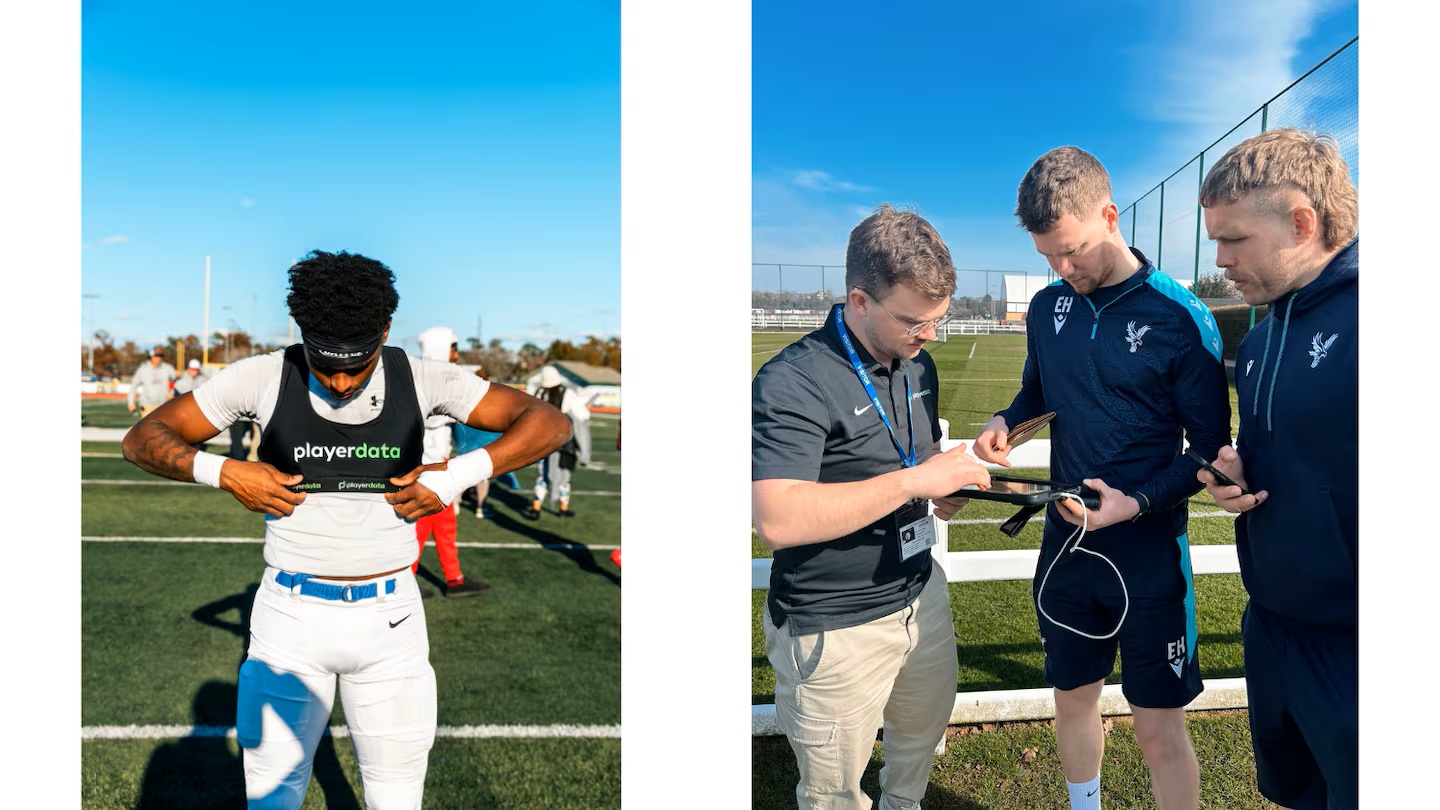
PlayerData’s Edge Air Tracker combines GPS and LPS tracking, the latter an indoor alternative when satellite coverage is not available. (Image: PlayerData)
The founding story is that, a decade ago, University of Edinburgh student Roy Hotrabhavanon had fashioned his own training tech to compete in archery by taking parts from consumer box retailers. Realizing there was little business upside in a niche sport, he sought to build for soccer instead, discovering there was a market gap particularly for grassroots, academy, university and women’s clubs who didn’t have the budget for an incumbent system such as Catapult or StatSports.
PlayerData is ubiquitous in the UK, where it records data from 94% of the country’s soccer pitches, Brodsky said, noting that the total includes the Premier League because its officials wear the monitoring devices during matches. The startup moved into the US market about two years ago, and Brodsky said the company has doubled or tripled its ARR (annual recurring revenue) in each of the past five years, building up to about 60,000 sensors in the market.
One of the biggest recent additions to the client roster is IMG Academy, where nearly 1,000 student-athletes will use the technology. The soccer program will install solar-powered beacons around all 15 soccer fields, and PlayerData and IMG will collaborate on developing and soft-launching sport-specific experiences in the app for volleyball and softball.
Abi Goldberg, an assistant strength and conditioning coach at Rutgers, supports the men’s and women’s soccer program whose seasons are concurrent, meaning she is balancing the training needs of both with little overlap. The use of PlayerData with both teams, Goldberg said, is helpful because the hardware and software systems are “incredibly user-friendly,” allowing her to review the data and communicate it the coaches even if it’s just a short window between their practices.
Often, each team’s director of operations will be tasked with overseeing PlayerData use at road games, but Goldberg said the tech doesn’t require an S&C professional to manage. She has even loaned devices to a few of the athletes for use in the offseason.
“Most GPS systems are in a big heavy briefcase-looking thing — I think there’s some been security nightmares in the airport — but these are way more compact,” she said. “They can put it in their backpack.”
This article was brought to you by SBJ Tech, a Leaders Group company. As a Leaders Performance Institute member, you are able to enjoy exclusive access to SBJ Tech content in the field of athletic performance.
The Leaders Performance Institute delved into the concept with David Dunne of AI-powered nutrition app Hexis.
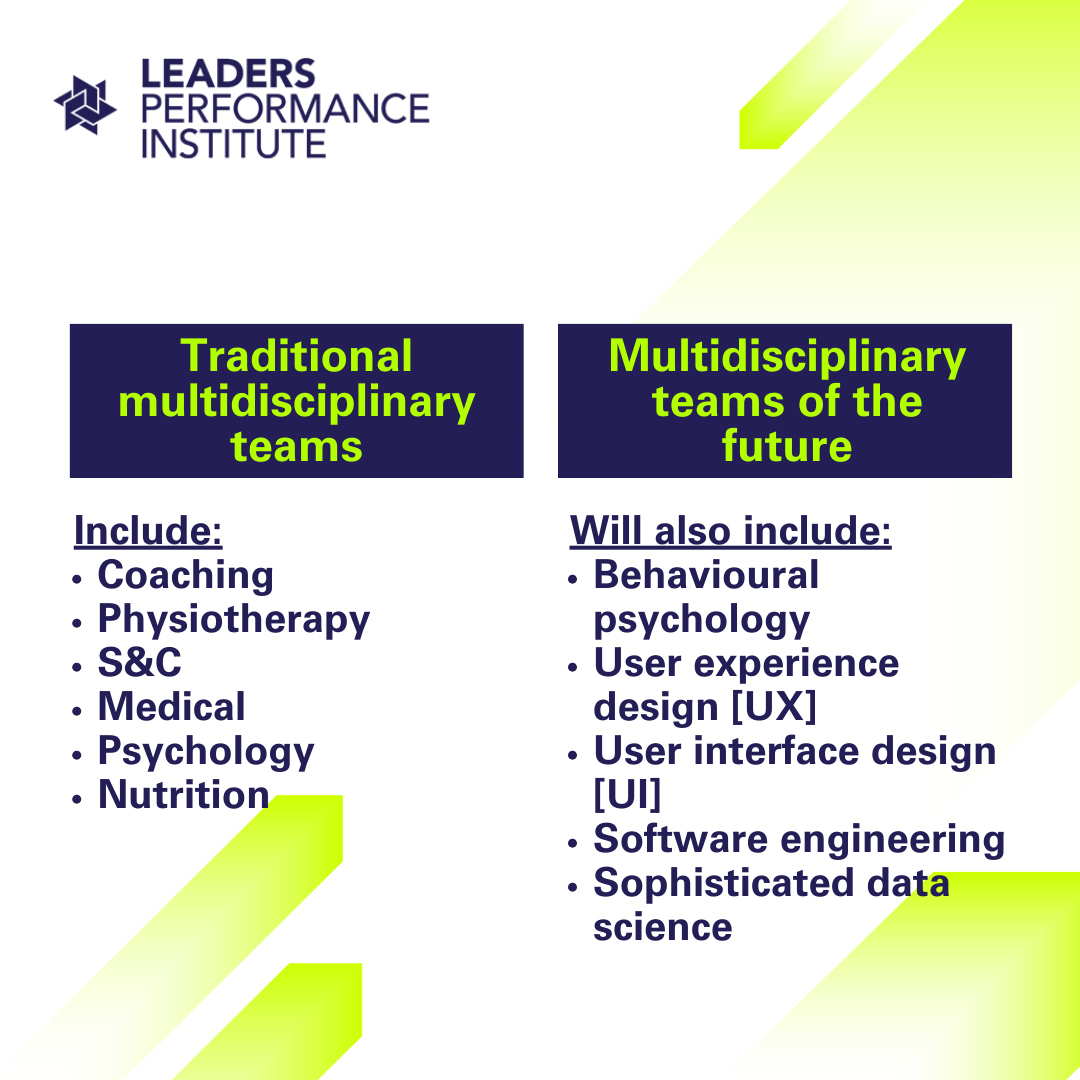
“We expect a nutritionist, coaches, S&C, psych and physio – that’s what we consider a multidisciplinary team,” he told the People Behind the Tech Podcast in April.
“However, now [a multidisciplinary team includes] behavioural psychology, UX [user experience design], UI [user interface design], data science, software engineering, performance science. It’s a whole other world that has opened up new possibilities that we didn’t know were there as a practitioner.”
Dunne, who is the CEO and Co-Founder of Hexis, an AI-powered predictive nutrition service for elite athletes, has made an almost full transition from high performance sport. He previously served as Head of Nutrition at English Premiership rugby club Harlequins and still works in a similar capacity with Ryder Cup Team Europe.
While his assessment of tech’s role in high performance is unsurprising, his views on those “possibilities” now open to practitioners provide some food for thought – and not only for nutritionists or dietitians.
“What we’re going to see is the evolution of the hybrid practitioner,” he continued.
What are the implications for you and your team? Below, we set out a HYBRID framework to illustrate the concept.
H – Haste – “[Going] back to Quins, you spend a lot of time behind the laptop,” said Dunne. “You got bogged down in a spreadsheet. It’s tedious.” However, a hybrid practitioner will “use tech for tasks that can be algorithmically delivered at scale.”
Y – Yield – this can mean being receptive to others; and a hybrid practitioner “uses technology for what it’s good at” while people can focus on what they’re best at, which is “being human”. As Dunne explained: “Humans are good at building relationships, learning how to have conversations, and listening to people and actually helping them change their behaviours and change their beliefs about certain consequences or their own abilities over time.”
B – Balance – Dunne’s Co-Founder at Hexis is Sam Impey. “A brilliant scientist,” as Dunne said. “A far greater academic than I’ll ever be.” Nevertheless, Dunne is aware of his own assets. “My personal strengths have always been on the coaching side – put me in any locker room, put me in any team setting, I love to have conversations, I love to listen.” In truth, a successful practitioner needs both sets of traits. As Dunne put it, “let’s call it practitioner tacit knowledge and actually the application on the frontline.” The best example of this in Hexis’ work is how their app has been influenced by the COM-B model, which is a framework for understanding and changing behaviour – both key factors in performance nutrition. For a behaviour to occur, a person must have the capability, opportunity and motivation to perform it. Practitioners aiming to change behaviour should therefore target one or more of these components.
R – Roadmap – practitioners are too often constrained by tech being restricted to trackers. “It’s retrospective”, said Dunne, specifically of nutrition trackers. But with predictive AI entering the market, the role of the practitioner is likely to be more forward-facing. “We always need to know [and] we always want to help them know what to do next,” he added. This is particularly important in light of Hexis-sponsored research suggesting that most athletes are ‘confirmation seekers’, meaning they want to lead on “making the decision but then they want something to help verify that they’re going in the right direction.” A hybrid practitioner can cater to this need.
I – IT / MI – “I think what we’re going to see more of is a more highly-skilled human practitioner with a lot more software skills and [skills such as] motivational interviewing [MI] on the frontline, and then technology systems that ensure a standard of care across the whole organisation, 24/7, 365 days a year,” said Dunne. Key to that is reducing the “noise” around the athlete. With the right plans and structures, the hybrid practitioner can “deliver impactful value to the athlete.”
D – Data – with apps such as Hexis allowing for data integration – their collaboration with training app TrainingPeaks is a prime example – there is the opportunity for practitioners to make better use of existing data rather than merely seeking the next thing. With the right blend of skills, the hybrid practitioner is well-placed to ask: what can we do with the information we already have?
Listen to the full interview with David Dunne below:
The Co-Founder of Hexis discusses the pinch points for athletes, practitioners and technology.
A Data & Innovation podcast brought to you in collaboration with
“There’s a fundamental mismatch between what practitioners can deliver and what athletes actually want and desire,” he told Joe Lemire and John Portch on the People Behind the Tech podcast.
“So we pivoted towards the COM-B model.”
During this episode we spoke at length about Hexis’ continued growth following a successful seed round, technology’s ability to influence the evolution of the practitioner, and the fundamental union of academic rigour and those so-called softer skills.
COM-B was a major part of that conversation. It has been integral to Hexis’ growth. The company used it in tandem with elements of design thinking which, as Dunne explains, stems from his time working for teams including Harlequins and Ryder Cup Team Europe.
The model is a framework for understanding and changing behaviour. It was developed by Susan Michie, Maartje van Stralen and Robert West in 2011. The model posits that behaviour (B) is a result of an interaction between three components:
Capability (C): this refers to an individual’s psychological and physical capacity to engage in the activity. It includes having the necessary knowledge, skills and abilities.
Opportunity (O): this encompasses all the factors outside the individual that make the behaviour possible, including social and physical environmental factors.
Motivation (M): this includes the brain processes that direct behaviour, such as habits, emotional responses, decision-making and analytical thinking.
Listen to the full conversation:
Listen above and subscribe today on iTunes, Spotify, Stitcher and Overcast, or your chosen podcast platform.
A Data & Innovation podcast brought to you in collaboration with
He spent two years as an S&C at the Orlando Magic, a further six years as Director of Science & Research at the Houston Rockets, before spending almost nine years at the National Basketball Players Association [NBPA].
Since 2022, he has served as Chief Medical Director of the National Basketball Retired Players Association [NBRPA], a non-profit organization comprised of former professional basketball players of the NBA, ABA, Harlem Globetrotters, and WNBA.
Rogowski was at the NBPA in 2015, the year the league introduced its wearables committee and his views were informed by his time in Orlando and Houston.
As he tells Joe Lemire and John Portch, he worked with players wary of wearables as well as those mor willing “guinea pigs”, as they refers to them, such as retired Magic point guard Jameer Nelson.
Rogowski would ask himself of the latest devices: “Is it practical? Is it something that you can wear in a practice? Is this something that I can consistently do? Or is this a one-time thing and you collect the data and move on?
“I had plenty of those devices that actually changed how I think about training these guys or how I’d help them with recovery. But it is a sale because, with the players, you only have so many asks.”
Rogowski recalls those moments working with players as well as:
Listen above and subscribe today on iTunes, Spotify, Stitcher and Overcast, or your chosen podcast platform.
Phil Coles of the Boston Celtics and Marty Lauzon of the Atlanta Hawks share their approach to performance preparation strategies for the post-season.
A webinar brought you by our Main Partners

“I feel in the past few years, this term has become a bit of a buzzword or a misused term, thrown around left and right,” says Černivec, who is moderating this Keiser Webinar.
Her guests are Phil Coles, the Executive Director of Performance at the Boston Celtics, and Marty Lauzon, the Director of Athletic Performance and Sports Medicine at the Atlanta Hawks. The title is Performance Preparation Strategies for the Post-Season.
It just so happens that the Celtics and Hawks are currently competing against each other in the first round of the NBA Playoffs but, beyond some friendly jibes, both were happy to talk to Černivec about their post-season work with their respective teams and how their views on load management have evolved.
Misconceptions around load management
“There’s definitely some misconceptions about what ‘load management’ is in the public and in the media,” Coles tells Černivec. “The first one is that load management means rest; that player’s aren’t playing, and I think that’s a real misconception because a lot of times load management can be encouraging players to do more.
“There’s also a misconception that this is dictated by people such as ourselves, directors of performance or sports scientists and, again, I think that’s completely untrue in a practical sense. We’re people that obviously spend our lives in this space and we’re what would be considered an expert opinion, but that expert opinion is discussed with the general manager, the coaches, and decisions are arrived at for the good of the player and for the team as a whole.”
Lauzon and Coles share the challenges posed by the NBA’s hectic game and travel schedule. “If we have a common language between us as practitioners, coaching, management and the players, that is really helpful,” says Lauzon.
“It’s always about starting with ‘what does that mean?’ For a certain player, it could be rest but, most of the time, it’s something else – you’re just changing the stressor, really. It’s about having that language so that everybody understands that it’s not just rest – the player’s not just laying on the table all day.”
Preparing for the playoffs
Černivec asks Coles and Lauzon how their approaches have changed during the post-season. As Coles explains, the density of games is less during the playoffs but the intensity is higher, as is the volume, due to the player rotations getting tighter as coaches rely on certain players.
“I think that’s important as we prepare players leading up to the playoffs that we’re trying to mimic all of those things,” he says, adding that the Celtics’ roster divides into three groups for the post-season: the high-volume players, who are playing the most minutes and under the most physical and mental stress; players who are either unlikely or ineligible to play in the playoffs; and a hybrid group between the two where players may get some minutes in certain games or series.
“There is a natural spread within your 15-17-man group of seven or eight players,” he continues. “There are the guys who are on a high-volume, high-stress programme and we’re focused on maintenance and recovery; we’ve got the guys at the other end and we’re looking at a longer-term development programme than what we’re focused on during the regular season because we know they’re not likely to feature significantly in this next period; and then we’ve got the group in the middle where we’re constantly evaluating what they have done, how well have they recovered, when do we need to push them on the practice court to ensure they’re staying prepared to play big minutes and effective minutes in the playoffs, but we’re not putting them in the game when they’re tired because we’re overworking them.”
Lauzon and the Hawks have a comparable approach. “Good conversation helps with that,” he tells Černivec. “Communicating with the staff so that they know that the development group needs to get pushed and they’re going to have more court time for practice; the high-volume players spend more time in the physio groups and in recovery. It’s dialogue and communication. As practitioners, it helps us plan best for what the needs are.”
He also makes the point that the post-season affords a team more days spent in one place. “It’s helpful in the playoffs that you may be in the city for four or five days. You’re not just coming in, coming out, coming in, coming out, which happens during the season. It’s more helpful for the guys who play a lot. They have a mainstay and we can really cater to them.”
‘Don’t dismiss the coach’s eye… or athlete feedback’
Lauzon and Coles welcome the opportunities that tech and data have brought to performance conversations with athletes and coaches, but both share the belief that a performance programme should be data-informed, not data-driven.
“I’ve been surprised sometimes how a coach can tell you what he sees,” says Lauzon. “The numbers are almost a little bit of a reflection of that. It can help to say ‘hey coach, what you’re seeing looks right’. The coach’s eye is important. They see the game in a way that we don’t see it as practitioners.
“It helps us in dialogue with the player and we try to optimise from there.”
Coles points to a “bell curve” in the introduction and use of tech and data in high performance. “When it starts, there’s a lot of data that people don’t understand and don’t know how best to use. There’s fear amongst how that data will be used,” he says.
Recalling his experiences working in his native Australia, he feels that athletes and teams became too reliant on data at one stage at the expense of the coach’s eye. “We’ve now gone past that and got to a point where we can recognise what the data can do for us.
“It gives people good valid reasons to continue on the process they’re on and if it challenges what they’re doing then it creates interesting questions for people to discuss.”
The starting point is always how the player is feeling. “There’s no data that can tell us how an athlete feels as well as what an athlete can tell you how they feel,” says Coles, who also emphasises the need for mutual trust.
“That’s the feedback that when you sit down with a coach you’d say ‘this is what we can see. The player feels fine. Or the player does not feel good’. That has to be the primary point when the coach factors that into making a big decision about what happens on a particular day.”
“The wellness check-in we do in the morning is probably the biggest thing we do all day because that’s when you get your feedback from the player himself,” says Lauzon. “You don’t treat an MRI and you don’t treat data – you treat the player.”
‘Wellness check-ins have gone full circle’
Coles and Lauzon tell Černivec there is no getting away from sports as a people business.
“The mental component is just as important as the physical component, particularly when you get into the playoffs and you have a deep playoff run because the continual stress builds up over a long period,” says Coles. “And the difficulty with the mental side is that it’s much harder to be objective.
“Our data is not as good in that sense but it’s every bit as important. In fact, I genuinely think the mental fatigue that happens in a long playoff series is a greater issue than the physical fatigue given how well most of the players are prepared.”
Coles’ daily wellness checks have gone full circle. “Over time, I’ve gone through everything from very basic to really detailed and now I’m back at a really basic check-in,” he continues. “That really is a fall-back system to make sure that no one fell through the cracks and to throw up a flag to make sure that we go and have a conversation with someone if they don’t report that they’re feeling great.”
As he says, “we rely much more on the personal interaction than the particular questionnaire.”
Lauzon reports a similar experience. “We’ve been through the whole gamut where players could fill it out on an iPad or on their phone and then we were more formal with them. Now, I think we’re going back to more face-to-face, one-on-one personal interactions that starts with what’s going on in their lives first. Then you get the information you need.”
Education is a constant
Coles explains that sleep, nutrition and hydration represents 90% of Boston’s recovery programme and all are monitored using a range of objective and subjective metrics, which can then be used to educate and impart information.
“It’s not like we sit down and give a lecture to the players once a year on the importance of these things, it’s a continual part of the individual relationships they have with individual staff who are focused on that.”
“Players want to know if you’re going to scan them or force plate them – they want to know why,” says Lauzon. “If you explain it to them that’s where it starts. ‘You guys are measuring how much I’m drinking in game or how much I’m drinking pre-game’. You get player buy-in that way and they get a better sense of their bodies and what they need. It always starts with education.”
As with Coles, there is no big pre-season lecture or seminar at the Hawks. “It’s nice in the NBA that there’s 16 or 17 players so there’s a lot more touch points than on a bigger team,” he adds. Veteran players are also useful role models for both rookies and those players from overseas who may be versed in a different way of approaching preparation and recovery.
“We all have the same message and the same language so that the player gets the same message constantly from our staff. And if there’s people helping him, if the player has a personal chef or assistant, we have to educate them as well and bring them onboard with what we’re trying to do.”
A Human Performance article brought to you by our Main Partners
A recent study, led by Jan Ekstrand (2021), analysed trends in injury rates among male professional football players across 18 seasons. They identified a decrease in injury trends as well as an increase in player availability in both training and matches.
In the Australian Football League (AFL), recent results seemed to show stable injury rates and missed matches, as the player-salary costs remained stable too (Eliakam et al, 2020). In the National Basketball Association (NBA) recent results showed an increased in injuries (unique injuries) and games missed due to injuries (Torres-Ronda et al, 2022).
Nonetheless, what seems to be pretty consistent across the industry is that injuries cost money, and a few studies are starting to prove (objectively with data) they cost performance (success) too. And from the team and the individual perspective, every time we hear about a main injury in a player it makes me think, ‘here we go again; how these type of injury still occurs so often?’ or ‘why so many occurrences of this injury?’
The first question I want to pose is: what are we doing wrong when it comes to injuries, and are there steps we can take at an organisational level to buck the trend?
If we study the injury data that has emerged from the NBA in the last four years we can see that the occurrences of injury are increasing despite ever greater resource being poured into injury prevention.
It is in everyone’s interest to fix the situation, given that injuries cost both money and success. Beyond the bottom line, there is also the disruption to your team. When important players are absent it can increase the pressure on the rest of the roster and your coaching staff, as well as increase the working hours of your performance staff behind the scenes.
Risk-reward
Firstly, should we use ‘injury prevention’ or (managing) ‘injury risk’? Sometimes semantics can make us rethink what we’re doing. With ‘injury prevention’, we often see more of a focus on strength training exercises, whereas ‘injury risk’ allows an assessment of the likelihood of an injury occurring and enables decisions to be made to reduce that likelihood.
Of course, an opponent could step on a player’s foot at any time. There are things that we can control and others that we cannot. The schedule is not going to change, so could it come down to minute-management? Is it worth a player playing the second night of back-to-back games, with a high cumulative minutes (for his age, experience, strength levels, team’s season performance)? What other factors are coming into play? I believe decisions should be made in a risk-reward context.
With this in mind, what injury trends are you noticing with your teams? How have your internal review processes evolved to manage those trends? The greater investment in injury prevention has created a lot of moving pieces and still the injury numbers are ticking upwards. In the NBA, it is load-related, with tendon and ligament injuries on the rise (specifically, knee injuries).
There will inevitably be differences between teams, which could come down to playing style, the choices of the coach, or simple bad luck during any given campaign, but this tells me that we should be reviewing internally what we’re doing with our athletes.
With frameworks for decision making and tools such as strength assessments, biomechanics, and ultrasounds, among many other assessment tools for internal and external loads, and players’ subjective perceptions of fatigue ratings, we can have information about many aspects of the athletes’ day to day. But how can we use this information and communicate it to coaches and the various stakeholders to make a better decision around whether or not a player plays tonight or for how many minutes?
When staff are making assessments, are they allowed to do their jobs, and by this I mean, how is your player buy-in context and organisation support? Are we doing the right testing, at the right timings, and analysing the right metrics? Are the players using their time in the right way to promote injury prevention? Is it important to track and classify their drills for injury risk as well as for conditioning and performance? Which types of statistics are we using? Are they correct? Should we review deeply our resources, what we can realistically do and expectations about the risk of injury?
The missing piece
It is also important to consider the culture of a franchise. If a coach has been in tenure for three, five or more years they likely have more trust and stability for long-term processes. Such scenarios stand in contrast to some franchises where ‘you lose three games in a row and the coach is fired’, making the environment more unstable, and depending on how it affects the staff, more volatile. For those coaches, it is hard to say ‘we’re going to develop this player and every 20 games he’s going to rest for one game, depending on the opponent or difficulty of the game.’ They need to be successful today and they’re going to squeeze the sponge or play the cards that they have.
Sticking with the NBA, when a franchise is bringing in college players or players from overseas they will inevitably be impacted by the schedule, which is between two to three times the length (or congested fixtures) than the European average season. How should we manage those players and introduce them to their new context?
When the European competition increased the number of games there was also a spike in injuries and severity. The schedules are unlikely to be reduced in any corner of the globe, so the issue becomes: how do we handle that? Do we need bigger squads? Do we need to have greater rotation? Do these need to be enshrined in the rules?
And what is happening in those moments that we can’t control? What are the athletes eating? What are their habits? Their professionalism? Their education in their own bodies and recovery? I think we’re making steps in general in the sports community because we have more professionals, more education, more investment in food, but then why are injuries increasing, or not significantly decreasing?
In addition, I don’t think we have enough good data to know why injuries are happening. The impact of data collection and analysis is another consideration, particularly when considering risk-reward and decision-making. When using that data, are we being too conservative? Are we using the data against our interests? Or are we pushing too much because of pressures (including players’ desire to play)?
It can also depend on the sport or the league. There are some risk management systems that have access to datasets on multiple teams and sports; they might be able to call upon injury or tracking information.
What are we missing in the analysis? We might be getting better at some things with injuries but there’s still the trend of injuries increasing. Should the leagues be more involved? because nobody wants the star players missing, not teams, fans, media or the broadcasters. As a league, how could we have a database where people submit anonymised information that can lead to analysis? I venture to say that injury analysis is way more complex than the way that we’re attacking it, and that we are probably ‘missing something somewhere’.
Lorena is one of six Leaders Performance Advisors, a group of leading performance thinkers providing more subject expertise to our member-only content and learning resources. To find out more about all our Performance Advisors, click here.
A data & innovation article brought to you by our Partners

“I experienced it first-hand as a practitioner,” Rich Buchanan tells the Leaders Performance Institute, having previously worked behind the scenes at Swansea City FC, the Wales FA, and other organizations. “The people tasked with making sense out of assorted data are under immense pressure to interpret information every single day for every single player throughout an entire season. The weight of delivering ROI lies in their hands.”
Buchanan, who has also worked for organizations in the US and continental Europe, is now the Performance Director at Zone7. The company’s artificial intelligence [AI] system is being used by a growing number of top-tier sports outfits as they look to convert data collection into actionable insights for higher levels of athlete performance and availability.
“If you have one person undertaking manual analysis and interpretation, it is difficult, if not impossible, to do that consistently well over the course of a campaign,” he continues. “Just as we’ve seen in other industries, I believe AI will play an increasingly important role in helping professionals identify complex risk patterns from an athlete’s data that would otherwise be invisible to the human eye.”
How does data fatigue manifest? “Typically, sports scientists or fitness coaches are the ones tasked with monitoring players using data-generating tools, like GPS or biometric wearables,” says Buchanan. “Many of these professionals, however, are not data specialists by trade. They are generally sports practitioners whose expertise is better served in athlete-facing environments – on a pitch, in a gym, etc. – where they work directly with athletes in a practical manner.”
“Right now, the conventional norm for making sense of athlete performance data in sport requires significant time commitment to examine large datasets. It is a laborious manual analysis and interpretation process, one which often runs counter to why these professionals embarked on a career in sport in the first place. As a result, disenchantment becomes quickly apparent and you see signs of data fatigue setting in as they’re pressured to deliver meaningful insights that can then be practically applied.
“Even now, as many organizations employ data science personnel, it’s not humanly possible to do this kind of manual analysis and interpretation effectively and consistently for multiple athletes over the course of a season. Combined with the frequency and complexity of new datasets becoming available, the manual approach often results in flawed insights that reduce the value that organizations receive from investments in data collection tools.”
Buchanan works closely with Tal Brown, CEO and Co-Founder of Zone7, whose extensive background in creating and deploying AI technology with the likes of Salesforce and Oracle has allowed him to witness data fatigue first-hand.
“The need to find accurate solutions for harmonizing, analyzing, and interpreting such large volumes of data has never been clearer,” says Brown. “I’ve spent much of my career creating intelligent tools that minimize data fatigue while creating more efficient data analysis processes. This is now becoming a significant challenge for decision makers in sport, especially as they’re tasked with validating and correctly interpreting data from a growing array of different sources. It’s not just game and competition data, we’re also seeing increased amounts of medical, strength & conditioning, sleep and general wellbeing data generated by wearable technologies.”
The scenario of data fatigue described by Buchanan is not uncommon and Zone7 is aware of the vital need to adopt a ‘practitioner’s lens,’ continues Brown. “Tech innovation and evolution is driven by the need to answer harder questions in more efficient and reliable ways. You need to collaborate with practitioners and ultimately provide the insights that add value in their specific environments.”
One such practitioner is Javier Vidal, a Performance Coach with Spanish La Liga club Valencia CF. Vidal has used Zone7 in a number of different team environments. “Zone7 is a tool I’ve used for several years,” said Vidal. “Its AI has allowed me to adapt my day-to-day routine and get more value of out new data generating technologies that are arising all the time.
Zone7 has been deployed and operated real time by Vidal at Valencia CF since the start of the 21/22 season and the number of confirmed injuries has dropped by 52% compared to the previous season. This closely resembles results during his tenure in Getafe another La Liga team, where Vidal saw a drop of 70%, with a 65% reduction in days that first-team players were lost due to injury. “It would be the work of many people analyzing data all day to gain such useful information, but with Zone7 I get accurate, usable information within minutes that I can immediately put into practice.”

Buchanan adds that, in the case of forecasting injury risk, AI can also take a complex, multifaceted problem and present it in an easy-to-understand way. “At the top line, Zone7 presents ‘athletes at high, medium, or low risk. On top of that, it presents potential actionable solutions, such as, ‘do more or less in this specific area than you originally intended.”
Multifaceted problems also create greater risk of blind spots emerging in athlete monitoring. In this case, the relationship between classic sports performance data streams such as external workload, strength and internal workload, and ‘next gen’ of data points such as heartrate variability [HRV] and biomarkers monitoring stress, sleep or diet presents a margin for error. “We can create visibility into how those nodes interact in the day-to-day environment,” says Brown. “More data allows us to calibrate tools that can understand those relationships. Traditional spreadsheet-like tools just don’t offer that functionality.”
One of the missions driving Zone7 is to give practitioners a sense of security at moments when they are under significant pressure to deliver. “One of the hardest parts of a coach, analyst, or performance specialist’s job is giving definitive advice on decisions made around athletes,” says Buchanan. “The number of times these professionals are tasked with doing this under pressure from all directions, with only their own subjective opinion to draw upon, is concerning. Equipping medical, fitness or coaching professionals with the objectivity that AI provides, driven by complex computations, creates more certainty and a stronger case for the advice they provide in that scenario.”
“Humans, by nature, already have in-built biases,” Buchanan continues. “We already have opinions about certain athletes; who’s robust and who’s not robust, who’s likely to report muscle tightness, etc. Now, if Zone7 corroborates those opinions, it assures the user. If what Zone7 suggests turns out to be true, then the trust builds. When we suggest something that’s counterintuitive, people may find that uncomfortable because it’s challenging preconceived beliefs. But I would say, in a way, that’s the true value-add that Zone7 brings, highlighting those blind spots. We’re there to make sure those players, and the opportunities to pre-emptively intervene, don’t slip through the net.”
Brown and Buchanan are excited about the opportunities that lie ahead for data science in professional sports, whether that be 360-degree support for any interaction a player has related to performance, the possibility for longitudinal injury risk profiling, or the ability to support practitioner across a variety of different sports, each with their own cadences. The latter is already underway, with Zone7 being actively applied across American football, basketball, baseball, and rugby, in addition to extensive work in soccer.
Zone7 will also continue to challenge accepted wisdoms. “Regardless of the value individual practitioners and sports organizations place on data to manage athletes/players, the industry has been heavily reliant on simplistic data analysis and interpretation for a number of years and, quite simply, there’s now a more refined way of doing it,” says Buchanan. “Using AI to simulate different training load scenarios with the aim of physically peaking on certain days on the training cycle is just around the corner. “This is where people can get very precise on how they prepare their players or athletes for future events, rather than best guess periodization models.”
“Ultimately, future sporting success belongs to those who leverage their data in the most efficient, effective and accurate manner. We’re here, primed and ready to help practitioners in sport do just that.”
To connect with Zone7 directly, please email [email protected]
A Human Performance article brought to you by our Main Partners

Gera, a former US Marine and NFL coach, is ideally placed to moderate a session that brings together Lance Stucky from US Air Force Special Operations Command, Will Lezner, the Director of Mental Performance at Major League Baseball’s Los Angeles Angels, and Ty Sevin, the Director of Human Performance, Research and education at Keiser.
“I always found the one common factor between elite athletes and warriors is acceptance,” Gera continues. “Elite warriors just accept that ‘here is the bar, this is the requirement, this is the stuff I have to do in order to get there so that I don’t let my team down.’ Elite athletes love practising; and practice is mundane.”
Stucky, who also spent time working with the NFL’s Carolina Panthers, argues that few groups can meet the grit of Special Forces operators – not even athletes – but, “both expect that they’ll not only meet the standard but exceed the standard, no matter what it is. It’s that mindset of ‘I’m better than you and I’m going to prove it to you.’ Both elite athletes and operators have that type A mentality.”
As part of the Leaders Athlete Optimisation Series, the panel explored trends in the physical and mental preparation of elite performers across sport and the military, beginning with athlete signatures and wrapping up with a discussion on the transferability of training programmes in different environments.
A training ethos
As ever, the key consideration when individualising training is the demands of the task. Coaches must identify the athletic movement needed by the athlete and then reverse-engineer those demands to be able to train and test for them.
“I understand when they say the art of coaching is the pragmatic experience applied with your scientific background,” says Sevin, who has decades of experience coaching both Olympic and professional athletes.
He shared his training ethos:
‘Strength coach’ is a misnomer
In explaining his ethos, Sevin reveals his dislike for the term ‘strength coach’ and why he prefers ‘human performance coach’. “‘Strength’ only encompasses a very small portion of what we do as performance coaches,” he says, which is true when it comes to individualising training programmes.
He cites renowned management thinker Peter Drucker, who once said: “you can’t manage what you can’t measure”. “The process I use is a procedure many people call ‘test, evaluate and prescribe’,” says Sevin. “In my mind, that is taking the subjectivity out of it and that’s why I use signatures because I want to be very objective.”
Sevin achieves that objectivity in part through force-velocity profiles that highlight unilateral imbalances. “These play a large role in enabling people to generate force, power, and speed and it also plays a large role in the durability of athletes, and it also contributes to a lack of endurance. You can create power, force and speed baselines.”
On the theme of individualisation, he points out that on all the Premier League teams with whom Keiser works, goalkeepers have the highest velocity outcomes – more than their outfield peers. “We try to understand the key performance indicators for every sport and the improvements that specific individual needs to make to match that signature.”
Similarly, in US Air Force Special Operations, there are differences depending on role, team and mission, although, as Stucky illustrates, operators need to be prepared for all eventualities. “One team might focus more on long-range movements where they’re carrying that heavy rucksack,” he says. “They might be in austere environments for an extended length of time. How can we generate that energy system to be able to keep up with that work capacity? And can they actually be explosive and be able to move and do what they have to do tactically? I want to say that we really have to train our guys to be a jack of all trades.
“I also equate them to wresters or UFC fighters, where they’re going to have a high demand of quick spurts but then they have to be able to recover while they’re still moving. You train the energy system and musculoskeletal system.”
It is a growth area in physical performance, but Lezner’s experience in Major League Baseball is that there are currently few available tools on the mental side of athlete optimisation. Testing is banned at elite level and the only opportunities for collecting biofeedback are in scouting and developmental contexts. “That was the most tangible opportunity for them to understand, OK, this is where I can integrate some sort of arousal regulation techniques.”
Developing self-directed athletes
Having explored athlete signatures Gera steers the conversation towards those times when the athlete or soldier is away from the coach, perhaps at competition overseas in the case of sport or in various theatres of operation in the military.
Sevin explains that athletic signatures build in a level of sustainability. “[Athletic signatures] protect me and allows them, when they’re away from me, to not get caught up in listening to people on the side, he says. “It protects them when they know ‘this is my process’. They don’t have to think. I want to take the responsibility off the athlete so when they’re on their own I’m trying to keep them on target without having distractions.”
There is an educational component too. Sevin continues: “My approach is that it teaches them how to think like a coach, to understand their body and how it adapts and what the plan is.”
In sharing his views, Stucky returns to the question of baseline testing raised by Sevin. “We’ll individualise it for the unique soldier to the unique situation. At the end of the day, it’s always about controlling the controllables. There’s places that we go and we know what we’re going to have. We can actually build a programme and we can keep that in our programme bank and manipulate that for the guys when they’re away.”
For the most part, service personnel have access to well-appointed gyms while on deployment. “The biggest thing is educating the individual after the test. If we have 20 workouts or contacts, how big a relationship can we create with them to believe in what we’re doing, to have that teamwork between our team and the actual operator that we’re training and how much does he believe in what we’re doing and can he improve on that in those austere environments?”
To bring the focus back to the mental side of the equation, Gera asks Lezner about the differences in working with players at spring training versus in-season and there is a clear distinction. “That spring training period, those 45 days-plus in some cases, is critical for upskilling athletes,” says Lezner. “It’s really dependent on the staff support that you have not only at major league level but at minor league level.
“The critical juncture is when you get to in-season, now you’re working with just the major league guys. You do have dedicated time available on the road, at home, however, at that time, these guys get into their routines to the point where the operational tempo of games and everything they’re doing starts to accelerate, so if they’re not self-directive at that point you might be trying to catch up with them.
“There’s a couple of things when being proactive that are very helpful. One is to have the staff so that these players are learning these habits and behaviours at the minor leagues and doing their upskilling there. My No 1 goal for all athletes that I work with is for them to become self-directive so that I become obsolete, to an extent.”
The best do not always buy-in
To wrap up the main discussion, Gera asks Sevin if the best athletes buy into the concept of athletic signatures.
“No, actually. It’s a mixed bag. Everybody’s an individual,” says Sevin. “The greatest athletes in a lot of cases are very narcissistic. They’re just the lions and tigers of the world. They’re pretty relentless and they’re almost violent in the way that they think about things and very aggressive. Sometimes the relationships are outstanding and sometimes it’s a challenge and I don’t think I can pigeon hole one particular way to do it.”
All in all, Sevin has worked with 24 athletes who have competed at the Olympics or world championships. “They were by far never the most talented for the most part. It all came back to lifestyle, a relentless drive of placing priority on what they were doing.”
Download the latest Performance Special Report – Winning With Nutrition
Long relegated to the side lines, nutrition is finally getting the attention it deserves when it comes to helping athletes achieve peak performance. Download our latest Special Report, produced in partnership with Science in Sport and featuring NBA champions the Milwaukee Bucks, the NFL’s Dallas Cowboys, and English Premier League club Aston Aston Villa.