9 Apr 2024
ArticlesIn a recent Leaders Virtual Roundtable, members discussed the enablers and barriers to sustaining a successful culture.
There are a wealth of barriers that work against the creation of strong and positive cultures in high performance.
However, there are also enablers that have served members well in their teams.
This split was in evidence during a recent Leaders Virtual Roundtable when we asked attending members to rate their organisations’ cultures on a scale of 1 (‘very weak’) to 5 (‘very strong’).
While 43% considered their team’s culture ‘strong or very strong’, 14% perceived their culture as ‘weak’, with a further 43% suggesting their team’s culture was ‘neither strong nor weak’.
There is plenty of room for the weak to improve and for the strong to get better too.
Here we explore how to best build, sustain and renew your team culture.
Before we get into that, let’s look at the main barriers.
Poor results. The inevitable starting point. Negative results can lead to a blame culture and, in some of the worst cases, the beginning of a downward spiral. Even teams with good intentions can stall. One attendee said: “we have strong expectations at the start of the season, but as soon as the season starts, there’s lots of grey areas and we find it difficult to upload our expectations and we end up going off in silos.”
Differences of opinion. If there is minimal alignment or collective belief in what matters between the senior representatives of your team then it can be a killer for culture, especially if results begin to go south.
Unconstructive / non-existent feedback. Blame culture is one thing, ultra criticism another, but several members admitted they can struggle to glean feedback from younger generations of athletes in particular. This hinders their team’s efforts to create an environment that is about more than just winning.
A lack of psychological safety. While also recognised as an enabler (see below), is psychological safety truly attainable in a high-performance (and therefore high-risk) environment? The jury is still out for some people in sport.
With these barriers in mind, let’s turn to the positive influences on team culture.
Clarity and alignment: these are by-products of environments that have been able to define, manage and model their expectations – essentially those that take the building, sustaining and reviewing of culture seriously. Get this right and it helps to provide a framework for constructive feedback that extends beyond culture to performance. Moreover, if the performance side of your team has meaningful interaction with the business side (and vice versa), it can enable the different groups to see how their work impacts others and it provides the foundations for wider cultural alignment.
Celebrate positive behaviours: no, this is not a silver bullet but it can work wonders as part of an intentional and consistent approach. “It’s about giving it more than lip-service,” noted one member. “It’s about calling it out when people aren’t meeting expectations but also celebrating culture in action.” Crucially, this practice is not results-based. It separates the desired behaviours from the performance outcome.
Storytelling: this is a useful tool for instilling purpose, inducting new athletes, and enabling periodic cultural resets. There is a tendency to fall into the trap of not renewing your culture at the end of a natural cycle and basing your work on the assumption that everyone knows where they need to be. Yet sport is transient in nature and the central cast is continually changing. Meet that challenge by giving your athletes, old and new, the opportunity to write the next chapter of your story. Storytelling can build connections and help people to explain where they see themselves and how they want to be known both individually and collectively.
Let’s wrap up with some key questions to ask yourself:
Who are your cultural leaders? They need not be your head coach – in fact they may be the wrong person – it is important to identify and empower your cultural architects, whoever they may be. They will be able to ensure you are consistently celebrating positive behaviours.
Are you hiring the right people? One attendee shared they would rather have the “right” person doing the job not quite as well than the “wrong” person having the skill and competency but continuously undermining the collective.
Do your people feel they belong? Belonging is a significant enabler and comes from psychological safety, where individuals feel safe to take interpersonal risks. These dynamics play out differently in each environment. How it looks in your environment is for you to determine. One attendee, for example, suggested that female athletes need to feel they belong in order to play well, while male athletes need to play well in order to feel like they belong.
As this session of the Leadership Skills Series demonstrated, we can all become better leaders by developing trusting relationships.
For the latest edition of our Leadership Skills Series, we explored the art of persuasion. All leaders in sport have the potential to influence others’ thoughts, feelings or actions through effective communication and interpersonal techniques.
The session highlighted four related areas of focus.
Trust is rightfully acknowledged as the cornerstone of effective leadership and the foundation of relationship-building. To unpack all of that we turned to the Trust Equation. It is a conceptual formula used to describe the components that build trust in professional and personal relationships. It’s often represented as: 
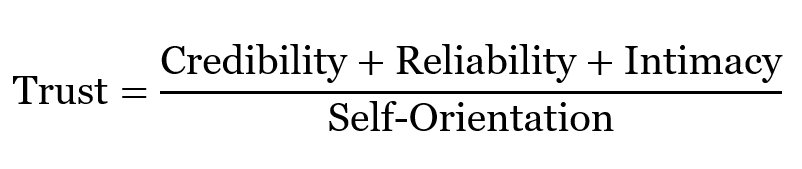
This is what each component means:
Credibility speaks to words and credentials. How authentic are we?
Reliability is the perception of a person’s integrity. Do you do what you say? Are your actions connected to your words?
Intimacy involves the feeling of safety or security when sharing information with someone. How safe or secure does the client or colleague feel in sharing with us?
Self-orientation reflects the degree to which a person’s focus is directed towards themselves as opposed to being focused on others. What are our motives? For our benefit or the benefit of others?
The higher the numerator (credibility, reliability, intimacy), the greater the trust. Conversely, the higher the self-orientation, the lower the trust. Ultimately, the equation serves as a mindful tool to enrich discussions, elevate trust levels, and deepen relationships within our teams.
When leading a team or a department, it matters how you are perceived by others. The ability to self-assess your personal status is another strategic tool wielded by seasoned leaders to convey confidence and authority. It includes an assessment of your:
Such elements can be ranked on a scale from 1 (‘low status’) to 10 (‘high status’) and, when done sincerely, this can be an invaluable guide for navigating various workplace scenarios and can even foster emotional intelligence, which is pivotal in forging genuine connections with athletes and team members. It can also facilitate the development of more impactful leadership skills that inspire and motivate with greater efficiency.
Flows of logic are the pathways our minds create to connect ideas and evidence to reach a reasoned conclusion. They are essential in critical thinking, problem-solving, and, of course, forming persuasive arguments. Flows of logic involve a sequence of statements or steps that follow one another in a rational and coherent manner. These frameworks can take three different forms, depending on your scenario:
These can be indispensable guides when constructing persuasive arguments. By grounding our narratives in these logical flows, we enhance storytelling capabilities and foster deeper connections with our teams. This pragmatic approach ensures proactive, relevant support while avoiding unnecessary complexity, thereby maintaining clarity and engagement, particularly in high-pressure situations where decisive leadership is paramount.
If you can put those three factors together then you can be better at delivering your message. Mindful communication is another tool upon which you can rely. This idea urges leaders to remain present and deliberate when communicating. It can help a person to:
The members in attendance discussed the success and failure of these elements in the context of people that ‘think to speak,’ and those that ‘speak to think’.
Here are some effective mantras to keep in mind:
Final reflections
As members reflected on the transformative potential of incorporating these persuasion techniques into their leadership repertoire, they described the following as essential steps towards mastering persuasiveness in your leadership approach:
In the final part of our interview, Dr David Fletcher discusses the importance of building helpful thought patterns and developing the correct habits.
A Human Performance article brought you by our Main Partners

Their mindset is a good starting point, says Dr David Fletcher. “If you can train the psychological aspect and manipulate the environment, the way to check that you’re getting it right is that you’ve got athletes walking into training and competition situations with a challenge mindset,” he tells the Leaders Performance Institute.
“In other words, they perceive the demands as an opportunity to perform, an opportunity for growth, an opportunity for learning, as opposed to a threat to their ambitions where they end up in a panic-stricken state,” he continues. “That’s your acid test of whether your resilience training is working.”
Fletcher, who is the Professor of Human Performance & Health and Associate Pro Vice-Chancellor for Sport, Health and Well-Being, at Loughborough University, has little time for toxic positivity – the pressure to display positive emotions to the suppression of all else – “we’re not robots or machines,” he says. “What we’re looking for is the majority of the time they’re stepping into arenas where they’re up for the challenge and they see it as an opportunity.”
There is an element of metacognition in the way that the best athletes harness challenging circumstances to their advantage. “I don’t want to go into too much jargon, but resilient athletes enter a higher level of functioning,” says Fletcher. “Hopefully your initial emotions are ones of excitement, you’re up for it, but if you are a little bit more anxious and uncertain, there’s another stage of cognitive processing where you evaluate that emotion and the best athletes can give themselves a safety net. You’re not sure on the initial context and you’ve got a bit of anxiety running through you, but you’re still able to interpret this negative emotion in a positive way. This is a skill that we’ve seen in some of the world’s best athletes. They’re able to say ‘well, actually I’ve been anxious before, the anxiety is going to help me drive through pain’ or ‘the anxiety is actually going to help me focus more on what I need to focus on’. Whereas a lesser athlete, when they have some of those negative emotions come in, they will then spiral into an unhelpful thought pattern.”
Fletcher has been talking to the Leaders Performance Institute for a series that looks at how psychological resilience can be developed, the influence of the environment, as well as any other considerations for coaches in sport.
In the fourth and final part of our interview, Fletcher discusses the reframing of unhelpful thought patterns with a view to developing athlete resilience in an environment that successfully balances challenge and support.
What types of thinking patterns prevent the development of resilience?
David Fletcher: There’s a host of different things athletes can tell themselves. For example, ‘if I mess this up this is going to be the end of my career’ or trying to second guess what the crowd is thinking. ‘What are people in the crowd thinking of me? or ‘what will my parents think?’ or ‘what are my teammates thinking?’ There’s all sorts of traps and distractions from optimal thinking patterns that will get in the way of being resilient in the moment
What steps can athletes take to prevent these unhelpful thought patterns hindering their performance?
DF: People need to stay in the present. That’s the first thing. So don’t think about the previous point if it’s a tennis match; or if you think ‘what if I win this competition? How much money will I earn?’ You need to stay relatively positive, focusing on what you need to do versus what you need to avoid doing. What are some of the key tactics I need to focus on staying relatively positive? As soon as you get distracted from those things then some of these more unhelpful thinking patterns can creep in. We do a lot of work around developing habits of behaviour in order to reengage at different times. Again, take a tennis player, for example, the idea of resetting between each point. The obvious one is when you hit the ball into the net and you’re dwelling upon that, but even if you hit great shots you have still got to reset for the next point. It helps to go through a physical behavioural pattern where you might turn your back on the opponent, you may look down at your racket and straighten some of the strings, using that as a cue to restraighten some of the thoughts in your mind and refocus on the next point as opposed to dwelling on the previous point, which would be something that could compromise your resilience.
How can athletes build the correct habits?
DF: A lot of it is around putting together everything that we’ve discussed. So starting with basic fundamental psychological skills training about learning how to better set goals, not just focusing on outcome goals but also incorporating into the process performance goals and, most importantly, getting the balance right between those factors and practising imagery techniques and developing those. Then bringing these into training contexts and situations where we optimise that challenge and support over time. You’re merging the two together to try and harness that psychological development and then you’re trying to bring that all together under a challenge mindset over time.
Does that go beyond competitive situations?
DF: This is an important point to emphasise when we’re talking about the development of resilience. It’s not just about that moment in competition. It’s about handling everything else that goes with elite level sport. There’s a broader consideration around training camps and lifestyle. For example, you’ve got a holding camp then you go into the Olympic environment. So how do you train for all of those types of things? I’ve attended meetings about the distractions present at the Olympics. Coaches discussed how we can train our athletes not to be distracted by some of those things and we’re also doing what’s called ‘what-if’ scenario planning. So what are some of the challenges and stressors that our athletes have encountered previously within the Olympic Village? One example is an athlete getting on a bus that took him to the wrong venue. Social media has also become an issue for a lot of top level athletes. So again, it adds some novel dimension to this idea of resilience.
As we wrap up, do you have any final thoughts?
DF: There’s a lot being written and said about resilience, with plenty of research available, but it’s another thing to develop on the ground. It is fundamentally reliant on relationships. The first thing you should do is hire a skilled psychologist and ensure they have the support of coaches, performance directors and the broader leadership and management within your organisation. Otherwise there is only so much they can achieve in teaching psychological skills and strategies. Perhaps the environment is wrong, say there’s too much challenge and not enough support, where the psychologist cannot input effectively. Or the other way around. There’s too much support and not enough challenge and the environment’s too comfortable. Then you’re never going to create and coach truly resilient athletes when it comes to the moment of competition. You need buy-in. It’s going to be a collective effort of working together to help craft that environment to help the athletes perform together. Some of the other considerations are around trying to monitor the environment and really understand the players and the support staff on an individual level because you do want to be able to assess and monitor whether you’re having an impact and, if you’re not, what you need to do accordingly. If you’re not monitoring things effectively then that can be a challenge too.
Read our interview in full:
Part II – Psychological Resilience: Everyone Has a Trainability Bandwidth
Part III – How the Training Environment Can Influence an Athlete’s Resilience
Our Leadership Skills Series turned its attention to the people at the heart of cultural change and the steps they can take to become more skilled as architects of their team’s culture.
We revisited the definition of culture, explored a newly formed hypothesis around sustaining high performing cultures and discussed six levers for leading a culture.
What is ‘culture’?
To frame our conversations, we revisited the definition of culture to set the tone for the insights that followed. It’s fair to say that culture does have a multitude of definitions but the ones we landed on as part of this call were:
‘The norms of behaviour and thinking that influence how people behave in a given group’.
‘Culture emerges as a result of the behaviours that are encouraged, discouraged and tolerated by people and systems over time’.
Four core components of sustained high performing culture
As part of our roundtable conversations, we had the opportunity to explore the latest research into sustained high performing cultures and took the opportunity to learn from organisations that have made genuine progress.
The research hypothesised that if you can excel in these four areas – purpose, belonging, psychological safety and cultural leadership – you are in an excellent position to drive, influence and sustain your organisation’s culture.
To bring these areas to life for our members, we ran a series of interactive polls at the table to score on a scale of 1-5 how well we think our organisations do at these four different elements. The data from the polls are as follows:
We asked: to what extent are people in your environment motivated to serve a purpose that feels bigger than them?
We asked: to what extent does everyone feel valued, a sense of belonging and safe to be themselves?
We asked: to what extent do people feel safe speaking up and challenging each other?
We asked: to what extent is their shared ownership for our culture from staff and athletes?
This poll highlighted that there is a lot of development work and intent required to drive our cultures forward.
The six levers needed to lead a culture
What are you keen to pay more attention to in strengthening your culture? As we came to the end of the skills session, we explored six key levers for leading culture and, specifically, cultural change.
For any individual, a message needs to be heard at least six times for you to take it in. That message needs to be continually repeated, so if the principles are sticky, they naturally become easier to remember. Think about your straplines or strategy and reflect on if they meet that level of ‘stickiness’. A good example from the Olympic world is the question: ‘will it make the boat go faster?’
This is the classic example of ‘words on the wall’ versus living the values. If the leaders and cultural leaders really model those behaviours, it’s what people will experience and lead by. When we consider inclusive leadership, the research shows that leaders can influence the people, the athletes, the organisation around them by up to 70% with their behaviours.
Constantly reviewing your organisation and your culture to make sure you are reflecting on where you are. Ask yourself: where are our gaps? Where are our strengths? How can we improve?
You can use a system rating scale from 1-4 to guide some of these insights. These system rating scales create an opportunity for those culture conversations to emerge in how they provide insight into the health of the culture at a specific moment in time.
One attendee shared they had invested a lot of time around the theme of psychological safety. As an example, if you want to go after psychological safety as an organisation, one of the key skills that underpins psychological safety is enabling people to speak up. Providing these opportunities supports the intent to make positive change.
Feedback is so critical. One of the things that we see happen in a large percentage of organisations is that people don’t deliver skilful feedback; and feedback can feel quite personal. Therefore, it’s about creating that feedback loop and that culture of what we call ‘skilled candour’, so that people are able to deliver feedback in a skilful manner.
When engaging in culture change, do you have the right people in the environment? Ultimately, it may come down to a time when you have to make a decision as a leader about getting the right people on the bus.
Though it may not be as trainable as some people claim, Dr David Fletcher identifies some of the personal qualities that define psychologically resilient athletes.
A Human Performance article brought you by our Main Partners

“The short answer is both,” says Dr David Fletcher, the Professor of Human Performance & Health and Associate Pro Vice-Chancellor for Sport, Health and Well-Being, at Loughborough University.
“Your personality characteristics have a large genetic component,” he continues. “The physiologist Per-Olof Åstrand once said ‘If you want to be an Olympic champion, choose your parents wisely’ and he was talking from a physiological point of view, but there are certain personality characteristics that do give you a real head start.
“But the good news is that there is a trainability bandwidth, which means psychological skills can be trained. However, they are trainable but not as trainable or developable as some people might claim.”
Fletcher is talking to the Leaders Performance Institute for a series that looks at how psychological resilience can be developed, the influence of the environment, as well as any other considerations for coaches in sport.
In the second part of our interview, he discusses the necessary personal qualities, trainable psychological skills, and the caveats for all teams looking to develop their athletes’ psychological resilience.
What are some of the personal qualities or psychological factors that are important for developing psychological resilience?
David Fletcher: There’s almost a whole shopping list here. I mean there’s probably about 50 years’ worth of research which has looked at some of these personal qualities or psychological factors that are important. I can list a few that we know, such was self-confidence, which underpins resilience. We know optimal levels of motivation self-determination are important. We also know certain personality characteristics are advantageous, such as the Type A behaviour pattern [commonly people who are highly competitive, ambitious, work-driven, time-conscious and aggressive]. There are other important social-related qualities, such as people who are able to ask for help and engage in social support. They tend to handle stress better and be more resilient. There’s a raft of factors that go into making a psychologically resilient individual and there’s parallels with the physical aspects of training for sport.
You have previously said that it is important to understand the differences between personality characteristics, psychological skills and desirable outcomes. Can you please explain that point?
DF: Personality characteristics are enduring and distinctive. In other words, they stay fairly stable over time and they’re distinctive in that they are what make us individuals and separate us from other individuals. They are quite stubborn and don’t change very easily. That’s not say that they can’t change. They will do during periods of extreme adversity, or indeed extreme success, they can alter personality, but by and large they stay fairly constant. On the other hand, psychological skills are much more malleable and amenable to training, such as goal setting-imagery, self-talk or relaxation strategies. There are other skills such as the ability to plan or proactivity that don’t receive quite as much airtime in the sports psychology literature but I would say they are equally important in developing resilience. Now, it’s important to distinguish between those because, as a psychologist going in and working with an athlete, that has implications for how, as well as how often, you assess those qualities because you probably need to monitor those amenable to change more regularly than personality characteristics. You also mentioned desirable outcomes so it’s probably best if I give an example here. If we take certain personality characteristics, like levels of self-esteem and traits for confidence, they stay fairly consistent and essentially they refer to your general tendency to believe in yourself and your capabilities. That’s the personality-type characteristics that are relevant here, but you can also do a lot to enhance your self-confidence using skills like goal-setting, imagery and self-talk. Consistently, the literature shows and that those tools can help to develop self-confidence. So what we’re trying to do is merge those skills with their physical qualities. When a performer is placed in difficult, stressful positions, we ask the question ‘to what extent do you believe in yourself in this specific situation?’ That will be a factor of both your personality and how well you’ve learned these skills.
Is there much variation amongst athletes in different sports? Are certain traits more prevalent in athletes than the general population?
DF: The scientific literature hasn’t fully unravelled that but elite level athletes do have certain characteristics and traits are more prevalent than in the general population. These include high levels of self-confidence, optimism, openness, proactivity. Part of the reason is these help them perform in demanding situations. They have that sort of head start. The analogy is right there with physical characteristics. In men’s basketball, for instance, we tend to see people who are over six foot performing at the higher levels. One thing I find interesting, and it’s a trap I’ve seen some researchers and practitioners fall into, is to not confuse the characteristics for high performance with characteristics that are likeable, socially desirable, ethical or to assume that they help support mental health. One example is narcissism. So narcissists are individuals that crave adulation, they tend to perform well in arenas where they get that adulation. So in an Olympic final, you’ve got a huge crowd who are who are going to celebrate your successes; so narcissists particularly like high pressure situations because of the potential that that brings them for this adulation. That’s a personality characteristic that again would give you a head start in an Olympic arena but narcissism isn’t a particularly pleasant or desirable characteristic. These are very important considerations whether you’re working as a psychologist or just generally working in high performance contexts. Selfishness, perfectionism and obsessiveness tend to be advantageous for developing resilience and for high performance but they’re not advantageous for mental health, sustaining relationships or marriages. That’s why we sometimes see individuals who are very high performance who struggle in other contexts. When we start to unpick some of these personal qualities and what they’re all about it certainly gets quite interesting and present an ethical challenge for psychologists and coaches when working with these individuals. How do we help them not only as a performer but more holistically as a person?
Read our interview in full:
Part III – How the Training Environment Can Influence an Athlete’s Resilience
We bring you insights, reflections and a range of tips from the Brisbane Lions, San Antonio Spurs, Melbourne Business School and beyond.
An article brought to you by our Event Partners


The renowned leadership consultant was onstage at the Leaders Sport Performance Summit at Melbourne’s Glasshouse speaking about her book The Leading Edge, in which she proposes a framework for leadership based on notion that when we are able to lead ourselves we are better equipped to steward others through periods of change and development.
An audience of more than 200 Leaders Performance Institute members sat with rapt attention as Ransom joined coaches and leaders from organisations including the Brisbane Lions, San Antonio Spurs and Melbourne Business School, all of whom laid out how they are working to ensure their people can navigate the shifting sands of high performance in years to come.
“Research suggests some of the most in-demand skills by 2030 will be how we work together, connect, and build empathy,” Ransom continued.
Here, in light of those skills, we explore eight ways those who took to the stage are working to future-proof their teams.
The recent renaissance in Australian cricket – the men’s and women’s teams are reigning world champions across four different formats – has not been a happy accident. Andrew McDonald and Shelley Nitschke, the head coaches of the men’s and women’s teams respectively, stressed the need for thorough performance planning, skilful execution and finding the space to pick up lessons along the way.
Andrew McDonald, Head Coach, Australia men’s cricket team
Shelley Nitschke, Head Coach, Australia women’s cricket team
Next steps:
Burnout is a universal problem, with New Zealand and Australia suffering some of the highest rates in the world, according to leadership consultant Holly Ransom. She argues that while stress is inevitable, and can be abated, burnout can be entirely avoided. In her view, the conditions necessary for eradicating burnout stem from empathetic leadership and, when a leader adapts their habits, it gives permission for others to do the same.
Holly Ransom on the notion that we can’t sustain leadership, without leading ourselves first.
Next steps:
1) Complete an energy audit – when are our natural highs and lows in a day, and how are we using them?
2) Establish your building blocks – do the little things that help you build momentum.
3) Set your micro-breaks – take time to get mini hits of new energy.
Kit Wise of the Royal Melbourne Institute of Technology [RMIT] and Budi Miller of the Theatre of Others, an innovative performing arts company, were invited onstage to share their approaches to fostering creativity and risk-taking in their environments.
Professor Kit Wise, Dean, School of Art, RMIT
Budi Miller, Co-Artistic Director, Theatre of Others
Next steps:
The New Zealand All Blacks and San Antonio Spurs are worlds apart in sporting terms but share numerous commonalities when it comes to bringing to life and sustaining a winning culture. Beyond results, both are renowned for creating environments where people and innovation flourish, as the All Blacks’ Mike Anthony and Spurs’ Phil Cullen explained.
Mike Anthony, High Performance Development Manager, New Zealand Rugby Union
Phil Cullen, Senior Director of Basketball Operations and Organizational Development, San Antonio Spurs
Next steps:
New Zealand Rugby have identified five factors that enable their group to flourish:
1) Connection – players take pride in serving their community.
2) Balance – the group looks for learning, stimulation and edge.
3) Fun – a big part of balance.
4) Learning – athletes learn by doing; so what environment will facilitate the best learning?
5) Family – the organisation has worked to bring families in while also helping them to understand the expectations of an athlete in high performance sport.
The Spurs have their three core values:
1) Character, which is based on values.
2) Selflessness, which is culture-focused.
3) ‘Pound the Rock’. A metaphor inspired by 19th Century Danish-American social reformer Jacob Riis. His Stonecutter’s Credo perfectly captures the Spurs’ drive for championships:
“When nothing seems to help, I go and look at a stonecutter hammering away at his rock perhaps a hundred times without as much as a crack showing in it. Yet at the hundred and first blow it will split in two, and I know it was not that blow that did it, but all that had gone before.”
The Stonecutter’s Credo, Jacob Riis
The Brisbane Lions men’s team, under the stewardship of Senior Coach Chris Fagan, have in recent years returned to prominence for the first time in a generation. Amongst the factors responsible for their rise is their ability to out-learn their opponents, as High Performance Manager Damien Austin explained.
Damien Austin, High Performance Manager, Brisbane Lions
Next steps:
Models for change are all good and well – change is inevitable, so perhaps they are entirely necessary – but what are some of the so-called ‘soft’ factors that enable a leader to influence change? Professor Jen Overbeck was on hand in Melbourne to dispense some tips for explaining and justifying change to others.
Jen Overbeck, Associate Dean, Melbourne Business School
Next steps:
Wellbeing and performance are indivisible, yet there is more we can all be doing to ensure our people can flourish. At the Glasshouse, Emily Downes of High Performance Sport New Zealand and Sonia Boland from the Australian Institute of Sport provided an insight into their work helping people to thrive amidst the challenges presented by high performance sport.
Emily Downes, General Manager – Wellbeing & Leadership, High Performance Sport New Zealand
Sonia Boland, National Wellbeing Manager, Australian Institute of Sport
Next steps:
As women’s sport continues to evolve, the system will need the athletes and the coaches to fill the spaces created. Given the hitherto piecemeal approach to developing women’s sport, and the often misunderstood differences between men and women athletes, this is far from a given. Helene Wilson of High Performance Sport New Zealand and Tarkyn Lockyer of the AFL are two individuals meeting this challenge head on.
Helene Wilson, High Performance Sport New Zealand
Tarkyn Lockyer, Australian Football League
Next steps:

Bobby Scales lays out areas where sports routinely fall down when it comes to diversity, equity and inclusion.
Inevitably, the player makes a poor play in a game or practice and their coach, typically an American, will need to correct the mistake.
The coach finds that the player will not look them in the eye and feels disrespected because, in American culture, you are taught from a young age to look a senior person in the eye and you say ‘yes sir’, ‘yes ma’am’, ‘no sir’, ‘no ma’am’.
By contrast, in Latin culture, you do not look your elders in the eye when they are correcting you.
There is a mutual misunderstanding that does little for team unity and does nothing to further the cause of diversity, equity and inclusion.
Teams are increasingly aware of this. When I worked at the Los Angeles Angels, we considered it important to take American coaches to the Dominican Republic, to let them immerse themselves in the culture at the academy and work with the players. We wanted them to understand what life looks like in the Dominican; to better understand how these young men grow up.
Equally, Latin American players need to be afforded the grace to learn the social norms of the United States.
This mutual understanding is the key to weaving the fabric of team unity and success.
So how can we better embrace diversity, equity and inclusion? Here are four thoughts.
1. Don’t be afraid of the conversation
No team is perfect and we could all be doing more to further the cause. But are you ready to have the conversation? It may sound obvious but people are often too afraid of the conversation for fear of saying something wrong or fear of being canceled. The benefits of diverse teams are clear in the world of business and sports has started to take note. But would you be comfortable or promoting, say, a female coach in a male-dominated environment? Is it within your gift to go against the grain and make what may be a counterintuitive appointment? To reach that point, a leader must construct an environment where people understand that players, coaches and practitioners are here because they are the best possible person to be in their position. I would rather lose with players that have a growth mindset – and I don’t think you’re going to win with players that have a fixed mindset anyway. There’s not a player on earth worth their salt who does not want to get better. They will listen to an individual if they have cultivated a relationship. For a complete culture, you need to have coaches and staff members that are aware of this, who feel supported.
2. Don’t get bogged down in the obvious differences
I am a 46-year-old black man and I could be sitting in a front office next another 46-year-old black man, but we could have grown up in different circumstances and, as such, we will bring different experiences to the table. As important as ethnic, religious and gender diversity are, they may not necessarily lead to diversity of thought – cognitive diversity. Someone in your team may have grown up on a council estate in a tough part of London and another may have grown up in Beverley Hills, California, and had people who worked in their house and they’ve never made their bed. Perfect: LEAN INTO IT! People from different walks of life, socio-economic backgrounds, and different cultures will come to a problem on the table in a different way. Perspectives – different perspectives – are exactly what I, as a leader, want. This allows for constructive dissent, which is where the best outcomes lie. When you have people who are willing to disagree with each other you will have a richer conversation. It’s then up to the leader to pull those opinions together, form a consensus, and move forward with an outcome or a solution that is beneficial to the team.
3. Identify the individuals in your team who are underserved
You have to cultivate relationships – they are way more important than the X’s and O’s, tactics or data. As well-known American football coach Herman Edwards once said: YYP – Know Your Personnel. A leader must know how to access them even if it isn’t the leader directly. Maybe it’s an assistant coach or a practitioner on your staff who has built a trusting relationship with the player. Again, lean into that. There is a certain truth to the idea that the physio knows everything that’s going on. I’m a big believer in authenticity and people will reveal themselves to you if your environment is one of support, warmth and truth.
4. Find opportunities to learn… then teach people!
Do you celebrate cultural milestones and holidays? You should, because they represent an opportunity to teach people from other cultures about that culture. For example, if there is a Muslim player in your mostly non-Muslim team, and you’re playing during Ramadan, there is an opportunity to educate your other players and coaching staff on what that means for that player and their faith. A crucial point to make: before even reaching that point of cultural exchange you yourself as a coach or executive are going to need to get stuck in and commit to proper research for yourself – you cannot teach that which you yourself do not know. Manage this process well – within an environment of support, warmth and truth – and you’ve brought your team closer together.
31 Jan 2024
ArticlesBen Baroody tells us the World Series winners needed to find values that meant something to everyone in the organization.
Culture often precedes results
The Texas Rangers’ transformation under General Manager Chris Young and Manager Bruce Bochy saw them go from 102 losses during the 2021 Major League Baseball season to the World Series just two years later. Bochy, for one, could not have enjoyed a more successful first campaign in Arlington.
It is tempting to attribute part of the turnaround to the organization’s increased focus on personal development, particularly when Ben Baroody was promoted to Director of Leadership & Organizational Development, Player Enrichment Programs, and Mental Performance in November 2021. But the truth, as he told us himself, is that the groundwork had been laid for years by the staff, coaches and players independently of on-field results.
“I’ve been here nine seasons and there have always been a lot of positive elements to our culture,” Baroody told the Leaders Performance Podcast in January.
The team did, however, revisit their values in light of that 2021 season. Baroody continued: “It came down to refining our core values – who we are and what we represent, how we live out those values – and [establishing] a belief in what we can accomplish together when everyone has a clear picture of what those priority values are. [Then] it’s easier to embody them and be held accountable to them. We know what matters most and what we are working towards.”
The Rangers values include “be a good teammate”, “compete with passion” and “dominate the fundamentals”. “On the surface they seem over-simplified but they mean a lot and can be applicable in a lot of different ways.”
Your values need to be reinforced daily
Too often teams fall prey to the words they stick on the clubhouse wall and the Rangers were no different in the past. “We’ve been victims of that,” said Baroody. “I think that every organization is.” One solution, he added, is continuous reinforcement “through meetings, through presentations, through discussions – they aren’t just on a wall somewhere – they are truly part of how we operate, they are included as we constantly evaluate our decision making and in our evaluation of personnel, both players and staff. They are the main component of our performance reviews from a staff standpoint.”
Values, when they are perceived as meaningful, can be applied by people on a 24/7 basis. “You can boil them down to the most obvious application, but when you think through how you’re structuring your day, how you’re structuring your week, your season, your lifestyle. They can be applied 24 hours a day and we’ve tried to really live them out and not be selective in when we embody them,” Baroody said.
They should resonate beyond your sport or competition
The Rangers’ values are defined by all domains of the organization. “We all have clarity into what they mean for us personally in our different sub-departments,” said Baroody. The same goes for staff and players. In fact, it is a fundamental development exercise for young players at the Rangers’ minor league affiliates. “We’ve put it to them to speak amongst themselves, have collaborative discussions, to create the definitions around those [values] and to set forth the behaviors that exemplify those values.”
At a staff level, “it comes down to simplicity and clarity in having values that are applicable to everyone in the organization whether you’re a player, whether you’re a scout, whether you’re a coach, whether you’re an analyst – you know what it means to the organization as a whole.”
Even if you’re a non-playing member of staff you’re still “leading with a competitiveness. The communication and collaboration and care you have for others – that’s how you’re exemplifying being that good teammate.”
It doesn’t end with winning
The process did not end with the Rangers’ World Series victory in November. “It reinforced we’re on the right track with culture,” said Baroody. However, “as soon as you think you have it figured out, you’re close to being humbled.” The word ‘culture’, as he explained, has its roots in agricultural cultivation. “[Your culture] has to be cultivated so you’re always going to have to pull some weeds and tend to things, and give it water and give it sunlight. It can’t be stagnant.”
Therefore, he does not perceive a hunger issue as the team prepares for Spring Training. “There’s pride, there’s accomplishment, there have been celebrations, but there’s definitely not been contentment and our focus is on building on 2023 with a competitive focus on 2024 and beyond. And I think that in itself is a good insight into who we are and who we aim to be and what we try to represent.”
Listen to the full interview with the Texas Rangers’ Ben Baroody:
Listen above and subscribe today on iTunes, Spotify, Stitcher and Overcast, or your chosen podcast platform.
29 Jan 2024
ArticlesFrom the English Premier League to the NBA via the AFL, the Leaders Performance Institute Think Tank gives coaches, managers and directors the opportunities to share lessons and ideas around the performance questions of the day.
The Think Tank is designed to connect general managers, coaches and directors of performance – the people with responsibility at the highest levels of world – sport with each other and the ideas that have served their peers best.
The discussions on the day were wide ranging, as the participants delved into five common problems and identified possible approaches and solutions.
Renewal is a continuous process in sport, which is not to say that it is always easy, frictionless and without complications. If you are the person tasked with delivering upon your team’s vision, consider:
It is often incumbent on the head coach to provide the energy to the playing group, but who is looking out for the energy of the coach? At a time when coaches fear coming across as ‘weak’, here are some tips for coaches seeking to protect their personal energy.
Succession planning is hard, particularly when one considers that generation-defining coaches are more a product of circumstance than formal programmes. Nevertheless, how can we give aspiring coaches a better chance?
No one has the fully come to terms with talent development pathways, hence the ever-present questions around attributes, development gaps and purpose. What can we do to better identify and then develop our young athletes?
No other area is as widely misunderstood by coaches and practitioners as artificial intelligence and its role in sport. There is, however, no need to stray from your performance principles in putting them into practice. Remember:
Participants
Mo Bobat, Director of Cricket, Royal Challengers Bangalore
Michael Bourne, Performance Director, Lawn Tennis Association
Matti Clements, Executive General Manager, Australian Institute of Sport
Steve Cooper, football manager
Chris Fagan, Senior Coach, Brisbane Lions
Rob Key, Managing Director of Cricket, England & Wales Cricket Board
Marc-Oliver Kochan, Managing Director, Red Bull Athlete Performance
Sean Marks, General Manager, Brooklyn Nets
Tabai Matson, Director of Performance & Development, Harlequin RFC
Sara Symington, Head of Olympic & Paralympic Programmes, British Cycling
Jess Thirlby, Head Coach, England Netball
Simon Timson, Performance Director, Manchester City FC
Gregor Townsend, Head Coach, Scotland men’s rugby team
23 Jan 2024
ArticlesMembers of the Leaders Performance Institute answered this question from their own experience and shared responses ranging from environmental renew to the power of positive storytelling.
The notion of ‘belonging’ can be simply defined as ‘a sense of connectedness to others and what you are doing’. The Cambridge English Dictionary extends the definition of belonging to ‘a feeling of being happy or comfortable as part of a particular group and having a good relationship with the other members of the group because they welcome you and accept you’.
Psychology research shows that in cultures and environments that show autonomy, competence and belonging, individuals will elevate their engage in tasks and activities they are asked to commit to.
It’s clear from both the literature and lived experiences of the group that creating belonging is a powerful tool for a harmonious and high-functioning environment. The aim of this particular roundtable was to share best practices and examples of how we are trying to foster belonging in our environments.
It starts at the induction stage
In one of the breakout groups, they reinforced the idea that the process of creating positive belonging starts at the induction or onboarding phase and how important it is to dedicate time and intent towards this process to set the right tone. The work to create belonging continues week on week during this onboarding phase, with the acknowledgement and value that an individual or individuals bring to the team. From a team perspective, it is an opportunity to acknowledge the variety and diversity of backgrounds, skills and views of those in the department or organisation from the outset.
In summarising this first point, there was an excellent reflection that how we make people or an individual feel is the most important thing. Every interaction matters and what you do is about making them feel the way you want them to feel.
Setting the stall out around the culture
There were a number of reflections on how to give your environment the best opportunity for positive belonging. Identify the values and culture expected of individuals within your environment, and perhaps most importantly, find practical ways to instil them. Is everyone in the environment crystal clear on what the behaviours and expectations are? If you have this in place, there can be collective accountability. Similarly, it is important to be consistent in positively reinforcing, noticing and celebrating positive examples of those behaviours.
A couple of people on the call also suggested that coach buy-in is really crucial in this process. If the head coach buys into the values then the majority of people in the environment tend to follow, such is the influence the head coach carries.
In setting yourselves up for success, create opportunities for athletes, coaches and staff to convene and build the culture together. Creating opportunities for discussion on values and behaviours supports the idea of creating a sense of belonging. It is widely acknowledged that engagement, contribution and a love for what you do leads to a sense of belonging, therefore lies the challenge in ensuring we are bringing this to life.
Finally, there was a discussion around language and its importance. There was a fantastic phrase shared on the call that ‘above-the-line language is powerful, but below-the-line language is powerless’. There is a responsibility to own the standards of the language.
The power of storytelling
A common response from the group around effective ways to instil belonging was utilising the power of story. Find the story that connects to the people that you’re working with, whilst recognising the significant cultural differences that exist in the environment. The story that you use must align with the culture. One environment on the call shared how they leant on metaphor in creating an overarching theme that is reframed every year.
Story also presents the opportunity to connect those across the backroom staff, athlete population and other forward-facing roles. There was a suggestion this should also extend to family members of those involved, bringing them into the culture and environment, knowing the importance of the environment off the field. Do they feel that sense of belonging as well?
Finally, we also discussed the impact story can have around connecting individuals to the cultural environment of the country that you are in. It also presents the opportunity to embrace the culture that individual is bringing into the environment.
Create opportunities for shared experiences & collective input
Responses from the group indicate that every interaction matters and it is important to be mindful of that. Therefore, how are you intentionally creating opportunities for shared experiences and opportunities for collective input from different stakeholders?
A simple initiative to instil is celebrating ‘the good’ when done well and highlighting small wins and successes.
Encourage active listening and understanding of everyone’s opinions – providing a space and opportunity for everyone to have a voice in key decisions is found to be an effective way of supporting belonging in an environment. To ensure the above is both effective and a success, organisational leaders require an openness and receptivity to ensure the environment is designed to be safe.
There were also a number of reflections around the power of ‘inclusive initiatives and rituals’ that bring people together. Finally on this point: are you formally capturing information from the stakeholders in your environment in a consistent way? This is a simple tactic to remain on the pulse of the environment, ensure those in the organisation have a chance to provide feedback and contribute to decision-making and the state of play on the culture.
Providing space to better understand the ‘whole person’
One of the final key buckets of discussion around instilling a sense of belonging in your environment was formal and informal opportunities to better understand the whole person. We should strive to provide space to celebrate authenticity and our true selves. Does your environment provide an opportunity for employees to breathe and express themselves?
A foundation stone of the High Performance Strategy in the Australian Olympic System is the athlete’s voice. The idea is to provide opportunities to understand one’s journey, both as an athlete and as a person. The self-determination theory concept is something that is really key in this piece and its relatedness to belonging. Creating opportunities to understand the whole person allows for further insight around ones intrinsic motivation and the opportunity for honest, open conversations within the environment.
Final reflections
At our Leaders Meet: High Performance Environments event in Melbourne back in 2023, we ran an Open Spaces session on this exact topic. The aim of the session was to allow the audience on the day to share stories, experiences and perspectives on belonging. Five things came through strongly from those in the room that day around what we can do to enhance belonging in our environment.