As the former New Zealand PM explains, the better question isn’t whether you’ll experience impostor syndrome but how you’ll act when you do.
“It was a leader-only event and they’d decided I was not a leader,” she told an audience during an onstage appearance at Westminster’s Methodist Central Hall earlier in June. “I find myself really holding back from saying ‘I’m the Prime Minister’ as if somehow it’s name-dropping,” she continued.
Within moments, Malcolm Turnbull, the then-Prime Minister of Australia, with whom she had been talking in the corridor, returned, grabbed Ardern’s arm, and walked through with her while indignantly uttering the words ‘she’s the Prime Minister of New Zealand’.
Leaders at that APEC meeting had been given identifying pins to wear, but Ardern’s was covered by her long hair.
Ardern, who served as Prime Minister of New Zealand between 2017 and 2023, has spoken of her impostor syndrome during various public appearances and also in her recent memoir A Different Kind of Power.
The APEC security staff may have perceived her as an impostor due to her gender – she was one of just three female leaders at that meeting – but that was not an issue for Ardern herself. New Zealand has long had women serve in senior governmental posts, including Prime Minister [three], Speaker of the House, and Governor-General [four]. “I didn’t look out at the world and think that a woman couldn’t lead,” said Ardern, “but I didn’t think you could lead with my personality.”
She was 14 when her favourite teacher introduced her to the concept of impostor syndrome, ‘a phrase,’ she writes, ‘I would remember for the rest of my life’. It represented ‘puzzle pieces clicking together’.
Some telltale signs of Ardern’s impostor syndrome
Impostor syndrome is not a recognised psychiatric disorder but it is experienced by a whole range of people regardless of their accomplishments.
Ardern alludes to three areas where her impostor syndrome has tended to manifest.
Her perfectionism: as she explains in her memoir, she was noted as a skilled public speaker and debater at high school. Nevertheless she suffered from debilitating nerves. Even with her exhaustive preparation she ‘could not shake the feeling that something could go terribly wrong. And when it did, it would also be proof that I wasn’t good enough to be there in the first place.’
Unrealistic personal expectations: during her recent appearance on HBR’s IdeaCast, Ardern spoke of the notion in leadership “that confidence is built through absolute knowledge and displaying a sense of the fact that we have all of the answers all of the time.” It is an idea she has come to refute.
Unfavourable personal comparisons: Ardern’s father once protectively described her as ‘too thin-skinned’ for politics. There were times when she concurred. She noted the resilience of Helen Clark when she worked as a researcher in the former New Zealand Prime Minister’s office in the early 2000s. ‘And while Helen Clark had shown me that it was possible to be a woman in politics,’ Ardern wrote, ‘no one had shown me that you could be sensitive and survive’.
How Ardern deals with it
She accepts that impostor syndrome doesn’t go away. “In my experience, it does not,” said Ardern onstage. In any case, “it’s such a broad turn of phrase,” she added. “I would prefer to just describe it as a confidence gap because I think there’s a spectrum and, at any given time, you can be in different places on that.”
She does not accept it as a sign of weakness. When she was asked to go beyond her perceived areas of competence, her instinctive response as PM was “to anticipate risk, to prepare, to bring humility to what you’re doing, to bring in experts, to bring in advisors. And don’t we want that in our leaders?”
She does not believe that impostor syndrome is always bad. “Just remember all that it brings you,” she said. “It doesn’t take everything, it brings you something as well. Just remember that I existed as Prime Minister for five years with my monkey on my shoulder and I do believe it made me better at my job.”

A Different Kind of Power: A Memoir by Jacinda Ardern. Available now from Penguin Random House.
In a recent Leaders Virtual Roundtable, Tim Cox of Management Futures presents a series of tools for navigating those obstacles.
Many of you will be familiar with VUCA (which stands for ‘volatility’, ‘uncertainty’, ‘complexity’ and ‘ambiguity’) and employed it in your day to day work.
It looks like this:
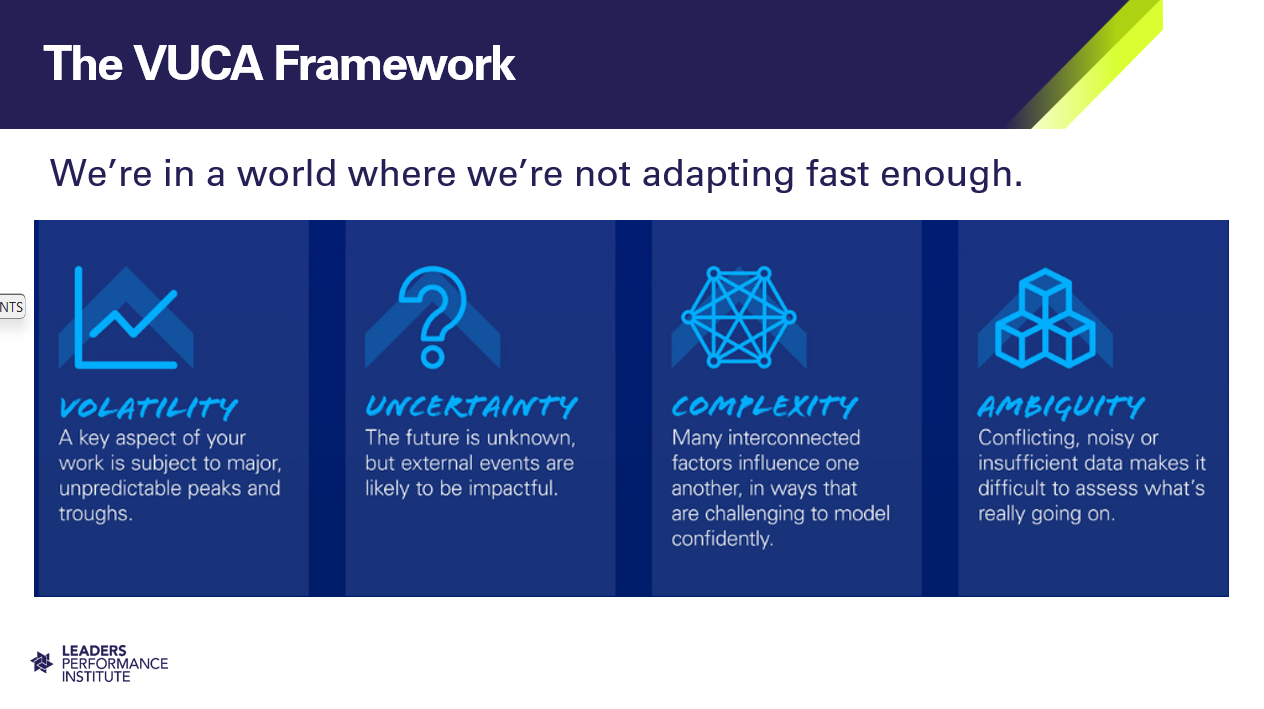
VUCA was devised in military circles in the 1980s as a strategic response to external forces and is both analytical and structural. It remains a useful tool for planning and building resilience.
However, there is a growing consensus that VUCA alone does not capture the emotional and psychological toll as environments become increasingly complex.
In 2018, the author Jamais Cascio, a self-styled ‘futurist’, published his BANI Framework, which is his effort to introduce a more human-centred lens, that emphasises fragility, emotional responses, and the breakdown of linear logic.
Here is an outline:
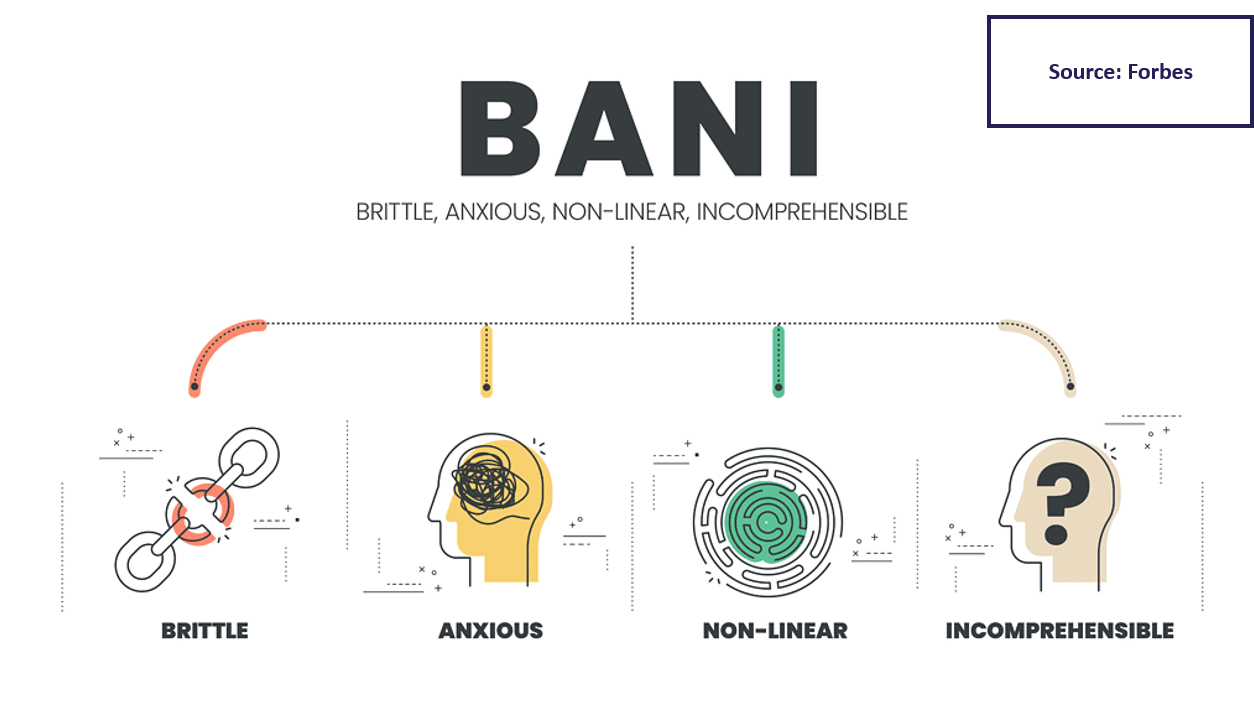
And here is how it may look in your environment:
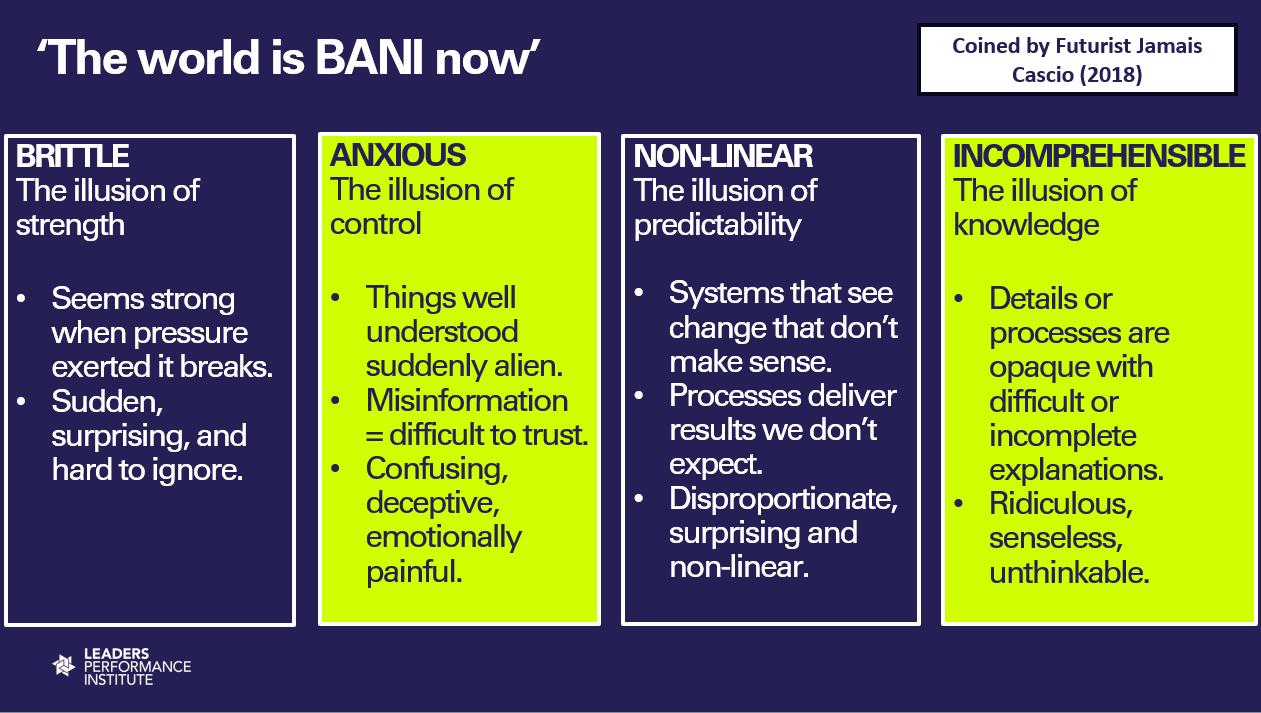
“Cascio sees BANI as parallelling VUCA, but he thinks VUCA is not real enough,” said Tim Cox of Management Futures, the host of a recent Leaders Virtual Roundtable. “He’s not saying BANI replaces VUCA, but he feels that it’s much more up to date with what’s going on at the moment.”
It helped to set the scene for the second session of our three-part Virtual Roundtable series entitled ‘Leading in Complexity’.
Which trap is most common in your organisation?
In part one, we explored how adaptability can increase the chances of an effective response to complexity.
In part two, we turned our attention to four common factors that can inhibit your ability to be adaptable and asked the table to select their most common ‘trap’.
Cox then spoke to each trap in turn.
This trap was cited by the fewest attendees but, as Cox explained, “even in sport we are often hijacked by emotions and we fail to adapt because they override our thinking.”
One must “relax, observe, and make a call”. Cox has some tips on that front:
Nearly half of attendees cited this as the most prominent trap.
It is an enacting metaphor too. “The classic operating from an out-of-date map was the belief that the world was flat,” said Cox. “It limited people and it spread fear in people not to go beyond certain points.”
Without active sense-making, he explained, leaders risk falling into mental ruts that limit adaptability.
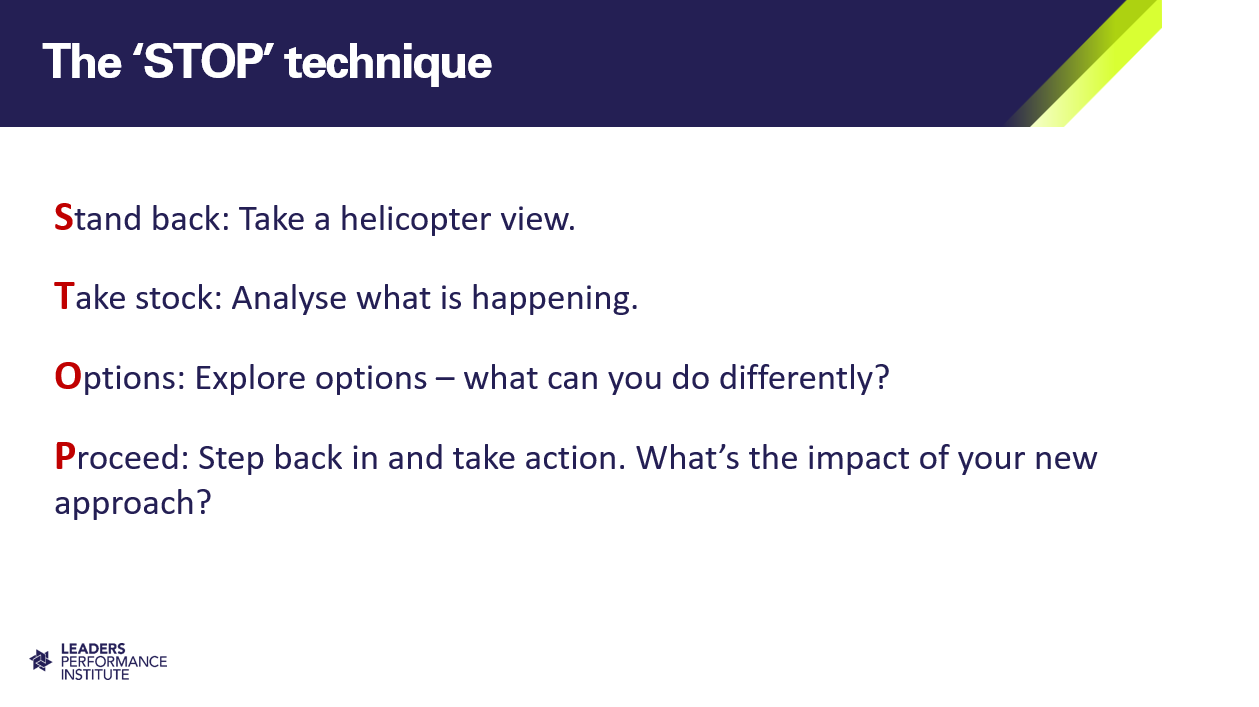
Cox recommended the following:
It is a practical method for fostering adaptability and creative problem-solving in complex environments:
Our poll indicated that more than one in five attendees rank this as their team’s most prominent inhibitor.
“Authoritative leadership has been proven time and time again to be effective in very short bursts,” said Cox, “but it isn’t much good for adaptability.” The reasons are simple enough. “It’s really difficult for one person to be able to think through, be creative, respond to the environment around them when things are changing at a high pace.”
Leaders should:
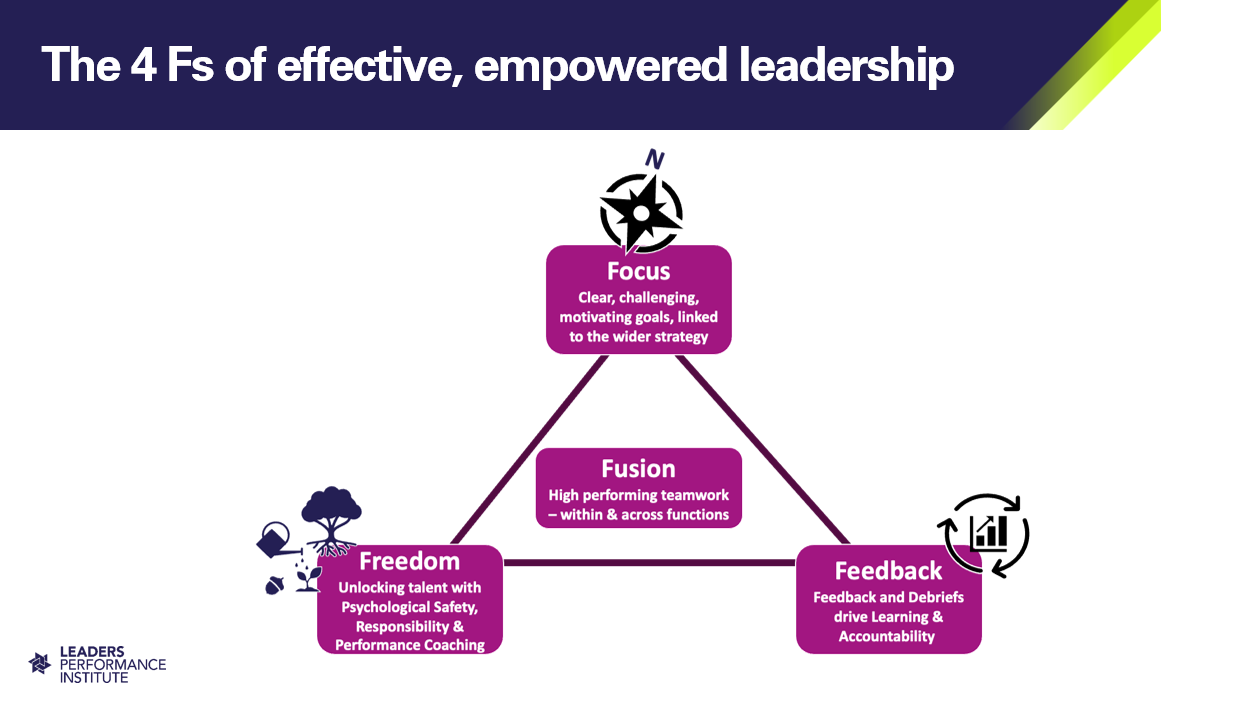 Focus: The leader must deliver clear, strategic alignment where everyone understands the direction and purpose of their work.
Feedback: Regular feedback and debriefing are essential for learning and continuous improvement, especially in dynamic settings.
Freedom: Give people autonomy and allow them to explore, innovate, and respond to change.
Fusion: This is about building strong relationships and collaboration, both within and beyond your organisation with a view to harnessing collective intelligence
As with authoritative leadership, our poll indicated that more than one in five attendees rank this as their team’s most prominent inhibitor.
Cox had a selection of ideas that leaders might consider:
Other inhibitors cited by Leaders Performance Institute members:
Sign up for Part Three
In the third and final session on 3 July, we will explore building a collective playbook for leading in complexity:
In the first episode of our special three-part series, the Sixers’ VP of Athlete Care discusses the importance of the performance director’s role in establishing clear communication lines, engendering trust and shaping the team’s culture.
A podcast brought to you by our Main Partners

“The issues I’ve seen here, they’re very rarely – almost never – [a result of] things getting missed,” Simon Rice, the Vice President of Athlete Care at the Philadelphia 76ers, tells Teamworks’ Director of Athlete Performance Andrew Trimble and Leaders Performance Institute Editor John Portch.
“Where we run into slight problems is everyone trying to do the right thing with really good intentions,” he continues, citing the hypothetical example of three practitioners on the Sixers’ Health & Performance group prescribing the same loading plan to an athlete and inadvertently tripling their load.
“It often comes back to communication and it comes back to this idea of fitting the puzzle pieces to fully support that player.”
It takes mutual understanding and trust between athlete and coach, as Simon touched upon in the recent Teamworks and Leaders Special Report, entitled High Performance Unpacked: Interconnected Performance Teams, and it was a theme he expanded upon in the first episode of our new three-part series.
Elsewhere, Simon also talks about the role of the performance director as a cultural leader [4:00]; the importance of establishing what’s best for the athlete right now [15:30]; the work of the Health & Performance group with external clinicians [34:00]; and how his team can give athletes confidence in their bodies through its joint decision model [55:00].
Listen above and subscribe today on iTunes, Spotify, Stitcher and Overcast, or your chosen podcast platform.
Dr Edd Vahid of the Premier League outlines the importance of a unified purpose, regular feedback and carefully chosen words.
The US President asked him what he did for NASA. “I’m helping to put a man on the Moon,” the janitor replied.
The Leaders Performance Institute is reminded of the moment by Edd Vahid.
“The janitor did not talk about his day-to-day tasks,” says the Premier League’s Head of Academy Football Operations, “but his contribution to the overall mission”.
This famous line resonates with Vahid and, in Leaders’ recent Trend Report, clarity and alignment were both cited as major influences on the quality of leadership by coaches and practitioners across the globe.
“We know that alignment often comes down to the clarity of expectations and that comes from a strong, unified purpose,” said Vahid, who noted that even well-meaning individuals can be drawn into silos without a guiding hand.
The report also revealed that sport is obsessed with the topic and, in the grand scheme of things, does alignment quite well: almost 50 per cent of respondents saw their teams as ‘somewhat aligned’.
“It’s worth noting that the figure sits at about 20 per cent in other sectors,” said John Bull, the Director & Lead for High Performance Research at Management Futures, in the report.
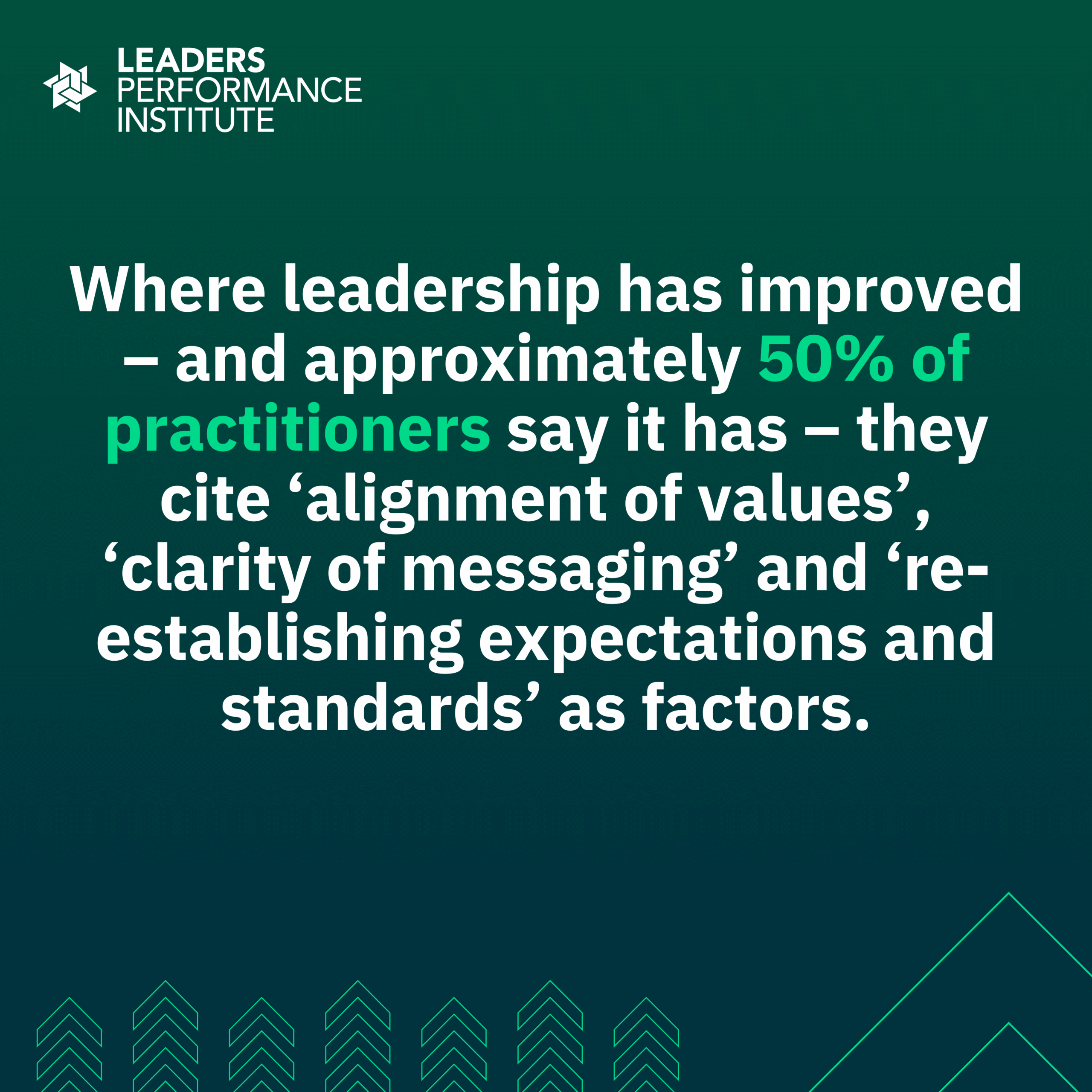
There is still room for improvement: only 12.6 per cent said their organisations are ‘well aligned’.
As Vahid explains, teams could start with the following.
Establish a regular and consistent theme
“Alignment is done best when it’s regular and not just your annual ‘here’s what we’re going after, see you again in 12 months’ time,” says Vahid. “It’s got to be constant. In every meeting there needs to be a regular and consistent theme that people are working towards and, importantly, they know their contribution.”
In 2024, Vahid published A Cultural Hypothesis, which explored the factors that enable a sustained culture of success. One element stood out as a ‘super enabler’ for Vahid: cultural leadership. The term acknowledges that leadership exists on three levels within an organisation:
The guardians, Vahid argues, are critical to alignment. “The reality is that if you’re a senior leader, you’re not going to be on the ground, you’re not going to be able to influence every different scenario – that’s where you need your guardians, your foot soldiers on the ground who are able to distil your message and ensure there is direct alignment to the organisation’s aims.”
NASA’s janitor was a cultural guardian in Vahid’s eyes.
Find the right repeatable words
“Language offers you the opportunity for shared understanding,” says Vahid, “and shared understanding is crucial in alignment, so people know what they’re going after. A leader might not necessarily use the word ‘alignment’, but they’ll be talking about their overall purpose.” NASA’s purpose was simple but powerful. “Your language must be repeatable and resonate with people.”
Vahid also says that high-performing organisations tend to have goals that transcend winning. “It’s important to get everyone behind it. Everyone must believe it is attainable, and it must drive them to want to get out of bed in the morning and come to work.”
What if there’s clarity, but still misalignment?
Vahid explains there could be a few factors at play, all of which point to the importance of feedback:
Staff development needs. If a staff member commits an error of execution, it is an opportunity to deliver developmental feedback. Vahid says: “Does everyone understand what we’re going after? If they do and they step outside of that, then feedback is warranted.”
Psychological safety. “It’s a buzz term,” says Vahid of the commonly used phrase, “but it’s crucial for people to feel they are in a feedback culture.” The leader must show that the intent of feedback is to help the individual to progress. “You’re taking time to give them feedback because you care,” he adds. “You’re then seeking to work with the individual to create that development.”
The leader’s behaviour. Leaders must also demonstrate their willingness to listen to feedback. “They need to provide ‘speak up’ signals,” says Vahid with reference to the work of psychologist Megan Reitz. “The leader needs the skill to understand the position they’re in and the power they carry in that dynamic.”
What to read next
The Brisbane Lions Have Turned Female Athlete Health into a Performance Question. Here’s How
Ian Walsh of Red Bull is renowned for his meticulous approach to tackling some of the biggest waves on the planet. Here he shares his wisdom with the wider sporting community.
Main Image: Fred Pompermayer / Red Bull Content Pool
“In every other part of my life there’s a million things going on. I feel like I always have ten balls in the air. Did I forget to take the laundry out? Did I put it in the dryer? I have bills to pay, groceries to buy. And surfing is one of the few places in the world where that all just drifts away.”
This level of focus may sound familiar to athletes, but the stakes of big wave surfing are something else entirely. One false move and Walsh risks serious injury every time he mounts his board.
Walsh has built a career on his coolness under pressure, which is why he was invited to share his insights at the Leaders Sport Performance Summit at Red Bull Media House in Santa Monica last year.

Ian Walsh poses for a portrait at the Volcom Pipe Pro on 4 February 2018, on the island of Oahu, Hawaii, USA. [Zak Noyle / Red Bull Content Poo]l
1. He acknowledges and harnesses his fear
“Those nerves and everything you fear are natural, and you can use that to elevate your performance,” said Walsh. “It commands every ounce of your being and your focus to deal with what’s coming at you and how you want to navigate it to try and finish on your feet.”
This ability comes with “repetitions and time”. Walsh was in town for a training block at Red Bull’s state-of-the-art Athlete Performance Center ahead of the northern hemisphere summer season. “I’m going to take full advantage of having this amount of time in a facility like this,” he added. “It gives me the chance to push myself in a controlled environment.”
2. He keeps his ‘smart brain’ online
Walsh can keep his ‘smart brain’ online under pressure. It is a term often used by high-performance specialist Rachel Vickery. “Have you got enough buffer in the system to absorb that natural increase in arousal state peaking?” she said on the Leaders Performance Podcast in 2023.
“Every human has a threshold that basically says if my arousal stays below my threshold or below my red line, I can perform in a way that I’ve got a lot more control of. If I’ve got more buffer in the system, so to speak, then when I get the normal increase in arousal it’s still under control and it’s not shooting me across the red line.”
In Walsh’s case, he de-escalates and grounds himself through the ‘breathe-up’ technique, which is a cycle of diaphragmatic breathing aimed at lowering his heart rate and preparing his body to stay relaxed underwater for an extended period.
Additionally, thanks to training alongside Red Bull freediver Kirk Krack, Walsh has learned to hold his breath underwater for up to five minutes. “It’s creating situations where I could elevate my heart rate and then get into a breath hold and understand how my body is going to react and eventually adapt to those scenarios.”
“It’s a skill in and of itself to then go, ‘how do I apply that once this physiological threat response kicks in? How well am I able to adapt and adjust and execute when all those changes happen?’” said Vickery, who would no doubt approve of Walsh’s strategies.
3. He already knows what to do when things go wrong
Walsh has long had a firm interest in meteorology and bathymetry [the study of the seabed, lakebeds and riverbeds]. He can pinpoint with reasonable accuracy when and where the most suitable swells will appear during both the northern and southern hemisphere surfing seasons. He said: “The reason it evolved to so much precision is to give myself as much of an opportunity on those special days as I can, because those days are rare and everything can change so fast on those mega swells.
He then readies his equipment and support team. “By having my preparation done, I can get absolutely smoked on a wave, break my board, everything gets washed onto the rocks, but I have everything ready to go again. I can go right to the boat or the jet ski, get my second board, catch my breath, make sure everything’s good and then get back into the lineup within 15-20 minutes.
“If you don’t have that ready, you could spend two hours dealing with it and it could be another month to six weeks or even the next season when you get another opportunity to push yourself in that calibre of surf.”
His meticulousness extends to listing and ranking restaurant menus in different locations. It drives his partner up the wall. “I take it into my normal life and my girlfriend can attest to how annoying those details are.”
Jokes aside, Walsh’s approach calls to mind the words of mountaineer Kenton Cool, who once told an audience at a Leaders Sport Performance Summit: “People often think of extreme adventure athletes as possessing a ridiculous appetite for risk, that we’re reckless, foolhardy and make illogical decisions. In reality, it’s quite the opposite.”

Ian Walsh photo session for The Red Bulletin, Los Angeles, 19 July 2024. [Maria Jose Govea / The Red Bulletin]
Walsh’s near-catastrophic failures have taught him to be humble when ironing out creases in his performance. “Letting go of some of your ego will create a lot more latitude for opportunities,” he said. “Maybe I did get annihilated on that wave, but I was also an eighth of an inch from making it.”
Walsh studies film of his efforts. He is also a comprehensive note-taker. “I can go back and be like ‘this swell angle, these winds, these tides are shaping up like January 10, 2004 [a date on which he suffered a severe injury – one of several throughout his career]’.” He can then tell himself “maybe I should have ridden this forward or tried those fins. Maybe our water safety protocol could have been a little more buttoned-up.”
What to read next
May shone a spotlight on ‘influencing skills’, leading in complex environments, coach development and finding the right ways to test tech solutions.
“We want to keep on building from this,” said Slegers after her side had defeated Barcelona Femení 1-0 in May’s Uefa Women’s Champions League final.
“We believe in who we are and what we do and we want to keep on building and keep on going next season.”
Slegers, who is less than a year into her first head coaching role, knows the risk of standing still, both as a team and as a head coach.
Throughout the fifth month, the Leaders Performance Institute was on hand to deliver a selection of sessions to help members further hone their leadership skills, from the art of influencing to introducing and managing more efficient processes for testing tech.
Here are some of the choicest cuts.
To influence, you need to listen
Jeff Pagliano of Management Futures hosted an ‘influencing skills’ session for Leaders Performance Institute members as part of our Leadership Skills Series.
He introduced the topic of ‘listening well’, which supports influencing in two specific ways.
“It helps the intimacy part of the trust equation and it gives you the context for a person’s point of view,” he said. “You’re more prepared when the time comes for you to share your knowledge and suggest a course of action.
“Active listening is when you’re not only tuned into what someone says but also what they feel and believe picking up on both their verbal and non-verbal communication is the foundation of intimacy and the antithesis of self-interest.”
He shared the following image to illustrate his point:
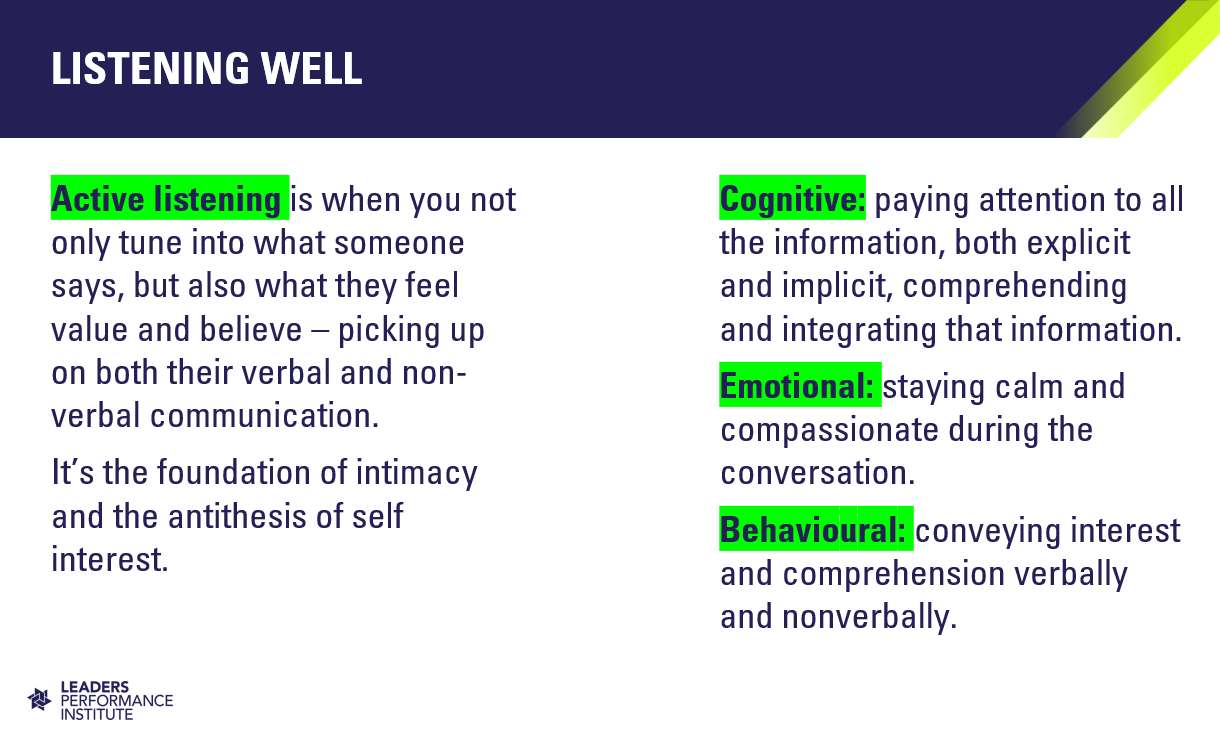
When you’re talking to someone you are hoping to influence it’s always useful to reflect on the goals of each conversation, both what you want and what the other person needs as a way to determine the best way to listen at the moment. And you may realise that a different mode or combinations of modes would be better.
Jeff Pagliano, Management Futures
Top tips for leading in complexity
In May, we also launched a Learning Series that explored adaptability in the complex world of high performance. In the first session, Tim Cox of Management Futures offered a series of seven tips, including: prioritise time for analysing what is changing.
Here’s what that entails:
Read all seven tips here.
Are you able to thoroughly assess tech solutions?
At the beginning of May, we published our Trend Report entitled ‘The Winning Formula for the Future of Performance Sport’.
The report delves into the barriers that prevent organisations adopting new technologies and is informed by more than 200 individuals from nearly 40 sports. While cost was predictably high on the list, three other challenges emerged as equally, if not more, critical.
It was the perfect opportunity to run a virtual roundtable discussing the systems and processes that members have in place at their teams. The table identified a number of critical success factors.
While much of the conversation focused on systems and structures, several participants emphasised the importance of culture and communication as critical to the success of these processes. One high performance manager noted that their organisation is “risk-averse” when it comes to new tech, not because of a lack of interest, but because of a desire to protect core business functions. “If there’s anything we can use to get all the noise out of other people’s way so they can actually do the day-to-day job better, then we’re normally onboard with that.”
Another pointed out the generational divide in digital fluency. Younger staff are digital natives and eager to adopt new tools. Older staff, by contrast, may be more cautious or feel overwhelmed. Bridging this gap requires not just training, but empathy and thoughtful change management.
Additionally, performance sport may need to rethink its leadership structures. In other industries, CTOs and innovation directors play a critical role in aligning technology with strategy. In sport, these roles are rare but increasingly necessary.
Without someone to “own” the innovation agenda, organisations risk falling into reactive patterns and chasing shiny new tools without a clear sense of purpose. As one contributor put it, “We need someone who can sit above the noise and guide us forward.”
Coach development cannot be separated from athlete development
Another virtual roundtable looked at helping athletes to bridge the gap from the youth to senior ranks.
While discussing an array of approaches, the table underlined the importance of investing in coach development as a key influence on transition experiences for athletes. One element of this is ensuring coaches are equipped to recognise and understand different transitions as they occur in different contexts and, therefore, deal with them more effectively.
An environment within the Olympic system explained how their decentralised programme has witnessed new performance records at junior level due in part to their consistent approach to coach development. Their heightened emphasis on coach support and development extends not only to their current athletes but those next on the pathway.
Also, coach-to-coach exchanges enable individuals to discuss both common transitions and those lesser-considered transitions that are nevertheless challenging, such as injuries.
Additional reporting by Luke Whitworth.
Read the Trend Report now
In the first of a three-part virtual Learning Series, we explore why adaptability is becoming a crucial modern leadership skill.
The General Manager of Player Development & Leadership at the Adelaide Crows was speaking in The Winning Formula for the Future of Performance Sport, our recent Trend Report.
The sentiment struck a chord with Jackson’s fellow contributor, Tim Cox of Management Futures.
“We work in sport and other sectors, and there is that feeling of stifling,” Cox told a recent leaders virtual roundtable. “The pace of change, the demands on us are increasing, and it can feel almost suffocating for leaders sometimes. What do we do here? How can we respond effectively?”
Cox, who co-hosted this Learning Series with the Leaders Performance Institute, hinted at the growing complexity of sport and the ever-increasing importance of being able to lead through complexity, which is the overarching theme of a three-part virtual roundtable series that seeks to help leaders develop the necessary skills.
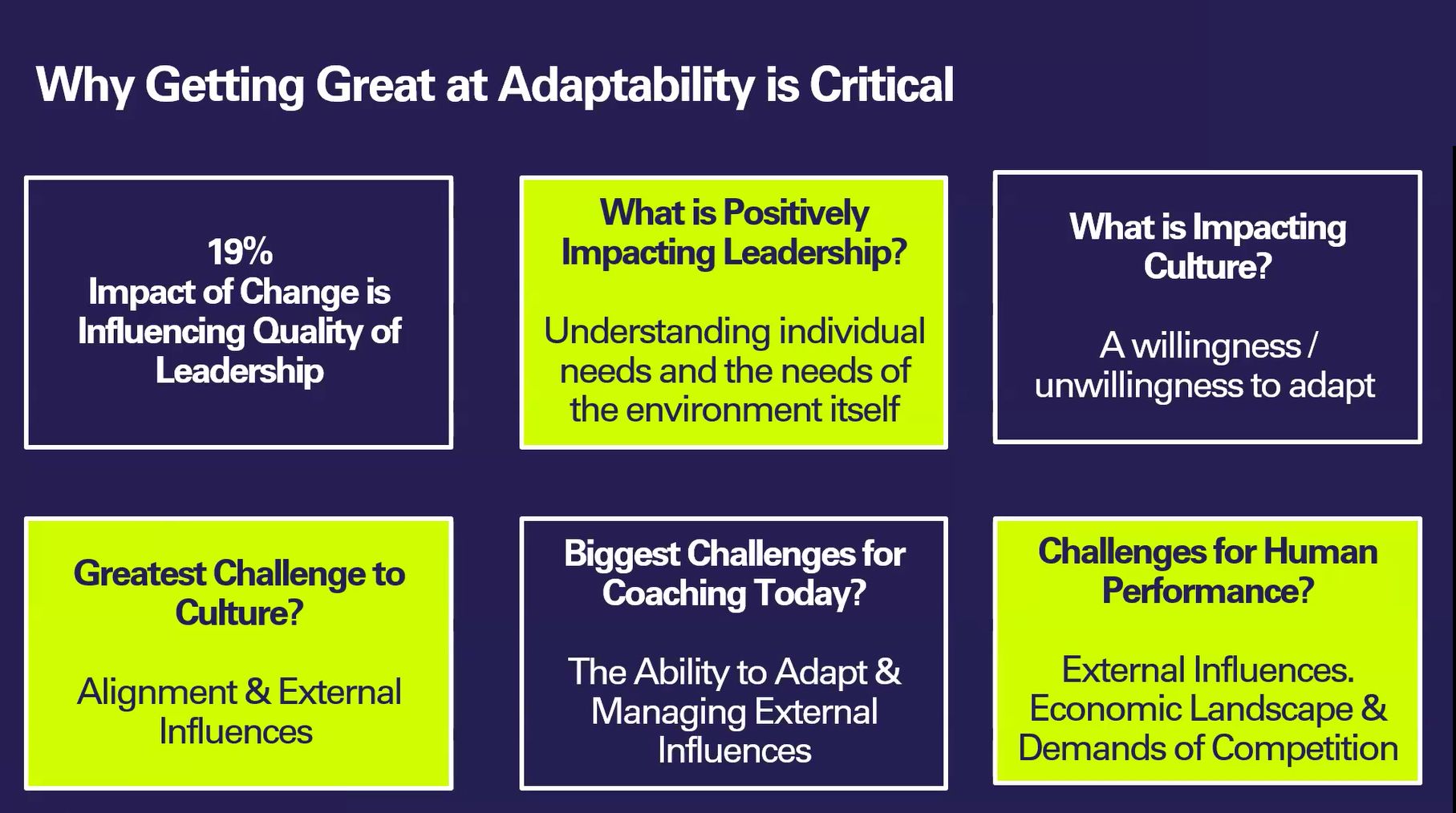
To follow up, we shared five areas where complexity continues to grow in sport. Most if not all will be familiar to athletes, coaches and practitioners alike:
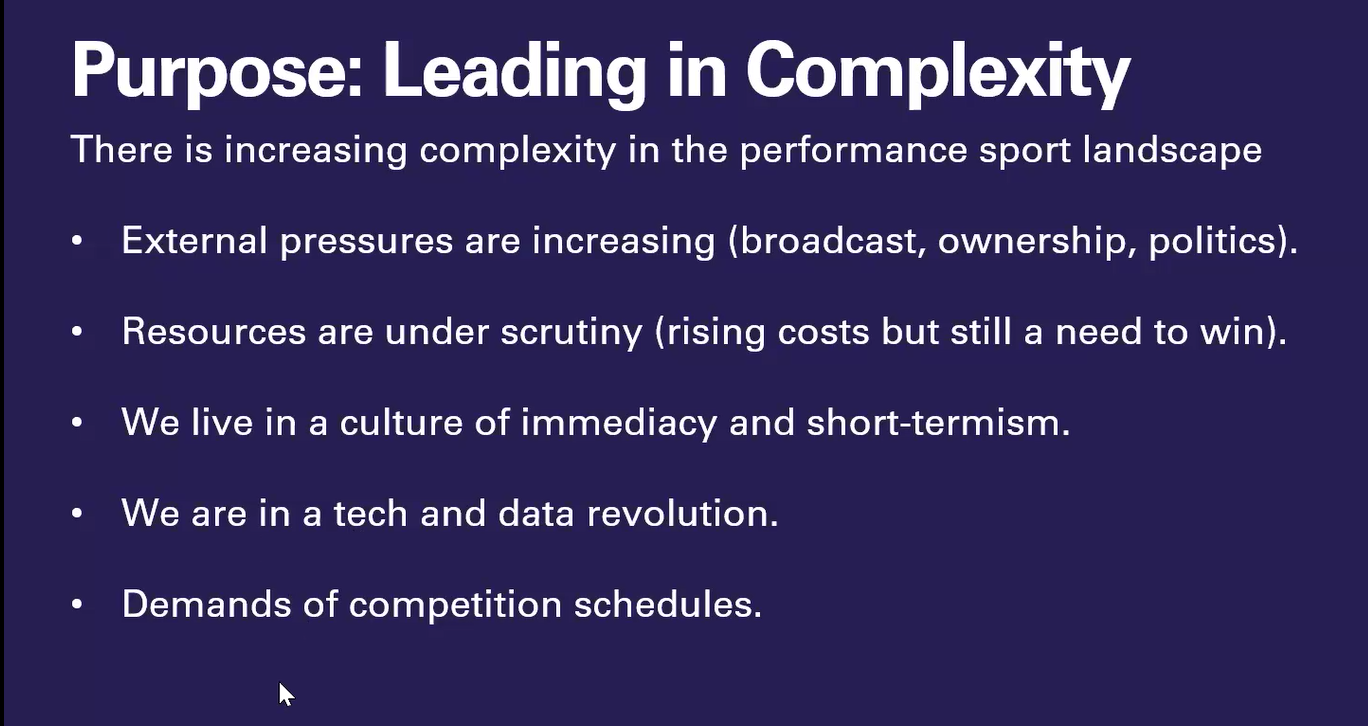
Adaptability: a vital skill
Session one explored the concept of adaptability and how leaders can increase the chance of an effective response from their teams. This came up in the Trend Report. The following also stood out from the report’s findings:
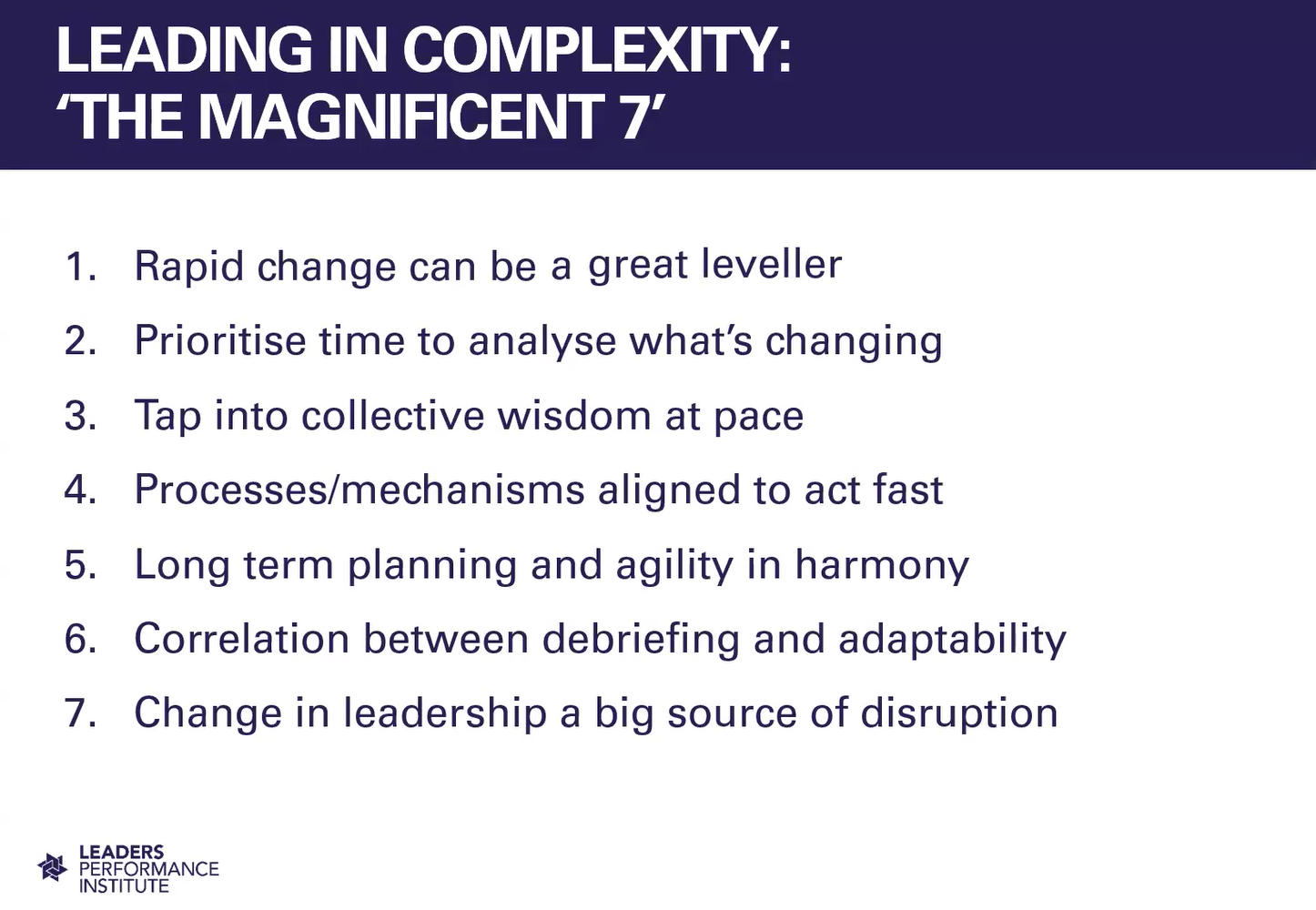
The Magnificent Seven: tips for leading in complexity
Cox distilled his thoughts on the topic into seven ‘magnificent’ areas. “Whether they’re magnificent or not, you’ll be able to make a call on it,” he said.
In a world where change is constant, smaller or less-resourced teams can gain a competitive edge by being more agile.
“This is a simple one: it’s really prioritising time to actually analyse what is changing.”
As one participant said, “adaptive cultures are the ones where everybody has a voice. They can voice feedback, they can push back on ideas, and ultimately, that helps you get to the right idea.”
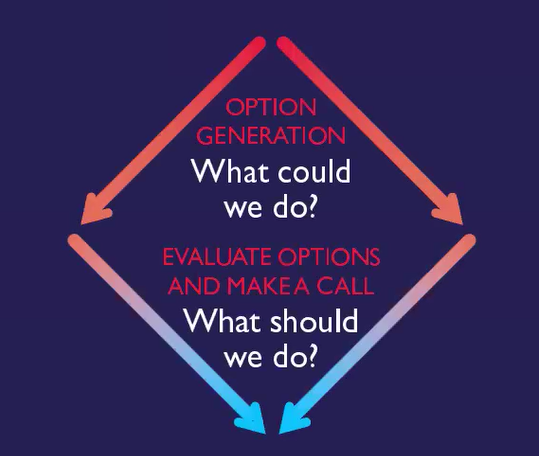
While tapping into collective wisdom is essential, it must be balanced with the ability to make decisions and act quickly. Yet while on-field decisions can be taken in minutes, “off the pitch,” as Cox said, “we can often be inordinately slow in adapting and responding to change.”
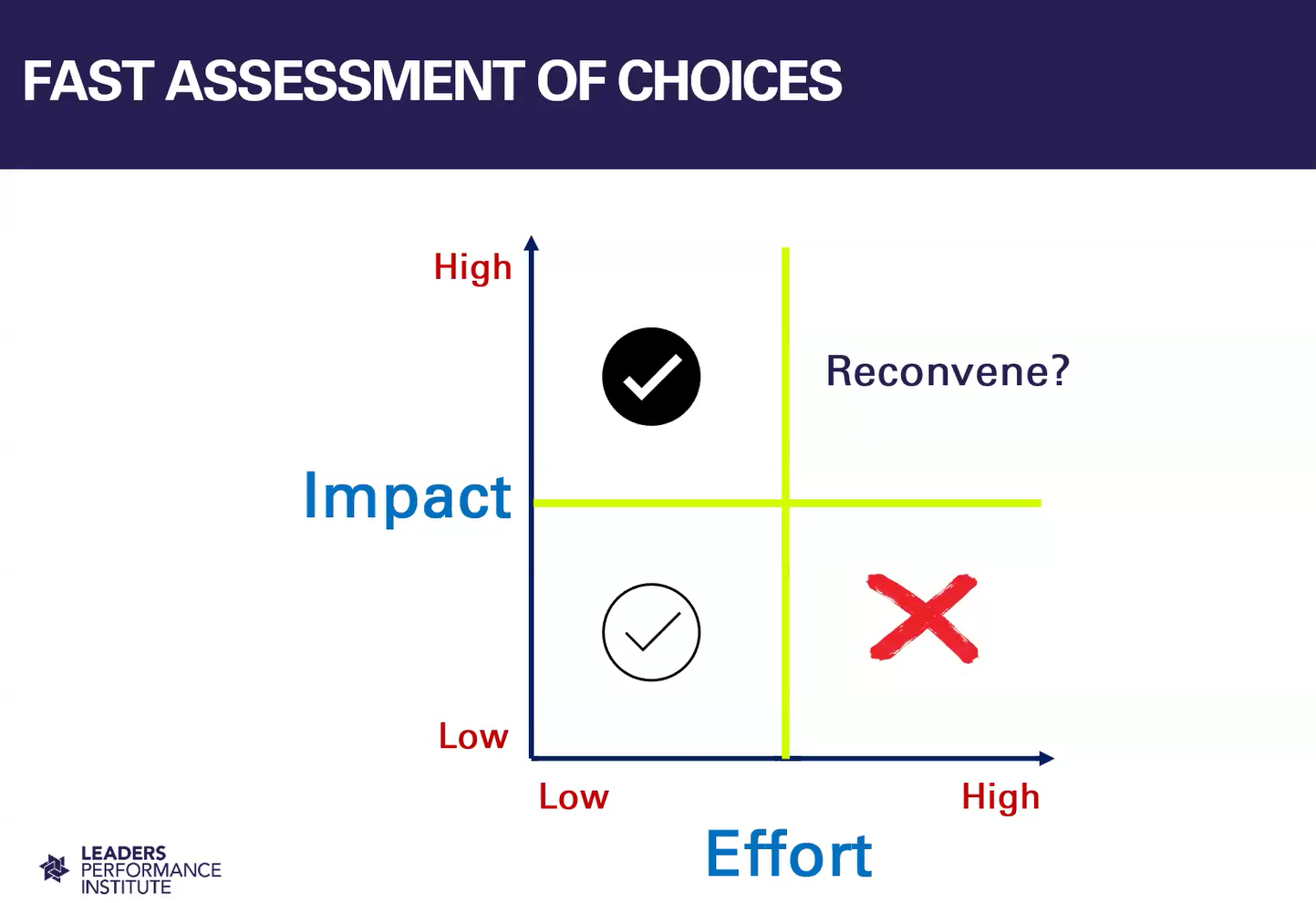
The ideal choices are those that are high impact and low effort. These are the quick wins. Conversely, high effort and low impact choices should be avoided as they are distractions and drains on resource.
Agility requires action, even in the face of uncertainty. Not knowing everything shouldn’t prevent progress.
You can, however, take a structured approach by recruiting wisely, implementing training programmes and pivoting smartly. Teams, Cox suggested, can ask themselves “what are our skill gaps for now or where are we strong now? What are the skills we’re going to need to make this pivot?”
“To adapt, we’ve got to learn,” said Cox with specific reference to the special forces, “and the better we are at debriefing, then the better we are at learning and then adapting.”
He explained that debriefing should be a deliberate, embedded practice. It’s not just about reviewing what happened – or when responding to a crisis – but extracting lessons to fuel future action.
“To what extent can we get these transitions right?” asked Cox. “Because obviously they have big organisational and team impacts, not just on the individuals close to them, they can filter down to the whole organisation.”
Who are your cultural guardians? Cultural guardians, as discussed by Dr Edd Vahid, are the individuals or mechanisms that ensure core values and practices are preserved during leadership changes. They are, as Cox explained, indispensable. “Any new leader is going to want to change things,” he said, “but what are the pieces that we need to absolutely hold on to? What is handed over to the leaders that we know to be true about this culture in this organisation?”
To sum up…
Looking ahead
This session was the first in a three-part series. Future discussions will explore:
Part 2: Inhibitors to adaptability – what gets in the way?
Part 3: Building a collective playbook for leading in complexity
In a recent Leadership Skills Series Session, Jeff Pagliano of Management Futures set out a series of tools, including the trust equation, active listening and ‘flows of knowledge’.
“Influencing is often strictly correlated with the level of knowledge or technical insight we can offer in any given situation and our ability to communicate that knowledge effectively,” said Jeff Pagliano, a consultant with leadership specialists Management Futures.
“However, influencing we believe is much broader than this.”
Pagliano was hosting an ‘influencing skills’ session for Leaders Performance Institute members as part of our Leadership Skills Series.
“A lot of you are employed to lead or influence outcomes, not for your technical knowledge but for your ability to build trust, grasp complex ideas, think rationally, and motivate,” he continued.
“The best influencers are often those who listen carefully to the needs of those around them, ask the right questions, and then communicate a compelling vision. And this has as much to do with credibility as knowledge does and, interestingly, the further you go up in an organisation, the less useful your IQ, your technical knowledge, is and the more useful your EQ, your emotional intelligence.”
Over the course of an hour, Pagliano explained why your ability to build trust, actively listen, and communicate compellingly – areas in which we can all improve – underpins your ability to influence.
‘The trust equation’
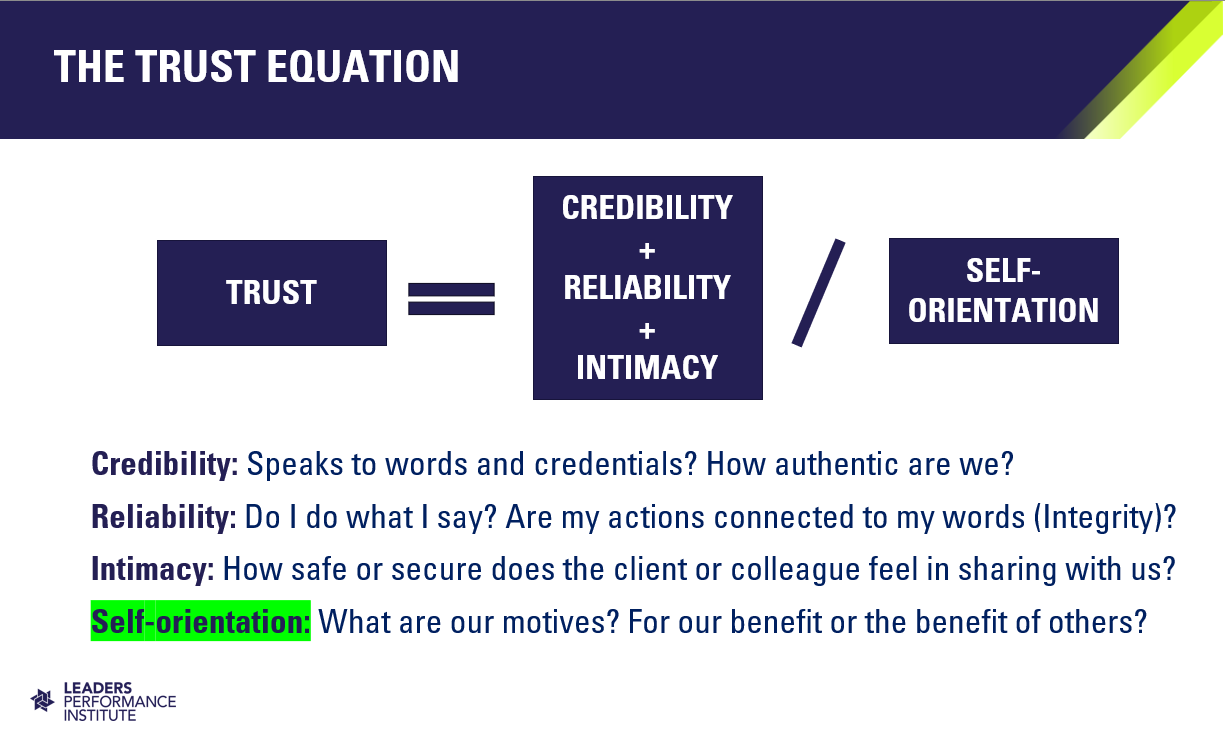
To start, Pagliano presented the trust equation to the group:
He then explained his thoughts on each:
Trust =
Credibility: “This speaks to both words and credentials. People should be confident that you know what you’re talking about, but it may not be just about the content, it could be how you show up as well. Credibility is a blend of what you know and how you present yourself.”
+
Reliability: “You do what you say you’re going to do. Your actions are connected to your words and your follow through. One thing that’s interesting to note is that people will sometimes over-promise and under-deliver; and it’s a very natural instinct to do that because we naturally want to please or we want to show the best of ourselves but, actually, over the long term, this can really work against you.”
+
Intimacy: “If credibility and reliability are the sort of things that are quite concrete, intimacy is a little more ambiguous. It’s more to do with the sense you have that someone will be there for you, and you try to gauge how emotionally intelligent they are. You’re noticing how well they listen, how much they connect, how much warmth they have, how much understanding. It’s less concrete, but equally important.”
/
Self-orientation: “Anytime you are building trust you do have to have some self-orientation because in any kind of negotiation or where you’re looking to influence, it would feel suspicious if someone thought you were entirely magnanimous about everything and you had no vested interest in anything. It’s about getting the right amount and not letting it overwhelm the other three. That’s why you have the first three divided by self-orientation.”
When you’re focused on being more genuine and interested in the other human being good things are going to flow for that, opportunities flow from that, but if the opportunity is so prevalent in the conversation that you’re trying to jump on it constantly, the other person’s going to feel it.
Active listening
Pagliano then introduced the topic of ‘listening well’, which supports influencing in two specific ways.
“It helps the intimacy part of the trust equation and it gives you the context for a person’s point of view,” he said. “You’re more prepared when the time comes for you to share your knowledge and suggest a course of action.
“Active listening is when you’re not only tuned into what someone says but also what they feel and believe picking up on both their verbal and non-verbal communication is the foundation of intimacy and the antithesis of self-interest.”
He shared the following image to illustrate his point:
When you’re talking to someone you are hoping to influence it’s always useful to reflect on the goals of each conversation, both what you want and what the other person needs as a way to determine the best way to listen at the moment. And you may realise that a different mode or combinations of modes would be better.
Flows of knowledge
“If the trust equation is where it should be and you have been listening well, you have laid the groundwork to engage with the person you are trying to influence in conversation,” said Pagliano in taking the conversation further. “We have a great framework for you to use: it is called “flows of logic.” Pagliano cited former BBC presenter Stephanie Hughes in his explanation:
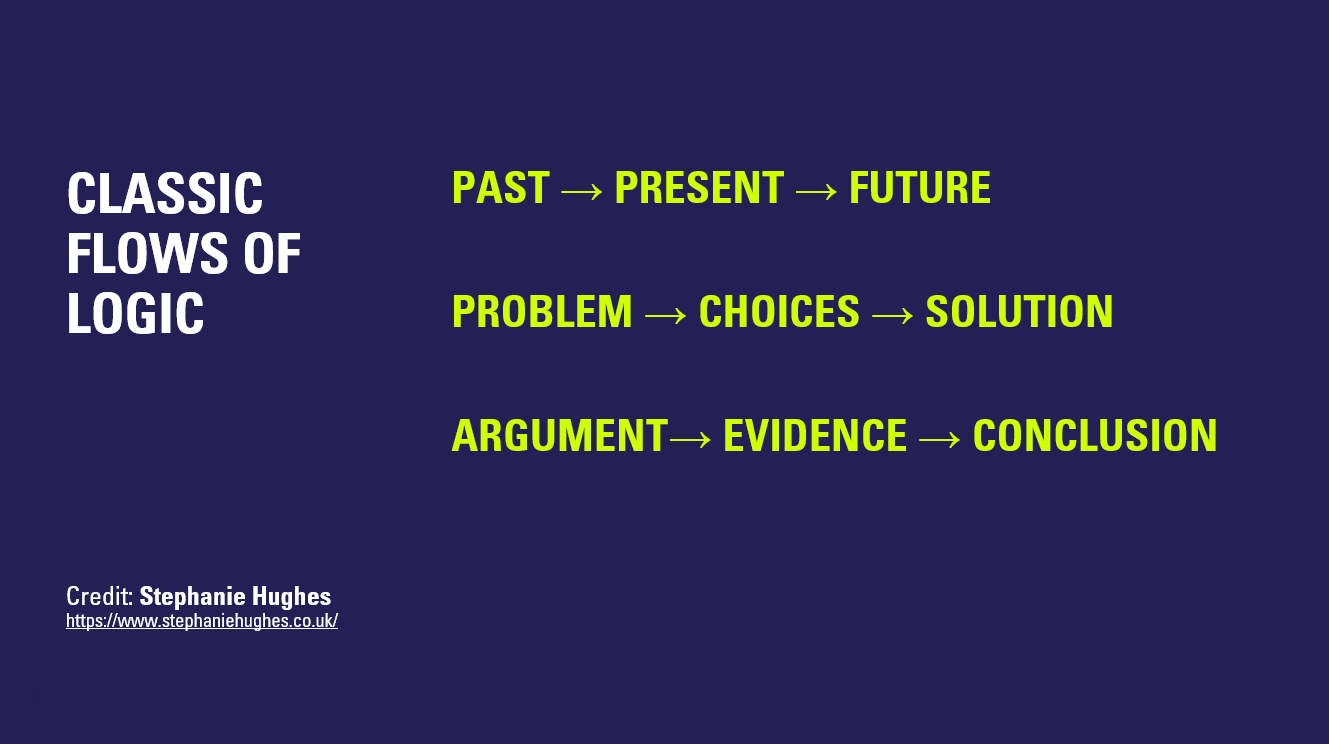
Pagliano explained their value, particularly in non-rehearsed, spontaneous conversations:
Past → Present → Future
“When you go through these phases of logic, it’s the middle word that is important. Like in the first one, if we just say, ‘in the past we did this’ and ‘then in the future, we’re going to do that’ and you don’t give any context for the present, it’s less powerful.”
Problem → Choices → Solution
“[To say] ‘here’s a problem or solution’ – that’s not an influencing tool – that’s just a command. To present choices shows your credibility.”
Argument → Evidence → Conclusion
“The third could happen when you’re pushing back at someone who’s come at you with a different opinion, and here this is where the middle word is important, because if you just say, ‘I believe this and here’s a conclusion’, it’s just an opinion. But if you add evidence, it becomes more than an opinion. It becomes a fact, and it becomes far more concrete. It’s much more objective because it’s based on evidence.”
You want to sound like you know what you’re talking about and you’re not floundering and, if there’s a logic to what you’re saying, the information is more easily understood and retained, so these serve a multitude of purposes.
The final factor: push and pull skills
Pagliano presented a final slide:
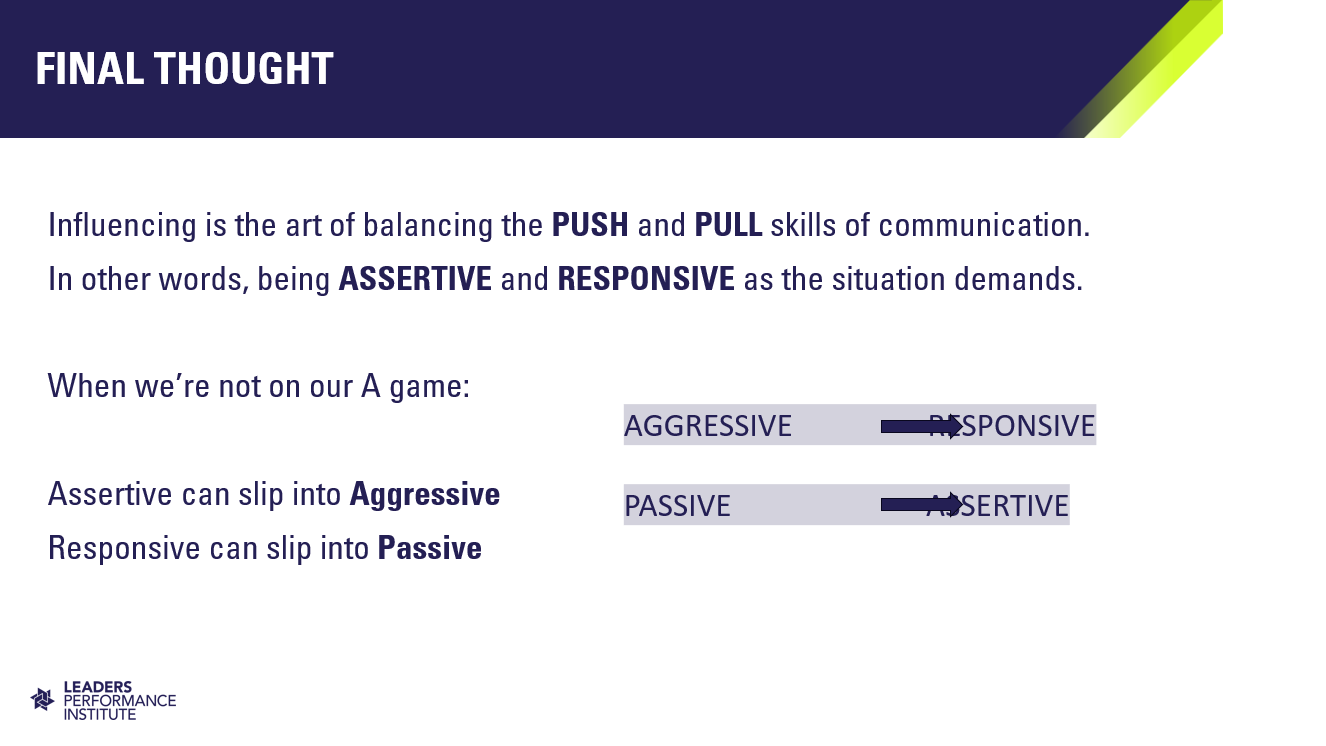
“Effective influencing is our ability to balance those push and pull skills,” he said.
“The ‘push’ would be that flow of logic. When you’re a subject matter expert and you’re trying to communicate your point of view in a way that moves the other to take a recommended course of action, those pull skills [build] that trust equation, the active listening, and it’s good to reflect where we need to focus more.
“Often, ‘push’ comes more naturally for people, and when we’re not on our A game, those of us who have a propensity to be more responsive can slip into passive; and those of us who are more assertive can slip into aggressive.”
Aggressive: go to responsive. Passive: go to assertive. And make sure you’re constantly aware of those push-pull dynamics.
What to read next