Leaders in Business
  • Membership
  • Events
  • Content
  • Virtual Learning
  • Connections
  • Partners
Login
  • Leaders Meet: Innovation
  • Events
    • Leaders Week London
    • Leaders Sports Awards
    • Leaders Club Events
    • Leaders Performance Institute Events
    • Leaders Meet: Innovation
  • Memberships
    • The Leaders Club
    • Leaders Performance Institute
  • About
    • Careers
    • Contact
I’m a sports leader:
  • Off The Field For those focused on the business of the sport View more
  • On The Field For those working with an athlete or elite team View more
  • Login
    • Leaders ClubThe membership for future sport business leaders
    • Leaders Performance InstituteThe membership for elite performance practitioners
  • Newsletters
Performance Institute Leaders Performance Institute Logo
  • Membership
  • Events
  • Content
  • Virtual Learning
  • Connections
  • Partners
Login

23 Aug 2023

Articles

Easy, Accessible, Social and Timely: Exploring the Environmental Nudges Available to Coaches in High Performance

Category
Coaching & Development, Leadership & Culture
Share
Facebook Twitter Email Copy Link
https://leadersinsport.com/performance-institute/articles/easy-accessible-social-and-timely-exploring-the-environmental-nudges-available-to-coaches-in-high-performance/

In the second half of a our two-part interview, physical performance coach Ben Rosenblatt discusses behavioural nudges and the gamification of training.

By John Portch and Sarah Evans
When it comes to performance, the current generation of athletes are, on the whole, better informed and more inquisitive than their predecessors.

But what can a practitioner do when an athlete doesn’t ask ‘why’?

“There’s a few options,” says Ben Rosenblatt, a physical performance coach who has worked with the England men’s football team, GB and England women’s hockey teams and Olympic Judoka amongst others.

“Do you know them well enough to understand why they don’t want to know? If it’s because they just want to get told, they’ve got trust, and they don’t want to know ‘why’, they just want to crack on with it and say ‘go on then, give us the programme’, I’ll commit to it, we’ll give it a crack, and then afterwards we can work out how well that worked.

“Do they not want to know ‘why’ because they’ve disengaged? If so, then you might just see them floating around a session or trying to disrupt others.

“The other one is that they’re just not that interested in physical conditioning and preparation because not everyone is. Most people take up sport or play high level sport not because they love doing press-ups and sit-ups, it’s because they love their sport.

“So you’ve got to try and understand the reason why they’ve disengaged and you’re also trying to find out, as a consequence, how they’re best going to receive information. So you can just ask some really simple questions to ascertain that. If it were you and me working together I’ll ask: ‘what’s the best way that we communicate with each other? What do you need from me? what’s important to you physically? what’s worked in the past?

“You might say: ‘I just need a programme and to crack on’. That’s absolutely fine and that’s what you’re going to get. But then we can also ask the athlete ‘can we review it every six weeks?’ This will give you both the opportunity to learn more about each other.”

This is the second part of our interview with Rosenblatt, who discussed behavioural mapping in the first instalment.

The conversation takes a turn into nudge theory, which is defined by Imperial College London as: ‘based upon the idea that by shaping the environment, also known as the choice architecture, one can influence the likelihood that one option is chosen over another by individuals.’

“This is where you bleed into the gamification of training and environmental nudges to encourage people to engage in stuff they might not necessarily want to,” says Rosenblatt, who in 2021 visited the Behavioural Insights Team (commonly known as the ‘Nudge Unit’), which previously operated under the auspices of the UK Government but is now run independently. It has informed his approach, as have visits to University College London, the University of Bedfordshire, and the Design Museum in London.

Returning to nudge theory, Rosenblatt says: “The basic principle is called EAST, which is making things: easy, accessible, social and timely.

“If you can make anything align with any of those four things, if you can make something really easy to engage in, really accessible, so it’s at the right time and the right place, it’s part of the social environment and it’s timely, it’s at the time when they should be doing it, then you’ll absolutely get the behaviour change.”

He cites an example from his time with the England men’s football team. “One problem was how we get the players to go in the pool immediately after training on a particular day with the physical performance team. Using nudge principles we decided to nick the players trainers and put them in the pool area! This meant, to walk back to the hotel, they had to go to the pool first! We also put recovery shakes in there and scattered some balls and some inflatables in the pool. So when they went to get their trainers, it was easier to take a shake and then jump in the pool with their mates rather than leave! They ended up staying in for half an hour or so.

Gamification can be a useful tool in training environments. “If it’s a group that does want to engage a little bit more, like the hockey girls, then you do things like have a synchronised swimming competition. Again, if you’re saying we’re going to do a pool recovery session, then the players will come in knackered, they’ll go up and down the pool for 10 minutes and get out. If we say we’re having a synchronised swimming competition and you’ve got 15 minutes to come up with a routine, they’re in there for 40 minutes working out what the routine is, hanging around the pool to play afterwards etc. Those are ways you can get players that just aren’t interested or who don’t want to know. Rather than giving them full autonomy, you create an environmental nudge that means that they have to dive in there literally.

“There’s other ways of doing it. One other idea is to play with the schedule. OK, so let’s say you’re trying to introduce a new form of training to the group (like strength work). Rather than make the session an additional training session, make it part of the original training session. So if they’re coming into the gym before going onto the grass, start with a familiar warm up, something they’re comfortable with and then you introduce the new activity as a competition. If it’s aligned to something you want them to get better at and want them to improve at; because it’s a competition everyone’s automatically engaged in it.

“Again, this is more relevant to athletes who aren’t as engaged with their physical preparation. But if you do a familiar warm up and there’s some little competition then they’re automatically going to engage in it.  If it’s aligned to the physical outcome that you want, then they’re going to improve! The best way I’ve found of organising competition for maximum engagement is 1 1v1 competition in a team v team scenario… essentially you stack up points for your team by winning individual competitions against your opponents.

“You can then start to make it fun. We had an ongoing jump squat competition throughout the Euros where the players would compete for boxing belts based on how fast they were moving the bar. Training intensity and enjoyment went through the roof! All the athletes have noticed is that they’ve had a bit of fun and they’ve enjoyed themselves whilst being really physical. But if you start stacking that up over a course of two, three, four or five weeks, you’ve got a really strong physical conditioning response there.”

Ben Rosenblatt is the Founder of 292 Performance.

Want to discuss environmental nudges with Ben?

Email: [email protected]

Twitter: @ben_rosenblatt

Members Only

22 Aug 2023

Articles

Effective Talent Development Models: Why Individualisation and Interdisciplinary Are Critical Features

Category
Coaching & Development, Premium
Share
Facebook Twitter Email Copy Link
https://leadersinsport.com/performance-institute/articles/creating-effective-talent-development-models-why-individualisation-and-interdisciplinary-are-critical-features/

In the second session of his Performance Support Series on talent development, Edd Vahid of the English Premier League discusses individualisation and interdisciplinary support.

By Luke Whitworth
Our latest Performance Support Series explores the past, present, and future of talent development. This series of learning is being delivered by Dr Edd Vahid, the Head of Academy Football Operations at the English Premier League.

For the second session of the series, Vahid outlined a few aims for those in attendance, as we continue to explore the ‘5 I’s’ model first shared in session one. If you missed out on the first part of this series, you can read about the model and other key points here. The aims were as followed:

  • Introduce individualised and interdisciplinary support as critical features of successful talent development models.
  • Discuss the challenges, tensions and opportunities in individualising support.
  • Explore the conditions that allow interdisciplinary support to thrive.

Being individualised

As part of the first session of this series, attendees were asked to rank themselves around their effectiveness of the ‘5 I’s’ model. On a ranking of 1-5, below were the responses for the two parts of the model we explored in session two:

  • Individualised Support: 4.1
  • Interdisciplinary Support: 3.8

These responses provided some interesting insights into where we think we are in relation to our talent development frameworks and environment. Providing individualised and interdisciplinary support, scored highest out of the five elements of the model, but with clear room for improvement.

To help us think about the importance of being truly individualised, whilst also appreciating the tensions and challenges that come along with this, Vahid brought in some of the work from author Todd Rose and renowned sociologist Pierre Bourdieu to elevate these points.

The End of Average

In Rose’s The End of Average, there was an anecdote highlighting bodies of research by the US Air Force into why there were so many incidents, despite having some of the best pilots in the world and the best technology. One of the key summaries was that the cockpit was built upon the average needs of a pilot rather than the specific needs.

Out of 4,063 pilots, not a single airman could fit in the cockpit, within the average range on all 10 dimensions. One pilot might have a longer-than-average arm length, but a shorter-than-average leg length. Another pilot might have a big chest but small hips. Even more astonishing, (Lt. Gilbert S.) Daniels discovered that if you picked out just three of the ten dimensions of size — say, neck circumference, thigh circumference and wrist circumference — less than 3.5 per cent of pilots would be average sized on all three dimensions. Daniels’s findings were clear and incontrovertible. There was no such thing as an average pilot. If you’ve designed a cockpit to fit the average pilot, you’ve actually designed it to fit no one.

This passage in The End of Average highlights that being truly individualised is crucial in allowing us to optimise the support and impact we can have on individuals. It is also worth noting that individualisation continues to be a challenge with the scales we are operating at, and the resources we have at our disposal.

Habitus, field and capital

To align to the work of Rose, we complemented this with the research of Bourdieu, whose work encourages us think more deeply about ‘the individual’ and, in our context, who we are trying to provide individualised support for.

Bourdieu talked about the concepts of habitus, field and capital.

‘Habitus’ is the ‘product of history, (that) produces individual and collective practices. It ensures the active presence of past experiences, which, deposited in each organism in the form of schemes of perception, thought and action… Bourdieu and Wacquant suggest that when an individual encounters an environment that is compatible with their established habitus, they are like ‘fish in water’. It’s important to recognise that we all have individual habituses; we’re different.

‘Field’ is the social arena, where people compete for resources and demonstrate their power.

‘Capital’ is the notion of competing in a field and enhance social position – individuals require capital. Different forms of capital might exist and potentially include physical and economic. The new environment (field) establishes the cultural, social and symbolic. An individual must adapt if they have aspirations for distinction and subsequent progression. Relevant to us, how are we creating experiences to better prepare our talent for what’s next?

The tensions in being individualised

We know that being individualised is an important element of an effective talent development model. However, we must acknowledge the tensions and challenges that can exist around this. Some of these tensions and challenges can be ironed out, some just exist and are hard to eradicate. Based on some of Vahid’s experiences, he shared a few that he often sees:

The individual and / or the team. Cohesion is an important part of a high-performing team. There could be a tension in an individual who isn’t in the higher grading from an individual performance point of view, but is a strong contributor to team cohesion or getting the best out of others. What do you do?

Performance vs potential: many environments experience the challenge of defining potential – what is it and how are we assessing it? How predictable can we be in that assessment? There are many examples of individuals who were judged to not be at a particular level, but have moved to another environment and thrived.

Club and organisational philosophy. It depends on the organisation and what the philosophy is. Is it about prioritising and getting one or two athletes in the first team environment? Therefore, you would be in your own right to focus on A-grade talent and not so much those that might support the cohesion of the group.

Interdisciplinary support

‘If the only tool you have is a hammer, you tend to see every problem as a nail’ – Abraham Maslow

At the heart of these conversations, the value of having multiple eyes and different perspectives that add value. An effective multidisciplinary team, working in an interdisciplinary fashion is reliant on an inclusive environment where everyone can turn up and truly express themselves and feel comfortable in contribution. How do we get an interdisciplinary function to work effectively?

The conditions

Psychological safety is an underpinning concept that supports interdisciplinarity. The work of Professor Timothy Clark at Durham University, a specialist in environmental humanities and deconstruction, suggests that the first step is about inclusion safety and how we as leaders or individuals are contributing to a team to ensure there is suitable inclusion into conversations, allowing everyone to contribute.

Author Patrick Lencioni’s work around the ‘The 5 Dysfunctions of a Team’ suggests that the heart of dysfunction is the absence of trust. Invest time to ensure that the individuals can show up to enable the multidisciplinary team to work in an interdisciplinary fashion.

Judgment criteria. When giving consideration to how disciplines or individuals are judged, these have to be aligned with the organisational vision. Each discipline can have their own detailed judgment criteria and if that is not aligned it can cause separation which undermines the ability to work in an interdisciplinary fashion. To underline this point, it’s also important to have interdisciplinary markers of success.

Role clarity. A consideration for how the various disciplines are inducted for how they contribute to the bigger picture.

How do we physically create the conditions for conversations? How are you working to create flow and connection in an organisation? In Edd’s experience in talent development environments, there’s been a strong push to get multidisciplinary teams sitting closer together to enhance interdisciplinarity but do we need to be doing more than just where people sit and creating more conditions within the environments to support this way of operating?

Members Only

18 Aug 2023

Articles

Hawk-Eye and the Future of Officiating in the NBA

Category
Data & Innovation, Premium
Share
Facebook Twitter Email Copy Link
https://leadersinsport.com/performance-institute/articles/hawk-eye-and-the-future-of-officiating-in-the-nba/

As the league introduces Hawk-Eye as its new tracking technology, the level of granular detail available to officials is set to grow.

Main Image: Hawk-Eye

A Data & Innovation article brought to you by

sport techie
By Joe Lemire
The future of officiating in basketball may reside in a broadcast trailer, sitting in a parking lot in the baking hot Nevada desert. The unassuming exterior belies the (thankfully air conditioned) interior where Hawk-Eye has set up a pair of workrooms, adorned with desks, monitors, a referee-connected intercom and more monitors.

To the right is the group overseeing the implementation of the Hawk-Eye player and ball tracking system that is set to replace Second Spectrum as the raw data collector and enhance the offering by providing 3D pose data via 29 points on the body, rather than a single center of mass. To the left is the on-premises replay room, a luxury not typically afforded the NBA Summer League.

The Summer League, which took place between July 7 and July 17, was used as an experiment in innovation, as the league conducted a final test of its new tracking provider while also assessing new avenues of reviewing close calls and then communicating those decisions swiftly to the earpiece or wristwatch of an on-court official.

“Number one is just a dry run of the core tracking system because that’s the lifeblood of team front offices and Sportradar, our partner — we want to make sure that is working because that’s the foundation of all this,” said NBA Basketball Strategy VP Tom Ryan, who oversees technology initiatives. “Building on top of that, we are, for the first time, going to see what a fully-integrated, tracking-plus-video replay system looks like. We’ve never used tracking data live in a replay center.”
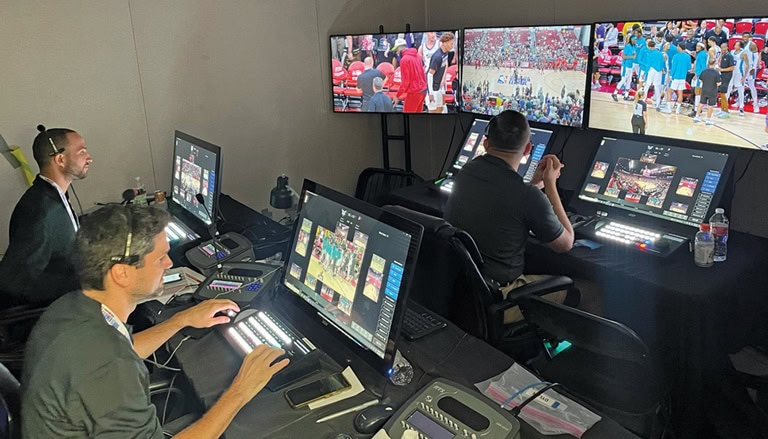
Image: Joe Lemire

The legacy product of Sony-owned Hawk-Eye is its precision ball tracking used to adjudicate line calls in tennis before an expansion to tracking players, their limbs and balls in other sports, like MLB. Its other primary offering is the Synchronized Multi-Angle Replay Technology (SMART) video replay that’s used by the NFL and others.

Now, the NBA is pairing the two with an eye toward generating supplemental evidence to help referees make decisions on goaltending, the primary point of emphasis this year. Foot-on-the-line and last-touched-out-of-bounds calls will be in R&D all year. In the future, those determinations could be fully automated, though that step would require sign off from the Competition Committee and the National Basketball Referees Association.

“Our top objective here at the Summer League is to showcase how all of our different technologies can come together to create this synergy of solutions to provide the NBA with ultimately what they need to better officiate the game,” said Dan Cash, Hawk-Eye’s Managing Director for North America. “We believe that if you couple that [tracking] with replay, which we’re demonstrating here, you have a really powerful tool to be able to officiate the game efficiently and effectively.”

Hawk-Eye installed its optical tracking system in every NBA arena over the course of two months, January to March, this year. It entails 14 cameras with 4K resolution that are expected to operate at 120 frames per second — double the broadcast standard for sports — and could go even higher, although the requisite processing power necessitates a trade-off with latency. A 15th camera may be deployed at times that’s capable of a whopping 1,000 fps with even greater resolution.

What these cameras provide, first and most obviously, are more angles of the action. A questionable three-pointer in the Summer League’s first few days lacked a conclusive broadcast view, but one of the Hawk-Eye cameras had a better angle to confirm the foot was behind the line.

But the tracking data provides a new dimension of analysis. The NBA flew out its usual Secaucus-based replay operators for a trial. “It’s video plus data, which is a new skill to learn,” Ryan said, adding that “we have a different [replay] partner that we’re really happy with,” referring to EVS. Hawk-Eye’s three prior visits to the Summer League were all for testing in the background; this is its first time used in games.

The cameras collect positional data of the basketball and players’ hands, then apply the rules of goaltending and the laws of physics. On the replay operator’s screen are yes-no indicators for the goaltending criteria.

“Goaltending is relatively easy — if the ball passes its apex, if it’s over the cylinder, if it’s touching the backboard — those are all pretty defined use cases, but if we haven’t collected data for a significant amount of time, you don’t have a historical data set to refer to, to understand where your pain points are,” Hawk-Eye Commercial irector Justin Goltz said.

“Realistically, the technology moves in at a pace that it can do it relatively quickly, but there’s a lot of logistics to get it from this broadcast truck, or from the stadium, down to the court that needs to be hashed out over a season or two.”

The operator also sees a second-screen experience with a replay animation similar in spirit to what Hawk-Eye has made famous in tennis. The NBA is still evaluating the best presentation of information and visuals to, first, help make the correct call and, second, show the fans. “A big part of this initiative is just more transparency,” Ryan said.
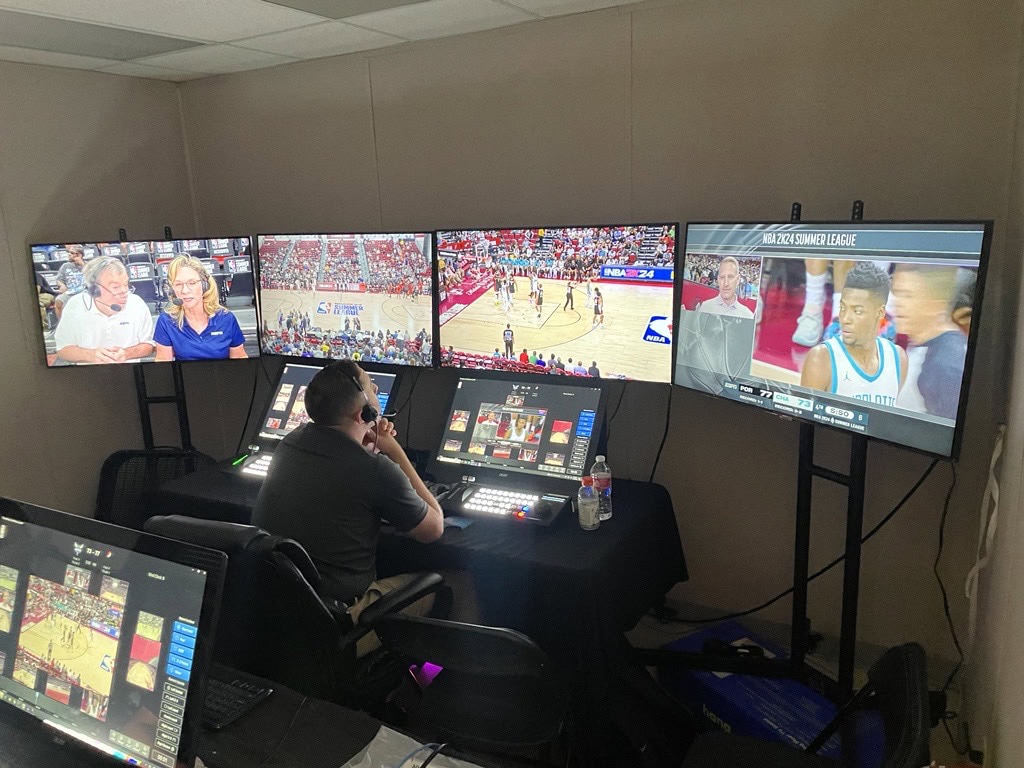
Image: Joe Lemire

Following the same adage that content is king but distribution is queen, so too with this enhanced replay format is that accuracy is paramount, but efficiency is critical, too. The league is testing two methods of communication to its referees: both audible messages to an earpiece or haptic and written transmissions to a watch.

The NBA, for example, introduced a new mechanism for relaying a scoring change from the replay center to the on-court officials last year. If a two-pointer became a three, or vice versa, a blue light would flash at the scorer’s table. The problem: looking in that direction was never part of the usual routine or field of vision. Of about 120 such blue light indicators, only five were organically spotted.

That’s an obvious starting point — and not novel as other sports, such as soccer, have done this for years — but it could lead to other use cases.

“Live communications with the ref is definitely a core component of our strategy because if we’re doing all this work on the automation side,” Ryan said, “you have to be able to communicate that with the ref in real time.”

This article was brought to you by SBJ Tech, a Leaders Group company. As a Leaders Performance Institute member, you are able to enjoy exclusive access to SBJ Tech content in the field of athletic performance.

8 Aug 2023

Articles

Do your Team’s Behaviours Truly Match their Performance Ambitions?

Category
Coaching & Development, Human Performance, Leadership & Culture
Share
Facebook Twitter Email Copy Link
https://leadersinsport.com/performance-institute/articles/do-your-teams-behaviours-truly-match-their-performance-ambitions/

In the first instalment of our two-part interview, physical performance coach Ben Rosenblatt considers the benefits of behaviour mapping a programme.

By John Portch and Sarah Evans
What causes athletes to develop self-defeating behaviours in a high performance environment?

“My starting point is that no one is trying to do it,” says physical performance coach Ben Rosenblatt.

“As a high performance athlete, everyone’s got the intent to go and win. No one turns up to training every day thinking ‘I’m going to be difficult today’. You can turn up and say ‘I don’t really fancy it’ because that’s what humans do, but no one has the intention to be bad.”

Rosenblatt was the Lead Men’s Physical Performance Coach at the Football Association between 2016 and 2023 and was part of Gareth Southgate’s staff at two Fifa World Cups and one Uefa European Championships. He has worked across a series of sports and has worked at both the English Institute of Sport (now UK Sports Institute) and the British Olympic Association.

In the first part of our interview, Rosenblatt makes the case for a framework that enables a practitioner to bridge performance gaps.

‘Things didn’t match up’

Rosenblatt explains that his approach when entering a programme has evolved, although his principles remain unchanged. He says: “It is a case of identifying what the team’s ambitions are, seeing how resonant they are with what they’re trying to achieve, and then identifying the behaviours that should be in place to deliver that.”

He recalls an example from an Olympic sport where those two were misaligned. “One team wanted to be the best in the world and the most physically dominant,” Rosenblatt continues. “For me, those things didn’t match up, particularly when I spoke to the athletes and coaches and heard a different narrative.

“When I dug into it with the athletes and coaches and asked ‘what are the hallmarks and successful traits of teams you think are going to enable you to win and how are we going to do it?’ Then I quickly realised that their ambitions around being physically fittest and the most dominant were probably not the thing that was going to help us win in the Olympics.”

A gold medal-winning performance did not require a well-executed 30-15 intermittent fitness test or bleep test. “There were problems with basic things like stability and robustness and just being able to train frequently enough. We can go and chase all the sexy stuff, which physical conditioning coaches really want to do like speed and agility, strength and power, but what we really need to do is keep the players playing consistently and increasing volume and intensity for their sport-specific training because that’s what will make them a better team.”

‘How does that individual learn?’

Why might a team fall into a poor behavioural pattern in the first place?

“It typically comes from a gap in capabilities, knowledge, skills and experience,” says Rosenblatt. “It can also be their opportunity, so the social environment they’re in; and then their motivation.”

He explains that a coach’s understanding of athlete motivation may be flawed. “A coach might say ‘they just don’t want it enough’ or ‘they just don’t know enough’ then you can end up in a fight with an athlete who says ‘what are you talking about? I’m doing everything I can’ or you can try to bamboozle them with knowledge that they don’t really know how to receive,” he continues.

“An example might be: ‘I’m going to give you some detailed information about why strength training is important’ and they’re like ‘I don’t really care’ or ‘I don’t have the framework to understand what you’re telling me’. You’ve got to identify where those gaps in behaviours and opportunities are. So if it is around knowledge, skills and experience, then you’ve got to ask the question ‘how do they learn? How does that individual learn? How do they best receive and retain information?’

“That might be different as a head coach compared to a young athlete or even a seasoned athlete. They’re going to learn and experience physical training differently. They’re also different generations; they’re going to have different social values placed on them as well. Understanding the individual and how they learn and receive knowledge is really important.”

‘Not everyone had seen Rocky’

Rosenblatt’s understanding came from a growing appreciation of motivation science, which he had previously overlooked.

The penny dropped prior to the 2016 Rio Olympics, when he worked concurrently with GB judokas and women’s field hockey players. Whilst the Judokas wanted to receive a training programme and be told what to do, this approach didn’t work with the women’s hockey team.

“I tried to understand the motivational science behind it,” he says. “I assumed my generation, my background, I was brought up in a boxing gym and I assumed everyone had watched Rocky and that’s what kind of motivation meant to everyone else. But actually, it’s about the athlete needing to have autonomy and feel like they’re making a decision; is there a connection between the work they’re currently doing and what they’re aspiring to achieve and do they feel like they’re getting better?

“So if you really want to make sure an athlete is motivated to commit to the programme and commit to certain behaviours that are different to the ones they’re currently engaging in, is there a connection between what they’re trying to do and what they’re trying to achieve? The tangible – can they see it? Have they had a choice in the path that they’re taking?

“They might not have the skills and experience to write the programme or to take all the direction, but there still has to be a choice somewhere along the line. ‘Do you want to train at 3 or 3:30?’ If there’s some level of choice it makes people feel more connected to it.

“The other one is progression. Do they actually feel they’re getting better and it’s achieving the things they’re really interested in? I think that was the biggest mistake I made with the hockey group when I came in.

“That comes back to helping the players connect and recognise what’s important to the things they’re trying to achieve. I think that’s always a tricky one when people start introducing strength training, in particular, into team sports or any kind of training for athletes.

“I’ve certainly had that experience in football. There’s a big disconnect between lifting weights and performance. Particularly when the first thing you experience when you lift weights for the first time is that you get sore and you can’t move for two or three days. There’s a real disconnect with that. So I think you’ve got to recognise the experience that the athlete is actually living. That’s really important. Also, work out the different solutions and strategies that are available for that player at that particular time.”

Ben Rosenblatt is the Founder of 292 Performance.

Want to discuss performance behaviours with Ben?

Email: [email protected]

Twitter: @ben_rosenblatt

Members Only

11 Jul 2023

Articles

British Tennis: Innovating Through Constraints in Youth Development

Category
Coaching & Development, Premium
Share
Facebook Twitter Email Copy Link
https://leadersinsport.com/performance-institute/articles/british-tennis-innovating-through-constraints-in-youth-development/

Kate Warne-Holland of the Lawn Tennis Association discusses the competition formats introduced at the height of Covid. Such were the opportunities for player-coach interaction that these formats have been retained as we continue to emerge from the pandemic.

By John Portch
The most influential disruptor of sport in recent times remains the pandemic, but Kate Warne-Holland reflects on that period with pride.

“I think we did even better during the pandemic because it was an opportunity,” says the Under-14s Girls’ Captain at the Lawn Tennis Association [LTA].

“I think we all saw it as an opportunity to talk more because what happens in tennis is the day to day gets so unbelievably busy. I’m sure it’s the same in every sport. The coaches are coaching and we’re trying to organise and make things better but we can’t find the time to really reflect and do that together”.

One area of improvement was the online provision of coach education – a special project of Warne-Holland’s – and there was also the establishment of 15 regional player development centres (RPDCs). She estimates that 75% of all young British players are based at one of these centres. Each RPDC has an LTA-funded head coach that has been employed from tennis’ wider coaching pool.

“We have a very strong link to the head coaches and their development plans; where they want to go, what they want to enhance in their programmes,” she adds.

“Covid was a terrible thing in numerous ways, but here was an opportunity. Player development is much more connected and it also gave us a chance within the LTA for more fluid cross-department communication”.

Warne-Holland, who has been in her current role for three years, was a contributor to our March Special Report Navigating your Way Through Major Competitions. The LTA will take young British players away from the natural habitats of their home programmes to tournaments across the globe. Youngsters can be away for up to 15 weeks per year, as she told the Leaders Performance Institute.

The LTA’s approach to youth development is continually tweaked and, as Warne-Holland explains, the travel and budget constraints enforced on the organisation during the height of the pandemic led her and her colleagues to adopt a “hybrid” approach between UK-based camp and both home and overseas competition programmes as lockdown restrictions eased.

“That meant we could get the kids together, sparring, peer group training, and get the competition box ticked by allowing them to compete more often, which they weren’t getting because they weren’t able to travel.

“We sought out cheaper court time, good venues in the middle of the country, outdoors as much as possible. We came up with what we called ‘NAGP [National Age Group Programmes] weekends’. They’re now called National Matchplay Weekends because they’re not solely for NAGP.

“It’s a fluid group of 16 players. For each weekend, eight automatically get their place based on success before but then another eight go into a selection process”.

As Covid restrictions eased in Britain, the LTA also devised a junior team competition between players from England and Scotland that helped to replace the summer and winter cups that were cancelled as the globe got to grips with the pandemic.

Crucially, as Covid policies receded, these competitions have remained. “They haven’t disappeared now we are back to ‘normality’,” says Warne-Holland. “They were so valuable and they were encouraging the private coaches to be there and coach on court. It provided an opportunity for the coaches to develop the players right in front of them. So they weren’t on a balcony, watching four matches, and then going home and working on it. We allowed and encouraged them to sit on court so they were able to impact on the player immediately.

“Ideas like that we’ve kept. It’s a very effective way of actually providing an environment that will help these kids when they travel, because it’s peer v peer, so it’s both pressured and very high support”.

Warne-Holland is not entirely fazed by the notion of future challenges, including budget cuts. “You’d find other ways to make things happen and find that high challenge,” she says. “Take them to the strongest tournaments, don’t take them to the easier, more expensive tournaments in places such as Scandinavia. Take them across the pond to France, get in the minibus, and off you go! I think it’s a more realistic journey for them. As I tell the girls, smooth seas don’t create great sailors. Make it choppy, make it high challenge, but if we’ve done the right things they’ll be able to go towards the challenge rather than running away”.

9 Jun 2023

Articles

Leaders Meet: People Development – the Key Afternoon Takeaways

Category
Coaching & Development, Human Performance, Leadership & Culture
Share
Facebook Twitter Email Copy Link
https://leadersinsport.com/performance-institute/articles/leaders-meet-people-development-the-key-afternoon-takeaways/

The afternoon at Global Life Field brought to the stage the Texas Rangers, digital solutions provider TaskUs, and leadership experts Management Futures.

In partnership with

By Luke Whitworth
Leaders Meet: People Development, hosted alongside the Texas Rangers, was our second physical event of the year in North America.

Throughout the day, we engaged in case study sessions, roundtable discussions and skill-based learning centred around the overarching theme of people development for performance.

These are the key afternoon takeaways. (Morning takeaways can be found here.)

Session 3: Elevating Performance Through Psychological Health & Safety

Speaker: Rachel Lutz-Guevara, Vice President of Wellness & Resiliency, TaskUs

  • Psychological health: the management of psychological health and risk; promoting wellbeing.
  • Opportunity: we don’t think about psychological health and safety as we do physical health and safety. We are more susceptible to psychological injury vs. physical injury within the workplace.
  • How do we develop strategies to implement this into the broader framework? Some of the risks could exist could locker room talk, media pressures, lack of cultural humility – these may not seem much of a big deal, they can degrade the skills of high performing and resilient people.
  • If we make investments in this space, we can see developments in performance.
  • The framework: understand the organisation and its innate risks. What are the needs and expectations of people? What is the scope and scale of the programme? Identify the leaders – it is one thing to delegate, another thing to have modelling and sponsorship from the top down. Create policies and embed them into the operational execution.
  • How to do this in practice: prevention strategies.
  • Prevention: primordial, primary, secondary, tertiary.
  • Think about recruitment: how do you ensure the right people are joining? Integration of wellness-informed questions as part of this process creates an holistic view before someone starts. Are they going to be a good fit?
  • Onboarding: in employment, how do you prepare your people? What is the fabric of the organisation?
  • Resiliency muscle: the organisation are looking to grow resiliency muscle through experiential learning. TaskUs mandate paid wellness time around skills based training.
  • Post employment: how are you supporting those that choose to leave?
  • Be explicit: about the work – talking about the spectrum of risks that can occur. We want to be transparent. Provide opportunity to opt-out. Have a holistic approach to get the right people. Services available once they enter the company. Expectation of how employees use those services.
  • Research outcomes: with this strategy, TaskUs employees who have gone through this recruitment process is resulting in the organisation retaining staff members 35% longer than counterparts who don’t have this – and they are able to adjust to work quicker.
  • Impact of skill acquisition training: KPIs have improved 4% / accuracy 8%. Attrition by 50%. What could that do for the broader organisation? Operating, performing and feeling better – there is a business case to investing in wellbeing and learning.
  • Flawed methodology: there is too much focus on reactive techniques. We are seeing many organisations not leaning into the proactive side of things enough.
  • Thriving teams: go proactive and leave reactive behind. Are we doing this across the whole organisation and not just for athletes? Why do it – it builds confidence and relationships etc. Having provisions alone isn’t enough, embedding into the structure of a preventative angle is where dividends get paid.
  • Keep people well: meet people when they are well and keep them well instead of waiting for decline and then intervening.
  • Flawed methodology: many rely on company culture and motivation. We assume that if we are supplying something new and shiny, it will drive engagement. Structure, discipline, consistency and availability of resources allow us to arrive at culture and motivation.
  • How to start the framework: ‘I’m willing to make myself feel uncomfortable for the good of the team. Sometimes good things come from being uncomfortable’.
  • Identify and engage an executive leader: they serve as an advocate so that there are no barriers to execution.
  • Build a business case: most organisations are running a business that is performance-driven and see wellness as part of the broader business wellness ecosystem. This is going to help a wellbeing programme flourish.
  • Hiring an expert: ensure you have deep technical knowledge and expertise. Have evidence-based practices that are effective.
  • Start with vulnerability.
  • Think about how you show up, how you want to be seen.

Session 4: Translating Values into Development

Speaker: Dayton Moore, Senior Advisor, Texas Rangers

  • Values in the journey: two things learnt from the journey: 1) Forgive every single day. 2) You can’t quit.
  • Keeping energy and focus: human beings are motivated by praise and defeated by criticism. It’s important to have people around you who are energy givers, problem-solvers and positive by nature.
  • Reflect on your youth: never stop looking at the game from the eyes of your youth.
  • Being self-aware: Dayton shared that he always wanted to have ‘numbers’ people around him – there was a deficiency in knowledge so ‘layering on’ was important to help further support his decision making.
  • Experiences are vital: all experiences are vital – the biggest challenge is to utilise and align together. In leadership whatever values you think are important, if you want togetherness and unity, how are you creating pathways for relationships to thrive?
  • Five areas when recruiting a player: scouting evaluation / character evaluation / medical evaluation / financial evaluation / R&D evaluation. All must come together to acquire a player.
  • Identifying talent: three things you can always look at and tap into – where are their playgrounds / who are their playmates / what are their ‘play toys’ (spending their money on).

Session 5: Skills Development – Building Our Personal Impact

Speaker: Tim Cox, Managing Director, Management Futures

“I’ve learned that people will forget what you said, people will forget what you did, but people will never forget how you made them feel.”​ Maya Angelou
  • Status: building credibility through the confidence we convey.
  • Status: low and high status.
  • Low: speaking softly​. Speaking quickly and disjointedly​. Using low status language – “it’s nothing major, but…”. Cocking your head to one side​. Difficulty maintaining eye contact. Fidgeting while speaking​. Not occupying space with ease​. Tentative ‘errs’ which invite interruption​.
  • High: Speaking with passion/Purpose​. Maintaining eye contact​. Adopting confident body language – still, upright, strong gestures​. Speaking slowly and clearly​. Tone conveys importance of message​. Speaking at a volume that is heard.

Effective behaviours

There are push and pull behaviours.

Responsive:

  • Explorative questioning​.
  • Authentic Listening​. Staying open​.
  • Summarising & acknowledging.

Assertive:

  • Sharing our perspective​.
  • Clear on what we want​.
  • Evidence-based persuasion​.
  • Giving effective feedback.

Ineffective Behaviours

Passive:

  • Giving in too soon​.
  • Feeling ‘unworthy’​.
  • Low status​.
  • Not challenging.

Aggressive:

  • Aggression.
  • Attacking​.
  • Arguing​.
  • Refusing to listen.​

Questions to consider around your personal impact:

  • What do people say about you?
  • How does that differ from your own perception?
  • What specifically can you do to bridge the gap?

The key morning takeaways are available here.

9 Jun 2023

Articles

Leaders Meet: People Development – the Key Morning Takeaways

Category
Coaching & Development, Human Performance, Leadership & Culture
Share
Facebook Twitter Email Copy Link
https://leadersinsport.com/performance-institute/articles/leaders-meet-people-development-the-key-morning-takeaways/

The morning at Globe Life Field delivered insights from the Texas Rangers, Dallas Mavericks, the Center for BrainHealth and included the Women’s Sport Breakfast.

In partnership with

By Luke Whitworth
Leaders Meet: People Development, hosted alongside the Texas Rangers, was our second physical event of the year in North America.

Throughout the day, we engaged in case study sessions, roundtable discussions and skill-based learning centred around the overarching theme of people development for performance.

These are the key morning takeaways. (Afternoon takeaways can be found here.)

Women’s Sport Breakfast: Development Experiences

Speakers:

Hannah Huesman, Mental Performance Coordinator, Texas Rangers

Shelby Baron, Coordinator of Player & Coach Services, United States Tennis Association

Michaelene Courtis, Senior Director of Baseball Operations, Texas Rangers

  • Life is a people game. When you prioritise others and yourself with respect, you are going to continue to grow.
  • Find ways to connect with people who are not like you. With all walks of life, we tend to look for and find commonalities with people. Have an appreciation that we can learn from everyone.
  • In order to lead, you have to go and do it. Going out and doing the work is the best development you can have.
  • Reciprocal mentorship: Shelby shared the power of the concept of reciprocal mentorship. It elevates collaboration between two people and provides more opportunity for quality learning.
  • Dealing with an athlete – sport psych experiences. Red light vs. green light.
  • Don’t take responsibility lightly as someone responsible for developing others. We want to be there based on the experiences we have engaged in.
  • For women working in elite sport environments, your mentor or mentors don’t just need to just be women. Who are those that are going to help you grow, develop and challenge your thinking? Encouragement to seek out allies. Understanding you don’t have to have someone who looks like you.
  • Developing others: in a player context, look to be proactive in developing relationships through mental skills. Look to equip them with skills they need before things can turn. In all development, it’s important to focus on performance strengths before performance weaknesses.
  • Person before performer: this is an important sentiment to withhold. Have vulnerability in knowing them as a person through showing genuine interest in them as a person.
  • Growth: Hannah shared that one of the most valuable growth opportunities was being the middle person. It challenges you to think about how to connect with people, collate information and deliver it to others.
  • Engage in relationship mapping: everyone in the discussion shared the importance of relationship mapping. Building these relationships creates an impact in the environment that makes a difference to performance.

Session 1: Developing a Learning Culture

Speakers:

Chris Young, General Manager, Texas Rangers

Nico Harrison, General Manager, Dallas Mavericks

  • Instilling a learning culture: it’s a simple set of thought processes – if you are not learning you are not advancing and innovating. Nico shared that when he joined the Mavs, he was super intentional in not bringing in close colleagues who had already been part of his journey, as to not create a gap between his personal philosophy and where the team was at with the talent already in the environment. There was a feeling of wanting to feel uncomfortable and to learn on the job at a faster rate.
  • What can you hear & see in a learning culture: it always starts around people who ask questions and listen. Chris shared that he looks at this when evaluating – how open are you? How much time do you spend talking or listening? Are they curious?
  • Be willing to fail: thinking about fail can be a difficult notion when working with athletes at the highest level. Look at this more from a recalibration point of view to help you move forward. Being empowered to not be scared to fail.
  • Retain focus when pressure comes on: the idea of an environment with a learning culture is that it is open and results don’t matter – the reality is that there is an expectation to win. It’s good to say that we are open-minded. It leads to improvement, but if we are not succeeding with that mindset, we need to recalibrate and shift. One of the core values of the Texas Rangers is to dominate the fundamentals, whilst having an appreciation that we can’t be great at everything, but what are the most important aspects to be as successful as possible? These may evolve and shift which are part of a true learning culture.
  • Servant leader: Nico shared that the development of the team is a focus. We want an environment where everyone can develop, but it’s important to invest in the high potential talent in the environment and help to accelerate their potential – if you don’t do that, it is hard to maintain.
  • Philosophy: every decision made or interaction made, think about the players and how they will react or think – what the impact could that be on them as a human being? Everything can carry weight and value for them. Operate from a place of care and show them that their best interests are at the heart of your process, but accompanied by high standards that we want to hold them to. Asking people ‘what do you want to achieve for yourself?’ is a great starting point.
  • Growing trust: Nico shared that he is still building trust, which can take longer than a couple of years. Turnover has been at a sensible pace, as in his experiences it can only metabolise at a certain rate. Lots of change can stifle growth.
  • What does success look like: The Texas Rangers as an organisation has two goals, the second being that every employee has the opportunity to achieve their dreams in the organisation, sport or industry. These correlate to the first goal of seeking to win a championship. The biggest goal set at the start of the season, was being an organisation that overachieves – it is a signal or a sign of a healthy culture as it is bringing the best out of everybody and functioning as a whole. Are we in the conversation? How do you develop the team? How do they feel? Are your people excited driving into work? Do they have a voice? Do they reach their goals? Does what they say matters?
  • Assess the project of learning: depends on individual circumstances but ensure you are reviewing whether we are making progress and moving forward. What do we need to amend or alter or do to fill in the blanks? Empower departmental heads to evaluate against the fundamental aspects of what we want to be good at and review against those.
  • Five factors critical for developing a learning culture: humble people that are open-minded / curiosity / drive / empowerment / collaboration – people that trust each other.

Session 2: Developing Healthier and Stronger Minds – Unlocking Human Potential Through Improved Brain Health & Performance

Speaker: Jennifer Zientz, Center for BrainHealth, The University of Texas at Dallas

  • Brain health: it is an emerging field – ‘neck up check ups’. Without brain health, we really don’t have health as it regulates everything we do; 50% of what we do is toxic to our brain health.
  • Fast-paced environments: with fast-paced environments, it is critical to have good brain health. We are living far longer, but we don’t know how to keep our brains healthy for the remainder of our lives – the peak is 42-45 years old.
  • Neuroplasticity: science is showing the power of neuroplasticity. Your brain is constantly wiring and re-wiring. It is driven by experience and being a passive attendee doesn’t impact it as positively. We need to engage in deeper level thinking to develop neuroplasticity.
  • Performance: if we can have improved focus / clarity / change readiness we can influence performance. Our ability to be prepared, adaptable and positioned for change readiness can support success. How we use our brain everyday can influence these factors.
  • Information overload: a basic skill that we engage in all the time. It increases cortisol and decreases performance – this is what’s known as maladaptive neuroplasticity.
  • Less is more: the less that you are able to have in your environments, the better. With simultaneous inputs, we are not getting at front networks the way we should. These front networks are the CEO of your brain: judgement, reasoning and decision-making.
  • The environment: the environment can impact your memory. Every single day in our roles, there are hard conversations and decisions – can you do it without extra and alternate inputs (less is more)? Knowing what you need to pay attention to and focusing on that, not trying to take everything in at one time. This is significant for brain health.
  • You will get more done if you do less.
  • Superficial learning: how deeply so we think about information? How much time do you spend in superficial learning environments? This type of learning is highly familiar to us, where not a huge amount of brain power is needed to solve problems. We don’t have to put as much elbow grease into brain power.
  • Front networks: when we spend too much time in superficial thinking, we are not engaging our front networks. We are relying on overused and overlearned information. We need efficiencies, but you have to be putting some elbow grease into it. Your brain is like your body – like anything, you start somewhere and then have to up your ante.
  • Curiosity & motivation: these are the biggest drivers of brain health. Curiosity are the new ways to explore and the motivation is the drive to succeed.
  • Deeper level thinking: deep dives into information and issues. How much of your time do you spend in service level thinking – where can you change that? How intentional are you at stopping and thinking how and where can we do things differently? Be prudent to jump in and don’t solely rely on expertise all the time. It will increase dopamine and agility.
  • Yourself as an athlete: do you treat yourself as well as the athletes? When in an industry of winning, the greatest asset is the brain. How we are going to get there depends on brain power.
  • Possibility thinking: thinking outside the box and having open-mindedness. We have lots of ideas, ultimately it comes down to the possibilities we see for ourselves, team and organisation. We operate in a mindset of just doing better than last time – better doesn’t equate to more. It’s about trying things and a culture of possibility through exploration.
  • Changing environments: just because we tried things last year and it failed, doesn’t mean it will fail again. How can we be change ready? What are the possibilities that could exist?
  • Be possibility thinkers on behalf of others – in leadership, having the ability to forecast with each individual we work with. Putting in seeds of ideas – possibility thinking increases flexibility in our thinking, provides perspectives and reframes failure.
  • How are you calibrating your mental resources? Deploy you greatest thinking skillset where you need it and not expending excess brain power on low level things that impact mental energy.
  • The workplace: this is one of the most important places where we shape our brain.
  • Seek to do 10% less multitasking.
  • Identify the things that you can improve and want to improve – don’t be surface level thinkers. Get to the root of the issue and why it matters. Engage your thinking and get a better level of neuroplasticity.
  • What are you doing with the information is what will change your brain. Improve synchronicity of those front networks.
  • Do you think about your brain? Usually people don’t unless something happens to it. Your brain is your favourite organ. If you put your brain health into the game it can change so much.
  • We each need every ounce of mental advantage to maintain and improve the world around us – it starts with us at an individual level.

The key afternoon takeaways are available here.

Members Only

23 May 2023

Articles

Making the Most Out of your Athlete Management System

Category
Coaching & Development, Human Performance, Leadership & Culture, Premium
Share
Facebook Twitter Email Copy Link
https://leadersinsport.com/performance-institute/articles/making-the-most-out-of-your-athlete-management-system/

The latest Leaders Performance Institute members Virtual Roundtable focused on the use of internal athlete management systems (AMS) and, in particular, the challenges around maximising its usage and the solutions that are having the most impact.

By Luke Whitworth with additional reporting by John Portch
Over the last two years in particular, it has become more and more apparent that there are a number of challenges practitioners are facing around the utilisation of their respective athlete management systems. Data collation has increased, performance teams have grown or introduced more expertise, and there is the continued conversation as to whether vendors and service providers are able to create platforms that cater for the needs and address the challenges that teams are facing as part of this process.

From the conversations on the call, it has become abundantly clear that multiple challenges remain, there is still a gap around how to actually maximise the systems to their fullest potential, but on the flip side, there are some effective solutions taking place across the industry to shift the dial. For the first segment of the call, we laid out on the table the key challenges everyone is facing.

Barriers to effective utilisation

  1. General data and system challenges

The speed and functionality of the system continues to provide nagging daily challenges that can slow down work streams – ‘we are reverting back to pencil and paper pretty quickly’.

  1. Data literacy

Within organisations there are different levels of knowledge and competency around data processes and the utilisation of the AMS. The lack of knowledge alignment is creating challenges to the efficiency of processes and communication across departments. This will feed into the solutions section as well, but there isn’t often orientation around what actually needs be collated and why – there are many different viewpoints so too much data is being collated which is making it hard to connect effectively with the athletes.

  1. Data hygiene & discipline

This point links closely to the one prior. There is a lot of inputting of inaccurate data or missing data. As one of the participants on the call summed up ‘if you are putting garbage in you will get garbage out’.

  1. Poor integration

One of the most popular challenges shared in the groups was the lack of integration between different platforms which are utilised by different performance departments. It is creating more work, data overload and not a clear picture for athlete development. Many environments are also finding that certain systems are very rigid and are instead looking to develop their own internal systems which are tailored to their specific needs – one member of the group shared that service providers and vendors are trying to provide solutions we don’t need.

  1. Player buy-in

As we know, one of the main reasons for data collation and analysis is to improve performance outcomes for athletes. Some of the organisations on the call shared that there still remains a gap in the athlete’s literacy and general buy-in about the systems. If we are unable to get the athletes onboard, it makes it incredibly challenging to initiate any kind of changes in behaviour.

Solutions and considerations to elevate effectiveness

  1. Do the basics well

Considering the complexity and ‘rabbit holes’ we can find ourselves heading down with athlete management systems, the conversation was a gentle reminder to ensure you continue to do the basics right. Capture the data effectively, consistently and accurately. There are important questions to regroup on around what’s important to capture, how is the information shared, how is it visualised and what does it mean? Start at a place of simplicity and importance.

  1. Work on understanding users’ needs

We are witnessing an increase in different stakeholder involvement around performance: players, parents, other departments, executives etc. Be intentional in figuring out how to connect with them around the data. Ensure it is user-friendly, digestible, colourful if it needs to be – we should be striving to tell stories and create emotion around this so it elevates the engagement with the information.

  1. Education

Education is perhaps one of the most crucial elements in elevating the effectiveness of your systems. We need to strive to get everyone on the same page and focus time and effort on the ‘human elements’ of working with data to elevate understanding.

From an athlete perspective, educate them on ‘the why’ and work on engaging them so there is no secrecy, no fear, but complete transparency. Recruitment: one organisation on the call who have recently transitioned AMS provider shared the success they had around being intent on hiring people who were incredibly proficient with the new system and who could help the team build it out to maximise its effectiveness, as opposed to trying to uptrain existing staff which would prove to be incredibly time consuming. When athletes believe that something will support their performance, they start to take ownership of the conversation and it leads to those casual collisions we desire.

  1. Organisational alignment

Another simple solution that has witnessed some impactful results has been a shared message from senior leadership to outline expectations when it comes to the utilisation of the AMS – ‘we are doing this. We’re investing a lot of money and everybody will be using it, it’s not an option’. A top-down message to bring everyone to a level playing field of understanding is a simple step to creating clarity and alignment.

  1. Avoid a one-size-fits-all approach

It’s fair to say that everyone on the call is craving a one-size-fits-all system that integrates everything that all departments and stakeholders want – the reality is that it is going to be incredibly challenging to do this. Not trying to have a one-size-fits-all will take away a lot of stress. Instead, try focusing on building a database that can house what’s critical and then having your individual platforms that are specific to the day-to-day tasks.

  1. Be disciplined

Linking to point four above, a clear expectation from everyone to maintain high standards around data hygiene. It’s a simple solution but how many organisations can safely say their data hygiene is perfect?

Group reflections and insights

  • Exploring how to use the AMS to drive buy-in from athletes.
  • AMS should function to serve the communication and support of the players and staff as opposed to being the communication to players and staff. Staff should be supported with the proper information in the optimal format to maximise their connection with the players and staff they serve.
  • Is an AMS a tool to manage data or a tool to manage athletes?
  • Data literacy: it’s important to bring everyone up to speed but you must meet staff where they’re at. Training whilst also listening to their wants and needs is vital.
  • Educating players on the idea that the AMS is simply another tool to help them optimise their on-field performance.
  • Be clear on what data you want to collect and why before you start, so that you have the appropriate system.
  • Education is key for athlete engagement.
  • Use a sandbox model to test graphs and insights using your desired platform before implementing into an AMS.
  • The AMS can have different functions: player-facing format or being used by coaches, analysts and scientists. Does an AMS need to be a one-size-fits-all?
  • Spend more time looking backwards from the athlete to the distribution of data to how it’s collected and finally why it’s collected.

22 May 2023

Articles

How Can you Help Female Staff to Thrive in your Teams?

Category
Leadership & Culture
Share
Facebook Twitter Email Copy Link
https://leadersinsport.com/performance-institute/articles/how-can-you-help-female-staff-to-thrive-in-your-teams/

The Leaders Performance Institute brings you a series of thinking points and initiatives from the recent Women’s High Performance Sport Community Group calls, where the focus was on how being intentional in your environmental design can enable women to flourish.

Would you like to join the community, and attend the next calls? Discover more here.
By Rachel Woodland
In our first two Women’s High Performance Sport Community Group calls, we explored environmental factors that enable women – practitioners and athletes – to flourish within a sports organisation. 

To begin each call, we’ve asked several individuals from a range of sports, including Major League Baseball, Australian rules football, as well as several Olympic sports in the United Kingdom, to share how they have helped their female staff to thrive. 

The Leaders Performance Institute has picked out a series of thinking points and initiatives – some from beyond the realms of sport – highlighted during the two calls. 

Focus on recruitment 

People are integral to an environment. We know women are less like to apply for roles. Thus, we must take time to encourage talented and capable women through our doors. Some methods of reducing the barriers to women applying for roles in high performance include deliberately not expecting them to have experience playing the sport, being mindful of the wording of the job description, tailoring the interview experience itself, and facilitating job shares. However, we must then consider what support will be needed to enable female staff members to thrive once in situ. This includes making sure there’s the capacity to provide the necessary training to compensate for any experience gaps.  

Encourage a sense of belonging 

There’s many layers to ‘belonging’, and we were reminded of the hormonal soup described by Owen Eastwood in his book Belonging, as well as the perceived heightened importance of this in women’s sport. Across the calls we discussed a handful of specific ideas. Firstly, removing cliques. Where individuals have a genuine, mutual interest in one another, there’ll be connection and appreciation of everyone’s individuality. With such thinking in mind, the Brisbane Lions’ women’s team, for example, aim for every player to enter and leave the playing group having not wavered from being their one true self. The collective also works purposefully to ensure that every player knows their value to the team. All of this can be enhanced by helping others be true to themselves, as explained in the next consideration. 

Know who you are beyond your role 

From a performance lifestyle perspective, this can come back to creating space for athletes to explore, embrace, celebrate, and share their identity beyond being an athlete. We can help our staff and athletes bring their whole selves to work, the ‘bells and whistles’ versions of themselves, and help them to achieve their biggest dreams. 

Get women to the table and let them support others once they’re there 

One group described the process of bringing more women to the table of the decision makers as a journey. They broke it into six steps for an individual woman: 

Step 1: Find a route to the table; ‘get in the door’.  

Step 2: Build up the courage to speak at the table.  

Step 3: Build a community of support through conversations with those at the table, and by inviting others to the table. 

Step 4: Take on a leadership role, volunteer to be responsible when opportunities arise.  

Step 5: Dare to lead the group to places they haven’t been before. This might include adding new roles at the table, or the discussion of new topics.  

Step 6: Encourage those at the table to think in new ways that ensures the topics and challenges and, therefore, work that needs doing, is done by everyone at the table, not just you. 

Make sure everyone helps to create the environment 

Where many won’t be at the table, it’s important to enable women to have a voice, asking for their opinions and experiences, not merely assuming they will come. We can also provide space for people to talk; and listening and responding to what we hear will generate additional buy-in. We should challenge ourselves to also consider how we still enable athletes to learn life skills when we’re removing some of the challenges that taught lessons as women’s sport progresses.  

Have the difficult conversations 

If we’re asking for and creating spaces for voices, we need to make hard conversations easy to start. Organisations are striving to be fearless about hard conversations, which normalises being bold and starting a conversation. Beyond having a conversation, there is now an expectation about the level of support needed once a conversation has been had. This means that people in these organisations a) have allies and it’s not only women bringing contributions to the table; and b) can have open conversations that focus on what’s not been done rather than barriers; breaking big challenges down to what they can do next. Ultimately, we can see that progress is being made when these types of conversation are started by allies for us, potentially before we’ve even recognised a need for them ourselves. 

Help people through the change 

Potentially the point that has resonated most with the Leaders Performance Institute in recent weeks is the need to ensure change happens. When we are having difficult conversations, for example, we need to educate those involved on the challenges brought forward so that they can be fully understood. We shouldn’t expect those who haven’t experienced something to understand the impact and gravitas the first time. There has been consensus in the calls that further educational resources, socialising, and normalising are needed, especially around female health. This needs to be for staff, including coaches, as well as athletes. 

Furthermore, understanding will support the pursuit of justice, which gives strong foundations to equity over equality, and in theory sustainable change.  

Know what still needs to change 

At the same time as the above, we need to map and continuously challenge ourselves to identify where changes are still needed. If that’s where there isn’t diversity in a specific job role, it’s understanding why there’s a lack of diversity in the first place. We need to ask ourselves ‘do we show people what’s possible? Is it how we’re recruiting? Is it how we’re developing?’ as a method of understanding how to best implement further development.

Members Only

10 May 2023

Articles

When your Team Reaches its Goal and Exceeds your Expectations, What Is Next?

Category
Leadership & Culture, Premium
Share
Facebook Twitter Email Copy Link
https://leadersinsport.com/performance-institute/articles/when-your-team-reaches-its-goal-and-exceeds-your-expectations-what-is-next/

That question faced the Ireland women’s hockey team when they claimed silver at the 2018 World Cup and, in the intervening period, the team continues to develop its ability to challenge for medals in the future.

By John Portch
Ireland’s women stunned field hockey observers in reaching the 2018 World Cup final in London, England.

The team went into the tournament ranked 16 in the world and few observers expected them to put together a run that saw them oust India, whom they also beat in the pool phase, and Spain via penalty shootouts.

Ireland lost the final 6-0 to the Netherlands but in claiming silver earned their first-ever World Cup medal.

Lisa Jacob, who currently serves as High Performance Director across the women’s and men’s programmes at Hockey Ireland, a role into which she stepped in September 2022, watched that success from afar and reflects on its impact in the second part of her interview with the Leaders Performance Institute.

“The impact it had is kind of two sides to the same coin,” says Jacob, who previously spoke to the Leaders Performance Institute about her own career path.

“On one side, you’ve had success and you have realised your potential to mix it with the best when it matters most. Then, on the other side of it, that implicitly created an expectation that when it comes to another major tournament or the next one, they would be in the mix for medals again.

“In reality, the team have been in that ranking zone between eighth to fourteenth; and eighth is probably a jump when they won the medal based on the points, but in reality, Ireland’s current ranking of 13 is probably accurate enough. You’re fighting in that 10-14 space,” she continues.

At the 2022 World Cup, co-hosted by Spain and the Netherlands, Ireland were unable to progress beyond the pool phase. “In some ways, it’s illogical to think that you win the silver medal and all of a sudden you’re in the top two nations in the world, but I think some part of that created an expectation in the player group that they should be doing X, Y or Z afterwards and I’m not sure that it supported them to be their best,” says Jacob in reflection.

“It’s taken quite a few years to work through that; and part of that has been realising consistently ten games out of ten where they actually sit in the world rankings. But what I think is great is the combination of some really experienced old heads who were at the World Cup and have achieved that success. They know it’s possible and how they did it in terms of replicating it, but you also have people who were coming in and haven’t got that so they just have to work hard to mix it with these other nations when they’re playing them.”

Jacob explains that a sense of enjoyment has been essential. “The majority of the girls know that if everything gets too serious and too intense that it doesn’t facilitate their best performance. The group is probably 70% new so what might have worked for those guys who won the medal and what now works for the overall balance of the current group might be different.”

The power of people

Jacob, who contributed to the Leaders Performance Institute’s recent Special Report, Navigating Your Way Through Major Competitions, describes the importance of the work done at home in Ireland, particularly given the programme’s tight budgets.

“It might not be as glamourous as going away to play Argentina, but it’s really about making the home-based activity really count, being clear about what you want to get out of your training blocks,” she says.

Home-based work also provides the players and staff with opportunities for team-building through constructive engagement and feedback. “It’s something that Ireland have always been excellent at,” adds Jacob. “It’s making sure that you have really good people involved and not just good professionals. And we’ll find a way to go the extra mile. There’s always a bit of good humour despite whatever adversity or situation you end up in. The programme is in a good place now and what I would say is that the athletes and staff, when they travel, it’s not that they’re in five-star hotels, but they’re in very good places. It’s a far cry from having no money.

“What’s really good is that you end up in a position where things aren’t perfect and nearly every time you travel or go to a competition, you have situations where a bus doesn’t turn up or the food they planned it for that time but, actually that’s Irish time, not Spanish time or whatever. I think the power of people to deal with those things in a really good way is something we’ve been good at in Hockey Ireland.”

The programme’s work in the field of performance psychology has also been instrumental in fostering an open team culture. Says Jacob: “The group that are there now, the team is much younger. There’s been quite a lot of transition since that 2018 World Cup and, thankfully, there are still some of the players who are there; so you have some connection to the possibility of succeeding at that level but you also have a lot of people who aren’t connected to it and in some ways have no baggage either because as much as the lows come with baggage the highs also shift expectations, it does a lot of things to you. What’s good now is the people and the culture, the psychology, the directness of dealing with the things that really impact performance that are not really the first ten things that go on the page but are things that make the biggest difference to the players and staff.”

Jacob admits that providing a smooth integration for younger players is a work in progress. “One of the things I’m taking a look at is how we’re aligned from pathway to senior and how we actually support people to transition; and that’s in lots of different spaces but obviously that development squad to senior transition is key.

“What works really well in the women’s programme is that there’s normally like a squad of 30 and, every year, between five and eight of those would be development squad athletes. So they would do the majority of their training with the seniors but they wouldn’t have any expectations around selection or whatever but they’d still have access to all the team’s support staff. They’re in a lot of the team meetings, they’re in all of the databases. There is real integration, but the next step for us, even though they’re embedded in the team, is to be more personalised about how we push them individually to transition really well.”

Cohesion and connection

Jacob explains that physical preparation no longer provides the performance edge it might once have, as the world-leading teams are all so finely-tuned. However, “Ireland has always been a nation where that kind of passion comes out in physicality. The first thing is making sure that that box is ticked because I think it underpins a lot.”

Beyond conditioning, Ireland’s focus for 2023 – a year in which there are a series of qualifying tournaments for the 2024 Paris Olympics, including the EuroHockey Championships in August – is set pieces, particularly penalty corners.

“There’d be a huge amount of opportunity that comes from penalty corners,” says Jacob. “Reflecting on the last two years in the women’s programme, they’ve had a lot of opportunity but the conversion rate hasn’t been high enough in those key games to get over the line. I think it’s the smallest thing that will make the biggest difference; if you do nothing else, this is what we’re looking at.

“The last thing for me is the cohesion and the connection within the squad. It’s not necessarily a gender thing, it’s not specific to women, but that feel factor within the group and that belief of possibility and being on-track, seeing progress, and, I suppose, confidence in a sense. They’re going in the right direction. You can be ticking all the boxes but if that one is missing then there’s probably a bit of an empty shell ready to perform.

“That doesn’t just come from being positive about everything; I think really reflecting upon things genuinely and authentically, and having hard conversations about what we’re going to do about it and all that kind of stuff, breeds a sense of confidence that we’re doing the right things, we’re having the right conversations and this will bring us to where we’re trying to get to.”

That place may not be the podium in Paris. “Bearing in mind that the profile of the team is younger and in transition, you’ve probably got a large cohort of that group peaking more closely to 2028 than 2024,” says Jacob.

If Ireland’s women or men are to reach the 2028 Olympics in Los Angeles, they will have to navigate a path through field hockey’s most competitive continent.

“Part of what’s so great about being in Europe, even though it’s arguably the toughest continent to be playing hockey in, is that you have a very good measure of where you stand. If you look at the world rankings and the European rankings at the same time, you’ll always have four Europeans in the top six in the world; so how are you mixing it with those groups? Are you getting close to them? Are you breaking into that top four in Europe?

“We’re playing those nations all the way through the pathway from under-16s. So in Ireland, although we’re planning for our peak to be at senior level rather than the Germans who win everything at under-18s or whatever, how are we making those gains relatively speaking from where we were four or six years ago? It’s also important just as a signpost to go ‘yeah, we’re on track or we’re doing really well or whatever’ but, yeah, it’s mission critical to get into that top six.”

Lisa Jacob is a contributor to our latest Special Report, titled Navigating Your Way Through Major Competitions: a snapshot from Olympic, Paralympic and elite team sports. In addition to Hockey Ireland, it features insights from Swimming Australia, the Lawn Tennis Association, Athletics Australia and Welsh Rugby Union. Each has teams competing in major tournaments this year, and all are bound to give you something to think about in your future projects.

Go to home
Follow us on Instagram Follow us on LinkedIn Follow us on X

Contact

Leaders UK

Tuition House
27-37 St George's Road
Wimbledon
SW19 4EU
London
United Kingdom

Enquiries Line: +44 (0)207 806 9817
Switchboard Number: +44 (0)207 042 8666

Leaders US

120 W Morehead St # 400
Charlotte
NC 28202
United States

Enquiries Line: +1 646 350 0449

Leaders

  • Contact
  • About
  • Careers
  • News
  • Privacy Policy
  • CA Privacy Rights
  • Cookie Notice
  • Website Terms of Use

Performance Institute

  • Membership
  • Events
  • Content
  • Virtual Learning
  • Connections
  • Partners

Latest

Intelligence Hub
High Performance Future Trends Research Elite Performance Partners continue to drive the potential in high performance forward through renewed Leaders partnership
Your Privacy Choices

© 2026 Leaders. All rights reserved

  • Privacy Policy

Attendees

x