Andrea Hudy is one of the individuals posing those questions, as UConn’s Director of Sports Performance for women’s basketball tells The People Behind the Tech podcast.
A Data & Innovation podcast brought to you in collaboration with

She returned to action in November 2023 after 15 months out and drove UConn all the way to the Final Four of the NCAA Women’s Basketball Tournament.
Behind the scenes, Andrea Hudy, the Director of Sports Performance (Women’s Basketball) at UConn, was critical to Bueckers’ convalescence and is working (while pursuing a PhD) to ensure there are fewer such occurrences in the future.
“My passion is trying to understand why people get hurt or the story behind their injuries and keep them strong and resilient for what’s unexpected or the challenges ahead,” she tells The People Behind the Tech podcast.
Andrea speaks from her own experience of injury as a varsity volleyball player. Indeed, when anyone says she “played without an ACL” for six years – as Andrea told Joe Lemire and John Portch – it makes you sit up and take notice.
In the first episode of this new series, we discuss the questions that still need to be asked about female injury occurrence rates [18:00]. We also touch upon Andrea’s career in college athletics, which took in tenures at Texas and Kansas before she returned to UConn three years ago for her second spell [8:40]. Then, we broach her willingness to experiment with new technologies while concurrently seeking better insights from existing datasets [11:40]. Finally, she tells us why she can occasionally see herself as a modern, real-life Icarus [26:30] and much more besides.
Listen above and subscribe today on iTunes, Spotify, Stitcher and Overcast, or your chosen podcast platform.
Six NFL teams used Ferretly’s innovative service as an extra layer of scouting ahead of April’s event.
A Data & Innovation article brought to you by
Ferretly is acutely aware of that dynamic and the startup has developed an AI-powered social media screening platform for a half-dozen NFL teams who took part in April’s NFL Draft in Detroit.
“The behavior off the field is almost as important as their athletic prowess to these organizations,” Ferretly Founder/CEO Darrin Lipscomb told SBJ in a recent interview. “Because their brand is at stake.”
Ferretly’s platform scans publicly available posts across seven top social media sites – including Facebook, X, Instagram and LinkedIn – links accounts to the subject (with a confidence score attached) and analyzes their activity across 12 classifications, like disparaging/prejudicial remarks, political speech, threats, drug mentions/images and so on. Such posts can include text, images or even memes.
The engine’s findings are then distilled into in-depth summary reports, with elements ranging from a subject’s flagged behaviors listed chronologically, a word cloud of frequently used phrases or topics, sentiment trends, and aggregated news coverage of the subject.
“A person that’s evaluating that individual can then use [the report] to better assess an individual’s character and integrity,” Lipscomb said. “We don’t adjudicate. We just want to surface those and say, ‘Here’s what he posts.’”
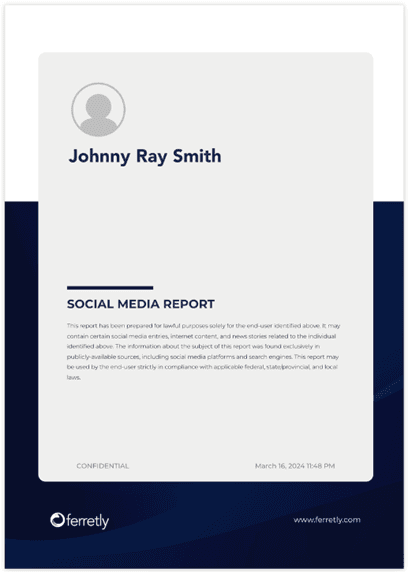
Image: Ferretly
That surfacing is surface-level, Lipscomb added, so past posts deleted at the time of the report would not be included, nor would posts from a private profile. Ferretly’s services are also Fair Credit Reporting Act (FCRA) compliant, a federal law protecting the privacy of subjects of consumer reports.
Still, Lipscomb noted that among this year’s top 200 or so NFL Draft prospects, about 70% had at least one behavior flagged – more than double the rate in other industries Ferretly covers (where the average is 33-34%). The three most common flags: profanity, disparaging remarks and political speech.
Lipscomb estimated sports teams comprise about 10% of Ferretly’s business, which encompasses nearly 1,000 clients across the retail, media, finance and public sectors, among others (they added 75 customers in Q1 this year). Influencer vetting is another popular use case, and teams in the English Premier League, NHL, NBA, MLB and Division I college are clients.
“There’s no real separate distinction between whether you’re hiring an NFL player versus an influencer,” Lipscomb said. “It’s the same report, the same assessment.”
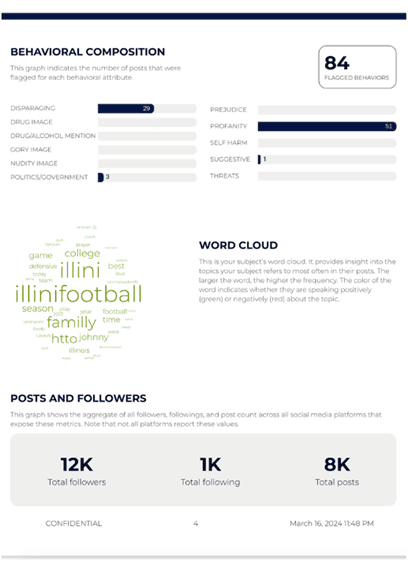
Image: Ferretly
Ferretly offers its platform as a SaaS solution, or with analyst support at a higher cost. Running an analysis takes about an hour, with reports typically turned around within a day, Lipscomb said, adding that most clients average about $20 per report. The price point is determined by volume of reports per month.
“It’s really a rapid turnaround because of the use of AI, especially for social profile discovery and the machine learning classifications. We probably do more use of AI than most of our competitors,” Lipscomb said. “There’s some competitors that do this mostly manually. They’ll produce a report at about three times the cost of what we charge.”
This year, Ferretly had analyzed around 250 NFL Draft prospects across their client’s potential targets by the time the Chicago Bears used the No 1 pick to select USC quarterback Caleb Williams.
This article was brought to you by SBJ Tech, a Leaders Group company. As a Leaders Performance Institute member, you are able to enjoy exclusive access to SBJ Tech content in the field of athletic performance.
Plantiga believes their wearable sensors can fight back against the male bias and collect data on ground forces, contact times, stride length, and asymmetries for female athletes.
Main image: Plantiga
A Data & Innovation article brought to you by
After that season, however, Bueckers underwent right ankle surgery. The following year, she suffered a tibial plateau fracture and meniscus tear in her left knee, which required another operation. In August 2022, she tore the ACL in that knee — another surgery.
But Bueckers was fully cleared for the 2023-24 season and returned to form. She was again a unanimous All-American, leading UConn to the Final Four again. During the tournament, her legendary coach, Geno Auriemma, called Bueckers “the best player in America,” in an implied comparison to Iowa’s Caitlin Clark.
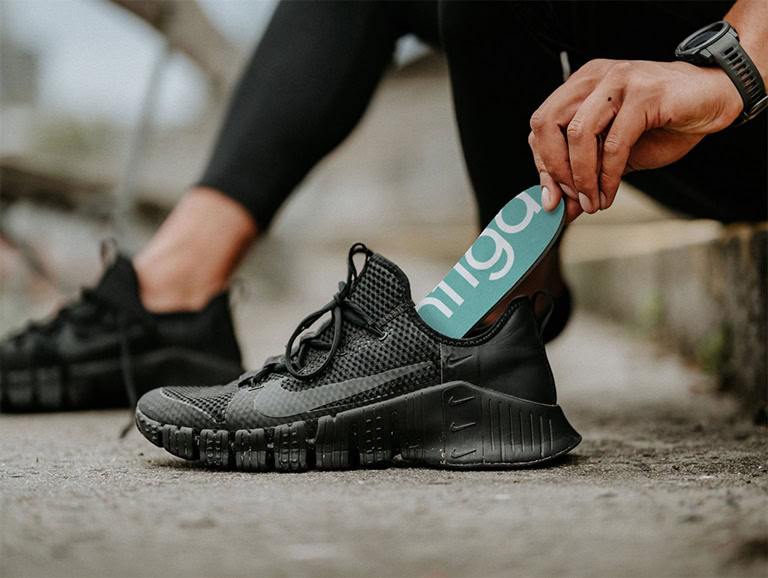
Among the modalities helping monitor her as she returned to elite performance were sensors embedded in the insoles of the sneakers she wears in practices and games. That device, made by Plantiga, is in the early stages of a multifaceted effort to collect real-world biomechanics data on female athletes. Its sensors collect data on ground forces, contact times, stride length, asymmetries and more.
Plantiga is working with the WNBA through its participation in the NBA Launchpad program. It’s helping women’s running shoe brand Hettas inform its designs and materials. And it’s being deployed to track elite athletes such as UConn’s Bueckers, Azzi Fudd and Jana El Alfy, all of whom have suffered ACL or Achilles injuries over the past 20 months.
“The main problem that we see in women’s sports right now is that there’s a really big bias in the scientific literature, and there’s a bias in the resources that are often made available to women’s teams,” said Matt Jordan, a kinesiology professor at the University of Calgary who serves as Plantiga’s Chief Scientific Officer.
“Where Plantiga comes in is it affords us a brand-new opportunity to study girls and women playing in sport on the field of play, doing the things they do in the real world, not just in a lab, but on the field and on the turf. And it really opens up a new paradigm to be able to understand how training load, movement biomechanics and asymmetries, and how these things really influence the health profile of the female athlete.”
Plantiga Co-Founder/CEO Quin Sandler described the dual motivation for pursuing research in women’s sports: the altruistic idea of helping advance the science for women and also the business opportunity of supporting an underserved market. Title IX already ensures a large population of young women playing elite sports at U.S. universities, but the recent explosion in popularity of all women’s sports — pro and college — is helping grow budgets for more rigorous training tech.
Plantiga is helping women’s running shoe brand Hettas inform its design and materials as it builds sneakers for elite athletes, as well as working with the WNBA through the NBA Launchpad program. Image: Plantiga
Sandler declined to specify the price, but said it is comparable to the cost of technologies such as Catapult and Kinexon. In some instances, teams could get the same load monitoring data only from Plantiga.
The research gap between male and female athletes has been well documented in recent years, but the severe discrepancy persists. Chris Napier, Director of the Simon Fraser University Run Lab that has been conducting research for Hettas, said there’s a huge opportunity to create more optimal sneakers for women because just about everything to date has been designed based on research for men.
“Then they just make the shoe a little bit smaller for women, and we think we can do better than that,” Napier said. “We think we can actually optimize those materials and the geometries to really suit female runners and make them improve their mechanics to make them perform better. And then we think, potentially, we can also do better to prevent injury.”
The stark need became apparent when his company built a predictive model for the Canadian Armed Forces regarding knee injuries in soldiers.
Because most of the test subjects were men, Plantiga’s model became precise in identifying trends in their data. It could estimate how long ago a male soldier injured his knee down to the month.
“When we applied that model to women, it just didn’t work. Same model, same machine learning, but that goes to show you that their movement patterns are so unique that our model — because it was just trained on male data — literally couldn’t even see it accurately on women,” Sandler said. “If [the data] wasn’t on both sexes, it basically rendered it almost useless.”
Through NBA Launchpad, Plantiga is conducting a two-pronged research effort. Its technology will be available to WNBA players and performance coaches for use in practice to collect data on elite players, and it will be offered to a high-level girls’ basketball program, New Heights in Brooklyn, with a particular focus on tracking its U17 club team for up to six months.
Plantiga successfully completed the NBA’s rigorous wearables validation program, but the WNBA CBA prohibits wearable usage in games. The WNBA is introducing optical tracking for the first time this year with Second Spectrum, but there’s appeal in the potential of collecting ground forces from a device such as Plantiga as well. (The company’s athlete user investors include NBA player Thaddeus Young and Olympic gold medal-winning sprinter Andre de Grasse.)
NBA Vice President Tom Ryan described the utility of an inertial measurement unit, which is the type of sensor used by Plantiga, in the shoe: “Being able to have an IMU that is right there at the point of contact for both feet, we think is just a piece of data that is always going to be valuable, as a complement to optical.”
This is the first year Launchpad introduced a focus on the WNBA, with Ryan explaining that the league looked at technologies with application at all levels of “the basketball pyramid.” He said, “The goal on the grassroots side is to take all those learnings that an elite health and performance professional at a WNBA setting or NBA setting could teach an athlete, but then being able to take those learnings and productize it into Plantiga’s platform.”
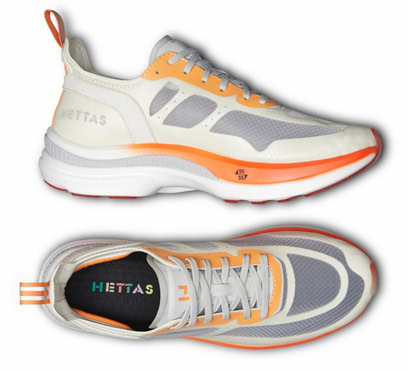
Image: Plantiga
The goal is to collect longitudinal data that would create benchmarks of progression, just as has been established in European soccer academies, which have voluminous data on what the physical performance of each age and positional cohort should be.
“We want to collect a first-of-its-kind data set on what that player development pathway looks like,” Sandler added. “What does an elite 17-year-old basketball player look like? What does an elite 19-year-old, 21-year-old, 24-year-old look like?”
In the case of Bueckers, she began wearing Plantiga in early January, according to Andrea Hudy, UConn’s Director of Sports Performance for Women’s Basketball. Hudy noted the use of Plantiga at this juncture is mostly for information gathering. For Bueckers specifically, the data indicates “there are some things we can do after the season that I think will be helpful for her,” Hudy said, but too much intervention during a season would be unwise and impractical.
Hudy, who is concurrently in a PhD program at UConn, cited a 2019 research paper on Division I women’s soccer players who had MRI scans of their ACLs before and after the season. The study found a 10% increase in knees with edema, a type of swelling in the tissue outside of the joint, which is strongly correlated with injuries to the ligament.
“Is it an overuse injury? Is it a traumatic injury? What are we dealing with?” said Hudy, who was recruited by Auriemma in the late 1980s before a pair of ACL injuries. She instead played Division I volleyball at Maryland and said her personal injury history helps drive her research.
“It’s all coming back, in my opinion, to just gait patterns, and what happens before or after an injury,” Hudy added. “And then how does that reflect your gait afterwards? Because your body compensates in so many ways. And it’s just the kinetic chain of dysfunction if you don’t correct it right away.”
That can persist and manifest itself in future ailments. Part of the epidemic around ACL injuries, added Jordan, is the high recurrence rates, which studies have pegged as anywhere from 8 to 40 times higher risk, as well as the challenge just to return to the same level of play.
“Your ability to return to performance — that, you can’t hack unless you’re training smart, monitoring your deficits and attending to this every single day as a part of your training,” Jordan said. “We’ve known that forever, and the blind spot is essentially that once the athletes are back on the court, we have no clue how they look because we don’t have biomechanical devices that allow us to measure in the real world.”
In a world of insole sensors and properly designed sneakers, the shoes female athletes wear might finally fit.
This article was brought to you by SBJ Tech, a Leaders Group company. As a Leaders Performance Institute member, you are able to enjoy exclusive access to SBJ Tech content in the field of athletic performance.
Alphabeats explains that the goal is to train one’s brain to produce more alpha waves, which are typically associated with calmness.
A Data & Innovation article brought to you by
The offering consists of an EEG-sensor-embedded headband supplied by BrainBit, which monitors brain activity while users go through mental training sessions in an accompanying mobile app. The sessions, ranging from eight to 12 minutes, are augmented by music playlists curated in partnership with audio streamer Feed.fm (which works with Dr Daniel Bowling, PhD, a neuroscientist at Stanford University School of Medicine) and include dynamic visualizations, cognitive games and eyes-closed meditations.
The idea, according to Alphabeats chief commercial officer Jorrit DeVries? “Training alpha [brainwaves],” he said, recommending users deploy Alphabeats’ solution several times per week over a four-to-six week span to see results. “This is not a solution that you use while you’re working out, for example.”
Alphabeats’ core innovation is in proprietary algorithms that respond to users’ brain activity – sourced from the EEG sensors – in real time. The goal through that feedback is to train one’s brain to produce more alpha waves, which are typically associated with calmness. The system does this by altering music to reinforce negative feedback when less alpha waves are being produced, and vice versa.
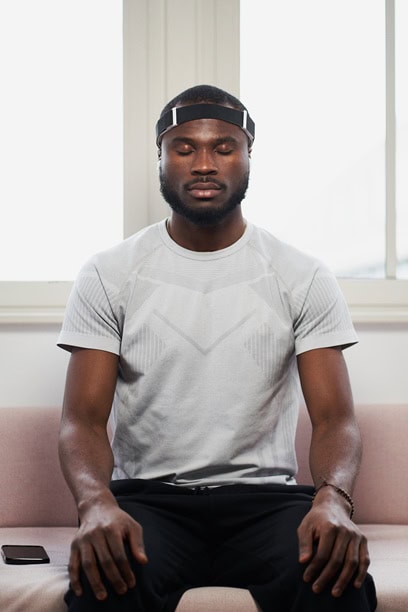
Image: Alphabeats
“At a very general level, you could say that [the music] would sound more flat [when providing negative feedback],” said Alphabeats’ head of product Elroy Verhoeven. “And if you were doing well, it would sound richer. It’s a continuous process as you’re listening to the music.”
Alphabeats’ thesis is that athlete training has historically not dedicated enough time to mental performance, instead focusing almost exclusively on physical training, nutrition and gear. Verhoeven and DeVries cite research conducted with Tilburg University in the Netherlands dating back to 2012 as evidence for their method.
“The trick is – if you’re familiar with meditation – to really tap into alpha, and to calm your brain down and to make sure that you produce more of the alpha waves than beta or gamma waves and really start to calm down your brain,” DeVries said. “That will ultimately lead to better focus, but also to better sleep outcomes and better recovery.”
Although Alphabeats’ technology is hardware-agnostic – it only requires EEG sensors to connect with – BrainBit is the company’s exclusive hardware provider as of now. Using the product on an individual basis involves purchasing a BrainBit headband (which retails for $499) and registering for Alphabeats’ $15.99 per month app subscription. In line with its US launch, however, Alphabeats is offering new customers a headband and one-year subscription for a total cost of $499.
The company also offers a starter package for teams, which includes 10 headbands and user accounts, access to an analytics dashboard, and support for onboarding and data analysis. Pricing for that offering varies. Alphabeats has a formal partnership with the Dutch Olympic archery team and a “couple” more in the hopper that they cannot yet publicly share, DeVries said.
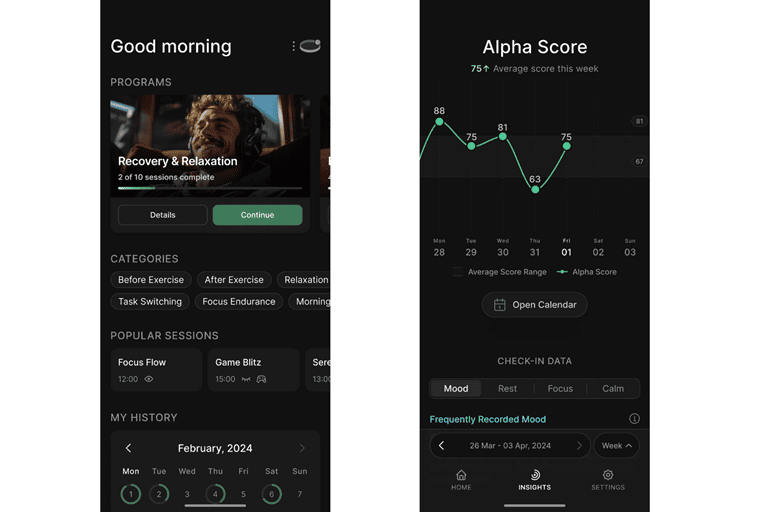
Image: Alphabeats
The vision is that as EEG sensoring becomes more widespread, Alphabeats will be well-positioned to serve athletes and teams. “That’s our moonshot,” Verhoeven said, referencing Apple’s work around EEG sensors in its AirPods – for which the tech giant received approval on a patent last year – as one example.
“There’s different market segments where this taps into. We look, potentially, at a $12 billion market,” DeVries said. “This is a huge market where you see a lot of potential in different areas. But if you then boil it down to what we’re trying to do here, is really capture the athlete platform market, to make sure we connect as many athletes as possible in a hardware-agnostic way, to really build an install base that drives us to the next wave of growth where you see that EEG measurement become more and more available.”
This article was brought to you by SBJ Tech, a Leaders Group company. As a Leaders Performance Institute member, you are able to enjoy exclusive access to SBJ Tech content in the field of athletic performance.
In the third and final session of her Performance Support Series, Dr Meg Popovic explored the value in wellbeing intelligence in fostering environments where athletes and coaches can thrive.
A Human Performance article brought you by our Main Partners

So said Dr Meg Popovic at the outset of her Performance Support Series, where across three sessions she led Leaders Performance Institute members in an exploration of wellbeing and burnout.
In her view, high performance environments that foster wellbeing also:
She also acknowledged that her definition of wellbeing, while having broad relevance, will have subtly different application in each and every environment.
As for her own environment, Popovic is the Senior Professional Sports Manager for North America at EPIC Global Solutions, the world’s leading independent gambling harm minimisation consultancy and a valued Partner of the Leaders Performance Institute.
She also served as the Toronto Maple Leafs’ Director of Athlete Wellbeing & Performance between 2018 and 2021 and drew on that experience in this third and final session where she delved into wellbeing frameworks and ‘wellbeing intelligence’.
How to bring a wellbeing framework to life
An intentional strategy is essential when you have finite time with athletes and staff.
At the Leafs, Popovic adopted a three-phase approach:
However, your framework is not viable without ‘wellbeing intelligence’
‘Wellbeing intelligence’ refers to a skillset that leaders can develop to better understand and improve their own and staff wellbeing.
As Popovic explained, workplace challenges continue to increase and so having wellbeing intelligence becomes essential for effective leadership.
At the Leafs, she focused on three key areas of intelligence that integrated growth mindset and learning into the wellbeing and performance strategy of athletes and staff.
How do we ‘do’ growth mindset so the organisation embodies a growth mindset? The Leafs introduced ‘Mindset Mondays’, which was an organisation-wide communication sent to all athletes and staff to encourage the cultivation of character and performance that positively impacts the wider team culture. The communication spotlighted a person in the organisation each week who would share ‘The Seeds’, ‘The Sunlight’ and ‘The Growth’; providing advice, content and perspectives that everyone could read and engage with.
They also introduced professional development Thursdays. This was a 15-week period during the off-season which provided opportunities for athletes and staff to learn from experts outside of their specific sport. The player sessions were strictly a space for the players. The sessions gave them ownership of fostering their own growth mindset with guidance from key members of staff.
The ‘team of teams’ – the interconnected departments within an organisation – necessitates relational intelligence to better understand the unique needs of different subcultural groups within a team.
The Leafs hosted dedicated player development programmes enabling athletes to learn more about mental performance, wellbeing and different areas of interest. Alumni were also brought in to share stories around being a professional athlete.
There were also staff professional development workshops – four in-season and two in the off-season – for each department. These workshops were aligned to the goals of the team, specifically the areas identified when it came to skill development and building team culture.
At director level, there were fortnightly roundtables to connect C-suite individuals to each other in the hope of cross-pollinating ideas and best practices. Too often this subculture is overlooked.
What can be done to amplify individual experience and learning of self, profession, and leadership?
At the Leafs, one-to-one coaching was available for both athletes and staff to engage in confidential conversations. They also created a dedicated one-to-one player programme designed for athletes to discover answers to questions such as:
Another approach was a prospect mentorship programme, focused on providing support for up-and-coming talent. This was co-created with development staff to provide mentorship and professional development training for future and current young prospects.
Select alumni were also paired with the prospects in monthly calls to explore themes such as goal-setting, professionalism, use of social media, time management, navigating conflict and skill development.
Finally, athlete care and other support resources were created in collaboration with doctors, the operations team and the performance director to provide options for athletes and their families to access whilst playing for the team. These resources included parental support, family therapy, psychological assessment and mental health resources, clinical psychology and mental performance specialists.
The recurring challenges currently facing athletes, coaches and staff
The PGA Tour player and US Ryder Cup captain is the latest guest in SBJ Tech’s series The Athlete’s Voice.
A Data & Innovation article brought to you by
You can’t have a discussion about sports technology today without including athletes in that conversation. Their partnerships, investments and endorsements help fuel the space – they have emerged as major stakeholders in the sports tech ecosystem. The Athlete’s Voice series highlights the athletes leading the way and the projects and products they’re putting their influence behind.
Among the standout traits of Johnson, 48, is his durability. He had played 69 consecutive majors until withdrawing from the 2021 Open Championship, not because of injury, but because he had tested positive for Covid-19. In fact, Johnson revealed that he has never undergone any surgery in his career — before joking that he wished he hadn’t said that publicly.
One fitness tool Johnson has adopted in recent years is GolfForever, which recently raised a $10 million Series A investment round and was named the Official Golf Fitness System of the PGA Tour. GolfForever uses its patented SwingTrainer, resistance bands and AI-powered app to guide workouts. It was created by chiropractor Jeremy James and has been used by company ambassadors Johnson, Scottie Scheffler, Justin Leonard and Tom Kim. In all, more than 400 PGA Tour and LPGA pros are users.
On how’s he incorporated GolfForever into his training…
The versatility of it is one of the aspects I love about it. I use it every day. I use it at my gym at home, if I don’t see any of my PT guys, just to get going. I can use it in my hotel room. I can use it to warm up for tournament, before I practice at home, whatever. I use it all the time, because of what it has and the ease of it. It’s very mobile — stick it in my golf bag and go. Shoot, I can use it on the range before I actually started to compete. So I just love the accessibility of it at any given moment is really what I think sets it apart from other apparatuses when you’re talking about engaging, warming up, creating some sort of mobility, yet stability. That’s where I find it to be the best thing on the market.
On his training progression…
I do use weights. I do use other apparatuses, too, for my conditioning. This thing is not going to put on 15 pounds [6.8kg] of muscle. I’m 48 years old. Longevity and injury prevention are my two focuses, and knock on wood, I’m probably an oddity in the sense that I’ve never had to go under the knife — I shouldn’t have put that out there, but anyway.
I give my body its full attention each and every day. I think [GolfForever] really helps from a corrective standpoint. It allows me to go through my corrective exercises, my corrective movements, so that I’m warm. I can even go in and do some heavier stuff after I use it. And then when I cool down, it’s great to get everything balanced and firing again after my workout. The app is great, too. They have an app that’s very comprehensive. If I’ve got a corporate event and I’m just going to travel [but not compete], I could just take I could take the bands and the apparatus and use the app, and I can get a full workout in my hotel room if I desire.
On golfers’ need to counterbalance their rotational movements…
That is an absolutely fantastic question. Obviously I’m right handed player, so there is asymmetry in me innately. And I say that it’s probably because I didn’t give my body the attention it needed when I was a young, young, young pro. In the late 90s, golf fitness was just kind of a thing — now, it’s a full-fledged industry. Shoot, golf recovery is a full-fledged industry.
From my body’s standpoint, I’m trying to get as symmetrical as possible, fully knowing that it’s probably not going to be that possible because I’m still hitting golf balls constantly. I would have to hit golf balls left handed, at a pretty high rate to find some sort of symmetry, and I don’t intend on doing so. But the beauty of this GolfForever is it allows me to get into motions. If I need to do more — we’ll just say, for lack of a better term, left handed — I can do that.
One of my imbalances is I can really turn through the ball. So post-impact, I can just keep going. On my backswing, my T-spine, my torso, even down into my low back and shoulders, that whole area basically is fine, but it just doesn’t want to turn as far in the backswing as it does on the downswing. So I’m constantly doing a little bit more to help open up my T-spine on the way back. That’s always an emphasis, if I’m going to get specific.
I actually have a left-handed seven iron. I can go in my gym, or I have a little simulator room. I can go in there and just hit balls — it’s ugly But I can do that. I can actually put a weight on there too, if I desired, and I’ve got to be careful because it’s really uncomfortable. It’s really awkward. And it kind of hurts. But there’s some there’s some truth in that. Yeah.
On other parts of his wellness routine…
I think I’m fairly diligent. I’m sure there’s peers of mine, especially guys that are younger, that may exhaust the resources even more, but I cold plunge probably two times a day, usually in the morning to get me going. It’s kind of like an endorphin release. It’s a hormonal balancing mechanism, and then I’m also going to use heat therapy as well. I just got done working out. So everybody thinks well, you should cool down and get the plunge. Well, the research says you should wait at least three to four hours, so I’ll cold plunge probably tonight before I go to bed. I’ve got a plunge at home, and then I’ll also introduce heat before I go practice to get limber.
Then for supplements, I’m pretty diligent on what I put into my body for the most part. I mean, I can eat bad, too, like anybody but I’m also very conscious of what goes in. I’m a chiropractor’s son, so that’s all I know. Whether it’s vitamins or other things of that nature, I’m a part of a company called LivPur with four other golfers and we make pre-, during and post-round supplements that help —whether it’s aminos, electrolytes, proteins. I’m always constantly monitoring, monitoring that intake.
On recovery…
Sleep obviously is massive. And that’s the best form of recovery for frankly anybody if you can get proper sleep. I used to wear a Whoop. Probably should get back into it. I’ve got some of the things I can wear, too, but it gave me a little bit anxiety. I was only into it for about four to five, maybe six months. I’d be like, ‘Man, I slept great last night,’ and then it says you didn’t or just the opposite. But that’s data, and I love objective data. I probably need to get back into it. My boys are actually starting to do that — I’ve got a martial artist and a football player.
Teammates of mine — my PT and chiros — are constantly encouraging me, pushing me, making me uncomfortable. That’s also, I think, very rewarding in the end, too, so there’s a lot of things that go into my day-to-day operation.
On evaluating business deals…
I think my plate’s pretty full. With my team, my manager, my wife, we pursue relationships more than business opportunities. It’s got to be a good fit. It’s got to be a win-win. So I don’t you know, with three kids at home, I’m not desiring anything more. I like who I’m associated with. I hope they would say the same. And I don’t say it lightly because if we’re going to start something, you’re going to get all of me. I can only be both feet in with a certain number of obligations or ambassador roles. I don’t think it’s fair to myself or them if I spread myself too thin.
On the PGA Tour’s offer of equity to its players…
That’s a hard question. I’m learning as I go. I’ve pursued some communication with certain individuals and the Tour. I think everybody’s kind of learning. I understand it is probably the appropriate or pertinent next step in our evolution as a product. I’m also pretty trustworthy in the sense that I feel like there’s individuals making these decisions that are a lot more wise than I am, especially when it comes to just business in general and the savviness it requires.
It is new. It is obviously somewhat reactionary. But I’ll tell you what I am: I’m grateful for my peers. Because I served on that board in the past, I’m really grateful for the time and energy they’re putting into it. I don’t even know the half of it.
There’s really two factors in my mind, and the first one is I hope the money side of things is not the motivation. There’s an appropriate way to pursue money. Greed is the inappropriate way. So I hope, and I trust that they’re doing that right. And then the second thing would be — and these are 30,000-foot view things — don’t let the game of golf be secondary. It’s still got to be for the fans, it’s still got to be a level of entertainment, it’s still got to be meritocracy, it’s still got to be the purest form of the game where you earn what you get in the dirt. I trust that that that’s still a priority.
This article was brought to you by SBJ Tech, a Leaders Group company. As a Leaders Performance Institute member, you are able to enjoy exclusive access to SBJ Tech content in the field of athletic performance.