Dr David Fletcher explains how the training environment can be manipulated to promote resilience.
A Human Performance article brought you by our Main Partners

“It’s the same for all of us in our day-to-day lives with stressors and strains that we experience,” he continues. “It might be that a major life event occurs and as a consequence that’s the last straw that breaks the camel’s back and we struggle as a consequence. It may be day-to-day stressors in the environment that build up over time.
“Psychologists call this ‘allostatic load’ and it’s where it can lead to burnout or, in a sporting context, overtraining.”
There is more to it than just teaching psychological skills or qualities. “That’s the starting point.”
Fletcher is talking to the Leaders Performance Institute for a series that looks at better understanding psychological resilience, how it can be developed, as well as any other considerations for coaches in sport.
In the third part of our interview, Fletcher discusses how the environment in which someone operates influences their resilience, which has implications for coaching practice.
Why is it important to balance challenge and support in developing resilience?
DF: Challenge is all about providing developmental feedback. It’s feedback telling you how you are going to develop over the next 12 months and the challenge is for you to be able to step up your game in this respect. And, of course, there could be physical goals, certain technical goals, nutritional goals, lifestyle goals, psychological skills training goals. There’s a whole raft of different things that go into challenging people; and in sport and high performance we tend to be quite good at that. The area that sometimes gets neglected is the idea of supporting people in order to meet those challenges and those demands. ‘So if you’re going to progress by this much in the next week or the next month towards this goal, what do we need to put in place to support you in order to do this?’
What can coaches be doing better?
DF: This is all about encouraging people; providing them with confidence and motivation. I mentioned developmental feedback, but the feedback we need here is motivational feedback. Instead of looking forwards, we’re saying ‘12 months ago, you were here now you here look at how you’ve progressed and here are the reasons why you’ve progressed over the last twelve months you did this better. You did this better. You perform well in this situation, in this context’. So it’s about bolstering people, bolstering their self-esteem, their confidence and motivation. It’s also about providing them with support around what they’ve done better and how they’re doing things better on different fronts.
Is there a role for other staff too?
DF: Absolutely. This is where you need to try and draw in your sports science and medicine team so that the sport support they get is bespoke to them as individuals particularly at elite levels of competition. So what are the fine-grained areas that you can work on that are bespoke and specific to you? It’s an area that can get neglected, particularly at the higher levels. The optimal development of resilience is very much contingent upon balancing challenge and support, the fluctuations between the two, and trying to get that balance right; and some of the research that we’ve done suggests the best coaches intuitively and instinctively have a really good feel not only on how to balance the two for an individual but how to balance challenge and support for all of the individuals in the team. So you can imagine, if you’ve got a squad of 20-30 players they’re coming in and out of training, they’ve got all sorts of things going on in their lives. It’s not just the stressors and demands associated with the sport. It’s things outside of the sport. So no psychologists in the world could monitor all of those stresses and demands on all of those different athletes and then modify and tweak an intervention. The best coaches have got that real instinctive sense of when to back off somebody, dial down the challenge, dial up the support and put the arm around them. Or maybe an individual is getting a bit complacent and they need to dial up the challenge in different ways.
Are there any specific types of training for resilience that involve manipulating the environment?
DF: It’s really extending this idea around challenge and support and looking at specific contexts. What are the specific types of stresses and strains that people need to perform under? The principles are the same whatever the sport. We’re still looking at how can we place individuals under or challenge them to perform under more pressure. The key to that is what can we do to support them to do that? So you’re asking more of the athletes but you’re also saying ‘in order to meet this demand here’s my advice, here’s some of the things that you can do to step up and meet that demand’; and that’s crucial for coaches to do. You don’t just throw them into a pressurised situation that that, first of all, is too pressurised and too extreme. We’ve seen some cases of that in the past over the last couple of decades where people have wildly misjudged that and what people are capable of. I might add to that as well situations when the pressure is completely irrelevant or unrealistic, such as in a boot camp. The stresses and the pressures can be completely irrelevant to what your athletes will face in competition. The environment has got to be progressively challenging and it’s got to be realistic to meet these demands, but also, as I emphasised before, you’ve got to support players and athletes in order to achieve this. So what are you underpinning this with in terms of psychological skills training around imagery, around preparation around planning, around nutritional development? All the things that can help them meet these demands within the context that they’re working.
Read our interview in full:
Part II – Psychological Resilience: Everyone Has a Trainability Bandwidth
The Hawkin TruStrength dynameter promises to guide training and rehab for athletes and coaches.
Main Image: Hawkin Dynamics
A Data & Innovation article brought to you by

Developed by John Cronin — a professor at the Sports Performance Research Institute New Zealand at the Auckland University of Technology — the TruStrength is the size of a fist with two protruding rings on which users can attach resistance bands or cable-tethered bars to measure both isometric (peak) and dynamic force.
Hawkin touts the TruStrength as having a sensitivity of one Newton and a reading measured at 1,200 hertz, a sampling rate several times the industry average. Data feeds into the same app as the force plates for practitioners — strength and conditioning coaches, physical therapists and others — to guide training and rehab.
“We can enable coaches and clinicians to get better, more accurate data easier and more rapidly, more efficiently — and that’s the name of the game in sports tech,” Hawkin Dynamics CEO Ben Watson said. “I don’t care what your device does. I don’t care how advanced the technology is, how much AI it’s got jammed into it, whatever other buzzwords we want to use. That stuff sounds great. But if it doesn’t make the coach’s job easier, they’re not going to use it.”
Between Cronin’s research at SPRINZ and some additional work he does in his appointment as Chief Science Officer of Athlete Training and Health in Houston, the TruStrength has already undergone years of validation with his team building protocols and normative datasets before he brought the device to Hawkin for commercialization.
Hawkin, which is headquartered just outside Portland, Maine, has deployed nearly 1,600 force plates across its performance, clinical and tactical divisions. It has a notable presence in elite sports, particularly in the NHL.
“We’re not inventing new modalities of measurement,” Watson said. “No, we’re just doing it better.”
Cronin, who has joined the Hawkin team as Product Specialist, said the use of TruStrength in physical therapy settings is an early focus. Many clinicians don’t have easy access to objective force measurements and thus under-load what patients are capable of because they don’t have the datapoints to help with exercise progression. Additionally, isometric movements are safe starting point for injured patients.
“What we’re trying to bring to the PT market as a rehab-by-numbers approach,” Cronin said. “We’re trying to bring a lot more quantitative accuracy to what they do. It’s a guessing game, really, for them.”
Low-tech training tools such as resistance bands can now produce objective data when attached to the dynamometer. And Cronin envisions the TruStrength as a training tool, with previously hard to measure movements now quantifiable.
“Peak force is important,” he said, “but a lot of people are really interested in how fast you express your force and so that’s that rate of force development measurement.”
The impetus for TruStrength first originated on the SPRINZ campus in Auckland, which doubles as New Zealand’s National Olympic Training Center. Cronin began collaborating with a PhD student seeking better isometric force measurements — an assessment of one’s true strength, hence the name. The faculty and graduate student population are wholly focused on improving sports performance with an eye on chasing answers in their research institute with a high bar for innovation, an environment that helped shape TruStrength.
“It’s a campus where industry and a university have come together,” Cronin said. “Our mantra is ask, answer, share.”
This article was brought to you by SBJ Tech, a Leaders Group company. As a Leaders Performance Institute member, you are able to enjoy exclusive access to SBJ Tech content in the field of athletic performance.
Reigning Formula E world champion Jake Dennis explains why he needs to be heavily involved in the process of each iteration of his Andretti car and some of the software used onboard.
Main Image: the tests, which highlight the demands of being a professional tennis player, can be used to showcase the attributes of the ATP Tour’s next generation. (ATP Tour)
A Data & Innovation article brought to you by
You can’t have a discussion about sports technology today without including athletes in that conversation. Their partnerships, investments and endorsements help fuel the space – they have emerged as major stakeholders in the sports tech ecosystem. The Athlete’s Voice series highlights the athletes leading the way and the projects and products they’re putting their influence behind.
* * * * *
Dennis, 28, is featured in the unscripted docuseries Formula E Unplugged that airs domestically on the Roku Channel and began Season 10 with a ninth-place finish in Mexico City earlier this month. He is again driving a Porsche, this time alongside his new Andretti teammate, Norman Nato, as well as the TAG Heuer Porsche team of Pascal Wehrlein and António Félix da Costa. Since 2018, Dennis has also been a simulator driver for Red Bull’s championship Formula 1 team, a role that included the opportunity of driving the car at a practice session in Abu Dhabi last fall.
On pushing the limits of the Next Gen Formula E car…
That goal is endless. How far we can push this car in terms of software is crazy, and to see how much it’s developed from this time last year, it’s pretty impressive. This time last year in Mexico, everyone was just trying to survive and see the checkered flag, and I think everyone did a really good job with that whereas now the reliability is extremely good. The software is being pushed to the absolute limit in what we’re allowed to do. And I think it’s going to be now down to lap time, efficiency and performance.
Even from July in London, I think we’ve made over 230 iterations of software changes, and the car has only been out [on the track] like four times. So it’s always evolving. It’s a snowball effect. They’re not always good [changes]. They’re not always positives, and definitely not 230 positive steps forward, that’s for sure.
But it’s just great to be part of it. The drivers have a real big input of the direction where the software should go. And they’re always keen to listen to us because we’re the ones driving it, obviously. But it can be quite easy, especially for the performance engineers, the data guys, when you really look down into the numbers, you can get led down the garden path, and they think they found the golden bullet, but it doesn’t always work like that.
On how much he wants to be involved in that planning process…
In the offseason, I definitely get more involved in terms of just the direction — not so much the nitty-gritty stuff — but the direction where I feel like the software needs to be changed. I made a WhatsApp group with me, Pascal, da Costa and Norman this year after London to put our heads together and make sure we’re all on the same boat because we’re all running the same software. So it’s important that all four drivers want to go in the direction we need it, and I think that was positive for us. I think that made it was a bit closer together as well.
But honestly, when the season starts and the development is obviously moving forward — but less of a rate because the races are just back to back and it’s a bit more intense — then generally I let my performance engineer, my software guy lead the direction of where he thinks it should go. And then on the race weekend itself, where there’s no development changes, it’s just you work with what you’ve got, then then you can go into detail of corner by corner. You can generally split each corner down to three stages as well, and then you can go into right detail. I think that’s important.
There’s definitely drivers who go in way more detail than me like Max Gunther, my teammate from the BMW days — he is like a guru with that type of stuff. He absolutely loves it. So he definitely analyzes every little bit, whereas there’s other drivers which are the complete opposite end, and I’m probably in the middle somewhere.
On Formula E Unplugged…
I’m really for it. I enjoy the series. I think it was filmed well so far, the two episodes I’ve watched, and I think it’s really good for the sport. We’re trying to obviously have this sort of mini-Drive to Survive series, which really allows the fans to connect with the drivers and see behind the scenes, which ultimately will hopefully make them keep coming back to watch the other episodes, but also mainly the Formular E season itself, to bring in better viewer [numbers]. So, yeah, I’m definitely looking forward to having Unplugged again next season, and trying to make it better — better insights, more personality across to the camera. I think that’s ultimately what the fans want, and what sponsorships want really as well.
On Formula E’s presence in North America…
Formula 1 now is massive in America, and I think it’s great because we definitely also get the knock-on effect of that, the second wind of it. I think the American following has definitely passed into Formula E. Personally it was a bit of shame to lose New York. It’s a great city. It’s a cool city.
And to go to Portland, I think all drivers were a little bit skeptical. But then when we went there, the race itself was absolutely mental. I was obviously on the fortunate side and had a great result [second place]. But it was a difficult race, we had well over 600 overtakes, which is bonkers. But it was a great spectacle. And I think everyone really enjoyed it. So I’m looking forward to going back. We’ve got a doubleheader this year as well, so really just trying to get as far into the American market as we possibly can. We’re pushing for more future races in America as well, which will be exciting.
On driving Red Bull’s Formula 1 car in an Abu Dhabi practice session last November…
It was amazing. It’s not very often you get to ride the most successful Formula 1 car ever made, and yeah, I’d be lying if I said I didn’t enjoy it. It was such a cool experience to obviously be driving in a Formula 1 race weekend — one off the bucket list.
I’m getting quite old now. I’m 28. So I’d say to get that ticked off before my career ends is pretty special. The cars are obviously achieving very different things to Formula E. It’s just all about performance and lap time in Formula 1, and to drive the Red Bull Car was pretty special. The handling, the behavior, of the car is everything a driver would want, and it was cool to get well over 100 laps on the Tuesday after the race weekend as well.
On his role as Red Bull’s simulator driver…
The development inside of simulators nowadays is massive, whether it’s Formula 1 or Formula E, but with the endless budget of Formula 1, you can really push the limits of software, hardware, and try and make the car as fast as possible. How close they are now is scarily good — the only thing you really miss is the sensation of speed and the fear factor. Everything else in terms of the way you brake, the way you accelerate, the way you turn is identical.
Don’t get me wrong, when I first jumped in Abu Dhabi, it was like, ‘What is this car? It’s so fast.’ But they’re so real life-like now, you can really improve the car throughout the season and develop it at a serious rate. They can make this virtual rear wing, like this is what it’s going to do and then you put it on in the simulator. You can get real life feedback of what it will do and then they also take your driver input and then they put the two together — driver feedback and then the numbers they generate — and see if it’s worth making it.
Before the budget cap came in, I think they probably would have just made it and just put on the car and see what happened whereas nowadays, with a budget cap of whatever it is, $250 million, they have to be a little bit more wary that they can’t just make every single idea that comes into their head. I think makes my life a little bit more harder, a little bit more difficult. And that they trust your feedback a bit more. Because yeah, someone like Max [Verstappen] and Checo [Sergio Pérez] are so busy, they don’t have the time to go on the simulator every other week. So yeah, I’d like to give myself some credit for making the RB19 or RB 20 so good. [laughs]
On wearing Whoop and the different training between Formula 1 and Formula E…
I hadn’t really paid too much attention to my sleep before I put the Whoop band on. It was just another factor of sleep analysis. I definitely just make more of a conscious effort not to try and put it in the red zone [indicating fatigue], which then generally gives you a bit of benefit the next day.
Fitness is obviously important inside the Formula E, and it’s a very different kind of fitness to Formula 1. Formula 1 was extremely easy from the neck down — you have power steering, and you’re strapped in so tight. You obviously have a lot of g-forces, but through your body, I felt nothing. It was just mainly your neck whereas in Formula E, your neck doesn’t really ever suffer. It is really your arms, your wrists, your shoulders. With no power steering, it’s extremely difficult, especially the Gen3 car with the Hankook tire. The front powertrain, when you brake and turn, the steering weight is so excessive, and I think that a lot of drivers are requesting for it to be lighter. But thankfully, I’m one of the bigger guys and have a bit of structure behind me.
You just have to train different aspects. But I would be lying to say like that you need to have the fitness of a football player or an NFL player or something like this. These guys, if they’re fit, they genuinely gain, I think, proper performance. They can just run faster, they can run longer, they can do way more, whereas for us, as long as you’ve got some strength behind you and some stamina and you can get from A to B, the biggest thing that’s making you so fast is how talented you are in terms of your skill and obviously how good your race car is — not so much how fast you can sprint 200 meters.
This article was brought to you by SBJ Tech, a Leaders Group company. As a Leaders Performance Institute member, you are able to enjoy exclusive access to SBJ Tech content in the field of athletic performance.
In time, players on the ATP Tour will benefit from benchmarking data and the establishment of definitive norms in tennis high performance.
Main Image: the tests, which highlight the demands of being a professional tennis player, can be used to showcase the attributes of the ATP Tour’s next generation. (ATP Tour)
A Data & Innovation article brought to you by
Before the tournament began, one of the courts at the King Abdullah Sports City was strewn with gadgetry: force plates, cameras, flashing lights. The ATP had organized the first athletic combine in Tour history, called Basecamp, putting the young men through a series of NFL Combine-style drills such as the 10m sprint, vertical jump and a pair of agility tests.
For the actual tennis matches, the players were offered tracking devices — GPS trackers with conjoined heart rate monitors — with two wearing them and five others indicating they were interested to do so in the future after having more time to acclimate. In combination with the existing player and ball tracking from Hawk-Eye, with Kinexon’s data analysis platform, the ATP Tour produced a Physicality Index to measure the athletes’ exertion and effort.
All of the data collected was shared with the players and some of it was published in web stories and social media to tout their athleticism. BreakAway Data’s app was used to grant the athletes easy access to their data from matches, practice and Basecamp while ai.io’s mobile tech unit, aiLabs, provided the testing equipment.
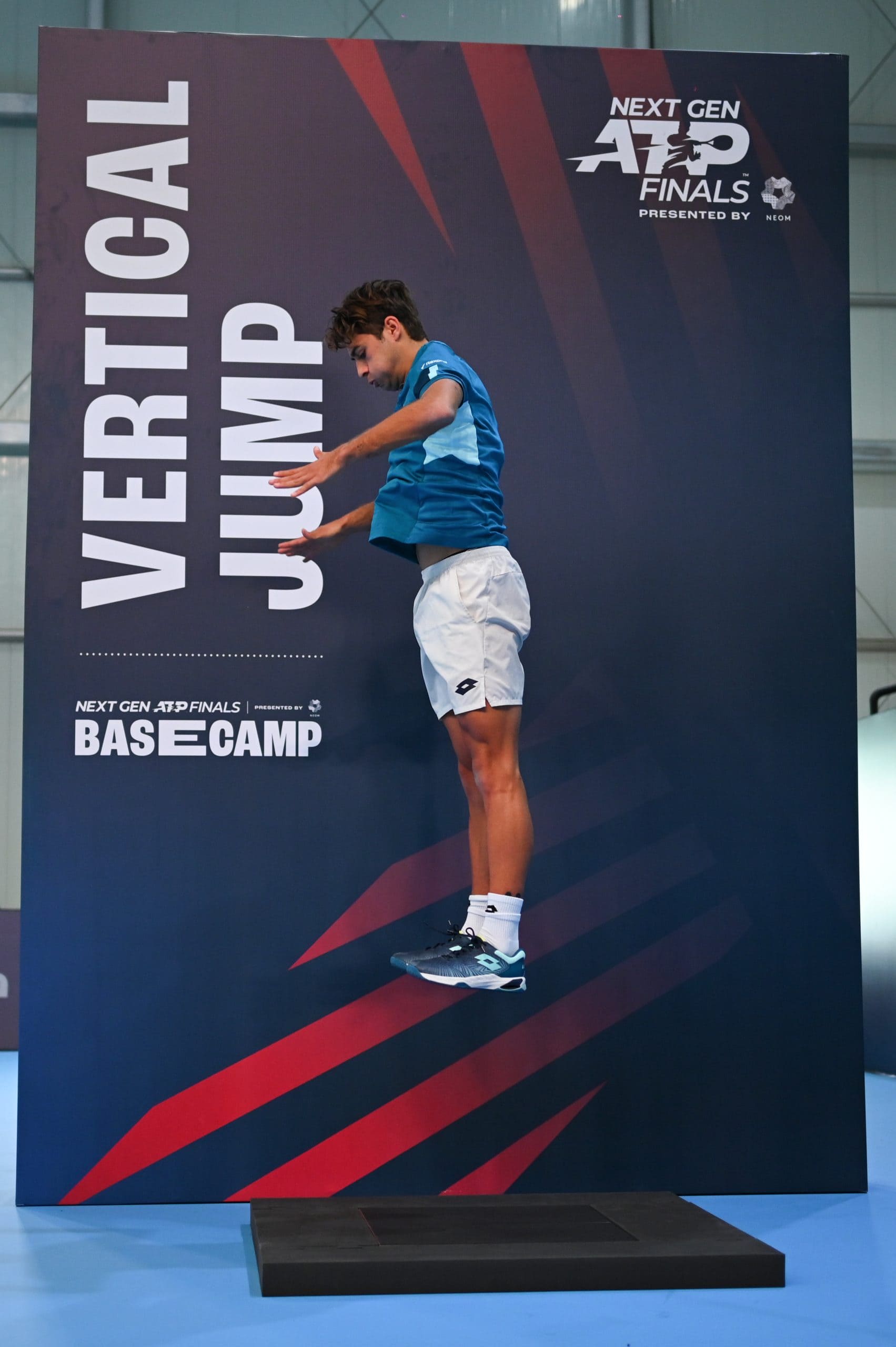
One of the motivations for the adoption of the new tech and data from Basecamp is to support athlete wellness guidelines, such as informing mandatory rest periods between matches. (ATP Tour)
“We really want you to understand yourself a little bit better off the court and tell that story to the fans as well because I think tennis players are great athletes, but we’ve never really had anything to measure that,” said James Marsalek, ATP Tour Senior Manager for Strategic Projects & Event Operations. “All these different metrics will then help us tell a slightly different narrative of, ‘Actually, you know what, they are [great athletes] because they compare X, Y and Z on the scales with basketball, football, whatever it might be.’”
The activations around the Next Gen Final were the most acute example of a broader strategy from the ATP Tour. In 2023, Tennis Data Innovations, which is the joint venture of the ATP and ATP Media, mandated that every tournament court have player and ball tracking. In March, Marsalek said the Tour started offering raw tracking data to all players for free. In September, the ATP and TDI created Tennis IQ, an analytics platform accessible to all ATP Tour players.
Marsalek said the goal is to have video embedded and synced to the data by 2025, with integration and visualization of wearable and other biometric data on the road map as well.
“It’s trying to tell this full story where players have got this one-stop shop that has access to everything,” he said, adding, “We tried to level the playing field and provide access to all our members.”
Though the ITF, the international governing body for the sport, began permitting wearable technology in matches back in 2019, the ATP didn’t sanction it until its most recent board meeting in November. It remains contingent on the Tour platform supporting it, which Marsalek estimated should happen in the first quarter of 2024.
“The ATP have got a hugely ambitious and fantastic opportunity to make data not just relevant but really progressive for the sport,” said BreakAway Data Head of International Business Ben Smith, who formerly led research and innovation at Chelsea FC. “Tennis, with the ATP leading it, have got an opportunity to help the sport progress over the next two, three years in a way that is, I think, hugely exciting and will advance both the physicality and the quality of the sport in a way that fans should be really excited about.”
In a video summary of Next Gen Basecamp produced by the ATP Tour, Arthur Fils — who ranked first in every category — could be seen celebrating his wins, a testament to the competitive spirit even with something brand news.
Just as often, the players asked, “Is that good?” Officials from the ATP Tour, ai.io and BreakAway Data were able to share some benchmarks, but more definitive norms will be established as this combine testing grows. Flavio Cobolli, who finished top-three in three of the four tests, called it a “good experience” and was quoted saying, “I want [Carlos] Alcaraz to do this for sure.”
Alcaraz is perhaps the premier athlete on the men’s Tour right now, whose 2022 US Open title run scored highly on the USTA’s Physicality Index, and would surely be a devastating combine competitor. But while the NFL Combine and team pro days are a rite of passage for all top prospects to improve their draft standing, that incentive doesn’t exist in tennis. To induce the elite players to participate, attaching prize money or other reward is likely necessary. But the accompanying videos and data may well be a new sponsorable asset.
“We ought to be a little bit creative,” Marsalek said. “We don’t have the same sense of jeopardy as the NFL does, where there’s a lot on the line, so we need to make sure that our athletes enjoy doing it. If they don’t, there’s no content.”
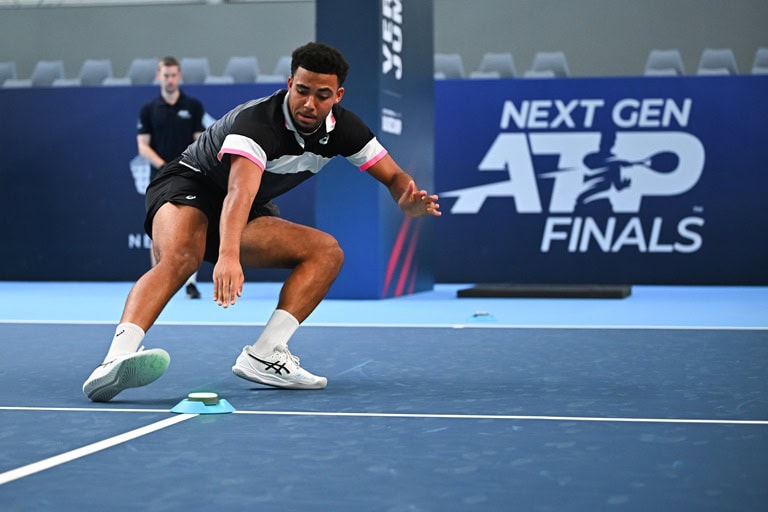
All of the data collected from Basecamp was shared with the players and some of it was published in web stories and social media to tout their athleticism. (ATP Tour)
The other motivation for the adoption of the new tech and data is to support athlete wellness guidelines, such as informing mandatory rest periods between matches. In the ATP’s 48-week season, most players average about 25 tournaments and, with Masters 1000 events all expanding to two weeks, that increases the amount of travel time.
Marsalek emphasized that data will not become the sole determining factor in decisions, but it is intended to provide a balance with an athlete’s feel in a skill-based sport. The goal is to encourage the use of data but have a centralized process to govern it — which should aid all stakeholders in tennis, just as was evident in Basecamp.
“It’s genuine high performance. Yes, it’s really enjoyable and competitive, and so the athletes have a good engaging experience. But there’s also valuable insight that those practitioner teams will take and move into the training environment,” Smith said, before adding about the development of data-driven narratives for fans. “That’s just really good, interesting engagement that, I think, opens up tennis to a slightly wider market.”
This article was brought to you by SBJ Tech, a Leaders Group company. As a Leaders Performance Institute member, you are able to enjoy exclusive access to SBJ Tech content in the field of athletic performance.
A Data & Innovation article brought to you by
You can’t have a discussion about sports technology today without including athletes in that conversation. Their partnerships, investments and endorsements help fuel the space – they have emerged as major stakeholders in the sports tech ecosystem. The Athlete’s Voice series highlights the athletes leading the way and the projects and products they’re putting their influence behind.
* * * * *
Barkley is a two-time Pro Bowl selection, earning the honor after his rookie campaign in which he ran for 1,307 yards and caught 91 passes as well as in 2022 when he ran for 1,312 yards and had 57 catches in his return to stardom two years after tearing his ACL. Barkley could be a free agent as the Giants weigh whether to place the franchise player tag on him for a second straight season.
Last week, Barkley added his latest brand partnership with Silk, a producer of plant-based products. He joined the Feel Planty Good Challenge, a campaign to incorporate Silk in breakfast every day for a week. He has done a wide range of deals in his career, including with blue chips like Nike, Pepsi, Toyota and Visa.
On the partnership with Silk…
I’m excited and happy to be partnering with Silk and doing the Silk Feel Planty Good Challenge. I think it’s a fun challenge for everyone to get involved. It’s healthy. It’s an easy, quick way to add plant-based [food] in your diet, especially breakfast. I think people overthink breakfast too much. When you could have a quick, easy, simple, tasty breakfast and get your day started off right.
I’m doing the challenge myself. I think it’s important for me too with my diet and nutrition, especially after coming off a long year. You want to start off right and get the body back into the right form so I can have the best offseason I can so I can attack the next year.
On when he started getting more serious about his nutrition…
I would say even when I tore my knee three or four years ago. But the year [2021] where [Brian Daboll] and Joe Schoen [arrived] and we moved off from [Joe] Judge and we got into our phase with Dabes, so two years ago, was really when the focus changed for me. I feel like my career was at a point where I was coming off the ACL and didn’t have the year that I wanted to have.
And, man, I wanted to do it again, I want to be dominant. I want to have a major impact on the game for my team, and I was able to have another Pro Bowl year. I thought I had a pretty good year this year, too, just the ankle injury kind of slowed me down a little bit. But definitely with the way I’ve changed my diet and my training has definitely helped me up to this point.
On how prior offseasons compared to this one…
I trained in Arizona at Exos. I think I’m going to stay around a little more in Jersey. My daughter is in school now. So definitely going to be out here a little longer. I feel like that’s important, too — get back to the grind of it by yourself, in a basement, blast music, kind of like I’m in high school again, get that mindset to give me back ready for the season. When I’m able to get out there, I’ll go out there and work on my techniques and everything to get back to the player I know I am.
I just redid my gym downstairs, so I’m excited to get down there and get to work. I’m going to add a little boxing, too. My little brother is going to become a boxer and definitely going to be with him and training him a little bit too. Also I’m going to lose a little weight. I’m going to play a little lighter next year.
On why Exos is such a good fit…
It’s just relationships. I’m a big relationships guy when it comes to the training side — when it comes to anything, to be honest. I feel like that’s the most important thing. I have a trainer there, Nic Hill, who’s great. But I respect him more as a person. I know he’s going to challenge me. I know he’s going to hold me accountable. And I know he’s going to push me.
Also I had a couple of my teammates out there. You have Deebo, Hop, Odell [Deebo Samuel, DeAndre Hopkins, Odell Beckham]. When you have guys like that, and you’re in a gym or you’re on a track, you’re talking crap and you push each other — it pulls the best out of each other too. So those are the real main focuses why. Obviously Exos has an unbelievable facility and all the great equipment, but for me personally, that’s what matter most.
On how much he tracks his training data…
Yeah, I do, especially we do a lot with the team. We’ve got Catapult to track your speeds, track the mileage you have, how much wear and tear you put on your body, your balances. Especially working with Ryan [Flaherty], he is really data-driven. I got to learn a lot from him. But the biggest thing I learned from him, I wouldn’t even say it’s the data stuff. It’s more just that he’s been with all the best. He’s been with the LeBrons, the Kobes, the Serenas — all the people who did it at the highest level. So he knows what it takes, he knows the mentality it will take.
On when he is at peak performance…
I probably felt my best coming into a season my third year. I was in unbelievable shape coming into the year I tore my knee. I felt amazing. But that’s when we had Covid. I was locked away in house, in a gym and on a treadmill. That’s when I got to really my peak — everything was where I wanted it to be.
When I play my best is when I’m free. When I just let loose, don’t care. It’s hard when you battled injuries. Even when you want to be this tough guy and be like, ‘No, I don’t think about it.’ But it’s your body. It’s impossible. When there’s a disconnect in your mind and your body, and you can see that you’re taking extra steps or doing this and you’re like, ‘Why am I doing that?’
But it’s just your body and mind have got to be connected. So I feel like I had my body and my mind connected after my knee [rehab] last year, which I had a pretty good year. And I felt good, I felt great coming into this year, too. But when I’m playing free, to answer your question. When I’m playing free and it’s no F’s given, as they say. That’s when I’m at my best, season-wise and in the game.
On training his mental game and using a mental performance coach…
That’s something I think I’m going to add this year — I might add a mental coach. That definitely can help. But for me, the way I do it [now], how I challenge myself, is to throw yourself in the fire. When that’s working out, when it’s training, when it’s conditioning, put yourself in uncomfortable positions to have that mindset that, ‘You know what, I’m going to get through it.’
That’s more to be mentally ready for that moment or that play or that game, but the [mind and body] disconnect is all about just trust. You’ve got to put your body in those situations. You’ve got to go through it. Eventually, you’ll know because, boom, you make a cut or you do something. It’s like, ‘OK, that’s back. And everything feels free.’ You’re not thinking about it. Every decision I make is right, but I’m not thinking, ‘OK, I’m running inside a zone. The front-side linebacker to the play side jumped inside, now I’ve got to do this.’ No, it’s just boom, boom, and I’m there. OK, one-on-one with the safety. Am I going to attack the safety?’ Nope, my body already knows what I’m doing. I watch film. I know what he’s going to do.
On how he responds to those who devalue running backs…
Yeah, I can go into that in two ways. I can sit there and bring up stats and numbers for myself, but I will keep myself out of it. I would use Christian McCaffrey as an example, who I’m a big fan, who I think is the best running back in NFL right now — right now, I’m going to get him soon, but right now. He’s MVP-caliber, just what he’s able to bring to that team.
It’s all trends. When you talk about the value of the running back position, it’s all because in recent years, backs that got paid high money, they had an injury histories. And so now it’s the trend. It just unfortunately sucks for guys like me, and it sucks for other guys that also have to go through it. They can do that for any position. So in 5 or 10 years and we’re paying wide receivers all that money, if three, four, five of the seven guys who are the highest paid end up getting injured and are not producing, then they’re going to be able to do the same thing to the wide receivers position.
And then if you want to talk about value of positions of just anything, it’s a team sport. We give credit to too much people anyway, to be completely honest. And we’re fortunate enough to get paid a lot of money — some more than others — but the reality of it is that’s the truth: it is a team sport. One of the best quarterbacks in the NFL right now was the last pick of the draft. You could find talent anywhere.
On how he evaluates deals with brands…
Authentic. Early in my career, there was some stuff that I did that wasn’t authentic. And that’s no diss or anything to any one of the brands — I’m thankful and grateful for any brand that I have partnered with, but for me now, it’s more authentic. Silk matches up with everything that I align with and what I want to do.
Dr David Fletcher defines psychological resilience and outlines the influence of a person’s individual qualities, their environment, and a challenge mindset.
A Human Performance article brought you by our Main Partners
“When we’re talking about any high performance environment, and particularly when we’re talking about sustaining success over time, psychological resilience becomes increasingly important the higher you go,” says Dr David Fletcher, the Professor of Human Performance & Health and Associate Pro Vice-Chancellor for Sport, Health and Well-Being, at Loughborough University.
“The demands placed on individuals performing at the highest levels, whether in a sport, business, military context or any other domain, intensify and they come from an increasing number of sources. They also become more intense and more frequent,” he continues.
“With that, individuals need to be able to cope with, adapt to, and just generally deal with stressors in a variety of different ways, which necessitates resilience. That’s why resilience is particularly important for sustained success.”
Fletcher is talking to the Leaders Performance Institute for a series that looks at how psychological resilience can be developed, how it can be influenced by an environment, as well as any other considerations for coaches in sport.
In the first part of our interview, he sets out what psychological resilience means to both scientists and applied practitioners how this has implications in sporting environments.
What is psychological resilience?
David Fletcher: This is a contested area amongst academics. One definition is the ability to withstand and adapt to different types of stressors. ‘Resilience’ comes from the Latin verb ‘resilire’, which literally translates means ‘to leap back’. That’s where the phrase ‘bouncebackability’ comes from too. ‘Resilience’ is where there’s some form of disruption to somebody’s functioning or their performance and they’re able to regain their original levels of functioning and performance quite rapidly. Over time, the word and its usage have evolved. If we use sporting parlance, if the commentators on a football match describe a defence as being ‘very resilient today’ they’re not talking about a team that’s conceding goals. They’re talking about a defence that’s withstanding pressure and some modern scholars use it in that way too. That’s a subtly different meaning to the original term.
What are some of the implications for an academic and an applied practitioner such as you?
DF: When I’m working, whether as an academic or an applied practitioner, I do make a distinction between what I call ‘rebound resilience’ and more ‘robust resilience’. I think that’s important regardless of what context you’re in because of the implications for research scientists. How do you define ‘resilience’? How do you then measure resilience and what are the key parameters you need to look at? Then, as an applied practitioner, a psychologist working with athletes, there will be a subtle difference in some of the skills you might try to teach an athlete or a team to either withstand stressors or if there’s some kind of disruption and they need to be able to rebound quicker.
Does this ever lead to some confusion?
DF: It is important to be able to distinguish between ‘resilience’ and some related terms, perhaps the most notable of which is ‘coping’. To be clear, ‘coping’ is where there’s been disruption to somebody’s functioning but they’re unable to rebound as quickly and it takes them more time to deal with and work through some of the issues that arise under stress and pressure. That’s where I see the distinction between something like resilience and coping; and again that’s quite important for practitioners because the type of techniques that you’d need to teach athletes to cope more effectively. With more prolonged stress it is, again, subtly different to some of the techniques that are important for resilience.
How do you approach the development of psychological resilience?
DF: There is no magic bullet that is going to develop resilience – we need to look at it more holistically. To look at it from a bird’s eye view, we need to focus on three main areas. The first area relates to personal qualities or the psychological makeup of an athlete or, if we’re talking about a team, it’s a little more around the psychosocial makeup of that team. In other words, the relationships that bind the team members together. Either way, that’s the first thing that you would focus on.
The second area that we look at tends to get neglected, in my opinion, is the environment in which an individual or a team is operating, their surrounding conditions, the facilities, the management, the teammates, all those types of things. We’re talking about trying to optimise or manipulate that environment in such a way that it facilitates the development of resilience rather than either not stimulating that development of resilience at all or, the flip side of that, crushing individuals and putting them under too much pressure and, again, not leading to the development of resilience.
The third area is the combined effect of personal qualities and the environment. What you’re looking to develop is a challenge mindset. Individuals who step intro stressful situations and see it more as a challenge than a threat or, if we’re talking about a team, rather than it being a mindset we’re talking a bit more about a challenge culture in the dressing room. There’s like a collective confidence and efficacy in stressful situations. If you just focus on one of those areas and neglect the others, in my view, you’re not going to develop resilience optimally.
Read our interview in full:
Part II – Psychological Resilience: Everyone Has a Trainability Bandwidth
Part III – How the Training Environment Can Influence an Athlete’s Resilience
USA Bobsled and Skeleton have hired Marc van den Berg to help them craft a fleet of competitive sleds for the 2026 Winter Olympics.
Main image courtesy of USA Bobsled and Skeleton
A Data & Innovation article brought to you by
Short for “Made in the USA,” the new sled is the first of many that USA Bobsled and Skeleton is building with large financial contributions of partners that will see the Americans complete a fleet of about two dozen sleds over the next few years.
The M-USA project comes as the organization attempts to keep pace internationally and gain an edge leading into the Milan-Cortina Olympics in 2026.
“I feel our competitive advantage right now is our pool of athletes and our coaching staff,” said CEO Aron McGuire. “We’re lagging behind in sled technology, but that’s where we’re actively working to be on a level playing field with the rest of the world, Germany specifically.”
Indeed, everyone is chasing the Germans. They won seven of a possible 12 medals in the Beijing Olympics, including gold in all but one event and a sweep of the two-man podium. In monobob, where women compete in standardized sleds, the Germans were shut out with Americans Kaillie Humphries and Elana Meyers Taylor claiming gold and silver, respectively.
A team of engineers build German sleds at the government-funded Institute for the Research and Development of Sports Equipment. It has taken on an almost mythic-type quality in the sport, with a reported 80 employees and 7 million-euro annual budget — a total that is spent on other sports as well, but even a portion dedicated to bobsled eclipses many other countries.
To try to keep up, the Americans brought on Marc van den Berg to be their technology and equipment lead. The Dutchman had helped the Canadian team win gold in two-woman in Sochi and two-man in Pyeongchang.
Van den Berg joined USABS in 2020, finding the sleds lagging behind and spending the lead-up to the 2022 Olympics repairing existing sleds. At the time, the U.S. team was buying sleds from Europe.
“When I arrived over here, there was no workshop, no sled program, no runner program. There was no one with knowledge,” he said. “I had to build it from the ground up.
“It’s really hard to fight [the Germans], but I’ve got a lot of experience. There’s a lot of knowledge in the U.S. with racing and stuff like that, so I think we can do it, but it’s not going to be easy.”
Van den Berg started by enlisting partners who could help him rebuild the U.S. fleet. Mooresville, N.C.-based deBotech had long worked with USABS and its athletes on building sleds and signed on to produce the carbon-fiber bodies. Industrial designer Cameron Dempster designs sleds with van den Berg. Advance Mfg. Co., Inc. committed to building the chassis and the runners, or blades the sled rides on.
“We have a phenomenal team right now,” said Hans deBot, founder and president of deBotech. “This is probably the best and most wonderful opportunity that’s ever presented itself.”
It remains a challenge to effectively replace the Americans’ aging fleet of sleds.
In the 1990s, NASCAR driver Geoff Bodine helped fund and lead a project to get the Americans in new sleds rather than the secondhand European ones they had been using. In the 2000s, USABS partnered with BMW to build new sleds, and Steve Holcomb piloted the Night Train to four-man gold in Vancouver, ending a 62-year drought.
“When we’ve built competitive sleds, the U.S. has a history of being successful,” McGuire said.
The plan is to build 20 such sleds before Milan-Cortina, with a mix of development and competition two-person sleds, plus an additional three four-man sleds. (Advance is also making runners for monobob sleds.)
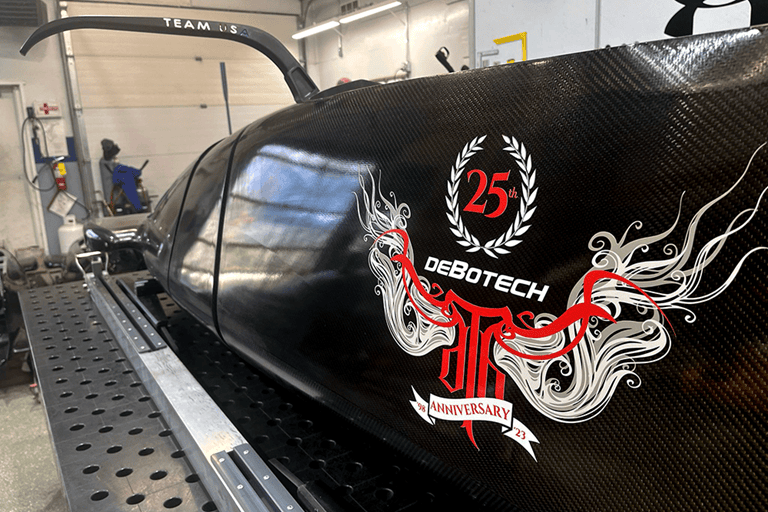
North Carolina-based deBotech is working with USABS and Advance Mfg. Co., Inc. to keep the team competitive with countries such as Germany. (Image: USA Bobsled and Skeleton)
Already, the Americans have four sleds on the World Cup circuit and plan to use feedback from athletes on the composites to tweak going forward.
“I think in 2014, we had the fastest sleds then after Germany got the fastest sleds,” said Meyers Taylor, a four-time Olympian and five-time medalist. “It’s really an arms race, but I think we’re moving in the right direction in terms of technology. To have Marc on board and to have partners on board, it’s really encouraging.”
It’s also the lifeblood of the project. USABS paid about $60,000 for deBotech to create the mold on which the new sleds will be based. But van den Berg estimated that in labor and materials, Advance is contributing around $1 million and deBotech is committed to $1 million to $2 million.
“Without these partners there was no project because we cannot afford it,” he said.
Advance, which had built runners for U.S. sleds for years, signed on to add chassis too. Like deBotech, the company wanted to support the athletes.
“It’s a great morale booster for our company and something that the whole team can root for,” said Jeff Amanti, Vice President at Advance. “Everyone can kind of get behind it.”
Sleds can cost anywhere from $28,000 for a monobob to $100,000 for a four-man. Once the M-USA project is complete, USABS plans to leave development sleds in Europe and Asia to cut down on the $125,000 to $150,000 it pays to ship sleds annually.
Many will be development sleds made on the same mold as the competition sleds. They’re similar enough that Love is competing in one currently as not enough World Cup sleds were ready when she made the team.
“What we did — 20 sleds — no one did that in the world,” said van den Berg. “Not even China with the Olympics with all the money, or Russia.”
Through the first month of World Cup competition, the U.S. team has three medals with the new sleds or runners, and van den Berg has heard from other countries inquiring about what they’re doing.
But the patriotic passion project for USABS and the partners will remain here. The M-USA sleds are not for sale.
In the latest edition of The People Behind the Tech Podcast, Peak AI’s Gary McCoy ponders the impact of artificial intelligence on coaching and performance.
A Data & Innovation podcast brought to you in collaboration with
Gary McCoy is the CEO of Peak AI, which has been shortlisted in Sports Business Journals’ list of the 10 Most Innovative Sports Tech Companies of 2023.
Peak AI uses psycholinguistics to enhance performance and Gary has a firm view on that coach’s comment.
“If you don’t know what they do, go and lead them because they probably don’t know what they’re doing either,” he tells Joe and John on the latest edition of The People Behind the Tech podcast.
“Artificial intelligence and data, as a general staple in sports, needs guidance,” he continues, “it needs transactional guidance to evolve the athlete.”
Gary spoke at length about the need for coaches to fully engage with AI and also dipped into a range of areas, including:
Listen above and subscribe today on iTunes, Spotify, Stitcher and Overcast, or your chosen podcast platform.