Discover the app permitting teams across sports to finally interrogate their data in ways previously unavailable due to various constraints.

A common refrain permeated his experiences and conversations, prompting Schuster to start Gemini Sports Analytics. In partnership with Snowflake’s cloud computing and DataRobot’s artificial intelligence, Gemini adds a no-code layer of predictive analytics on top of a team’s existing data infrastructure, whether it be an athlete management system or bespoke team dashboard.
“In those travels, what I saw reinforced what I’ve seen in my career up to that point, which is that teams have way too much data than they know what to do with,” he says. “They don’t have the bandwidth or the capacity to wrangle it. It’s not for lack of trying, it’s not for lack of talent.”
Gemini was working with beta partners — the UFC, as well as teams in MLB, the NBA, international rugby and European soccer — in continuing refining the product in advance of the baseball winter meetings in December.
Among its key executives are a pair of former developers in the Houston Astros’ analytics department, Chandler Evans and Nate Verlin, as well as former Catapult Senior Business Development Manager Mathew Young and former Oklahoma City data architect Troy Carter. Miami-based GSA is a recent graduate of the leAD Sports & Health Tech accelerator in Lake Nona, Florida, and raised a $1.5 million seed round co-led by Florida Funders and the Florida Institute.
The pain point for so many clubs has been that, despite the relative ease of deploying new data-collecting cameras and sensors, the management and interpretation of those end products is a more onerous task. The soccer partner, despite have an above-average data science pedigree, didn’t have the personnel or resources to employ machine learning. So much time was spent cleaning, organizing and visualizing the raw data.
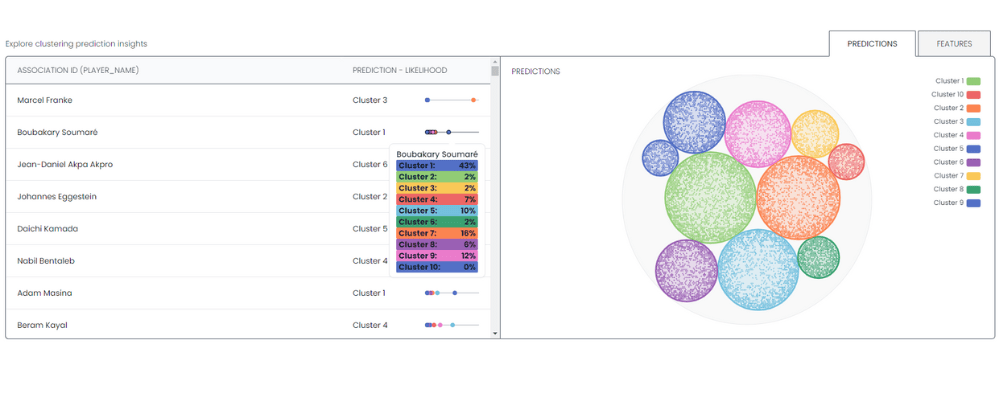
“They actually hadn’t run a single predictive model in a year and a half, and we ran 168 in under two weeks,” Schuster says, adding, “Our engineers are a force multiplier.”
Duncan French, the VP of Performance at the UFC Performance Institute, understands the issue acutely. Of the UFC’s 650 fighters, he says 87% work train with PI programming, and about 250 are in residence in Las Vegas at any given time. His team has distributed more than 500 Oura rings for sleep monitoring, accounting for more than 60,000 nights of data.
“Having aggregated a pretty significant amount of information and data, having built out a pretty decent data architecture to this point, the next iteration of that development was into our ability to harness the power of the data in a more automated fashion,” French says. “One of the things that we have is a capacity issue. We don’t have data scientists on our team, right? So it’s either our own staff, or it doesn’t get done.”
French was happy to be a testing partner for Gemini, in part because he says the UFC’s innovation mantra is “be first.” He also had gotten to know Schuster through his S&C travels over the past decade, with French crediting the GSA team for understanding the daily workflow and reality of applied sport science in the elite environment.
“We’re providing, hopefully, a pretty robust performance infrastructure, which can challenge and interrogate their software,” French says. “And hopefully in return, we’re going to get access to a system that will allow us to ask some high-level questions and harness the power of our data, perhaps more so than we have been doing.”
At all the most heavily resourced sports clubs, data science staffing lags behind what’s needed to make proper use of all the information collected. Whether it’s evaluating the soccer transfer market for a good tactical fit or building activity and recovery profiles based on the type of match play, GSA is seeking to empower everyone in the organization to utilize AI for insights.
“These non-technical stakeholders like assistant general managers, strength and conditioning coaches, high performance managers, they want to work with data, they’re the right generation to be working with data, but they’re not coders,” Schuster says. “They’re not going to write Python and R scripts. They need to have a tool to do data queries with, to ask questions of the data.”
Another differentiating factor for Gemini, Schuster says, is his academic background. While some AMS providers provide some concierge model building services, he says GSA puts the tool into the teams’ hands and, importantly, won’t produce an opaque solution without showing its work. Schuster and collaborators have prioritized publishing research papers explaining some of their models, such as two using NBA data, about effective use of force plate testing and on injury forecasting.
“We are never going to hide behind a black box,” Schuster says. “We’re going to put the tool in users’ hands, and the model should be open source because scouts and GM should understand why things are happening the way they are in their team.”
This article was brought to you by SBJ Tech, a Leaders Group company. As a Leaders Performance Institute member, you are able to enjoy exclusive access to SBJ Tech content in the field of athletic performance.
This recent Leaders Virtual Roundtable asked: what is working in terms of wellbeing support and where do the challenges and opportunities remain?
A Human Performance Article Brought to you by our Main Partners

Recommended reading:
How People Learn: Designing Education and Training that Works to Improve Performance
What Sports Can Learn from Approaches to Wellbeing in the Business World
Why Wellbeing and Performance Are Indivisible
Framing the topic:
Our first topic-led virtual roundtable for 2023 looked at how our members were balancing wellbeing and performance. We have seen a shift away from the ‘win at all cost’ mentality towards ‘winning well’ but understand elite sport is a results-driven industry, so we asked our members what they were doing to continue to push for high performance whilst also balancing wellbeing. What is working in terms of wellbeing support and where do the challenges and opportunities remain?
The discussion spanned many different areas, but we have picked out five key ways in which our members were able to balance wellbeing with performance:
1. The importance of language
2. A whole club approach
3. Recover. Support
4. Begin wellbeing work with younger athletes
5. Having a long-term vision
Here are some of the key takeaways from our members on the call:
Meghan Klingenberg of the USWNT and the Portland Thorns would no longer play without the device.
Meghan Klingenberg of the NWSL’s Portland Thorns FC cringes at the thought of it. She has been taught, as a defender, to circle under even the most towering kick and head it away from her goal, which is basically tantamount to getting kicked in the skull.
“Have you ever stuck your face in front of a ball that’s going 60 miles an hour?” Klingenberg asked Wednesday. “That’s what it is.”
“It’s spiraling down out of the top of the stadium, and you know it’s going to suck, but you have to [head] it. It feels scary. It feels like shit when it hits you, and it’s not something anybody wants to do. Like the worst thing ever. I get so mad at those goalkeepers.”
That, in a nutshell, explains why Klingenberg is practically on a crusade to promote the Q-Collar, an FDA-approved [US Food and Drug Administration] device worn around the neck that gently compresses the jugular vein to increase blood flow to the skull — theoretically limiting the brain from shifting around dangerously on contact.
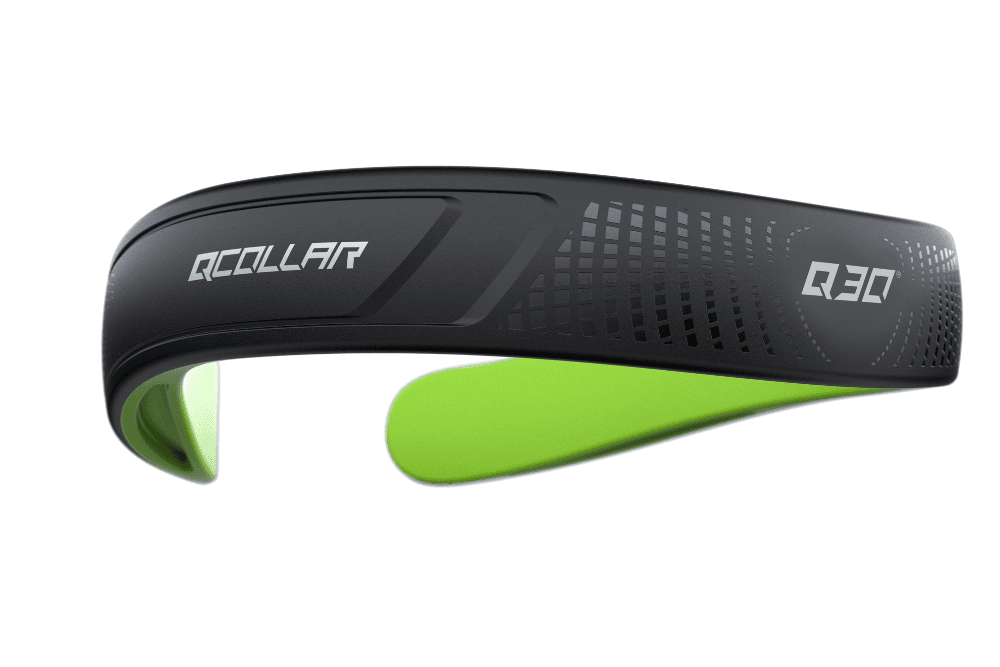
The Q-Collar, a neck-worn device that provides stability to protect the brain from head impact, has gained popularity among the Portland Thorns as Meghan Klingenberg along with teammates Emily Menges and Rocky Rodriguez.
During the NWSL championship game in late October — when Portland defeated the Kansas City Current, 2-0 — it’s no coincidence that Klingenberg’s teammates Emily Menges and Rocky Rodriguez also wore the Q-Collar. The technology, developed by Q30 Innovations and first available on the US Market in September of 2021, is being deployed in physically volatile sports such as football and lacrosse. Dallas’ running back Tony Pollard and tight end Dalton Schultz are among those wearing it this season in the NFL, and every player from the men’s Premier Lacrosse League has been equipped with the device, as well.
But Klingenberg, who organically heard about the Q-Collar while watching a biomimicry special on Hulu about five years ago, is taking it all a step further. She wears it proudly during games, dives on the field like a banshee and will advocate the device to anyone and everyone who asks.
“We block shots with our heads, we go up and take elbows to the face to try and get a header before another player — it’s a very physical sport,” she told SportTechie. “And so whenever I’m defending in the box, I might not head a ball, but I might be bumping attackers and making sure they can’t get to the ball. And you might fall over, you might run into the goalkeeper. It’s all of these things.”
“What I like most about the Q-Collar is I don’t have to worry about that ever. I just throw it on, and then I know that I’m protected, and then I can just go out and be me. And, honestly, that’s the most valuable thing it does is allowing me to be me. Because when I’m me, I kick ass. And when I kick ass, my team does well.”
SportTechie Daily: Subscribe to our morning newsletter for sports technology news and analysis.
Klingenberg’s quasi-campaign to inundate the sports world with Q-Collars is partly subtle, partly fear, partly — and this is her word — synchro-destiny. She is a vegan who drives a hybrid car or e-bikes, takes long walks through Portland’s Washington Park and has always been “environmentally conscious.” And when she saw on that 2017 biomimicry show that the Q-Collar was inspired by the odd behavior of woodpeckers knocking their heads against trees, she knew this was a science for her.
“I just don’t believe coincidences are coincidences,” she says. “I think they’re like little winks from the universe, and I try and like follow them whenever they happen. And this just seemed to be too great of a wink from the universe to pass up.”
Aware that she had been crashing on soccer fields since she was six and figuring she’d suffered a myriad of minor concussions throughout her journey from the U.S. National team to the pros, she “cold-called” Q30 Innovations for a demo of the device. Because it was still being researched in 2017, they told her: ‘sorry, another time’.
That time came approximately a year later when she wrapped it around her neck for the first time. She wasn’t sure if it would choke her, cut off her circulation or set her free. Turned out to be the latter.
“Well, anything around the neck feels weird,” she says. “We’re not used to that kind of pressure being around our necks. And I think for some people, at the beginning at least, can be a little triggering. Like, ‘Oh my god, I’ve got this pressure around my neck. I don’t like that.’ But… after wearing it for about a week, I barely noticed it.”
“I haven’t noticed any concussions or any dizziness since wearing this, and, honestly, I don’t even notice that I’m wearing it at all. I actually notice it more when I don’t wear it now. When we have a run-through practice where we’re not kicking any balls and we’re just literally stretching and things like that, it feels weird to be on a field without it on. That, to me, is the best part — that I get all that protection without thinking about it for one second.”
It’s never been her plan to shove the product down (or on) people’s throats. But ever since she began wearing it, she’s found that a popular Google search query has become: Meghan Klingenberg’s neck. As for her teammates, they don’t have to Google her; they just started asking about the technology straight to her face.
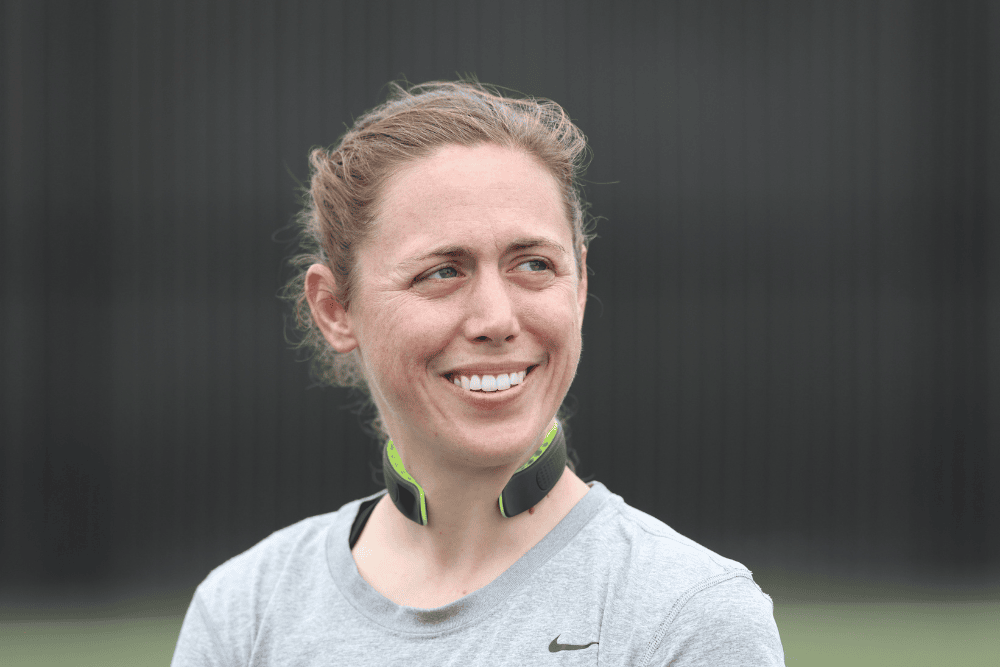
“My teammates are like, ‘What are you doing? What are you wearing? And they’re very skeptical at first because anything new in soccer is like, ‘Nah.’ But honestly, the best analogy I give them is: if you take a plastic water bottle and you fill it up halfway and you put a marble in there and you shake it around, it hits the walls of the bottle really hard. But if you fill it up all the way and put the marble in and you shake it around, it doesn’t hit the walls as hard. And that’s what I tell people the Q-Collar does for my brain.”
“And the light bulb goes on immediately. And they understand. They’re like, ‘Ohh, that makes so much sense.’ So I just really encourage my teammates to try it in the offseason and see if they like it. Honestly, I say, ‘Give it two weeks. If at the end of two weeks, you’re still noticing it, then it’s not for you. But if at the end of two weeks, you haven’t noticed it, then this is definitely for you.’”
Her two teammates — the defender Menges and the midfielder Rodriguez — each wore the Q-Collar this past year, and defender Becky Sauerbrunn has promised to try it this current off-season. And that’s not to mention the dozen NWSL opponents who have sauntered up to Klingenberg to ask about the device, as well.
“Oh yeah, they’ll ask me in the tunnels, after games, when they’re just chatting,” Klingenberg says. “They want to know. Some people are like, ‘What is this?’ They’re like, ‘Is this a way for your coach to communicate with you during [games].’ I’m like, ‘There’s no frigging chance I would ever wear something like that. There’s no way I want somebody chirping in my ear in the middle of a match. No chance.’ But then I give them the quick spiel about the water bottle and just chat about that, and they seem really interested. I would say probably like 30 to 40 percent of people want it.”
“I mean, I would advocate this for every kid in the entire world who’s playing a sport. Because, I mean, I wish that I had this since I was 6 years old. I’m serious. It really bothers me that I have 20 years of experience of heading a ball without the Q-collar on.”
This article was brought to you by SBJ Tech, a Leaders Group company. As a Leaders Performance Institute member, you are able to enjoy exclusive access to SBJ Tech content in the field of athletic performance.
Ty Sevin of Keiser says that coaches often overcomplicate performance.
A Human Performance Article Brought to you by our Main Partners
Ty Sevin, the President of Keiser Corporation, was speaking at a lunchtime masterclass at the 2022 Leaders Sport Performance Summit at London’s Twickenham Stadium.
The session, which was titled ‘Engineering Human Performance: utilising the principles of elite sport and bringing them to the boardroom’, placed Sevin onstage with Matchroom Boxing’s Head of Performance Dan Lawrence as they discussed their favoured high performance pillars, bridging performance gaps, and taking the standards of elite sports training into everyday life.
“[Performance Coach and Professor] Andy Galpin said ‘methods are many and concepts are few’,” Sevin continued, “and I feel like there’s a fundamental lack in the understanding of concept – basic fundamental principles that guide us in human performance – and more performance coaches [are becoming] dogmatic about their methods.”
Sevin, a former athlete and coach with three decades of experience at Olympic and collegiate level, was addressing the question of why coaches often overcomplicate performance. “The method is the means to the end but they don’t focus on being dogmatic about the concepts, they focus on the methods. So you have to understand what kind of engine you’re building and that totally depends on what the requirement of the sport is. And once you can simplify that, evaluate the athlete, evaluate what they have to perform on the field, it doesn’t matter what they do in the weight room if it doesn’t transfer on the field of play it’s a total waste of time.”
Physical-tactical-technical-mental
What sets apart podium-potential athletes from the rest? “There was not a physical gap between the people who won and who didn’t: it was the extreme ownership and it was the passion that they had – the soft skills,” said Sevin, perhaps reflecting on his time as the Director of the Track and Field Residency Program at the United States Olympic Committee’s Olympic Training Center in Chula Vista, California. “It’s the relentless pursuit in many cases of going where no one had gone before.”
He highlighted specific traits: belief, consistency, compliance, hard work and dedication. In underlining his point he referenced the reflections of British Olympian Dina Asher-Smith, who spoke onstage earlier that day. “You have to have a team built around you,” he added, suggesting that community may be the most important factor behind those traits.
They all provide the foundations for Sevin’s winning “triad” of an athlete’s physical capability, tactical and technical ability and mental competency. The coach’s role is essential at that intersection. “You’re trying to address each one of those things individually and then going back to your basic concepts of ‘what does this athlete need? What are their strengths?’ Doing a simple SWAT analysis on an athlete, which is something that came from the business world that I incorporated at a very young age. You’ve got to know the strength of an athlete and what their weaknesses are; and within those three pillars you can address almost anything that happens as long as the principles are being met on top of it.”
Better coaches are better guessers
Sevin was immersed in the traditional coaching ethos of being athlete-centred, coach-driven and science-based. However, he prefers to switch ‘science’ for ‘results’.
“Science seeks answers and training seeks results,” he said. “If you look to science, you have to have pragmatic experience. The reason that coaches I think do well over time is not that the coach is so much better than the coaches they’re competing against, it’s because they have the opportunity to work with athletes over a long duration of time where they learn knowledge and they see all these different holes that athletes can have. So if you’re a young coach and you’ve got no mentor or progress and you see a hole or a deficiency in an athlete, you’re practically guessing; and as you become more experienced as a coach you become a better guesser.
“Someone asks: ‘how do you get to that level?’ It wasn’t because I was a better coach, I got involved with really good coaches at a really young age and you learn from the athletes. There’s nothing you can learn in a university setting that will help you on the field; and that’s the art of coaching.”
Sevin, who also worked as a stockbroker upon leaving college, feels that the lessons he learned in that world were readily applicable to his future coaching. “I had that foundation of understanding of how to do strategic operations planning and I applied it to an athlete,” he said. “And when you identify every criterion that’s necessary for whatever they’re competing in and you have a pretty good idea of that athlete. [You have to] test, evaluate, prescribe.
“So I test. I’m matching that test up against what the demands are of that position, that body type, that skillset, that metabolic need; what are the limb speed requirements? What are the power output requirements? What do they have to do to become resilient? That all falls in that onion of the human capabilities. You test, you evaluate, and then based on your education, based on your pragmatic experience, you implement.”
Sevin explained that he sees himself more as an educator than a coach, that he focuses heavily on the ‘why’ with an athlete. “I like it because a lot of coaches don’t know the ‘why’. They really don’t know the why, they just do it because that’s the way they were trained or that’s how their mentor did it and that’s where the dogmatic approach comes from.”
Education and communication are the coach’s trump cards. “It’s an evolution of understanding the athlete, how is your relationship with them, how do you communicate with them, but if you can identify the problem, tell them why this is hurting their performance, and have a game plan, and be honest about it and say ‘this could work or it may not work’, with the honesty and the communication you fill the gaps in over time.”
A Human Performance article brought to you by our Main Partners
There is an appetite for self-reporting
When Tish Guerin served as the Carolina Panthers’ Director of Player Wellness between 2018 and 2020 she was one of the first in the NFL. Yet far from finding herself at a loose end, she was able to hit the ground running. “One of the things I found interesting was the immediate self-reporting,” she told an audience at the 2020 Leaders Sport Performance Summit in Charlotte. “That was how I really started to measure the psychological wellbeing of our players.” Guerin was also proactive in her approach. “I had to make sure I was at the forefront, that they knew they could come to me and get that confidential interaction with me.” It worked. “Players came to me pretty much within my first week and they weren’t necessarily talking about the weather or their favourite restaurants – they were talking about real life issues that they were dealing with and wanted to combat those.”
Work out their normal
Right from the moment then-Head Coach Ron Rivera invited Guerin to address his players in the locker room, Guerin was visible around the practice facility come hail, rain or shine and joined the players at mealtimes. They knew they could check in at any stage and it enabled her to establish “behavioural baselines”, as she puts it, for each player, which is no mean feat on a roster of 53 athletes. “I know what their normal is,” she said. “I know what it looks like when a player has a good mindset and is emotionally balanced because I know what their levels are and I see them every day. That’s the benefit of being able to interact with them day in and day out.
“It’s about being able to recognise if, during a play, they struggled and I know it’s not something they struggled with typically. That’s where I’m able to go in and say, ‘hey, I noticed you hesitated before you made that block and in this play that’s not normally something you would do. Why is that?’ That’s addressing that potential performance anxiety and working through it.”
They may best respond to someone else
“One of the things that’s been important for me is acknowledging that players may not respond to me,” she said. “That meant I couldn’t come in and have an ego about that. When Coach Rivera brought me in, he let me get up in front of the team and give my spiel and I let them know right off: ‘if you prefer a male, that’s perfectly fine. I’m happy to refer you to wherever you’ll get the best treatment from’. You have to be aware of who you are serving, who those athletes are, who they might best respond to.”
Life beyond sport
Guerin explained the importance of providing players with coping skills, which are, “just those things you do to help you keep calm; that give you balance. You want to encourage activities that give the person a sense of peace, balance and a way to relax.” She also delved into tackling the ever-present threat of performance anxiety. “You want to change the thought process so that instead of a player thinking ‘I’m not going to make this block because this guy has two inches on me and about 30lbs’ you think ‘I’m going to keep my feet planted on the ground, I’m going to dig in all the way through and I’m going to hold them off with everything I have in me.’”
“Changing how you look at things can be instrumental in helping to decrease performance anxiety,” she continued. “We encourage our athletes to look outside of their discipline to something else that gives them joy. I don’t care if it’s a cooking class; we’ve had a player who’s learning to be a pilot; one guy was interested in being a glass blower. ‘I don’t know why but, hey, do your thing.’
“It helps the creative process and it helps them to buy-in more to being on the football field because now they have some balance.”
The former US Open champion discusses Hawk-Eye’s use in tennis, using Whoop to further research on women’s health in sports, and how the WTA is supporting the mental health of its players.

You can’t have a discussion about sports technology today without including athletes in that conversation. Their partnerships, investments and endorsements help fuel the space – they have emerged as major stakeholders in the sports tech ecosystem. This series highlights the athletes leading the way and the projects and products they’re putting their influence behind.
A native of Fresno, California, Stephens also returned from a foot injury to win the WTA Comeback Player of the Year in 2017 and was a finalist at the 2018 French Open. In February, she beat Marie Bouzková at the Abierto Zapopan tournament in Mexico to capture her first WTA title since 2018.
Stephens, 29, has earned more than $17 million in career prize money and is currently the 37th-ranked singles player on the WTA Tour. Earlier this year, she partnered with Icy Hot, joining Shaquille O’Neal, NFL tight end Darren Waller and USWNT soccer star Rose Lavelle as ambassadors for the company. She recently promoted the new Icy Hot PRO cream and dry spray pain-relief products while attending a pickleball event in New York City alongside the National Athletic Trainers’ Association.
“If you’ve used Icy Hot, you know what it’s like, but this version is just little bit stronger, it works faster. It’s for that everyday person who’s training, getting massages with their trainer,” Stephens told SportTechie at the John McEnroe Tennis Academy.
Stephens is also a member of the Women’s Performance Collective, the research initiative from wearable fitness leader Whoop to study female athlete performance. She is also a proponent of tennis expanding its use of Hawk-Eye, the electronic line-calling system that replaced line judges at the 2020 US Open and 2021 Australian Open. Hawk-Eye’s camera system remains limited to video review challenges in most ATP and WTA Tour events, and it isn’t used at all at the French Open.
On supporting Hawk-Eye but being conscious of the jobs that could be lost . . .
I grew up with line judges, with referees. Just a few weeks ago in Guadalajara I had a terrible line call against me. We were using Hawk-Eye and the chair [umpire] made a mistake. That was a human error. Hawk-Eye didn’t make the mistake, but the linesperson made an error. We reviewed it on Hawk-Eye, it was a mistake. Then the umpire made another bad call, and I ended up losing the game. There’s a lot of human error element that we no longer need. We don’t want it either, but we don’t need it because there is automatic calling. We don’t need people to be on the court.
Mind you do that does take away jobs, it takes away livelihoods of a lot of people. But I feel like in sport, there’s too much money on the line, ranking points on the line, contracts on the line, for people to be making human errors in the sport where we’ve advanced so much that we can see line calls live as they happen. We shouldn’t have any errors in our sport, especially when you’re playing for hundreds of thousands of dollars, sometimes millions of dollars. That little bit can change the course of a match. And that makes all the difference in the world.
From a chair umpires’ perspective, you have to be ranked super high to be a gold badge level umpire, which people work their whole careers for. And now we’re being like, ‘Okay, we don’t need you anymore, because we have automatic calling.’ So it’s kind of a double-edged sword. You lose jobs, but you gain a lot of clarity in the sport, which I think is important. But obviously, tennis is a very traditional sport, any change is always very hard to make. It’s always something that has to be thought of for like 10 years before we actually do anything. So we’re in that phase now.
On her partnership with Whoop …
It’s great because it’s for sleep, recovery, it’s to track all of those things. There’s been fitness trackers before and all those things before but this one is a little bit more advanced, tracking your menstrual cycle, your HRV [heart rate variability]. In sport, every little bit matters, especially when you’re at the top of your sport, the top of your game. So being able to monitor your sleep and your routines, like if you didn’t get enough deep sleep, or your sleep [score] decreased because you slept more. All those things matter when you’re performing at a high level, especially day in and day out whether you’re training or you’re competing in tournaments. So being able to partner with Whoop is amazing, because it helps not only me, but all of the players — men and women on the tour, it helps everyone.
On data ownership and using Whoop to further women’s health research …
We don’t have a union. We have our Tour, which owns the data because the partnership is with the Tour. But we own I believe all of our own personal data. They can use it and have access to it and can do research on it. But we own all of our own data. We’re all technically independent contractors. So we own all of our stuff.
But obviously, we use it to help other athletes. We use it to help monitor menstrual cycles of top performing athletes and then help people who are just weekend warriors or people training for tennis. And women just don’t have enough data and enough science behind all of these things. There’s not enough research. So being able to contribute to that has been super helpful. Just helping the next generation of athletes because we are collecting data for women in sport, we’re trying to make it more advanced and we’re trying to move the needle a bit. All of these things and all these things that we’re monitoring help a lot
On strides the WTA has made to support mental health….
There’s always work to be done everywhere, but I think the WTA does a great job. We have people on the road, therapists on the road that we can talk to in person and make appointments with. There’s a lot of support on the road just because we are all isolated and by ourselves most of the time. A lot of us do need that little extra support, we travel 40 weeks out of the year away from family, friends, husbands, wives, whatever it is, and it is difficult. The WTA has done a good job to support us to make sure that we do have those people on staff and on hand week in and week out.
And I think that’s been super beneficial, especially because COVID through us all for a loop so we are kind of getting back to normal but in a way that we feel more supported and have more access to things that we didn’t before like Modern Health and the Calm app. All of these things are just extra little things that we can use to help self-soothe ourselves and whatever it may be whatever we need in that moment. So the WTA has done a good job at trying to make that happen for us.
On how she uses Hyperice’s massage and recovery products …
I am an investor in Hyperice. I use NormaTec, all of the Hyperice gadgets — the Hyperice Go, the Hypervolt, which has been super helpful. It’s something you could travel with, be on the road with. I use [Hyperice products] for warmup and then I just use it when I’m sitting in my bed, laying around. It’s good post-match, too, but post-match, I’m getting more manual massage with my trainer, my physio so that’s a little bit different. But you can kind of use it wherever, I just did it on an airplane.
This article was brought to you by SportTechie, a Leaders Group company. As a Leaders Performance Institute member, you are able to enjoy exclusive access to SportTechie content in the field of athletic performance.